Questions · Page 1 of 2

[3 Mark Question Answer]

🎯

Test yourself on this topic

50 questions · timed · auto-graded

Question 13 Marks
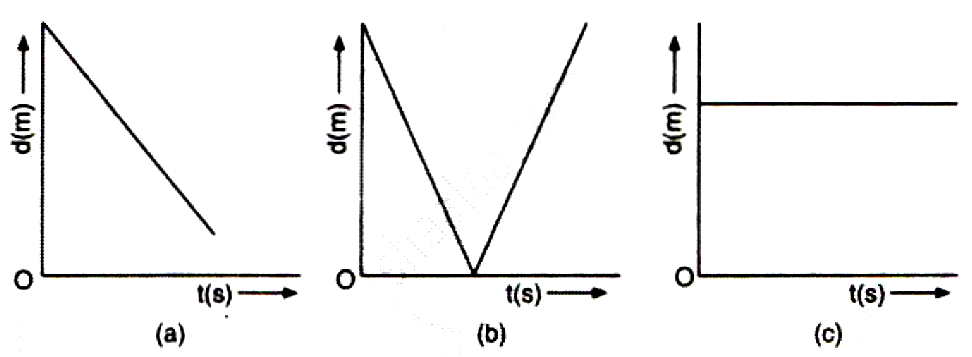
Write down the type of motion of a body in each of the following distance time-graph.
Answer
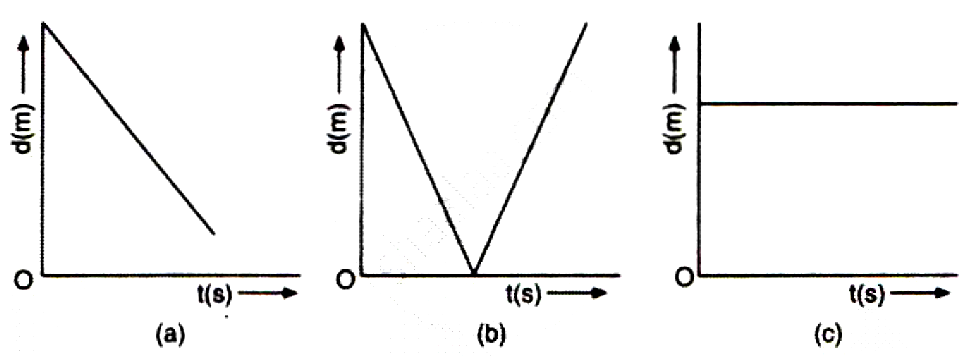
(i) The body is showing decreasing velocity that is retardation.
(ii) Initially, the body is showing retarded motion and then an accelerating one.
(iii) The body is in the state of rest.
View full question & answer
Question 23 Marks
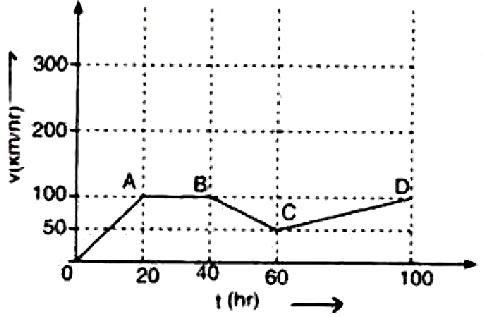
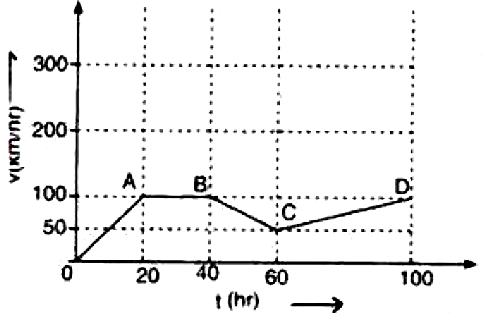
The figure represents graphically the velocity of a car moving along a straight road over a period of $100$ hours.

Calculate the distance travelled in the last $40$ h.
Answer

Distance travelled in last 40 hour would be equal to area under graph during that time $=50 \times(100-$
$60)+\frac{1}{2} \times(100-60) \times(100-50) $
$S=2000+1000=3000 km$
View full question & answer
Question 33 Marks
Figure represents graphically the velocity of a car moving along a straight road over a period of 100 hours.

Calculate the acceleration along AB and the retardation along BC.
Answer

Acceleration along $AB= (100 - 100)/(40 -20) = 0 ms^{-2}$​​​​​​​
Retardation along $CD= (100 - 50)/ (100 - 60) = 50/40 = 1.25 ms^{-2}​​​​​​​$​​​​​​​
View full question & answer
Question 43 Marks
Figure represents graphically the velocity of a car moving along a straight road over a period of 100 hours.

How long is the body travelling with a uniform velocity?
Answer

Body is travelling with uniform velocity from point A to B i.e for (40 - 20) = 20 hr.
View full question & answer
Question 53 Marks
A train is moving at a speed of $90 km/h$. On applying brakes, a retardation of $2.5 ms^{-2}$​​​​​​​ is created. At what distance before, should the driver apply the brakes to stop the train at the station?
Answer
Initial speed of train $= 90 km/hr$
Speed of train imn m/s $= ( 90 \times 1000 )/3600 = 25 m/s.$
Retardation of the train $= 2.5 ms^{-2}.$
Final speed of train at platform = 0 m/s.
We know that $v2 - u2 = 2as.$
$0 - 25 \times 25 = 2 \times (-2.5) \times s$
$S = 625/5 = 125 m.$
So driver should apply the brakes $125 m$ before the platform.
View full question & answer
Question 63 Marks
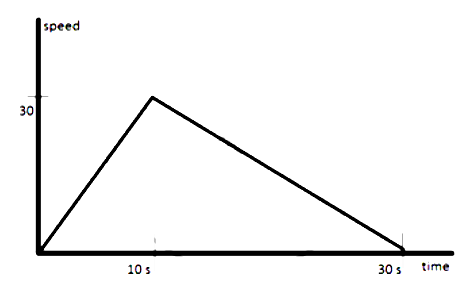
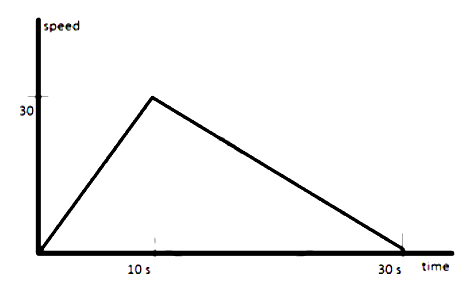
A car accelerates to a velocity of 30 m/s in 10 s and then decelerates for 20 s so that it stops. Draw a velocity-time graph to represent the motion and find:
Distance travelled
Answer

Distance travelled= area under speed time graph = $\frac{1}{2}$x30x30 =450 m.
View full question & answer
Question 73 Marks
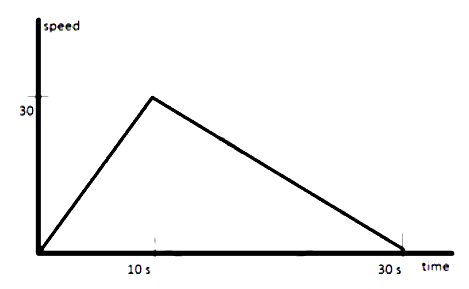
A car accelerates to a velocity of 30 m/s in $10 \ s$ and then decelerates for 20 s so that it stops. Draw a velocity-time graph to represent the motion and find:
The Deceleration.
Answer

Deceleration $a = ( v - u )/t = ( o - 30 )/ 20 = -1.5 ms^{-2}$
View full question & answer
Question 83 Marks
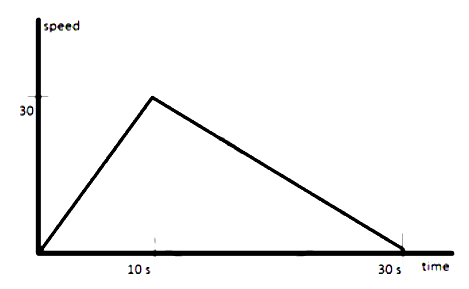
A car accelerates to a velocity of 30 m/s in $10 \ s$ and then decelerates for $20 \ s$ so that it stops. Draw a velocity-time graph to represent the motion and find:
The acceleration.
Answer

Acceleration $a= (v - u)/t= (30 - 0)/ 10 = 3 ms^{-2}$
View full question & answer
Question 93 Marks
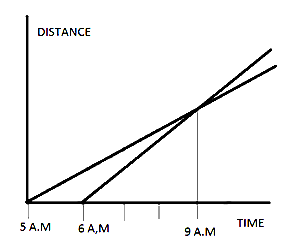
Two friends leave Delhi for Chandigarh in their cars. A starts at $ 5 am$ and moves with a constant speed of $30$ km/h, whereas B starts at $6$ am and moves with a constant speed of $40 kmh^{-1}$. Plot the distance-time graph for their motion and find at what time the two friends will meet and at what distance from Delhi.
Answer

So we can see that the two friends wiil meet at $9$ a.m ant till then they cover a distance of $u \times t = u' xt' = 30 \times 4 = 40 \times 3 =120 km$ So they are $120 \ km$ away from Delhi when they meet at $9 a.m.$
View full question & answer
Question 103 Marks
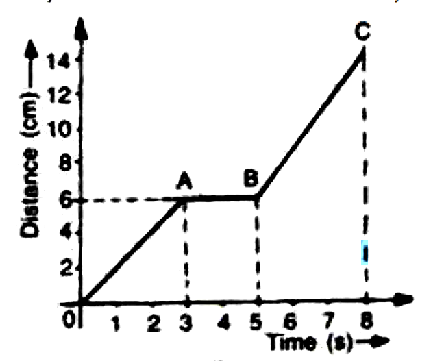
In figure the position of a body times is shown . Calculate the speed of the body as it moves from 0 to A, A to B, B to C and i ts average speed .
Answer

{a) Speed as it moves from o to a = {6 - O)/ {3 - 0 = 2 ms-1.
(b) Speed as it moves from A to B = {6 - 6)/ (5 - 3) = o ms-1.
(c) Speed as it moves from B to c = {14 - 6)/ {8 -5) = 8/ 3 = 2.66 ms-1
View full question & answer
Question 113 Marks
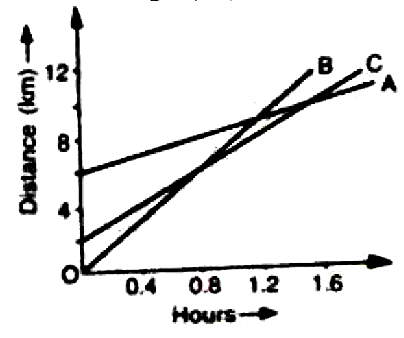
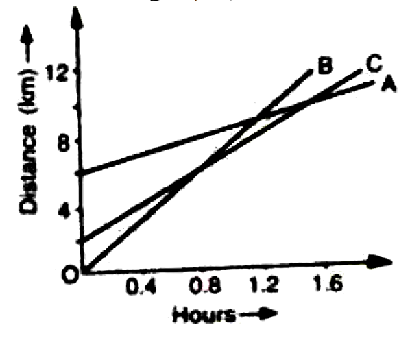
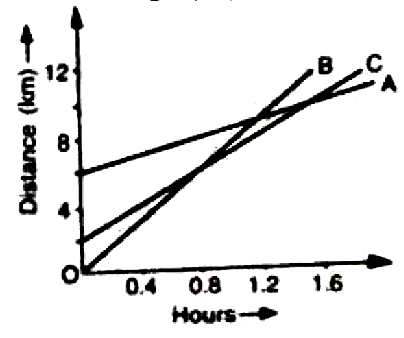
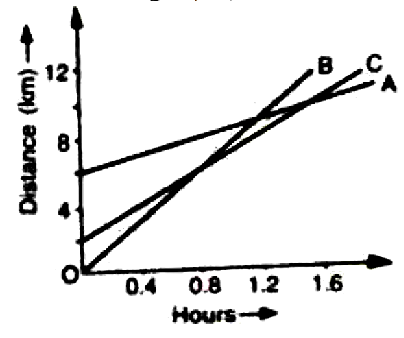
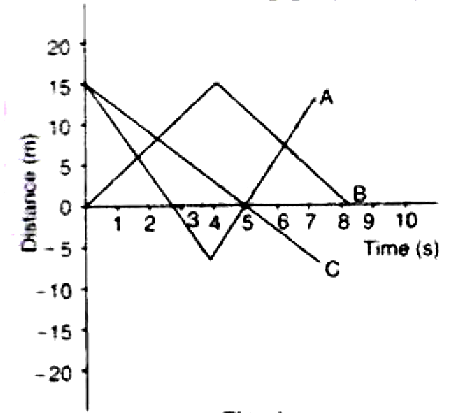
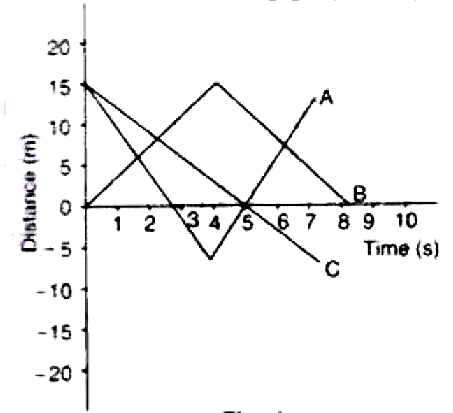
Figure shows the distance-time graph of three students A, B and C. On the basis of the graph, answer the following :

How far did B travel between the time he passed C and A?
Answer

8 travel 4 km between the time he passed C and A.
View full question & answer
Question 123 Marks
Figure shows the distance-time graph of three students A, B and C. On the basis of the graph, answer the following :

When B meets A, where is C?
Answer

C is at 8 km when B meets A.
View full question & answer
Question 133 Marks
Figure shows the distance-time graph of three students A, B and C. On the basis of the graph, answer the following :

Will the three ever meet at any point on the road?
Answer

All of them never come at the same point at the same time.
View full question & answer
Question 143 Marks
Figure shows the distance-time graph of three students A, B and C. On the basis of the graph, answer the following :

Which of the three is traveling the fastest?
Answer

8 is travelling fastest among all the 3 students
View full question & answer
Question 153 Marks
A car travels 30 km at a uniform speed of 60 km/h and the next 30 km at a uniform speed of 20 km/h. What is its average speed?
Answer
Car travls 30 km distance with speed 60 km/hr
Time taken by car to travel this distance = 30/60 = 0.5 hr.
Car travels another distance of 30 km with speed of 20 km/hr.
Time taken by car to travel this distance = 30/20 = 1.5 hr.
Total time taken = 1.5 + 0.5 = 2 hr.
Total distance = 30+ 30 = 60 km.
Average speed of car = 60/2 = 30 km/hr.
View full question & answer
Question 163 Marks
A body covers half the distance with the speed A and the other half with speed B. What will be the average speed for the whole journey?
Answer
Let total distance be S .
Boy covers distance $S / 2$ with speed $A$ then time taken by him to cover this distance would be $T_1=S / 2 A$.
Again boy covers rest of the distance $S / 2$ with speed $B$ then time taken by him to cover this distance would be $T_2$ $= S / 2 B$.
So total time taken by boy to cover the distance $S$ is $T=T_1+T_2$.
Total time $T=S / 2(1 / A+1 / B)=s(A+B) / 2 A B$.
And average speed $=S / T=2 A B /(A+B)$.
View full question & answer
Question 173 Marks
Draw the distance-time graphs of the bodies P and Q starting from rest, moving with uniform speeds with P moving faster than Q.
View full question & answer
Question 183 Marks
For a body moving along a circular path, show that:
Linear speed = Angular velocity X radius of the circle
Answer
Angular displacement θ = length of arc/ radius of circle
θ= I / r
I= θxr
divide above equation with t
l/t = θxr/ t
now l/t = v {linear speed)
θ/ r= w
So v = ωr.
View full question & answer
Question 193 Marks
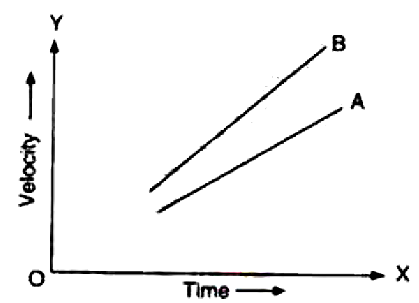
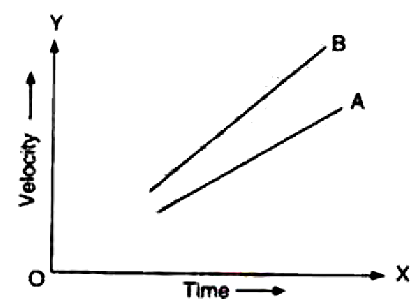
Figure shows the velocity-time graphs for two objects A and B moving in same direction . Which object has the greater a cceleration?
Answer

As acceleration is the slope of line in velocity time graph and as B has greater slope than line A.
So B has greater acceleration than A.
View full question & answer
Question 203 Marks
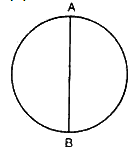
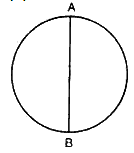
A circular cycle track has a circumstance of 314 m with AB as one of its diameter. A cyclist travels from A to B along the circular path with a velocity of constant magnitude 15. 7 m/ s. Find :
(a) The distance moved by the cyclist.
(b) The displacement of the cyclist if AB represents north-south direction .
(c) The average velocity of the cyclist.
Answer

Circumference of track = 314 m.
We know that circumference = 2nr
So 2nr = 314
R = 314/ 2n = 50 m
Diameter of track would be = 2 x 50 = 100 m.
Length of path AB= 100 m.
(a) Distance moved by cyclist= half the circumference of track i.e 314/ 2 = 157 m.
(b) The displacement of cyclist is equal to the diameter of circle i.e AB= 100 m.
(c) Average velocity would be equal to = 15.7 ms-1.
View full question & answer
Question 213 Marks
An artificial satellite is moving in a circular orbit of radius nearly 42,250 km. Calculate its linear velocity, if it takes 24 hours to revolve round the earth
Answer
Radius of orbit is 42250 km.
Distance covered by satellite to complete 1 revolution is 2 πr.
So distance is = 2 X 3.14 X42250 =265330 km.
time taken by satellite to complete one revolution is 24 hr = 24X60X60=86400 sec.
so linear velocity is= distance /time= 265330/86400 ms-1 = 3.07 km s-1.
View full question & answer
Question 223 Marks
A girl had designed a clap switch for a science exhibition that enabled her to switch on or off an alarm just with clapping of hands. While testing her device in a hall, she noticed that once the alarm has sounded it followed with another one due to echo of the clap, that is, the sound reflected by the walls. She recorded the two soundings of alarm with her tape recorder and found out that time difference in between them is $0.1 \ s$. If the distance of the walls be $15 \ m$, calculate the speed of sound.
Answer
Time difference of $0.1 \ s$ denotes the time taken by sound to go from device to wall and back to wall. As the distance between wall and device is 15 m so total distance covered by sound is $2 \times 15 m =30 m.$
So speed of sound is = total distance covered/time taken $= 30/0.1 =300 ms^{-1}.$
So speed of sound is $300 ms^{-1}.$
View full question & answer
Question 233 Marks
The average time taken by a normal person to react to an emergency is one fifteenth of a second and is called the 'reaction time'. If a bus is moving with a velocity of $60 km / h$ and its driver sees a child running across the road, how much distance would the bus had moved before he could press the brakes? The reaction time of the people increases when they are intoxicated. How much distance had the bus moved if the reaction time of the driver were $1 / 2 s$ under the influence of alcohol?
Answer
Bus is moving with initial velocity of $u=60 km / hr$.
$60 km / hr=(60 \times 1000) / 3600=u=16.66 ms^{-1}$
Reaction time $= t =1 / 15 sec$.
Distance would the bus had moved before pressing the bus would be $= uXt$.
$S=16.66 \times 1 / 15=1.1 m$
Now if the driver is intoxiacated then reaction time would be $t=1 / 2$ seconds.
$\text { So } S \text { becomes } S=uXt=16.66 \times 1 / 2=8.33 m$
View full question & answer
Question 243 Marks
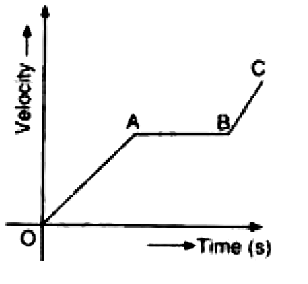
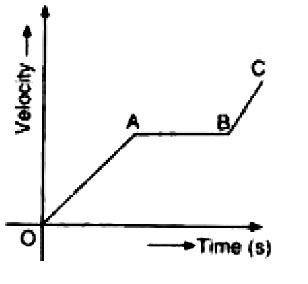
Interpret the following graph:
Answer

ln this graph portion O to A represents motion with acceleration, A to E represents motion with uniform velocity, 8 to C represents motion with acceleration.
View full question & answer
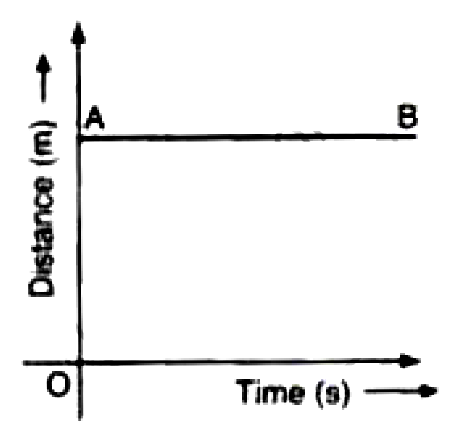
Question 253 Marks
Interpret the following graph:
Answer

In distance time graph a straight line parallel to time axis represents state of motion.
View full question & answer
Question 263 Marks
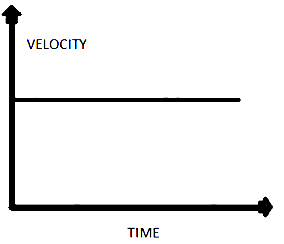
Draw velocity-time graph to show:
Zero acceleration
Write a sentence to explain the shape of graph.
Answer

As slope of velocity time graph gives acceleration. So motion with zero acceleration is represented by line having zero zero slope with time axis or a line parallel to the time axis.
View full question & answer
Question 273 Marks
Draw velocity-time graph to show:
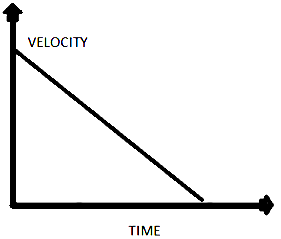
Deceleration
Write a sentence to explain the shape of graph.
Answer

Deceleration is represented by a straight line having a negative slope with time axis.
View full question & answer
Question 283 Marks
Draw velocity-time graph to show:
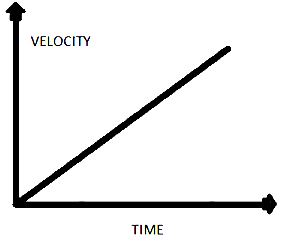
Acceleration
Write a sentence to explain the shape of graph.
Answer

Acceleration is represented by a line on a velocity time graph with a positive slope with time axis.
View full question & answer
Question 293 Marks
Draw distance-time graph to show:
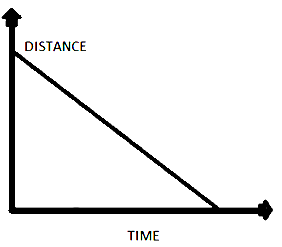
Decreasing velocity
Answer

As slope of this line is negative so this represent decreasing velocity.
View full question & answer
Question 303 Marks
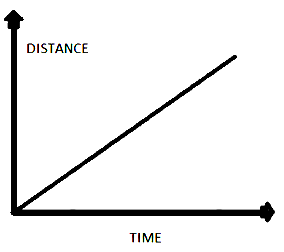
Draw distance-time graph to show:
Uniform velocity
Answer

As uniform velocity means slope of line should be constant throughout the motion so this graph also represents uniform velocity
View full question & answer
Question 313 Marks
Draw distance-time graph to show:
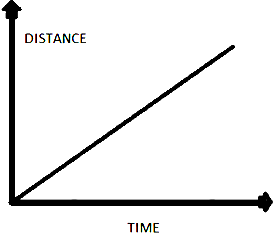
Increasing velocity
Answer

As slope of a distance time graph indicates velocity so a increasing velocity means a straight line having a positive slope with time axis.
View full question & answer
Question 323 Marks
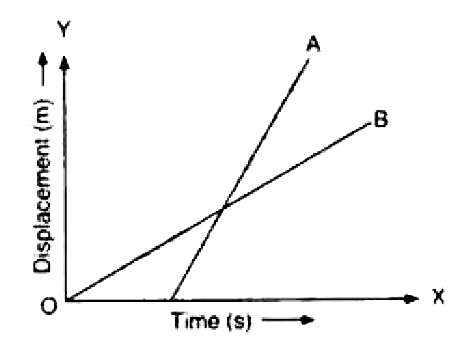
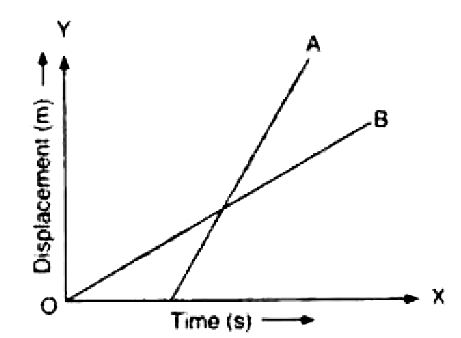
Figure shows displacement- time graph of two objects A and B moving in a stra ight line. Which object is moving fa ster?
Answer

As slope of line A is greater than line 8 that means velocity of body A is greater than body 8 or in other words body A is moving faster
View full question & answer
Question 333 Marks
Which of the following graphs represents a motion with negative acceleration?
Answer

Graph (c) represents a motion with negative acceleration.
View full question & answer
Question 343 Marks
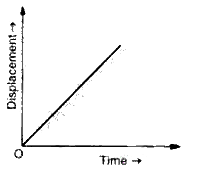
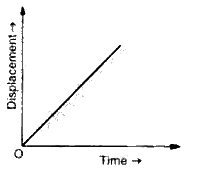
Interpret the following graph:
Answer

If displacement time graph of a body is straight line moving upwards and starting from origin then it means body has started from and moving with a uniform velocity,
View full question & answer
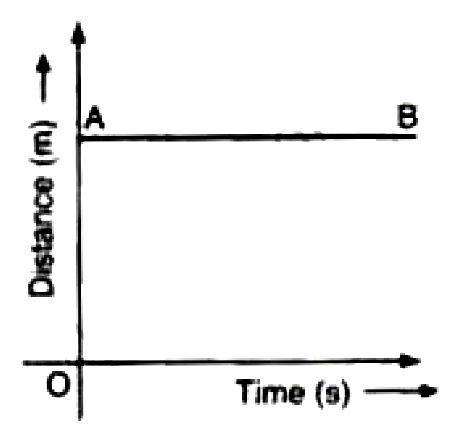
Question 353 Marks
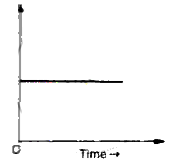
Interpret the following graph:
Answer

If distance time graph of a body is straight line parallel to x axis then the body is said to be at rest .
View full question & answer
Question 363 Marks
Draw the following graph:
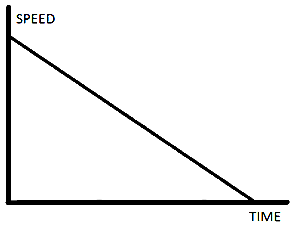
Speed versus time for a uniformly retarded motion.
Answer

Spped time graph for a uniformity retarded motion
View full question & answer
Question 373 Marks
Draw the following graph:
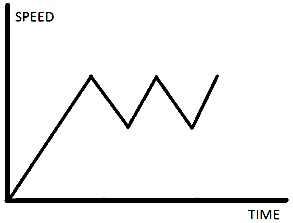
Speed versus time for a fluctuating speed.
Answer

Speed time graph for a body showing fluctuating speed.
View full question & answer
Question 383 Marks
Draw the following graph:
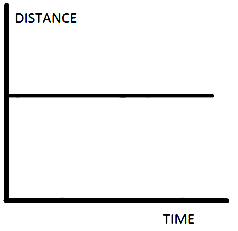
Distance versus time for a body at rest.
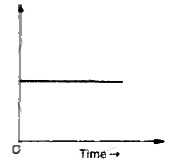
Answer

Distance time graph for a body at rest.
View full question & answer
Question 393 Marks
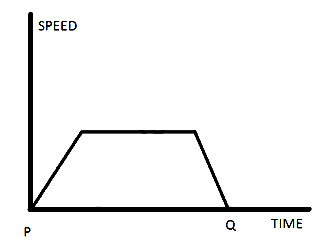
Draw the speed-time graph of a body starting from some point P, gradually picking up speed, then running at a uniform speed and finally slowing down to stop at some point Q.
Answer

Speed time graph of a body starting from point P gradually picking up speed, then running at a uniform speed and finally slowing down to stop at some point Q
View full question & answer
Question 403 Marks
Draw the speed-time graph of a body when its initial speed is not zero and the speed increases uniformly with time.
Answer

Speed time graph of a body when itS Initial speed is not ze ro and and speed increase uniformly with time.
View full question & answer
Question 413 Marks
The speed of a car increases from 1$0 \ km/h$ to $64$ km/h in $10$ seconds. What will be its acceleration?
Answer
Initial velocity $u =10 km / hr .=(10 \times 1000) / 3600=8.33 ms^{-1}$.
Final velocity $=64 km / hr =(64 \times 1000) / 3600=17.77 ms^{-1}$.
Time $=10 s$.
Acceleration $=( v - u ) / t =(17.77-8.33) / 10=9.44 / 10=0.94 ms^{-2}$.
View full question & answer
Question 423 Marks
The initial velocity of a car is $10 ms^{-1}$. It moves with an acceleration of $2 ms^{-2}.$ What will be its speed after $10$ seconds?
Answer
Initial velocity $u =10 ms^{-1}.$
Acceleration $a = 2 ms^{-2}.$
Time $t = 10 s.$
By using first equation of motion
V = u + at.
$V = 10 + 2 \times 10.$
V (final velocity) $= 30 ms^{-1}.$
View full question & answer
Question 433 Marks
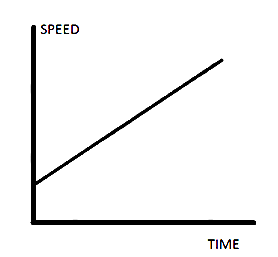
How does the slope of a speed-time graph give the acceleration of a body moving along a straight line?
Answer
Slope of a graph is given as rate of change of y coordinates to the x coordinate. In speed time graph speed is on the y axis and time is on the x axis. And we define acceleration as rate of change of speed with respect to time. So slope of a speed time graph gives acceleration.
View full question & answer
Question 443 Marks
Find the initial velocity of a car which is stopped in 10 seconds by applying brakes. Retardation due to brakes is$ 2.5 ms^{-2}.$
Answer
Let initial velocity be $u$.
Final velocity is $v =0 m / s$.
Time taken by body to come to rest $=10 sec$.
Retardation $=2.5 ms^{-2}$.
We know $v = u + at$.
Then $u = v$ - at.
$u=0-(-2.5 \times 10)=25 m / s$
So initial velocity of the body is $25 m / s$.
View full question & answer
Question 453 Marks
A car traveling at $60 \ km/h$, stops on applying brakes in $10$ seconds. What is its acceleration?
Answer
First convert $60 km / h$ in $m / s$.
$60 km / hr=(60 \times 1000) / 3600=16.7 m / s .$
This is initial velocity of car i.e $u=16.7 m / s$.
As car stops in 10 seconds so final velocity is $=0 m / s$.
So acceleration $=( v - u ) / t =(0-16.7) / 10=-1.67 ms^{-2}$.
Acceleration of car is $=-1.67 ms^{-2}$.
View full question & answer
Question 463 Marks
The area of the right triangle under a speed-time graph is 500 m, in a time interval of 20 s. What is the speed of the body? Is the motion uniform or non-uniform?
Answer
Yes the motion is uniform and the uniform speed is given by area under speed time graph divided by time interval.
So speed = 500/20 =25 m/s.
View full question & answer
Question 473 Marks
The acceleration of a moving body is constant in magnitude and direction. Must the path of the body be a straight line?
If not, given an example.
Answer
If the acceleration of a moving body is constant in magnitude and direction then the path of the body must not be a straight line because in circular motion also acceleration of a body is constant in magnitude and always directed towards the centre.
So the path of the body may be a straight line and may be a circular one.
View full question & answer
Question 483 Marks
A car travels from $P$ to $Q$ at a uniform speed of $20 ms^{-1}$ and immediately turns back and travels towards $Q$ with a uniform speed of $30 ms^{-1}$. What is the average speed for the whole journey?
Answer
let distance between P and Q is S .
Speed of car while travelling from $P$ to $Q$ is $20 m / s$.
Let car take time $T_1$ to travel from $P$ to $Q$ then $T_1=S / 20$.
Speed of car while travelling from $Q$ to $P$ is $30 m / s$.
Let car take time $T_2$ to travel from Q to P then $T _2= S / 30$.
Total time $= T _1+ T _2= S / 20+ S / 30= S / 12$.
So average speed of journey $=$ total distance $/$ total time $=2 S /( S / 12)=24 m / s$.
Average speed of journey is $24 m / s$.
View full question & answer
Question 493 Marks
A body goes from $P$ to $Q$ with a uniform speed of u and immediately returns back to $P$ at a uniform speed of v. What is the average speed for the whole journey?
Answer
Let S be the distance between $P$ and $Q.$
Body covers forward journey distance S ($P$ to $Q$) with speed u then time taken by him to cover this distance would be $T_1 =S/u.$
Again body covers backward journey distance S ($Q$ to $P$) with speed v then time taken by him to cover this distance would be $T_2 =S/v.$
So total time taken by body to cover the distance S is $T = T_1 + T_2.$
Total time $T= S (1/u +1/v) = s(u+v)/uv.$
And average speed =$ 2S/T = 2uv/(u+v).$
View full question & answer
Question 503 Marks
Arrange the following speeds in the increasing order:
(i) A bicycle moving with a speed of 36 km/h.
(ii) A car moving with a speed of 2 km/min.
(iii) An athlete running with a speed of 7 m/s.
Answer
We convert all the speeds in m/s to compare them.
36 km/hr = (36 X 1000)/3600 = 10m/s.
2 km/min = (2 X 1000)/60 = 33.3 m/s.
7 m/s = 7 m/s.
So increasing order of speed is 7m/s < 10m/s <33m/s.
View full question & answer
[3 Mark Question Answer] - PHYSICS STD 9 Questions - Vidyadip