Questions

[2 Mark Question Answer]

🎯

Test yourself on this topic

24 questions · timed · auto-graded

Question 12 Marks
Define the terms pole, principal axis and centre of curvature with reference to a spherical mirror.
Answer
Pole: The geometric centre of the spherical surface of mirror is called the pole of mirror.
Principal axis: It is the straight line joining the pole of the mirror to its centre of curvature.
Centre of curvature: The centre of curvature of a mirror is the centre of the sphere of which the mirror is a part. 
View full question & answer
Question 22 Marks
Which mirror will you prefer to use as a rear view mirror in a car : plane mirror or convex mirror? Give one reason.
Answer
A convex mirror is preferred as a rear view mirror because it has a wider field of view as compared to a plane mirror of same size.
View full question & answer
Question 32 Marks
(a) When a concave mirror is used as a shaving mirror, where is the person's face in relation to the focus of mirror?
(b) State three characteristics of the image seen in part (a).
Answer
(a) The person's face is between the pole and focus of the mirror.
(b) The image formed is erect, virtual and magnified.
View full question & answer
Question 42 Marks
State two uses of a concave mirror.
Answer
Two uses of concave mirror:
(i) It is used as a shaving mirror.
(ii) It is used as reflector in torch, head light of automobiles etc.
View full question & answer
Question 52 Marks
Upto what maximum distance from a concave mirror, the image can be obtained? What will be the location of object for it?
Answer
The maximum distance that can be obtained in concave mirror is infinity. For this case the object has to be at focus.
View full question & answer
Question 62 Marks
Name the two kinds of spherical mirrors and distinguish between them.
Answer
Two kinds of spherical mirrors are concave and convex.
Distinction between concave and convex mirror: A concave mirror's bulging surface is silvered and reflection takes place from the hollow surface but a convex mirror's inner surface is silvered and reflection takes place from the bulging surface.
View full question & answer
Question 72 Marks
Upto what maximum distance from the pole the image in a convex mirror can be obtained? what will be the location of object then ?
Answer
The image formed by a convex mirror is always between pole and focus. Hence, the maximum distance that can be obtained in convex mirror is the focal length. For this case the object has to be at infinity.
View full question & answer
Question 82 Marks
Write the spherical mirror's formula and explain the meaning of each symbol used in it.
Answer
The spherical mirror's formula is $\frac{1}{u}+\frac{1}{v}=\frac{1}{f}$
Here, u is the object distance, v is the image distance and f is the focal length of the mirror.
View full question & answer
Question 92 Marks
Discuss the position and nature of image formed by a convex mirror when an object is moved from infinity towards the pole of mirror.
Answer
In a convex mirror, the image formed is always virtual, upright and diminished. It is always situated between its pole and focus, irrespective of the distance of object in front of the mirror.
View full question & answer
Question 102 Marks
Discuss the position and nature of image formed by a concave mirror when an object is moved from infinity towards the pole of mirror.
Answer
When an object is moved from infinity towards the pole of mirror, the image formed moves away from the mirror. The image formed is real and inverted.
View full question & answer
Question 112 Marks
The magnification for a mirror is $-3.$ How are $u$ and $v$ related?
Answer
Magnification of a mirror is
$ m=-\frac{v}{u}$
$\because m=-3$
$\therefore-3=-\frac{v}{u}$
$\therefore v=3 u $
But, u will always be negative
$\therefore v =-3 u$
View full question & answer
Question 122 Marks
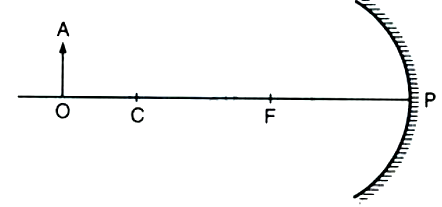
Figure shows a concave mirror with its pole at P, focus F and centre of curvature C. Draw ray diagram to show the formation of image of an object OA.
View full question & answer
Question 132 Marks
The erect image formed by a concave mirror is of size double the size of object. How are u and v related?
Answer
Magnification is
$ m =\frac{ I }{ O }=\frac{20}{ O }=2$
$\because m =-\frac{ v }{ u }$
$\therefore-\frac{ v }{ u }=2$
$\therefore v =-2 u $
But, $u$ is always negative
$\therefore v =2\ u$
View full question & answer
Question 142 Marks
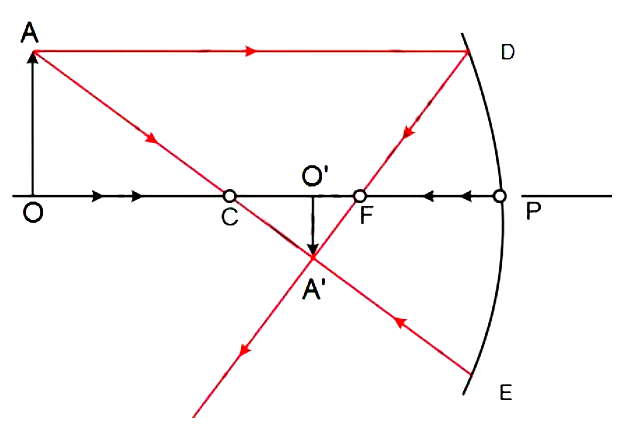
Figure shows a concave mirror with its pole at P, focus F and centre of curvature C. Draw ray diagram to show the formation of image of an object OA.
Answer
Solution is as follows.
View full question & answer
Question 152 Marks
State two uses of a plane mirror.
Answer
Two uses of plane mirror:
  1. In barber's shop for seeing the hairs at the back of head, two mirrors facing each other are fixed on opposite walls at the front and back of the viewer.
  2. In solar heating devices such as a solar cooker, solar water heater, etc., a plane mirror is used to reflect the incident light rays from sun on the substance to be heated.
View full question & answer
Question 162 Marks
An object is placed (i) asymmetrically (ii) symmetrically, between two plane mirrors inclined at an angle of $50^\circ $. Find the number of images formed.
Answer
Angle between the mirrors, $\theta=50^{\circ}$
Now, $n =360^{\circ} / \theta^{\circ}=360^{\circ} / 50^{\circ}=7.27$, which is odd.
(i) When placed asymmetrically, number of images formed will be $n$, i.e.$ 7 .$
(ii) When placed symmetrically, number of images formed will be $(n-1)$; i.e. $7-1=6$ images
View full question & answer
Question 172 Marks
State the number of images of an object placed between two mirrors, formed in each case when mirrors are inclined to each other at $(a) 90^\circ $, and $(b) 60^\circ .$
Answer
(a) Angle between the mirrors, $\theta=90^{\circ}$
Now, $n=360^{\circ} / \theta^{\circ}=360^{\circ} / 90^{\circ}=4$, which is even.
Hence number of images formed will be ( $n -1$ ); i.e., 4 - $1=3$ images
(b) Angle between the mirrors, $\theta=60^{\circ}$
Now, $n=360^{\circ} / \theta^{\circ}=360^{\circ} / 60^{\circ}=6$, which is even.
Hence number of images formed will be ( $n-1$ ); i.e., $6-1=5$ images
View full question & answer
Question 182 Marks
Draw a diagram to show the reflection of a ray of light using a plane mirror. In the diagram, label the incident ray, the reflected ray, the normal, the angle of incidence and the angle of reflection.
View full question & answer
Question 192 Marks
State the two laws of reflection of light.
Answer
Laws of reflection:
  1. The angle of incidence is equal to the angle of reflection.
  2. The incident ray, the reflected ray and the normal at the point of incidence, lie in the same plane.
View full question & answer
Question 202 Marks
An optician while testing the eyes of a patient keeps a chart of letters 3 m behind the patient and asks him to see the letters on the image of chart formed in a plane mirror kept at distance 2 m in front of him. At what distance is the chart seen by the patient?
Answer
Distance between man and chart = 3m
Distance between man and mirror = 2m
Therefore, distance between chart and mirror = 5 m
Now, final image is formed on the mirror, which is at a distance of 2 m from the man, therefore, the chart as seen by patient is (5m + 2m =) 7m away.
View full question & answer
Question 212 Marks
A man standing in front of a plane mirror finds his image at a distance 6 metre from himself. What is the distance of man from the mirror?
Answer
Distance between man and his image = 6m
Distance between man and mirror + distance between mirror and image = 6m
But, Distance between man and mirror (object distance) = distance between mirror and image (image distance)
Therefore, distance of man from mirror = 6/2 = 3m
View full question & answer
Question 222 Marks
A ray is incident on a plane mirror . Its reflected ray is perpandicular to the incident ray . Find the angle of incidence .
Answer
Angle of incidence (i) + Angle of reflection$(r) = 90^o$
But, as per the laws of reflection, $i = r$
Therefore, $2 i = 90^o$
$Or, i = r = 45^o​​​​​​​$​​​​​​​
View full question & answer
Question 232 Marks
The letters on the front of an ambulance are written laterally inverted like Image. Give reason.
Answer
The letters on the front of a ambulance are written laterally inverted, so that the driver of the vehicle moving ahead of the ambulance reads these words laterally inverted as AMBULANCE, in his rear view mirror, and gices side to pass the ambulance first.
View full question & answer
Question 242 Marks
Write three characteristics of the image formed by a plane mirror?
Answer
(a) Three characteristics of image formed by plane mirror:
(i) Image formed in erect (upright)
(ii) Image formed is virtual
(iii) Image formed is of the same size as the object
View full question & answer
[2 Mark Question Answer] - PHYSICS STD 9 Questions - Vidyadip