Questions

5 Marks Questions

Take a timed test

18 questions · self-marked practice — reveal the answer and mark yourself.

Question 15 Marks
A is a point at a distance 13cm from the centre O of a circle of radius 5cm. AP and AQ are the tangents to the circle at P and Q. If a tangent BC is drawn at a point R lying on the minor arc PQ to intersect AP at B and AQ at C, find the perimeter of the $\triangle\text{ABC}.$
Answer
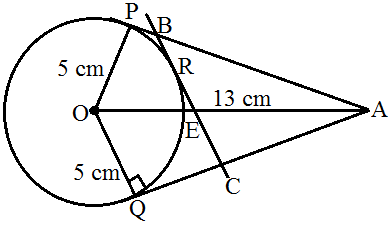

OA = 13cm
OP = OQ = 5cm
OP and PA are radius and tangent respectively at contact point P.
$\therefore\ \angle\text{OPA}=90^\circ$
In right angled $\triangle\text{OPA}$ by pythagoras theorem
$PA^2 = OA^2 - OP^2 = 13^2 - 5^2 = 169 - 25 = 144$
$\Rightarrow PA = 12cm$
points A, B and C are exterior to the circle and tangents drawn from an external point to a circle are equal so
$PA = QA$
$BP = BR$
$CR = CQ$
Perimeter of $\triangle\text{ABC}=\text{AB + BC + AC}$
$= AB + BR + RC + AC$ [From figure]
$= AB + BP + CQ + AC = AP + AQ$
$= AP + AP = 2AP = 2 × 12 = 24cm$
So, the perimeter of $\triangle\text{ABC}=24\text{cm}.$
View full question & answer
Question 25 Marks
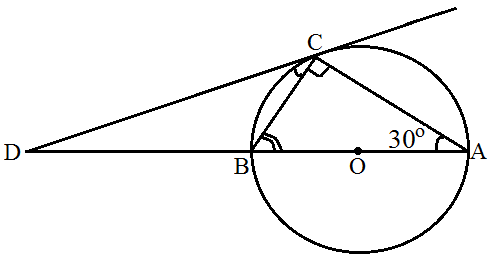
AB is a diameter and AC is a chord of a circle with centre O such that $\angle\text{BAC}=30^\circ.$ The tangent at C intersects extended AB at a point D. Prove that BC = BD.
Answer

Given: A circle with centre O.
A tangent CD at C.
Diameter AB is produced to D.
BC and AC chord are joined, $\angle\text{BAC}=30^\circ.$
To prove: BC = BD
Proof: DC is tangent at C and, CB is chord at C.
$\therefore\ \angle\text{DCB}=\angle\text{BAC}$ $[\angle\text{s}$ in alternat segment of a circle$]$
$\Rightarrow\ \angle\text{DCB}=30^\circ\ \ ...(\text{i})\ [\because\ \angle\text{BAC}=30^\circ(\text{Given})]$
AOB is diameter. [Given]
$\therefore\ \angle\text{BAC}=90^\circ$ [Angle in a semi circle]
$\therefore\ \angle\text{ABC}=180^\circ-90^\circ-30^\circ=60^\circ$
In $\triangle\text{BDC},$
Exterior $\angle\text{ABC}=\angle\text{D}+\angle\text{BCD}$
$\Rightarrow\ 60^\circ=\angle\text{D}+30^\circ$
$\Rightarrow\ \angle\text{D}=30^\circ\ \ ...(\text{ii})$
$\therefore\ \angle\text{DCB}=\angle\text{D}=30^\circ [\text{From (i),(ii)}]$
$\Rightarrow\ \text{BD = BC}$ $[\because$ Sides opposite to equal angles are equal in a triangle$]$
Hence, proved.
View full question & answer
Question 35 Marks
Prove that the centre of a circle touching two intersecting lines lies on the angle bisector of the lines.
Answer
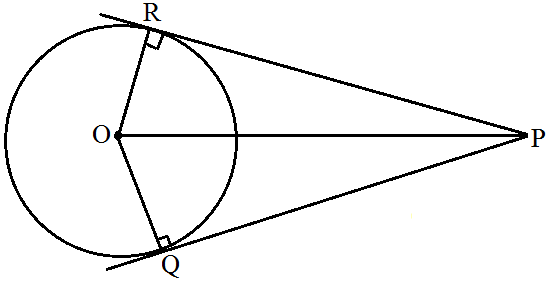
Given two tangents PQ and PR are drawn from an external point P to a circle with centre O.
To prove centre of a circle touching two intersecting lines lies on the angle bisector of the lines. In $\angle\text{RPQ}.$ Construction Join OR, and OQ. In $\triangle\text{POP and }\triangle\text{POO}$ $\angle\text{PRO}\cong\angle\text{PQO}=90^\circ$ [tangent at any point of a circle is perpendicular to the radius through the point of contact] OR = OQ [radii of some circle] Since OP is common $\therefore\ \triangle\text{PRO}\cong\triangle\text{PQO}$ [RHS] Hence, $\angle\text{RPO}=\angle\text{QPO}$ [by CPCT] Thus, O lies on angle bisecter of PR and PQ. Hence proved.
View full question & answer
Question 45 Marks
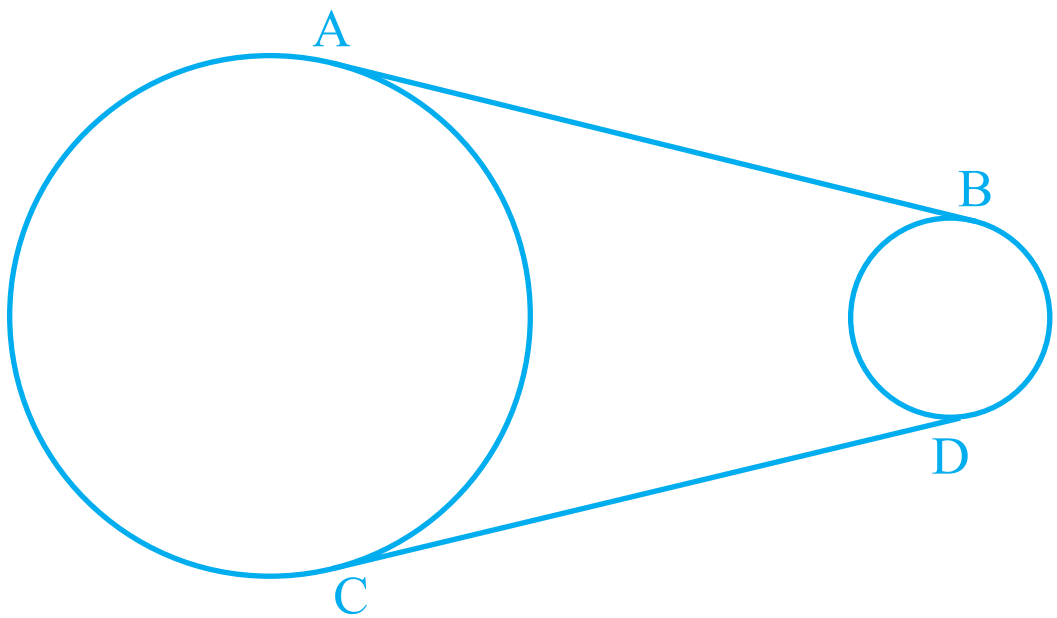
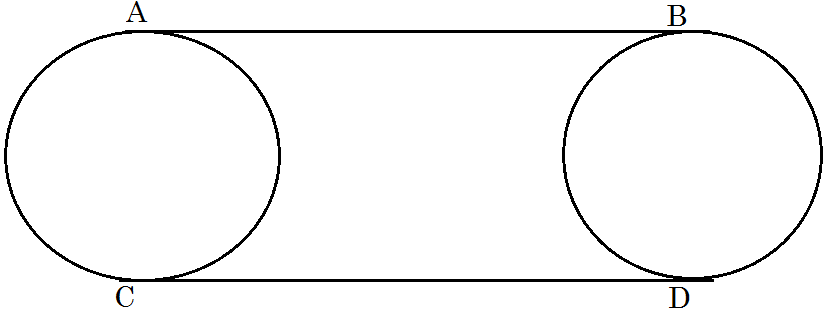
In Figure, AB and CD are common tangents to two circles of unequal radii. Prove that AB = CD.
Answer
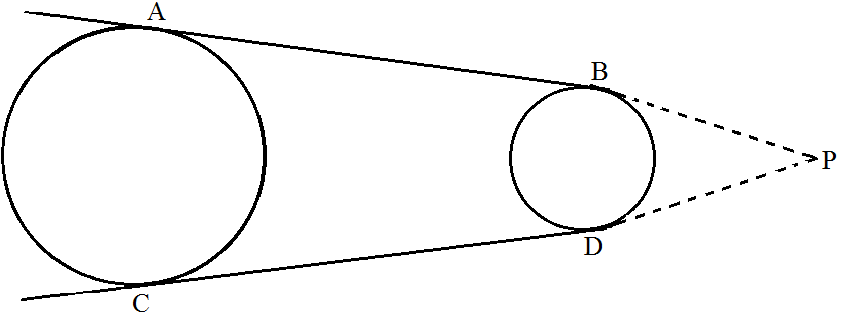
Given AS and CD are common tangent to two circles of unequal radius To prove AB = CD
Construction produce AB and CD, to intersect at P. Proof: PA = PC [the length of tangents drawn from an internal point to a circle are equal] Also, PB = PD [the lengths of tangents drawn from an internal point to a circle are equal] $\therefore$ PA - PB = PC - PD AB = CD Hence proved.
View full question & answer
Question 55 Marks
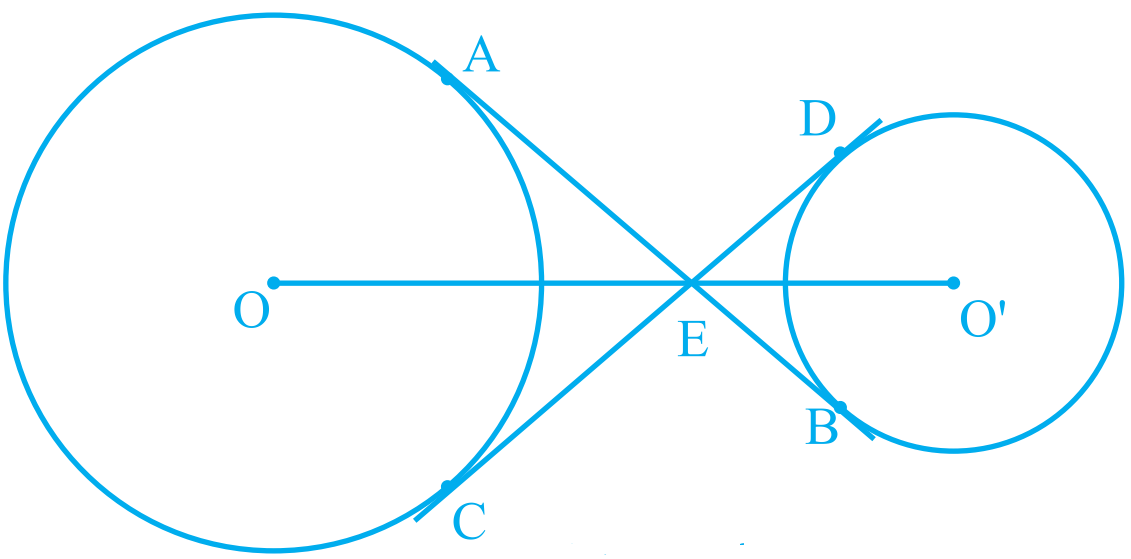
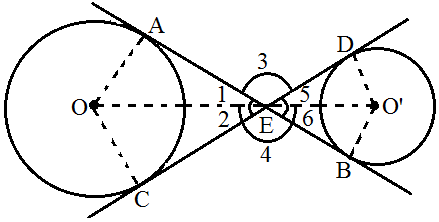
In Figure, the common tangent, AB and CD to two circles with centres O and O' intersect at E. Prove that the points O, E, O' are collinear.
Answer

Given: Two circle (non intersecting) with their centres O and O'.
Two common tangents AB and CD intersect at E between the circles.
To prove: O, E, O' points are collinear.
Construction: Join OA, OC, O'D, O'B and EO and EO'
Proof: In $\triangle\text{AEO and }\triangle\text{CEO},$
OE = OE [Common]
OA = OC [Radii of same circle]
EA = EC [Tangents from an external point to a circle are equal in length]
$\therefore\ \angle\text{OEA}\cong\angle\text{OEC}$ [By SSS criterion of congruence]
$\Rightarrow\ \angle\text{OEA}=\angle\text{OEC}\ \ [\text{CPCT}]$
$\therefore\ \angle1=\angle2\ \ [\text{CPCT}]$
Similarly, $\angle5=\angle6$
and $\angle3=\angle4$ [Vertically opposite angles]
Since sum of angles at a point = 360°
$\therefore\ \angle1+\angle2+\angle3+\angle4+\angle5+\angle6=360^\circ$
$\Rightarrow\ 2(\angle1+\angle3+\angle5)=360^\circ$
$\Rightarrow\ \angle1+\angle3+\angle5=180^\circ$
$\Rightarrow\ \angle\text{OEO}'=180^\circ$
$\therefore$ OEO' is a straight line.
Hence, O, E and O' are collinear.
View full question & answer
Question 65 Marks
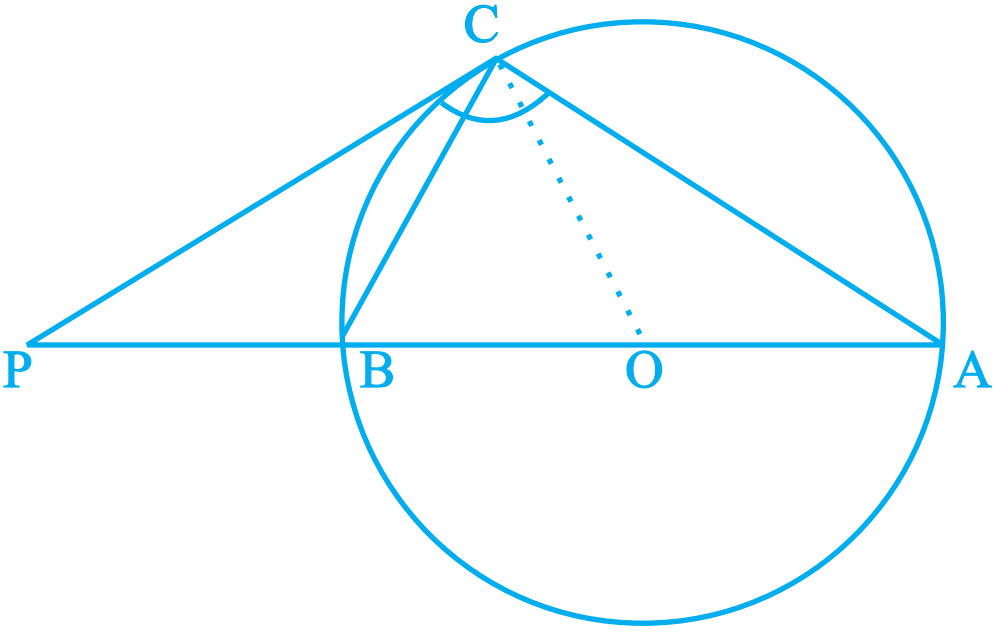
The tangent at a point C of a circle and a diameter AB when extended intersect at P. If $\angle\text{PCA}=110^\circ,$ find $\angle\text{CBA}.$
[Hint: Join C with centre O.]
Answer
OC and CP are radius and tangent respectively at point C.
So, $\angle\text{OCP}=90^\circ$
$\angle\text{OCA}=\angle\text{ACP}-\angle\text{OCP}$
$\Rightarrow\ \angle\text{OCA}=110^\circ-90^\circ$
$\Rightarrow\ \angle\text{OCA}=20^\circ$
In $\triangle\text{OAC},$
$\text{OA = OC}$ [Radius of same circle]
$\therefore\ \angle\text{OCA}=\angle\text{A}=20^\circ$ $[\because$ Angle opposite to equal sides are equal$]$
CP and CB are tangent and chord of a circle.
$\therefore\ \angle\text{CBP}=\angle\text{A}$ [Angle in alternate segments are equal]
In $\triangle\text{CAP},$
$\angle\text{P}+\angle\text{A}+\angle\text{ACP}=180^\circ$ [Angle sum property of a triangle]
$\Rightarrow\ \angle\text{P}+20^\circ+110^\circ=180^\circ$
$\Rightarrow\ \angle\text{P}=180^\circ-130^\circ$
$\Rightarrow\ \angle\text{P}=50^\circ$
In $\triangle\text{BPC},$
Exterior angle $\angle\text{CBA}=\angle\text{P}+\angle\text{BCP}$
$\Rightarrow\ \angle\text{CBA}=50^\circ+20^\circ$
$\Rightarrow\ \angle\text{CBA}=70^\circ$
View full question & answer
Question 75 Marks
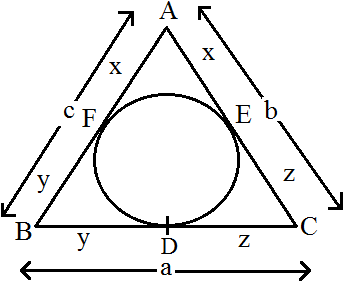
Let s denote the semi-perimeter of a triangle ABC in which BC = a, CA = b, AB = c. If a circle touches the sides BC, CA, AB at D, E, F, respectively, prove that BD = s – b.
Answer
Given: A circle inscribed in $\triangle\text{ABC}$ touches the sides BC, CA and AB at D, E, F respectively.
To prove: BD = s - b Proof: tangents drawn from an external point to the circle are equal. vertices of $\triangle\text{ABC}$ are in the exterior of circle. so, AF = AE = x BF = BD = y CD = CE = z Now, AB + BC + CA = c + a + b ⇒ AF + BF + BD + DC + AE + CE = a + b + c ⇒ x + y + y +z + x + z = a + b + c ⇒ 2x + 2y + 2z = a + b + c ⇒ 2(x + y + z) = a + b + c $\Rightarrow\ \text{x}+\text{y}+\text{z}=\frac{\text{a + b + c}}{2}$ ⇒ x + y + z = s [Given] ⇒ y = s - (x + z) ⇒ y = s - x - z ⇒ y = s - (AE + EC) ⇒ y = s - AC ⇒ BD = s - b Hence, proved.
View full question & answer
Question 85 Marks
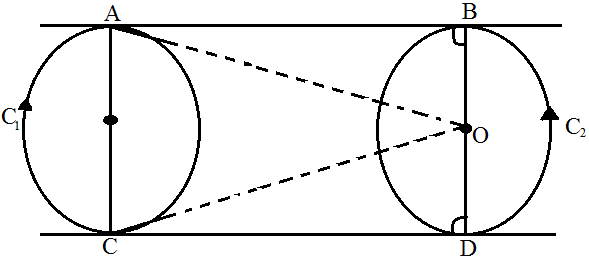
In Question 5 above, if radii of the two circles are equal, prove that AB = CD.
Answer
Given AB and CD are tangents to two circles of equal radii. To prove AB = CD
Construction join OA, OC, O'B and O'D Proof: Now, $\angle\text{OAB}=90^\circ$ [tangent at any point of a circle is perpendicular to radius through the point of contact] Thus, AC is a straight line. Also, $\angle\text{OAB}+\angle\text{OCD}=180^\circ$ $\therefore$ AB || CD Similarly, BD is a straight line and $\angle\text{O'BA}=\angle\text{O'DC}=90^\circ$ Also, AC = BC [radii of two circles are equal] In quadrilateral ABCD. $\angle\text{A}=\angle\text{B}=\angle\text{C}=\angle\text{D}=90^\circ$ and AC = BD ABCD is a rectangle Hence, AB = CD [opposite sides of rectangle are equal]
View full question & answer
Question 95 Marks
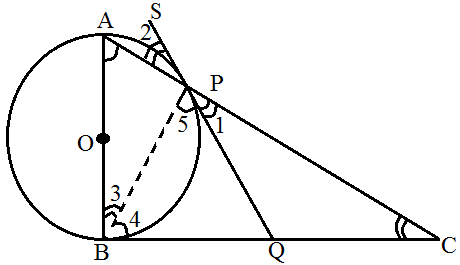
In a right triangle ABC in which $\angle\text{B}=90^\circ,$ a circle is drawn with AB as diameter intersecting the hypotenuse AC and P. Prove that the tangent to the circle at P bisects BC.
Answer

Given: $\triangle\text{ABC}$ in which $\angle\text{B}=90^\circ$
Circle with diameter AB intersect the hypotenuse AC at P.
A tangent SPQ at P is drawn to meet BC at Q.
To prove: Q is mid point of BC.
Construction: Join PB.
Proof: SPQ is tangent and AP is chord at contact point p.
$\therefore\ \angle2=\angle3$ [Angles in alternate segment of circle]
$\angle2=\angle3$ [Vertically opposite angles]
$\Rightarrow\ \angle3=\angle1\ \ ...(\text{i})$ [From above two relations]
$\angle\text{ABC}=90^\circ\ \ [\text{Given}]$
OB is radius so, BC will be tangent at B.
$\therefore\ \angle3=90^\circ-\angle4\ \ ...(\text{ii})$
$\angle\text{APB}=90^\circ\ \ [\angle\ \text{in a semi circle}]$
$\Rightarrow\ \angle\text{C}=90^\circ-\angle4\ \ ...(\text{iii})$
From (ii) and (iii), $\angle\text{C}=\angle3$
Using (i), $\angle\text{C}=\angle1$
$\Rightarrow\ \text{CQ}=\text{QP}\ \ ...(\text{iv})\ [\text{Sides opp. to}=\angle\text{s in}\ \triangle\text{QPC}]$
$\angle4=90^\circ-\angle3$
$\angle5=90^\circ-\angle1\ [\text{From fig.}]$
$\angle3=\angle1$
$\therefore\ \angle4=\angle5$
$\Rightarrow\ \text{PQ}=\text{BQ}\ \ ...(\text{v})$ $[$Sides opp. to equal angles in $\triangle\text{QPB}]$
From (iv) and (v),
$\text{BQ}=\text{CQ}$
Therefore, Q is mid-point of BC. Hence, proved.
View full question & answer
Question 105 Marks
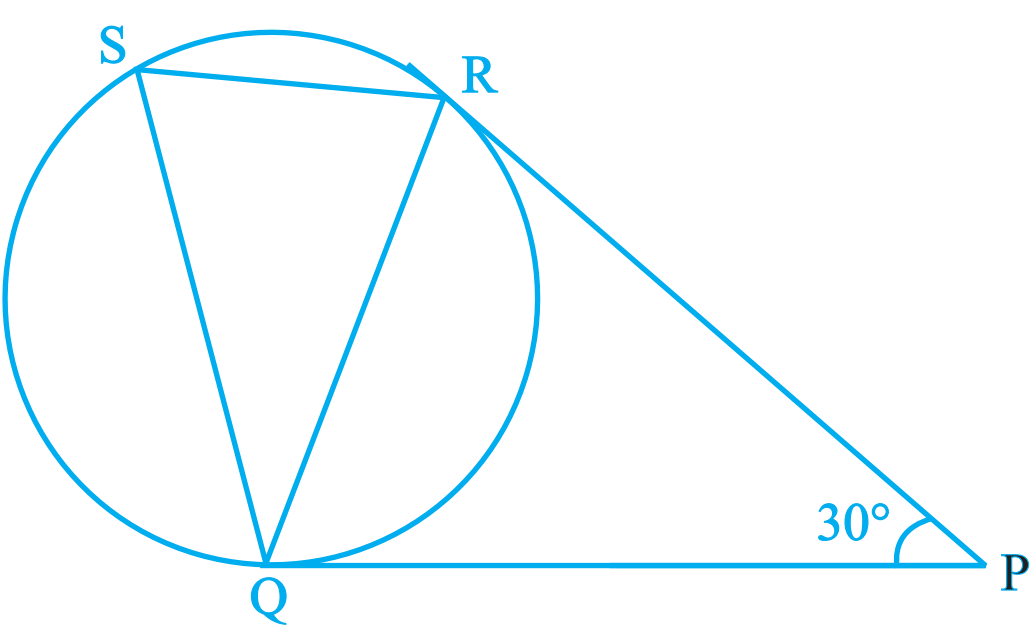
In Figure, tangents PQ and PR are drawn to a circle such that $\angle\text{RPQ}=30^\circ.$ A chord RS is drawn parallel to the tangent PQ. Find the $\angle\text{RQS}.$ [Hint: Draw a line through Q and perpendicular to QP.]
Answer
In $\triangle\text{PRQ},$ PQ and PR are tangents from an external point P to circle.
$\therefore\ \text{PR}=\text{PQ}$
$\Rightarrow\ \angle2=\angle1$ $[\angle\text{s}$ opp. to equal sides in $\triangle\text{PRQ}$ are equal$]$
$\angle1+\angle2+\angle\text{RPQ}=180^\circ\ [\text{Int.}\angle\text{s}\ \text{of}\ \triangle]$
$\Rightarrow\ \angle1+\angle1+30^\circ=180^\circ$
$\Rightarrow\ 2\angle1=180^\circ-30^\circ$
$\Rightarrow\ \angle1=\frac{150^\circ}{2}$
$\therefore\ \angle1=\angle2=75^\circ$
Tangent PQ || SR [Given]
$\therefore\ \angle2=\angle3=75^\circ$ [Alternate interior angles]
PQ is tangent at Q and QR is chord at Q.
$\therefore\ \angle\text{S}=\angle2=75^\circ$ $[\angle\text{s}$ in alternate segment of circle$]$
In $\triangle\text{SRQ},$
$\angle\text{S}+\angle3+\angle\text{SQR}=180^\circ$ [Angle sum property of a triangle]
$\Rightarrow\ 75^\circ+75^\circ+\angle\text{SQR}=180^\circ$
$\Rightarrow\ \angle\text{SQR}=180^\circ-150^\circ$
$\Rightarrow\ \angle\text{SQR}=30^\circ$
View full question & answer
Question 115 Marks
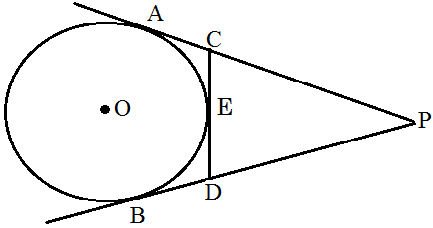
From an external point P, two tangents, PA and PB are drawn to a circle with centre O. At one point E on the circle tangent is drawn which intersects PA and PB at C and D, respectively. If PA = 10cm, find the the perimeter of $\triangle\text{PCD}.$
Answer

Given: A circle with centre O.
PA, PB are tangents from an external point P. A tangent CD at E intersect AP and PB at C and D respectively.
To find: Perimeter of $\triangle\text{PCD}.$
Method: Tangent drawn from an external point to a circle are equal.
$\therefore$ PA = PB = 10cm [Given]
CA = CE
DE = DB
Perimeter of $\triangle\text{PCD}=\text{PC + PD + CD}$
= PC + PD + CE + DE
= PC + CE + PD + DE
= PC + CA + PD + DB
= PA + PB
= 10 + 10 = 20cm
$\therefore$ Perimeter of $\triangle\text{PCD}=20\text{cm}.$
View full question & answer
Question 125 Marks
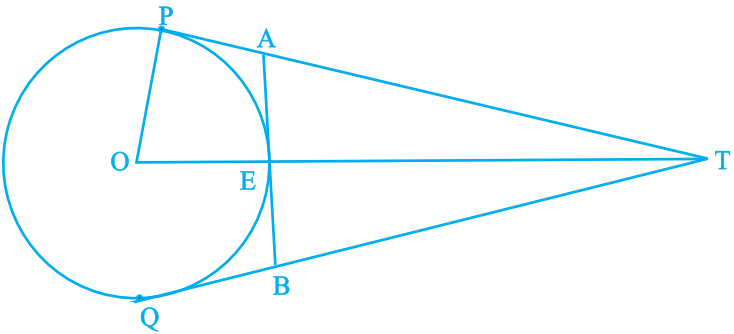
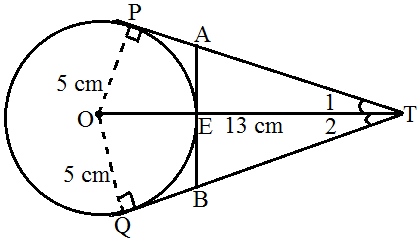
In Figure, O is the centre of a circle of radius 5cm, T is a point such that OT = 13cm and OT intersects the circle at E. If AB is the tangent to the circle at E, find the length of AB
.
Answer

OP = OQ = 5cm
OT = 13cm
OP and PT are radius and tangent respectively at contact point P.
$\therefore\ \angle\text{OPT}=90^\circ$
So, by pythagoras theorem, in right angled $\triangle\text{OPT},$
$PT^2 = OT^2 - OP^2 = 13^2 - 5^2$
$= 169 - 25 = 144$
$\Rightarrow PT = 12cm.$
AP and AE are two tangents from an external point A to a circle.
$\therefore$ AP = AE
AEB is tangent and OE is radius at contact point E.
So, $\text{AB}\perp\text{OT}\ \ ...(\text{i})$
So, by pythagoras theorem, in right angle $\triangle\text{AET},$
$AE^2 = AT^2 - ET^2$
$\Rightarrow AE^2 = (PT - PA)^2 - [TO - OE]^2$
$= (12 - AE)^2 - (13 - 5)^2$
$\Rightarrow AE^2 = (12)^2 + (AE)^2 - 2(12)(AE) - (8)^2$
$\Rightarrow AE^2 - AE^2 + 24AE = 144 - 64$
$\Rightarrow 24AE = 80$
$\Rightarrow\ \text{AE}=\frac{80}{24}\text{cm}$
$\Rightarrow\ \text{AE}=\frac{10}{3}\text{cm}$
In $\triangle\text{TPO and }\triangle\text{TQO},$
OT = OT [Common]
PT = QT [Tangents from T]
OP = OQ [Radii of same circle]
$\therefore\ \triangle\text{TPO}\cong\triangle\text{TQO}$ [By SSS criterion of congruence]
$\Rightarrow\ \angle1=\angle2\ \ ...(\text{ii})\ [\text{CPCT}]$
In $\triangle\text{ETA and }\triangle\text{ETB},$
ET = ET [Common]
$\angle\text{TEA}=\angle\text{TEB}=90^\circ\ \ [\text{From (i)}]$
$\angle1=\angle2\ \ [\text{CPCT}]\ \ [\text{From (ii)}]$
$\therefore\ \triangle\text{ETA}\cong\triangle\text{ETB}$ [By ASA criterion of congruence]
$\Rightarrow\ \text{AE = BE}\ \ [\text{CPCT}]$
$\Rightarrow\ \text{AB}=2\text{AE}=2\times\frac{10}{3}$
$\Rightarrow\ \text{AB}=\frac{20}{3}\text{cm}.$
Hence, the required length is $\frac{20}{3}\text{cm}.$
View full question & answer
Question 135 Marks
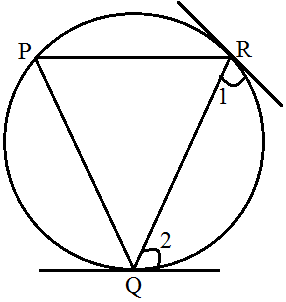
Prove that the tangents drawn at the ends of a chord of a circle make equal angles with the chord.
Answer
To prove $\angle1=\angle2,$ let PQ be a chord of the circle. Tangents are drawn at the points R and Q.
Let P be another point on the circle, then, join PQ and PR. Since, at point Q, there is a tangent. $\therefore\ \angle2=\angle\text{P}$ [angles in alternate segments are equal] since, at point R, there is a tangent. $\therefore\ \angle1=\angle\text{P}$ [angles in alternate segments are equal] $\therefore\ \angle1=\angle2=\angle\text{P}$ Hence proved.
View full question & answer
Question 145 Marks
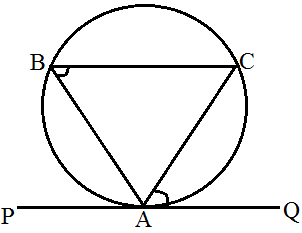
Prove that the tangent drawn at the mid-point of an arc of a circle is parallel to the chord joining the end points of the arc.
Answer

Given: arc BAC in which A is mid point of arc BAC.
PAQ is tangent at A.
To prove: BC || PAQ
Proof: PAQ is tangent and CAB is an are at contact point A.
$\therefore\ \angle\text{CAQ}=\angle\text{B}\ \ ...(\text{i})$
[Angles in alternate segment of a ccircle]
A is mid point of arc BAC.
$\therefore$ min. arc AB = min. arc AC
⇒ Chord AB = Chord AC [Equal arcs subtend equal chords]
$\Rightarrow\ \angle\text{C}=\angle\text{B}\ \ ...(\text{ii})$ [Angles opp. to equal sides in $\triangle\text{ABC}$ are equal]
$\Rightarrow\ \angle\text{C}=\angle\text{CAQ}$ [From (i) and (ii)]
These are alternate interior angles and are equal.
$\therefore$ BC || PAQ.
Hence, proved.
View full question & answer
Question 155 Marks
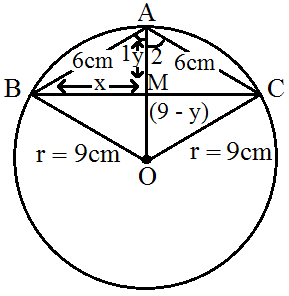
If an isosceles triangle ABC, in which AB = AC = 6cm, is inscribed in a circle of radius 9cm, find the area of the triangle.
Answer

In figure, $\triangle\text{ABC}$ has AB = AC = 6cm.
In $\triangle\text{OAB and }\triangle\text{OAC},$
AB = AC [Given]
OA = OA [Common]
OB = OC [Radii of same circle]
$\therefore\ \triangle\text{OAB}\cong\triangle\text{OAC}$
[By SSS criterion of congruence]
$\Rightarrow\ \angle1=\angle2\ \ [\text{CPCT}]$
In $\triangle\text{AMC and }\triangle\text{AMB},$
$\angle1=\angle2\ \ [\text{Proved above}]$
AM = AC [Common]
AB = AC [Given]
$\therefore\ \triangle\text{AMB}\cong\triangle\text{AMC}$ [By SAS criterion of congruence]
$\Rightarrow\ \angle\text{AMB}=\angle\text{AMC}=90^\circ$ [CPCT and Linear pair axiom]
Now, Area of $\triangle\text{ABC}=\frac{1}{2}\text{BC}\times\text{AM}$
Let BM = x and AM = y,
then MO = OA - AM
⇒ MO = OA - AM
⇒ MO = 9 - y
In right angled $\triangle\text{BMA and }\triangle\text{BMO},$
$x^2 + y^2 = 6^2 ...(i)$ [By pythagoras theorem]
$x^2 + (9 - y)^2 = 9^2$
$x^2 + (9)^2 + (y)^2 - 2(9)(y) = 81$
$\Rightarrow x^2 + 81 + y^2 - 18y = 81$
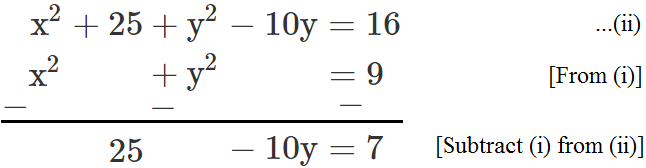
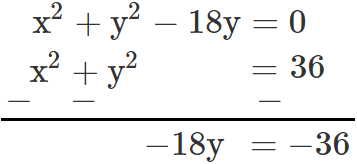
$\Rightarrow x + y - 18y = 0 ...(ii)$
Now, subtract (i) from (ii)

$\Rightarrow\ \text{y}=\frac{-36}{-18}$
$\Rightarrow y = 2cm$
$ \Rightarrow AM = 2cm$
But,$ x^2 + y^2 = 36$ [From (i)]
$\Rightarrow x^2 + (-2) = 36$
$\Rightarrow x^2 = 36 - 4 = 32$
$\Rightarrow\ \text{x}= \sqrt{32}=4\sqrt{2}\text{cm}$
$\therefore\ \text{BC}=2\text{x}=2\times4\sqrt{2}=8\sqrt{2}\text{cm}$
$(\because$ Perpendicular from centre to chord bisects the chord$)$
$\therefore\ \text{Area of }\triangle\text{ABC}=\frac{1}{2}\times2\times8\sqrt{2}$
$\Rightarrow\ \text{Area of }\triangle\text{ABC}=8\sqrt{2}\text{cm}^2$
View full question & answer
Question 165 Marks
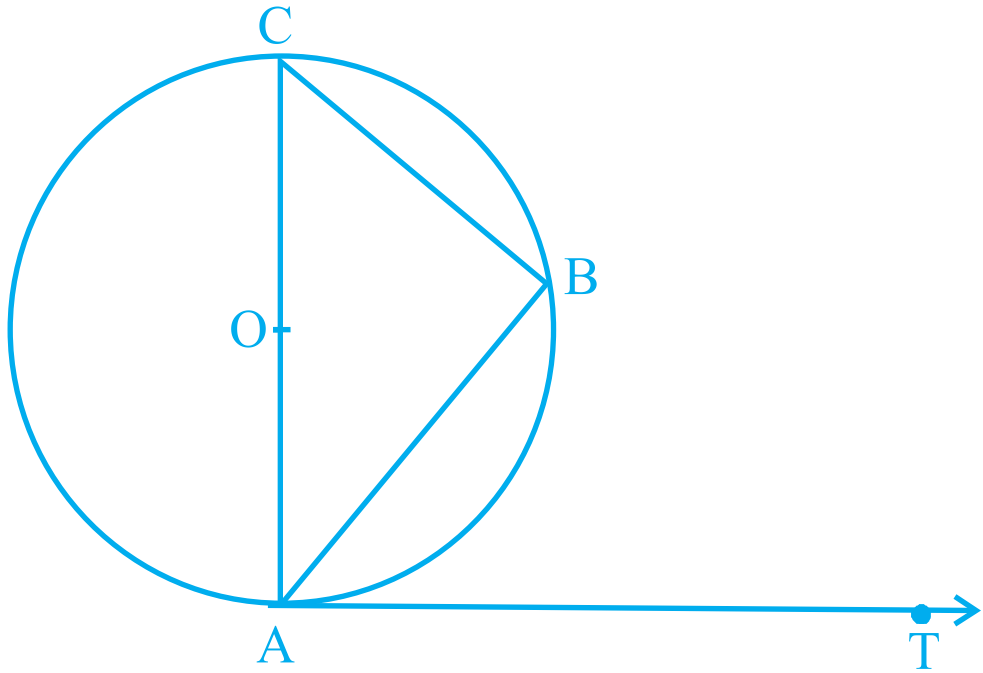
If AB is a chord of a circle with centre O, AOC is a diameter and AT is the tangent at A as shown in Figure. Prove that $\angle\text{BAT}=\angle\text{ACB}.$
Answer
Given: Chord AB, diameter AOC and tangent at A of a circle with centre O.
To prove: $\angle\text{BAT}=\angle\text{ACB}.$
Proof: Radius OA and tangent AT at A are perpendicular.
$\therefore\ \angle\text{OAT}=90^\circ$
$\Rightarrow\ \angle\text{BAT}=90^\circ-\angle1\ \ ...(\text{i})$
AOC is diameter.
$\therefore\ \angle\text{B}=90^\circ$
$\Rightarrow\ \angle\text{C}+\angle1=90^\circ$
$\Rightarrow\ \angle\text{C}=90^\circ-\angle1\ \ ...(\text{ii})$
From (i) and (ii), we get
$\angle\text{BAT}=\angle\text{ACB}.$
Hence, proved.
View full question & answer
Question 175 Marks
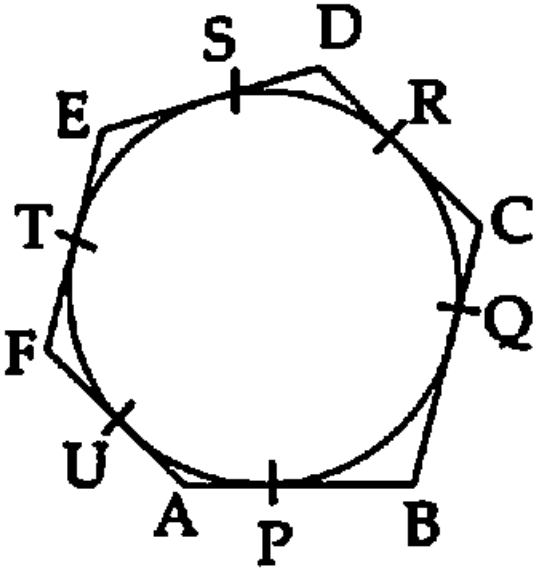
If a hexagon ABCDEF circumscribe a circle, prove that AB + CD + EF = BC + DE + FA.
Answer
Given: A circle inscribed in a hexagon ABCDEF.

Sides, AB, BC, CD, DE and DF touches the circle at P, Q, R, S, T and U respectively.
To prove: AB + CD + EF = BC + DE + FA
Proof: We know that tangents from an external point to a circle are equal.
Here, vertices of hexagon are outside the circle so
AP = AU
BP = BQ
CQ = CR
DR = DS
ES = ET
FT = FU
LHS = AB + CD + EF = (AP + PB) + (DR + CR) + (ET + TF)
By using above results, we have
LHS = AB + CD + EF = AU + BQ + DS + CQ + ES + FU
= AU + FU + BQ + CQ +DS + ES
= AF + BC + DE.
Hence, proved.
View full question & answer
Question 185 Marks
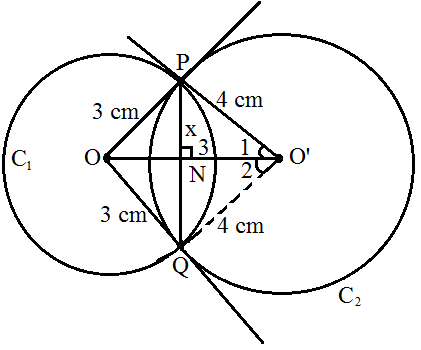
Two circles with centres O and O' of radii 3cm and 4cm, respectively intersect at two points P and Q such that OP and O'P are tangents to the two circles. Find the length of the common chord PQ.
Answer


PO' is tangent on circle $C_1$ at P.
OP is tangent on circle $C_2​​​​​​​$ at P. As radius OP and tangent PO' are at a point of contact P
$\therefore\ \angle\text{P}=90^\circ$
So, by pythagoras thiorem in right angled $\triangle\text{OPO'},$
$OO'^2 = OP^2 + PO'^2 = 3^2 + 4^2 = 9 + 16 = 25cm$
$\Rightarrow OO' = 5cm$
$\triangle\text{OO'P}\cong\triangle\text{OO'Q}$ [By SSS criterion of congruence]
$\Rightarrow\ \angle1=\angle2$
$\triangle\text{O'NP}\cong\triangle\text{O'NQ}$ [By SSS criterion of congruence]
$\Rightarrow\ \angle3=\angle\text{O'NQ}\ \ [\text{CPCT}]$
$\Rightarrow\ \angle3=\angle\text{O'NQ}=90^\circ$ [Linear pair axiom]
Let ON = y, then NO' = (5 - y)
Let PN = x
By pythagoras thiorem in $\triangle\text{PNO and }\triangle\text{PNO'},$ we have
$x^2 + y^2 = 3^2 ...(i)$
$x^2 + (5 - y)^2 = 4^2​​​​​​​$​​​​​​​
⇒ -10y = 7 - 25
$\Rightarrow -10y = -18$
$\Rightarrow y = 1.8$
But,$ x^2 + y^2 = 3^2​​​​​​​$​​​​​​​ [From (i)]
$\Rightarrow x^2 + (1.8)^2 = 3^2$
$\Rightarrow x^2 = 9 - 3.24$
$\Rightarrow x = 2.4$
$\therefore$ The perpendicular drawn from the centre bisects the chord.
$\therefore$ $PQ = 2PN = 2x$
$= 2 \times 2.4$
$\Rightarrow PQ = 4.8cm.$
View full question & answer