Questions · Page 1 of 3

M.C.Q (1 Marks)

Take a timed test

50 questions · auto-graded multiple-choice test.

MCQ 11 Mark
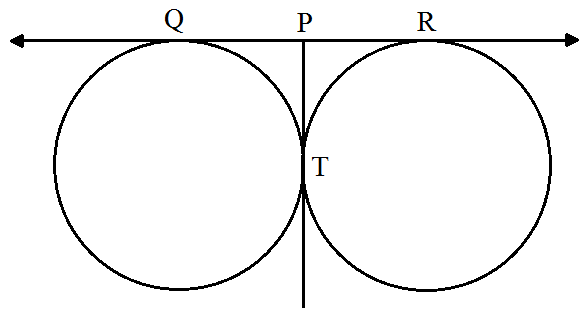
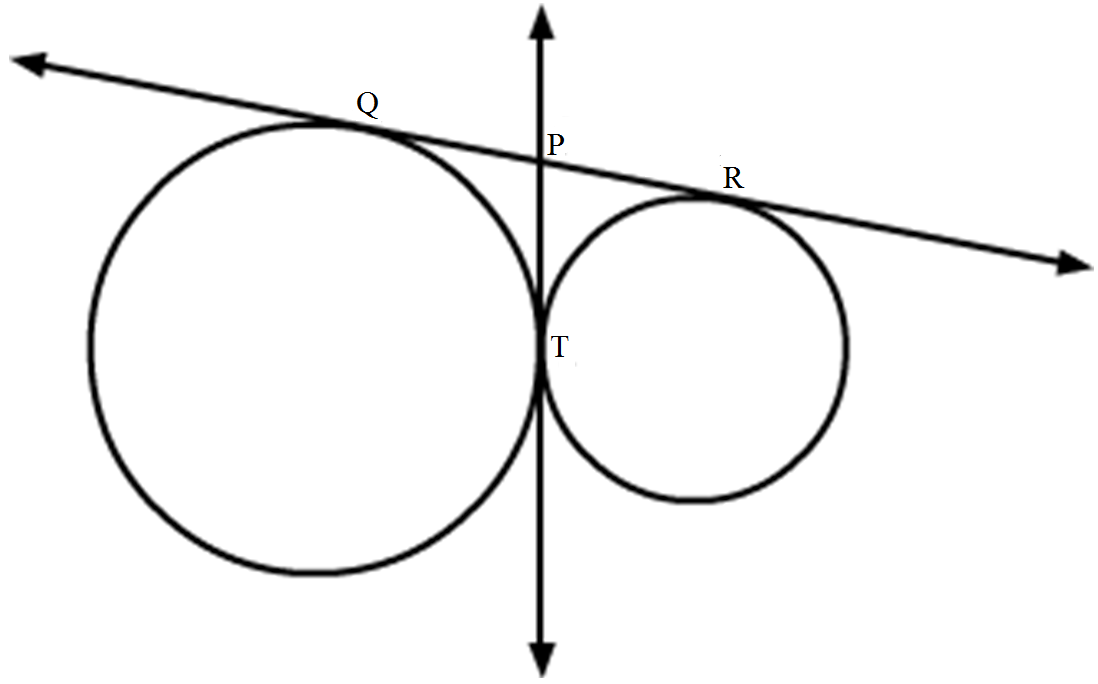
In the given figure, QR is a common tangent to the given circles touching externally at the point T. The tangent at T meets QR at P. If PT = 3.8cm, then the length of
QR (in cm) is:
  • A
    3.8
  • 7.6
  • C
    5.7
  • D
    1.9
Answer
Correct option: B.
7.6
It is given that QR is a common tangent to the given circles touching externally at the point T. Also, the tangent at T meets QR at P such that PT = 3.8cm.
Now, PQ and PT are tangents drawn to the same circle from an external point.
$\therefore$ PQ = PT = 3.8cm (Lengths of tangents drawn from an external point to a circle are equal)
PR and PT are tangents drawn to the same circle from an external point T.
$\therefore$ PR = PT = 3.8cm (Lengths of tangents drawn from an external point to a circle are equal)
Now,
QR = PQ + PR = 3.8cm + 3.8cm = 7.6cm
Thus, the length of QR is 7.6cm.
View full question & answer
MCQ 21 Mark
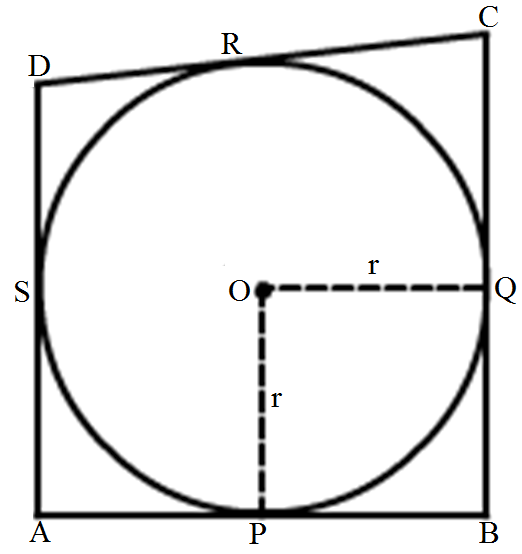
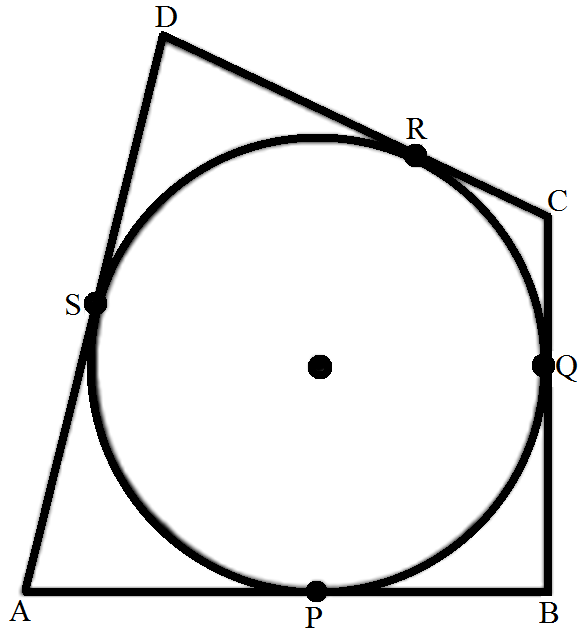
In the figure, a quadrilateral ABCD is drawn to circumscribe a circle such that its sides AB, BC, CD and AD touch the circle at P, Q, R and S respectively. If AB = x cm,
BC= 7cm, CR = 3cm and AS = 5cm, then x =
  • A
    10
  • 9
  • C
    8
  • D
    7
Answer
Correct option: B.
9
In the given figure,
ABCD is a quadrilateral circumscribe a circle and its sides AB, BC, CD and DA touch the circle at P, Q, R and S respectively.
AB = x cm, BC = 7cm, CR = 3cm, AS = 5cm
CR and CQ are tangents to the circle from C
CR = CQ = 3cm
BQ = BC – CQ = 7 – 3 = 4cm
BQ = and BP are tangents from B
BP = BQ = 4cm
AS and AP are tangents from A
AP = AS = 5cm
AB = AP + BP = 5 + 4 = 9cm
x = 9cm
View full question & answer
MCQ 31 Mark
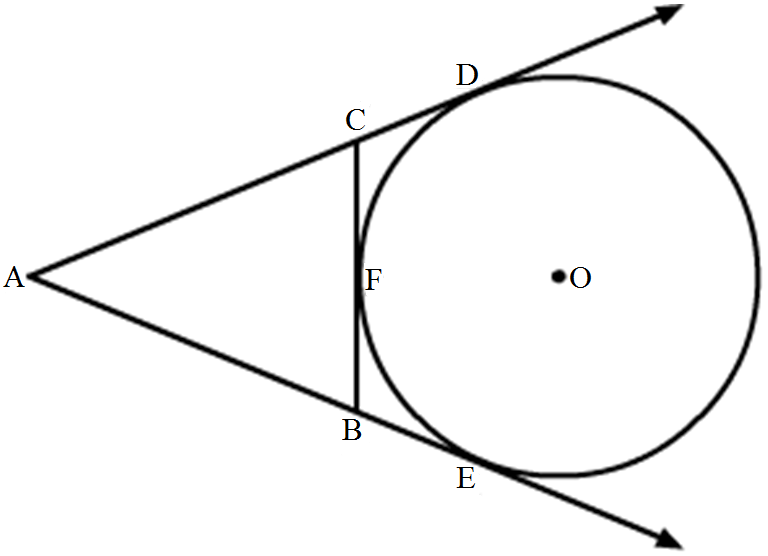
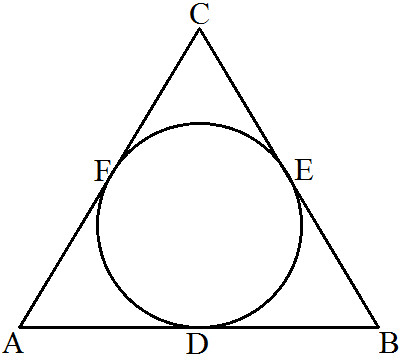
In the given figure, if AD, AE and BC are tangents to the circle at D, E and F respectively, Then:
  • A
    AD = AB + BC + CA
  • 2AD = AB + BC + CA
  • C
    3AD = AB + BC + CA
  • D
    4AD = AB + BC + CA
Answer
Correct option: B.
2AD = AB + BC + CA

By the property of tangent
AC = AB (tangent from A)...(i)
CD = CF (tangent from C)...(ii)
BF = BE (tangent from B)...(iii)
Now taking RHS,
AB + BC + CA = AB + BF + FC + CA
AB + BC + CA = AB + BE + CD + CA [ from (ii) & (iii) ]
AB + BC + CA = AE + AD
AB + BC + CA = 2AD
View full question & answer
MCQ 41 Mark
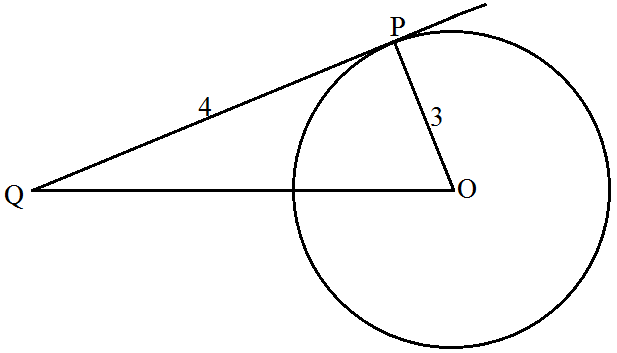
The length of the tangent from a point $A$ at a circle, of radius $3 \ cm,$ is $4 \ cm.$ The distance of $A$ from the centre of the circle is:
  • A
    $\sqrt{7}\text{cm}$
  • B
    $7\ cm$
  • $5\ cm$
  • D
    $25\ cm$
Answer
Correct option: C.
$5\ cm$

We know, radius always perpendicular to tangent so we say $\triangle\text{OPA}$ is right angle triangle then $\angle\text{OPA}=90^{\circ}$
Now, we have to find $OA$
$\Rightarrow O A^2=A P^2+O P^2$
$\Rightarrow O A^2=4^2+3^2$
$\Rightarrow O A^2=16+9$
$\Rightarrow OA = \sqrt{25}$
$\Rightarrow OA = 5$
Hence, correct choice is $(c)$
View full question & answer
MCQ 51 Mark
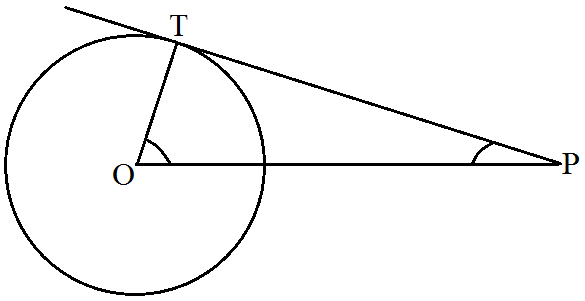
If PT is tahgent drawn froth a point P to a circle touching it at T and O is the centre of the circle, then ∠OPT + ∠POT =
  • A
    30°
  • B
    60°
  • 90°
  • D
    180°
Answer
Correct option: C.
90°

In the figure, PT is the tangent to the circle with centre O.
OP and OT are joined
PT is tangent and OT is the radius
OT ⊥ PT
Now in right $\triangle\text{OTP}$
$\angle\text{OTP}=90^{\circ}$
$\angle\text{OPT}+\angle\text{POT}=180^{\circ}-90^{\circ}=90^{\circ}$
View full question & answer
MCQ 61 Mark
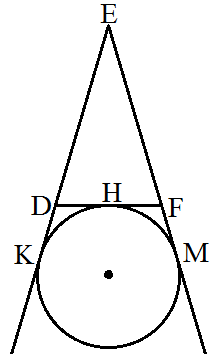
In the figure, a circle touches the side DF of $\triangle\text{EDF}$ at H and touches ED and EF produced at K and M respectively. If EK = 9cm, then the perimeter $\triangle\text{EDF}$ of is:
  • 18cm
  • B
    13.5cm
  • C
    12cm
  • D
    9cm
Answer
Correct option: A.
18cm
In $\triangle\text{DEF}$
DF touches the circle at H and circle touches ED and EF Produced at K and M respectively.
EK = 9cm
EK and EM are the tangents to the circle.
EM = EK = 9cm
Similarly DH and DK are the tangent.
DH = DK and FH and FM are tangents.
FH = FM
Now, perimeter of $\triangle\text{DEF}$
= ED + DF + EF
= ED + DH + FH + EF
= ED + DK + EM + EF
= EK + EM
= 9 + 9
= 18cm.
View full question & answer
MCQ 71 Mark
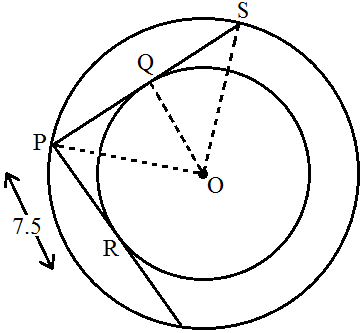
In the given figure, there are two concentric circles with centre O. PR and PQS are tangents to the inner circle from point plying on the outer circle. If PR = 7.5cm, then PS is equal to:
  • A
    10cm
  • B
    12cm
  • 15cm
  • D
    18cm
Answer
Correct option: C.
15cm

Here, PO = OS(radius)
then $\triangle\text{POS}$ called isosceles triangle.
We know, In isosceles triangle line drawn from vertex to base, then line bisects the base in equal parts. so we say,
PQ = QS ...(i)
From the property of tangent
PR = PQ = 7.5cm [tangent from point P] ...(ii)
Now we have to find PS,
PS = PQ + QS
⇒ PS = PQ + PQ [from eq.(i)]
⇒ PS = 7.5 + 7.5 [fromeq.(ii)]
⇒ PS =15cm
View full question & answer
MCQ 81 Mark
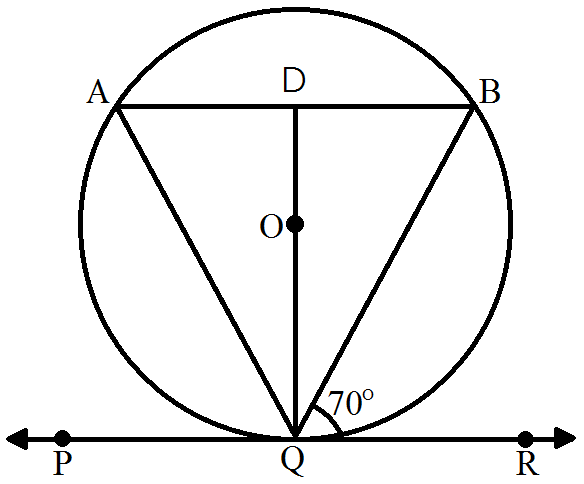
In the figure, if PQR is the tangent to a circle at Q whose centre is O, AB is a chord parallel to PR and $\angle\text{BQR}=70^\circ$ then $\angle\text{AQB}$ is equal to:
  • A
    20°
  • 40°
  • C
    35°
  • D
    45°
Answer
Correct option: B.
40°
Given, AB || PR
$\angle\text{ABQ}=\angle\text{BQR}=70^\circ$ [alternate angles]
Also QD is perpendicular to AB and QD bisects AB.
In $\triangle\text{QDA}\ \text{and}\ \triangle\text{QDB}$
$\angle\text{QDA}= \angle\text{QDB}$ [each 90°]
AD = BD
QD = QD [common side
$\triangle\text{ADQ}=\angle\text{BDQ}$ [by SAS similarity criterion]
Then, $\angle\text{QAD}=\angle\text{QDA}\ ....(\text{i})$ [c.p.c.t.]
Also, $\angle\text{ABQ}=\angle\text{BQR}$ [alternate interior angle
$\angle\text{ABQ}=70^\circ$$[\angle\text{BQR}=70^\circ]$
Hence, $\angle\text{QAB}=70^\circ$ [from Eq. (i)]
Now, In $\triangle\text{ABQ},$
$\angle\text{A}+\angle\text{B}+\angle\text{Q}=180^\circ$
$\Rightarrow\angle\text{Q}=180^\circ-(70^\circ+70^\circ)=40^\circ$
View full question & answer
MCQ 91 Mark
If radii of two concentric circles are $4\ cm$ and $5\ cm,$ then the length of each chord of one circle which is tangent to the other circle is :
  • A
    $3\ cm$
  • $6\ cm$
  • C
    $9\ cm$
  • D
    $1\ cm$
Answer
Correct option: B.
$6\ cm$
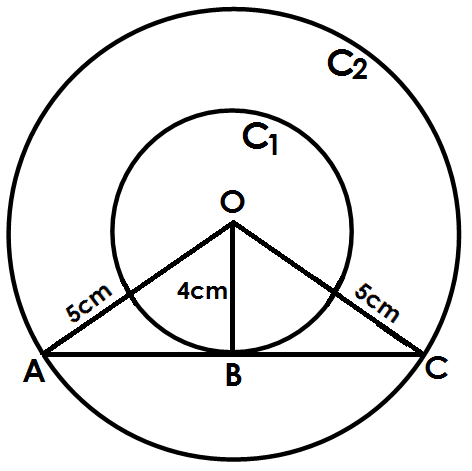
Let $O$ be the centre of two concentric circles $C_1$ and $C_2$, whose radii are $r_1=4 \mathrm{~cm}$ and $r_2=5 \mathrm{~cm}$.
Now, we draw a chord $A C$ of circle $C_2$, which touches the circle $C_1$ at $B$.
Also, join $OB,$ which is perpendicular to $AC. $
$[$Tangent at any point of circle is perpendicular to radius throughly the point of contact$]$
Now, in right angled $\triangle \mathrm{OBC}$, by using Pythagoras theorem,
$\Rightarrow \mathrm{OC}^2=\mathrm{BC}^2+\mathrm{BO}^2\left[(\text { hypotenuse })^2=(\text { base })^2+(\text { perpendicular })^2\right]$
$\Rightarrow 5^2=\mathrm{BC}^2+4^2$
$\Rightarrow \mathrm{BC^2}=25-16=9$
$\Rightarrow \mathrm{BC}=3 \mathrm{~cm}$
Length of chord $A C=2 B C=2 \times 3=6 \mathrm{~cm}$.
View full question & answer
MCQ 101 Mark
In the given figure, if AB = 8cm and PE = 3cm, then AE =
  • A
    11cm
  • B
    7cm
  • 5cm
  • D
    3cm
Answer
Correct option: C.
5cm

We know that tangents drawn from the same external point will be equal in length.
Therefore,
AB = AC
It is given that,
AB = 8cm
Hence,
AC = 8cm …… (1)
Similarly,
PE = CE
It is given that,
PE = 3cm
Therefore,
CE = 3cm …… (2)
Subtracting equations (1) and (2), we get,
AC − CE = 8 − 3
From the figure we can see that,
AC − CE = AE
Therefore,
AE = 8 − 3
AE = 5cm
View full question & answer
MCQ 111 Mark
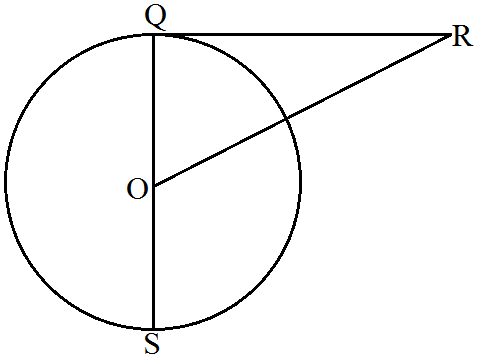
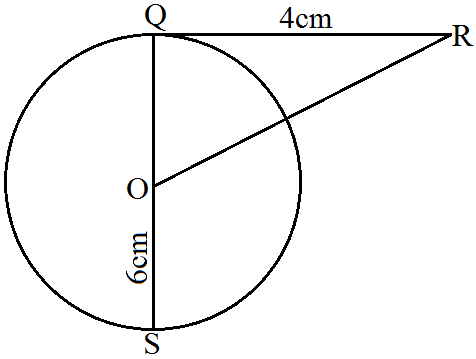
In the given figure, $RQ$ is a tangent to the circle with centre $O$. If $SQ = 6\ cm$ and $QR = 4\ cm,$ then $OR =$​​​​​​​
  • A
    $8\ cm$
  • B
    $3\ cm$
  • C
    $2.5\ cm$
  • $5\ cm$
Answer
Correct option: D.
$5\ cm$
In the figure, $0$ is the centre of the circle $QR$ is tangent to the circle and $\text{QOS}$ is a diameter $SQ = 6\ cm, QR = 4\ cm$


$\text{OQ}=\ \frac{1}{2}\ \text{QS}=\frac{1}{2}\times6=3\text{cm}$
$OQ$ is radius
$OQ \perp QR$
Now in right $\triangle\text{OQR}$
$O R^2=Q R^2+Q O^2$
$=(3)^2+(4)^2$
$=9+16$
​​​​​​​$=25$
$=(5)^2$
$OR = 5\ cm$
View full question & answer
MCQ 121 Mark
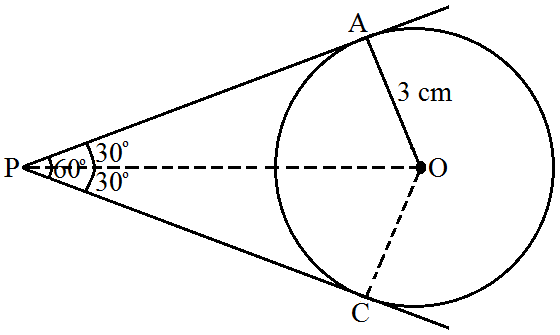
If two tangents inclined at a angle of 60° are drawn to a circle of radius 3cm, then length of each tangent is equal to:
  • A
    $\frac{3\sqrt{3}}{2}\text{cm}$
  • B
    $6\text{cm}$
  • C
    $3\text{cm}$
  • $3\sqrt{3}\text{cm}$
Answer
Correct option: D.
$3\sqrt{3}\text{cm}$

Let P be an external point and a pair of tangents is drawn from point P and angle between these two tangents is 60°. Join OA and OP.
Also, OP is a bisector of line.
$\angle\text{APO}=\angle\text{CPO}=30^\circ$
Also, OA ⊥ AP
Tangent at any point of a circle is perpendicular to the radius through the point of contact.
In right angled $\triangle\text{OAP},\tan30^\circ=\frac{\text{OA}}{\text{AP}}=\frac{3}{\text{AP}}$
$\Rightarrow\frac{1}{\sqrt{3}}=\frac{3}{\text{AP}}$
$\Rightarrow\text{AP}=3\sqrt{3}\text{cm}$
Hence, the length of each tangent is $3\sqrt{3}\text{cm}$
View full question & answer
MCQ 131 Mark
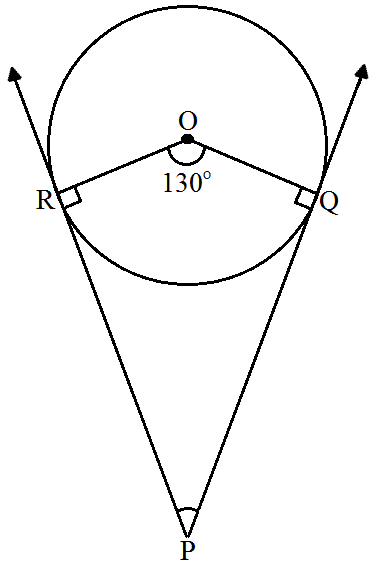
If angle between two radii of a circle is 130°, the angle between the tangent at the ends of radii is:
  • A
    90°
  • 50°
  • C
    70°
  • D
    40°
Answer
Correct option: B.
50°

Let PQ and RP be the radii of the circle with the centre O.
$\angle\text{ROQ}=130^\circ$
$\text{RP}\bot\text{OR}\ \text{and}\ \text{PQ}\bot\text{OQ}$ (Radii are perpendicular to the tangent)
In quadilateral ROQP,
$\angle\text{ORP}+\angle\text{RPQ}+\angle\text{PQO}+\angle\text{QOR}=360^\circ$
$\Rightarrow90^\circ+\angle\text{RPQ}+90^\circ+130^\circ=360^\circ$
$\Rightarrow\angle\text{RPQ}=50^\circ$
View full question & answer
MCQ 141 Mark
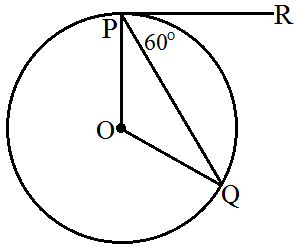
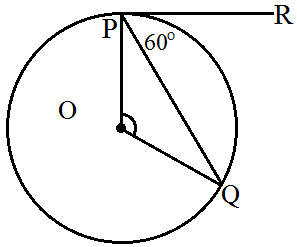
In the figure, if PR is tangent to the circle at P and Q is the centre of the circle, then ∠POQ =
  • A
    110°
  • B
    100°
  • 120°
  • D
    90°
Answer
Correct option: C.
120°

We know, radius OP$\bot $ to tangent PR then $\angle\text{OPR}=90^{\circ}$
Now,
$\angle\text{OPQ}=\angle\text{OPR}-\angle\text{QPR}$
$\angle\text{OPQ}=90^{\circ}-60^{\circ}$
$\angle\text{OPQ}=30^{\circ}$
In $\triangle\text{OPQ},$
OP = OQ (radius of circle)
$\angle\text{OPQ}=\angle\text{OQP}=30^{\circ}$(opposite angle of same side)
we also know that sum of all angle of triangle is 180°, then
$\angle\text{OPQ}+\angle\text{OQP}+\angle\text{POQ}=180^{\circ}$
$\Rightarrow30^{\circ}+30^{\circ}+\angle\text{POQ}=180^{\circ}$
$\Rightarrow\angle\text{POQ}=120^{\circ}$
View full question & answer
MCQ 151 Mark
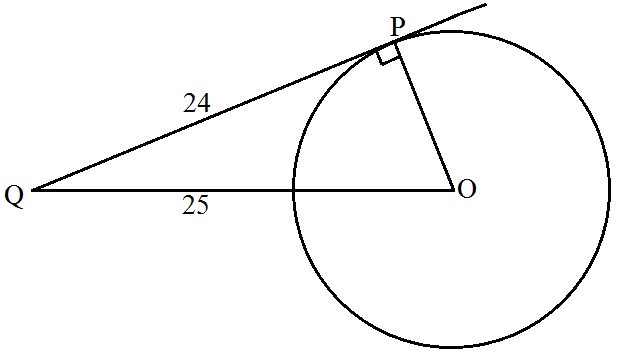
From a point $Q$, the length of the tangent to a circle is $24\ cm$ and the distance of $Q$ from the centre is $25\ cm.$ The radius of the circle is:
  • $7\ cm$
  • B
    $12\ cm$
  • C
    $15\ cm$
  • D
    $24.5\ cm$
Answer
Correct option: A.
$7\ cm$

We know, radius always perpendicular to tangent so we say $\triangle\text{OPQ}$ is right angle triangle then $\angle\text{OPQ}=90^{\circ}$
Now, we have to find $OP$
$\Rightarrow OP^2 = OQ^2 - PQ^2$
$\Rightarrow OP^2 = 25^2 - 24^2$
$\Rightarrow OP^2 = 625 - 576$
$\Rightarrow\text{OP}=\sqrt{49}$
$\Rightarrow OP = 7\ cm$
Hence, correct choice is $(A)$
View full question & answer
MCQ 161 Mark
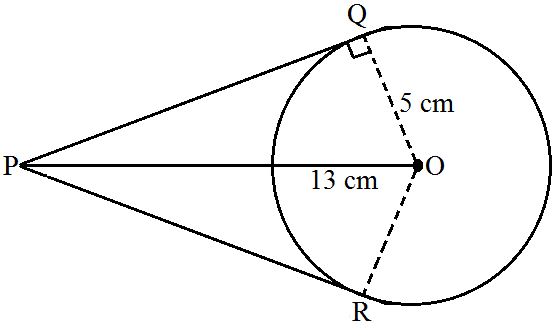
From a point $P$ which is at a distance $13\ cm$ from the centre $O$ of a circle of radius $5\ cm,$ the pair of tangent $PQ$ and $PR$ to the circle are drawn. Then the area of the quadrilateral $\text{PQOR}$ is
  • $60\ cm^2$
  • B
    $65\ cm^2$
  • C
    $30\ cm^2$
  • D
    $32.5\ cm^2$
Answer
Correct option: A.
$60\ cm^2$

Firstly, draw a circle of radius $5\ cm$ having centre $O.$
$P$ is a point at a distance of $13\ cm$ from $O.$
$A$ pair of tangents $PQ$ and $PR$ are drawn.
Thus, quadrilateral $\text{PQOR}$ is formed.
$OQ \perp QP [$since, $AP$ is a tangent line$]$
In right angled $\triangle\text{POQ}$
$\Rightarrow OP^2 = OQ^2 + QP^2$
$\Rightarrow 13^2 = 5^2 + QP^2$
$\Rightarrow QP^2 = 169 – 25 = 144 = 12^2$
$\Rightarrow QP = 12\ cm$
Now, $\text{area}\ \text{of}\triangle\text{OQP}=\frac{1}{2}\times\text{QP}\times\text{QO}=\frac{1}{2}\times12\times5=30\text{cm}^2$
Area of quadilateral $\text{QORP} = 2\triangle\text{OQP}=2\times30=60\text{cm}^2$
View full question & answer
MCQ 171 Mark
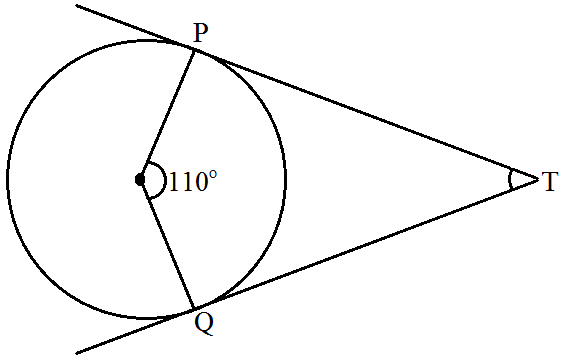
If TP and TQ are two tangents to a circle with centre O so that $\angle\text{POQ}=110^{\circ},$ then, $\angle\text{PTQ}$ is equal to:
  • A
    60°
  • 70°
  • C
    80°
  • D
    90°
Answer
Correct option: B.
70°

TP and TQ are the tangents from T to the circle with centre O and OP, OQ are joined and $\angle\text{POQ}=110^{\circ},$
But $\angle\text{POQ}+\angle\text{PTQ}=180^{\circ}$
$\Rightarrow110^{\circ}+\angle\text{PTQ}=180^{\circ}$
$\Rightarrow\angle\text{PTQ}=180^{\circ}-110^{\circ}=70^{\circ}$
View full question & answer
MCQ 181 Mark
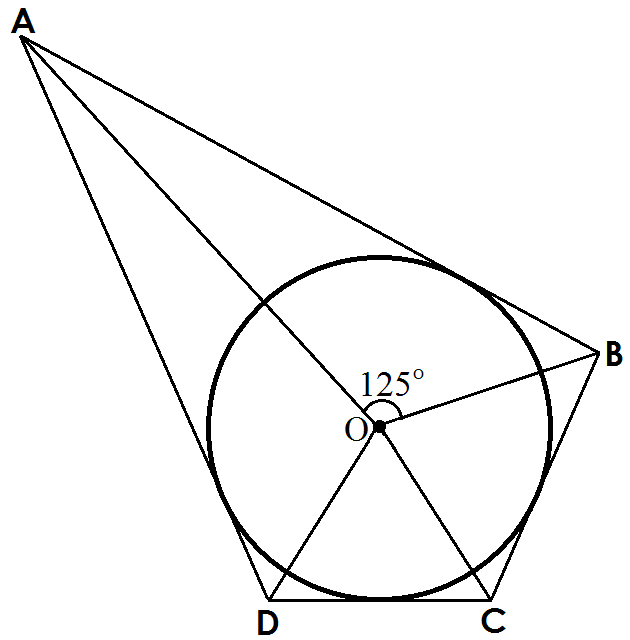
In the figure, if $\angle\text{AOB}=125^\circ$ then $\angle\text{COD}$ is equal to:
  • A
    45°
  • B
    35°
  • 55°
  • D
    $62\frac{1}{2}^\circ$
Answer
Correct option: C.
55°
We know that, the opposite sides of a quadrilateral circumscribing a circle subtend supplementary angles at the centre of the circle
$\angle\text{AOB}+\angle\text{COD}=180^\circ$
$\Rightarrow\angle\text{COD}=180^\circ-\angle\text{AOB}=180^\circ-125^\circ=55^\circ$
View full question & answer
MCQ 191 Mark
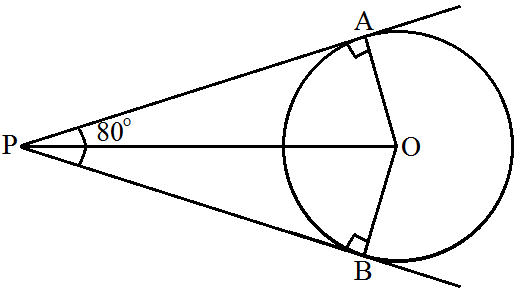
If tangents PA and PB from a point P to a circle with centre O are inclined to each other at
  • 50°
  • B
    60°
  • C
    70°
  • D
    80°
Answer
Correct option: A.
50°

We know, radius is always perpendicular to tangent
then,
$\angle\text{OAP}=90^{\circ}(\text{OA}\bot\text{PA})$
$\angle\text{OBP}=90^{\circ}(\text{OB}\bot\text{PB})$
$\angle\text{APB}=80^{\circ}(\text{given})$
We also know that sum of all angles of a quadilateral is 360° then,
$\angle\text{OAP}+\angle\text{OBP}+\angle\text{APB}+\angle\text{AOB}=360^{\circ}$
$\Rightarrow90^{\circ}+90^{\circ}+80^{\circ}+\angle\text{AOB}=360^{\circ}$
$\Rightarrow260^{\circ}+\angle\text{AOB}=360^{\circ}$
$\Rightarrow\angle\text{AOB}=100^{\circ}...(\text{i})$
Now, consider $\triangle\text{POA}\ \text{and}\ \triangle\text{POB},$
OA = OB (Radius of circle)
PA = PB (tangent grom external point P)
OP = OP (commom)
So, By using SSS congurancy,
$\triangle\text{POA}\cong\triangle\text{POB}$
then $\angle\text{POA}=\triangle\text{POB}...(\text{ii})$
By eq. (i) and (ii)
$\Rightarrow\angle\text{AOB}=100^{\circ}$
$\Rightarrow\angle\text{POA}+\angle\text{POB}=100^{\circ}$
$\Rightarrow2\angle\text{POA}=100^{\circ}$
$\Rightarrow\angle\text{POA}=50^{\circ}$
Hence, correct choice is (A)
View full question & answer
MCQ 201 Mark
The length of the tangent drawn from a point $8 \ cm$ away from the centre of a circle of radius $6 \ cm$ is:
  • A
    $\sqrt{7}\text{cm}$
  • $2\sqrt{7}\text{cm}$
  • C
    $10\text{cm}$
  • D
    $5\text{cm}$
Answer
Correct option: B.
$2\sqrt{7}\text{cm}$
Let us first put the given data in the form of a diagram.
We know that the radius of a circle will always be perpendicular to the tangent at the point of contact.
Therefore, $OP$ is perpendicular to $QP.$ We can now use Pythagoras theorem to find the length of $QP.$
$QP^2 = OQ^2 - OP^2$
$QP^2 = 8^2 - 6^2$
$QP^2 = 64 - 36$
$QP^2 = 28$
$QP = \sqrt{28}$
$QP = 2\sqrt{7}$
View full question & answer
MCQ 211 Mark
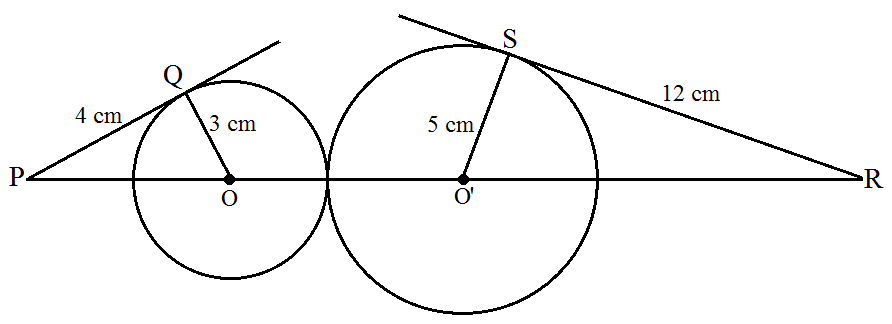
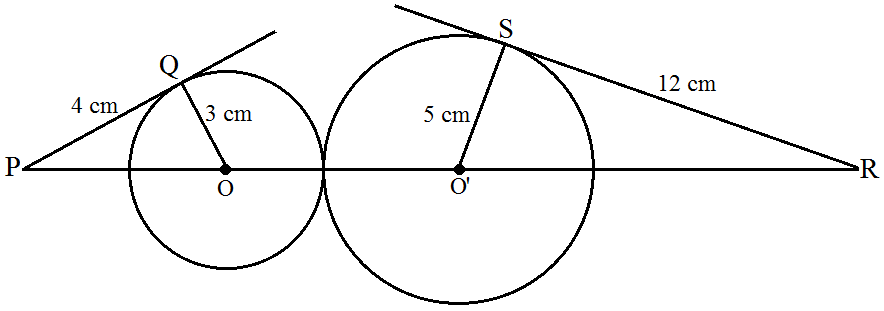
In the figure, $PR =$
  • A
    $20\ cm$
  • $26\ cm$
  • C
    $24\ cm$
  • D
    $28\ cm$
Answer
Correct option: B.
$26\ cm$

In the figure, two circles with centre $O$ and $O’$ touch each other externally $PQ$ and $RS$ are the tangents drawn to the circles.
$OQ$ and $O’S$ are the radii of these circles and $OQ = 3\ cm, PQ = 4\ cm, O’S = 5\ cm$ and $SR = 12\ cm.$
Now in right $\triangle\text{OQP}$
$OP^2 = (OQ)^2 + PQ^2$
$= (3)^2 + (4)^2$
$= 9 + 16$
$= 25$
$= (5)^2$
$OP = 5\ cm$
Similarly in right $\triangle\text{RSO}$
$(O’R)^2 = (RS)^2 + (O’S)^2$
$= (12)^2 + (5)^2$
$= 144 + 25$
$= 169$
$= (13)^2$
$O’R = 13\ cm$
Now $PR = OP + OO’ + O’R$
$= 5 + (3 + 5) + 13$
$= 26\ cm.$
View full question & answer
MCQ 221 Mark
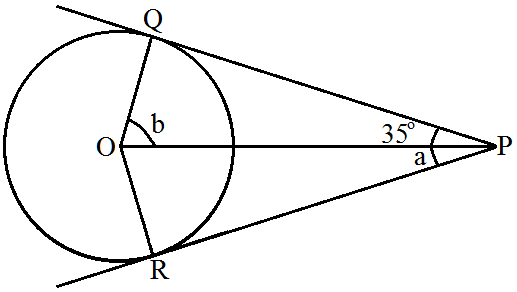
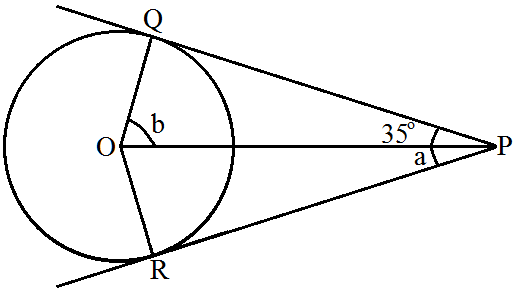
In the given figure, PQ and PR are tangents drawn from P to a circle with centre O. If $\angle\text{OPQ}=35^\circ$, then:
  • A
    a= 30°, b= 60°
  • a= 35°, b = 55°
  • C
    a= 40°, b = 50°
  • D
    a= 45°, b = 45°
Answer
Correct option: B.
a= 35°, b = 55°

We know, radius always $\bot$ TP tangent
$\text{OQ}\bot\text{QP}$
$\text{OR}\bot\text{RP}$
From above eq. $\triangle\text{OQP}$ and $\triangle\text{ORP}$ is right angle triangle then,
$\angle\text{OQP}=\angle\text{ORP}=90^\circ$
$\triangle\text{OQP}\sim\triangle\text{ORP}$
then $\angle\text{QPO}=\angle\text{RPO}=35^\circ=\angle\text{a}$
sum of all angles in $\triangle\text{OQP}$ is 180°
$\angle\text{OQP}+\angle\text{QPO}+\angle\text{QOP}=180^\circ$
$\Rightarrow90^\circ+35^\circ+\angle\text{b}=180^\circ$
$\Rightarrow\angle\text{b}=55^\circ$
View full question & answer
MCQ 231 Mark
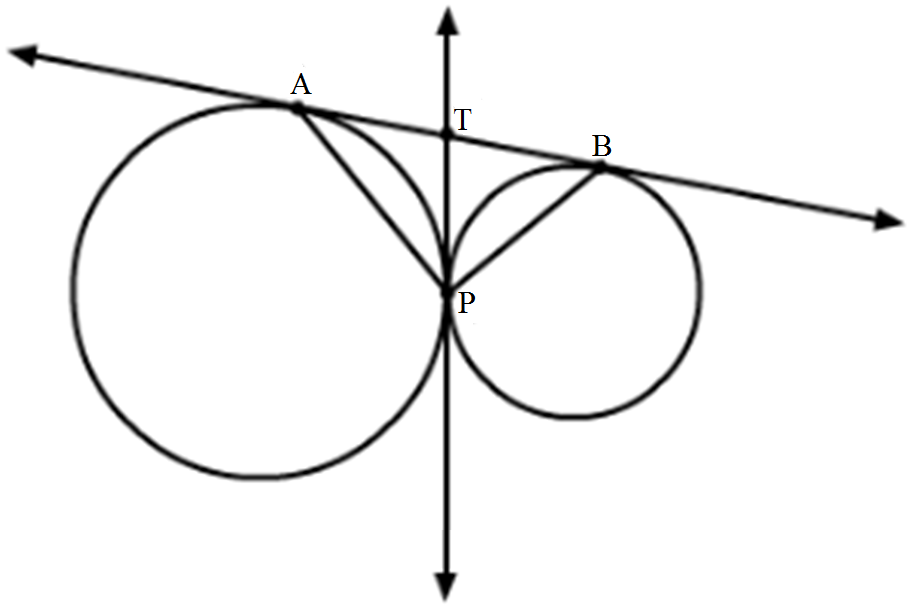
Two circles touch each other externally at P. AB is a common tangent to the circle touching them at A and B. The value of $\angle\text{APB}$ is:
  • A
    30º
  • B
    45º
  • C
    60º
  • 90º
Answer
Correct option: D.
90º

It is given that two circles touch each other externally at P. AB is a common tangent to the circle touching them at A and B.
Draw a tangent to the circle at P, intersecting AB at T.
Now, TA and TP are tangent drawn to the same circle from an external point T.
$\therefore$ TA = TP (Length of tangents drawn from an external point to a circle are equal)
TB and TP are tangent drawn to the same circle from an external point T.
$\therefore$ TB = TP (Length of tangents drawn from an external point to a circle are equal)
In $\triangle\text{ATP}$
TA = TP
$\therefore\angle\text{APT}=\angle\text{PAT}...(1)$(In a triangle, equal sides have equal angles opposite to them)
In $\triangle\text{BTP},$
TB = TP
$\therefore\angle\text{BPT}=\angle\text{PBT}...(2)$(In a triangle, equal sides have equal angles opposite to them)
Now, in $\triangle\text{APB},$
$\Rightarrow\angle\text{APB}+\angle\text{PAB}+\angle\text{PBA}=180^\circ$(Angle sum property)
$\Rightarrow\angle\text{APB}+\angle\text{APT}+\angle\text{BPT}=180^\circ$[From (1) and (2)]
$\Rightarrow\angle\text{APB}+\angle\text{APB}=180^\circ$
$\Rightarrow2\angle\text{APB}=180^\circ$
$\Rightarrow\angle\text{APB}=90^\circ$
Thus, the value of $\angle\text{APB}\ \text{is}\ 90^\circ$
View full question & answer
MCQ 241 Mark
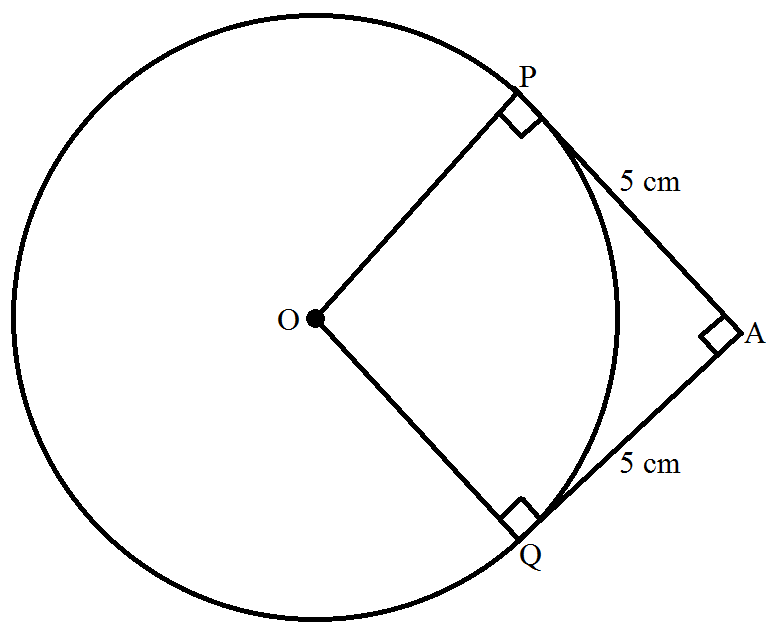
The pair of tangents AP and AQ drawn from an external point to a circle with centre O are perpendicular to each other and length of each tangent is 5cm. The radius of
the circle is:
  • A
    10cm
  • B
    7.5cm
  • 5cm
  • D
    2.5cm
Answer
Correct option: C.
5cm

Given: AP and AQ are tangents to the ciecle with centre O, AP $\bot$ AQ and AP = AQ = 5cm
We know that radius of a circle is perpendicular to the tangent at the point of contact.
$\Rightarrow\text{OP}\bot\text{AP}\ \text{and}\ \text{OQ}\bot\text{AQ}$
Also sum of all angles of a quadilateral is 360°
$\Rightarrow\angle\text{O}+\angle\text{P}+\angle\text{A}+\angle\text{Q}=360^\circ$
$\Rightarrow\angle\text{O}+90^\circ+90^\circ=360^\circ$
$\Rightarrow\angle\text{O}=360^\circ-270^\circ=90^\circ$
Thus$\angle\text{O}=\angle\text{P}=\angle\text{A}=\angle\text{Q}=90^\circ$
⇒ OPAQ is a rectangle.
Since adjacent sides of OPAQ i.e. AP and AQ are equal. Thus OPAQ is a square radius = OP = OQ = AP = AQ = 5cm
View full question & answer
MCQ 251 Mark
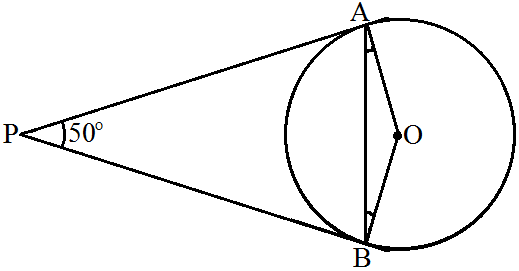
If PA and PB are tangents to the circle with centre O such that $\angle\text{APB}=50^\circ$ then $\angle\text{OAB}$ is equal to:
  • 25°
  • B
    30°
  • C
    40°
  • D
    50°
Answer
Correct option: A.
25°
Given, PA and PB are tangent lines.
PA = PB [Since, the length of tangents drawn from an$​​​​\angle\text{PAB}=​​​​\angle\text{PBA}=\theta$ [say]
In $​​​​\triangle\text{PAB},$
$​​​​\angle\text{P}+​​​​\angle\text{A}+​​​​\angle\text{B}=180^\circ$ [since, sum of angles of a triangle = 180°
$50^\circ+\theta+\theta=180^\circ$
$2\theta=180^\circ-50^\circ=130^\circ$
$\theta=65^\circ$
Also, OA ⊥ PA [Since, tangent at any point of a circle is perpendicular to the radius through the point of contact.]
$\angle\text{PAO}=90^\circ$
$\Rightarrow\angle\text{PAB}+\angle\text{BAO}=90^\circ$
$\Rightarrow65^\circ+\angle\text{BAO}=90^\circ$
$\Rightarrow\angle\text{BAO}=90^\circ-65=25^\circ$
View full question & answer
MCQ 261 Mark
In the given figure, a circle with centre O is inscribed in a quadrilateral ABCD such that, it touches sides BC, AB, AD and CD at points P, Q, R and S respectively. If AB
= 29cm, AD = 23cm, $\angle\text{B}=90^\circ$ and DS = 5cm, then the radius of the circle (in cm) is:
  • 11
  • B
    18
  • C
    6
  • D
    15
Answer
Correct option: A.
11
In the figure, a circle touches the sides of a quadrilateral ABCD.
$\angle\text{B}=90^\circ,$ OP = OQ = r
AB = 29cm, AD = 23cm, DS = 5cm
$\angle\text{B}=90^\circ,$
BA is tangent and OQ is radius
$​​​​\angle\text{QPB}=90^\circ$
Similarly OP is radius and BC is tangents.
$​​​​\angle\text{OPB}=90^\circ$
But $\angle\text{B}=90^\circ,$ (given)
PBQO is a square.
DS = 5cm
But DS and DR are tangents to the circles.
DR = 5cm
But AD = 23cm
AR = 23 – 5= 18cm
AR = AQ (tangents to the circle from A.)
AQ = 18cm
But AB = 29 cm
BQ = 29 – 18 = 11cm
OPBQ is a square.
OQ = BQ = 11cm
Radius of the circle = 11cm.
View full question & answer
MCQ 271 Mark
If four sides of a quadrilateral ABCD are tangential to a circle, then:
  • A
    AC + AD = BD + CD
  • AB + CD = BC + AD
  • C
    AB + CD = AC + BC
  • D
    AC + AD = BC + DB
Answer
Correct option: B.
AB + CD = BC + AD
A circle is inscribed in a quadrilateral ABCD which touches the sides AB, BC, CD and DA at P, Q, R and S respectively then the sum of two opposite sides is equal
to the sum of other two opposite sides
AB + CD = BC + AD
View full question & answer
MCQ 281 Mark
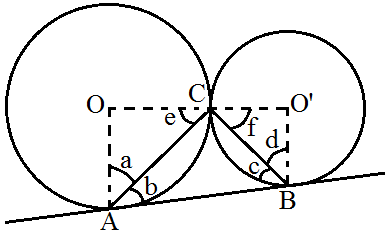
Two equal circles touch each other externally at C and AB is a common tangent to the circles. Then, $\angle\text{ACB}=$
  • A
    60°
  • B
    45°
  • C
    30°
  • 90°
Answer
Correct option: D.
90°

we know, radius always $\bot$ to tangent then,
$\angle\text{OAB}=\angle\text{a}+\angle\text{b}=90^{\circ}[\because\text{OA}\bot\text{AB}]$
$\Rightarrow\angle\text{a}=90^{\circ}=\angle\text{b}...(\text{i})$
$\angle\text{O'BA}=\angle\text{C}+\angle\text{d}=90^{\circ}$
$\Rightarrow\angle\text{d}=90^{\circ}-\angle\text{c}...(\text{ii})$
Here, redius are equal.
$\angle\text{a}=\angle\text{e}$ (opposite angle of same side)
$\angle\text{d}=\angle\text{f}$ (opposite angle of same side)
Now,
$\Rightarrow\angle\text{ACB}=\angle\text{OCO'}-\angle\text{e}-\angle\text{f}$
$\Rightarrow\angle\text{ACB}=180^{\circ}-\angle\text{a}-\angle\text{d}$
Put the value from eq. (i) and (ii)
$\Rightarrow\angle\text{ACB}=180^{\circ}-(90-\angle\text{b})-(90-\angle\text{c})$
$\Rightarrow\angle\text{ACB}=180^{\circ}-90-\angle\text{b}-90-\angle\text{c}$
$\Rightarrow\angle\text{ACB}=\angle\text{b}+\angle\text{c}...(\text{iii})$
Now In $\triangle\text{ACB}$
$\angle\text{b}+\angle\text{c}+\angle\text{ACB}=180^{\circ}$
from eq....(iii)
$\Rightarrow\angle\text{ACB}+\angle\text{ACB}=180^{\circ}$
$\Rightarrow2\angle\text{ACB}=180^{\circ}$
$\Rightarrow\angle\text{ACB}=90^{\circ}$
View full question & answer
MCQ 291 Mark
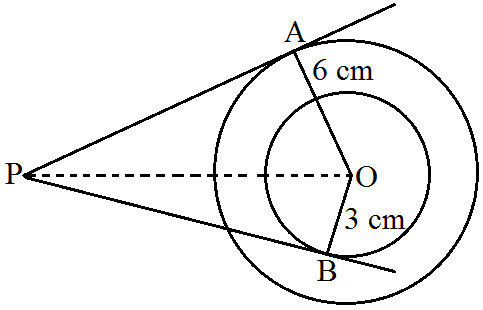
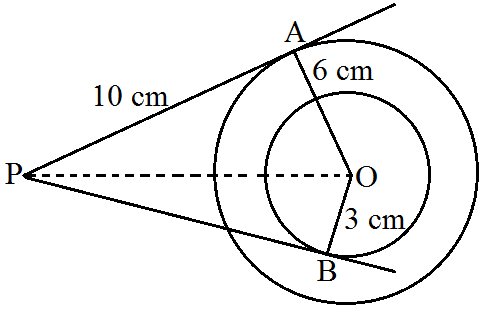
In the figure, if $AP = 10\ cm,$ then $BP =$
  • A
    $\sqrt{91}\text{cm}$
  • $\sqrt{127}\text{cm}$
  • C
    $\sqrt{119}\text{cm}$
  • D
    $\sqrt{109}\text{cm}$
Answer
Correct option: B.
$\sqrt{127}\text{cm}$

In the figure,
$O A=6 \ cm, O B=3 \ cm$ and $A P=10 \ cm$
$O A$ is radius and $A P$ is the tangent
$O A \perp A P$
Now in right $\triangle OAP$
$O P^2=A P^2+O A^2=(10)^2+(6)^2=100+36=136$
Similarly $B P$ is tangent and $O B$ is radius
$O P^2=O B^2+B P^2$
$136=(3)^2+B P^2$
$136=9+B P^2$
$\Rightarrow B P^2=136-9=127$
$B P=\sqrt{127} \ cm$
View full question & answer
MCQ 301 Mark
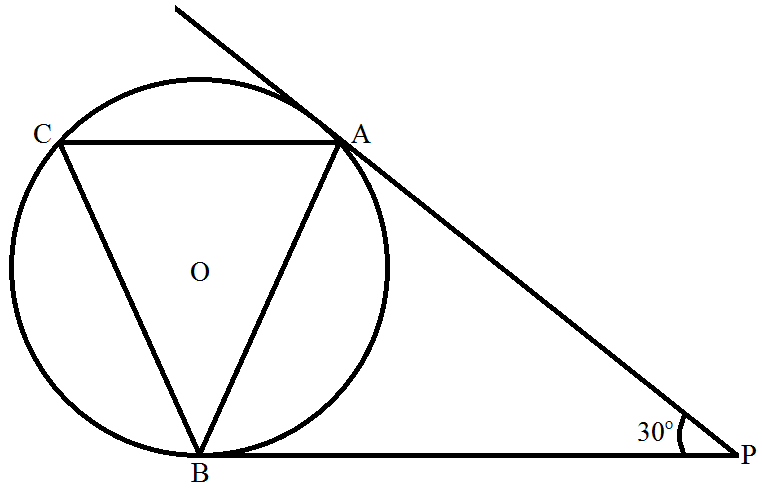
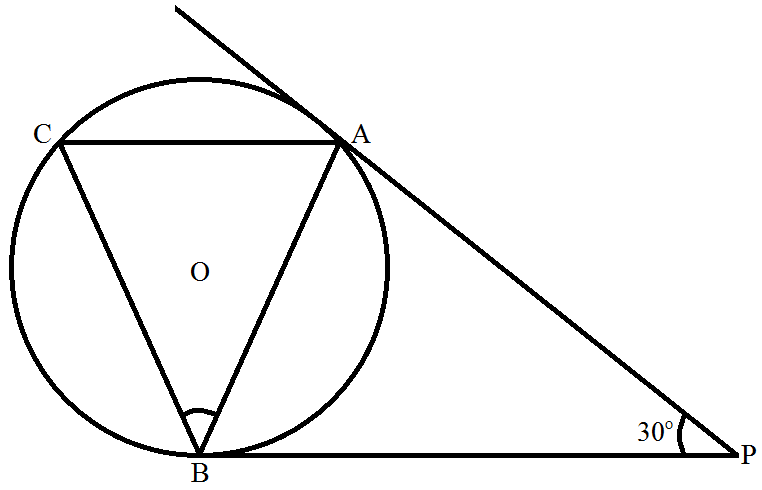
In the figure, if tangents PA and PB are drawn to a circle such that $\angle\text{APB}=30^\circ$ and chord AC is drawn parallel to the tangent PB, then $\angle\text{ABC}$ =
  • A
    60°
  • B
    90°
  • 30°
  • D
    None of these
Answer
Correct option: C.
30°

By property of tangent PA = PB (tangent from P)
then, In $\triangle\text{ABP}$
PA = PB and $\angle\text{PAB}=\angle\text{ABP}$
Sum of all angles of triangle APB is 180°
$\angle\text{PAB}+\angle\text{ABP}+\angle\text{APB}=180^\circ$
$\Rightarrow\angle\text{ABP}+\angle\text{ABP}+30^\circ=180^\circ$
$\Rightarrow2\angle\text{ABP}=150^\circ$
$\Rightarrow\angle\text{ABP}=75^\circ$
$\angle\text{ABP}=\angle\text{BAC}=75^\circ$(Alternate algles)
$\angle\text{ABP}=\angle\text{ACB}=75^\circ$(Alternate segment theorem)
Now, sum of all angles of $\triangle\text{ABC}$ 180°
$\Rightarrow\angle\text{BAC}+\angle\text{ACB}+\angle\text{ABC}=180^\circ$
$\Rightarrow75^\circ+75^\circ+\angle\text{ABC}=180^\circ$
$\Rightarrow\angle\text{ABC}=30^\circ$
View full question & answer
MCQ 311 Mark
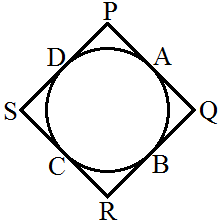
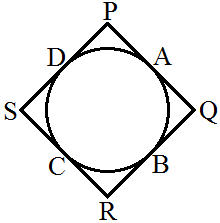
In the given figure, if quadrilateral PQRS circumscribes a circle, then PD + QB =
  • PQ
  • B
    QR
  • C
    PR
  • D
    PS
Answer
Correct option: A.
PQ

We know that tangents drawn to a circle from the same external point will be equal in length.
Therefore,
PD = PA …… (1)
QB = QA …… (2)
Adding equations (1) and (2), we get,
PD + QB = PA + QA
By looking at the figure we can say,
PD + QB = PQ.
View full question & answer
MCQ 321 Mark
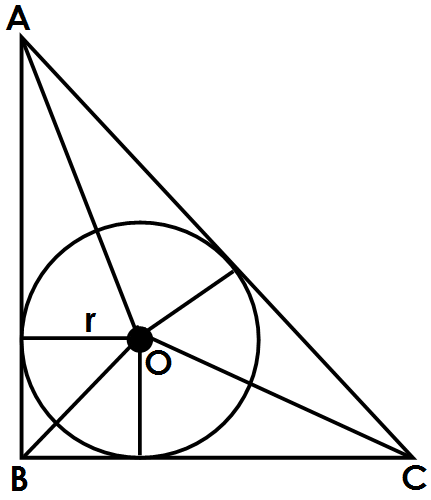
In a right triangle $\text{ABC,}$ right angled at $B, BC = 12\ cm$ and $AB = 5\ cm.$ The radius of the circle inscribed in the triangle $($in $cm)$ is:
  • A
    $4$
  • B
    $3$
  • $2$
  • D
    $1$
Answer
Correct option: C.
$2$

$\Rightarrow AC^2 = AB^2 + (BC)^2 [$Pythagoras theorem$]$
$\Rightarrow AC^2 = 25 + 144 = 169$
$\Rightarrow AC = 13\ cm$
$\text{ar}.\ \text{of}\ \triangle\text{ABC}$ $=\text{ar}.\ \text{of}\ \triangle\text{AOB}$ $+\text{ar}.\ \text{of}\ \triangle\text{BOC}$ $+\text{ar}.\ \text{of}\ \triangle\text{AOC}$
$\frac{5\times12}{2}=\frac{\text{AB}\times\text{r}}{2}+\frac{\text{BC}\times\text{r}}{2}+\frac{\text{AC}\times\text{r}}{2}$
$60=\text{r}(\text{AB}+\text{BC}+\text{AC})$ $[\because\text{Area}\ \text{of}\ \triangle=\frac{\text{Base}\times\text{Corr.alt}}{2}]$
$60=\text{r}(5+12+13)$
$60=30\text{r}\Rightarrow\text{r}=2\text{cm}$
View full question & answer
MCQ 331 Mark
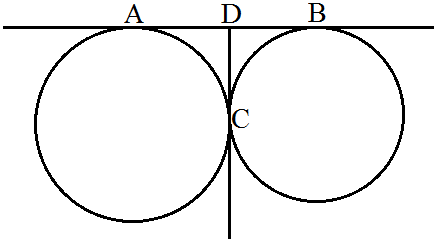
AB and CD are two common tangents to circles which touch each other at C. If D lies on AB such that CD = 4cm, then AB is equal to:
  • A
    4cm
  • B
    6cm
  • 8cm
  • D
    12cm
Answer
Correct option: C.
8cm

By property of tangent,
AD = DC (tangent from D)
DB = DC (tangent from D)
Given, DC = 4cm
Now, we have to find AB
AB = AD + DB
⇒ AB = DC + DC
⇒ AB = 2DC
⇒ AB = 2 × 4
⇒ AB = 8cm
View full question & answer
MCQ 341 Mark
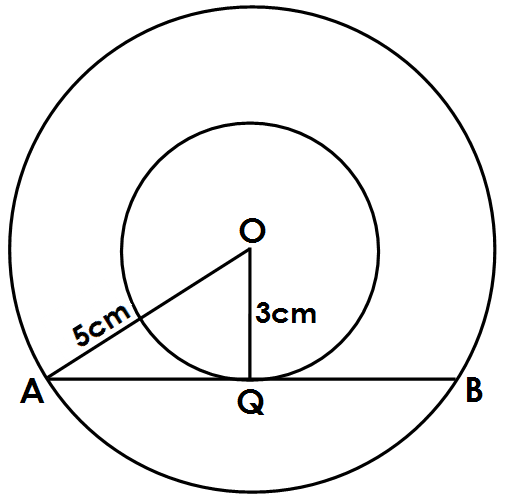
Two concentric circles of radii $3\ cm$ and $5\ cm$ are given. Then length of chord $BC$ which touches the inner circle at $P$ is equal to:
  • A
    $4\ cm$
  • B
    $6\ cm$
  • $8\ cm$
  • D
    $10\ cm$
Answer
Correct option: C.
$8\ cm$

Here, radius $OQ \bot$ to tangent $AB$ then we say,
$\angle\text{OQA}=\angle\text{OQB}=90^\circ$
and $\triangle\text{OQA}$ is right angle triangle then,
$AQ^2 = OA^2 - OQ^2$
$\Rightarrow AQ2 = 5^2 - 3^2$
$\Rightarrow AQ^2 = 25 - 9$
$\Rightarrow\text{AQ}^2=\sqrt{16}$
$\Rightarrow AQ = 4\ cm$
By property of tangent.
$BQ = BP($tangent from point $B)$
$\because OQ$ bisects $AB$ then $AQ = QB = 4\ cm$
$OP$ bisects $AB$ then $BP = PC = 4\ cm$
Now, we have to find $BC,$
$BC = BP + PC$
$\Rightarrow BC = 4 + 4$
$\Rightarrow BC = 8\ cm.$
View full question & answer
MCQ 351 Mark
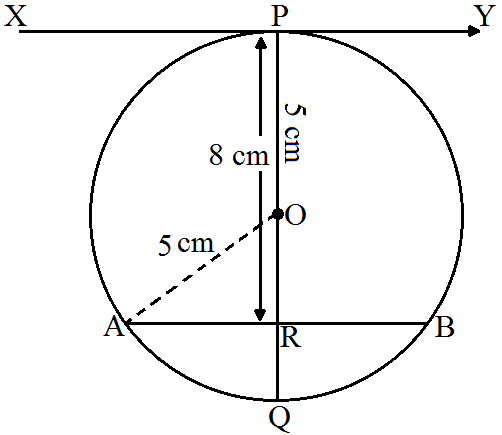
At one end of a diameter $PQ$ of a circle of radius $5\ cm,$ tangent $\text{XPY}$ is drawn to the circle. The length of chord $AB$ parallel to $XY$ and at distance of $8\ cm$ from $P$ is:
  • A
    $5\ cm$
  • B
    $6\ cm$
  • C
    $7\ cm$
  • $8\ cm$
Answer
Correct option: D.
$8\ cm$

In the figure, $PQ$ is diameter $\text{XPY}$ is tangent to the circle with centre $O$ and radius $5 \ cm$ From $P$ , at a distance of $8 \ cm A B$ is a chord drawn parallel to $X Y$.
To find the length of $A B$ Join $O A$
$XY$ is tangent and $OP$ is the radius.
$O P \perp X Y$ or $P Q \perp X Y$
$A B \| X Y$
$O Q$ is $\perp A B$ which meets $A B$ at $R$
Now in right $\triangle OAR$
$O A^2=O R^2+A R^2$
$(5)^2=(3)^2+A R^2$
$25=9+A R^2$
$\Rightarrow A R^2=25-9=16=(4)^2$
$A R=4 \ cm$
But $R$ is mid$-$point of $A B$
$AB=2 AR=2 \times 4=8 \ cm$
View full question & answer
MCQ 361 Mark
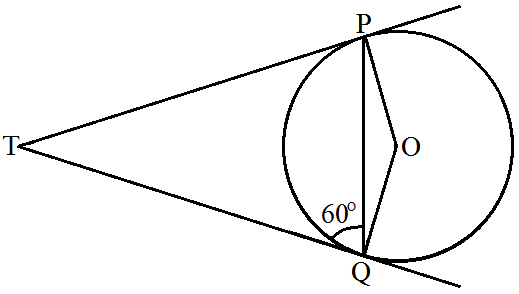
In the figure, if TP and TQ are tangents drawn from an external point T to a circle with centre O such that$\angle\text{TQP}=60^\circ,$ then:
  • A
    25°
  • 30°
  • C
    40°
  • D
    60°
Answer
Correct option: B.
30°
In the figure, TP and TQ are the tangents drawn from T to the circle with centre O. OP, OQ and PQ are joined.
$\angle\text{TQP}=60^\circ$
TP = TQ (Tangents from T to the circle)
$\angle\text{TPQ}=\angle\text{TQP}=60^\circ$
$\angle\text{PTQ}=180^\circ-(60^\circ+60^\circ)=180^\circ-120^\circ=60^\circ$
and $\angle\text{PTQ}=180^\circ-(60^\circ+60^\circ)=180^\circ-120^\circ=60^\circ$
But OP = OQ (radii of the same circle.)
$\angle\text{OPQ}=\angle\text{OQP}$
But $\angle\text{OPQ}+\angle\text{OQP}=180^\circ-120^\circ=60^\circ$
But $\angle\text{OQP}=30^\circ$
View full question & answer
MCQ 371 Mark
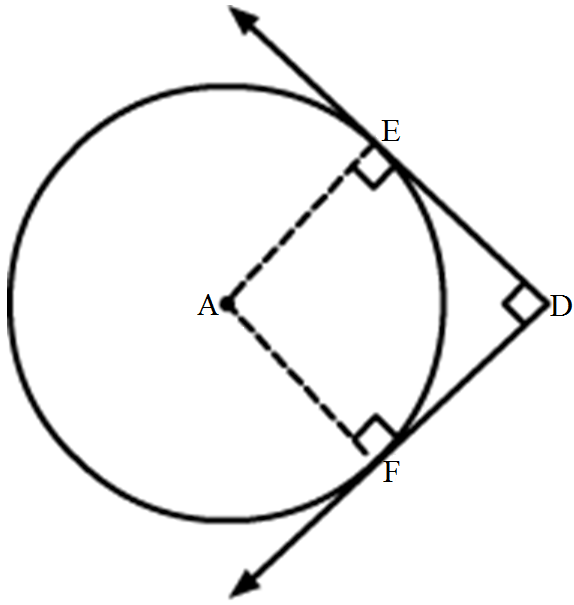
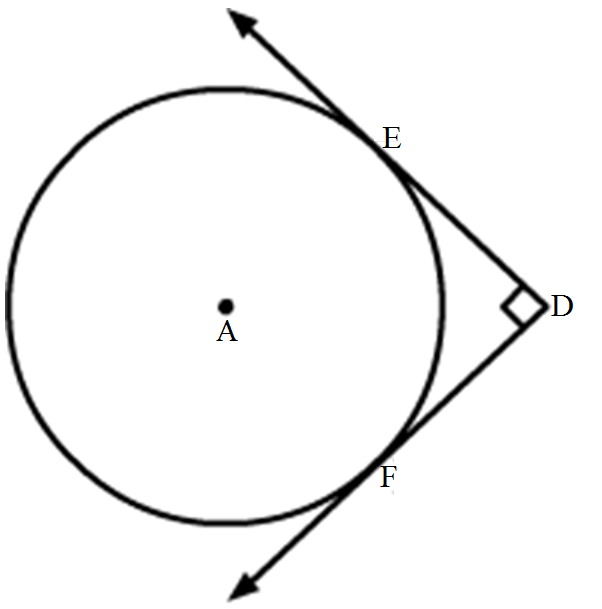
In the given figure, DE and DF are tangents from an external point D to a circle with centre A. If DE = 5cm and DE ⊥ DF, then the radius of the circle is:
  • A
    3cm
  • 5cm
  • C
    4cm
  • D
    6cm
Answer
Correct option: B.
5cm

join AE and AF.
Now, DE is a tangent at E and AE is the radius through the point of contact E.
$\therefore\angle\text{AED}=90^\circ$(Tangent at any point of a circle is perpendicular to the radius through the point of contact)
Also, DF is a tangent at F and AF is the radius through the point of contct F.)
$\therefore\angle\text{AFD}=90^\circ$(Tangent at any point of a circle is perpendicular to the radius through the point of contact)
$\therefore\angle\text{EDF}=90^\circ\ (\text{DE}\bot\text{DF})$
Also, DF = DE (length of tangents drawn from an external point to a circle are equal)
so, AEDF is a square.
$\therefore$ AE = AF = DE = 5cm (sides if square are equal)
Thus, the radius of the circle is 5cm.
View full question & answer
MCQ 381 Mark
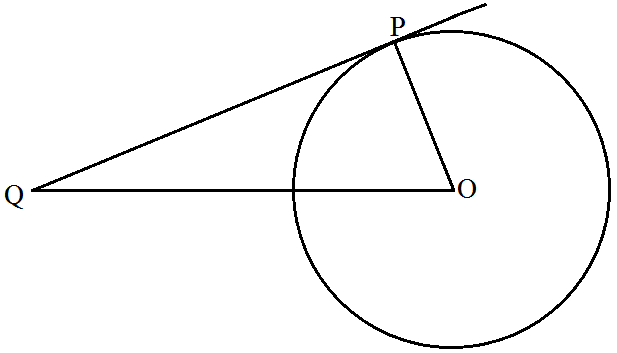
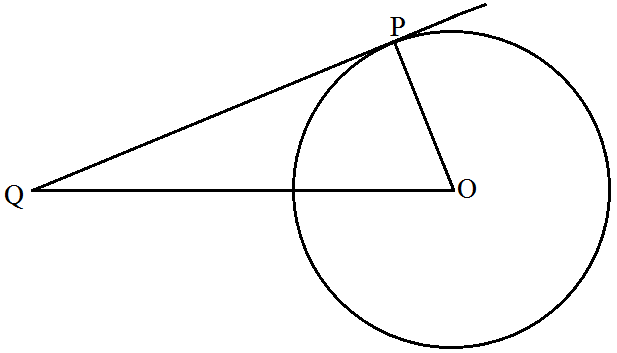
A tangent $PQ$ at a point $P$ of a circle of radius $5\ cm$ meets a line through the centre $O$ at a point $Q$ such that $OQ = 12\ cm$. Length $PQ$ is:
  • A
    $12\ cm$
  • B
    $13\ cm$
  • C
    $8.5\ cm$
  • $\sqrt{119}\text{cm}$
Answer
Correct option: D.
$\sqrt{119}\text{cm}$
Let us first put the given data in the form of a diagram.

Given data is as follows:
$O Q=12 \ cm$
$O P=5 \ cm$
We have to find the length of $QP.$
We know that the radius of a circle will always be perpendicular to the tangent at the point of contact.
Therefore, $OP$ is perpendicular to $QP.$ We can now use Pythagoras theorem to find the length of $QP.$
$Q P^2=O Q^2-O P^2$
$Q P^2=12^2-5^2$
$Q P^2=144-25$
$Q P^2=119$
$Q P \sqrt{119}$
Therefore the correct answer is choice $(d).$
View full question & answer
MCQ 391 Mark
In the figure, if AP = PB, then:
  • A
    AC = AB
  • AC = BC
  • C
    AQ = QC
  • D
    AB = BC
Answer
Correct option: B.
AC = BC

In the figure, AP = PB
But AP and AQ are the tangent from A to the circle.
AP = AQ
Similarly PB = BR
But AP = PB (given)
AQ = BR ….(i)
But CQ and CR the tangents drawn from C to the circle
CQ = CR
Adding in (i)
AQ + CQ = BR + CR
AC = BC
View full question & answer
MCQ 401 Mark
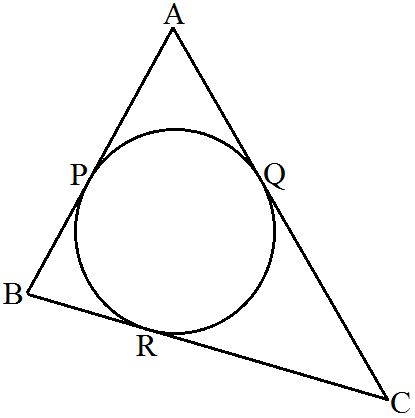
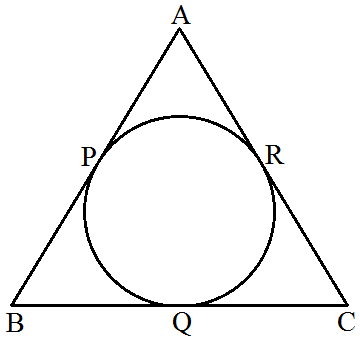
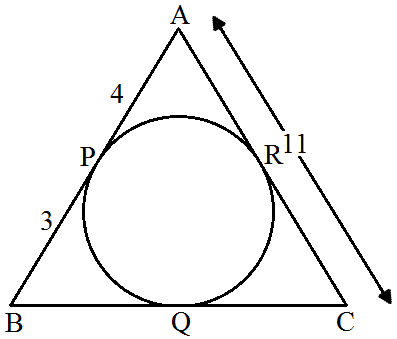
In the given figure, the sides AB, BC and CA of triangle ABC, touch a circle at P, Q and R respectively. If PA = 4cm, BP = 3cm and AC = 11cm, then length of BC is:
  • A
    11cm
  • 10cm
  • C
    14cm
  • D
    15cm
Answer
Correct option: B.
10cm

By property of tangent
AP = AR = 4cm(tangent from A) ...(i)
BP = BQ = 3cm(tangent from B) ...(ii)
RC = QC(tangent from C) ...(iii)
AC = 11cm(given)
Now, we have to find BC
BC = BQ + QC
⇒ BC = 3 + RC [from eq. (ii) and (iii)]
⇒ BC = 3 + (AC + AR) [from fig]
⇒ BC = 3 + (11 - 4) [from eq. (i)]
⇒ BC = 3 + 7
⇒ BC = 10cm
View full question & answer
MCQ 411 Mark
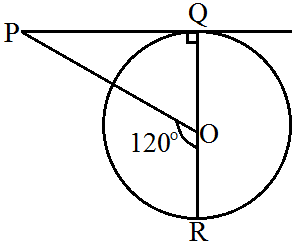
PQ is a tangent drawn from a point P to a circle with centre O and QOR is a diameter of the circle such that $\angle\text{POR}=120^{\circ}$ then $\angle\text{OPQ}$ is:
  • A
    60°
  • B
    45°
  • 30°
  • D
    90°
Answer
Correct option: C.
30°

we know, radius always $\bot$ to tangent, then
$\angle\text{PQO}=90^{\circ}(\text{OQ}\bot\text{PQ})$
Given, $\angle\text{POR}=120^{\circ}$
then, $\angle\text{POQ}=\angle\text{QOR}-\angle\text{POR}$
$\Rightarrow\angle\text{POQ}=180^{\circ}-120^{\circ}$
$\Rightarrow\angle\text{POQ}=60^{\circ}$
Now, In $\triangle\text{OPQ}$
Sum of all angles are equal to $180^{\circ}$
then,
$\angle\text{OPQ}+\angle\text{POQ}+\angle\text{PQO}=180^{\circ}$
$\Rightarrow\angle\text{OPQ}+90^{\circ}+60^{\circ}=180^{\circ}$
$\Rightarrow\angle\text{OPQ}+150^{\circ}=180^{\circ}$
$\Rightarrow\angle\text{OPQ}=30^{\circ}$
View full question & answer
MCQ 421 Mark
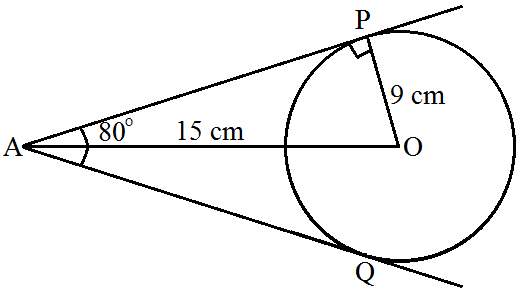
$AP$ and $AQ$ are tangents drawn from a point $A$ to a circle with centre $O$ and radius $9\ cm.$ If $OA = 15\ cm,$ then $AP + AQ =$
  • A
    $12\ cm$
  • B
    $18\ cm$
  • $24\ cm$
  • D
    $36\ cm$
Answer
Correct option: C.
$24\ cm$

By the property of tangent
$A P=A Q($tangent from $A )...(i)$
We know, radius always $\perp$ to tangent then $\triangle OPQ$ is right angle triangle the $\angle OPA =90^{\circ}$
Now, $A P^2=O A^2-O P^2$
$\Rightarrow A P^2=15^2-9^2$
$\Rightarrow A P^2=225-81$
$\Rightarrow A P=\sqrt{144}$
$\Rightarrow A P=12 \ cm$
we have to find $A P+A Q=12+12=24 \ cm[$ from $( i )]$
View full question & answer
MCQ 431 Mark
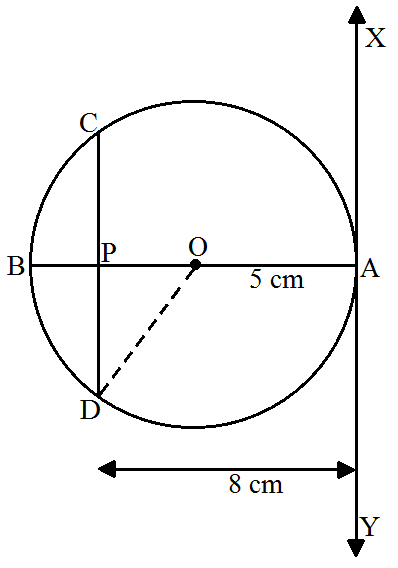
At one end $A$ of a diameter $AB$ of a circle of radius $5\ cm,$ tangent $\text{XAY}$ is drawn to the circle. The length of the chord $CD$ parallel to $XY$ and at a distance $8\ cm$ from $A$ is :
  • A
    $4\ cm$
  • B
    $5\ cm$
  • C
    $6\ cm$
  • $8\ cm$
Answer
Correct option: D.
$8\ cm$

$XY$ is the tangent to the circle with centre $O$.
$CD$ is the chord.
$OA = OB = OD = 5\ cm\ ($radii$)$
$PA = 8\ cm$
$PO = 3\ cm$
In $\triangle\text{POD},$
$\Rightarrow P D^2+P O^2=O D^2$
$\Rightarrow 3^2+P D^2=5^2$
$\Rightarrow P D^2=25-9=16$
$\Rightarrow P D=4 \mathrm{~cm}$
Hence, $C D=C P+P D$
$=4+4=8 \mathrm{~cm}$.
View full question & answer
MCQ 441 Mark
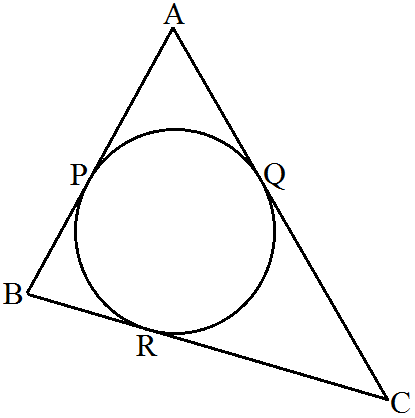
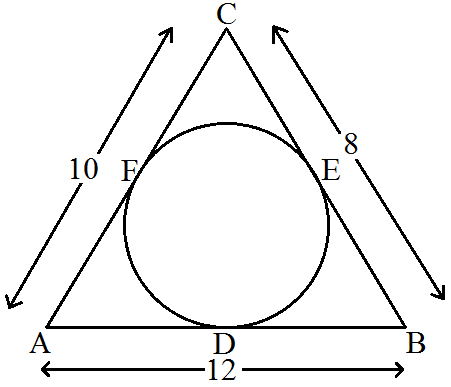
In the adjacent figure, if AB = 12cm, BC = 8cm and AC = 10cm, then AD =
  • A
    5cm
  • B
    4cm
  • C
    6cm
  • 7cm
Answer
Correct option: D.
7cm

Given,
AB = AD + DB = 12cm...(i)
BC = BE + EC = 8cm...(ii)
CA + CF + FA = 10cm...(iii)
from the property of tangent
AD = AF ( tangent from A ) ...(iv)
DB = BE ( tangent from A ) ...(v)
CF = CE ( tangent from A ) ...(vi)
Now, we have to find AD
By substracting eq.(ii) from eq.(i), then
⇒ AD + DB - (BE + EC) = 12 - 8
⇒ AD + BE - BE - CF = 4 [ from eq.(v) ]
⇒ AD - CF = 4
⇒ AD - (10 - AF) = 4 [ from eq,(iii) ]
⇒ AD - 10 + AF = 4
⇒ AD - 10 + AD = 4
⇒ 2AD = 14
⇒ AD = 7
View full question & answer
MCQ 451 Mark
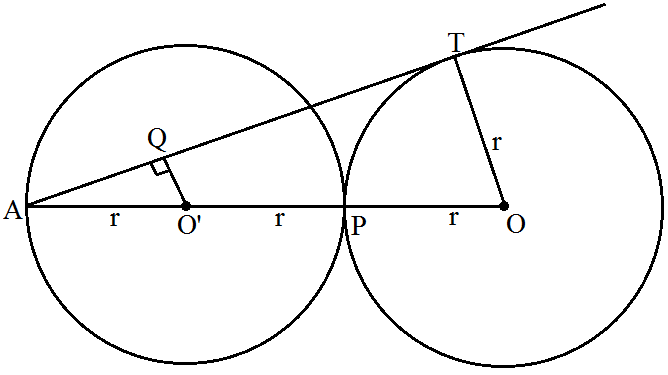
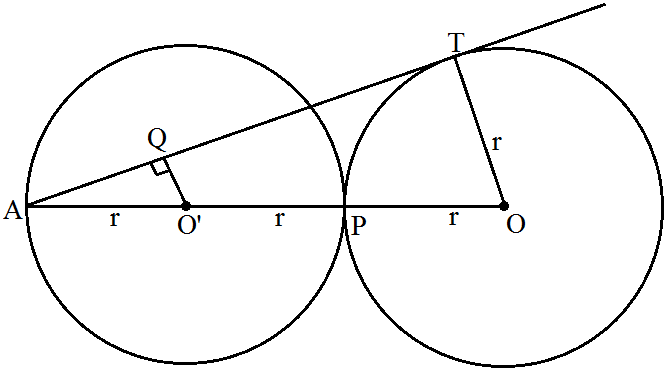
Two circles of same radii r and centres O and O' touch each other at P as shown in. If O O' is produced to meet the circle C (O', r) at A and AT is a tangent to the
circle C (O,r) such that O'QAT. Then AO: AO' =
  • A
    3/2
  • B
    2
  • 3
  • D
    1/4
Answer
Correct option: C.
3

From the given figure we have,
AO = r + r + r
AO = 3r
AO’ = r
Therefore,
$\frac{\text{AO}}{\text{AO'}}=\frac{3\text{r}}{\text{r}}$
$\frac{\text{AO}}{\text{AO'}}=3$
Also as $\text{O'Q}\parallel\text{OT}$ therefore $\frac{\text{AT}}{\text{AQ}}=\frac{\text{AO}}{\text{AO'}}$
View full question & answer
MCQ 461 Mark
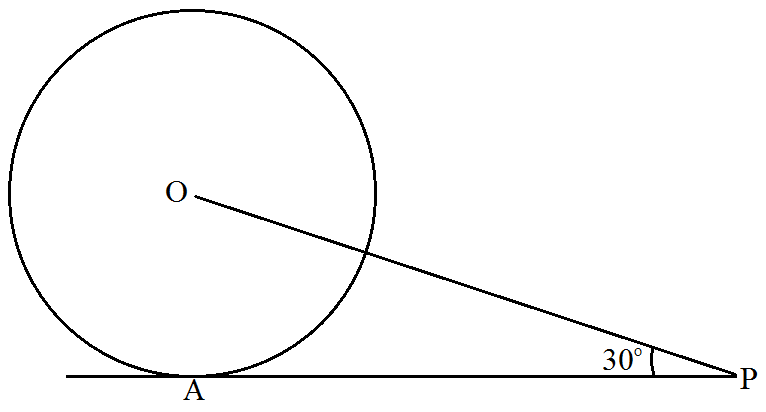
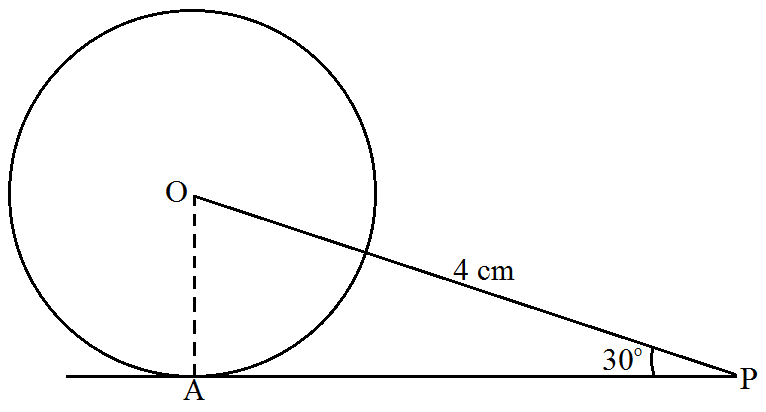
In the figure, AP is a tangent to the circle with centre O such that OP = 4cm and $\angle\text{OPA}=30^{\circ}$. Then, AP =
  • A
    $2\sqrt{2}\text{cm}$
  • B
    $2\text{cm}$
  • $2\sqrt{3}\text{cm}$
  • D
    $3\sqrt{2}\text{cm}$
Answer
Correct option: C.
$2\sqrt{3}\text{cm}$
In the figure, AP is the tangent to the circle with centre O such that OP = 4cm, $\angle\text{OPA}=30^{\circ}$
Join OA, let AP = x


$\cos30^{\circ}=\frac{\text{AP}}{\text{OP}}$
$\Rightarrow\frac{\sqrt{3}}{2}=\frac{\text{x}}{4}\Rightarrow\text{x}=\frac{4\times\sqrt{3}}{2}=2\sqrt{3}\text{cm}$
View full question & answer
MCQ 471 Mark
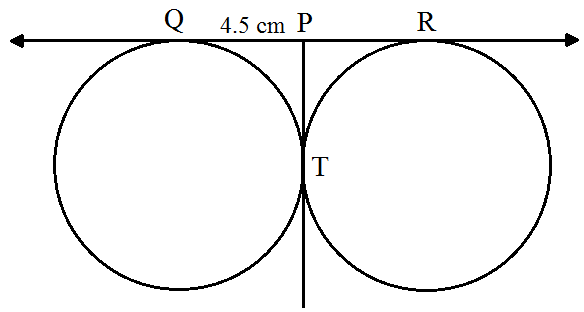
In the figure, two equal circles touch each other at T, if QP = 4.5cm, then QR =
  • 9cm
  • B
    18cm
  • C
    15cm
  • D
    13.5cm
Answer
Correct option: A.
9cm


In the figure, two equal circles touch, each other externally at T
QR is the common tangent QP = 4.5cm
PQ = PT (tangents from P to the circle)
Similarly PT = PR
PQ = PT = PR
Now QR = PQ + PR = 4.5 + 4.5 = 9cm
View full question & answer
MCQ 481 Mark
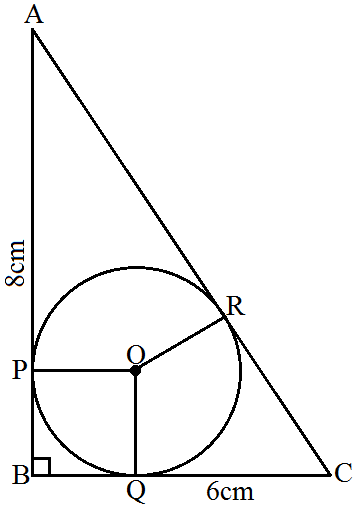
$\text{ABC}$ is a right angled triangle, right angled at $B$ such that $BC = 6\ cm$ and $AB = 8\ cm$. A circle with centre $O$ is inscribed in $\triangle \text{ABC.}$ The radius of the circle is:
  • A
    $1\ cm$
  • $2\ cm$
  • C
    $3\ cm$
  • D
    $4\ cm$
Answer
Correct option: B.
$2\ cm$
In a right $\triangle\text{ABC},$
$\angle\text{B}=90^{\circ}$
$BC = 6\ cm, AB = 8\ cm$

$A C^2=A B^2+B C^2 \text { (Pythagoras Theorem) }$
$=(8)^2+(6)^2=64+36=100=(10)^2$
$A C=10 \ cm$
An incircle is drawn with centre $0$ which touches the sides of the triangle $\text{ABC}$ at $P, Q$ and $\text{ROP, OQ}$ and $O R$ are radii and $\text{AB, BC}$ an $C A$ are the tangents to the circle.
$O P \perp A B, O Q \perp B C$ and $O R \perp C A$
$\text{OPBQ}$ is a square.
Let $r$ be the radius of the incircle.
$P B=B Q=r$
$A R=A P=8-r,$
$C Q=C R=6-r$
$A C=A R+C$
$\Rightarrow 10=8-r+6-r$
$\Rightarrow 10=14-2 r$
$\Rightarrow 2 r=14-10=4$
$\Rightarrow r=2$
Radius of the incircle $=2 \ cm$.
View full question & answer
MCQ 491 Mark
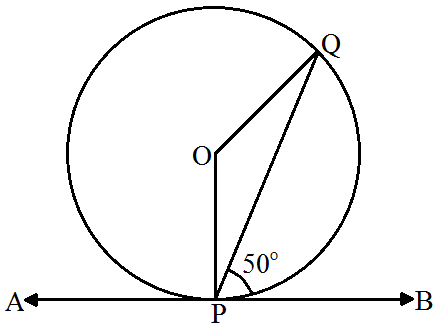
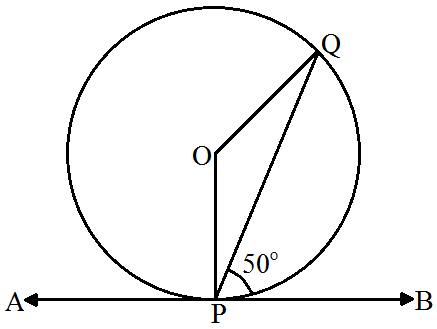
In the figure, APB is a tangent to a circle with centre O at point P. If $\angle\text{QPB}=50^\circ$ then the measure of $\angle\text{POQ}$ is:
  • 100°
  • B
    120°
  • C
    140°
  • D
    150°
Answer
Correct option: A.
100°

In the figure, APB is a tangent to the circle with centre O.
$\angle\text{QPB}=50^\circ$
OP is radius and APB is a tangent.
OP ⊥ AB
$\Rightarrow\text{OPB}=90^\circ$
$\Rightarrow\angle\text{OPQ}+\angle\text{QPB}=90^\circ$
$\angle\text{OPQ}+50^\circ=90^\circ$
$\Rightarrow\angle\text{OPQ}=90^\circ-50^\circ=40^{\circ}$
But OP = OQ
$\angle\text{OPQ}=\angle\text{OQP}=40^{\circ}$
$\angle\text{POQ}=180^{\circ}-(40^{\circ}+40^{\circ})=180^{\circ}-80^{\circ}=100^{\circ}$
View full question & answer
MCQ 501 Mark
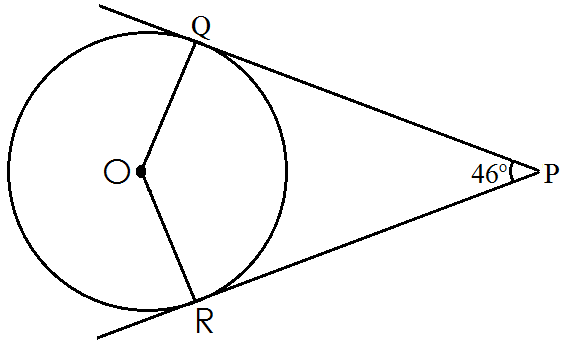
In the figure, PQ and PR are two tangents to a circle with centre O. If $\angle\text{QPR}=46^\circ$ then $\angle\text{QOR}$ equals:
  • A
    67°
  • 134°
  • C
    44°
  • D
    46°
Answer
Correct option: B.
134°
$\angle\text{OQP}=90^\circ$ [Tangent is ⊥ to the radius through the point of contact]
$\angle\text{ORP}=90^\circ$
$\angle\text{OQP}+\angle\text{QPR}+\angle\text{ORP}+\angle\text{QOR}=360^\circ$ [Angle sum property of a quad.]
$90^\circ+46^\circ+90^\circ+\angle\text{QOR}=360^\circ$
$\angle\text{QOR}=360^\circ-90^\circ-46^\circ-90^\circ=134^\circ$
View full question & answer
M.C.Q (1 Marks) - Maths STD 10 Questions - Vidyadip