Questions · Page 2 of 3

M.C.Q (1 Marks)

MCQ 511 Mark
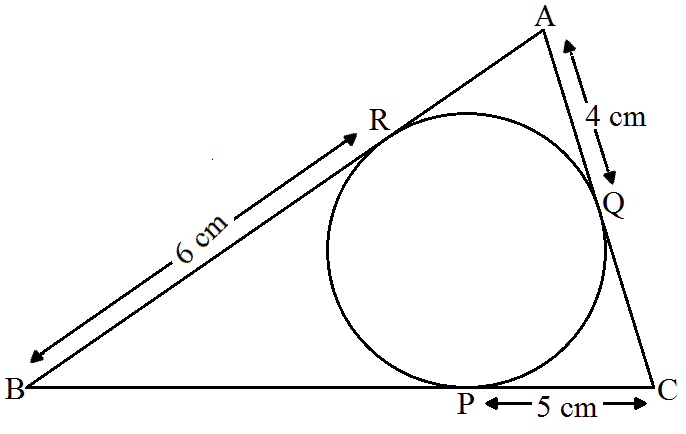
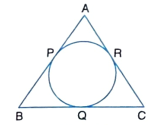
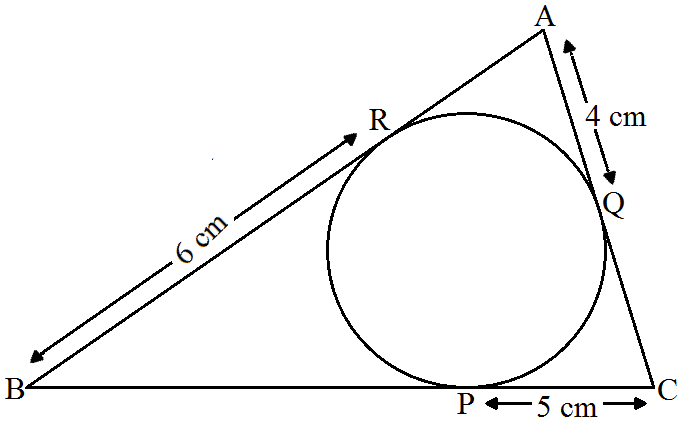
In the figure, the perimeter of $\triangle\text{ABC}$ is:
  • 30cm
  • B
    60cm
  • C
    45cm
  • D
    15cm
Answer
Correct option: A.
30cm

By the property of tangent
AO = AR = 4cm (tangent from A)
BR = BP = 6cm (tangent from B)
PC = CQ = 5cm (tangent from C)
Perimeter of $\triangle\text{ABC}$ = AB + BC + CA
Perimeter of $\triangle\text{ABC}$ = AR + BR + BP + PC + CQ + QA
Perimeter of $\triangle\text{ABC}$ = 4 + 6 + 6 + 5 + 5 + 4
Perimeter of $\triangle\text{ABC}$ = 30cm
View full question & answer
MCQ 521 Mark
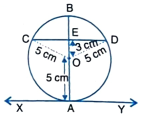
At one end $A$ of a diameter $A B$ of a circle of radius 5 cm , tangent $X A Y$ is drawn to the circle. The length of the chord $C D$ parallel to $X Y$ and at a distance 8 cm from $A$ is
Image
  • A
    4 cm
  • B
    5 cm
  • C
    6 cm
  • 8 cm
Answer
Correct option: D.
8 cm
(D)8 cm
In right triangle $O E D$,
$
\begin{array}{ll}
& O D^2=O E^2+E D^2 \\
\Rightarrow & E D=\sqrt{O D^2-O E^2}=\sqrt{25-9}=4 cm \\
\text { Hence, } \quad & C D=2 E D=8 cm
\end{array}
$
View full question & answer
MCQ 531 Mark
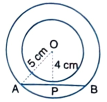
17 If radii of two concentric circles are 4 cm and 5 cm , then the length of each chord of one circle which is tangent to the other circle is
Image
  • A
    3 cm
  • 6 cm
  • C
    9 cm
  • D
    1 cm
Answer
Correct option: B.
6 cm
(B)6 cm
Let $O$ be the common centre and $A B$ be a chord of the bigger circle touching the smaller circle at $P$. Clearly, $P$ is the mid-point of $A B$. Applying Pythagoras Theorem in $\triangle O P A$, we obtain
$
O A^2=O P^2+A P^2 \Rightarrow 5^2=4^2+A P^2 \Rightarrow A P=3 cm
$
Hence, $A B=2 A P=6 cm$.
View full question & answer
MCQ 541 Mark
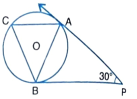
In Fig. if tangents PA and $P B$ are drawn to a circle such that $\angle A P B=30^{\circ}$ and chord $A C$ is drawn parallel to the tangent $P B$, then $\angle A B C=$
Image
  • A
    $60^{\circ}$
  • B
    $90^{\circ}$
  • $30^{\circ}$
  • D
    none of these
Answer
Correct option: C.
$30^{\circ}$
(C)$30^{\circ}$
In $\triangle P A B$, we have
$
P A=P B \Rightarrow \angle P A B=\angle P B A
$
But, $\quad \angle P A B+\angle P B A+\angle A P B=180^{\circ}$
$
\Rightarrow \quad 2 \angle P A B+30^{\circ}=180^{\circ} \Rightarrow \angle P A B=75^{\circ}=\angle P B A
$
Given that $A C$ is parallel to $P B$.
$
\therefore \quad \angle B A C=\angle P B A \Rightarrow \angle B A C=75^{\circ}
$
Since angles in the alternate segments are equal. Therefore,
$
\angle P B A=\angle A C B \Rightarrow \angle A C B=75^{\circ}
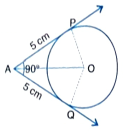
$
Thus, in $\triangle A B C$, we have $\angle B A C=75^{\circ}$ and $\angle A C B=75^{\circ}$. Therefore, $\angle A B C=30^{\circ}$
View full question & answer
MCQ 551 Mark
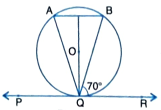
In Fig. if $P Q R$ is the tangent to a circle at $Q$ whose centre is $O, A B$ is a chord parallel to $P R$ and $\angle B Q R=70^{\circ}$, then $\angle A Q B$ is equal to
Image
  • A
    $20^{\circ}$
  • $40^{\circ}$
  • C
    $35^{\circ}$
  • D
    $45^{\circ}$
Answer
Correct option: B.
$40^{\circ}$
(B)$40^{\circ}$
Given that $P Q R$ is tangent to the circle at $Q$ and $O$ is the centre of the circle. Therefore, $O Q \perp P R$ i.e. $\angle O Q R=90^{\circ} \Rightarrow \angle O Q B=20^{\circ}$.
Now, $\quad A B \| P R$ and $\angle B Q R=70^{\circ} \Rightarrow \angle A B Q=70^{\circ}$
We find that
$\angle Q A B=\angle B Q R\qquad$ [Angles in alternate segments]
$
\Rightarrow \quad \angle Q A B=70^{\circ}
$
Using angle sum property in $\triangle Q A B$, we obtain
$
\angle Q A B+\angle Q B A+\angle A Q B=180^{\circ} \Rightarrow 70^{\circ}+70^{\circ}+\angle A Q B=180^{\circ} \Rightarrow \angle A Q B=40^{\circ}
$
View full question & answer
MCQ 571 Mark
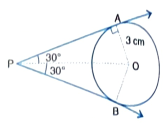
If two tangents inclined at an angle of $60^{\circ}$ are drawn to a circle of radius 3 cm , then length of each tangent is equal to
Image
  • A
    $\frac{3 \sqrt{3}}{2} cm$
  • B
    6 cm
  • C
    3 cm
  • $3 \sqrt{3} cm$
Answer
Correct option: D.
$3 \sqrt{3} cm$
(D)$3 \sqrt{3} cm$
It is given that $\angle A P B=60^{\circ}$. Therefore, $\angle O P A=\frac{1}{2} \angle A P B=30^{\circ}$.
In right triangle $P A O$, we obtain
$
\tan 30^{\circ}=\frac{O A}{A P} \Rightarrow \frac{1}{\sqrt{3}}=\frac{3}{A P} \Rightarrow A P=3 \sqrt{3} cm
$
View full question & answer
MCQ 581 Mark
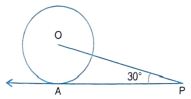
In Fig. $A P$ is a tangent to the circle with centre $O$ such that $O P=4 cm$ and $\angle O P A=30^{\circ}$. Then, $A P=$
Image
  • A
    $2 \sqrt{2} cm$
  • B
    2 cm
  • $2 \sqrt{3} cm$
  • D
    $3 \sqrt{2} cm$
Answer
Correct option: C.
$2 \sqrt{3} cm$
View full question & answer
MCQ 601 Mark
If from a point $A$ which is at a distance of 13 cm from the centre $O$ of a circle of radius 5 cm , the pair of tangent $A B$ and $A C$ to the circle are drawn, then the area of quadrilateral $A B O C$ is
  • $60 cm^2$
  • B
    $120 cm^2$
  • C
    $50 cm^2$
  • D
    $80 cm^2$
Answer
Correct option: A.
$60 cm^2$
View full question & answer
MCQ 611 Mark
If angle between two radii of a circle is $130^{\circ}$, the angle between the tangents at the ends of radii is
  • A
    $90^{\circ}$
  • $50^{\circ}$
  • C
    $70^{\circ}$
  • D
    $40^{\circ}$
Answer
Correct option: B.
$50^{\circ}$
View full question & answer
MCQ 621 Mark
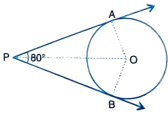
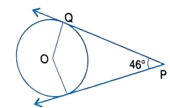
If tangents $P A$ and $P B$ from a point $P$ to a circle with centre $O$ are inclined to each other at an angle of $80^{\circ}$, then $\angle P O A$ is equal to
Image
  • $50^{\circ}$
  • B
    $60^{\circ}$
  • C
    $70^{\circ}$
  • D
    $80^{\circ}$
Answer
Correct option: A.
$50^{\circ}$
(A)$50^{\circ}$
We know that $\angle A P B$ and $\angle A O B$ are supplementary i.e.
$
\begin{array}{ll}
& \angle A P B+\angle A O B=180^{\circ} \\
\Rightarrow & \angle A O B=180^{\circ}-\angle A P B=180^{\circ}-80^{\circ}=100^{\circ} \\
\therefore \quad & \angle P O A=\frac{1}{2} \angle A O B=50^{\circ}
\end{array}
$
View full question & answer
MCQ 631 Mark
If PA and PB are two tangents to a circle with centre $O$ such that $\angle A O B=110^{\circ}$, then $\angle A P B$ is equal to
  • A
    $60^{\circ}$
  • $70^{\circ}$
  • C
    $80^{\circ}$
  • D
    $90^{\circ}$
Answer
Correct option: B.
$70^{\circ}$
(B)$70^{\circ}$
$\angle A P B$ and $\angle A O B$ are supplementary (See Fig. 8.13).
$
\therefore \quad \angle A P B+\angle A O B=180^{\circ} \Rightarrow \angle A P B=180^{\circ}-110^{\circ}=70^{\circ}
$
View full question & answer
MCQ 641 Mark
From a point $Q$, the length of the tangent to a circle is 24 cm and the distance of $Q$ from the centre is 25 cm . The radius of the circle is
  • 7 cm
  • B
    12 cm
  • C
    15 cm
  • D
    24.5 cm .
Answer
Correct option: A.
7 cm
View full question & answer
MCQ 661 Mark
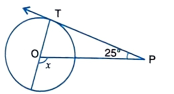
In Fig. if PT is a tangent to the circle with centre $O$ and $\angle T P O=25^{\circ}$, then the measure of $x$ is
Image
  • A
    $120^{\circ}$
  • B
    $125^{\circ}$
  • C
    $110^{\circ}$
  • $115^{\circ}$
Answer
Correct option: D.
$115^{\circ}$
(D)$115^{\circ}$
$P T$ is a tangent to the circle at $T$ and $O T$ is the radius through $T$. Therefore, $\angle O T P=90^{\circ}$.
In $\triangle O P T$, we have $\angle O P T=25^{\circ}, \angle O T P=90^{\circ}$.
Using exterior angle property in $\triangle O P T$, we obtain
$
x=90^{\circ}+25^{\circ}=115^{\circ}
$
View full question & answer
MCQ 671 Mark
A line which intersects a circle in two distinct points, is called a
  • A
    chord
  • B
    tangent
  • secant
  • D
    diameter
Answer
Correct option: C.
secant
View full question & answer
MCQ 681 Mark
A chord of a circle of radius 10 cm subtends a right angle at its centre. The length of the chord is
  • A
    $5 \sqrt{2} cm$
  • $10 \sqrt{2} cm$
  • C
    $5 / \sqrt{2} cm$
  • D
    5 cm
Answer
Correct option: B.
$10 \sqrt{2} cm$
View full question & answer
MCQ 691 Mark
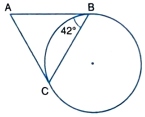
In Fig. $A B$ and $A C$ are tangents to the circle. If $\angle A B C=42^{\circ}$, then the measure of $\angle B A C$ is
Image
  • $96^{\circ}$
  • B
    $42^{\circ}$
  • C
    $106^{\circ}$
  • D
    $86^{\circ}$
Answer
Correct option: A.
$96^{\circ}$
View full question & answer
MCQ 711 Mark
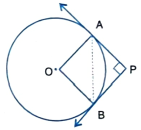
In Fig. tangents $P A$ and $P B$ to the circle centred at $O$, from point $P$ are perpendicular to each other. If $P A=5 cm$, then length of $A B$ is equal to
Image
  • A
    5 cm
  • $5 \sqrt{2} cm$
  • C
    $2 \sqrt{5} cm$
  • D
    10 cm
Answer
Correct option: B.
$5 \sqrt{2} cm$
View full question & answer
MCQ 721 Mark
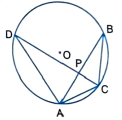
In Fig. $A B$ and $C D$ are two chords of a circle intersecting at $P$. Choose the correct statement from the following:
Image
  • A
    $\triangle A D P \sim \triangle C B A$
  • B
    $\triangle A D P \sim \triangle B P C$
  • C
    $\triangle A D P \sim \triangle B C P$
  • $\triangle A D P \sim \triangle C B P$
Answer
Correct option: D.
$\triangle A D P \sim \triangle C B P$
View full question & answer
MCQ 731 Mark
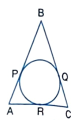
In Fig. $ A B=B C=10 cm$. If $A C=7 cm$, then the length of $B P$ is
Image
  • A
    3.5 cm
  • B
    7 cm
  • 6.5 cm
  • D
    5 cm
Answer
Correct option: C.
6.5 cm
(C)6.5 cm
Let $B C=a, C A=b$ and $A B=c$. Then, $a=c=10 cm$ and $b=7 cm$
Let s be the semi-perimeter of $\triangle A B C$. Then,
$\begin{aligned} & s=\frac{1}{2}(10+10+7) cm =13.5 cm \\ \therefore \quad & B P=B Q=s-b \Rightarrow B P=(13.5-7) cm =6.5 cm\end{aligned}$
$\begin{array}{l}\text { ALITER } \quad A B+B C+C A=(10+10+7) cm \\ \Rightarrow \quad(B P+A P)+(B Q+C Q)+C A=27\end{array}$
$\Rightarrow \quad 2 B P+(A R+C R)+7=27 \qquad[\because B P=B Q$ and $A P=A R, C Q=C R]$
$\Rightarrow \quad 2 B P+A C+7=27 \Rightarrow 2 B P+7+7=27 \Rightarrow 2 B P=13 \Rightarrow B P=6.5 cm$
View full question & answer
MCQ 741 Mark
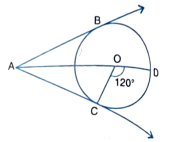
In Fig. $A C$ and $A B$ are tangents to a circle centred at $O$. If $\angle C O D=120^{\circ}$, then $\angle B A O$ is equal to
Image
  • $30^{\circ}$
  • B
    $60^{\circ}$
  • C
    $45^{\circ}$
  • D
    $90^{\circ}$
Answer
Correct option: A.
$30^{\circ}$
(A)$30^{\circ}$
In $\triangle A O C$, using exterior angle property, we obtain
$\begin{array}{ll} & \angle D O C=\angle O C A+\angle O A C \\ \Rightarrow & 120^{\circ}=90^{\circ}+\angle O A C \\ \Rightarrow & \angle O A C=30^{\circ} \\ \Rightarrow & \angle B A O=30^{\circ} \quad[\because \angle B A O=\angle C A O]\end{array}$
View full question & answer
MCQ 751 Mark
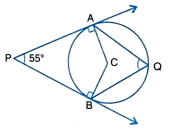
In Fig. PA and PB are tangents from external point $P$ to a circle with centre $C$ and $Q$ is only point on the circle. Then the measure of $\angle A Q B$ is
Image
  • $62 \frac{1}{2}^{\circ}$
  • B
    $125^{\circ}$
  • C
    $55^{\circ}$
  • D
    $90^{\circ}$
Answer
Correct option: A.
$62 \frac{1}{2}^{\circ}$
(A)$62 \frac{1}{2}^{\circ}$
$\angle A P B$ and $\angle A C B$ are supplementary angles.
$
\begin{array}{ll}
\therefore & \angle A P B+\angle A C B=180^{\circ} \\
\Rightarrow & 55^{\circ}+\angle A C B=180^{\circ} \Rightarrow \angle A C B=180^{\circ}-55^{\circ}=125^{\circ}
\end{array}
$
Arc $A B$ makes angle $\angle A C B$ at the centre and $\angle A Q B$ at a point on the circle.
$
\therefore \quad \angle A Q B=\frac{1}{2} \angle A C B=\frac{1}{2} \times 125^{\circ}=62 \frac{1}{2}^{\circ}
$
View full question & answer
MCQ 761 Mark
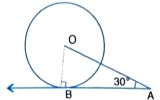
In Fig. $ A B$ is a tangent to the circle centred at $O$. If $O A=6 cm$ and $\angle O A B=30^{\circ}$, then the radius of the circle is
Image
  • 3 cm
  • B
    $3 \sqrt{3} cm$
  • C
    2 cm
  • D
    $\sqrt{3} cm$
Answer
Correct option: A.
3 cm
(A)3 cm
Join $O B$. Clearly, $O B \perp A B$
In $\triangle O B A$, we obtain
$
\sin 30^{\circ}=\frac{O B}{O A} \Rightarrow \frac{1}{2}=\frac{O B}{6} \Rightarrow O B=3 cm
$
View full question & answer
MCQ 771 Mark
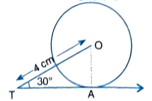
In Fig. $T A$ is a langent to the circle with centre $O$ such that $O T=4 cm, \angle O T A=30^{\circ}$, then length of TA is
Image
  • $2 \sqrt{3} cm$
  • B
    2 cm
  • C
    $2 \sqrt{2} cm$
  • D
    $\sqrt{3} cm$
Answer
Correct option: A.
$2 \sqrt{3} cm$
(A)$2 \sqrt{3} cm$
In triangle $O A T$, we find that $O A \perp T A$. Therefore, $\angle O A T=90^{\circ}$.
In $\triangle O A T$, we obtain
$
\cos 30^{\circ}=\frac{T A}{O T} \Rightarrow \frac{\sqrt{3}}{2}=\frac{T A}{4} \Rightarrow T A=2 \sqrt{3} cm
$
View full question & answer
MCQ 781 Mark
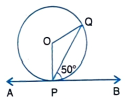
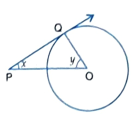
In Fig. PQ is a tangent to the circle with centre $O$. If $\angle O P Q=x, \angle P O Q=y$, then $x+y$ is
Image
  • A
    $45^{\circ}$
  • $90^{\circ}$
  • C
    $60^{\circ}$
  • D
    $180^{\circ}$
Answer
Correct option: B.
$90^{\circ}$
(B)$90^{\circ}$
$P Q$ is tangent to the circle at $Q$ and $O Q$ is radius.
$
O Q \perp P Q \Rightarrow \angle P Q O=90^{\circ}
$
Using angle sum property in $\triangle O P Q$, we obtain
$
\begin{aligned}
& x+y+\angle P Q O=180^{\circ} \\
\Rightarrow \quad & x+y+90^{\circ}=180^{\circ} \Rightarrow x+y=90^{\circ}
\end{aligned}
$
View full question & answer
MCQ 791 Mark
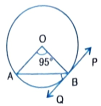
In Fig.$P Q$ is a tangent to the circle centred at $O$. If $\angle A O B=95^{\circ}$, then the measure of $\angle A B Q$ will be
Image
  • $47 \frac{1}{2}^{\circ}$
  • B
    $42 \frac{1}{2}^{\circ}$
  • C
    $85^{\circ}$
  • D
    $95^{\circ}$
Answer
Correct option: A.
$47 \frac{1}{2}^{\circ}$
(A)$47 \frac{1}{2}^{\circ}$
$\triangle A O B$ is an isosceles triangle with $O A=O B$.
$
\therefore \quad \angle O A B=\angle O B A
$
Using angle sum property in $\triangle A O B$, we obtain
$
\begin{array}{ll}
& \angle O A B+\angle O B A+\angle A O B=180^{\circ} \\
\Rightarrow \quad & 2 \angle O A B+95^{\circ}=180^{\circ} \\
\Rightarrow \quad & 2 \times \angle O A B=85^{\circ} \Rightarrow \angle O A B=42 \frac{1}{2}^{\circ} \Rightarrow \angle O B A=42 \frac{1}{2}^{\circ}
\end{array}
$
Fig. 8. 17
Now, $\quad O B \perp P Q$
$
\Rightarrow \quad \angle O B Q=90^{\circ} \Rightarrow \angle O B A+\angle A B Q=90^{\circ} \Rightarrow 42 \frac{1}{2}^{\circ}+\angle A B Q=90^{\circ} \Rightarrow \angle A B Q=47 \frac{1}{2}^{\circ}
$
View full question & answer
MCQ 801 Mark
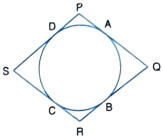
In Fig. if quadrilateral $P Q R S$ circumscribes a circle, then $P D+Q B=$
Image
  • $P Q$
  • B
    $Q R$
  • C
    $P R$
  • D
    $P S$
Answer
Correct option: A.
$P Q$
View full question & answer
MCQ 811 Mark
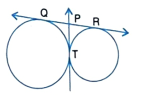
In Fig. $Q R$ is a common tangent to the given circles touching externally at the point $T$. The tangent at $T$ meets $Q R$ at $P$. If $P T=3.8 cm$, then the length of $Q R( in cm )$ is
Image
  • A
    3.8
  • 7.6
  • C
    5.7
  • D
    1.9
Answer
Correct option: B.
7.6
View full question & answer
MCQ 841 Mark
Two circles touch each other externally at $P . A B$ is a common tangent to the circle touching them at $A$ and $B$. The value of $\angle A P B$ is
  • A
    $30^{\circ}$
  • B
    $45^{\circ}$
  • C
    $60^{\circ}$
  • $90^{\circ}$
Answer
Correct option: D.
$90^{\circ}$
View full question & answer
MCQ 851 Mark
In a right triangle $A B C$, right angled at $B, B C=12 cm$ and $A B=5 cm$. The radius of the circle inscribed in the triangle (in cm ) is
  • A
    4
  • B
    3
  • 2
  • D
    1
Answer
Correct option: C.
2
View full question & answer
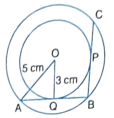
MCQ 861 Mark
In Fig. two concentric circles of radii 3 cm and 5 cm are given. Then length of chord $B C$ which touches the inner circle at $P$ is equal to
Image
  • A
    4 cm
  • B
    6 cm
  • 8 cm
  • D
    10 cm
Answer
Correct option: C.
8 cm
View full question & answer
MCQ 871 Mark
The maximum number of common tangents that can be drawn to two circles intersecting at two distinct points is
  • A
    1
  • 2
  • C
    3
  • D
    4
Answer
Correct option: B.
2
View full question & answer
MCQ 881 Mark
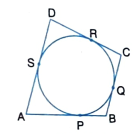
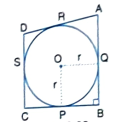
In Fig. a circle with centre $O$ is inscribed in a quadrilateral $A B C D$ such that, it touches sides $B C, A B, A D$ and $C D$ at points $P, Q, R$ and $S$ respectively. If $A B=29 cm, A D=23 cm$, $\angle B=90^{\circ}$ and $D S=5 cm$, then the radius of the circle (in cm ) is
Image
  • 11
  • B
    18
  • C
    6
  • D
    15
Answer
Correct option: A.
11
View full question & answer
MCQ 901 Mark
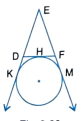
In Fig. a circle touches the side $D F$ of $\triangle E D F$ at $H$ and touches ED and EF produced at $K$ and $M$ respectively. If $E K=9 cm$, then the perimeter of $\triangle E D F$ is
Image
  • 18 cm
  • B
    13.5 cm
  • C
    12 cm
  • D
    9 cm
Answer
Correct option: A.
18 cm
View full question & answer
MCQ 921 Mark
ln Fig. $P T$ is a tangent to the circle at $P$ and $Q R$ is a diameter of the circle, if $\angle R P T=50^{\circ}$, then $\angle Q R P=$
Image
  • A
    $50^{\circ}$
  • B
    $90^{\circ}$
  • C
    $60^{\circ}$
  • $40^{\circ}$
Answer
Correct option: D.
$40^{\circ}$
(D)$40^{\circ}$
Since angles in the alternate segments are equal. Therefore,
$
\angle P Q R=\angle T P R \Rightarrow \angle P Q R=50^{\circ}
$
Since $Q R$ is a diameter and angle in a semi-circle is a right angle.
Therefore, $\angle Q P R=90^{\circ}$. Thus, in $\triangle P Q R$, we obtain
$
\angle P Q R=50^{\circ} \text { and } \angle Q P R=90^{\circ} \Rightarrow \angle P R Q=180^{\circ}-90^{\circ}-50^{\circ}=40^{\circ}
$
View full question & answer
MCQ 931 Mark
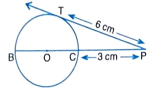
In Fig. O is the centre of circle and $P T$ is a tangent at $T$. If $P C=3 cm, P T=6 cm$, then the radius of the circle is
Image
  • A
    9 cm
  • B
    6 cm
  • 4.5 cm
  • D
    3 cm
Answer
Correct option: C.
4.5 cm
(C)4.5 cm
Since $P T$ is a tangent and $P C B$ is a secant to the circle.
$
\therefore \quad P C \times P B=P T^2 \Rightarrow 3 \times P B=6^2 \Rightarrow P B=12 cm \Rightarrow B C=9 cm \Rightarrow \text { radius }=4.5 cm
$
View full question & answer
MCQ 941 Mark
In Fig. PT is a tangent to the circle at a point $T$ and PAB is a secant to the circle. If $P A=9 cm$ and $A B=7 cm$, then $P T$
Image
  • A
    16 cm
  • 12 cm
  • C
    9 cm
  • D
    18 cm
Answer
Correct option: B.
12 cm
(B)12 cm
Since $P T$ is a tangent and $P A B$ is a secant to the circle. Therefore,
$
P T^2=P A \times P B=9(9+7)=144 \Rightarrow P T=12 cm
$
View full question & answer
MCQ 951 Mark
The pair of tangents $A P$ and $A Q$ drawn from an external point to a circle with centre $O$ are perpendicular to cach other and length of each tangen is 5 cm . The radius of the circle is
Image
  • A
    10 cm
  • B
    7.5 cm
  • 5 cm
  • D
    2.5 cm
Answer
Correct option: C.
5 cm
(C)5 cm
It is given that $\angle P A Q=90^{\circ}$. We know that $\angle P A Q$ and $\angle P O Q$ are supplementary. Therefore, $\angle P O Q=90^{\circ}$. Consequently, quadrilateral $\triangle P O Q$ is a square. Therefore, $O P=A P \Rightarrow O P=5 cm$.
View full question & answer
MCQ 961 Mark
From a point $P$ which is at a distance 13 cm from the centre O of a circle of radius 5 cm , the pair of tansents PQ and PR to the circle are drawn. Then the area of the quadrilateral $P Q O R$ is
Image
  • $60 cm^2$
  • B
    $65 cm^2$
  • C
    $30 cm^2$
  • D
    $32.5 cm^2$
Answer
Correct option: A.
$60 cm^2$
(A)$60 cm^2$
Applying P'ythagoras theorem in right triangle PQO, we obtain $O P^2=O Q^2+P Q^2$
$
\begin{array}{ll}
& O P^2=O Q^2+P Q^2 \\
\Rightarrow & P Q=\sqrt{O P^2-O Q^2}=\sqrt{13^2-5^2}=\sqrt{169-25}=12 cm \\
\therefore & \text { Area of } \triangle O Q P=\frac{1}{2}(P Q \times O Q)=\frac{1}{2}(12 \times 5) cm^2=30 cm^2
\end{array}
$
Hence, $\operatorname{ar}\left(\right.$ quad $P(Q O R)=2 \operatorname{ar}(\triangle O Q P)=60 cm^2$
View full question & answer
MCQ 971 Mark
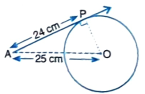
The length of the tangent $A P$, from an external point $A$ is 24 cm . If the distance of the point $A$ from the centre $O$ of the circle is 25 cm , then the diameter of the circle is
Image
  • A
    15 cm
  • 14 cm
  • C
    7 cm
  • D
    12 cm
Answer
Correct option: B.
14 cm
(B)14 cm
Applying Pythagoras theorem in right triangle APO, we obtain
$
\begin{array}{ll}
& O A^2=O P^2+A P^2 \\
\Rightarrow \quad & O P=\sqrt{O A^2-A P^2}=\sqrt{25^2-24^2}=\sqrt{49}=7 \\
\therefore \quad & \text { Diameter }=2 O P=2 \times 7=14 cm
\end{array}
$
View full question & answer
MCQ 991 Mark
Two circles touch each other externally at $P$. If $A B$ is a common tangent to the circles touching them at $A$ and $B$. Then, $\angle A P B=$
  • A
    $30^{\circ}$
  • B
    $45^{\circ}$
  • C
    $60^{\circ}$
  • $90^{\circ}$
Answer
Correct option: D.
$90^{\circ}$
View full question & answer
MCQ 1001 Mark
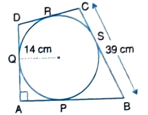
In Fig. quadrilateral $A B C D$ is circumscribed, touching the circle at $P, Q, R$ and $S$ such that $\angle D A B=90^{\circ}$. If $C R=23 cm, C B=39 cm$ and the radius of the circle is 14 cm , then $A B=$
Image
  • A
    16 cm
  • B
    39 cm
  • C
    37 cm
  • 30 cm
Answer
Correct option: D.
30 cm
View full question & answer
M.C.Q (1 Marks) - Page 2 - Maths STD 10 Questions - Vidyadip