Questions

True False[1 Marks ]

Take a timed test

12 questions · self-marked practice — reveal the answer and mark yourself.

Question 11 Mark
State whether the following statements are true or false. Justify your answer.
Points A(4, 3), B(6, 4), C(5, -6) and D(-3, 5) are the vertices of a parallelogram.
Answer
False:The diagonals of parallelogram bisect each othere so, ABCD will be a parallelogram if,
mid-point of diagonal AC = mid-point of diagonal BD
$\Rightarrow\Big(\frac{\text{x}_1+\text{x}_2}{2},\frac{\text{y}_1+\text{y}_2}{2}\Big)=\Big(\frac{\text{x}'_1+\text{x}'_2}{2},\frac{\text{y}'_1+\text{y}'_2}{2}\Big)$
$\Rightarrow\Big(\frac{4+5}{2},\frac{-6+3}{3}\Big)=\Big(\frac{6-3}{4+5}\Big)$
$\Rightarrow\Big(\frac{9}{2},\frac{-3}{2}\Big)\neq\Big(\frac{3}{2},\frac{9}{2}\Big)$
Hence ABCD is not a parallelogram.
View full question & answer
Question 21 Mark
State whether the following statements are true or false. Justify your answer.
The points (0, 5), (0, -9) and (3, 6) are collinear.
Answer
False:Three points A, B, and C will be collinear if the area of $\triangle\text{ABC}=0$
$\Rightarrow\frac{1}{2}[\text{x}_1(\text{y}_2-\text{y}_3)+\text{x}_2(\text{y}_3-\text{y}_1)+\text{x}_3(\text{y}_1-\text{y}_2)]$
$\Rightarrow\frac{1}{2}[0(-9-6)+0(6-5)+3(5-(-9)]=0$
$\Rightarrow0+0+3(14)=0$
$\Rightarrow42\neq0,$ which is false.
Hence, the given points are not collinear.
View full question & answer
Question 31 Mark
State whether the following statements are true or false. Justify your answer.
The points A(-1, -2), B(4, 3), C(2, 5) and D(-3, 0) in that order form a rectangle.
Answer
True:ABCD will from a rectangle if:
  1. It is a parallelogram.
  2. Diagonals are equal.
For parallelogram: Diagonals bisect each othere.
i. e., Mid point of AC = Mid point of BD is
$\text{i.e,}\Big(\frac{-1+2}{2},\frac{-2+5}{2}\Big)=\Big(\frac{4-3}{2},\frac{3+0}{2}\Big)$
$\Rightarrow\Big(\frac{1}{2},\frac{3}{2}\Big)=\Big(\frac{1}{2},\frac{3}{2}\Big)$
Hence, ABCD is a parallelogram.
Now, Diagonal $\text{AC}=\sqrt{(2+1)^2+(5+1)^2}$
$\Rightarrow\text{AC}=\sqrt{9+49}$
$\Rightarrow\text{AC}=\sqrt{58}\text{ units}$
and Diagonal $\text{BD}=\sqrt{(-3-4)^2+(0-3)^2}$
$\Rightarrow\text{BD}=\sqrt{49+9}$
$\Rightarrow\text{BD}=\sqrt{58}\text{ units}$
Digonal AC = Digonal BD
Hence, ABCD is a rectangle.
View full question & answer
Question 41 Mark
State whether the following statements are true or false. Justify your answer.
A circle has its centre at the origin and a point P(5, 0) lies on it. The point Q(6, 8) lies outside the circle.
Answer
True:If the distance of $Q$ from the cente $O(0,0)$ is greater than the radius then point $Q$ lies in the exterior of the circle. Point $P(5,0)$ lies on thr circle and centre is at $O(0,0)$ so radius $=O P$
$\Rightarrow O P^2=\left(x_2-x_1\right)^2+\left(y_2-y_1\right)^2$
$\Rightarrow O P^2=(5-0)^2+(0-0)^2$
$\Rightarrow O P^2=5^2$
$\Rightarrow O P=5 \text { units }$
Now, $OQ ^2=(6-0)^2+(8-0)^2$
$\Rightarrow O Q^2=36+64$
$\Rightarrow O Q^2=100$
$\Rightarrow O Q=10 \text { units }$
$\Rightarrow O Q>O P \text { (radius) }$
So, point Q lies exterior to circle.
View full question & answer
Question 51 Mark
State whether the following statements are true or false. Justify your answer.
$\triangle\text{ABC}$ with vertices A(-2, 0), B(2, 0) and C(0, 2) is similar to $\triangle\text{DEF}$ with vertices D(-4, 0) and F(0, 4).
Answer
True:
$\triangle\text{ABC}\sim\triangle\text{DEF}$
If $\frac{\text{AB}}{\text{DE}}=\frac{\text{AC}}{\text{DF}}=\frac{\text{BC}}{\text{EF}}=\text{k}$
In $\triangle\text{ABC},$
$\Rightarrow AB^2 = [2 - (-2)]^2 + [0 - (0)]^2$
$\Rightarrow AB^2 = (4)^2 + 0$
$\Rightarrow AB^2 = (4)^2$
$\Rightarrow AB = 4 units$
$\Rightarrow BC^2 = (0 - 2)^2 + (2 - 0)^2$
$\Rightarrow BC^2 = 4 + 4$
$\Rightarrow BC^2 = 8$
$\Rightarrow\text{BC}=2\sqrt{2}\text{ units}$
$\Rightarrow AC^2 = [0 - (-2)]^2 + (-2 - 0)^2$
$\Rightarrow AC^2 = 2^2 + 2^2$
$\Rightarrow AC^2 = 4 + 4$
$\Rightarrow AC^2 = 8$
$\Rightarrow\text{AC}=2\sqrt{2}\text{ units}$
In $\triangle\text{DEF},$
$\Rightarrow DE^2 = [4 - (-4)]^2 + (0 - 0)^2$
$\Rightarrow DE^2 = (8)^2$
$\Rightarrow DE^2 = 8 units$
$\Rightarrow EF^2 = (0 - 4)^2 + (4 - 0)^2$
$\Rightarrow EF^2 = 44 + 44$
$\Rightarrow EF^2 = 16 + 16$
$\Rightarrow EF^2 = 32$
$\Rightarrow\text{EF}=4\sqrt{2}\text{ units}$
$\Rightarrow DF^2= [0 - (-4)]^2+ (4 - 0)^2$
$\Rightarrow DF^2 = 16 + 16$
$\Rightarrow DF^2 = 32$
$\Rightarrow\text{DF}=4\sqrt{2}\text{ units}$
Now, $\frac{\text{AB}}{\text{DE}}=\frac{4}{8}=\frac{1}{2}$
$\frac{\text{BC}}{\text{EF}}=\frac{2\sqrt{2}}{4\sqrt{2}}=\frac{1}{2}$
$\frac{\text{AC}}{\text{DF}}=\frac{2\sqrt{2}}{4\sqrt{2}}=\frac{1}{2}$
$\therefore\frac{\text{AB}}{\text{DE}}=\frac{\text{AC}}{\text{DF}}=\frac{\text{AB}}{\text{DE}}=\frac{1}{2}$
Hence, $\triangle\text{ ABC}\sim\triangle\text{ DEF}.$
View full question & answer
Question 61 Mark
State whether the following statements are true or false. Justify your answer.
The point A(2, 7) lies on the perpendicular bisector of line segment joining the points P(6, 5) and Q(0, -4).
Answer
False:
Any points (A) on perpendicular bisector will be equidistant from P and Q so,
PA = QA
or $PA^2 = QA^2$
$\Rightarrow (2 - 6)^2 + [7 - (5)]^2 = (2 - 0)^2 + [7 - (-4)]^2$
$\Rightarrow (-4)^2 + (2)^2 = 2^2 + (11)^2$
$\Rightarrow 16 + 4 = 4 + 121$
$\Rightarrow20\neq125$
So, A does not lie on the perpendicular bisector of PQ.
View full question & answer
Question 71 Mark
State whether the following statements are true or false. Justify your answer.
Point P(0, 2) is the point of intersection of y-axis and perpendicular bisector of line segment joining the points A(-1, 1) and B(3, 3).
Answer
False:As the point P(0, 2) is the point of intersection of y-axis and perpendicular bisector of the line joining the points A(-1, 1) and B(-3, 3), then point P must be equidistant from A and B. So, we must write PA = PB.
$\Big[\because\text{ d}=\sqrt{(\text{x}_2-\text{x}_1)^2+(\text{y}_2-\text{y}_1)^2}\Big]$
$\text{PA}=\sqrt{(-1-0)^2+(1-2)^2}$
$\text{PA}=\sqrt{1+1}=\sqrt{2}\text{ units}$
$\text{PB}=\sqrt{(3-0)^2+(3-2)^2}$
$\text{PB}=\sqrt{9+1}=\sqrt{10}\text{ units}$
$\therefore\text{PA}\neq\text{PB}$
Hence the given statement is false.
View full question & answer
Question 81 Mark
State whether the following statements are true or false. Justify your answer.
Point P(-4, 2) lies on the line segment joining the points A(-4, 6) and B(-4, -6).
Answer
True:We observe that x-coordiante is sane i.e, equal to (-4) so line is parallel to y-coordinate of P i.e., 2 lies between 6 and -6 of A and B respectively. Hence, P lies between and on AB.
Alternate Answer
Point P(-4, 2) will lie on the line AB if area of $\triangle\text{ABP}$ is Zero.
$\therefore\text{i.e., } \text{ar }\text{ABP}=0$
$\Rightarrow\frac{1}{2}\big[\text{x}_1(\text{y}_2-\text{y}_3)+\text{x}_2(\text{y}_3-\text{y}_1)+\text{x}_3(\text{y}_1-\text{y}_2)\big]$
$\Rightarrow\frac{1}{2}\big[-4(-6-2)-4(2-6)-4(6+6)\big]=0$
$\Rightarrow\big[-4(-8)-4(-4)-4(12)\big]=0$
$\Rightarrow32+16-48=0 $
$\Rightarrow48+48=0$ which is true.
Hence, point P lies on the line joining A and B.
View full question & answer
Question 91 Mark
State whether the following statements are true or false. Justify your answer.
Points A(-6, 10), B(-4, 6) and C(3, -8) are collinear such that
$\text{AB}=\frac{2}{9}=\text{AC}.$
Answer
True:Points A, B and C will be collinear if $\text{ar}(\triangle\text{ABC})=0$
$\text{ar}\triangle\text{ABC}=\frac{1}{2}[\text{x}_1(\text{y}_2-\text{y}_3)+\text{x}_2(\text{y}_3-\text{y}_1)+\text{x}_3(\text{y}_1-\text{y}_2)]$
$\Rightarrow\frac{1}{2}[-6\{6-(-8)\}-4(-8-10)+3(10-6)]=0$
$\Rightarrow-6(14)-4(-18)+3(4)=0$
$\Rightarrow-84+72+12=0$
$\Rightarrow-84+84=0,$ which is true
So, points A, B and C are collinear.
$\text{AC}^2=(\text{x}_2-\text{x}_1)^2+(\text{y}_2-\text{y}_1)^2$
$\Rightarrow\text{AC}^2=(3+6)^2+(-8-10)^2$
$\Rightarrow\text{AC}^2=81+324$
$\Rightarrow\text{AC}=\sqrt{405}$
$\Rightarrow\text{AC}=9\sqrt{5}\text{ units}$
$\Rightarrow\text{AB}^2=[-4-(-6)]^2+(6-10)^2$
$\Rightarrow\text{AB}^2=(-4+6)^2+(-4)^2$
$\Rightarrow\text{AB}^2=4+16$
$\Rightarrow\text{AB}^2=20$
$\Rightarrow\text{AB}=2\sqrt{5}\text{ units}$
Now, $\text{AB}=\frac{2}{9}\text{AC}$
R. H. S $=\frac{2}{9}\times9\sqrt{5}$
$=2\sqrt{5}$
$=\text{AB}$
Hence, $\text{AB}=\frac{2}{9}\text{AC}$ is true.
View full question & answer
Question 101 Mark
State whether the following statements are true or false. Justify your answer.
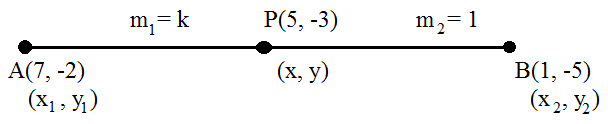
Point P(5, -3) is one of the two points of trisection of the line segment joining the points A(7, -2) and B(1, -5).
Answer
True:
Let points P divides the line AB in ratio K : 1 then
$\text{x}=\frac{\text{m}_1\text{x}_2+\text{m}_2\text{x}_1}{\text{m}_1+\text{m}_2}$ and $\text{y}=\frac{\text{m}_1\text{y}_2+\text{m}_2\text{y}_1}{\text{m}_1+\text{m}_2}$
$\Rightarrow\text{x}=\frac{\text{k+7}}{\text{k+1}}$   $\text{y}=\frac{\text{k}(-5)+1(-2)}{\text{k+1}}$
$\Rightarrow5=\frac{\text{k}+7}{\text{k}+1}$   $-3=\frac{-5\text{k}-2}{\text{k}+1}$
$\Rightarrow5\text{k}+5=\text{k}+7$   $-5\text{k}-2=-3\text{k}-3$
$\Rightarrow4\text{k}=7-5$   $-2\text{k}=-3+2$
$\Rightarrow\text{k}=\frac{2}{4}=\frac{1}{2}$   $\text{k}=\frac{-1}{-2}=\frac{1}{2}$
So, P divides AB in 1 : 2 ratio.
Hence, P is one point of trisection of AB.
View full question & answer
Question 111 Mark
State whether the following statements are true or false. Justify your answer.
Points A(3, 1), B(12, -2) and C(0, 2) cannot be the vertices of a triangle.
Answer
True:Points A, B, C can form a triangle if the sum of any two sides is greater than the third side.
$\Rightarrow AB^2 = (x_2- x_1)^2 + (y_2- y_1)^2$
$\Rightarrow AB^2 = (12 - 3)^2 + (-2 - 1)^2$
$\Rightarrow AB^2 = 81 + 9$
$\Rightarrow AB^2= 90$
$\Rightarrow\text{AB}=3\sqrt{10}\text{ units}$
$\Rightarrow BC^2 = (0 - 12)^2 + [2 - (-2)]^2$
$\Rightarrow BC^2= 144 + 16$
$\Rightarrow BC^2 = 160$
$\Rightarrow\text{BC}=4\sqrt{10}\text{ units}$
$\Rightarrow AC^2 = (0 - 3)^2 + (2 - 1)^2$
$\Rightarrow AC^2 = 9 + 1$
$\Rightarrow AC^2 = 10$
$\Rightarrow\text{AC}=\sqrt{10}\text{ units}$
$\therefore\text{AC}=\sqrt{10}\text{ units},\text{AB}=3\sqrt{10}\text{ units}$
and $\text{BC}=4\sqrt{10}\text{ units}$
Now, $\text{AB}+\text{AC}$
$\Rightarrow\sqrt{10}+3\sqrt{10}$
$\Rightarrow4\sqrt{10}\text{ units}=\text{BC}$
So, A, B, C points cannot from a $\triangle.$
View full question & answer
Question 121 Mark
State whether the following statements are true or false. Justify your answer.
The point P(-2, 4) lies on a circle of radius 6 and centre C(3, 5).
Answer
False:
The point P(-2, 4) lies on a circle if distance between P and centre is equal to the radius so distance of P from centre O(3, 5) will be
$\Rightarrow OP^2 = (-2 - 3)^2+ (-4 - 5)^2$
$\Rightarrow OP^2 = 25 + (-1)$
$\Rightarrow\text{OP}=\sqrt{26}\neq\text{radius }6$
So, P does not lie on the circle. It will lie inside the circle.
View full question & answer