Questions

True False[1 Marks ]

Take a timed test

12 questions · self-marked practice — reveal the answer and mark yourself.

Question 11 Mark
Write ‘True’ or ‘False’ and justify your answer.
$\frac{\tan47^\circ}{\cot43^\circ}=1$
Answer
True.47º and 43º are complementry angles.
$\therefore\ \frac{\tan47^\circ}{\cot43^\circ}=\frac{\tan47^\circ}{\cot(90^\circ-47^\circ)}=\frac{\tan47^\circ}{\tan47^\circ}=1$
Hence, the given expression is true.
View full question & answer
Question 21 Mark
Write ‘True’ or ‘False’ and justify your answer.
If a man standing on a platform 3 metres above the surface of a lake observes a cloud and its reflection in the lake, then the angle of elevation of the cloud is equal to the angle of depression of its reflection.
Answer
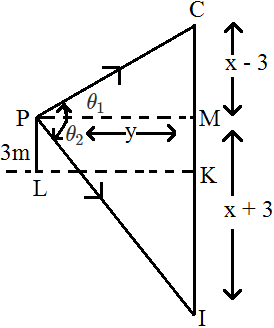
False. The observer is at the platform (P) 3m above the surface LK of the lake. He observes the angle of elevation of cloud C from P and its reflection image in the lake is formed at I. The observer measures in the angle of depression of image (I) $\theta_2.$ Draw PM $\perp$ on the vertical line passing through the cloud and its image.
CK = KI = x by the prop. of reflection. CM = CK - MK = x - 3 MI = KI + MK = x + 3 Now, $\tan\theta_1=\frac{\text{x}-3}{\text{y}}\text{ and }\tan\theta_2=\frac{\text{x}+3}{\text{y}}$ $\Rightarrow\ \text{y}=\frac{\text{x}-3}{\tan\theta_1}\text{ and }\text{y}=\frac{\text{x}+3}{\tan\theta_2}$ $\Rightarrow\ \frac{\text{x}+3}{\tan\theta_2}=\frac{\text{x}-3}{\tan\theta_1}$ $\Rightarrow\ \tan\theta_2=\Big(\frac{\text{x}+3}{\text{x}-3}\Big)\tan\theta_1$ $\Rightarrow\ \tan\theta_1\neq\tan\theta_2$or $\theta_1\neq\theta_2$
Alternate Answer
By the property of image formation, the distance of image and the object are equal from the reflecting surface. So, $\text{KC}=\text{KI}$ $\Rightarrow\ \text{MI}\neq\text{MC}$ $\Rightarrow\ \triangle\text{MPC}\neq\triangle\text{MPI}$ So $\theta_1\neq\theta_2$
View full question & answer
Question 31 Mark
Write ‘True’ or ‘False’ and justify your answer.
The value of the expression (sin80º - cos80º) is negative.
Answer
False.80º is near to 90º, sin90º = 1 and cos90º = 0
So, the given expression sin80º - cos80º > 0
So, the value of the given expression is posittive. So, the given statement is false.
View full question & answer
Question 41 Mark
Write ‘True’ or ‘False’ and justify your answer.
The angle of elevation of the top of a tower is 30°. If the height of the tower is doubled, then the angle of elevation of its top will also be doubled.
Answer
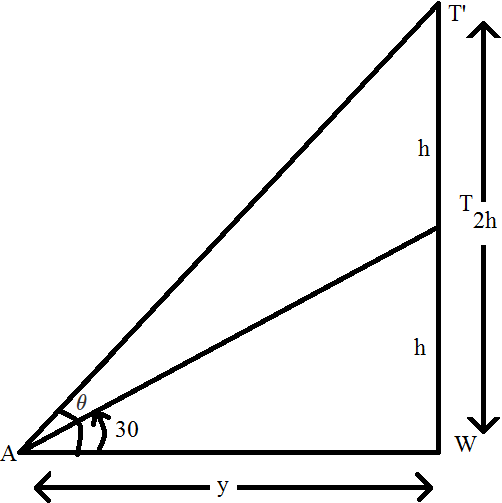
False.Let the height of the tower is h. For the observer at A the angle of elevation is equal to 30º.

$\tan30^\circ=\frac{\text{h}}{\text{y}}$
$\Rightarrow\ \frac{1}{\sqrt{3}}=\frac{\text{h}}{\text{y}}$
$\Rightarrow\ \text{y}=\text{h}\sqrt{3}$
Now, the height of the tower increases to 2h.
Now, let the new angle of elevation at A becomes $\theta$ then
$\tan\theta=\frac{2\text{h}}{\text{y}}$
$\Rightarrow\ \tan\theta=\frac{2\text{h}}{\text{h}\sqrt{3}}$
$\Rightarrow\ \tan\theta=\frac{2}{\sqrt{3}}$
But, $\tan60^\circ=\sqrt{3}$
$\Rightarrow\ \tan60^\circ=\sqrt{3}\neq\frac{2}{\sqrt{3}}$
So, $\theta\neq60^\circ$
Hence, angle of elevation will not be doubled or the given statement is false.
View full question & answer
Question 51 Mark
Write ‘True’ or ‘False’ and justify your answer.
The value of $2\sin\theta\text{can be}\Big(\text{a}+\frac{1}{\text{a}}\Big),$ where a is a positive number, and $\text{a}\neq1.$
Answer
False.Consider 'a' and$\frac{'1'}{\text{a}}$ as positive numbers and $\text{a}\neq0$
Arithumetic mean (AM) of a and $\frac{1}{\text{a}}=\frac{\Big(\text{a}+\frac{1}{\text{a}}\Big)}{2}$
Geometric mean (GM) of a and $\frac{1}{\text{a}}=\sqrt{\text{a}\times\frac{1}{\text{a}}}=1$
$\because\ \text{AM}>\text{GM}$
$\therefore\ \frac{\Big(\text{a}+\frac{1}{\text{a}}\Big)}{2}>1$
$\Rightarrow\ \Big(\text{a}+\frac{1}{\text{a}}\Big)>2$
Let $\text{a}+\frac{1}{\text{a}}=2\sin\theta$
$\Rightarrow\ 2\sin\theta>2$
$\Rightarrow\ \sin\theta>1$
Which can never be possible.
Hence, our consideration that $\text{a}+\frac{1}{\text{a}}=2\sin\theta$ is false.
Alternate Answer
a is positive and $\text{a}\neq1$ i.e., a can be above 0 all real and values except 1.
Let 0 < a < 1 then $\frac{1}{\text{a}}$ will be more then 1 so $\text{a}+\frac{1}{\text{a}}>2$ for any value of a.
Let $\text{a}=0.2\Rightarrow\text{a}+\frac{1}{\text{a}}=0.2+\frac{1}{0.2}=5.2$
$\text{a}=0.9\Rightarrow\text{a}+\frac{1}{\text{a}}=0.9+\frac{1}{0.9}=0.9+1.111=2.011$
Put $\text{a}+\frac{1}{\text{a}}=2\sin\theta$
$\therefore\ 2\sin\theta>2$
$\Rightarrow\ \sin\theta>1$
Which is impossible so $2\sin\theta\neq\text{a}+\frac{1}{\text{a}}$
Hence, the given statement is false. If we take any value of a more than one, then the value of $\text{a}+\frac{1}{\text{a}}$ is always greater then 2 which repeats the result.
View full question & answer
Question 61 Mark
Write ‘True’ or ‘False’ and justify your answer.
The value of the expression $(cos^223º - sin^267º)$ is positive.
Answer
False. $23^{\circ}$ and $67^{\circ}$ are complementry angles so.
$cos^223º - sin^267º = cos^223º - sin^2(90º - 23º)$
$= cos^223º - cos^223º$
$= 0$
So, the value of the given expression is not positive. Hence, the given statement is false.
View full question & answer
Question 71 Mark
Write ‘True’ or ‘False’ and justify your answer.
If the height of a tower and the distance of the point of observation from its foot, both, are increased by 10%, then the angle of elevation of its top remains unchanged.
Answer
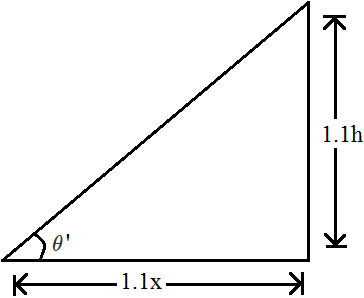
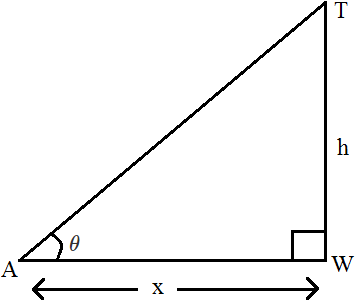
True.Let height h of tower TW makes an angle of elevation to observer at A and the distance from foot of tower to the observer is x.

$\therefore\ \tan\theta=\frac{\text{h}}{\text{x}}$
Now, h and increases by 10%
$\therefore\ \text{h'=h+10% of h}=\text{h}+\frac{10}{100}\times\text{h}=\text{h}+0.1\text{h}$
⇒ h' = 1.1h
Similarly, x' = 1.1x

$\therefore\ \tan\theta'=\frac{1.1\text{h}}{1.1\text{x}}=\frac{\text{h}}{\text{x}}\ \ (\text{II})$
From (I) and (II), we get
$\tan\theta=\tan\theta'$
$\Rightarrow\ \theta=\theta'$
Hence, the given statement is true.
View full question & answer
Question 81 Mark
Write ‘True’ or ‘False’ and justify your answer.
$(\tan\theta+2)(2\tan\theta+1)=5\tan\theta+\sec^2\theta$
Answer
False.LHS$=(\tan\theta+2)(2\tan\theta+1)$
$=\tan\theta(2\tan\theta+1)+2(2\tan\theta+1)$
$=2\tan^2\theta+\tan\theta+4\tan\theta+2$
$=2\tan^2\theta+5\tan\theta+2$
$=2(\tan^2\theta+1)+5\tan\theta$
$=2\sec^2\theta+5\tan\theta\neq$ RHS
Hence, the given statement is false.
View full question & answer
Question 91 Mark
Write ‘True’ or ‘False’ and justify your answer.
If $cosA + cos^2A = 1, then sin^2A + sin^4A = 1$
Answer
True.$cosA + cos^2A = 1 [Given]$
$\Rightarrow cosA = 1 - cos^2A$
$\Rightarrow cosA = sin^2A$
$\Rightarrow cos^2A = sin^4A$
$Now, LHS = sin^2A + sin^4A$
$= cosA + cos^2A$
$= 1 = RHS$
Hence, the given statement is true.
View full question & answer
Question 101 Mark
Write ‘True’ or ‘False’ and justify your answer.
If the length of the shadow of a tower is increasing, then the angle of elevation of the sun is also increasing.
Answer
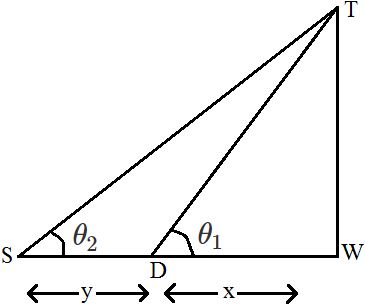
False.The shadow of a tower on the ground increases from x to (x + y) when angle of elevation of the sun change from $\theta_1\text{ to }\theta_2.$

$\therefore\ \theta_1$ is the exterior angle of $\triangle\text{TSD}$
So $\theta_1>\theta_2$
So, on increasing the length of shadow the angle of elevation decreases.
Hence, the given statement is false.
View full question & answer
Question 111 Mark
Write ‘True’ or ‘False’ and justify your answer.
$\cos\theta=\frac{\text{a}^2+\text{b}^2}{2\text{ab}},$ where a and b are two distinct numbers such that ab > 0.
Answer
False.Consider two numbers $a^2$ and $b^2$ then
Arithmetic mean (AM) of $a^2$ and $b^2=\frac{a^2+b^2}{2}$
Geometric mean (GM) of $a^2$ and $b^2=\sqrt{a^2 \times b^2}$
$\Rightarrow\ \text{GM}=\text{ab}$
$\because\ \text{AM}>\text{GM}$
$\therefore\ \frac{\text{a}^2+\text{b}^2}{2}>\text{ab}$
$\Rightarrow\ \frac{\text{a}^2+\text{b}^2}{2\text{ab}}>1$
$\Rightarrow\ \cos\theta>1\ \Big(\text{Given}\cos\theta=\frac{\text{a}^2+\text{b}^2}{2\text{ab}}\Big)$
But, the value of $\cos\theta$ can never be greater than 1.
So,the given expression is false.
View full question & answer
Question 121 Mark
Write ‘True’ or ‘False’ and justify your answer.
$\sqrt{(1-\cos^2\theta)\sec^2\theta}=\tan\theta$
Answer
True.LHS $=\sqrt{(1-\cos^2\theta)\sec^2\theta}=\sqrt{\sin^2\theta.\frac{1}{\cos^2\theta}}$
$=\sqrt{\frac{\sin^2\theta}{\cos^2\theta}}=\tan\theta=$ RHS
Hence, the given expression is true.
View full question & answer