Question 11 Mark
Prove the given identity, where the angles involved are acute angles for which the expressions are defined. (cosec A - sin A) (sec A - cos A) = $\frac { 1 } { \tan A + \cot A }$
[Hint: Simplify LHS and RHS separately]
AnswerLHS
$= ( \csc A - \sin A ) ( \sec A - \cos A )$
$= \left( \frac { 1 } { \sin A } - \sin A \right) \left( \frac { 1 } { \cos A } - \cos A \right) = \frac { 1 - \sin ^ { 2 } A } { \sin A } \frac { 1 - \cos ^ { 2 } A } { \cos A }$
$= \frac { \cos ^ { 2 } A } { \sin A } \frac { \sin ^ { 2 } A } { \cos A } , \ldots \ldots \ \because \sin ^ { 2 } A + \cos ^ { 2 } A = 1 = \frac { \frac { \sin A \cos A } { \sin A \cos A } } { \frac { \sin ^ { 2 } A } { \sin A \cos A } + \frac { \cos ^ { 2 } A } { \sin A \cos A } }$
........ Dividing the numerator and denominator by sin A cos A
$= \frac { 1 } { \tan A + \cot A }$
= RHS
View full question & answer→Question 21 Mark
Prove the given identity, where the angles involved are acute angles for which the expressions are defined. $\frac { \sin \theta - 2 \sin ^ { 3 } \theta } { 2 \cos ^ { 2 } \theta - \cos \theta } = \tan \theta$
AnswerLHS
$= \frac { \sin \theta - 2 \sin ^ { 3 } \theta } { 2 \cos ^ { 2 } \theta - \cos \theta } = \frac { \sin \theta \left( 1 - 2 \sin ^ { 2 } \theta \right) } { \cos \theta \left( 2 \cos ^ { 2 } \theta - 1 \right) }$
$= \frac { \sin \theta \left( \cos ^ { 2 } \theta + \sin ^ { 2 } \theta - 2 \sin ^ { 2 } \theta \right) } { \cos \theta \left( 2 \cos ^ { 2 } \theta - \cos ^ { 2 } \theta - \sin ^ { 2 } \theta \right) } \quad \because \cos ^ { 2 } \theta + \sin ^ { 2 } \theta = 1$
$= \frac { \sin \theta \left( \cos ^ { 2 } \theta - \sin ^ { 2 } \theta \right) } { \cos \theta \left( \cos ^ { 2 } \theta - \sin ^ { 2 } \theta \right) } = \tan \theta$
= RHS
View full question & answer→Question 31 Mark
Prove the given identity, where the angles involved are acute angles for which the expressions are defined. $\sqrt { \frac { 1 + \sin A } { 1 - \sin A } }$ = sec A + tan A
AnswerL.H.S. $\sqrt { \frac { 1 + \sin A } { 1 - \sin A } }$
$= \sqrt { \frac { 1 + \sin A } { 1 - \sin A } } \times \sqrt { \frac { 1 + \sin A } { 1 + \sin A } }$
$=\sqrt { \frac { ( 1 + \sin A ) ^ { 2 } } { 1 - \sin ^ { 2 } A } } \left[ \because ( a + b ) ( a - b ) = a ^ { 2 } - b ^ { 2 } \right]$
$=\sqrt { \frac { ( 1 + \sin A ) ^ { 2 } } { \cos ^ { 2 } A } } \left[ \because 1 - \sin ^ { 2 } \theta = \cos ^ { 2 } \theta \right]$
$=\frac { 1 + \sin A } { \cos A } = \frac { 1 } { \cos A } + \frac { \sin A } { \cos A } = \sec A + \tan A = R \cdot H . S .$
View full question & answer→Question 41 Mark
Prove the given identity, where the angles involved are acute angles for which the expressions are defined. $\frac { 1 + \sec A } { \sec A } = \frac { \sin ^ { 2 } A } { 1 - \cos A }$
[Hint: Simplify LHS and RHS separately]
Answer$\mathrm { LHS } = \frac { 1 + \sec A } { \sec A } = \frac { 1 + \frac { 1 } { \cos A } } { \frac { 1 } { \cos A } }$
$= \frac { \frac { \cos A + 1 } { \cos A } } { \frac { 1 } { \cos A } } = \cos A + 1 = 1 + \cos A$
$= \frac { ( 1 + \cos A ) ( 1 - \cos A ) } { 1 - \cos A } = \frac { 1 - \cos ^ { 2 } A } { 1 - \cos A }$
$= \frac { \sin ^ { 2 } A } { 1 - \cos A } \cdot \because \sin ^ { 2 } A + \cos ^ { 2 } A = 1$
= RHS
View full question & answer→Question 51 Mark
Prove the given identity, where the angles involved are acute angles for which the expressions are defined.
$\left( \frac { 1 + \tan ^ { 2 } A } { 1 + \cot ^ { 2 } A } \right) = \left( \frac { 1 - \tan A } { 1 - \cot A } \right) ^ { 2 }$ $= tan^2 A$
Answer$= \frac { 1 + \tan ^ { 2 } A } { 1 + \cot ^ { 2 } A } = \frac { 1 + \tan ^ { 2 } A } { 1 + \frac { 1 } { \tan ^ { 2 } A } } \cdot \because \cot A = \frac { 1 } { \tan A }$
$= \frac { 1 + \tan ^ { 2 } A } { \frac { \tan ^ { 2 } A + 1 } { \tan ^ { 2 } A } } = \tan ^ { 2 } A \ldots \ldots ( 1 )$
$\left( \frac { 1 - \tan A } { 1 - \cot A } \right) ^ { 2 } = \left( \frac { 1 - \tan A } { 1 - \frac { 1 } { \tan A } } \right) ^ { 2 }$
$= \left\{ \frac { 1 - \tan A } { \left( \frac { \tan A - 1 } { \tan A } \right) } \right\} ^ { 2 } = ( - \tan A ) ^ { 2 } = \tan ^ { 2 } A$ ....... (2)
(1) and (2) taken together given the result.
View full question & answer→Question 61 Mark
Prove the given identity, where the angles involved are acute angles for which the expressions are defined. $( cosec\; \theta - \cot \theta ) ^ { 2 } = \frac { 1 - \cos \theta } { 1 + \cos \theta }$
Answer$L H S = ( cosec\; \theta - \cot \theta ) ^ { 2 }$
$= \left( \frac { 1 } { \sin \theta } - \frac { \cos \theta } { \sin \theta } \right) ^ { 2 } = \left( \frac { 1 - \cos \theta } { \sin \theta } \right) ^ { 2 } = \frac { ( 1 - \cos \theta ) ^ { 2 } } { \sin ^ { 2 } \theta }$
$= \frac { ( 1 - \cos \theta ) ^ { 2 } } { 1 - \cos ^ { 2 } \theta } = \frac { ( 1 - \cos \theta ) ^ { 2 } } { ( 1 - \cos \theta ) ( 1 + \cos \theta ) }$
$= \frac { 1 - \cos \theta } { 1 + \cos \theta } = R H S$
View full question & answer→Question 71 Mark
$\frac { 1 + \tan ^ { 2 } A } { 1 + \cot ^ { 2 } A }=$
View full question & answer→Question 81 Mark
(sec A + tan A) (1 – sin A)
Question 91 Mark
$9 \sec ^2 A-9 \tan ^2 A=$
View full question & answer→Question 101 Mark
Find the value of $\sin 25^{\circ} \cos 65^{\circ}+\cos 25^{\circ} \sin 65^{\circ}$
AnswerWe have to find the value of $\sin 25^{\circ} \cos 65^{\circ}+\cos 25^{\circ} \sin 65^{\circ}$
$= sin 25^\circcos (90^\circ-25^\circ) + cos 25^\circsin 65^\circ {by using Cos (90 - A) = Sin A}$
$= sin 25^\circsin 25^\circ + cos 25^\circsin 65^\circ= sin^2 25^\circ + cos 25^\circ sin (90^\circ-25^\circ) {by using Sin (90-A) = Cos A}$
$= sin^2 25^\circ + cos^2 25^\circ$
$= 1$
View full question & answer→Question 111 Mark
$\cot A$ is not defined for $A=0^{\circ}$.
View full question & answer→Question 121 Mark
sin$\theta$ = cos$\theta$ for all values of $\theta$.
View full question & answer→Question 131 Mark
The value of cos$\theta$ increase as $\theta$ increases.
View full question & answer→Question 141 Mark
The value of sin$\theta$ increases as $\theta$ increases.
View full question & answer→Question 151 Mark
The trigonometric function sin (A + B) = sin A + sin B.
Question 161 Mark
$\frac{2 \tan 30^{\circ}}{1-\tan ^{2} 30^{\circ}}$ =
AnswerWe have $\frac{2 \tan 30^{\circ}}{1-\tan ^{2} 30^{\circ}}$= $\frac{2\times\frac{1} {\sqrt{3}}}{1- (\frac{1} {\sqrt{3}})^{2} }$
= ${\frac2{\sqrt{3}}}\times{}{\frac3{{2}}}$
= ${\frac3{{\sqrt{3}}}}= \sqrt{3} $ = $\tan 60^{\circ}$
View full question & answer→Question 171 Mark
sin 2A = 2 sin A is true when A =
Answersin 2A = 2 sin A is true when A =${0^ \circ }$
$\because $$\sin {\text{2A}} = 2\sin {\text{A}}$
$ \Rightarrow $$\sin \left( {2 \times {0^ \circ }} \right) = \sin {0^ \circ }$
$ \Rightarrow $$\sin {0^ \circ } = \sin {0^ \circ }$
View full question & answer→Question 181 Mark
$\frac{{1 - {{\tan }^2}45^\circ }}{{1 + {{\tan }^2}45^\circ }} = $
AnswerGiven: $\frac{{1 - {{\tan }^2}45^\circ }}{{1 + {{\tan }^2}45^\circ }}$
= $\frac{{1 - {{\left( 1 \right)}^2}}}{{1 + {{\left( 1 \right)}^2}}} = \frac{{1 - 1}}{{1 + 1}}$= 0/2 = 0
View full question & answer→Question 191 Mark
$\frac{{2\tan 30^\circ }}{{1 + {{\tan }^2}30^\circ }} = $
AnswerGiven: $\frac{{2\tan 30^\circ }}{{1 + {{\tan }^2}30^\circ }}$
= $\frac{{2 \times \frac{1}{{\sqrt 3 }}}}{{1 + {{\left( {\frac{1}{{\sqrt 3 }}} \right)}^2}}}$
= $\frac{2}{{\sqrt 3 \left( {\frac{{3 + 1}}{3}} \right)}}$
= $\frac{6}{{4\sqrt 3 }} = \frac{3}{{2\sqrt 3 }}$
= $\frac{{\sqrt 3 }}{2}$
= $\sin {60^ \circ }$
View full question & answer→Question 201 Mark
Evaluate: $\frac { 5 \cos ^ { 2 } 60 ^ { \circ } + 4 \sec ^ { 2 } 30 ^ { \circ } - \tan ^ { 2 } 45 ^ { \circ } } { \sin ^ { 2 } 30 ^ { \circ } + \cos ^ { 2 } 30 ^ { \circ } }$
AnswerGiven: $\frac { 5 \cos ^ { 2 } 60 ^ { \circ } + 4 \sec ^ { 2 } 30 ^ { \circ } - \tan ^ { 2 } 45 ^ { \circ } } { \sin ^ { 2 } 30 ^ { \circ } + \cos ^ { 2 } 30 ^ { \circ } }$
$= \frac { 5 \left( \frac { 1 } { 2 } \right) ^ { 2 } + 4 \left( \frac { 2 } { \sqrt { 3 } } \right) ^ { 2 } - ( 1 ) ^ { 2 } } { \left( \frac { 1 } { 2 } \right) ^ { 2 } + \left( \frac { \sqrt { 3 } } { 2 } \right) ^ { 2 } }$
$= \frac { 5 \times \frac { 1 } { 4 } + 4 \times \frac { 4 } { 3 } - 1 } { \frac { 1 } { 4 } + \frac { 3 } { 4 } }$
$= \frac { \frac { 5 } { 4 } + \frac { 16 } { 3 } - 1 } { \frac { 1 + 3 } { 4 } }$
$= \frac { \frac { 15 + 64 - 12 } { 12 } } { \frac { 4 } { 4 } }$
$= \frac { \frac { 67 } { 12 } } { 1 }$
$= \frac { 67 } { 12 }$
View full question & answer→Question 211 Mark
Evaluate: $2 \tan ^2 45^{\circ}+\cos ^2 30^{\circ}-\sin ^2 60^{\circ}$
AnswerGive that 3cot A = 4
Or cot $A = \frac{4}{3}$
Consider a right angle triangle $\Delta ABC$ right angled at point B.
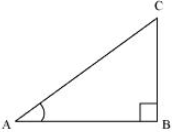
$\cot A = \frac{{Side\;adjacent\;to\;\angle A}}{{Side\;opposite\;to\;\angle A}}$
$\frac{{AB}}{{BC}} = \frac{4}{3}$
If AB is 4K, BC will be 3K. where K is a positive integer
Now in $\Delta ABC$
$(AC)^2 = (AB)^2 + (BC)^2$
$= (4K)^2 + (3K)^2$
$= 16 K^2 + 9K^2$
$= 25K^2$
AC = 5K
$\cos A = \frac{{Side\;adjacent\;to\;\angle A}}{{hypotenuse}} = \frac{{AB}}{{AC}}$
$ = \frac{{4K}}{{5K}} = \frac{4}{5}$
$\sin A = \frac{{Side\;opposite\;to\;\angle A}}{{hypotenuse}} = \frac{{BC}}{{AC}}$
$ = \frac{{3K}}{{5K}} = \frac{3}{5}$
$\tan A = \frac{{Side\;opposite\;to\;\angle A}}{{Side\;adjacent\;to\;angle\;A}} = \frac{{BC}}{{AB}}$
$ = \frac{{3K}}{{4K}} = \frac{3}{4}$
$\frac{{1 - {{\tan }^2}A}}{{1 + {{\tan }^2}A}} = \frac{{1 - {{\left( {\frac{3}{4}} \right)}^2}}}{{1 + {{\left( {\frac{3}{4}} \right)}^2}}} = \frac{{1 - \frac{9}{{16}}}}{{1 + \frac{9}{{16}}}}$
$ = \frac{{\frac{7}{{16}}}}{{\frac{{25}}{{16}}}} = \frac{7}{{25}}$
${\cos ^2}A - {\sin ^2}A = {\left( {\frac{4}{5}} \right)^2} - {\left( {\frac{3}{5}} \right)^2}$
$ = \frac{{16}}{{25}} - \frac{9}{{25}} = \frac{7}{{25}}$
Hence $\frac{{1 - {{\tan }^2}A}}{{1 + {{\tan }^2}A}} = {\cos ^2}A - {\sin ^2}A$ View full question & answer→Question 221 Mark
Evaluate: sin 60° cos 30° + sin 30° cos 60°
Answer$\sin 60 ^ { \circ } \cos 30 ^ { \circ } + \sin 30 ^ { \circ } \cos 60 ^ { \circ }$
$= \frac { \sqrt { 3 } } { 2 } \cdot \frac { \sqrt { 3 } } { 2 } + \frac { 1 } { 2 } \cdot \frac { 1 } { 2 }$
$= \frac { 3 } { 4 } + \frac { 1 } { 4 } = 1$
View full question & answer→Question 231 Mark
If $\cot \theta = \frac { 7 } { 8 }$, evaluate: $\cot ^ { 2 } \theta$
AnswerGiven,
$ \cot \theta=\frac{7}{8}$
$\cot ^2 \theta=\left(\frac{7}{8}\right)^2=\frac{49}{64} $
View full question & answer→Question 241 Mark
If $\angle A$ and $\angle B$ are acute angles such that cos A = cos B then show that $\angle A = \angle B$.
AnswerLet us draw a right triangle ABC.
15 cot A = 8 ...... Given
$\Rightarrow \cot A = \frac { 8 } { 15 } \Rightarrow \frac { A B } { B C } = \frac { 8 } { 15 }$
$\Rightarrow \frac { A B } { 8 } = \frac { B C } { 15 } = k ( 5 a y )$
where k is a positive number
$\Rightarrow A B = 8 k$
BC = 15k
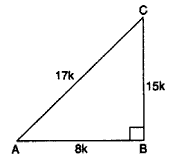
By using the Pythagoras theorem, we have
$A C ^ { 2 } = A B ^ { 2 } + B C ^ { 2 }$
$\Rightarrow A C ^ { 2 } = ( 8 k ) ^ { 2 } + ( 15 k ) ^ { 2 } \Rightarrow A C ^ { 2 } = 64 k ^ { 2 } + 225 k ^ { 2 }$
$\Rightarrow A C = \sqrt { 289 k ^ { 2 } } \Rightarrow A C = 17 k$
Now, $\sin A = \frac { B C } { A C } = \frac { 15 k } { 17 k } = \frac { 15 } { 17 }$
and, $\sec A = \frac { A C } { A B } = \frac { 17 k } { 8 k } = \frac { 17 } { 8 }$
View full question & answer→Question 251 Mark
Evaluate $\frac{\tan 65^{\circ}}{\cot 25^{\circ}}$
AnswerWe know : cot A = tan (90° – A)
So, cot 25° = tan (90° – 25°) = tan 65°
i.e., $\frac{\tan 65^{\circ}}{\cot 25^{\circ}}=\frac{\tan 65^{\circ}}{\tan 65^{\circ}}=1$
View full question & answer→Question 261 Mark
If $\sin (A-B)=\frac{1}{2}, \cos (A+B)=\frac{1}{2}, 0^{\circ}<A+B \leq 90^{\circ}, A>B$ find $A$ and $B$.
AnswerAccording to the question, $\sin (A-B)=\frac{1}{2}$, therefore, $A-B=30^{\circ}$ ......(1)
$\cos (A+B)=\frac{1}{2}$, therefore, $A + B =60^{\circ}$ ..... (2)
Solving (1) and (2), we get
$A=45^{\circ}$ and $B=15^{\circ}$
View full question & answer→Question 271 Mark
Express cot 85° + cos 75° in terms of trigonometric ratios of angles between 0° and 45°.
Answercot 85° + cos 75°
= tan (90° - 85°) + sin (90° - 75°)
= tan 5° + sin 15
View full question & answer→