Question 15 Marks
Find the zeroes of the following polynomials by factorisation method and verify the relations between the zeroes and the coefficients of the polynomials:
$2\text{x}^2 +\frac{7}{2}\text{x}+\frac{3}{4}$.
AnswerLet $\text{f}\text{(x)}=2\text{x}^2+\frac{7}{2}\text{x}+\frac{3}{4}=8\text{x}^2+14\text{x}+3$
$= 8x^2 + 12x + 2x + 3$ [by splitting the middle term]
$= 4x(2x + 3) + 1(2x + 3)$
$= (2x + 3)(4x + 1)$
So, the value of $8x^2 + 14x + 3$ is zero when 2x + 3 = 0 or 4x + 1 = 0,
i.e., when $\text{x}=-\frac{3}{2}$ or $\text{x}=-\frac{1}{4}$
So, the zeroes of $8x^2 + 14x + 3$ are $-\frac{3}{2}$ and $-\frac{1}{4}$
$\therefore\ \text{Sum of zeroes}=-\frac{3}{2}-\frac{1}{4}=-\frac{7}{4}=\frac{-7}{2\times2}$
$=-\frac{(\text{Coefficient of x})}{(\text{Coefficient of x}^2)}$
and $\text{product of zeroes}=\Big(-\frac{3}{2}\Big)\Big(-\frac{1}{4}\Big)=\frac{3}{8}=\frac{3}{2\times4}$
$=\frac{\text{Constant term}}{\text{Coefficient of x}^2}$
Hence, verified the relations between the zeroes and the coefficients of the polynomial.
View full question & answer→Question 25 Marks
Find the zeroes of the following polynomials by factorisation method and verify the relations between the zeroes and the coefficients of the polynomials:
$7\text{y}^2-\frac{11}{3}\text{y}-\frac{2}{3}$.
AnswerLet $\text{f}\text{(y)}=7\text{y}^2-\frac{11}{3}\text{y}-\frac{2}{3}$
$=21\text{y}^2-11\text{y}-2$
$=21\text{y}^2-14\text{y}+3\text{y}-2$ [By splitting the middle term]
$=7\text{y}(3\text{y}-2)+1(3\text{y}-2)$
$=(3\text{y}-2)(7\text{y}+1)$
So, the value of $7\text{y}^2-\frac{11}{3}\text{y}-\frac{2}{3}$ is zero when $3\text{y}-2=0$ or $7\text{y}+1=0,$
i.e. when $\text{y}=\frac{2}{3}$ or $\text{y}=-\frac{1}{7}$
So, the zeroes of $7\text{y}^2-\frac{11}{3}\text{y}-\frac{2}{3}$ are $\frac{2}{3}$ and $-\frac{1}{7}$
$\therefore\ \text{Sum of zeroes}=\frac{2}{3}-\frac{1}{7}=\frac{14-3}{21}=\frac{11}{21}=-\Big(\frac{-11}{3\times7}\Big)$
$=(-1).\Big(\frac{\text{Coefficient of y}}{\text{Coefficient of y}^2}\Big)$
and $\text{product of zeroes}=\Big(\frac{2}{3}\Big)\Big(-\frac{1}{7}\Big)=\frac{-2}{21}=\frac{-2}{3\times7}$
$=(-1)^2\Big(\frac{\text{Constant term}}{\text{Coefficient of y}^2}\Big)$
Hence, verified the relations between the zeroes and the coefficient of the polynomial.
View full question & answer→Question 35 Marks
For each of the following, find a quadratic polynomial whose sum and product respectively of the zeroes are as given. Also find the zeroes of these polynomials by factorisation.
$-2\sqrt{3},-9$
AnswerMain Concept:
- If $\alpha$, $\beta$ are the zeroes of f(x), then
$\text{f}(\text{x})=\text{x}^2-(\alpha+\beta)\text{x}+\alpha\beta$
- The zeroes of f(x) are given be f(x) = 0.
$\alpha+\beta=-2\sqrt{3}$ and $\alpha\beta=-9$ [Given]
$\text{f}\text{(x)}=\text{x}^2-(\alpha+\beta)\text{x}+\alpha\beta$ [Formula]
$=\text{x}^2-(-2\sqrt{3})\text{x}+(-9)$
$\Rightarrow\ \text{f}(\text{x})=\text{x}^2+2\sqrt{3}\text{x}-9$
For zeroes of polynomial f(x), f(x) = 0
$\Rightarrow\ \text{x}^2+2\sqrt{3}\text{x}-9=0$
$\Rightarrow\ \text{x}^2+3\sqrt{3}\text{x}-1\sqrt{3}\text{x}-9=0$
$\Rightarrow\ \text{x}(\text{x}+3\sqrt{3})-\sqrt{3}(\text{x}+3\sqrt{3})=0$
$\Rightarrow\ (\text{x}+3\sqrt{3})(\text{x}-\sqrt{3})=0$
$\Rightarrow\ \text{x}+3\sqrt{3}=0$ or $(\text{x}-\sqrt{3})=0$
$\Rightarrow\ \text{x}=-3\sqrt{3}$ or $\text{x}=\sqrt{3}$
$\therefore\ \alpha=-3\sqrt{3}$ and $\beta=\sqrt{3}$ View full question & answer→Question 45 Marks
For each of the following, find a quadratic polynomial whose sum and product respectively of the zeroes are as given. Also find the zeroes of these polynomials by factorisation.
$\frac{-8}{3}$, $\frac{4}{3}$
AnswerMain Concept:
- If $\alpha$, $\beta$ are the zeroes of f(x), then
$\text{f}(\text{x})=\text{x}^2-(\alpha+\beta)\text{x}+\alpha\beta$
- The zeroes of f(x) are given be f(x) = 0.
$\alpha+\beta=\frac{-8}{3}$ and $\alpha.\beta=\frac{4}{3}$ [Given]
$\text{f}(\text{x})=\text{x}^2-(\alpha+\beta)\text{x}+\alpha\beta$ [Formula]
$=\text{x}^2-\Big(\frac{-8}{3}\Big)\text{x}+\frac{4}{3}$
Multiplying of dividing f(x) by any real number does not affect the zeroes of polynomial.
So, $f(x) = 3x^2 + 8x + 4$ [Multiplting by LCM 3]
Foe zeroes of f(x), f(x) = 0
$\Rightarrow 3x^2 + 8x + 4 = 0$
$\Rightarrow 3x^2 + 6x + 2x + 4 = 0$
$\Rightarrow 3x(x + 2) + 2(x + 2) = 0$
$\Rightarrow (x + 2)(3x + 2) = 0$
$\Rightarrow x + 2 = 0 or 3x + 2 = 0$
$\Rightarrow x = -2$ of $\text{x}=\frac{-2}{3}$
$\therefore\ \alpha = -2$ and $\beta=\frac{-2}{3}$ View full question & answer→Question 55 Marks
Find $k$ so that $x^2+2 x+k$ is a factor of $2 x^4+x^3-14 x^2+5 x+6$. Also find all the zeroes of the two polynomials.
AnswerMain Concept:
Fector theorem and Euclid's division algorithm. By factor theorem and Euclid's dividsiom algorithm, we get
f(x) = g(x) × q(x) + r(x)
Let $f(x) = 2x^4 + x^3 – 14x^2 + 5x + 6$
and $g(x) = x^2 + 2x + k ..... (i)$
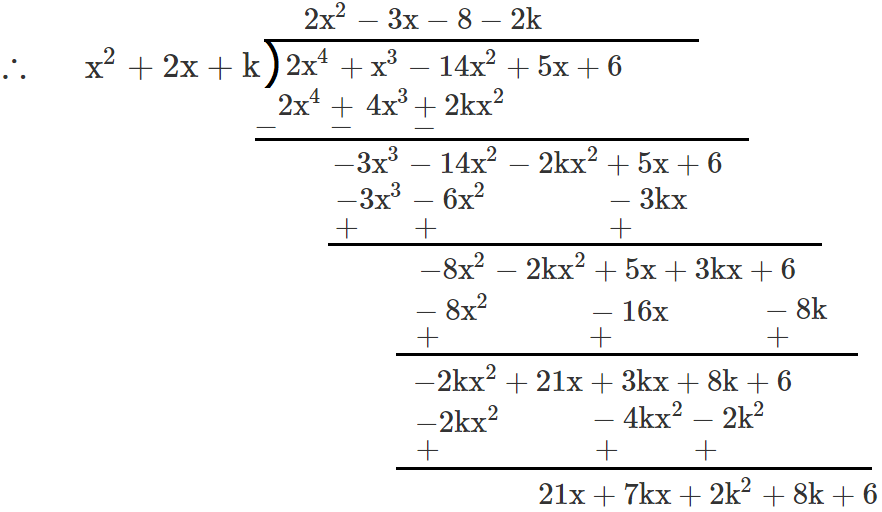
But, r(x) = 0
$\therefore$ $(21 + 7k)x + 2k^2 + 8k + 6 = 0x + 0$
$\Rightarrow 21 + 7k = 0$
$\Rightarrow\ \text{k}=\frac{-21}{-3}$
$\Rightarrow\ \text{k}=-3$
and $2k^2 + 8k + 6 = 0$
$2k^2 + 6k + 2k + 6 = 0$
$\Rightarrow 2k(k + 3) + 2(k + 3) = 0$
$\Rightarrow (k + 3)(2k + 2) = 0$
$\Rightarrow k + 3 = 0 or 2k + 2 = 0$
$\Rightarrow k = -3 or k = -1$
$\therefore$ Common solution is $k = -3$
$So, q(x) = 2x^2 - 3x - 8 - 2(-3)$
$= 2x^2 - 3x - 8 + 6$
$\Rightarrow q(x) = 2x^2 - 3x - 2$
$\therefore$ $f(x) = g(x) q(x) + 0$
$= (x^2 + 2x - 3)(2x^2 - 3x - 2)$
$= (2x^2 - 4x + 1x - 2)(x^2 + 3x - 1x - 3)$
$= [2x(x - 2) + 1 (x - 2)][x(x + 3) -1(x + 3)]$
$\Rightarrow f(x) = (x - 2)(2x + 1)(x + 3)(x - 1)$
For zeroes of f(x), f(x) = 0
$\therefore$ (x - 1)(x - 2)(x + 3)(2x + 1) = 0
⇒ (x - 1) = 0, (x - 2) = 0, (x + 3) = 0 and 2x + 1 = 0
⇒ x = 1, x = 2, x = -3 and $\text{x}=\frac{-1}{2}$
So, zeroes of f(x) are 1, 2, -3, and $\frac{-1}{2}$ View full question & answer→Question 65 Marks
Given that $\text{x}-\sqrt{5}$ is a factor of the cubic polynomial $\text{x}^3-3\sqrt{5}\text{x}^2+13\text{x}-3\sqrt{5}$, find all the zeroes of the polynomial.
AnswerMain Concept:Factor theorem, Euclid,s division algorithm.
Let $\text{f}\text{(x)}=\text{x}^3-3\sqrt{5}\text{x}^2+13\text{x}-3\sqrt{5}$
and $\text{g}\text{(x)}=(\text{x}-\sqrt{5})$
$\because$ g(x) is a factor of f(x) so $\text{f}\text{(x)}=\text{q}\text{(x)}(\text{x}-\sqrt{5})$
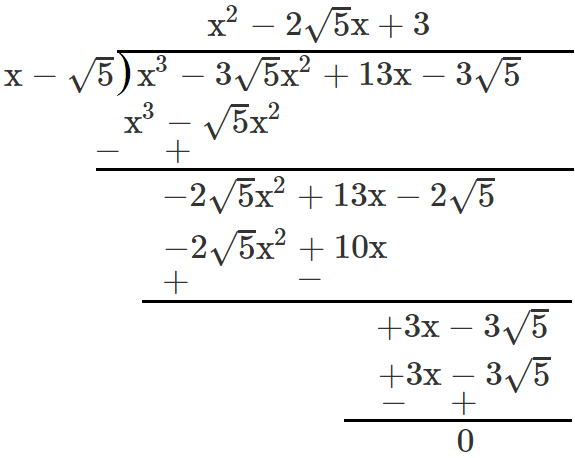
But, f(x) = q(x)g(x) $\therefore\ \text{f}\text{(x)}=(\text{x}^2-2\sqrt{5}\text{x}+3)(\text{x}-\sqrt{5})$ $\Rightarrow\ \text{f}\text{(x)}=\{\text{x}^2-\big[\big(\sqrt{5}+\sqrt{2}\big)+\big(\sqrt{5}-\sqrt{2}\big)\}\text{x}+\big(\sqrt{5}-\sqrt{2}\big)\big(\sqrt{5}+\sqrt{2}\big)\big]\big[\text{(x)}-\sqrt{5}\big]$ $=\big[\text{x}^2-\big(\sqrt{5}+\sqrt{2}\big)\text{x}-\big(\sqrt{5}-\sqrt{2}\big)\text{x}+\big(\sqrt{5}-\sqrt{2}\big)\big(\sqrt{5}+\sqrt{2}\big)\big]\big[\text{(x)}-\sqrt{5}\big]$ $=\text{x}\big[\text{x}-(\sqrt{5}+\sqrt{2})\big]-(\sqrt{5}-\sqrt{2})[\text{x}-(5+\sqrt{5})\big]\big[\text{x}-\sqrt{5}\big]$ $\Rightarrow\ \text{f}\text{(x)}=(\text{x}-\sqrt{5}-\sqrt{2})(\text{x}-\sqrt{5}+\sqrt{2})(\text{x}-\sqrt{5})$ For zeroes of f(x), f(x) = 0 $\Rightarrow\ (\text{x}-\sqrt{5}-\sqrt{2})(\text{x}-\sqrt{5}+\sqrt{2})(\text{x}-\sqrt{5})=0$ $\Rightarrow\ (\text{x}-\sqrt{5}-\sqrt{2}) = 0$ or $(\text{x}-\sqrt{5}+\sqrt{2})=0$ or $(\text{x}-\sqrt{5})=0$ $\Rightarrow\ \text{x}=\sqrt{5}+\sqrt{2}$ or $\text{x}=\sqrt{5}-\sqrt{2}$ or $\text{x}=+\sqrt{5}$ $\therefore$ Zeroes are $(\sqrt{5}+\sqrt{2})$, $(\sqrt{5}-\sqrt{2})$ and $\sqrt{5}$. View full question & answer→Question 75 Marks
Find the zeroes of the following polynomials by factorisation method and verify the relations between the zeroes and the coefficients of the polynomials:
$t^3 – 2t^2 – 15t.$
AnswerLet $f(t) = t^3 - 2t^2 - 15t$
$= t(t^2 - 2t - 15)$
$= t(t^2 - 5t + 3t - 15)$ [by splitting the middle term]
$= t[t(t - 5) + 3(t - 5)]$
$= t(t - 5) (t + 3)$
So, the value of $t^3-2 t^2-15 t$ is zero when $t=0$ of $t-5=0$ of $t+3=0$
i.e., when $t=0$ of $t=5$ of $t=-3$.
So, the zeroes of $t^3-2 t^2-15 t$ are $-3,0$ and 5 .
$\therefore\ \text{Sum of zeroes} = -3+0+5=2=\frac{-(-2)}{1}$
$=(-1).\Big(\frac{\text{Coefficien of t}^2}{\text{Coefficient of t}^3}\Big)$
Sum of product of two zeroes at a time
= (-3)(0) + (0)(5) + (5)(-3)
= 0 + 5 - 15 = -15
$=(-1)^2\Big(\frac{\text{Coefficient if t}}{\text{Coefficient of t}^3}\Big)$
and product of zeroes = (-3)(0)(5) = 0
$=(-1)^3\Big(\frac{\text{Constant term}}{\text{Coefficient of t}^3}\Big)$
Hence, verified the relations between the zeroes and the coefficients of the polynomial.
View full question & answer→Question 85 Marks
Find the zeroes of the following polynomials by factorisation method and verify the relations between the zeroes and the coefficients of the polynomials:
$2\text{s}^2-(1+2\sqrt{2})\text{s}+\sqrt{2}$.
AnswerLet $\text{f}(\text{s})=2\text{s}^2-(1+2\sqrt{2})\text{s}+\sqrt{2}$
$=2\text{s}^2-\text{s}+2\sqrt{2}\text{ s}+\sqrt{2}$
$=\text{s}(2\text{s}-1)-\sqrt{2}(2\text{s}-1)$
$=(2\text{s}-1)(\text{s}-\sqrt{2})$
So, the value of $2\text{s}^2-(1+2\sqrt{2})\text{s}+\sqrt{2}$ is zero when $2\text{s}-1=0$ or $\text{s}-\sqrt{2} = 0,$
i.e., when $\text{s}=\frac{1}{2}$ or $\text{s}=\sqrt{2}$
So, the zeroes of $2\text{s}^2-(1+2\sqrt{2})\text{s}+\sqrt{2}$ are $\frac{1}{2}$ and $\sqrt{2}$
$\therefore\ \text{Sum of zeroes}=\frac{1}{2}+\sqrt{2}=\frac{1+2\sqrt{2}}{2}=\frac{-[-(1+2\sqrt{2})]}{2}$
$=\frac{\text{(Coefficient of s)}}{\text{(Coefficient of s)}^2}$
and $\text{product of zeroes}=\frac{1}{2}.\sqrt{2}=\frac{1}{\sqrt{2}}=\frac{\text{Constant term}}{\text{Coefficient of s}^2}$
Hence, verified the relations between the zeroes and the coefficients of the polynomial.
View full question & answer→Question 95 Marks
For each of the following, find a quadratic polynomial whose sum and product respectively of the zeroes are as given. Also find the zeroes of these polynomials by factorisation.
$\frac{-3}{2\sqrt{5}}$, $-\frac{1}{2}$
AnswerMain Concept:
- If $\alpha$, $\beta$ are the zeroes of f(x), then
$\text{f}(\text{x})=\text{x}^2-(\alpha+\beta)\text{x}+\alpha\beta$
- The zeroes of f(x) are given be f(x) = 0.
$\alpha+\beta=\frac{-3}{\sqrt{5}}$ and $\alpha.\beta=\frac{1}{2}$ [Given]
$\text{f}\text{(x)}=\text{x}^2-(\alpha+\beta)\text{x}+\alpha\beta$ [Formula]
$=\text{x}^2-\Big(\frac{-3}{2\sqrt{5}}\Big)\text{x}+\Big(-\frac{1}{2}\Big)$
$\Rightarrow\ \text{f}\text{(x)}=\text{x}^2+\frac{3}{2\sqrt{5}}\text{x}-\frac{1}{2}$
Multipiying or dividing f(x) by any real number does not affect the zeroes of f(x). On multiplying f(x) by $2\sqrt{5}$ (LCM), we get
$\text{f}(\text{x})=2\sqrt{5}\text{ x}^2+3\text{x}-\sqrt{5}$
For zeroes of polynomial f(x), f(x) = 0
$\Rightarrow\ 2\sqrt{5}\text{ x}^2+3\text{x}-\sqrt{5}=0$
$\Rightarrow\ 2\sqrt{5}\text{ x}^2+5\text{x}-2\text{x}-\sqrt{5}=0$
$\Rightarrow\ \sqrt{5}\text{x}(2\text{x}+\sqrt{5})-1(2\text{x}+\sqrt{5})=0$
$\Rightarrow\ (2\text{x}+\sqrt{5})(\sqrt{5}\text{x}-1)=0$
$\Rightarrow\ (2\text{x}+\sqrt{5})=0$ or $\sqrt{5}\text{x}-1=0$
$\Rightarrow\ \text{x}=\frac{-\sqrt{5}}{2}$ or $\text{x}=\frac{1}{\sqrt{5}}$
$\therefore\ \alpha=\frac{-\sqrt{5}}{2}$ and $\beta=\frac{1}{\sqrt{5}}$. View full question & answer→Question 105 Marks
For each of the following, find a quadratic polynomial whose sum and product respectively of the zeroes are as given. Also find the zeroes of these polynomials by factorisation.
$\frac{21}{8}$, $\frac{5}{16}$
AnswerMain Concept:
- If $\alpha$, $\beta$ are the zeroes of f(x), then
$\text{f}(\text{x})=\text{x}^2-(\alpha+\beta)\text{x}+\alpha\beta$
- The zeroes of f(x) are given be f(x) = 0.
$\alpha+\beta=\frac{21}{8}$ and $\alpha.\beta=\frac{5}{16}$ [Given]
$\text{f}(\text{x})=\text{x}^2-(\alpha+\beta)\text{x}+\alpha\beta$ [Formula]
$\Rightarrow\ \text{f}\text{(x)}=\text{x}^2-\Big(\frac{21}{8}\Big)\text{x}+\Big(\frac{5}{16}\Big)$
Multiplying (or dividing) f(x) by any real number does not affect the zeroes of f(x) so, multiplying f(x) by 16 (LCM), we get
$f(x) = 16x^2 - 42x + 5$
For zeroes of polynomial f(x), f(x) = 0
$\Rightarrow 16x^2 - 42x + 5 = 0$
$\Rightarrow 16x^2 - 40x - 2x + 5 = 0$
$\Rightarrow 8x(2x - 5) - 1(2x - 5) = 0$
$\Rightarrow (2x - 5)(8x - 1) = 0$
$\Rightarrow 2x - 5 = 0 or 8x - 1 = 0$
$\Rightarrow\ \text{x}=\frac{5}{2}$ or $\text{x}=\frac{1}{8}$
$\therefore\ \alpha=\frac{5}{2}$ and $\beta=\frac{1}{8}$ View full question & answer→Question 115 Marks
Find the zeroes of the following polynomials by factorisation method and verify the relations between the zeroes and the coefficients of the polynomials:
$4\text{x}^2+5\sqrt{2\text{x}}-3$.
AnswerLet $\text{f}\text{(x)}=4\text{x}^2+5\sqrt{2\text{x}}-3$
$=4\text{x}^2+6\sqrt{2\text{x}}-\sqrt{2\text{x}}-3$ [by splitting the middle term]
$=2\sqrt{2\text{x}}(\sqrt{2\text{x}}+3)-1(\sqrt{2\text{x}}+3)$
$=(\sqrt{2\text{x}}+3)(2\sqrt{2}.\text{x}-1)$
So, the value of $4\text{x}^2+5\sqrt{2\text{x}}-3$ is zero when $\sqrt{2\text{x}}+3=0$ or $2\sqrt{2}.\text{x}-1=0,$
i.e., when $\text{x}=-\frac{3}{\sqrt{2}}$ or $\text{x}=\frac{1}{2\sqrt{2}}$
So, the zeroes of $4\text{x}^2+5\sqrt{2\text{x}}-3$ are $-\frac{3}{\sqrt{2}}$ and $\frac{1}{2\sqrt{2}}$
$\therefore\ \text{Sum of zeroes}=-\frac{3}{\sqrt{2}}+\frac{1}{2\sqrt{2}}$
$=-\frac{5}{2\sqrt{2}}=\frac{-5\sqrt{2}}{4}$
$=-\frac{\text{(Coefficient of x)}}{\text{(Coefficient of x)}^2}$
and $\text{product of zeroes}=-\frac{3}{\sqrt{2}}.\frac{1}{2\sqrt{2}}=-\frac{3}{4}$
$=\frac{\text{Constant term}}{\text{Coefficient of x}^2}$
Hence, verified the relations between the zeroes and the coefficients of the polynomial.
View full question & answer→Question 125 Marks
Find the zeroes of the following polynomials by factorisation method and verify the relations between the zeroes and the coefficients of the polynomials:
$4x^2 – 3x – 1.$
AnswerLet $f(x) = 4x^2 - 3x - 1$
$= 4x^2 - 4x + x - 1$ [by splitting the middle term]
$= 4x(x - 1) + 1(x - 1)$
$= (x - 1)(4x + 1)$
So, the value of $4 x^2-3 x-1$ is zero when $x-1=0$ or $4 x+1=0$ i.e., when $x=1$ or $x=-\frac{1}{4}$, So, the zeroes of $4 x^2-3 x-1$ are 1 and $-\frac{1}{4}$,
$\therefore\ \text{Sum of zeroes}=1-\frac{1}{4}=\frac{3}{4}=\frac{-(-3)}{4}$
$=(-1)\Big(\frac{\text{Coefficient of x}}{\text{Coefficient of x}^2}\Big)$
and $\text{product of zeroes}=(1)\Big(-\frac{1}{4}\Big)=-\frac{1}{4}$
$=(-1)^2\Big(\frac{\text{Constant term}}{\text{Coeffcient of x}^2}\Big)$
Hence, verified the relations between the zeroes and the coefficients of the polynomial.
View full question & answer→Question 135 Marks
Find the zeroes of the following polynomials by factorisation method and verify the relations between the zeroes and the coefficients of the polynomials:
$\text{y}^2+\frac{3}{5}\sqrt{5}\text{y}-5$.
AnswerLet $\text{f}\text{(x)}=\text{y}^2+\frac{3}{5}\sqrt{5}\text{y}-5$
$=2\text{y}^2+3\sqrt{5}\text{y}-10$
$=2\text{y}^2+4\sqrt{5}\text{ y}-\sqrt{5}\text{ y}-10$
$=2\text{y}(\text{y}+2\sqrt{5})-\sqrt{5}(\text{y}+2\sqrt{5})$
$=(\text{y}+2\sqrt{5})(2\text{y}-\sqrt{5})$
So, the value of $\text{y}^2+\frac{3}{2}\sqrt{5}\text{y}-5$ is zero when $(\text{y}+2\sqrt{5})=0$ or $(2\text{y}-\sqrt{5})=0,$
i.e., when $\text{y}=-2\sqrt{5}$ or $\text{y}=\frac{\sqrt{5}}{2}.$
So, the zeroes of $2\text{y}^2+3\sqrt{5}\text{y}-10$ are $-2\sqrt{5}$ and $\frac{\sqrt{5}}{2}$
$\therefore\ \text{Sum of zeroes}=-2\sqrt{5}+\frac{\sqrt{5}}{2}=\frac{-3\sqrt{5}}{2}=-\frac{(\text{Coefficient of y})}{(\text{Coefficient of y}^2)}$
and $\text{product of zeroes}=-2\sqrt{5}\times\frac{\sqrt{5}}{2}=-5=\frac{\text{Constant term}}{\text{Coefficient of y}^2}$
Hence, verified the relations between the zeroes and the coefficients of the polynomial.
View full question & answer→Question 145 Marks
Given that $\sqrt{2}$ is a zero of the cubic polynomial $6\text{x}^3+\sqrt{2}\text{x}^2-10\text{x}-4\sqrt{2}$ findits other two zeroes.
AnswerMain Concept: Using Euclid's division algorithm here, remainder is zero. Then quotient will be quadratic whose zeroes can be find out by factorisation. Let $\text{f}\text{(x)}=6\text{x}^3+\sqrt{2}\text{x}^2-10\text{x}-4\sqrt{2}$ If $\sqrt{2}$ is the zero of f(x), then $(\text{x}-\sqrt{2})$ will be a factoer of f(x). So, by remainder theorem when f(x) is divided by $(\text{x}-\sqrt{2})$, the quotient comes out to be quadratic. 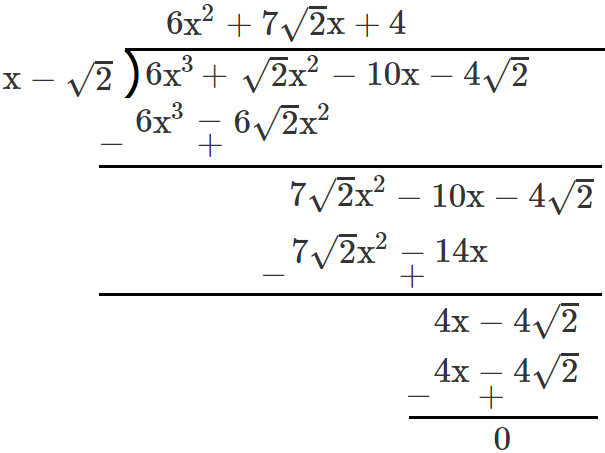 $\therefore\ \text{f}\text{(x)}=(\text{x}-\sqrt{2})(6\text{x}^2+4\sqrt{2}\text{x}+3\sqrt{2}\text{x}+4)=0$ $\Rightarrow\ (\text{x}-\sqrt{2})\big[2\text{x}(3\text{x}+2\sqrt{2})+\sqrt{2}(3\text{x}+2\sqrt{2})\big]=0$$\Rightarrow\ (\text{x}-\sqrt{2})(3\text{x}+2\sqrt{2})(2\text{x}+\sqrt{2})=0$
$\Rightarrow\ \text{x}-\sqrt{2}=0$ or $3\text{x}+2\sqrt{2}=0$ or $2\text{x}+\sqrt{2}=0$
$\Rightarrow\ \text{x}=\sqrt{2}$ or $\text{x}=\frac{-2\sqrt{2}}{3}$ or $\text{x}=\frac{-\sqrt{2}}{2}$
So, other two roots are $\frac{-2\sqrt{2}}{3}$ and $\frac{-\sqrt{2}}{3}$. View full question & answer→Question 155 Marks
Given that the zeroes of the cubic polynomial $x^3 – 6x^2 + 3x + 10$ are of the form a, a + b, a + 2b for some real numbers a and b, find the values of a and b as well as the zeroes of the given polynomial.
AnswerMain concept:
$\alpha+\beta+\gamma=\frac{-\text{b}}{\text{a}}$, $\alpha\beta+\beta\gamma+\gamma\alpha=\frac{+\text{c}}{\text{a}}$ and $\alpha\beta\gamma=\frac{-\text{d}}{\text{c}}$
Let $\text{f}\text{(x)}=\text{x}^3-6\text{x}^2+3\text{x}+10$ [given] .....(i)
$\alpha=\text{a}$, $\beta=\text{a}+\text{b}$ and $\gamma=\text{a}+2\text{b}$ [Given]
But, $\text{f}\text{(x)}=\text{ax}^3+\text{bx}^2+\text{cd}+\text{d}\ .....\text{(ii)}$
$\therefore$ a = a, b = -6, c = 3 and d = +10 [Comparing (i) and (ii)]
$\alpha+\beta+\gamma=\frac{-\text{b}}{\text{a}}$
$\Rightarrow\ \text{a}+\text{a}+\text{b}+\text{a}+2\text{b}=\frac{+6}{1}\ \Rightarrow\ 3\text{a}+3\text{b}=6$
$\Rightarrow\ \text{a}+\text{b}=2$
$\Rightarrow\ \text{b}=2-\text{a}\ .....\text{(iii)}$
$\alpha\beta+\beta\gamma+\gamma\alpha=\frac{\text{c}}{\text{a}}$
$\Rightarrow\ \text{a}(\text{a}+\text{b})+(\text{a}+\text{b})(\text{a}+2\text{b})+(\text{a}+2\text{b})(\text{a})=\frac{3}{1}$
$\Rightarrow a^2 + ab + a^2 + 2ab + ab + 2b^2 + a^2 + 2ab = 3$
$\Rightarrow 3a^2 + 6ab + 2b^2 = 3$
$\Rightarrow 3a^2 + 6a(2 - a) + 2(2 - a)^2 = 3 [Using (iii)]$
$\Rightarrow 3a^2 + 12a - 6a^2 + 2(4 + a^2 - 4a) = 3$
$\Rightarrow -3a^2 + 12a + 8 + 2a^2 - 8a - 3 = 0$
$\Rightarrow -a^2 + 4a + 5 = 0$
$\Rightarrow a^2 - 4a - 5 = 0$
$\Rightarrow a^2 - 5a + a - 5 = 0$
$\Rightarrow a(a - 5) + 1(a - 5) = 0$
$\Rightarrow (a + 1)(a - 5) = 0$
$\Rightarrow (a + 1) = 0 or (a - 5) = 0$
$\Rightarrow a = -1 or a = 5$
Now, b = 2 - a [From (iii)]
When a = 5, b = 2 - 5 = -3
When a = -1, b = 2 - (-1) = 3
If a = -1 and b = 3, then zeroes are, a, (a + b), (a + 2b)
= -1, (-1 + 3), [-1 + 2(3)]
= -1, 2, 5
If a = 5, and b = -3, then zeroes are 5,[5+(-3)], [5 + 2(-3)] = 5, 2, -1
So,zeroes in both sases are $\beta = 2$, $\gamma = -1$ and $\alpha = 5$.
View full question & answer→Question 165 Marks
Find the zeroes of the following polynomials by factorisation method and verify the relations between the zeroes and the coefficients of the polynomials:
$\text{v}^2+4\sqrt{3}\text{v}-15$.
AnswerLet $\text{f}(\text{v})=\text{v}^2+4\sqrt{3}\text{v}-15$
$=\text{v}^2+(5\sqrt{3}-\sqrt{3})\text{v}-15$ [by splitting the middle term]
$=\text{v}^2+5\sqrt{3}\text{v}-\sqrt{3}\text{v}-15$
$=\text{v}(\text{v}+5\sqrt{3})-\sqrt{3}(\text{v}+5\sqrt{\text{3}})$
$=(\text{v}+5\sqrt{3})-(\text{v}+\sqrt{\text{3}})$
So, the value of $\text{v}^2+4\sqrt{3}\text{v}-15$ is zero when $\text{v}+5\sqrt{3}=0$ or $\text{v}-\sqrt{3}=0,$
i.e., when $\text{v}=-5\sqrt{3}$ or $\text{v}=\sqrt{3}.$
So, then zeroes of $\text{v}^2+4\sqrt{3}\text{v}-15$ are $-5\sqrt{3}$ and $\sqrt{3}.$
$\therefore\ \text{Sum of zeroes}=-5\sqrt{3}+\sqrt{3}=-4\sqrt{3}$
$=(-1)\Big(\frac{\text{Coefficient of v}}{\text{Coefficient of v}^2}\Big)$
and $\text{product of zeroes}=(-5\sqrt{3})(\sqrt{3})$
$=-5\times3=-15$
$=(-1)^2\Big(\frac{\text{Constant term}}{\text{Coefficient of v}^2}\Big)$
Hence, verified the relations between the zeroes and the coefficients of the polynomial.
View full question & answer→Question 175 Marks
For which values of a and b, are the zeroes of $q(x) = x^3 + 2x^2 + a$ also the zeroes of the polynomial $p(x) = x^5 – x^4 – 4x^3 + 3x^2 + 3x + b$? Which zeroes of p(x) are not the zeroes of q(x)?
AnswerMain Concept:
Factor theorem and Euclid's division algorithm. By factor therem it q(x) is a factor of p(x), then r(x) must be zero.
$p(x) = x^5 - x^4 - 4x^3 + 3x^2 + 3x + b$
$q(x) = x^3 + 2x^2 + a$
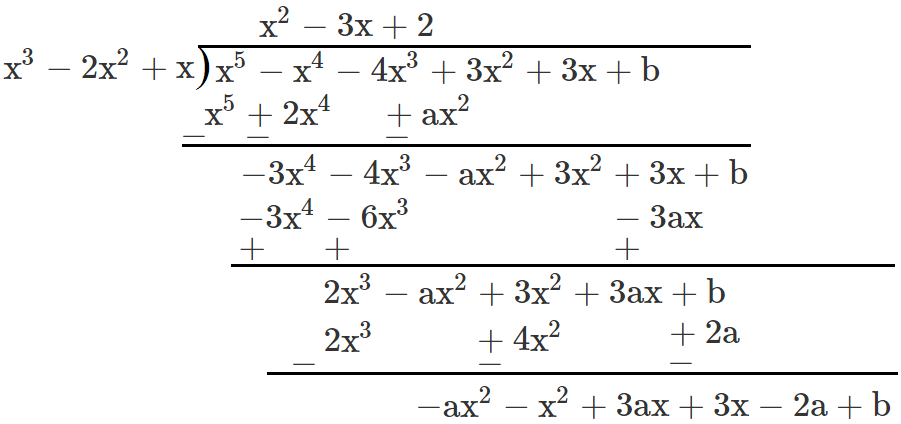
So, by factor theorem remainder must be zero i.e.,
r(x) = 0
$\Rightarrow -(a + 1)x^2 + (3a + 3)a + (b - 2a) = 0x^2 + 0x + 0$
Comparing the coefficients if x2, x and constt. on both sides, we get
-(a + 1) = and 3a + 3 = 0 and b - 2a = 0
⇒ a = -1 and a = -1 and b - 2(-1) = 0
⇒ b = -2
For a = -1 and b = -2, zeroes of q(x) will be zeroes of p(x).
For zeroes of p(x), p(x) = 0
$\Rightarrow (x^3 + 2x^2 + a)(x^2 - 3x + 2) = 0$
$\Rightarrow [x^3 + 2x^2 - 1][x^2 - 2x - 1x + 2] = 0$
$\Rightarrow (x^3 + 2x^2 - 1)[x(x - 2) - 1(x - 2)] = 0$
$\Rightarrow (x^3 + 2x^2 - 1)(x - 2)(x - 1) = 0$
Hence, x = 2 and 1 are not the zeroes of q(x). View full question & answer→