Question
Find the zeroes of the following polynomials by factorisation method and verify the relations between the zeroes and the coefficients of the polynomials:
$2\text{x}^2 +\frac{7}{2}\text{x}+\frac{3}{4}$.
Answer

Let $\text{f}\text{(x)}=2\text{x}^2+\frac{7}{2}\text{x}+\frac{3}{4}=8\text{x}^2+14\text{x}+3$
$= 8x^2 + 12x + 2x + 3$ [by splitting the middle term]
$= 4x(2x + 3) + 1(2x + 3)$
$= (2x + 3)(4x + 1)$
So, the value of $8x^2 + 14x + 3$ is zero when 2x + 3 = 0 or 4x + 1 = 0,
i.e., when $\text{x}=-\frac{3}{2}$ or $\text{x}=-\frac{1}{4}$
So, the zeroes of $8x^2 + 14x + 3$ are $-\frac{3}{2}$ and $-\frac{1}{4}$
$\therefore\ \text{Sum of zeroes}=-\frac{3}{2}-\frac{1}{4}=-\frac{7}{4}=\frac{-7}{2\times2}$
$=-\frac{(\text{Coefficient of x})}{(\text{Coefficient of x}^2)}$
and $\text{product of zeroes}=\Big(-\frac{3}{2}\Big)\Big(-\frac{1}{4}\Big)=\frac{3}{8}=\frac{3}{2\times4}$
$=\frac{\text{Constant term}}{\text{Coefficient of x}^2}$
Hence, verified the relations between the zeroes and the coefficients of the polynomial.

Need a full question paper?

Generate a complete, print-ready paper with questions like this in minutes — across 16+ boards, with answer keys.

Start Generating Free

Similar questions

If the ratio of the sum of the first $n$ terms of two A.Ps is $(7 n+1):(4 n+27)$, then find the ratio of their $9^{\text {th }}$terms.
Solve graphically the following system of linear equation. Also find the coordinates of the points where the lines meet axis of y.
$2x - y - 5 = 0,$
$x - y - 3 = 0.$
Solve the following system of equations graphically:
2x - 3y + 13 = 0,
3x - 2y + 12 = 0
Prove the following trigonometric identities.
$\frac{\cot^2\text{A}(\sec\text{A}-1)}{1+\sin\text{A}}=\sec^2\text{A}\Big(\frac{1-\sin\text{A}}{1+\sin\text{A}}\Big)$
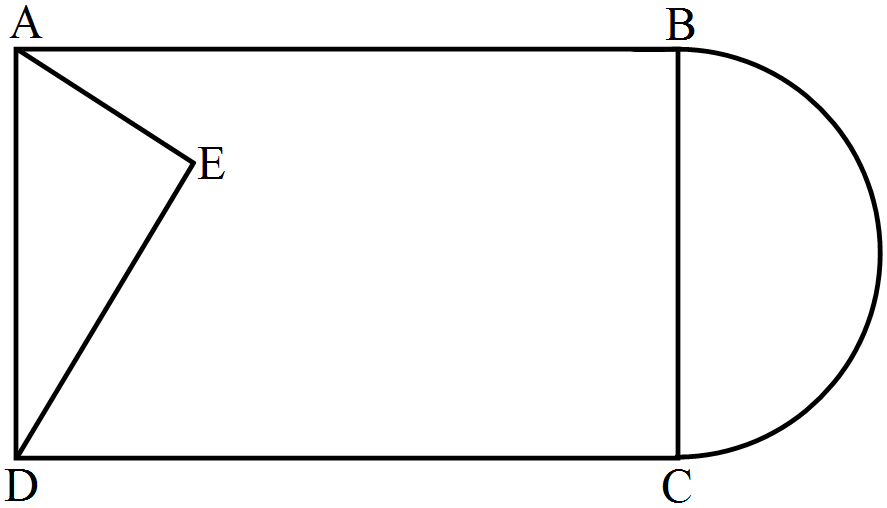
In the given figure, from a rectangular region ABCD with AB = 20cm, a right triangle AED with AE = 9cm and DE = 12cm, is cut off. On the other end, taking BC as diameter, a semicircle is added on outside the region. Find the area of the shaded region. $\big[\text{Use }\pi=3.14\big]$
In a quadrilateral ABCD, $\angle\text{A}+\angle\text{D}=90^\circ.$ Prove that $AC^2 + BD^2 = AD^2 + BC^2.$
[Hint: Produce AB and DC to meet at E]
A person invested some amount at the rate of $12 \%$ simple interest and the remaining at $10 \%$. He received yearly interest of $₹ 130$ but if he had interchanged the amount invested, he would have received $₹ 4$ more as the interest. How much money did he invest at different rates?
The four vertices of a quadrilateral are (1, 2), (-5, 6), (7, -4) and (k, -2) taken in order. If the area of the quadrilateral is zero, find the value of k.
A and B each has some money. If A gives Rs. 30 to B, then B will have twice the money left with A. But, if B gives Rs. 10 to A, then A will have thrice as much as is left with B. How much money does each have?
Draw a circle of radius 4.2cm. Draw a pair of tangents to this circle inclined to each other at an angle of 45°.