Question 12 Marks
If a line divides any two sides of a triangle in the same ratio, then the line is parallel to the third side.
Answer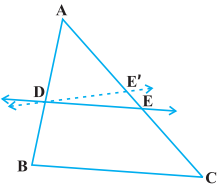
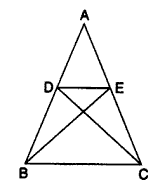
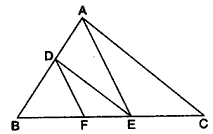
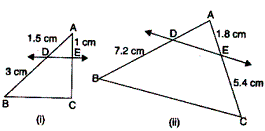
This theorem can be proved by taking a line DE such that $\frac{ AD }{ DB }=\frac{ AE }{ EC }$ and assuming that $DE$ is not parallel to $BC$ (see Fig. 6.12).
If $DE$ is not parallel to $BC$, draw a line $DE ^{\prime}$ parallel to $BC$.
So,
$ \frac{ AD }{ DB }=\frac{ AE ^{\prime}}{ E ^{\prime} C } \quad \text { (Why ?) }$
$\text{Therefore,}$
$\frac{ AE }{ EC }=\frac{ AE ^{\prime}}{ E ^{\prime} C } \quad \text { (Why?) } $
Adding 1 to both sides of above, you can see that $E$ and $E ^{\prime}$ must coincide. (Why ?)
Let us take some examples to illustrate the use of the above theorems.
View full question & answer→This theorem can be proved by taking a line DE such that $\frac{ AD }{ DB }=\frac{ AE }{ EC }$ and assuming that $DE$ is not parallel to $BC$ (see Fig. 6.12).
If $DE$ is not parallel to $BC$, draw a line $DE ^{\prime}$ parallel to $BC$.
So,
$ \frac{ AD }{ DB }=\frac{ AE ^{\prime}}{ E ^{\prime} C } \quad \text { (Why ?) }$
$\text{Therefore,}$
$\frac{ AE }{ EC }=\frac{ AE ^{\prime}}{ E ^{\prime} C } \quad \text { (Why?) } $
Adding 1 to both sides of above, you can see that $E$ and $E ^{\prime}$ must coincide. (Why ?)
Let us take some examples to illustrate the use of the above theorems.