Questions

Fill In The Blanks[1 Marks ]

Take a timed test

18 questions · self-marked practice — reveal the answer and mark yourself.
Question 11 Mark
All concentric circles are _________ to each other.
Answer
All concentric circles are similar to each other.
View full question & answer
Question 21 Mark
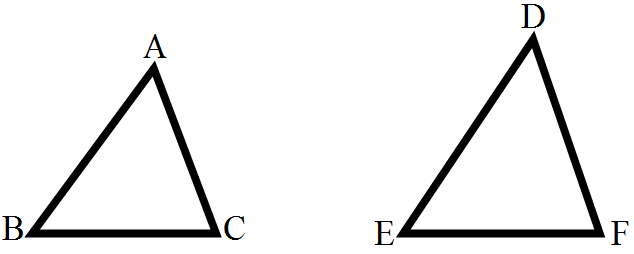
Let $\triangle ABC \sim \triangle DEF$ and their areas be respectively $81 cm^2$ and $144 cm^2$. If $EF =24 cm$, then length of side BC is....... cm .
Answer
Let $\triangle\text{ABC}\sim\triangle\text{DEF}$ and their areas be respectively $81cm^2$ and $144cm^2$. If EF = 24cm, then length of side BC is 18cm.Solution:

$\triangle\text{ABC}\sim\triangle\text{DEF}$
$\frac{\text{ar.}\triangle\text{ABC}}{\text{ar.}\triangle\text{DEF}}=\Big(\frac{\text{BC}}{\text{EF}}\Big)^2$
$\frac{81}{144}=\Big(\frac{\text{BC}}{24}\Big)^2$
$\frac{\text{BC}}{24}=\sqrt{\frac{81}{144}}$
$\frac{\text{BC}}{24}=\frac{9}{12}$
$\text{BC}=\frac{9}{12}\times24$
$\text{BC} = 18\text{cm}$
View full question & answer
Question 31 Mark
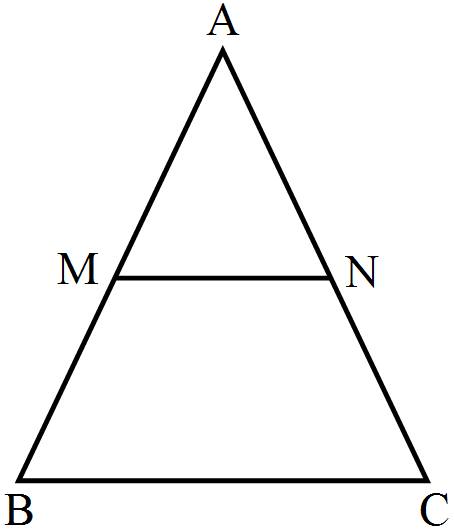
In fig. MN || BC and AM : MB = 1 : 2, then $\frac{\text{ar}(\triangle\text{AMN})}{\text{ar}(\triangle\text{ABC})}=$ _________.
Answer
In fig. MN || BC and AM : MB = 1 : 2, then $\frac{\text{ar}(\triangle\text{AMN})}{\text{ar}(\triangle\text{ABC})}=\frac{1}{9}$ $$ Solution: Since we have given that AM : MB = 1 : 2 So, AB = 1 + 2 = 3 Since MN || BC So, Using "Area similarity theorem" ,we get that$\frac{\text{ar}(\triangle\text{AMN})}{\text{ar}(\triangle\text{ABC})}=\frac{\text{AM}^2}{\text{AB}^2}=\frac{1}{3^2}=\frac{1}{9}$
Hence, the required ratio is 1 : 9.
View full question & answer
Question 41 Mark
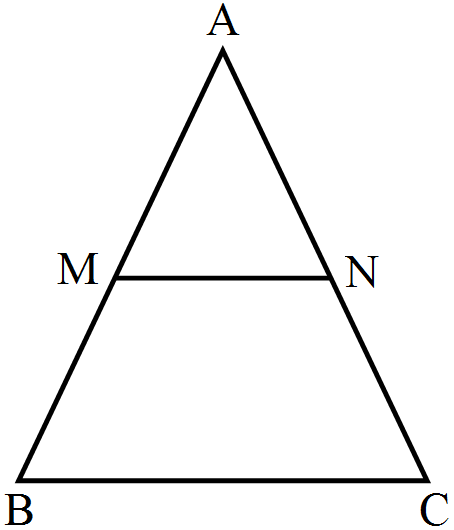
In fig. MN || BC and AM : MB = 1 : 2, then $\frac{\text{ar}(\triangle\text{AMN})}{\text{ar}(\triangle\text{ABC})}=$ _________.
Answer
In fig. MN || BC and AM : MB = 1 : 2, then $\frac{\text{ar}(\triangle\text{AMN})}{\text{ar}(\triangle\text{ABC})}=\frac{1}{9}$ $$ Solution: Since we have given that AM : MB = 1 : 2 So, AB = 1 + 2 = 3 Since MN || BC So, Using "Area similarity theorem" ,we get that$\frac{\text{ar}(\triangle\text{AMN})}{\text{ar}(\triangle\text{ABC})}=\frac{\text{AM}^2}{\text{AB}^2}=\frac{1}{3^2}=\frac{1}{9}$
Hence, the required ratio is 1 : 9.
View full question & answer
Question 51 Mark
A ladder 10m long reaches a window 8m above the ground. The distance of the foot of the ladder from the base of the wall is _________ m.
Answer
A ladder 10m long reaches a window 8m above the ground. The distance of the foot of the ladder from the base of the wall is 6m.
Solution:
Image
Let AB be A ladder and B is the window at 8m above the ground C. Now, In right triangle ABC
By using Pythagoras theorem, we have
$AB^2 = BC^2 + CA^2$
$\Rightarrow 10^2 = 8^2 + CA^2$
$\Rightarrow CA^2 = 100 - 64$
$\Rightarrow CA^2 = 36$
$\Rightarrow CA = 6m.$
Hence, the distance of the foot of the ladder from the base of the wall is 6m.
View full question & answer
Question 61 Mark
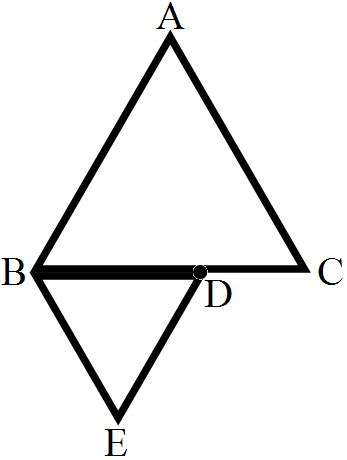
ABC and BDE are two equilateral triangles such that D is the mid-point of BC. Ratio of the areas of triangles ABC and BDE is _____________.
Answer
ABC and BDE are two equilateral triangles such that D is the mid-point of BC. Ratio of the areas of triangles ABC and BDE is 4 : 1. Solution: $\triangle\text{ABC}$ and $\triangle\text{BDE}$ are both equilateral triangles.
$\therefore\triangle\text{ABC}\sim\text{BDE}$
[Using AAA similar condition]. We know that the ratio of the areas of two similar triangles is equal to the ratio of the squares of any two corresponding sides.$\therefore\frac{\text{ar}(\triangle\text{ABC})}{\text{ar}(\triangle\text{BDE})}=\frac{\text{AB}^2}{\text{BD}^2}$
$\frac{\text{ar}(\triangle\text{ABC})}{\text{ar}(\triangle\text{BDE})}=\Big(\frac{\text{BC}}{\text{BD}}\Big)^2$
$\Rightarrow[\therefore\text{AB}=\text{BC}=\text{CA}]$
$\Rightarrow\frac{\text{ar}(\triangle\text{ABC})}{\text{ar}(\triangle\text{BDE})}=\Big(\frac{2\text{BD}}{\text{BD}}\Big)^2$
$\Rightarrow\frac{\text{ar}(\triangle\text{ABC})}{\text{ar}(\triangle\text{BDE})}=\frac41$
Hence, 4 : 1 is the correct answer.
View full question & answer
Question 71 Mark
Given $\triangle\text{ABC}\sim\triangle\text{PQR},$ if $\frac{\text{AB}}{\text{PQ}}=\frac13,$ then $\frac{\text{ar}(\triangle\text{ABC})}{\text{ar}(\triangle\text{PQR)}}=$ _________.
Answer
Given $\triangle\text{ABC}\sim\triangle\text{PQR},$ if $\frac{\text{AB}}{\text{PQ}}=\frac13,$ then $\frac{\text{ar}(\triangle\text{ABC})}{\text{ar}(\triangle\text{PQR)}}=$ $\frac19.$ Solution:$\frac{\text{ar}(\triangle\text{ABC})}{\text{ar}(\triangle\text{PQR)}}=\frac{\text{(AB)}^2}{(\text{PQ})^2}(\frac13)^2=\frac19.$
View full question & answer
Question 81 Mark
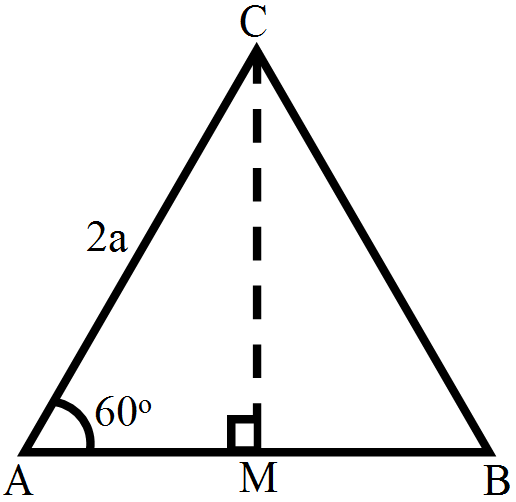
ABC is an equilateral triangle of side 2a, then length of one of its altitude is _______.
Answer
ABC is an equilateral triangle of side 2a, then length of one of its altitude is $\sqrt3\text{a}.$ Solution: ABC is an equilateral triangle side = 2a AB = AC = BC = 2a
In $\triangle\text{ACM}$$\sin60^\circ=\frac{\text{CM}}{\text{AC}}$
$\frac{\sqrt3}{2}=\frac{\text{CM}}{2\text{a}}$
$\text{CM}=2\text{a}\times\frac{\sqrt3}{2}$
Altitude $\text{CM}=\sqrt{3}\text{a}$
View full question & answer
Question 91 Mark
Two triangles are similar, if their corresponding angles are .......... (proportional, equal).
Answer
Two triangles are similar, if their corresponding angles are equal.
View full question & answer
Question 101 Mark
Two polygons of the same number of sides are similar, if (a) their corresponding angles are and (b) their corresponding sides are ........... (equal, proportional).
Answer
Two polygons of the same number of sides are similar, if (a) their corresponding angles are and (b) their corresponding sides are proportional.
View full question & answer
Question 151 Mark
All ________ triangles are similar. (isosceles, equilateral)
Answer
All equilateral triangles are similar.
View full question & answer
Question 161 Mark
All .......... triangles are similar (isosceles, equilateral).
Answer
All equilateral triangles are similar.
View full question & answer
Question 171 Mark
Two triangles are similar, if their corresponding sides are ........... (proportional, equal).
Answer
Two triangles are similar, if their corresponding sides are proportional.
View full question & answer
Question 181 Mark
Two polygons of the same number of sides are similar, if (a) their corresponding angles are ________ and (b) their corresponding sides are ________ . (equal, proportional)
Answer
Two polygons of the same number of sides are similar, if (a) their corresponding angles are equal and (b) their corresponding sides are proportional.
View full question & answer