MCQ 11 Mark
Choose the correct answer from the given four options: $\text{In }\angle\text{BAC}=90^\circ\text{ and}\text{ AD}\perp\text{BC}.\text{Then,}$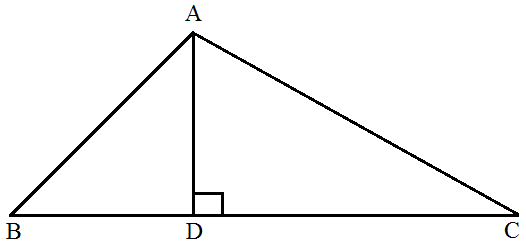 Traingles
 - A
$B D \times C D=B C^2$
- B
$A B \times A C=B C^2$
- ✓
$B D \times C D=A D^2$
- D
$A B \times A C=A D^2$
AnswerCorrect option: C. $B D \times C D=A D^2$
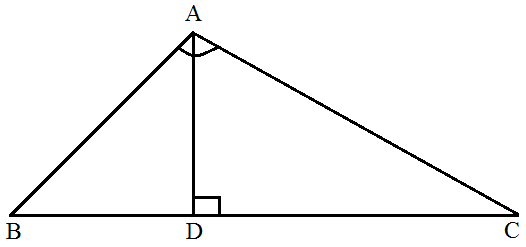
$\angle\text{D}=\angle\text{D}=90^\circ$
$\angle\text{DBA}=\angle\text{DAC}\ \ \big[\text{each equal to } 90^\circ-<\text{c}\big]$
$\therefore\triangle\text{ADB}\sim\triangle\text{ADC}\ \ \big[\text{by AAA simillariy criterion}\big]$
$\therefore\frac{BD}{AD}=\frac{AD}{CD}$
$\Rightarrow\text{BD}\times\text{CD}=\text{AD}^2$ View full question & answer→MCQ 21 Mark
Choose the correct answer from the given four options:
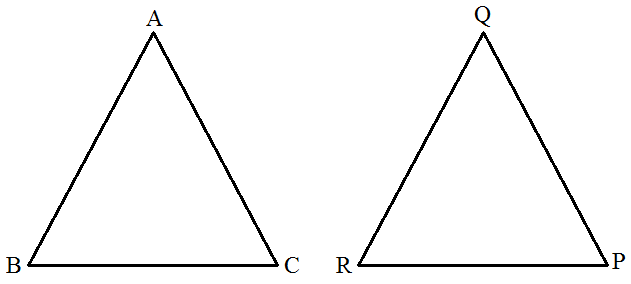
If in two traingles ABC and PQR, $\frac{\text{AB}}{\text{QR}}=\frac{\text{BC}}{\text{PR}}=\frac{\text{CA}}{\text{PQ}},$ then:
- A
$\triangle\text{PQR}\sim\triangle\text{CAB}$
- B
$\triangle\text{PQR}\sim\triangle\text{ABC}$
- ✓
$\triangle\text{CBA}\sim\triangle\text{PQR}$
- D
$\triangle\text{BCA}\sim\triangle\text{PQR}$
AnswerCorrect option: C. $\triangle\text{CBA}\sim\triangle\text{PQR}$
Given, in two $\triangle\text{PQR}=\frac{\text{AB}}{\text{QR}}=\frac{\text{BC}}{\text{PR}}=\frac{\text{CA}}{\text{PQ}} $
Which shows that sidles of one triangle are proportional to the side of thew other triangle, then their Corresponding angles are also equal, so by SSS similarity, triangles are similar.
$\text{i.e.,}\ \triangle\text{CAB}\sim\triangle\text{PQR}$
View full question & answer→MCQ 31 Mark
Choose the correct answer from the given four options:
The lengths of the diagonals of a rhombus are $16\ cm$ and $12\ cm$. Then, the length of the side of the rhombus is:
- A
$ 9\ cm$
- ✓
$ 10\ cm$
- C
$ 8\ cm$
- D
$20\ cm$
AnswerCorrect option: B. $ 10\ cm$
We know that, the diagonals of a rhombus are perpendicular bisector of each other.
Given, $AC = 16\ cm$ and $BD = 12\ cm [$left$]$
$\therefore AO= 8\ cm, SO = 6\ cm$
and $\angle\text{AOB}=90^\circ$
In right angled $\angle\text{AOB},$
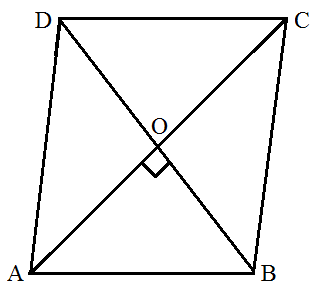
$A B^2=A O^2+O B^2 [$by pythagoras theorem$]$
$\Rightarrow A B^2=8^2+6^2$
$\Rightarrow A B^2=64+36$
$\Rightarrow A B^2=100$
$\therefore AB = 10\ cm$ View full question & answer→MCQ 41 Mark
Choose the correct answer from the given four options:
It $S$ is a point on side $PQ$ of a $\triangle\text{PQR}$ such that $PS = QS = RS$, then:
- A
$PR \times QR=RS^2$
- B
$QS+RS=QR^2$
- ✓
$PR+QR=PQ^2$
- D
$PS+RS=PR^2$
AnswerCorrect option: C. $PR+QR=PQ^2$
Given, in $\triangle\text{PQR}$
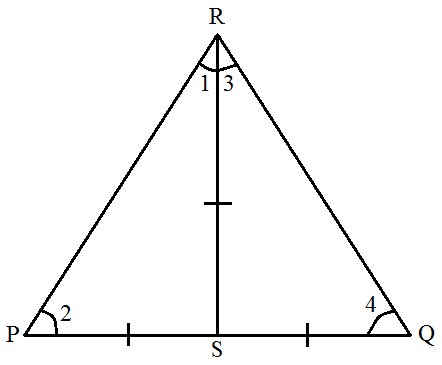
$\text{PS}=\text{QS}=\text{RS}\ .......(\text{i})$
$\text{In }\triangle\text{ PSR},\ \ \text{PS}=\text{RS} [$from Eq.$(i)]$
$\Rightarrow\angle1=\angle2\ ......(\text{ii})$
Similarly, in $\triangle\text{RSQ},$
$\Rightarrow\angle3=\angle4\ ......(\text{iii})$
[Corresponding angles of equal sides are equal]
Now, in $\triangle\text{PQR},$ sum of angles $=180^\circ$
$\Rightarrow\angle{\text{P}}+\angle{\text{Q}}+\angle{\text{R}}=180^\circ$
$\Rightarrow\angle2+\angle4+\angle1+\angle3=180^\circ$
$\Rightarrow\angle1+\angle3+\angle1+\angle3=180^\circ$
$\Rightarrow2(\angle1+\angle3)=180^\circ$
$\Rightarrow\angle1+\angle3=\frac{180^\circ}{2}=90^\circ$
$\therefore\angle\text{R}=90^\circ$
In $\triangle\text{PQR},$ by Pythagoras theorem,
$\text{PR}^2=\text{QR}^2=\text{PQ}^2$ View full question & answer→MCQ 51 Mark
Choose the correct answer from the given four options:
$\text{If}\ \triangle\text{ABC}\sim\triangle\text{EDF}\text{ and}\ \triangle\text{ABC}$ is not similar to $\triangle\text{DEF},$ then which of the following is not true?
AnswerGiven, $\triangle\text{ABC}\sim\triangle\text{EDF}$
$\therefore\ \frac{\text{AB}}{\text{ED}}=\frac{\text{BC}}{\text{DF}}=\frac{\text{AC}}{\text{EF}}$
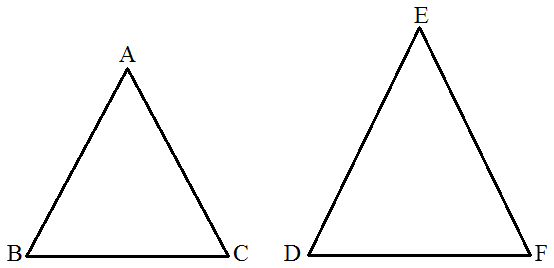
Taking first two terms, we get
$\frac{\text{AB}}{\text{ED}}=\frac{\text{BC}}{\text{DF}}$
$\Rightarrow\text{AB}\times\text{DF}=\text{ED}\times\text{BC}$
$\text{or}\ \text{BC}\times \text{DE}=\text{AB}\times\text{DF}$
So, option (a) is also true.
Taking first and last terms, we get
$\frac{\text{BC}}{\text{DF}}=\frac{\text{AC}}{\text{EF}}$
$\Rightarrow\text{AB}\times\text{EF} = \text{ED}\times\text{AC}$
Hence, Option (b) is true. View full question & answer→MCQ 61 Mark
Choose the correct answer from the given four options:
It is given that $\triangle\text{ABC}\sim\triangle\text{DEF},\ \angle\text{A}=30^\circ,\ \angle\text{C}=50^\circ,$ AB = 5cm, AC = 8cm, and DF = 7.5cm Then, the following is true:
- A
$\text{DE}=12\text{cm},\angle\text{F}=50^\circ$
- ✓
$\text{DE}=12\text{cm},\angle\text{F}=100^\circ$
- C
$\text{EF}=12\text{cm},\angle\text{D}=100^\circ$
- D
$\text{EF}=12\text{cm},\angle\text{D}=30^\circ$
AnswerCorrect option: B. $\text{DE}=12\text{cm},\angle\text{F}=100^\circ$
Given, $\triangle\text{ABC}\sim\triangle\text{DFE},$ $\text{then }\angle\text{A}=\angle{\text{D}}=30^\circ,\angle{\text{C}}=\angle{\text{E}}=50^\circ$
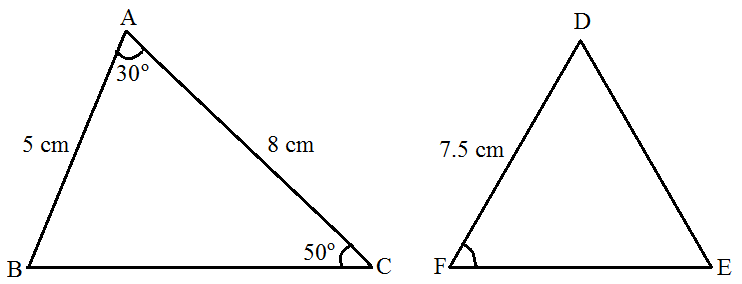
$\therefore\angle\text{B}=\angle\text{F}=180^\circ-(30^\circ+50^\circ)=100^\circ$
$\text{Also}, \text{AB}=5\text{cm},\text{AC}=8\text{cm}\text{ and}\text{ DF}=7.5\text{cm}$
$\therefore\frac{\text{AB}}{\text{DF}}=\frac{\text{AC}}{\text{DE}}$
$\Rightarrow\frac{5}{7.5}=\frac{8}{\text{DE}}$
$\therefore\text{DE}=\frac{8\times7.5}{5}=12\text{cm}$
$\text{Hence},\text{DE}=12\text{cm},\angle\text{F}=100^\circ$ View full question & answer→MCQ 71 Mark
Choose the correct answer from the given four options:
In triangles ABC and DEF, $\angle\text{B}=\angle\text{E},\angle\text{F}=\angle\text{C}\ \text{and}\text{ AB}=3\text{ DE}.$ Then, the two triangles are:
- A
Congruent but not similar.
- ✓
Similar but not congruent.
- C
Neither congruent nor similar.
- D
Congruent as well as similar.
AnswerCorrect option: B. Similar but not congruent.
$\text{In}\ \triangle\text{ABC}\text{ and}\ \triangle\text{DEF}, \angle\text{B}=\angle\text{E}=\angle\text{F}\ \text{and}=\text{AB}=3\text{DE}$
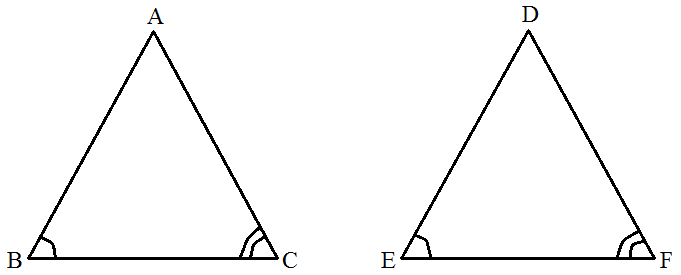
We know that, if in two triangles corresponding two angles are same, then they are similar by AAA similarity criterion. Also $\triangle\text{ABC}\text{ and}\ \triangle\text{DEF}$ do not satisfy any rule of congruency, (SAS, ASA, SSS), so both are not congruent. View full question & answer→MCQ 81 Mark
Choose the correct answer from the given four options:
If in triangles ABC and DEF, $\frac{\text{AB}}{\text{DE}}=\frac{\text{BC}}{\text{FD}},$ then they will be similar, when:
- A
$\angle\text{B}=\angle\text{E}$
- B
$\angle\text{A}=\angle\text{D}$
- ✓
$\angle\text{B}=\angle\text{D}$
- D
$\angle\text{A}=\angle\text{F}$
AnswerCorrect option: C. $\angle\text{B}=\angle\text{D}$
Given, in $\triangle\text{ABC}\text{ and }\triangle\text{DEF},$
$\frac{\text{AB}}{\text{DE}}=\frac{\text{BC}}{\text{FD}}$
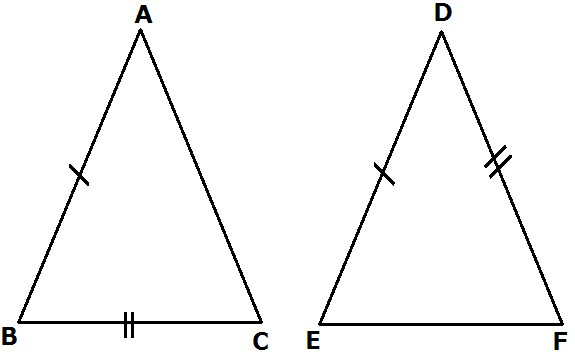
Here, Angle formed by DE and FD is $\angle\text{D}.$
So, $\angle\text{B}=\angle\text{D}$
$\Rightarrow\text{DABC}\sim\text{DEDF}$ View full question & answer→MCQ 91 Mark
Choose the correct answer from the given four options:
If $\triangle\text{ABC}\sim\triangle\text{QRP},\frac{\text{ar}(\text{ABC})}{\text{ar}(\text{PQR})}=\frac{9}{4},$ AB = 18cm and BC = 15cm, then PR is equal to:
- ✓
- B
- C
$\frac{20}{3}\text{cm}$
- D
AnswerGiven, $\triangle\text{ABC}\sim\triangle\text{QRP},$ AB = 18cm and BC = 15cm
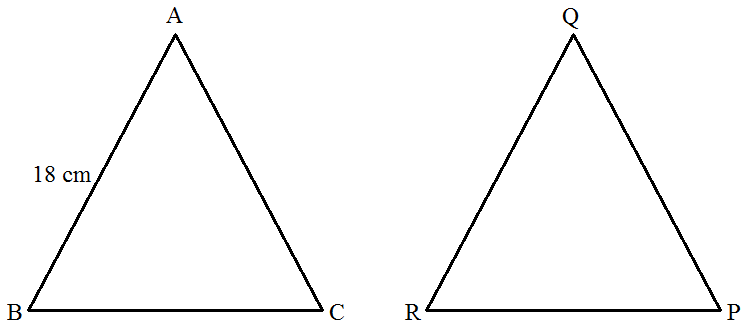
We know that, the ratio of are of two similar triangles is equal to the ratio of square of their corresponding sides.
$\therefore\frac{\text{ar}(\triangle\text{ABC})}{\text{ar}(\triangle\text{PQR})}=\frac{(\text{BC})^2}{(\text{RP})^2}$
$\text{But given, }\frac{\text{ar}(\triangle\text{ABC})}{\text{ar}(\triangle\text{PQR})}=\frac{9}{4}$
$\Rightarrow\frac{(15)^2}{(\text{RP})^2}=\frac{9}{4}$
$\Rightarrow\big(\text{RP})^2=\frac{225\times4}{9}=100$
$\therefore\text{RP}=10\text{cm}$ View full question & answer→MCQ 101 Mark
Choose the correct answer from the given four options:
In two line segments AC and BD intersect each other at the point P such that PA = 6cm, PB = 3cm, PC = 2.5cm, PD = 5cm, $\angle\text{APB}=50^\circ\text{ and} \ \angle\text{CDP}=30^\circ.$ Then $\angle\text{PBA}$ is equal to:
- A
$50^\circ$
- B
$30^\circ$
- C
$60^\circ$
- ✓
$100^\circ$
AnswerCorrect option: D. $100^\circ$
$\angle\text{APB}=\angle\text{CPD}=50^\circ$ [vertically opposite angles]
$\frac{\text{AP}}{\text{PD}}=\frac{6}{5}\ ......(\text{i})$
$\text{and }\frac{\text{BP}}{\text{CP}}=\frac{3}{2.5}=\frac{6}{5}\ ......(\text{ii})$
From Eq. (i) and (ii)
$\frac{\text{AP}}{\text{PD}}=\frac{\text{BP}}{\text{CP}}$
$\therefore\triangle\text{APB}\sim\triangle\text{DPC}$ [by SAS similarity criterion]
$\therefore\angle\text{A}=\angle\text{D} = 30^\circ $ [Corresponding angles of similar triangles]
$\text{In}\ \triangle\text{APB},\ \ \angle\text{A}+ \angle\text{B}+ \angle\text{PBA}=180^\circ$ [Sum of angles of a triangle = 180°]
$\Rightarrow30^\circ+\angle\text{B}+50^\circ=180^\circ$
$\therefore\angle\text{B}=180^\circ-(50^\circ+30^\circ)=100^\circ$
$\text{i,e.,}\ \ \angle\text{PBA}=100^\circ$
View full question & answer→MCQ 111 Mark
Choose the correct answer from the given four options:
If in two triangles DEF and PQR, $\angle\text{D}=\angle\text{Q}\ \text{and}\ \angle\text{R}=\angle\text{E},$ then which of the following is not true?
- A
$\frac{\text{EF}}{\text{PR}}=\frac{\text{DF}}{\text{PQ}}$
- ✓
$\frac{\text{DF}}{\text{PQ}}=\frac{\text{EF}}{\text{RP}}$
- C
$\frac{\text{DF}}{\text{QR}}=\frac{\text{DF}}{\text{PQ}}$
- D
$\frac{\text{EF}}{\text{RP}}=\frac{\text{DF}}{\text{RQ}}$
AnswerCorrect option: B. $\frac{\text{DF}}{\text{PQ}}=\frac{\text{EF}}{\text{RP}}$
Give, $\triangle\text{DEF},\angle\text{D}=\angle\text{Q},\angle\text{R}=\angle\text{E}$
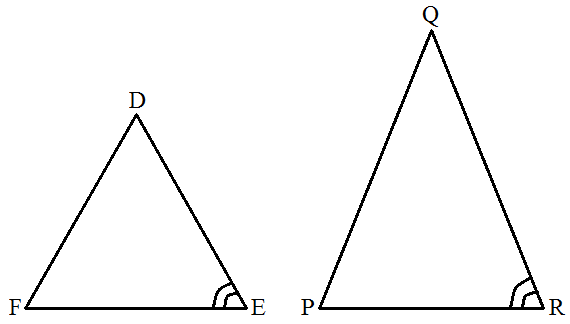
$\therefore\triangle\text{DEF}\sim\triangle\text{QRP}$ [by AAA similarity criterion]
$\Rightarrow\angle\text{F}=\angle\text{P}$ [Corresponding angles of similar triangles]
$\therefore\frac{\text{DF}}{\text{PQ}}=\frac{\text{EF}}{\text{RP}}$ Hence proved. View full question & answer→MCQ 121 Mark
Choose the correct answer from the given four options:
Its is given that $\triangle\text{ABC}\sim\triangle\text{PQR},\text{with}\frac{\text{BC}}{\text{QR}}=\frac{1}{3}.$$\text{Then},\frac{\text{ar}(\text{PQR})}{\text{ar}(\text{BCA})}$ is equal to:
- ✓
$9$
- B
$3$
- C
$\frac{1}{3}$
- D
$\frac{1}{9}$
AnswerGiven, $\triangle\text{ABC}\sim\triangle\text{PQR},\text{and}\frac{\text{BC}}{\text{QR}}=\frac{1}{3}.$
We know that the ratio of the areas of two similar triangles is equal to squal of the ratio of their corresponding sides.
$\therefore\frac{\text{ar}(\text{PQR})}{\text{ar}(\text{BCA})}=\frac{(\text{QR})^2}{(\text{BC})^2}$
$\Big(\frac{\text{QR}}{\text{BC}}\Big)^2=\Big(\frac{3}{1}\Big)^2=\frac{9}{1}=9$
View full question & answer→