Questions

[5 marks Questions]

Take a timed test

14 questions · self-marked practice — reveal the answer and mark yourself.

Question 15 Marks
Differentiate between inherited and acquired characters. Give one example for each type.
Answer
 
Acquired Traits
Inherited Traits
1.
Development: The traits develop during life time of an individual.
The traits are obtained from the parents.
2.
Nature: They are somatic variations.
They are genetic variations.
3.
Cause: Acquired traits develop due to direct effect of environment, use and conscious efforts.
The traits develop due to mutations and reshuffling of genetic material.
4.
Fate: They die with the death of the individual.
Ex. Muscular body of a wrestler.
They are passed on to the next generation.
Ex. Fused and free ear lobes.
View full question & answer
Question 25 Marks
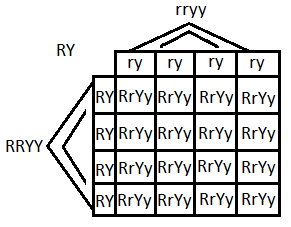
Study the following cross and showing self-pollination in $F_1$, fill in the blank and answer the question that follows:
Parents RRYY × rryy
  Round, yellow   wrinkled, green
$F_1$ RrYy × ?
  Round, yellow    
Answer
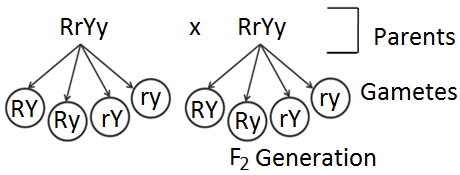
A dihybrid cross shows inheritance of two different traits simultaneously. A cross between two pure breeding dominant and recessive parents gives heterozygous dominant offspring. All $F_1$progeny in this cross will have genotype RrYy and will exhibit round and yellow phenotype. Self cross in $F_1$ progeny gives $F_2$generation and follow law of independent assortment of characters.
RrYy × RrYy
Round yellow   Round yellow
View full question & answer
Question 35 Marks
Give reasons why acquired characters are not inherited.
Answer
Acquired characters are acquired due to individual’s response to external stimuli. These traits develop because of constant exposure to a certain stimulus and the resultant response by the individual. Let us take the example of a certain cricketer who is an excellent batsman. He could become an excellent batsman because of several reasons. Some of them could be; his keen interest in the game, timely support from his family and friends, proper coaching at the right age and timely selection in the cricket team. All the cricketing ability could be acquired by him because of the way he responded to all the challenges and opportunity. But this does not mean that the son of this cricketer would become an excellent cricketer; because cricketing ability is not an inheritable character.
In fact, acquired characters just alter the phenotype of an individual. It has no effect on genotype. A character can only be inheritable when it changes the genotype of individual. Hence, acquired characters are not inherited.
View full question & answer
Question 45 Marks
Why did Mendel choose pea plant for his experiments?
Answer
Mendel chose Garden Pea or Edible Pea (Pisum sativum) as his experimental material because of:
  1. Easy availability of detectable contrasting traits of several characters.
  2. Flower structure normally allows self fertilization but cross fertilization can also be carried out easily.
  3. Annual nature of the plant.
  4. Formation of a large number of seeds by each plant.
  5. Requirement of little care except at the time of cross breeding.
View full question & answer
Question 55 Marks
A woman has only daughters. Analyse the situation genetically and provide a suitable explanation.
Answer
Humans follow XX - XY mechanism of sex determination. Human females have forty-six chromosomes arranged in twenty two homologous and homomorphic autosomes and two copies of X chromosomes as sex chromosomes (44 + XX). They do not play significant role in sex determination of child.
Males have twenty-two homomorphic pairs and one heteromorphic pair, the XY pair (44 + XY). Fertilization of egg (22 + X) with sperm carrying 22 + X chromosomes gives female child (44A + XX). Fertilization of egg (22 + X) with sperm carrying 22 + Y chromosomes gives male child (44A + XY). Only daughters indicate fusion of egg with sperms carrying 22 + X chromosomes every time.
View full question & answer
Question 65 Marks
All the human races like Africans, Asians, Europeans, Americans and others might have evolved from a common ancestor. Provide a few evidences in support of this view.
Answer
All the human races appear to be different but they have a large number of common characters. The list of common characters can be very long but we can make a shorter list:
  • Similar size of brain.
  • Bipedal locomotion Hair of body.
  • Ability to handle tools.
  • Ability to communicate using language.
  • Highly complex social behavior.
  • Same body design.
All these characters show a common ancestry for all human races. Moreover, the fact that all human beings are able to interbreed keeps them under the same species.
View full question & answer
Question 75 Marks
Mention three important features of fossils which help in the study of evolution.
Answer
Fossils are remains or impressions of past organisms that are found in the rocks. Fossils of lower strata belong to early periods while those of upper strata are of later periods. Arranging the fossils stratumwise will indicate the occurrence of different forms of life at different times. It is found that the early fossils generally belong to simple organisms. Complexity and elaboration increased gradually with evolution. Evolution has never been linear or straight. A number of variants or branches appeared, some of which were more complex while others were less complex. Fossils indicate the path of evolution of different groups.They can indicate the phylogeny of some organisms, e.g, Horse, Elephant.
Some fossils have characteristics intermediate between two groups, e.g., toothed bird Archaeopteryx. They indicate how one group has evolved from another.
View full question & answer
Question 85 Marks
Bacteria have a simpler body plan when compared with human beings. Does it mean that human beings are more evolved than bacteria? Provide a suitable explanation.
Answer
It depends on our perspective through which we try to evaluate evolution. If complexity in body design is the parameter to define evolution, then human beings are more evolved than bacteria. Bacteria are unicellular while human beings are multicellular. Bacteria show cellular level of organization, while human beings show organ system level of organization. In terms of complexity human beings are definitely highly evolved compared to bacteria.But when we compare the ability of survival, then situation is quite opposite. Human beings are living in almost every part of the earth but they can live only on land. Moreover, in extreme environmental conditions, human beings make artificial facilities to counter the adverse conditions. This means their body is not adapted to withstand extreme climatic conditions. Bacteria, on the other hand, are known to be present almost everywhere on earth. They are known to live even in some of the harshest conditions; like Sulphur spring, crater of volcano, etc. Bacteria can survive in highly acidic environment and they can survive extreme temperatures. From this angle, bacteria can be considered as more evolved than human beings.
View full question & answer
Question 95 Marks
Does geographical isolation of individuals of a species lead to formation of a new species? Provide a suitable explanation.
Answer
Yes, geographical isolation of individuals of a species leads to speciation. Splitting of existing species into two new species followed by their geographical isolation brings about reproductive isolation. Populations of a species get separated into two groups by accumulation of genetic variations in them. These newly formed groups are then isolated by any geographical barrier.
Reproductive isolation is absence of interbreeding between members of different species. Geographical barriers prevent interbreeding between two groups. This in turn causes isolation of gene pool of section of population from rest; inhibits gene flow (spread of genes between populations) and thereby leads to formation of new species.
View full question & answer
Question 105 Marks
Evolution has exhibited a greater stability of molecular structure when compared with morphological structures. Comment on the statement and justify your opinion.
Answer
The apparent structures in an organism, are termed morphological structures. Morphological structures can be easily seen by all us. Molecular structure is about the structure of biomolecules which are the integral components of organisms.
We see lot of diversity all around us. This diversity is possible because of diversity in morphological structures. This shows that morphological structures are least stable. Life which began as simple forms on the earth in now composed of many complex forms.
But despite all the evolution which have taken place through millions of years, the structure biomolecules remains the same. A DNA is same in a human and in a mouse. A protein has same structure in a bird and in a fungi. So, the molecular basis of life has not changed through all these years. This shows that evolution has exhibited a greater stability of molecular structure when compared with morphological structure.
View full question & answer
Question 115 Marks
In question 44, what are the combinations of character in the $F_2$ progeny? What are their ratios?
Answer
A dihybrid cross shows inheritance of two different traits simultaneously. A cross between two pure breeding dominant and recessive parents gives heterozygous dominant offspring. All $F_1$ progeny in this cross will have genotype RrYy and will exhibit round and yellow phenotype. Self cross in $F_1$ progeny gives $F_1$ generation and follow law of independent assortment of characters.
Gametes
RY
Ry
rY
ry
RY
RRYY
Round Yellow
RRyy
Round Yellow
RrYY
Round Yellow
RrYy
Round Yellow
Ry
RRYy
Round Yellow
RRyy
Round Green
RrYy
Round Yellow
Rryy
Round Green
rY
RrYY
Round Yellow
RrYy
Round Yellow
rrYY
Wrinkled Yellow
rrYy
Wrinkled Yellow
ry
RrYy
Round Yellow
Rryy
Round Green
rrYy
Wrinkled Yellow
rryy
Wrinkled Green
Combination of characters:
Phenotypic ratio = 9 round yellow, 3 round green, 3 wrinkled yellow, 1 wrinkled green. So, $F_1$ generation exhibits both parental and recombinant offspring. Hence, the ratio is = 9 : 3 : 3 : 1
View full question & answer
Question 125 Marks
Give the basic features of the mechanism of inheritance.
Answer
Basic Features of Inheritance:
  1. Unit Characters: An organism is made of a large number of characters, each of which behaves as a unit.
  2. Genes: Characters are controlled by genes.
  3. One Gene-One Character: A single gene generally controls one character.
  4. Location of Genes: Genes are located on chromosomes.
  5. Alleles: A gene may have two or more forms called alleles. They represent different traits of a character.
  6. Paired Alleles: An individual possesses two alleles of every gene. The two may be similar or dissimilar.
  7. Dominance: Where there are two different forms or alleles of the gene, generally one expresses its effect. It is called dominant allele. The other which does not express its effect in presence of dominant allele, is called recessive allele.
  8. Segregation: The two alleles separate at the time of gamete formation. A gamete has only one allele or form of the gene.
  9. Independent Assortment: The alleles of different genes located on separate chromosomes behave independent of one another.
  10. Pairing: Fusion of gametes during fertilization, brings together the two forms of a gene in the zygote.
View full question & answer
Question 135 Marks
Give reasons for the appearance of new combinations of characters in the $F_2$ progeny.
Answer
Independent assortment: The two forms of a gene separate and pair independent of the two forms of other genes during gametogenesis and fertilisation. It causes new combination of characters, e.g.;
Parents RrYy RrYy
Gametes RYRyrYry RYRyrYry
 
RY
Ry
rY
ry
RY
RRYY
Round Yellow
RRYy
Round Yellow
RrYY
Round Yellow
RrYy
Round Yellow
Ry
RRYy
Round Yellow
RRyy
Round Green
RrYy
Round Yellow
Rryy
Round Green
rY
RrYY
Round Yellow
RrYy
Round Yellow
rrYY
Wrinkled Yellow
rrYy
Wrinkled Yellow
ry
RrYy
Round Yellow
Rryy
Round Green
rrYy
Wrinkled Yellow
rryy
Wrinkled Green
Round Yellow = 9
Round Green = 3
Wrinkled Yellow = 3
Wrinkled Green = 1
Recombinants $=\frac{6}{16}$
View full question & answer
Question 145 Marks
In the following crosses write the characteristics of the progeny.
 
Cross
Progeny
a.
RRYY × RRYY
Round, yellow Round, yellow
..............
b.
RrYy × RrYy
Round, yellow Round, yellow
..............
c.
rryy × rryy
wrinkled, green wrinkled, green
..............
d.
RRYY × rryy
Round, yellow wrinkled green
..............
Answer
  1. Round yellow (RRYY)
  2. Round yellow (RRYY), Round yellow (RrYy), Round green (RRyy), Round green (Rryy), wrinkled yellow (rrYY), wrinkled yellow (rrYy), wrinkled green (rryy).
  1. Wrinkled green (rryy)
  2. Round yellow (RrYy)
View full question & answer
[5 marks Questions] - Science STD 10 Questions - Vidyadip