Questions · Page 1 of 4

M.C.Q (1 Marks)

🎯

Test yourself on this topic

50 questions · timed · auto-graded

MCQ 11 Mark
$\text{HCHO}$ and $\text{HCOOH}$ are detected by:
  • $ \mathrm{NaHCO}_3 $
  • B
    $ \mathrm{CuSO}_4 / \mathrm{NaOH} $
  • C
    $ \mathrm{AgNO}_3 / \mathrm{NH}_4 \mathrm{OH}$
  • D
    All of these
Answer
Correct option: A.
$ \mathrm{NaHCO}_3 $
Both $\text{HCHO}$ and $\text{HCOOH}$ react with $\ce{AgNO_3​/NH_4​OH}$
$\ce{CuSO_4​/NaOH}$ solution. But $\ce{HCOOH}$ gives effervescences of $\ce{CO_2}$​ when reacts with $\ce{NaHCO_3}$​, whereas $\ce{HCHO}$ does not give any effervescence of $\ce{CO_2}$​ when reacts with $\ce{NaHCO_3}$​.
$\ce{HCOOH + NaHCO_3 \rightarrow HCOONa + H_2​O + CO_2 \uparrow}$
View full question & answer
MCQ 21 Mark
$\sigma_{\text{C}-\text{C}} :4 ;\ \sigma_{\text{C}-\text{H}}:6;\ \pi_{\text{C}=\text{C}}:1; \ \pi_{\text{C}\equiv\text{C}}:2$ These number of $\sigma$ and $\pi$-bonds are present in which of the following molecule?
  • $\text{CH}\equiv\text{C} -\text{CH}=\text{CH}-\text{CH}_{3}$
  • B
    $\text{CH}_{2}=\text{C}=\text{CH}-\text{CH}_{3}$
  • C
    $\text{CH}_{2}=\text{CH}-\text{CH}=\text{CH}_{3}$
  • D
    None of the above.
Answer
Correct option: A.
$\text{CH}\equiv\text{C} -\text{CH}=\text{CH}-\text{CH}_{3}$
View full question & answer
MCQ 31 Mark
In which of the following inductive effect is possible:
  • A
    Butane
  • B
    Benzene
  • C
    Cyclohexane
  • Butanal
Answer
Correct option: D.
Butanal
To show inductive effect compound must contain electronegative element$/$eletropositive element attatched to $C-$atom.
So that movement of electrons away from chain$/$towards chain would occur. This is possible only in case of Butanal among given options.
View full question & answer
MCQ 41 Mark
Sodium nitroprusside reacts with sodium sulphide formed in lassaigne's test to detect presence of sulphur gives violet colour due to:
  • A
    $\text{Na}_2\big[\text{Fe}(\text{CN})_5\text{NO}\big]$
  • $\text{Na}_4\big[\text{Fe}(\text{CN})_5\text{NOS}\big]$
  • C
    $\text{Na}_2\big[\text{Fe}(\text{CN})_5\text{COS}\big]$
  • D
    None of these.
Answer
Correct option: B.
$\text{Na}_4\big[\text{Fe}(\text{CN})_5\text{NOS}\big]$
$\text{Na}_2\text{S}+\text{Na}_2\big[\text{Fe}(\text{CN})_5\text{NO}\big]\xrightarrow{\ \ \ \ }\text{Na}_4\big[\text{Fe}(\text{CN})_5\text{NOS}\big]\\\ \ \ \ \ \ \ \ \ \ \ \ \ \ \ \ \ \ \ \ \ \ \ \ \ \ \ \ \ \ \ \ \ \ \ \ \ \ \ \ \ \ \ \ \ \ \ \ \ \ \ \ \ \ \ \ \ \ \ \ \text{Violet coloour}$
View full question & answer
MCQ 51 Mark
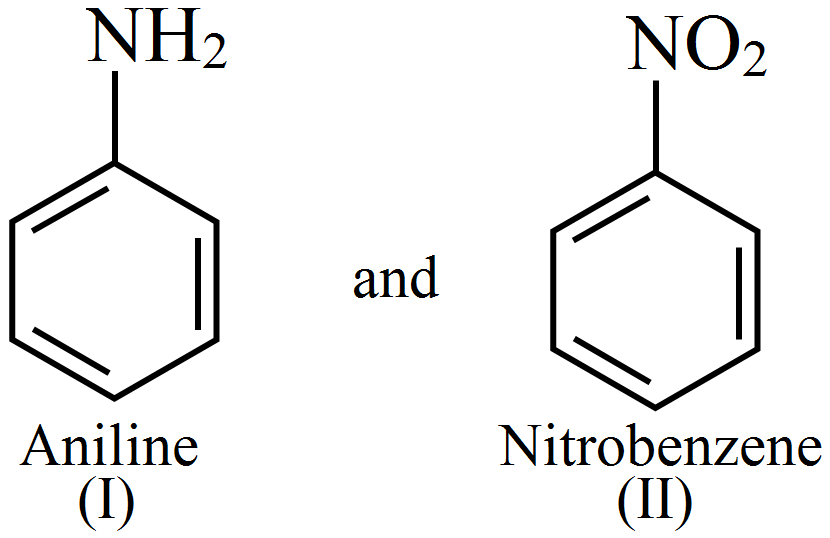
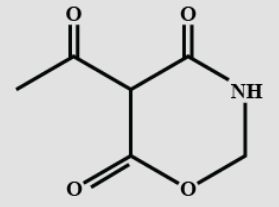
Consider the following compounds,

Which of the following statements is$/$ are true regarding $I$ and $II$?
  • I shows $+R-$effect, whereas $II$ shows $-R-$effect.
  • B
    I shows $-R-$effect, whereas $II$ shows $+R-$effect.
  • C
    Both $I$ and $II$ show $+R-$effect.
  • D
    Both $I$ and $II$ show $-R-$effect.
Answer
Correct option: A.
I shows $+R-$effect, whereas $II$ shows $-R-$effect.
View full question & answer
MCQ 61 Mark
The principle involved in paper chromatography is:
  • A
    Adsorption
  • Partition
  • C
    Solubility
  • D
    Volatility
Answer
Correct option: B.
Partition
In paper chromatography, separation of the components of a mixture depends upon their partitioning between water held in the stationary phase $($i.e. adsorbent paper$)$ and the liquid present in the mobile phase.
View full question & answer
MCQ 71 Mark
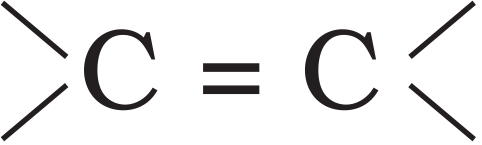
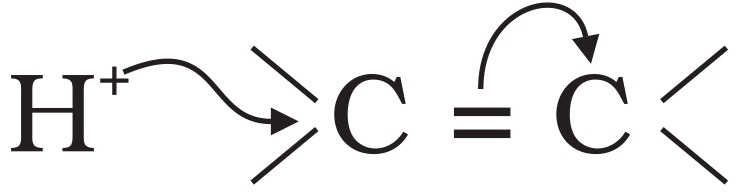
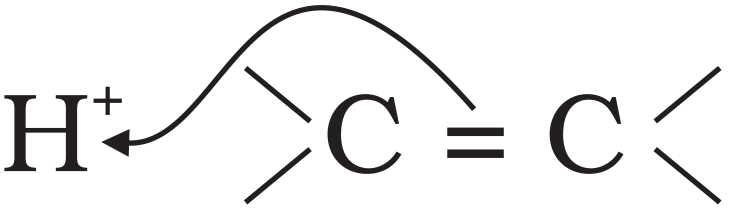
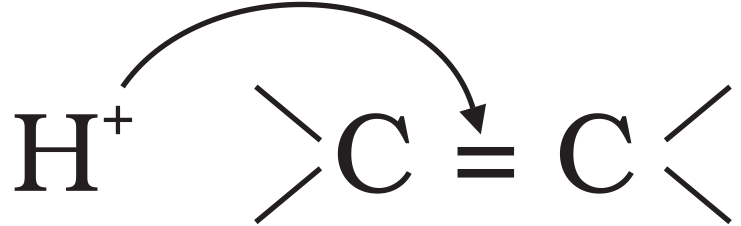
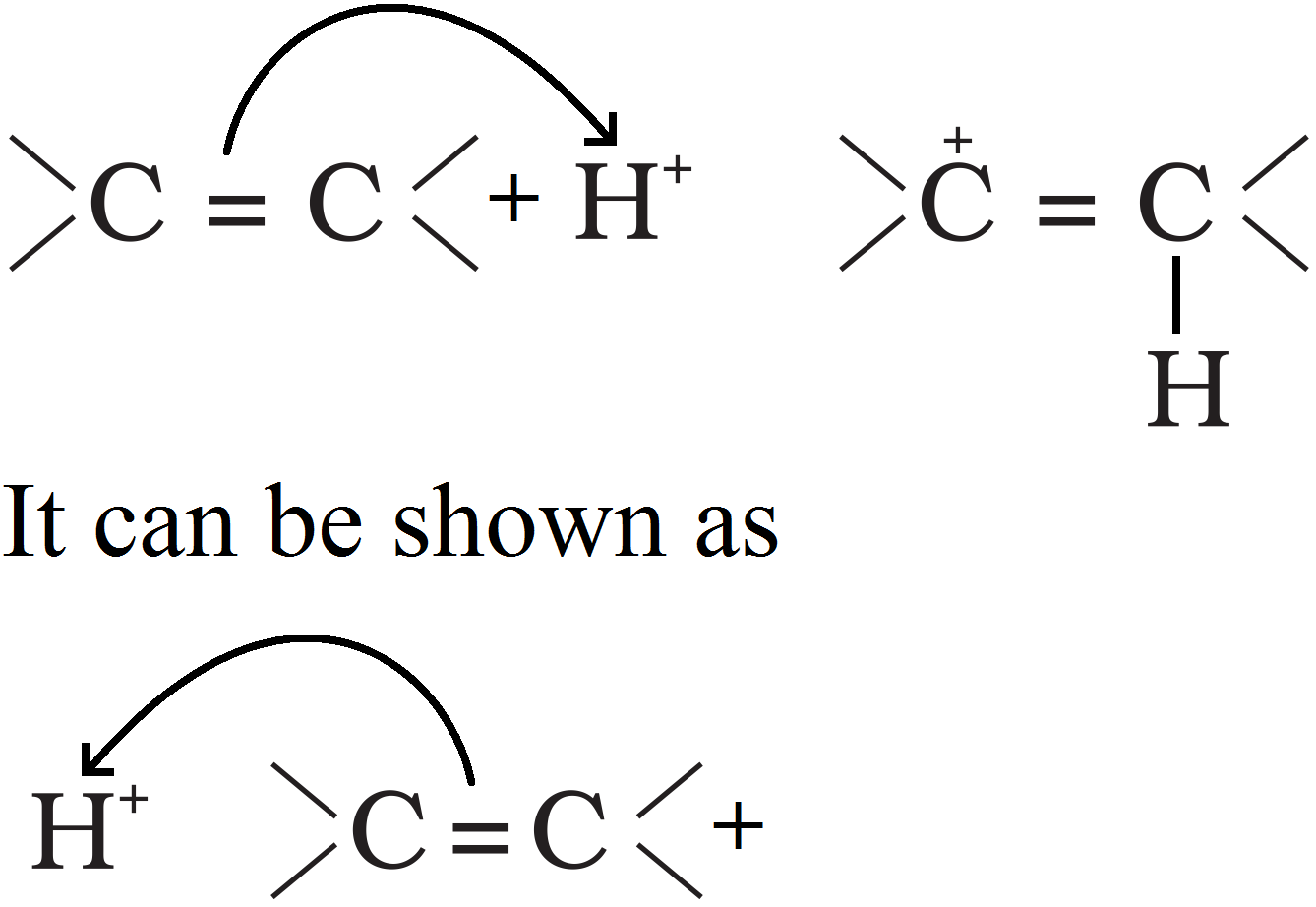
The addition of $\ce{HCl}$ to an alkene proceeds in two steps. The first step is the attack of $H^+$ ion to portion which can be shown as:
  • A
  • C
  • D
    All of these are possible.
Answer
Correct option: B.
Since double bond is a source of electrons and the charge flows from source of more electron density, therefore, $n$ electrons of the double bond attack the proton.
View full question & answer
MCQ 81 Mark
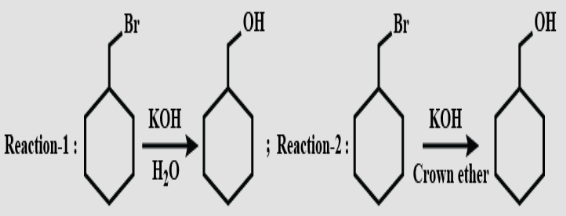
Which of the reactions shown given will be faster?
  • A
    Reaction $1$
  • Reaction $2$
  • C
    Both have equal rates of reaction.
  • D
    Cannot be predicted.
Answer
Correct option: B.
Reaction $2$
Since given reaction is $\ce{S_{N2}}$​ and we know that $\ce{S_{N2}}$​ favoured in presence of polar aprotic solvent like crown$-$ethers, $\ce{DMSO, DMF}$, etc not $\ce{H_2​O}$ which is polar protic solvent.
In reaction $2$ polar solvent $($crown ether$)$ is used.
Thus reaction $2$ is faster than reaction $1$.
View full question & answer
MCQ 91 Mark
Successive members of homologous series differ from one another in their mass by:
  • A
    $10$ units
  • B
    $15$ units
  • C
    $20$ units
  • $14$ units
Answer
Correct option: D.
$14$ units
A series of organic compounds with the same general formula but differ from adjacent members by $\ce{"−CH_2v−"}$ group are referred to as homologous series of compounds. Successive members of homologous series differ from one another in their mass by $14$ units.
For example: $\ce{CH_4}$​ and $\ce{C_2​H_6}$​ are homologous series. Its molar mass is 16 and 30gm/mole respectively.
Hence, it is differed by unit $14$.
View full question & answer
MCQ 101 Mark
Electronegativity of carbon atoms depends upon their state of hybridisation. In which of the following compounds, the carbon marked with asterisk is most electronegative?
  • A
    $ \mathrm{CH}_3-\mathrm{CH}_2-{ }^* \mathrm{CH}_2-\mathrm{CH}_3 $
  • B
    $ \mathrm{CH}_3-{ } ^*\mathrm{CH}=\mathrm{CH}-\mathrm{CH}_3 $
  • $ \mathrm{CH}_3-\mathrm{CH}_2-\mathrm{C} \equiv{ }^* \mathrm{CH} $
  • D
    $ \mathrm{CH}_3-\mathrm{CH}_2-\mathrm{CH}={ }^* \mathrm{CH}_2$
Answer
Correct option: C.
$ \mathrm{CH}_3-\mathrm{CH}_2-\mathrm{C} \equiv{ }^* \mathrm{CH} $
Electronegativity increases as the state of hybridization changes from $sp^3$ to $sp^2$ and $sp^2$ to sp. Thus, sp hybridized carbon has the highest electronegativity.
View full question & answer
MCQ 111 Mark
Which term is the best match for the color of a chemical substance students make note of:
  • Qualitative data
  • B
    Inference
  • C
    Observation
  • D
    Hypothesis
Answer
Correct option: A.
Qualitative data
Color of the substance is the qualitative property. Qualitative properties are the properties which can be observed without making any measurements or calculations.
View full question & answer
MCQ 121 Mark
Yellow ammonium sulphide can separate:
  • $\ce{CdS}$ and $\mathrm{As}_2 \mathrm{S}_3$
  • B
    $\mathrm{Bi}_2 \mathrm{S}_3$ and $\ce{CuS}$
     
  • C
    $\ce{PbS}$ and $\mathrm{Bi}_2 \mathrm{S}_3$
     
  • D
    $\ce{HgS}$ and $\ce{PbS}$
Answer
Correct option: A.
$\ce{CdS}$ and $\mathrm{As}_2 \mathrm{S}_3$
Since $\ce{CdS}$ belongs to $\ce{IIA}$ group and $\mathrm{As}_2 \mathrm{S}_3$​ belongs to $\ce{IIB}$ group, they can be separated with yellow ammonium sulphide as only $\ce{IIB}$ group sulphides dissolve in yellow ammoium sulphide.
View full question & answer
MCQ 131 Mark
Which of the following pairs are members of a homologous series?
  • A
    $ \mathrm{CH}_3 \mathrm{OCH}_3 ; \mathrm{CH}_3 \mathrm{CH}_2 \mathrm{OH} $
  • $ \mathrm{CH}_3 \mathrm{CHO} ; \mathrm{CH}_3 \mathrm{CH}_2 \mathrm{CHO} $
  • C
    $ \mathrm{CH}_3 \mathrm{CH}_2 \mathrm{COOH} ; \mathrm{CH}_3 \mathrm{COOCH}_3$
  • D
    $\left(\mathrm{CH}_3\right)_2 \mathrm{CHOH} ; \mathrm{CH}_3 \mathrm{CH}_2 \mathrm{OH} $
Answer
Correct option: B.
$ \mathrm{CH}_3 \mathrm{CHO} ; \mathrm{CH}_3 \mathrm{CH}_2 \mathrm{CHO} $
Acetaldehyde i.e $ \mathrm{CH}_3 \mathrm{CHO}$ and propionaldehyde i.e $\mathrm{CH}_3 \mathrm{CH}_2 \mathrm{CHO} $ belong from the aldehyde family hence they are homologous series.
View full question & answer
MCQ 141 Mark
The bond that consist of an upper and a lower sharing of electron orbitals is called as :
  • A $pi$ bond
  • B
    A sigma bond
  • C
    A hydrogen bond
  • D
    An ionic bond
Answer
Correct option: A.
A $pi$ bond
The bond that consist of an upper and a lower sharing of electron orbitals is called as a $pi$ bond.
A pi bond is formed by lateral $($side ways$)$ overlap.
For example, two $\ce{2pz}$​ orbitals of two $C$ atoms laterally overlap to for pi bond in ethene $\mathrm{CH}_2=\mathrm{CH}_2$.
View full question & answer
MCQ 151 Mark
In Kjeldahl's method for estimation of nitrogen, $\ce{CuSO_4}$ acts as:
  • A
    Oxidising agent.
  • B
    Reducing agent.
  • C
    Catalytic agent.
  • Hydrolysis agent.
Answer
Correct option: D.
Hydrolysis agent.
In Kjeldahl's method $($used for the estimation of nitrogen$)$ the organic compound is heated with conc. $\mathrm{H}_2 \mathrm{SO}_4$ in the presence of $\mathrm{K}_2 \mathrm{SO}_4 ($used to elevate boiling point of $\mathrm{H}_2 \mathrm{SO}_4 )$ and $\mathrm{CuSO}_4($used as catalyst$)$ to convert all the nitrogen into $\left(\mathrm{NH}_4\right)_2 \mathrm{SO}_4$
View full question & answer
MCQ 161 Mark
In each of the following, the carbonyl group is present except in:
  • A
    $\ce{HCHO}$
  • B
    $ \mathrm{CH}_3 \mathrm{COCH}_3 $
  • $ \mathrm{HCH}_2 \mathrm{OH}$
  • D
    $\ \ \ \ \ \ \ \ \ \ \ \ \text{O}\\\ \ \ \ \ \ \ \ \ \ \ \ ||\\\text{CH}_3​−\text{C}​−\text{H}$
Answer
Correct option: C.
$ \mathrm{HCH}_2 \mathrm{OH}$
Carbonyl group is $−C = O$ group, which present in aldehydes and ketones but not present in alcohols.
View full question & answer
MCQ 171 Mark
In the detection test of carbon and hydrogen with cupric oxide, carbon is oxidized to:
  • A
    Carbon monoxide
  • Carbon dioxide
  • C
    Carbonic acid
  • D
    Copper sulphate
Answer
Correct option: B.
Carbon dioxide
The given organic compound is mixed with dry copper oxide $\ce{(CuO)}$ and heated in a hard glass tube. The products of the reaction are passed over $($white$)$ anhydrous copper sulphate and then bubbled through lime water.
If copper sulphate turns blue due to the formation of $\mathrm{CuSO}_4 \cdot 5 \mathrm{H}_2 \mathrm{O} ($by water vapor$)$ then the compound contains hydrogen.
If lime water is turned milky by $\ce{CO_2}$​, then the compound contains carbon.So, the carbon is oxidized to $\ce{CO_2}$​.
View full question & answer
MCQ 181 Mark
In Dumas method, $0.25\ g$ of organic compound gave $40\ ml$ of $N$, at $300k$ and $725\ mm$ pressure. If aqueous tension at $300k$ is $25\ mm$, the percentage of nitrogen in compound is:
  • $16.76\%$
  • B
    $15.76\%$
  • C
    $17.36\%$
  • D
    $18.20\%$
Answer
Correct option: A.
$16.76\%$
$\frac{\text{P}_1\text{V}_1}{\text{T}_1}=\frac{\text{P}_2\text{V}_2}{\text{T}_2}\Rightarrow \frac{40\times760}{300}=\frac{\text{V}_2\times760}{273}$
$\Rightarrow\text{V}_2=\frac{28\times273}{76\times3}$ $[\text{P}=725-25=700\text{mm}]$
$\text{V}_2=\frac{7644}{228}=33.53\ \text{mL}$
$\%\text{ of }\text{N}=\frac{\text{V}_2}{8\text{w}}=\frac{33.53}{8\times0.25}=16.76\%$
View full question & answer
MCQ 191 Mark
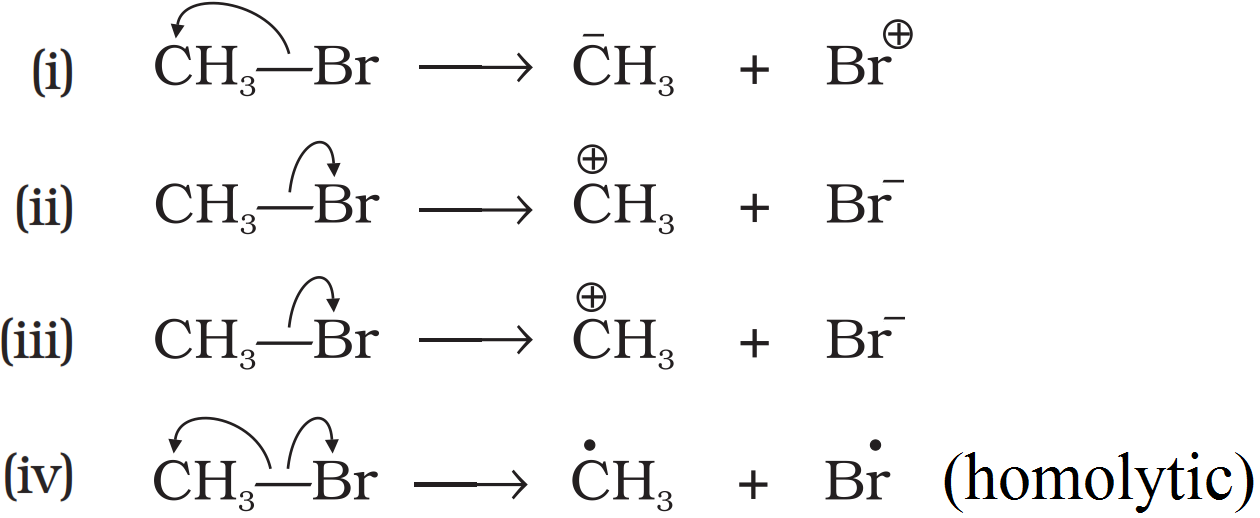
Covalent bond can undergo fission in two different ways. The correct representation involving a heterolytic fission of $\ce{CH_3—Br}$ is :
  • A
  • C
  • D
Answer
Correct option: B.
Arrow denotes the direction of movement of electrons

Since, $Br$ is more electronegative than carbon, hence heterolytic fission occurs in such a.
View full question & answer
MCQ 201 Mark
Name the two types of chromatography techniques based on the principle of differential adsorption.
  • A
    Column chromatography and thick layer chromatography.
  • B
    Non-column chromatography and thin layer chromatography.
  • Column chromatography and thin layer chromatography.
  • D
    Paper chromatography and thick layer chromatography.
Answer
Correct option: C.
Column chromatography and thin layer chromatography.
Two types of adsorption chromatography techniques are column chromatography and thin layer chromatography.
View full question & answer
MCQ 211 Mark
Homologous series is $.........$
  • A series of compounds in which the same functional group substitutes for hydrogen in a carbon chain.
  • B
    A series of compounds in which different functional group substitutes for hydrogen in a carbon chain.
  • C
    A series of compounds with same molecular formula and different structural formulae.
  • D
    A series of compounds with same molecular formula but different functional groups.
Answer
Correct option: A.
A series of compounds in which the same functional group substitutes for hydrogen in a carbon chain.
Homologous series is a series of compounds in which the same functional group substitutes for hydrogen in a carbon chain. The chemical properties of the compounds are very similar.
Example of a homologous series : $\mathrm{CH}_3 \mathrm{OH}, \mathrm{C}_2 \mathrm{H}_5 \mathrm{OH}, \mathrm{C}_3 \mathrm{H}_7 \mathrm{OH}, \mathrm{C}_4 \mathrm{H}_9 \mathrm{OH}$.
View full question & answer
MCQ 221 Mark
$Pi$ bond is formed:
  • A
    By the overlapping of atomic orbitals on the axis of nuclei.
  • B
    By mutual sharing of $p -$ electrons.
  • By sideways overlapping of half filled $p -$ orbitals.
  • D
    By overlapping of $s-$orbitals with $p -$ orbital.
Answer
Correct option: C.
By sideways overlapping of half filled $p -$ orbitals.
If a bond between two atoms is broken when one atom is rotated around the bond axis, that bond is called a $pi$ bond.
$Pi$ bonds are formed by the sideways overlap of parallel half filled $p−$orbitals on adjacent atoms as shown in the figure.
They are not formed from hybrid orbitals.
View full question & answer
MCQ 231 Mark
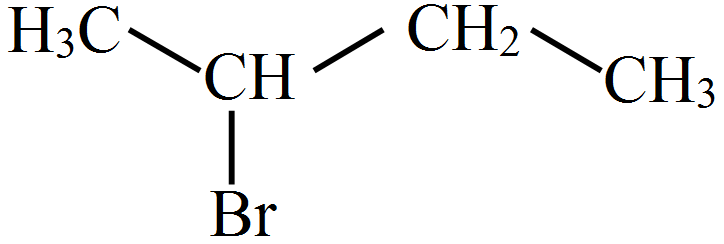
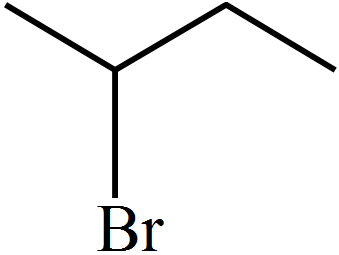
The correct way$(s)$ of representing $2-$bromobutane is$/$ are:
  • A
    $\mathrm{CH}_3 \mathrm{CHBrCH}_2 \mathrm{CH}_3$
  • B
  • C
  • All of the above
Answer
Correct option: D.
All of the above
View full question & answer
MCQ 241 Mark
Which general formula represents the homologous series of hydrocarbons that includes the compound $1-$heptyne?
  • A
    $ \mathrm{C}_n \mathrm{H}_{2 n-6} $
  • B
    $ \mathrm{C}_n \mathrm{H}_{2 n} $
  • $ \mathrm{C}_n \mathrm{H}_{2 n-2} $
  • D
    $ \mathrm{C}_n \mathrm{H}_{2 n+2}$
Answer
Correct option: C.
$ \mathrm{C}_n \mathrm{H}_{2 n-2} $
$1-$heptyne is alkyne. The general formula for alkyne is $ \mathrm{C}_n \mathrm{H}_{2 n-2}$.
View full question & answer
MCQ 251 Mark
Sodium extract gives blood red colour when treated with $\ce{FeCl_3}$​. Formation of blood red colour confirms the presence of:
  • A
    Only nitrogen
  • B
    Only sulphur
  • C
    Only halogens
  • Both nitrogen and sulphur
Answer
Correct option: D.
Both nitrogen and sulphur
$Na + N + C + S \rightarrow \text{NaSCN} ($Sodium thiocyanate$)$
$\mathrm{SCN}^{-}+\mathrm{Fe}^{+} \rightarrow[\mathrm{Fe}(\mathrm{SCN})]^{2+} ($Ferric thiocyanate$) ($Blood$-$red colour$)$
It confirms the presence of both $N$ and $S$.
View full question & answer
MCQ 261 Mark
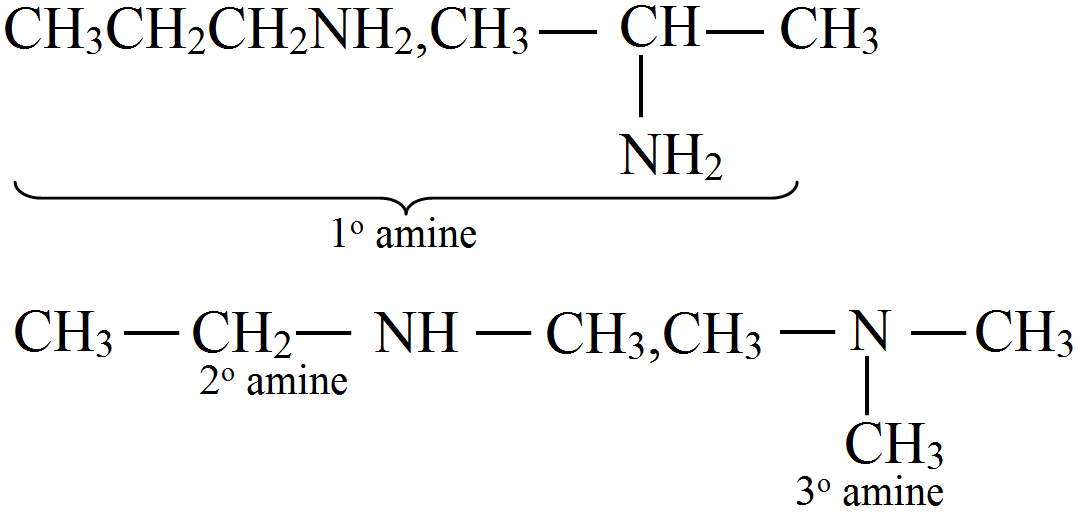
The number of structural isomers possible for the molecular formula $= \mathrm{C}_3 \mathrm{H}_9 \mathrm{N}$ is:
  • $4$
  • B
    $5$
  • C
    $2$
  • D
    $3$
Answer
Correct option: A.
$4$
Structural isomers of $\mathrm{C}_3 \mathrm{H}_9 \mathrm{N}$ are
View full question & answer
MCQ 271 Mark
Which substance has the lowest boiling point?
  • A
    $ \mathrm{CH}_3 \mathrm{CH}_2 \mathrm{CH}_2 \mathrm{CH}_2 \mathrm{OCH}_3 $
  • B
    $ \mathrm{CH}_3 \mathrm{CH}_2 \mathrm{OCH}_2 \mathrm{CH}_3 $
  • $ \mathrm{CH}_3 \mathrm{CH}_2 \mathrm{CH}_2 \mathrm{CH}_3 $
  • D
    $ \mathrm{CH}_3 \mathrm{CH}_2 \mathrm{C}=\mathrm{OCH}_3 $
Answer
Correct option: C.
$ \mathrm{CH}_3 \mathrm{CH}_2 \mathrm{CH}_2 \mathrm{CH}_3 $
$ \mathrm{CH}_3 \mathrm{CH}_2 \mathrm{CH}_2 \mathrm{CH}_3  (n−$butane$)$ has the lowest boiling point as it has lowest molecular weight and is non polar. It has weakest intramolecular forces of attraction.
All others are polar compounds and so has dipole$-$dipole inbteraction.
View full question & answer
MCQ 281 Mark
In which of the following, functional group isomerism is not possible?
  • A
    Alcohols
  • B
    Aldehydes
  • Alkyl halides
  • D
    Cyanides
Answer
Correct option: C.
Alkyl halides
Alkyl halides do not show functional isomerism. Alcohols and ethers; aldehydes and ketones; cyanides and isocyanides are functional isomers.
View full question & answer
MCQ 291 Mark
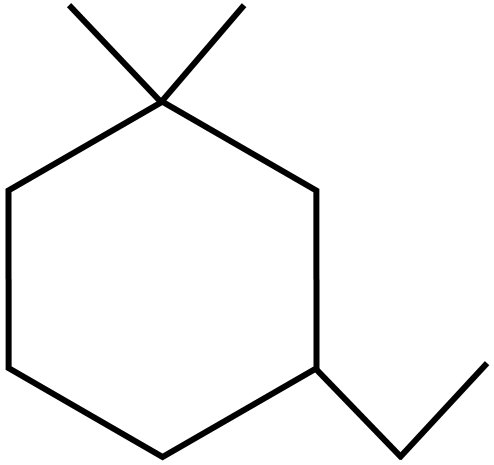
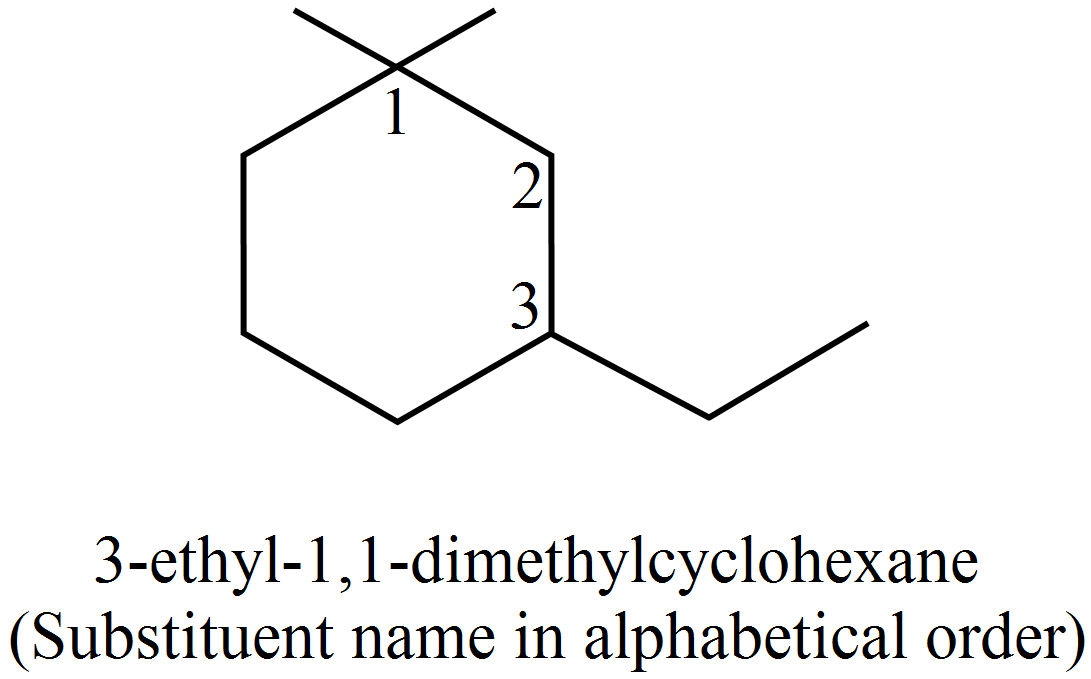
What is the correct $\text{IUPAC}$ name of the following?
  • $3-$ethyl$-1,1-$dimethylcyclohexane.
  • B
    $1-$ethyl$-3,3-$dimethylcyclohexane.
  • C
    $1,1-$dimethyl$-3-$ethylcyclohexane.
  • D
    None of the above.
Answer
Correct option: A.
$3-$ethyl$-1,1-$dimethylcyclohexane.
The correct $\text{IUPAC}$ name of the following structure is
View full question & answer
MCQ 301 Mark
The functional group present in organic acid is :
  • A
    $\ce{−OH}$
  • B
    $\ce{−CHO}$
  • $\ce{−COOH}$
  • D
    $\ce{> C = O}$
Answer
Correct option: C.
$\ce{−COOH}$
The functional group present every organic acid is $\ce{−COOH}$ as it dissociate in water as $\ce{−COO^-}$ and $H^+$.
View full question & answer
MCQ 311 Mark
The difference in energy between the actual structure and lowest energy canonical form is called:
  • Resonance energy.
  • B
    Localisation energy.
  • C
    Both $(a)$ and $(b)$.
  • D
    All of these.
Answer
Correct option: A.
Resonance energy.
View full question & answer
MCQ 321 Mark
Glycerol can be separated from spent$-$lye in soap industry by:
  • A
    Chromatography.
  • B
    Sublimation.
  • C
    Fractional distillation.
  • Distillaltion under reduced pressure.
Answer
Correct option: D.
Distillaltion under reduced pressure.
Glycerol decomposes at its boiling point is separated from spent$-$lye by using distillation under reduced pressure.
View full question & answer
MCQ 331 Mark
What is the technological applications of fractional distillation?
  • To separate different fractions of crude oil in petroleum industry.
  • B
    To separate different fractions of volatile and non-volatile solvents.
  • C
    To separate mixture of amino acids.
  • D
    No technological application of fractional distillation.
Answer
Correct option: A.
To separate different fractions of crude oil in petroleum industry.
View full question & answer
MCQ 341 Mark
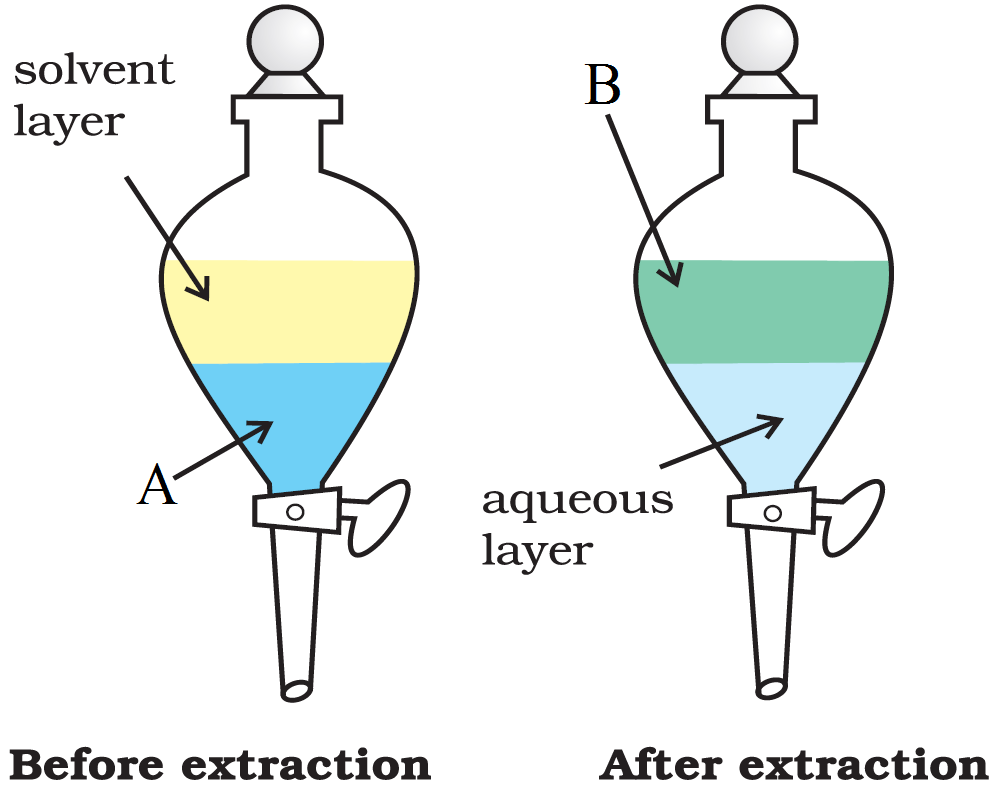
What does $A$ and $B$ refer to, in the figure of differential extraction? Choose the correct option.
  • $A \rightarrow$ Organic compound in aqueous layer. $B \rightarrow$ Organic compound in solvent layer.
  • B
    $A \rightarrow$ Organic compound in solvent layer. $B \rightarrow$ Organic compound in aqueous layer.
  • C
    $A \rightarrow$ Inorganic compound in aqueous layer. $B \rightarrow$ Inorganic compound in solvent layer.
  • D
    $A \rightarrow$ Inorganic compound in solvent layer. $B \rightarrow$ Inorganic compound in aqueous layer.
Answer
Correct option: A.
$A \rightarrow$ Organic compound in aqueous layer. $B \rightarrow$ Organic compound in solvent layer.
  1. $A \rightarrow$ Organic compound in aqueous layer.
  2. $B \rightarrow$ Organic compound in solvent layer.
View full question & answer
MCQ 351 Mark
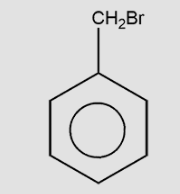
$\text{IUPAC}$ name of the above compound is:
  • Bromo methyl benzene
  • B
    Phenyl methyl bromide
  • C
    Benzyl bromide
  • D
    Benzal bromide
Answer
Correct option: A.
Bromo methyl benzene
View full question & answer
MCQ 361 Mark
In Carius method of estimation of halogens, $250\ mg$ of an organic compound gave $141\ mg$ of $\text{AgBr}$. The percentage of bromine in the compound is $($atomic mass $Ag = 108$ and $Br = 80)$
  • $24$
  • B
    $36$
  • C
    $48$
  • D
    $60$
Answer
Correct option: A.
$24$
View full question & answer
MCQ 371 Mark
Give the functional group of the following. $-\text{OH}$
  • A
    Aldehydic group
  • Alcoholic group
  • C
    Ketonic group
  • D
    Carboxylic group
Answer
Correct option: B.
Alcoholic group
$−\text{OH}$ represents an alcoholic group. It represents alcohols such as ethanol $\mathrm{CH}_3,-\mathrm{CH}_2,-\mathrm{OH}$.
The general formula of alcohols is $\text{R−OH}$.
View full question & answer
MCQ 381 Mark
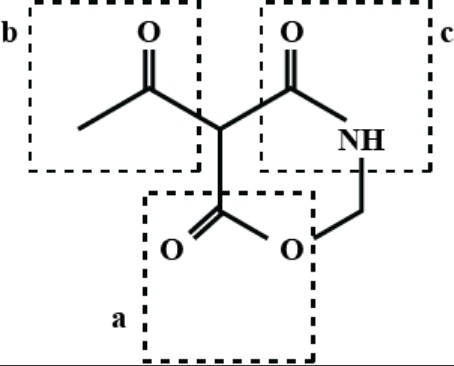
Identify which functional group are not present in the given compound?
  • A
    Ketone
  • B
    Ester
  • C
    Amide
  • Ether
Answer
Correct option: D.
Ether
Box $a$ encloses ester group, $b$ encloses ketone group while $c$ encloses amide group.
Here ether group is not present.
View full question & answer
MCQ 391 Mark
Why does ethane have a higher boiling point than methane?
  • Difference in size
  • B
    Functional group
  • C
    Difference in shape
  • D
    None of above
Answer
Correct option: A.
Difference in size
Ethane have a higher boiling point than methane because molecules of ethane $(\left(\mathrm{C}_2 \mathrm{H}_6\right))$ have more Van der Waals forces $($intermolecular forces$)$ with neighboring molecules than methane $(\mathrm{CH}_4)$ due to the greater number of atoms present in the molecule of ethane compared to methane.
View full question & answer
MCQ 401 Mark
Which of the following should be added in the compound for the detection of carbon and hydrogen?
  • A
    Cu(I) oxide.
  • Cu(II) oxide.
  • C
    Zn dust.
  • D
    Activated charcoal.
Answer
Correct option: B.
Cu(II) oxide.
b. Cu(II) oxide.
Explanation:
Carbon and hydrogen are detected by heating the compound with Cu(II) oxide. Carbon present in the compound is oxidised to carbon dioxide (tested with lime-water, which develop turbidity) and hydrogen to water (tested with anhydrous copper sulphate, which turns blue)
$\text{C}+ 2\text{CuO} \xrightarrow[]{\Delta}2\text{Cu + CO}_{2}\uparrow$
$\text{2H} + \text{CuO}\xrightarrow[]{\Delta} \text{Cu} + \text{H}_{2}\text{O}$
$\text{CO}_{2} + \text{Ca}(\text{OH})_{2} \xrightarrow{\ \ \ \ \ }\text{CaCO}_{3} \downarrow + \text{H}_{2}\text{O}\\ \ \ \ \ \ \ \ \ \ \ \ \ \ \ \ \ \ \ \ \ \ \ \ \ \ \ \ \ \ \ \ \ \ \ \ \ \text{White turbidity}$
View full question & answer
MCQ 411 Mark
Carbon and hydrogen are detected by heating the organic compound with $..........$
  • A
    Magnesium oxide
  • Cupric oxide
  • C
    Zinc oxide
  • D
    Sulphur dioxide
Answer
Correct option: B.
Cupric oxide
The detection of various elements present in an organic compound is called qualitative analysis. Carbon and hydrogen are present in almost all the organic compounds.
Carbon and hydrogen are detected by heating the organic compound with cupric oxide $\text{(CuO)}$ strongly, where carbon is oxidized to carbon dioxide and hydrogen to water.
Carbon dioxide is tested by lime water test, whereas water is tested by anhydrous copper sulphate test.
View full question & answer
MCQ 421 Mark
Study the structures given below carefully and choose the type of isomerism they represent.
$ \ \ \ \ \ \ \ \ \ \ \ \ \text{CH}_3 \\ \ \ \ \ \ \ \ \ \ \ \ \ \ \ |\\\ \text{CH}_3-\text{C}-\text{CH}_3 \ \ \ \ \ \ \ \ \ \ \ \ \ \ \ \ \ \ \ \ \ \ \ \ \ \ \ \ \\ \ \ \ \ \ \ \ \ \ \ \ \ \ \ |\\ \ \ \ \ \ \ \ \ \ \ \ \ \ \text{CH}_3$
$ \ \ \ \ \ \ \ \ \ \ \ \ \text{CH}_3 \\ \ \ \ \ \ \ \ \ \ \ \ \ \ \ |\\\ \text{CH}_3-\text{CH}- \text{CH}_2-\text{CH}_3$
  • Chain isomerism.
  • B
    Position isomerism.
  • C
    Functional isomerism.
  • D
    Metamerism.
Answer
Correct option: A.
Chain isomerism.
$ \ \ \ \ \ \ \ \ \ \ \ \ \text{CH}_3 \\ \ \ \ \ \ \ \ \ \ \ \ \ \ \ |\\\ \text{CH}_3-\text{C}-\text{CH}_3 \ \ \ \ \ \ \ \ \ \ \ \ \ \ \ \ \ \ \ \ \ \ \ \ \ \ \ \ \\ \ \ \ \ \ \ \ \ \ \ \ \ \ \ |\\ \ \ \ \ \ \ \ \ \ \ \ \ \ \text{CH}_3 \ \ \ \ \ \ \ \ \ \ \ \ \text{CH}_3 \\ \ \ \ \ \ \ \ \ \ \ \ \ \ \ |\\\ \text{CH}_3-\text{CH}- \text{CH}_2-\text{CH}_3$
chain isomers as they have different carbon chains.
View full question & answer
MCQ 431 Mark
In the Kjeldahl's method for estimation of nitrogen present in a soil sample, ammonia evolved from $0.75g$ of sample neutralised $10\ mL$ of $1M\ \mathrm{H}_2 \mathrm{SO}$. The percentage of nitrogen in the soil is:
  • $37.33$
  • B
    $45.33$
  • C
    $35.33$
  • D
    $45.33$
Answer
Correct option: A.
$37.33$
View full question & answer
MCQ 441 Mark
Generally pi bond is formed from the lateral overlap of :
  • A
    $s−s$ orbitals
  • B
    $p−p$ orbitals
  • C
    $d−d$ orbitals
  • Both $B$ and $C$
Answer
Correct option: D.
Both $B$ and $C$
$\pi$ bond is formed by lateral $($side ways$)$ overlap of either $p−p, d−d$ or $d−p$ orbitals.
View full question & answer
MCQ 451 Mark
The formula of methane is $ \mathrm{CH}_2 $ and its succeeding member ethane is expressed in $ \mathrm{C_2H_6}$​. The common difference of succession between them is:
  • $ \mathrm{CH}_2 $
  • B
    $ \mathrm{C}_2 \mathrm{H}_2$
  • C
    $ \mathrm{CH}_4 $​
  • D
    None of the above
Answer
Correct option: A.
$ \mathrm{CH}_2 $
Methane and ethane are alkanes. These are saturated carbon compounds.
They have the general formula $\mathrm{C}_n \mathrm{H}_\text{2 n+2}$​​​​​​​​.
All the alkanes differ by $ \mathrm{CH}_2 $ group successively in the series.
View full question & answer
MCQ 461 Mark
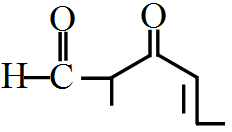
The $\text{IUPAC}$ name of the compound
  • $5-$ Formyl hex $-2-$ en $-3-$ one.
  • B
    $5-$ methyl $-4-$ oxohex $-2-$ en $-5-$ al.
  • C
    $3-$ keto $-2 $ methyl hex $-5-$ enal.
  • D
    $3-$ keto $-2-$ methyl hex $-4-$ enal.
Answer
Correct option: A.
$5-$ Formyl hex $-2-$ en $-3-$ one.
Aldehyde group is preferred over keto group.
View full question & answer
MCQ 471 Mark
Preceeding and succeeding homologous of $\mathrm{C}_{11} \mathrm{H}_{24} $ respectively :
  • A
    $ \mathrm{C}_9 \mathrm{H}_{20}, \mathrm{C}_{11} \mathrm{H}_{22} $
  • $ \mathrm{C}_9 \mathrm{H}_{20}, \mathrm{C}_{11} \mathrm{H}_{24} $
  • C
    $ \mathrm{C}_{11} \mathrm{H}_{24}, \mathrm{C}_9 \mathrm{H}_{20} $
  • D
    $ \mathrm{C}_8 \mathrm{H}_{18}, \mathrm{C}_9 \mathrm{H}_{20} $
Answer
Correct option: B.
$ \mathrm{C}_9 \mathrm{H}_{20}, \mathrm{C}_{11} \mathrm{H}_{24} $
Preceeeding homologue is $ \mathrm{C}_9 \mathrm{H}_{20}$​.
Succeeding homologue is $\mathrm{C}_{11} \mathrm{H}_{24} $.
View full question & answer
MCQ 481 Mark
Homologous have the same :
  • A
    Empirical formulae
  • B
    Molecular formulae
  • Chemical properties
  • D
    Physical properties
Answer
Correct option: C.
Chemical properties
Members of Homologous series have same chemical properties.
View full question & answer
MCQ 491 Mark
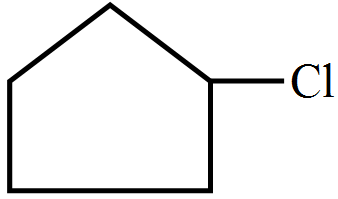
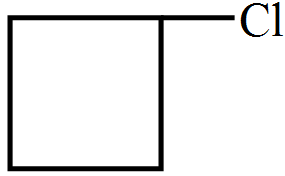
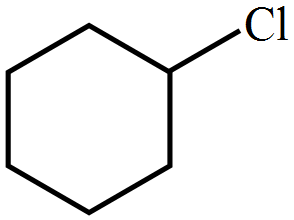
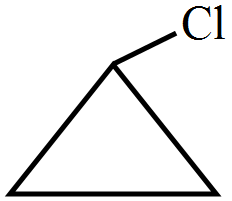
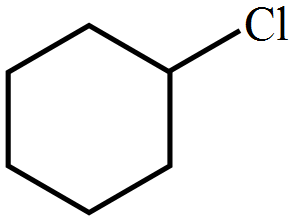
In cyclic compounds, the bond $-$ line formula for chlorocyclohexane is represented by which of the following representations?
  • A
  • B
  • D
Answer
Correct option: C.
Structure of chlorocyclohexane is :
View full question & answer
MCQ 501 Mark
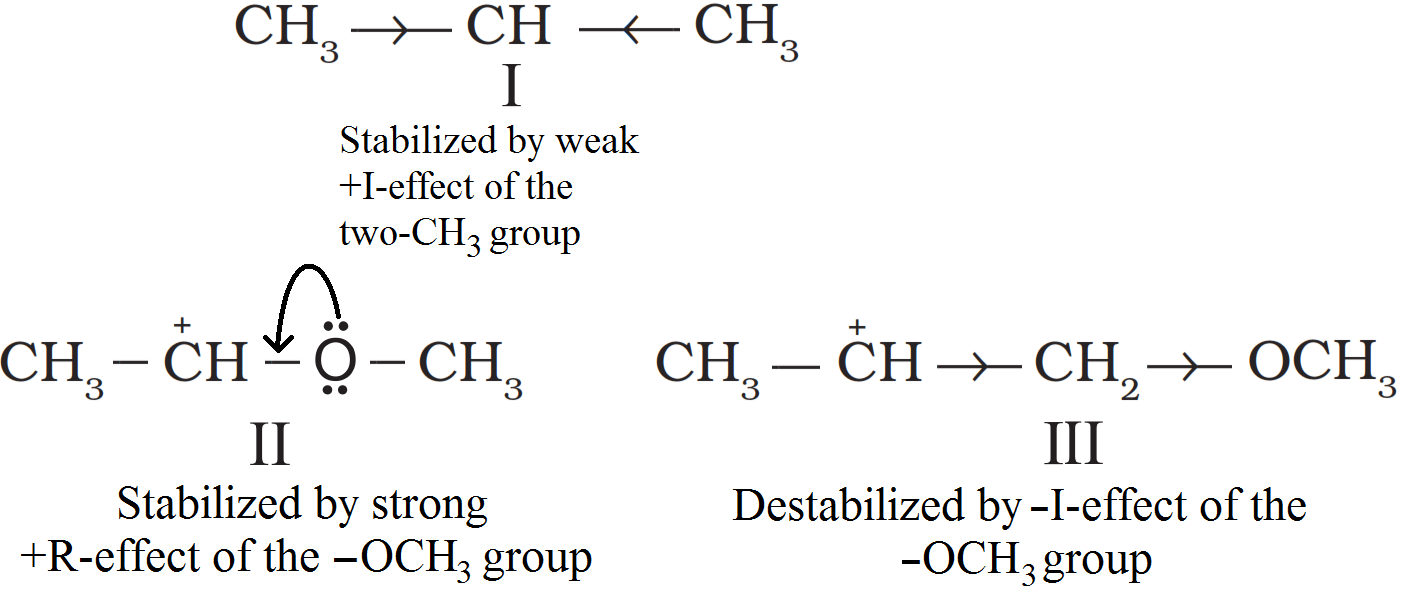
What is the correct order of decreasing stability of the following cations.
  1. $\ \ \ \ \ \ \ \ \ \ \ +\\\text{CH}_3-\text{CH}-\text{OCH}_3$
  2. $\ \ \ \ \ \ \ \ \ \ \ +\\\text{CH}_3-\text{CH}-\text{OCH}_3$
  3. $\ \ \ \ \ \ \ \ \ \ \ +\\\text{CH}_3-\text{CH}-\text{CH}_2-\text{OCH}_3$
  • $\text{II > I > III}$
  • B
    $\text{II > III > I}$
  • C
    $\text{III > I > II}$
  • D
    $\text{I > II > III}$
Answer
Correct option: A.
$\text{II > I > III}$

Thus, the stability of carbocation decreasws in the order : $\text{II > I >III}.$
View full question & answer
M.C.Q (1 Marks) - Chemistry STD 11 Science Questions - Vidyadip