Questions

Case study (4 Marks)

Take a timed test

11 questions · self-marked practice — reveal the answer and mark yourself.

Question 14 Marks
Why are vectors needed for replication of DNA during rDNA technology?
Answer
The vector provides the origin of replication.
View full question & answer
Question 24 Marks
Read the following and answer any four questions from (i) to (v) given below:DNA replication is a complex multistep process that requires enzymes, protein factors and metal ions. DNA replication in eukaryotes occurs in the nucleus during the S-phase of the cell cycle. It is semidiscontinuous in eukaryotes. in prokaryotes, replication takes place in the cytoplasm. DNA replication in bacteria occurs prior to fission. Nucleoid or viral chromosome is a single molecule of nucleic acid, it may be linear of circular. Nucleic acid in a virus is either DNA or RNA but never both.
  1. In viral DNA, how many origin of replication are present?
  1. Single
  2. Twice
  3. Multiple
  4. None
  1. Select the main enzyme involved in DNA replication.
  1. DNA ligase
  2. DNA dependent DNA polymerase
  3. Topoisomerase
  4. Helicase
  1. Read the given statement and select the option that correctly fill in the blanks. Enzyme (i) acts over the Ori site and unwinds the two strands of DNA by destroying (ii) bonds.
  1. (i)-Helicase (ii) Glycosidic
  2. (i)-Helicase (ii)-Hydrogen
  3. (i)-Unwindase (ii)-Phosphodiester
  4. (i)-Unwindase (ii)-Glycosidic
  1. DNA strand, built up of Okazaki fragments, is called.
  1. Lagging strand.
  2. Leading strand.
  3. Complementary strand.
  4. Parental strand.
  1. Select the incorrect statement about DNA polymerase in eukaryotes.
  1. Polymerase $\alpha$ is required for initiation of replication.
  2. When the RNA primer gets removed the gap is filled by DNA polymerase $\beta$ in eukaryotes.
  3. Polymerase $\in$ helps in elongation of lagging strand.
  4. Polymerase $\delta$ is largest and main enzyme for DNA replication in eukaryotes.
Answer
  1. (a) Single
Explanation:

Replication begins at a particular spot called origin of replication or ori. Bacterial and viral DNA has a single origin of replication. It functions as a single replicating unit or replicon.
  1. (b) DNA dependent DNA polymerase
Explanation:

A large number of enzymes are required for DNA replication. DNA-dependent DNA polymerase is the main enzyme which takes part in combining deoxyribose nucleotides to fonn new DNA strands.
  1. (b) (i)-Helicase (ii)-Hydrogen
  2. (a) Lagging strand.
Explanation:

Lagging strand is a replicated strand of DNA which is formed in short segments called Okazaki fragments. Its growth is discontinuous.
  1. (c) Polymerase $\delta$ is largest and main enzyme for DNA replication in eukaryotes.
Explanation:

DNA Polymerase a is the largest and main enzyme for replication in eukaryotes.
View full question & answer
Question 34 Marks
Read the following and answer any four questions from (i) to (v) given below:
In prokaryotes, DNA is circular and present in the cytoplasm but in eukaryotes, DNA is linear and mainly confined to the nucleus. DNA or deoxyribonucleic acid is a long polymer of nucleotides. In 1953, the first correct double-helical structure of DNA was worked out by Watson and Crick. Based on the X-ray diffraction data produced by Maurice Wilkins and Rosalind Franklin. It is composed of three components, i.e., A phosphate group, a deoxyribose sugar and a nitrogenous base. Different forms of DNA are B-DNA, Z-DNA, A-DNA, C-DNA and D-DNA.
  1. Name the linkage present between the nitrogen base and pentose sugar in DNA.
  1. Phosphodiester bond
  2. Phosphodiester bond
  3. Hydrogen bond
  4. None of these
  1. The double helix structure of DNA was proposed by.
  1. James Watson and Francis Crick.
  2. Earwin Chargaff
  3. Federick Griffith
  4. Hershey and Chase.
  1. The double chain of B-DNA is coiled in a helical fashion. The spiral twisting of B-DNA duplex produces.
  1. Right and left part.
  2. Major and minor grooves.
  3. Upper and lower side.
  4. Linear and circular part.
  1. Assertion: The two strands of DNA helix have uniform distance between them.
Reason: A large sized purine always paired opposite to a small sized pyrimidine.
  1. Both assertion and reason are true and reason is the correct explanation of assertion.
  2. Both assertion and reason are true but reason is not the correct explanation of assertion.
  3. Assertion is true but reason is false.
  4. Both assertion and reason are false.
  1. Which of the following describes the structure of B-DNA?
S.no
Polynudeotide chains
(a)
Parallel
5
(b)
Anti-parallel
10
(c)
Parallel
15
(d)
Anti-parallel
20
Answer
  1. (b) Phosphodiester bond
Explanation:

In DNA the nitrogenous base and a pentose sugar joins to form nucleoside with the help of bond called glycosidic bond or N-glycosidic linkage.
  1. (a) James Watson and Francis Crick.
Explanation:

The correct structure of DNA was first worked out by James Watson and Francis Crick in 1953. Their double-helix model of DNA structure was based on two major investigations, i.e., Chargaff's rules of base pairing and study of X-ray diffraction pattern of DNA produced by Maurice Wilkins and Rosalind Franklin which helped Watson and Crick to design the 3-dimensional structure of DNA
  1. (b) Major and minor grooves.
Explanation:

Due to spiral twisting, the B-DNA duplex comes to have two types of alternate grooves, i.e., major (length 22 A) and minor (length 12 A).
  1. (a) Both assertion and reason are true and reason is the correct explanation of assertion.
  2. (b)
    S.no
    Polynudeotide chains
    Polynudeotide chains
    (b) Anti-parallel 10
Explanation:

The double helical chains of B-DNA are bound to each other via hydrogen bonds in an antiparallel fashion, i.e., 5 -3 in one and 3' -5' in other. The pitch of helix per tum is 3. 4 nm with 10 base pairs in each turn.
View full question & answer
Question 44 Marks
Read the following and answer any four questions from (i) to (v) given below:
Mutation explains the relationship between gene and DNA. The effects of large deletions and rearrangement in a segment of DNA results in loss or gain of gene and its function. Insertion or deletion of one or two bases changes the reading frame from the point of insertion or deletion. A classical example of point mutation is a change of single base pair in the gene for beta globin chain that results in change of amino acid residue glutamate to valine and results into a diseased condition called sickle cell anaemia.
  1. A mutation is a change produced by an alteration in the genetic mechanism and.
  1. May arise spontaneously.
  2. Is always induced by the environment.
  3. Is never advantageous.
  4. Is not inherited.
  1. The DNA code for glutamic acid is CTC or CTT. The code for valine is CAA or CAT. In sickle cell haemoglobin, valine is present instead of glutamic acid.
Assuming a single base pair substitution has occurred, what is the mRNA code in the affected mutant?
  1. CUU
  2. GAA
  3. GAG
  4. GUA
  1. A mutation involving the substitution of one nitrogenous base for another has altered the base sequence of a DNA molecule, coding for four amino acids, as shown below.
Normal A-G-C-A-T-G-G-A-T-C-C-T

Mutant A-G-C-A-T-G-C-A-T-C-C-T
The table shows six codons and the corresponding amino acids into which each is translated.
mRNA codon
Amino acid
AAG
Lysine
CUA
Leucine
GGA
Glycine
GUA
Valine
UAC
Tyrosine
UCG
Serine
The mutation has changed the amino acid.
  1. Leucine to valine.
  2. Lysine to glycine.
  3. Serine to leucine.
  4. Tyrosine to lysine.
  1. Assertion : Insertion or deletion of three or its multiple bases, insert or delete one or multiple codons and so one or multiple amino acids.
Reason: Reading frame remains unaltered with insertion or deletion of three or its multiple bases.
  1. Both assertion and reason are true, and reason is the correct explanation of assertion.
  2. Both assertion and reason are true, but reason is not the correct explanation of assertion.
  3. Assertion is true, but reason is false.
  4. Both assertion and reason are false.
  1. Part of the amino acid sequences in normal and sickle cell haemoglobin are shown.
Normal haemoglobin Sickle cell haemoglobin
Thr-Pro-Glu-Glu Thr-Pro-Val-Glu
mRNA codons for these amino acids are
Glutamine (Glu) GAA GAG
Praline (Pro) CCU CCC
Threonine (Thr) ACU ACC
Valine (Val) GUA GUG
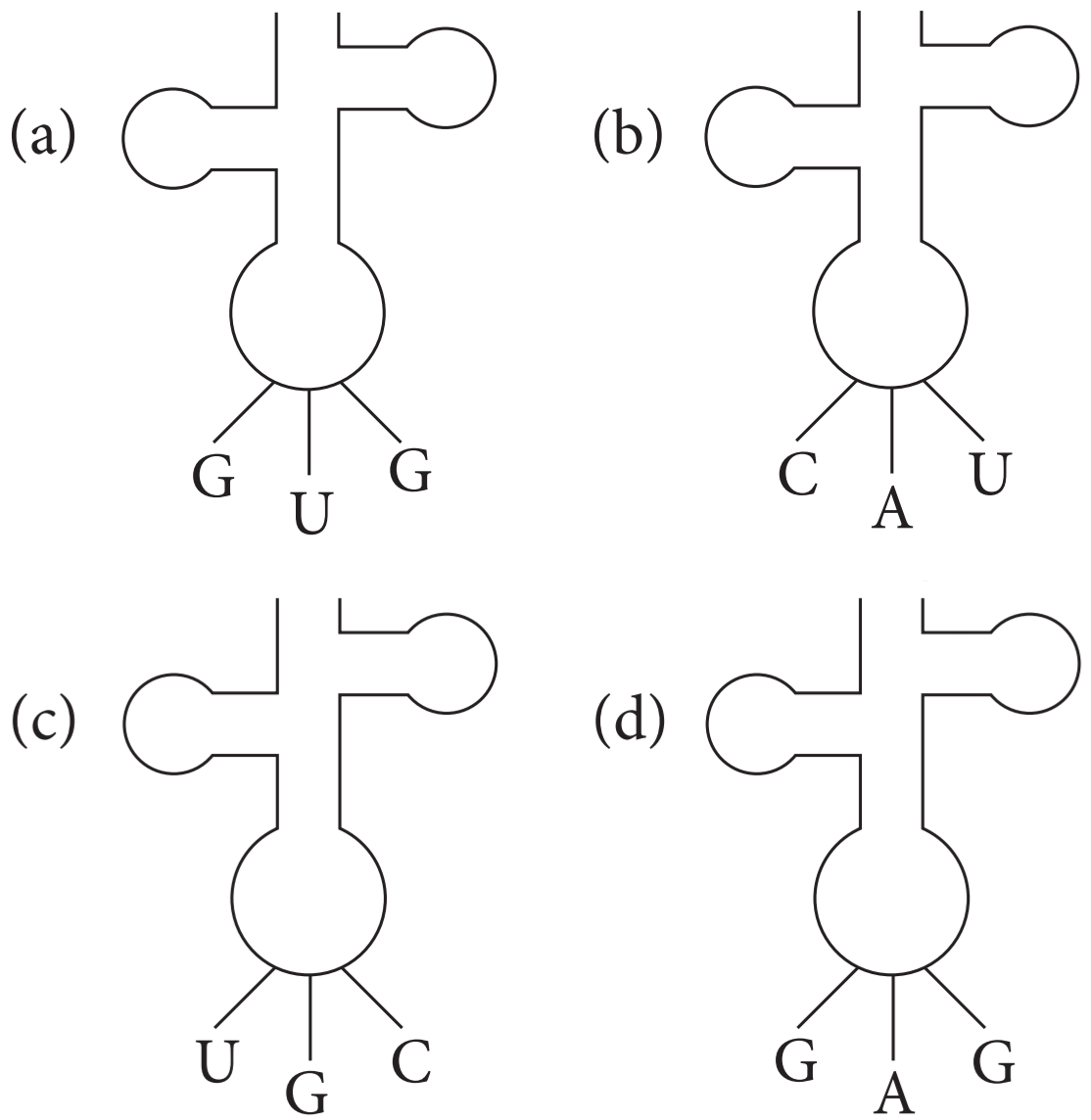
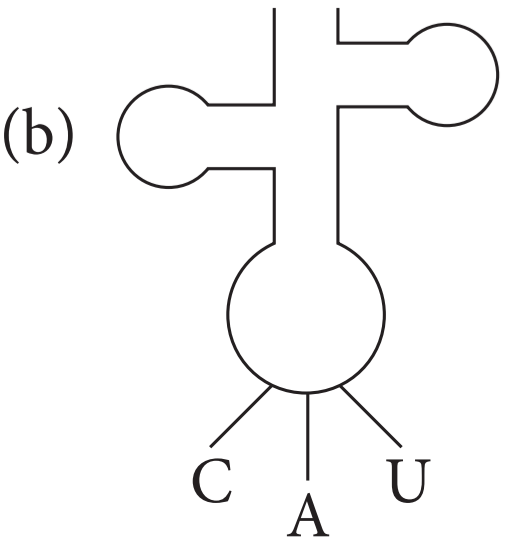
Which transfer RNA molecule is involved in the formation of this part of the sickle cell haemoglobin?
Answer
  1. (a) May arise spontaneously.
Explanation:

A mutation is a change in the DNA that changes the physiological effect of the DNA on the cell. Such phenomenon may be caused by radiation, chemical carcinogens, or may occur spontaneously.
  1. (d) GUA
Explanation:

Since a single base pair substitution has caused this mutation, the original codon for glutamic acid must have been CTT, and the mutant codon is CAT. The mRNA code for this mutant is hence GUA, i.e., complementary to CAT.
  1. (a) Leucine to valine.
Explanation:

The segment coding for GAT on the normal DNA molecule has been transcribed into CUA in the mRNA molecule, therefore the mutant DNA strand CAT will be transcribed into GUA on the mRNA molecule. This implies a change from the amino acid leucine to valine.
  1. (b) Both assertion and reason are true, but reason is not the correct explanation of assertion.
  2. (b)
Explanation:

CAU in tRNA is the only one that can compliment the valine in the sickle cell haemoglobin.
View full question & answer
Question 54 Marks
Read the following and answer any four questions from (i) to (v) given below:
Translation is the process of polymerisation of amino acids to form a polypeptide. The order and sequence of amino acids are defined by the sequence bases in the mRNA. The amino acids are joined by a bond called peptide bond. Ribosome is the site of protein synthesis.
  1. Which ion is essential for association of both units of ribosome at the time of protein formation?
  1. $\mathrm{Mg}^{2+}$
  2. $\mathrm{Mn}^{2+}$
  3. $\mathrm{Cl}^{-}$
  4. $\mathrm{Ca}^{2+}$
  1. During translation, how many initiation factors are required in eukaryotes for initiation reactions?
  1. 3
  2. 6
  3. 7
  4. 9
  1. Which part of mRNA contains untranslated regions (UTR)?
  1. 3' end
  2. 5' end
  3. Either 3' or 5' end
  4. Both 5' end and 3' end
  1. Name the enzyme that helps in combining amino acid to its particular tRNA?
  1. Activating enzyme
  2. Amino-acyl tRNA-synthetas
  3. PeptidyI transferase
  4. Both (a) and (b)
  1. From the given list, select the translation machinery.
  1. mRNA
  2. Ribosomes
  3. Amino acids
  4. tRNAs
  5. Peptidyl transferase
  6. Amino acyl tRNA synthetase
  7. Pyrophosphatase
  1. (1), (2), (3), (4) and (6)
  2. (1), (2), (3), (4) and (5)
  3. (1), (2), (3), (4), (5) and (6)
  4. (1), (2), (3), (4), (5), (6) and (7)
Answer
  1. (a) $\mathrm{Mg}^{2+}$
Explanation:

The two subunits of ribosomes come together at the time of protein formation. This phenomenon is called association. $\mathrm{Mg}^{2+}$ is essential for it.
  1. (d) 9
Explanation:

Eukaryotes have nine initiation factors- eIf2, eIf3 eIf1 elf4A, eIf4B, eIf4C, eIf4D, eIf5,eIf6.
  1. (d) Both 5' end and 3' end
Explanation:

An mRNA molecule has some additional sequences that are not translated and are called untranslated regions (UTR). The UTRs are present at both 5' end (before start codon) and at 3' -end (after stop codon). They are required for efficient translation process.
  1. (d) Both (a) and (b)
Explanation:

Amino-acyI tRNA-synthetase is also called aa-activating enzyme.
  1. (a) (1), (2), (3), (4) and (6)
Explanation:

Enzyme peptidyI transferase is component of larger subunit of ribosome. It catalyses two principal chemical reaction - peptide bond formation and peptide release. Enzyme pyrophosphatase hydrolyses pyrophosphate and provides energy for driving the initial reaction of activating amino acids.
View full question & answer
Question 64 Marks
Read the following and answer any four questions from (i) to (v) given below:
The process of translation requires transfer of genetic information from a polymer of nucleotides to synthesise a polymer of amino acids. The relationship between the sequence of amino acids in a polypeptide and nucleotide sequence of DNA or mRNA is called genetic code. George Gamow suggested that in order to code for all the 20 amino acids, code should be made up of three nucleotides.
  1. What is a codon?
  1. A length of DNA which codes for a particular protein.
  2. A part of the tRNA molecule to which a specific amino acid is attached.
  3. A part of the tRNA molecule which recognises the triplet code on the messenger RNA.
  4. A part of the messenger RNA molecule that has a sequence of bases coding for an amino acid.
  1. Three consecutive bases in the DNA molecule provide the code for each amino acid in a protein molecule. What is the maximum number of different triplets that could occurs?
  1. 16
  2. 20
  3. 24
  4. 64
  1. Listed below are some amino acids and their corresponding mRNA triplets.
Amino acid
mRNA triplet
Phenylalanine
UUU
Lysine
AAG
Arginine
CGA
Alanine
GCA
Which DNA sequence would be needed to produce the following polypeptide sequence? Alanine-Arginine-Lysine-Phenylalanine
  1. $\text{CGT}\ \ \ \text{GCT}\ \ \ \text{TTC}\ \ \ \text{AAA}$
  2. $\text{CGT}\ \ \ \text{GCT}\ \ \ \text{TTC}\ \ \ \text{TTT}$
  3. $\text{CGU}\ \ \ \text{GCU}\ \ \ \text{UUC}\ \ \ \text{AAA}$
  4. $\text{CGU}\ \ \ \text{GCU}\ \ \ \text{UUC}\ \ \ \text{TTT}$
  1. Identify the non-sense codons among the following.
  1. AUG
  2. GUG
  3. UAA
  4. UGG
  1. A polypeptide is made using synthetic mRNA molecules as shown.
Synthetic mRNA used
Polypeptide produced
UUUAAAUUUAAA
Phenylalanine-Iysine-phenylalanine-Iysine
What are the DNA codes for the amino acids phenylalanine and lysine?
S.no
Phenylalanine
Lysine
(a)
AAA
TTT
(b)
AAA
UUU
(c)
GGG
CCC
(d)
TTT
GGG
Answer
  1. (d) A part of the messenger RNA molecule that has a sequence of bases coding for an amino acid.
Explanation:

Codon is complementary to a triplet of temple! Strand. It is found in mRNA. Anticodon is complementary to a codon, it occurs in tRNA.
  1. (d) 64
Explanation:

The triplet code consists of three of the four nucleotide bases -A, C, G or T. Thus the maximum number of codon is $4^3= 64.$
  1. (b) $\text{CGT}\ \ \ \text{GCT}\ \ \ \text{TTC}\ \ \ \text{TTT}$
Explanation:

The complementary bases of GCA-CGA-AAG-UUU are CGT-GCT-TTC-AAA on the DNA strand.
  1. (c) UAA
Explanation:

AUG and GUG are initiation codon which codes for methionine and valine respectively. UGG codes for tryptophan. UAA (ochre) is a termination codon.
  1. (a)
S.no
Phenylalanine
Lysine
(a)
AAA
TTT
Explanation:

The triplet codon of phenylalanine (UUU) will base pair with AAA in the DNA molecule, and that of lysine (AAA) will base pair with TTT.
View full question & answer
Question 74 Marks
Read the following and answer any four questions front (i) to (v) given below:
Gene regulation is the mechanism of switching off and switching on of the genes depending upon the requirement of cells and the state of development. Gene regulation is of two types : negative and positive. In negative generegulation the genes continue expressing their effect till their activity is suppressed. Positive gene regulation is the one in which the genes remain non-expressed unless and until they are induced to do it. Operon model is a co-ordinated group of genes such as structural gene, operator gene, promoter gene, regulator gene which function together and regulate a metabolic pathway as a unit, e.g., lac operon, trp operon, ara operon, etc.
  1. Regulation of gene expression occurs at the level of.
  1. Transcription
  2. Processing/splicing
  3. Translation
  4. All of these.
  1. Inducible operon system usually occurs in A pathways. Nutrient molecules serve as B to stimulate production of the enzymes necessary for their breakdown. Genes for inducible operon are usually switched C and the repressor is synthesised in an D form.
S.no
A
B
C
D
(a)
anabolic
corepressor
on
inactive
(b)
anabolic
inducer
off
active
(c)
catabolic
inducer
off
active
(d)
catabolic
corepressor
on
inactive
  1. An mRNA molecule transcribed from the lac operon contains nucleotide sequences complementary to.
  1. Structural genes coding for the enzymes.
  2. the operator region
  3. the promotor region
  4. the repressor gene.
  1. Which statement correctly describes the control of transcription of the genes involved in the breakdown of lactose in Estherichia coli?
  1. A repressor protein binds to the operator and the genes are switched on.
  2. A repressor protein binds to the operator and the genes are switched off.
  3. A transcription factor binds to the promoter and the genes are switched on.
  4. A transcription factor binds to the promoter and the genes are switched off.
  1. Function of catabolic activator protein in lac operon is.
  1. To form mRNA
  2. Help to bind RNA polymerase
  3. Code for repressor
  4. To activates lac gene when glucose is absent.
Answer
  1. (d) All of these.
Explanation:

Regulation of gene expression can be exerted at four levels : transcriptional level during formation of primary transcript, processing like splicing, terminal additions or modifications, transport of mRNAs from nucleus to the cytoplasm and translational level.
  1. (c)
S.no
A
B
C
D
(c) catabolic inducer off active
  1. (a) Structural genes coding for the enzymes.
Explanation:

Only the structural genes of an operon are transcribed into mRNA molecule. Structural gene is a region of DNA that codes for a protein or RNA molecule that forms part of a structure or has an enzymatic function. In the case of lac operon, the structural genes are lac Z, lac Y, lac A which codes for $\beta$- galactosidase, lac permease and $\beta$-galactoside transacetylase respectively
  1. (b) A repressor protein binds to the operator and the genes are switched off.
Explanation:

The lac operon consists of:

Promoter: binding site of RNA

polymerase Operator: binding site of the lac repressor protein

CAP Binding Site : binding site of catabolite activator protein.

3 structural genes: lac Z, lac Y and lac A. When lac repressor protein is synthesised in its active conformation, it binds to the operator and the operon is switched off, so there is no transcription.
  1. (d) To activates lac gene when glucose is absent.
View full question & answer
Question 84 Marks
Read the following and answer any four questions from (i) to (v) given below:
RNA or ribonucleic acid is a single chain polyribonucleotide which functions as carrier of coded genetic or hereditary information from DNA to cytoplasm for taking part in protein and enzyme synthesis. Six types of RNAs are ribosomal, transfer, messenger, genomic, small nuclear and small cytoplasmic RNA. Out of these, rRNA, mRNA and tRNA are major classes of RNAs that are involved in gene expression.
  1. Which one is referred to a soluble RNA?
  1. mRNA
  2. tRNA
  3. rRNA
  4. hnRNA
  1. The RNA that picks up specific amino acid from amino acid pool in the cytoplasm to ribosome during protein synthesis is?
  1. rRNA
  2. hnRNA
  3. mRNA
  4. tRNA
  1. Which of the following is found in both DNA and messenger RNA?
  1. Double helix structure
  2. Ribose
  3. Sugar-phosphate chain
  4. Thymine
  1. Which of the following statements regarding RNA is correct?
  1. Messenger RN As carries coded information for synthesis of polypeptide.
  2. Ribosomal RNAs bind with tRNA to catalyse the formation of phosphodiester bonds.
  3. Genomic RNA is always single stranded.
  4. Synthesis of rRNA occurs in cytoplasm by RNA polymerase III
  1. In studying a virus, you find the following proportions of nitrogenous bases present: adenine 23%, guanine 37%, cytosine 23% uracil 17%. Which of the following statement(s) regarding this virus is/are correct?
  1. It probably uses RNA as its genetic material.
  2. The genetic material of this virus is probably single stranded.
  3. Base pairing rules in virus in this virus include adenine: cytosine.
  1. I only
  2. I and II only
  3. II and III only
  4. All of these.
Answer
  1. (b) tRNA
Explanation:

tRNA is also referred to as soluble RNA (sRNA) because it cannot be easily separated even by ultra centrifugation technique.
  1. (d) tRNA
Explanation:

tRNA carries specific type of amino acid at CCA end to the ribosome during protein synthesis. It places the required amino acid properly in the sequence and translates the coded message of mRNA in terms of amino acids
  1. (c) Sugar-phosphate chain
Explanation:

The double helix structure is only found in DNA. Ribose is only found in mRNA, DNA has deoxyribose sugar instead. Thymine is found only in DNA, uracil replaces thymine in mRNA. Only the sugar-phosphate backbone is found common in both
  1. (a) Messenger RN As carries coded information for synthesis of polypeptide.
Explanation:

Ribosomal RNA is made in the nucleus. Ribosomal RNA binds with proteins to form large and small ribosomal subunits which combine to form ribosomes in the cytoplasm. Genomic RNA may be single stranded or double stranded. It is fragmented in influenza virus. Synthesis of rRNA occur in nucleolus.
  1. (b) I and II only
Explanation:

Uracil is present in this virus. So, RNA is the genetic material. The genetic material is not double stranded as the percentage of guanine and cytosine are not equal. Bases do not pair in single stranded viruses.
View full question & answer
Question 94 Marks
Read the following and answer any four questions from (i) to (v) given below:
DNA fingerprinting is a technique of determining nucleotide sequences of certain areas of DNA which are unique to each individual. Each person has a unique DNA fingerprint. Each fingerprint is the same for every cell, tissue and organ of a person. DNA fingerprinting is the basis of paternity testing in case of disputes.
  1. The technique developed to identify a person with the help of DNA restriction analysis is known as.
  1. DNA profiting
  2. DNA fingerprinting
  3. RFLP
  4. Both (a) and (b).
  1. For DNA fingerprinting, DNA is obtained from.
  1. Blood
  2. Hair root cells
  3. Semen
  4. All of these
  1. During DNA fingerprinting, the radioactive probes.
  1. Hybridise with DNA sample to form double stranded structure
  2. Egrade the DNA
  3. Create positive charge on DNA
  4. Cut the DNA sample at various sites.
  1. In India, DNA fingerprinting technique was developed by?
  1. Dr. Lalji Singh
  2. Alec Jeffreys
  3. Dr. Khorana
  4. None of these.
  1. Which of the following is true about DNA fingerprinting?
  1. VNTR is used as probe.
  2. DNA samples are loaded on agarose gel electrophoresis.
  3. It is based on identification of nucleotide sequence present on the DNA molecule.
  4. All of these
Answer
  1. (d) Both (a) and (b).
  2. (d) All of these
Explanation:

For DNA fingerprinting, DNA is obtained from blood, semen, hair roots, tissue samples, nuclei of white blood cells or of spermatozoa, body secretions, etc.
  1. (a) Hybridise with DNA sample to form double stranded structure
Explanation:

In DNA fingerprinting, during hybridisation the bands are flooded with single stranded radioactive DNA probe. This single stranded DNA probe and sample DNA hybridise to form double stranded structure due to natural affinity.
  1. (a) Dr. Lalji Singh
Explanation:

In India, DNA fingerprinting technique was developed by Dr. Lalji Singh.
  1. (d) All of these
View full question & answer
Question 104 Marks
Read the following and answer any four questions from (i) to (v) given below:
Deoxyribonucleic acid (DNA) and ribonucleic acid (RNA) are the two types of nucleic acids found in the living systems. DNA acts as the genetic material in most of the organisms. Although, RNA also acts as a genetic material in some organisms.
  1. In which of the following organisms, RNA acts as a genetic material?
  1. Escherichia coli
  2. $\text{Q}\beta$ Bacteriophage
  3. Tobacco Mosaic viruses
  4. Both (b) and (c)
  1. What is the reason for the additional stability of DNA in comparison to RNA?
  1. Presence of thymine
  2. Presence of uracil
  3. Presence of OH group
  4. Presence of deoxyribose sugar
  1. Which of the following criteria a molecule must fulfill to act as a genetic material?
  1. It should be able to generate its replica.
  2. It should be stable chemically and structurally.
  3. It should be able to express itself in the form of Mendelian character.
  4. All of these
  1. Assertion: RNA is liable and easily degradable.
Reason: The 2'- OH group present at every nucleotide in RNA is a reactive group
  1. Both assertion and reason are true, and reason is the correct explanation of assertion.
  2. Both assertion and reason are true, but reason is not the correct explanation of assertion.
  3. Assertion is true, but reason is false.
  4. Both assertion and reason are false.
  1. Read the given statement and select the option that correctly fill in the blanks. Pyrimidines present in DNA are (i) and (ii) while pyrimidines present in RNA are (iii) and (iv).
  1. (i)-Adenine (iii)-Guanine (iii)-Cytosine, (iv)-Thymine
  2. (i)-Cytosine (iii)Thymine (iii)-Cytosine, (iv)-Uracil
  3. (i)-Cytosine (iii)-Uracil (iii)-Adenine, (iv)-Guanine
  4. (i)-Cytosine (iii)-Uracil (iii)-Cytosine, (iv)-Thymine
Answer
  1. (c) Both (b) and (c)
Explanation:

DNA is the genetic material in E. coli. RNA is the genetic material in Tobacco Mosaic virus and $\text{Q}\beta$ bacteriophage.
  1. (a) Presence of thymine
Explanation:

The presence of thymine in DNA at the place of uracil which is present in RNA provides additional stability to DNA.
  1. (d) All of these
  2. (a) Both assertion and reason are true, and reason is the correct explanation of assertion.
  3. (b) (i)-Cytosine (iii)Thymine (iii)-Cytosine, (iv)-Uracil
Explanation:

Purines present in DNA and RNA are adenine and guanine, while pyrimidines present in DNA are cytosine and thymine and pyrimidines present in RNA are cytosine and uracil.
View full question & answer
Question 114 Marks
Read the following and answer any four questions from (i) to (v) given below:
The process of copying genetic information from template strand of DNA into RNA is called transcription. It is mediated by RNA polymerase. Transcription takes place in the nucleus of eukaryotic cells. In transcription, only a segment of DNA and only one of the strands is copied into RNA.
  1. What are regions of transcription unit in a DNA molecule?
  1. Promoter
  2. Structural gene
  3. Terminator
  4. All of these
  1. Monocistronic structural genes are found in which organisms?
  1. Prokaryotes
  2. Bacteria
  3. Viruses
  4. Eukaryotes
  1. Which enzyme helps in tailing or polyadenylation?
  1. Poly-A polymerase
  2. Exonuclease
  3. RNA polymerase I
  4. RNA polymerase II
  1. Assertion: A single RNA polymerase in prokaryotes synthesis all types of RNAs.
Reason: Prokaryotic RNA polymerase has sigma $(\sigma)$ factor.
  1. Both assertion and reason are true, and reason is the correct explanation of assertion.
  2. Both assertion and reason are true, but reason is not the correct explanation of assertion.
  3. Assertion is true, but reason is false.
  4. Both assertion and reason are false.
  1. Read the given list of materials.
  1. RNA polymerase enzyme
  2. DNA template.
  3. DNA template.
  4. Okazaki segments.
  5. Four types of ribonucleotides triphosphates.
  6. Divalent metal ions $Mg^{2+}$ as a cofactor.
Which of the above given materials are required for transcription?
  1. (1) (2) (3) and(4)
  2. (1) (2) (3) (5) and(6)
  3. (1) (2) (5) and(6)
  4. All of these
Answer
  1. (d) All of these
  2. (d) Eukaryotes
Explanation:

Monocistronic structural gene carries information for synthesis of one polypeptide chain. They are mostly found in eukaryotes.
  1. (a) Poly-A polymerase
Explanation:

Tailing or polyadenylation is addition of a poly-A tail at 3 end of hn mRNA with the help of poly-A polymerase. The poly-A tail contains adenate residues (about 200 - 300 residues). Polyadenylation is thought to protect the 3' end from degradation by exonucleases.
  1. (b) Both assertion and reason are true, but reason is not the correct explanation of assertion.
  2. (c) (1) (2) (5) and(6)
Explanation:

RNA primer and Okazaki segments are not needed in transcription.
View full question & answer