Question 12 Marks
Write structures of different isomers corresponding to the molecular formula, $C_3H_9N$. Write IUPAC names of the isomers which will liberate nitrogen gas on treatment with nitrous acid.
Answer
- $\text{CH}_3-\text{CH}-2-\text{CH}_2-\text{NH}_2$
Propan $- 1 -$ amine(pri)
- Propan $- 2 -$ amine (pri)
$ \ \ \ \ \ \ \ \ \ \ \ \text{NH}_2\\ \ \ \ \ \ \ \ \ \ \ \ \ \ \ |\\\text{CH}_3-\text{CH}-\text{CH}_3$
- $\text{CH}_3-\text{CH}_2-\text{C}_2\text{H}_5$
N-methylethanamine (Sec)
primary amine, $(a)$ Propan $- 1 - $amine, and $(b)$ Propan $- 2 -$ amine will liberate nitrogen gas on treatment with nitrous acid.
$\text{CH}_3\text{CH}_2\text{CH}_2\text{NH}_2+\text{HNO}_2\rightarrow\text{CH}_3\text{CH}_2\text{CH}_2\text{OH}+\text{N}_2+\text{HCl}\\\text{Propan-1-amine} \ \ \ \ \ \ \ \ \ \ \ \ \ \ \ \ \ \ \ \ \ \ \ \ \ \ \ \ \ \ \ \text{Propan-1-ol}$ View full question & answer→Question 22 Marks
Give the structures of A, B and C in the following reaction:
$\text{C}_6\text{H}_5\text{NO}_2\xrightarrow[]{\text{Fe}/\text{HCl}}\text{A}\xrightarrow[273\text{K}]{\text{NaNO}_2+\text{HCl}}\text{B}\xrightarrow[\Delta]{\text{H}_2\text{O}/\text{H}^+}\text{C}$
Answer$\text{C}_6\text{H}_5\text{NO}_2\xrightarrow[]{\text{Fe}/\text{HCl}}\text{C}_6\text{H}_5\text{NH}_2\xrightarrow[273\text{K}]{\text{NaNO}_2+\text{HCl}}\text{C}_6\text{H}_5-\stackrel{{+}}{{\text{N}_2}}\stackrel{{-}}{{\text{Cl}}}\\ \ \ \ \ \ \ \ \ \ \ \ \ \ \ \ \ \ \ \ \ \ \ \ \ \ \ \ \ \ \ \ \ \ \ \ \text{Aniline} \ \ \ \ \ \ \ \ \ \ \ \ \ \ \ \ \ \ \ \text{Benzendiazonium}\\ \ \ \ \ \ \ \ \ \ \ \ \ \ \ \ \ \ \ \ \ \ \ \ \ \ \ \ \ \ \ \ \ \ \ \ \ \ \ (\text{A}) \ \ \ \ \ \ \ \ \ \ \ \ \ \ \ \ \ \ \ \ \ \ \ \ \ \ \ \ \ \ \ \text{Cloride}\\ \ \ \ \ \ \ \ \ \ \ \ \ \ \ \ \ \ \ \ \ \ \ \ \ \ \ \ \ \ \ \ \ \ \ \ \ \ \ \ \ \ \ \ \ \ \ \ \ \ \ \ \ \ \ \ \ \ \ \ \ \ \ \ \ \ \ \ \ \ \ \ \ \ \ \ \ \ \ (\text{B})\\\ \ \ \ \ \ \ \ \ \ \ \ \ \ \ \ \ \ \ \ \ \ \ \ \ \ \ \ \ \ \ \ \ \ \ \ \ \ \ \ \ \ \ \ \ \ \ \ \ \ \ \ \ \ \ \ \ \ \ \ \ \ \ \ \ \ \ \ \ \ \ \ \ \ \ \ \Delta\downarrow{\text{H}_2\text{O}/\text{H}^+}\\ \ \ \ \ \ \ \ \ \ \ \ \ \ \ \ \ \ \ \ \ \ \ \ \ \ \ \ \ \ \ \ \ \ \ \ \ \ \ \ \ \ \ \ \ \ \ \ \ \ \ \ \ \ \ \ \ \ \ \ \ \ \ \ \ \ \ \ \ \ \ \ \ \ \ \text{C}_6\text{H}_5\text{OH}\\ \ \ \ \ \ \ \ \ \ \ \ \ \ \ \ \ \ \ \ \ \ \ \ \ \ \ \ \ \ \ \ \ \ \ \ \ \ \ \ \ \ \ \ \ \ \ \ \ \ \ \ \ \ \ \ \ \ \ \ \ \ \ \ \ \ \ \ \ \ \ \ \ \ \ \ \ \text{Phenol}\\ \ \ \ \ \ \ \ \ \ \ \ \ \ \ \ \ \ \ \ \ \ \ \ \ \ \ \ \ \ \ \ \ \ \ \ \ \ \ \ \ \ \ \ \ \ \ \ \ \ \ \ \ \ \ \ \ \ \ \ \ \ \ \ \ \ \ \ \ \ \ \ \ \ \ \ \ \ (\text{C})$
View full question & answer→Question 32 Marks
Write chemical reaction of aniline with benzoyl chloride and write the name of the product obtained.
Question 42 Marks
Accomplish the following conversion:
Nitrobenzene to benzoic acid.
Question 52 Marks
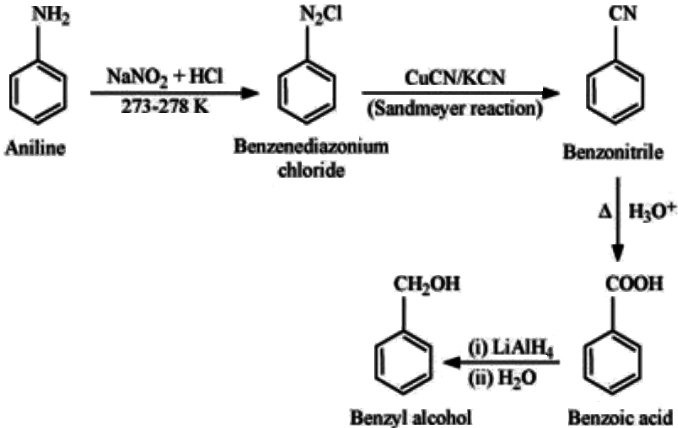
Accomplish the following conversion: Aniline to benzyl alcohol
Answer
Aniline to benzyl alcohol
View full question & answer→Question 62 Marks
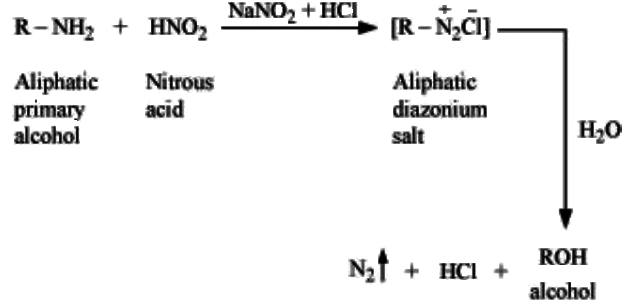
Write the reactions of (i) aromatic and (ii) aliphatic primary amines with nitrous acid.
Answer
- Aromatic amines react with nitrous acid $($prepared in situ from $NaNO_2$ and a mineral acid such as $HCl)$ at $273 - 278$ K to form stable aromatic diazonium salts i.e., $NaCl$ and $H_2O.$
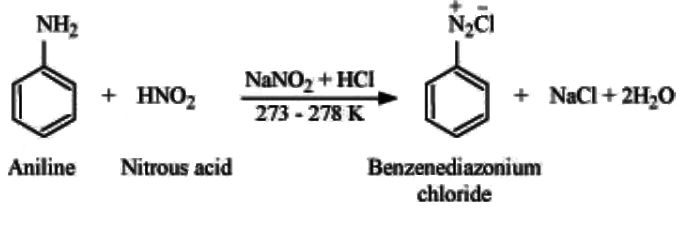
- Aliphatic primary amines react with nitrous acid $($prepared in situ from $NaNO_2$ and a mineral acid such as $HCl)$ to form unstable aliphatic diazonium salts, which further produce alcohol and $HCl$ with the evolution of $N_2$ gas.
View full question & answer→Question 72 Marks
Give the structures of A, B and C in the following reaction: $\text{C}_6\text{H}_5\text{NO}_2\xrightarrow[]{\text{Fe}/\text{HCl}}\text{A}\xrightarrow[273\text{K}]{\text{HNO}_2}\text{B}\xrightarrow[]{\text{C}_6\text{H}_5\text{OH}}\text{C}$
View full question & answer→Question 82 Marks
Describe a method for the identification of primary, secondary and tertiary amines. Also write chemical equations of the reactions involved.
AnswerThe three types of amines can be distinguished by Hinsberg method. The sample is treated with benzene sulphonyl chloride, $C_6H_5SO_2Cl$ (Hinsberg’s reagent) followed by treatment with aqueous $KOH$ $(5\%)$ solution. Based upon the observations, the following conclusions may be drawn:
- If a clear solution is obtained, then it is a primary amine.
- If the solution is turbid or ppt appears and remains unaffected by the addition of an acid, the given amine is a secondary amine.
- If the sample remains insoluble in alkali and dissolves in an acid, then it is a tertiary amine.
$\text{C}_6\text{H}_5\text{SO}_2\text{Cl}+\text{RNH}_2\rightarrow\text{C}_6\text{H}_5\text{SO}_2\text{NHR}+\text{HCl}\\ \ \ \ \ \ \ \ \ \ \ \ \ \ \ \ \ \ \ \ \ \ \ \ \ \ \text{Primary} \ \ \ \ \text{monoslkyl substituted}\\ \ \ \ \ \ \ \ \ \ \ \ \ \ \ \ \ \ \ \ \ \ \ \ \ \ \ \ \text{amine} \ \ \ \ \ \ \ \ \ \ \text{sulphonamide} \ \ \ \ \ \ \ \ \ \ \ \ \ \ \ \ \ \ \ \ \ \ \ \ \ \ \ \ \ \ \ \ \ \ \ \ \ \ \ \ \ \ \ $
$\text{C}_6\text{H}_5\text{SO}_2\text{NHR}+\text{KOH}\rightarrow\text{C}_6\text{H}_5\text{SO}_2\text{NKR}+\text{H}_2\text{O}\\ \ \ \ \ \ \ \ \ \ \ \ \ \ \ \ \ \ \ \ \ \ \ \ \ \ \ \ \ \ \ \ \ \ \ \ \ \ \ \ \ \ \ \ \ \ \ \ \ \ \ \ \ \ \ \text{soluble}$
The secondary amine forms dialkyl sulphonamide which is insoluble in alkali
$\text{C}_6\text{H}_5\text{SO}_2\text{Cl}+\text{R}_2\text{NH}\rightarrow\text{C}_6\text{H}_5\text{SO}_2\text{NR}_2+\text{HCl}\\ \ \ \ \ \ \ \ \ \ \ \ \ \ \ \ \ \ \ \ \ \ \ \text{secoundary} \ \ \text{dialkyl sulphonamide}\\ \ \ \ \ \ \ \ \ \ \ \ \ \ \ \ \ \ \ \ \ \ \ \ \ \text{amine} \ \ \ \ \ \ \ \ \ \ \ (\text{insoluble in alkali})$
Tertiary amine do not react with Hinsberg’s reagent. They do not dissolve in alkali, but dissolve in acid.
$\text{R}_3\text{N}+\text{HCl}\rightarrow\text{R}_3\text{NH}^+\text{Cl}\\\text{Tetiary amine} $ View full question & answer→Question 92 Marks
Accomplish the following conversion:
Chlorobenzene to p-chloroaniline.
AnswerChlorobenzene to p-bromo aniline
View full question & answer→Question 102 Marks
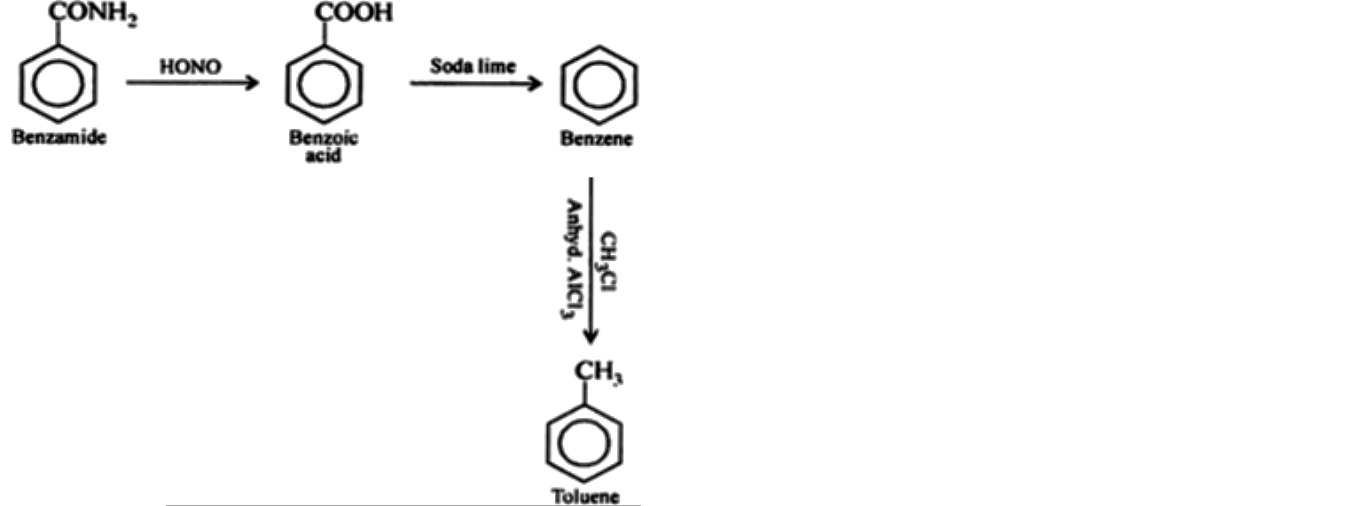
Accomplish the following conversion: Benzamide to toluene
Answer
Conversion of Benzamide to toluene;
View full question & answer→Question 112 Marks
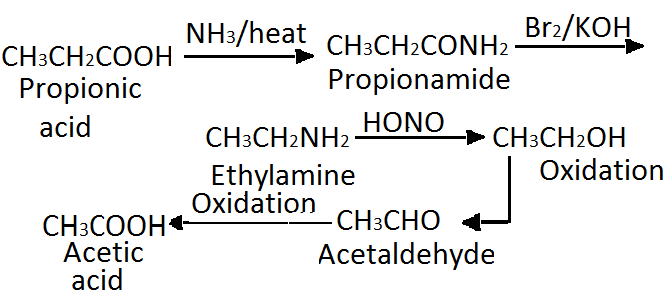
How will you convert: Propaonic acid into ethanoic acid?
Answer
Propanoic acid into ethanoic acid.
View full question & answer→Question 122 Marks
An aromatic compound $‘A’$ on treatment with aqueous ammonia and heating forms compound $‘B’$ which on heating with $Br_2$ and $KOH$ forms a compound $‘C’$ of molecular formula $C_6H_7N.$ Write the structures and IUPAC names of compounds $A,\ B,\ C.$
View full question & answer→Question 132 Marks
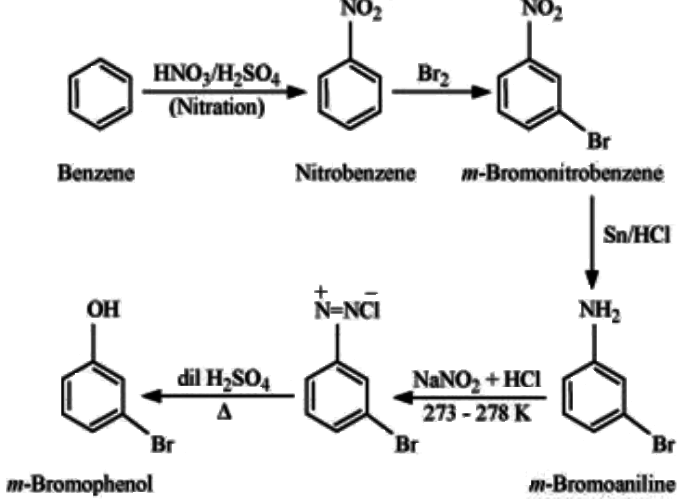
Accomplish the following conversion:
Benzene to m-bromophenol.
AnswerBenzene to m-bromophenol
View full question & answer→Question 142 Marks
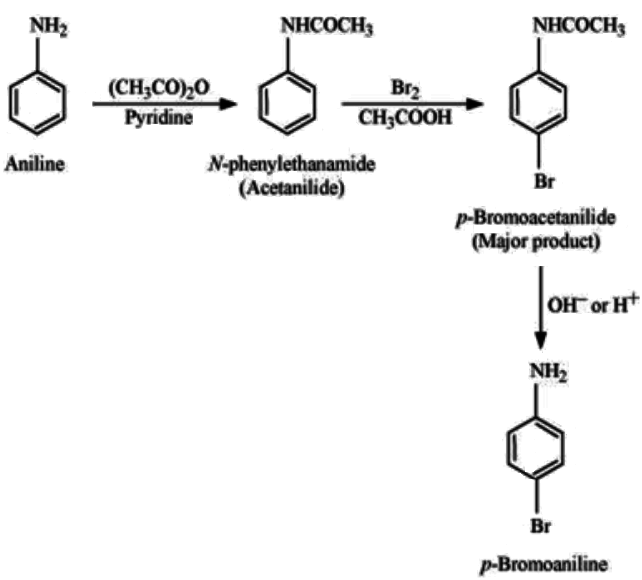
Accomplish the following conversion:
Aniline to p-bromoaniline.
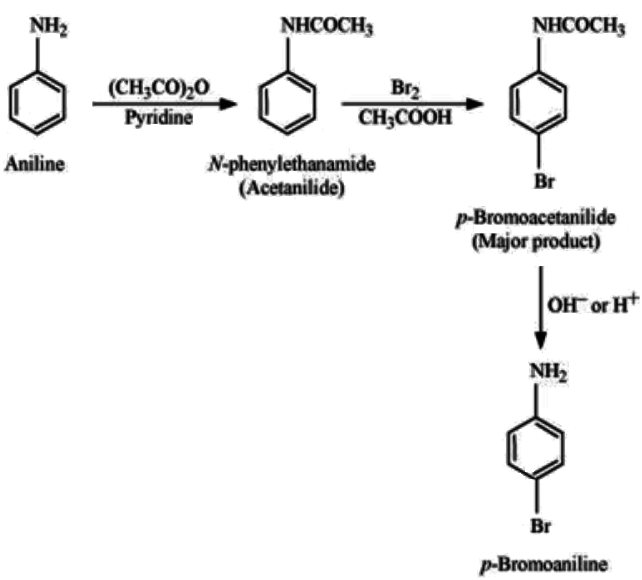
AnswerAniline to p-bromoaniline
View full question & answer→Question 152 Marks
Give the structure of A, B and C in the following reaction:
$\text{CH}_3\text{CH}_2\text{I}\xrightarrow[]{\text{NaCN}}\text{A}\xrightarrow[\text{Partial hydolysis}]{\text{OH}^+}\text{B}\xrightarrow[]{\text{NaOH}+\text{Br}_2}\text{C}$
Answer$\text{CH}_3\text{CH}_2\text{I}\xrightarrow[]{\text{NaCN}}\text{CH}_3-\text{CH}_2-\text{C}\equiv\text{N}\xrightarrow[]{\text{OH}^+}\text{CH}_3\text{CH}_2\text{CONH}_2\\ \ \ \ \ \ \ \ \ \ \ \ \ \ \ \ \ \ \ \ \ \ \ \ \ \ \ \ \ \ \ \ \ \ \ \ \ \ \ \ \ (\text{A}) \ \ \ \ \ \ \ \ \ \ \ \ \ \ \ \ \ \ \ \text{Partial}\ \ \ \ \ \ \ \ \ \ \ \ \ (\text{B}) \ \ \ \ \ \ \ \\ \ \ \ \ \ \ \ \ \ \ \ \ \ \ \ \ \ \ \ \ \ \ \ \ \ \ \ \ \ \ \ \ \ \ \ \ \ \text{Ethyl cynid} \ \ \ \ \ \text{hydrolysis}\\ \ \ \ \ \ \ \ \ \ \ \ \ \ \ \ \ \ \ \ \ \ \ \ \ \ \ \ \ \ \ \ \ \ \ \ \ \ \ \ \ \ \ \ \ \ \ \ \ \ \ \ \ \ \ \ \ \ \ \ \ \ \ \ \ \ \ \ \ \ \ \ \ \ \ \ \ \ \ \ \ \ \ \ \ \ \ \ \ \ \ \ \ \ \ \Bigg\downarrow{\text{NaOH}+\text{Br}_2}\\ \ \ \ \ \ \ \ \ \ \ \ \ \ \ \ \ \ \ \ \ \ \ \ \ \ \ \ \ \ \ \ \ \ \ \ \ \ \ \ \ \ \ \ \ \ \ \ \ \ \ \ \ \ \ \ \ \ \ \ \ \ \ \ \ \ \ \ \ \ \ \ \ \ \ \ \ \ \ \ \ \ \ \ \text{CH}_3\text{CH}_2\text{NH}_2\\ \ \ \ \ \ \ \ \ \ \ \ \ \ \ \ \ \ \ \ \ \ \ \ \ \ \ \ \ \ \ \ \ \ \ \ \ \ \ \ \ \ \ \ \ \ \ \ \ \ \ \ \ \ \ \ \ \ \ \ \ \ \ \ \ \ \ \ \ \ \ \ \ \ \ \ \ \ \ \ \ \ \ \ \ \ \ \ \ \ \ \ \ \ (\text{C})$
View full question & answer→Question 162 Marks
Give the structures of A, B and C in the following reaction:
$\text{CH}_3\text{COOH}\xrightarrow[\Delta]{\text{NH}_3}\text{A}\xrightarrow[]{\text{NaOBr}}\text{B}\xrightarrow[]{\text{NaNO}_2/\text{HCl}}\text{C}$
Answer$\text{CH}_3\text{COOH}\xrightarrow[\Delta]{\text{NH}_3}\text{CH}_3\text{CONH}_2\xrightarrow[]{\text{NaOBr}}\text{CH}_3\text{NH}_2\\ \ \ \ \ \ \ \ \ \ \ \ \ \ \ \ \ \ \ \ \ \ \ \ \ \ \ \ \ \ \text{Ethanamide} \ \ \ \ \ \ \ \ \ \ \ \text{Methanamide}\\ \ \ \ \ \ \ \ \ \ \ \ \ \ \ \ \ \ \ \ \ \ \ \ \ \ \ \ \ \ \ \ \ \ \ \ (\text{A}) \ \ \ \ \ \ \ \ \ \ \ \ \ \ \ \ \ \ \ \ \ \ \ \ \ \ \ \ (\text{B})\\\ \ \ \ \ \ \ \ \ \ \ \ \ \ \ \ \ \ \ \ \ \ \ \ \ \ \ \ \ \ \ \ \ \ \ \ \ \ \ \ \ \ \ \ \ \ \ \ \ \ \ \ \ \ \ \ \ \ \ \ \ \ \ \ \ \ \ \ \ \ \Bigg\downarrow{\text{NaNo}_2/\text{HCl}}\\ \ \ \ \ \ \ \ \ \ \ \ \ \ \ \ \ \ \ \ \ \ \ \ \ \ \ \ \ \ \ \ \ \ \ \ \ \ \ \ \ \ \ \ \ \ \ \ \ \ \ \ \ \ \ \ \ \ \ \ \ \ \ \ \ \ \ \ \ \text{CH}_3\text{OH}\\ \ \ \ \ \ \ \ \ \ \ \ \ \ \ \ \ \ \ \ \ \ \ \ \ \ \ \ \ \ \ \ \ \ \ \ \ \ \ \ \ \ \ \ \ \ \ \ \ \ \ \ \ \ \ \ \ \ \ \ \ \ \ \ \ \ \ \ \ \text{Methanol}\\ \ \ \ \ \ \ \ \ \ \ \ \ \ \ \ \ \ \ \ \ \ \ \ \ \ \ \ \ \ \ \ \ \ \ \ \ \ \ \ \ \ \ \ \ \ \ \ \ \ \ \ \ \ \ \ \ \ \ \ \ \ \ \ \ \ \ \ \ \ \ \ ( \text{C})$
View full question & answer→Question 172 Marks
Accomplish the following conversion: Aniline to 2, 4, 6 -tribromofluorobenzene.
Question 182 Marks
Give the structures of A, B and C in the following reaction:
$\text{C}_6\text{H}_5\text{N}_2\text{Cl}\xrightarrow[]{\text{CuCN}}\text{A}\xrightarrow[]{\text{H}_2\text{O}/\text{H}^+}\text{B}\xrightarrow[\Delta]{\text{NH}_3}\text{C}$
Answer$\text{C}_6\text{H}_5\text{N}_2\text{Cl}\xrightarrow[]{\text{CuCN}}\text{C}_6\text{H}_5\text{CN}\xrightarrow[]{\text{H}_2\text{O}/\text{H}^+}\text{C}_6\text{H}_5\text{COOH}\\ \ \ \ \ \ \ \ \ \ \ \ \ \ \ \ \ \ \ \ \ \ \ \ \ \ \ \ \ \ \text{Cyanobenzene} \ \ \ \ \ \ \ \text{Benzoic acid}\\ \ \ \ \ \ \ \ \ \ \ \ \ \ \ \ \ \ \ \ \ \ \ \ \ \ \ \ \ \ \ \ \ \ \ \ \ \ (\text{A}) \ \ \ \ \ \ \ \ \ \ \ \ \ \ \ \ \ \ \ \ \ \ \ \ \ \ (\text{B})\\ \ \ \ \ \ \ \ \ \ \ \ \ \ \ \ \ \ \ \ \ \ \ \ \ \ \ \ \ \ \ \ \ \ \ \ \ \ \ \ \ \ \ \ \ \ \ \ \ \ \ \ \ \ \ \ \ \ \ \ \ \ \ \ \ \ \ \ \ \Delta\Big\downarrow{\text{NH}_3}\\ \ \ \ \ \ \ \ \ \ \ \ \ \ \ \ \ \ \ \ \ \ \ \ \ \ \ \ \ \ \ \ \ \ \ \ \ \ \ \ \ \ \ \ \ \ \ \ \ \ \ \ \ \ \ \ \ \ \ \ \ \ \text{C}_6\text{H}_5\text{CONH}_2\\ \ \ \ \ \ \ \ \ \ \ \ \ \ \ \ \ \ \ \ \ \ \ \ \ \ \ \ \ \ \ \ \ \ \ \ \ \ \ \ \ \ \ \ \ \ \ \ \ \ \ \ \ \ \ \ \ \ \ \ \ \ \ \ \text{Benzamide}\\ \ \ \ \ \ \ \ \ \ \ \ \ \ \ \ \ \ \ \ \ \ \ \ \ \ \ \ \ \ \ \ \ \ \ \ \ \ \ \ \ \ \ \ \ \ \ \ \ \ \ \ \ \ \ \ \ \ \ \ \ \ \ \ \ \ \ \ \ \ \ (\text{C})$
View full question & answer→Question 192 Marks
Give the structures of A, B and C in the following reaction:
$\text{CH}_3\text{CH}_2\text{Br}\xrightarrow[]{\text{KCN}}\text{A}\xrightarrow[]{\text{LIAlH}_4}\text{B}\xrightarrow[0^\circ\text{C}]{\text{HNO}_2}\text{C}$
Answer$\text{C}_6\text{H}_5\text{CN}, \ \text{B}-\text{C}_6\text{H}_5\text{COOH} \ \text{and} \ \text{C}=\text{C}_6\text{H}_5\text{CONH}_2.$
View full question & answer→Question 202 Marks
How will you convert:
Methanamine into ethanamine.
AnswerConversion of Methanamine into Ethanamine.
$\text{CH}_3\text{NH}_2\xrightarrow[]{\text{HONO}}\text{CH}_3\text{OH}\xrightarrow[]{\text{PI}_3}\text{CH}_3\text{I}\xrightarrow[]{\text{KCN}(\text{alc})}\\\text{Methanamine} \ \ \ \ \ \ \ \text{Methyl} \ \ \ \ \ \ \ \ \ \text{Methyl}\\ \ \ \ \ \ \ \ \ \ \ \ \ \ \ \ \ \ \ \ \ \ \ \ \ \ \ \ \ \ \ \ \text{alcohol} \ \ \ \ \ \ \ \ \ \ \text{iodide} \ \ \\\text{CH}_3\text{C}\equiv\text{N}\xrightarrow[\text{Na}/\text{alcohol}]{4(\text{H})}\text{CH}_3\text{CH}_2\text{NH}_2\\\text{methyl}\ \ \ \ \ \ \ \ \ \ \ \ \ \ \ \ \ \ \ \ \ \ \ \ \ \text{Ethanamine}\\\text{cynide} \ \ \ \ \ \ \ \ \ \ \ \ \ \ \ \ \ \ \ \ \ \ \ \ \ \ \ \ \ \ \ \ \ \ \ \ \ \ \ \ \ \ \ \ \ \ \ $
View full question & answer→Question 212 Marks
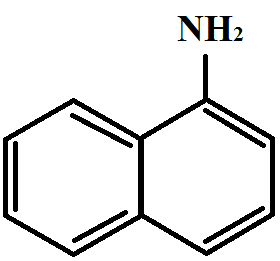
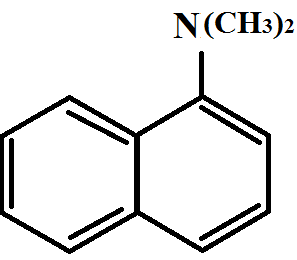
Classify the following amines as primary, secondary or tertiary:
-
-
-
$(\text{C}_2\text{H}_5)_2\text{CHNH}_2$
-
$(\text{C}_2\text{H}_5)_2\text{NH}$
Question 222 Marks
- Write structures of different isomeric amines corresponding to the molecular formula, $C_4H_{11}N.$
- Write IUPAC names of all the isomers.
- What type of isomerism is exhibited by different pairs of amines?
Answer$(i)\ \&\ (ii)$ There are total $8$ geometrical isomers of the given compound.
| |
Isomers |
IUPAC Name |
| 1. |
$\text{CH}_3-\text{CH}_2-\text{CH}_2-\text{CH}_2-\text{NH}_2$ |
Butan$-1$ amine or butanamine |
| 2. |
$ \ \ \ \ \ \ \ \ \ \ \ \ \ \ \ \ \ \ \ \ \ \ \ \ \text{NH}_2\\ \ \ \ \ \ \ \ \ \ \ \ \ \ \ \ \ \ \ \ \ \ \ \ \ \ \ \ \ |\\\text{CH}_3-\text{CH}_2-\text{CH}-\text{CH}_3$ |
Butan $- 2 -$ amine. |
| 3. |
$ \ \ \ \ \ \ \ \ \ \ \ \ \ \ \text{CH}_3\\ \ \ \ \ \ \ \ \ \ \ \ \ \ \ \ \ |\\\text{CH}_3-\text{CH}-\text{CH}_2-\text{NH}_2$ |
$2 -$ Methylpropanamine |
| 4. |
$ \ \ \ \ \ \ \ \ \ \ \text{CH}_3\\ \ \ \ \ \ \ \ \ \ \ \ \ \ |\\\text{CH}_3-\text{C}-\text{NH}_2\\ \ \ \ \ \ \ \ \ \ \ \ \ \ \ |\\ \ \ \ \ \ \ \ \ \ \ \ \text{CH}_3$ |
$2 -$ Methylpropan$ - 2 -$ amine |
| 5. |
$\text{CH}_3-\text{CH}_2-\text{CH}_2-\text{NH}-\text{CH}_2$ |
$N -$ Ethylethanamine |
| 6. |
$\text{CH}_3-\text{CH}_2-\text{CH}_2-\text{NH}-\text{CH}_3$ |
$N -$ Methylpropanamine |
| 7. |
$ \ \ \ \ \ \ \ \ \ \ \ \ \ \ \text{CH}_3\\ \ \ \ \ \ \ \ \ \ \ \ \ \ \ \ \ |\\\text{CH}_3-\text{CH}-\text{NH}-\text{CH}_3$ |
$N -$ Methylpropan $- 2 -$ amine |
| 8. |
$ \ \ \ \ \ \ \ \ \ \ \ \ \ \ \ \ \ \ \ \ \ \ \text{CH}_3\\ \ \ \ \ \ \ \ \ \ \ \ \ \ \ \ \ \ \ \ \ \ \ \ \ \ \ |\\\text{CH}_3-\text{CH}_2-\text{N}-\text{CH}_3$ |
$N, N - $Dimethylethanamine |
(iii) a) Pairs $1, 2, 6, 7$ Exhibit position isomerism: View full question & answer→Question 232 Marks
Give the chemical tests to distinguish between the following pairs of compounds:
- Ethylamine and Aniline.
- Aniline and Benzylamine.
Answer
- Ethylamine and aniline
Aniline forms an azo-dye with benzenediazoniumchloride through coupling reaction whereas ethylamine does not form an azo-dye.
- Aniline and benzylamine
Aniline forms an azo-dye with benzenediazoniumchloride through coupling reaction whereas benzylamine does not form an azo-dye.
View full question & answer→Question 242 Marks
Complete the following reaction equations:
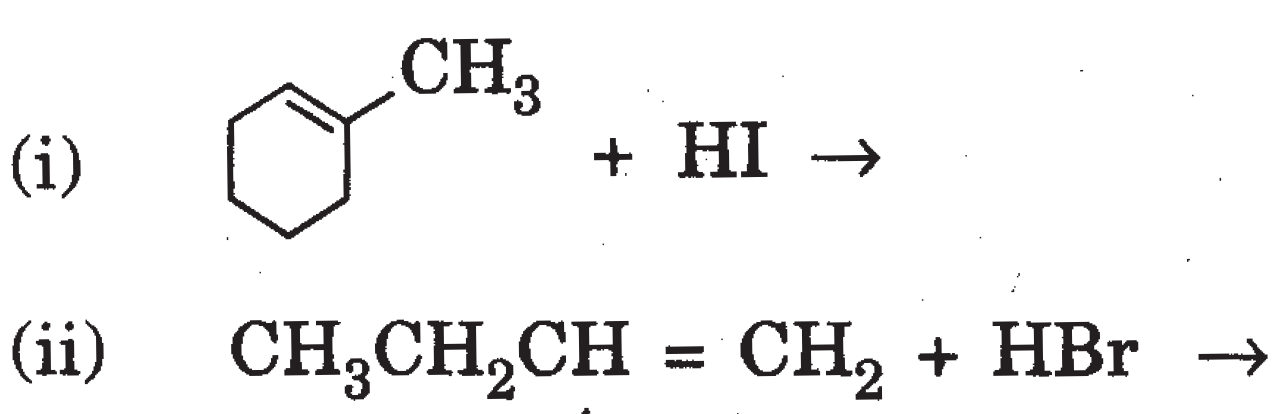
Question 252 Marks
- Arrange the following in an increasing order of basic strength in water:
$C_6H_5NH_2, (C_2H_5)_2NH, (C_2H_5)_3N$ and $NH_3.$
- Arrange the following in increasing order of basic strength in gas phase:
$C_2H_5NH_2, (C_2H_5)_2NH, (C_2H_5)_3N$ and $CH_3NH_2.$Answer
- $C_6H_5 NH_2 < NH_3 < (C_2H_5)_3 N < (C_2H_5)_2 NH$ in water.
- $CH_3NH_2 < C_2H_5NH_2 < (C_2H_5)_2 NH < (C_2H_5)_3N$ in gas phase.
View full question & answer→Question 262 Marks
How will you carry out the following conversion?
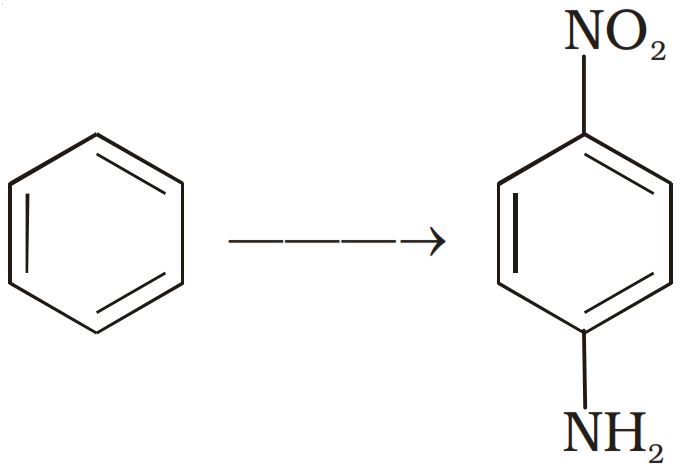
Answer
Conversion of benzene to p-nitroaniline can be done as:
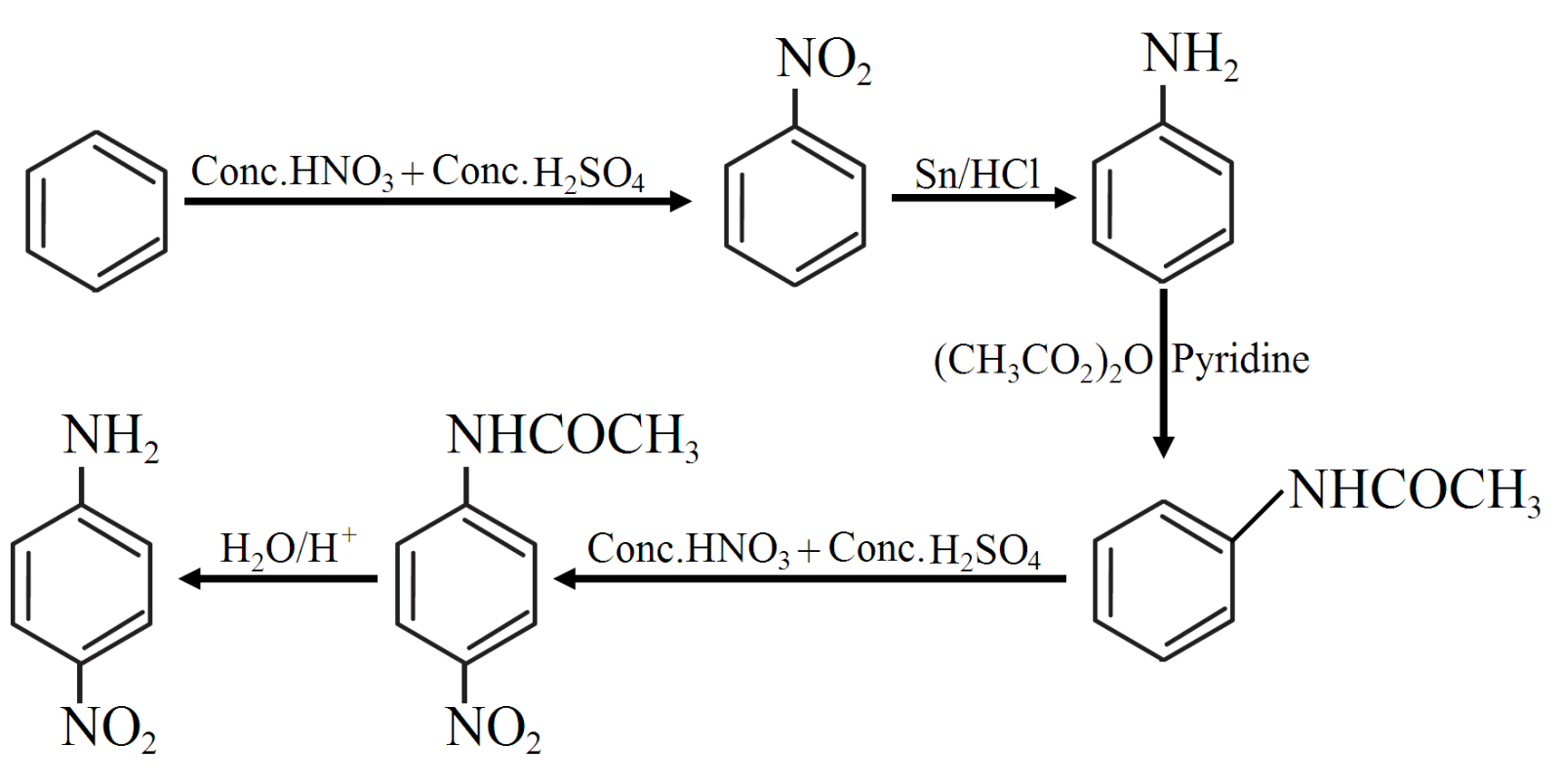
View full question & answer→Question 272 Marks
Differentiate between globular and fibrous proteins.
AnswerDifference between globular protein and fibrous protein:
| |
Fibrous protein
|
Globular protein
|
| 1. |
It is a fibre-like structure formed by the polypeptide chain. These proteins are held together by strong hydrogen and disulphide bonds.
|
The polypeptide chain in this protein is folded around itself, giving rise to a spherical Structure.
|
| 2. |
It is usually insoluble in water, but soluble in strong acids and bases.
|
It is usually soluble in water, acids, bases and salts.
|
| 3. |
They have comparatively stronger intermolecular forces of attraction.
|
They have weak intermolecular hydrogen bonding.
|
| 4. |
Example: Collagen, fibroin, myosin, hair, skin,silk, wool, etc.
|
Egg, albumin, casein of milk, insulin.
|
View full question & answer→Question 282 Marks
Give the structures of A, B and C in the following reaction:$\text{C}_6\text{H}_5\text{NO}_2\xrightarrow[]{\text{Fe}/\text{HCl}}\text{A}\xrightarrow[273\text{K}]{\text{NaNO}_2+\text{HCl}}\text{B}\xrightarrow[\Delta]{\text{H}_2\text{O}/\text{H}^+}\text{C}$
Answer$\text{C}_6\text{H}_5\text{NO}_2\xrightarrow[]{\text{Fe}/\text{HCl}}\text{C}_6\text{H}_5\text{NH}_2\xrightarrow[273\text{K}]{\text{NaNO}_2+\text{HCl}}\text{C}_6\text{H}_5-\stackrel{{+}}{{\text{N}_2}}\stackrel{{-}}{{\text{Cl}}}\\ \ \ \ \ \ \ \ \ \ \ \ \ \ \ \ \ \ \ \ \ \ \ \ \ \ \ \ \ \ \ \ \ \ \ \ \text{Aniline} \ \ \ \ \ \ \ \ \ \ \ \ \ \ \ \ \ \ \ \text{Benzendiazonium}\\ \ \ \ \ \ \ \ \ \ \ \ \ \ \ \ \ \ \ \ \ \ \ \ \ \ \ \ \ \ \ \ \ \ \ \ \ \ \ (\text{A}) \ \ \ \ \ \ \ \ \ \ \ \ \ \ \ \ \ \ \ \ \ \ \ \ \ \ \ \ \ \ \ \text{Cloride}\\ \ \ \ \ \ \ \ \ \ \ \ \ \ \ \ \ \ \ \ \ \ \ \ \ \ \ \ \ \ \ \ \ \ \ \ \ \ \ \ \ \ \ \ \ \ \ \ \ \ \ \ \ \ \ \ \ \ \ \ \ \ \ \ \ \ \ \ \ \ \ \ \ \ \ \ \ \ \ (\text{B})\\\ \ \ \ \ \ \ \ \ \ \ \ \ \ \ \ \ \ \ \ \ \ \ \ \ \ \ \ \ \ \ \ \ \ \ \ \ \ \ \ \ \ \ \ \ \ \ \ \ \ \ \ \ \ \ \ \ \ \ \ \ \ \ \ \ \ \ \ \ \ \ \ \ \ \ \ \Delta\downarrow{\text{H}_2\text{O}/\text{H}^+}\\ \ \ \ \ \ \ \ \ \ \ \ \ \ \ \ \ \ \ \ \ \ \ \ \ \ \ \ \ \ \ \ \ \ \ \ \ \ \ \ \ \ \ \ \ \ \ \ \ \ \ \ \ \ \ \ \ \ \ \ \ \ \ \ \ \ \ \ \ \ \ \ \ \ \ \text{C}_6\text{H}_5\text{OH}\\ \ \ \ \ \ \ \ \ \ \ \ \ \ \ \ \ \ \ \ \ \ \ \ \ \ \ \ \ \ \ \ \ \ \ \ \ \ \ \ \ \ \ \ \ \ \ \ \ \ \ \ \ \ \ \ \ \ \ \ \ \ \ \ \ \ \ \ \ \ \ \ \ \ \ \ \ \text{Phenol}\\ \ \ \ \ \ \ \ \ \ \ \ \ \ \ \ \ \ \ \ \ \ \ \ \ \ \ \ \ \ \ \ \ \ \ \ \ \ \ \ \ \ \ \ \ \ \ \ \ \ \ \ \ \ \ \ \ \ \ \ \ \ \ \ \ \ \ \ \ \ \ \ \ \ \ \ \ \ (\text{C})$
View full question & answer→Question 292 Marks
A primary amine, $RNH_2$ can be reacted with $CH_3-X$ to get secondary amine, $R-NHCH_3$ but the only disadvantage is that $3^\circ$ amine and quaternary ammonium salts are also obtained as side products. Can you suggest a method where $RNH_2$ forms only $2^\circ$ amine?
Answer$\text{RNH}_2\xrightarrow{\text{KOH}/\text{CHCl}_3}\text{RNC}\xrightarrow{\text{H}_2/\text{Pd}}\text{RNHCH} _3$Carbylamine reaction is shown by $1^\circ$ amine only which results in the replacement of two hydrogen atoms attached to nitrogen atom of $NH_2$ group by one carbon atom. On catalytic reduction, the isocyanide will give a secondary amine with one methyl group.
View full question & answer→Question 302 Marks
Write the following conversions: nitrobenzene → acetanilide
Question 312 Marks
Give the structures of A, B and C in the following reactions:$\text{C}_6\text{H}_5\text{NO}_2\xrightarrow{\text{Fe/HCl}\ \ }\text{A}\xrightarrow{\text{HNO}_2;273\text{K}\ \ }\text{B}\xrightarrow{\text{NH}_3;\Delta\ \ }\text{C}$
View full question & answer→Question 322 Marks
How will you carry out the following conversions?
- toluene → p-toluidine.
- p-toluidine diazonium chloride → p-toluic acid.
Answer
- toluene → p-toluidine.
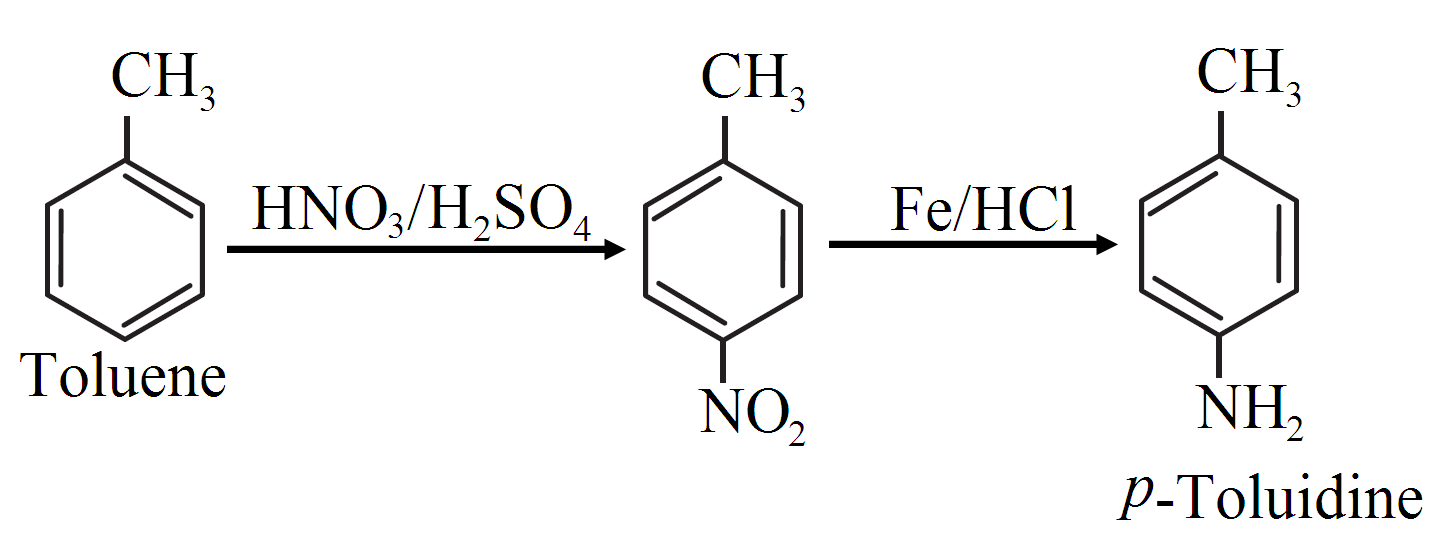
- p-toluidine diazonium chloride → p-toluic acid.
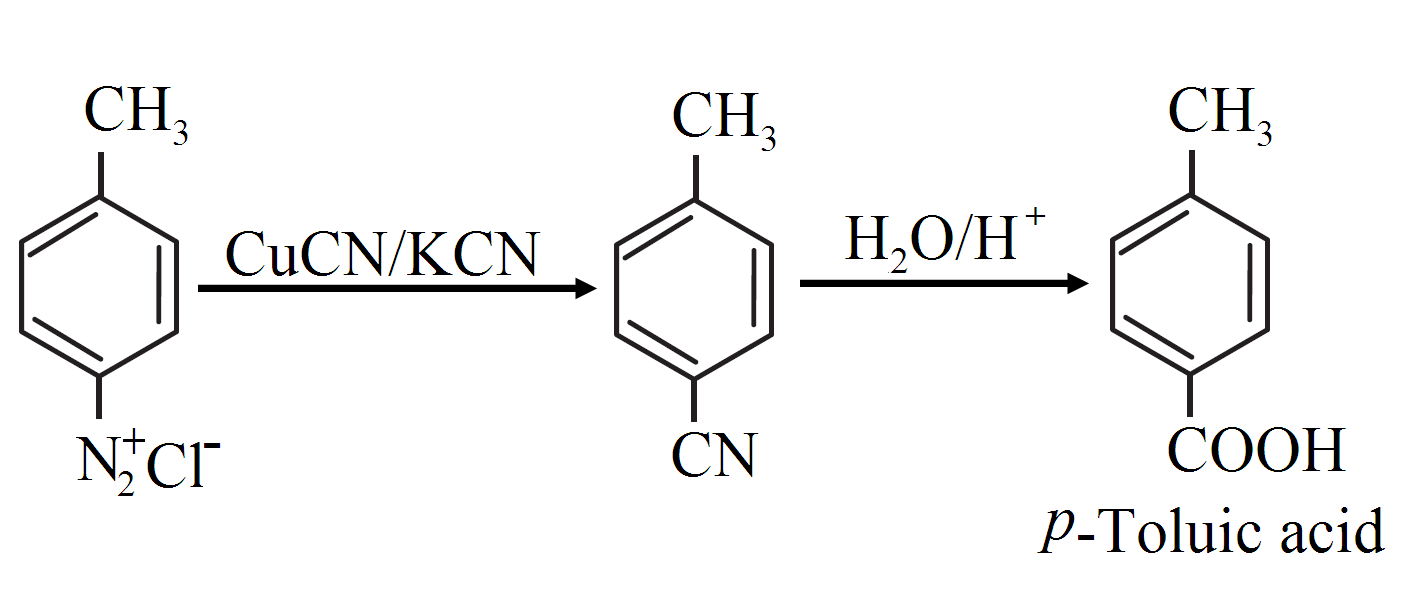
View full question & answer→Question 332 Marks
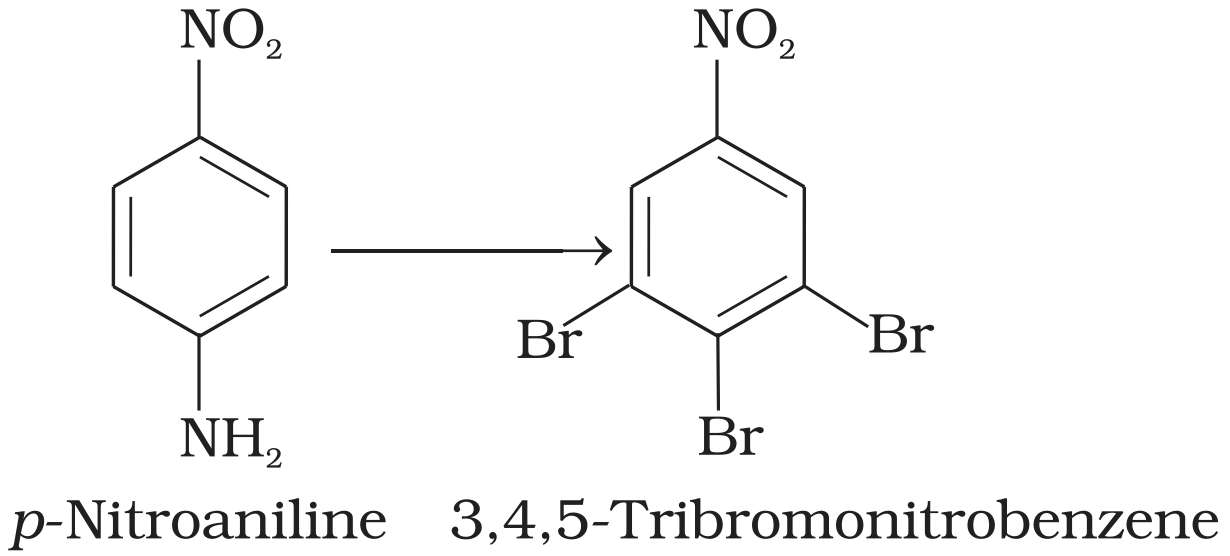
How will you bring out the following conversion?
Question 342 Marks
Give the structures of A, B and C in the following reaction:$\text{C}_6\text{H}_5\text{NO}_2\xrightarrow[]{\text{Fe}/\text{HCl}}\text{A}\xrightarrow[273\text{K}]{\text{HNO}_2}\text{B}\xrightarrow[]{\text{C}_6\text{H}_5\text{OH}}\text{C}$
View full question & answer→Question 352 Marks
Write following conversions:
- Nitrobenzene → acetanilide.
- Acetanilide → p-nitroaniline.
Question 362 Marks
Give the structure of A, B and C in the following reaction:$\text{CH}_3\text{CH}_2\text{I}\xrightarrow[]{\text{NaCN}}\text{A}\xrightarrow[\text{Partial hydolysis}]{\text{OH}^+}\text{B}\xrightarrow[]{\text{NaOH}+\text{Br}_2}\text{C}$
Answer$\text{CH}_3\text{CH}_2\text{I}\xrightarrow[]{\text{NaCN}}\text{CH}_3-\text{CH}_2-\text{C}\equiv\text{N}\xrightarrow[]{\text{OH}^+}\text{CH}_3\text{CH}_2\text{CONH}_2\\ \ \ \ \ \ \ \ \ \ \ \ \ \ \ \ \ \ \ \ \ \ \ \ \ \ \ \ \ \ \ \ \ \ \ \ \ \ \ \ \ (\text{A}) \ \ \ \ \ \ \ \ \ \ \ \ \ \ \ \ \ \ \ \text{Partial}\ \ \ \ \ \ \ \ \ \ \ \ \ (\text{B}) \ \ \ \ \ \ \ \\ \ \ \ \ \ \ \ \ \ \ \ \ \ \ \ \ \ \ \ \ \ \ \ \ \ \ \ \ \ \ \ \ \ \ \ \ \ \text{Ethyl cynid} \ \ \ \ \ \text{hydrolysis}\\ \ \ \ \ \ \ \ \ \ \ \ \ \ \ \ \ \ \ \ \ \ \ \ \ \ \ \ \ \ \ \ \ \ \ \ \ \ \ \ \ \ \ \ \ \ \ \ \ \ \ \ \ \ \ \ \ \ \ \ \ \ \ \ \ \ \ \ \ \ \ \ \ \ \ \ \ \ \ \ \ \ \ \ \ \ \ \ \ \ \ \ \ \ \ \Bigg\downarrow{\text{NaOH}+\text{Br}_2}\\ \ \ \ \ \ \ \ \ \ \ \ \ \ \ \ \ \ \ \ \ \ \ \ \ \ \ \ \ \ \ \ \ \ \ \ \ \ \ \ \ \ \ \ \ \ \ \ \ \ \ \ \ \ \ \ \ \ \ \ \ \ \ \ \ \ \ \ \ \ \ \ \ \ \ \ \ \ \ \ \ \ \ \ \text{CH}_3\text{CH}_2\text{NH}_2\\ \ \ \ \ \ \ \ \ \ \ \ \ \ \ \ \ \ \ \ \ \ \ \ \ \ \ \ \ \ \ \ \ \ \ \ \ \ \ \ \ \ \ \ \ \ \ \ \ \ \ \ \ \ \ \ \ \ \ \ \ \ \ \ \ \ \ \ \ \ \ \ \ \ \ \ \ \ \ \ \ \ \ \ \ \ \ \ \ \ \ \ \ \ (\text{C})$
View full question & answer→Question 372 Marks
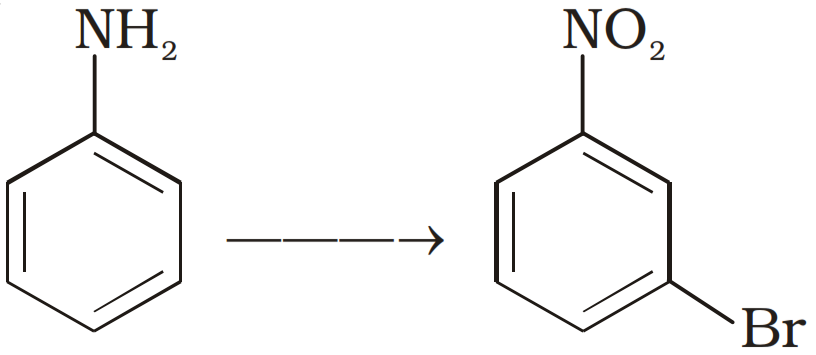
How will you carry out the following conversion?
Question 382 Marks
Give the structures of A, B and C in the following reaction:$\text{CH}_3\text{COOH}\xrightarrow[\Delta]{\text{NH}_3}\text{A}\xrightarrow[]{\text{NaOBr}}\text{B}\xrightarrow[]{\text{NaNO}_2/\text{HCl}}\text{C}$
Answer$\text{CH}_3\text{COOH}\xrightarrow[\Delta]{\text{NH}_3}\text{CH}_3\text{CONH}_2\xrightarrow[]{\text{NaOBr}}\text{CH}_3\text{NH}_2\\ \ \ \ \ \ \ \ \ \ \ \ \ \ \ \ \ \ \ \ \ \ \ \ \ \ \ \ \ \ \text{Ethanamide} \ \ \ \ \ \ \ \ \ \ \ \text{Methanamide}\\ \ \ \ \ \ \ \ \ \ \ \ \ \ \ \ \ \ \ \ \ \ \ \ \ \ \ \ \ \ \ \ \ \ \ \ (\text{A}) \ \ \ \ \ \ \ \ \ \ \ \ \ \ \ \ \ \ \ \ \ \ \ \ \ \ \ \ (\text{B})\\\ \ \ \ \ \ \ \ \ \ \ \ \ \ \ \ \ \ \ \ \ \ \ \ \ \ \ \ \ \ \ \ \ \ \ \ \ \ \ \ \ \ \ \ \ \ \ \ \ \ \ \ \ \ \ \ \ \ \ \ \ \ \ \ \ \ \ \ \ \ \Bigg\downarrow{\text{NaNo}_2/\text{HCl}}\\ \ \ \ \ \ \ \ \ \ \ \ \ \ \ \ \ \ \ \ \ \ \ \ \ \ \ \ \ \ \ \ \ \ \ \ \ \ \ \ \ \ \ \ \ \ \ \ \ \ \ \ \ \ \ \ \ \ \ \ \ \ \ \ \ \ \ \ \ \text{CH}_3\text{OH}\\ \ \ \ \ \ \ \ \ \ \ \ \ \ \ \ \ \ \ \ \ \ \ \ \ \ \ \ \ \ \ \ \ \ \ \ \ \ \ \ \ \ \ \ \ \ \ \ \ \ \ \ \ \ \ \ \ \ \ \ \ \ \ \ \ \ \ \ \ \text{Methanol}\\ \ \ \ \ \ \ \ \ \ \ \ \ \ \ \ \ \ \ \ \ \ \ \ \ \ \ \ \ \ \ \ \ \ \ \ \ \ \ \ \ \ \ \ \ \ \ \ \ \ \ \ \ \ \ \ \ \ \ \ \ \ \ \ \ \ \ \ \ \ \ \ ( \text{C})$
View full question & answer→Question 392 Marks
Answer
- In $CH_3NH_2,$ the +I effect of $-CH_3$ group makes lone pair of electrons on $N-$atom more available for donation. On the other hand in $C_6H_5NH_2,$ the resonance effect causes delocalisation of lone pair of electrons over benzene ring and makes it less available for donation.
Hence, $CH_3NH_2$ is more basic than $C_6H_5NH_2.$
- $CH_3NH_2$ is more basic than $NH_3.\ CH_3$ group due to its $+ve$ I effect pushes electron towards nitrogen in $\text{CH}_3\stackrel{{..\ \ \ \ \ \ \ }}{\hbox{N}\text{H}_2}$ and this makes the unshared electron pair more available for sharing with the proton of the acid.
-
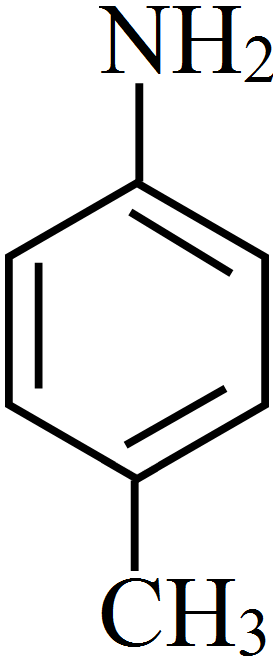
is stronger base than
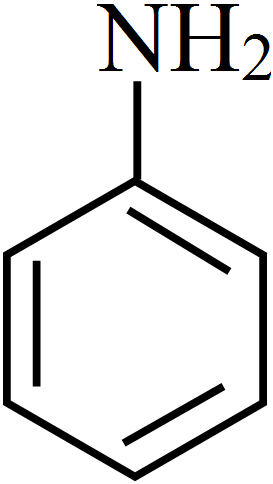
as $CH_3$ group is electron releasing by $+I$ effect and hyperconjugation effect. View full question & answer→Question 402 Marks
Explain the observed $K_b$ order:
$Et_2NH > Et_3N > EtNH_2$ in aqueous solution.
AnswerDue to combination of +I effect, solvation effect and steric hindrance of ethyl group the basic strength of ethyl substituted amines in aqueous solution is as follows:
$Et_2NH > Et_3N > EtNH_2$
As a stronger base has a higher $K_b$ value, therefore, $K_b$ value decreases in the order:
$Et_2NH > Et_3N > EtNH_2$
View full question & answer→Question 412 Marks
Give the structures of A, B and C in the following reactions:$\text{C}_6\text{H}_5\text{N}_2\text{Cl}\xrightarrow{\text{CuCN}\ \ }\text{A}\xrightarrow{\text{H}_2\text{O/H}^+\ \ }\text{B}\xrightarrow{\text{NH}_3;\Delta\ \ \ }\text{C}$
View full question & answer→Question 422 Marks
Give the structures of A, B and C in the following reaction:$\text{C}_6\text{H}_5\text{N}_2\text{Cl}\xrightarrow[]{\text{CuCN}}\text{A}\xrightarrow[]{\text{H}_2\text{O}/\text{H}^+}\text{B}\xrightarrow[\Delta]{\text{NH}_3}\text{C}$
Answer$\text{C}_6\text{H}_5\text{N}_2\text{Cl}\xrightarrow[]{\text{CuCN}}\text{C}_6\text{H}_5\text{CN}\xrightarrow[]{\text{H}_2\text{O}/\text{H}^+}\text{C}_6\text{H}_5\text{COOH}\\ \ \ \ \ \ \ \ \ \ \ \ \ \ \ \ \ \ \ \ \ \ \ \ \ \ \ \ \ \ \text{Cyanobenzene} \ \ \ \ \ \ \ \text{Benzoic acid}\\ \ \ \ \ \ \ \ \ \ \ \ \ \ \ \ \ \ \ \ \ \ \ \ \ \ \ \ \ \ \ \ \ \ \ \ \ \ (\text{A}) \ \ \ \ \ \ \ \ \ \ \ \ \ \ \ \ \ \ \ \ \ \ \ \ \ \ (\text{B})\\ \ \ \ \ \ \ \ \ \ \ \ \ \ \ \ \ \ \ \ \ \ \ \ \ \ \ \ \ \ \ \ \ \ \ \ \ \ \ \ \ \ \ \ \ \ \ \ \ \ \ \ \ \ \ \ \ \ \ \ \ \ \ \ \ \ \ \ \ \Delta\Big\downarrow{\text{NH}_3}\\ \ \ \ \ \ \ \ \ \ \ \ \ \ \ \ \ \ \ \ \ \ \ \ \ \ \ \ \ \ \ \ \ \ \ \ \ \ \ \ \ \ \ \ \ \ \ \ \ \ \ \ \ \ \ \ \ \ \ \ \ \ \text{C}_6\text{H}_5\text{CONH}_2\\ \ \ \ \ \ \ \ \ \ \ \ \ \ \ \ \ \ \ \ \ \ \ \ \ \ \ \ \ \ \ \ \ \ \ \ \ \ \ \ \ \ \ \ \ \ \ \ \ \ \ \ \ \ \ \ \ \ \ \ \ \ \ \ \text{Benzamide}\\ \ \ \ \ \ \ \ \ \ \ \ \ \ \ \ \ \ \ \ \ \ \ \ \ \ \ \ \ \ \ \ \ \ \ \ \ \ \ \ \ \ \ \ \ \ \ \ \ \ \ \ \ \ \ \ \ \ \ \ \ \ \ \ \ \ \ \ \ \ \ (\text{C})$
View full question & answer→Question 432 Marks
How are vitamins classified? Name the vitamin responsible for the coagulation of blood.
AnswerVitamins are classified into two groups depending upon their solubility in water or fat.
- Fat soluble vitamins: Vitamins which are soluble in fat and oils but insoluble in water. These are Vitamins A, D, E, and K.
- Water soluble vitamins: Vitamins which are soluble in water. These are B group vitamin and vitamin C.
Vitamin K is responsible for the coagulation of blood.
View full question & answer→Question 442 Marks
Give the structures of A, B and C in the following reaction:$\text{CH}_3\text{CH}_2\text{Br}\xrightarrow[]{\text{KCN}}\text{A}\xrightarrow[]{\text{LIAlH}_4}\text{B}\xrightarrow[0^\circ\text{C}]{\text{HNO}_2}\text{C}$
Answer$\text{C}_6\text{H}_5\text{CN}, \ \text{B}-\text{C}_6\text{H}_5\text{COOH} \ \text{and} \ \text{C}=\text{C}_6\text{H}_5\text{CONH}_2.$
View full question & answer→Question 452 Marks
What are the reactions involved in the reductive removal of nitro group from an aromatic compound?
Answer$\text{C}_6\text{H}_5-\text{NO}\xrightarrow[\text{Reduction}]{\text{Sn/HCl}\ \ } \text{C}_6\text{H}_5-\text{NH}_5-\text{NH}_2\xrightarrow[(\text{Diazotisation})]{273-278\ \ }\\ \text{Nitrobenzene}\ \ \ \ \ \ \ \ \ \ \ \ \ \ \ \ \ \ \ \ \ \ \ \ \ \ \ \text{Aniline}\ \ \ \ \ \\\text{C}_6\text{H}_5-\stackrel{{+}}{\hbox{N}}\equiv\text{NCl}^- \ \ \ \ \ \xrightarrow[\text{(Reduction)}]{\text{Aq. H}_3\text{PO}_2\ \ }\ \ \ \ \ \ \text{C}_6\text{H}_6\\ \text{Benzenediazonium chloride}\ \ \ \ \ \ \ \ \ \ \ \ \ \text{Benzene}$
View full question & answer→Question 462 Marks
Answer the following questions: Illustrate the following reactions:
- Hoffmann bromamide degradation reaction.
- Coupling reaction.
Answer
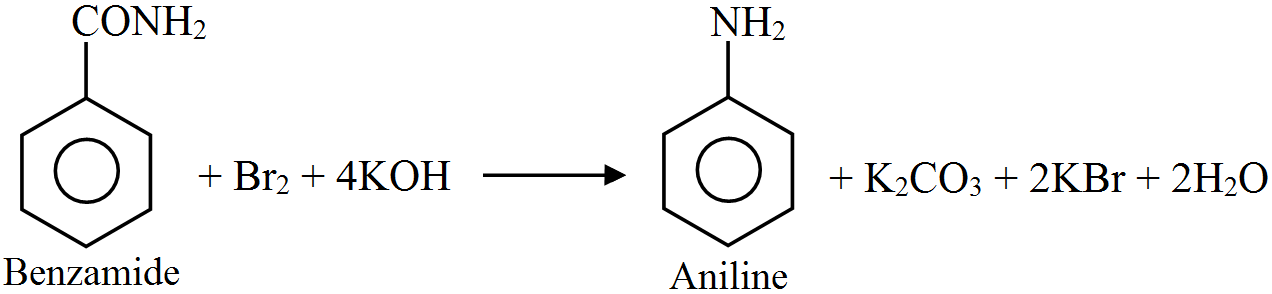
- Hoffmann bromamide reaction: When a primary acid amide is heated with an aqueous or ethanolic solution of NaOH or KOH and bromine (i.e., NaOBr or KOBr), it gives a primary amine with one carbon atom less.
$\text{R}-\text{CONH}_2+\text{Br}_2+4\text{NaOH}\xrightarrow{ \ \ \ \ }\text{R}-\text{NH}_2+\text{Na}_2\text{CO}_3+2\text{NaBr}+2\text{H}_2\text{O}\\ \ \ \text{Acid amid} \ \ \ \ \ \ \ \ \ \ \ \ \ \ \ \ \ \ \ \ \ \ \ \ \ \ \ \ \ \ \ \ \ \ \ \ \ \ \ 1^*\text{a mine}$
- Reactions involving retention of diazo group:
Coupling reaction: The reaction of diazonium salts with phenols and aromatic amines to form azo compounds of the general formula, Ar-N = N-Ar is called coupling reaction. The mechanism is basically that of electrophilic substitution where the diazonium ion is electrophile. In this reaction, the nitrogen atoms of the diazo group are retained in the product. The coupling with phenols takes place in mildly alkaline medium while with amines, it occurs under faintly acidic conditions. For example,
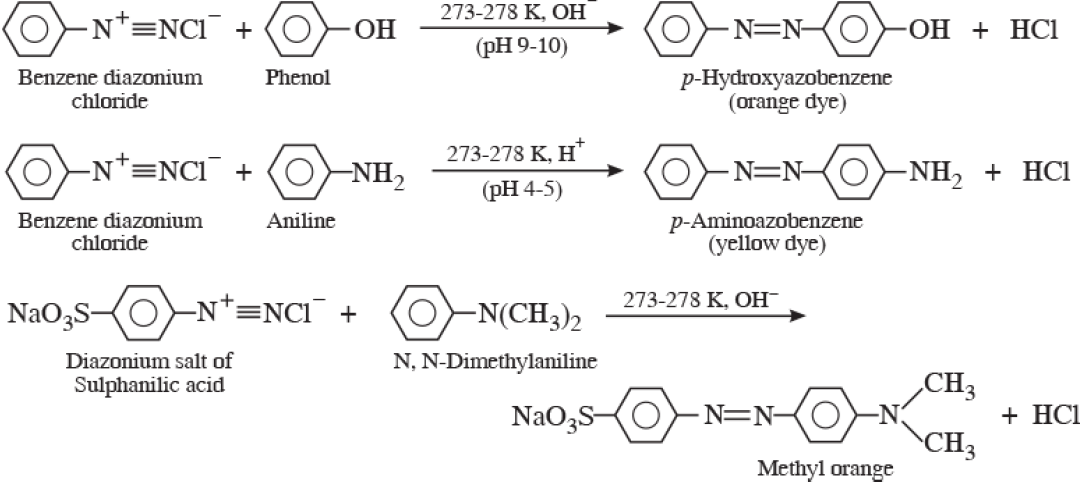
Coupling generally occurs at the p-position, w.r.t., the hydroxyl or the amino group, if free, otherwise it takes place at the O-position. View full question & answer→Question 472 Marks
What are nucleic acids? Mention their two important functions.
AnswerNucleic acids are biomolecules found in the nuclei of all living cells, as one of the constituents of chromosomes. There are mainly two types of nucleic acids - deoxyribonucleic acid (DNA) and ribonucleic acid (RNA). Nucleic acids are also known as polynucleotides as they are longchain polymers of nucleotides.
Two main functions of nucleic acids are:
- DNA is responsible for the transmission of inherent characters from one generation to the next. This process of transmission is called heredity.
- Nucleic acids (both DNA and RNA) are responsible for protein synthesis in a cell. Even though the proteins are actually synthesised by the various RNA molecules in a cell, the message for the synthesis of a particular protein is present in DNA.
View full question & answer→