Question types

Haloalkanes and Haloarenes question types

468 questions across 7 question groups — pick any mix to generate a Chemistry paper with step-by-step answer keys.

468
Questions
7
Question groups
5
Question types
Sample Questions

Haloalkanes and Haloarenes questions

One sample from each question group in this chapter. Select any group above to see the full set with answer keys.

Chlorobenzene on treatment with sodium in dry ether gives diphenyl. The name of the reaction is?
  • Fittig reaction
  • B
    Wurtz.Fittg reaction
  • C
    Sandmeyer reaction
  • D
    Gattermann reaction

Answer: A.

View full solution
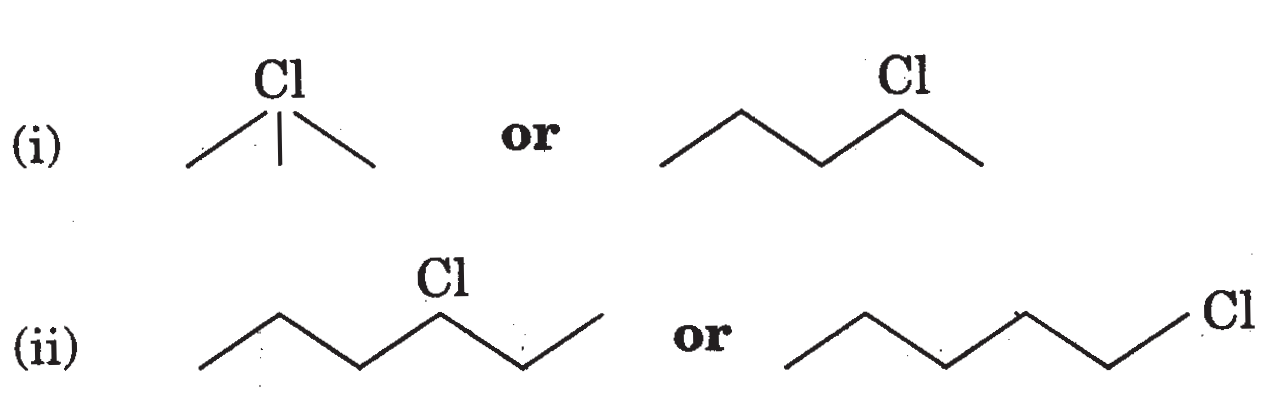
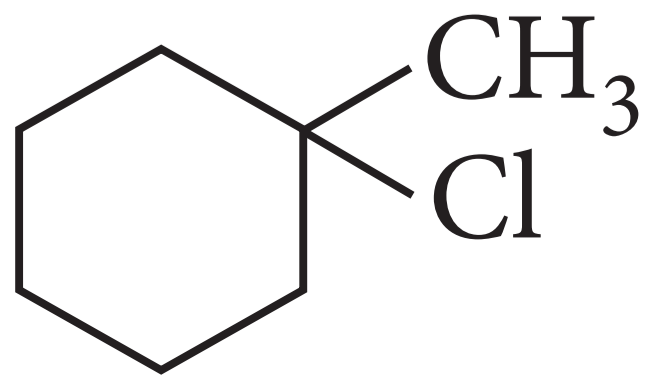
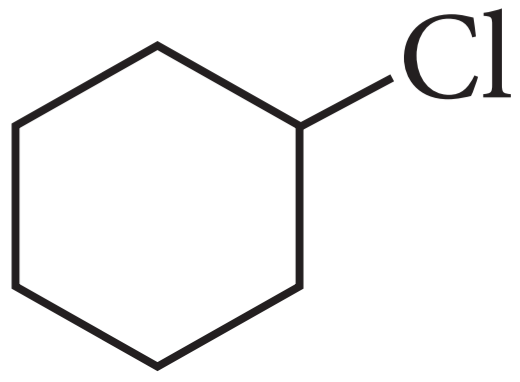
Which of the following compounds will give racemic mixture on nucleophilic substitution by $OH–$ ion?
  • $(a)$
  • B
    $\text{(a), (b), (c)}$
  • C
    $\text{(b), (c)}$
  • D
    $\text{(a), (c)}$

Answer: A.

View full solution
Which of the following carbon$-$halogen bond is extremely polar though nonionic among given alkyl halides?
  • $C−F$
  • B
    $\text{C−Br}$
  • C
    $\text{C−Cl}$
  • D
    $C−I$

Answer: A.

View full solution
$t-$Butyl chloride preferably undergo hydrolysis by:
  • $S_{N_1}$ mechanism
  • B
    $S_{N_2}$ mechanism
  • C
    Any of $(a)$ and $(b)$
  • D
    None of these

Answer: A.

View full solution
In these questions, a statement of assertion followed by a statement of reason is given. Choose the correct answer out of the following choices.
Assertion: Lower members of alkyl halides are colourless gases.
Reason: Alkyl iodides in general turn black on exposure to air and light.
  • A
    Assertion and reason both are correct statements and reason is correct explanation for assertion.
  • B
    Assertion and reason both are correct statements but reason is not correct explanation for assertion.
  • Assertion is correct statement but reason is wrong statement.
  • D
    Assertion is wrong statement but reason is correct statement. 

Answer: C.

View full solution
In these questions, a statement of assertion followed by a statement of reason is given. Choose the correct answer out of the following choices.
Assertion: The presence of nitro group facilitates nucleophilic substitution reactions in aryl halides.
Reason: The intermediate carbanion is stabilised due to the presence of nitro group.
  • Assertion and reason both are correct statements and reason is correct explanation for assertion.
  • B
    Assertion and reason both are correct statements but reason is not correct explanation for assertion.
  • C
    Assertion is correct statement but reason is wrong statement.
  • D
    Assertion is wrong statement but reason is correct statement.

Answer: A.

View full solution
Note: In the following questions a statement of assertion followed by a statement of reason is given. Choose the correct answer out of the following choices.
Assertion: tert$-$Butyl bromide undergoes Wurtz reaction to give $2, 2, 3, 3-$tetramethylbutane.
Reason: In Wurtz reaction, alkyl halides react with sodium in dry ether to give hydrocarbon containing double the number of carbon atoms present in the halide.
  • Assertion and reason both are correct and reason is correct explanation of assertion.
  • B
    Assertion and reason both are wrong statements.
  • C
    Assertion is correct but reason is wrong statement.
  • D
    Assertion is wrong but reason is correct statement.

Answer: A.

View full solution
In these questions, a statement of assertion followed by a statement of reason is given. Choose the correct answer out of the following choices.
Assertion: Haloalkanes show $H-$bonding.
Reason: Haloalkanes are insoluble in water.
  • A
    Assertion and reason both are correct statements and reason is correct explanation for assertion.
  • B
    Assertion and reason both are correct statements but reason is not correct explanation for assertion.
  • C
    Assertion is correct statement but reason is wrong statement.
  • Assertion is wrong statement but reason is correct statement.

Answer: D.

View full solution
Note: In the following questions a statement of assertion followed by a statement of reason is given. Choose the correct answer out of the following choices.
Assertion: The boiling points of alkyl halides decrease in the order$:\ \ce{RI > RBr > RCl > RF}$
Reason: The boiling points of alkyl chlorides, bromides and iodides are considerably higher than that of the hydrocarbon of comparable molecular mass.
  • A
    Assertion and reason both are correct and reason is correct explanation of assertion.
  • B
    Assertion and reason both are wrong statements.
  • C
    Assertion is correct but reason is wrong statement.
  • Assertion and reasonboth are correct statements, but reasonis not the correct explanation of assertion.

Answer: D.

View full solution
In these questions, a statement of assertion followed by a statement of reason is given. Choose the correct answer out of the following choices.
Assertion: $P-$Dichlorobenzene is less soluble in organic solvents than the corresponding $o-$isomer.
Reason: $O-$Dichlorobenzene is polar while $p-$dichlorobenzene is not.
  • A
    Assertion and reason both are correct statements and reason is correct explanation for assertion.
  • Assertion and reason both are correct statements but reason is not correct explanation for assertion.
  • C
    Assertion is correct statement but reason is wrong statement.
  • D
    Assertion is wrong statement but reason is correct statement.

Answer: B.

View full solution
Read the given passage and answer the questions number 1 to 5 that follow:
The substitution reaction of alkyl halide mainly occurs by $S_N1$ or $S_N2$ mechanism. Whatever mechanism alkyl halides follow for the substitution reaction to occur, the polarity of the carbon halogen bond is responsible for these substitution reactions. The rate of $S_N1$ reactions are governed by the stability of carbocation whereas for $S_N2$ reactions steric factor is the deciding factor. If the starting material is a chiral compound, we may end up with an inverted product or racemic mixture depending upon the type of mechanism followed by alkyl halide. Cleavage of ethers with HI is also governed by steric factor and stability of carbocation, which indicates that in organic chemistry, these two major factors help us in deciding the kind of product formed.
Predict the stereochemistry of the product formed if an optically active alkyl halide undergoes substitution reaction by $S_N2$ mechanism.
View full solution
Name the following halides according to IUPAC system and classify them as alkyl, allyl, benzyl (primary, secondary, tertiary), vinyl or aryl halides:
$m-ClCH_2C_6H_4CH_2C(CH_3)_3$
View full solution
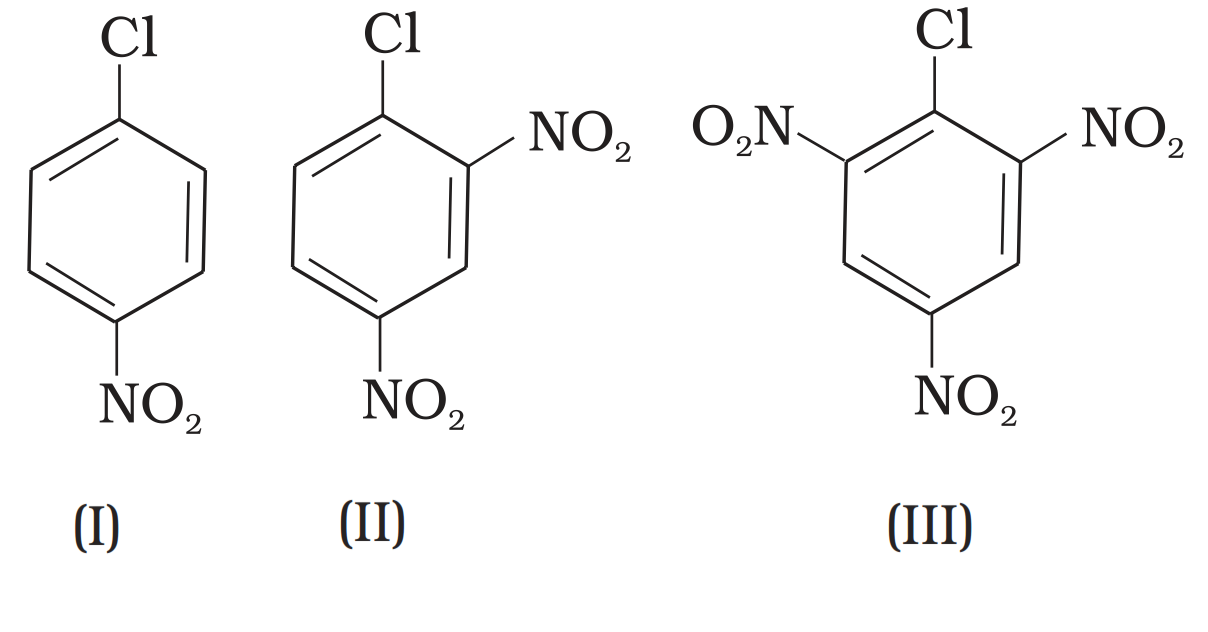
Aryl halides are extremely less reactive towards nucleophilic substitution. Predict and explain the order of reactivity of the following compounds towards nucleophilic substitution:
View full solution
Match the items of Column I and Column II
  Column I   Column II
(i) $S_N1$ reaction (a) vic-dibromides
(ii) Chemicals in fire extinguisher (b) gem-dihalides
(iii) Bromination of alkenes (c) Racemisation
(iv) Alkylidene halides (d) Saytzeff rule
(v) Elimination of HX from alkylhalide (e) Chlorobromocarbons
View full solution
Some alkylhalides undergo substitution whereas some undergo elimination reaction on treatment with bases. Discuss the structural features of alkyl halides with the help of examples which are responsible for this difference.
View full solution
Write the mechanism of the following reaction: $ \text{CH}_{3}\text{CH}_{2}\text{OH}\xrightarrow{HBr}\text{CH}_{3}\text{CH}_{2}\text{Br}+\text{H}_{2}\text{O}$
View full solution
Q 223 Marks Question3 Marks
Complete the following giving the structures of major organic products.
$(\text{CH}_3)_3-\text{C}-\text{CH}_2-\text{Br}\xrightarrow[\Delta]{\text{C}_2\text{H}_5\text{ONa}/\text{C}_2\text{H}_5\text{OH}}\ ........$
View full solution
Q 233 Marks Question3 Marks
Give reasons:
  1. n-Butyl bromide has higher boiling point than t-butyl bromide.
  2. Racemic mixture is optically inactive.
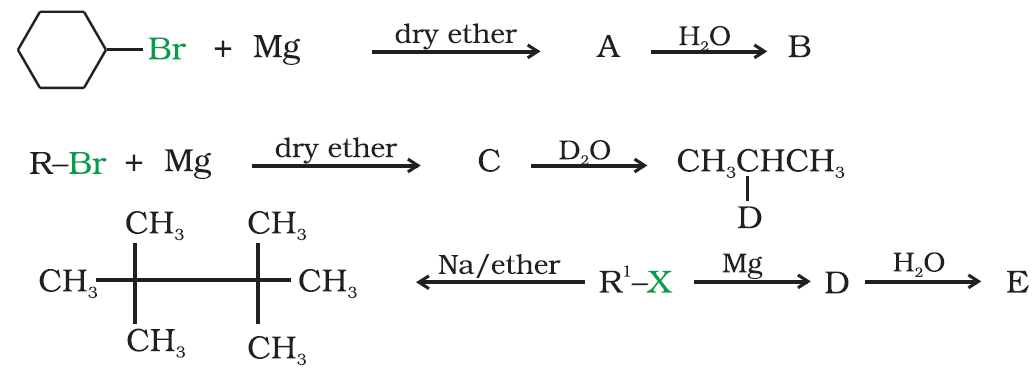
  3. The presence of nitro group $(–NO_2)$ at o/p positions increases the reactivity of haloarenes towards nucleophilic substitution reactions.
View full solution
Q 243 Marks Question3 Marks
Complete the following reactions:
  1. $\text{CH}_{3}\text{CH}_{2}\text{NH}_{2}+\text{CHCl}_{3}+\text{alc. KOH}\rightarrow$
  2. $\text{C}_{6}\text{H}_{5}\text{N}_{2}^{+}\text{Cl}^{-}\xrightarrow[\text{(Room}\text{ temp.)}]{H_2O}$
View full solution
Q 253 Marks Question3 Marks
How would you achieve the following conversions:
  1. Nitrobenzene to aniline.
  2. An alkyl halide to a quaternary ammonium salt.
  3. Aniline to benzonitrile.
Write the chemical equation with reaction conditions in each case.
View full solution
Read the passage given below and answer the following questions: The order of reactivity towards $S_N1$ reaction depends upon the stability of carbocation in the first step. Greater the stability of the carbocation, greater will be its ease of formation from alkyl halide and hence faster will be the rate of the reaction. As we know, $3^\circ$ carbocation is most stable, therefore, the tert-alkyl that halides will undergo $S_N1$ reaction very fast. For example, it has been observed that the reaction $(CH_3)_3CBr$ with $OH^-$ ion to give 2-methyl-2-propanol is about I million times as fast as the corresponding reaction of the methyl bromide to give methanol. The primary alkyl halides always react predominantly by $S_N2$ mechanism. On the other hand, the tertiary alkyl halides react predominantly by $S_N1$ mechanism. Secondary alkyl halides may react by either mechanism or by both the mechanisms without much preference depending upon the nature of the nucleophile and solvent. In these questions (Q. No. i-tv), a statement of assertion followed by a statement of reason is given. Choose tile correct answer out of tile following choices.
  1. Assertion and reason both are correct statements and reason is correct explanation for assertion.
  2. Assertion and reason both are correct statements but reason is not correct explanation for assertion.
  3. Assertion is correct statement but reason is wrong statement.
  4. Assertion is wrong statement but reason is correct statement.
  1. Assertion: Low concentration of nudeophile favours $S_N1$ mechanism.
Reason: $2^\circ$ alkyl halides are less reactive than $1^\circ$ towards $S_N1$ reactions.
  1. Assertion: Polar solvent slows down $S_N2$ reactions.
Reason: $CH_3-Br$ is less reactive than $CH_3Cl.$
  1. Assertion: Benzyl bromide when kept in acetone- water it produces benzyl alcohol.
Reason: The reaction follows $S_N2$ mechanism.
  1. Assertion: Rate of hydrolysis of methyl chloride to methanol is higher in DMF than in water.
Reason: Hydrolysis of methyl chloride follows second order kinetics.
  1. Assertion: $S_N1$ reaction is carried out in the presence of a polar protic solvent.
Reason: A polar protic solvent increases the stability of carbocation due to solvation.
View full solution
Read the passage given below and answer the following questions:
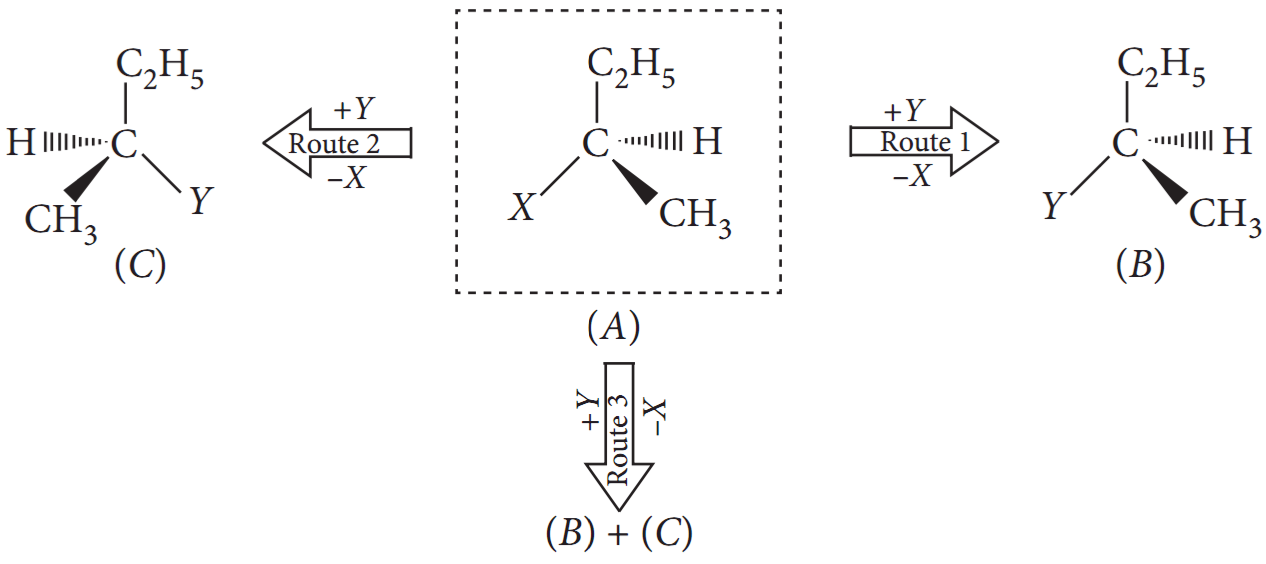
When a chemical reaction involves bond cleavage or bond formation at an asymmetric carbon atom, three different products may be formed. For example, during the substitution of a group $X$ by $Y$ in the following reaction, the three possible products may be shown below:
  1. If Bis the only product, the process is called retention of configuration because $B$ has the same configuration as the starting reactant $(A).$
  2. If C is the only product, the process is called inversion of configuration because $C$ has the configuration opposite to the starting reactant $(A).$
  3. If an equimolar mixture of Band $C (r.e., a 50 : 50$ mixture$)$ is fanned, then the process is called racemisation and the product is optically inactive because one isomer will rotate the light in the direction opposite to another.
In these questions (Q. No. i-iv), a statement of assertion followed by a statement of reason is given. Choose the correct answer out of the following choices.
  1. Assertion and reason both are correct statements and reason is correct explanation for assertion.
  2. Assertion and reason both are correct statements but reason is not correct explanation for assertion.
  3. Assertion is correct statement but reason is wrong statement.
  4. Assertion is wrong statement but reason is correct statement.
  1. Assertion: A reaction is said to be stereospecific if a particular stereoisomer of the reactant produces a specific stereoisomer of the product.
Reason: Bromination of cis$-2-$butene gives meso$-2, 3-$dibromobutane which is stereospecific.
  1. Assertion: Addition of $Br_2$ to cis-but-2-ene is stereoselective.
Reason: $S_N2$ reactions are stereospecific as well as stereoselective.
  1. Assertion: Optically active $2-$iodobutane on treatment with Nal in acetone undergoes recemization.
Reason: Repeated Walden inversions on the reactant and its product eventually gives a racemic mixture.
  1. Assertion: $S_N2$ reaction of an optically active alkyl halide with an aqueous solution of $KOH$ always gives an alcohol with opposite sign of rotation.
Reason: $S_N2$ reactions always proceed with inversion of configuration.
  1. Assertion: Nudeophilic substitution reaction of an optically active alkyl halide gives a mixture of en an ti om ers.
Reason: The reaction occurs by $S_N2$ mechanism.
View full solution
Read the passage given below and answer the following questions:
Nucleophilic substitution reactions are of two types; substitution nucleophilic bimolecular $(S_N2)$ and substitution nucleophilic unimolecular $(S_N1)$ depending on molecules taking part in determining the rate of reaction. Reactivity of alkyl halide towards $S_N1$ and $S_N2$ reactions depends on various factors such as steric hindrance, stability of intermediate or transition state, and polarity of solvent. $S_N2$ reaction mechanism is favoured mostly by primary alkyl halide then secondary and then tertiary. This order is reversed in case of $S_N1$ reactions.
The following questions are multiple choice questions. Choose the most appropriate answer:
  1. Which of the following is most reactive towards nucleophilic substitution reaction?
  1. $C_6H_5Cl$
  2. $CH_2 = CHCl$
  3. $ClCH_2CH = CH_2$
  4. $CH_3CH = CHCl$
  1. Isopropyl chloride undergoes hydrolysis by:
  1. $S_N1$ mechanism.
  2. $S_N2$ mechanism.
  3. $S_N1$ and $S_N2$ mechanism.
  4. Neither $S_N1$ nor $S_N2$ mechanism.
  1. The most reactive nucleophile among the following is:
  1. $CH_3O^-$
  2. $C_6H_5O^-$
  3. $(CH_3)_2CHO^-$
  4. $(CH_3)_3CO^-$
  1. Tertiary alkyl halides are practically inert to substitution by $S_N2$ mechanism because of:
  1. Insolubility.
  2. Instability.
  3. Inductive effect.
  4. Stearic hindrance.
  1. Which of the following is the correct order of decreasing $S_N2$ reactivity?
  1. $RCH_2X > R_2CHX > R_3CX$
  2. $R_3CX > R_2CHX > RCH_2X$
  3. $R_2CHX > R_3CX > RCH_2X$
  4. $RCH_2X > R_3CX > R_2CHX$
View full solution
Read the passage given below and answer the following questions:
A chlorocompound $(A)$ on reduction with $Zn-Cu$ and ethanol gives the hydrocarbon $(B)$ with five carbon atoms. When $(A)$ is dissolved in dry ether and treated with sodium metal it gave $2, 2, 5, 5 -$ tetramethylhexane. The treatment of $(A)$ with alcoholic $KCN$ gives compound $( C).$
The following questions are multiple choice questions. Choose the most appropriate answer:
  1. The compound $(A)$ is:
  1. $1-$chloro$-2, 2-$dimethylpropane.
  2. $1-$chloro$-2, 2-$dimethyl butane.
  3. $1-$chloro$-2-$methyl butane.
  4. $2-$chloro$-2-$methyl butane.
  1. The reaction of $(C)$ with Na, $C_2H_5OH$ gives:
  1. $(CH_3)_3C CH_2CONH_2$
  2. $(CH_3)_3C NH_2$
  3. $(CH_3)_3C CH_2CH_2NH_2$
  4. $(CH_3)_2CHCH_2NH_2$
  1. The reaction of $(C)$ with Na, $C_2H_5OH$ is called:
  1. Gilman reaction.
  2. Mendius reaction.
  3. Grooves process.
  4. Swart's reaction.
  1. The reaction of $(A)$ with aq. $KOH$ will preferably favour:
  1. $S_N1$ mechanism.
  2. $S_N2$ mechanism.
  3. $E_1$ mechanism.
  4. $E_2$ mechanism.
  1. Compound $(B)$ is:
  1. $N-$pentane.
  2. $2, 2-$dimethylpropane.
  3. $2-$methylbutane.
  4. None of these.
View full solution

Read the passage given below and answer the following questions:
The aryl halides are relatively less reactive towards nucleophilic substitution reactions as compared to alkyl halides. This low reactivity can be attributed to the following factors:
  • The $C - X$ bond in halobenzene has a partial double bond character due to involvement of halogen electrons in resonance with benzene ring.
  • The $C - X$ bond in aryl halides is less polar as compared to that in alkyl halides as $sp^2$ hyridised carbon is more electronegative than $sp^3$ hybridised carbon.
In these questions (Q. No. i-Iv), a statement of assertion followed by a statement of reason is given. Choose the correct answer out of the following choices.
  1. Assertion and reason both are correct statements and reason is correct explanation for assertion.
  2. Assertion and reason both are correct statements but reason is not correct explanation for assertion.
  3. Assertion is correct statement but reason is wrong statement.
  4. Assertion is wrong statement but reason is correct statement.
  1. Assertion: Primary benzylic halides are more reactive than primary alkyl halides towards $S_N1$ reactions.
Reason: Reactivity depends upon the nature of the nucleophile and the solvent.
  1. Assertion: is more reactive than towards nucleophilic substitution reactions.
Reason: Tertiary alkyl halides react predominantly by $S_N1$ mechanism.
  1. Assertion: Chlorobenzene is more reactive than p-chloroanisole to nucleophilic substitution reactions.
Reason: Greater the stability of carbanion, greater is its ease of formation and hence, more reactive is the aryl halide.
  1. Assertion: $4-$Nitrochlorobenzene undergoes nucleophilic substitution more readily than chlorobenzene.
Reason: Chlorobenzene undergoes nucleophilic substitution by elimination-addition mechanism while 4-nitrochlorobenzene undergoes nucleophilic substitution by addition-elimination mechanism.
  1. Assertion: Chlorobenzene is less reactive than benzene towards the electrophilic substitution reaction.
Reason: Resonance destabilises the carbocation.
View full solution
Primary alkyl halide C4H9Br (a) reacted with alcoholic KOH to give compound (b). Compound (b) is reacted with HBr to give (c) which is an isomer of (a). When (a) is reacted with sodium metal it gives compound (d), C8H18 which is different from the compound formed when n-butyl bromide is reacted with sodium. Give the structural formula of (a) and write the equations for all the reactions.
View full solution

Generate a Haloalkanes and Haloarenes paper free

Pick question groups from the list above, set marks and difficulty, and export a branded PDF with step-by-step answer keys. First 3 chapters free — no signup.

Download App