MCQ 11 Mark
The value of Henry’s constant $K_H$ is $.......$
- A
Greater for gases with higher solubility.
- ✓
Greater for gases with lower solubility.
- C
- D
Not related to the solubility of gases.
AnswerCorrect option: B. Greater for gases with lower solubility.
The value of Henry's constant $K_H$ is greater for gases with lower solubility because of the mathematical relation.
$\text{P}=\text{K}_\text{H}\times\text{x}$
$\text{K}_\text{H}=\frac{\text{P}}{\text{x}}$
where$, K_H$ represents Henry's constant$, p$ is partial pressure of the gas in vapour phase, and $x$ denotes mole fraction of the gas in solution. Thus $K_H$ is inversely proportional to mole fraction of gas in solution $($representing its solubility$).$
View full question & answer→MCQ 21 Mark
Which of the following options is not a viable option?
AnswerA solid solution is a one $-$ or more $-$ solute solid $-$ state solution in a solvent. Solid solutions include brass, bronze, and hydrated salts. Liquid solutions include aerated beverages.
View full question & answer→MCQ 31 Mark
Among the following substances the lowest vapour pressure is exerted by:
MCQ 41 Mark
Which of the following statements is false?
- ✓
Two different solutions of sucrose of same molality prepared in different solvents will have the same depression in freezing point.
- B
The osmotic pressure of a solution is given by the equation $\pi=\text{CRT}\ ($where $C$ is the molarity of the solution$).$
- C
Decreasing order of osmotic pressure for $0.01M$ aqueous solutions of barium chloride, potassium chloride, acetic acid and sucrose is $\mathrm{BaCl}_2 > \mathrm{KCl} > \mathrm{CH}_3 \mathrm{COOH} > $ sucrose.
- D
According to Raoult's law, the vapour pressure exerted by a volatile component of a solution is directly proportional to its mole fraction in the solution.
AnswerCorrect option: A. Two different solutions of sucrose of same molality prepared in different solvents will have the same depression in freezing point.
$\text{Tf = Kfm}$ Since $Kf$ values depend upon the nature of solvent, the depression in freezing point of the solution would not be the same.
View full question & answer→MCQ 51 Mark
What is an example of camphor in $N_2$ gas?
AnswerSolid in gaseous solution is an example of camphor in $N_2$ gas. Gaseous solution refers to a solution in which the solvent is gaseous. Other gaseous solutions include air $(O_2 + N_2),$ iodine vapors in air, humidity in air, and so on.
View full question & answer→MCQ 61 Mark
The correct statement among the following is:
- ✓
Smoke is carbon dispersed in air.
- B
Butter is water dispersed in fat.
- C
Greater is the valency of ion more will be its coagulating power.
- D
More is the gold number of a lyophobic sot, more is protecting power.
AnswerCorrect option: A. Smoke is carbon dispersed in air.
Smoke is carbon $($solid particle$)$ dispersed in air. It is the type of solid in gas type of solution.
View full question & answer→MCQ 71 Mark
A solution of benzene and toluene is an example of $.......$ solution.
AnswerDue to absence of polarity, benzene and toluene dont have any interaction forces so they dont show any deviation and forms ideal solutions.
View full question & answer→MCQ 81 Mark
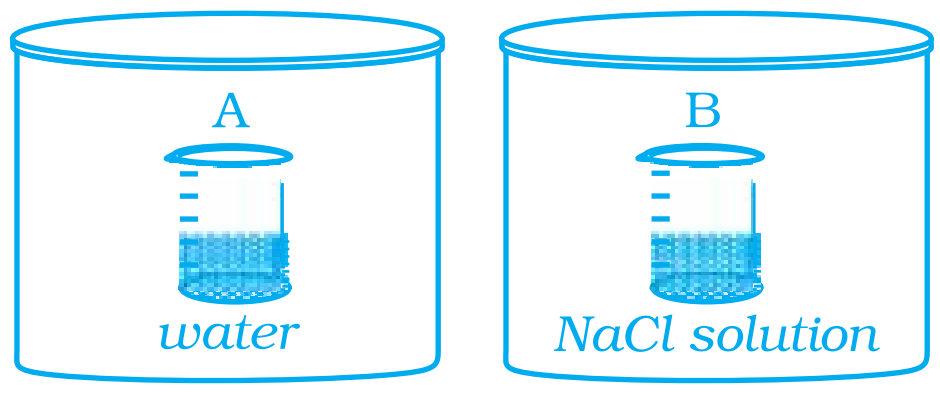
Two beakers of capacity $500\ mL$ were taken. One of these beakers, labelled as $“A\ ”,$ was filled with $400\ mL$ water whereas the beaker labelled $“B\ ”$ was filled with $400\ mL$ of $2M$ solution of $\text{NaCl}.$ At the same temperature both the beakers were placed in closed containers of same material and same capacity as shown in. At a given temperature, which of the following statement is correct about the vapour pressure of pure water and that of $\text{NaCl}$ solution.
AnswerCorrect option: A. vapour pressure in container $(A)$ is more than that in container $(B).$
Since $\text{NaCl}$ is a non$-$volatile solute, it will reduce vapour pressure of the solution. Hence, vapour pressure of pure water in container $A$ is more than in container $B.$
View full question & answer→MCQ 91 Mark
The rate of vapourisation of water depends upon:
- A
- B
Surface area of container
- C
kinetic energy of liquid molecules
- ✓
AnswerThe rate of vapourization of water depends on the temperature and surface area.
The kinetic energy of molecules depends on the temperature of the water.
Increasing temperature or surface area increases the rate of evaporation and vice$-$versa.
View full question & answer→MCQ 101 Mark
The atmospheric pollution is generally measured in the units of:
AnswerCorrect option: D. $\text{ppm}$
View full question & answer→MCQ 111 Mark
The possible van't Hoff factor for sodium chloride in water assuming sodium chloride is partially ionized:
- A
$0.5$
- B
$0.75$
- C
$2.5$
- ✓
$1.5$
View full question & answer→MCQ 121 Mark
Out of molality $(m),$ molarity $(M),$ formality $(F)$ and mole fraction $(x),$ those which are independent of temperature are:
- A
$M, m$
- B
$F, x$
- ✓
$m, x$
- D
$M, x$
AnswerCorrect option: C. $m, x$
View full question & answer→MCQ 131 Mark
The incorrect statement is:
AnswerCorrect option: B. Vapour pressure only depends on temperature and not on the nature of substance.
The vapour pressure depends on the temperature and the nature of substance.
View full question & answer→MCQ 141 Mark
When a solution containing non $-$ volatile solute is diluted with water,
- A
Its vapour pressure increases.
- B
Its osmotic pressure increases.
- ✓
Its boiling point increases.
- D
Its freezing point increases.
AnswerCorrect option: C. Its boiling point increases.
View full question & answer→MCQ 151 Mark
Which of the following is a true solution?
- ✓
Sugar$-$water mixture
- B
- C
- D
AnswerCorrect option: A. Sugar$-$water mixture
View full question & answer→MCQ 161 Mark
On the basis of information given below mark the correct option.Information: On adding acetone to methanol some of the hydrogen bonds between methanol molecules break.
- ✓
At specific composition methanol$-$acetone mixture will form minimum boiling azeotrope and will show positive deviation from Raoult’s law.
- B
At specific composition methanol$-$acetone mixture forms maximum boiling azeotrope and will show positive deviation from Raoult’s law.
- C
At specific composition methanol$-$acetone mixture will form minimum boiling azeotrope and will show negative deviation from Raoult’s law.
- D
At specific composition methanol$-$acetone mixture will form maximum boiling azeotrope and will show negative deviation from Raoult’s law.
AnswerCorrect option: A. At specific composition methanol$-$acetone mixture will form minimum boiling azeotrope and will show positive deviation from Raoult’s law.
At specific composition methanol$-$acetone mixture will show positive deviation from Raoulfs law as it has lesser interactions than methanol$-$methanol and acetone$-$acetone interactions. Hence it forms minimum boiling azeotrope.
View full question & answer→MCQ 171 Mark
To determine the solubility of a solute in water, a solution must be prepared that is $......$
AnswerThe maximum number of moles of solute that can be dissolved in a given volume of solution represents the solubility of solution.
A solution with the maximum possible amount of solute is saturated.
Hence a saturated solution must be prepared to determine the solubility of a solute in water,
View full question & answer→MCQ 181 Mark
$18g$ glucose $(C_6H_{12}O_6)$ is added to $178.2g$ of water. The vapour pressure of this aqueous solution at $100^\circ C$ in torr is:
- A
$7.60$
- B
$76.00$
- ✓
$752.40$
- D
$759.00$
AnswerCorrect option: C. $752.40$
Molecular mass of water $= (2 \times 1) + (1 \times 16) = 18g$
For $178.2g$ water$, \text{n}_\text{A}=\frac{178.2}{18}=9.9\text{ mol}$
Molecular mass of glucose $= (6)(12) + (12)(1) + 6(16) = 180g.$
For $18g$ glucose$, \text{n}_\text{B}=\frac{18}{180}=0.1\text{ mol}$
$\text{X}_{\text{B}}=\frac{0.1}{(0.1+9.9)}=0.01$
$\text{X}_{\text{A}}=1-0.01=0.99$
For lowering of vapour pressure,
$\text{P}=\text{P}^0_\text{A}\text{x}^{\text{A}}=\text{P}^0_\text{A}(1-\text{X}_\text{B})$
$\text{P}=760(1-0.01)$
$\text{P}=760-7.6$
$\text{P}=752.40\ \text{torr}$
Vapour pressure of water is $752.40\ \text{torr}.$
View full question & answer→MCQ 191 Mark
When $1$ mole of a substance is present in $1L$ of the solution, it is known as :
AnswerMolar concentration is a measure of the concentration of a solute in a solution and its unit is mol $L^{-1}$. Molarity is a method to express the concentration of a solution. It is defined as the number of moles of solute dissolved per liter of solution.
Hence, when $1$ mole of a substance is present in $1L$ of the solution, it is known as a molar solution.
View full question & answer→MCQ 201 Mark
A solution containing $10.2g$ glycerine per litre is isotonic with a $2\%$ solution of glucose. What is the molecular mass of glycerine?
- ✓
$91.8g$
- B
$1198g$
- C
$83.9g$
- D
$890.3g$
AnswerCorrect option: A. $91.8g$
View full question & answer→MCQ 211 Mark
Which of the following solutions does not show positive deviation?
AnswerToluene and Benzene are very similar molecules and hence are ideal solution, others are solutions showing positive deviation $($Theory based. To be memorized$.)$
View full question & answer→MCQ 221 Mark
$3$ moles of $P$ and $2$ moles of $Q$ are mixed, what will be their total vapour pressure in the solution if their partial vapour pressures are $80$ and $60$ torr respectively?
- A
$80$ torr
- B
$140$ torr
- ✓
$72$ torr
- D
$70$ torr
AnswerCorrect option: C. $72$ torr
View full question & answer→MCQ 231 Mark
Most of the processes in our body occur in:
MCQ 241 Mark
If $\text{PCl}_5$ is $80\%$ dissociated at $250$ then its vapour density at room temperature will be:
- A
$56.5$
- ✓
$104.25$
- C
$101.2$
- D
$52.7$
AnswerCorrect option: B. $104.25$
View full question & answer→MCQ 251 Mark
The vapour pressure of the solution containing $30g.$ of non $-$ volatile solute of molecular weight $60$ in $360\ gm$ of water approximately at $30^\circ c$ is$:\ ($vapour pressure of water at $30^\circ c = 24\ mm$ of $Hg)$
- A
$26.8\ mm$
- B
$25.8\ mm$
- ✓
$23.40\ mm$
- D
$29.4\ mm$
AnswerCorrect option: C. $23.40\ mm$
Given,
mass of solute $30g$
mass of solvent $360g$
the molecular mass of solute $60g$
the molecular mass of solvent that is water is $18g$
The pressure of pure water is $24\ mm\ Hg$
$\frac{\text{p}_0-\text{p}}{\text{P}} =$ moles of solute/ total no. of moles
$\frac{\text{p}_0-\text{p}}{\text{P}}=\frac{\frac{30}{60}}{\frac{30}{60}+\frac{360}{180}}$
$\frac{\text{p}_0-\text{p}}{\text{P}}=\frac{1}{41}$
$\text{P}=23.4\text{ mm Hg}$
View full question & answer→MCQ 261 Mark
The values of Van’t Hoff factors for $\text{KCl, NaCl}$ and $\mathrm{K}_2 \mathrm{SO}_4,$ respectively, are $.......$
- A
$2, 2$ and $2$
- ✓
$2, 2$ and $3$
- C
$1, 1$ and $2$
- D
$1, 1$ and $1$
AnswerCorrect option: B. $2, 2$ and $3$
$\mathrm{KCl}\left(\mathrm{K}^{+}+\mathrm{Cl}\right)$ and $\mathrm{NaCl}\left(\mathrm{Na}^{+}+\mathrm{Cl}\right)$ ionize to give $2$ ions and $\mathrm{K}_2 \mathrm{SO}_4\left(2 \mathrm{~K}^{+}+\mathrm{SO}^{-}_4\right)$ionizes to give $3$ ions thus, van't Hoff factors for $\mathrm{KCl}, \mathrm{NaCl}$ and $\mathrm{K}_2 \mathrm{SO}_4$ are $2, 2$ and $3$ respectively.
View full question & answer→MCQ 271 Mark
The molal elevation constant depends upon:
- A
- ✓
- C
Vapour pressure of the solution.
- D
View full question & answer→MCQ 281 Mark
In which case van't Hoff factor is maximum $($assuming no hydrolysis$)\ ?$
- A
$\text{KCl}, 50\%$ ionised
- B
$\mathrm{K}_2 \mathrm{SO}_4, 40\%$ ionised
- ✓
$\mathrm{FeCI}_3, 30\%$ ionised
- D
$\mathrm{SnCI}_4, 20\%$ ionised
AnswerCorrect option: C. $\mathrm{FeCI}_3, 30\%$ ionised
Soluten $a_ i = [1 + (n -1)a]$
$\text{KCl}\ 20.51.5$
$\mathrm{K}_2 \mathrm{SO}_4\ 30.41.8$
$\mathrm{FeCI}_3\ 40.31.9$
$\mathrm{SnCI}_4\ 50.21.8$
View full question & answer→MCQ 291 Mark
A solution made up of numerous components in which each component’s property is the weighted sum of its separate properties. The answer is:
- ✓
- B
Non $-$ Ideal solution
- C
- D
AnswerAn ideal solution is made up of numerous components, each of which has a property that is the weighted sum of the attributes of the others.
View full question & answer→MCQ 301 Mark
$12g$ of a non $-$ volatile solute dissolved in $108g$ of water produces the relative lowering of the vapour pressure of $0.1.$ The molecular mass of the solute is:
Answer$12g$ of a non $-$ volatile solute dissolved in $108g$ of water produces the relative lowering of vapour pressure of $0.1.$
The molecular mass of the solute is $20.$
$\frac{\triangle\text{P}}{\text{P}^0}=0.1$
$\frac{\triangle\text{P}}{\text{P}^0}=\frac{\text{W}_2\text{M}_1}{\text{W}_1\text{M}_2}$
$0.1=\frac{12\text{g}\times18\text{g}/\text{mol}}{108\text{g}\times\text{M}_2}$
$\text{M}_2=20\text{g}/\text{mol}$
Note$:\ W_1$ and $W_2$ are weights of water and solute respectively.
$M_1$ and $M_2$ are molecular weights of water and solute respectively.
View full question & answer→MCQ 311 Mark
Colligative properties are observed when $.......$
$a.$ A non volatile solid is dissolved in a volatile liquid.
$b.$ A non volatile liquid is dissolved in another volatile liquid.
$c.$ A gas is dissolved in non volatile liquid.
$d.$ A volatile liquid is dissolved in another volatile liquid.
- A
$a$ and $c$
- ✓
$a$ and $b$
- C
$b$ and $c$
- D
$a$ and $d$
AnswerCorrect option: B. $a$ and $b$
Colligative properties are observed when a non$-$volatile solid or liquid are dissolved in a volatile liquid.
View full question & answer→MCQ 321 Mark
Sprinkling of salt helps in clearing the snow covered roads in hills. The phenomenon involved in the process is:
- A
Lowering in vapour pressure of snow.
- ✓
Depression in freezing point of snow.
- C
Melting of ice due to increase in temperature by putting salt.
- D
Increase in freezing point of snow.
AnswerCorrect option: B. Depression in freezing point of snow.
View full question & answer→MCQ 331 Mark
Raoult's law is obeyed by each constituent of a binary liquid solution when:
- A
The forces of attractions between like molecules are greater than those between unlike molecules.
- B
The forces of attractions between like molecules are smaller than those between unlike molecules.
- ✓
The forces of attractions between like molecules are identical with those between unlike molecules.
- D
The volume occupied by unlike molecules are different.
AnswerCorrect option: C. The forces of attractions between like molecules are identical with those between unlike molecules.
When the forces of attractions between like molecules are identical with those between unlike molecules, Raoult's law is obeyed by each constituent of a binary liquid solution.
In such case, the total vapour pressure of the solution is the sum of the partial vapour pressures of components of the solution.
View full question & answer→MCQ 341 Mark
The boiling point of an azeotropic mixture of water and ethanol is less than that of water and ethanol. The mixture shows:
- A
No deviation from Raoult’s Law.
- ✓
Positive deviation from Raoult’s Law.
- C
Negative deviation from Raoult’s Law.
- D
That the solution is unsaturated.
AnswerCorrect option: B. Positive deviation from Raoult’s Law.
View full question & answer→MCQ 351 Mark
A concentrated solution contains high amount of $.......:$
AnswerA concentrated solution contains the maximum amount of solute that can be dissolved because solubility depends on temperature, a solution that is concentrated at one temperature may not be concentrated at a higher temperature.
View full question & answer→MCQ 361 Mark
The vapour pressure of a dilute solution of a solute is not influenced by:
- A
- ✓
- C
- D
Degree of dissociation of solute
AnswerVapour pressure of a dilute solution depends upon the temperature, mole fraction, and degree of dissociation of solute and independent of the melting point of solute.
View full question & answer→MCQ 371 Mark
People add sodium chloride to water while boiling eggs. This is to:
- A
Decrease the boiling point.
- ✓
Increase the boiling point.
- C
Prevent the breaking of eggs.
- D
AnswerCorrect option: B. Increase the boiling point.
View full question & answer→MCQ 381 Mark
Which of the following statements is false?
- A
Units of atmospheric pressure and osmotic pressure are the same.
- ✓
In reverse osmosis, solvent molecules move through a semipermeable membrane from a region of lower concentration of solute to a region of higher concentration.
- C
The value of molal depression constant depends on nature of solvent.
- D
Relative lowering of vapour pressure, is a dimensionless quantity.
AnswerCorrect option: B. In reverse osmosis, solvent molecules move through a semipermeable membrane from a region of lower concentration of solute to a region of higher concentration.
In reverse osmosis solvent molecules move through a semipermeable membrane from a region of higher concentration of solute to a region of lower concentration, therefore the given statement at $(ii)$ is false.
View full question & answer→MCQ 391 Mark
The value of observed and calculated molecular weight of silver nitrate are $92.64$ and $170$ respectively. The degree of dissociation of silver nitrate is:
- A
$60\%$
- ✓
$83.5\%$
- C
$46.7\%$
- D
$60.23\%$
AnswerCorrect option: B. $83.5\%$
View full question & answer→MCQ 401 Mark
The ratio of the actual value of a colligative property to the value calculated, assuming the substance to be a nonelectrolyte, is referred to as $.........$
AnswerThe van't Hoff factor is the ratio of the actual value of a colligative property to the value calculated. It is assumed that the substance is a nonelectroyte.
It can also be represented as the ratio of actual number of particles to the number of particles for no ionization.
View full question & answer→MCQ 411 Mark
Which of the following fluoride is used as rat poison?
- A
$\mathrm{CaF}_2$
- B
$KF$
- ✓
$\text{NaF}$
- D
$\mathrm{MgF}_2$
AnswerCorrect option: C. $\text{NaF}$
View full question & answer→MCQ 421 Mark
Which one of the following is a primary standard?
AnswerThe primary standard is a compound of sufficient purity from which standard solutions of known normalities can be prepared by direct weighing of it and diluting to a defined volume of solution.
Potassium Dichromate $(K_2Cr_2O_7)$ is suitable to be used as a primary standard. It cannot be obtained in very pure form. It readily reacts with any traces of organic material or any other reducing substance in wate
View full question & answer→MCQ 431 Mark
Calculate the vapour pressure of aqueous $0.1m$ glucose solution at $300K$ temperature, the vapour pressure of water is $0.03$ bar at $4$ temperature.
- A
$0.5$ bar
- B
$0.29$ bar
- C
$0.3$ bar
- ✓
$0.03$ bar
AnswerCorrect option: D. $0.03$ bar
View full question & answer→MCQ 441 Mark
Two containers$, X$ and $Y$ at $300K$ and $350K$ with water vapour pressures $22\ mm$ and $40\ mm$ respectively a are connected, initially closed with a valve. If the valves opened.
- ✓
The final pressure in each container is $31\ mm.$
- B
The final pressure in each container is $40\ mm.$
- C
Mass of $\text{H2O}\ (l)$ in $X$ increases.
- D
Mass of $H_2O(l)$ in $Y$ decreases roar.
AnswerCorrect option: A. The final pressure in each container is $31\ mm.$
View full question & answer→MCQ 451 Mark
Which of the following aqueous solutions should have the highest boiling point?
- A
$\text{1.0M NaOH}$
- ✓
$\ce{1.0M Na_2SO_4}$
- C
$\ce{1.0M NH_4NO_3}$
- D
$\ce{1.0M KNO_3}$
AnswerCorrect option: B. $\ce{1.0M Na_2SO_4}$
In $\ce{1.0M Na_2SO}_4$ solution vant $H$ off factor$, i > 1$ and is maximum when compared with the other three given electrolytes. So, the extent of dissociation in case of $\ce{1.0M Na_2SO_4}$ would be highest yielding maximum no. of ions as compared to the other given electrolytes in their $1.0M$ solutions.
View full question & answer→MCQ 461 Mark
On dissolving sugar in water at room temperature solution feels cool to touch. Under which of the following cases dissolution of sugar will be most rapid?
- A
Sugar crystals in cold water.
- B
Sugar crystals in hot water.
- C
Powdered sugar in cold water.
- ✓
Powdered sugar in hot water.
AnswerCorrect option: D. Powdered sugar in hot water.
Since the solution is cool to touch, the dissolution is endothermic. Therefore, high temperature will favour dissolution. Further, powdered sugar has large surface area and is favourable for dissolution.
View full question & answer→MCQ 471 Mark
Value of Henry’s constant $K_H ......$
- ✓
Increases with increase in temperature.
- B
Decreases with increase in temperature.
- C
- D
First increases then decreases.
AnswerCorrect option: A. Increases with increase in temperature.
Value of Henry’s constant increases with increase in temperature.
View full question & answer→MCQ 481 Mark
The following substances were all dissolved in $100$ grams of water at $290K$ to produce saturated solutions.If the solution is heated to $310K,$ which substance will have a decrease in its solubility:
- A
$\text{NaCI}$
- B
$KI$
- C
$\text{CaCl}_2$
- ✓
$\text{HCI}$
AnswerCorrect option: D. $\text{HCI}$
The following substances were all dissolved in $100$ grams of water at $290K$ to produce saturated solutions. If the solution is heated to $310K, \text{HCl}$ will have a decrease in its solubility$. \text{HCl}$ is a gas. The solubility of a gas in a solution is inversely proportional to the absolute temperature. With increase in the temperature, the solubility of a gas decreases.
View full question & answer→MCQ 491 Mark
Which of the following solutions shows positive deviation from Raoult’s law?
- A
Acetone $+$ Aniline
- ✓
Acetone $+$ Ethanol
- C
Water $+$ Nitric acid
- D
Chloroform $+$ Benzene
AnswerCorrect option: B. Acetone $+$ Ethanol
View full question & answer→MCQ 501 Mark
A cylinder filled with a movable piston contains liquid water in equilibrium with water vapour at $25^\circ C.$ Which one of the following operations results in a decrease in the equilibrium vapour pressure?
- A
Moving piston downward a short distance
- B
Removing a small amount of vapour
- C
Removing a small amount of the liquid water
- ✓
Dissolving salt in the water
AnswerCorrect option: D. Dissolving salt in the water
Vapour pressure is a surface phenomenon, when the surface area is more, vapour pressure will be more. When we add solute, what we do is we decrease the vapour pressure of solvent because same of the salt ions will be present at the solvent surface, thus taking place of same of the solvent particles which were actively participating in maintain, that previous high value of vapour pressure. So, the equilibrium vapour pressure value decreases. Thus, dissolving salt in water results in decreasing of equilibrium vapour pressure.
View full question & answer→MCQ 511 Mark
The Vant Hoff factor for a dilute solution $\mathrm{K}_3\left[\mathrm{Fe}(\mathrm{CN})_6\right].$
View full question & answer→MCQ 521 Mark
In an endothermic process, solubility increases with $......$ in temperature:
AnswerThe effect of temperature on solubility depends on the type of reaction that occurs during the process of dissolving the solute in the solvent. In endothermic reactions, increasing the temperature increases the solubility of the solute in a solution. In exothermic reactions, increasing the temperature decreases the solubility of the solute.
View full question & answer→MCQ 531 Mark
$.......$ obeys Raoult’s law in all stages of concentration.
- ✓
- B
Non $-$ Ideal solution
- C
- D
AnswerAt all concentration levels, Ideal Solution follows Raoult’s law.
View full question & answer→MCQ 541 Mark
A zinc metal sample containing zinc chloride as impurity was made to react with an excess of dilute hydrochloric acid at $27^\circ C.$ Liberated hydrogen gas is collected at $760\ mm\ Hg$ pressure that occupies $780.0\ cm^3$ volume. If the vapour pressure of water at $27^\circ C$ is $14\ mm\ Hg,$ what is the volume of $H_2$ at $\text{STP}?$ The Standard pressure is $760\ mm\ Hg\ ($molar volume of gas at standard temperature and pressure, $\text{STP} = 22.4\ dm^3)$
- A
$746\ cm^3$
- ✓
$697\ cm^3$
- C
$750\ cm^3$
- D
$300\ cm^3$
AnswerCorrect option: B. $697\ cm^3$
View full question & answer→MCQ 551 Mark
Vapour pressure of a pure liquid $X$ is $\text{2 atm}$ at $300K.$ It is lowered to $\text{atm}$ on dissolving $1 g$ of $Y$ in $20g$ of liquid $X.$ If molar mass of $X$ is $200,$ what is the molar mass of $Y?$
View full question & answer→MCQ 561 Mark
The pressure that a single component in a gaseous mixture would exert if it existed alone in the same volume as the mixture and at the same temperature as the mixture is referred to as.
- A
- ✓
- C
Total pressure of a gas mixture
- D
AnswerPartial pressure is the pressure exerted by a single component in a gaseous mixture if it exists alone in the same volume.
View full question & answer→MCQ 571 Mark
Which substance would dissolve fastest in water?
AnswerCorrect option: A. $1g$ granulated sugar
Each Granulated sugar is touched with water so exposed surface is highest from others so its solubility is highest.
View full question & answer→MCQ 581 Mark
The vapour pressure of water at $300K$ in a closed container is $\text{0.4 atm.}$ If the volume of the container is doubled, its vapour pressure at $300K$ will be:
- A
$\text{0.8 atm}$
- B
$\text{0.2 atm}$
- ✓
$\text{0.4 atm}$
- D
$\text{0.6 atm}$
AnswerCorrect option: C. $\text{0.4 atm}$
Vapour pressure will be the same because it doesn't depend on the volume it depends only on Temperature.
View full question & answer→MCQ 591 Mark
Consider the and mark the correct option.
- A
Water will move from side $(A)$ to side $(B)$ if a pressure lower than osmotic pressure is applied on piston $(B).$
- ✓
Water will move from side $(B)$ to side $(A)$ if a pressure greater than osmotic pressure is applied on piston $(B).$
- C
Water will move from side $(B)$ to side $(A)$ if a pressure equal to osmotic pressure is applied on piston $(B).$
- D
Water will move from side $(A)$ to side $(B)$ if pressure equal to osmotic pressure is applied on piston $(A).$
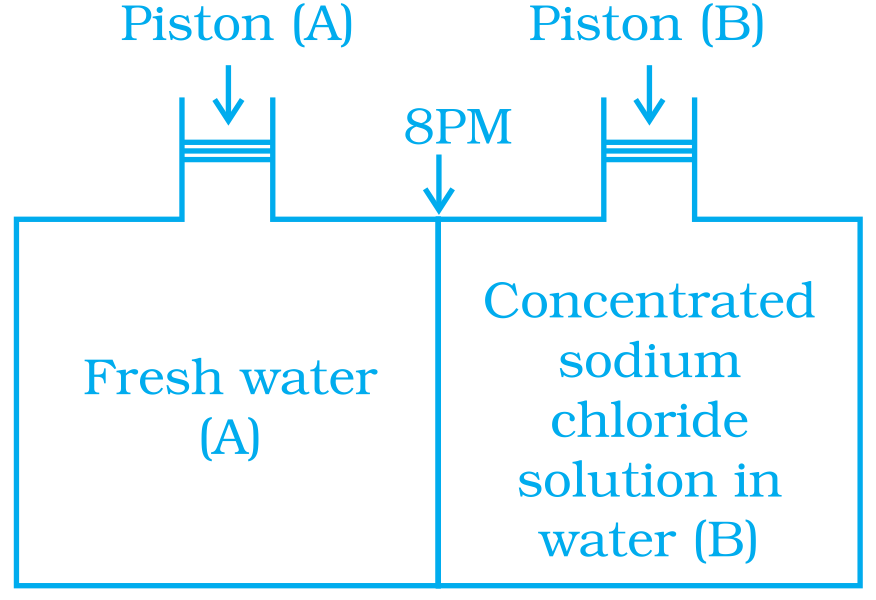
AnswerCorrect option: B. Water will move from side $(B)$ to side $(A)$ if a pressure greater than osmotic pressure is applied on piston $(B).$
Water will move from side $(B)$ to side $(A)$ if pressure greater than osmotic pressure is applied on piston $(B)$ due to reverse osmosis.
View full question & answer→MCQ 601 Mark
What will be the degree of dissociation of $\ce{0.1M Mg(NO_3)_2}$ solution if van’t Hoff factor is $2.74?$
- A
$75\%$
- ✓
$87\%$
- C
$100\%$
- D
$92\%$
AnswerCorrect option: B. $87\%$
View full question & answer→MCQ 611 Mark
Which of the following units is useful in relating concentration of solution with its vapour pressure?
AnswerIt is mole fraction $(x)$ which is useful in relating concentration of solution with its vapour pressure. For example according to Rault's law in a binary solution of two volatile liquids, $p_1 = x_1 {p^0}_1$ where $p_1$ is vapour pressure of component $1,$ and $x_1$ is its mole fraction in solution, ${p^0}_1$ denotes the vapour pressure of pure solvent.
View full question & answer→MCQ 621 Mark
At equilibrium, the rate of dissolution of a solid solute in a volatile liquid solvent is:
- A
Less than the rate of crystallisation
- B
Greater than the rate of crystallisation
- ✓
Equal to the rate of crytallisation
- D
AnswerCorrect option: C. Equal to the rate of crytallisation
Crystallization is the process of the formation of solid crystals precipitating from a solution.
In an unsaturated solution, the rate of dissolution of a solute in a volatile liquid solvent is greater than the rate of crystallization.
In a supersaturated solution, the rate of dissolution of a solute in a volatile liquid solvent is less than the rate of crystallization.
At equilibrium, the rate of dissolution of a solute in a volatile liquid solvent is equal to the rate of crystallization.
View full question & answer→MCQ 631 Mark
AnswerThe solution is made up of two components that is solute and solvent.
View full question & answer→MCQ 641 Mark
Which salt may show the same value of van't Hoff factor $(i)$ as that of $\mathrm{K}_4 \mathrm{Fe}(\mathrm{CN})_6$ in very dilute solution state?
- ✓
$\mathrm{Al}_2\left(\mathrm{SO}_4\right)_3$
- B
$\text{NaCl}$
- C
$\mathrm{Al}\left(\mathrm{NO}_3\right)_3$
- D
$\mathrm{Na}_2 \mathrm{SO}_4$
AnswerCorrect option: A. $\mathrm{Al}_2\left(\mathrm{SO}_4\right)_3$
View full question & answer→MCQ 651 Mark
$1$ mole of liquid $A$ and $9$ moles of liquid $B$ are mixed to form a solution. If $\text{P}^\circ_\text{B}=400_\text{mm}$ of $Hg$ and $\text{P}^\circ_\text{B}=200_\text{mm}$ of $Hg$ at a temperature $'T\ '$ and normal boiling point of liquid $B$ is $300K$ then answer the questions that follow. Given data$:\ K_b = 2.7K \ kg\ mol^{-1}$, Molar mass of $B = 100$ If $'A\ '$ is perfectly non$-$volatile and it dimerises to an extent of $60\%$ then what will be the vapour pressure of the solution.
- A
$\text{360}\text{mm}$ of $\text{Hg}$
- ✓
$\frac{3600}{9.7}\text{mm}$ of $\text{Hg}$
- C
$\frac{4000}{9.7}\text{mm}$ of $\text{Hg}$
- D
$36\text{mm}$ of $\text{Hg}$
AnswerCorrect option: B. $\frac{3600}{9.7}\text{mm}$ of $\text{Hg}$
View full question & answer→MCQ 661 Mark
An unripe mango placed in a concentrated salt solution to prepare pickle, shrivels because $.......$
- A
It gains water due to osmosis.
- B
It loses water due to reverse osmosis.
- C
It gains water due to reverse osmosis.
- ✓
It loses water due to osmosis.
AnswerCorrect option: D. It loses water due to osmosis.
Water starts moving out of mango $($lower concentration$)$ to the salt solution $($higher concentration$)$ due to osmosis.
View full question & answer→MCQ 671 Mark
$4L$ of $0.02M$ aqueous solution of $\text{NaCl}$ was diluted by adding one litre of water. The molality of the resultant solution is $.......$
- A
$0.004$
- B
$0.008$
- C
$0.012$
- ✓
$0.016$
AnswerCorrect option: D. $0.016$
Apply the relation, $\mathrm{M}_1\mathrm{V}_1=\mathrm{M}_2\mathrm{V}_2$
Given, $\mathrm{M}_1=0.02 \mathrm{M}, \mathrm{V}_1=4 \mathrm{L}, \mathrm{M}_2= ?,$
$\mathrm{V}_2=5 \mathrm{L}$
Therefore, $0.02 \times 4 \mathrm{L}=\mathrm{M}_2 \times 5 \mathrm{L}$
$\mathrm{M}_2=0.08 / 5$
$=0.016M$
View full question & answer→MCQ 681 Mark
Colligative properties depend on $......$
- A
The nature of the solute particles dissolved in solution.
- ✓
The number of solute particles in solution.
- C
The physical properties of the solute particles dissolved in solution.
- D
The nature of solvent particles.
AnswerCorrect option: B. The number of solute particles in solution.
Colligative properties depend upon the number of solute particles in the solution and independent of its nature.
View full question & answer→MCQ 691 Mark
How much oxygen is dissolved in $100\ rnL$ water at $298K$ if partial pressure of oxygen is $\text{0.5 atm}$ and $K = 1.4 \times 10^{-3} mol / L / \text{atm}?$
- A
$22.4\ mg$
- B
$22.4g$
- C
$2.24g$
- ✓
$2.24\ mg$
AnswerCorrect option: D. $2.24\ mg$
View full question & answer→MCQ 701 Mark
Low concentration of oxygen in the blood and tissues of people living at high altitude is due to $......$
- A
- ✓
Low atmospheric pressure.
- C
High atmospheric pressure.
- D
Both low temperature and high atmospheric pressure.
AnswerCorrect option: B. Low atmospheric pressure.
At high altitude the atmospheric pressure is decreased $\ \&\ ,$ due to low atmospheric pressure the solubility of oxygen in blood and tissues is reduced.
View full question & answer→MCQ 711 Mark
What happens when a solute crystal is added to a supersaturated solution?
- A
It becomes a colloidal solution.
- B
The solute dissolves in the solution.
- C
The solution desaturates.
- ✓
The solute precipitates out of the solution.
AnswerCorrect option: D. The solute precipitates out of the solution.
Solute particles leave the solution and form a crystalline precipitate when a solute crystal is added to a supersaturated solution. Seeding refers to the addition of the solute crystal.
View full question & answer→MCQ 721 Mark
Which has the lowest boiling point at $\text{1 atm}$ pressure?
- A
$\text{0.1 M KCl}$
- ✓
$0.1 M$ Urea
- C
$\ce{0.1 M CaCl_2}$
- D
$\ce{0.1 M A1Cl_3}$
AnswerCorrect option: B. $0.1 M$ Urea
View full question & answer→MCQ 731 Mark
If $2\ gm$ of $\text{NaOH}$ is present is $200\ ml$ of its solution, its molarity will be:
AnswerCorrect option: A. $0.25$
View full question & answer→MCQ 741 Mark
A liquid is kept in a closed vessel. If a glass plate $($negligible mass$)$ with a small hole is kept on top of the liquid surface, then the vapour pressure of the liquid in the vessel is :
- A
More than what would be if the glass plate were removed
- ✓
Same as what would be if the glass plate were removed
- C
Less than what would be if the glass plate were removed
- D
AnswerCorrect option: B. Same as what would be if the glass plate were removed
The vapour pressure of the liquid in the vessel is same as what would be if the glass plate were removed. Vapour pressure is characteristic property of a solvent at a temperature.
View full question & answer→MCQ 751 Mark
At equilibrium the rate of dissociation of a solid solute in a volatile liquid solvent is:
- A
Less than the rate of crystallisation
- B
Greater than the rate of crystallisation
- ✓
Equal to the rate of crystallisation
- D
AnswerCorrect option: C. Equal to the rate of crystallisation
View full question & answer→MCQ 761 Mark
The volume occupied by a single gas in a mixture at the same temperature and pressure is referred to as the single $-$ gas volume.
- A
- ✓
- C
Total volume of a gas mixture
- D
AnswerAt the same temperature and pressure, the volume occupied by a single gas alone in a combination is a portion of a volume.
View full question & answer→MCQ 771 Mark
The system that forms maximum boilingazetrope is:
AnswerCorrect option: A. Acetone $-$ chloroform
View full question & answer→MCQ 781 Mark
$1M, 2.5$ litre $\text{NaOH}$ solution is mixed with another $0.5M, 3$ litre $\text{NaOH}$ solution. Then find out the molarity of resultant solution:
- A
$0.80M$
- B
$1.0M$
- ✓
$0.73M$
- D
$0.50M$
AnswerCorrect option: C. $0.73M$
View full question & answer→MCQ 791 Mark
When two perfect solutions with volume $V$ each are combined, What is the volume of the solution as a result?
- A
$V$
- ✓
$2V$
- C
Greater than $2V$
- D
Less than $2V$
AnswerWhen two perfect solutions are mixed, there is no change in volume.
View full question & answer→MCQ 801 Mark
$234.2\ gm$ of sugar syrup contains $34.2\ gm$ of sugar. What is the molal concentration of the solution.
View full question & answer→MCQ 811 Mark
Mole fraction of glycerine $\mathrm{C}_3 \mathrm{H}_5(\mathrm{OH})_3$ in solution containing $36g$ of water and $46g$ of glycerine is:
- A
$0.46$
- B
$0.40$
- ✓
$0.20$
- D
$0.36$
AnswerCorrect option: C. $0.20$
View full question & answer→MCQ 821 Mark
When a solution is diluted at constant temperature, its vapour pressure:
AnswerWhen a solution is diluted at a constant temperature, its vapour pressure increases.
When the solution is diluted, the mole fraction of solute decreases and the mole fraction of solvent increases.
Hence, the relative lowering in vapour pressure decreases and the vapor pressure increases.
View full question & answer→MCQ 831 Mark
Maximum amount of a solid solute that can be dissolved in a specified amount of a given liquid solvent does not depend upon $........$
AnswerSolubility of a solid in liquid does not depend upon pressure since solid and liquids are almost incompressible.
View full question & answer→MCQ 841 Mark
- A
Number of electrons of an atom.
- ✓
Sum of the numbers of electrons and protons of an atom.
- C
Sum of the numbers of neutrons and protons of an atom.
- D
AnswerCorrect option: B. Sum of the numbers of electrons and protons of an atom.
View full question & answer→MCQ 851 Mark
A beaker contains a solution of substance $'A\ ’.$ Precipitation of substance $'A\ ’$ takes place when small amount of $'A\ ’$ is added to the solution. The solution is $......$
AnswerWhen small amount of solute is added to its solution and it does not dissolve and get precipitated then this solution is supersaturated solution.
View full question & answer→MCQ 861 Mark
$H_2S$ is a toxic gas used in qualitative analysis. If solubility of $H_2S$ in water at $\text{STP}$ is $0.195m.$ what is the value of $K_H?$
- A
$0.0263$ bar
- B
$69.16$ bar
- C
$192$ bar
- ✓
$282$ bar
AnswerCorrect option: D. $282$ bar
View full question & answer→MCQ 871 Mark
In comparison to a $0.01M$ solution of glucose, the depression in freezing point of a $\ce{0.01M MgCl_2}$ solution is $.......$
AnswerDepression in freezing point is a colligative property. In case of $\ce{MgCl_2}$ value of van’t. Hoff factor will be more. No. of ions yielded when a molecule of $\ce{MgCl_2}$ gets dissociated in its aqueous solution is $= 3.$ Thus one molecule of $\ce{0.01M MgCl_2}$ gives out three particles/ ions in solution, thereby increasing the number of particles present in its solution to three times. It is because of this that depression in freezing point of $\ce{0.01M MgCl_2}$ will be three times as compared to that of $0.01M -$ glucose solution, where no dissociation of the molecule takes place.
View full question & answer→MCQ 881 Mark
$100\ mL$ of liquid $A$ and $25\ mL$ of liquid $B$ are mixed to formal solution of volume $125\ mL.$ Then the solution is $......$
AnswerAs change in volume $(\triangle\text{V})$ is zero so the solution is ideal.
View full question & answer→MCQ 891 Mark
The Van't Hoff factors i for an electrolyte which undergoes dissociation and association in solvents are respectively:
- ✓
Greater than one and less than one
- B
Less than one and greater than one
- C
Less than one and less than one
- D
Greater than one and greater than one
AnswerCorrect option: A. Greater than one and less than one
In case of association of solute particles in solution, the observed molecular weight of solute being more than the normal, the value of factor $'i\ '$ is less than unity $($i.e. $i < 1),$ while for dissociation the value of $i$ is greater than unity $($i.e. $i > 1),$ because the observed molecular weight has lesser value than normal molecular weight.
View full question & answer→MCQ 901 Mark
The relative lowering in vapour pressure is proportional to the ratio of number of :
- A
Solute molecules to solvent molecules.
- B
Solvent molecules to solute molecules.
- ✓
Solute molecules to the total number of molecules to the total number of molecules in solution.
- D
Solvent molecules to the total number of molecules in solution.
AnswerCorrect option: C. Solute molecules to the total number of molecules to the total number of molecules in solution.
Relative lowering of vapour pressure. The vapour pressure of a liquid is the pressure of the vapor which is in equilibrium with that liquid. The vapour pressure of a solvent is lowered when a non-volatile solute is dissolved in it to form a solution.
View full question & answer→MCQ 911 Mark
A closed vessel is maintained at a constant temperature. It is first evacuated and then vapour is injected into it continuously. The pressure of the vapour in the vessel is:
- A
- ✓
First increases and then remains constant
- C
First increases and then decreases
- D
AnswerCorrect option: B. First increases and then remains constant
The molecules of a gas are in a state of random motion. They continuously collide against the walls of the container. Even at ordinary temperature and pressure, the number of molecular collisions with walls is very large. During each collision, certain momentum is transferred to the walls of the container. The pressure exerted by the gas is due to continuous bombardment of gas molecules against the walls of the container. Due to this continuous bombardment, the walls of the container experience a continuous force which is equal to the total momentum imparted to the walls per second. The average force experienced per unit area of the walls of the container determines the pressure exerted by the gas. This should be clear from the fact that although the molecule collisions are random, the pressure remains constant.
View full question & answer→MCQ 921 Mark
A drop each of two non$-$corrosive and nonirritating liquids $A$ and $B$ at a temperature of $22^\circ$C are placed on the skin. Liquid $A$ gives a more cooling sensation than liquid $B.$ Which of the following can be said about the liquids $A$ and $B?$
- A
Liquid $A$ has higher boiling point than that of liquid $B$
- B
Liquid $A$ has higher latent heat of vaporisation than that of liquid $B$
- ✓
Liquid $A$ has lower latent heat of vaporisation than that of liquid $B$
- D
The boiling points of liquid $A$ and $B$ are equal
AnswerCorrect option: C. Liquid $A$ has lower latent heat of vaporisation than that of liquid $B$
Liquid $A$ gives cooling sensation means liquid $A$ is absorbing more heat from the skin, so, liquid $A$ and $B$ can be differentiated as liquid $A$ has lower latent heat of vaporisation than that of liquid $B.$
View full question & answer→MCQ 931 Mark
The van't Hoff factor for a solute which does not dissociate or associate in solution is:
AnswerThe Van't Hoff factor for a solute which does not dissociate or associate in solution is $1$ as it is non$-$electrolyte.
View full question & answer→MCQ 941 Mark
The Van't Hoff factor of $0.1M \mathrm{Ba}\left(\mathrm{NO}_3\right)_2$ solutions is $2.74.$ The degree of dissociation will be:
- A
$91.3\%$
- ✓
$87\%$
- C
$100\%$
- D
$74\%$
AnswerCorrect option: B. $87\%$
View full question & answer→MCQ 951 Mark
On the basis of information given below mark the correct option.Information:
- In bromoethane and chloroethane mixture intermolecular interactions of $A–A$ and $B–B$ type are nearly same as $A–B$ type interactions.
- In ethanol and acetone mixture $A–A$ or $B–B$ type intermolecular interactions are stronger than $A–B$ type interactions.
- In chloroform and acetone mixture $A–A$ or $B–B$ type intermolecular interactions are weaker than $A–B$ type interactions.
- A
Solution $(B)$ and $(C)$ will follow Raoult’s law.
- ✓
Solution $(A)$ will follow Raoult’s law.
- C
Solution $(B)$ will show negative deviation from Raoult’s law.
- D
Solution $(C)$ will show positive deviation from Raoult’s law.
AnswerCorrect option: B. Solution $(A)$ will follow Raoult’s law.
For an ideal solution $A-A$ and $B-B$ intermolecular interactions should be nearly same as $A-B$ type interactions.
View full question & answer→MCQ 961 Mark
For which solution the value of Van't hoff factor is not equal to $1?$
AnswerGlucose, sugar and fructose are non$-$ electrolytes, acetic acid is weak elecrolyte and hence dissociates in hydrogen and acetate ions.
Colligative property depends on number of particles present in the solution.
van't Hoff factor is ratio of observed colligative property to theoretical colligative property.
Therefore, van't Hoff factor of acetic acid is greater than $1.$
View full question & answer→MCQ 971 Mark
$50L$ of a certain liquid is confined in a piston system at the external pressure $\text{100 atm.}$ This pressure is suddenly released and liquid is expanded against the constant one atmosphere pressure, volume of the liquid increases by $1L$ and the final pressure on the liquid is $\text{10 atm.}$ Find the magnitude of work done.
- ✓
$\text{1L atm}$
- B
$\text{5L atm}$
- C
$\text{50L atm}$
- D
$\text{500L atm}$
AnswerCorrect option: A. $\text{1L atm}$
View full question & answer→MCQ 981 Mark
Identify which of the following statements is $\text{FALSE.}$
- A
The vapor pressure of a liquid decreases with increasing atmospheric pressure.
- B
The value of an equilibrium constant is dependent on temperature.
- C
The rate of a spontaneous reaction cannot be determined solely by its Gibbs free energy.
- ✓
During a phase transition, the temperature of a substance must be constant.
AnswerCorrect option: D. During a phase transition, the temperature of a substance must be constant.
During phase transition, temperature is taken on the $x-$axis of the phase transition curve, hence, during phase transition the temperature of substance changes.
View full question & answer→MCQ 991 Mark
At a certain temperature, the vapour pressure of water is $50\ mm.$ The relative lowering of vapour pressure of a solution containing $36g$ of glucose in $900g$ of water is:
- A
$0.1$
- B
$0.5$
- C
$0.004$
- ✓
$3.75$
AnswerCorrect option: D. $3.75$
View full question & answer→MCQ 1001 Mark
If two liquids $A$ and $B$ form minimum boiling azeotrope at some specific composition then $......$
- A
$A–B$ interactions are stronger than those between $A–A$ or $B–B.$
- B
vapour pressure of solution increases because more number of molecules of liquids $A$ and $B$ can escape from the solution.
- C
vapour pressure of solution decreases because less number of molecules of only one of the liquids escape from the solution.
- ✓
$A–B$ interactions are weaker than those between $A–A$ or $B–B.$
AnswerCorrect option: D. $A–B$ interactions are weaker than those between $A–A$ or $B–B.$
- The solutions which show large positive deviation from Rault's law form minimum boiling azeotrope at some specific composition.
- In case of positive deviation from Rault's law $A-B$ interactions are weaker than those between $A–A$ or $B–B.$
View full question & answer→MCQ 1011 Mark
An ideal binary solution is prepared by two liquids $A$ and $B,$ with $\text{P}^\circ_\text{A}>\text{P}^\circ_\text{B}.$Then:
- A
$A - B$ interactions are stronger than $A - A$ and $B - B.$
- B
$A$ and $B$ have same molecular masses.
- ✓
$A - B$ interactions are similar to $A - A$ and $B - B$ interactions.
- D
Both $A$ and $B$ are non $-$ polar substances.
AnswerCorrect option: C. $A - B$ interactions are similar to $A - A$ and $B - B$ interactions.
For an ideal binary solution containing two liquids $A$ and $B, A - B$ interactions are similar to $A - A$ and $B - B$ interactions.
View full question & answer→MCQ 1021 Mark
Considering the formation, breaking and strength of hydrogen bond, predict which of the following mixtures will show a positive deviation from Raoult’s law?
AnswerMixture of Methanol and acetone shows positive deviation because methanol$-$methanol and acetone$-$acetone interactions are more than methanol-acetone. The more number of hydrogen bonds are broken the less number of new $H-$bonds are formed.
View full question & answer→MCQ 1031 Mark
We have three aqueous solutions of $\text{NaCl}$ labelled as $'A\ ’, 'B\ ’$ and $'C\ ’$ with concentrations $0.1M, 0.01M$ and $0.001M,$ respectively. The value of van’t Hoff factor for these solutions will be in the order $......$
- A
$ i_A < i_B < i_C $
- B
$ i_A > i_B > i_C $
- ✓
$ i_A = i_B = i_C $
- D
$ i_A < i_B > i_C $
AnswerCorrect option: C. $ i_A = i_B = i_C $
The value of van’t Hoff’s factor will be $ i_A = i_B = i_C $ due to complete dissociation of strong electrolyte $(\text{NaCl})$ in dilute solutions. On complete dissociation value of $i$ for $\text{NaCl}$ is $2.$
View full question & answer→MCQ 1041 Mark
Equipment needed for measuring the vapour pressure of a liquid:
AnswerA Manometer is a device to measure pressures. A common simple manometer consists of a $U$ shaped tube of glass filled with some liquid. Typically the liquid is mercury because of its high density.
View full question & answer→MCQ 1051 Mark
For carrying reverse osmosis for desalination of water the material used for making semipermeable membrane is:
MCQ 1061 Mark
$\mathrm{K_H}$ value for $\operatorname{Ar}(\mathrm{g}), \mathrm{CO}_2(\mathrm{g}), \mathrm{HCHO}(\mathrm{g})$ and $\mathrm{CH}_4(\mathrm{\sim g})$ are $40.39,1.67,1.83 \times 10^{-5}$ and $0.413$ respectively. Arrange these gases in the order of their increasing solubility.
- A
$ \mathrm{HCHO} < \mathrm{CH}_4 < \mathrm{CO}_2 < \mathrm{Ar} $
- B
$ \mathrm{HCHO} < \mathrm{CO}_2 < \mathrm{CH}_4 < \mathrm{Ar} $
- ✓
$ \mathrm{Ar} < \mathrm{CO}_2 < \mathrm{CH}_4 < \mathrm{HCHO} $
- D
$ \mathrm{Ar} < \mathrm{CH}_4 < \mathrm{CO}_2 < \mathrm{HCHO} $
AnswerCorrect option: C. $ \mathrm{Ar} < \mathrm{CO}_2 < \mathrm{CH}_4 < \mathrm{HCHO} $
$ \mathrm{Ar} < \mathrm{CO}_2 < \mathrm{CH}_4 < \mathrm{HCHO} $ Explanation: Higher the value of $\mathrm{K_H}$ lower will be the solubility of the gas at a given pressure, hence the solubility of given gases would increase with increase in $\mathrm{K_H}$ values.
View full question & answer→MCQ 1071 Mark
The vapour pressures of two liquids $A$ and $B$ in their pure states are in the ratio of $1 : 2.$ A binary solution of $A$ and $B$ contains $A$ and $B$ in the mole proportion of $1 : 2.$ The mole fraction of $A$ in the vapour phase of the solution will be:
- A
$0.33$
- ✓
$0.2$
- C
$0.25$
- D
$0.52$
Answer$\frac{\text{P}^\circ_\text{A}}{\text{P}^\circ_\text{B}}=\frac{1}{2}$
$\frac{\text{X}_{\text{A}}}{\text{X}_{\text{B}}}=\frac{1}{2}$
$\text{P}_{\text{T}}\gamma_\text{A}=\text{P}^\circ_\text{A}\text{x}_\text{A}$
$\therefore\frac{\gamma_\text{A}}{\gamma_\text{B}}=\frac{\text{P}^\circ_\text{A}}{\text{P}^\circ_\text{B}}\frac{\text{X}_\text{A}}{\text{X}_\text{B}}$
We know $\gamma_\text{A}+\gamma_{\text{B}}=1$
$\therefore\gamma_\text{A}=0.2$
View full question & answer→MCQ 1081 Mark
At same temperature which pair of the following solutions are isotonic?
- A
$0.2 \mathrm{M} \mathrm{\sim BaCl}_2$ and $0.2 M$ urea
- B
$0.1M$ urea and $\text{0.1M NaCl}$
- C
$\text{0.1 M NaCl}$ and $0.1 \mathrm{M} \mathrm{\sim K}_2 \mathrm{SO}_4$
- ✓
$0.1 \mathrm{M} \mathrm{\sim Ba}\left(\mathrm{NO}_3\right)_2$ and $0.1 \mathrm{M} \mathrm{\sim Na}_2 \mathrm{SO}_4$
AnswerCorrect option: D. $0.1 \mathrm{M} \mathrm{\sim Ba}\left(\mathrm{NO}_3\right)_2$ and $0.1 \mathrm{M} \mathrm{\sim Na}_2 \mathrm{SO}_4$
Isotonic solutions have the same osmotic pressure and same molar concentration.
The solution of $0.1 \mathrm{M} \mathrm{\sim Ba}\left(\mathrm{NO}_3\right)_2$ and $0.1 \mathrm{M} \mathrm{\sim Na}_2 \mathrm{SO}_4$ are isotonic.
The osmotic pressure of $0.1 \mathrm{M} \mathrm{\sim Ba}\left(\mathrm{NO}_3\right)_2$
$= \text{iMRT} = 3 \times 0.1RT = 0.3RT$
Osmotic pressure of $0.1M \mathrm{\sim Na}_2 \mathrm{SO}_4$
$= \text{iMRT} = 3 \times 0.1RT = 0.3RT$
The correct answer is "The solution of $0.1 \mathrm{M} \mathrm{\sim Ba}\left(\mathrm{NO}_3\right)_2$ and $0.1M \mathrm{\sim Na}_2 \mathrm{SO}_4$ are isotonic".
View full question & answer→MCQ 1091 Mark
Which of the following conditions is not correct for ideal solution:
- A
No change in volume on mixing
- B
No change in enthalpy on mixing
- C
- ✓
Lonisation of solute should occurs to a small extent
AnswerCorrect option: D. Lonisation of solute should occurs to a small extent
In an ideal solution, no change in volume on mixing, no change in enthalpy on mixing and it obeys Raoults law but ionisation of solute should not occur to a small extent.
View full question & answer→MCQ 1101 Mark
What is the molality of an aqueous solution,whose relative lowering of vapour pressure is $0.1$
- A
$2m$
- B
$2.75m$
- C
$3.25m$
- ✓
$5.56m$
AnswerCorrect option: D. $5.56m$
View full question & answer→MCQ 1111 Mark
Which one of the following electrolytes has the same value of van't Hoff's factor $(i)$ as that of $\mathrm{Al}_2\left(\mathrm{SO}_4\right)_3 ($if all are $100\%$ ionised$)?$
- A
$ \mathrm{Al}\left(\mathrm{NO}_3\right)_3 $
- ✓
$ \mathrm{\sim K}_4\left[\mathrm{Fe}(\mathrm{CN})_6\right] $
- C
$ \mathrm{K}_2 \mathrm{SO}_4 $
- D
$ \mathrm{\sim K}_3\left[\mathrm{Fe}(\mathrm{CN})_6\right] $
AnswerCorrect option: B. $ \mathrm{\sim K}_4\left[\mathrm{Fe}(\mathrm{CN})_6\right] $
Van't Hoff factor $i = \frac{\text{number of solute particles present in solution}}{\text{theoretical number of solute particles due to solution of non electrolyte }}$
$=\frac{\text{n(observed)}}{\text{n(theoretical)}}.$
$1$ molecule of $\mathrm{Al}_2\left(\mathrm{SO}_4\right)_3$ ionizes in solution to produce $5$ ions.
$\text{Al}_2(\text{SO}_4)_3\rightarrow2\text{Al}^{3+}+3\text{SO}^2_4$
Hence$, i =\frac{\text{n(observed)}}{\text{n(theoretical)}}=\frac{5}{1}=5.$
$1$ molecule of $\mathrm{K}_4\left[\mathrm{Fe}(\mathrm{CN})_6\right]$ ionize in solution to produce $5$ ions.
$\mathrm{K}_4\left[\mathrm{Fe}(\mathrm{CN})_6\right]$
$\rightarrow 4 \mathrm{\sim K}^{+}+\left[\mathrm{Fe}(\mathrm{CN})_6\right]^{4-}$
Hence, i $=\frac{\text{n(observed)}}{\text{n(theoretical)}}=\frac{5}{1}=5.$
Thus, $\mathrm{K}_4\left[\mathrm{Fe}(\mathrm{CN})_6\right]$ has the same value of van't Hoff's factor $(i)$ as that of $\mathrm{Al}_2\left(\mathrm{SO}_4\right)_3 ($assuming $100\%$ ionization$).$
Note$:\ 1$ molecule each of $\mathrm{Al}\left(\mathrm{NO}_3\right)_3, \mathrm{\sim K}_2 \mathrm{SO}_4$ and $\mathrm{K}_4\left[\mathrm{Fe}(\mathrm{CN})_6\right]$ ionizes in solution to produce $4, 3$ and $4$ ions respectively.
View full question & answer→MCQ 1121 Mark
Which of the following are true solutions?
AnswerCorrect option: A. $\text{ENO}$ salt in water
The definition of true solution is a homogeneous mixture of two or more substances in which substance dissolved $($solute$)$ in solvent has the size of the particle less than $10^{-9}m$ or $1\ nm.$ So the perfect example of true solution is $\text{ENO}$ salt in water. $\text{ENO}$ is perfectly soluble in water and has minimum size.
View full question & answer→MCQ 1131 Mark
Which of the following property indicates weak intermolecular forces of attraction in liquid?
- A
High heat of vaporization
- ✓
- C
High critical temperature
- D
AnswerThe molecules that are having weak intermolecular forces of attraction, they can easily dissociate and convert into vapour state, so, molecules with weak intractions have high vapour pressure.
View full question & answer→MCQ 1141 Mark
Molarity of liquid $\text{HCl}$ will be, if density of solution is $1.17 gm/cc.$
- A
$36.5$
- ✓
$32.05$
- C
$18.25$
- D
$42.10$
AnswerCorrect option: B. $32.05$
View full question & answer→MCQ 1151 Mark
A mixture of benzene and toluene forms:
AnswerMixing of benzene and toluene does not involve any kind of decrease or increase in interaction forces in between molecules so they form ideal solution.
View full question & answer→MCQ 1161 Mark
Partial pressure of a solution component is directly proportional to its mole fraction. This is known as:
MCQ 1171 Mark
To an aqueous solution of $\text{NaI},$ increasing amounts of solid $\text{HgI}_2$ is added, the vapour pressure of the solution:
AnswerCorrect option: B. Increases to a constant value.
View full question & answer→MCQ 1181 Mark
Which of the following plot does not represent the behaviour of an ideal binary liquid solution of $A$ and $B?$
- A
Plot of $p_A$ vs $x_A$ is linear
- B
Plot of $p_B$ vs $x_B$ is linear
- C
Plot of $p_{total}$ vs $x_A$ is linear
- ✓
Plot of $p_{total}$ vs $x_B$ is parabola
AnswerCorrect option: D. Plot of $p_{total}$ vs $x_B$ is parabola
View full question & answer→MCQ 1191 Mark
Which one of the following is the ratio of the lowering of vapour pressure of $0.1M$ aqueous solutions of $\text{BaCl}_2, \text{NaCl}$ and $\mathrm{Al}_2\left(\mathrm{SO}_4\right)_3$ respectively?
- ✓
$3 : 2 : 5$
- B
$5 : 2 : 3$
- C
$5 : 3 : 2$
- D
$2 : 3 : 5$
AnswerCorrect option: A. $3 : 2 : 5$
Lowering of vapour pressure is a colligative property. It depends on the number of particles of the solute.
$\text{BaCl}_2\rightleftharpoons\text{Ba}^{2+}+2\text{Cl}^−; 3$ ions
$\text{NaCl}\rightleftharpoons\text{Na}^++\text{Cl}^−; 2$ ions
$\text{Al}_2(\text{SO}_4)_3\rightleftharpoons2\text{Al}^{3+}+3\text{SO}^{3-}_4; 5$ ions
Hence, the ratio of lowering of vapour pressure is $3 : 2 : 5$ since the concentration of the solutions are same.
View full question & answer→MCQ 1201 Mark
When a solute is present in trace quantities the following expression is used:
MCQ 1211 Mark
The heat of solution or mixing has a negative side.
AnswerThe heat of solution or mixing has a negative side. Dissolution’s heat.
View full question & answer→MCQ 1221 Mark
Which characteristics the weak inter molecular forces of attraction in a liquid?
- A
- ✓
- C
High critical temperature
- D
High heat of vapourisation
AnswerThe stronger the intermolecular forces between the molecules, the harder it is for vaporization to occur since more energy is required to break the bonds holding the molecules together. So, weak intermolecular forces means high vapour pressure.
View full question & answer→MCQ 1231 Mark
The law which indicates the relation’-hip between solubility of a gas in liquid and pressure rs:
- A
- ✓
- C
Lowering of vapour pressure
- D
View full question & answer→MCQ 1241 Mark
The mass of a non $-$ volatile non $-$ electrolyte solute $($molar mass $= 50g\ mol−1)$ needed to be dissolved in $114g$ octane to reduce its vapour pressure to $75\%$ is:
- A
$37.5g$
- B
$75g$
- ✓
$150g$
- D
$50g$
AnswerCorrect option: C. $150g$
View full question & answer→MCQ 1251 Mark
A student slowly mixes salt into $25\ ml$ of water until no more salt dissolves in it. The student could make more salt dissolve in the solution by:
AnswerAs no more salt is dissolving in the solution, the solution has became saturated solution. The student can dissolve more solution by heating the solution as on heating the saturated solution become supersaturated. After, the solution become supersaturated, no more salt can be dissolved, it will precipitate out.
View full question & answer→MCQ 1261 Mark
Vant Hoff factor for a dilute solution of glucose is:
AnswerSolution of glucose is a non$-$electrolytic solution.
For a non $-$ electrolytic solution, vant hoff factor is $1.$
View full question & answer→MCQ 1271 Mark
When heating of a miscible solution begins, vapours formed will be:
- A
Of liquid lower in boiling point
- B
Of liquid higher in boiling point
- ✓
Of both liquids with a higher concentration of liquid having low boiling point
- D
AnswerCorrect option: C. Of both liquids with a higher concentration of liquid having low boiling point
When heating begins in miscible solutions, vapours will be of both liquids with a higher concentration of liquid having a low boiling point $($since that component will be more volatile in nature$).$
View full question & answer→MCQ 1281 Mark
Which of the following solutions will have the highest boiling point:
- A
$\ce{1M BaCl_2}$.
- B
$1M$ Urea.
- ✓
$\ce{1M FeCl_3}$.
- D
$\ce{1M NaCl}.$
AnswerCorrect option: C. $\ce{1M FeCl_3}$.
$\ce{FeCl_3}$ solution $(\text{T}_\text{b}=\text{T}_\text{b}^0+\Delta\text{T}_\text{b})$ As number of ions produced is maximum in $\ce{FeCl_3}$ solution. The colligative property $\Delta\text{T}_\text{b}$ will be maximum in case of $\ce{FeCl_3}$.
View full question & answer→MCQ 1291 Mark
Relative lowering of vapour pressure of a solution is equal to:
- A
The mole fraction of solvent
- B
The ratio of moles of solute to moles of solvent
- ✓
The mole fraction of solute
- D
The ratio of moles of solvent to moles of solute
AnswerCorrect option: C. The mole fraction of solute
Relative lowering of vapour pressure of a solution is equal to the mole fraction of solute. After adding the solute, the vapour pressure of the solution is found to be lower than that of the pure liquid at a given temperature.
View full question & answer→MCQ 1301 Mark
At equilibrium the rate of dissolution of a solid solute in a volatile liquid solvent is $......$
- A
Less than the rate of crystallisation.
- B
Greater than the rate of crystallisation.
- ✓
Equal to the rate of crystallisation.
- D
AnswerCorrect option: C. Equal to the rate of crystallisation.
This happens as per conditions attained at equilibrium state; i.e. rate of forward reaction $($dissolution$) =$ rate of backward reaction $($crystallisation$)$
View full question & answer→MCQ 1311 Mark
Which of the following would have the lowest vapor pressure in the pure state?
- ✓
Sodium hydroxide because of the strong interparticle forces of ionic solids
- B
Methanol because of the hydrogen bonding in the functional group along with the non-polar nature of the carbon hydrogen bonds
- C
Water because of the very strong hydrogen bonding in the substances
- D
Ammonia because of the unbonded pair of electrons on the central atom coupled with hydrogen bonding in the substance.
AnswerCorrect option: A. Sodium hydroxide because of the strong interparticle forces of ionic solids
Sodium hydroxide have lowest vapour pressure in the pure state because of the strong interparticle forces of ionic solids and also non-volatile in nature.
View full question & answer→MCQ 1321 Mark
At a given temperature, osmotic pressure of a concentrated solution of a substance $........$
- ✓
Is higher than that at a dilute solution.
- B
Is lower than that of a dilute solution.
- C
Is same as that of a dilute solution.
- D
Cannot be compared with osmotic pressure of dilute solution.
AnswerCorrect option: A. Is higher than that at a dilute solution.
$\pi=\text{CRT}$
Where $C$ is concentration of the solution. So, the higher the concentration of solution at given temperature the higher will be the osmotic pressure.
View full question & answer→MCQ 1331 Mark
The unit of ebulioscopic constant is $.......$
- ✓
$\ce{K \ kg\ mol^{-1}}$ or $\ce{K(molality)^{-1}}$
- B
$\ce{mol kg K^{-1}}$ or $\ce{K^{-1}(molality)}$
- C
$\ce{kg mol^{-1} K^{-1}}$ or $\ce{K^{-1}(molality)^{-1}}$
- D
$\ce{K mol kg^{-1}}$ or $\ce{K(molality)}$
AnswerCorrect option: A. $\ce{K \ kg\ mol^{-1}}$ or $\ce{K(molality)^{-1}}$
$\text{K}_{\text{b}}=\frac{\Delta\text{T}_{\text{b}}}{\text{m}}=\frac{\text{K}}{\text{mol kg}^{-1}}$ or $\text{K}\text{(molality)}^{-1}$
The unit of ebullioscopic constant is $\ce{K kg mol^{-1}}$ or $\ce{K molality^{-1}}$
View full question & answer→MCQ 1341 Mark
What weight of glycerol should be added to $600g$ of water in order to lower its freezing point by $10^\circ C?$
- A
$496g$
- ✓
$297g$
- C
$310g$
- D
$426g$
AnswerCorrect option: B. $297g$
View full question & answer→MCQ 1351 Mark
For an ideal liquid solution, which of the following is unity?
AnswerAn activity coefficient is a factor used in thermodynamics to account for deviations from ideal behavior in a mixture of chemical substances.
Hence, for an ideal liquid solution, that deviation is $0,$ as the mole fraction of other substance is $0.$
View full question & answer→MCQ 1361 Mark
Which characteristic the weak intermolecular forces of attraction in a liquid?
- A
- ✓
- C
High critical temperature
- D
High heat of vaporization
AnswerHigh vapour pressure leads to the weak intermolecular forces of attraction in a liquid.Weaker are the intermolecular forces of attractions, more is the tendency for evaporation, more is vapour pressure, lower is boiling point.
View full question & answer→MCQ 1371 Mark
For a very dilute solution of $\ce{H_3PO_3}$ van't Hoff factor is:
- A
$i = 7$
- ✓
$i = 3$
- C
$i = 4$
- D
$i = 5$
AnswerCorrect option: B. $i = 3$
View full question & answer→MCQ 1381 Mark
For a binary ideal liquid solution, the variation in total vapour pressure versus composition of solution is given by which of the curves?
$i.$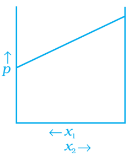
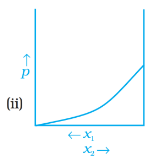 $iii.$
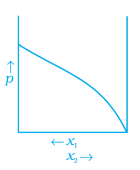 $iv.$
$iv.$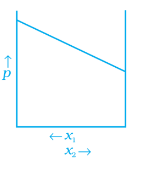
- A
$i$ and $ii$
- B
$i$ and $iii$
- C
$ii$ and $iii$
- ✓
$i$ and $iv$
AnswerCorrect option: D. $i$ and $iv$
The slopes at $(i)$ and $(iv)$ are straight lines, therefore they represent ideal behaviour of the solution.
View full question & answer→MCQ 1391 Mark
When $20g$ of napthoic acid $(\mathrm{C}_{11} \mathrm{H}_8 \mathrm{O}_2)$ is dissolved in $50g$ of benzene $(K_f = 1.72K kg/ mol),$ a freezing point depression of $2K$ is observed. The van't Hoff factor $(i)$ is:
View full question & answer→MCQ 1401 Mark
Henry’s law constant for molality of methane is benzene at $298K$ is $4.27 \times 10^5mm\ Hg.$ The mole fraction of methane is nenzene at $298K$ under $760\ mm\ Hg$ is:
- ✓
$1.78 \times 10^{-3}$
- B
$17.43$
- C
$0.114$
- D
$2.814$
AnswerCorrect option: A. $1.78 \times 10^{-3}$
View full question & answer→MCQ 1411 Mark
The pressure at which liquid and vapour can coexist at equilibrium is called the :
- ✓
- B
- C
- D
Saturated vapour pressure
AnswerOrdinary evaporation is a surface phenomenon $-$ some molecules have enough kinetic energy to escape. If the container is closed, then an equilibrium is reached where an equal number of molecules return to the surface.
The pressure at which this equilibrium where the coexistence of liquid and vapour is achieved is called the saturated vapor pressure.
View full question & answer→MCQ 1421 Mark
A plant cell shrinks when it is kept in a:
MCQ 1431 Mark
Which of the following have least vapour pressure?
- A
$\ce{0.1M NaCl sol}$
- ✓
$\ce{0.1M urea sol}$
- C
$\ce{0.1M AlCl_3 sol}$
- D
$\ce{0.1M KCl sol}$
AnswerCorrect option: B. $\ce{0.1M urea sol}$
View full question & answer→