Questions · Page 2 of 6

M.C.Q (1 Marks)

MCQ 511 Mark
Van de Graaff generator is used to:
  • A
    Store electrical energy.
  • Build up high voltage of few million volts.
  • C
    Decelerate charged particle like electrons.
  • D
    Both $(a)$ and $(b).$
Answer
Correct option: B.
Build up high voltage of few million volts.
View full question & answer
MCQ 521 Mark
The capacitance of the capacitor is inversely proportional to:
  • A
    $Q.$
  • $V.$
  • C
    Both $a$ and $b.$
  • D
    None.
Answer
Correct option: B.
$V.$
View full question & answer
MCQ 531 Mark
A pendulum $($ positively charged and hinged at some length above the plate$)$ is swinging above a parallel plate $($infinitely large and having negative charge$)$, now consider the following statements, $($consider gravity$):$
  • Angular momentum about the hinge point of the ball will be max at lowest point.
  • B
    Electric potential energy will be max at highest point.
  • C
    Gravitational potential energy will be lowest at highest point.
  • D
    None of the above.
Answer
Correct option: A.
Angular momentum about the hinge point of the ball will be max at lowest point.

Angular momentum about the hinge point of the ball will be max at point. mV will be max at closer point because law of conservation says that the swinging energy will be gathered when it will be at lowest point. The potential energy is maximum.

View full question & answer
MCQ 541 Mark
A parallel plate capacitor is charged. If the plates are pulled apart:
  • A
    The capacitance increases.
  • The potential difference increases.
  • C
    The total charge increases.
  • D
    The charge and potential difference remain the same.
Answer
Correct option: B.
The potential difference increases.

Capacitance of a parallel plate capacitor.
$\text{C}=ε0\text{AdC}=ε0\text{Ad}$
A parallel plate capacitor is charged $($battery is disconnected$)$ then the plates are pulled apart, the capacitance decreases while the charge remains the same.
$\because$ Potentialdifference $=$ ChargeCapacitance\because Potentialdifference $=$ ChargeCapacitance.
$\therefore$ potential difference increases.

View full question & answer
MCQ 551 Mark
A positively charged particle is released from rest in an uniform electric field. The electric potential energy of the charge:
  • A
    Remains a constant because the electric field is uniform.
  • B
    Increases because the charge moves along the electric field.
  • Decreases because the charge moves along the electric field.
  • D
    Decreases because the charge moves opposite to the electric field.
Answer
Correct option: C.
Decreases because the charge moves along the electric field.
The positive charge will experience an electrostatic force whose direction will be along the direction of electric field.
In other words, positive charge will move from high electrostatic potential to low electrostatic potential.
Work will be done by electric filed on the charge and the electric potential energy of the charge will decrease.
View full question & answer
MCQ 561 Mark
When air in a capacitor is replaced by a medium of dielectric constant $K$, the capacity:
  • A
    Decreases $K$ times.
  • Increases $K$ times.
  • C
    Increases $K2$ times.
  • D
    Remains constant.
Answer
Correct option: B.
Increases $K$ times.
View full question & answer
MCQ 571 Mark
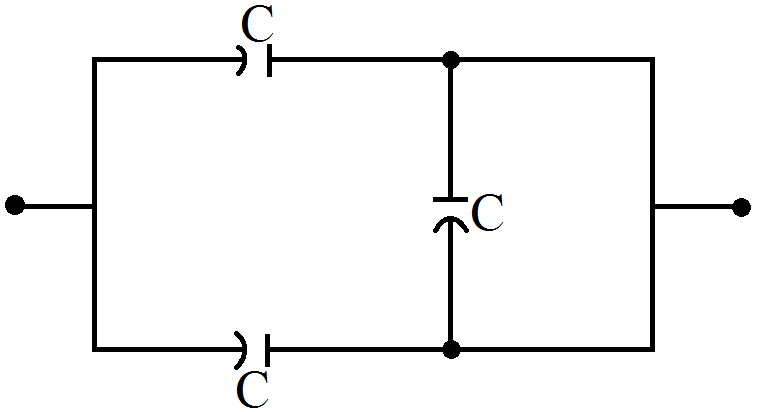
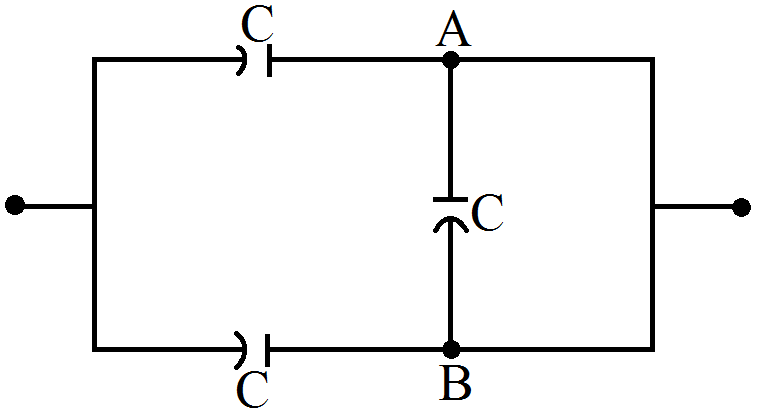
The equivalent capacitance of the combination shown in figure is:
  • A
    $C$
  • $2C$
  • C
    $\frac{\text{C}}{2}$
  • D
    None of these.
Answer
Correct option: B.
$2C$

Since the potential at point $A$ is equal to the potential at point $B$, no current will flow along arm $A B$. Hence, the capacitor on arm $AB$ will not contribute to the circuit. Also, because the remaining two capacitors are connected in parallel, the net capacitance of the circuit is given by
$C_{\text {eq }}=C+C=2 C$
View full question & answer
MCQ 581 Mark
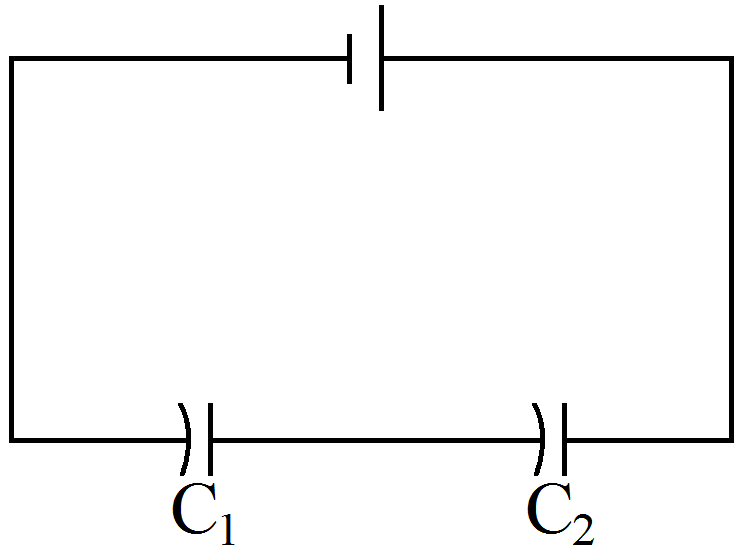
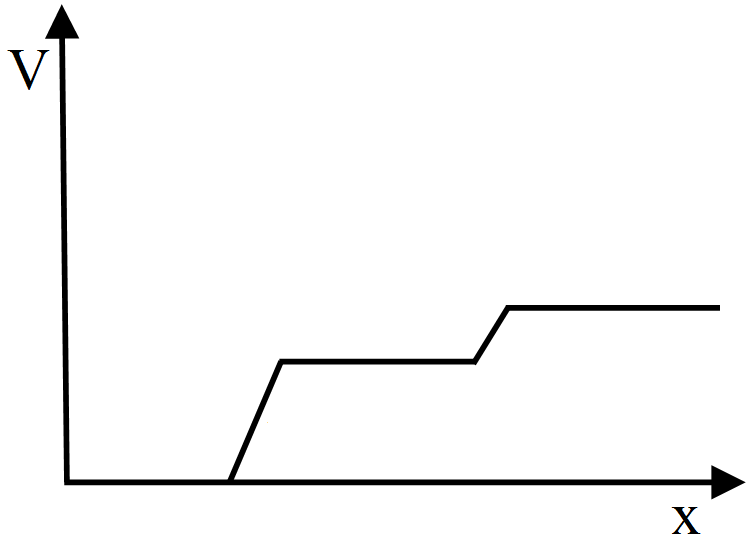
Figure shows two capacitors connected in series and joined to a battery. The graph shows the variation in potential as one moves from left to right on the branch containing the capacitors:
  • A
    $C_1 > C_2$
  • B
    $C_1=C_2$
  • $C_1 < C_2$
  • D
    The information is not sufficient to decide the relation between $C_1$ and $C_2$.
Answer
Correct option: C.
$C_1 < C_2$


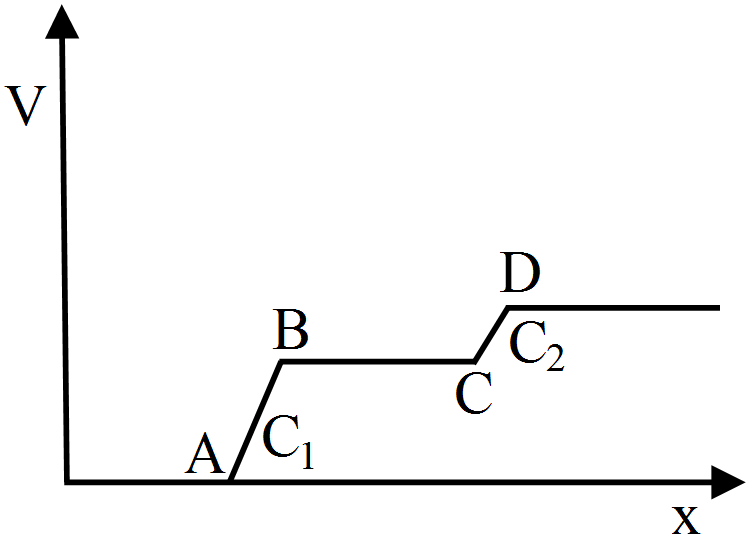
Region $A B$ shows the potential difference across capacitor $C_1$ and region $C D$ shows the potential difference across capacitor $C_2$. Now, we can see from the graph that region $A B$ is greater than region $C D$. Therefore, the potential difference across capacitor $C_1$ is greater than that across capacitor $C_2$.
$\because$ Capacitance, $C =\frac{ Q }{ V }$
$\therefore C _1< C _2 (Q$ remains the same in series connection$).$

View full question & answer
MCQ 591 Mark
One Volt is equal to:
  • A
    $1$ Joule
  • B
    $1$ Newton/ Coulomb
  • $1$ Joule/ Coulomb
  • D
    $1$ Coulomb/ Newton
Answer
Correct option: C.
$1$ Joule/ Coulomb

The volt is a measure of electric potential. One volt is defined as the difference in electric potential between two points of a conducting wire when an electric current of one ampere dissipates one watt of power between those points. It is also equal to the potential difference between two parallel, infinite planes spaced $1$ meter apart that create an electric field of $1$ newton per coulomb. Additionally, it is the potential difference between two points that will impart one joule of energy per coulomb of charge that passes through it. It can be expressed in terms of $SI$ base units $(m, kg$, s, and $A)$
$1\text{volte}=\frac{1\text{joule}}{\text{Coulomb}}$

View full question & answer
MCQ 601 Mark
When moving electron comes closer to other stationary electron, then its kinetic energy and potential energy respectively $......$ and $......$
  • A
    Increases, increases
  • B
    Increases, decreases
  • Decreases, increases
  • D
    Decreases, decreases
Answer
Correct option: C.
Decreases, increases

When electron comes closer to the other stationary electron, its kinetic energy decreases because of repulsion between them. As per conservation of energy, the potential energy increases.

View full question & answer
MCQ 611 Mark
If the capacitors having capacitance $C _1$ and $C _2$ are connected in series then their resultant capacitance is given by:
  • $1 / C=1 / C_1+1 / C_2$
  • B
    $1 / C=1 / C_1-1 / C_2$
  • C
    $C=C_1+C_2$
  • D
    None
Answer
Correct option: A.
$1 / C=1 / C_1+1 / C_2$
a. $1 / C=1 / C_1+1 / C_2$​​​​​​​
View full question & answer
MCQ 621 Mark
The electric field and the electric potential at a point are $E$ and $V$ respectively.
  • A
    If $E = 0, V$ must be zero.
  • If $V = 0, E$ must be zero.
  • C
    If $\text{E}\neq0, V$ cannot be zero.
  • D
    If $\text{V}\neq0, E$ cannot be zero.
Answer
Correct option: B.
If $V = 0, E$ must be zero.
Electric field is negative gradient of electric potential.
$\text{E}=-\text{grad}(\text{V})$
$\text{E}=-\frac{\text{dV}}{\text{dr}}$
If $\text{E}=0$
$-\frac{\text{dV}}{\text{dr}}=0$
This implies
$V =$ constant.
A constant can be zero or a quantifiable number.
View full question & answer
MCQ 631 Mark
The magnitude of the electric field is given by the change in magnitude of potential per unit displacement $......$ to the equipotential surface at the point.
  • A
    Normal.
  • B
    Perpendicular.
  • C
    Parallel.
  • Both $a$ and $b.$
Answer
Correct option: D.
Both $a$ and $b.$
View full question & answer
MCQ 641 Mark
Work done by an external force in bringing a unit positive charge from infinity to a point is called as:
  • A
    Potential energy at that point.
  • B
    Electric field at that point.
  • Electric potential at that point.
  • D
    None.
Answer
Correct option: C.
Electric potential at that point.
View full question & answer
MCQ 651 Mark
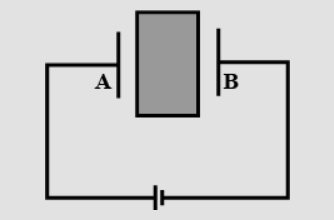
An insulator plate is passed between the plates of a capacitor. Then, current:
  • A
    First flows from $A$ to $B$ and then from $B$ to $A$
  • First flows from $B$ to $A$ and then from $A$ to $B$
  • C
    Always flows from $B$ to $A$
  • D
    Always flows from $A$ to $B$
Answer
Correct option: B.
First flows from $B$ to $A$ and then from $A$ to $B$
View full question & answer
MCQ 661 Mark
The plate current in a diode is zero. It is possible that:
  • A
    The plate voltage is zero.
  • B
    The plate voltage is slightly negative.
  • C
    The plate voltage is slightly positive.
  • All of the above.
Answer
Correct option: D.
All of the above.
Explanation:
The plate current varies directly with the plate voltage. Therefore, if the plate voltage is zero, the plate current is also zero. Due to the same reason, if the plate voltage is negative, the plate current will be zero. Now, if the plate is slightly positive, then it may be the reason that the plate voltage is not able to reduce the effect of space charge. Hence, the current may be zero. Now, as the temperature of the filament is low, it will not be able to emit electrons and the resulting plate current will be zero. Hence, all the options are possible.
View full question & answer
MCQ 671 Mark
The electrostatic potential due to a point charge is inversely proportional to:
  • A
    $\frac{1}{\text{r}}$
  • B
    $\frac{1}{\text{r}^2}$
  • $\text{r}$
  • D
    $\text{r}^2$
Answer
Correct option: C.
$\text{r}$
View full question & answer
MCQ 691 Mark
Two point charges $10C$ and $-10C$ are placed at a certain distance. What is the electric potential of their midpoint?
  • A
    Some positive value.
  • B
    Some negative value.
  • Zero.
  • D
    Depends on medium.
Answer
Correct option: C.
Zero.
Electric potential is a scalar quantity and its value is solely dependent on the charge near it and the distance from that charge. In this case, the point is equidistant from the two point charges and the point charges have the same value but opposite nature. Therefore equal but opposite potentials are generated due to the charges and hence the net potential at midpoint becomes zero.
View full question & answer
MCQ 701 Mark
The factor by which the capacitance increases from its vacuum value when the dielectric is inserted fully between the plates of a capacitor, is called as:
  • A
    Dielectric.
  • Dielectric constant of the substance.
  • C
    Permittivity.
  • D
    Permiability
Answer
Correct option: B.
Dielectric constant of the substance.
View full question & answer
MCQ 711 Mark
Equipotential surfaces:
  • A
    Are closer in regions of large electric fields compared to regions of lower electric fields.
  • B
    Will be more crowded near sharp edges of a conductor.
  • C
    Will be more crowded near regions of large charge densities.
  • All of the above.
Answer
Correct option: D.
All of the above.
Equipotential surfaces are closer in regions of large electric fields because electric field intensity is inversely proportional to the separation between equipotential surfaces.
As the electric field intensities is large near sharp edges of a charged conductor or near the regions of large charge densities. Therefore, numbers of equipotential surfaces are closer to such places or in other words they are more crowded.
View full question & answer
MCQ 721 Mark
The electric potential at a point on the equatorial line of an electric dipole is:
  • A
    Directly proportional to distance.
  • B
    Inversely proportional to distance.
  • C
    Inversely proportional to square of the distance.
  • None of these.
Answer
Correct option: D.
None of these.
View full question & answer
MCQ 731 Mark
Which of the following is / are true about the principle of Van de Graaff generator?
  • A
    The action of sharp points.
  • B
    The charge given to a hollow conductor is tranferred to outer surface and is distributed uniformly over it.
  • C
    It is used for accelerating uncharged particle.
  • Both $(a)$ and $(b).$
Answer
Correct option: D.
Both $(a)$ and $(b).$
View full question & answer
MCQ 741 Mark
In a charged capacitor, the energy resides:
  • A
    In the positive charges.
  • B
    In both the positive and negative charges.
  • In the field between the plates.
  • D
    Around the edges of the capacitor plates.
Answer
Correct option: C.
In the field between the plates.
View full question & answer
MCQ 751 Mark
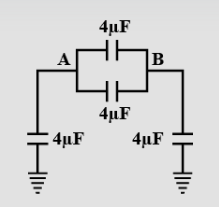
Find equivalent capacitance between $A$ and $B$
  • A
    $4\mu\text{F}$
  • B
    $6\mu\text{F}$
  • $8\mu\text{F}$
  • D
    $10\mu\text{F}$
Answer
Correct option: C.
$8\mu\text{F}$
c. $8 \mu F$
Explanation:
In the given figure, Equivalent capcitance between A and B .
$C_{e g}=C_1+C_2$
$=4 \mu F +4 \mu F$
View full question & answer
MCQ 761 Mark
A dielectric slab is inserted between the plates of an isolated charged capacitor. Which of the following quantities will remain the same?
  • A
    The electric field in the capacitor.
  • The charge on the capacitor.
  • C
    The potential difference between the plates.
  • D
    The stored energy in the capacitor.
Answer
Correct option: B.
The charge on the capacitor.
When we insert a dielectric between the plates of a capacitor, induced charges of opposite polarity appear on the face of the dielectric. They build an electric field inside the dielectric, directed opposite to the original field of the capacitor.
Thus, the net effect is a reduced electric field.
Also, as the potential is proportional to the field, the potential decreases and so does the stored energy $U$, which is given by
$\text{U}=\frac{\text{qV}}{2}$
Thus, only the charge on the capacitor remains unchanged, as the charge is conserved in an isolated system.
View full question & answer
MCQ 771 Mark
When was Van de Graff generator invented and by whom?
  • A
    $1944$, Robin Van de Graff
  • B
    $1932$, Robert Van de Graff
  • C
    $1933,$ Robin Van de Graff
  • $1933$, Robert Van de Graff
Answer
Correct option: D.
$1933$, Robert Van de Graff
Van de Graff generator was invented by Robert Jemison Van de Graff on November $28, 1933$. Robert Jemison invented the Van de Graff generator, which is a kind of high$-$voltage electrostatic generator that accelerates particles, while he was doing his $\text{PhD}$ in Princeton University.
View full question & answer
MCQ 781 Mark
The dipole moment per unit volume is called as:
  • A
    Dielectrics.
  • Polarisation.
  • C
    Electric field.
  • D
    Electric dipole moment.
Answer
Correct option: B.
Polarisation.
View full question & answer
MCQ 791 Mark
A parallel plate air capacitor has capacity $′C′$ farad, potential $′V′$ volt and energy $′E′$ joule. When the gap between the plates is completely filled with dielectric.
  • A
    Both $V$ and $E$ increase
  • Both $V$ and $E$ decrease
  • C
    $V$ decreases, $E$ increases
  • D
    $V$ increases, $E$ decreases
Answer
Correct option: B.
Both $V$ and $E$ decrease

A parallel $-$ plate capacitor with a dielectric. The electric field is reduced between the plates because the dielectric material is polarized, producing an opposing field. When there is a dielectric, the potential is also reduced because potential is inversely proportional to dielectric

View full question & answer
MCQ 811 Mark
From a point charge, there is a fixed point A. At A, there is an electric field of $500V/ m$ and potential difference of $3000V$. Distance between point charge and $A$ will be:
  • $6m.$
  • B
    $12m.$
  • C
    $16m.$
  • D
    $24m.$
Answer
Correct option: A.
$6m.$
View full question & answer
MCQ 831 Mark
A capacitor is a system of two conductors separated by $......$
  • A
    Conductors.
  • B
    Dielectrics.
  • An insulators.
  • D
    None.
Answer
Correct option: C.
An insulators.
View full question & answer
MCQ 841 Mark
Capacity of a parallel plate condenser can be increased by:
  • A
    Increasing the distance between the plates.
  • B
    Increasing the thickness of the plates.
  • C
    Decreasing the thickness of the plates.
  • Decreasing the distance between the plates.
Answer
Correct option: D.
Decreasing the distance between the plates.
View full question & answer
MCQ 851 Mark
Electrostatic potential is $......$ throughout the volume of the conductor and has $......$ value on its surface.
  • A
    Same, constant.
  • Constant, same.
  • C
    Different, same.
  • D
    Constant, different.
Answer
Correct option: B.
Constant, same.
View full question & answer
MCQ 861 Mark
What is the electric field in the cavity of a hollow charged conductor?
  • A
    Positive
  • B
    Negative
  • Zero
  • D
    Depends on the nature of the conductor
Answer
Correct option: C.
Zero

By Gauss’s theorem, the charge enclosed by the gaussian surface is zero. Consequently, the electric field must be zero at every point inside the cavity. Then, the entire excess charge lies on its surface.

View full question & answer
MCQ 871 Mark
$1$ electron volt $= ................. J$.
  • $1.6 \times 10^{-19}$
  • B
    $4.8 \times 10^{-19}$
  • C
    $1.6 \times 10^{-10}$
  • D
    $10$
Answer
Correct option: A.
$1.6 \times 10^{-19}$
a. $1.6 \times 10^{-19}$
Explanation:
$1$ electron volt is the amount of work done if an electron is passed through a potential difference of $1 \ V$ . Therefore the work done $=1 V \times$ charge of an electron $=1.602 \times 10^{-19} J$. But it is a small quantity and hence we use kilo electron volt and mega electron volt in practical.
View full question & answer
MCQ 881 Mark
In parallel combination of capacitors, the effective capacitance:
  • A
    Decreases.
  • Increases.
  • C
    Remains same.
  • D
    None.
Answer
Correct option: B.
Increases.
View full question & answer
MCQ 891 Mark
A point charge q is rotated along a circle in the electric field generated by another point charge $Q$. The work done by the electric field on the rotating charge in one complete revolution is $......$?
  • zero
  • B
    positive
  • C
    negative
  • D
    zero if the charge $Q$ is at the center and nonzero otherwise.
Answer
Correct option: A.
zero

The net displacement round one complete circle is $0.$

View full question & answer
MCQ 901 Mark
In case of a Van de Graaff generator, the breakdown field of air is:
  • A
    $2 \times 108 V m ^{-1}$
  • $3 \times 106 V m ^{-1}$
  • C
    $2 \times 108 V m ^{-1}$
  • D
    $3 \times 104 V m ^{-1}$
Answer
Correct option: B.
$3 \times 106 V m ^{-1}$
b. $3 \times 106 V m ^{-1}$​​​​​​​
View full question & answer
MCQ 911 Mark
In a region, the potential is represented by $V(x, y, z) = 6x - 8xy - 8y + 6yz$, where $V$ is in volts and $x, y, z$ are in metres. The electric force experienced by a charge of $2$ coulomb situated at point $(1, 1, 1)$ is:
  • A
    $6\sqrt{5}\text{ N}$
  • B
    $30\text{N}$
  • C
    $24\text{N}$
  • $4\sqrt{35}\text{ N}$
Answer
Correct option: D.
$4\sqrt{35}\text{ N}$
View full question & answer
MCQ 921 Mark
The work done by the external force in bringing the charge $q$ from infinity to a point is called as:
  • A
    Electric field due to charge $q$ at that point.
  • Potential energy due to charge $q$ at that point.
  • C
    Both $a$ and $b.$
  • D
    None.
Answer
Correct option: B.
Potential energy due to charge $q$ at that point.
View full question & answer
MCQ 931 Mark
Three capacitors each of capacity $ 4μ\text{F}$ are to be connected in such a way that the effective capacitance is $6μ\text{F}$. This can be done by:
  • A
    Connecting them in series.
  • B
    Connecting them is parallel.
  • Connecting two in series and one in parallel.
  • D
    Connecting two in parallel and one in series.
Answer
Correct option: C.
Connecting two in series and one in parallel.
View full question & answer
MCQ 941 Mark
Name the unit of electrical potential:
  • A
    Coulomb
  • B
    Watt
  • C
    Joule
  • Volt
Answer
Correct option: D.
Volt

Electrical potential is a type of potential energy, and refers to the energy that could be released if electric current is allowed to flow.

View full question & answer
MCQ 951 Mark
Mark the correct options:
  • A
    A diode valve can be used as a rectifier.
  • B
    A triode valve can be used as a rectifier.
  • C
    A triode valve can be used as an amplifier.
  • All of the above.
Answer
Correct option: D.
All of the above.
Explanation:
A diode valve and a triode valve allow current to flow only in one direction. Since a rectifier is a device that converts alternating current (bi-directional) into direct current (uni-directional), a diode valve and a triode valve can be used as rectifiers. A triode valve can control its output in proportion to the input signal. That is, it can act as an amplifier, whereas a diode valve cannot control its output in proportion to the input signal. So, it cannot be use as an amplifier.
View full question & answer
MCQ 961 Mark
Coulomb’s force between two stationery charges is also:
  • A
    Non conservative force.
  • Conservative force.
  • C
    Both $a$ and $b.$
  • D
    None.
Answer
Correct option: B.
Conservative force.
View full question & answer
MCQ 971 Mark
A dielectric slab is inserted between the plates of an isolated capacitor. The force between the plates will:
  • A
    Increase.
  • B
    Decrease.
  • Remain unchanged.
  • D
    Become zero.
Answer
Correct option: C.
Remain unchanged.

The force between the plates is given by
$\text{F}=\frac{\text{q}^2}{2\in_0\text{A}}$
Since the capacitor is isolated, the charge on the plates remains constant.
We know that the charge is conserved in an isolated system.
Thus, the force acting between the plates remains unchanged.

View full question & answer
MCQ 981 Mark
How does the potential difference change with the effect of the dielectric when the battery is kept disconnected from the capacitor?
  • A
    Increases
  • Decreases
  • C
    Remains constant
  • D
    Becomes zero
Answer
Correct option: B.
Decreases
When the dielectric slab is introduced between the plates, the induced surface charge on the dielectric reduces the electric field.
The reduction in the electric field results in a decrease in potential difference.
$\text{V}=\text{Ed}=\frac{\text{E}_0\text{d}}{\text{k}}=\frac{\text{V}_0}{\text{k}}$
View full question & answer
MCQ 991 Mark
Equipotential surfaces of a single point charge are $........$ surfaces centred at the charge.
  • A
    Concentric cylindrical.
  • B
    Concentric circular.
  • Concentric spherical.
  • D
    None.
Answer
Correct option: C.
Concentric spherical.
View full question & answer
MCQ 1001 Mark
Which of the following about potential at a point due to a given point charge is true? The potential at a point P due to a given point charge.
  • Is a function of distance from the point charge.
  • B
    Varies inversely as the square of distance from the point charge.
  • C
    Is a vector quantity.
  • D
    Is directly proportional to the square of distance from the point charge.
Answer
Correct option: A.
Is a function of distance from the point charge.
View full question & answer
M.C.Q (1 Marks) - Page 2 - Physics STD 12 Science Questions - Vidyadip