Question types

Electrostatic Potential and Capacitance question types

549 questions across 7 question groups — pick any mix to generate a Physics paper with step-by-step answer keys.

549
Questions
7
Question groups
5
Question types
Sample Questions

Electrostatic Potential and Capacitance questions

One sample from each question group in this chapter. Select any group above to see the full set with answer keys.

A point charge is situated at an axial point of a small electric dipole at a large distance from it. The charge experiences a force F. If the distance of the charge is doubled, the force acting on the charge will become:
  • A
    $2\text{F}$
  • B
    $\frac{\text{F}}{2}$
  • C
    $\frac{\text{F}}{4}$
  • $\frac{\text{F}}{8}$

Answer: D.

View full solution
An electric dipole consisting of charges $+q$ and $-q$ separated by a distance $L$ is in stable equilibrium in a uniform electric field $\vec{\text{E}}.$ The electrostatic potential energy of the dipole is:
  • A
    $qLE$
  • B
    zero
  • $–qLE$
  • D
    $–2 qEL$

Answer: C.

View full solution
$...X...$ is a machine that can build up high voltages of the order of a few million volts. Here, A refers to:
  • A
    Dynamo.
  • Van De Graaff generator.
  • C
    $DC$ generator.
  • D
    $AC$ generator.

Answer: B.

View full solution
An electric dipole is kept in non-uniform elecric field. it experiences?
  • A force and a torque.
  • B
    A force but not a torque.
  • C
    A torque but not a force.
  • D
    Neither a force nor a torque.

Answer: A.

View full solution
What is the net electrostatic field in the interior of a conductor?
  • A
    Positive
  • B
    Negative
  • Zero
  • D
    Depends on the nature of the conductor

Answer: C.

View full solution
For two statements are given-one labelled Assertion (A) and the other labelled Reason (R). Select the correct answer to these questions from the codes (a), (b), (c) and (d) as given below.
  1. Both A and R are true, and R is the correct explanation of A.
  2. Both A and R are true, but R is not the correct explanation of A.
  3. A is true, but R is false.
  4. A is false, and R is also false.
Assertion (A): Positive charge always moves from a higher potential point to a lower potential point.
Reason (R): Electric potential is a vector quantity.
View full solution
For two statements are given-one labelled Assertion (A) and the other labelled Reason (R). Select the correct answer to these questions from the codes (a), (b), (c) and (d) as given below.
  1. Both A and R are true, and R is the correct explanation of A.
  2. Both A and R are true, but R is not the correct explanation of A.
  3. A is true, but R is false.
  4. A is false, and R is also false.
Assertion (A): The surface of a conductor is an equipotential surface.
Reason (R): Conductor allows the flow of charge.
View full solution
For two statements are given-one labelled Assertion (A) and the other labelled Reason (R). Select the correct answer to these questions from the codes (a), (b), (c) and (d) as given below.
  1. Both A and R are true, and R is the correct explanation of A.
  2. Both A and R are true, but R is not the correct explanation of A.
  3. A is true, but R is false.
  4. A is false, and R is also false.
Assertion (A): A capacitor is connected to a battery. If we move its plate further apart, work will be done against the electrostatic attraction between the plates, and the energy of the capacitor gets decreased.
Reason (R): The energy stored in capacitor is dissipated in the form of heat energy.
View full solution
For two statements are given-one labelled Assertion (A) and the other labelled Reason (R). Select the correct answer to these questions from the codes (a), (b), (c) and (d) as given below.
  1. Both A and R are true, and R is the correct explanation of A.
  2. Both A and R are true, but R is not the correct explanation of A.
  3. A is true, but R is false.
  4. A is false, and R is also false.
Assertion (A): The whole charge of a conductor cannot be transferred to another isolated conductor.
Reason (R): The total transfer of charge from one to another is not possible.
View full solution
For two statements are given-one labelled Assertion (A) and the other labelled Reason (R). Select the correct answer to these questions from the codes (a), (b), (c) and (d) as given below.
  1. Both A and R are true, and R is the correct explanation of A.
  2. Both A and R are true, but R is not the correct explanation of A.
  3. A is true, but R is false.
  4. A is false, and R is also false.
Assertion (A): When a dielectric medium is filled between the plates of a condenser, its capacitance increases.
Reason (R): The dielectric medium reduces the potential difference between the plates of the condenser.
View full solution
Answer carefully:Two large conducting spheres carrying charges $Q_1$ and $Q_2$ are brought close to each other. Is the magnitude of electrostatic force between them exactly given by $\frac{\text{Q}_1\text{Q}_2}{{4}\pi\in_{0}\text{r}^{2}}$, where r is the distance between their centres?
View full solution
Answer the following:
What are the forms of energy into which the electrical energy of the atmosphere is dissipated during a lightning?
(Hint: The earth has an electric field of about $100 \mathrm{Vm}^{-1}$ at its surface in the downward direction, corresponding to a surface charge density $=-10^{-9} \mathrm{Cm}^{-2}$. Due to the slight conductivity of the atmosphere up to about 50 km (beyond which it is good conductor), about +1800 C is pumped every second into the earth as a whole. The earth, however, does not get discharged since thunderstorms and lightning occurring continually all over the globe pump an equal amount of negative charge on the earth.)
View full solution
Answer carefully:
A small test charge is released at rest at a point in an electrostatic field configuration. Will it travel along the field line passing through that point?
View full solution
Answer the following:
The top of the atmosphere is at about 400 kV with respect to the surface of the earth, corresponding to an electric field that decreases with altitude. Near the surface of the earth, the field is about $100 \mathrm{Vm}^{-1}$. Why then do we not get an electric shock as we step out of our house into the open? (Assume the house to be a steel cage so there is no field inside!)
View full solution
Three capacitors each of capacitance 9 pF are connected in series.
  1. What is the total capacitance of the combination?
  2. What is the potential difference across each capacitor if the combination is connected to a 120 V supply?
View full solution
Answer the following:
The discharging current in the atmosphere due to the small conductivity of air is known to be 1800A on an average over the globe. Why then does the atmosphere not discharge itself completely in due course and become electrically neutral? In other words, what keeps the atmosphere charged?
View full solution
Two charges 2 µC and –2 µC are placed at points A and B 6 cm apart.
  1. Identify an equipotential surface of the system.
  2. What is the direction of the electric field at every point on this surface?
View full solution
In a Van de Graaff type generator a spherical metal shell is to be a $15 \times 10^6 \mathrm{~V}$ electrode. The dielectric strength of the gas surrounding the electrode is $5 \times 10^7 \mathrm{Vm}^{-1}$. What is the minimum radius of the spherical shell required? (You will learn from this exercise why one cannot build an electrostatic generator using a very small shell which requires a small charge to acquire a high potential.)
View full solution
Answer the following: A man fixes outside his house one evening a two metre high insulating slab carrying on its top a large aluminium sheet of area $1m^2$. Will he get an electric shock if he touches the metal sheet next morning?
View full solution
Q 213 Marks Question3 Marks
  1. Find equivalent capacitance between A and B in the combination given below. Each capacitor is of 2 μF capacitance.
  1. If a dc source of 7 V is connected across AB, how much charge is drawn from the source and what is the energy stored in the network?
View full solution
Q 223 Marks Question3 Marks
A spherical conducting shell of inner radius $r_1$ and outer radius $r_2$ has a charge Q.
  1. A charge q is placed at the centre of the shell. What is the surface charge density on the inner and outer surfaces of the shell?
  2. Is the electric field inside a cavity (with no charge) zero, even if the shell is not spherical, but has any irregular shape? Explain
View full solution
Q 233 Marks Question3 Marks
A parallel plate capacitor with air between the plates has a capacitance of 8 pF $(1pF = 10^{–12}F)$. What will be the capacitance if the distance between the plates is reduced by half, and the space between them is filled with a substance of dielectric constant 6?
View full solution
Q 243 Marks Question3 Marks
A spherical conductor of radius 12 cm has a charge of 1.6 × 10⁻⁷C distributed uniformly on its surface. What is the electric field:
  1. Inside the sphere
  2. Just outside the sphere
  3. At a point 18 cm from the centre of the sphere?
View full solution
Q 253 Marks Question3 Marks
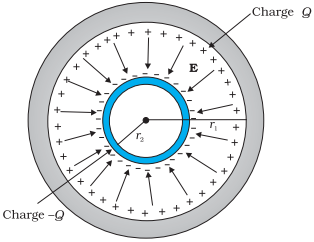
A spherical capacitor consists of two concentric spherical conductors, held in position by suitable insulating supports (2.36). Show
that the capacitance of a spherical capacitor is given by $\text{C}=\frac{{4}\pi\in_{0}\text{r}_1\text{r}_2}{\text{r}_1-\text{r}_2}$ where $r_1$ and $r_2$ are the radii of outer and inner spheres, respectively.
View full solution
A 600pF capacitor is charged by a 200V supply. It is then disconnected from the supply and is connected to another uncharged 600 pF capacitor. How much electrostatic energy is lost in the process?
View full solution
Two charges $5 \times 10^{–8} C$ and $–3 \times 10^{–8} C$ are located 16 cm apart. At what point(s) on the line joining the two charges is the electric potential zero? Take the potential at infinity to be zero.
View full solution
Show that the force on each plate of a parallel plate capacitor has a magnitude equal to $\frac{1}{2}$ QE, where Q is the charge on the capacitor, and E is the magnitude of electric field between the plates. Explain the origin of the factor $\frac{1}{2}$.
View full solution
A cube of side b has a charge q at each of its vertices. Determine the potential and electric field due to this charge array at the centre of the cube.
View full solution
Figure shows a charge array known as an electric quadrupole. For a point on the axis of the quadrupole, obtain the dependence of potential on r for r/a >> 1, and contrast your results with thatdue to an electric dipole, and an electric monopole (i.e., a single charge).
View full solution
The mean free path of electrons in a gas in a discharge tube is inversely proportional to the pressure inside it. The Crookes dark space occupies half the length of the discharge tube when the pressure is 0.02mm of mercury. Estimate the pressure at which the dark space will fill the whole tube.
View full solution
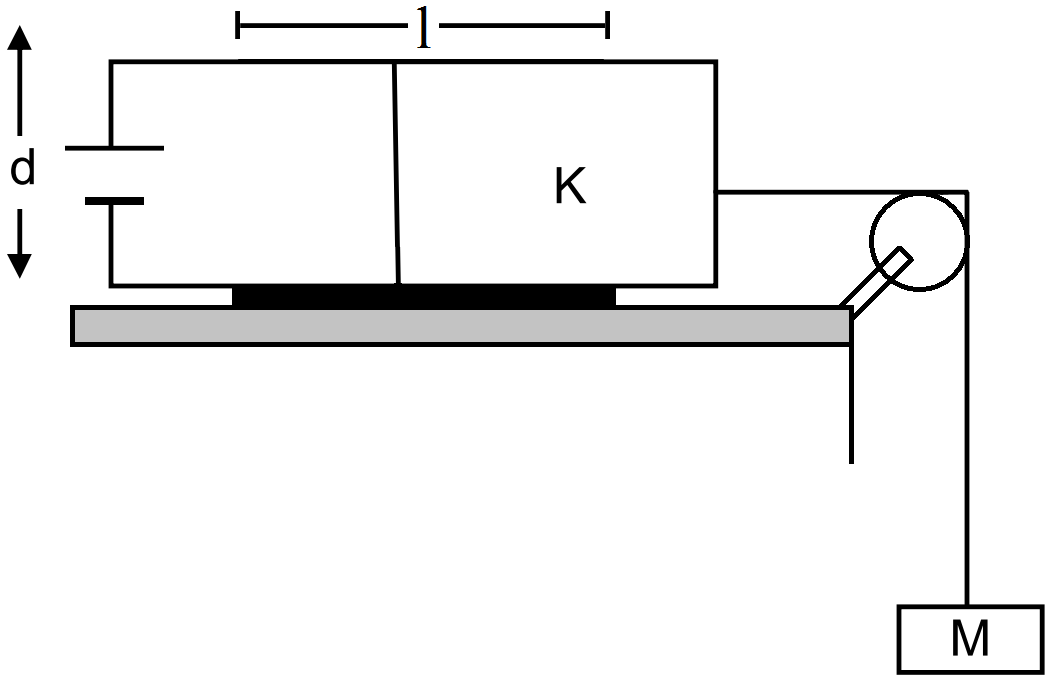
Consider the situation shown in figure. The width of each plate is b. The capacitor plates are rigidly clamped in the laboratory and connected to a battery of emf $\in.$ All surfaces are frictionless. Calculate the value of M for which the dielectric slab will stay in equilibrium.
View full solution
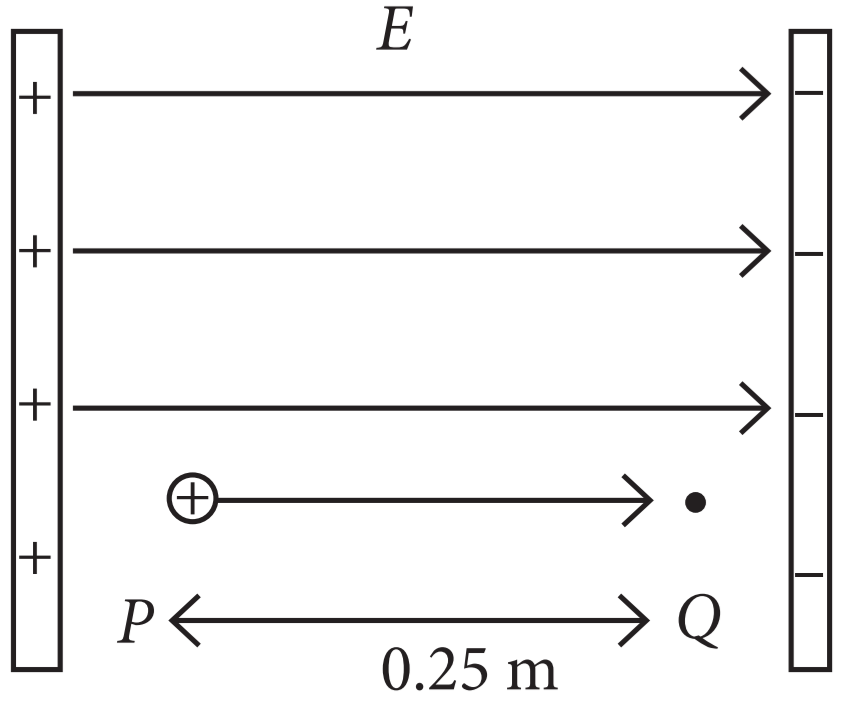
Potential difference $(\triangle\text{V})$ between two points A and B separated by a distance x, in a uniform electric field E is given by $\triangle\text{V}=-\text{Ex},$ where xis measured parallel to the field lines. If a charge $q_0$ moves from P to Q, the change in potential energy $(\triangle\text{U})$ is given as $\triangle\text{U}=-\text{q}_0\triangle\text{V}.$ A proton is released from rest in uniform electric field of magnitude $4.0 \times 10^8Vm^{-1}$ directed along the positive X-axis. The proton undergoes a displacement of 0.25m in the direction of E. Mass of a proton $= 1.66 \times 10^{-27}kg$ and charge of proton $= 1.6 \times 10^{-19}C.$
  1. The change in electric potential of the proton between the points A and B is:
  1. $-1 \times 10^8V$
  2. $1 \times 10^8V$
  3. $6.4 \times 10^{-19}V$
  4. $-6.4 \times 10^{-19}V$
  1. The change in electric potential energy of the proton for displacement from A to B is:
  1. $1.6 \times 10^{11}J$
  2. $0.5 \times 10^{23}J$
  3. $-1.6 \times 10^{-11}J$
  4. $3.2 \times 10^{22}J$
  1. The mutual electrostatic potential energy between two protons which are at a distance of $9 \times 10^{-15}$m, in $_{92}U^{235}$ nucleus is:
  1. $1.56 \times 10^{-14}J$
  2. $5.5 \times 10^{-14}J$
  3. $2.56 \times 10^{-14}J$
  4. $4.56 \times 10^{-14}J$
  1. If a system consistsoftwocharges 4mC and -3mC with no external field placed at (-5cm, 0, 0) and (5cm, 0, 0) respectively. The amount of work required to separate the two charges infinitely away from each other is:
  1. -1.1J
  2. 2J
  3. 2.5J
  4. 3J
  1. As the proton moves from P to Q, then:
  1. The potential energy of proton decreases.
  2. The potential energy of proton increases.
  3. The proton loses kinetic energy.
  4. Total energy of the proton increases.
View full solution
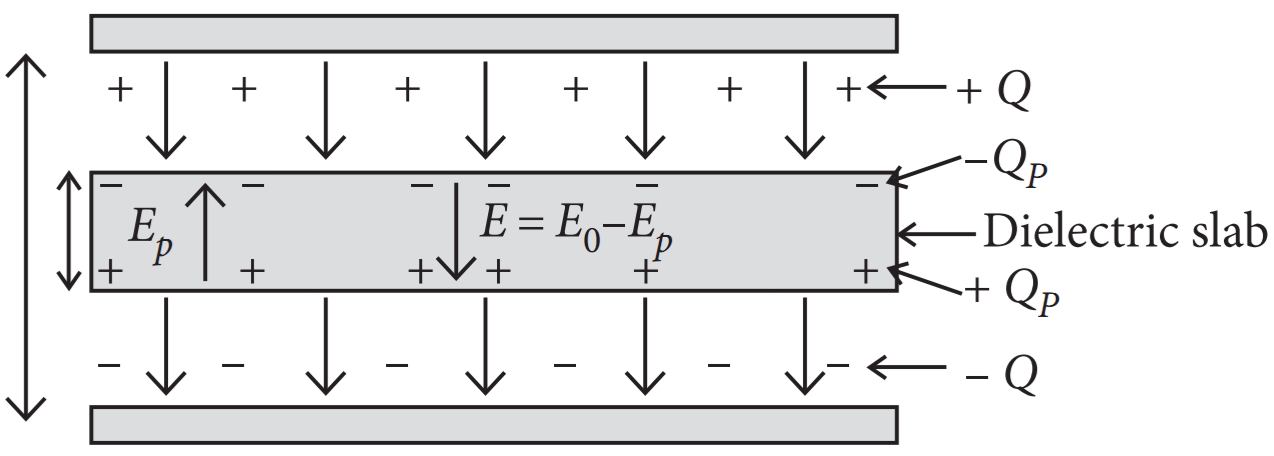
A dielectric slab is a substance which does not allow the flow of charges through it but permits them to exert electrostatic forces on one another. When a dielectric slab is placed between the plates, the field $E_0$ polarises the dielectric. This induces charge $-Q_P$ on the upper surface and $+ Q_P$ on the lower surface of the dielectric. These induced charges set up a field $E_P$ inside the dielectric in the opposite direction of $\vec{\text{E}_0}$ as shown.
  1. ln a parallel plate capacitor, the capacitance increases from $4\mu\text{F}$ to $80\mu\text{F},$ on introducing a dielectric medium between the plates. What is the dielectric constant of the medium?
  1. 10
  2. 20
  3. 50
  4. 100
  1. A parallel plate capacitor with air between the plates has a capacitance of 8pE The separation between the plates is now reduced half and the space between them is filled with a medium of dielectric constant 5. Calculate the value of capacitance of the capacitor in second case.
  1. 8pF
  2. 10pF
  3. 80pF
  4. 100pF
  1. A dielectric introduced between the plates of a parallel plate condenser:
  1. Decreases the electric field between the plates.
  2. Increases the capacity of the condenser.
  3. Increases the charge stored in the condenser.
  4. Increases the capacity of the condenser.
  1. A parallel plate capacitor of capacitance 1 pF has separation between the plates is d. When the distance of separation becomes 2d and wax of dielectric constant x is inserted in it the capacitance becomes 2pE What is the value of x?
  1. 2
  2. 4
  3. 6
  4. 8
  1. A parallel plate capacitor having area A and separated by distanced is filled by copper plate of thickness b. The new capacity is:
  1. $\frac{\in_0\text{A}}{\text{d}+\frac{\text{b}}{2}}$
  2. $\frac{\in_0\text{A}}{\text{2d}}$
  3. $\frac{\in_0\text{A}}{\text{d-b}}$
  4. $\frac{2\in_0\text{A}}{\text{d}+\frac{\text{b}}{2}}$
View full solution
A capacitor is a device to store energy. The process of charging up a capacitor involves the transferring of electric charges from its one place to another. This work done in charging the capacitor is stored as its electrical potential energy.
If q is the charge and V is the potential difference across a capacitor at any instant during its charging, then small work done in storing an additional small charge dq against the repulsion of charge q already stored on it is $\text{dW}=\text{V.dq}=(\frac{\text{q}}{\text{C}})\text{dq}.$
  1. A system of 2 capacitors of capacitance $2\mu\text{F}$ and $4\mu\text{F}$ is connected in series across a potential difference of 6 V. The energy stored in the system is:
  1. $3\mu\text{J}$
  2. $24\mu\text{J}$
  3. $30\mu\text{J}$
  4. $108\mu\text{J}$
  1. A capacitor of capacitance of $10\mu\text{F}$ is charged to 10V. The energy stored in it is:
  1. $100\mu\text{J}$
  2. $500\mu\text{J}$
  3. $1000\mu\text{J}$
  4. $1\mu\text{J}$
  1. A parallel plate air capacitor has capacity C farad, potential V volt and energy E joule. When the gap between the plates is completely filled with dielectric:
  1. Both V and E increase.
  2. Both V and E decrease.
  3. V decreases, E increases.
  4. V increases, E decreases.
  1. A capacitor with capacitance $5\mu\text{F}$ s charged to $5\mu\text{C}.$ If the plates are pulled apart to reduce the capacitance to $2\mu\text{F},$ how much work is done?
  1. $6.25 \times 10^{-6}J$
  2. $3.75 \times 10^{-6}J$
  3. $2.16 \times 10^{-6}J$
  4. $2.55 \times 10^{-6}J$
  1. A metallic sphere ofradius 18cm has been given a charge of $5 \times 10^{-6}C$. The energy of the charged conductor is:
  1. 0.2J
  2. 0.6J
  3. 1.2J
  4. 2.4J
View full solution

Generate a Electrostatic Potential and Capacitance paper free

Pick question groups from the list above, set marks and difficulty, and export a branded PDF with step-by-step answer keys. First 3 chapters free — no signup.

Download App