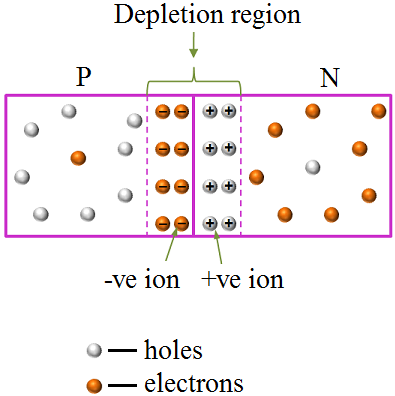
Questions

1 Marks Question

Take a timed test

46 questions · 1 auto-graded MCQ + 45 self-marked written.

Question 21 Mark
In an n-type silicon, which of the following statement is true:
  1. Electrons are majority carriers and trivalent atoms are the dopants.
  2. Electrons are minority carriers and pentavalent atoms are the dopants.
  3. Holes are minority carriers and pentavalent atoms are the dopants.
  4. Holes are majority carriers and trivalent atoms are the dopants.
Answer
  1. Holes are minority carriers and pentavalent atoms are the dopants.
In an n-type silicon, the electrons are the majority carriers, while the holes are the minority carriers. An n-type semiconductor is obtained when pentavalent atoms, such as phosphorus, are doped in silicon atoms.
View full question & answer
Question 31 Mark
For transistor action, which of the following statements are correct:
  1. Base, emitter and collector regions should have similar size and doping concentrations.
  2. The base region must be very thin and lightly doped.
  3. The emitter junction is forward biased and collector junction is reverse biased.
  4. Both the emitter junction as well as the collector junction are forward biased.
Answer
  1. The emitter junction is forward biased and collector junction is reverse biased.
For a transistor action, the junction must be lightly doped so that the base region is very thin. Also, the emitter junction must be forward-biased and collector junction should be reversebiased.
View full question & answer
MCQ 41 Mark
Carbon, silicon and germanium have four valence electrons each. These are characterised by valence and conduction bands separated by energy band gap respectively equal to $ \left(E_g\right)_C, \left(E_g\right)_{S i}$ and $ \left(E_g\right)_{G e} $ Which of the following statements is true
  • A
    $ \left(E_g\right)_{\mathrm{Si}} < \left(E_g\right)_{G e} < \left(E_g\right)_C $
     
  • B
    $ \left(E_g\right)_C < \left(E_g\right)_{G e} < \left(E_g\right)_{S i} $
     
  • $ \left(E_g\right)_C > \left(E_g\right)_{S i} > \left(E_g\right)_{G e} $
     
  • D
    $ \left(E_g\right)_C=\left(E_g\right)_{\mathrm{Si}}=\left(E_g\right)_{G e}$
Answer
Correct option: C.
$ \left(E_g\right)_C > \left(E_g\right)_{S i} > \left(E_g\right)_{G e} $
 
Of the three given elements, the energy band gap of carbon is the maximum and that of germanium is the least.
The energy band gap of these elements are related as: $ \left(E_g\right)_C > \left(E_g\right)_{S i} > \left(E_g\right)_{G e} $
View full question & answer
Question 51 Mark
For a transistor amplifier, the voltage gain,
  1. Remains constant for all frequencies.
  2. Is high at high and low frequencies and constant in the middle frequency range.
  3. Is low at high and low frequencies and constant at mid frequencies.
  4. None of the above.
Answer
  1. Is low at high and low frequencies and constant at mid frequencies.
The voltage gain of a transistor amplifier is constant at mid frequency range only. It is low at high and low frequencies.
View full question & answer
Question 61 Mark
In an unbiased p-n junction, holes diffuse from the p-region to n-region because,
  1. Free electrons in the n-region attract them.
  2. They move across the junction by the potential difference.
  3. Hole concentration in p-region is more as compared to n-region.
  4. All the above.
Answer
  1. Hole concentration in p-region is more as compared to n-region.
The diffusion of charge carriers across a junction takes place from the region of higher concentration to the region of lower concentration. In this case, the p-region has greater concentration of holes than the n-region. Hence, in an unbiased p-n junction, holes diffuse from the p-region to the n-region.
View full question & answer
Question 71 Mark
When a forward bias is applied to a p-n junction, it
  1. Raises the potential barrier.
  2. Reduces the majority carrier current to zero.
  3. Lowers the potential barrier.
  4. None of the above.
Answer
  1. Lowers the potential barrier.
When a forward bias is applied to a p-n junction, it lowers the value of potential barrier. In the case of a forward bias, the potential barrier opposes the applied voltage. Hence, the potential barrier across the junction gets reduced.
View full question & answer
Question 81 Mark
Which of the statements is true for p-type semiconductos.
  1. Electrons are majority carriers and trivalent atoms are the dopants.
  2. Electrons are minority carriers and pentavalent atoms are the dopants.
  3. Holes are minority carriers and pentavalent atoms are the dopants.
  4. Holes are majority carriers and trivalent atoms are the dopants.
Answer
  1. Holes are majority carriers and trivalent atoms are the dopants.
In a p-type semiconductor, the holes are the majority carriers, while the electrons are the minority carriers. A p-type semiconductor is obtained when trivalent atoms, such as aluminium, are doped in silicon atoms.
View full question & answer
Question 91 Mark
What happens to the width of depletion layer of a p-n junction when it is (i) forward biased, (ii) reverse biased?
Answer
  1. (Slightly) decreases.
  2. (Slightly) Increases.
View full question & answer
Question 111 Mark
State the reason, why Ga As is most commonly used in making of a solar cell.
Answer
Bandgap (1 eV to 1.8 eV)/high absorption coefficient/conductivity 1.
View full question & answer
Question 141 Mark
In a transistor, doping level in base is increased slightly. How will it affect (i) collector current and (ii) base current?
Answer
Collector current decreases slightly.
Base current increases slightly.
View full question & answer
Question 151 Mark
What will be the values of input A and B for the Boolean expression $\big(\overline{\text{A} + \text{B}}\big) . \big(\overline{\text{A}.\text{B}}\big) = 1?$
Answer
A = 0B = 0
View full question & answer
Question 161 Mark
Why cannot we use Si and Ge in fabrication of visible LEDs?
Answer
LEDs must have band gap in the order of 1.8eV to 3eV but Si & Ge have band gap less than 1.8eV so these cannot be used to fabricate LEDs.
View full question & answer
Question 171 Mark
How does an increase in doping concentration affect the width of depletion layer of a p-n junction diode?
Answer

Since all the recombination process takes place at the junction or nearby region so depletion width is decreased with doping. In this manner, free electrons and holes reduce the ions. Reduction of positive ions means reduction of depletion region. Thus, the depletion region decreases.
Mathematically: Depletion width is nonlinearly and inversely proportional to the doping;
$\text{W}\propto1(\sqrt{\text{doping}}).$
View full question & answer
Question 181 Mark
How does the conductivity of a semiconductor change with rise in temperature?
Answer
The conductivity of a semiconductor increases with increase of temperature.
View full question & answer
Question 201 Mark
What is the approximate width of depletion layer in p-n junction diode?
Answer
The depletion layer in junction diode is of the order of micrometer ($\approx$ 10-6m).
View full question & answer
Question 211 Mark
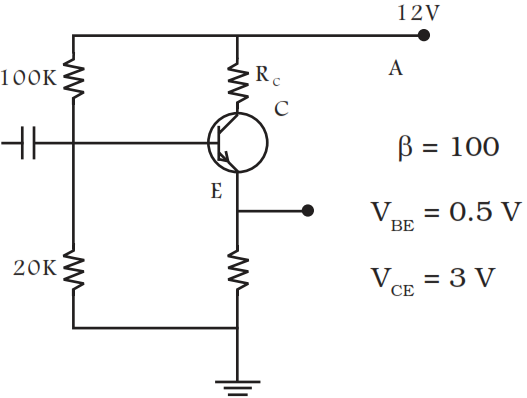
In the circuit shown in Fig., find the value of $R_C$.
Answer
$\text{I}_\text{E}=\text{I}_\text{C}+\text{I}_\text{B}\text{ and I}_\text{C}=\beta\text{I}_\text{B}\ .....(1)$
$\text{I}_\text{C}\text{R}_\text{C}+\text{V}_\text{CE}+\text{I}_\text{E}\text{R}_\text{E}=\text{V}_\text{CC}\ .....(2)$
$\text{RI}_\text{B}+\text{V}_\text{BE}+\text{I}_\text{E}\text{R}_\text{E}=\text{V}_\text{CC}\ .....(3)$
$\Rightarrow\ \text{I}_\text{E}\approx\text{I}_\text{C}=\beta\text{I}_\text{B}$
$(\text{R}+\beta\text{R}_\text{E})\text{I}_\text{B}=\text{V}_\text{CC}-\text{V}_\text{BE}$
$\Rightarrow\ \text{I}_\text{B}=\frac{\text{V}_\text{CC}-\text{V}_\text{BE}}{\text{R}+\beta.\text{R}_\text{E}}=\frac{12-0.5}{80+1.2\times100}=\frac{11.5}{200}\text{mA}$
From ...(2)
$\text{R}_\text{C}+\text{R}_\text{E}=\frac{\text{V}_\text{CC}-\text{V}_\text{BE}}{\text{I}_\text{C}}=\frac{\text{V}_\text{CC}-\text{V}_\text{CE}}{\beta\text{I}_\text{B}}=\frac{2}{11.5}(12-3)\text{K}\Omega=1.56\text{K}\Omega$
$\text{R}_\text{C}=1.56-1=0.56\text{k}\Omega$
View full question & answer
Question 221 Mark
How is a sample of an n-type semiconductor electrically neutral though it has an excess of negative charge carriers?
Answer
The sample contains atoms of either original material or the impurity which are all neutral.
View full question & answer
Question 231 Mark
Name the type of charge carriers in p-n junction diode when forward biased.
Answer
Majority charge carriers: electrons and holes.
View full question & answer
Question 241 Mark
What is the value of electrical conductivity of a semiconductor at absolute zero?
Answer
At absolute zero, a semiconductor has no free charge carrier; hence the electrical conductivity of a semiconductor at absolute zero is zero.
View full question & answer
Question 251 Mark
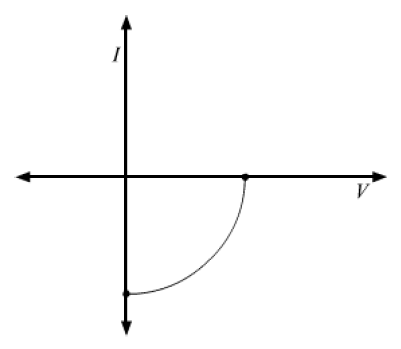
In the given diagram, is the diode D forward or reverse biased?
Answer
The given diode is reverse biased.
View full question & answer
Question 281 Mark
What is the net charge on a given piece of:
  1. p-type semiconductor.
  2. n-type semiconductor?
Answer
  1. Zero
  2. Zero.
View full question & answer
Question 291 Mark
If ni is density of intrinsic charge carriers; nh and ne are densities of hole and electrons in extrinsic semiconductor, what is the relation among them?
Answer
$\text{n}_\text{e}\text{n}_\text{h}=\text{n}^2_\text{i}$
View full question & answer
Question 301 Mark
When a semiconducting material is doped with an impurity, new acceptor levels are created. In a particular thermal collision, a valence electron receives an energy equal to 2kT and just reaches one of the acceptor levels. Assuming that the energy of the electron was at the top edge of the valence band and that the temperature T is equal to 300K, find the energy of the acceptor levels above the valence band.
Answer
2KT = Energy gap between acceptor band and valency band
$\Rightarrow2\times1.38\times10^{-23}\times300$
$\Rightarrow\text{E}=(2\times1.38\times3)\times10^{21}\text{J}$
$=\frac{6\times1.38}{1.6}\times\frac{10^{-21}}{10^{-19}}\text{eV}=\Big(\frac{6\times1.38}{1.6}\Big)\times10^{-2}\text{eV}$
$=5.175\times10^{-2}\text{eV}=51.75\text{meV}=50\text{meV}.$
View full question & answer
Question 311 Mark
Name the logic gate whose repetitive use can make digital circuits.
Answer
The repeated use of NAND or NOR gates alone can give all basic gates.
View full question & answer
Question 321 Mark
Name the type of charge carriers in p-n junction when reverse biased.
Answer
Minority charge carriers: electrons and holes.
View full question & answer
Question 341 Mark
In a semiconductor the concentration of electrons is $8 \times 10^{13} \mathrm{~cm}^{-3}$ and that of holes is $5 \times 10^{12} \mathrm{~cm}^{-3}$. Is it a p-type or n-type semiconductor?
Answer
As concentration of electrons is more than the concentration of holes, the given extrinsic semiconductor is n-type.
View full question & answer
Question 361 Mark
In a transistor, both emitter and collector regions are of the same nature of doping. Can these regions be interchanged?
Answer
No, the emitter and collector regions cannot be interchanged. Since these are differently doped.
View full question & answer
Question 371 Mark
‘Device X’ shown here, converts the input voltage waveform into the output voltage waveform as shown in fig. Name the device X.
Answer
The box contains the circuit of full wave rectifier.
View full question & answer
Question 381 Mark
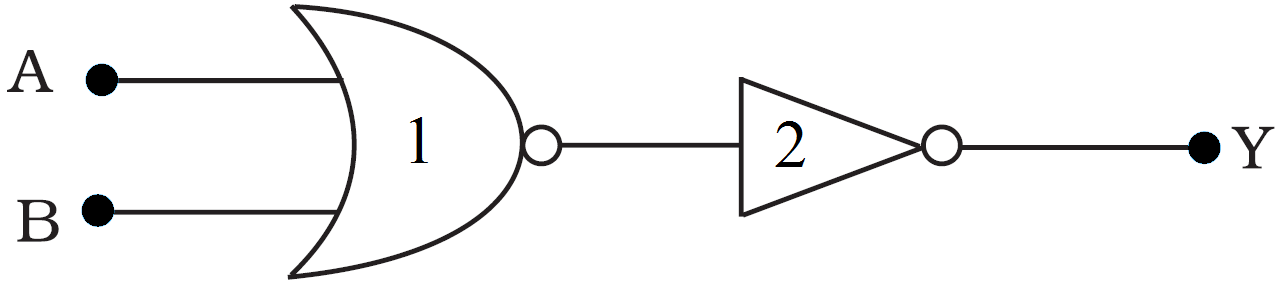
In the given logic circuit, name the logic gates 1 and 2 and write the name of the combination of gates.
Answer
Logic gate ‘1’ is OR gate and logic gate 2 is NOT gate. The combination of gates is NOR gate.
View full question & answer
Question 391 Mark
What is the frequency of output signal of (i) Half wave rectifier (ii) Full wave rectifier, if the frequency of input signal is 50Hz?
Answer
For half wave rectifier, the output frequency = 50Hz.
For full wave rectifier, the output frequency is 100Hz.
View full question & answer
Question 401 Mark
Which of the following frequencies will be suitable for beyond-thehorizon communication using sky waves?
  1. 10 kHz
  2. 10 MHz
  3. 1 GHz
  4. 1000 GHz
Answer
b. 10 MHz For beyond the horizon communication, it is necessary for the signal waves to travel a large distance. 10 KHz signals cannot be radiated effeciently because of the antenna size. The high energy signal waves (1GHz - 1000 GHz) penetrate the ionosphere. 10MHz frequencies get reflected easily from the ionosphere. Hence, signal waves of such frequencies are suitable for beyond the horizon communication. Therefore the answer is (b)
View full question & answer
Question 411 Mark
How does the energy gap in a semiconductor vary, when doped with a pentavalent impurity?
Answer
The energy gap decreases.
View full question & answer
Question 421 Mark
What is the order of energy gap in a semiconductor?
Answer
The energy gap in a semiconductor is of the order of 1 eV.
View full question & answer
Question 431 Mark
Give the ratio of number of holes and number of conduction electrons in an intrinsic semiconductor.
Answer
Ratio = 1 : 1.
View full question & answer
Question 441 Mark
Can we take one slab of p-type semiconductor and physically join it to another n-type semiconductor to get p-n junction?
Answer
No! Any slab, howsoever flat, will have roughness much larger than the inter-atomic crystal spacing ( 2 to $3 \mathring A$ ) and hence continuous contact at the atomic level will not be possible. The junction will behave as a discontinuity for the flowing charge carriers.
View full question & answer
Question 451 Mark
Suppose a pure Si crystal has $5 \times 10^{28}$ atoms $m ^{-3}$. It is doped by $1 ppm$ concentration of pentavalent As. Calculate the number of electrons and holes. Given that $n_i=1.5 \times 10^{16} m ^{-3}$.
Answer
Note that thermally generated electrons $\left(n_i \sim 10^{16} m ^{-3}\right)$ are negligibly small as compared to those produced by doping.
Therefore, $n_e \approx N_D$.
Since $n_e n_h=n_i^2$, The number of holes
$
\begin{aligned}
n_h & =\left(2.25 \times 10^{32}\right) /\left(5 \times 10^{22}\right) \\
& \sim 4.5 \times 10^9 m ^{-3}
\end{aligned}
$
View full question & answer
Question 461 Mark
C, Si and Ge have same lattice structure. Why is $C$ insulator while $Si$ and Ge intrinsic semiconductors?
Answer
The 4 bonding electrons of $C , Si$ or Ge lie, respectively, in the second, third and fourth orbit. Hence, energy required to take out an electron from these atoms (i.e., ionisation energy $E_q$ ) will be least for Ge, followed by $Si$ and highest for $C$. Hence, number of free electrons for conduction in Ge and Si are significant but negligibly small for $C$.
View full question & answer