MCQ 15 Marks
If $4, a, a, 36$ are in proportion, then $a =$
Answer$4, a, a, 36$ are in proportion; therefore, we get:
$4 : a : : a : 36$
$\Rightarrow 4 : a = a : 36$
$\Rightarrow 4 \times 36 = a \times a$
$\Rightarrow 144 = a2$
$\Rightarrow a = 12$
View full question & answer→MCQ 25 Marks
If the cost of $25$ packets of $12$ pencils each is $Rs. 750,$ then the cost of $30$ packets of $8$ pencils each is:
- ✓
$Rs. 600$
- B
$Rs. 720$
- C
$Rs. 640$
- D
AnswerCorrect option: A. $Rs. 600$
It is given that the cost of $25$ packets of $12$ pencils each is $Rs. 750;$
Therefore, we have:
Cost of $(25 \times 12)$ pencils $= 300$ pencils $= Rs. 750$
Let the cost of $(30 \times 8)$ or $240$ pencils be $Rs. x,$
$\because 750 : 300 : : x : 240$
$\therefore$ Cost of $(30 \times 8) = 240$ pencils
$=\frac{750\times240}{300}=\text{Rs. 600}$
View full question & answer→MCQ 35 Marks
Mark the correct alternative in the following : If $343$ is the third proportional of $a$ and $b,$ where $a : b = 1 : 7,$ then value of $a + b$ is:
AnswerIf is given that,
$\frac{\text{a}}{\text{b}}=\frac{1}{7}\ ....(1)$
According to the question,
$a : b : : b : 343$
$\Rightarrow\frac{\text{a}}{\text{b}}=\frac{\text{b}}{343}$
$\Rightarrow\frac{1}{7}=\frac{\text{b}}{343}\ ....[\text{From (1)}]$
$\Rightarrow\frac{1\times343}{7}=\frac{\text{b}\times343}{343}$
$\Rightarrow49=\text{b}$
Now,
$\frac{\text{a}}{\text{b}}=\frac{1}{7}$
$\Rightarrow\frac{\text{a}}{49}=\frac{1}{7}$
$\Rightarrow\frac{\text{a}\times49}{49}=\frac{1\times49}{7}$
$\Rightarrow\text{a}=7$
Thus, $a + b = 7 + 49 = 56$
Hence, the correct option is $(c).$
View full question & answer→MCQ 45 Marks
Mark the correct alternative in the following: The first three terms of a proportion are $12, 21$ and $8$ respectively. Then $4^{th}$ term is:
AnswerLet the $4^{th}$ term be $x.$
According to the question,
$12 : 21 : : 8 : x$
$\Rightarrow $ Product of extreme term $=$ product of mean terms
$\Rightarrow12\text{x}=8\times21$
$\Rightarrow12\text{x}=168$
$\Rightarrow\frac{12\text{x}}{12}=\frac{168}{12}$
$\Rightarrow\text{x}=14$
Hence, the correct option is $(c).$
View full question & answer→MCQ 55 Marks
If $a, b, c$ are in proportion, then
- ✓
$a : b : : b : c$
- B
$a : b : : c : a$
- C
$a : b : : c : b$
- D
$a : c : : b : c$
AnswerCorrect option: A. $a : b : : b : c$
$\Rightarrow ac = b^2$
View full question & answer→MCQ 65 Marks
The first, second and fourth terms of a proportion are $16, 24$ and $54$ respectively. The third term is:
AnswerThe first, second and fourth term of a proportion are $16, 24$ and $54,$ respectively.
Let third term is be $x,$
According to the question, we have:
$16 : 24 = x : 54$
$16 : 24 = x : 54$
$\Rightarrow\frac{16\times54}{24}=\text{x}$
$\Rightarrow\text{x}=36$
View full question & answer→MCQ 75 Marks
Mark the correct alternative in the following:If $4 : 3 = x^2 : 12$, then the value of $x (x > 0).$
Answer$\frac{4}{3}=\frac{\text{x}^2}{12}$
$\Rightarrow\frac{4\times4}{3\times4}=\frac{\text{x}^2}{12}$
$\Rightarrow\frac{16}{12}=\frac{\text{x}^2}{12}$
$\Rightarrow4^2=\text{x}^2\ (\because\text{x}>0)$
$\Rightarrow4=\text{x}$
Hence, the correct option is $(b).$
View full question & answer→MCQ 85 Marks
$12$ men can finish a piece of work in $25$ days. The number of days in which the same piece of work can be done by $20$ men, is:
- A
$10$ days.
- B
$12$ days.
- ✓
$15$ days.
- D
$14$ days.
AnswerCorrect option: C. $15$ days.
It is given that $12$ men can finish a piece of work in $25$ days.
Let the number of days required to do the same piece of work by $20$ men be $x$ days.
We get,
$20 : 12 = 25 : x$
$=\frac{12\times25}{20}$
$= 15$ Days.
View full question & answer→MCQ 95 Marks
If $5 : 4 : : 30 : x,$ then the value of $x$ is:
Answer$5 : 4 : : 30 : x$
$\Rightarrow5:4=30:\text{x}$
$\Rightarrow\text{x}=\frac{30\times4}{5}$
$=24$
View full question & answer→MCQ 105 Marks
$14 :$ If $a, b, c, d$ are in proportion, then
- A
$ab = cd$
- B
$ac = bd$
- ✓
$ad = bc$
- D
AnswerCorrect option: C. $ad = bc$
$\because a, b, c$ and $d$ are in proportion,
$\therefore a : b = c : d$
$\Rightarrow ab = cd$
$\Rightarrow ad = bc$
View full question & answer→MCQ 115 Marks
Mark the correct alternative in the following: Two numbers are in the ration $3 : 5$ and their sum is $96.$ The larger number is:
AnswerLet the larger number be $x.$
Then, the smaller number be $(96 - x).$
According to the question,
$\frac{96-\text{x}}{\text{x}}=\frac{3}{5}$
$\Rightarrow\frac{(96-\text{x})\times\text{x}\times5}{\text{x}}=\frac{3\times\text{x}\times5}{5}$
$\Rightarrow5(96-\text{x})=3\text{x}$
$\Rightarrow480-5\text{x}=3\text{x}$
$\Rightarrow3\text{x}+5\text{x}=480$
$\Rightarrow8\text{x}=480$
$\Rightarrow\frac{8\text{x}}{8}=\frac{480}{8}$
$\Rightarrow\text{x}=60$
Thus, the larger number is $60.$
Hence, the correct option is $(c).$
View full question & answer→MCQ 125 Marks
Mark the correct alternative in the following: If $80 : 60 = x : 12,$ then $x =$
AnswerIt is given that,$\frac{80}{60}=\frac{\text{x}}{12}$
$\Rightarrow\frac{80\div5}{60\div5}=\frac{\text{x}}{12}$
$\Rightarrow\frac{16}{12}=\frac{\text{x}}{12}$
$\Rightarrow\text{x}=16$
Hence, the correct option is $(a).$
View full question & answer→MCQ 135 Marks
Mark the correct alternative in the following: If $a = 2b,$ then $a : b =$
- ✓
$2 : 1$
- B
$1 : 2$
- C
$3 : 4$
- D
$4 : 3$
AnswerCorrect option: A. $2 : 1$
$a = 2b$
$\Rightarrow\frac{\text{a}}{\text{b}}=\frac{2}{1}$
$\Rightarrow\text{a}:\text{b}=2:1$
Hence, the correct option is $(a).$
View full question & answer→MCQ 145 Marks
Mark the correct alternative in the following: If $4 : 5 : : x : 45,$ then $x =$
Answer$4 : 5 : : x : 45$
$\Rightarrow\frac{4}{5}=\frac{\text{x}}{45}$
$\Rightarrow\frac{4\times45}{5}=\frac{\text{x}\times45}{45}$
$\Rightarrow\frac{4\times6}{1}=\text{x}$
$\Rightarrow\text{x}=36$
Hence, the correct option is $(c).$
View full question & answer→MCQ 155 Marks
The ratio of boys and girls in a school is $12 : 5.$ If there are $840$ girls in the school, then the number of boys is:
- A
$1190$
- B
$2380$
- ✓
$2016$
- D
$2142$
AnswerCorrect option: C. $2016$
None of the given options are correct,
If the number of girls in the school is $840,$
let the number of boys be $x,$
It is given that the ratio of boys and girls is $12 : 5,$
Therefore, we get:
$\therefore 12 : 5 = x : 840$
$\text{x}=\frac{12\times840}{5}=2016$
View full question & answer→MCQ 165 Marks
Two ratio $384 : 480$ in its simplest form is:
- A
$3 : 5$
- B
$5 : 4$
- ✓
$4 : 5$
- D
$2 : 5$
AnswerCorrect option: C. $4 : 5$
$384 : 480 = 4 : 5 ($Dividing the denominator and numerator by $96).$
View full question & answer→MCQ 175 Marks
If $57 : x = 51 : 85,$ then the value of $x$ is:
AnswerConsider
$57 : x = 51 : 85$
$\Rightarrow\frac{57\times85}{51}=\text{x}$
$\Rightarrow\text{x}=95$
View full question & answer→MCQ 185 Marks
The angles of a triangle are in the ratio $1 : 2 : 3.$ The measure of the largest angle is:
- A
$30^\circ$
- B
$60^\circ$
- ✓
$90^\circ$
- D
$120^\circ$
AnswerCorrect option: C. $90^\circ$
Let $x$ stand for the measure of angle $1.$
Then $2x$ for angle $2$ and finally $3x$ for angle $3.$
So, $x + 2x + 3x = 180$ and $6x = 180$
Therefore, $x = 30, 2x = 60$ and $3x = 90$
View full question & answer→MCQ 195 Marks
The sides of a triangle are in the ratio $2 : 3 : 5.$ If its perimeter is $100\ cm,$ the length of its smallest side is:
- A
$2\ cm$
- ✓
$20\ cm$
- C
$3\ cm$
- D
$5\ cm$
AnswerCorrect option: B. $20\ cm$
We have,
$= 2x + 3x + 5x = 100$
$= 10x = 100$
$= x = 10$
Now,
Length of the smallest side $= 2 \times 10 = 20$
View full question & answer→MCQ 205 Marks
Mark the correct alternative in the following: If six men can do a piece of work in $6$ days, then $3$ men can do same work in,
- A
$10$ days.
- ✓
$12$ days.
- C
$15$ days.
- D
$18$ days.
AnswerCorrect option: B. $12$ days.
Let the required number of days be $x.$
Number of days is inversaly proportional to the number of men.
According to the question,
$6 : 3 : : x : 6$
$\Rightarrow\frac{6}{3}=\frac{\text{x}}{6}$
$\Rightarrow\frac{6\times6}{3}=\frac{\text{x}\times6}{6}$
$\Rightarrow\frac{36}{3}=\text{x}$
$\Rightarrow\text{x}=12$
Thus, $3$ men can do same work in $12$ days.
Hence, the correct option is $(b).$
View full question & answer→MCQ 215 Marks
Length and width of a field are in the ratio $5 : 3.$ If the width of the field is $42m,$ then its length is:
- A
$50m$
- ✓
$70m$
- C
$80m$
- D
$100m$
AnswerRatio of length and width of the field $= 5 : 3$
Let the length be $xm.$
$\because$ Width $= 42m$
$\therefore$ Length $= 5 : 3 = x : 42$
$\Rightarrow\text{x}=\frac{5}{3\times42}=70\text{m}$
View full question & answer→MCQ 225 Marks
Mark the correct alternative in the following: If $x : y = 1 : 1,$ then $\frac{3\text{x}+4\text{y}}{5\text{x}+6\text{y}}=$
- ✓
$\frac{7}{11}$
- B
$\frac{17}{11}$
- C
$\frac{17}{23}$
- D
$\frac{4}{5}$
AnswerCorrect option: A. $\frac{7}{11}$
It is given that,
$\frac{\text{x}}{\text{y}}=\frac{1}{1}=1\ ....(1)$
Now,
$\frac{3\text{x}+4\text{y}}{5\text{x}+6\text{y}}=\frac{(3\text{x}+4\text{y}\div\text{y})}{(5\text{x}+6\text{y})\div\text{y}}$
$=\frac{3\big(\frac{\text{x}}{\text{y}}\big)+4}{5\big(\frac{\text{x}}{\text{y}}\big)+6}$
$=\frac{3(1)+4}{5(1)+6}\ [\text{From (1)}]$
$=\frac{3+4}{5+6}$
$=\frac{7}{11}$
Hence, the correct option is $(a).$
View full question & answer→MCQ 235 Marks
If $A, B, C,$ divide $Rs. 1200$ in the ratio $2 : 3 : 5, $ then $B's$ share is:
- A
$Rs. 240$
- B
$Rs. 600$
- C
$Rs. 380$
- ✓
$Rs. 360$
AnswerCorrect option: D. $Rs. 360$
$= 2x + 3x + 5x = 1200$
$= 10x = 1200$
$x = 120$
$B's$ share $= 3x$
$= 3 \times 120 = 360$
View full question & answer→MCQ 245 Marks
A ratio equivalent of $2 : 3$ is:
- A
$4 : 3$
- B
$2 : 6$
- ✓
$6 : 9$
- D
$10 : 9$
AnswerCorrect option: C. $6 : 9$
$2 : 3$ is equivalent to $6 : 9 ($Dividing by $3).$
View full question & answer→MCQ 255 Marks
If the cost of $5$ bars of a soap is $Rs. 30,$ then the cost of one dozen bars is:
- A
$Rs. 60$
- B
$Rs. 120$
- ✓
$Rs. 72$
- D
$Rs. 140$
AnswerCorrect option: C. $Rs. 72$
Let the cost of one dozen bars be $Rs. x$
$\therefore 30 : 5 = x : 12$
$\Rightarrow\text{x}=\frac{30}{5\times12}=\text{Rs. 72}$
Cost of one dozen $(12)$ bars $= Rs. 72$
View full question & answer→MCQ 265 Marks
Mark the correct alternative in the following: If $x : y = 2 : 3$ and $y : z = 2 : 3,$ then $x : x =$
- A
$2 : 3$
- B
$3 : 4$
- C
$5 : 7$
- ✓
$4 : 9$
AnswerCorrect option: D. $4 : 9$
It is given that,
$\frac{\text{x}}{\text{y}}=\frac{2}{3}\ ....(1)$
and
$\frac{\text{y}}{\text{z}}=\frac{2}{3}\ ....(2)$
Now,
$\frac{\text{x}}{\text{y}}=\frac{2}{3}$
$\Rightarrow\frac{\text{x}}{\text{y}}\times\frac{\text{y}}{\text{z}}=\frac{2}{3}\times\frac{\text{y}}{\text{z}}\ [\text{From (2)}]$
$\Rightarrow\frac{\text{x}}{\text{z}}=\frac{4}{9}$
$\Rightarrow\text{x}:\text{z}=4:9$
Hence, the correct option is $(d).$
View full question & answer→MCQ 275 Marks
If $a, b, c,$ are in proportion, then
- A
$a^2= bc$
- ✓
$b^2= ac$
- C
$c^2= ab$
- D
AnswerCorrect option: B. $b^2= ac$
$\because a, b$ and $d$ are in proportion,
$\therefore a : b : : c$
$\Rightarrow ab = bc$
$\Rightarrow b^2 = ac$
View full question & answer→MCQ 285 Marks
The ratio of male and female employees in a multinational company is $5 : 3.$ If there are $115$ male employees in the company, then the number of female employees is:
AnswerIf the number of male employees is $115,$
let the number of female employees be $x.$
According to the question:
$5 : 3 = 115 : x$
$\Rightarrow\text{x}=\frac{115}{5\times3}=69$
View full question & answer→MCQ 295 Marks
If a bus travels $126\ km$ in $3$ hours and a train travels $315\ km$ in $5$ hours, then the ratio of their speeds is:
- A
$2 : 5$
- ✓
$2 : 3$
- C
$5 : 2$
- D
$25 : 6$
AnswerCorrect option: B. $2 : 3$
Speed $=$ Distance Time
Speed of the bus $=\frac{126}{3}=42\text{km/h}$
Speed of the train $=\frac{315}{5}=63\text{km/h}$
Ratio of their speeds $= 42 : 63 = 2 : 3 ($Divide by $21).$
View full question & answer→Question 305 Marks
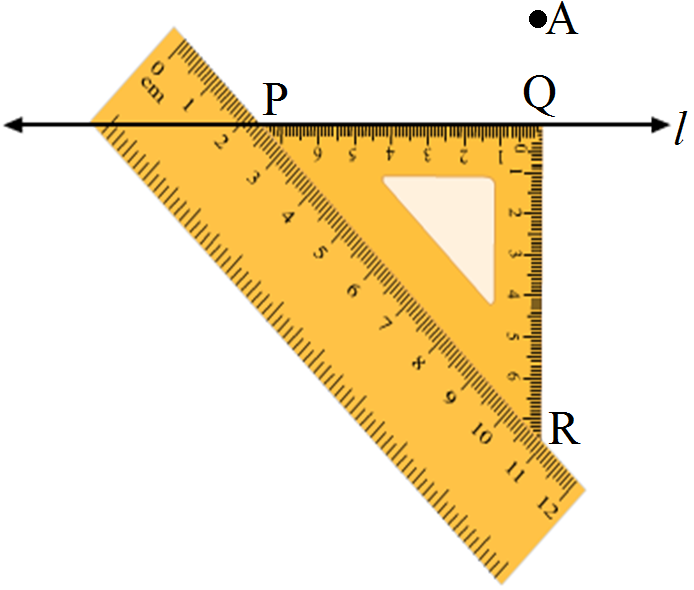
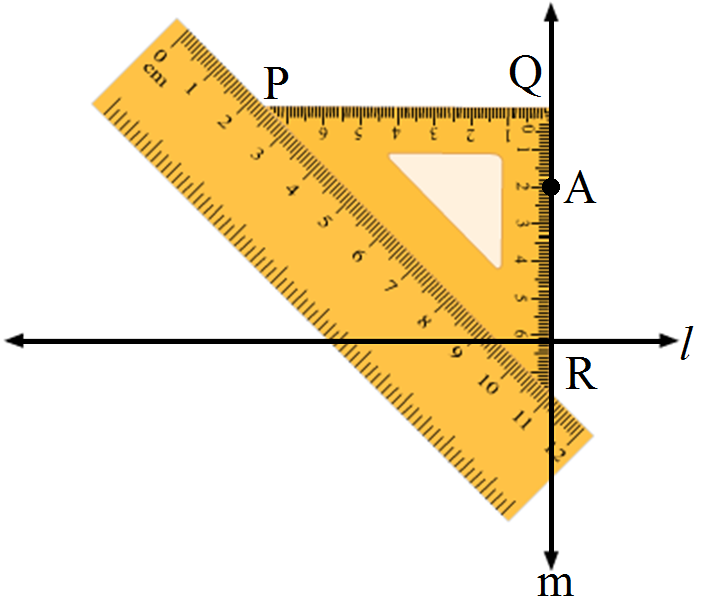
Draw a line $l.$ Take a point $A,$ not lying on $l.$ Draw a line m such that $\text{m}\perp\text{l}$ and passing through $A.$ Using ruler and a set-square.
AnswerWe draw a line $L$ and take a point $A$ outside it. Place a set square $PQR$ such that its one arm $PQ$ of the right angle is along the line $L.$ Without disturbing the position of set-square, place a ruler along its edge $PR.$ Now, without disturbing the position of the ruler, slide the set-square along the ruler until its arm $QR$ reaches point $A$. Without disturbing the position of the set-square, draw a line $m.$ Line m is the required line perpendicular to line $L.$
View full question & answer→Question 315 Marks
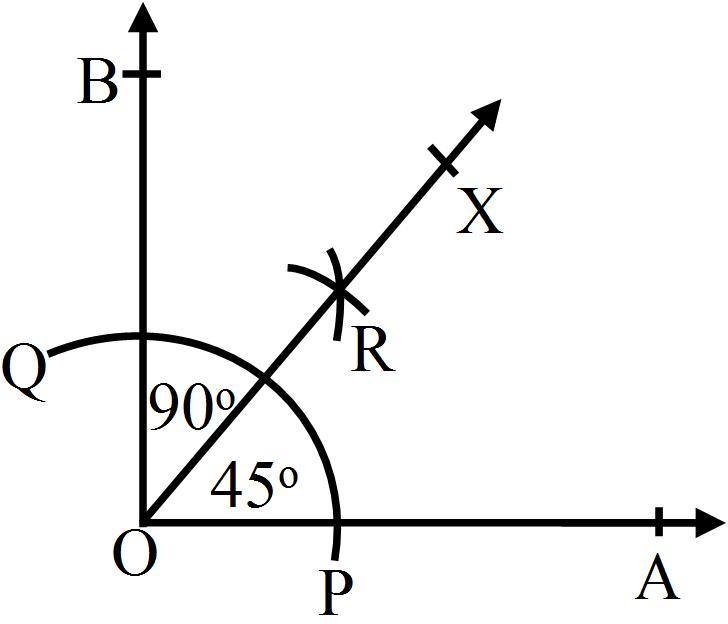
Using protractor, draw a right angle. Bisect it to get an angle of measure $45^\circ .$
AnswerWe know that a right angle is of $90^\circ .$
Draw a ray $OA.$
With the help of a protractor, draw an $\angle\text{AOB}$ of 9$0^\circ .$
With centre at $O$ and a convenient radius, draw an arc cutting sides $OA$ and $OB$ at $P$ and $Q,$ respectively.
With centre at $P$ and radius more than half of $PQ,$ draw an arc.
With the same radius and centre at $Q,$ draw another arc intersecting the previous arc at $R.$
Join O $a$nd $R$ and extend it to $X.$
$\angle\text{AOX}$ is the required angle of $45^\circ .$
$\angle\text{AOB}=90^{\circ}$
$\angle\text{AOX}=45^{\circ}$
View full question & answer→Question 325 Marks
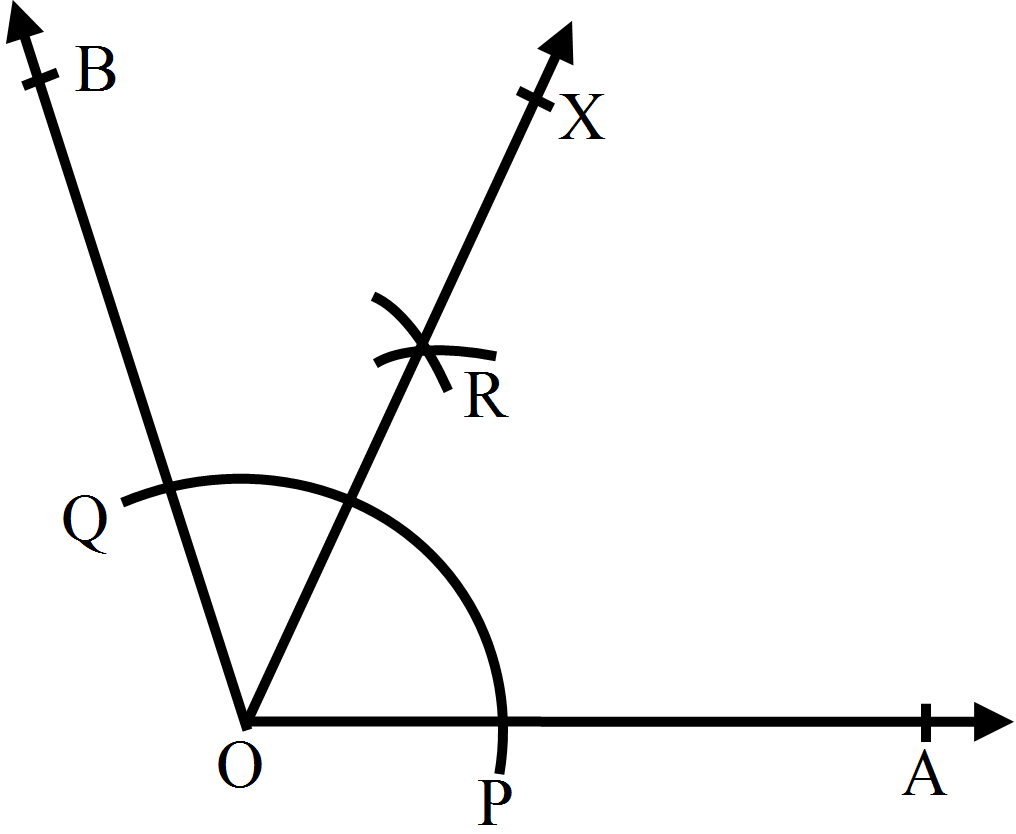
Using your protractor, draw an angle of measure $108^\circ .$ With this angle as given, draw an angle of $54^\circ .$
AnswerDraw a ray $OA.$
With the help of a protractor, construct an angle $\angle\text{AOB}$ of $108^\circ .$
Since, $\frac{108}{2}=54^{\circ}$
Therefore, $54^\circ $ is half of $108^\circ .$
To get the angle of $54^\circ ,$ we need to bisect the angle of $108^\circ .$
With centre at $O$ and a convenient radius, draw an arc cutting sides $OA$ and $OB$ at $P$ and $Q,$ respectively.
With centre at $P$ and radius more than half of $PQ,$ draw an arc.
With the same radius and centre at $Q,$ draw another arc intersecting the previous arc at $R.$
Join $O$ and $R$ and extend it to $X.$
$\angle\text{AOX}$ is the required angle of $54^\circ .$
View full question & answer→Question 335 Marks
Using ruler and compasses only, draw a right angle.
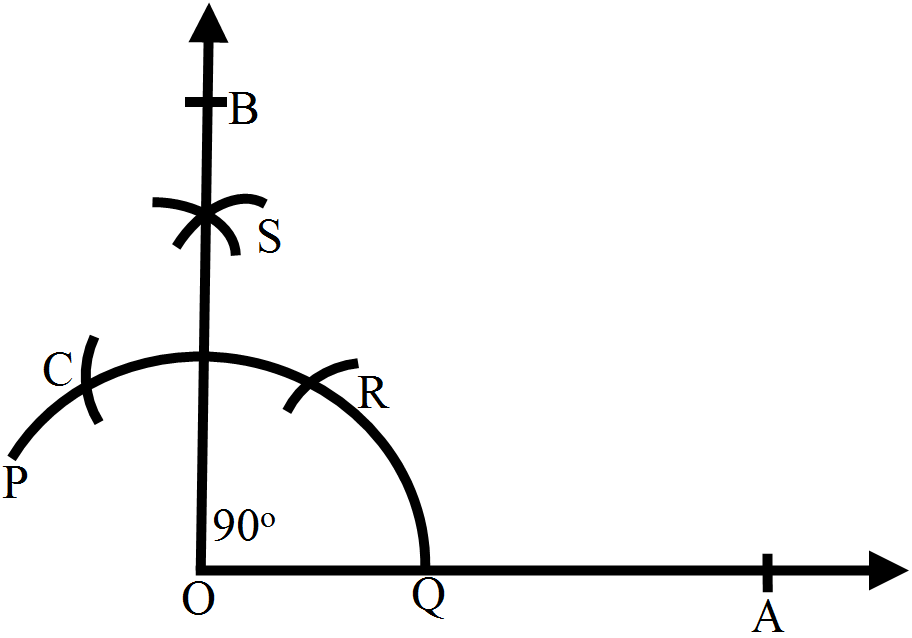
AnswerDraw a ray $OA.$ With a convenient radius and centre at $O,$ draw an arc $PQ$ with the help of a compass intersecting the ray $OA$ at $P.$ With the same radius and centre at $P,$ draw another arc intersecting the arc $PQ$ at $R.$ With the same radius and centre at $R,$ draw an arc cutting the arc $PQ$ at $C,$ opposite $P.$ Taking $C$ and $R$ as the centre, draw two arcs of radius more than half of $CR$ that intersect each other at $S.$ Join $O$ and $S$ and extend the line to $B.$
$\angle\text{AOB}$ is the required angle of $90^\circ .$
View full question & answer→Question 345 Marks
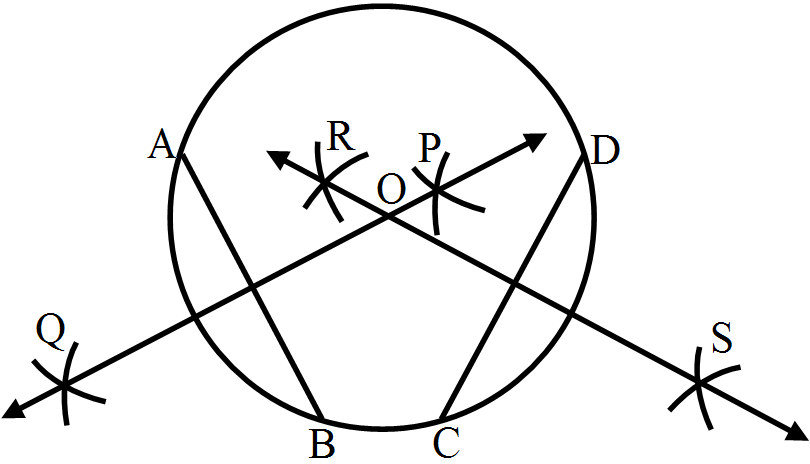
Draw a circle with centre at point $O.$ Draw its two chords $AB$ and $CD$ such that $AB$ is not parallel to $CD.$ Draw the perpendicular bisectors of $AB$ and $CD.$ At what point do they intersect$?$
AnswerDraw a circle with centre at $0.$ We draw two chords $AB$ and $CD$ as shown in the figure.
$i.\ $With $A$ as centre and radius more than half of $AB,$ draw arcs on both sides of $AB.$
$ii.\ $With the same radius and $B$ as centre, draw arcs cutting the arcs of step $(i)$ at $P$ and $Q.$
$iii.\ $Join $P$ and $Q.$
$iv.\ $With $C$ as centre and radius more than half of $CD,$ draw arcs on both sides of $CD.$
$v.\ $With the same radius and $D$ as centre, draw arcs cutting the arcs of step $(iv)$ at $R$ and $S.$
$vi.\ $Join $R$ and $S.$
We draw the line segments of perpendicular bisector of $AB$ and $CD.$
We see that the perpendicular bisector of $AB$ and $CD$ meet at $0,$ the centre of the circle.
View full question & answer→Question 355 Marks
Draw a line segment of length $10\ cm$ and bisect it. Further bisect one of the equal parts and measure its length.
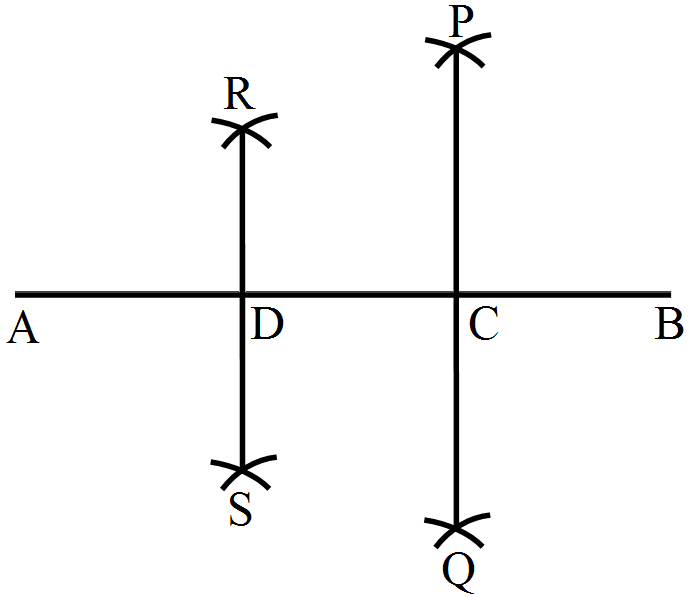
AnswerDraw a line segment $AB$ of length $10\ cm$ and bisect it.
$i.\ $With $A$ as centre and radius more than half of $AB,$ draw arcs on both sides of $AB.$
$ii.\ $With the same radius and $B$ as centre, draw arcs cutting the arcs of step $(i)$ at $P$ and $Q,$ respectively.
$iii.\ $Join $P$ and $Q.$ Line $PQ$ intersects line $AB$ at $C.$
$iv.\ $With $A$ as centre and radius more than half of $AC,$ draw arcs on both sides of $AB.$
$v.\ $With the same radius and $C$ as centre, draw arcs cutting the arcs of step $(iv) $ at $R$ and $S,$ respectively.
$vi.$Join $R$ and $S.$
Line $RS$ intersects $AC$ at $D.$ If we measure $AD$ with the ruler, we have $AD = 2.5\ cm$
View full question & answer→Question 365 Marks
Draw a line segment $AB$ and bisect it. Bisect one of the equal parts to obtain a line segment of length $\frac{1}{2}(\text{AB}).$
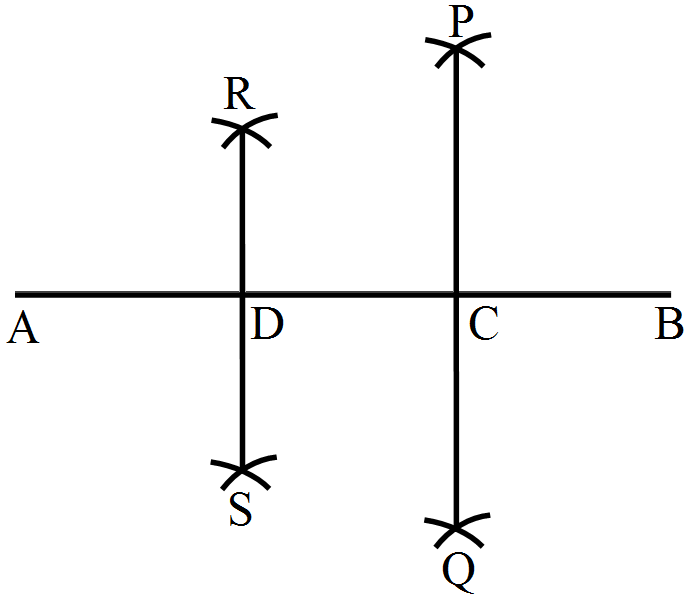
AnswerDraw a line segment $AB.$
$i.\ $With $A$ as centre and radius more than half of $AB,$ draw arcs on both sides of $AB.$
$ii.\ $With the same radius and $B$ as centre, draw arcs cutting the arcs drawn in step $(i)$ at $P$ and $Q.$
$iii.\ $Join $P$ and $Q. PQ$ intersects $AB$ at $C.$
$iv.\ $With $A$ as centre and radius more than half of $AC,$ draw arcs on both sides of $AC.$
$v.\ $With the same radius and $C$ as centre, draw arcs cutting the arcs drawn in step $(iv)$ at $R$ and $S.$
$vi.\ $Join $R$ and $S. RS$ intersects $AB$ at $D.$
Now, $AC$ and $CB$ are equal. Both are $\frac{1}{2}(\text{AB}).$ Again, divide $AC$ at $D$. So, $AD$ and $AC$ are of same length, i.e., $\frac{1}{4}\text{(AB)}.$
View full question & answer→Question 375 Marks
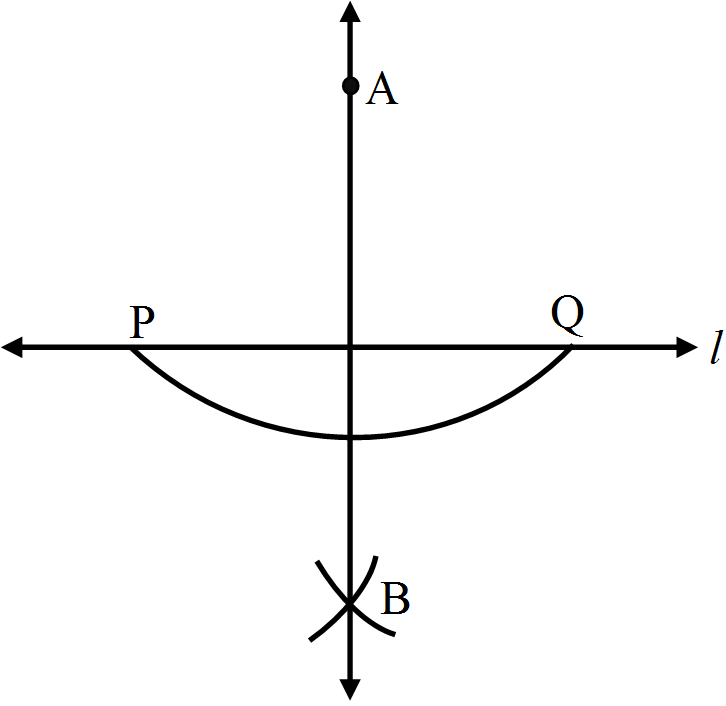
Draw a line $l.$ Take a point $A,$ not lying on $l.$ Draw a line $m$ such that $\text{m}\perp\text{l}$ and passing through $A.$ Using ruler and compasses.
AnswerWith $A$ as centre, draw an arc $PQ,$ which intersects line $L$ at points $P$ and $Q.$ Without disturbing the compass and taking $P$ and $Q$ as centres, we construct two arcs such that they intersect each other. The point where both arcs intersect is $B.$ Join points $A$ and $B$ and extend it in both directions. This is the required line.
View full question & answer→Question 385 Marks
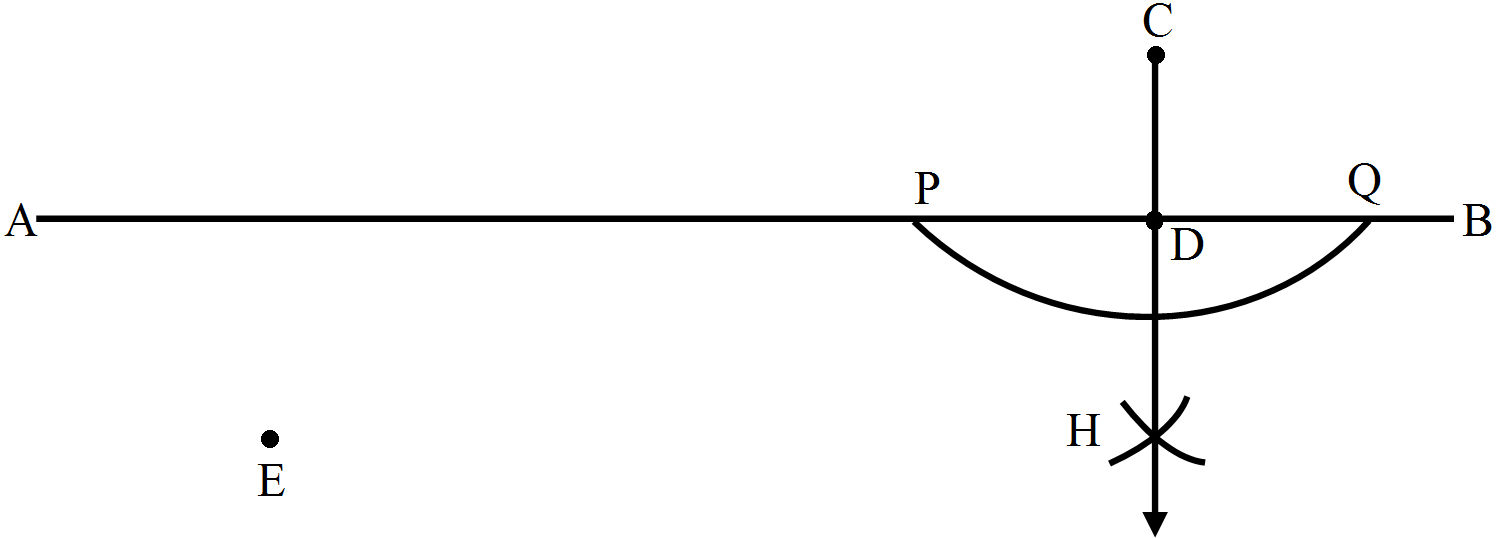
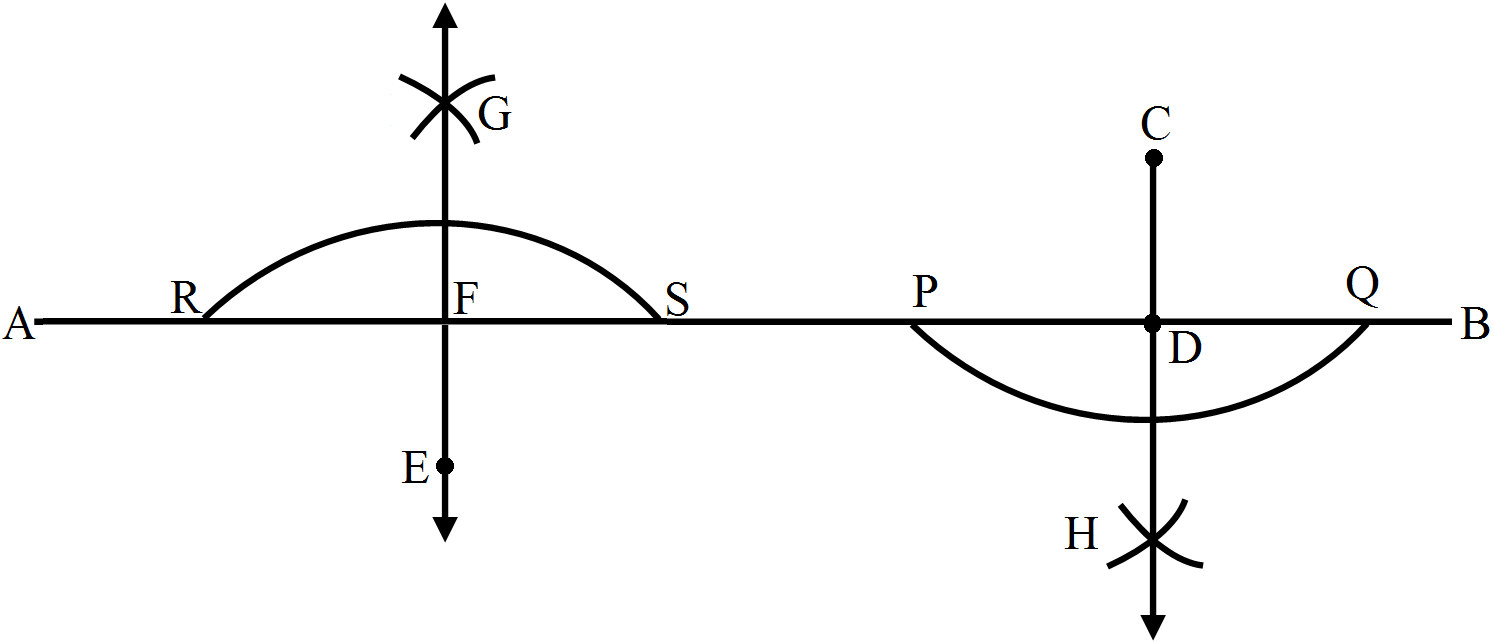
Draw a line $AB$ and take two points $C$ and $E$ on opposite sides of $AB.$ Through $C,$ draw $\text{CD}\perp\text{AB}$ and through $E$ draw $\text{EF}\perp\text{AB}.$ Using ruler and compassed.
AnswerDraw a line $AB$ and take two points $C$ and $E$ on its opposite sides. With $C$ as centre, draw an arc $PQ,$ which intersects line $AB$ at $P$ and $Q$. Taking $P$ and $Q$ as centres, construct two arcs, such that they intersect each other at $H.$ Join points $H$ and $C$. $HC$ crosses $AB$ at $D.$ We have $\text{CD}\perp\text{AB}.$ Similarly, take $E$ as centre and draw an arc $RS.$ Taking $R$ and $S$ as centres, draw two arcs which intersect each other at $G. $ Join points $G$ and $E. GE$ crosses $AB$ at $F.$ We have $\text{EF}\bot\text{AB}.$
View full question & answer→Question 395 Marks
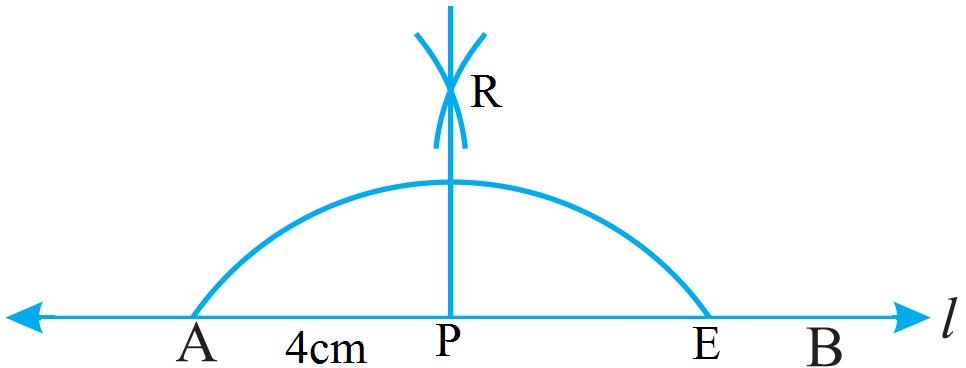
Draw a line segment $AB$ of length $10\ cm.$ Mark a point $P$ on $AB$ such that $AP = 4\ cm.$ Draw a line through $P$ perpendicular to $AB.$
AnswerWe draw line $L$ and take a point $A$ on it.
Using a ruler and a compass, we mark a point $B, 10\ cm$ from $A,$ on the line $L.$
$AB$ is the required line segment of $10\ cm.$
Again, we mark a point $P,$ which is $4\ cm$ from $A,$ in the direction of $B.$
With $P$ as centre, take a radius of $4\ cm$ and construct an arc intersecting the line $L $ at two points $A$ and $E.$
With $A$ and $E$ as centres, take a radius of $6\ cm$ and construct two arcs intersecting each other at $R.$
We join $PR$ and extend it. $PR$ is the required line, which is perpendicular to $AB.$
View full question & answer→Question 405 Marks
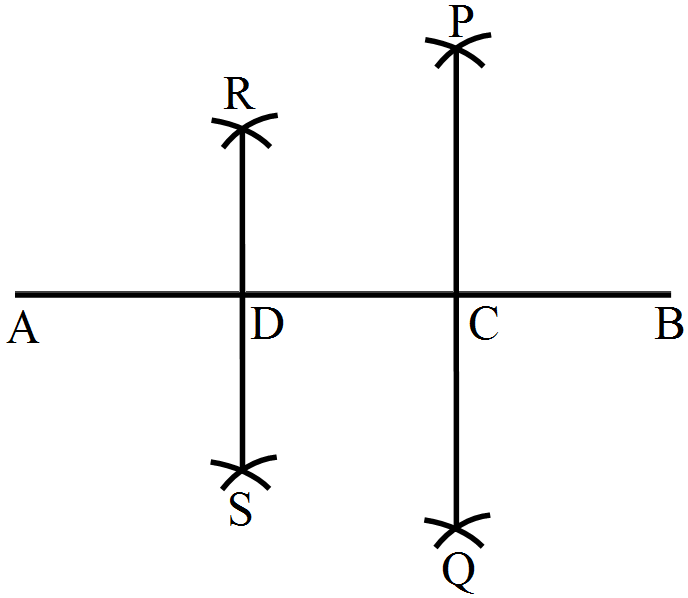
Draw a line segment $AB$ and by ruler and compasses, obtain a line segment of length $\frac{3}{4}(\text{AB}).$
AnswerDraw a line segment $AB$ using the ruler.
$i.\ $With $A$ as centre and radius more than half of $AB,$ draw arcs on both sides of $AB.$
$ii.\ $With the same radius and $B$ as centre, draw arcs cutting the arcs drawn in step $(i)$ at $P$ and $Q.$
$iii.\ $Join $P$ and $Q. PQ$ intersects $AB$ at $C.$
$iv.\ $With $A$ as centre and radius more than half of $AB,$ draw arcs on both sides of $AC.$
$v.\ $With the same radius and $C$ as centre, draw arcs cutting the arcs drawn in step $(iv)$ at $R$ and $S.$
$vi.\ $Join $R$ and $S. RS$ intersects $AB$ at $D.$
Bisect $AC$ again and mark the point of bisection as $D.$ So, we have: $ AD =\frac{1}{4}\text{(AB)}, DC =\frac{1}{4}\text{(AB)}$ and $CB =\frac{1}{2}\text{(AB)}$
Therefore, $DB =\frac{1}{4}(\text{AB})+\frac{1}{2}(\text{AB})=\frac{3}{4}(\text{AB})$
Thus, $DB$ is the required line segment of length $\frac{3}{4}(\text{AB}).$
View full question & answer→Question 415 Marks
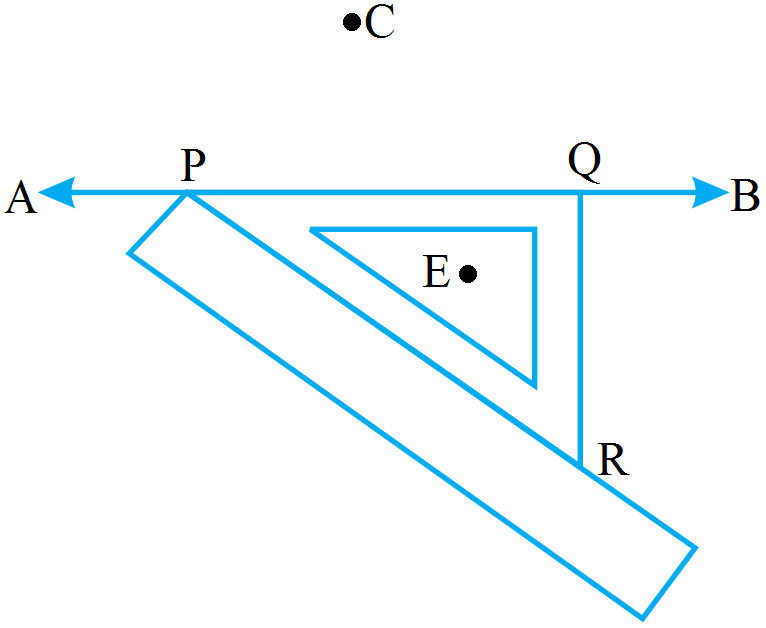
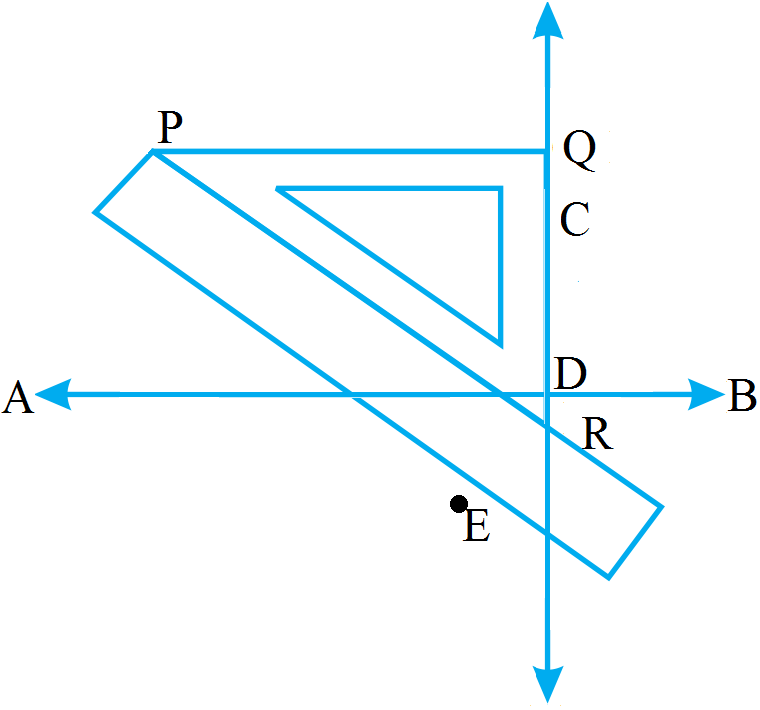
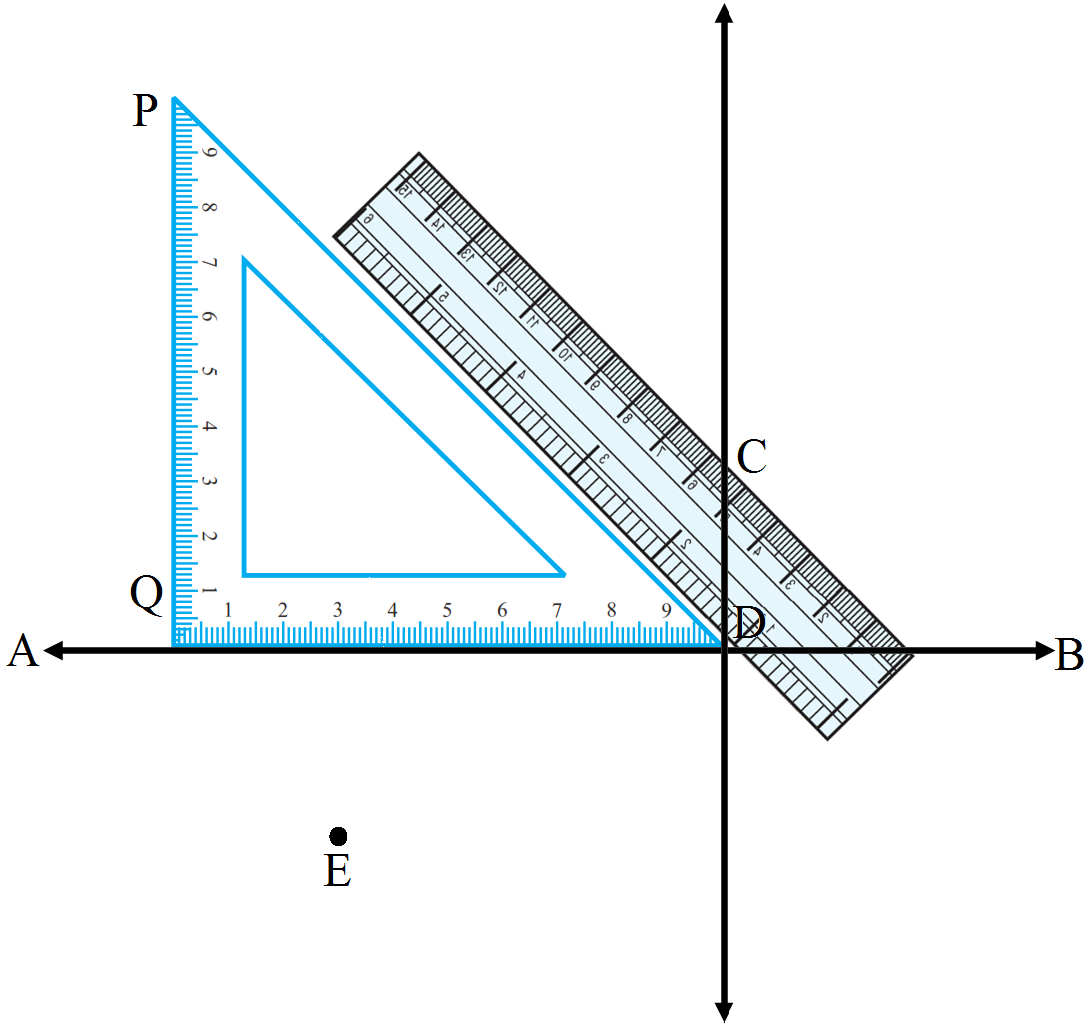
Draw a line $AB$ and take two points $C$ and $E$ on opposite sides of $AB.$ Through $C,$ draw $\text{CD}\perp\text{AB}$ and through E draw $\text{EF}\perp\text{AB}.$ ruler and set-squares.
AnswerDraw a line $AB$ and take two points $C$ and $E$ on the opposite sides of the line $AB.$ On the side of $E,$ place a set-square $PQR,$ such that its one arm $PQ$ of the right angle is along the line $AB.$ Without disturbing the position of the set-square, place a ruler along its edge $PR.$ Now, without disturbing the position of the ruler, slide the set square along the ruler until the arm $QR$ reaches point $C$. Without disturbing the position of the set-square, draw a line $CD,$ where $D$ is a point on $AB. CD$ is the required line and $\text{CD}\perp\text{AB}.$ We repeat the same process starting with taking set-square on the side of $E,$ we draw a line $\text{EF}\perp\text{AB}.$
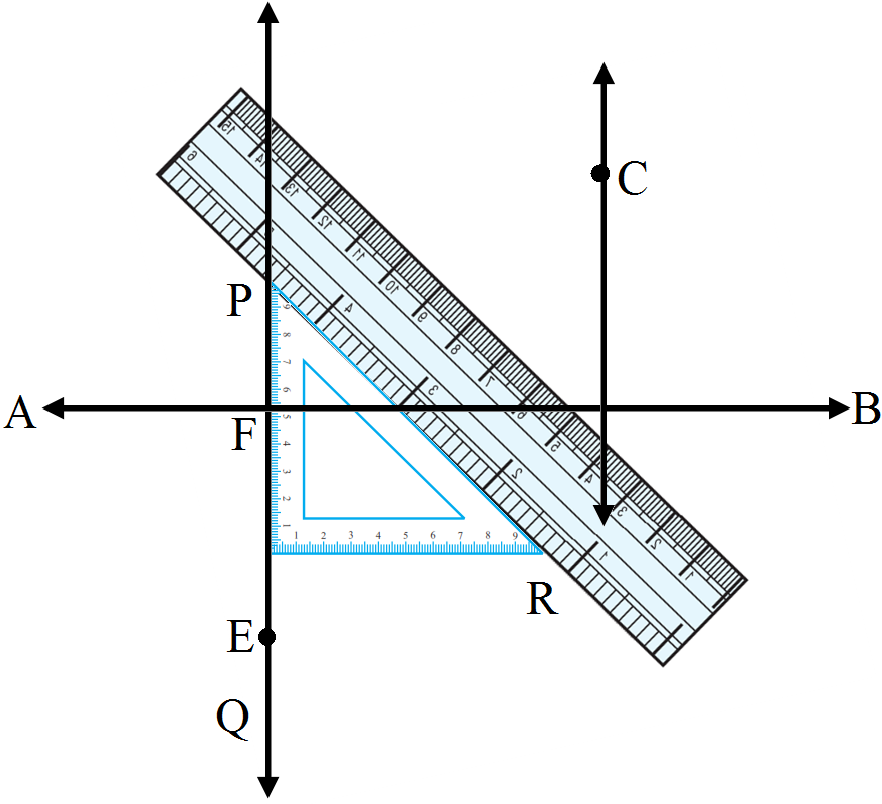
View full question & answer→Question 425 Marks
Draw a pair of vertically opposite angles. Bisect each of the two angles. Verify that the bisecting rays are in the same line.
AnswerDraw two lines $AB$ and $CD$ intersecting each other at $O.$
We know that the vertically opposite angles are equal.
Therefore, $\angle\text{BOC}=\angle\text{AOD}$ and
$\angle\text{AOC}=\angle\text{BOD}.$
We bisect angle $AOC$ and draw the bisecting ray as $OX.$
Similarly, we bisect angle $BOD$ and draw the bisecting ray as $OY.$
Now, $\angle\text{XOA}+\angle\text{AOD}+\angle\text{DOY}$
$=\frac{1}{2}\angle\text{AOC}+\angle\text{AOD}+\frac{1}{2}\angle\text{BOD}$
$=\frac{1}{2}\angle\text{BOD}+\angle\text{AOD}+\frac{1}{2}\angle\text{BOD}$
$[\text{As,}\angle\text{AOC}=\angle\text{BOD}]$
$=\angle\text{AOD}+\angle\text{BOD}$
Since, $AB $ is a line.
Therefore, $\angle\text{AOD}$ and $\angle\text{BOD}$ are supplementary angles and the sum of these two angles will be $180^\circ .$
Therefore, $\angle\text{XOA}+\angle\text{AOD}+\angle\text{DOY}=180^{\circ}$
We know that the angles on one side of a straight line will always add to $180^\circ .$
Also, the sum of the angles is $180^\circ .$
Therefore, $XY$ is a straight line.
Thus, $OX$ and $OY$ are in the same line.
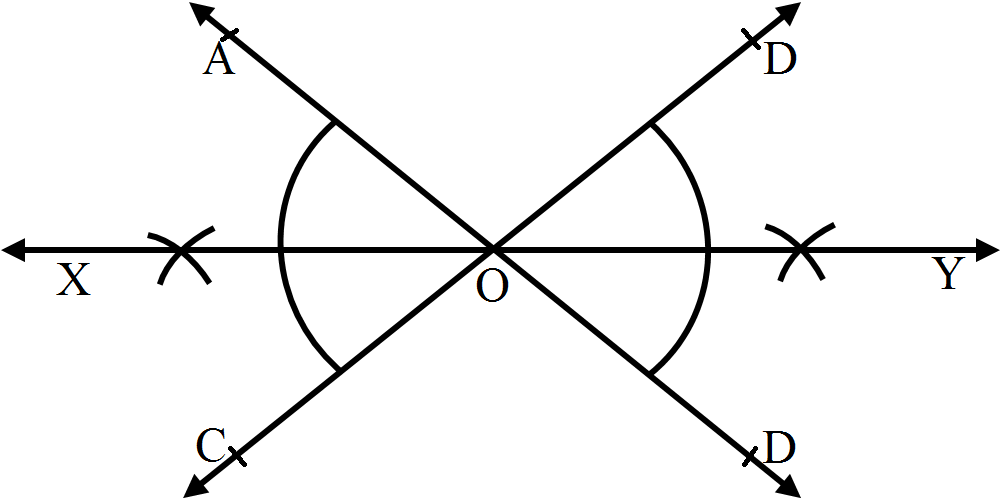
View full question & answer→Question 435 Marks
Construct the following angles with the help of a protractor: $45^\circ , 67^\circ , 38^\circ , 110^\circ , 179^\circ , 98^\circ , 84^\circ $
Answer$45^\circ $ We draw a ray $OA$. We place the protractor on $OA$ such that its centre coincides with the point $O$ and the diameter of the protractor coincides with $OA.$ We mark a point $B$ against the mark of $45^\circ $ on the protractor. We remove the protractor and draw $OB.$
$\angle\text{AOB}$ is the required angle of $45^\circ .$
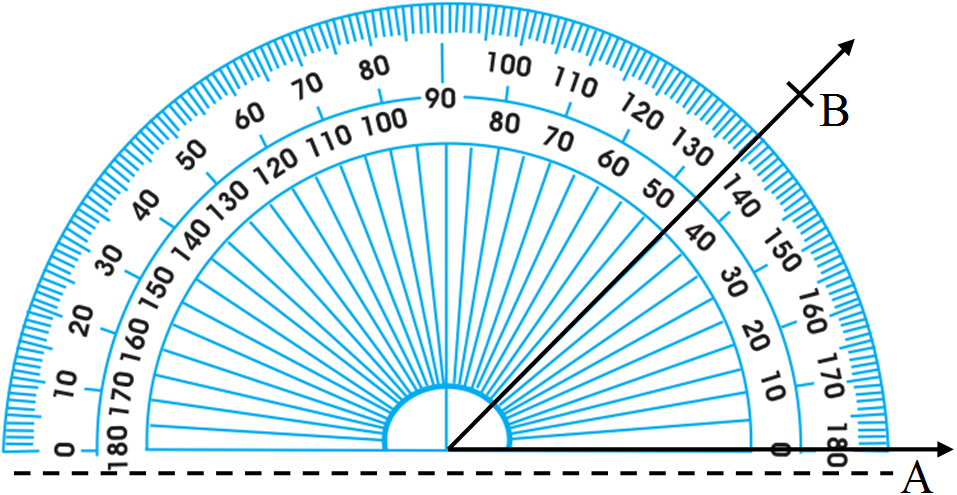
Similarly, we draw the angles $67^\circ, 38^\circ, 110^\circ, 179^\circ, 98^\circ$ and $84^\circ .$
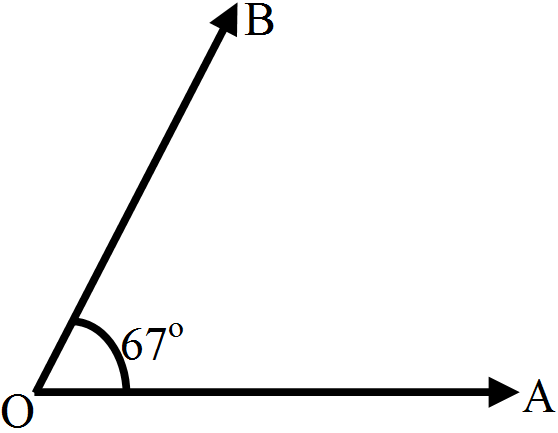
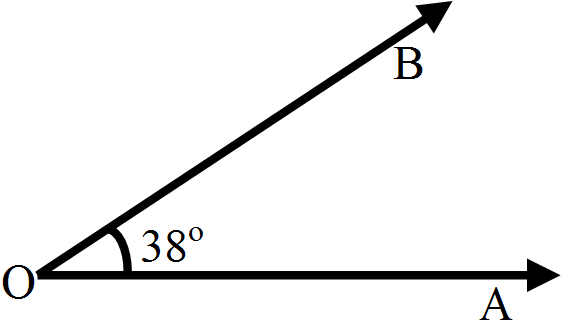

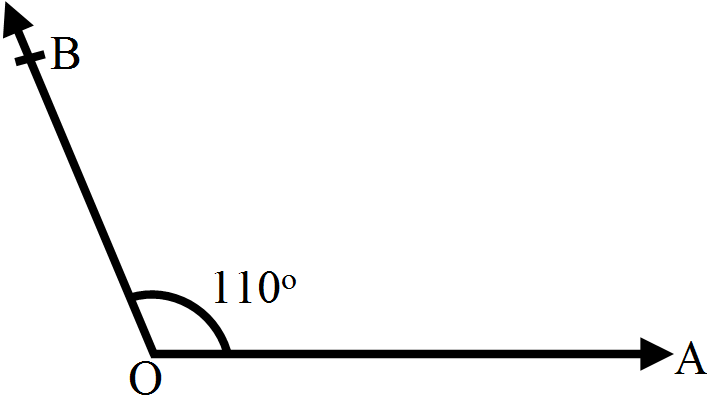
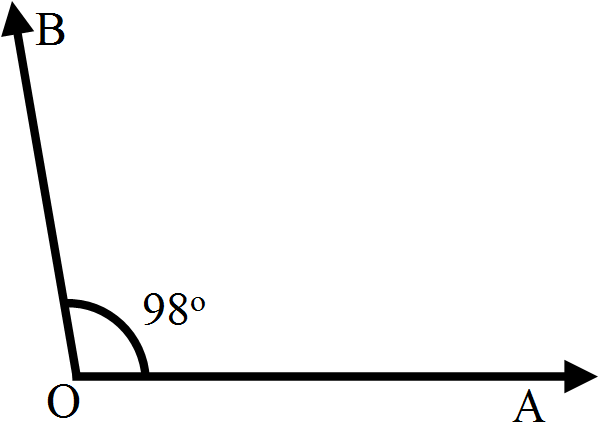
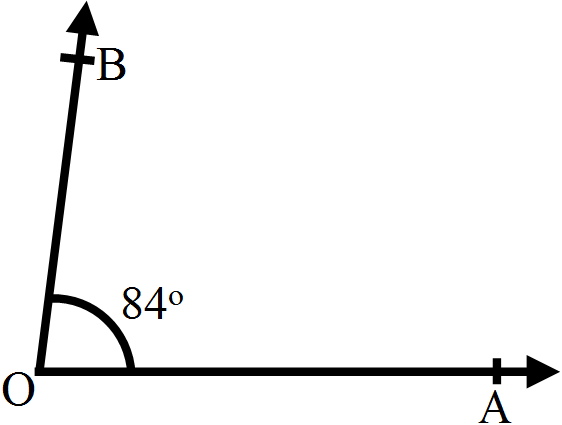
View full question & answer→Question 445 Marks
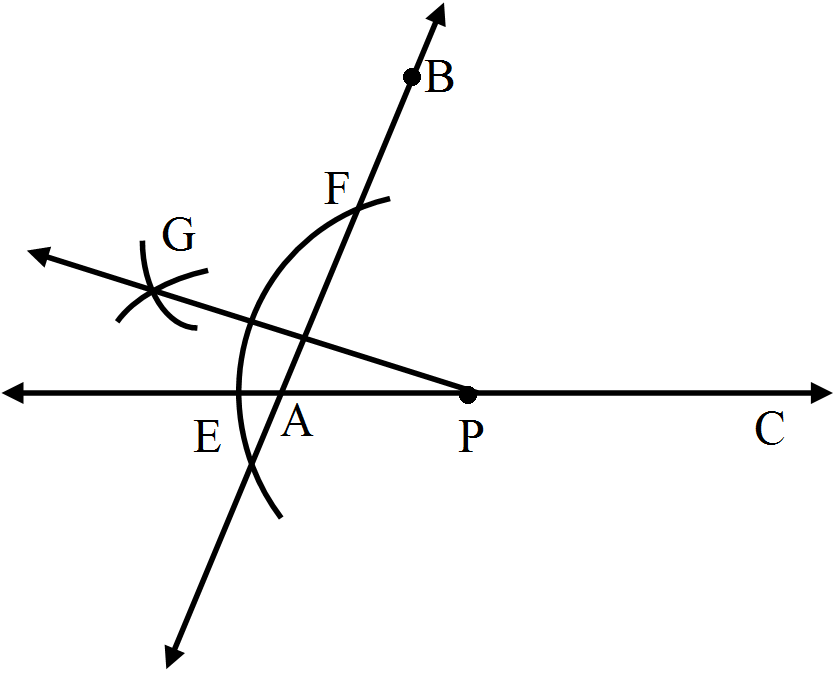
Using a protractor, draw $\angle\text{BAC}$ of measure $70^\circ .$ On side $AC,$ take a point $P,$ such that $AP = 2\ cm.$ From $P$ draw a line perpendicular to $AB.$
AnswerDraw a line segment $AC$ on a line $L$
$i.\ $Take a protractor and place it on the segment $AC$ such that segment $AC$ coincides with the line of diameter of protractor and middle of this line coincides with point $A.$
$ii.\ $Counting from the right side, mark the point as $B$ at the point of $70^\circ $ of the protractor and draw $AB.$
$iii.\ $Now, measuring $2\ cm$ from $A$ on $AC,$ mark a point $P.$
$iv.\ $With $P$ as centre, draw an arc intersecting line $1$ at points $E$ and $F.$
$v.\ $Using the same radius and $E$ and $F$ as centres, construct two arcs that intersect at point $G$ on the other side.
$vi.$Join $PG.$
View full question & answer→Question 455 Marks
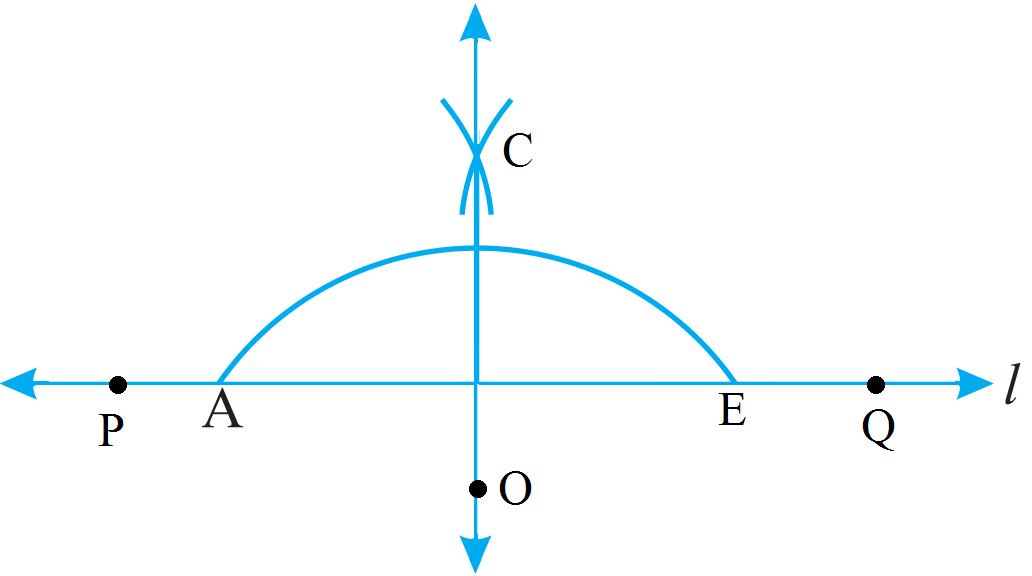
Draw a line segment $PQ$ of length $12\ cm.$ Mark a point $O$ outside this segment. Draw a line through $O$ perpendicular to $PQ.$
AnswerDraw a line $L$ and take a point $P$ on it. Using a ruler and a compass, mark a point $Q$ on the line $L,$ where $PQ = 12\ cm.$ Mark a point $Q$ outside $PQ.$ Now, with $O$ as centre, draw an arc of appropriate radius such that the arc cuts the line at points $A$ and $B.$ Taking $A$ and $B$ as centres, construct two arcs such that they intersect each other at $C.$ Join $OC. OC$ is the required line, which is perpendicular to $PQ.$
View full question & answer→Question 465 Marks
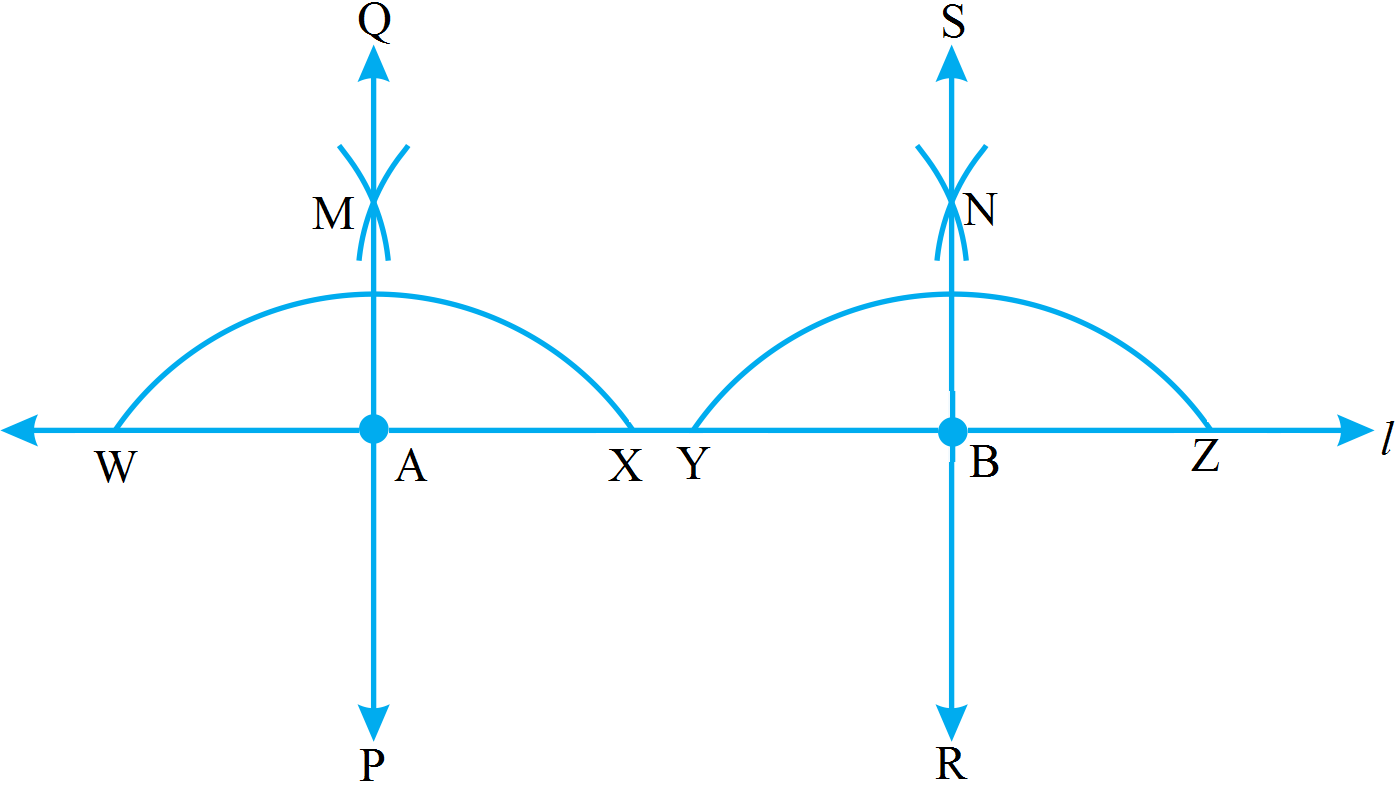
Draw a line segment $AB$ of length $8\ cm.$ At each end of this line segment, draw a line perpendicular to $AB.$ Are these two lines parallel?
Answer$i.\ $Take a convenient radius with $A$ as centre and draw an arc intersecting the line at points $W$ and $X.$
$ii.\ $With $W$ and $X$ as centres and radius greater than $AW,$ construct two arcs intersecting each other at $M.$
$iii.\ $Join $AM$ and extend it in both directions to $P$ and $Q.$
$iv.\ $Take a convenient radius with $B$ as centre and draw an arc intersecting the line at points $Y$ and $Z.$
$v.\ $With $Y$ and $Z$ as centres and a radius greater than $YB,$ construct two arcs intersecting each other at $N$.
$vi.\ $Join $BN$ and extend it in both directions to $S$ and $R.$
Let the lines perpendicular at $A$ and $B$ be $PQ$ and $RS,$ respectively.
Since, $\angle\text{QAB}=90^{\circ}$ and $\angle\text{ABR}=90^{\circ}$
Therefore, $\angle\text{QAB}=\angle\text{ABR}.$
When two parallel lines are intersected by a third line, the two alternate interior angles are equal.
Since, $\angle\text{QAB}=\angle\text{ABR}$
Therefore, $PQ$ and $RS$ are parallel.
View full question & answer→Question 475 Marks
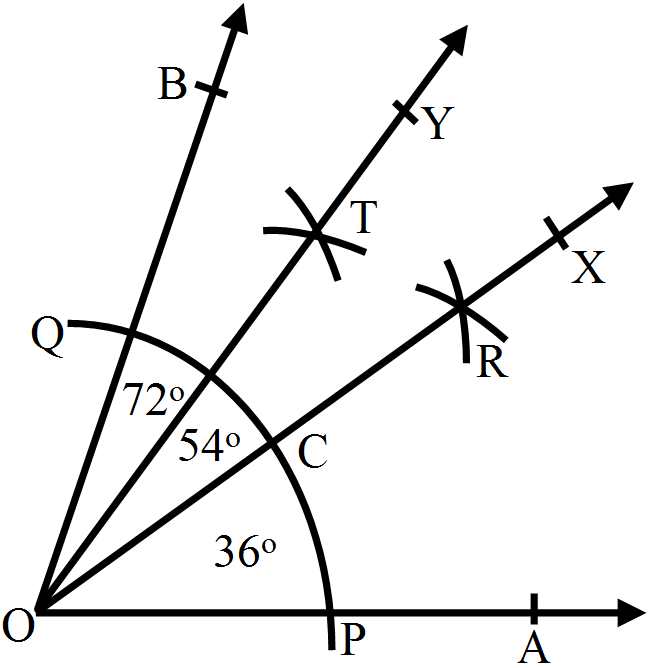
Using a protractor, draw an angle of measure $72^\circ .$ With this angle as given, draw angles of measure $36^\circ $ and $54^\circ .$
AnswerDraw a ray $OA$.
With the help of a protractor, draw an angle $\angle\text{AOB}$ of $72^\circ $.
With a convenient radius and centre at $O,$ draw an arc cutting sides $OA $ and $OB$ at $P$ and $Q,$ respectively.
With $P$ and $Q$ as centres and radius more than half of $PQ,$ draw two arcs cutting each other at $R.$
Join $O$ and $R$ and extend it to $X.$
$ OR$ intersects arc $PQ$ at $C. $
With $C$ and $Q$ as centres and radius more than half of $CQ,$ draw two arcs cutting each other at $T.$
Join $O$ and $T$ and extend it to $Y.$
Now, $OX$ bisects $\angle\text{AOB}$
Therefore, $\angle\text{AOX}=\angle\text{BOX}=\frac{72}{2}=36^{\circ}$
Again, $OY$ bisects $\angle\text{BOX}$
Therefore, $\angle\text{XOY}=\angle\text{BOY}=\frac{36}{2}=18^{\circ}$
Therefore, $\angle\text{AOX}$ is the required angle of $36^\circ $ and $\angle\text{AOY}=\angle\text{AOX}+\angle\text{XOY}=36^{\circ}+18^{\circ}=54^{\circ}$
Therefore, $\angle\text{AOY}$ is the required angle of $54^\circ .$
View full question & answer→Question 485 Marks
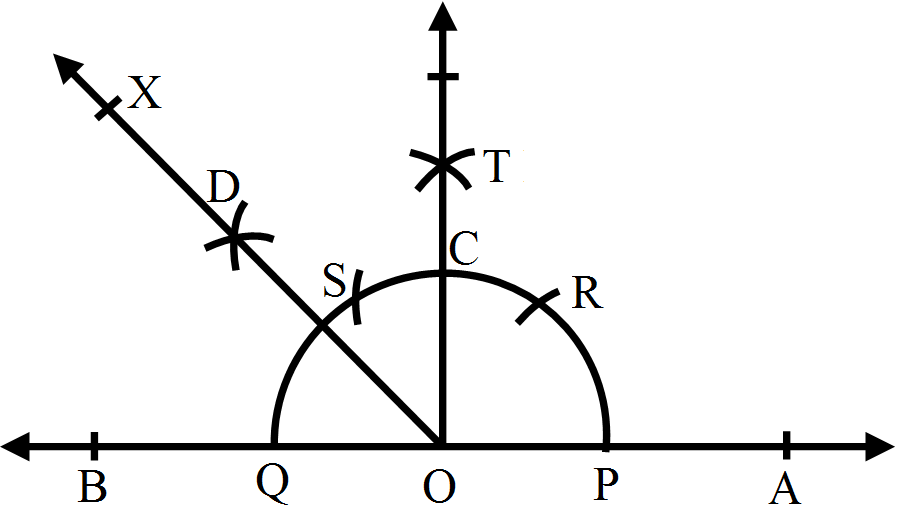
Using ruler and compasses only, draw an angle of measure $135^\circ .$
AnswerWe draw a line $AB$ and mark a point $O$ on it. With a convenient radius and centre at $O,$ draw an arc $PQ$ with the help of a compass intersecting the line $AB$ at $P$ and $Q.$ With the same radius and centre at $P,$ draw another arc intersecting the arc $PQ$ at $R.$ With the same radius and centre at $Q,$ draw one more arc intersecting the arc $PQ$ at $S,$ opposite to $P.$ Taking $S$ and $R$ as centres and radius more than half of $SR,$ draw two arcs intersecting each other at $T.$ Join $O$ and $T$ intersecting the arc $PQ$ at $C.$ Taking $C$ and $Q$ as centres and radius more than half of $CQ,$ draw two arcs intersecting each other at $D.$ Join $O$ and $D$ and extend it to $X$ to form the ray $OX.$
$\angle\text{AOX}$ is the required angle of measure $135^\circ .$
View full question & answer→Question 495 Marks
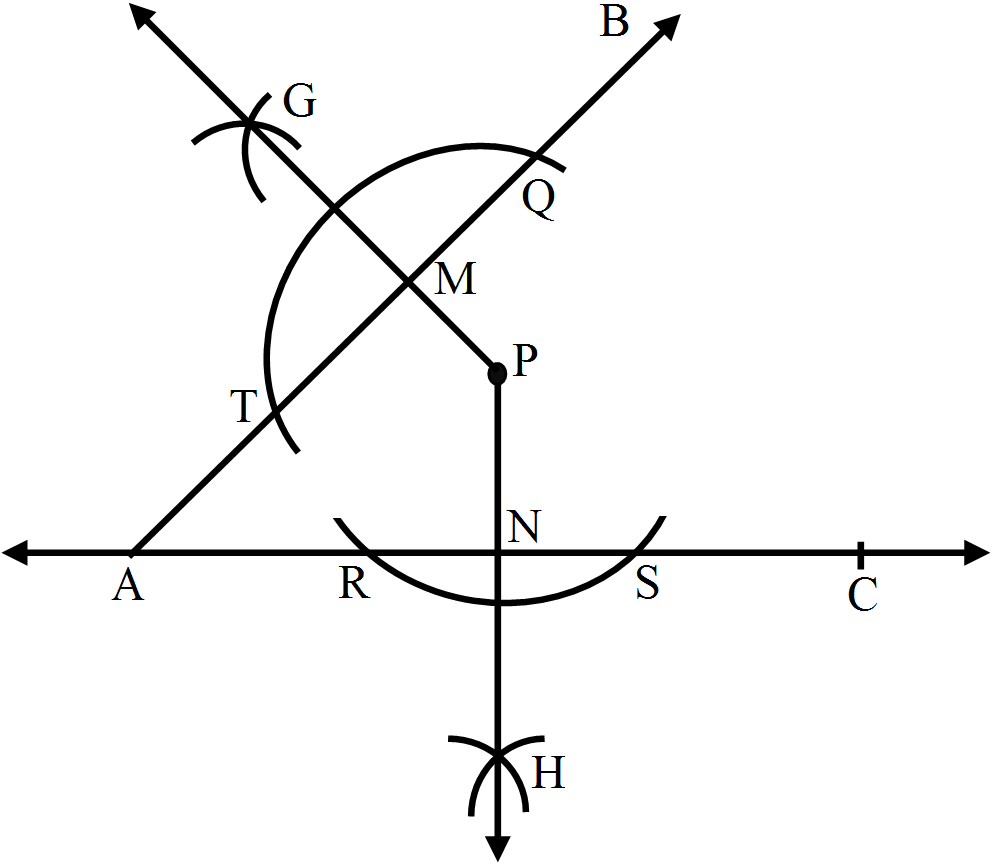
Using a protractor, draw $\angle\text{BAC}$ of measure $45^\circ .$ Take a point $P$ in the interior of $\angle\text{BAC}.$ From $P$ draw line segments $PM$ and $PN$ such that $\text{PM}\perp\text{AB}$ and $\text{PN}\perp\text{AC},$ Measure $\angle\text{MPN}.$
Answer$i.\ $Draw a line segment $A$ on the line $L .$
$ii.\ $Take a protractor and place it on the segment $AC$ such that $AC$ coincides with the line of the diameter of the protractor and the middle point of the line coincides with point $A.$
$iii.\ $Counting from the right side, mark a point as $B$ at the point of $45^\circ $ of protractor and draw a line segment $AB.$
$iv.\ $Take a convenient radius with $P$ as centre, construct an arc intersecting the line segments $AB$ at $T$ and $Q$ and $AC$ at $R$ and $S.$
$v.\ $Using the same radius and with $T$ and $Q$ as centres, construct two arcs intersecting at $G$ on the other side.
$vi.\ $Using the same radius and with $R$ and $S$ as centres, construct two arcs intersecting at $H$ on the other side.
$vii.\ $Join $PG$ and $PH$ which intersects $AB$ and $AC$ at $M$ and $N,$ respectively.
On measuring $\angle\text{MPN}$ using a protractor, we get it equal to $135^\circ .$
View full question & answer→Question 505 Marks
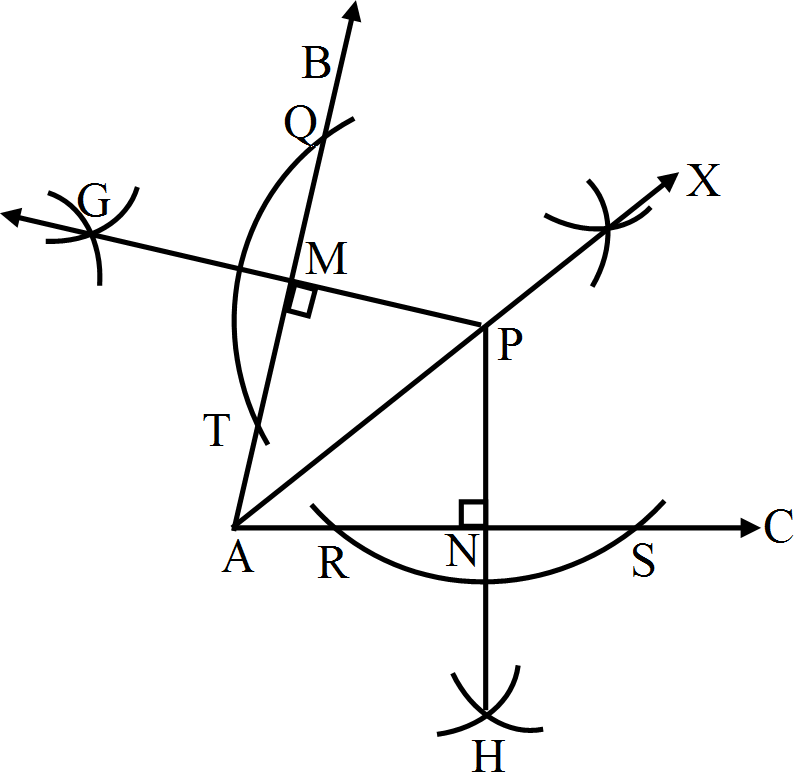
Draw an angle and label it as $\angle\text{BAC}.$ Draw its bisector ray $AX$ and take a point $P$ on it. From $P$ draw line segments $PM$ and $PN,$ such that $\text{PM}\perp\text{AB}$ and $\text{PN}\perp\text{AC},$ where $M$ and $N$ are respectively points on rays $AB$ and $AC$. Measure $PM$ and $PN.$ Are the two lengths equal$?$
Answer$i.\ $Draw $\angle\text{BAC}$ on the line segment $AC.$
With a convenient radius and $A$ as centre, draw an arc from $AB$ and $AC.$
$ii.\ $The points where arc cuts $AB$ and $AC,$ take both points as centres and draw two small arcs intersecting at $X.$ Now, draw $AX.$
$iii.\ $Take a point $P$ on the ray $AX.$
$iv.\ $Take a convenient radius with $P$ as centre and construct an arc intersecting the line segments $AB$ at $T$ and $Q$ and $AC$ at $R$ and $S,$ respectively.
$v.\ $Using the same radius and with $T$ and $Q$ as centres, construct two arcs intersecting at $G$ on the other side.
$vi.\ $Using the same radius and with $R$ and $S$ as centres, construct two arcs intersecting at $H$ on the other side.
$vii.\ $Join $PG$ and $PH,$ which intersects $AB$ and $AC$ at $M$ and $N, $respectively.
On measuring $PM$ and $PN$ using a ruler, we find that both are equal.
View full question & answer→