Question 12 Marks
Express the number appearing in the statement in standard form: The distance of the Sun from the centre of the Milky Way Galaxy is estimated to be $300,000,000,000,000,000,000\ m.$
AnswerGiven that,
Distance of sun from the centre of Milky Way galaxy $= 300, 000, 000, 000, 000, 000, 000\ m$
Thus, it can be expressed as,
$300,000,000,000,000,000,000=3 \times 10^{20} \mathrm{~m}$
View full question & answer→Question 22 Marks
Simplify:$\frac{3^{5} \times 10^{5} \times 25}{5^{7} \times 6^{5}}$
Answer$\frac{3^{5} \times 10^{5} \times 25}{5^{7} \times 6^{5}}=\frac{3^{5} \times(2 \times 5)^{5} \times 5^{2}}{5^{7} \times(2 \times 3)^{5}}$
= $\frac{3^{5} \times 2^{5} \times 5^{5} \times 5^{2}}{5^{7} \times 2^{5} \times 3^{5}}$
= $\frac{3^{5} \times 2^{5} \times 5^{5+2}}{2^{5} \times 3^{5} \times 5^{7}}=\frac{2^{5} \times 3^{5} \times 5^{7}}{2^{5} \times 3^{5} \times 5^{7}}$
$=2^{5-5} \times 3^{5-5} \times 5^{7-7}$
$=2^0 \times 3^0 \times 5^0$
$=1 \times 1 \times 1=1$
View full question & answer→Question 32 Marks
Simplify:$\frac{25 \times 5^{2} \times t^{8}}{10^{3} t^{4}}$
Answer$\frac{25 \times 5^{2} \times t^{8}}{10^{3} \times t^{4}}=\frac{5^{2} \times 5^{2} \times t^{8}}{(2 \times 5)^{3} \times t^{4}}=\frac{5^{2+2} \times t^{8}}{2^{3} \times 5^{3} \times t^{4}}$
$\frac{5^{4} \times t^{8}}{2^{3} \times 5^{3} \times t^{4}}=\frac{5^{4-3} \times \ t^{8-4}}{2^{3}}=\frac{5^{1} \times \ t^{4}}{2^{3}}=\frac{5 t^{4}}{8}$
View full question & answer→Question 42 Marks
Simplify $\frac{\left(2^{5}\right)^{2} \times 7^{3}}{8^{3} \times 7}$
Answer$\frac{\left(2^{5}\right)^{2} \times 7^{3}}{8^{3} \times 7}=\frac{2^{5 \times 2} \times 7^{3}}{\left(2^{3}\right)^{3} \times 7}=\frac{2^{10} \times 7^{3}}{2^{3 \times 3} \times 7}$
= $\frac{2^{10} \times 7^{3}}{2^{9} \times 7}$
$=2^{10-9} \times 7^{3-1}=2^{1 \times 7^2}$
$=2 \times 7 \times 7=98$
View full question & answer→Question 52 Marks
Express a product of prime factor only in exponential form: $768$
AnswerThe given number is: $768$
We have to express this as a product of prime factors only in exponential form
Thus, $768=2 \times 2 \times 2 \times 2 \times 2 \times 2 \times 2 \times 2 \times 3=2^8 \times 3$
View full question & answer→Question 62 Marks
Express the product of prime factors only in exponential form: $729 \times 64$
AnswerGiven product is; $729 \times 64$
We have to express this as a product of prime factors only in exponential form
Thus,
$729 \times 64$
$=(3 \times 3 \times 3 \times 3 \times 3 \times 3) \times(2 \times 2 \times 2 \times 2 \times 2 \times 2)=3^6 \times 2^6$
View full question & answer→Question 72 Marks
Express the number as a product of prime factors only in exponential form: $270.$
Answer
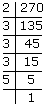
$\therefore 270=2 \times 3 \times 3 \times 3 \times 5=2^1 \times 3^3 \times 5^1$
It is the required prime factor product form. View full question & answer→Question 82 Marks
Express the number as a product of prime factors only in exponential form: $108 \times 192.$
Answer$108 \times 192 = (2 \times2 \times 3 \times 3 \times 3) \times (2 \times 2 \times 2 \times 2 \times 2 \times 2 \times 3)$
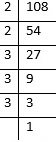
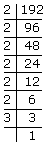
$= 2 \times 2 \times 3 \times 3 \times 3 \times 2 \times 2 \times 2 \times 2 \times 2 \times 2 \times 3$
$= 2 \times 2 \times 2 \times 2 \times 2 \times 2 \times 2 \times 2 \times 3 \times 3 \times 3 \times 3$
$= 2^8 \times 3^4$
It is the required prime factor product form. View full question & answer→Question 92 Marks
Say true or false and justify your answer : $3^0 = (1000)^0$
Answer$3^0=1,$
$1000^0=1.$
$\therefore 3^0=1000^0 \text { is true. }$
View full question & answer→Question 102 Marks
Say true or false and justify your answer: $2^3 \times 3^2 = 6^5$
AnswerSay true or false and justify your answer: $2^3 \times 3^2=6^5$
$LHS =$ Expand $2^3$ and $3^2$
$2^3=2 \times 2 \times 2=8$
$5^2=5 \times 5=25$
$=8 \times 25=200$
$\text { RHS }=6^5$
$6 \times 6 \times 6 \times 6 \times 6=7776$
$2^3 \times 3^2<6^5$
$\therefore 2^3 \times 3^2=6^5 \text { is false }$
View full question & answer→Question 112 Marks
Say true or false and justify your answer: $2^3 > 5^2$
AnswerExpand $2^3$ and $5^2$
$2^3=2 \times 2 \times 2=8$
$5^2=5 \times 5=25$
$\because 8$ is less than $25$
$\therefore 2^3>5^2$ is false.
View full question & answer→Question 122 Marks
Say true or false and justify your answer: $10 \times 10^{11} = 100^{11}$
AnswerBy the law of exponents we have,
$x^m \times x^n=x^{m+n}$
$\text { L.H.S. }=1010^{11}=10^{1 \times 10^{11}}$
$=10^{1+11}=10^{12}$
Hence $10 \times 10^{11}=10^{12}$
And
$100^{11}=(10 \times 10)^{11}=\left(10^2\right)^{11}$
$=10^{22}=\text { R.H.S. }$
Since $10^{12} \neq 10^{22}$
So, $10 \times 10^{11} \neq 100^{11}$
$\therefore 10 \times 10^{11}=100^{11}$ is False.
View full question & answer→Question 132 Marks
Simplify and express the number in exponential form: $\frac{2^{8} \times a^{5}}{4^{3} \times a^{3}}$
AnswerBy the law of exponents we have,
$\left(x^m\right)^n=x^{m n}$
$\frac{x^m}{x^n}=x^{m-n}$
By applying these laws we have
$\frac{2^8 \times a^5}{4^3 \times a^3}=\frac{2^8 \times a^5}{\left(2^2\right)^3 \times a^3}=\frac{2^8 \times a^5}{2^{2 \times 3} \times a^3}$
$=\frac{2^8 \times a^5}{2^6 \times a^3}=2^{8-6} \times a^{5-3}=2^2 \times a^2=(2 a)^2$
$=4 a^2$
Hence $\frac{2^8 \times \mathrm{a}^5}{4^3 \times \mathrm{a}^3}=4 \mathrm{a}^2$
View full question & answer→Question 142 Marks
Simplify and express in exponential form: $\left(3^{\circ}+2^{\circ}\right) \times 5^{\circ}$
AnswerBy the law of exponenets $x^0=1$
By applying this law,
$\left(3^{\circ}+2^{\circ}\right) \times 5^{\circ}=(1+1) \times 1=2 \times 1=2$
View full question & answer→Question 152 Marks
Simplify and express in exponential form: $2^0 \times 3^0 \times 4^0$
AnswerWe have, $2^0 \times 3^0 \times 4^0=1 \times 1 \times 1=1$
View full question & answer→Question 162 Marks
Simplify : $2^0+3^0+4^0$
AnswerWe have,
$2^0+3^0+4^0$
$=1+1+1=3$
View full question & answer→Question 172 Marks
Simplify and express in exponential form: $\frac{3^{7}}{3^{4} \times 3^{2}}$
AnswerIn the above question,
We have to simplify the given numbers into exponential form:
We have,
$\frac{3^7}{3^4 \times 3^2}$
Using identity: $\left(a^m \times a^n=a^{m+n}\right)$
$=\frac{3^7}{3^7}$
Using identity $\left(a^m \div a^n=a^{m-n}\right)$
$=3^{7-7}=3^0=1$
View full question & answer→Question 182 Marks
Simplify and express in exponential form: $\frac{3 \times 7^{2} \times 11^{8}}{21 \times 11^{3}}$
AnswerIn the above question,
We have to simplify the given numbers into exponential form:
We have
$\frac{3 \times 7^{2} \times 11^{8}}{21 \times 11^{3}}$ = $\frac{3 \times 7^{2} \times 11^{8}}{3 \times 7 \times 11^{3}}$
Using identity: $\left(a^m \div a^n=a^{m-n}\right)$
$=3^{1-1} \times 7^{2-1} \times 11^{8-3}=3^0 \times 7^1 \times 11^5=1 \times 7 \times 11^5=7 \times 11^5$
View full question & answer→Question 192 Marks
Simplify and express in exponential form: $25^4 \div 5^3$
AnswerIn the above question,
We have to simplify the given numbers into exponential form:
We have,
$25^4 \div 5^3=(5 \times 5)^4 \div 5^3$
Using identity: $\left(a^m\right)^n=a^{m n}$
$=5^2 \div 4 \div 5^3=5^8 \div 5^3$
Using identity: $\left(a^m \div a^n=a^{m-n}\right)$
$5^8 \div 5^3=5^{8-3}=5^5$
View full question & answer→Question 202 Marks
Simplify and express in exponential form: $\left(2^3 \times 2\right)^2$
AnswerIn the above question,
We have to simplify the given numbers into exponential form:
Therefore, We have,
$\left(2^3 \times 2\right)^2$
Using identity: $\left(a^m \times a^n=a^{m+n}\right)$
$=\left(2^{3+1}\right)^2=\left(2^4\right)^2$
Using identity: $\left(a^m\right)^n=a^{m n}$
Therefore,
$=2^{4 \times 2}=2^8$
View full question & answer→Question 212 Marks
Simplify and express the number in exponential form: $\frac{4^{5} \times a^{8} b^{3}}{4^{5} \times a^{5} b^{2}}$
AnswerBy the law of exponents, we have
$\frac{X^m}{X^n}=X^{m-n} \text { and } a^{\circ}=1$
By applying the law of exponents we have
$\frac{4^5}{4^5} \times \frac{a^8}{a^5} \times \frac{b^3}{b^2}=4^{5-5} \times a^{8-5} \times b^{3-2}$
$\frac{4^5 \times a^8 b^3}{4^5 \times a^5 b^2}=4^0 \times a^3 \mathrm{~b}=a^3 \mathrm{~b}$
View full question & answer→Question 222 Marks
Simplify and express the number in exponential form: $\left(\frac{a^{5}}{a^{3}}\right) \times a^8$
AnswerBy the law of exponents we have,
$\frac{x^m}{x^n}=X^{m-n} \text { and } X^m \times X^n=X^{m+n}$
By applying these laws of exponents
$\left(\frac{a^5}{a^3}\right) \times a^8=a^{5-3} \times a^8$
$=a^2 \times a^8=a^{2+8}=a^{10}$
Hence, $\left(\frac{a^5}{a^3}\right) \times a^8=a^{10}$
View full question & answer→Question 232 Marks
Using laws of exponent, simplify and write the answer in exponential form: $\left(2^{20} \div 2^{15}\right) \times 2^3$
AnswerBy the law of exponents we have, $x^m \div x^n=x^{m-n}$
By applying this law, we have $\left(2^{20} \div 2^{15}\right)=2^{20-15}=2^5$
$\left(2^{20} \div 2^{15}\right) \times 2^3=2^5 \times 2^3$
Again, we have $x^m \times x^n=x^{m+n}$
By applying this we have, $2^5 \times 2^3=2^{5+3}=2^8$ Hence, $\left(2^{20} \div 2^{15}\right) \times 2^3=2^8$
View full question & answer→Question 242 Marks
Using laws of exponent, simplify and write the answer in exponential form: $a^4 \times b^4$
Answer$a^4 \times b^4=a \times a \times a \times a \times b \times b \times b \times b$
$=(a \times b) \times(a \times b) \times(a \times b) \times(a \times b)$
$=(a b) \times(a b) \times(a b) \times(a b)=(a b)^4$
Hence, $a^4 \times b^4=(a b)^4$
View full question & answer→Question 252 Marks
Using laws of exponent, simplify and write the answer in exponential form: $2^5 \times 5^5$
AnswerBy expanding $2^5 \times 5^5$, we get $2 \times 2 \times 2 \times 2 \times 2 \times 5 \times 5 \times 5 \times 5 \times 5$
$=(2 \times 5) \times(2 \times 5) \times(2 \times 5) \times(2 \times 5) \times(2 \times 5)=10 \times 10 \times 10 \times 10 \times 10=10^5$
Hence $2^5 \times 5^5=10^5$
View full question & answer→Question 262 Marks
Using laws of exponent, simplify and write the answer in exponential form: $\left(5^2\right)^3 \div 5^3$
AnswerBy the law of exponents, $\left(a^m\right)^n=a^{m \times n}$
$a^m \div a^n=a^{m-n}$
by applying the first law, we have $\left(5^2\right)^3=5^{2 \times 3}=5^6$
$\left(5^2\right)^3 \div 5^3=5^6 \div 5^3$
By applying the second law, we have $5^6 \div 5^3=5^{6-3}=5^3$
$\left(5^2\right)^3 \div 5^3=5^3$
View full question & answer→Question 272 Marks
Using laws of exponent, simplify and write the answer in exponential form: $6^{15} \div 6^{10}$
AnswerBy the law of exponents,$\mathrm x^\mathrm m\;\div\;\mathrm x^\mathrm n\;=\;\mathrm x^{\mathrm m-\mathrm n}$
By applying this law we have,$6^{15}\;\div\;6^{10}\;=\;6^{15-10}\;=\;6^5$
Hence,$6^{15}\;\div\;6^{10}\;=\;6^5$
View full question & answer→Question 282 Marks
Using laws of exponent, simplify and write the answer in exponential form: $3^2 \times 3^4 \times 3^8$
AnswerBy the law of exponents, we have $x^m \times x^n=x^{m+n}$
By applying this rule, we have $3^2 \times 3^4=3^{2+4}=3^6$
$3^2 \times 3^4 \times 3^8=3^6 \times 3^8=3^{6+8}=3^{14}$
$3^2 \times 3^4 \times 3^8=3^{14}$
View full question & answer→Question 292 Marks
Compare the number: $4 \times 10^{14} ; 3 \times 10^{17}$
AnswerIn order to compare $4 \times 10^{14} ; 3 \times 10^{17}$, we should expand and then compare the values.
$3 \times 10^{17}=3 \times 10 \times 10 \times 10 \times 10 \times 10 \times 10 \times 10 \times 10 \times 10 \times 10 \times 10 \times 10 \times 10 \times 10 \times 10 \times 10 \times 10=3$
$\times 1000 \times 10^{14}$
$=3000 \times 10^{14}$
Clearly, $3000 \times 10^{14}>4 \times 10^{14}$
Hence, $3 \times 10^{17}>4 \times 10^{14}$
View full question & answer→Question 302 Marks
Compare the following number: $2.7 \times 10^{12}$ ; $1.5 \times 10^8$
AnswerIn order to compare $2.7 \times 10^{12}$ and $1.5 \times 10^8$, we should expand and find the values of both.
$2.7 \times 10^{12}=2.7 \times 10 \times 10 \times 10 \times 10 \times 10 \times 10 \times 10 \times 10 \times 10 \times 10 \times 10 \times 10$
$=2.7 \times 10000 \times 10^8=27000 \times 10^8$
Clearly, $27000 \times 10^8>1.5 \times 10^8$
$\Rightarrow 2.7 \times 10^{12}>1.5 \times 10^8$
View full question & answer→Question 312 Marks
Simplify: $(-2)^3 \times(-10)^3$
AnswerIn order to find $(-2)^3$, we should multiply $(-2)$, three times
$(-2)^3=(-2) \times(-2) \times(-2)=(-8)$
In order to find $(-10)^3$, we should multiply $(-10)$, three times
$(-10)^3=(-10) \times(-10) \times(-10)=(-1000)$
$(-2)^3 \times(-10)^3=(-8) \times(-1000)=8000$
Hence, $(-2)^3 \times(-10)^3=8000$
View full question & answer→Question 322 Marks
Simplify :$(-3)^2 \times(-5)^2$
AnswerIn order to find $(-3)^2$, we should multiply $(-3)$ two times.
$(-3)^2=(-3) \times(-3)=9$
In order to find $(-5)^2$, we should multiply $(-5)$ two times
$(-5)^2=(-5) \times(-5)=25$
$(-3)^2 \times(-5)^2=9 \times 25=225$
$\text { Hence, }(-3)^2 \times(-5)^2=225$
View full question & answer→Question 332 Marks
Express the number as a product of power of its prime factors: $3600$
AnswerIn order to get the prime factorisation, divide $3600$ continuously with prime numbers till we get $1$
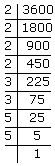
$\therefore 3600=2 \times 2 \times 2 \times 2 \times 3 \times 3 \times 5 \times 5=2^4 \times 3^2 \times 5^2$
It is the required prime factor product form. View full question & answer→Question 342 Marks
Express the number as a product of power of its prime factors: $540$
AnswerIn order to get the prime factorisation, divide $540$ with prime numbers continuously till we get a prime number
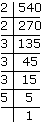
$\therefore 540=2 \times 2 \times 3 \times 3 \times 3 \times 5=2^2 \times 3^3 \times 5$
It is the required prime factor product form. View full question & answer→Question 352 Marks
Express the number as a product of power of its prime factors: $648$
AnswerDivide $648,$ with prime numbers to get the prime factors.
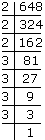
$\therefore 648=2 \times 2 \times 2 \times 3 \times 3 \times 3 \times 3=2^3 \times 3^4$
It is the required prime factor product form. View full question & answer→Question 362 Marks
Identify the greater number, if possible: $100^2$ and $2^{100}$
AnswerIn order to find the greater number in these two numbers, we should expand and find the value of $100^2$ and $2^{100}$
$100^2=100 \times 100=10000$
$2^{100}=2^{10} \times 2^{10} \times 2^{10} \times 2^{10} \times 2^{10} \times 2^{10} \times 2^{10} \times 2^{10} \times 2^{10} \times 2^{10}$
$=1024 \times 1024 \times 1024 \times 1024 \times 1024 \times 1024 \times 1024 \times 1024 \times 1024 \times 1024, \text { is clearly greater than } 10000$
$\therefore 2^{100}>100^2$
View full question & answer→Question 372 Marks
Identify the greater number, if possible: $2^8$ or $8^2$
AnswerWe have, $2^8$ or $8^2$
On simplifying we get,
$2^8=2 \times 2 \times 2 \times 2 \times 2 \times 2 \times 2 \times 2$
$=256$
$8^2=8 \times 8=64$
Clearly,
$256>64$
Thus,
$2^8>8^2$
View full question & answer→Question 382 Marks
Identify the greater number, if possible: $5^3$ or $3^5$
AnswerIn order to find the greater number, we should find the value of both $5^3$ and $3^5$
To get $5^3$, multiply $5$ three times
$5^3=5 \times 5 \times 5=125$
To get $3^5$, mutiply 3 five times
$3^5=3 \times 3 \times 3 \times 3 \times 3=243$
Since $243>125,3^5>5^3$
View full question & answer→Question 392 Marks
Identify the greater number, if possible: $4^3$ or $3^4$
AnswerIn order to find the greater number, we should find the value of both $4^3$ and $3^4$
To get $4^3$, multiply $4,3$ times.
Hence $4^3=4 \times 4 \times 4=64$
To get $3^4$, multiply $3,4$ times.
Hence $3^4=3 \times 3 \times 3 \times 3=81$
Since $81>64,3^4>4^3$
View full question & answer→Question 402 Marks
Express the following number using the exponential notation: $729$
AnswerIn order to express $729$ in exponential notation, we should find the prime factors of $729$ and express $729$ as the product of its prime factors.
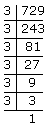
$\therefore 729=3 \times 3 \times 3 \times 3 \times 3 \times 3=3^6$
$\text { Also, } 729=3 \times 3 \times 3 \times 3 \times 3 \times 3=9 \times 9 \times 9=9^3$
Hence $3^6, 9^3$ are the exponential notations of $729$ View full question & answer→Question 412 Marks
Express the number using the exponential notation: $512$
AnswerIn order to express $512$ in exponential notation, we should find the factors of $512$ by prime factorisation method, and then express $512$ as the product of its prime factors
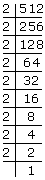
$\therefore 512=2 \times 2 \times 2 \times 2 \times 2 \times 2 \times 2 \times 2 \times 2=2^9$
Also,
$512=2 \times 2 \times 2 \times 2 \times 2 \times 2 \times 2 \times 2 \times 2$
$=2^3 \times 2^3 \times 2^3$
$=8^3$ View full question & answer→Question 422 Marks
Express the term in the exponential form: $(-4 \mathrm{~m})^3$
AnswerHere,
$(-4 \mathrm{~m})^3$
$=(-4 \times \mathrm{m})^3$
$=(-4 \times \mathrm{m}) \times(-4 \times \mathrm{m}) \times(-4 \times \mathrm{m})$
$=(-4) \times(-4) \times(-4) \times(\mathrm{m} \times \mathrm{m} \times \mathrm{m})$
$=(-4)^3 \times(\mathrm{m})^3$
View full question & answer→Question 432 Marks
Express the term in the exponential form: $(2 a)^4$
Answer$\text { Here, }(2 a)^4=2 a \times 2 a \times 2 a \times 2 a$
$=(2 \times 2 \times 2 \times 2) \times(a \times a \times a \times a)$
$=2^4 \times a^4$
View full question & answer→Question 442 Marks
Express the term in the exponential form: $(2 \times 3)^5$
AnswerHere, $(2 \times 3)^5$
$=(2 \times 3) \times(2 \times 3) \times(2 \times 3) \times(2 \times 3) \times(2 \times 3)$
$=(2 \times 2 \times 2 \times 2 \times 2) \times(3 \times 3 \times 3 \times 3 \times 3)$
$=2^5 \times 3^5$
View full question & answer→Question 452 Marks
Express the number as a product of power of prime factor: $16000$
Answer$\left.16,000=16 \times 1000=(2 \times 2 \times 2 \times 2) \times 1000=2^4 \times 10^3 \text { (as } 16=2 \times 2 \times 2 \times 2\right)$
$=(2 \times 2 \times 2 \times 2) \times(2 \times 2 \times 2 \times 5 \times 5 \times 5)=2^4 \times 2^3 \times 5^3$
$\text { (Since } 1000=2 \times 2 \times 2 \times 5 \times 5 \times 5)$
$=(2 \times 2 \times 2 \times 2 \times 2 \times 2 \times 2) \times(5 \times 5 \times 5)$
$\text { or, } 16,000=2^7 \times 5^3$
View full question & answer→Question 462 Marks
Express the number as a product of power of prime factor: $1000$
AnswerGiven number is $1000 .$
$1000=2 \times 500$
$=2 \times 2 \times 250$
$=2 \times 2 \times 2 \times 125$
$=2 \times 2 \times 2 \times 5 \times 25$
$=2 \times 2 \times 2 \times 5 \times 5 \times 5$
$\text { or, } 1000=2^3 \times 5^3$
View full question & answer→Question 472 Marks
Express the number as a product of power of prime factor: $432$
Answer$432=2 \times 216=2 \times 2 \times 108=2 \times 2 \times 2 \times 54$
$=2 \times 2 \times 2 \times 2 \times 27=2 \times 2 \times 2 \times 2 \times 3 \times 9$
$=2 \times 2 \times 2 \times 2 \times 3 \times 3 \times 3$
$\text { or } 432=2^4 \times 3^3 \text { (required form) }$
View full question & answer→Question 482 Marks
Express the number as a product of power of prime factor: $72$
Answer
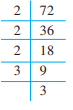
$72=2 \times 36=2 \times 2 \times 18$
$=2 \times 2 \times 2 \times 9$
$=2 \times 2 \times 2 \times 3 \times 3=2^3 \times 3^2$
Thus, $72=2^3 \times 3^2$ (required prime factor product form) View full question & answer→Question 492 Marks
Which one is greater $8^2$ or $2^8?$
AnswerIn order to find the greater number, we should find the value of both $2^8$ and $8^2$ To find the value of $2^8$ multiply $2 ,$ eight times
$2^8=2 \times 2 \times 2 \times 2 \times 2 \times 2 \times 2 \times 2=256$
To find the vale of $8^2$ multiply $8 ,$ two times
$8^2=8 \times 8=64$
Since $256>64,2^8>8^2$
Hence $2^8$ is greater
View full question & answer→Question 502 Marks
Simplify: $\frac{2 \times 3^{4} \times 2^{5}}{9 \times 4^{2}}$
AnswerHere,
$\frac{2 \times 3^{4} \times 2^{5}}{9 \times 4^{2}}=\frac{2 \times 3^{4} \times 2^{5}}{3^{2} \times\left(2^{2}\right)^{2}}=\frac{2 \times 2^{5} \times 3^{4}}{3^{2} \times 2^{2 \times 2}}$$=\frac{2^{1+5} \times 3^{4}}{2^{4} \times 3^{2}}=\frac{2^{6} \times 3^{4}}{2^{4} \times 3^{2}}$
$=2^{6-4} \times 3^{4-2}$
$=2^2 \times 3^2$
= $4 \times 9 = 36$
View full question & answer→Question 512 Marks
Simplify: $\frac{12^{4} \times 9^{3} \times 4}{6^{3} \times 8^{2} \times 27}$
AnswerWe have$\frac{12^{4} \times 9^{3} \times 4}{6^{3} \times 8^{2} \times 27}$
$=\frac{\left(2^{2} \times 3\right)^{4} \times\left(3^{2}\right)^{3} \times 2^{2}}{(2 \times 3)^{3} \times\left(2^{3}\right)^{2} \times 3^{3}}$
$=\frac{\left(2^{2}\right)^{4} \times(3)^{4} \times 3^{2 \times 3} \times 2^{2}}{2^{3} \times 3^{3} \times 2^{2 \times 3} \times 3^{3}}$
$=\frac{2^{8} \times 2^{2} \times 3^{4} \times 3^{6}}{2^{3} \times 2^{6} \times 3^{3} \times 3^{3}}$
$=\frac{2^{8+2} \times 3^{4+6}}{2^{3+6} \times 3^{3+3}}=\frac{2^{10} \times 3^{10}}{2^{9} \times 3^{6}}$
$=2^{10-9} \times 3^{10-6}=2^{1} \times 3^{4}$
$= 2 \times 81 = 162$
View full question & answer→Question 522 Marks
Write exponential form for $8 \times 8 \times 8 \times 8$ taking base as $2.$
AnswerWe have, $8 \times 8 \times 8 \times 8=8^4$
But we know that $8=2 \times 2 \times 2=2^3$
Therefore $8^4=\left(2^3\right) 4=2^3 \times 2^3 \times 2^3 \times 2^3$
$=2^{3 \times 4}[$ You may also use $(\mathrm{am})^n=\mathrm{am}^{\mathrm{n}} ]$
$=2^{12}$
View full question & answer→