Questions

3 Marks Question

Take a timed test

23 questions · self-marked practice — reveal the answer and mark yourself.

Question 13 Marks
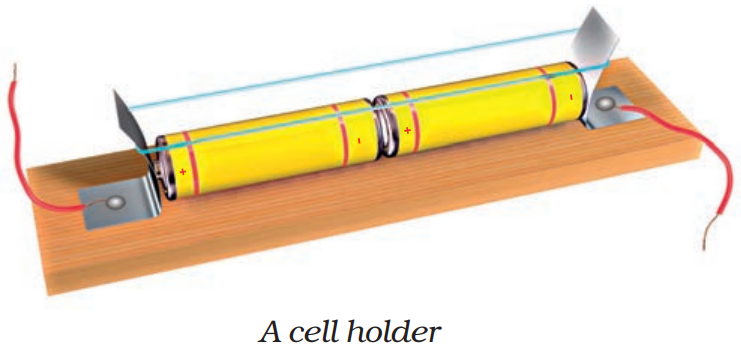
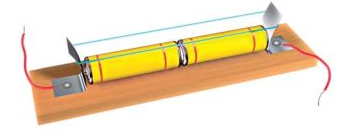
Zubeda made an electric circuit using a cell holder shown in Figure, a switch and a bulb. When she put the switch in the ‘ON’ position, the bulb did not glow. Help Zubeda in identifying the possible defects in the circuit.
Image

Answer
One of the reasons may be that the rubber band used in the cell holder may not be tight enough to keep the two cells in contact with each other. If the cells are not in proper contact with each other, then the circuit will not be complete and current will not flow through the circuit. Hence, the bulb will not glow.

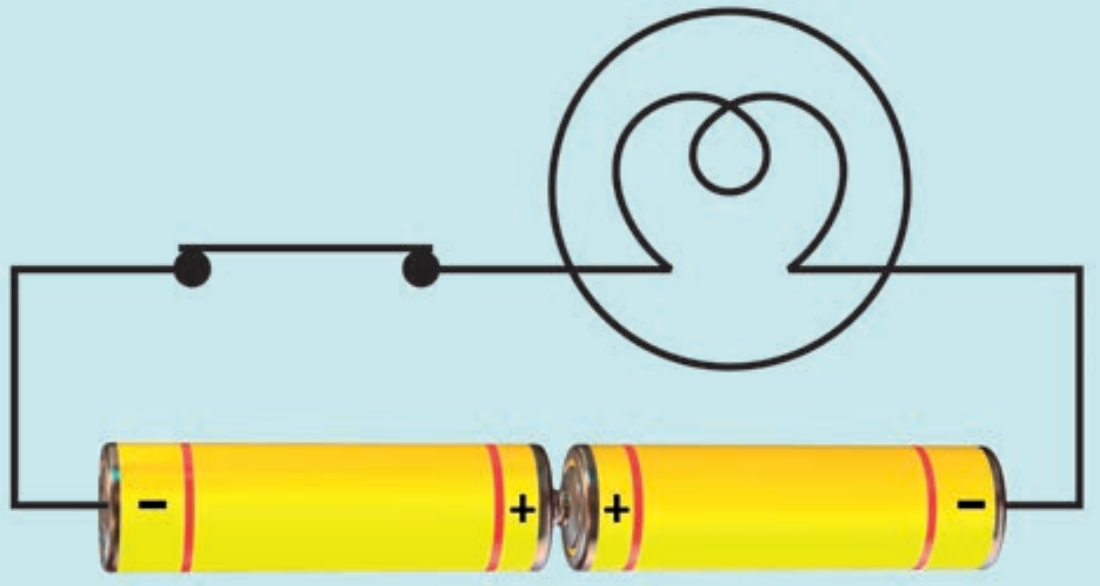
The other reason may be that the two cells are not connected properly. The negative terminal of one cell must be connected to the positive terminal of the other cell.
View full question & answer
Question 23 Marks
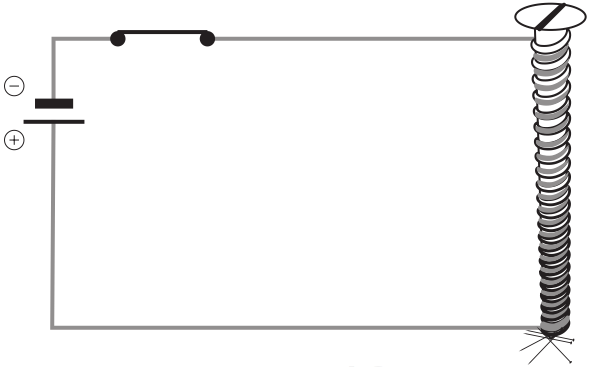
Your teacher has shown you the following activity. Activity: Teacher has wound a long insulated piece of wire around an iron nail in the form of a coil. Free ends of the wire are connected to a cell through a switch as shown in the Figure. The current is switched on and some pins are placed near the ends of the nail. Write down any three questions that come to your mind about this activity.
Answer
Some of the questions which may arise in our mind are as follows:
  1. Why does the iron nail attract the pins placed near its ends?
  2. On disconnecting the circuit, why pins get detached from the iron nail?
  3. What will happen if we use some other material like wood or straw in place of iron nail?
View full question & answer
Question 33 Marks
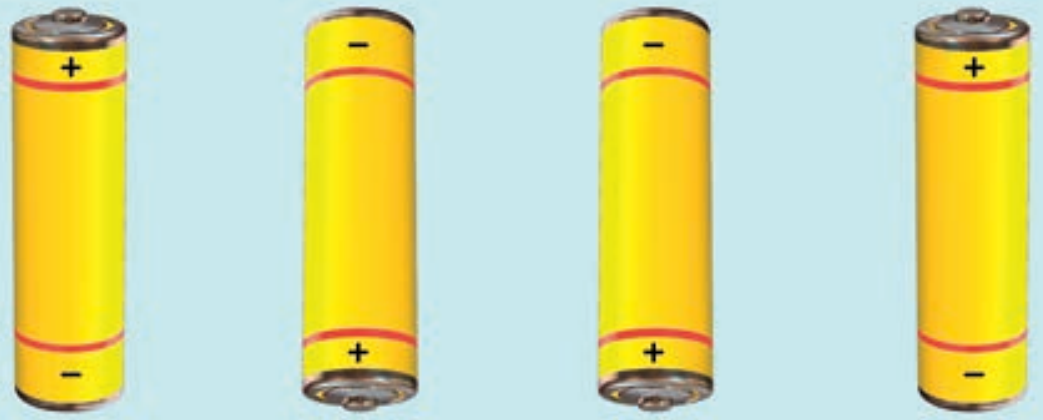
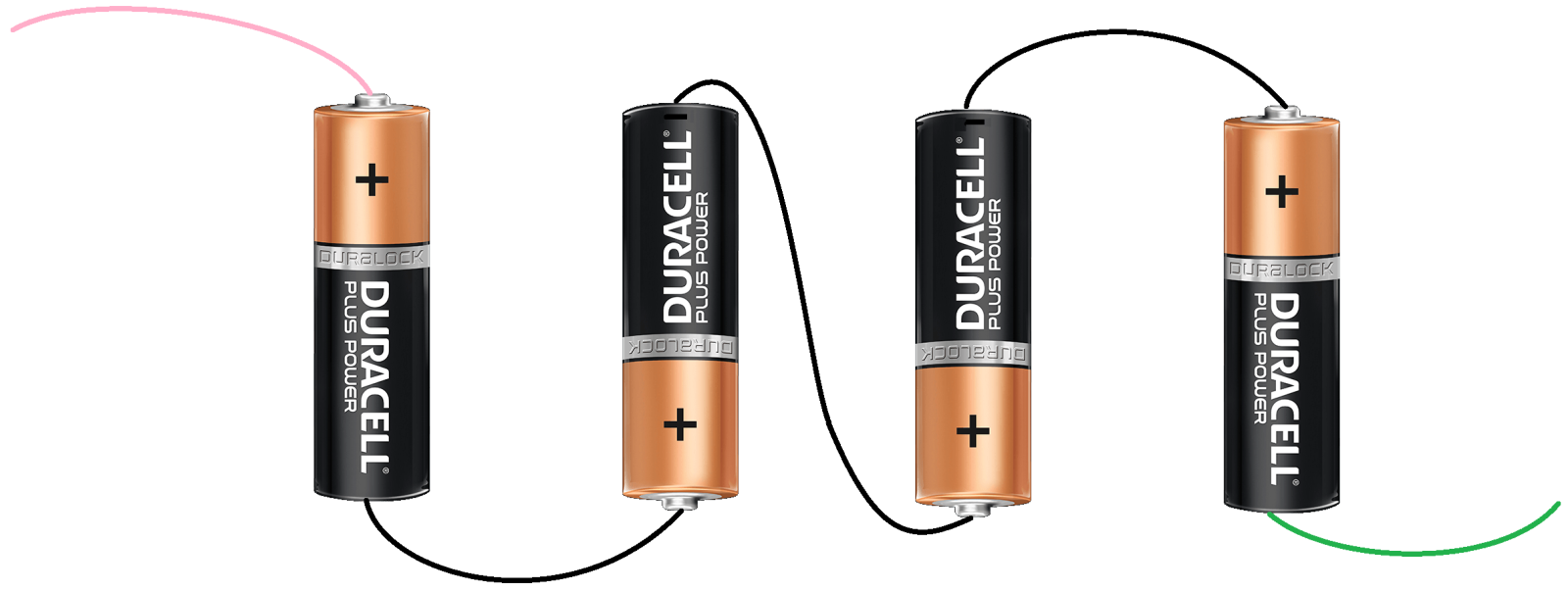
Fig. shows four cells fixed on a board. Draw lines to indicate how you will connect their terminals with wires to make a battery of four cells.
Answer
To make a battery, the negative terminal of one cell must be connected to the positive terminal of the next cell. The wire indicates the manner in which the given cells should be connected with each other, as shown in the following figure.
View full question & answer
Question 43 Marks
State one measure to avoid overloading in an electrical circuit. Also mention the name given to a situation in which the live and the neutral wires accidently come in contact. Describe the role of a safety device in this situation.
Answer
Overloading can be avoided if too many appliances are not connected to a single socket. Short circuiting is a name given to a situation in which the live and the neutral wires accidently come in contact. Electric fuse is a safety device. When a short circuit takes place or when overloading takes place, then the current becomes large and heats the fuse wire too much and thus, it gets melted and circuit breaks which prevents the damage of the wiring and electrical appliances.
View full question & answer
Question 53 Marks
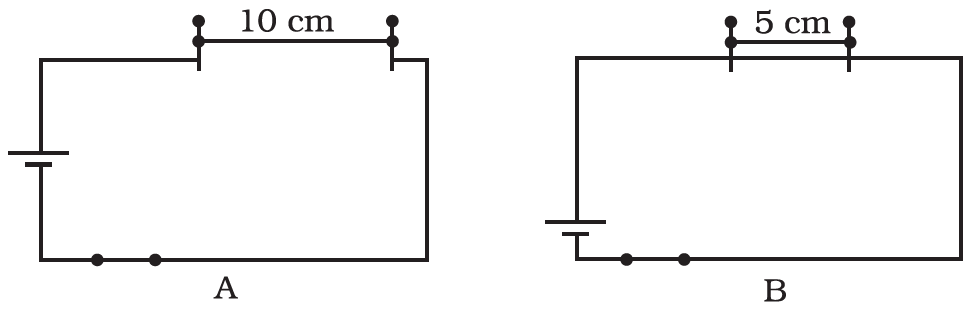
Paheli took a wire of length $10\ cm$. Boojho took a wire of $5\ cm$ of the same material and thickness both of them connected with wires as shown in the circuit given in figure. The current flowing in both the circuits is the same.
  1. Will the heat produced in both the cases be equal? Explain.
  2. Will the heat produced be the same, if the wires taken by them are of equal lengths but of different thickness? Explain.
Answer
  1. No, the amount of heat produced in both the wires will be different because amount of heat produced in a wire on passing electric current depends on the length of wire and here length is different for both the wires.
  2. No, the amount of heat produced in the wire of same length but different thickness cannot be same because amount of heat produced in a wire also depends on the thickness of the wire.
View full question & answer
Question 63 Marks
An electrician is carrying out some repairs in a building. He wants to replace a fuse by a piece of wire. Would you agree with the electrician? Give reasons for your response.
Answer
There is a maximum limit on the current which can safely flow through a circuit. If by accident the current exceeds this safe limit, the wires may become overheated and may cause fire. In order to prevent this, in all buildings fuses are inserted in all electrical circuits. If a proper fuse is there in the circuit, it will blow off and break the circuit. A fuse is thus a safety device which prevents damages to electrical circuits and possible fires. So we will not agree with an electrician, who is using a wire in place of fuse of proper rating as if by accident the current exceeds safe limit, the wires may become overheated and may cause fire.
View full question & answer
Question 73 Marks
Distinguish between the following. Cell and Battery
Answer
S. No.
Cell
Battery
$(i)$
A cell is a singular unit that produces electric current.
A battery is composed of many cells.
$(ii)$
A cell can be a battery.
A battery cannot be a cell.
$(iii)$
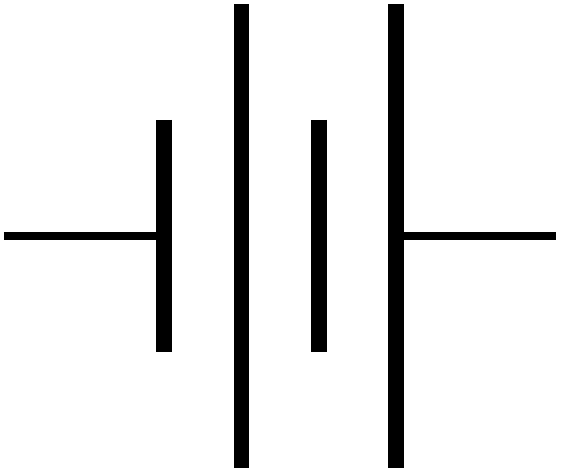
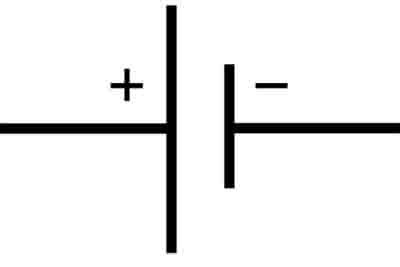
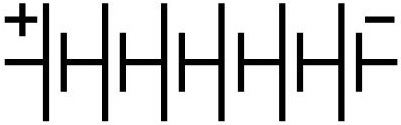
The symbol of a cell is.
The symbol of a battery is.
View full question & answer
Question 83 Marks
Explain the following.
  1. Copper and aluminium wires are usually employed for electricity transmission. Explain the reason.
  2. Explain how does the resistance of a wire vary with its length.
  3. The tungsten is used almost exclusively for filament of electric lamp. Comment.
Answer
  1. Due to the low resistance and strength of aluminium and coppers, both these metals are usually employed for the transmission of electricity.
  2. There is always an increase in the length of the wire with the increase in its resistance.
  3. Since tungsten has high melting point and high resistance. So, that is why, the tungsten is used exclusively for filament of electric lamp.
View full question & answer
Question 93 Marks
An electrician is carrying out some repairs in your house. He wants to replace a fuse by a piece of wire. Would you agree? Give reasons for your response.
Answer
The electrician cannot be allowed to replace the fuse in the house by a piece of wire. This is because every wire cannot be used as a fuse filament. A fuse filament must have a low melting point such that it could melt and break in response of large amount of current. Most of the wires have high melting points.
View full question & answer
Question 103 Marks
Write four uses of electromagnets.
Answer
  1. Used in cranes in steelworks and scrapyards.
  2. Used to remove foreign bodies like iron filings from a patient’s body.
  3. Used in electric bells, loudspeakers, etc.
  4. Used in modern trams and trains.
View full question & answer
Question 113 Marks
Zubeda made an electric circuit using a cell holder shown in Fig., a switch and a bulb. When she put the switch in the $‘ON’$ position, the bulb did not glow. Help Zubeda in identifying the possible defects in the circuit.
Answer
One of the reasons may be that the rubber band used in the cell holder may not be tight enough to keep the two cells in contact with each other. If the cells are not in proper contact with each other, then the circuit will not be complete and current will not flow through the circuit. Hence, the bulb will not glow. The other reason may be that the two cells are not connected properly. The negative terminal of one cell must be connected to the positive terminal of the other cell.
View full question & answer
Question 123 Marks
Draw in your notebook the symbols to represent the following components of electrical circuits: connecting wires, switch in the $‘OFF’$ position, bulb, cell, switch in the $‘ON’$ position, and battery.
View full question & answer
Question 133 Marks
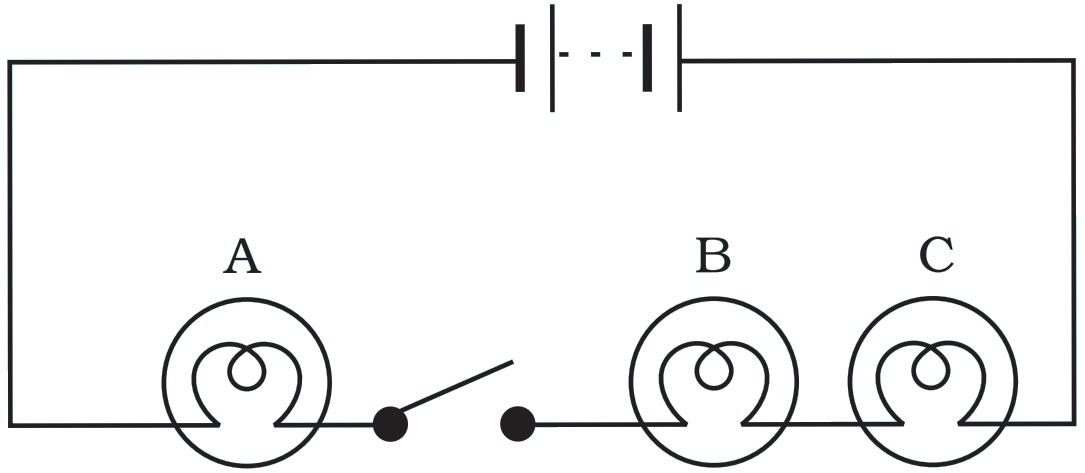
In the circuit shown in figure.
  1. Would any of the bulb glow when the switch is in the $‘OFF’$ position?
  2. What will be the order in which the bulbs $A, B$ and $C$ will glow when the switch is moved to the $‘ON’$ position?
Answer
  1. No.
When the switch is in $‘OFF’$ position, the current does not flow through the circuit. Hence, none of the bulbs will glow.
  1. Bulbs will glow simultaneously.
When the switch is moved to the $‘ON’$ position, then all the bulbs will glow at once. This is because they all are connected to the same battery and switch.
View full question & answer
Question 143 Marks
State the factors on which amount of heat produced depends?
Answer
The amount of heat produced in a wire depends on:

  1. Its material: Better conductors produce less heat; e.g. Elements of electric appliances are made of nichrome whereas connecting wires are made up of copper which is a better conductor so they do not get heated up as the element.

  2. Its length: As length increases heat produced increases; e.g. elements are coiled in heaters to increase length.

  3. Thickness: As thickness increases heat produced decreases; e.g. lead wires of iron, heater etc. are thicker than normal connecting wire so that they don’t get heated up easily.

View full question & answer
Question 153 Marks
Why mostly all electrical home appliances like refrigerator, toaster etc. are provided with a wire having green insulation?
Answer
Earth wire is the insulated green coloured copper wire which is connected to a metal plate deep inside the earth near the house. It is used as a safety measure. It is kept at zero potential by connecting it to the ground, thus, providing a low-resistance conducting path for the current. When by electric fault, if current flows through the metallic body of electric appliance and we touch it, then current finds the lower resistance path of earth wire than our body. So, current flows through earth wire only and we remain safe.
View full question & answer
Question 163 Marks
Explain the two effects of electric current along with their principles and uses.
Answer
When an electric current flows through a wire, the wire gets heated. It is the heating effect of current or When current flows through a metal wire it gets heated up, this is called heating effect of current. e.g. a glowing electric bulb becomes warm. This effect has many applications like Electric Heater, Light Bulb etc. When an electric current flows through a wire, it produces magnetic effect around it. A current carrying coil of an insulated wire wrapped around a piece of iron is called an electromagnet. Magnetic Effect of electric current has many applications like Electric Bell, Motor, Fan etc.
View full question & answer
Question 173 Marks
State the factors on which the force experienced by a current carrying conductor placed in a uniform magnetic field depends upon?
Answer
The factors which govern the force experienced by conductor which is placed in a uniform magnetic field are:
  1. Strength of the magnetic field in which conductor is placed.
  2. Strength of current flowing through the conductor.
  3. Length of conductor.
View full question & answer
Question 183 Marks
When the current is switched on through a wire, a compass needle kept nearby gets deflected from its north-south position. Explain.
Answer
When a current is switched on through a wire, the wire starts behaving as a magnet. Hence, when a compass needle is placed near the given current carrying wire, it gets influenced by the magnetic effect of electric current and gets deflected from its North- South position.
View full question & answer
Question 193 Marks
The bulb in the circuit shown in Fig. does not glow. Can you identify the problem? Make necessary changes in the circuit to make the bulb glow.
Answer
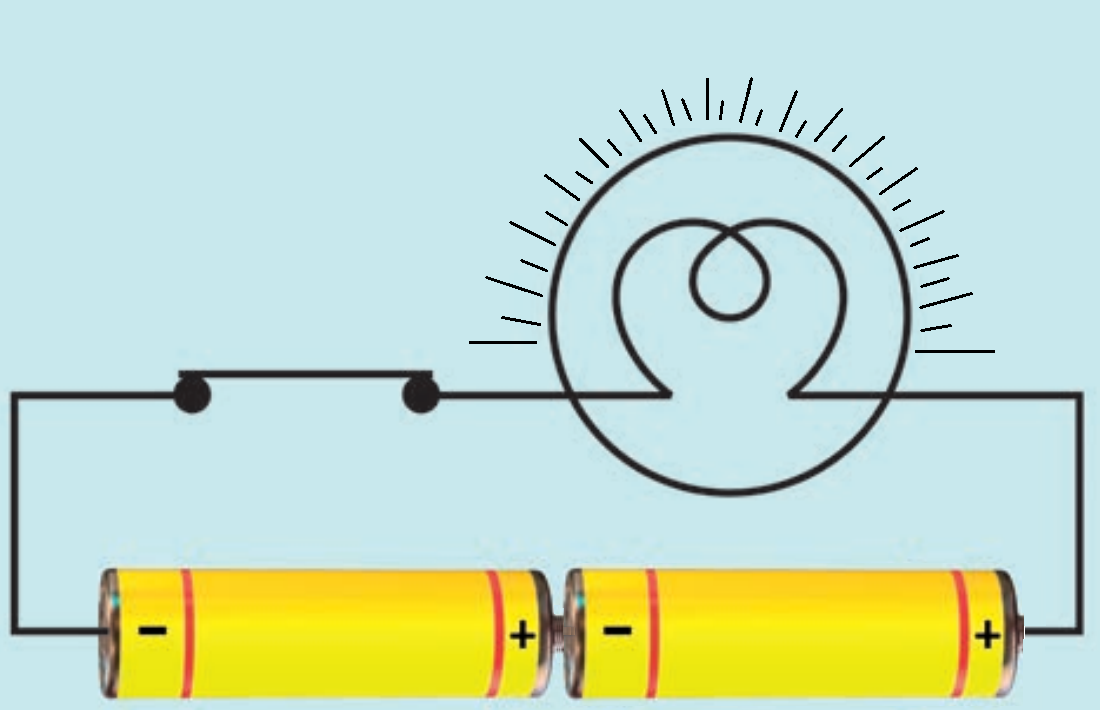
The bulb in the circuit is not glowing because the two cells are not connected properly. To make the bulb glow, the negative terminal of one cell should be connected to the positive terminal of the other cell, as shown in the given figure.
View full question & answer
Question 203 Marks
Write short notes on Short Circuiting.
Answer
Short-circuiting occurs in a circuit when the live wire comes in direct contact with the neutral wire. This causes much damage to the electric appliances connected with them. Reason of short circuiting. When the live wire touches the neutral wire, the contact portion of the two wires behave like load and due to very low resistance of copper wire, it draws very large amount of current. In the presence of this high current, the copper wire catches fire, due to joules heating effect.
View full question & answer
Question 213 Marks
Last Sunday, Pulpit was playing videotape in his room. While playing, the electricity of his house went off due to which he could not able to see anything around him. Then anyhow, he managed to get his mobile in his hand and with the help of its light, he went outside of his room to check if there was any problem in the electric circuit board of his house. At the same time, his father suggested him to maintain the distance from the circuit board and decided to call some electrician to check the problem.
  1. Explain, what happens when live wire and neutral wire touches each other directly?
  2. State the values here showed by Pulkit's father.
Answer
When live and neutral wire touches each other directly then it leads to short circuit in which the large amount of current flows through the household wiring and this large current may heat the wires to a dangerously high temperature and a fire may be started. Pulkit's father seems very sensible in taking the decisions and he showed a very great concern towards his son.
View full question & answer
Question 223 Marks
Distinguish between the following. An Open Switch and A Close Switch.
Answer
S. No.
Cell
Battery
$(i)$
An open switch does not allow current to pass through the circuit.
A close switch allows current to pass through the circuit..
$(ii)$
The bulb does not glow when switch is open.
The bulb glows when the switch is closed.
$(iii)$
It is represented as.
View full question & answer
Question 233 Marks
Draw the symbols of the following circuit components.
  1. Electric cell.
  2. Switch in off position.
  3. Electric bulb.
  4. Battery.
Answer
(i) Electric cell
(ii) Switch in off position.
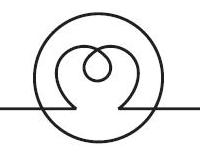
(iii) Electric bulb.
(iv) Battery.
View full question & answer