Questions

3 Marks Question

Take a timed test

20 questions · self-marked practice — reveal the answer and mark yourself.

Question 13 Marks
Give one use each of a concave and a convex mirror.
Answer
Concave mirrors can form enlarged image of the object. Therefore, they are used by the dentist to see the enlarged image of the patient’s teeth.

Convex mirror forms diminished and upright image of the object. It is used as a side view mirror of the car because it enables the driver to view objects spread over a large area behind him/her.
View full question & answer
Question 23 Marks
State two differences between a convex and a concave lens.
Answer
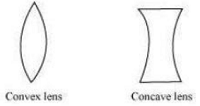
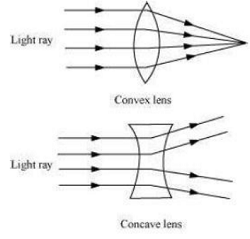
$1)$ Convex lens is thicker in the middle while concave lens is thinner in the middle.
Image
$2)$ A convex lens converges the light ray falling on it, while a concave lens diverges the light ray falling on it.
Image
View full question & answer
Question 33 Marks
Find out the letters of English alphabet or any other language known to you in which the image formed in a plane mirror appears exactly like the letter itself. Discuss your findings.
Answer
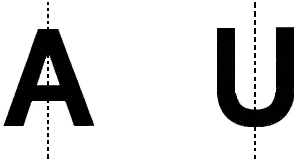
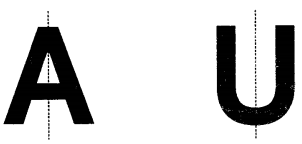
If the letters of English alphabet $A, H, I, M, O, T, U, V, W, X, Y$ are kept in front of a plane mirror, then they would form images which exactly look like the original letters of the alphabet. These letters are vertically symmetric. For example, if we divide letters $A$ and $U$ in the middle, then we would find that the right halves are equivalent to the left halves of the letters.Image
Hence, even if the image interchanges sidewise, it will appear same as the letter.
View full question & answer
Question 43 Marks
Give one use each of a concave and a convex mirror.
Answer
Concave mirrors can form enlarged image of the object. Therefore, they are used by the dentist to see the enlarged image of the patient’s teeth. Convex mirror forms diminished and upright image of the object. It is used as a side view mirror of the car because it enables the driver to view objects spread over a large area behind him/her.
View full question & answer
Question 53 Marks
Explain a convex mirror. What is the nature of image formed by this mirror$?$
Answer
If the reflecting surface of a mirror is convex, then it is called a convex mirror. A convex mirror is also known as a diverging mirror or fish eye mirror. The image formed by a convex mirror is virtual, erect and diminished. It means that a larger area is visible in a convex mirror than in a plane mirror of the same size. That is why convex mirrors have a variety of applications- as reflectors at sharp turns and tricky or 'blind' corners and in parking lots, and as rear-view mirrors in cars and on motorcycles. Rear view mirrors enable the driver/ rider to watch the road behind them. They are also used in super markets, stores and $ATM$ centres as a security measure. Objects like thumb tacks, Christmas baubles and sunglasses act as convex mirrors.
View full question & answer
Question 63 Marks
One day, Ramesh’s friend was performing their respective experiments given by their teacher. While sitting in the practical lab instead of performing experiment, Ramesh was playing with his meter scale. All the sudden, he held the scale in his hand and started moving in front of tubelight, then he observed the seven colours of white light. After sometimes, he got scolded by his lab teacher for not performing the experiment.
  1. Give the name of phenomenon that leads to the formation of band of seven colours.
  2. Name the constituent colours of white light.
  3. Mention the values shown by Ramesh here.
Answer
  1. Dispersion of white light is the name of phenomenon which leads to the formation of band of seven colours.
  2. There are seven constituent colours of white light, they are Violet, Indigo, Blue, Green, Yellow, Orange, Red $($i.e. $VIBGYOR).$
  3. Ramesh seems to be quite innovative with respect to the scientific methods and also very eager to learn science regarding phenomena.
View full question & answer
Question 73 Marks
Two different type of lenses are placed on a sheet of newspaper. How will you identify them without touching?
Answer
On identifying the size of the letters of newspaper, we can differentiate between the two types of lenses. If image of letters is large or magnified, then the lens is a convex lens and if the image of letters is smaller or diminished in size, then the lens is a concave lens.
View full question & answer
Question 83 Marks
Distinguish between the following. Real image and Virtual image.
Answer
S. No.
Real image
Virtual image
$(i)$
The reflected rays actually meet after reflection.
The reflected rays do not meet but appear to come from a point.
$(ii)$
It can be obtained on a screen.
It cannot be obtained on a screen.
$(iii)$
It is formed in front of the mirror.
It is formed behind the mirror.
View full question & answer
Question 93 Marks
Explain concave lens and there application.
Answer
It is a lens that possesses at least one surface that curves inwards. When light rays are incident on a concave lens, they bend outwards or diverge. The rays diverge away from each other. Thus, a concave lens is also called a diverging lens. A concave lens is thinner at its centre than at its edges, and is used to correct short sightedness. It does not focus at a single point. The image formed by a concave lens is upright, virtual and smaller than the object. For example, the images seen through a peephole are different from normal holes, because these peep holes contain concave lenses.
View full question & answer
Question 103 Marks
The side mirror of a scooter got broken. The mechanic replaced it with a plane mirror. Mention any inconvenience that the driver of the scooter will face while using it?
Answer
As we know that the side mirror of a scooter must be a convex mirror so that we can view a wide range of traffic spread over a large area. But if plane mirror, is used, we will not be able to see large area of traffic behind us which may create a difficulty in driving vehicle and can cause accident.
View full question & answer
Question 113 Marks
Define light. Name three important properties of light.
Answer
Light is a form of energy, which produces the sensation of vision.It has following characteristics:
  1. It travels in straight lines and does not bend.
  2. It does not require any medium to travel i.e. it travels even in vacuum.
  3. Its speed in vacuum is maximum whose value is $3 \times 10^8 \mathrm{~m} / \mathrm{s}$.
  4. It exhibits phenomena of reflection, refraction and scattering.
  5. A white light consists of seven colors $(VIBGYOR).$
View full question & answer
Question 123 Marks

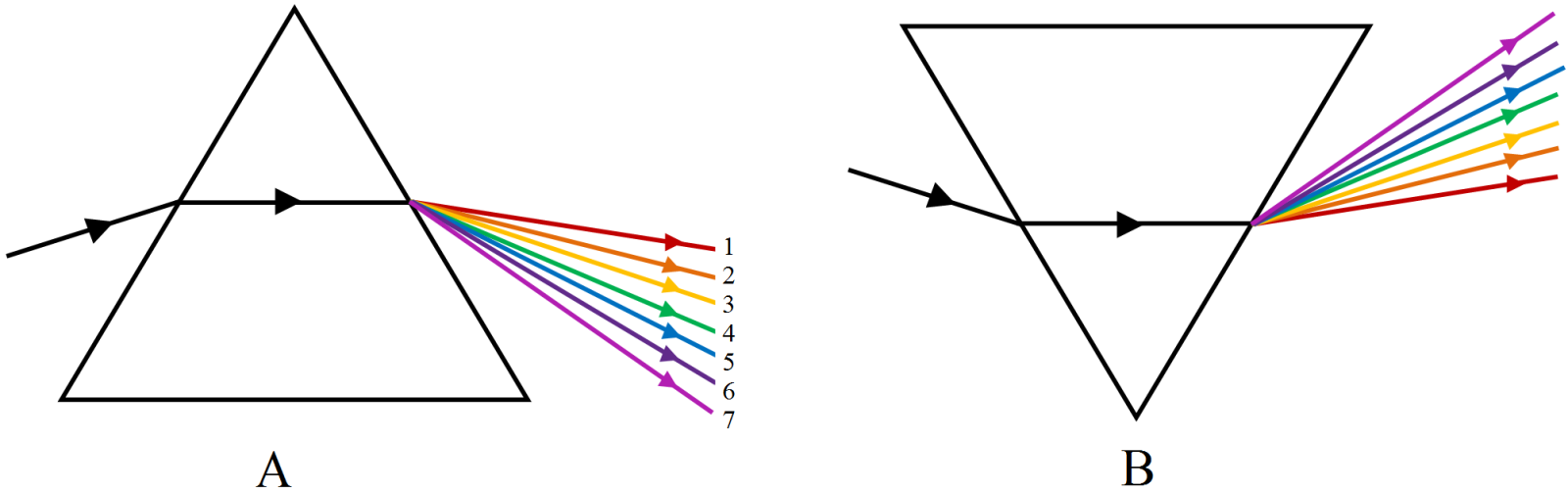
State the correct sequence $(1-7)$ of colours in the spectrum formed by the prisms $A$ and $B,$ shown in figure.
View full question & answer
Question 133 Marks
Last Sunday Girish’s mother, Priyanka was preparing the dinner in her kitchen for Girish and his father. Both of them were feeling so much hungry and they sat ideally on their respective chairs and having empty plates and spoons on their dinning table. They were shouting like a 5 years old child that they wanted the dinner so much eagerly in order to fulfil their stomach. At the sometime, Girish’s mother served the cooked food to both of them and the moment, when Girish was just about to eat the rice with the help of spoon, he noticed that the spoon has such a shining surface that it reflected the light rays incident on it.
  1. Explain the importance of shining surface in the reflection of light.
  2. Name the type of spherical mirror represented by the shining steel spoon.
  3. Mention the values shown by Priyanka here towards her family.
Answer
  1. As we know that the extent of reflection depends upon the shining of surface. So, greater the shining of the surface, more will be the reflection.
  2. Both convex and concave mirrors are represented by the shining steel spoon.
  3. The values shown by Priyanka here is concern and a satisfaction that she gets after serving the cooked food to her son and her husband.
View full question & answer
Question 143 Marks
Find out the letters of English alphabet or any other language known to you in which the image formed in a plane mirror appears exactly like the letter itself. Discuss your findings.
Answer
If the letters of English alphabet $A, H, I, M, O, T, U, V, W, X, Y$ are kept in front of a plane mirror, then they would form images which exactly look like the original letters of the alphabet. These letters are vertically symmetric. For example, if we divide letters $A$ and $U$ in the middle, then we would find that the right halves are equivalent to the left halves of the letters.

Hence, even if the image interchanges sidewise, it will appear same as the letter.
View full question & answer
Question 153 Marks
What is rainbow?
Answer
A rainbow is an optical phenomenon that is caused by reflection of light in water droplets in the Earth's atmosphere, resulting in a spectrum of light appearing in the sky. It takes the form of a multi-coloured arc. Rainbows caused by sunlight always appear in the section of sky directly opposite the sun. Rainbows can be observed whenever there are water drops in the air and sunlight shining from behind at a low altitude angle, the colour of rainbow are Red, Orange, Yellow, Green, Blue, Indigo, Violet.
View full question & answer
Question 163 Marks
State the characteristics of the image formed by a plane mirror.
Answer
The image formed by a plane mirror is erect, laterally inverted, and of the same size as that of the object. The left side of the object appears on the right side of the image. Also, the distance of the image from the plane mirror is same as the distance between the plane mirror and the object.
View full question & answer
Question 173 Marks
Explain a concave mirror. What is the nature of image formed by this mirror?
Answer
If the reflecting surface of a mirror is concave, then it is called a concave mirror. A concave mirror is also known as a converging mirror. It is used to magnify objects. Concave mirrors are used by dentists to obtain a magnified image of the teeth. They are also used in solar heaters or solar concentrators, and as reflectors in flashlights, and headlights of cars and scooters. The image formed by a concave mirror when the object is placed close to it is virtual, erect and magnified. The image formed by a concave mirror when the object is moved away from it is real, inverted, and magnified. The image formed by a concave mirror when the object is placed far away from it is real, inverted and diminished.
View full question & answer
Question 183 Marks
Explain convex lens and there application.
Answer
A convex lens makes the object magnified, when viewed through it. A convex lens is thick in the middle and thin at its edge. When light rays pass through a convex lens, they bend inwards and converge at a common point to form an image of the source of light. Rays from the sun converge to form its image as a bright spot. A convex lens converges light rays. Therefore, it is also called a converging lens. The image formed when the object is placed close to a convex lens is virtual, erect and magnified. Virtual images cannot be caught on a screen. Images that are caught on a screen are called real images. When the object is placed at a distance from a convex lens, the image formed is real, inverted and diminished.
View full question & answer
Question 193 Marks
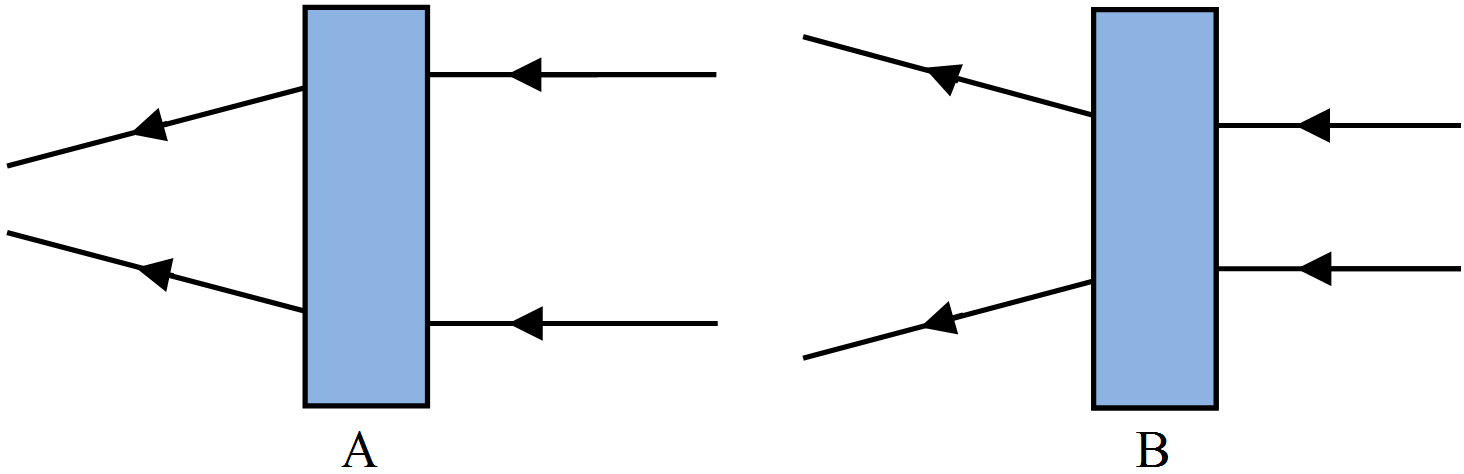
Observe the figures given below carefully.

The given figures show the path of light through lenses of two different types, represented by rectangular boxes $A$ and $B.$ What is the nature of lenses $A$ and $B?$
Answer
  1. Convex lens.
  2. Concave lens.
View full question & answer
Question 203 Marks
Differentiate between a plane mirror, concave mirror and a convex mirror without touching them.
Answer
These mirrors can be differentiated by bringing our face close to each mirror turn by turn. Since, a plane mirror will produce an image of the same size as our face while a concave mirror will produce a magnified image and our face will look much bigger and on other sides, a convex mirror will produce a diminished image and our face will look much smaller like a small child.
View full question & answer