Questions

5 Marks Questions

Take a timed test

17 questions · self-marked practice — reveal the answer and mark yourself.

Question 15 Marks
Explain through an activity that soil has moisture in it.
Answer

Take a plastic funnel and a filter paper. Fold the filter paper and place it in a plastic funnel. Now keep the funnel (with filter paper) in a beaker. Take some dry powdered soil and weigh it on a balance.
Note the mass of the soil taken. Now pour this weighed soil into the filter paper fixed in a funnel.
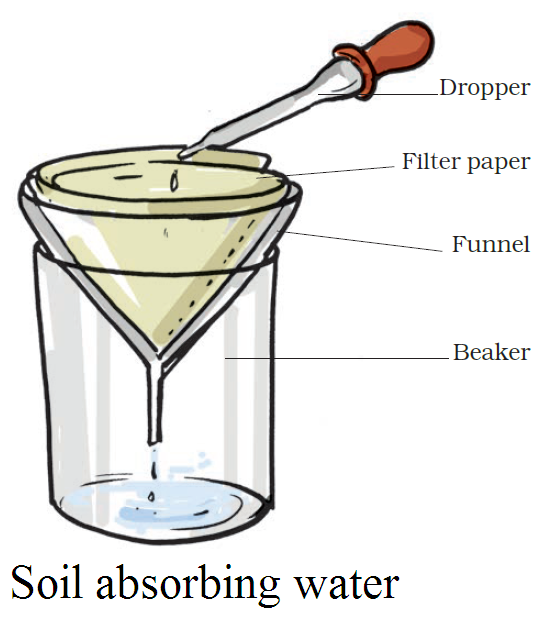
Take a measuring cylinder and fill it with water. Note the initial volume of water in the measuring cylinder. Take water from measuring cylinder with the help of a dropper and pour it drop by drop on the soil kept in the funnel. Be careful that water should not fall at one spot on the soil but should be poured uniformly all over the soil. Keep pouring water till it starts dripping from the lower end of the funnel.
Dripping of water from funnel shows that the soil taken on the filter paper has absorbed the maximum amount of water. Note the final volume of water that is left unused in the measuring cylinder.
By substracting the amount of water left in the measuring cylinder from the amount of initial volume of water taken in the measuring cylinder. We will get the volume of water absorbed by the soil which was taken on filter paper in the funnel. The difference in two reading gives the amount of water retained by the soil.
The calculation can be done as follows:
Suppose, the mass of the soil taken $= 50\ g$
Let the initial volume of water $U = 100\ mL$
and final volume of water $V = 60\ mL$
Therefore, the volume of water absorbed by the soil $= (U - V)\ mL = (100 - 60)\ mL = 40\ mL$
and weight of the water absorbed by the soil $= (U - V)\ Q = (100 - 60)\ g = 40\ g$
Therefore, the percentage of water absorbed
$=\Big(\frac{\text{U}-\text{V}}{50}\times100\Big)=\frac{40}{50}\times100=80\%<\text{br}/>$
When we perform this activity with different soil samples, we will see that.
  • Sandy soil will absorb less water and allows more water to percolate.
  • Clayey soil will absorb more water but allow less water to percolate.
  • Sandy soil will absorb less water than clayey soil because of the large spaces between the soil particles. The area where, there is a lot of clay in the soil, stagnant water collects above the soil whenever it rains.
View full question & answer
Question 25 Marks
Match the animals in Column $I$ with their natural place of dwelling (habitat) in Column $II.$
 
Column $I$
 
Column $II$
$(a)$
Earthworm
$(i)$
sand and beaches
$(b)$
Garden lizard
$(ii)$
burrows in soil
$(c)$
Crab
$(iii)$
deep, narrow holes in dry soils
$(d)$
Rodents
$(iv)$
surface of soil
$(e)$
Scorpion
$(v)$
surface of shaded moist soils
$(f)$
Snails and lungs
$(vi)$
a horizon of moist soils
Answer
 
Column $I$
 
Column $II$
$(a)$
Earthworm
$(vi)$
a horizon of moist soils
$(b)$
Garden lizard
$(iv)$
surface of soil
$(c)$
Crab
$(i)$
sand and beaches
$(d)$
Rodents
$(ii)$
burrows in soil
$(e)$
Scorpion
$(iii)$
deep, narrow holes in dry soils
$(f)$
Snails and lungs
$(v)$
surface of shaded moist soils
View full question & answer
Question 35 Marks
Match the items in Column $I$ with those in Column $II:$
 
Column $I$
 
Column $II$
$(i)$
A home for living organisms
$(a)$
Large particles
$(ii)$
Upper layer of the soil
$(b)$
All kinds of soil
$(iii)$
Sandy soil
$(c)$
Dark in colour
$(iv)$
Middle layer of the soil
$(d)$
Small particles and packed tight
$(v)$
Clayey soil
$(e)$
Lesser amount of humus
Answer
 
Column $I$
 
Column $II$
$(i)$
A home for living organisms
$(b)$
All kinds of soil
$(ii)$
Upper layer of the soil
$(c)$
Dark in colour
$(iii)$
Sandy soil
$(a)$
Large particles
$(iv)$
Middle layer of the soil
$(e)$
Lesser amount of humus
$(v)$
Clayey soil
$(d)$
Small particles and packed tight
View full question & answer
Question 45 Marks
Design an activity to show the soil erosion on a barren land.
Answer
Strong wind and rain can cause soil erosion from the barren land. This can be shown by performing an activity.
Take a wooden block and place some soil or sand on it. Keep an ice-cube tray at one end of the wooden black. Take a small battery-operated fan or hair dryer and hold it at the other end of the black near sand so that it blows the sand into the tray.
We will observe that when the fan blows it causes sand or soil particles to move and these get land in the various compartment of the ice-cube tray. This activity shows that the wind blows the soil on a barren land and may cause soil erosion.
View full question & answer
Question 55 Marks
Explain different types of soil found in India.
Answer
Following are the different types of soil found in India:
  1. Laterite Soils: This typical soil is found in those regions which receive heavy rainfall. This soil is poor in lime content and hence it is more acidic. This soil contains least moisture content.It is basically red in colour because of the presence of iron oxides. It is more popular in the coastal regions of Ratnagiri District and Malabar.
  2. Black Soil: It is black in colour due to presence of salt and large amount of humus. This soil becomes sticky when is wet. It does not contain adequate nitrogen but it contains sufficient phosphorous required for the growth of the plants.It is generally found in hilly areas.
  3. Red and Yellow Soils: Red and yellow soils are found in areas, which receive low rainfall. They contain huge concentration of iron oxides that are responsible for giving the reddish or yellow colour.
  4. Alluvial Soils: Alluvial Soils are mainly found in the plains of northern India. These soils have low phosphorous and nitrogen content and found in the north western regions of the country.
  5. Mountain Soils: Mountain soils are considered as a significant variety of soil in the Himalayan region of the country. They are mainly found in dry and cold district in the northern region of India.
View full question & answer
Question 65 Marks
State the main agents of weathering.
Answer
The main agents of weathering are:
  1. Temperature: Temperature changes that cause the rock surface to break apart.
  2. Frost: Ice expands and produces pressure, causing the crevices in rock to open.
  3. Air: Wind blow across rock surface and carry minute particle and form layer.
  4. Water: Continuous movement of rain water causes braking down of rock particles into fine particles.
  5. Living organism: Lichen grow on the surface of rocks and produce acid which corrode the rocky surface. Weathering by living organism is called biological weathering.
View full question & answer
Question 75 Marks
The soil is said to be inseparable part of our life. Why?
Answer
Soil is one of the most important natural resources. It is the uppermost layer of earth’s crust which is blackish-brown in colour. Major functions of the soil are:
  1. It supports plant growth by holding the roots firmly and supplying water and nutrients to the plants.
  2. It acts as a natural habitat for many organisms like earthworm, fungi, bacteria, ants, etc.
  3. It is also essential for agriculture which provides us food, clothing and shelter for all.
  4. It supplies water and nutrients to plants.
Therefore, we can say that the soil is inseparable part of our life.
View full question & answer
Question 85 Marks
State some ways to prevent soil erosion.
Answer
There are many ways to prevent soil erosion:
  1. By planting more trees and increasing the vegetation cover.
  2. By prevented Cutting of trees and deforestation and taking efforts to increase the green areas.
  3. By maintaining soil in its natural condition by using less manure or by crop rotation.
  4. By arranging proper irrigation.
View full question & answer
Question 95 Marks
Differentiate between laterite soil and black soil.
Answer
S.No. Clayey soil Sandy soil
$1.$ Higher ratio of fine particles. Higher ratio of large particles.
$2.$ Soil retains water and becomes sticky and wet. Loose particles, air permeate through the soil.
$3.$ Difficult to plough when wet. It dries up easily as it cannot retain water.
$4.$ Suitable for crops like paddy, wheat and gram. Suitable for vegetables, peanut and cotton cultivation.
View full question & answer
Question 105 Marks
Describe the different layers in soil profile.
Answer
Different layers of the soil are referred to as horizons:
  • The uppermost layer, the top soil, also known as A-horizon is generally dark in colour and fertile as it is rich in humus and minerals. This layer is generally soft, porous and can retain more water. This provides shelter for many living organisms such as worms, rodents, moles and beetles. The roots of small plants are embedded entirely in the topsoil.
  • The next layer, middle layer called B-horizon has a lesser amount of humus but more of minerals. This layer is generally harder and more compact.
  • The third layer is the C-horizon which is made up of small lumps of rocks with cracks and crevices.
  • Below this layer is the bedrock, which is hard and difficult to dig with a spade. Water can be held in the tiny gaps.
View full question & answer
Question 115 Marks
In towns and cities, generally, the bore wells have to be dug very deep to get water as compared to bore wells dug in villages. Give suitable reasons.
Answer
The borewells have to be dug very deep in towns and cities to get water as compared to those in villages because:
  1. Excessive use of water in towns, depletes the groundwater.
  2. Towns and cities have asphalted roads and vast areas of soil are concreted.
As a result, rainwater cannot percolate to recharge groundwater and the groundwater level further decreases.
Villages have larger areas of open soil surface and fewer asphalted roads and concrete surfaces. Thus, larger soil surface area is available for rainwater to percolate into the soil easily and recharge the groundwater. As a result, even shallow borewells yield water.
View full question & answer
Question 125 Marks
List the differences between clayey soil and sandy soil.
Answer
 
Clayey soil
 
Clayey soil
$1.$
The proportion of fine particles is higher.
$1.$
The proportion of large particles is higher.
$2.$
Particles are packed tightly.
$2.$
Particles are loosely packed.
$3.$
It can hold good amount of water.
$3.$
It is ability to retain water is low.
$4.$
Water cannot drain quickly.
$4.$
Water can drain quickly.
$5.$
It is heavy in weight.
$5.$
It is light in weight.
$6.$
Less air is trapped between the particles.
$6.$
More air is trapped between the particles.
$7.$
It is rich in humus.
$7.$
It is not rich in humus.
View full question & answer
Question 135 Marks
Soil is one of the most important natural resources. Explain?
Answer
Soil is one of the most important natural resources because:
  • It supports the growth of plants by holding the roots firmly and supplying water and nutrients.
  • It is the home for many organisms.
  • Soil is essential for agriculture. Agriculture provides food, clothing and shelter for all.
  • Soil is thus an inseparable part of our life.
View full question & answer
Question 145 Marks
What is soil pollution and factors responsible for the same?
Answer
The contamination of soil due to excess use of chemicals and harmful waste products like fertilizers, insecticides, industry waste is called soil pollution.The causes of soil pollution are as follow:
  • Excessive use of chemicals fertilizers and pesticides Acid rain.
  • Dumping of waste materials.
  • Leakage of radio hazard materials.
  • Polythene and plastics pollute soil as well as kill the organisms living in soil.
View full question & answer
Question 155 Marks
How soil is formed?
Answer
The soil is formed by the breaking down of rocks by the action of wind, water and climate. This process is called weathering. There are two different types of weathering. Physical weathering and chemical weathering. Mechanical (physical) weathering is the breakdown of rock into smaller particles due to such factors as freezing and thawing, release of pressure, water absorption, salt crystal formation, land mass uplift, expansion and contraction from the sun or fire, plant root growth, actions of animals, abrasion, or other means that do not directly affect the rock's chemistry. Chemical weathering is the dissolution, carbonation, oxidation, or hydrolysis of rock and mineral by chemical means only, mostly from reactions with water or the acids contained in rainwater. Other materials are formed in the process. Warm, tropical climates are ideal environments for chemical weathering to take place as the chemical reactions are quickened by the bountiful rain and warm temperatures.
View full question & answer
Question 165 Marks
Differentiate between clayey soil and sandy soil.
Answer
Laterite soil is found in those regions which receive heavy rainfall. This soil is poor in lime content and hence it is more acidic. This soil contains least moisture content. It is basically red in colour because of the presence of iron oxides. It is more popular in the coastal regions of Ratnagiri District and Malabar. But Black Soil is black in colour due to presence of salt and large amount of humus. This soil becomes sticky when is wet. It does not contain adequate nitrogen but it contains sufficient phosphorous required for the growth of the plants. It is generally found in hilly areas.
View full question & answer
Question 175 Marks
Explain the process of weathering, its type and importance in forming soil.
Answer
The soil is formed by the breaking down of rocks by the action of wind, water and climate. This process is called weathering, it broke down soil into small pieces that get mixed with humus and form soil. There are two different types of weathering. Physical weathering and chemical weathering. Mechanical (physical) weathering is the breakdown of rock into smaller particles due to such factors as freezing and thawing, release of pressure, water absorption, salt crystal formation, land mass uplift, expansion and contraction from the sun or fire, plant root growth, actions of animals, abrasion, or other means that do not directly affect the rock's chemistry. Chemical weathering is the dissolution, carbonation, oxidation, or hydrolysis of rock and mineral by chemical means only, mostly from reactions with water or the acids contained in rainwater. Other materials are formed in the process. Warm, tropical climates are ideal environments for chemical weathering to take place as the chemical reactions are quickened by the bountiful rain and warm temperatures.
View full question & answer