Question 13 Marks
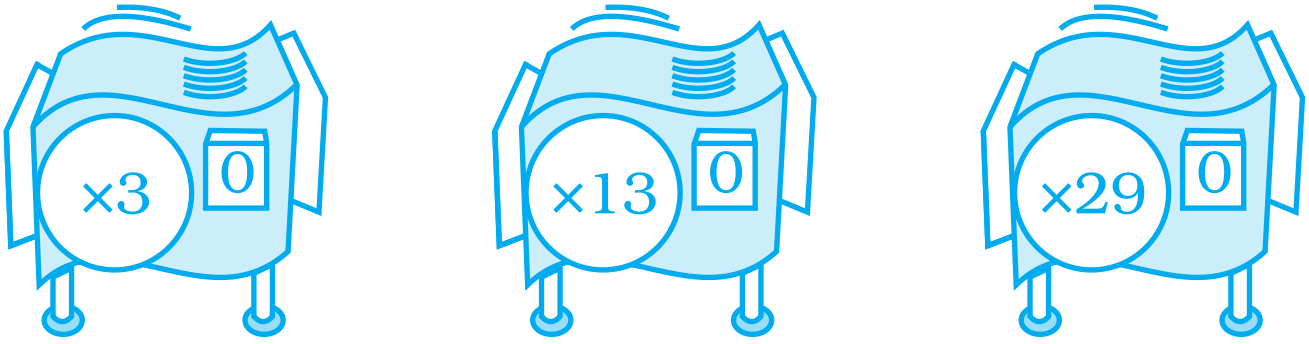
In a repeater machine with $0$ as an exponent, the base machine is applied $0$ times.
$a.$ What do these machines do to a piece of chalk?
$b.$ What do you think the value of $60$ is? You have seen that a hookup of repeater machines with the same base can be replaced by a single repeater machine. Similarly, when you multiply exponential expressions with the same base, you can replace them with a single expression.
Answer$a.$ Since, $3^\circ = 1, 13^\circ = 1, 29^\circ = 1$
Using law of exponents, $a^\circ = 1$ $[\because$ a is non$-$zero integer$]$
So, machine $(x3^\circ ), (x13^\circ )$ and $(x29^\circ )$ produce nothing on not change the piece $7$ chalk.
$b.$ Using the law of exponent $a^\circ = 1$ $[\because$ a is non$-$zero integer$]$
Similarly, $(x\ 6^\circ )$ machine does not change the piece.
View full question & answer→Question 23 Marks
Simplify: $\big(\frac{4}{13}\big)^4\times\big(\frac{13}{7}\big)^2\times\big(\frac{7}{4}\big)^3$
Answer$\big(\frac{4}{13}\big)^4\times\big(\frac{13}{7}\big)^2\times\big(\frac{7}{4}\big)^3$
$=\frac{(4)^4}{(13)^4}\times\frac{(13)^2}{(7)^2}\times\frac{(7)^3}{(4)^3}$
$=(4)^4\times(4)^{-3}\times(13)^2\times(13)^{-4}\times(7)^{3}\times(7)^{-2}$
$\big[\because\text{a}^{\text{-m}}=\frac{1}{\text{a}^{\text{m}}}\big]$
$=(4)^{4-3}\times(13)^{2-4}\times(7)^{3-2}$
$[\because\text{a}^{\text{m}}\times\text{a}^{\text{n}}=\text{a}^{\text{m}-\text{n}}]$
$=(4)^1\times(13)^{-2}\times(7)^1$
$=4\times\frac{1}{169}\times7$
$\big[\because\text{a}^{\text{-m}}=\frac{1}{\text{a}^{\text{m}}}\big]$
$=\frac{28}{169}$
View full question & answer→Question 33 Marks
$\frac{16\times10^2\times64}{2^4\times4^2}$
AnswerUsing laws of exponents, $a^m÷ a^n= (a)^{m-n} $ and $a^m× a^n= a^{m+n}$ [$\because$ a is non-zero integer]
$\therefore$ $\frac{16\times10^2\times64}{2^4\times4^2}$
$ =(4)^2 \times 10^2 \times 2^{-4} \times(4)^3 \times 4^{-2}[\because 64=4 \times 4 \times 4 \text { and } 16=4 \times 4] $
$ =\left(2^2\right)^3 \times 10^2 \times 2^{-4} $
$ =2^6 \times 10^2 \times 2^{-4} $
$ =2^2 \times 10^2 $
$ =4 \times 100\left[\because 2^2=4\right] $
$= 400$
View full question & answer→Question 43 Marks
Simplify: $\frac{(3^{-2})^{2}\times(5^2)^{-3}\times(\text{t}^{-3})^2}{(3^{-2})^{5}\times(5^3)^{-2}\times(\text{t}^{-4})^3}$
Answer$\frac{(3^{-2})^{2}\times(5^2)^{-3}\times(\text{t}^{-3})^2}{(3^{-2})^{5}\times(5^3)^{-2}\times(\text{t}^{-4})^3}$
$=\frac{(3)^{-4}\times(5)^{-6}\times\text{t}^{-6}}{(3)^{-10}\times(5)^{-6}\times\text{(t)}^{-12}}$
$[\because(\text{a}^{\text{m}})^\text{n}=(\text{a})^\text{mn}]$
$=(3)^{-4}\times(3)^{10}\times(5)^{-6}\times(5)^{6}\times(\text{t})^{-6}\times(\text{t})^{12}$
$=(3)^{-4+12}\times(5)^{-6+6}\times(\text{t})^{-6+12}$
$\big[\because\text{a}^{\text{-m}}=\frac{1}{\text{a}^{\text{m}}}\big]$
$=(3)^6\times5^0\times(\text{t})^6=(3\text{t})^6$
$[\because\text{a}^0=1]$
View full question & answer→Question 53 Marks
Find the value of x, so that:
$\left(2^{-1}+4^{-1}+6^{-1}+8^{-1}\right)^x=1$
AnswerWe have, $\left(2^{-1}+4^{-1}+6^{-1}+8^{-1}\right)^x=1$
Using law of exponents, $\text{a}^{-\text{m}}=\frac{1}{\text{a}^\text{m}}$ [$\because$ a is non-zero integer]
Then, $\Big(\frac{1}{2}+\frac{1}{4}+\frac{1}{6}+\frac{1}{8}\Big)^\text{x}=1$
$\Rightarrow\Big(\frac{12+6+4+3}{24}\Big)^\text{x}=1$ [$\because$ LCM of $2, 4, 6$ and $8 = 24]$
$\Rightarrow\Big(\frac{25}{24}\Big)^\text{x}=1$
This can be possible only if $x = 0.$
Since $a^0= 1$. [law of exponents]
View full question & answer→Question 63 Marks
Find three repeater machines that will do the same work as a $(x64)$ machine. Draw them, or describe them using exponents.
Answer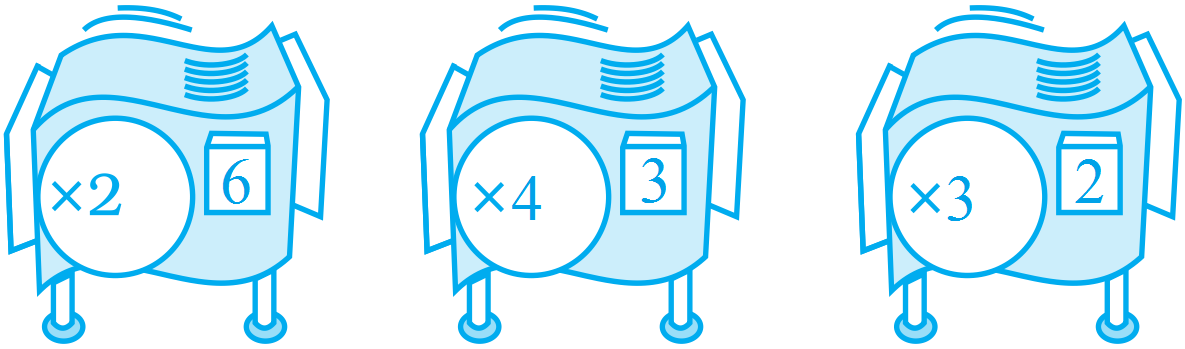
We know that, the possible factors of $64$ are $2, 4, 8:$
If $2^6= 64, 4^3= 64$ and $8^2= 64.$
Hence, three repeater machines that would work as a $(x64)$ will be $(x2^6 ), (x4^3)$ and $(x8^2)$. The diagram of $(x2^6), (x4^3)$ and $(x8^2)$ is given below. View full question & answer→Question 73 Marks
Find the value of $x$, so that:
$(-2)^3 \times(-2)^{-6}=(-2)^{2 x-1} $
AnswerWe have, $(-2)^3 \times(-2)^{-6}=(-2)^{2 x-1} $ Using law of exponents, $a^m× a^n= (a)^{m+n}$ [$\because$ a is non-zero integer]
Then, $(-2)^3 \times(-2)^{-6}=(-2)^{2 x-1} $
$ \Rightarrow(-2)^{3-6}=(-2)^{2 x-1} $
$ \Rightarrow(-2)^{-3}=(-2)^{2 x-1} $
On camparing both side,we get
$-3 = 2x - 1$
$\Rightarrow 2x = -2$
$\Rightarrow x = -1$
View full question & answer→Question 83 Marks
Express the following in standard form: Express $2$ years in seconds.
AnswerGiven,
$2$ year $= 2 \times 365$ days [$\because$
$1$ yr $= 365$ days approx.)
$= 2 \times 365 \times 24h$ [$\because$ 1 day = 24h]
$= 2 \times 365 \times 24 \times 60$ min [$\because$ 1 h = 60 min]
$= 2 \times 365 \times 24 \times 60 \times 60s$ [$\because 1$ min $= 60 s)$
$= 63072000s$
Standard form of $63072000$
$= 63072 \times 10 \times 10 \times 10$
$= 63072 \times 10^3$ [$\because$
$a^m\times a^n= (a)^{m+n}$]
$= 63072 \times 10^3\times 10^4$
$= 63072 \times 10^7s$
View full question & answer→Question 93 Marks
About $230$ billion litres of water flows through a river each day. How many litres of water flows through that river in a week? How many litres of water flows through the river in an year? Write your answer in standard notation.
AnswerWater flows through a river in each day $= 230000000000$ or $230$ billion.
Water flows through the river in a week $= 7 \times 230000000000$
$\because[1\text{week}=7\text{days}]$
$= 1610000000000$
$= 1610$ billion
$= 1.61 \times 10^{12}L$
Water flows through the river in an year $= 230000000000 \times 365$.$\because[1\text{year}=365\text{days}]$
$= 83950000000000$
$= 8.395 \times 10^{13}L$
View full question & answer→Question 103 Marks
$5^x+ 5^{x-1}= 750$
Answer$5\text{x} + 5\text{x}–1 = 750$
$\Rightarrow \ 5^{\text{x}}+\frac{5\text{x}}{5}=750$ $\Big[\because\text{a}^{\text{-m}}=\frac{1}{\text{a}^{\text{m}}}\Big]$
$\Rightarrow \ 5^{\text{x}}\Big(1+\frac{1}{5}\Big)=750 $
$\Rightarrow \ 5^\text{x}\Big(\frac{6}{5}\Big)=750 $
$\Rightarrow \ 5^{\text{x}}=750\times\frac{5}{6}$ $\Rightarrow \ 5^{\text{x}}=125\times5$ $\Rightarrow \ 5^{\text{x}}=625$
$\Rightarrow \ 5^{\text{x}}=5^4$
On compairing the powers of $5,$
$$we get $\text{x} = 4$
View full question & answer→Question 113 Marks
$\frac{125\times\text{x}^{-3}}{5^{-3}\times25\times\text{x}^{-6}}$
AnswerUsing laws of exponents, $a^m÷ a^n= (a)^{n-m}$ and $\text{a}^{-\text{m}}=\frac{1}{\text{a}^{\text{m}}}$
$\therefore \frac{125\times\text{x}^{-3}}{5^{-3}\times25\times\text{x}^{-6}}$
$=(5)^3\times5^3\times5^{-2}\times\text{x}^{-3}\times\text{x}^6$ [$\because 125 = 5 \times 5 \times 5$ and $25 = 5 \times 5]$
$=5^4\times\text{x}^3$
$=5\times5\times5\times5\times\text{x}^3$
$=625\text{x}^3$ [$\because$
$a^m\times a^n= a^{m+n}]$
View full question & answer→Question 123 Marks
The number of red blood cells per cubic millimetre of blood is approximately $5.5$ million. If the average body contains $5$ litres of blood, what is the total number of red cells in the body? Write the standard form. $(1\ litre = 1,00,000mm^3)$
AnswerThe average body contain $5L$ of blood. Also, the number of red blood cells per cubic millimetre of blood is approximately $5.5$ million.
Blood contained by body $= 5L = 5 \times 100000mm^3$
Red blood cells $= 5 \times 100000mm^3$
Blood $= 5.5 \times 1000000 \times 5 \times 100000$
$ =55 \times 5 \times 10^{5+5} $
$ =275 \times 10^{10} $
$ =2.75 \times 10^{10} \times 10^2 $
$ =2.75 \times 10^{12} $
View full question & answer→Question 133 Marks
By what number should $(-15)^{-1}$ be divided so that quotient may be equal to $(-5)^{-1}$?
AnswerLet $(-15)^{-1}$ be divided by x to get quotient $(-15)^{-1}$.
So, $\frac{(-15)^{-1}}{\text{x}}=(-15)^{-1}$
$\Rightarrow\frac{(-15)^{-1}}{(-15)^{-1}}=\text{x}$
$\Rightarrow\text{x}=(-15)^{-1+1}$ [$\because$ $a^m+ a^n= (a)^{m-n}$]
$\Rightarrow\text{x}=(-15)^{0}=1$ [$\because$ $a^0= 1$]
View full question & answer→Question 143 Marks
Find $x.$
$2^x+2^x+2^x=192$
Answer$⇒ 2^x(1+1+1) = 192$
$⇒ 3 × (2^x) = 192$
⇒ $2\text{x}=\frac{192}{3}=64$
$\Rightarrow2\text{x}=2\times2\times2\times2\times2\times2$
$\Rightarrow2\text{x}=2^{6}$
On compairing the powers of $2$, we get $x = 6$
View full question & answer→Question 153 Marks
Find $×$ so that $\Big(\frac{2}{9}\Big)^3\times\Big(\frac{2}{9}\Big)^{-6}=\Big(\frac{2}{9}\Big)^{2\text{x}-1}$
AnswerGiven,
$\Big(\frac{2}{9}\Big)^3\times\Big(\frac{2}{9}\Big)^{-6}=\Big(\frac{2}{9}\Big)^{2\text{x}-1}$
Using law of exponent, $a^m× a^n= (a)^{m+n}$
Then, $\Big(\frac{2}{9}\Big)^{3-6}=\Big(\frac{2}{9}\Big)^{2\text{x}-1}$
$\Rightarrow\Big(\frac{2}{9}\Big)^{-3}=\Big(\frac{2}{9}\Big)^{2\text{x}-1}$
On camparing, we get
$-3 = 2\times - 1$
$\Rightarrow -2 = 2\times $
$\Rightarrow \times = -1$
View full question & answer→Question 163 Marks
Two machines can be hooked together. When something is sent through this hook up, the output from the first machine becomes the input for the second.
$a.$ Which two machines hooked together do the same work a $(x102)$ machine does? Is there more than one arrangement of two machines that will work?

$b.$ Which stretching machine does the same work as two $(x2)$ machines hooked together?
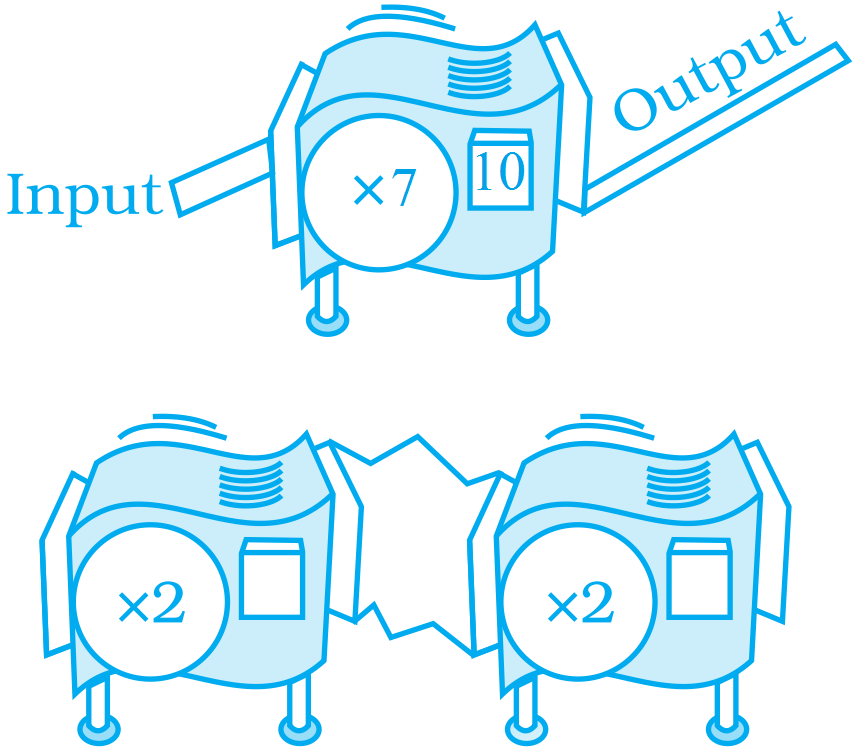
AnswerFor getting the same work a $(x10^2)$ machine does, we have to $(x2^2)$ and $(x5^2)$ machines hooked together.$\therefore x10^2 = x100$
Similarly, $x2^2\times 5^2= x4 \times 25 = x100$
If two machines $(x2)$ and $(x2)$ are hooked together to produce $x4$,
then a$(x4)$ single machine produce the same work.
View full question & answer→Question 173 Marks
find the value of n. $\frac{2^\text{n}\times2^6}{2^{-3}}=2^{18}$
AnswerGiven,
$\frac{2^\text{n}\times2^6}{2^{-3}}=2^{18}$
Using law of exponents, $\text{a}^{-\text{m}}=\frac{1}{\text{a}^{\text{m}}}$ [$\because$ a is non-zero integer]
$\Rightarrow2^\text{n}\times2^6\times2^3=2^{18}$
$\Rightarrow2^{\text{n}+9}=2^{18}$ $\left[\because a^m \times a^n=a^{m+n}\right]$
On camparing both side, we get
$n + 9 = 18 \left[\because a^m \div a^n=a^{m+n}\right]$
$ ⇒ n = 9$
View full question & answer→Question 183 Marks
Find x.$-\frac{1}{7}^{-5}+-\frac{1}{7}^{-7}=(-7)^{\text{x}}$
AnswerUsing law of exponents, $ a^m \times a^n=a^{m+n}[\because$ a is non-zero integer$]$
Then, $\Big(-\frac{1}{7}\Big)^{-5+7}=(-7)^{\text{x}}$
$\Rightarrow \ \big(\frac{-1}{7}\big)^2=(-7)^{\text{x}}$
$\Rightarrow \ (-7\big)^2=(-7)^{\text{x}}$
On comparing powers of $(-7)$, we get $x = -2$
View full question & answer→Question 193 Marks
If $\frac{5^\text{m}\times5^3\times5^{-2}}{5^{-5}}=5^{12}$, then find m.
AnswerGiven,
$\frac{5^\text{m}\times5^3\times5^{-2}}{5^{-5}}=5^{12}$
Using laws of exponents, $a^m÷ a^n= (a)^{m-n}$ and $\text{a}^{-\text{m}}=\frac{1}{\text{a}^\text{n}}$ [$\because$ a is non-zero integer]
Then,
$5^m\times 5^3\times 5^{-2}\times 5^5 = 5^{12}$
$\Rightarrow 5^m\times 5^8\times 5^{-2}= 5^{12}$
$\Rightarrow 5^m\times 5^6= 5^{12}$
$\Rightarrow 5^{m+6}= 5^{12}[\because a^m\times a^n= a^{m+n}]$
On camparing both sides, we get
$m + 6 = 12$
$\Rightarrow m = 6$
View full question & answer→Question 203 Marks
Find x. $\frac{-6^\text{x-7}{}}{7}=1$
AnswerWe have, $\Big(-\frac{6{}}{7}\Big)^\text{x-7}=1
$Using law of exponents, $x^0= 1[\because$ a is non-zero integer$]$
Then, $\Big(-\frac{6{}}{7}\Big)^\text{x-7}=1$
it is possible only, if $x = 7$
So, $\Big(\frac{-6^\text{}{}}{7}\Big)^{7-7}=1$
$\Rightarrow \ \Big(-\frac{6^\text{}{}}{7}\Big)^0=1$ $[\because\text{a}^0=1]$
Hence, $\text{x}=7$
View full question & answer→Question 213 Marks
The given table shows the crop production of a State in the year $2008$ and $2009$. Observe the table given below and answer the given questions.
|
Crop
|
$2008$ Harvest $($Hectare$)$
|
Increase/ Decrease $($Hectare$)$ in $2009$
|
|
Bajra
|
$1.4 \times 10^3$
|
$-100$
|
|
Jowar
|
$1.7 \times 10^6$
|
$-440,000$
|
|
Rice
|
$3.7 \times 10^3$
|
$-100$
|
|
Wheat
|
$5.1 \times 10^5$
|
$+190,000$
|
$a.$ For which crop$(s)$ did the production decrease?
$b.$ Write the production of all the crops in $2009$ in their standard form.
$c.$ Assuming the same decrease in rice production each year as in $2009$, how many acres will be harvested in $2015? $Write in standard form. Answer$a.$ On the basis of given table, bajra, jowar and rice crops's productions decreased.
$b.$ The production of all crop in $2009.$
$ \text { Bajra }=1.4 \times 10^3-0.1 \times 10^3=1.3 \times 10^3 $
$ \text { Jowar }=1.7 \times 10^6-44 \times 10^4 $
$ =1.7 \times 10^6-0.44 \times 10^6=1.26 \times 10^6 $
$ \text { Rice }=3.7 \times 10^3-0.1 \times 10^3=3.6 \times 10^3 $
$ \text { Wheat }=5.1 \times 10^5+19 \times 10^4 $
$ 5.1 \times 10^5+1.9 \times 10^5=7 \times 10^5 $
$c.$ Incomplete information
View full question & answer→Question 223 Marks
Find x.
$-\frac{2}{5}^{2\text{x}+6}\times\frac{2}{5}^{3}=\frac{2}{5}^{\text{x+2}}$
AnswerWe have, $\frac{2}{5}^{2\text{x}+6}\times\frac{2}{5}^{3}=\frac{2}{5}^{\text{x+2}}$
Using law of exponents, $a^m \times a^n=(a)^{m+n}$ $[\because$ a is non-zero integer$]$
Then, $\Big(\frac{2}{5}\Big)^{2\text{x}+6+3}=\Big(\frac{2}{5}\Big)^{\text{x+2}}$
On compairing powers of $\big(\frac{2}{5}\big)$, we get.
$2x + 6 + 3 = x + 2 $
$⇒ 2x + 9 = x + 2 $
$⇒ x = -7$
View full question & answer→Question 233 Marks
By what number should $\Big(\frac{-3}{2}\Big)^{-3}$ be divided so that the quotient may be $\Big(\frac{4}{27}\Big)^{-2}$ ?
AnswerLet $\Big(\frac{-3}{2}\Big)^{-3}$ be divided by x to get $\Big(\frac{4}{27}\Big)^{-2}$ as quotient.
Then, $\Big(\frac{-3}{2}\Big)^{-3}\div\text{x}=\Big(\frac{4}{27}\Big)^{-2}$
$\Rightarrow\text{x}=\Big(\frac{-3}{2}\Big)^{-3}\div\Big(\frac{2^2}{3^3}\Big)^{-2}$
$=\Big(\frac{-3}{2}\Big)^{-3}\div\frac{(2)^{-4}}{(3)^{-6}}$
$=\Big(\frac{-3}{2}\Big)^{-3}\times\frac{(3)^{-6}}{(2)^{-4}}$
$=\frac{(-3)^{-3}\times(3)^{-6}}{2^{-3}\times2^{-4}}=\frac{3^{-9}}{2^{-7}}$$\left[\because a^m \times a^n=a^{m+n}\right]$
$=\frac{2^{7}}{3^9}$ $\Big[\because\text{a}^{-\text{m}}=\frac{1}{\text{a}^\text{m}}\ \text{and}\ (\text{a}^\text{m})^\text{n}=(\text{a})^\text{mn}\Big]$
View full question & answer→Question 243 Marks
Long back in ancient times, a farmer saved the life of a king’s daughter. The king decided to reward the farmer with whatever he wished. The farmer, who was a chess champion, made an unusal request: “I would like you to place $1$ rupee on the first square of my chessboard, $2$ rupees on the second square, $4$ on the third square, 8 on the fourth square, and so on, until you have covered all 64 squares. Each square should have twice as many rupees as the previous square.” The king thought this to be too less and asked the farmer to think of some better reward, but the farmer didn’t agree.How much money has the farmer earned? [Hint: The following table may help you. What is the first square on which the king will place at least Rs $10$ lakh?]
|
Position of square on chess board
|
Amount (in Rs)
|
|
$1$st square
|
$1$
|
|
$2$nd square
|
$2$
|
|
$3$rd square
|
$4$
|
AnswerGiven, a$8 \times 8$grid Now, find the sum of each now,
1st row $=2^{\circ}+2^1+2^2+2^3+2^4+2^5+2^6+2^7=255 $
2nd row $=2^8+2^9+2^{10}+2^{11}+2^{12}+2^{13}+2^{14}+2^{15} $
$ =2^8\left(2^0+2^1+2^2+2^3+2^4+2^5+2^6+2^7\right) $
$ =2^8 \times 255=255 \times 256=65280$
3rd row $=2^{16} \times 255=16711680\left[\because 2^8=256\right.$ and $2^{16}=2^8 \times 2^8=265 \times 256$ and so on $]$
View full question & answer→Question 253 Marks
Find the value of $x^{-3}$ if $ x=(100)^{1-4} \div(100)^0 $.
AnswerGiven,
$ x=(100)^{1-4} \div(100)^0 $
$ \Rightarrow x=(100)^{-3} \div(100)^0 $
$ \Rightarrow x=(100)^{-3-0}\left[\because a^m \div a^n=(a)^{m-n}\right] $
$ \Rightarrow x=(100)^{-3}$
So, $x^{-3}=\left[(100)^{-3}\right]^{-3}$
$=(100)^9\left[\because\left(a^m\right)^n=(a)^{m n}\right]$
View full question & answer→Question 263 Marks
If $ 5^{3 x-1} \div 25=125 $, find the value of $x.$
AnswerGiven,
$ 5^{3 x-1} \div 25=125 $
$ \because 25=5 \times 5=5^2$
and $125=5 \times 5 \times 5=5^3$
$ \therefore 5^{3 x-1} \div(5)^2=(5)^3 $
$ \Rightarrow(5)^{3 x-1-2}=5^3\left(\because a^m \div a^n=(a)^{m-n}\right) $
$ \Rightarrow(5)^{3 x-3}=(5)^3$
On camparing both sides
View full question & answer→Question 273 Marks
Find the value of $x$, so that:
$\Big(\frac{5}{3}\Big)^{-2}\times\Big(\frac{5}{3}\Big)^{-14}=\Big(\frac{5}{3}\Big)^{8\text{x}}$
AnswerWe have,$\Big(\frac{5}{3}\Big)^{-2}\times\Big(\frac{5}{3}\Big)^{-14}=\Big(\frac{5}{3}\Big)^{8\text{x}}$
Using law of exponents, $a^m \times a^n=(a)^{m+n}$[$\because$ a is non-zero integer]
Then, $\Big(\frac{5}{3}\Big)^{-2}\times\Big(\frac{5}{3}\Big)^{-14}=\Big(\frac{5}{3}\Big)^{8\text{x}}$
$\Rightarrow\Big(\frac{5}{3}\Big)^{-2-14}=\Big(\frac{5}{3}\Big)^{8\text{x}}$
$\Rightarrow\Big(\frac{5}{3}\Big)^{-16}=\Big(\frac{5}{3}\Big)^{8\text{x}}$
On comparing both side, we get
$16=8\text{x}$
$\Rightarrow\text{x}=-2$
View full question & answer→Question 283 Marks
Simplify: $\bigg(\Big(\frac{-2}{3}\Big)^{-2}\bigg)^3\times\Big(\frac{1}{3}\Big)^{-4}\times3^{-1}\times\frac{1}{6}$
AnswerUsing law of exponents, $\left(a^m\right)^n=(a)^{m \times n}, a^{-m}=\frac{1}{a^m}, a^m \times a^n=a^{m+n}$ and $a^m \div a^n=a^{m-n}$ [$\because$ a is non-zero integer]
$\therefore$ $\bigg(\Big(\frac{-2}{3}\Big)^{-2}\bigg)^3\times\Big(\frac{1}{3}\Big)^{-4}\times3^{-1}\times\frac{1}{6}$ $=\Big(\frac{-2}{3}\Big)^{(-2)\times3}\times(3)^4\times\frac{1}{3}\times\frac{1}{6}$
$=\Big(\frac{-2}{3}\Big)^{-6}\times3^4\times\frac{1}{3}\times\frac{1}{2\times3}$ [$\because 6 = 2 \times 3]$
$=\Big(\frac{3}{-2}\Big)^{6}\times3^4\times\frac{1}{3\times2\times3}$
$=\frac{(3)^6}{(-2)^6}\times3^4\times\frac{1}{2^1\times3^2}$
$=\frac{(3)^{6+4}}{(2)^{6+1}\times3^2}$ $[(-a^m) = a^m$, if m is even number]
$=\frac{(3)^{10}}{2^7\times3^2}=\frac{3^{10-2}}{2^7}$
$=\frac{3^8}{2^7}$
View full question & answer→Question 293 Marks
While studying her family’s history. Shikha discovers records of ancestors $12$ generations back. She wonders how many ancestors she has had in the past $12$ generations. She starts to make a diagram to help her figure this out. The diagram soon becomes very complex.
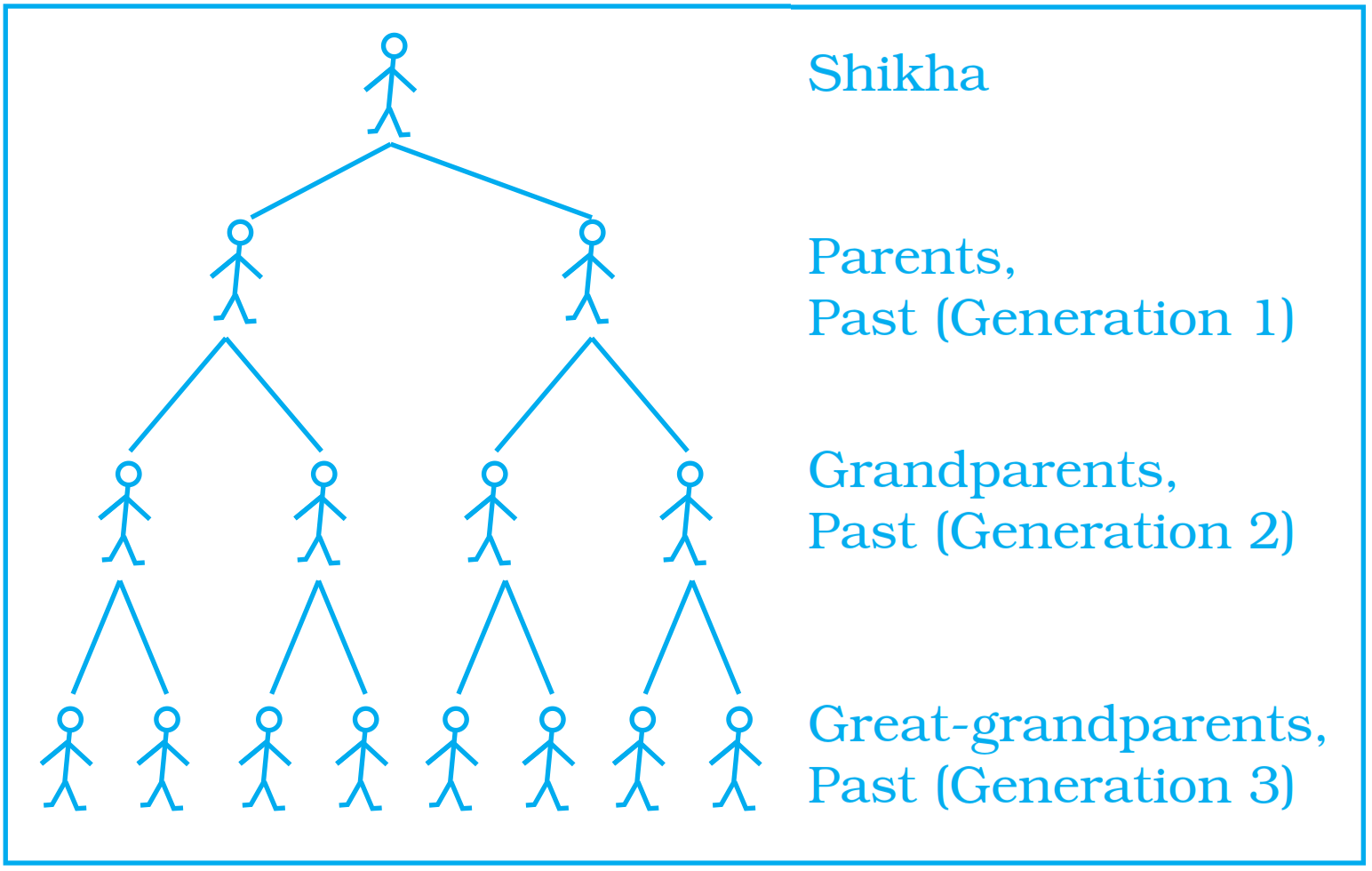
$a.$ Make a table and a graph showing the number of ancestors in each of the $12$ generations.
$b.$ Write an equation for the number of ancestors in a given generation $n.$ Answer$a.$ On the basis of given diagram, we can make a table that shows the number of ancestors in each of the $12$ generations.
|
Generations
|
Ancestors
|
|
$1^{st}$
|
$2$
|
|
$2^{nd}$
|
$2^2$
|
|
$3^{rd}$
|
$2^3$
|
|
$4^{th}..........12^{th}$
|
$2^4..........2^{12}$
|
Hence, we can also make a graph that shows the relation between generation and ancestor.
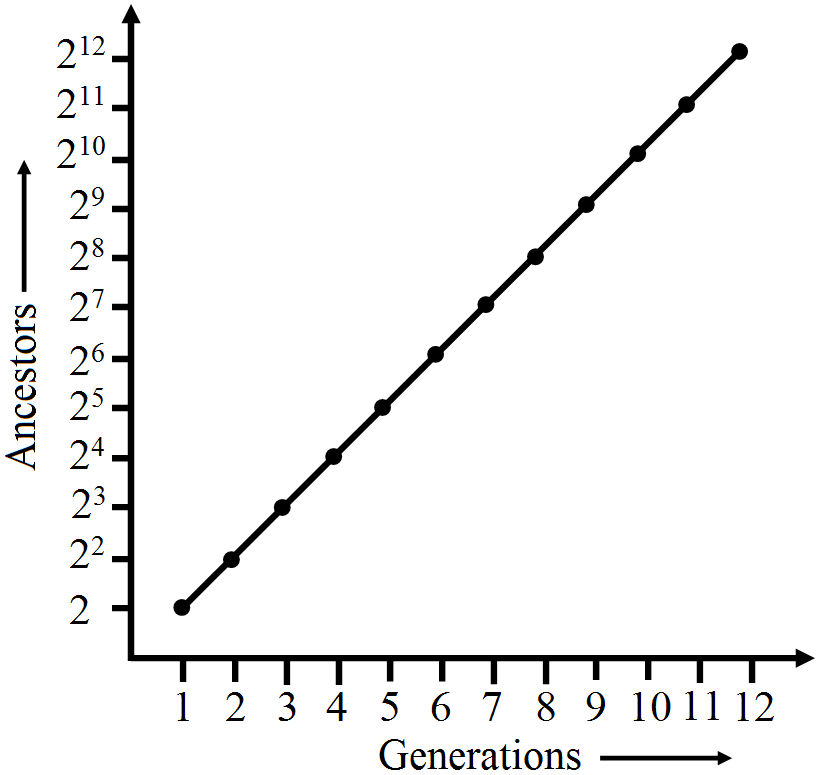
$b.$ On the basis of generation$-$ancestor graph, the number of ancestors in $n$ generations will $2^n.$ View full question & answer→