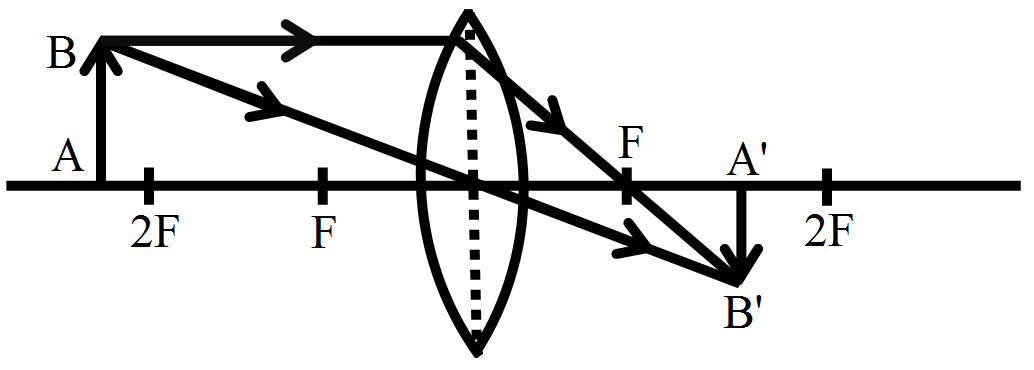
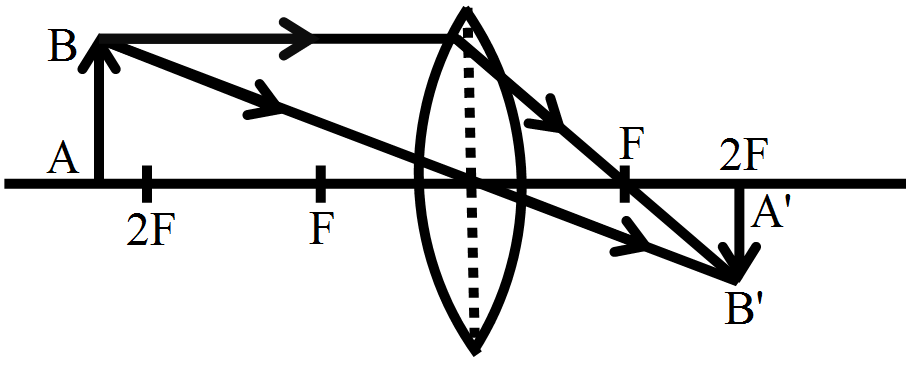
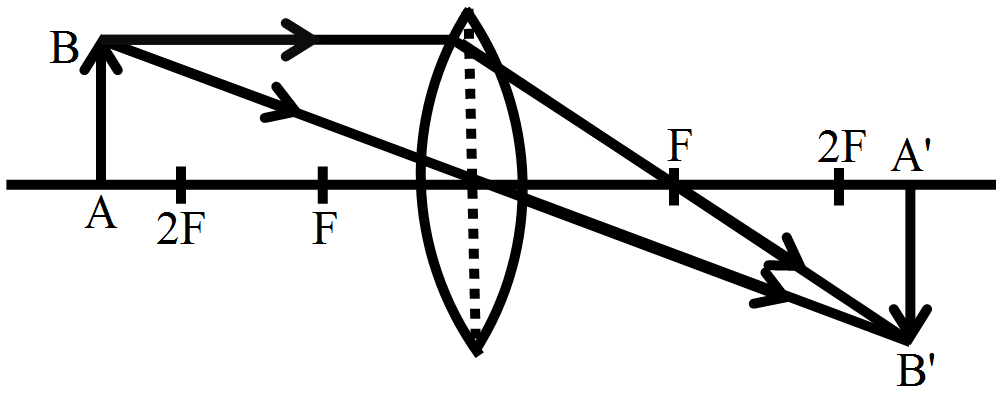
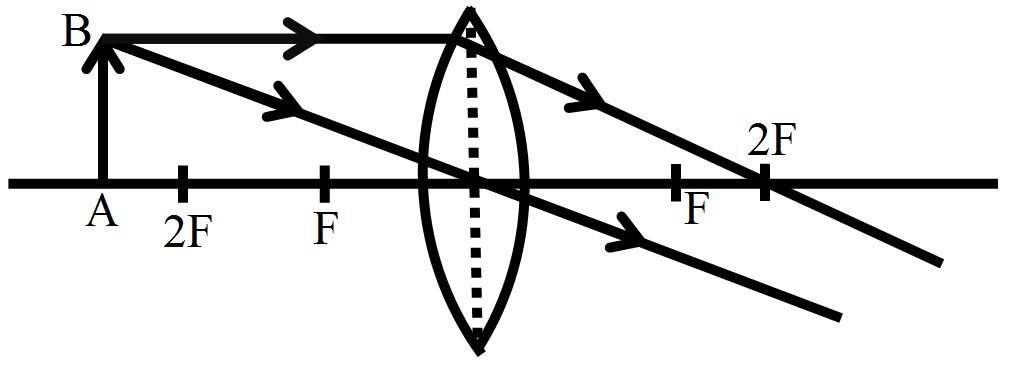
MCQ 11 Mark
The image formed by a plane mirror is always:
AnswerCorrect option: D. Both $(b)$ and $(c)$
View full question & answer→MCQ 21 Mark
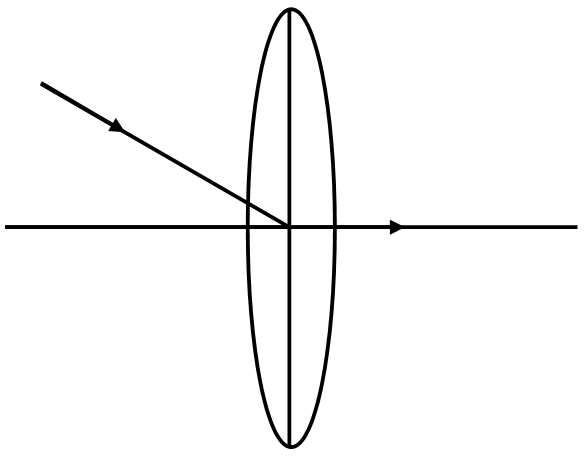
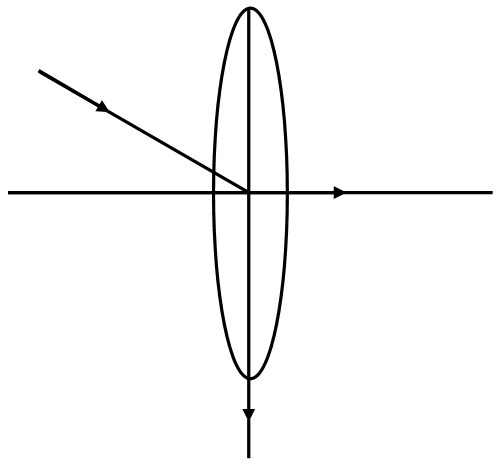
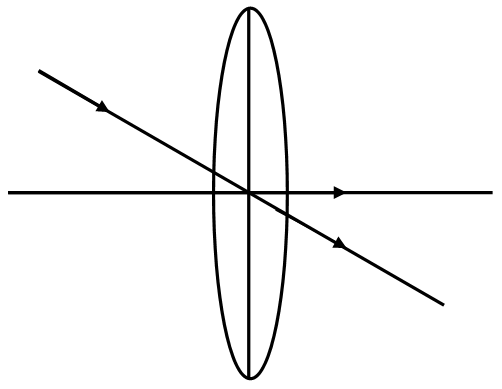
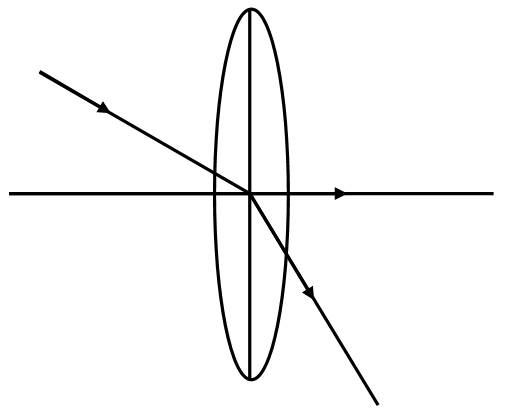
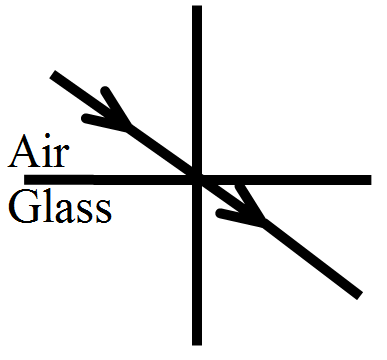
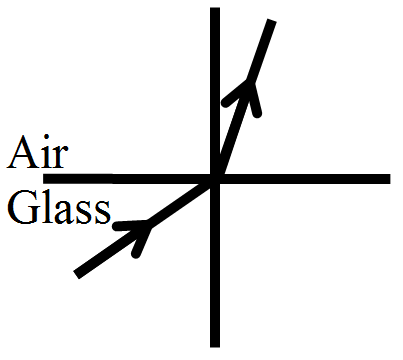
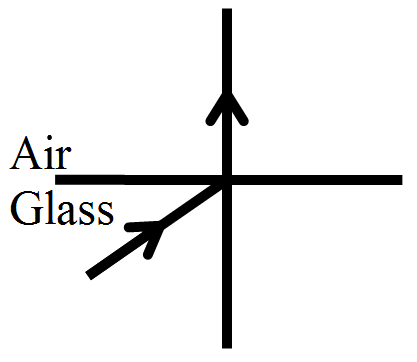
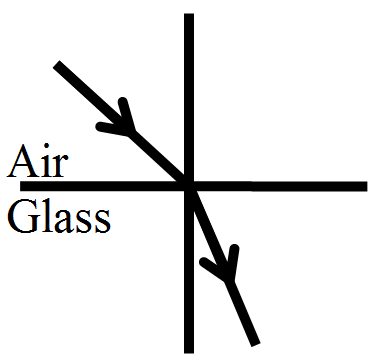
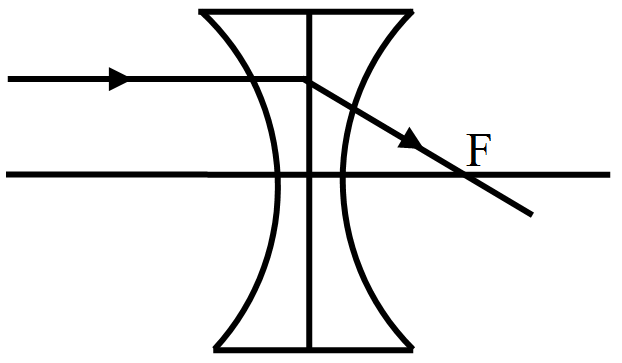
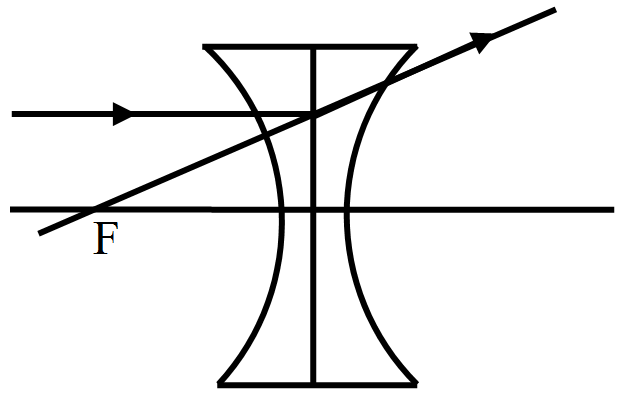
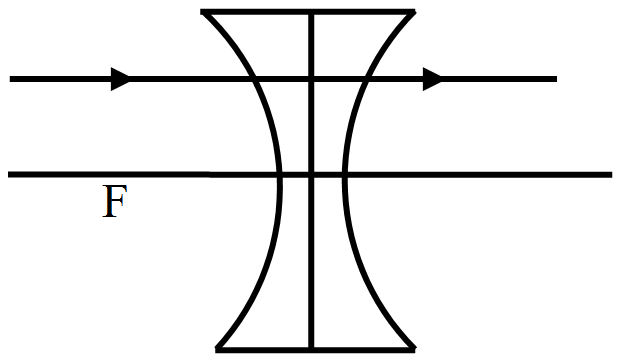
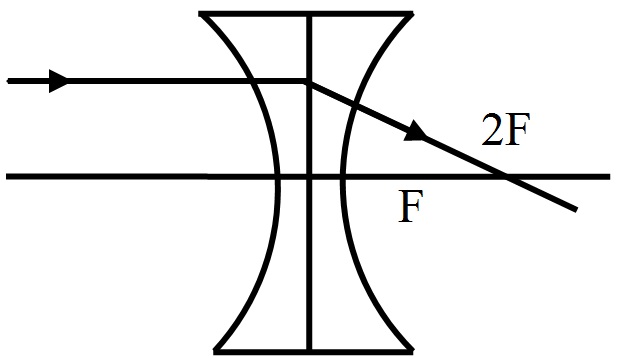
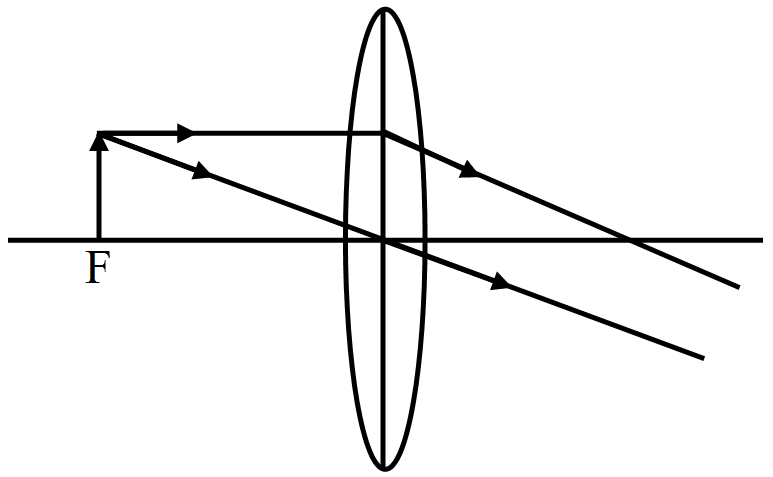
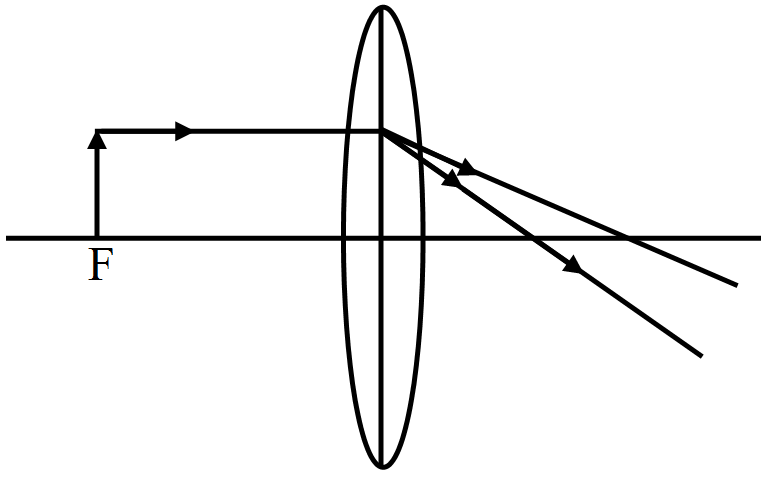
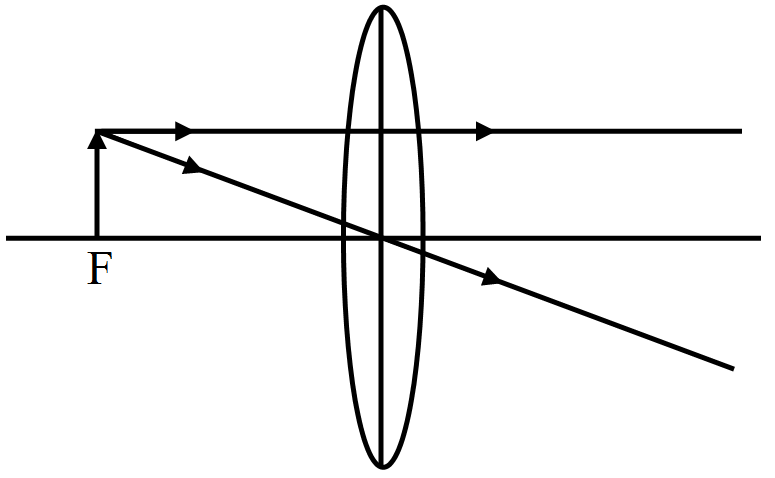
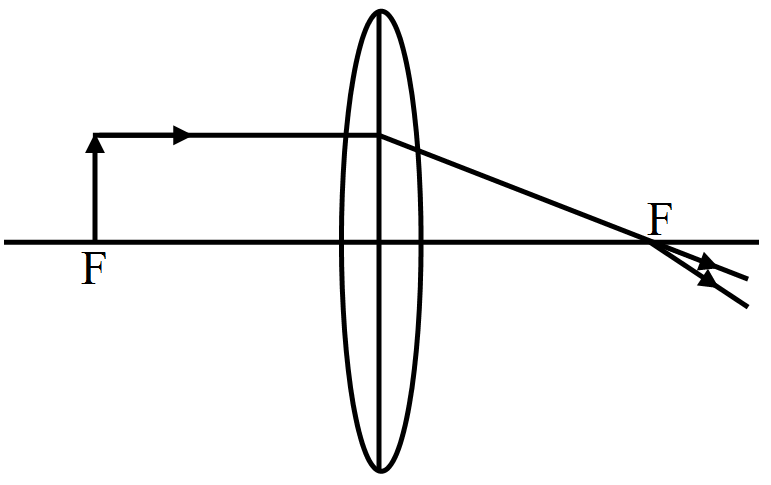
Which of the following diagrams correctly represents the ray of light passing through the optical centre?
MCQ 31 Mark
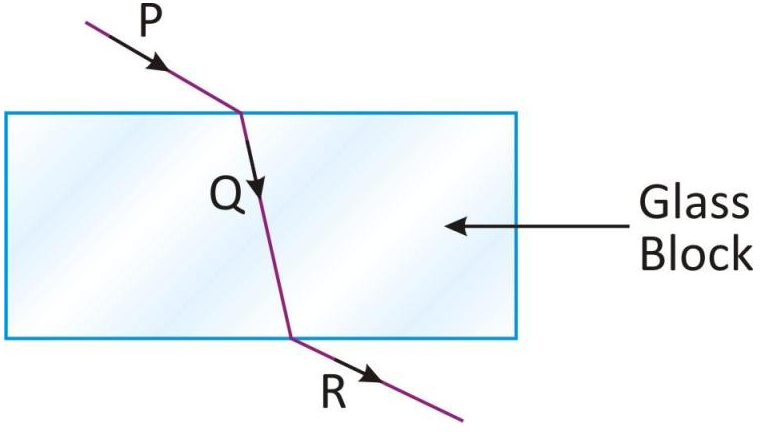
The diagram shows a ray $\text{PQR}$ travelling through a glass slab. Which option in the table gives the correct name for all three rays?
- A
| $P$ |
$Q$ |
$R$ |
| Incident ray |
Emergent ray |
Refracted ray |
- ✓
| $P$ |
$Q$ |
$R$ |
| Incident ray |
Refracted ray |
Emergent ray |
- C
| $P$ |
$Q$ |
$R$ |
| Emergent ray |
Incident ray |
Refracted ray |
- D
| $P$ |
$Q$ |
$R$ |
| Emergent ray |
Refracted ray |
Incident ray |
AnswerCorrect option: B.
| $P$ |
$Q$ |
$R$ |
| Incident ray |
Refracted ray |
Emergent ray |
View full question & answer→MCQ 41 Mark
The part of light which is returned back into the same medium is called.
- ✓
- B
- C
Both $(a)$ and $(b)$
- D
Neither $(a)$ nor $(b)$
View full question & answer→MCQ 51 Mark
A long vertical pin placed at $40\ cm,$ in front of a concave mirror gives an image at the same position. The focal length of the mirror in meters is:
- ✓
$0.2m$
- B
$0.4m$
- C
$0.6m$
- D
$0.8m$
AnswerCorrect option: A. $0.2m$
View full question & answer→MCQ 61 Mark
A fish is raising vertically to the surface of water in a lake uniformly at the rate of $2\text{ms}^{-1}$ observes a bird diving vertically towards the water at a rate $4\text{ms}^{-1}$ vertically above it. The refractive index of water is $\frac{4}{3}$. The actual velocity of the bird is.
- ✓
$\frac{3}{2}$
- B
$\frac{2}{3}$
- C
$\frac{4}{3}$
- D
$\frac{3}{4}$
AnswerCorrect option: A. $\frac{3}{2}$
Velocity of fish is $\mu$= $2\text{ms}^{-1}$ Velocity of bird $($w.r.t fish$)$ is $\text{V}$ = $4\text{ms}^{-1}$ Refractive index of water.
$\mu$ $=$$\frac{4}{3}$
Actual velocity of bird $= \frac{\text{V}-\mu}{\mu}=\frac{4-2}{\frac{4}{3}}=\frac{3}{4}\times2=\frac{3}{2}$
View full question & answer→MCQ 71 Mark
The deficiency of one of the following in the diet of a person for a considerable time can lead to a disease called night blindness. This one is:
- A
Vitamin $b$
- B
Vitamin $d$
- ✓
Vitamin $a$
- D
Vitamin $c$
AnswerCorrect option: C. Vitamin $a$
The deficiency of one of the following in the diet of a person for a considerable time can lead to a disease called night blindness. This one is “vitamin a”. The impaired dark adaptation of eyes is called as night blindness. People with this impairment can hardly see in dim environment or during night time. This due to vitamin deficiency is mostly treatable with vitamin supplement. Vitamin a helps in transfer of nerve impulses into image to retina. Some of the food with vitamin a are eggs, cod liver oil, yellow and orange fruits and vegetables and so on.
View full question & answer→MCQ 81 Mark
Which part of the human eye contracts and relaxes in order to adjust the focal length of the lens?
AnswerTo accommodate near and far vision, the ciliary muscles of the eye contract and expand respectively. This contraction and expansion is to respectively decrease and increase the focal length of the lens.
View full question & answer→MCQ 91 Mark
The deficiency of one of the following in the diet of a person for a considerable time can lead to a disease called night blindness. This one is:
- A
Vitamin $B.$
- B
Vitamin $D.$
- ✓
Vitamin $A.$
- D
Vitamin $C.$
AnswerCorrect option: C. Vitamin $A.$
Vitamin $A$ deficiencies occur from fat malabsorption, liver disorders and inadequate food intake.
View full question & answer→MCQ 101 Mark
Statement I: The radius of curvature and focal length of convex mirror are $80\ cm$ and $40\ cm.$
Statement II: The relation between radius of curvature and focal length is $R = 2f.$
- ✓
Both Statements are true, Statement$-II$ is the correct explanation of Statement$-I.$
- B
Both Statements are true, Statement$-II$ is not correct explanation of Statement$-I.$
- C
Statement$-I$ is true. Statement$-II$ is false.
- D
Statement$-I$ is false. Statement$-II$ is true.
AnswerCorrect option: A. Both Statements are true, Statement$-II$ is the correct explanation of Statement$-I.$
$ R = 2f$ Both Statements are true, Statement$-II$ is the correct explanation of Statement$-I.$
View full question & answer→MCQ 111 Mark
There are $............$ laws of reflection.
View full question & answer→MCQ 121 Mark
If you hold a pen in your right hand and stand in front of the mirror, the pen will be in the left hand in the image. This phenomenon is called:
MCQ 131 Mark
Part of the eye which controls the light entering is called:
AnswerIris is a dark muscular structure behind the cornea, which controls the amount of light entering into the eye.
View full question & answer→MCQ 141 Mark
If light falls perpendicularly on a plane mirror, what will be the angle in which it will be reflected$?$
- A
$45$ degrees
- ✓
$90$ degrees
- C
$180$ degrees
- D
$360$ degrees
AnswerCorrect option: B. $90$ degrees
View full question & answer→MCQ 151 Mark
Light passing through a prism splits into seven colours. This is called.
MCQ 161 Mark
Part of the eye which controls the entering of light is called
AnswerIris is a dark muscular structure behind the cornea, which controls the amount of light entering into the eye.
View full question & answer→MCQ 171 Mark
Which of the following parts of the eye has enormous number of photo$-$sensitive cells?
AnswerThe image of an object is formed on the retina of the eye. It is a delicate membrane, which contains a large number of light sensitive cells. These light sensitive cells are called cones. They transform the light signal into electrical signal, which is then sent to the brain.
View full question & answer→MCQ 181 Mark
The number of images formed of an object placed between two plane mirrors inclined at right angles to each other is:
AnswerThe relationship between no. of images and angle of mirror is
$\text{Images}=\Big(\frac{360^\circ}{\text{angle between the mirrors}}\Big)-1$
$\text{Images}=\Big(\frac{360^\circ}{90^\circ}\Big)-1$
Images $= 4 – 1$
Images $= 3$
View full question & answer→MCQ 191 Mark
There are $11$ letters in the word EXAMINATION. How many letters of this word are not changed when the word is seen in a plane mirror$?$
Answer The letters that are not changed when the word is seen by reflection are: $X, A, M, I, A, T, I, O$ i.e. $8$ letters.
View full question & answer→MCQ 201 Mark
The change in converging power of an eye-lens is caused by the action of:
AnswerThe ciliary muscle fibers affect the zonular fibers in eye and thus change the lens shape and thus changes the converging power.
View full question & answer→MCQ 211 Mark
Beam of light striking the reflecting surface is ca:
MCQ 221 Mark
For a concave mirror when object is placed at infinity the image is formed at.
MCQ 231 Mark
The bouncing back of light into the same medium is called:
MCQ 241 Mark
Four statements about the blind spot of the human eye: $I$ It is devoid of photosensitive cells. $II$ No image is formed at the blind spot. $III$ It connects the optic nerves to the retina. $IV$ Its malfunctioning makes a person blind. Which of the given statements is incorrect$?$
Answer Blindness is caused primarily because of the defect in the cornea. Hence, statement $IV$ is incorrect.
View full question & answer→MCQ 251 Mark
What happens in lateral inversion?
- A
The right side of the object will be on the right side of the image.
- B
The left side of the object will be on the left side of the image.
- C
The top of the object will be the bottom of the object.
- ✓
The right side of the object will be on the left side of the image.
AnswerCorrect option: D. The right side of the object will be on the left side of the image.
The image formed by the plane mirror is laterally inverted i.e., the right side of the object appears on the left side of the image and left side of the object appears on the right side of the image.
View full question & answer→MCQ 261 Mark
The phenomenon of breaking up of light into its seven constituent colours is known as$.......$
View full question & answer→MCQ 271 Mark
Which of the following statement is correct:
- A
Angle of incidence is never equal to angle of reflection.
- B
Angle of incidence is always greater than angle of reflection.
- C
Angle of incidence is always smaller than angle of reflection.
- ✓
Angle of incidence is always equal to angle of reflection.
AnswerCorrect option: D. Angle of incidence is always equal to angle of reflection.
View full question & answer→MCQ 281 Mark
The bending of a light which passes from one medium to other medium is.
MCQ 291 Mark
Statement $I:$ The plane containing the incident ray and the normal is called plane of incidence.
Statement $II:$ The plane containing the incident ray and the normal is called plane of reflection.
- A
Both Statements are true, Statement$-II$ is the correct explanation of Statement$-I.$
- ✓
Both Statements are true. Statement$-II$ is not correct explanation of Statement$-I.$
- C
Statement$-I$ is true, Statement$-II$ is false.
- D
Statement$-I$ is false. Statement$-II$ is true.
AnswerCorrect option: B. Both Statements are true. Statement$-II$ is not correct explanation of Statement$-I.$
View full question & answer→MCQ 301 Mark
Let the incident ray be fixed. Now, if a plane mirror is rotated through an angle of $20^\circ$ about an axis lying in its plane, then the reflected ray turns through an angle.
- A
$60^\circ$
- ✓
$40^\circ$
- C
$10^\circ$
- D
$30^\circ$
AnswerCorrect option: B. $40^\circ$
View full question & answer→MCQ 311 Mark
The ray that comes back from the surface after reflection is called:
MCQ 321 Mark
Which of the following is not a part of the human eye?
AnswerAuditory nerve is not a part of the human eye. Explanation: auditory nerve is a nerve bundle that transmits sound from cochlea to the brain. Cochlea is a auditory sense organ found at the back of each ears.
View full question & answer→MCQ 331 Mark
In the human eye, light is converted into electrical signals by the.
MCQ 341 Mark
Which of the following is a non$-$luminous object?
AnswerNon$-$luminous objects are those that are themselves not capable of producing their own light but can reflect light from another source. Moon reflects sunlight and hence is non$-$luminous.
View full question & answer→MCQ 351 Mark
The characteristics of an eye disease are given below.
$i.$ Eye sight becomes foggy.
$ii.$ Eye lens becomes cloudy.
$iii.$ There is a loss of vision.
In which of the following are the above characteristics observed?
AnswerCataract occurs in old age due to the given characteristics and can be cured by introducing a new artificial lens.
View full question & answer→MCQ 361 Mark
According to the laws of reflection, which of the following statements is correct?
- A
The angle of incidence is greater than the angle of reflection.
- B
The angle of incidence is less than the angle of reflection.
- ✓
The angle of incidence is equal to the angle of reflection.
- D
The angle of incidence is not equal to the angle of reflection.
AnswerCorrect option: C. The angle of incidence is equal to the angle of reflection.
According to the laws of reflection, the angle of incidence is always equal to the angle of reflection.
View full question & answer→MCQ 371 Mark
Image of our face in a plane mirror.
- ✓
- B
- C
Cannot be taken on the screen.
- D
Both $(b)$ and $(c).$
View full question & answer→MCQ 381 Mark
The defect of vision in which the eye$-$lens of a person gets progressively cloudy resulting in blurred vision is called :
AnswerCataract is the clouding of the lens of human eye, that lies behind the iris and pupil. It leaves to a blurred vision or decrease in vision.
View full question & answer→MCQ 391 Mark
The image of an object formed by a plane mirror is:
AnswerThe image formed by a plane mirror is virtual or unreal and it is also created behind the mirror. The image formed in a plane mirror is the same distance behind the mirror and the same size as the object as the object in front of it. And the image formed by a plane mirror is erect and always laterally inverted.
View full question & answer→MCQ 401 Mark
The incident ray and the reflected ray from a mirror are mutually perpendicular to each other. The angle of incidence is:
- A
$90^\circ$
- ✓
$45^\circ$
- C
$22.5^\circ$
- D
$30^\circ$
AnswerCorrect option: B. $45^\circ$
View full question & answer→MCQ 411 Mark
If a person wants to see an enlarged image of the object by using a convex lens then the lens must be held.
AnswerCorrect option: A. Close to the object so that the object lies within the focal length of the lens.
When the object is placed within the focal length of the lens, the image is formed on the same side as the object. It is virtual, erect and magnified.
View full question & answer→MCQ 421 Mark
The light ray passes in homogeneous medium.
MCQ 431 Mark
For the myopic eye, the defect is cured by:
AnswerMyopia can be corrected by using spectacles with concave lenses of the required power.
View full question & answer→MCQ 441 Mark
Which of the following changes occur when you walk out of bright sunshine into a poorly lit room?
- ✓
The pupil becomes larger.
- B
The lens becomes thicker.
- C
The ciliary muscle relaxes.
- D
The pupil becomes smaller.
AnswerCorrect option: A. The pupil becomes larger.
When a person walks out of bright sunshine into a poorly lit room, the pupil dilates and becomes larger to allow maximum light to enter the eye and thus helps in viewing things easily in a poorly lit room.
View full question & answer→MCQ 451 Mark
The range of vision of a normal human eye lies between.
- A
$25m$ and infinity.
- B
$2.5m$ and $5\ km.$
- C
$2.5\ cm$ and $5\ km.$
- ✓
$25\ cm$ and infinity.
AnswerCorrect option: D. $25\ cm$ and infinity.
The minimum object distance till which a normal human eye can see an object without any strain is known as the least distance of distinct vision. For the normal human eye this distance is $25\ cm.$ A person with normal vision can see objects that are very far away (or at infinity). Hence, the range of vision for a normal human eye lies between $25\ cm$ and infinity.
View full question & answer→MCQ 461 Mark
Statement $I:$ Real images are always inverted.
Statement $II:$ Virtual images are always erect.
- A
Both Statements are true, Statement$-II$ is the correct explanation of Statement$-I.$
- ✓
Both Statements are true, Statement$-II$ is not correct explanation of Statement$-I.$
- C
Statement$-I$ is true, Statement$-II$ is false.
- D
Statement$-I$ is false, Statement$-II$ is true.
AnswerCorrect option: B. Both Statements are true, Statement$-II$ is not correct explanation of Statement$-I.$
View full question & answer→MCQ 471 Mark
The property that which a light a ray passes obliquely from one medium into another it bends at interface is.
AnswerThe ratio of sine of angle of incidence to the sine of angle of refraction is called refractive index.
View full question & answer→MCQ 481 Mark
In the figure of the human eye, the cornea is represented by the letter.
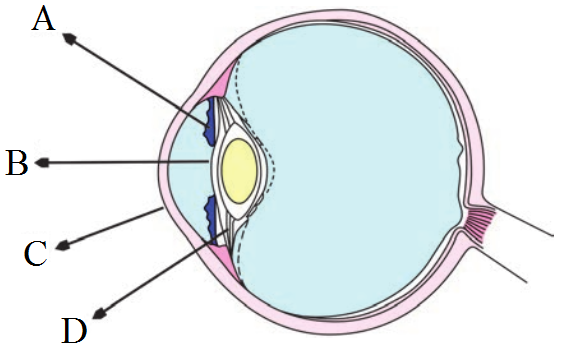
Answer The transparent front part of the eye is cornea labelled as $C\ ($this is a thin layer$).$
View full question & answer→MCQ 491 Mark
In a periscope, how are the reflecting mirrors arranged?
AnswerThe two reflecting, plane mirrors arranged in a periscope are parallel to each other. The light ray from the object is incident on the first plane mirror at an angle of $45^\circ$ and the reflected ray is incident on the second mirror at $45^\circ$ and is then reflected at $45^\circ$, which finally reaches the retina of the eye.
View full question & answer→MCQ 501 Mark
While sitting on the first bench, Mutum finds it difficult to read what is written on the blackboard. However, he can clearly see the same when he sits on the last bench. It can be concluded that Mutum is suffering from.
MCQ 511 Mark
Two mirrors $A$ and $B$ are placed at right angles to each other. $A$ ray of light incident on mirror $A$ at an angle of $25^\circ $ falls on mirror $B$ after reflection. The angle of reflection for the ray reflected from mirror $B$ would be:
- A
$25^\circ$
- B
$50^\circ$
- ✓
$65^\circ$
- D
$115^\circ$
AnswerCorrect option: C. $65^\circ$
View full question & answer→MCQ 521 Mark
Read the following sentences carefully, and choose the correct one:
- A
The ray of light which falls on the mirror surface is called incident ray.
- B
The point at which the incident ray strikes the mirror is called the point of incidence.
- C
The ray of light which is sent back by the mirror is called the reflected ray.
- ✓
AnswerHere, all the statements are correct.
View full question & answer→MCQ 531 Mark
If the object is placed $10\ cm$ in front of a convex mirror of radius of curvature $20\ cm,$ the magnification is:
- A
$2$
- B
$1$
- ✓
$\frac{1}{2}$
- D
$0$
AnswerCorrect option: C. $\frac{1}{2}$
View full question & answer→MCQ 541 Mark
In a quiz competition, you are asked a question where you have to choose the statement which is/ are correct?
- A
The image formed by a plane mirror is virtual and erect.
- B
The image formed by a plane mirror is behind the mirror.
- C
The image formed in a plane mirror is the same distance behind the mirror as the object is in front of it.
- ✓
AnswerHere, all the statements are correct.
View full question & answer→MCQ 551 Mark
If a mirror is rotated by $10^\circ$, the reflected ray is rotated by:
- A
$10^\circ$
- ✓
$20^\circ$
- C
$40^\circ$
- D
$30^\circ$
AnswerCorrect option: B. $20^\circ$
View full question & answer→MCQ 561 Mark
Consider the following statements and choose the incorrect one:
Answer Here, all the statements are correct.
View full question & answer→MCQ 571 Mark
When a light travels from one medium to another medium which are separated by sharp boundary, the characteristic which does not change is.
MCQ 581 Mark
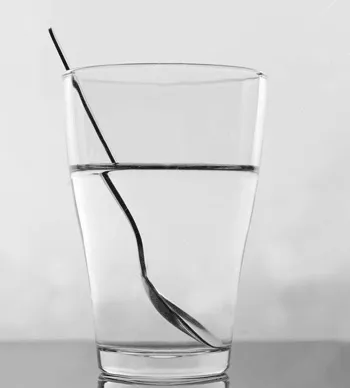
When we immerse a spoon in a glass containing water, it appears bent at the point, it enters in the water. This apparent bending of the spoon is due to $..........$
View full question & answer→MCQ 591 Mark
The diameter of spherical mirror in which reflection takes place is called.
MCQ 601 Mark
The least distance of distinct vision for a young adult with normal vision is about:
- A
$25\ m$
- B
$2.5\ cm$
- ✓
$25\ cm$
- D
$2.5\ m$
AnswerCorrect option: C. $25\ cm$
The least distance of distinct vision means the minimum distance for an object to be viewed clearly. This minimum distance for a young adult with normal vision is $25\ cm.$
View full question & answer→MCQ 611 Mark
Read the given statements and select the correct option.
Statement 1: A beam of light emitted by the point source placed in water always diverges in air.
Statement 2: The refracted ray moves away from normal when a ray goes from a denser medium to a rarer medium.
- ✓
Both statements $1$ and $2$ are true and statement $2$ is the correct explanation of statement $1.$
- B
Both statements $ 1$ and $2$ are true but statement $2$ is not the correct explanation of statement $1.$
- C
Statement $1$ is true but statement $2$ is false.
- D
Both statements $1$ and $2$ are false.
AnswerCorrect option: A. Both statements $1$ and $2$ are true and statement $2$ is the correct explanation of statement $1.$
Here, water is a denser medium and air is a rarer medium.
View full question & answer→MCQ 621 Mark
Statement $I:$ If refractive index of one medium is equal to refractive index of second medium, then beam does not bend at all.
Statement $II:$ The bending of light does not depend on refractive indices of media.
- ✓
Both Statements are true. Statement$-II$ is the correct explanation of Statement$-I$.
- B
Both Statements are true, Statement$-II$ is not correct explanation of Statement$-I$.
- C
Statement$-I$ is true. Statement$-II$ is false.
- D
Statement$-I$ is false. Statement$-II$ is true.
AnswerCorrect option: A. Both Statements are true. Statement$-II$ is the correct explanation of Statement$-I$.
View full question & answer→MCQ 631 Mark
Myopia is a defect of vision caused by:
- A
A decrease in the retinal distance from the lens.
- B
A decrease in the diameter of the eyeball.
- C
An increase in the thickness of the lens.
- ✓
An increase in the curvature of the lens.
AnswerCorrect option: D. An increase in the curvature of the lens.
In a myopic eye, the image of distant objects is formed in front of the retina and not on the retina, as shown in the given figure. Since eye lens is convex, all parallel rays converge at its focus. This is a clear indication of the shortening of the focal length of a myopic eye lens.
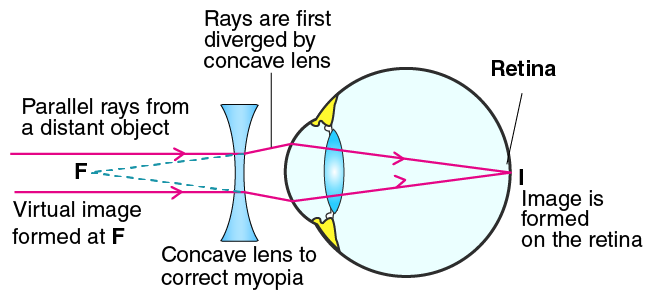
As a result, the curvature of the lens gets increased. Hence, myopia is caused by an increase in the curvature of the eye lens.
View full question & answer→MCQ 641 Mark
Tina has a defect in her eyes. She is not able to contract her iris properly. As a result of the defect in her eyes, Tina will not be able to see.
MCQ 651 Mark
Read the following sentences carefully, and choose the correct one:
- A
The retina is a screen on which the image is formed in the eye.
- B
The eye-lens focuses the image of an object on the retina.
- C
The optic nerve carries the image formed on retina to the brain in the form of electrical signals.
- ✓
AnswerHere, all the statements are correct.
View full question & answer→MCQ 661 Mark
A narrow beam of white light is passed through a glass prism as shown in the figure.
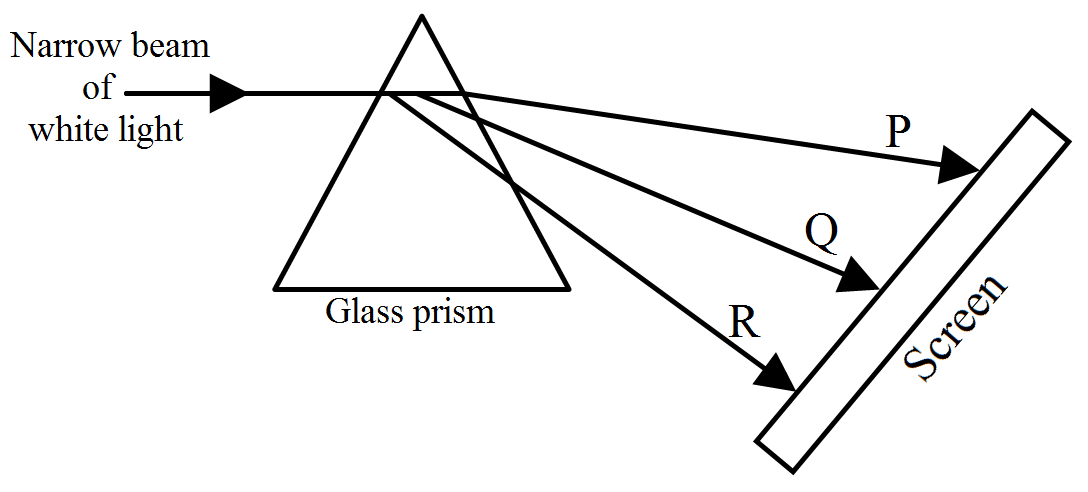
Which of the following is the correct order of colours emerging from the prism$?$ - A
| $P$ |
$Q$ |
$R$ |
| Red |
Blue |
Green |
- ✓
| $P$ |
$Q$ |
$R$ |
| Red |
Green |
Blue |
- C
| $P$ |
$Q$ |
$R$ |
| Blue |
Green |
Red |
- D
| $P$ |
$Q$ |
$R$ |
| Blue |
Red |
Green |
AnswerCorrect option: B.
| $P$ |
$Q$ |
$R$ |
| Red |
Green |
Blue |
When a narrow beam of light is allowed to pass through.
A prism, the white light splits into seven colours called spectrum. The order of colours emerging from the prism is Violet, Indigo, Blue, Green, Yellow, Orange and Red with Red colour deviating the least. So, $P$ is Red, $Q$ is Green and $R$ is Blue.Standards
View full question & answer→MCQ 671 Mark
In the human eye, the function of the optic nerves is to.
- A
Adjust the focus of the eye lens.
- ✓
Transmit electrical signals to the brain.
- C
Control the number of rod and cone cells.
- D
Donvert light signals into electrical signals.
AnswerCorrect option: B. Transmit electrical signals to the brain.
The optic nerves transmit the electrical signals generated by the retina to the brain.
View full question & answer→MCQ 681 Mark
Which of the following results in diffused reflection?
MCQ 691 Mark
Tina has a defect in her eyes. She is not able to contract her iris properly. As a result of the defect in her eyes, Tina will not be able to see.
AnswerIris is that part of the eye which controls the amount of light by contracting and expanding itself. In dim light, the iris contracts to expand the pupil, so as to allow more light to enter the eye. In this way, things become visible in dim light. It is given that Tina is not able to contract her iris properly. Hence, she will not be able to see properly in dim light.
View full question & answer→MCQ 701 Mark
When we look at a distant object, the ciliary muscles__$i$__, making the eye lens __$ii$__. This iii the focal length of the eye lens so that the image of that object gets focused on the retina. The information in which alternative completes the given statements?
- A
$i-$get released, $ii-$thicker, $iii-$decreases.
- B
$i-$contract, $ii-$thicker, $iii-$increases.
- ✓
$i-$get released, $ii-$thinner, $iii-$increses.
- D
$i-$contract, $ii-$thinner, $iii-$decreases.
AnswerCorrect option: C. $i-$get released, $ii-$thinner, $iii-$increses.
In the case of an object situated at a distance, almost parallel rays of light enter our eyes. Hence, the eye lens does not require a high converging power. As a result, the ciliary muscles get released and make the eye lens thinner, which in turn increases the focal length of the eye lens.
View full question & answer→MCQ 711 Mark
The nature of image formed by plane mirror is:
MCQ 721 Mark
An object is placed at a distance of $50\ cm$ from a concave lens of focal length $20\ cm.$ Find the position of the image $............$
- A
$10.2\ cm$
- B
$14.3\ cm$
- ✓
$-14.3\ cm$
- D
$-10.2\ cm$
AnswerCorrect option: C. $-14.3\ cm$
View full question & answer→MCQ 731 Mark
You are watching your right palm in the plane mirror by placing it parallel to it, which is in front of you, then you will observe your palm as.
MCQ 741 Mark
The primary function of the crystalline lens in the human eye is to.
- A
Reduce the intensity of light.
- ✓
Focus the incident light rays.
- C
Adjust the size of the pupil.
- D
Filter out the dust particles.
AnswerCorrect option: B. Focus the incident light rays.
The primary function of the crystalline lens present in the human eye is to focus the light coming from an object onto the retina.
View full question & answer→MCQ 751 Mark
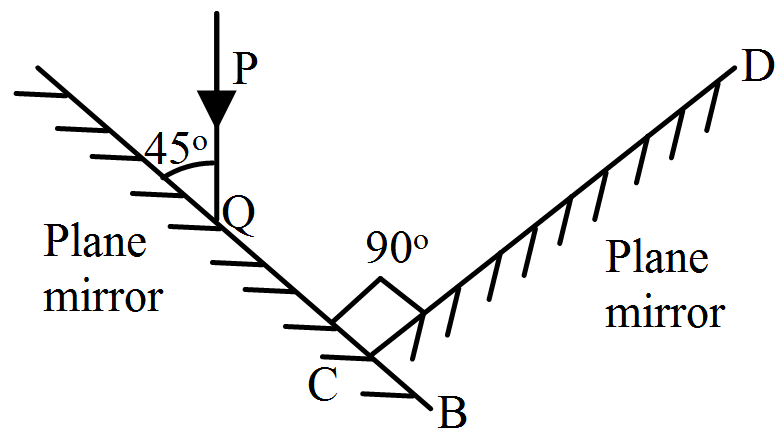
Two plane mirrors $AB$ and $CD$ are placed at right angles to one another. A ray of light $PQ$ hits $AB$ at $Q$ making an angle of $45^\circ $ as shown in the diagram. This ray will be reflected from mirror $CD$ at an angle.
- A
$20^\circ $
- B
$35^\circ$
- ✓
$45^\circ$
- D
$60^\circ$
AnswerCorrect option: C. $45^\circ$
Since $OS$ is normal to the mirror $AB.$
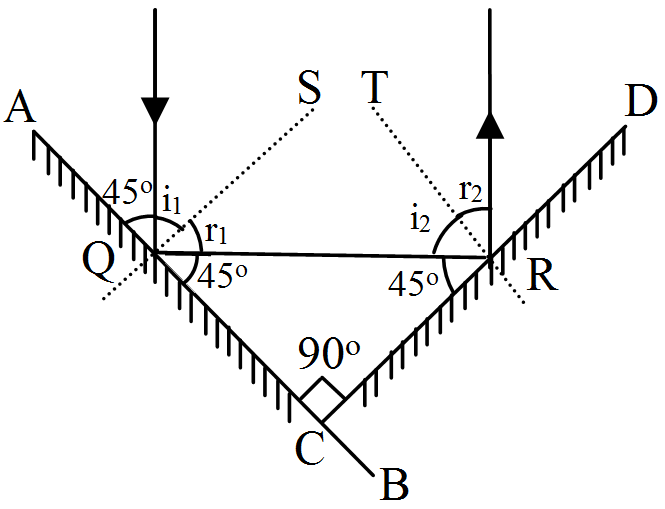
$\therefore\angle\text{i}_1=45^\circ, $ also $\angle\text{r}_1= 45^\circ$ in
$\Delta\text{CQR}, \angle\text{C} = 90^\circ, \angle\text{CQR} = 45^\circ$
$\therefore\angle\text{CQR} = 45^\circ$
$\big[$$\therefore$ sum of all the three angles in tringle is $180^\circ$$\big]$
Hence, $\angle\text{i}_2 = 45^\circ$
$\big[$ TR is the normal to the mirror BD$\big]$
$\therefore\angle\text{r}_2 = 45^\circ$
View full question & answer→MCQ 761 Mark
The refractive index of glass is $1.5$ and speed of light in air is $3 \times 10^{10}cm/ s,$ the speed of light in glass is.
AnswerCorrect option: B. $2 \times 10^{10}cm/ s$
View full question & answer→MCQ 771 Mark
A light ray is allowed to fall on the plane mirror. Now the mirror is rotated in plane of incidence, then which of the following will not change.
MCQ 781 Mark
When light travels from rarer medium to denser medium.
- ✓
Refracted ray bends to wards normal.
- B
Refracted ray bends away from normal.
- C
Ray undedicated from path.
- D
We cannot identified the ray.
AnswerCorrect option: A. Refracted ray bends to wards normal.
View full question & answer→MCQ 791 Mark
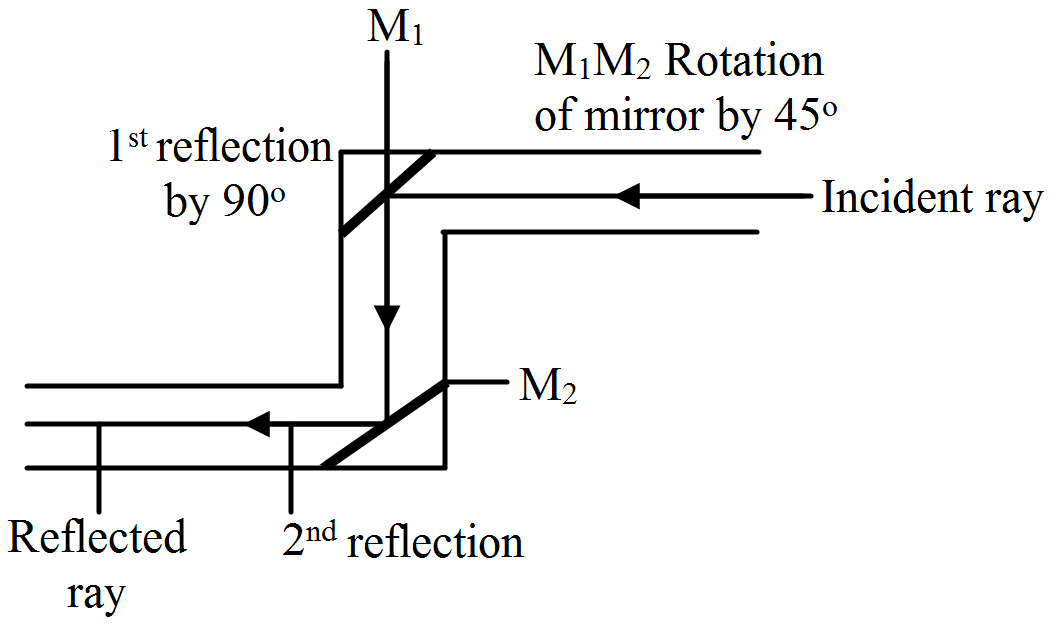
For a given incident ray, the plane of the mirror makes an angle $\theta$ with the incident ray, then the reflected ray is turned through $2\theta.$ Which of the following is based on the above principle?
AnswerIn the case of a periscope, the given fact is used and is illustrated below.
View full question & answer→MCQ 801 Mark
The velocity of light in air is $3 \times10^8\text{ms}^{-1}$ and in glass is $2 \times10^8\text{ms}^{-1}$. The refractive index of glass w.r.t air is.
- ✓
$\frac{2}{3}$
- B
$\frac{3}{2}$
- C
$\frac{4}{3}$
- D
$\frac{9}{4}$
AnswerCorrect option: A. $\frac{2}{3}$
$\text{V}_\text{a} = 3\times10^8\text{ms}^{-1}.....\text{V}_9 = 2\times10^8\text{ms}^{-1}$
$_\text{a}\mu^\text{g} = \frac{\text{V}_\text{g}}{\text{V}_\text{a}}= \frac{2\times10^8}{3\times10^8} = \frac{2}{3}$
View full question & answer→MCQ 811 Mark
A light bulb is placed between two plane mirrors inclined at an angle of $60^\circ .$ The number of images formed are:
View full question & answer→MCQ 821 Mark
Which of the following ray diagrams shown below represents the image formed by the convex lens when the object is placed beyond $2F?$
AnswerWhen the object is placed beyond $2F,$ the image is formed between $F$ and $2F.$ It is real, inverted and diminished.
View full question & answer→MCQ 831 Mark
Which of the following produces diffuse reflection of light?
- A
Mirror on a dressing table.
- B
- ✓
- D
AnswerScreen in a cinema hall produces diffuse reflection of light. When light incidence on smooth surface, the light is reflected in one direction as parallel beam. This is why our eyes cannot view the reflection from mirror, water and polished wood directly. When the light incidence on rough surface, the light is reflected in many directions. So, in cinema hall, the screen is designed as rough and irregular surface. In theatre, the projector projects parallel light rays which falls on screen. Due to irregularity of screen, the light is reflected in different direction. This type of reflection helps people from anywhere in the theatre to see the picture projected by the projector.
View full question & answer→MCQ 841 Mark
Consider three statements regarding the defects of eye.
I. If the size of the eye ball decreases, then the person suffers from myopia.
II. If the near point of eye becomes greater than $25\ cm,$ then the person is said to suffer from hypermetropia.
III. A person, at older age, suffering from presbyopia uses a bifocal lens for correction. Among the given statements.
- A
Only statement $I$ is correct.
- B
Only statement $II$ is correct.
- C
Both statements $I$ and $II$ are correct.
- ✓
Both statements $II$ and $III$ are correct.
AnswerCorrect option: D. Both statements $II$ and $III$ are correct.
View full question & answer→MCQ 851 Mark
Identify the value of persistence of vision.
- A
$\frac{1}{10}^{th}$ of a second.
- B
$\frac{1}{12}^{th}$ of a second.
- ✓
$\frac{1}{16}^{th}$ of a second.
- D
$\frac{1}{20}^{th}$ of a second.
AnswerCorrect option: C. $\frac{1}{16}^{th}$ of a second.
Persistence of vision is a phenomenon where the brain continues to sense the image even after the object has been removed. This lasts for $\frac{1}{16}^{th}$ of a second.
View full question & answer→MCQ 861 Mark
A convergent lens of focal length $20\ cm$ and made of a material with refractive index $1.1$ is immersed in water the lens behaves as a.
- A
Converging lens of focal length $20\ cm.$
- B
Converging lens of focal length less than $20\ cm.$
- C
Converging lens of focal length more than $20\ cm.$
- ✓
View full question & answer→MCQ 871 Mark
In which of the following are plane mirrors arranged at an angle to get a number of colored images?
AnswerThree plane mirrors are arranged at an angle to get a number of colored images in a kaleidoscope.
View full question & answer→MCQ 881 Mark
Which of the following is the characteristic of an ideal mirror?
- A
It absorbs all the amount of light incident on it.
- B
It refracts all the light.
- ✓
It reflects all the light.
- D
AnswerCorrect option: C. It reflects all the light.
An ideal mirror reflects all the light.
View full question & answer→MCQ 891 Mark
Statement $I:$ When light travels from one medium to another, then frequency remains constant.
Statement $II:$ When the direction of light ray is reversed, the ray simply retraces its path, this statement is called the Principle of reversibility of light.
- A
Both Statements are true. Statement$-II$ is the correct explanation of Statement$-I.$
- ✓
Both Statements are true, Statement$-II$ is not correct explanation of Statement$-I.$
- C
Statement$-I$ is true, Statement$-II$ is false.
- D
Statement$-I$ is false. Statement$-II$ is true
AnswerCorrect option: B. Both Statements are true, Statement$-II$ is not correct explanation of Statement$-I.$
View full question & answer→MCQ 901 Mark
Payal is completed her science chapter where she wrote some statements. She wants to know whether the statements are correct or not? Payel wants to take help from you:
- A
A ray of light which is incident normally on a mirror is reflected back along the same path.
- B
In regular reflection, a parallel beam of incident light is reflected as a parallel beam in one direction.
- C
Regular reflection of light occurs from smooth surfaces like that of a plane mirror or highly polished metal surfaces.
- ✓
AnswerHere, all the statements are correct.
View full question & answer→MCQ 911 Mark
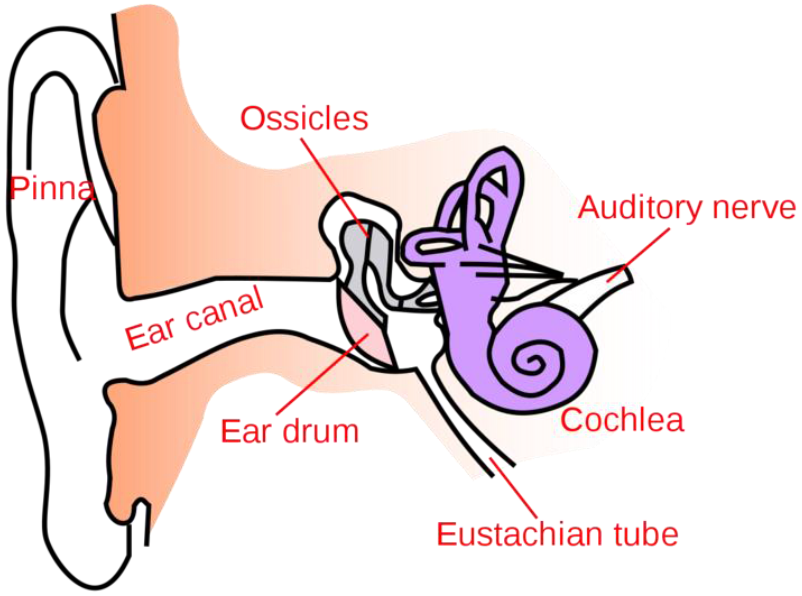
Which of the following is not a part of the human eye?
AnswerAuditory nerve is not a part of the human eye, but a part of human ear. It transmits hearing information between the brain and cochlea.
See the diagram of human ear attached:
View full question & answer→MCQ 921 Mark
The light ray, which strikes any surface, is called:
MCQ 931 Mark
Which of the following pairs of eye parts is responsible for controlling the amount of light entering into the eye?
- ✓
- B
- C
Cilliary muscles and iris.
- D
Cilliary muscles and pupil.
AnswerThe circular diaphragm in front of the eye lens is known as iris and the small opening in between the iris is known as pupil. The size of the pupil controls the amount of light entering into the eye. It is also true that the size of the pupil is controlled by the iris. Hence, both iris and pupil are responsible for controlling the amount of light entering into the eye.
View full question & answer→MCQ 941 Mark
In case of convex lens, as object is coming closer to the lens the image will $...........$
View full question & answer→MCQ 951 Mark
Front bulged part of the eyeball is called:
MCQ 961 Mark
$X$ is a surface that cannot produce clear images. What is $X?$
- ✓
- B
- C
- D
Smooth but curved surface.
AnswerWhen light is incident on a rough surface, irregular reflection takes place, hence the image formed is not clear.
View full question & answer→MCQ 971 Mark
The defect of vision in which the eye$-$lens of a person gets progressively cloudy resulting in blurred vision is called:
AnswerThe medical condition in which the lens of eye of a person becomes progressively cloudy resulting in blurred vision is called cataract. Cataract develops when the eye$-$lens of a person becomes cloudy or even opaque due to the formation of a membrane over it. Cataract decreases the vision of eye gradually. The vision of the person can be restored after getting surgery done on the having cataract. The eye defect called cataract cannot be corrected by any type of spectacle lenses.
View full question & answer→MCQ 981 Mark
View full question & answer→MCQ 991 Mark
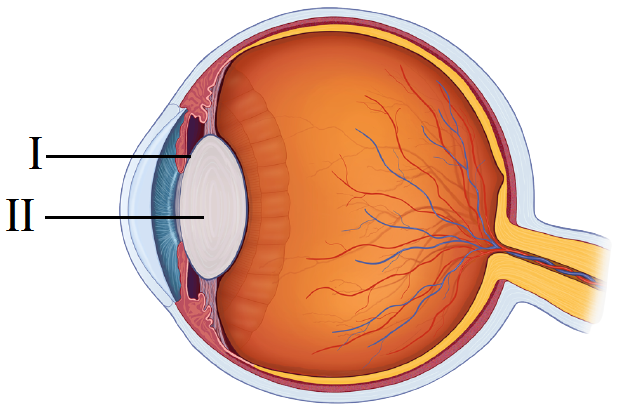
The given diagram is that of the human eye. In the given diagram, the parts labelled as $I$ and $II$ are respectively the.
View full question & answer→MCQ 1001 Mark
The angle between an incident ray and the plane mirror is $30^\circ .$ The total angle between the incident ray and the reflected ray will be:
- ✓
$30^\circ$
- B
$60^\circ$
- C
$90^\circ$
- D
$120^\circ$
AnswerCorrect option: A. $30^\circ$
The angle between the incident ray and the mirror is $30$ degrees.
Angle of incidence = angle of reflection.
$90$ degrees is going directly into the mirror.
So, $90 – 30 = 60$ degrees.
The total angle between the incident ray and the reflected ray will be $120$ degree.
View full question & answer→MCQ 1011 Mark
What is the perpendicular drawn at any point on a mirror called?
AnswerThe perpendicular drawn to the reflecting surface of a mirror at the point of incidence is called 'normal'. The point on the reflecting surface where the light ray is incident is called the point of incidence.
View full question & answer→MCQ 1021 Mark
A ray of light is incident on a plane mirror at an angle of $60^\circ$. What is the angle of deviation?
- ✓
$60^\circ$
- B
$30^\circ$
- C
$90^\circ$
- D
$180^\circ$
AnswerCorrect option: A. $60^\circ$
View full question & answer→MCQ 1031 Mark
We are able to see an object due to the presence of:
MCQ 1041 Mark
Statement $I:$ The phenomenon of left appearing right and right appearing left on reflection in a plane mirror is called later inversion.
Statement $II:$ Number of images formed for an object kept in between two mirror placed at angle $90^\circ$ to each other are $3.$
- A
Both Statements are true, Statement$-II$ is the correct explanation of Statement$-I.$
- ✓
Both Statements are true. Statement$-II$ is not correct explanation of Statement$-I.$
- C
Statement$-I$ is true, Statement$-II$ is false.
- D
Statement$-I$ is false, Statement$-II$ is true.
AnswerCorrect option: B. Both Statements are true. Statement$-II$ is not correct explanation of Statement$-I.$
View full question & answer→MCQ 1051 Mark
If refractive indices of glass and water are respectively $\frac{3}{2}$ and $\frac{4}{2}$, then the refractive index of glass with respective to water is.
- A
$2$
- B
$\frac{8}{9}$
- ✓
$\frac{9}{8}$
- D
$\frac{1}{2}$
AnswerCorrect option: C. $\frac{9}{8}$
View full question & answer→MCQ 1061 Mark
A clock hung on a wall of a hall has marks instead of numerals on its dial. On the opposite wall, there is a plane mirror and the image of the clock in the mirror indicates the time $7.40.$ hence, the time on the clock is.
- A
$7.40$
- ✓
$4.20$
- C
$5.40$
- D
$10.7$
AnswerCorrect option: B. $4.20$
View full question & answer→MCQ 1071 Mark
How does the eye change in order to focus on near or distant objects?
- A
The lens moves in or out.
- B
The retina moves in or out.
- ✓
The lens becomes thicker or thinner.
- D
The pupil becomes larger or smaller.
AnswerCorrect option: C. The lens becomes thicker or thinner.
The shape of the lens is changed by ciliary muscles so that the image forms at a sharp focus at the retina. The lens becomes thicker to focus at near objects and becomes thinner to focus at distant objects.
View full question & answer→MCQ 1081 Mark
Statement $I:$ The reflected ray formed by the plane mirror which is rotated with angle $\theta$ is shifted through an angle of $2\theta$.
Statement $II:$ Reflected ray rotates with an angle of $2\theta$ if the mirror rotates with $\theta$.
- ✓
Both Statements are true, Statement$-II$ is the correct explanation of Statement$-I.$
- B
Both Statements are true. Statement$-II$ is not correct explanation of Statement$-I.$
- C
Statement$-I$ is true. Statement$-II$ is false.
- D
Statement$-I$ is false, Statement$-II$ is true.
AnswerCorrect option: A. Both Statements are true, Statement$-II$ is the correct explanation of Statement$-I.$
View full question & answer→MCQ 1091 Mark
Three light bulbs are concealed from an observer by an opaque wall as shown. Without shifting the positions of the observer and the bulbs, the images of which of the bulbs can the observer see from the plane mirror?
- A
$P$ and $P$
- ✓
$P$ and $Q$
- C
Only $P$
- D
$Q$ and $R$
AnswerCorrect option: B. $P$ and $Q$
Bulbs $P$ and $Q$ lies in the plane of incidence of mirror while bulb $R$ does not. Thus, only the images of the bulbs $P$ and $Q$ can be seen by the observer from the plane mirror.
View full question & answer→MCQ 1101 Mark
Which of the following occurs in persons suffering from myopia?
- A
The eye ball is shortened.
- B
Ciliary muscles contract.
- ✓
- D
AnswerA person suffering from myopia has elongation of the eye ball. As such he cannot see distant objects clearly. A suitable concave lens can rectify the above defect, so that the image falls on the retina.
View full question & answer→MCQ 1111 Mark
Rainbow is a natural phenomenon showing.
MCQ 1121 Mark
Read the following sentences carefully, and choose the correct one:
- A
Periscope is used to see over the heads of a crowd.
- B
Periscope is used by soldiers sitting in a trench to observe the enemy activities outside.
- C
Periscope is used by a navy officer sitting in a submarine to see ships over the surface of water in the sea.
- ✓
AnswerHere, all the statements are correct.
View full question & answer→MCQ 1131 Mark
Which of the following ray diagrams shown below shows respectively the short sightedness condition and its correctness by using a lens?
$i.$ 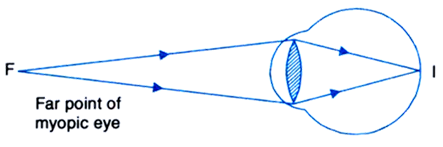
$ii.$ 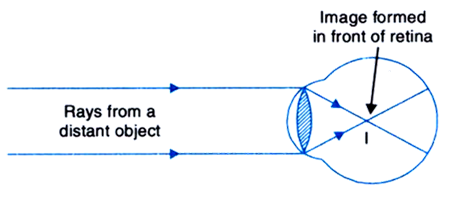
$iii.$ 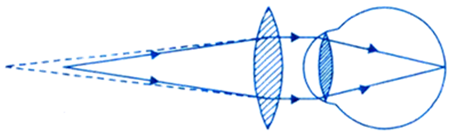
$iv.$ 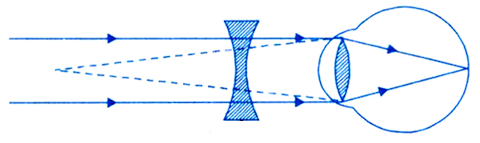
- A
$(i)$ and $(iv)$
- B
$(i)$ and $(iii)$
- ✓
$(ii)$ and $(iv)$
- D
$(ii)$ and $(iii)$
AnswerCorrect option: C. $(ii)$ and $(iv)$
In short sightedness image is formed in front of the retina and short sightedness can be corrected by using a concave lens.
View full question & answer→MCQ 1141 Mark
The change in converging power of an eye$-$lens is caused by the action of:
AnswerWe can clearly view an object only when image is clearly reflected on retina. Our eyes focus distinct and near objects and reflects the image on retina. When eyes need to focus distinct object, then ciliary muscles reflex which increases the focal length. The eye lens converges the light and the objects are said to be unaccommodated. When eyes need to focus nearby object, then ciliary muscles relax which decreases the focal length. The eye lens diverges the light and the objects are said to be accommodated. The accommodation power of eyes is as close as $25 \ cm$ and as far as infinity.
View full question & answer→MCQ 1151 Mark
A small boy places a paper written $'\text{PAPYRUS}'$ in front of a plane mirror. He finds that it appears totally inverted in opposite direction. He gets confused. He goes to his mother and tells his problem. His mother explains him the exact reason for this. The exact reason could be$..........$
View full question & answer→MCQ 1161 Mark
Statement $I:$ All the light rays actually converge at some point.
Statement $II:$ All the light rays appears to converge at some point.
- A
Both Statements are true. Statement$-II$ is the correct explanation of Statement$-I.$
- B
Both Statements are true, Statement$-II$ is not correct explanation of Statement$-I.$
- C
Statement$-I$ is true, Statement$-II$ is false.
- ✓
Statement$-I$ is false, Statement$-II$ is true.
AnswerCorrect option: D. Statement$-I$ is false, Statement$-II$ is true.
View full question & answer→MCQ 1171 Mark
If the angle of incidence of light falling on a plane mirror is 30degree, what will be the angle of reflection$?$
- A
$90$ degree
- B
$60$ degree
- ✓
$30$ degree
- D
$0$ degree
AnswerCorrect option: C. $30$ degree
View full question & answer→MCQ 1181 Mark
A When the angle between two plane mirrors is $60^\circ ,$ how many images will be formed by the mirrors$?$
AnswerIf two plane mirrors are inclined at an angle of $60^\circ ,$ then
$\text{n} = \frac{360}{60} -1=5$
images are formed.
View full question & answer→MCQ 1191 Mark
For a normal eye, in an adult, what is the least distance of distinct vision$?$
- A
$5$ to $8\ cm.$
- B
$10$ to $15\ cm.$
- ✓
$20$ to $25\ cm.$
- D
$30$ to $35\ cm.$
AnswerCorrect option: C. $20$ to $25\ cm.$
The point nearest to the eye at which an object is distinctly visible is called the near point of the eye. The distance of the near point of the eye is called the least distance of distinct vision. It varies with age. For an infant, it is $5$ to $8\ cm,$ for an adult, it is $20$ to $25\ cm.$
View full question & answer→MCQ 1201 Mark
When the white light is allowed to pass through the glass prism it under goes dispersion and splits up into its constituent colours. Which colour of the light show minimum refraction?
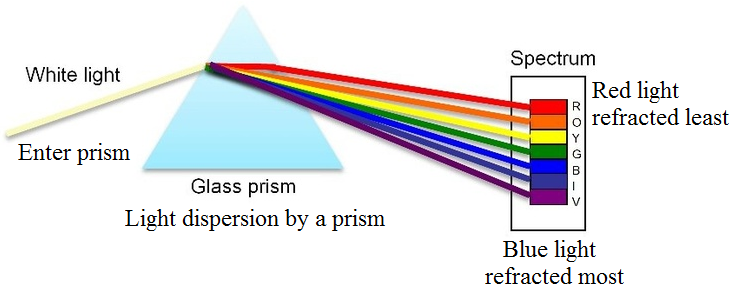
MCQ 1211 Mark
The second medium is optically denser.
- ✓
Ray bends towards normal.
- B
Ray bends away from normal.
- C
- D
AnswerCorrect option: A. Ray bends towards normal.
View full question & answer→MCQ 1221 Mark
Which of the following is the requirement of nocturnal animals like owl an bat?
- A
- B
- C
Retina with large number of rods.
- ✓
AnswerThe nocturnal animals need more light to see at night. The large cornea and pupil allow more light to enter into their eyes. They also have retina with large number of rods.
View full question & answer→MCQ 1231 Mark
The human eye forms the image of an object at its:
AnswerThe image of an object is formed at the retina of an eye which is the third and the innermost coat of an eye. Light rays are focused on the retina by cornea, lens and the pupil.
View full question & answer→MCQ 1241 Mark
An incident ray makes an angle of $65^\circ $ with the surface of a plane mirror. The angle of reflection in this case will be:
- A
$65^\circ $
- B
$45^\circ$
- C
$25^\circ$
- ✓
$35^\circ$
AnswerCorrect option: D. $35^\circ$
Angle of incidence is always equal to angle of refection. Hence, angle of reflection will be $35^\circ .$
View full question & answer→MCQ 1251 Mark
Which one of the following is correct?
AnswerLight is refracted towards the normal when it goes from a rarer medium to a denser medium.
View full question & answer→MCQ 1261 Mark
A ray of light is incident on a plane mirror at an angle of incidence of $30\ ?.$ The deviation produced by the mirror is:
- A
$30^\circ$
- B
$60^\circ$
- C
$90^\circ$
- ✓
$120^\circ$
AnswerCorrect option: D. $120^\circ$
View full question & answer→MCQ 1271 Mark
What is the phenomenon of light bouncing back into the same medium called?
AnswerThe phenomenon of light in which, light is reflected or bounced back into the same medium is called reflection.
View full question & answer→MCQ 1281 Mark
What is the nature of image formed on the retina of human eye of an object?
AnswerThe human eye serves as a convex lens. It forms real, inverted and diminished image of an object.
View full question & answer→MCQ 1291 Mark
Reflection is possible in case of.
- ✓
- B
- C
Both $(a)$ and $(b)$
- D
Neither $(a)$ nor $(b)$
View full question & answer→MCQ 1301 Mark
The spherical surfaces that have a property of reflection and that are highly polished are called.
MCQ 1311 Mark
A ray of light incident on a refracting surface. If the angle of incidence $60^\circ$ and the angle of refraction is $45^\circ$, then angle of deviation is.
- A
$30^\circ$
- B
$90^\circ$
- ✓
$15^\circ$
- D
$0^\circ$
AnswerCorrect option: C. $15^\circ$
$\text{d}=\text{i}=\text{r};$
$\text{d}= 15^\circ$
View full question & answer→MCQ 1321 Mark
A ray of light that falls on an eye first passes through the.
MCQ 1331 Mark
In the above problem, find the position of lower edge of the mirror relative to the ground is.
- A
$160\ cm$
- B
$75\ cm$
- ✓
$100\ cm$
- D
$200\ cm$
AnswerCorrect option: C. $100\ cm$
Height of the lower edge from ground $= h/ 2, h \rightarrow $ height of eyes from ground.
View full question & answer→MCQ 1341 Mark
A car or a truck driver always prefers a convex mirror in his vehicle. This is due to the fact that, the image formed in the convex mirror is always$..........$
View full question & answer→MCQ 1351 Mark
Consider the following statements and choose the correct one:
AnswerHere, all the statements are correct.
View full question & answer→MCQ 1361 Mark
A prism splits up light into different colours but a glass slab does not show dispersion because:
- A
The emergent ray is deviated from the direction of the incident ray by the angle of deviation.
- ✓
The incident and emergent rays are parallel to each other.
- C
The emergent ray is laterally displaced from glass slab and changes its direction.
- D
The incident and emergent rays are not parallel to each other.
AnswerCorrect option: B. The incident and emergent rays are parallel to each other.
Dispersion occurs when light is passed through a prism due to the difference in the angle of deviation for different colours. The opposite sides of a glass slab are parallel and therefore different colors emerge parallel to each other and are seen simultaneously.
View full question & answer→MCQ 1371 Mark
The diagram shows the path of a light ray $X,$ directed at a plane mirror.
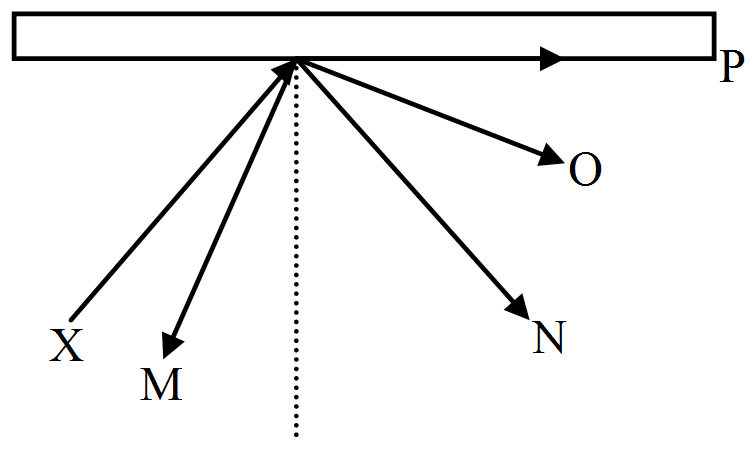
Which of the following is the correct reflected ray$?$ AnswerWe know that for a reflected ray, the angle that the incident ray makes with the line perpendicular to the surface is equal to the angle made by the reflected ray with this perpendicular line. $N$ is the correct reflected ray of $X.$
View full question & answer→MCQ 1381 Mark
Light of the wave length $7200\mathring{\text{A}}$ in air has a wave length in glass is equal to $(\mu =1.5)$.
- A
$7200\mathring{\text{A}}$
- ✓
$4800\mathring{\text{A}}$
- C
$1080\mathring{\text{A}}$
- D
$3600\mathring{\text{A}}$
AnswerCorrect option: B. $4800\mathring{\text{A}}$
$\frac{\mu_\text{m}}{\mu_\text{a}} = \frac{\lambda_\text{c}}{\lambda_\text{m}};$
$\frac{3}{2}=\frac{7200\mathring{\text{A}}}{\lambda_\text{m}};$
$\lambda_\text{m} = 2 \times 2400\mathring{\text{A}}$
$= 4800\mathring{\text{A}}$
View full question & answer→MCQ 1391 Mark
Identify the part of the human eye on which different images are formed.
AnswerImages are formed on the retina.
View full question & answer→MCQ 1401 Mark
Identify the nature of the image formed by the eye lens of a human eye.
- A
Real, upright and enlarged.
- B
Real, upright and diminished.
- ✓
Real, inverted and diminished.
- D
Virtual, inverted and diminished.
AnswerCorrect option: C. Real, inverted and diminished.
The image formed on the retina is real, inverted and diminished. The optic nerve transmits the inverted image to the brain which reads it as an erect image.
View full question & answer→MCQ 1411 Mark
If the velocity of light in vacuum is $c\ m/ s,$ then the velocity of light in a medium of refractive index $1.5$ is $..............$
- A
$1.5 \times c$
- B
$c$
- ✓
$\frac{\text{c}}{1.5}$
- D
AnswerCorrect option: C. $\frac{\text{c}}{1.5}$
View full question & answer→MCQ 1421 Mark
The virtual images are the image which cannot be obtained on the screen. Identify the virtual image from the figure given below:
- A
$-\frac{7}{3}$
- B
$-\frac{8}{7}$
- C
$\Big(-\frac{7}{8}\Big)$
- ✓
$\frac{4}{9}$
AnswerCorrect option: D. $\frac{4}{9}$
View full question & answer→MCQ 1431 Mark
Which of the following statements are correct regarding the image formed by a concave lens$?$
$i.$ The nature of image does not change much with the change in the object distance.
$ii.$ Always a virtual image is formed.
$iii.$ The image is larger in size.
$iv.$ Image is never formed between the optical centre and the focus.
- A
Only $(i), (ii)$ and $(iii).$
- ✓
Only $(i)$ and $(ii).$
- C
Only $(iii)$ and $(iv)$
- D
Only $(ii), (iii)$ and $(iv).$
AnswerCorrect option: B. Only $(i)$ and $(ii).$
View full question & answer→MCQ 1441 Mark
As the angle between two plane mirrors is decreased gradually, the number of images of an object placed between them:
- ✓
- B
- C
First increases then decreases.
- D
First decreases then increases.
AnswerWhen the angle between mirrors is $180^\circ $ then only single image is obtained. If the angle decreases, then the number of images increases. If the angle increases, then the number of images decreases. And when the angle between two plane mirrors become $0$ degree, that is, when the two plane mirrors become parallel to each other then, an infinite number of images are formed.
View full question & answer→MCQ 1451 Mark
An object is placed $40\ cm$ in front of a convex mirror of radius of curvature, $20\ cm.$ The image:
- A
Is real and $8\ cm$ behind the mirror.
- B
Is real and $8\ cm$ in front of the mirror.
- C
Is virtual and $8\ cm$ in front of the mirror.
- ✓
Is virtual and $8\ cm$ behind the mirror.
AnswerCorrect option: D. Is virtual and $8\ cm$ behind the mirror.
View full question & answer→MCQ 1461 Mark
When a light ray passes from one medium $(\mu_1)$ to other medium $(\mu_2)$. Refraction does not take place in the following situation.
- ✓
- B
$\mu_1 > \mu_2$
- C
$\mu_1 = \mu_2$
- D
$\mu_1 < \mu_2$
Answerif $\text{i} =0^\circ$then $\text{r}=0^\circ$
if $\mu_1 =\mu_2 $ then $\text{i} = \text{r}$
View full question & answer→MCQ 1471 Mark
If two plane mirrors are inclined at an angle of $40^\circ ,$ number of images formed will be:
View full question & answer→MCQ 1481 Mark
The size of the pupil of the eye is adjusted by:
AnswerThe muscles of the iris dilate and constrict the pupil and thus increases and reduces the amount of light entering the eye.
View full question & answer→MCQ 1491 Mark
The angle between the reflected ray and the nor:
MCQ 1501 Mark
An optician holds a test card $50\ cm$ behind a patient. The patient then looks in the plane mirror which is $100\ cm$ away. How far away from the patient's eyes is the image of the test card?
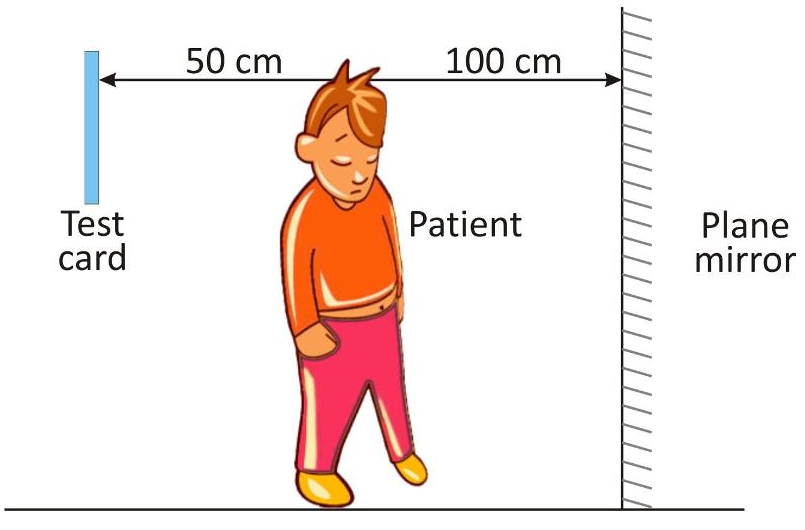
- A
$100\ cm$
- B
$150\ cm$
- C
$200\ cm$
- ✓
$250\ cm$
AnswerCorrect option: D. $250\ cm$
Object distance $= 150\ cm$
$\therefore$ Image distance $= 150\ cm$ (as in plane mirror, object distance is always equal to the image distance)
The patient is $100\ cm$ away from the mirror.
So, the distance between the patient's eyes and the image $= 100\ cm + 150\ cm = 250\ cm$
View full question & answer→MCQ 1511 Mark
Which of the following prevents internal reflections of light inside the human eye?
AnswerThe inner layer of the eye called the choroid is black. This prevents internal reflections of light inside the human eye.
View full question & answer→MCQ 1521 Mark
When a mirror is rotated through an angle $9$ the reflected ray from it, turns through an angle of:
- A
$\theta$
- B
$\frac{\theta}{2}$
- ✓
$2\theta$
- D
$0$
AnswerCorrect option: C. $2\theta$
View full question & answer→MCQ 1531 Mark
The angle of reflection is equal to the angle of incidence:
- ✓
- B
- C
Under special conditions.
- D
AnswerThe point at which the incident ray strikes the mirror is called the point of incidence. The angle of reflection is always equal to the angle of incidence.
View full question & answer→MCQ 1541 Mark
The human eye forms the image of an object at its:
AnswerIn the human eye, when the light rays enter to a sharp focusing point on the retina. It acts as the film on camera. It receives the image and passes to cornea. Here, the internal lens of the eyes is focused by cornea. It transforms this image falling on the lens into electrical impulses. The electrical impulses are transferred to optic nerves which carry information to brain and we can see the object.
View full question & answer→MCQ 1551 Mark
If the speed of red light is denoted by $\text{V}_\text{r}$, and the speed for violet light by $\text{V}_\text{u}$. Then in vacuum.
- A
$\text{V}_\text{r} >$ $\text{V}_\text{u}$
- ✓
$\text{V}_\text{r} = \text{V}_\text{u}$
- C
$\text{V}_\text{r} < \text{V}_\text{u}$
- D
Both $1\ \&\ 3$
AnswerCorrect option: B. $\text{V}_\text{r} = \text{V}_\text{u}$
View full question & answer→MCQ 1561 Mark
A simple magnifying glass consists of a.
- A
- B
- ✓
Convex lens of small focal length.
- D
Convex lens of large focal length.
AnswerCorrect option: C. Convex lens of small focal length.
View full question & answer→MCQ 1571 Mark
The Kaleidoscope is an instrument consisting of plane mirrors that produces multiple reflections of colored glass pieces and create beautiful pattern. It consists of three long and narrow strips of plane mirrors. The angle of inclination of the mirror is $............$
- A
$30^\circ$
- ✓
$60^\circ$
- C
$90^\circ$
- D
$120^\circ$
AnswerCorrect option: B. $60^\circ$
View full question & answer→MCQ 1581 Mark
Boojho is doing his homework which is given by his teacher. Would you help him to choose the correct sentences?
- A
The incident ray, the reflected ray and the normal, all lie in the same plane.
- B
The angle of reflection is always equal to the angle of incidence.
- C
If we change the angle of incidence, the angle of reflection will also change accordingly.
- ✓
AnswerHere, all the statements are correct.
View full question & answer→MCQ 1591 Mark
Type of mirror used as side view mirror is:
MCQ 1601 Mark
Which of the following part of eye controls the amount of light entering the eye by contracting or dilating?
MCQ 1611 Mark
- A
When raindrops absorb sunlight.
- B
When raindrops reflect sunlight.
- ✓
When raindrops disperse sunlight.
- D
When raindrops diffract sunlight.
AnswerCorrect option: C. When raindrops disperse sunlight.
The dispersion of sunlight is the splitting of white light into rays of seven different colours. Just after the rain, there are a large number of water drops in the air which act like small prisms. As the white sunlight enters these water drops, the constituents of white light of different colours are refracted by different amounts, and a band of seven colours called rainbow is formed.
View full question & answer→MCQ 1621 Mark
The change in focal length of an eye lens is caused by the action of the?
AnswerThe relaxation or contraction of ciliary muscles changes the curvature of the eye lens. The change in curvature of the eye lens changes the focal length of the eyes. Hence, the change in focal length of an eye lens is caused by the action of ciliary muscles.
View full question & answer→MCQ 1631 Mark
Which of the following statement is or are correct?
- A
Light is a form of energy.
- B
Light is needed to see things around us.
- C
We cannot see objects in a dark room or in the darkness of light even when our eyes are wide open.
- ✓
AnswerHere, all the statements are correct.
View full question & answer→MCQ 1641 Mark
How many images will be formed when two plane mirrors are placed parallel to each other?
MCQ 1651 Mark
The focal length of concave mirror is $-40\ cm$. Its radius of curvature is.
- A
$-20\ cm$
- B
$+20\ cf$
- ✓
$-80\ cm$
- D
$+80\ cm$
AnswerCorrect option: C. $-80\ cm$
View full question & answer→MCQ 1661 Mark
The number of images observable between two parallel mirrors is:
MCQ 1671 Mark
A mirror has $............$ surface.
View full question & answer→MCQ 1681 Mark
Velocity of light in vacuum is.
- A
$13 \times 10^6\ m/ s$
- B
$3 \times 10^{10}\ m/ s$
- ✓
$3 \times 10^{8}\ m/ s$
- D
$3 \times 10^{5}\ m/ s$
AnswerCorrect option: C. $3 \times 10^{8}\ m/ s$
View full question & answer→MCQ 1691 Mark
Image formed by the plane mirror is:
- A
- ✓
- C
Sometimes real sometimes virtual.
- D
View full question & answer→MCQ 1701 Mark
The light appears to travel in straight line because.
- A
It consists of small particles.
- B
The velocity of light is very large.
- ✓
The wavelength of light is very small.
- D
Light is reflected by surroundings.
AnswerCorrect option: C. The wavelength of light is very small.
View full question & answer→MCQ 1711 Mark
Match the column $I$ with column $II$ and column $III$ and select correct option from the codes given below. $($Note: These columns are for convex lens$).$
|
|
Column $I$
$($Position of the object$)$
|
|
Column $II$
$($Position of the image$)$
|
|
Column $III$
$($Type of Image$)$
|
|
$(a)$
|
Object beyond $2F$
|
$(i)$
|
At $2F$
|
$(p)$
|
Real, inverted, large
|
|
$(b)$
|
Object at $2F$
|
$(ii)$
|
Same side as the object
|
$(q)$
|
Virtual, erect, magnified
|
|
$(c)$
|
Object between $F$ and $2F$
|
$(iii)$
|
Beyond $2F$
|
$(r)$
|
Real, inverted, same size
|
|
$(d)$
|
Object within the focal length
|
$(iv)$
|
Between $F$ and $2F$
|
$(s)$
|
Real, inverted, diminished
|
- A
|
$(a)-(ii)-(p);$
|
$(b)-(iii)-(q);$
|
$(c)-(iv)-(r);$
|
$(d)-(i)-(s)$
|
- ✓
|
$(a)-(iv)-(s);$
|
$(b)-(i)-(r);$
|
$(c)-(iii)-(p);$
|
$(d)-(ii)-(q)$
|
- C
|
$(a)-(iii)-(q);$
|
$(b)-(ii)-(s);$
|
$(c)-(ii)-(r);$
|
$(d)-(iii)-(p)$
|
- D
|
$(a)-(i)-(r);$
|
$(b)-(iv)-(p);$
|
$(c)-(i)-(s);$
|
$(d)-(iv)-(q)$
|
AnswerCorrect option: B.
|
$(a)-(iv)-(s);$
|
$(b)-(i)-(r);$
|
$(c)-(iii)-(p);$
|
$(d)-(ii)-(q)$
|
View full question & answer→MCQ 1721 Mark
We can see a non$-$luminous object when the light:
- A
Emitted by the object falls on the eye.
- ✓
Is reflected from the object towards our eye.
- C
Completely passes through the object.
- D
Gets completely absorbed by the object.
AnswerCorrect option: B. Is reflected from the object towards our eye.
We can see a non$-$luminous object $($object that does not produce its own light$)$, when light reflected by the object enters our eyes.
View full question & answer→MCQ 1731 Mark
Statement $I:$ A school girl wears a school uniform of length $1m.$ She requires a mirror of length $0.5m$ fixed on the vertical wall to see her uniform in the mirror.
Statement $II:$ The minimum height of the mirror to be required to see the full image of man of height $h$ is $h/ 2.$
- ✓
Both Statements are true, Statement$-II$ is the correct explanation of Statement$-I$.
- B
Both Statements are true, Statement$-II$ is not correct explanation of Statement$-I.$
- C
Statement$-I$ is true, Statement$-II$ is false.
- D
Statement$-I$ is false. Statement$-II$ is true.
AnswerCorrect option: A. Both Statements are true, Statement$-II$ is the correct explanation of Statement$-I$.
Both Statements are true, Statement$-II$ is the correct explanation of Statement$-I.$
View full question & answer→MCQ 1741 Mark
The angle of incidence is always $............$ to theangle of reflection.
View full question & answer→MCQ 1751 Mark
If two plane mirrors are inclined at an angle of $90^\circ$ to each other, how many images of an object are seen$?$
AnswerCorrect option: C. Only $3$
Number of image $ =\frac{360^\circ}{\theta} - 1=\frac{360^\circ}{90^\circ}-1$
$=4-1=3$
View full question & answer→MCQ 1761 Mark
Statement $I:$ When a light ray from rarer medium is refracted into denser medium its velocity decreases and wavelength decreases.
Statement $II:$ Refractive index decreases with increases in temperature.
- A
Both Statements are true. Statement$-II$ is the correct explanation of Statement$-I.$
- ✓
Both Statements are true. Statement$-II$ is not correct explanation of Statement$-I$.
- C
Statement$-I$ is true, Statement$-II$ is false.
- D
Statement$-I$ is false. Statement$-II$ is true.
AnswerCorrect option: B. Both Statements are true. Statement$-II$ is not correct explanation of Statement$-I$.
View full question & answer→MCQ 1771 Mark
A ray of light is incident on a concave lens parallel to its principal axis. The path of the refracted ray is correctly depicted by:
MCQ 1781 Mark
A layered lens as shown in the figure is made of two materials indicated by different shades. A point object is placed on its axis. The lens will form.
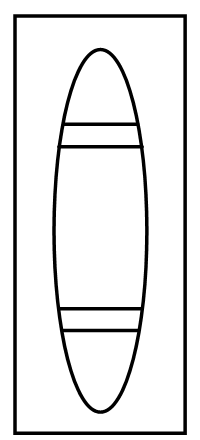
MCQ 1791 Mark
A double convex air bubble in water would behave as a.
MCQ 1801 Mark
The image formed by a convex mirror of real object is larger than the object.
- A
When $u < 2f$
- B
When $u > 2f$
- C
For all values of $u$
- ✓
For no value of $u$
AnswerCorrect option: D. For no value of $u$
Whatever may be the position of object, a convex mirror always forms a virtual, erect and diminished image.
View full question & answer→MCQ 1811 Mark
If the radius of curvature of a concave mirror is $R,$ its focal length is.
- A
$2R$
- B
$R$
- ✓
$\frac{\text{R}}{2}$
- D
$\frac{2}{\text{R}}$
AnswerCorrect option: C. $\frac{\text{R}}{2}$
View full question & answer→MCQ 1821 Mark
The focal length of the eye lens is adjusted by the.
AnswerIn the human eye, the ciliary muscles are attached with the eye lens. These muscles on contracting or relaxing make the eye lens thin or thick respectively. The focal length of the eye lens also changes with its thickness.
View full question & answer→MCQ 1831 Mark
The angle of incidence is the angle made by the incident ray with:
MCQ 1841 Mark
An object placed $4\ m$ from a plane mirror 'Br is shifted by $0.5\ m$ away from the mirror. What is the distance between the object and its image?
- A
$4\ m$
- B
$3.5\ m$
- ✓
$9\ m$
- D
$5\ m$
AnswerCorrect option: C. $9\ m$
Object distance after shifting the object $= 4\ m + 0.5 \ m = 4.5\ m$ For a plane mirror;
Object distance = Image distance $= 4.5 \ m$
Distance between the object and its image $= 4.5 + 4.5 = 9\ m.$
View full question & answer→MCQ 1851 Mark
A person cannot see the distant objects clearly $($though he can see the nearby objects clearly$)$. He is suffering from the defect of vision called:
AnswerMyopia is the defect of vision wherein a person cannot see the distant objects clearly as the light is unable to focus on the retina and thus distant objects appear to be blurred.
View full question & answer→MCQ 1861 Mark
Shyam views a certain object and finds that it is not properly visible to him. The image of the said object is formed by his eye lens $3\ cm$ away from the pupil of his eye. Shyam can correct the defect in his vision by using:
Answer The diameter of the eye ball is approximately $2.3\ cm.$
Images are formed on the retina of the normal eye, which is approximately $2.3\ cm$ behind the pupil.The formation of an image $3\ cm$ away from the pupil of the eye indicates that the light rays are focused behind the retina. For proper visibility, the light rays must focus on the retina.
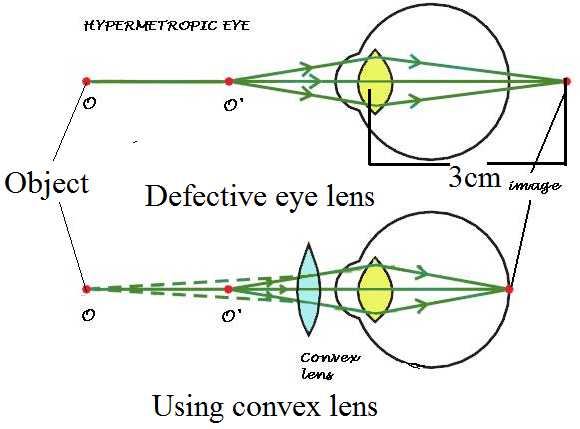
It can be concluded that Shyam is suffering from hypermetropia and a convex lens can be used to correct this defect.
View full question & answer→MCQ 1871 Mark
In the retina of the eye, the area having no sensory cells is called.
MCQ 1881 Mark
Which of the following is used by $E.N.T.$ doctors$?$
AnswerA concave mirror is used by $E.N.T.$ doctors to get a magnified image of internal organs like ear, nose and throat.
View full question & answer→MCQ 1891 Mark
Maximum part of light is reflected by:
MCQ 1901 Mark
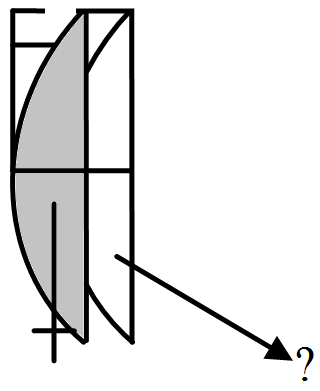
The two lens of different power are given as shown below in the figure.
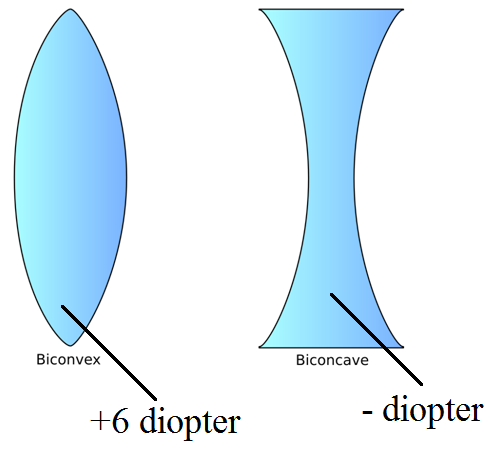
When both the lens is placed in contact with each other, the focal length of the combined lens is:
- A
$20$ diopter
- B
$22$ diopter
- ✓
$24$ diopter
- D
$16 $ diopter
AnswerCorrect option: C. $24$ diopter
View full question & answer→MCQ 1911 Mark
A thin lens produces an image of the same size as the object. Then from the optical centre of the lens, the distance of the object is.
- A
- B
$4f$
- ✓
$2f$
- D
$\frac{\text{f}}{2}$
View full question & answer→MCQ 1921 Mark
The image formed by the eye lens on the retina is.
- A
Real, inverted, and large.
- B
Virtual, erect, and large.
- ✓
Real, inverted, and diminished.
- D
Virtual, erect, and diminished.
AnswerCorrect option: C. Real, inverted, and diminished.
View full question & answer→MCQ 1931 Mark
Which of the following is not a luminous object?
MCQ 1941 Mark
We can see ourselves in mirror or polished surface but not on walls because the reflection from walls is:
MCQ 1951 Mark
Which of the following letters will be seen without any change in a plane mirror$?$
Answer$ T$ is a laterally symmetrical object and hence its image in a plane mirror would be the same as itself.
View full question & answer→MCQ 1961 Mark
Consider the following statements and select the option which correctly identifies true $(T)$ and false $(F).$
$i.$ Part that gives colour to the eye is iris.
$ii.$ Transparent outer layer that refracts light is lens.
$iii.$ Retina is a light sensitive layer of the eye.
$iv.$ Cornea is a region without any sensory cell
- A
$\begin{array}{|c|c|c|c|}
\hline \text { (i) } & \text { (ii) } & \text { (iii) } & \text { (iv) } \\
\hline F & T & F & T \\
\hline
\end{array}$
- B
$\begin{array}{|c|c|c|c|}
\hline \text { (i) } & \text { (ii) } & \text { (iii) } & \text { (iv) } \\
\hline T & F & T & T \\
\hline
\end{array}$
- C
$\begin{array}{|c|c|c|c|}
\hline \text { (i) } & \text { (ii) } & \text { (iii) } & \text { (iv) } \\
\hline T & T & F & F \\
\hline
\end{array}$
- ✓
$\begin{array}{|c|c|c|c|}
\hline \text { (i) } & \text { (ii) } & \text { (iii) } & \text { (iv) } \\
\hline F & F & T & T \\
\hline
\end{array}$
AnswerCorrect option: D. $\begin{array}{|c|c|c|c|}
\hline \text { (i) } & \text { (ii) } & \text { (iii) } & \text { (iv) } \\
\hline F & F & T & T \\
\hline
\end{array}$
Most of the refraction occurs in cornea. Cornea is a region without sensory cells. It is transparent and allows the light to enter the eye. Part that gives colour to the eyes is retina.
View full question & answer→MCQ 1971 Mark
The image formed by a plane mirror is:
- A
Virtual, behind the mirror and enlarged.
- ✓
Virtual, behind the mirror and of the same size as the object.
- C
Real, at the surface of the mirror and enlarged.
- D
Real, behind the mirror and of the same size as the object.
AnswerCorrect option: B. Virtual, behind the mirror and of the same size as the object.
The images formed by a plane mirror are virtual, opposite in direction and are of the same size as the object.
View full question & answer→MCQ 1981 Mark
Which of the following is a non-luminous object?
AnswerThe objects which do not emit their own light are called “non luminous” objects. Actually, the moon the non-luminous objects cannot make their own light. The moon, earth, table, chair, book, trees, plants, flowers, human beings, mirror, diamond are some of the examples of non-luminous objects.
View full question & answer→MCQ 1991 Mark
Two mirrors $A$ and $B$ are placed at right angles to each other as shown in the figure.
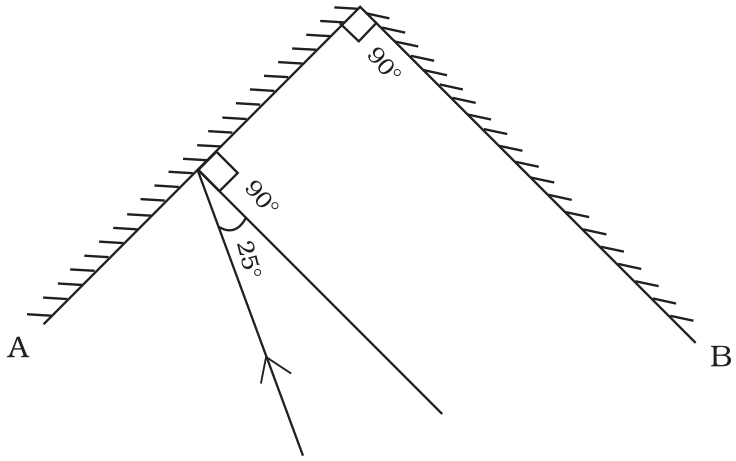
A ray of light incident on mirror $A$ at an angle of $25^\circ $ falls on mirror $B$ after reflection. The angle of reflection for the ray reflected from mirror $B$ would be: - A
$25^\circ .$
- B
$50^\circ .$
- ✓
$65^\circ .$
- D
$115^\circ .$
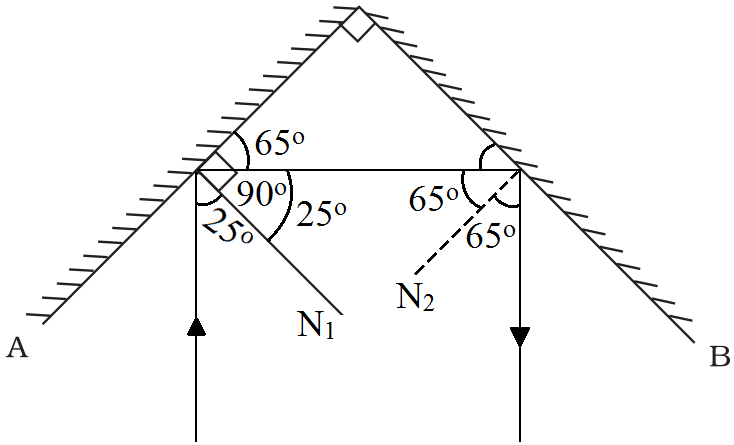
AnswerCorrect option: C. $65^\circ .$
Angle of reflection for the ray reflected from mirror $B$ will be $65^\circ $ because figure below shows how reflected ray from mirror A forms incident ray on mirror 6 and then reflected back by an angle of $65^\circ .$
View full question & answer→MCQ 2001 Mark
Band of seven colours is called:
MCQ 2011 Mark
Convergence of concave mirror can be decreased by dipping in.
- A
- B
- C
Both oil $\ \&\ $ water
- ✓
View full question & answer→MCQ 2021 Mark
The image of an object formed by a plane mirror is:
AnswerThe image of an object formed by a plane mirror is virtual always suggesting that the light rays do not actually come from the image.
View full question & answer→MCQ 2031 Mark
Which of the following statements is correct regarding rods and cones in the human eye?
- A
Cones are sensitive to dim light.
- ✓
Cones are sensitive to bright light.
- C
Rods are sensitive to bright light.
- D
AnswerCorrect option: B. Cones are sensitive to bright light.
Cones are sensitive to bright light and they sense colour. However, rods are sensitive dim light.
View full question & answer→MCQ 2041 Mark
If the angle of incidence is $80^\circ$, what will be the angle of reflection?
- ✓
$80^\circ$
- B
$100^\circ$
- C
$160^\circ$
- D
$20^\circ$
AnswerCorrect option: A. $80^\circ$
The angle of incidence $=$ the angle of reflection. So, the angle of reflection is $80^\circ$.
View full question & answer→MCQ 2051 Mark
The impression or sensation remains on the retina for about how many seconds even after removal of the object.
AnswerCorrect option: B. $\frac{1}{16}\text{th}$ of a second.
The impression or sensation remains on the retina for about $1/16th$ of a second even after removal of the object.
View full question & answer→MCQ 2061 Mark
United Football Club are playing an evening match. The team's jersey has blue and white stripes. What colour would the stripes appear under floodlights which produce a yellow light?
AnswerAn object appears blue when it reflects blue colour and absorbs rest of colours when light falls on it. But when yellow light falls on blue colour, it absorbs yellow and reflects nothing thus appears black. The white stripe reflects the yellow colour which falls on it, thus appears yellow.
View full question & answer→MCQ 2071 Mark
The property of plane mirror to make 'right appear as left' and vice versa, is called:
MCQ 2081 Mark
An object $5\ cm$ high is placed at a distance of $15\ cm$ from a concave mirror of radius of curvature $20\ cm.$ The height of the image in $cm$ is:
- A
$5\ cm$
- B
$20\ cm$
- C
$15\ cm$
- ✓
$10\ cm$
AnswerCorrect option: D. $10\ cm$
View full question & answer→MCQ 2091 Mark
A tiny mirror $M$ is fixed on a piece of cardboard placed on a table. The cardboard is illuminated by light from a bulb. The position of eye with respect to position of bulb is shown in Figure as $A, B, C$ and $D.$ In which position mirror will be visible$?$
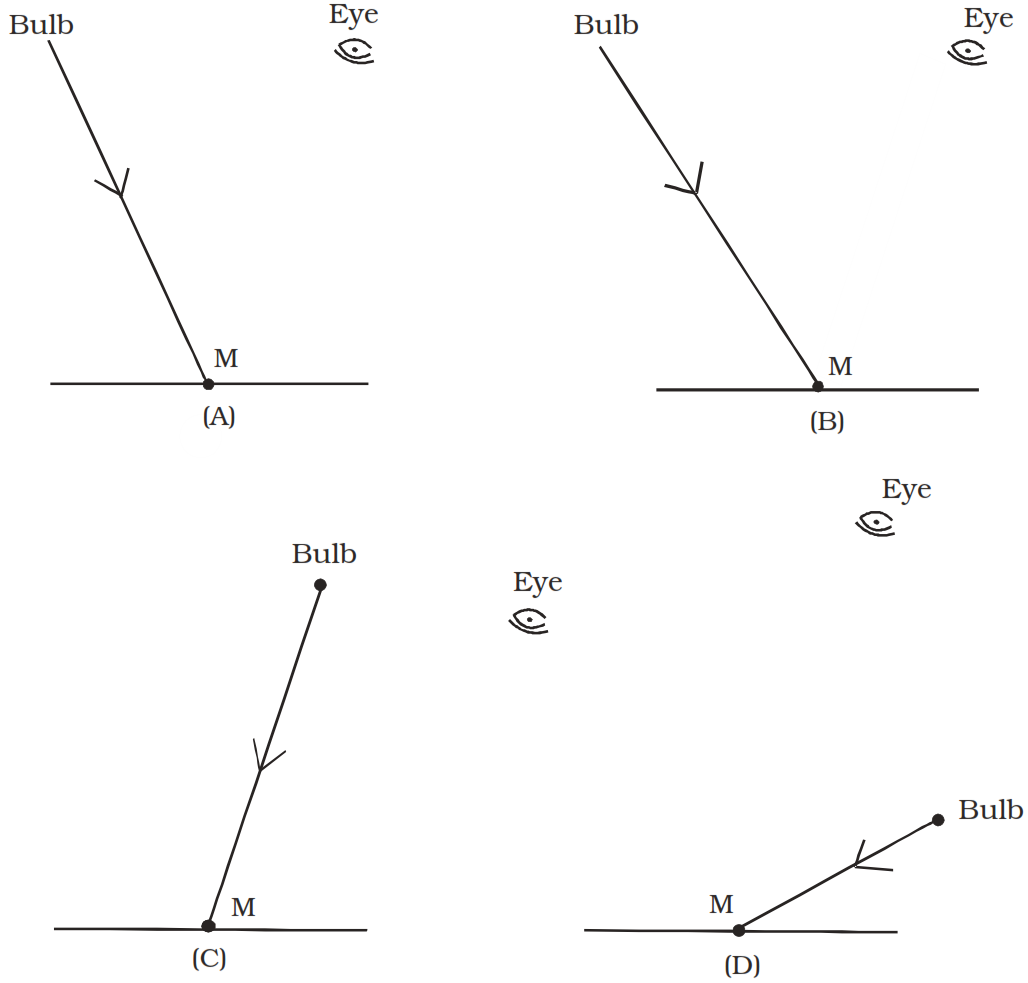
Answer Following the laws of reflection of light, in case $A,$ when a ray of light from the bulb strikes the mirror $M,$ it will get reflected back such that the angle of incidence is equal to the angle of reflection.
View full question & answer→MCQ 2101 Mark
A series of fast moving still pictures can create an illusion of movement. Why?
- A
The eye can focus on very rapidly changing pictures.
- B
The eye is quicker than the brain.
- ✓
The eye can separate two images only when the interval of separation between them is one-sixteenth of a second.
- D
The optical cortex can see through the rapidly moving images.
AnswerCorrect option: C. The eye can separate two images only when the interval of separation between them is one-sixteenth of a second.
A series of fast moving still pictures can create an illusion of movement as the eye can separate two images only when the interval of separation between them is one-sixteenth of a second. This happens due to a phenomenon called persistence of vision.
View full question & answer→MCQ 2111 Mark
The number of images of an object placed between two plane mirrors at $45^\circ $ to each other is:
View full question & answer→MCQ 2121 Mark
You are standing in front of a plane mirror, which is approaching you with a speed of $10\ cm/ sec.$ Then the speed of the image approaching you will be.
- A
$20\ cm/ s$
- B
$10\ cm/ s$
- ✓
$15\ cm/ s$
- D
$25\ cm/ s$
AnswerCorrect option: C. $15\ cm/ s$
For a plane mirror, the image distance = object distance. Therefore, the image is formed at a distance of $10\ cm$ from the mirror on the other side.
View full question & answer→MCQ 2131 Mark
An incident ray makes an angle of $65$ degree with the surface of a plane mirror. The angle of reflection in this case will be:
- A
$65^\circ$
- B
$45^\circ$
- ✓
$25^\circ$
- D
$35^\circ$
AnswerCorrect option: C. $25^\circ$
According to the law of reflection, the angle of incidence is equal to the angle of reflection. If the incident ray makes an angle of $65$ degree with the surface of plane mirror, than the angle of incidence can be calculated as: angle of incidence $= 90 –$ angle made with the plane mirror $= 90 – 65 = 25$ degree. Since, the angle of incidence is equal to the angle of reflection, therefore the required angle of reflection $= 25$ degree.
View full question & answer→MCQ 2141 Mark
What makes objects visible?
- A
The absorption of light by objects.
- ✓
The reflected light from the object.
- C
The total internal reflection taking place in an object.
- D
The refracted light from the object
AnswerCorrect option: B. The reflected light from the object.
An object is visible only when reflected light from the object reaches the retina of our eyes.
View full question & answer→MCQ 2151 Mark
The size of the pupil of the eye is adjusted by:
AnswerThe size of the pupil of the eye is adjusted by “iris”. The pupil of our eye is an entrance for the light rays to enter our eyes and give us the sensation of sight. If too much light enters our eyes, it can be dangerous for eyes. Whenever the light is strong, the pupil shrinks in order to reduce the entrance of light and protect our eyes. If too less light enters our eyes, we don’t get a clear vision. Whenever the light is weak, the pupil expands in order to increase the entrance of light and improve the vision. This is how pupil of the eye changes its size to adjust for different amount of light.
View full question & answer→MCQ 2161 Mark
Match the following: Position of object Position of image.
$i.$ Between pole and focus At $F.$
$ii.$ Between $F$ and $C$ At $C.$
$iii.$ At $C$ Behind the mirror.
$iv.$ At infinity Beyond $C.$
- A
$\text{1-A, 2-B, 3-D, 4-C.}$
- ✓
$\text{1-C, 2-D, 3-B, 4-A.}$
- C
$\text{1-C, 2-A, 3-D, 4-B.}$
- D
$\text{1-B, 2-C, 3-D, 4-A.}$
AnswerCorrect option: B. $\text{1-C, 2-D, 3-B, 4-A.}$
View full question & answer→MCQ 2171 Mark
Which of the following eye parts is not in contact with the eye lens?
AnswerCornea is the outer envelope of the eye. It provides focusing power to the eye. The aqueous humour separates the lens from the cornea.
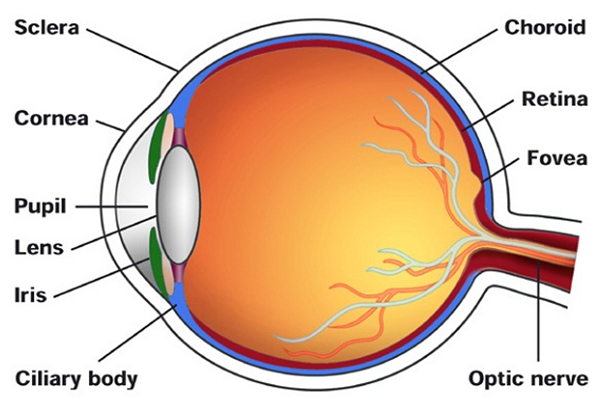
It can be observed that the cornea is not in contact with the eye lens.
View full question & answer→MCQ 2181 Mark
Motion and still pictures projected in a cinema hall are $............$ images.
View full question & answer→MCQ 2191 Mark
A plane mirror reflecting a ray of incident light is rotated through an angle $\theta$, about an axis through the point of incidence, in the plane of the mirror perpendicular to the plane of incidence. Then,
$i.$ The reflected ray does not rotate.
$ii.$ The reflected ray rotates through an angle $\theta$.
$iii.$ The reflected ray rotates through an angle 2$\theta$.
$iv. $The incident ray is fixed.
- A
Only $(i)$ is correct.
- B
$(i)$ and $(iii)$ are correct.
- ✓
$(iii)$ and $(iv)$ are correct.
- D
$(ii)$ and $(iv)$ are correct.
AnswerCorrect option: C. $(iii)$ and $(iv)$ are correct.
View full question & answer→MCQ 2201 Mark
A lady dressed in a new sari stands in front of a plane mirror fixed on a vertical wall, height of the lady is $160\ cm$ and that of her eyes from the ground is $150\ cm,$ then The length of the mirror required to see her fall view in the mirror is.
- A
$160\ cm$
- B
$100 \ cm$
- ✓
$80 \ cm$
- D
$320\ cm$
AnswerCorrect option: C. $80 \ cm$
Length of the plane mirror required is $H/ 2,$
$H =$ height of object.
View full question & answer→MCQ 2211 Mark
Periscope works on the principle of multiple reflections. It consists of two or more mirror, used for the reflection. If the two mirrors are placed at an angle of $90?$ how many images of the object are formed between them?
View full question & answer→MCQ 2221 Mark
When we stand in front of our dressing table, our left hand seems to be right and right seems to be left. This is called.
MCQ 2231 Mark
Visually impaired people can read and write using:
MCQ 2241 Mark
A plane mirror is approaching you at $10\ cm$ per second. You can see your image in it. At what speed will your image approaches you.
- A
$5\ cm/ s$
- B
$25\ cm/ s$
- ✓
$20\ cm/ s$
- D
$15\ cm/ s$
AnswerCorrect option: C. $20\ cm/ s$
View full question & answer→MCQ 2251 Mark
When the rays of light, diverging from a point, after reflection or refraction actually converge at some other point then that point is ___ image of the object.
- A
- ✓
- C
Both $(a)$ and $(b)$
- D
Neither $(a)$ nor $(b)$
Answer When the rays of light, diverging from a point, after reflection or refraction actually converge at some other point then that point is real image of the object.
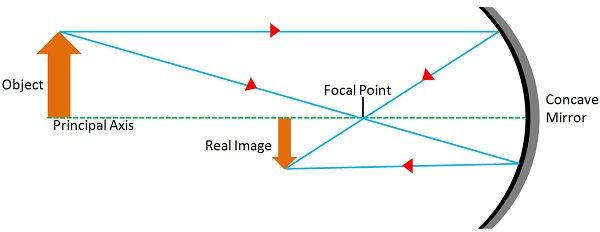
View full question & answer→MCQ 2261 Mark
An object $AB$ is placed in front of a convex lens at its principal focus as shown in the Figure.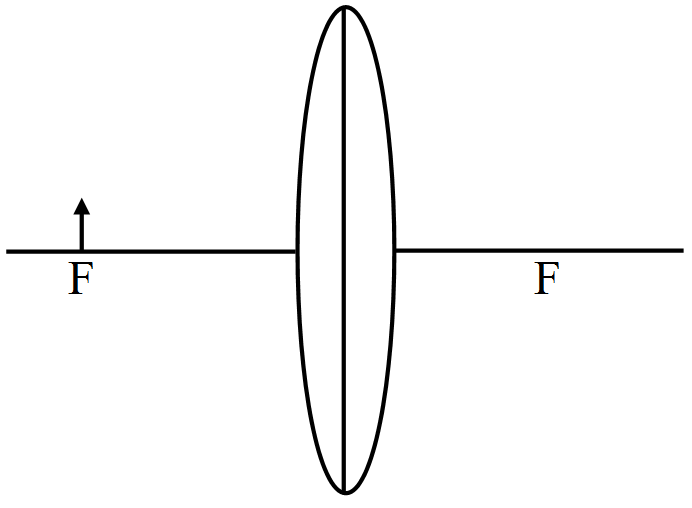
Which of the ray diagram given below correctly depicts the refraction through the lens $L?$ View full question & answer→MCQ 2271 Mark
To make a kaleidoscope we require.
MCQ 2281 Mark
Statement $I:$ A concave mirror has a real focus.
Statement $II:$ A convex mirror has a virtual focus.
- A
Both Statements are true. Statement$-II$ is the correct explanation of Statement$-I.$
- ✓
Both Statements are true. Statement$-II$ is not correct explanation of Statement$-I$.
- C
Statement$-I$ is true. Statement$-II$ is false.
- D
Statement$-I$ is false. Statement$-II$ is true.
AnswerCorrect option: B. Both Statements are true. Statement$-II$ is not correct explanation of Statement$-I$.
View full question & answer→MCQ 2291 Mark
The perpendicular drawn to the reflecting surface is called:
MCQ 2301 Mark
Which of the following can make beautiful patterns due to the formation of multiple images:
MCQ 2311 Mark
A device which works on the reflection of light from two plane mirrors arranged parallel to one another is:
AnswerPeriscopes are used to see objects that are not in direct line of sight.
View full question & answer→MCQ 2321 Mark
The reflection of light from a smooth surface is called:
MCQ 2331 Mark
In a science quiz competition, payel is asked a question where she had to choose the statement which was/were correct?
- A
An optical instrument in which reflected light is reflected again is a periscope.
- B
A periscope is a long, tubular device through which a person can see object that are out of the direct line of sight.
- C
A periscope works on the reflection of light from two plane mirrors arranged parallel to one another.
- ✓
AnswerHere, all the statements are correct.
View full question & answer→MCQ 2341 Mark
A straight stick partially immersed under water obliquely appears to be bent due to.
- A
- ✓
- C
Total internal reflection.
- D
View full question & answer→MCQ 2351 Mark
The back side of a plane mirror contains:
MCQ 2361 Mark
The ciliary muscles of the human eye contract and relax in order to.
- A
Adjust the size of the eyeball.
- ✓
Adjust the focal length of the lens.
- C
Control the amount of light entering the eye.
- D
Prevent foreign elements from entering the eye.
AnswerCorrect option: B. Adjust the focal length of the lens.
View full question & answer→MCQ 2371 Mark
With what is glass coated in order to convert it into a mirror?
AnswerGlass is coated with silver.
View full question & answer→MCQ 2381 Mark
Light starting from a medium of refractive index $\mu$ undergoes refraction into a medium $\mu_1$ If $i$ and $r$ stand for angles of incidence and refraction respectively, then,
- A
$\frac{\sin\text{i}}{\sin\text{r}}=\frac{\mu}{\mu_1}$
- ✓
$\frac{\sin\text{i}}{\sin\text{r}}=\frac{\mu_1}{\mu}$
- C
$\frac{\cos\text{i}}{\cos\text{r}}=\frac{\mu_1}{\mu}$
- D
$\frac{\sin\text{i}}{\sin\text{r}}=\frac{1}{\mu\mu^1}$
AnswerCorrect option: B. $\frac{\sin\text{i}}{\sin\text{r}}=\frac{\mu_1}{\mu}$
$\mu_1 \sin\text{i} = \mu_2 \sin\text{r};$
$\mu \sin\text{i} = \mu \sin\text{r};$
View full question & answer→MCQ 2391 Mark
The ciliary muscles of the human eye contract and relax in order to.
- A
Adjust the size of the eyeball.
- ✓
Adjust the focal length of the lens.
- C
Control the amount of light entering the eye.
- D
Prevent foreign elements from entering the eye.
AnswerCorrect option: B. Adjust the focal length of the lens.
View full question & answer→MCQ 2401 Mark
Which of the following statements is true?
- A
The angle of incidence is twice the angle of reflection.
- ✓
The incident ray, the reflected ray and the normal drawn at the point of incidence lie in the same plane.
- C
Some virtual images can be caught on the screen.
- D
A convex mirror forms a real image.
AnswerCorrect option: B. The incident ray, the reflected ray and the normal drawn at the point of incidence lie in the same plane.
When a light ray is reflected from the reflecting surface, the incident ray, the reflected ray and the normal lie in the same plane.
The angle of incidence $=$ The angle of reflection.
View full question & answer→MCQ 2411 Mark
In the figure,
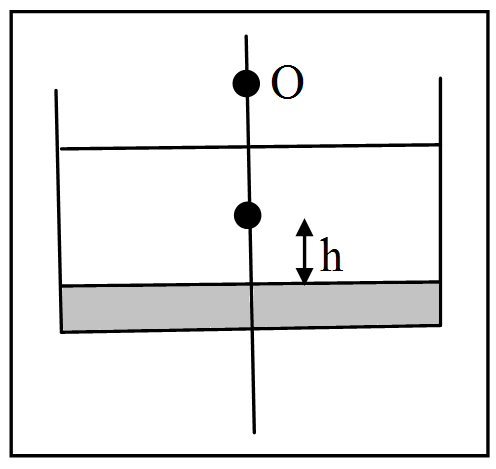
A point source $P$ is placed at a height $4\ m$ above the plane mirror in a medium of refractive index $1.2$ an observer $0$ vertically above $P,$ outside the liquid sees $P$ and its image in the mirror. The apparent distance between these two is $.........cm.$ - A
$3.3\ cm$
- B
$6.6\ cm$
- ✓
$9.9\ cm$
- D
$13.2\ cm$
AnswerCorrect option: C. $9.9\ cm$
View full question & answer→MCQ 2421 Mark
The graph drawn with object distance along $x-$ coordinate and image $($real$)$ distance as $y-$ coordinate for a convex is a.
View full question & answer→MCQ 2431 Mark
The diagram shows a ray of light reflected at a plane mirror.
Which pair of the angle of incidence and angle of reflection is correct?
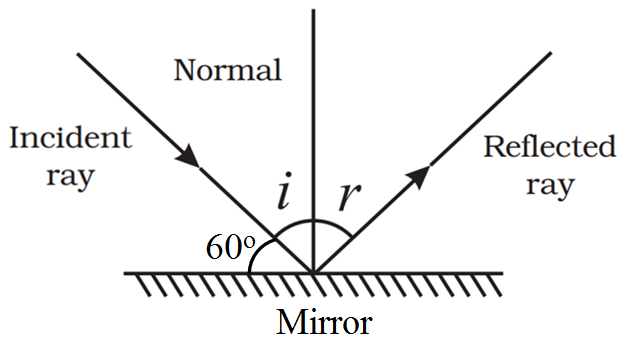
- ✓
|
Angle of Incidence
|
Angle of reflection
|
|
$30^\circ $
|
$30^\circ $
|
- B
|
Angle of Incidence
|
Angle of reflection
|
|
$30^\circ $
|
$60^\circ $
|
- C
|
Angle of Incidence
|
Angle of reflection
|
|
$60^\circ $
|
$30^\circ $
|
- D
|
Angle of Incidence
|
Angle of reflection
|
|
$60^\circ $
|
$60^\circ $
|
AnswerCorrect option: A.
|
Angle of Incidence
|
Angle of reflection
|
|
$30^\circ $
|
$30^\circ $
|
By the geometry of figure angle of incidence $= 30^\circ .$ According to first law of reflection, the angle of incidence is equal to the angle of reflection.
View full question & answer→MCQ 2441 Mark
In our houses, which of the following is used for looking at ourselves?
AnswerWe use plane mirrors to see ourselves, because the image formed by a plane mirror is virtual, erect and of the same size.
View full question & answer→MCQ 2451 Mark
Look at the given figure.
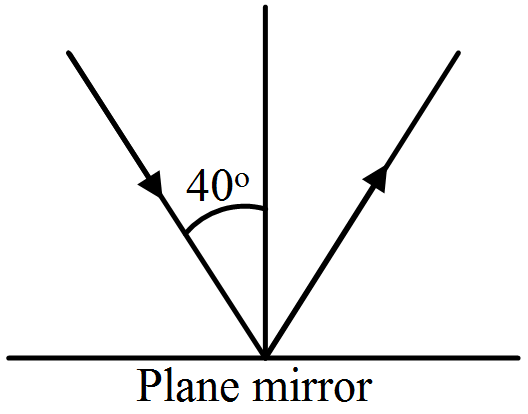
Find the angle between the incident ray and the reflected ray.
- A
$60^\circ$
- B
$90^\circ$
- ✓
$80^\circ$
- D
$40^\circ$
AnswerCorrect option: C. $80^\circ$
$\angle\text{i}=40^\circ ($given$)$
$\angle\text{i}=\angle\text{r}=40^\circ$
The angle between the incident ray and the reflected ray $=\angle\text{i}=\angle\text{r}=40^\circ+40^\circ = 80^\circ$
View full question & answer→MCQ 2461 Mark
An object situated at a distance of $10\ cm$ infront of a plane mirror. The distance of image from the mirror is.
- ✓
$10\ cm$
- B
$20\ cm$
- C
$5\ cm$
- D
AnswerCorrect option: A. $10\ cm$
View full question & answer→MCQ 2471 Mark
Observe the figure given below.
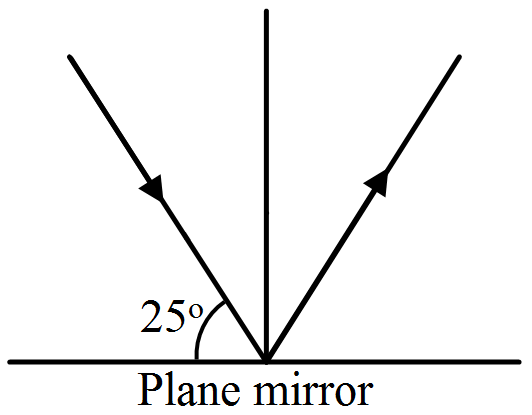
Find the angle between the incident and the reflected ray.
- A
$65^\circ$
- B
$90^\circ$
- ✓
$130^\circ$
- D
$25^\circ$
AnswerCorrect option: C. $130^\circ$
View full question & answer→MCQ 2481 Mark
Light is falling on surfaces $S_1 , S_2$ and $S_3$ as shown in the figure.
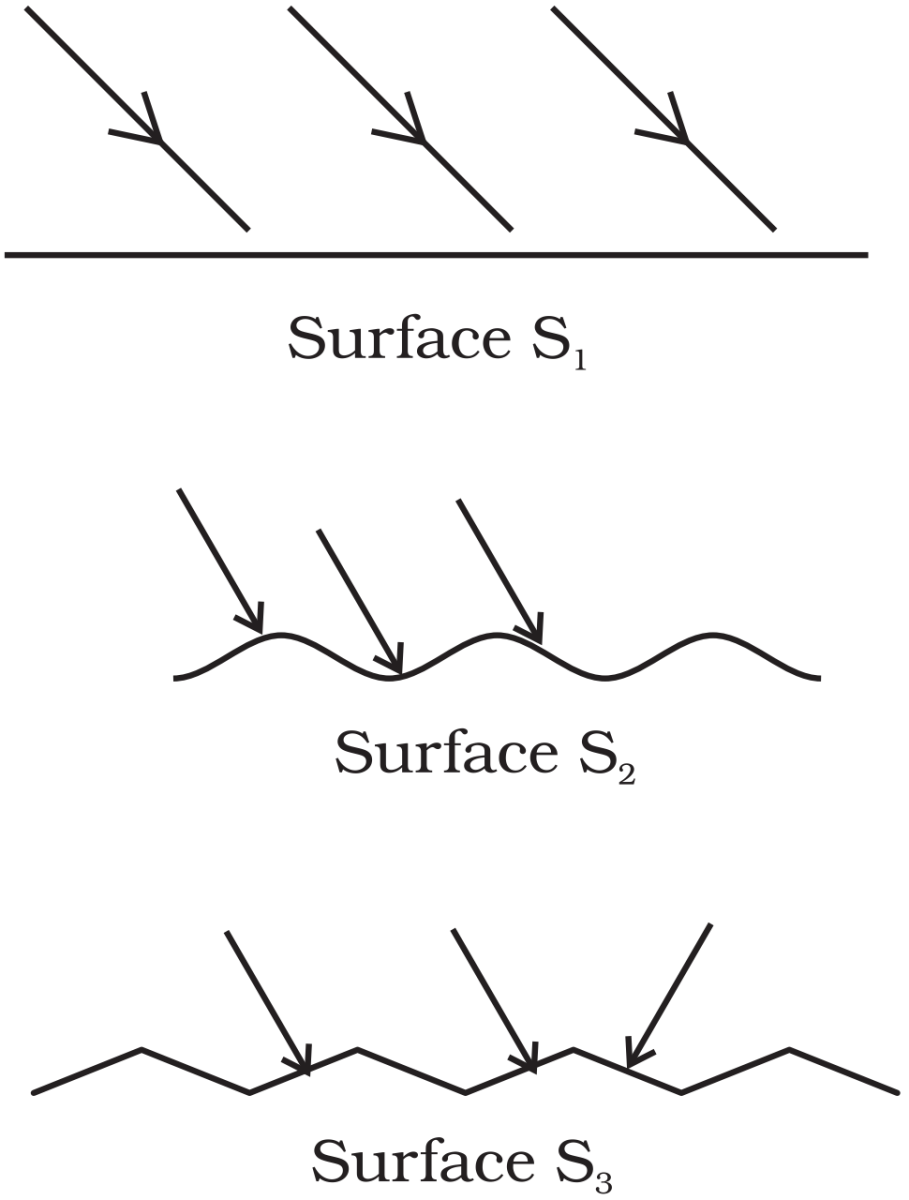
Surfaces on which the angle of incidence is equal to the angle of reflection is/are: - A
$S_1$ only.
- B
$S_1$ and $S_2$ only.
- C
$S_2$ and $S_3.$
- ✓
AnswerLaws of reflection are always followed whatever be the surface of the object. Therefore, the angle of incidence is equal to the angle of reflection on ail the three surfaces $(S_1, S_2$ and $S_3).$
View full question & answer→MCQ 2491 Mark
When the rays of light, diverging from a point, after reflection or refraction, appear to diverge from another point, then the image so formed is called.
- A
- ✓
- C
Both $(a)$ and $(b)$
- D
Neither $(a)$ nor $(b)$
AnswerWhen the rays of light, diverging from a point, after reflection or refraction, appear to diverge from another point, then the image so formed is called virtual image.
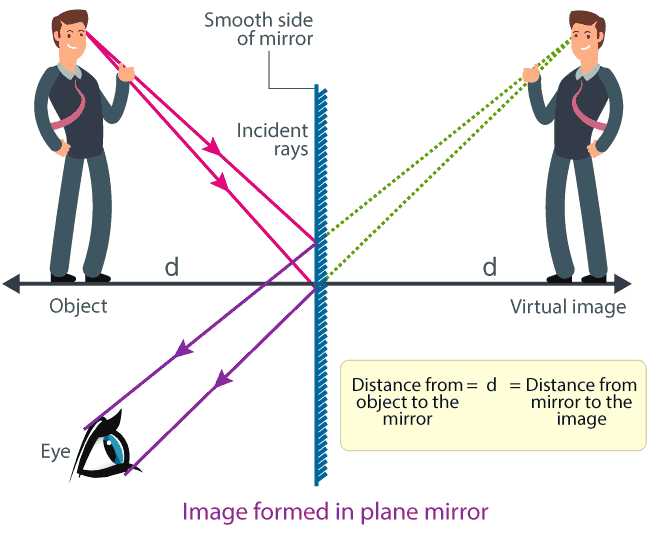
View full question & answer→MCQ 2501 Mark
A parallel beam of light is incident on a converging lens parallel to its principal axis. As one moves the source of light away from the lens on its principal axis, the intensity of light.
- A
- B
- ✓
- D
First increases than decreases.
AnswerIn the given situation, the intensity of light decreases continuously with increase in distance.
View full question & answer→MCQ 2511 Mark
If a person wants to see his fall size image, the minimum height of a plane mirror should be.
MCQ 2521 Mark
An owl can see clearly at night but not day time because it has.
- ✓
- B
- C
- D
Less rods and less cones.
View full question & answer→MCQ 2531 Mark
How many images are obtained when plane mirrors are arranged parallel to each other?
- A
- B
- ✓
Infinite number of images.
- D
AnswerCorrect option: C. Infinite number of images.
When two mirrors are kept parallel to each other, an infinite number of images can be seen.
View full question & answer→MCQ 2541 Mark
A small hole $P$ is made in a piece of cardboard. The hole is illuminated by a torch as shown in Figure. The pencil of light coming out of the hole falls on a mirror.
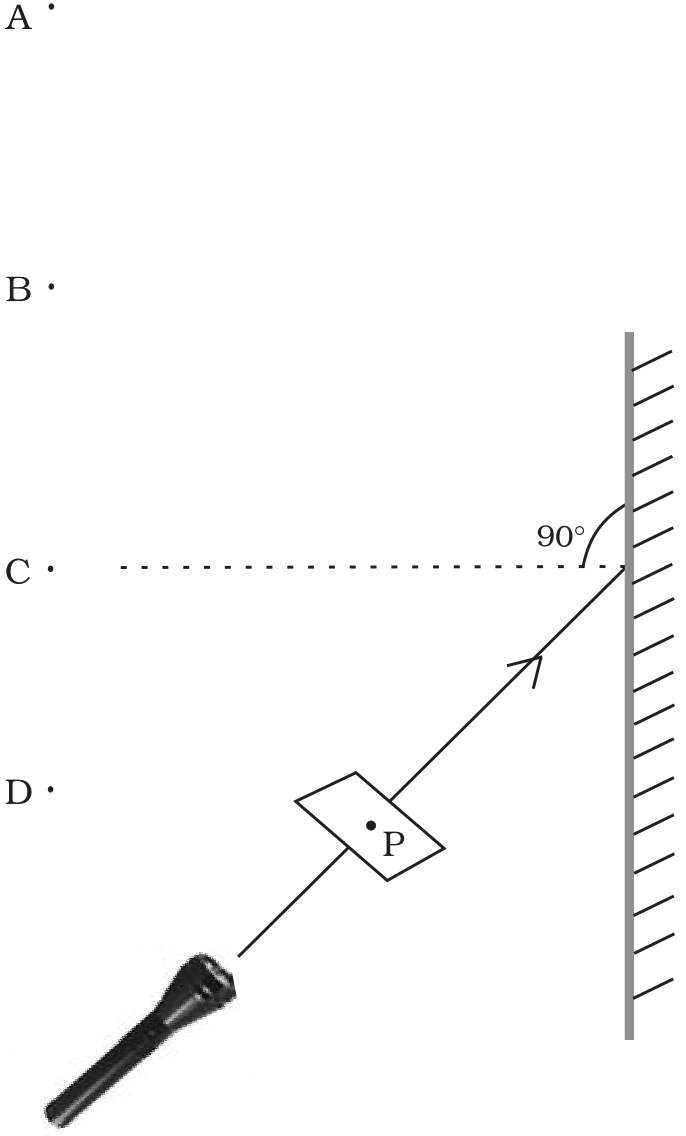
At which point should the eye be placed so that the hole can be seen? AnswerEye should be placed at A because the hole can be seen only, when the angle of incidence is equal to the angle of reflection.
View full question & answer→MCQ 2551 Mark
If the angle of incidence is $50^\circ$, then calculate the angle between the incident ray and the reflected ray.
- A
$50^\circ$
- ✓
$100^\circ$
- C
$130^\circ$
- D
$80^\circ$
AnswerCorrect option: B. $100^\circ$
In reflection of light, $\angle\text{i} = 50^\circ$ and $\angle\text{i} = \angle\text{r} =$ the angle between incident ray and reflected ray = $50^\circ$ + $50^\circ$ =$100^\circ.$
View full question & answer→MCQ 2561 Mark
In the diagram, the coin is just out of sight. If water is poured into the metal can, the coin will.
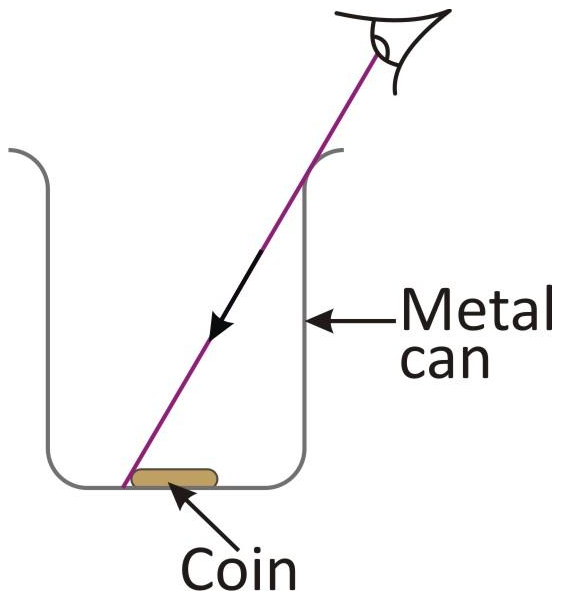
AnswerThe refraction of light occurs as it passes from water to air. Hence, the coin appears a little raised and becomes visible.
View full question & answer→MCQ 2571 Mark
In our eye $..........$ cells can sense colour.
View full question & answer→MCQ 2581 Mark
An owl can see clearly at night but not day time because it has
MCQ 2591 Mark
In our eye $.........$ cells can sense colour
View full question & answer→MCQ 2601 Mark
To make a kaleidoscope we require
MCQ 2611 Mark
Which of the following is not a luminous object?
MCQ 2621 Mark
If light falls perpendicularly on a plane mirror, what will be the angle in which it will be reflected$?$
- A
$ 45^\circ $
- B
$ 90^\circ$
- ✓
$ 180^\circ$
- D
$ 360^\circ$
AnswerCorrect option: C. $ 180^\circ$
View full question & answer→MCQ 2631 Mark
In the retina of the eye, the area having no sensory cells is called
MCQ 2641 Mark
Rainbow is a natural phenomenon showing
MCQ 2651 Mark
Light passing through a prism splits into seven colours. This is called
MCQ 2661 Mark
When we stand in front of our dressing table, our left hand seems to be right and right seems to be left. This is called
- A
Lef$-$rtight confusion
- ✓
- C
- D
View full question & answer→MCQ 2671 Mark
If the angle of incidence of light falling on a plane mirror is $30^\circ ,$ what will be the angle of reflection$?$
- A
$ 90^\circ$
- B
$ 60^\circ$
- ✓
$ 30^\circ$
- D
$ 0^\circ$
AnswerCorrect option: C. $ 30^\circ$
View full question & answer→MCQ 2681 Mark
Light enters the eye through
MCQ 2691 Mark
Myopia can be corrected by using a
MCQ 2701 Mark
The amount of light entering the eye is controlled by
MCQ 2711 Mark
The defect due to which a person is not able to see the distant objects clearly:
MCQ 2721 Mark
The splitting of white light into its seven constituent colours is called
MCQ 2731 Mark
What is the angle of incidence of a ray if the reflected ray is at an angle of $90^\circ $ to the incident ray?
- A
$60^\circ$
- ✓
$45^\circ$
- C
$90^\circ$
- D
$180^\circ$
AnswerCorrect option: B. $45^\circ$
View full question & answer→MCQ 2741 Mark
The image formed by a camera and a simple microscope are respectively
MCQ 2751 Mark
Visually impaired people can read and write using
MCQ 2761 Mark
Name the type of mirror used as a backview mirror.
MCQ 2771 Mark
In case of reflection of light, the angle of incidence $(i)$ and the angle of reflection $(r)$ are related as
- ✓
$i = r$
- B
$i < r$
- C
$i > r$
- D
AnswerCorrect option: A. $i = r$
View full question & answer→MCQ 2781 Mark
Which one of the following statements is correct regarding rods and cones in the human eye?
- A
Cones are sensitive to dim light
- ✓
Cones are sensitive to bright light
- C
Rods are sensitive to bright light
- D
AnswerCorrect option: B. Cones are sensitive to bright light
View full question & answer→MCQ 2791 Mark
Front balged part of the eyeball is called
MCQ 2801 Mark
Band of seven colours is called
MCQ 2811 Mark
Beam of light striking the reflecting surface is called
MCQ 2821 Mark
A smooth shining surface, which rebounds the light back in same or in different direction, is called