Questions

questions in short. [3 marks ]

Take a timed test

36 questions · self-marked practice — reveal the answer and mark yourself.

Question 13 Marks
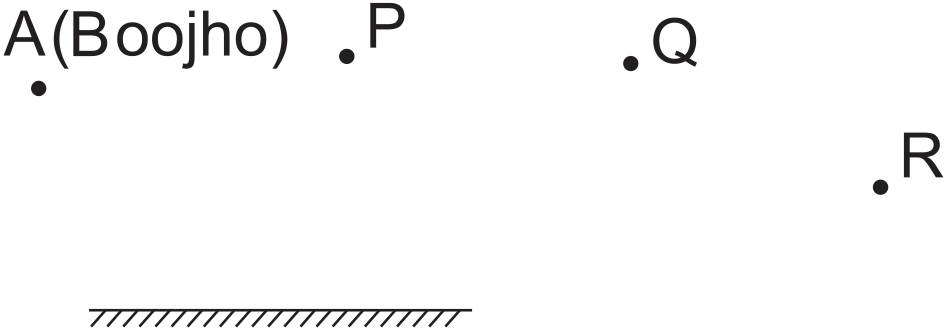
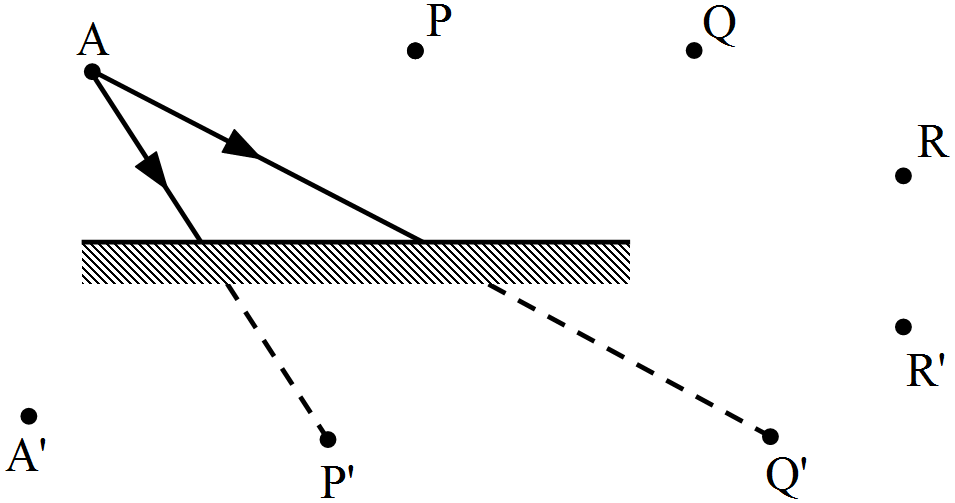
Boojho stands at A just on the side of a plane mirror as shown in Fig. $16.20$. Can he see himself in the mirror? Also can he see the image of objects situated at $P, Q$ and R$?$
Answer
A plane mirror forms a virtual image behind the mirror. The image is as far behind the mirror as the object is in front of it. A cannot see his image because the length of the mirror is too short on his side. However, he can see the objects placed at points $P$ and $Q$, but cannot see the object placed at point $R$ (as shown in the given figure).
View full question & answer
Question 33 Marks
Briefly mention, which of the following will cause regular reflection of light and which diffuse reflection of light. Paper
Answer
Diffuse reflection of light takes place. The surface of paper is not smooth. Law of reflection doesn’t hold.Additional information:
If you are thinking the paper is smooth than just remember - it is impossible to write on a smooth surface. Smooth surface means no friction. So, on the surface of mirror, we can consider as friction $= 0$. If the paper has zero friction that implies we cannot write on the paper.
View full question & answer
Question 43 Marks
Briefly mention, which of the following will cause regular reflection of light and which diffuse reflection of light. Marble floor with water spread over it.
Answer
Regular reflection of light takes place. The surface of the marble floor is covered with water and on the water surface law of reflection hold true.Additional information:
When the light fall on the surface of the water some part gets reflected and some part get refracted. Both laws of reflection and law of refraction hold true for water.
View full question & answer
Question 53 Marks
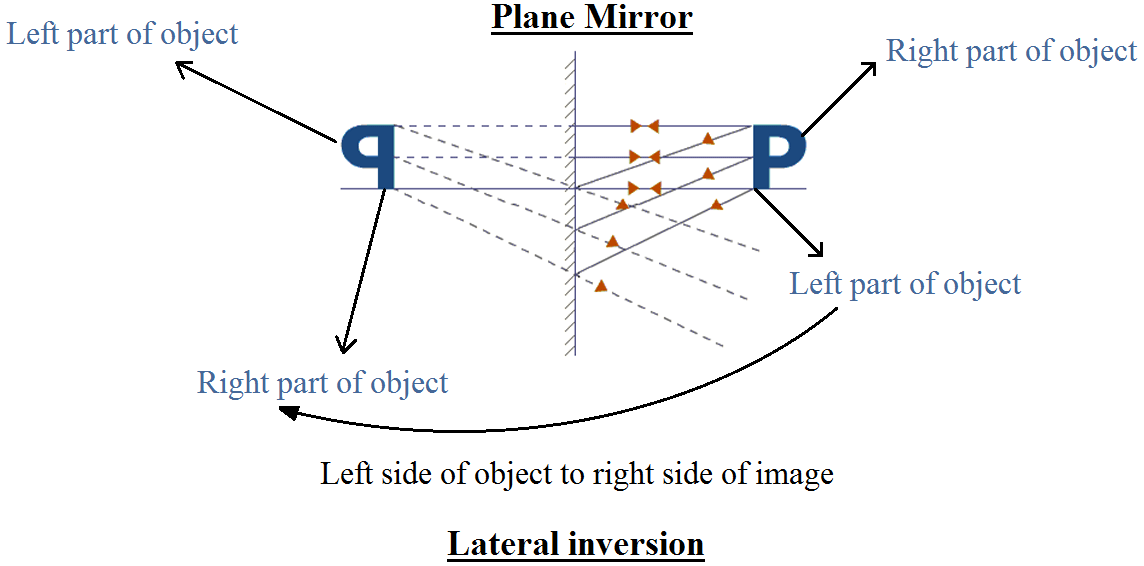
How does lateral inversion occur?
Answer
Lateral inversion means the reversal of image i.e. left the side of the object to appear right side in image and the right side of the object appear left side in the image.
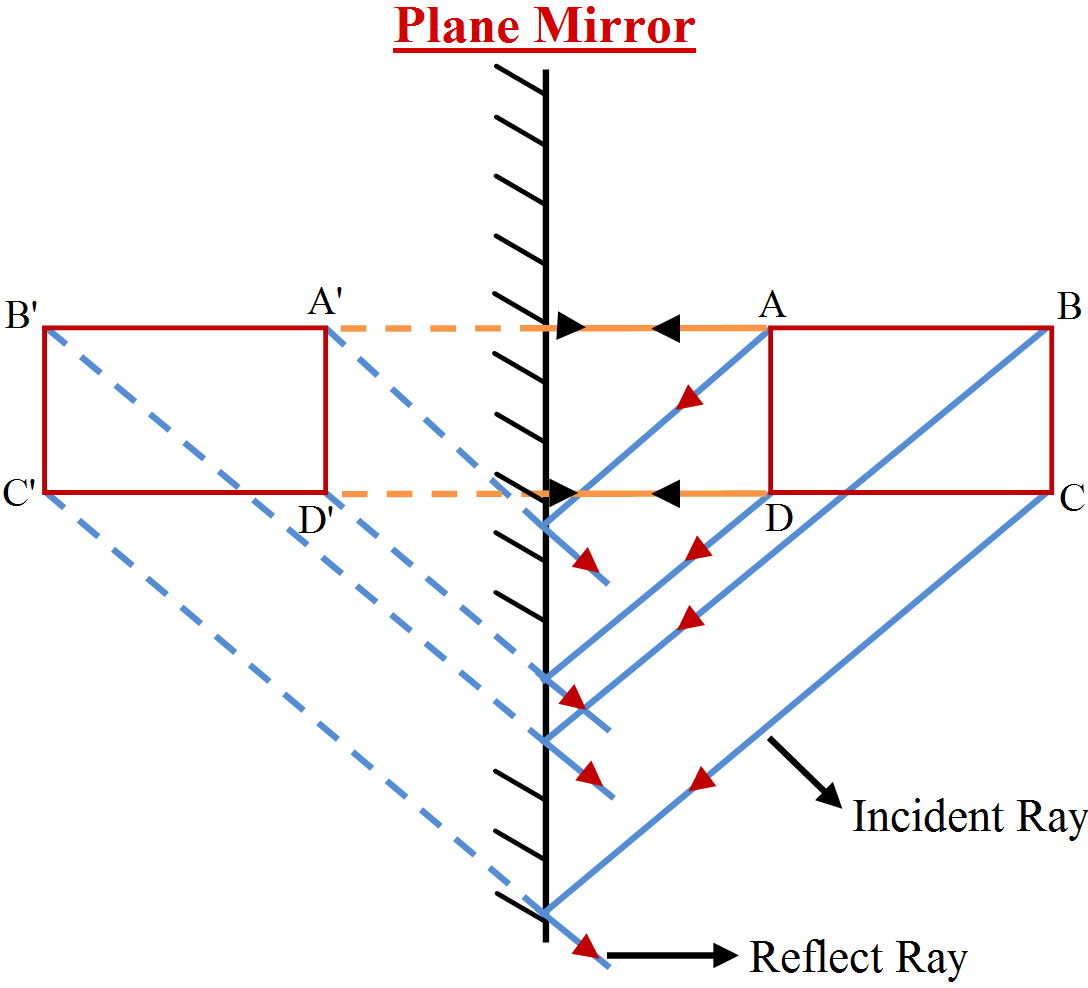
Let suppose the object is placed in front of the plane mirror. Its image will be formed behind the mirror and front side of the object & front side of image will face each other. This is due to the lateral inversion.
Let consider an object be in a rectangle shape $(ABCD)$

By seeing the image $(A'B'C'D')$ point $B'$ appear in the leftmost and an object point $B$ is at right side (lateral inversion) same with all the point of the rectangle.
View full question & answer
Question 63 Marks
What is the difference between regular reflection and diffuse reflection of light? Name one object which can produce regular reflection of light and another which produces diffuse reflection of light.
Answer
REGULAR REFLECTION OF LIGHT
DIFFUSED REFLECTION OF LIGHT
Regular reflection occurs from a polished or even surface.
Diffused reflection occurs from any uneven surface.
The reflected rays are parallel always.
The reflected rays are not parallel ever.
A plane mirror produces regular reflection of light.
A wall or piece of paper produces diffused reflection of light.
View full question & answer
Question 73 Marks
You see your image in a plane mirror? State two characteristics of the image so formed.
Answer
Characteristics of the image formed by a plane mirror are:
$-$The images formed by a plane mirror are virtual and erect.
$-$Image formed is of the same size as the object and is laterally inverted.
$-$Image is far behind the mirror as the object is in front of the mirror.
View full question & answer
Question 83 Marks
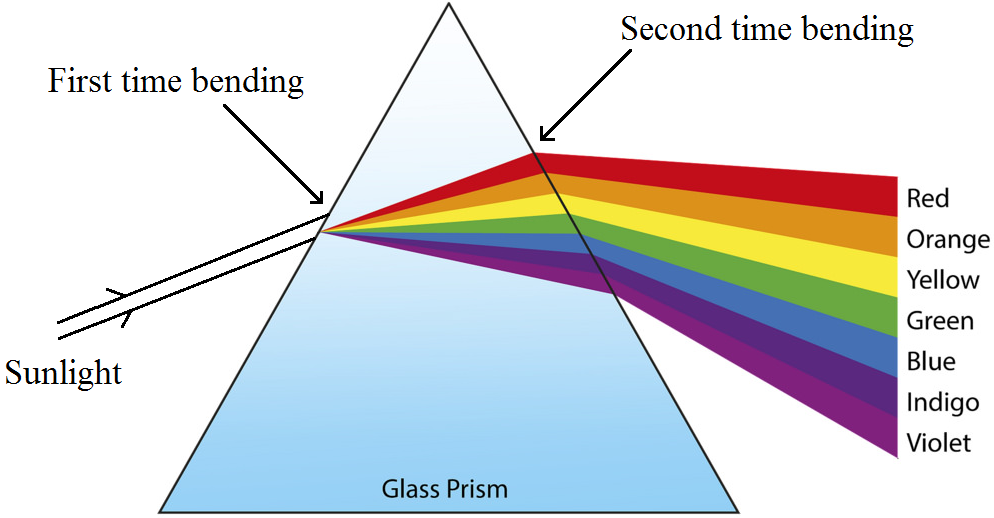
Explain, what happens when a beam of sunlight is passed through a glass prism.
Answer

Sunlight is the combination of seven components. When sunlight is allowed to pass through the glass prism it blends and gets split into seven colours. All the seven colour has different wavelength and while entering through a prism it bends (due to refraction) and angle of bending is different for all the colour. And while coming out from the prism light again get bend and we can see the entire different colour. This is also called Dispersion means spreading of white light into its full spectrum.
View full question & answer
Question 93 Marks
Briefly mention, which of the following will cause regular reflection of light and which diffuse reflection of light. Polished wooden table.
Answer
Regular reflection of light takes place. When a ray of light fall on a surface and angle of incidence is equal to the angle of reflection (law of reflection hold true) we called regular reflection. In case of polished wooden table law of reflection hold true because the surface is polished (smooth). Thus there will be a regular reflection.
View full question & answer
Question 103 Marks
Name any one defect of the eye. How is it corrected?
Answer

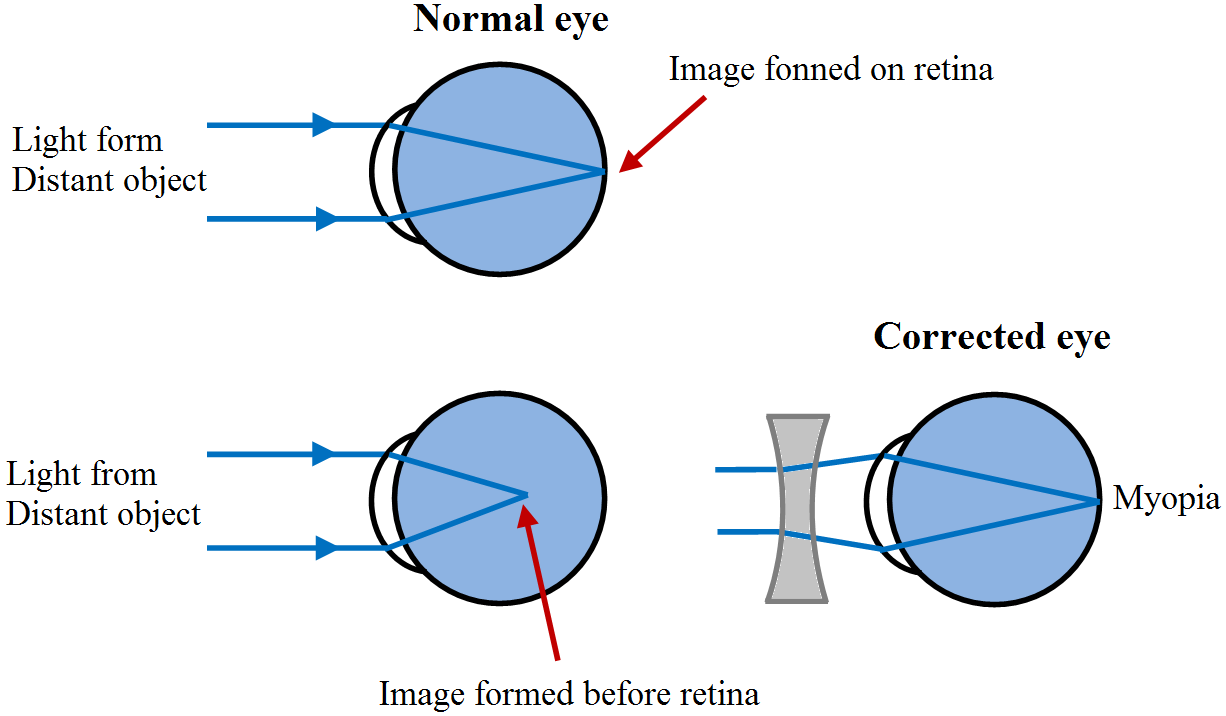
Myopia or Nearsightedness is one defect of the eye. (A person sees near objects clearly while distant objects appear blurred) Light from a distant object forms an image before it reaches the retina. This could be because the eye is too long, or the cornea or crystalline lens is too strong.
Let see in figure:

Myopia is corrected by using a concave (diverging) lens of appropriate power. Property of concave lens is to divert the light which helps in forming an image on the retina.
View full question & answer
Question 113 Marks
What makes things visible to us? Why cannot we see a book which is placed. $(a)$ Behind a wooden screen, and $(b)$ In a dark room?
Answer
Light makes things visible to us. We see an object when light passing through it is reflected. We cannot see a book which is placed.
$a.$ Behind a wooden screen because the wooden screen is opaque so it does not allow light to pass through it.
$b.$ In a dark room because there is no light to be reflected by the book. Thus, due to no reflection, the book is not visible.
View full question & answer
Question 123 Marks
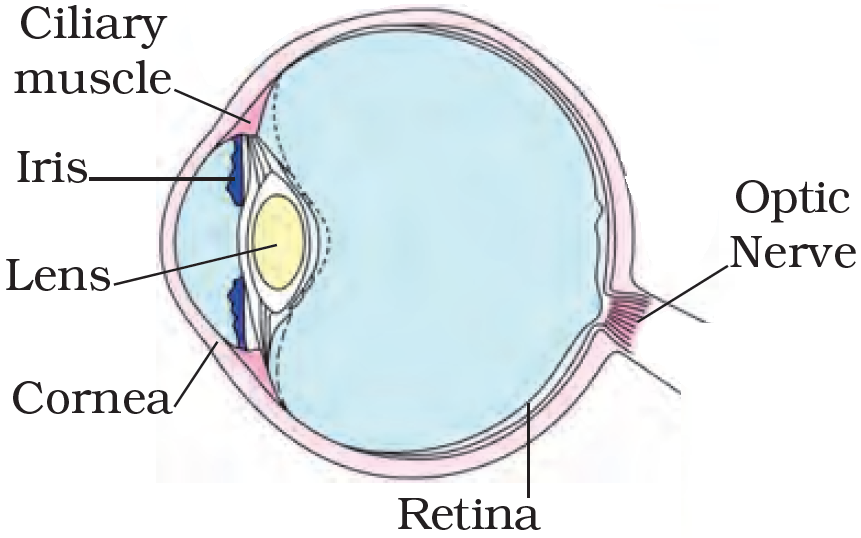
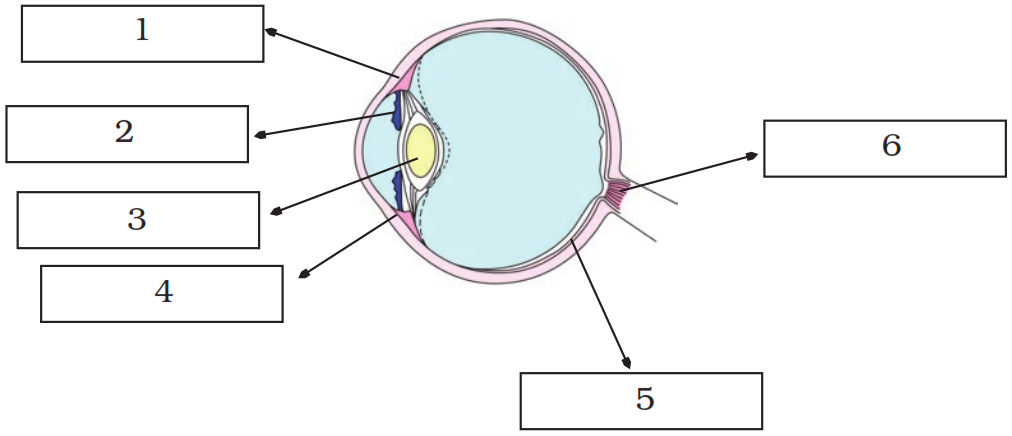
Write down the names of parts of the eye in the blank spaces shown in Figure.
Answer
The names of the parts of the eye as shown in the figure are:
$1.$ Ciliary muscle.
$2.$ Iris.
$3.$ Lens.
$4.$ Cornea.
$5.$ Retina.
$6.$ Optic nerve.
View full question & answer
Question 133 Marks
What is meant by a non-luminous object? Name two non-luminous objects.
Answer
Non- luminous objects are those that are themselves not capable of producing their own light but can reflect light from another source. $2$ non-luminous objects are- wood, plastics etc.
Moon also is incapable of producing its own light and it reflects sunlight and hence is non-luminous.
View full question & answer
Question 143 Marks
Explain in brief about Braille with the help of some example.
Answer
Braille is a system of touch reading and writing for blind persons in which raised dots to represent the letters of the alphabet. There is a rectangular block called cells that represent a certain alphabet or number or another symbol. Each cell contain risen tiny dot and different combination of this dot is used to represent a different symbol.Let take one example:
Louis Braille is a creator of Braille. He uses $3 \times 2$ dot in each cell to represent the alphabet. Here is an image that shows how to represent $'A'$ in Braille (only one dot is raised).
View full question & answer
Question 153 Marks
Explain lateral inversion with an example.
Answer

Lateral inversion means the reversal of image i.e. left side of the object to appear right side in image and right side of the object appear left side in the image. For example letter, 'b' and its image formed by a plane mirror is 'd' (lateral inversion).
View full question & answer
Question 163 Marks
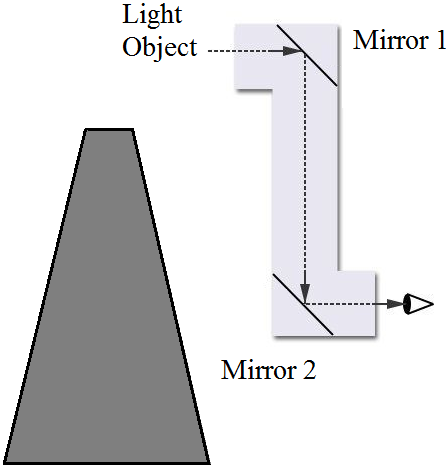
Describe the functioning of the periscope. Also, tell that how many mirrors are there in a periscope.
Answer
A periscope is an instrument which helps in viewing the objects which are not in the line of sight of the observer. It is used by the submarines to look at objects above the water surface. The principle behind periscope is reflection between two parallel plane mirrors. It consists of long cylindrical hollow tube bent at right angles and two plane mirrors are kept parallel and facing each other. The mirror is fixed at 45 degrees with the framework at the top and the bottom of the tube.Let see the simple structure of periscope:

We use two mirrors in a simple periscope.
View full question & answer
Question 173 Marks
Explain the process which enables us to perceive motion in a cartoon film.
Answer
In a cartoon film, we see the projection of static pictures on the screen in a specific order. Generally, the static pictures are made to move across the eye in a sequence at the rate of $24$ pictures per second (faster than $16$ per second) giving us the perception of a moving picture.
View full question & answer
Question 183 Marks
A student makes a device P by using three long and narrow strips of plane mirrors inclined at $60^\circ $ to one another which enables him to see beautiful patterns made by pieces of coloured glass bangles. On the other hand, another student makes a device $Q$ by using two plane mirrors arranged parallel to each other which helps him to see a football match clearly even when some very tall persons are sitting in front of him in the ground. What are $P$ and $Q?$
Answer
Device $P$ is a Kaleidoscope which consists of $3$ plain mirror strips are arranged inside a tube (cylinder) with colored glass pieces at one end and a glass to view on the other. The device $Q$ is a Periscope. A periscope is a device that reflects the reflected ray again. It consists of a tube attached to a set of $2$ mirrors. A periscope is used to see over, through or around any object. So, the student is able to see a football match clearly even when some very tall persons are sitting in front of him in the ground because the periscope helps him in seeing over, through and around the tall persons sitting in front of him in the ground.
View full question & answer
Question 193 Marks
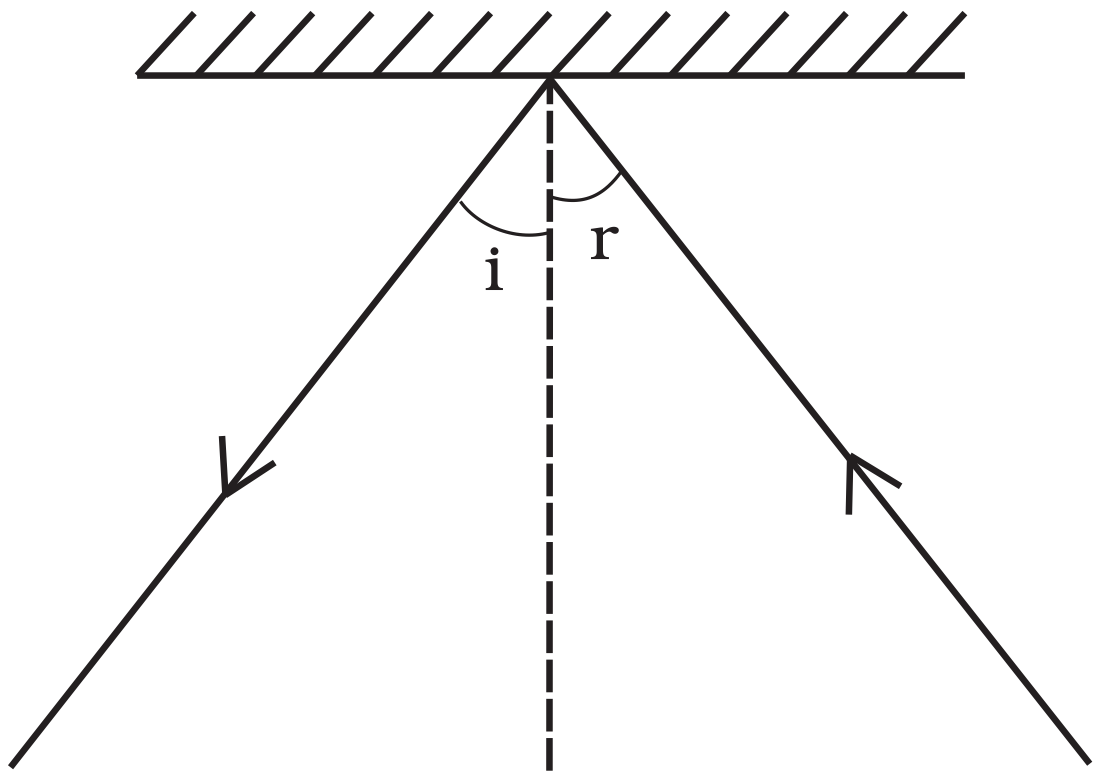
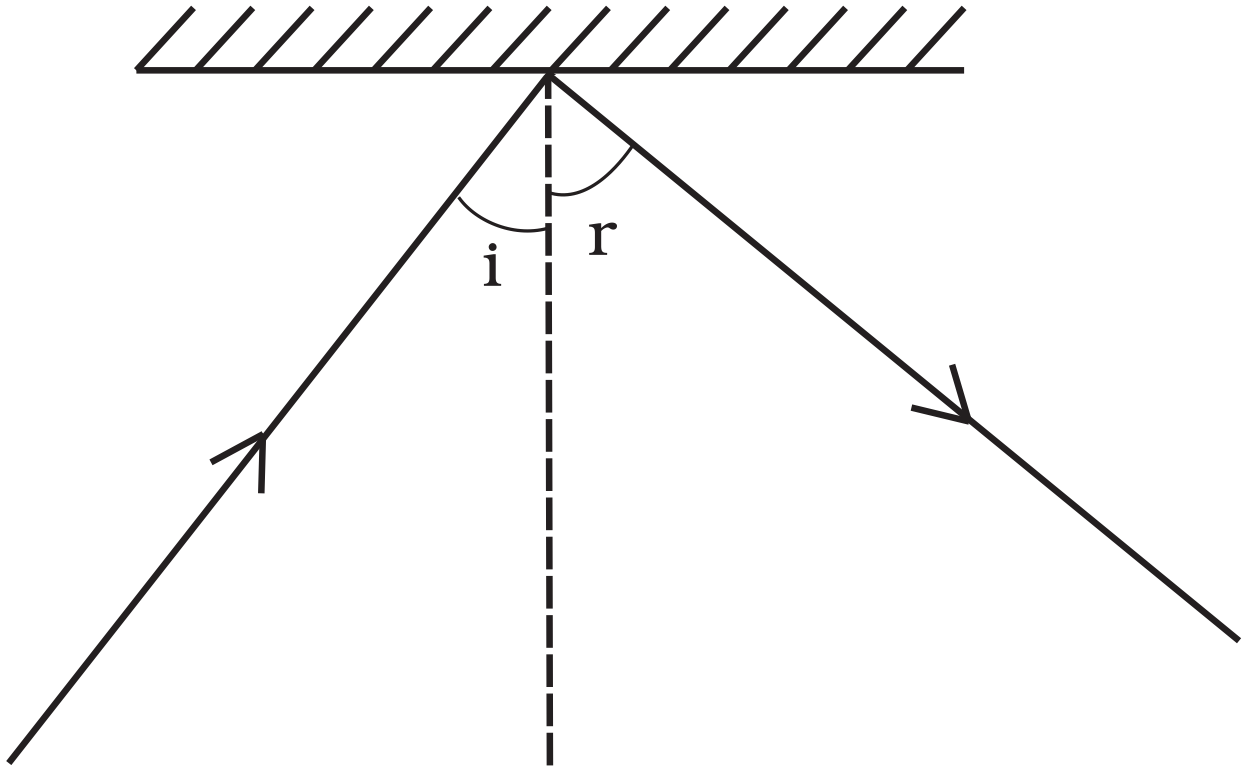
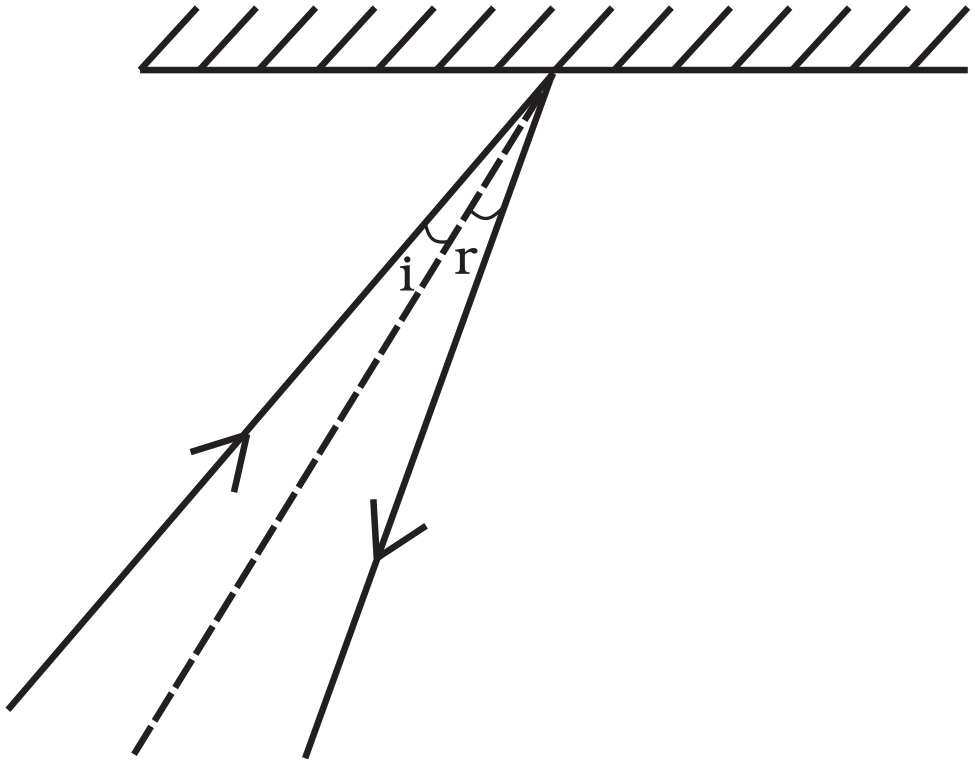
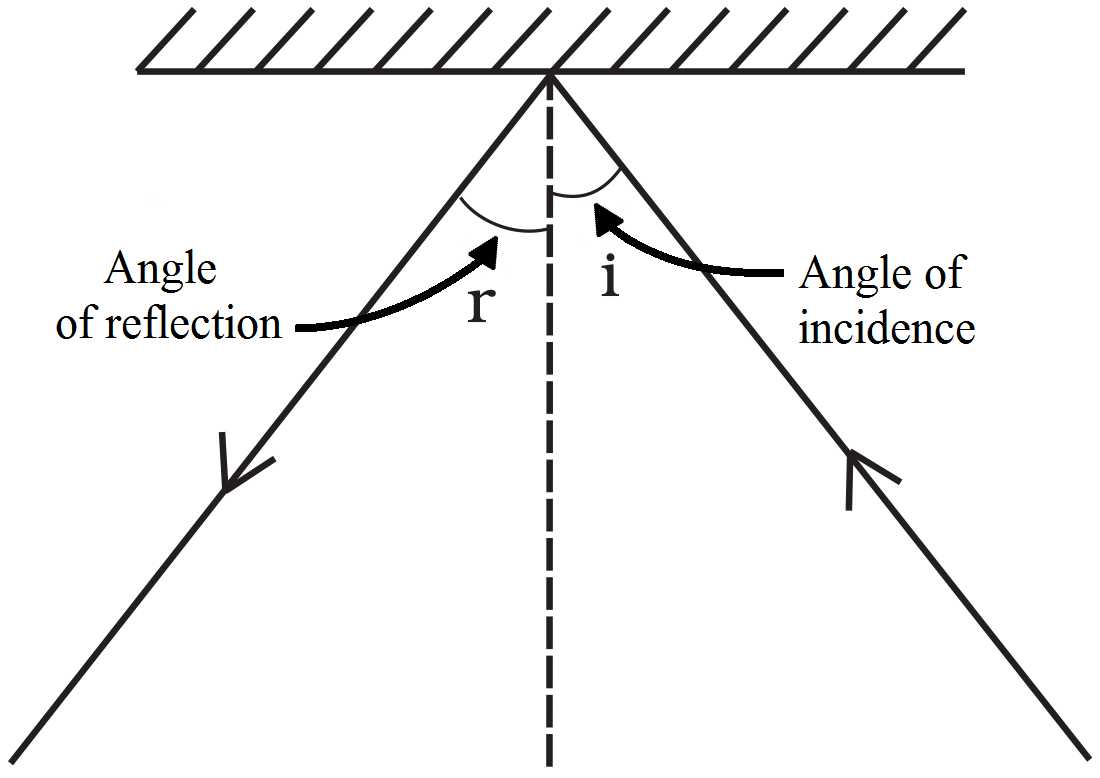
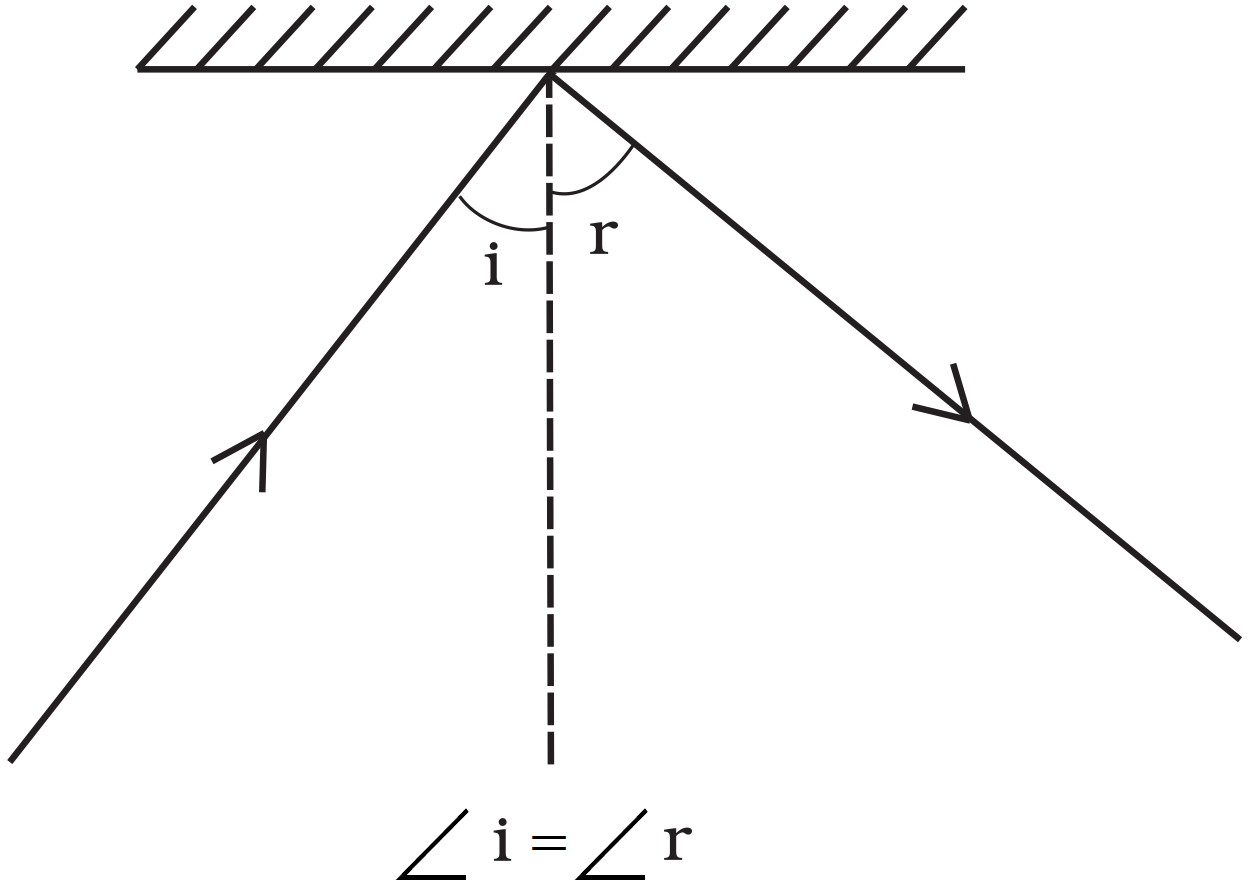
There is a mistake in each of the following ray diagrams given as
Figures a, b, and c. Make the necessary correction $(s).$
$a.$ 

$b.$ 

$c. $
Answer
$a.$ 

$b. $

$c.$ ​​​​​​​
View full question & answer
Question 203 Marks
Boojho while waving his hand very fast in front of his eyes, observes that his fingers appear blurred. What could be the reason for it?
Answer
The impression of an image persists for about $\frac{1}{6}\text{th}$ of a second on the retina. This is known as persistence of vision. If still images of a moving object are flashed on the eye at a rate faster than $16$ per second, then the eye perceives this object as moving. So, in case by waving hand very fast in front of eyes, the rate of movement of hand becomes very large (much faster than $16$ per second), therefore, the fingers appear blurred.
View full question & answer
Question 213 Marks
Name the cells on the retina of an eye:
$a.$ Which are sensitive to bright light.
$b.$ Which are sensitive to dim light.
$c.$ Which produce sensation of colour.
Answer
$a.$ Cones are sensitive to bright light. Cone shaped cells present in the retina are sensitive to bright light.
$b.$ Rods are sensitive to dim light. Rod shaped cells present in the retina are sensitive to dim light. They are most important for vision in dim light.
$c.$ Cones are the cells of retina that produce color sensation. These photoreceptor cells are responsible for color vision.
View full question & answer
Question 233 Marks
How many images of an object will be formed when the object is placed between two plane mirrors which are inclined at the following angles to one another?
$a. 120^\circ $
$b. 45^\circ $
$c. 180^\circ $
$d. 60^\circ $
$e. 90^\circ $
Answer
The formula to calculate the no. of images of an object placed between $2$ plane mirrors $\Big(\frac{360}{\theta}\Big)-1$
where theta is the angle of inclination.
$2\Big(\frac{360}{120}\Big)-1=3-1=2$
$7\Big(\frac{360}{45}\Big)-1=8-1=7$
$1\Big(\frac{360}{180}\Big)-1=2-1=1$
$5\Big(\frac{360}{60}\Big)-1=6-1=5$
$3\Big(\frac{360}{90}\Big)-1=4-1=3$
View full question & answer
Question 243 Marks
What do you mean by sources of light?
Answer
Source of light means any object which continuously emits light by the natural or artificial way. For example, the $SUN$ is a natural source of light, the bulb is an artificial source of light (convert one form of energy to light energy).
View full question & answer
Question 253 Marks
Explain why, an owl can see well in the night (but not during the day) whereas an eagle can see well during day (but not at night).
Answer
An owl can see well in the night but not during the day because owl is a night bird and night birds have fewer cones and more rods in the retina. Since rods function in less amount of light so an owl can see well in the night. To see well during the day, cones are required which are not present in adequate amount in an owl’s retina. An eagle can see well during the day but not during the night because eagle has more cones and lesser rods in the retina. Cones function in good amount of light so an eagle can see well during the day. To see well during the night, rods are required which are not present in adequate amount in a n eagle’s retina.
View full question & answer
Question 263 Marks
Man, $A$ has a defect of vision due to which he cannot see the nearby objects clearly $($though he can see the distant objects clearly$)$. On the other hand, man $B$ has a defect of vision due to which he cannot see the distant object clearly $($though he can see the nearby objects clearly$)$. The defect in man $A$ can be corrected by using spectacles containing lenses $C$ whereas the defect in man $B$ can be corrected by using spectacles containing lenses $D.$
$a.$ Name the defect of vision in man $(i) A$, and $(ii) B.$
$b.$ What type of lenses are $(i) C,$ and $(ii) D?$
Answer
The defect of vision in man are:
$i.$ Man $A$ suffers from hypermetropia wherein the image of a nearby object is formed behind the retina so the person has a blurred vision while looking at nearby objects.
$ii.$ Man $B$ suffers from myopia wherein Light from a distant object forms an image before it reaches the retina so the person can see the nearby objects clearly but not the distant objects.
The lenses are:
$i. C$ are Convex lens. These lenses are placed in front of a hyper$-$metropic eye which moves the image forward and focuses directly onto the retina which clears the vision of a nearby object.
$ii. D$ are concave lenses. These lenses are placed in front of a myopic eye which moves the image back to the retina and clarifies the image of a distant object.
View full question & answer
Question 273 Marks
The eye of a person exhibits a phenomenon $X$ due to which it can see the image of an object for a short duration of $Y$ even after the object has disappeared from his view. It is due to the phenomenon $X$ that we are able to see moving $Z$ on a television screen. What is $X, Y$ and $Z?$
Answer
The phenomenon $X$ is persistence of vision. The property of this phenomenon is that the image formed on the retina of the eye persists for about $\frac1{16}\text{th}$ of a second, hence if 16 frames are shown on a screen in succession, they are viewed by the retina as an ongoing action. Short duration of $Y$ is $\frac1{16}$ seconds. $Z$ is pictures. Due to the phenomenon of persistence of vision, we are able to see moving pictures on a television or a cinema screen.
View full question & answer
Question 283 Marks
State the various uses of a periscope.
Answer
$-$A periscope is used to see over, through or around any object.
$-$It can be used to see over a wall, to see around a corner.
$-$Periscopes are also used in warfare to keep an eye on the enemy.
View full question & answer
Question 293 Marks
Two plane mirrors are set at right angles to each other. A coin is placed in-between these two plane mirrors. How many images of the coin will be seen?
Answer
When $2$ plane mirrors are set at right angles to each other and a coin is placed in-between these two plane mirrors, then three images will be formed, see the diagram below:

 The formula for calculating the number of images, when two are kept at an angle $\theta $, is given as: $\Big(\frac{360}{\theta}\Big)-1$ Now, $\theta=90$ degree.
Thus, the number of images formed will be$=\Big(\frac{360}{\theta}\Big)-1$
$=\Big(\frac{360}{90}\Big)-1$
$=4-1$
$=3$
View full question & answer
Question 303 Marks
A ray of light strikes a plane mirror $XY$ at an angle of incidence of $65^\circ $, is reflected from this plane mirror and then strikes a second plane mirror $YZ$ placed at right angles to the first mirror. What is the angle of reflection for the mirror $YZ?$
Answer
The mirrors $XY$ and $YZ$ are at right angles, i.e., perpendicular. When a ray of light strikes the $XY$ mirror with 65degree angle, the incident angle will be $90 - 65 = 25^\circ $ on the $YZ$ mirror. Since angle of incidence = angle of reflection, the angle of reflection for $YZ$ mirror will be $25^\circ .$
View full question & answer
Question 313 Marks
A wall reflects light and a mirror also reflects light. What difference is there in the way they reflect light?
Answer
Reflection of light from a wall is diffused reflection because the surface of the wall is uneven so the light is reflected in different directions and also the reflected rays are not parallel. Reflection of light from a mirror is regular reflection because the surface of mirror is an even surface which is polished. The light gets reflected from the mirror surface in one particular direction and the reflected rays are all parallel.
View full question & answer
Question 323 Marks
What will be the number of images formed when an object is placed between two parallel plane mirrors facing each other?
Answer
Infinite number of images are formed when an object is placed between two parallel plane mirrors facing each other. The object undergoes multiple reflection to produce image of the distant object. The distance between the mirror and the object is inconsiderable in formation of infinite images. No matter how much the distance be, number of images formed will be infinite.
View full question & answer
Question 333 Marks
Draw a labeled diagram showing how a plane mirror an image of a point placed in front of it.
Answer
Let start drawing the diagram before start drawing we must know where the observer is placed. Here point object is $A$ and the ray of light from the object fall on the plane mirror. It gets reflected, here one incident ray strike at a perpendicular to the mirror and gets reflected along the same path $(i_1= r_1= 90^\circ $ at point $B$) and five ray strike at a different angle (point $B, C, D, E, F, G$). In each case, the law of reflection holds true so
At point $C i_2=r_2$, at point $D i_3=r_3$, at point $E i_4=r_4$, at point $F i_5=r_5$, at point $G i_6=r_6$
View full question & answer
Question 343 Marks
What are the functions of optic nerve and retina?
Answer
Optic nerve: Also called cranial nerve II (second cranial nerve). The optic nerve is present in the back of the eye. The function of the optic nerve is to transfer visual information from the retina to the vision centers of the brain. The information is carried in the form of electrical impulses. Retina: The retina is the membrane (tissue) that covers most of the inner surface of the eyeball. It contains hundreds of millions of light-sensitive cells, called cones and rods. Rod and cone cells are also called receptors (or photoreceptors). When a ray of light is falling on the retina, the cells present over the retina get activated and convert it into nervous signals (electrical impulse) which are transported to visual centers in the brain by the optic nerve.
View full question & answer
Question 353 Marks
Draw a labelled diagram showing how a plane mirror forms an image of a point object placed in front of it.
View full question & answer
Question 363 Marks
Name the two types of reflection of light. Which type of reflection makes us see an object from all directions?
Answer
The two types of reflection of light are Regular reflection of light and Diffused reflection of light. Regular reflection of light makes us see an object from all directions as the reflected rays are all parallel and in a particular direction so the image of the object can be viewed from all directions. In diffused reflection of light the reflected rays are neither parallel nor in a specific direction so the image of the object isn't visible from any direction.
View full question & answer