Question types

Microorganisms: Friend and Foe question types

346 questions across 12 question groups — pick any mix to generate a Science paper with step-by-step answer keys.

346
Questions
12
Question groups
5
Question types
Sample Questions

Microorganisms: Friend and Foe questions

One sample from each question group in this chapter. Select any group above to see the full set with answer keys.

Tick the correct answer. The process of conversion of sugar into alcohol is called:
  • A
    Nitrogen fixation.
  • B
    Moulding.
  • Fermentation.
  • D
    Infection.

Answer: C.

View full solution
Match the organisms in Column $I$ with their action in Column $II.$
  Column I   Column II
$(i)$
Bacteria
$(a)$
Fixing nitrogen
$(ii)$
Rhizobium
$(b)$
Setting of curd
$(iii)$
Lactobacillus
$(c)$
Baking of bread
$(iv)$
Yeast
$(d)$
Causing malaria
$(v)$
A protozoan
$(e)$
Causing cholera
$(vi)$
A virus
$(f)$
Causing AIDS
 
$(g)$
Producing antibodies
View full solution

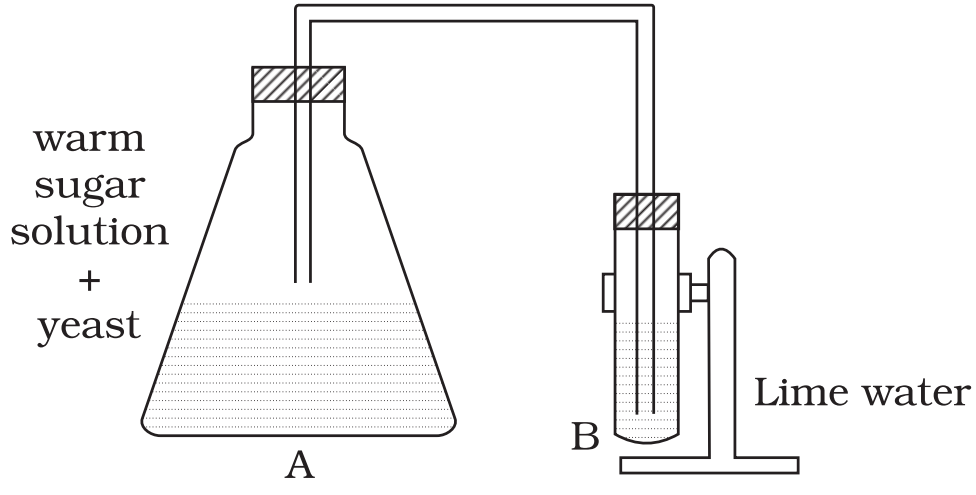
Observe the set up given in Fig and answer the following questions.
$a.$ What happens to the sugar solution in $A?$
$b.$ Which gas is released in $A?$
$c.$ What changes will you observe in $B$ when the released gas passes through it?
View full solution
Ria thought of making curd. For this, she took lukewarm milk, mixed some curd into it and stir well. She kept the mixture in fridge. Next day she observed that curd was not set. Can you tell why the curd did not set?
View full solution
Match the names of scientists given in Column $A$ with the discovery made by them given in Column $B.$
 
Column $A$
 
Column $B$
$(a)$
Louis Pasteur
$(i)$
Penicillin
$(b)$
Robert Koch
$(ii)$
Anthrax bacterium
$(c)$
Edward Jenner
$(iii)$
Fermentation
$(d)$
Alexander Fleming
$(iv)$
Small pox vaccine
 
 
$(v)$
Typhoid
View full solution
Match the microorganisms given in the Column $A$ to the group to which they belong in Column $B.$
 
Column $A$
 
Column $B$
$(a)$
Lactobacillus
$(i)$
Algae
$(b)$
Aspergillus
$(ii)$
Protozoa
$(c)$
Spirogyra
$(iii)$
Fungi
$(d)$
Paramecium
$(iv)$
Bacteria
View full solution
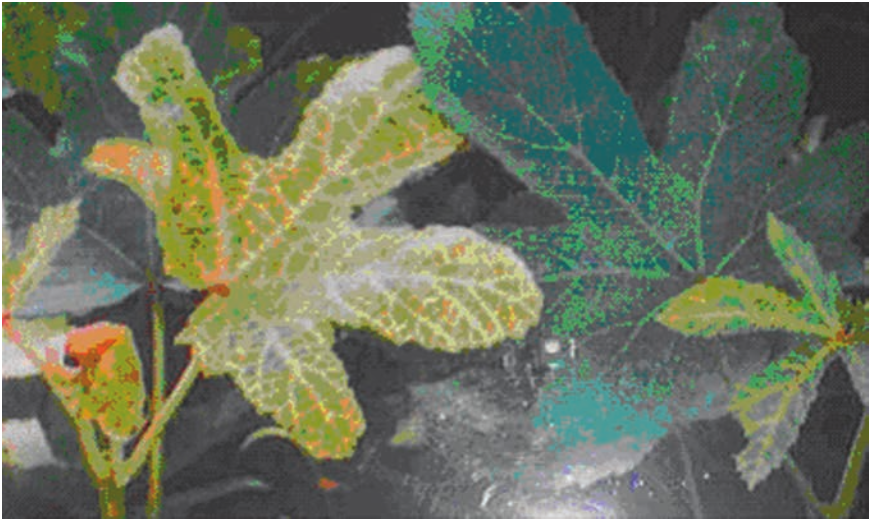
Observe the Fig and answer the questions that follows:

$a.$ Write the name of the disease.
$b.$ Name the causative agent of this disease?
$c.$ How does the disease spread from one plant to another?
$d.$ Name any two plant diseases and the microbes that cause them.
View full solution
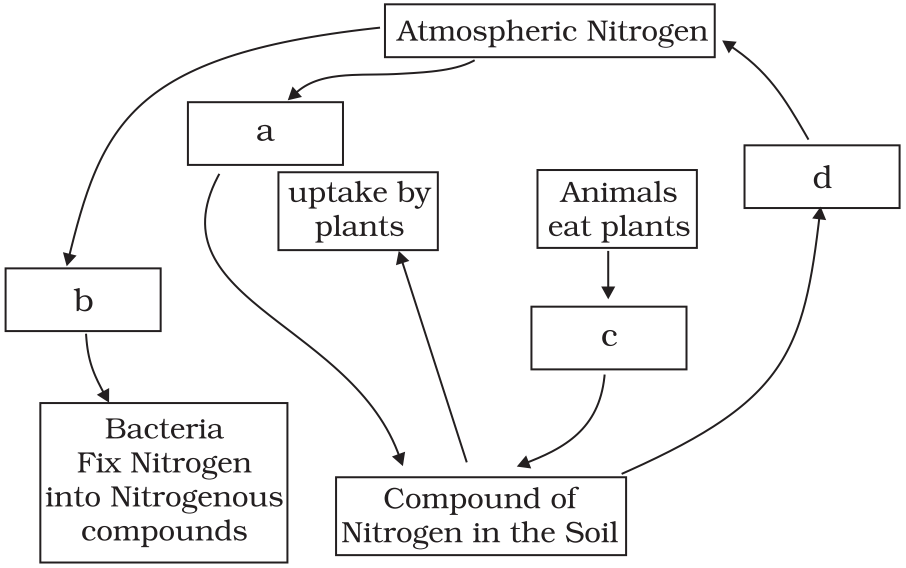
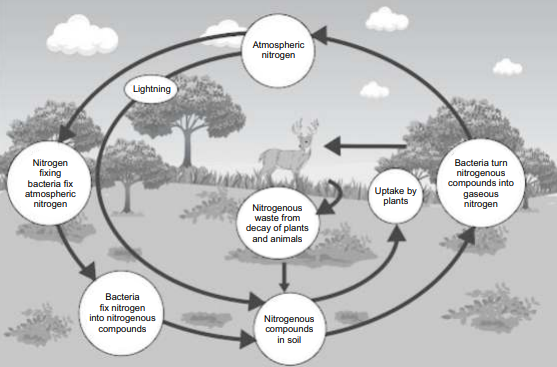
The picture shows the nitrogen cycle.
Image
$9.$ How do plants take up nitrogen$?$
$A.$ She should repeat the same experiment.
$B.$ She should leave the test tube undisturbed for six hours.
$C.$ She should repeat the experiment with test tubes containing more sugar solution.
$D.$ She should keep an extra set of test tubes with sugar solution but without the yeast.
$10.$ Plants and animals are continuously using nitrogen. Will there be a depletion of nitrogen in the environment due to this continuous use$?$ Explain your answer.
View full solution
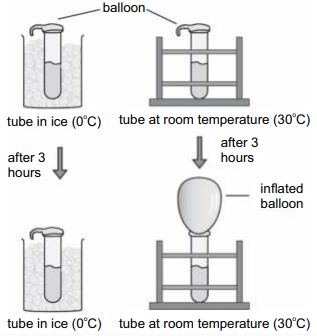
Manoj adds some yeast to two test tubes containing sugar solution.
One test tube is kept in ice and the other at room temperature.
The picture shows what happens after three hours.
Image
$5.$ What is Manoj investigating$?$
$A.$ Does yeast grow in sugar solution only$?$
$B.$ Does yeast convert sugar into alcohol$?$
$C.$ Does temperature affect the growth of yeast$?$
$D.$ Which gas is produced as yeast grows in sugar solution$?$
$6.$ How can Manoj conirm if the gas produced in the test tube at room temperature was due to the yeast growing in it$?$
$A.$ She should repeat the same experiment.
$B.$ She should leave the test tube undisturbed for six hours.
$C.$ She should repeat the experiment with test tubes containing more sugar solution.
$D.$ She should keep an extra set of test tubes with sugar solution but without the yeast.
$7.$ What should Manoj keep the same in both the test tubes for a fair experiment$?$
Circle ‘Yes’ or ‘No’ for each row.
Should this be kept same for both the test tubes? Yes or No
The concentration of sugar solution Yes/No
The colour of the balloons Yes/No
The amount of yeast added to each test tube Yes/No
$8.$ What type of organism is yeast$?$
$A.$ Fungi
$B.$ Algae
$C.$ Bacteria
$D.$ Protozoa
View full solution
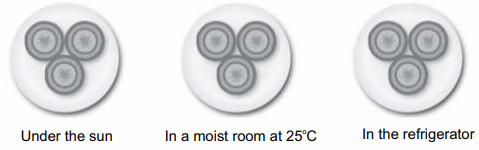
Suman wants to see how quickly carrots lose colour. Loss of colour shows rotting of carrot.
She observes carrot slices on a plate under three different conditions as shown below.Image

She notes how long the carrot slices on each plate take to change colour.
  Under the sun In a moist room at $25^\circ C$ In the refrigerator
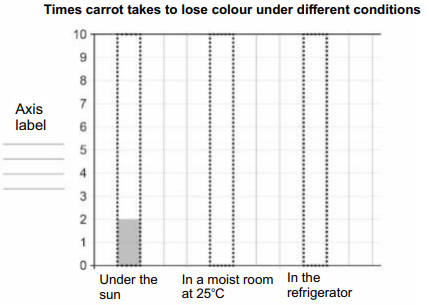
Time carrot slices take to change colour $2$ days $5$ days $8$ days
$3.$ What can Suman conclude from her activity$?$
$A.$ Carrots when kept under the sun do not rot easily.
$B.$ Carrots at room temperature lose colour more quickly.
$C.$ Carrots can be best preserved in hot and moist conditions.
$D.$ Carrots take more time to lose colour under cold conditions.
$4.$ Use the results of the activity to inish the graph below. The irst bar is drawn for you.
Put a label in the space provided for the axis on the left.
Image
View full solution
A trash can contains the following materials.
• Plastic straw
• Aluminium foil
• Tissue paper
• Glass bottles
• Chicken bonesImage
$1.$ Select the materials from the list that can be decomposed by microbes?
$2.$ Rohit is suffering from stomach ache and is passing watery stool. What should Rohit do to prevent the spread of infection to other family members?
$A.$ He should eat properly cooked food.
$B.$ He should wear a mask all the time.
$C.$ He should maintain distance from other family members.
$D.$ He should wash his hands with soap after using the bathroom.
View full solution

Generate a Microorganisms: Friend and Foe paper free

Pick question groups from the list above, set marks and difficulty, and export a branded PDF with step-by-step answer keys. First 3 chapters free — no signup.

Download App