Questions

5 Marks Questions

Take a timed test

15 questions · self-marked practice — reveal the answer and mark yourself.

Question 15 Marks
The ages (in years) of $360$ patients treated in a hospital on a particular day are given below:
Age in years
$10-20$
$20-30$
$30-40$
$40-50$
$50-60$
$60-70$
Number of patients
$90$
$40$
$60$
$20$
$120$
$30$
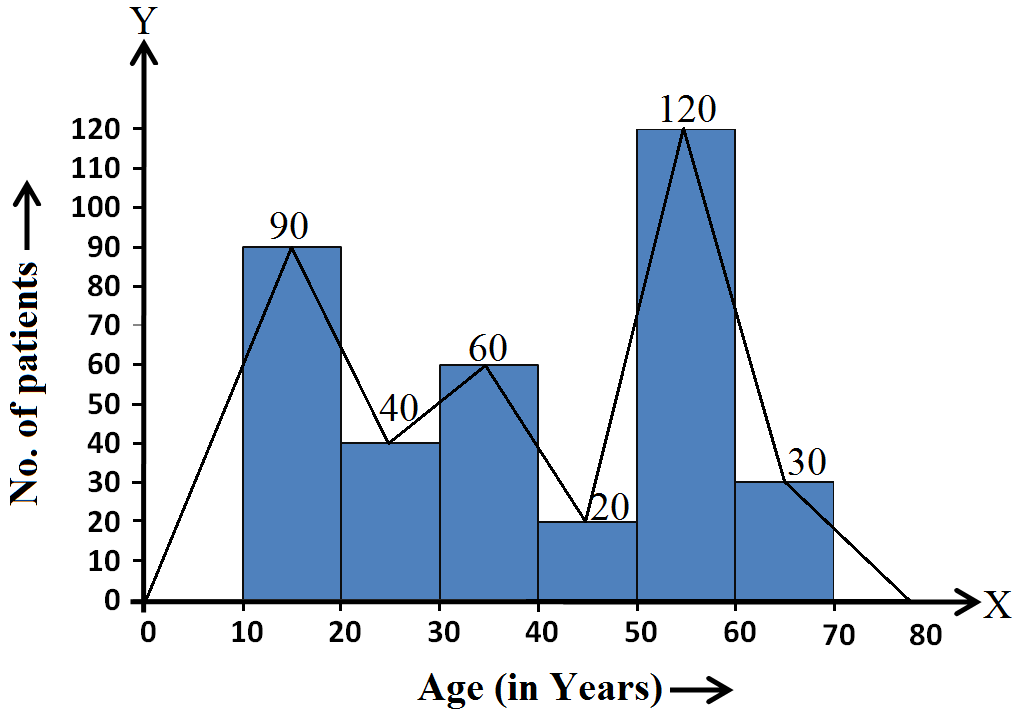
Draw a histogram and a frequency polygon on the same graph to represent the above data.
Answer
The given frequency distribution table is as below:
Age in years
$10-20$
$20-30$
$30-40$
$40-50$
$50-60$
$60-70$
Numbers of patients
$90$
$40$
$60$
$20$
$120$
$30$
Take class intervals i.e age in years along $x$-axis and number of patients of width equal to the size of the class intervals and height equal to the corrensponding frequencies. Thus we get the required histogram. In order to draw frequency polygon, we take imaginary intervals $0-10$ at the beginning and $70-80$ at the end each with frequency zero and join the mid-points of top of the rectangles. Thus, we obain a complete frequency polygon, shown below:
View full question & answer
Question 25 Marks
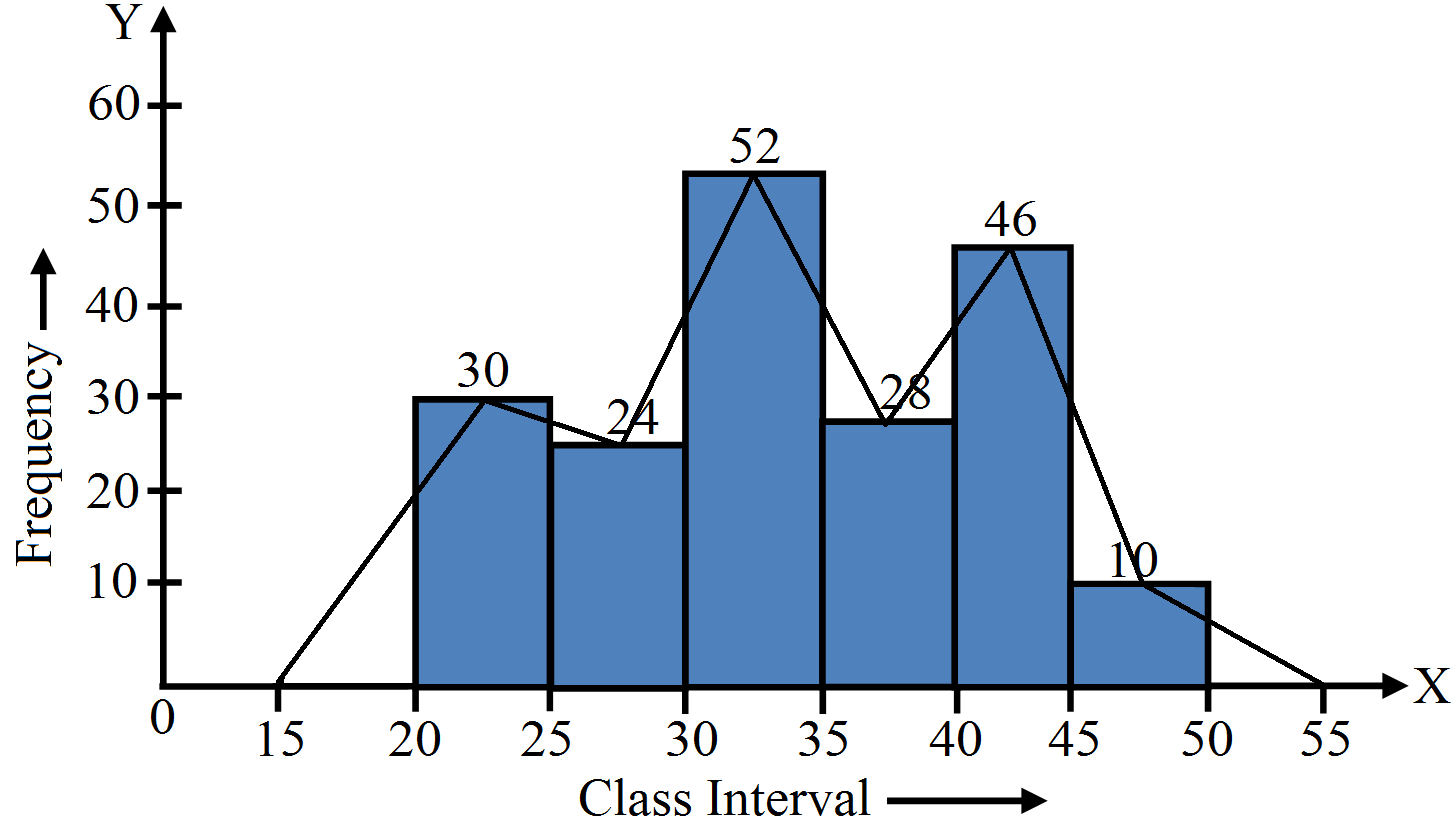
Draw a histogram and the frequency polygon from the following data:
Class interval
$20-25$
$25-30$
$30-35$
$35-40$
$40-45$
$45-50$
Frequency
$30$
$24$
$52$
$28$
$46$
$10$
Answer
The given frequency distribution table is below:
Class intervals
$20-25$
$25-30$
$30-35$
$35-40$
$40-45$
$45-50$
Frequency
$30$
$24$
$52$
$28$
$46$
$10$
Take class intervals along $x$-axis and frequencies along and draw rectangle s of width equal to the size of the class intervals and hights equal to the corresponding frequencies. Thus we get the required histogram. Now take imaginary class intervals $15-20$ at the beginning and $50-55$ at the end, each with frequency zero and join the mid points of top of the rectangles to get the reuaired frequency polygon.
View full question & answer
Question 35 Marks
The daily wages of $50$ workers in a factory are given below:
Daily wages (in Rs.)
$340-380$
$380-420$
$420-460$
$460-500$
$500-540$
$540-580$
Number of workers
$16$
$9$
$12$
$2$
$7$
$4$
Construct a histogram to represent the above frequency distribution.
Answer
Given frequency distribution is below:
Daily wages (in Rs.)
$340-380$
$380-420$
$420-460$
$460-500$
$500-540$
$540-580$
Number of workers
$16$
$9$
$12$
$2$
$7$
$4$
In the class intervals, If the upper limit of one class limit of the next class, It known as the exclusive method of classification. Clearly, the given frequency distribution is in the exclusive form. To draw the required, take class intervals, i.e. daily wages (in $Rs$.) along $x$-axis and frequencies i.e. no of workers alongy-axisand draw rectangles. So, we get the reuiredhistogram. Since the scale on $x$-axis starts at $340$, a kink (break) is indicated near the origin to show that the graph is drawn to scale beginning at $340$.
View full question & answer
Question 45 Marks
Construct a histogram for the following frequency distribution:
Class interval
$5-12$
$13-20$
$21-28$
$29-36$
$37-44$
$45-52$
Frequency
$6$
$15$
$24$
$18$
$4$
$9$
Answer
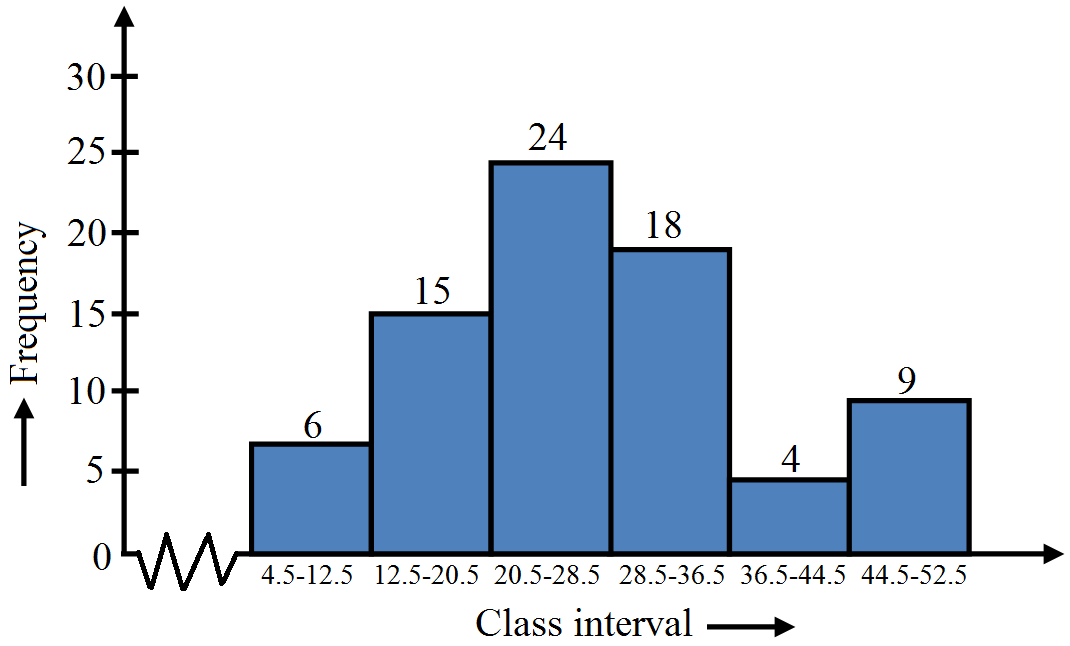
Histogram is the graphical representation of a frequency distrubution in the form of rectangles, such that there is no gap between any two successive rectangles. Clearly and the lower limit of the next class. Therefore, we need to convert the given frequency distribution into exclusive form, as shown below:
Class interval
$4.5-12.5$
$12.5-20.5$
$20.5-28.5$
$28.5-36.5$
$36.5-44.5$
$44.5-52.5$
Frequency
$6$
$15$
$24$
$18$
$4$
$9$
To draw the required histogram, take class intervals, along $x$-axis and frequencies along $y$-axis draw rectangles. So, we required histogram. Since the scale on $X$-axis starts at $4.5$, a kink (break) is indicated near the origin to show that graph is drawn to scale beginning at $4.5$.
View full question & answer
Question 55 Marks
The heights of $75$ students in a school are given below:
Height (in cm)
$130-136$
$136-142$
$142-148$
$148-154$
$154-160$
$160-166$
Number of students
$9$
$12$
$18$
$23$
$10$
$3$
Draw a histogram to represent the above data.
Answer
Height (in cm)
$130-136$
$136-142$
$142-148$
$148-154$
$154-160$
$160-166$
Number of students
$9$
$12$
$18$
$23$
$10$
$3$
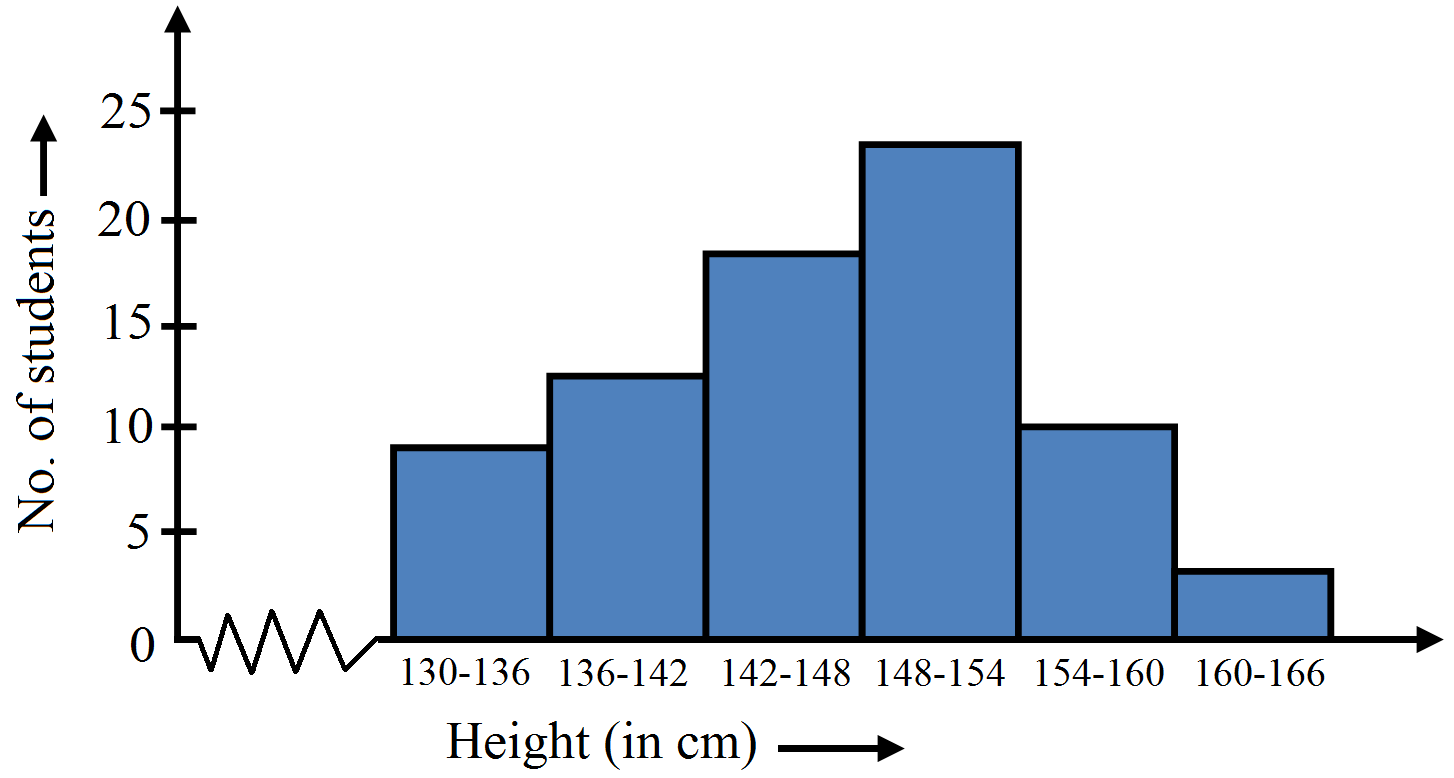
In the class intervals, If the upper limit of one class is the lower limit of the next class, It known as the exclusive method of classification.
Clearly, the given frequency distribution is in the exclusive form.
We take class intervals, i.e. height (in cm) along $x$-axis and frequencies i.e. number of stores along $y$-axis.
So, we get the required histogram.
Since the scale on $x$-axis starts at $130$, a kink (break) is indicated near the origin to show that the graph is drawn to scale beginning at $13$0.
View full question & answer
Question 65 Marks
Draw a histogram to represent the following data:
Class interval
$10-14$
$14-20$
$20-32$
$32-52$
$52-80$
Frequency
$5$
$6$
$9$
$25$
$21$
Answer
Given frequency distribution is as below:
Class interval
$10-14$
$14-20$
$20-32$
$32-52$
$52-80$
Freaquency
$5$
$6$
$9$
$25$
$21$
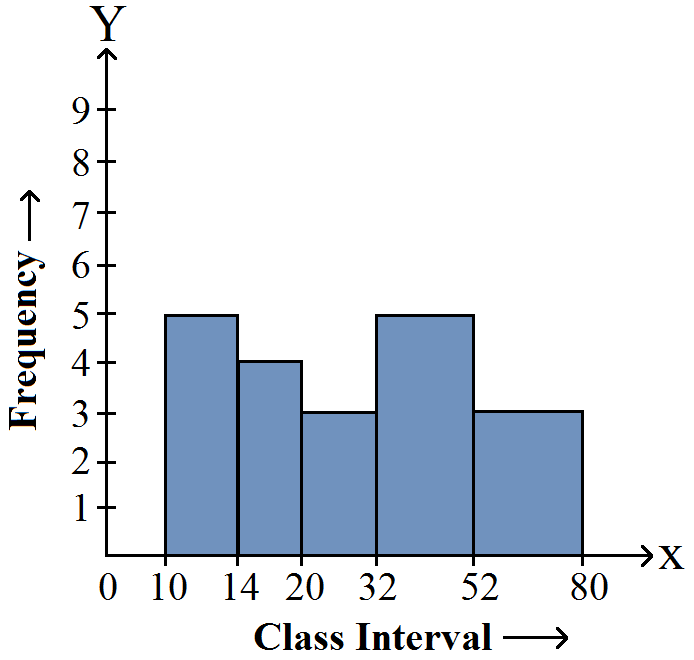
In the above table, class intervals are of unequal size, So we calcute the adjusted frequency by using the following formula: $\text{Adjusted Frequency}=\frac{\text{Minimum class sizex its frequaency}}{\text{Class size of this class}}$ Thus, the adjusted frequency table is:
Class intervals frequency Adjusted Frequency
$10-14$ $5$ $\frac{4}{4}\times5=5$
$14-20$ $6$ $\frac{4}{6}\times6=4$
$20-32$ $9$ $\frac{4}{12}\times9=3$
$32-52$ $25$ $\frac{4}{20}\times25=5$
$52-80$ $21$ $\frac{4}{28}\times21=3$
Now take class intervals along $x$-axis and adjusted frequency along $y$-axis and constant rectangles rectangles having their beses as class size and heights as the corresponding adjusted frequency. Thus, we obtain the histogram as shown below:
View full question & answer
Question 75 Marks
Draw a histogram for the follwoing data:
Class intervals
$600-640$
$640-680$
$680-720$
$720-760$
$760-800$
$800-840$
Frequency
$18$
$45$
$153$
$288$
$171$
$63$
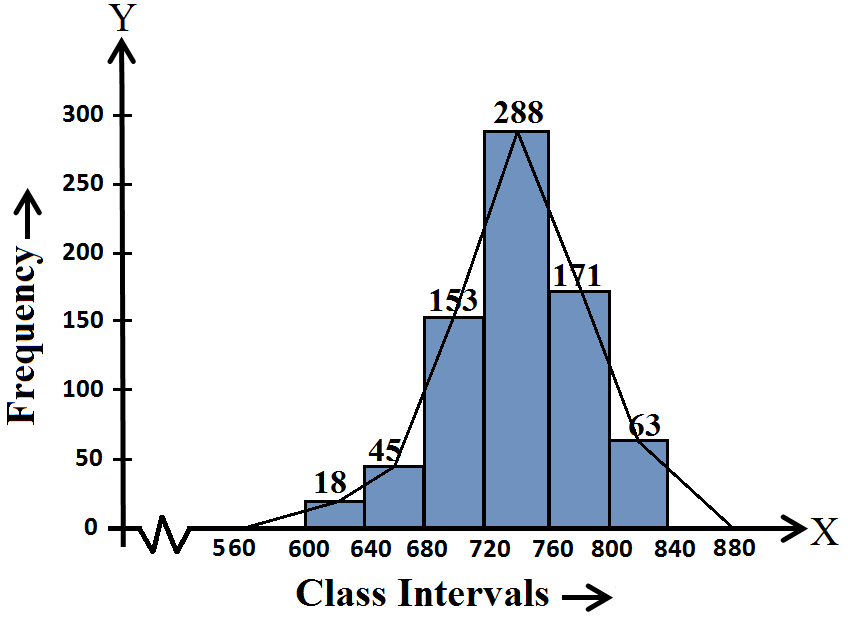
Using this histrogram, draw the frequency polygon on the same graph.
Answer
The given frequency distribution table is below:
Class intervals
$600-640$
$640-680$
$680-720$
$720-760$
$760-800$
$800-840$
Frequency
$18$
$45$
$153$
$288$
$171$
$63$
Take class intervals along $x$-axis and frequencies along and draw rectangle s of width equal to the size of the class intervals and hights equal to the corresponding frequencies. Thus we get the required histogram. Now take imaginary class intervals $560-600$ at the beginning and $840-880$ at the end, each with frequency zero and join the mid points of top of the rectangles to get the reuaired frequency polygon.
View full question & answer
Question 85 Marks
$100$ surnames were randomly picked up from a local telephone directory and frequency distribution of the number of letters in the English alphabet in the surnames was found as follows:
Number of letters
$1-4$
$4-6$
$6-8$
$8-12$
$12-20$
Number of surnames
$6$
$30$
$44$
$16$
$4$
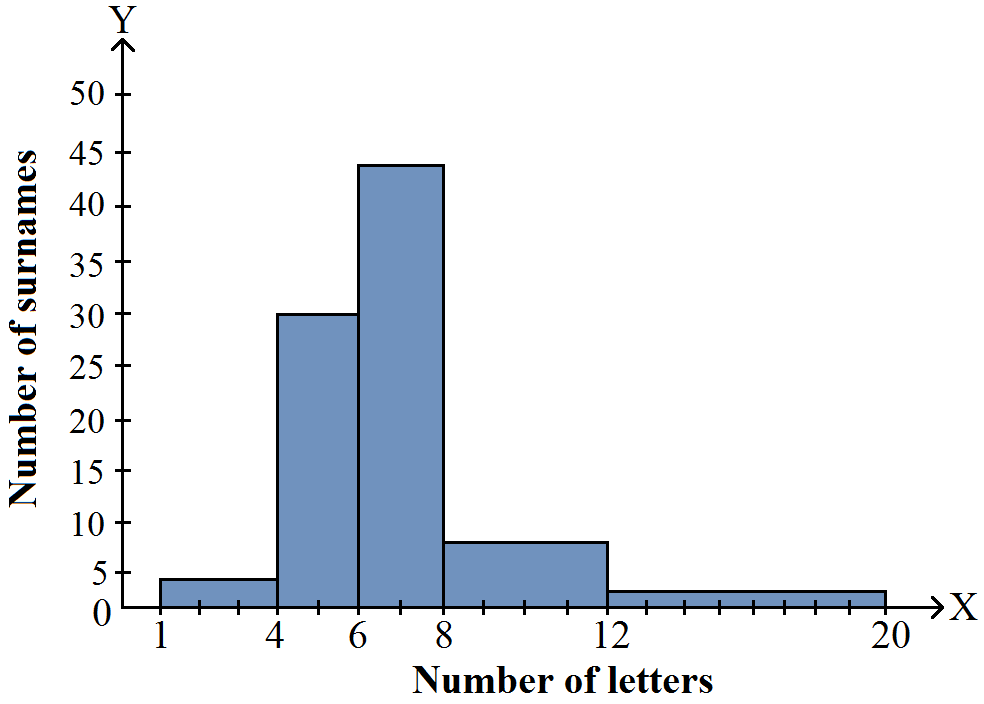
$i.$ Draw a histogram to depict the given information.
$ii.$ Write the class interval in which the maximum number of surnames lie.
Answer
$i.$ Minimum class size $= 6 - 4 = 2$
Adjusted frequency of a class $=\frac{\text{Minimum class size}}{\text{Class size}}\times$ Frequency of the class
Number of letters Number of surnames $($Frequency$)$ Adjusted Frequency
$1-4$ $6$ $\frac{2}{3}\times6=4$
$4-6$ $30$ $\frac{2}{2}\times30=30$
$6-8$ $44$ $\frac{2}{2}\times44=44$
$8-12$ $16$ $\frac{2}{4}\times16=8$
$12-20$ $4$ $\frac{2}{8}\times4=1$

$ii.$ Maximum number of surnames lies in the class interval $6-8$.
View full question & answer
Question 95 Marks
The following table shows the number of illiterate persons in the age group ($10-58$ years) in a town:
Age group (in years)
$10-16$
$17-23$
$24-30$
$31-37$
$38-44$
$45-51$
$50-58$
Number of illiterate persons
$175$
$325$
$100$
$150$
$250$
$400$
$525$
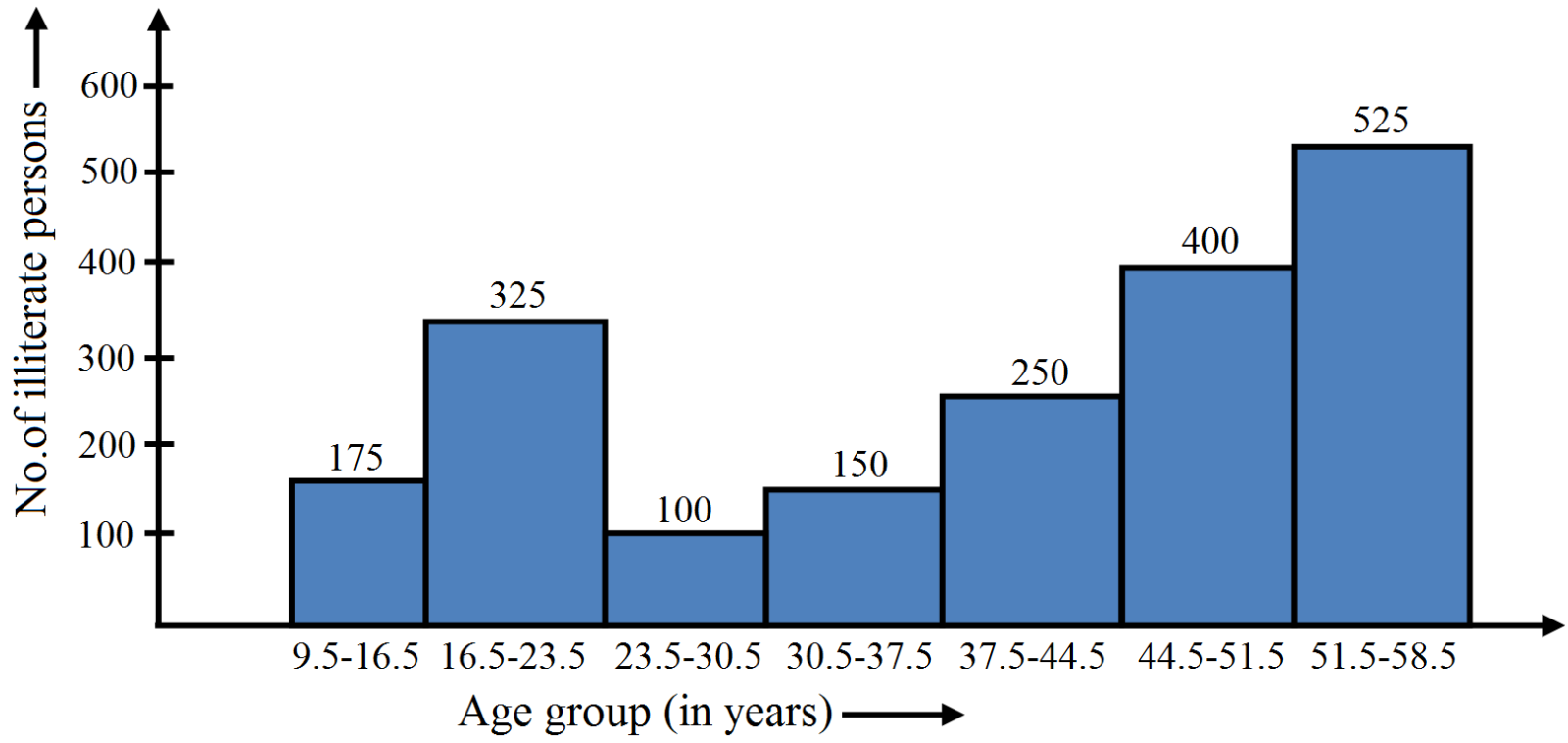
Draw a histogram to represent the above data.
Answer
Given frequency distribution is as below:
Age group (in years)
$10-16$
$17-23$
$24-30$
$31-37$
$38-44$
$45-51$
$52-58$
Number of illiterate persons
$175$
$325$
$100$
$150$
$250$
$400$
$525$
Histogram is the graphical representation of a frequency distrubution in the form of rectangles, such that there is no gap between any two successive rectangles. Clearly the given frequency distribution is in inclusive form, that is there is a gap between the upper limit of a class and the lower limit of the next class. Therefore, we need to convert the frequency distribution in exclusive form, as shown below:
Age group (in years)
$9.5-16.5$
$16.5-23.5$
$23.5-30.5$
$30.5-37.5$
$37.5-44.4$
$44.5-51.5$
$51.5-58.5$
Number of illiterate persons
$175$
$325$
$100$
$150$
$250$
$400$
$525$
To draw the required histogram, take class intervals, that is age, along $x$-axis and frequencies, that is number of illiterate persions along $y$-axis draw rectangles. So, we get the required histogram. Since the scale on $X$-axis starts at $9.5$, a kink (break) is indicated near the origin to show that graph is drawn to scale beginning at $9.5$
View full question & answer
Question 105 Marks
The follwoing table shows the average daily earnings of $40$ general stores in a market, during a certain week.
Daily wages (in Rs.)
$700-750$
$750-800$
$800-850$
$850-900$
$900-950$
$950-1000$
Number of stores
$6$
$9$
$2$
$7$
$11$
$5$
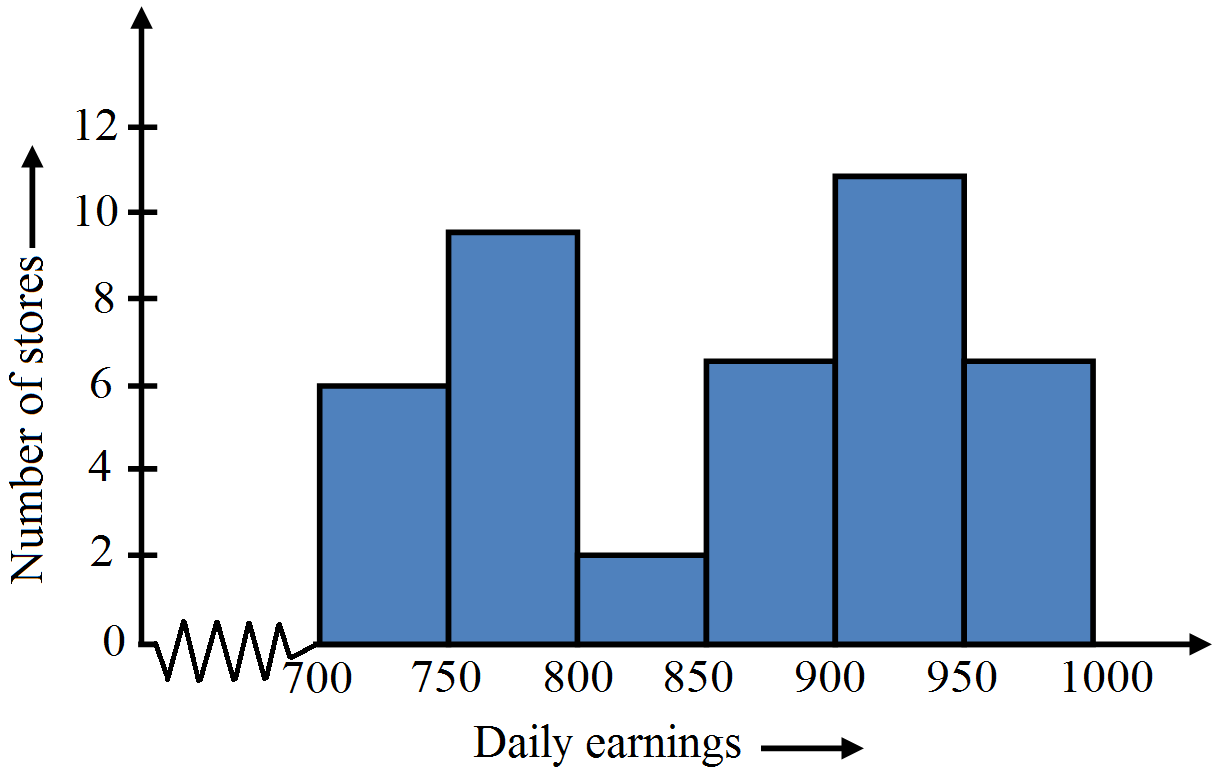
Draw a histogram to represent the above data.
Answer
Given frequency distribution is below:
Daily earning
$700-750$
$750-800$
$800-850$
$850-900$
$900-950$
$950-1000$
Number of stores
$6$
$9$
$2$
$7$
$11$
$5$
In the class intervals, If the upper limit of one class is the lower limit of the next class, It known as the exclusive method of classification.
Clearly, the given frequency distribution is in the exclusive form.
We take class intervals, i.e. daily earnings (in $Rs$.) along $x$-axis and frequencies i.e. number of stores along $y$-axis.
So, we get the required histogram. S
ince the scale on $x$-axis starts at $700$, a kink (break) is indicated near the origin to show that the graph is drawn to scale beginning at $700$.
View full question & answer
Question 115 Marks
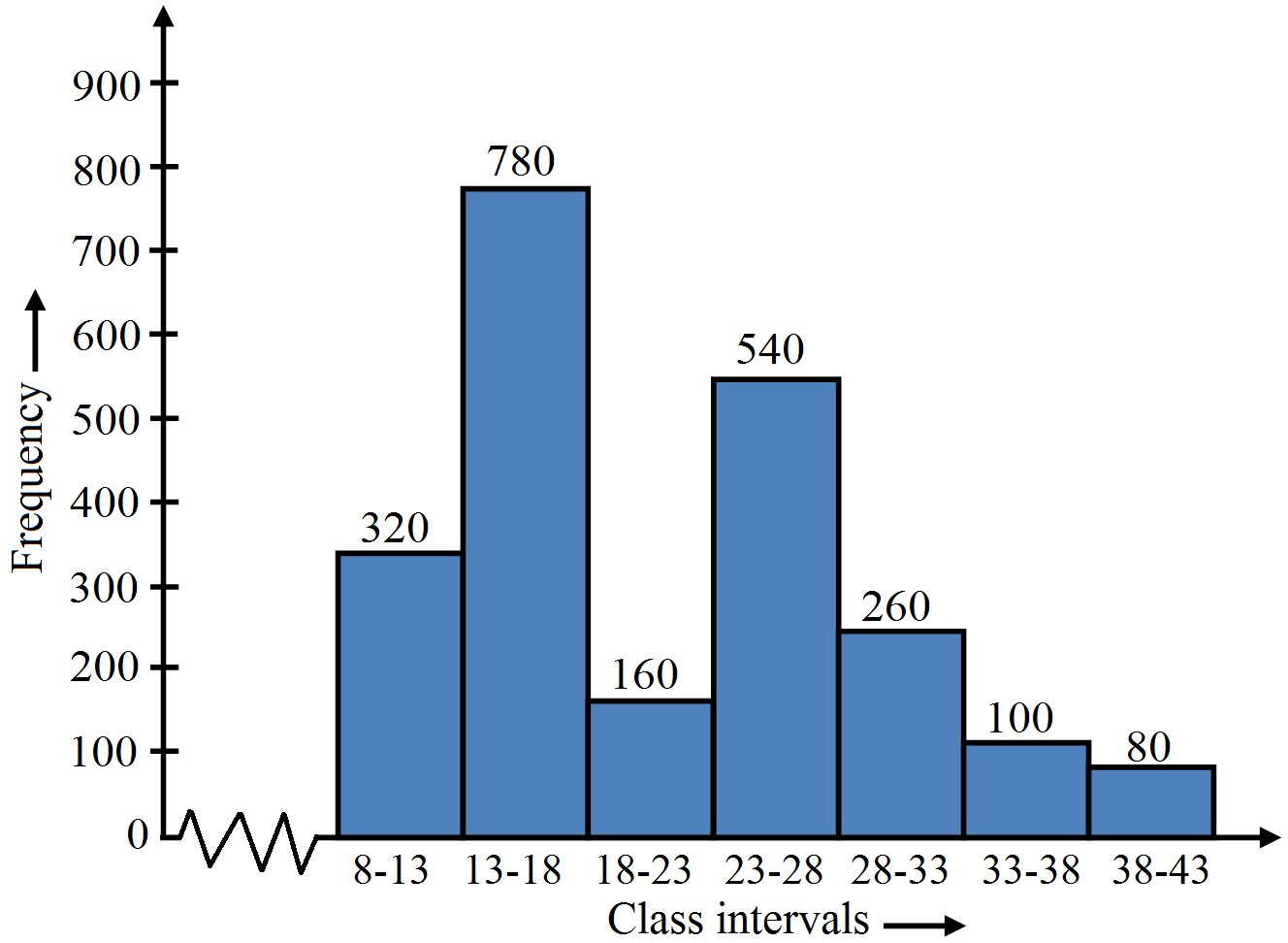
Draw a histogram for the frequency distribution of the following date:
Class interval
$8-13$
$13-18$
$18-23$
$23-28$
28-33
33-38
38-43
Frequency
$320$
$780$
$160$
$540$
260
100
80
Answer
Give frequency distribution is as below:
Class interval
$8-13$
$13-18$
$18-23$
$23-28$
$28-33$
$33-38$
$38-43$
Frequency
$320$
$780$
$160$
$540$
$260$
$100$
$80$
In the class intervals, if the upper limit of one class is the lower limit of the next class, it is know as the exclusive method of classification.
Clearly, the given frequency distribution is in the exclusive form.
We take class intervals along $x$-axis and frequency along $y$-axis.
So, we get the required histogram. Since the scale on $X$-axis starts at $8$, a kink (break) is indicated near the origin to show that the graph is drawn to scale beginning at $8$.
View full question & answer
Question 125 Marks
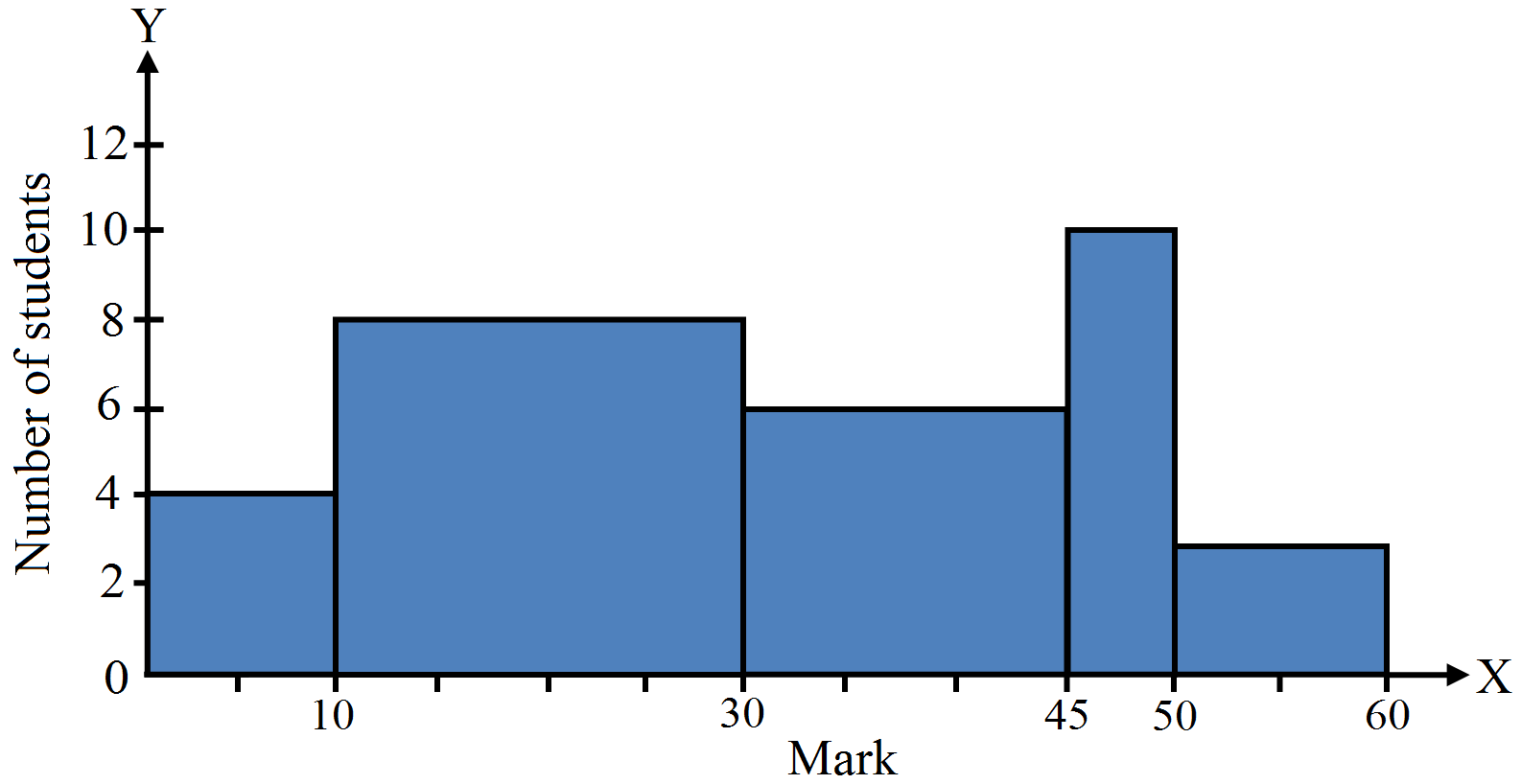
Draw a histogram to represnt the following information:
Marks
$0-10$
$10-30$
$30-45$
$45-50$
$50-60$
Number of student
$8$
$32$
$18$
$10$
$6$
Answer
Minimum class size$ = 50 - 45 = 5$
Adjusted frequency of a class $=\frac{\text{Minimum class size}}{\text{Class size}}\times\text{Frequency of the class}$
Marks Number of students (Frequency) Adjusted Frequency
$0-10$ $8$ $\frac{5}{10}\times8=4$
$10-30$ $32$ $\frac{5}{20}\times32=8$
$30-45$ $18$ $\frac{5}{15}\times18=6$
$45-50$ $10$ $\frac{5}{5}\times10=10$
$50-60$ $6$ $\frac{5}{10}\times6=3$
View full question & answer
Question 135 Marks
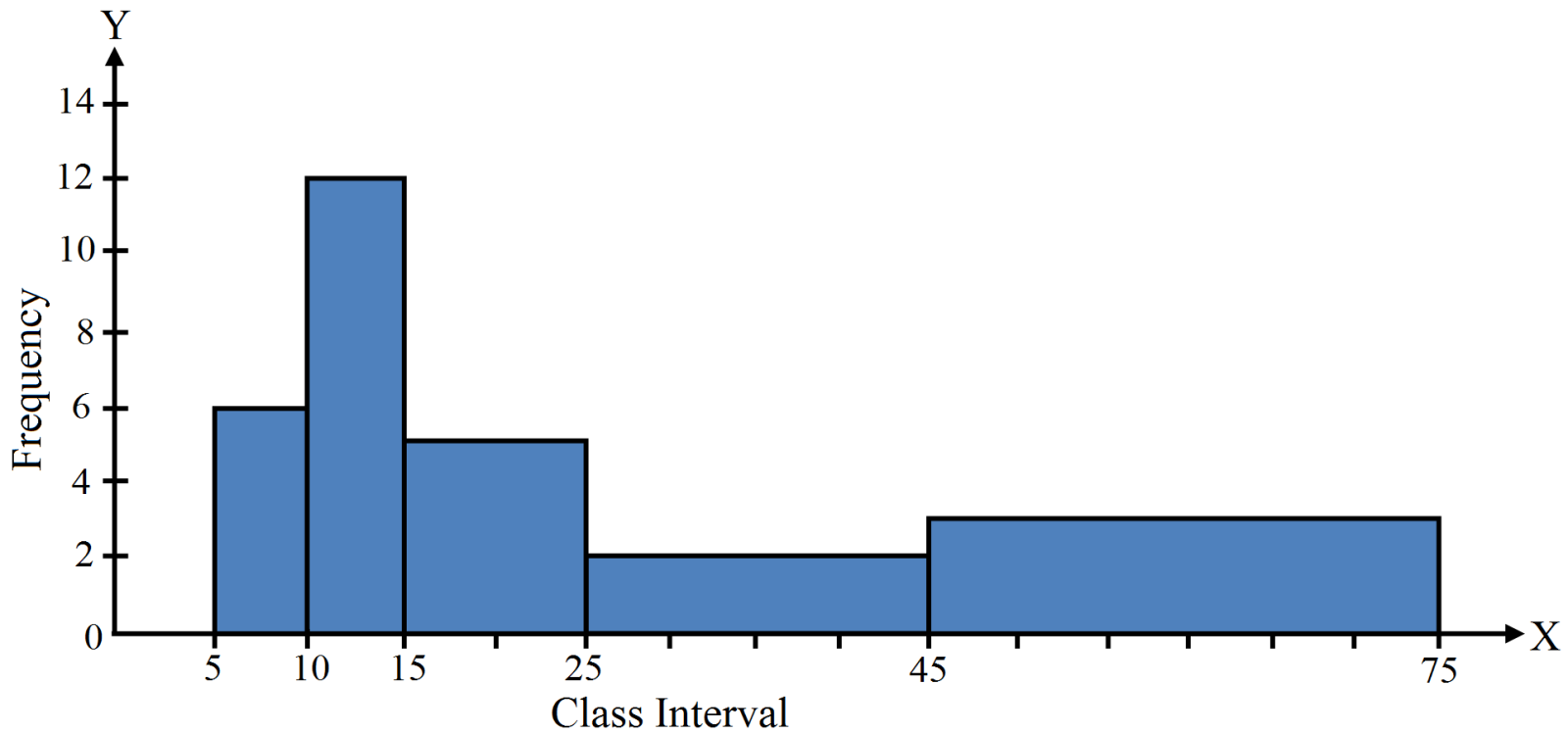
Draw a histogram to represent the following information:
Class interval
$5-10$
$10-15$
$15-25$
$25-45$
$45-75$
Frequency
$6$
$12$
$10$
$8$
$18$
Answer
Minimum class size $= 10 - 5 = 5$
Adjusted frequency of a class $=\frac{\text{Minimum class size}}{\text{Class size}}\times\text{Frequency of the class}$
class Interval Frequency Adjusted Frequency
$5-10$ $6$ $\frac{5}{5}\times6=6$
$10-15$ $15$ $\frac{5}{5}\times12=12$
$15-25$ $10$ $\frac{5}{10}\times10=5$
$25-45$ $8$ $\frac{5}{20}\times8=2$
$45-75$ $18$ $\frac{5}{30}\times18=3$
View full question & answer
Question 145 Marks
In a study of diabetic patients in a village, the following observations were noted.
Age in year
$10-20$
$20-30$
$30-40$
$40-50$
$50-60$
$60-70$
Number of patients
$2$
$5$
$12$
$19$
$9$
$4$
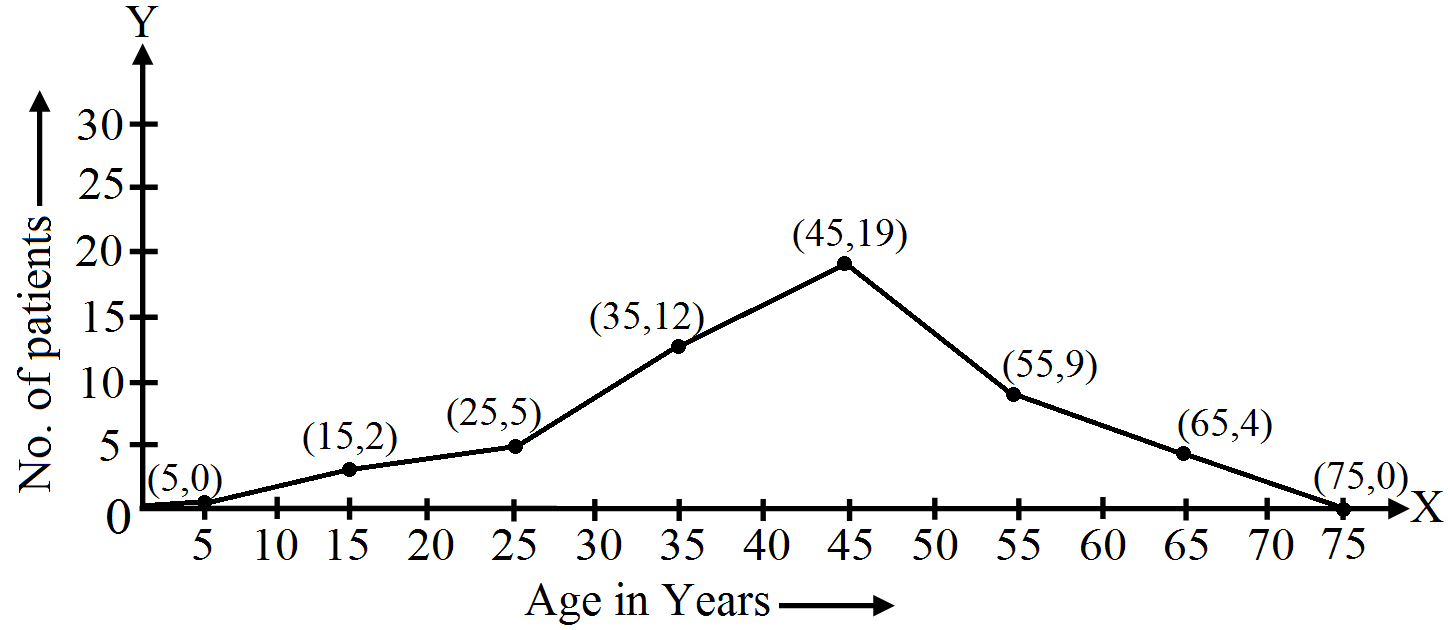
Represent the above data by a frequency polygon.
Answer
The given frequency distribution is as below:
Age in years
$10-20$
$20-30$
$30-40$
$40-50$
$50-60$
$60-70$
Number of patients
$2$
$5$
$12$
$19$
$9$
$4$
In order to draw, frequency polygon, we require class marks.
The class mark of a class interval is $=\frac{\text{lower limit}+\text{upper limit}}{2}$
The frequency distribution table with class marks is given below:
Marks
Number of students (Frequency)
Adjusted Frequency
$0-10$
$5$
$0$
$10-20$
$15$
$2$
$20-30$
$25$
$5$
$30-40$
$35$
$12$
$40-50$
$45$
$19$
$50-60$
$55$
$9$
$60-70$
$65$
$4$
$70-80$
$75$
$0$
In the above table, we have taken imaginary class intervals $0-10$ at beginning and $70-80$ at the end, each with frequency zero. Now take class marks along $x$-axis and the corresponding frequencies along $y$-axis.
plot points $(5, 0), (15, 2), (25, 5), (35, 12), (55, 9), (65, 9)$ and draw line segments.
View full question & answer
Question 155 Marks
Draw a frequency polygon for the following frequency distribution:
Class interval
$1-10$
$11-20$
$21-30$
$31-40$
$41-50$
$51-60$
Frequency
$8$
$3$
$6$
$12$
$2$
$7$
Answer
The given frequency distribution table is as below:
Class intervals
$1-10$
$11-20$
$21-30$
$31-40$
$41-50$
$51-60$
Frequency
$8$
$3$
$6$
$12$
$2$
$7$
This table has inclusive class intervals and so these are to be converted into exclusive class intervals (i.e true class limits).
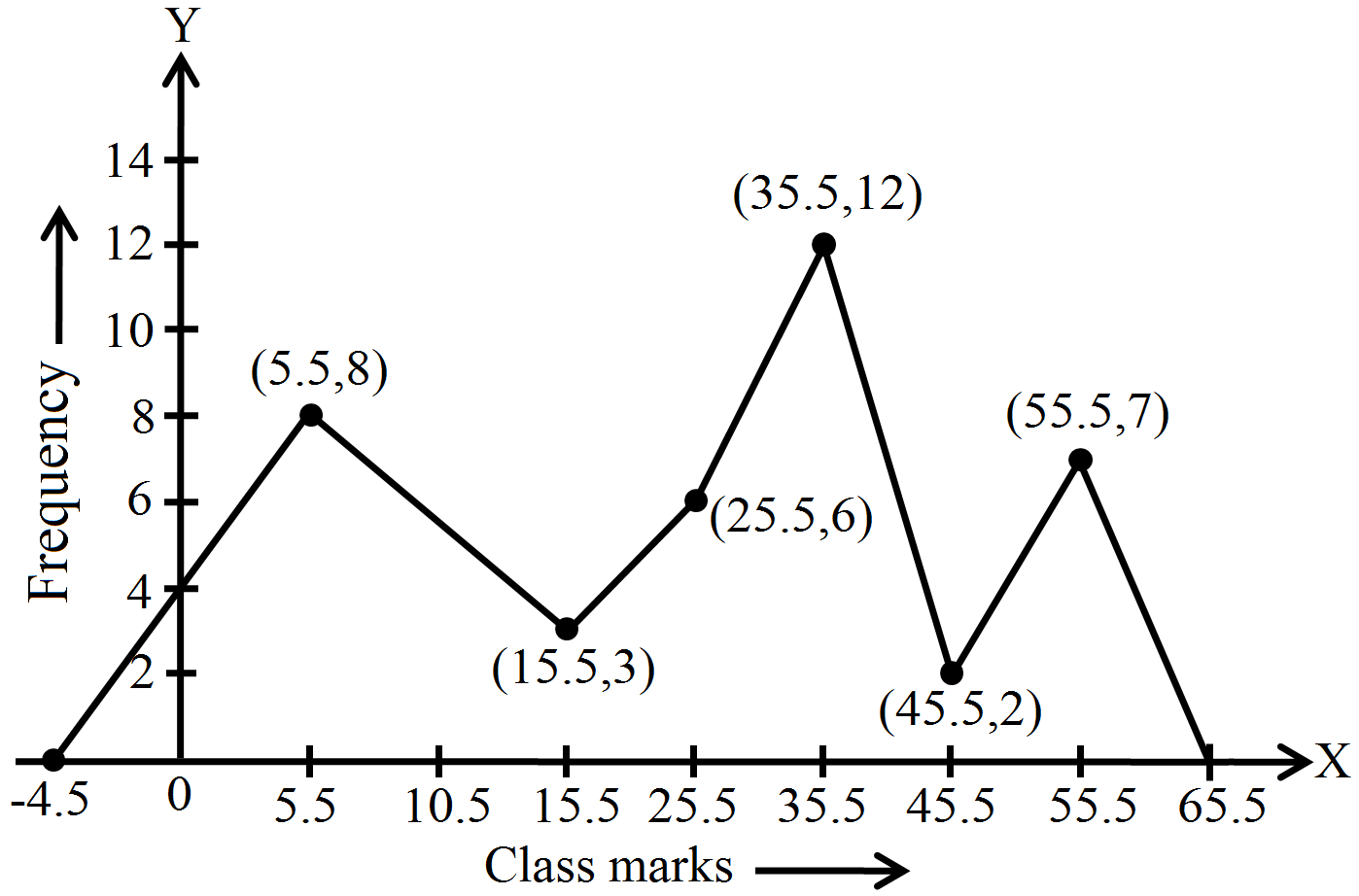
These are$ (0.5-10.5), (10.5-20.5), (20.5-30.5), (30.5-40.5), (40.5-50.5)$ and $(50.5-60.5)$ In order to draw a frequency polygon, we need to determine to determine the class marks.
Class marks of a class interval $=\frac{\text{Lower limit}+\text{upper limit}}{2}$ Take imaginary class interval $(-9.5-0.5)$ at the beginning and $(60.5-70.5)$ at the end, each with frequency zero. So, we have the following table
Class intervals
True class intervals
class marks
Frequency
$(-9)-0$
$(-9.5)-0.5$
$-4.5$
$0$
$1-10$
$0.5-10.5$
$5.5$
$8$
$11-20$
$10.5-20.5$
$15.5$
$3$
$21-30$
$20.5-30.5$
$25.5$
$6$
$31-40$
$30.5-40.5$
$35.5$
$12$
$41-50$
$40.5-50.5$
$45.5$
$2$
$51-60$
$50.5-60.5$
$55.5$
$7$
$61-70$
$60.5-70.5$
$65.5$
$0$
Now, take class marks along $x$-axis and their corresponding frequency along $y$-axis. Mark the points ans join them. Thus, we obtain a complete frequency polygon as shown below:
View full question & answer