Questions

5 Marks Questions

Take a timed test

46 questions · self-marked practice — reveal the answer and mark yourself.

Question 15 Marks
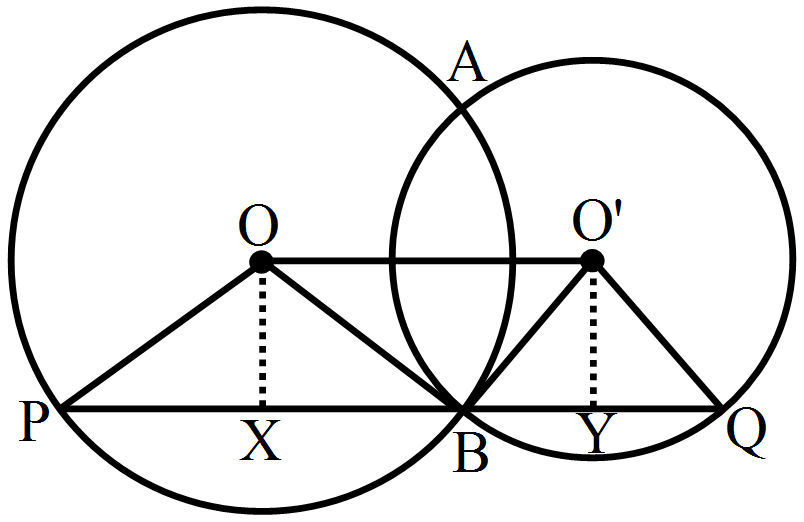
Two circles with centres $O$ and $O'$ intersect at two points $A$ and $B$. $A$ line $PQ$ is drawn parallel to $OO'$ through $A$ or $B$, intersecting the circles at $P$ and $Q$. Prove that $PQ = 2OO'$.
Answer
Given: Two circles with centres $O$ and $O'$ intersect at two points $A$ and $B$.
 
 Draw a line $PQ$ parallel to $OO'$ through $B$, $OX$ perpendicular to $PQ$, $O'Y$ perpendicular to $PQ$, join all.
We know that perpendicular drawn from the centre to the chord, bisects the chord.
$\therefore$ $PX = XB$ and $YQ = BY$
$\therefore$ $PX + YQ = XB + BY$
On adding $XB + BY$ on both sides,
we get $PX + YQ + XB + BY = 2(XB + BY)$
$\Rightarrow PQ = 2(XY) $
$​​​​​​​\Rightarrow PQ = 2(OO')$
Hence, $PQ = 2OO'$
View full question & answer
Question 25 Marks
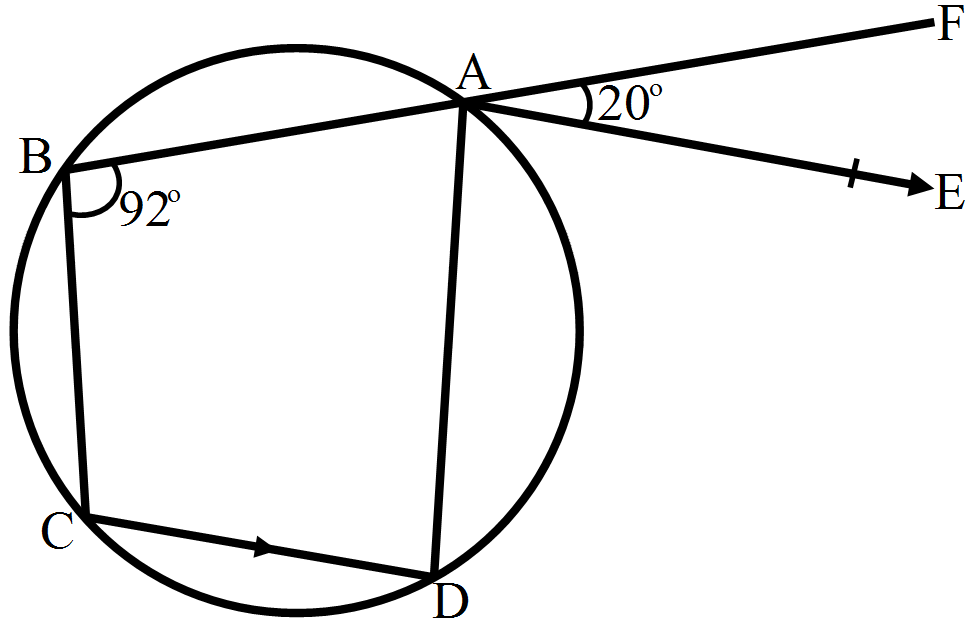
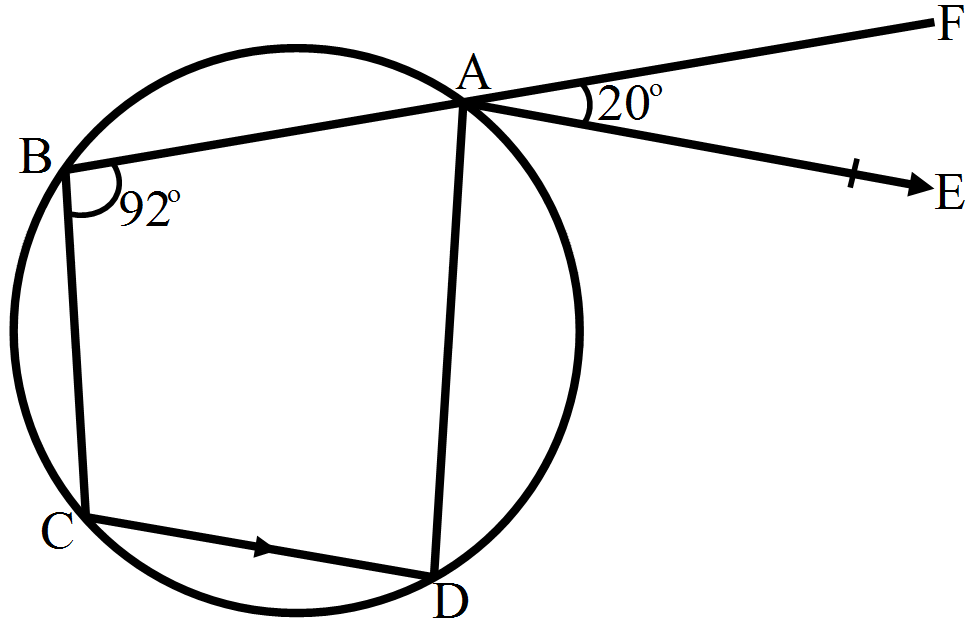
In the given figure, $ABCD$ is a cyclic quadrilateral in which $AE$ is drawn parallel to $CD$, and $BA$ is produced. If $\angle\text{ABC}=92^\circ$ and $\angle\text{FAE}=20^\circ,$ find $\angle\text{BCD}.$
Answer

Given: $ABCD$ is a cyclic quadrilateral.
Then $\angle\text{ABC}+\angle\text{ADC}=180^\circ$
$\Rightarrow\ 92^\circ+\angle\text{ADC}=180^\circ$
$\Rightarrow\ \angle\text{ADC}=(180^\circ-92^\circ)=88^\circ$ Again, $AE$ parallel to $CD$.
Thus, $\angle\text{EAD}=\angle\text{ADC}=88^\circ$ [Alternate angles]
We know that the exterior angle of a cyclic quadrilateral is equal to the interior opposite angle.
$\therefore\ \angle\text{BCD}=\angle\text{DAF}$
$\Rightarrow\ \angle\text{BCD}=\angle\text{EAD}+\angle\text{EAF}$
$=88^\circ+20^\circ=108^\circ$
​​​​​​​Hence, $\angle\text{BCD}=108^\circ$
View full question & answer
Question 35 Marks
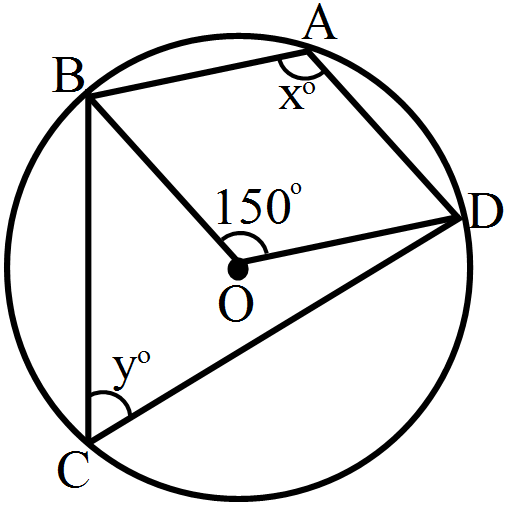
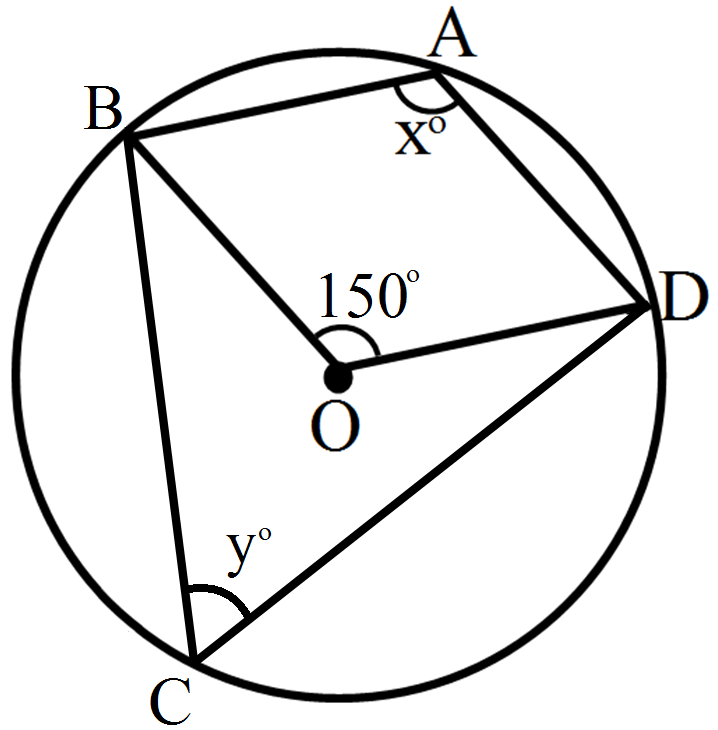
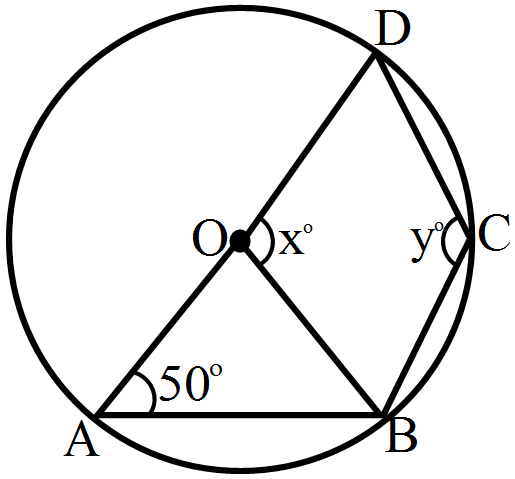
In the given figure, $O$ is the centre of a circle and $\angle\text{BOD}=150^\circ.$ Find the values of $x$ and $y$.
Answer
$O$ is the centre of the circle and $\angle\text{BOD}=150^\circ$
$\therefore$ reflex $\angle\text{BOD}=(360^\circ-\angle\text{BOD})$
$=(360^\circ-150^\circ)=210^\circ$

Now, $\text{x}=\frac{1}{2}(\text{reflex}\angle\text{BOD})$
$=\frac{1}{2}\times210^\circ=105^\circ$
$\therefore\ \text{x}=105^\circ$
Again, $x + y = 180^\circ $
$ \Rightarrow 105^\circ + y = 180^\circ $
$\Rightarrow y = 180^\circ - 105^\circ = 75^\circ $
$\therefore$ $y = 75^\circ $
View full question & answer
Question 45 Marks
In the adjoining figure, $AB$ and $AC$ are two equal chords of a circle with centre $O$. Show that $O$ lies on the bisector of $\angle\text{BAC}.$
Answer
Given: $AB$ and $AC$ are two equal chords of a circle with centre $O$.

To prove: $\angle\text{OAB}=\angle\text{OAC}$
Construction: Join $OA, OB$ and $OC$.
Proof: In $\triangle\text{OAB}$ and $\triangle\text{OAC},$
we have: $AB = AC$ (Given) $OA = OA$ (Common) $OB = OC$ (Radii of a circle)
$\therefore\ \triangle\text{OAB}\cong\triangle\text{OAC}$ (By $SSS$ congruency rule)
$\Rightarrow\ \angle\text{OAB}=\angle\text{OAC}$ $(C.P.C.T.)$
Hence, point $O$ lies on the bisector of $\angle\text{BAC}.$
View full question & answer
Question 55 Marks
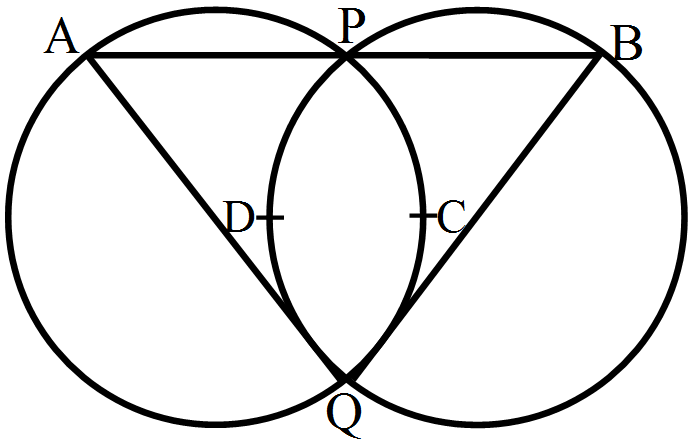
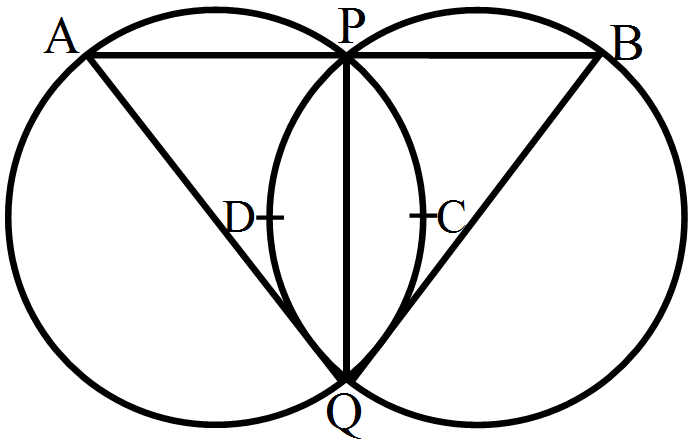
Two equal circles intersect in $P$ and $Q$. A straight line through $P$ meets the circles in $A$ and $B$. Prove that $QA = QB$.
Answer
Given: Two equal circles intersect at point $P$ and $Q$.
A straight line passes through $P$ and meets the circle at points $A$ and $B$.
To prove: $QA = QB$
Construction: Join $PQ$.
.
Proof: Two circles will be congruent if and only if they have equal radii.
Here, $PQ$ is the common chord to both the circles.
Thus, their corresponding arcs are equal (if two chords of a circle are equal, then their corresponding arcs are congruent).
So, arc $PCQ$ = arc $PDQ$
$\therefore\ \angle\text{QAP}=\angle\text{QBP}$ (Congruent arcs have the same degree in measure)
Hence, $QA = QB$ (In isosceles triangle, base angles are equal)
View full question & answer
Question 65 Marks
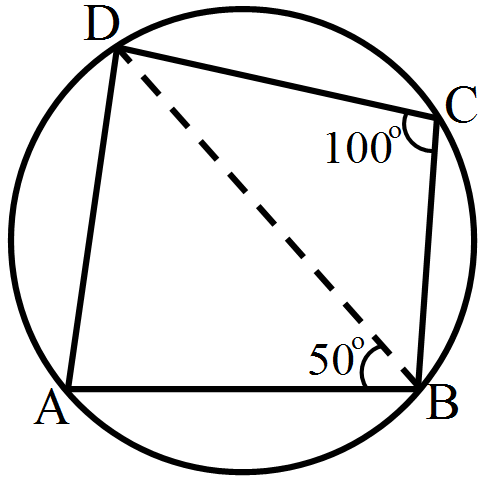
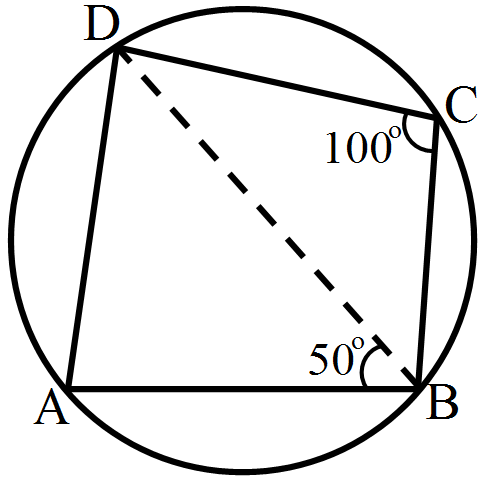
In the adjoining figure, $ABCD$ is a cyclic quadrilateral in which $\angle\text{BCD}=100^\circ$ and $\angle\text{ABD}=50^\circ.$ Find $\angle\text{ADB}.$
Answer
$ABCD$ is a cyclic quadrilateral.
$\therefore\ \angle\text{A}+\angle\text{C}=180^\circ$ [Opposite of a cyclic quadrilateral are supplementary]
$\Rightarrow\ \angle\text{A}+100^\circ=180^\circ$
$\Rightarrow\ \angle\text{A}=180^\circ-100^\circ=80^\circ$

Now, in $\triangle\text{ABD},$ we have: $\angle\text{A}+\angle\text{ABD}+\angle\text{ADB}=180^\circ$
$\Rightarrow\ 80^\circ+50^\circ+\angle\text{ADB}=180^\circ$
$\Rightarrow\ \angle\text{ADB}=180^\circ-130^\circ=50^\circ$
$\therefore\ \angle\text{ADB}=50^\circ$
View full question & answer
Question 75 Marks
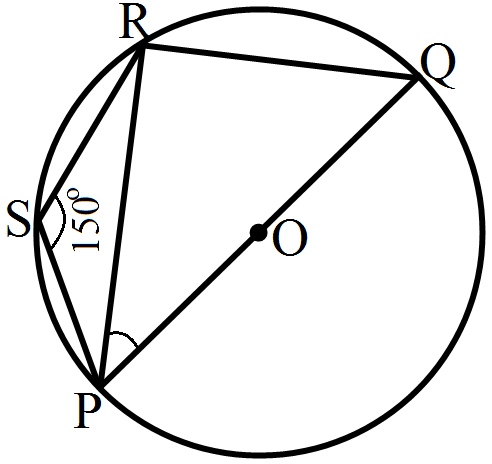
In the given figure, $POQ$ is a diameter and $PQRS$ is a cyclic quadrilateral. If $\angle\text{PSR}=150^\circ,$ find $\angle\text{RPQ}.$
Answer

 In cyclic quadrilateral $PQRS$,
we have: $\angle\text{PSR}+\angle\text{PQR}=180^\circ$
$\Rightarrow\ 150^\circ+\angle\text{PQR}=180^\circ$
$\Rightarrow\ \angle\text{PQR}=(180^\circ-150^\circ)=30^\circ$
$\therefore\ \angle\text{PQR}=30^\circ\dots(\text{i})$
Also, $\angle\text{PQR}=90^\circ\dots(\text{ii})$ (Angle in a semicircle)
Now, in $\triangle\text{PRQ},$
 we have: $\angle\text{PQR}+\angle\text{PRQ}+\angle\text{RPQ}=180^\circ$
$\Rightarrow\ 30^\circ+90^\circ+\angle\text{RPQ}=180^\circ$ [From $(i)$ and $(ii)$]
​​​​​​​$\Rightarrow\ \angle\text{RPQ}=180^\circ-120^\circ=60^\circ$
$\therefore\ \angle\text{RPQ}=60^\circ$
View full question & answer
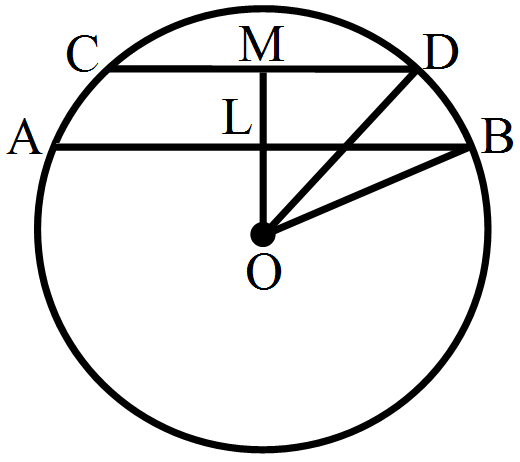
Question 85 Marks
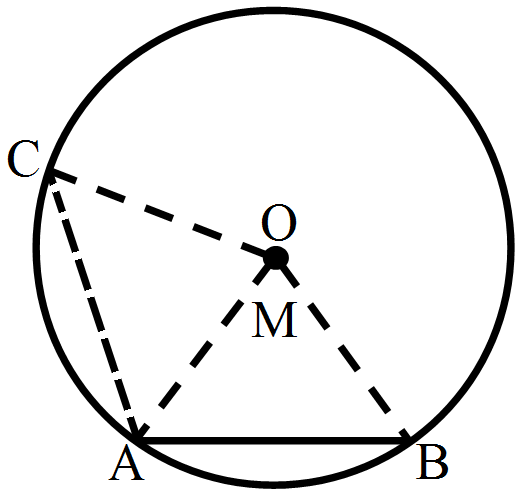
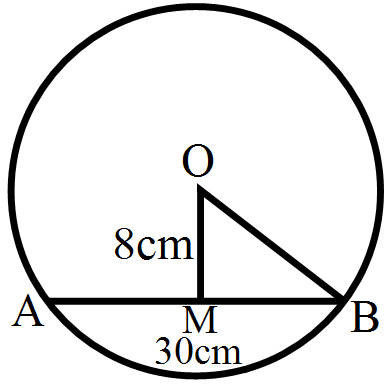
A chord of length $30\ cm$ is drawn at a distance of 8cm from the centre of a circle. Find out the radius of the circle.
Answer
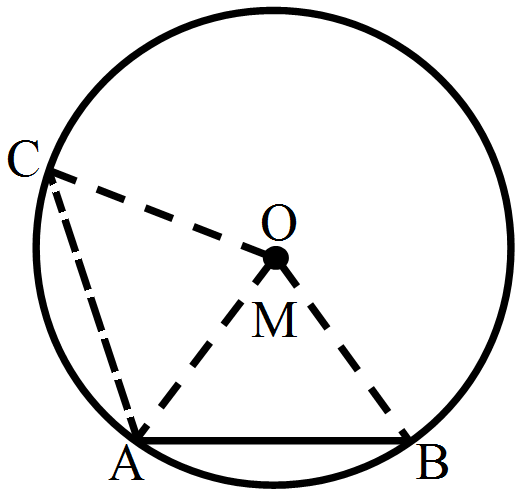
Let $AB$ be the chord of the given circle with centre $O$. The perpendicular circle to the chord is $8\ cm$.
Join $OB.$
Then OM $= 8\ cm$ and $AB = 30\ cm.$

We know that the perpendicular from the centre of a circle to a chord.
$\therefore\ \text{MB}=\Big(\frac{\text{AB}}{2}\Big)=\Big(\frac{30}{2}\Big)\text{cm}=15\text{cm}$
From the right $\triangle\text{OMB},$ we have:
$OB^2= OM^2 + MB^2$
$\Rightarrow OB^2 = 8^2 + 15^2$
$\Rightarrow OB^2 = 64 + 225$
$\Rightarrow OB^2 = 289$
$\Rightarrow\ \text{OB}=\sqrt{289}\text{cm}=17\text{cm}$
Hence, the required length of the radius is $17\ cm.$
View full question & answer
Question 95 Marks
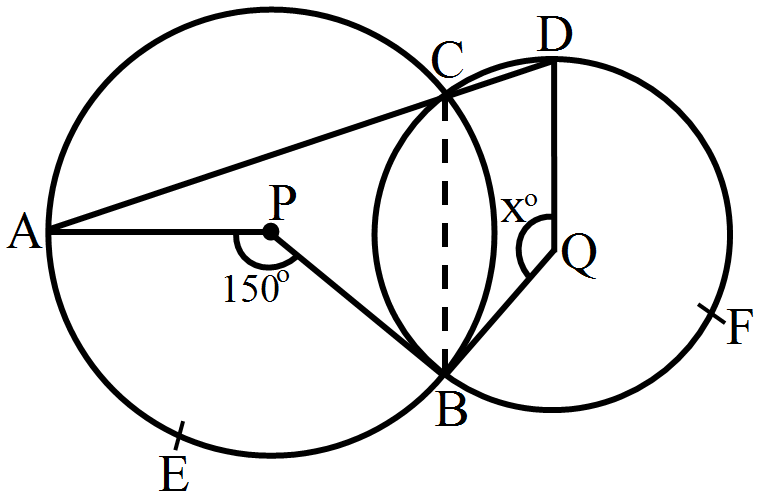
In the figure given below, $P$ and $Q$ are centres of two circles, intersecting at $B$ and $C$, and $ACD$ is a straight line.
If $\angle\text{APB}=150^\circ$ and $\angle\text{BQD}=\text{x}^\circ,$ find the value of x.
Answer
We know that the angle subtended by an arc of a circle at the centre is double the angle subtended by it on the remaining part of the circle.
 Here, arc $AEB$ subtends $\angle\text{APB}$ at the centre and $\angle\text{ACB}$ at $C$ on the circle.
$\therefore\ \angle\text{APB}=2\angle\text{ACB}$
$\Rightarrow\ \angle\text{ACB}=\frac{150^\circ}{2}=75^\circ\dots(1)$ Since $ACD$ is a straight line,
$\angle\text{ACB}=2\angle\text{BCD}=180^\circ$
$\Rightarrow\ \angle\text{BCD}=180^\circ-75^\circ$
$\Rightarrow\ \angle\text{BCD}=105^\circ\dots(2)$ Also,
 arc $BFD$ subtends reflex $\angle\text{BQD}$ at the centre and $\angle\text{BCD}$ at $C$ on the circle.
$\therefore$ reflex $\angle\text{BQD}=2\angle\text{BCD}$
$\Rightarrow$ reflex $\angle\text{BQD}=2(105^\circ)=210^\circ\dots(3)$
Now, reflex $\angle\text{BQD}+\angle\text{BQD}=360^\circ$
$\Rightarrow\ 210^\circ+\text{x}=360^\circ$
$\Rightarrow\ \text{x}=360^\circ-210^\circ$
$\Rightarrow\ \text{x}=150^\circ$ Hence, $\text{x}=150^\circ.$
View full question & answer
Question 105 Marks
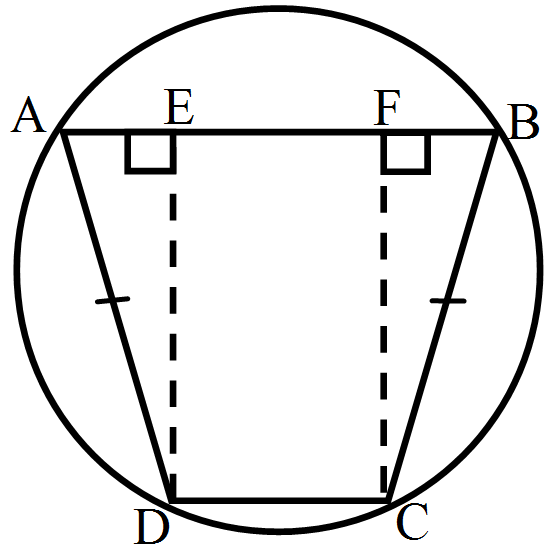
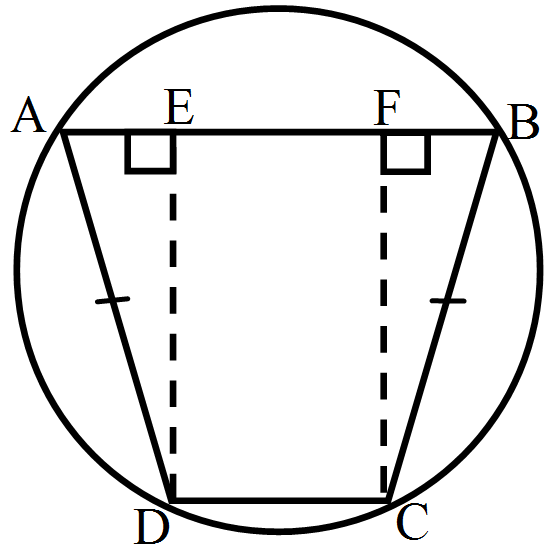
In the given figure, $ABCD$ is a quadrilateral in which $AD = BC$ and $\angle\text{ADC}=\angle\text{BCD}.$ Show that the points $A, B, C, D$ lie on a circle.
Answer

$ABCD$ is a quadrilateral in which $AD = BC$ and $\angle\text{ADC}=\angle\text{BCD}.$
Draw $\text{DE}\perp\text{AB}$ and $\text{CF}\perp\text{AB}.$ In $\triangle\text{ADE}$ and $\triangle\text{BCF},$
we have: $\angle\text{ADE}=\angle\text{ADC}-90^\circ=\angle\text{BCD}-90^\circ=\angle\text{BCF}$
$[$given: $\angle\text{ADC}=\angle\text{BCD}]$ $AD = BC$ [given]
$\therefore\ \triangle\text{ADE}\cong\angle\text{BCF}$ [By $AAS$ congruency]
$\Rightarrow\ \angle\text{A}=\angle\text{B}$
Now, $\angle\text{A}+\angle\text{B}+​​\angle\text{C}+\angle\text{D}=360^\circ$
$\Rightarrow\ 2\angle\text{B}=2\angle\text{D}=360^\circ$
$\Rightarrow\ \angle\text{B}+\angle\text{D}=180^\circ$
Hence, $ABCD$ is a cyclic quadrilateral.
View full question & answer
Question 115 Marks
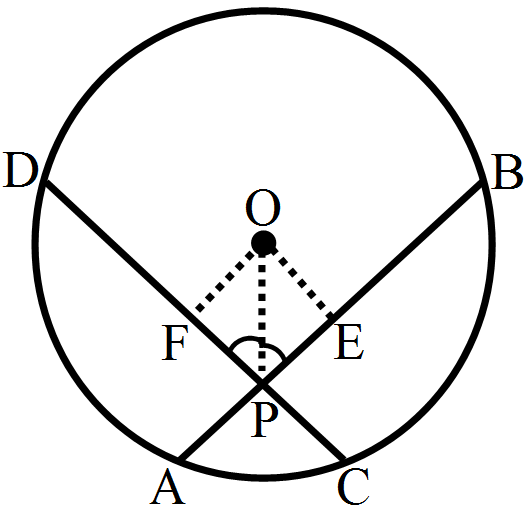
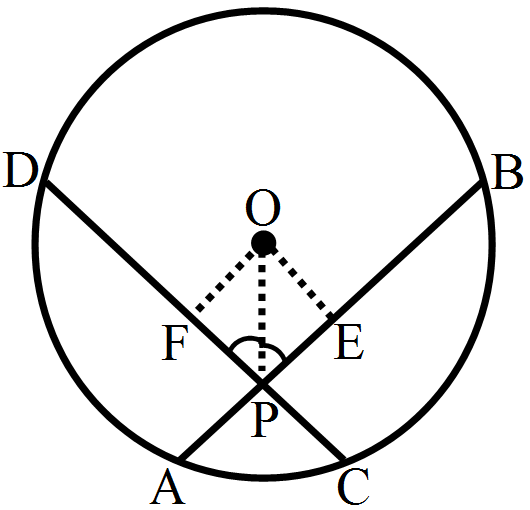
In the given figure, $O$ is the centre of a circle in which chords $AB$ and $CD$ intersect at $P$ such that $PO$ bisects $\angle\text{BPD}.$ Prove that $AB$ $= CD$.
Answer

Given: $O$ is the centre of a circle in which chords $AB$ and $CD$ intersect.
at $P$ such that $PO$ bisects $\angle\text{BPD}.$
To prove: $AB = CD$
Construction: Draw $\text{OE}\perp\text{AB}$ and $\text{OF}\perp\text{CD}.$
Proof: In $\triangle\text{OEP}$ and $\triangle\text{OFP},$
 we have: $\angle\text{OEP}=\angle\text{OFP}$ [$90^\circ $ each] $OP = OP$ [Common]
$\angle\text{OPE}=\angle\text{OPF}$
$[\because$ $OP$ bisects $\angle\text{BPD}]$
Thus, $\triangle\text{OEP}\cong\triangle\text{OFP}$ [$AAS$ criterion]
$\Rightarrow OE = OF$
Thus, chords $AB$ and $CD$ are equidistant from the centre $O$.
$\Rightarrow AB = CD$ $[\because$ Chords equidistant from the centre are equal$]$
 $\therefore$ $AB = CD$
View full question & answer
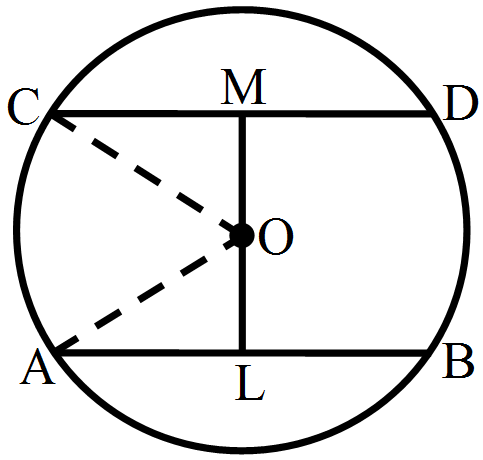
Question 125 Marks
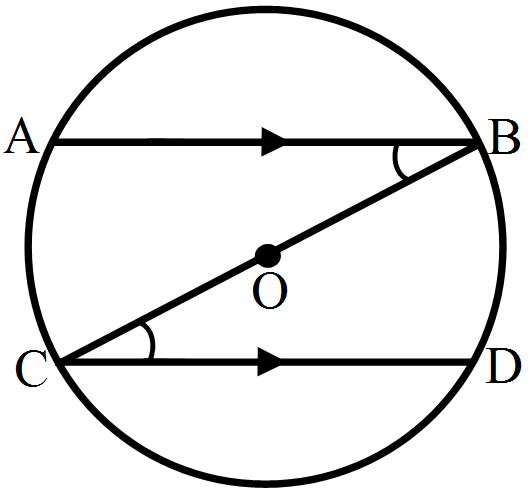
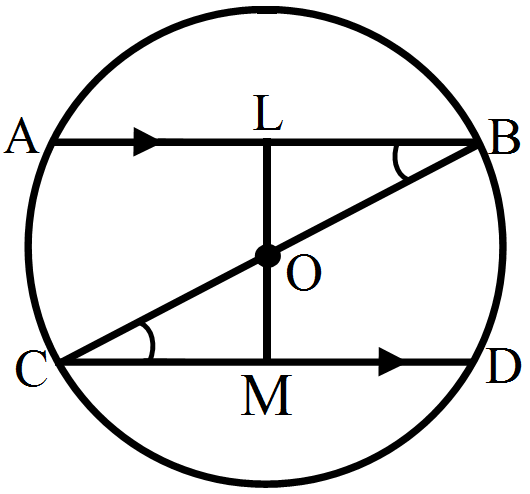
In the adjoining figure, $BC$ is a diameter of a circle with centre $O.$ If $AB$ and $CD$ are two chords such that $AB || CD,$ prove that $AB = CD.$
Answer
Given: $BC$ is a diameter of a circle with centre $O. $
$AB$ and $CD$ are two chords such that $AB || CD.$ TO prove: $AB = CD$
Construction: Draw $\text{OL}\perp\text{AB}$ and $\text{OM}\perp\text{CD}.$

Proof: In $\triangle\text{OLB}$ and $\triangle\text{OMC},$
we have: $\angle\text{OLB}=\angle\text{OMC}$ [ 90^\circ each]
$\angle\text{OBL}=\angle\text{OCD} [$Alternate angles as $AB || CD]$
$\text{OB}=\text{OC}$ [Radii of a circle] $\therefore\ \triangle\text{OLB}\cong\triangle\text{OMC}$ (AAS criterion)
Thus, $OL = OM (C.P.C.T.)$
We know that chords equidistant from the centre are equal.
​​​​​​​Hence, $AB = CD$
View full question & answer
Question 135 Marks
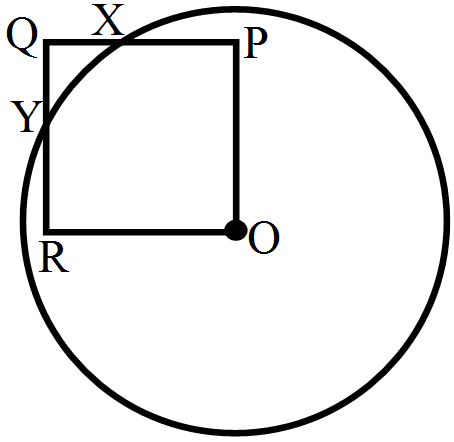
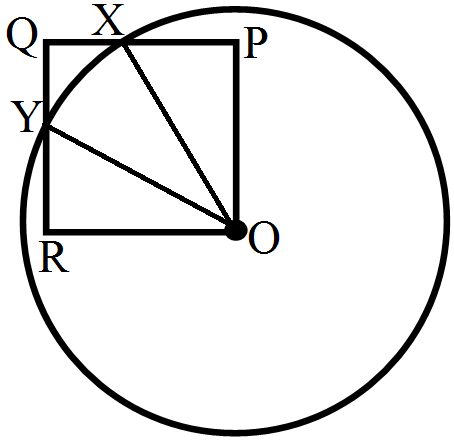
In the adjoining figure, $OPQR$ is a square. A circle drawn with centre $O$ cuts the square at $X$ and $Y$. Prove that $QX = QY$.
Answer
Given: $OPQR$ is a square. A circle with centre $O$ cuts the square at $X$ and $Y$.
To prove: $QX = QY$
Construction: Join $OX $and $OY$.

Proof: In $\triangle\text{OXP}$ and $\triangle\text{OYP},$
we have: $\angle\text{OPX}=\angle\text{ORY}$ ($90^\circ $ each)
$OX = OY $(Radii of a circle)
$OP = OR$ (Sides of a square)
$\therefore\ \triangle\text{OXP}\cong\triangle\text{OYP}$ (BY $R.H.S.$ congruency rule)
$\Rightarrow PX = RY ($By $C.P.C.T.)$
$\Rightarrow PQ - PX = QR - RY (PQ$ and $QR$ are sides of a square)
$\Rightarrow QX = QY$ Hence, proved.
View full question & answer
Question 145 Marks
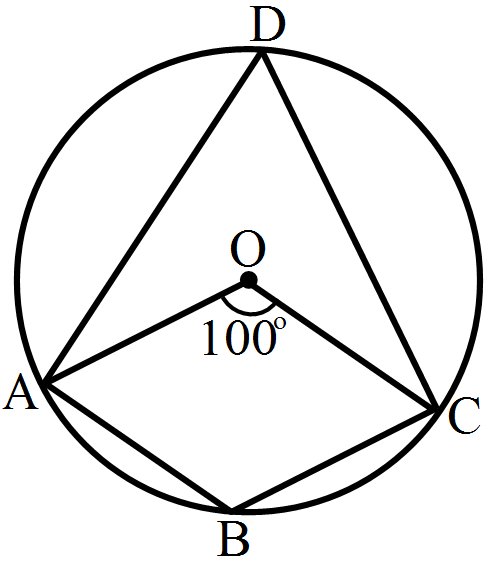
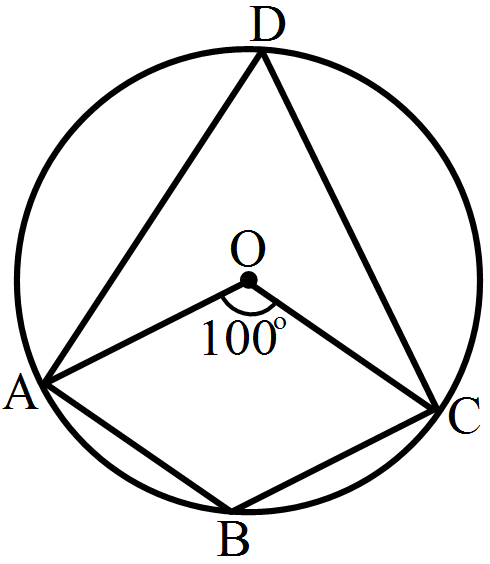
In the given figure, $O$ is the centre of the given circle and measure of arc $ABC$ is $100^\circ$. Determine $\angle\text{ADC}$ and $\angle\text{ABC}.$
Answer

We know that the angle subtended by an arc is twice the angle subtended by it on the circumference in the alternate segment. Thus, $\angle\text{AOC}=2\angle\text{ADC}$
$\Rightarrow\ 100^\circ=2\angle\text{ADC}$
$\therefore\ \angle\text{ADC}=50^\circ$
The opposite angles of a cyclic quadrilateral are supplementary and $ABCD$ is a cyclic quadrilateral.
Thus, $\angle\text{ADC}+\angle\text{ABC}=180^\circ$
$\Rightarrow\ 50^\circ+\angle\text{ABC}=180^\circ$
$\Rightarrow\ \angle\text{ABC}=(180^\circ-50^\circ)=130^\circ$
$\therefore\ \angle\text{ADC}=50^\circ$ and $ \angle\text{ABC}=130^\circ$
View full question & answer
Question 155 Marks
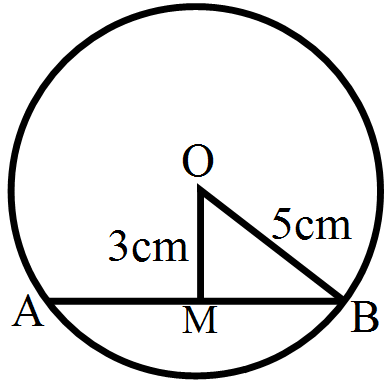
Find the length of a chord which is at a distance of $3\ cm$ from the centre of a circle of radius $5\ cm.$
Answer
Let $AB$ be the chord of the given circle with centre $O$ and a radius of $5\ cm$. Then $OM = 3\ cm$ and $OB = 5\ cm$
 From the right $\triangle\text{OMB},$
we have: $OB^2 = OM^2 + MB^{2 [Pythagoras theorem]}$
$\Rightarrow 5^2 = 3^2 + MB^2$
$\Rightarrow 25 = 9 + MB^2$
$\Rightarrow MB^2 = (25 - 9) = 16$
$\Rightarrow\ \text{MB}=\sqrt{16}\text{cm}=4\text{cm}$
Since the perpendicular from the centre of a circle to a chord bisects the chord,
we have: $AB = 2 \times MB = (2 \times 4)cm = 8\ cm$
Hence, the required length of the chord is $8\ cm$.
View full question & answer
Question 165 Marks
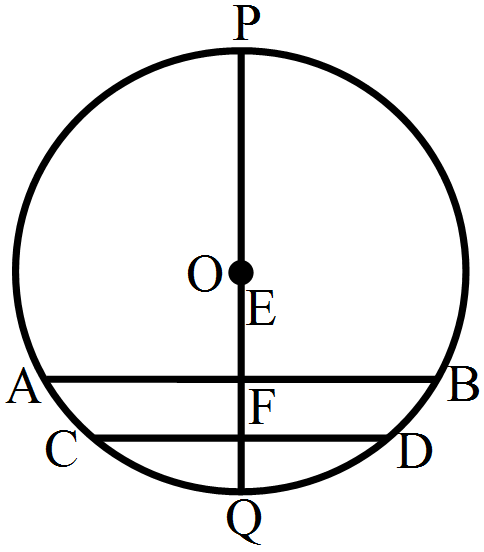
Prove that the diameter of a circle perpendicular to one of the two parallel chords of a circle is perpendicular to the other and bisects it.
Answer

Given: $AB$ and $CD$ are two parallel chords of a circle with centre $O$.
$POQ$ is a diameter which is perpendicular to $AB$.
To prove: $\text{PF}\perp\text{CD}$ and $CF = FD$
 Proof: $AB || CD$ and $POQ$ is a diameter.
$\angle\text{PEB}=90^\circ$ [Given] $\angle\text{PFD}=\angle\text{PEB}$
$[\because$ $AB\ ||\ CD$, Corresponding angles$]$
Thus, $\text{PF}\perp\text{CD}$
$\therefore\ \text{OF}\perp\text{CD}$ We know that the perpendicular from the centre to a chord bisects the chord. i.e., $CF = FD$
​​​​​​​Hence, $POQ$ is perpendicular to $CD$ and bisects it.
View full question & answer
Question 175 Marks
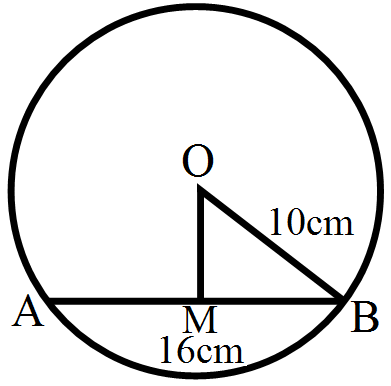
A chord of length $16\ cm$ is drawn in a circle of radius $10\ cm$. Find the distance of the chord from the centre of the circle.
Answer
Let $AB$ be the chord of the given circle with centre $O$ and a radius of $10\ cm$. Then $AB =16\ cm$ and $OB = 10\ cm$
 From $O$, draw $OM$ perpendicular to $AB.$
We know that the perpendicular from the centre of a circle to a chord bisects the chord.
$\therefore\ \text{BM}=\Big(\frac{16}{2}\Big)\text{cm}=8\text{cm}$ In the right $\triangle\text{OMB},$
we have: $OB^2 = OM^2 + MB^2$ [Pythagoras theorem]
$\Rightarrow 10^2 = OM^2 + 8^2$
$\Rightarrow 100 = OM^2 + 64$
$\Rightarrow OM^2 = (100 - 64) = 36$
$\Rightarrow\ \text{OM}=\sqrt{36}\text{cm}=6\text{cm}$
Hence, the distance of the chord from the centre is $6\ cm$.
View full question & answer
Question 185 Marks
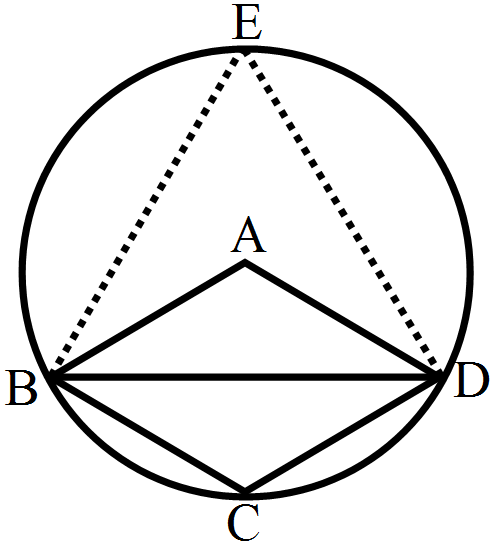
$ABCD$ is a quadrilateral such that $A$ is the centre of the circle passing through $B, C$ and $D$. Prove that $\angle\text{CBD}+\angle\text{CDB}=\frac{1}{2}\angle\text{BAD}.$
Answer

Construction: Take a point $E$ on the circle. Join $BE, DE$ and $BD$.
 We know that the angle subtended by an arc of a circle at its centre is twice the angle subtended by the same arc at a point on the circumference.
$\Rightarrow\ \angle\text{BAD}=2\angle\text{BED}$
$\Rightarrow\ \angle\text{BED}=\frac{1}{2}\angle\text{BAD}\dots\text(\text{i})$ Now, $EBCD$ is a cyclic quadrilateral.
$\Rightarrow\ \angle\text{BED}+\angle\text{BCD}=180^\circ$
$\Rightarrow\ \angle\text{BCD}=180^\circ-\angle\text{BED}$
$\Rightarrow\ \angle\text{BCD}=\frac{1}{2}\angle\text{BAD}\dots\text(\text{ii})$ [Using $(ii)$] In $\triangle\text{BCD},$ by angle sum property
$\Rightarrow\ \angle\text{CBD}+\angle\text{CDB}\angle\text{BCD}=180^\circ$
$\Rightarrow\ \angle\text{CBD}+\angle\text{CDB}+180^\circ-\frac{1}{2}\angle\text{BAD}=180^\circ$ [Using $(ii)$]
$\Rightarrow\ \angle\text{CBD}+\angle\text{CDB}=\frac{1}{2}\angle\text{BAD}$
View full question & answer
Question 195 Marks
Give a geometrical construction for finding the fourth point lying on a circle passing through three given points, without finding the centre of the circle. Justify the construction.
Answer
Let $A, B$ and $C$ be the given points. With $B$ as the centre and a radius equal to $AC$, draw an arc. With $C$ as the centre and $AB$ as radius, draw another arc, which cuts the previous arcat $D$.

Then $D$ is the required point $BD$ and $CD$.
In $\triangle\text{ABC}$ and $\triangle\text{DCB}$
$AB = DC\ AC = DB\ BC = CB$ [Common]
$\therefore\ \triangle\text{ABC}\cong\triangle\text{DCB}$ [By $SSS$]
$\Rightarrow\ \angle\text{BAC}=\angle\text{CDB}$ $[C.P.C.T.]$
Thus, BC subtends equal angles, $\angle\text{BAC}$ and $\angle\text{CDB}$ on the same side of it.
$\therefore$ Points $A, B, C, D$ are concyclic.
View full question & answer
Question 205 Marks
The diagonals of a cyclic quadrilateral are at right angles. Prove that the perpendicular from the point of their intersection on any side when produced backwards, bisects the opposite side.
Answer
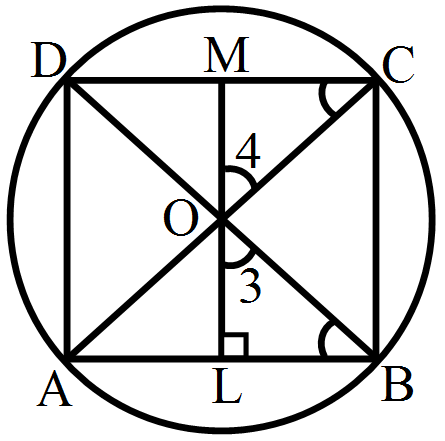
Given: Let $ABCD$ be a cyclic quadrilateral whose diagonals $AC$ and $BD$ intersect at $O$ at right angles.
Let $\text{OL}\perp\text{AB}$ such that $LO$ produced meets $CD$ at $M$.
 
To prove: $CM = MD$
Proof: $\angle\text{1}=\angle\text{2}$ [angles in the same segment]
​​​​​​​$\angle\text{2}+\angle\text{3}=90^\circ$
$[\angle\text{OLB}=90^\circ]$
$\angle\text{3}+\angle\text{4}=90^\circ$
$[\because$ $LOM$ is a straight line and $\angle\text{BOC}=90^\circ]$
$\therefore\ \angle\text{2}+\angle\text{3}=\angle\text{3}+\angle\text{4}$
$\Rightarrow\ \angle\text{2}=\angle\text{4}$ Thus, $ \angle\text{1}=\angle\text{2}$ And $ \angle\text{2}=\angle\text{4}$
$\Rightarrow\ \angle\text{1}=\angle\text{4}$
$\therefore\ \text{OM}=\text{CM}$ Similarly $\text{OM}=\text{MD}$
Hence, $\text{CM}=\text{MD}$
View full question & answer
Question 215 Marks
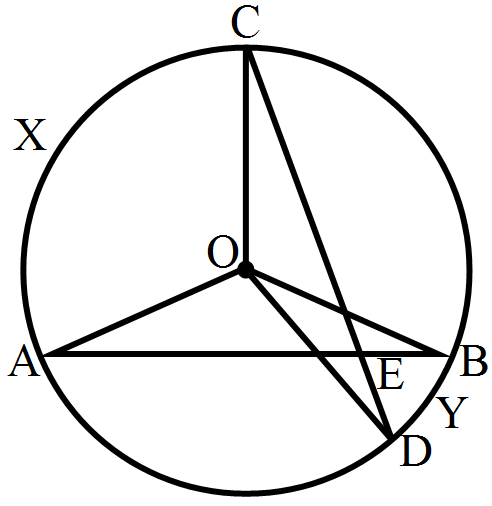
In the given figure, $AB$ and $CD$ are two chords of a circle, intersecting each other at a point $E$. Prove that $\angle\text{AEC}=\frac{1}{2}$(angle subtended by arc $CXA$ at the centre + angle subtended by arc $DYB$ at the centre).
Answer

We know that the angle subtended by an arc of a circle at the centre is double the angle subtended by it on the remaining part of the circle.
Here, arc $AXC$ subtends $\angle\text{AOC}$ at the centre and $\angle\text{ADC}$ at $D$ on the circle.
$\therefore\ \angle\text{AOC}=2\angle\text{ADC}$
$\Rightarrow\ \angle\text{ADC}=\frac{1}{2}(\angle\text{AOC})\dots(\text{i})$
Also, arc $DYB$ subtends $\angle\text{DOB}$ at the centre and $\angle\text{DAB}$ at $A$ on the circle.
$\therefore\ \angle\text{DOB}=2\angle\text{DAB}$
$\Rightarrow\ \angle\text{DAB}=\frac{1}{2}(\angle\text{DOB})\dots(\text{ii})$
Now, in $\angle\text{ADE},$
$\angle\text{AEC}=\angle\text{ADC}+\angle\text{DAB}$ [Exterior angle]
$\Rightarrow\ \angle\text{AEC}=\frac{1}{2}(\angle\text{AOC}+\angle\text{DOB})$ [From $(i)$ and $(ii)$]
Hence, $\angle\text{AEC}=\frac{1}{2}$(angle subtended by arc $CXA$ at the centre + angle subtended by arc $DYB$ at the centre).
View full question & answer
Question 225 Marks
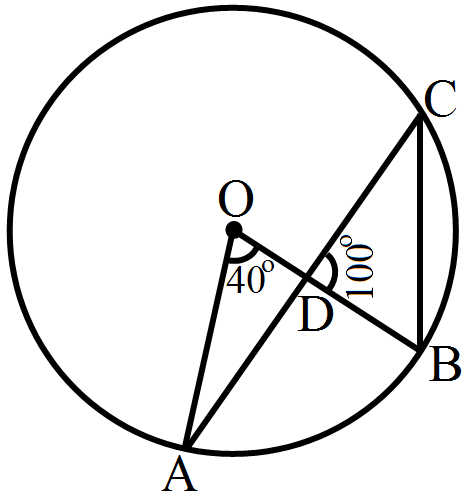
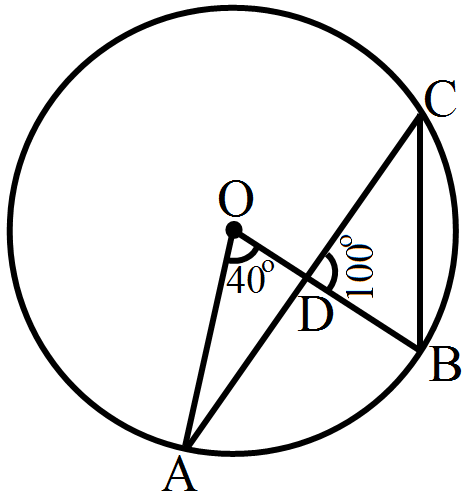
In the given figure, $O$ is the centre of a circle, $\angle\text{AOB}=40^\circ$ and $\angle\text{BDC}=100^\circ,$ find $\angle\text{OBC}.$
Answer

We know that the angle subtended by an arc of a circle at the centre is double the angle subtended by the arc at any point on the circumference.
$\angle\text{AOB}=2\angle\text{ACB}$
$=2\angle\text{DCB}$ $[\because\ ​\angle\text{ACB}=\angle\text{DCB}]$
$\therefore\ \angle\text{DCB}=\frac{1}{2}\angle\text{AOB}$
$\Rightarrow\ \angle\text{DCB}=\Big(\frac{1}{2}\times40^\circ\Big)=20^\circ$
Considering $\triangle\text{DBC},$ we have:
$\angle\text{BDC}+\angle\text{DCB}+\angle\text{DBC}=180^\circ$
$\Rightarrow\ 100^\circ+20^\circ+\angle\text{DBC}=180^\circ$
$\Rightarrow\ \angle\text{DBC}=(180^\circ-120^\circ)=60^\circ$
$\Rightarrow\ \angle\text{OBC}=\angle\text{DBC}=60^\circ$
Hence, $\angle\text{OBC}=60^\circ$
View full question & answer
Question 235 Marks
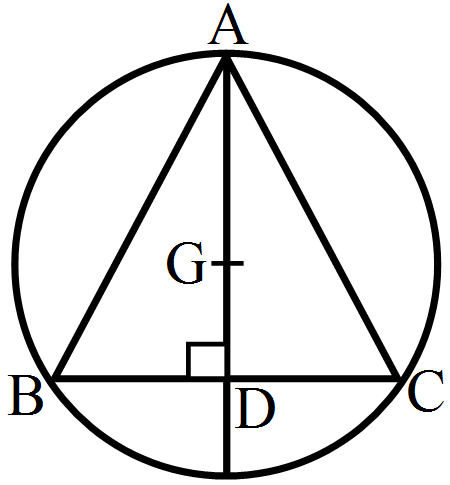
An equilateral triangle of side $9\ cm$ is inscribed in a circle. Find the radius of the circle.
Answer
Let $\triangle\text{ABC}$ be an equilateral triangle of side $9\ cm$. Let $AD$ be one of its median.

Then, $\text{AD}\perp\text{BC}$
$[\triangle\text{ABC}$ is an equilateral triangle$]$
Also, $\text{BD}=\Big(\frac{\text{BC}}{2}\Big)=\Big(\frac{9}{2}\Big)=4.5\text{cm}$ In right angled $\triangle\text{ADB},$
​​​​​​​we have: $\text{AB}^2=\text{AD}^2+\text{BD}^2$
$\Rightarrow\ \text{AD}^2=\text{AB}^2-\text{BD}^2$
$\Rightarrow\ \text{AD}=\sqrt{\text{AB}^2-\text{BD}^2}$
$=\sqrt{(9)^2-\Big(\frac{9}{2}\Big)^2}\text{cm}$
$=\frac{9\sqrt{3}}{2}\text{cm}$ In the equilateral triangle, the centroid and circumcentre coincide and $AG : GD = 2 : 1.$
Now, radius $=\text{AG}=\frac{2}{3}\text{AD}$
$\Rightarrow\ \text{AG}=\Big(\frac{2}{3}\times\frac{9\sqrt{3}}{2}\Big)=3\sqrt{3}\text{cm}$
$\therefore$ The radius of the circle is $3\sqrt{3}\text{cm}.$
View full question & answer
Question 245 Marks
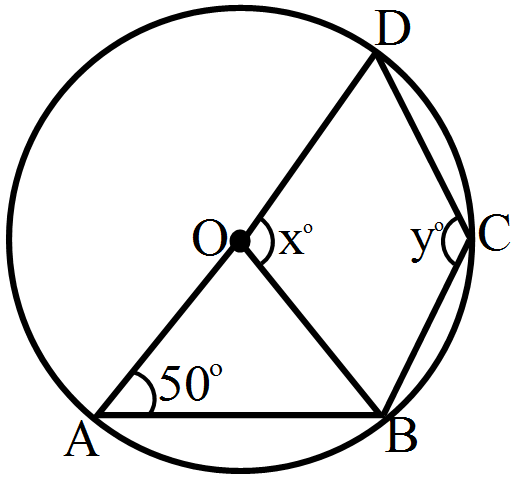
In the given figure, $O$ is the centre of the circle and $\angle\text{DAB}=50^\circ.$Calculate the values of $x$ and $y$.
Answer

$O$ is the centre of the circle and $\angle\text{DAB}=50^\circ.$
$OA = OB$ [Radii of a circle]
$\Rightarrow\ \angle\text{OBA}=\angle\text{OAB}=50^\circ$ In $\triangle\text{OAB},$
we have: $\angle\text{OAB}+\angle\text{OBA}+\angle\text{AOB}=180^\circ$
$\Rightarrow\ 50^\circ+50^\circ+\angle\text{AOB}=180^\circ$
$\Rightarrow\ \angle\text{AOB}=(180^\circ-100^\circ)=80^\circ$ Since $AOD$ is a straight line,
we have: $\therefore\ \text{x}=180^\circ-\angle\text{AOB}$
$=(180^\circ-80^\circ)=100^\circ$
$\text{i.e},\text{x}=100^\circ$ The opposite angles of a cyclic quadrilateral are supplementary.
$ABCD$ is a cyclic quadrilateral.
Thus, $\angle\text{DAB}+\angle\text{BCD}=180^\circ$
$\angle\text{BCD}=(180^\circ-50^\circ)=130^\circ$
$\therefore\ \text{y}=130^\circ$ Hence, $\text{x}=100^\circ$ and $\text{y}=130^\circ$
View full question & answer
Question 255 Marks
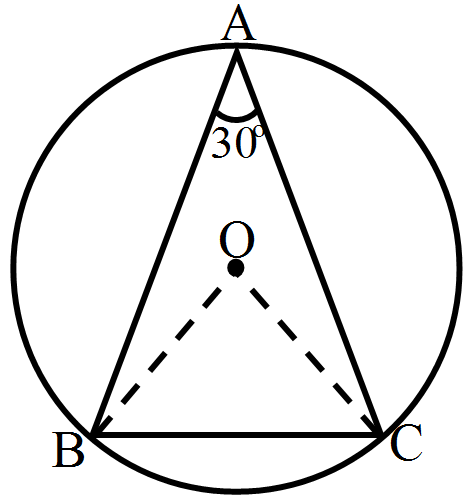
In the given figure, $\angle\text{BAC}=30^\circ.$ Show that $BC$ is equal to the radius of the circumcircle of $\triangle\text{ABC}$ whose centre is $O$.
Answer
Join $OB$ and $OC$. $\angle\text{BOC}=2\angle\text{BAC}$
[As angle subtended by an arc of a circle at the centre is double the angle subtended by the arc at any point on the circumference]
$=2\times30^\circ$
$[\because\ \angle\text{BAC}=30^\circ]$
$=60^\circ\dots(\text{i})$ Consider $\triangle\text{BOC},$
we have: $OB = OC$ [Radii of a circle]
$\Rightarrow\ \angle\text{OBC}=\angle\text{OCB}\dots(\text{ii})$ In $\triangle\text{BOC},$ we have: $\angle\text{BOC}+\angle\text{OBC}+\angle\text{OCB}=180^\circ$ [Angle sum property of a triangle]
$\Rightarrow\ 60^\circ+\angle\text{OCB}+\angle\text{OCB}=180^\circ$ [From $(i)$ and $(ii)$]
 $\Rightarrow\ 2\angle\text{OCB}=(180^\circ-60^\circ)=120^\circ$
$\Rightarrow\ \angle\text{OCB}=60^\circ\dots(\text{ii})$
Thus we have: $\angle\text{OBC}=\angle\text{OCB}=\angle\text{BOC}=60^\circ$
Hence, $\triangle\text{BOC}$ is an equilateral triangle. i.e., $OB = OC = BC$
$\therefore$ BC is the radius of the circumcircle.
View full question & answer
Question 265 Marks
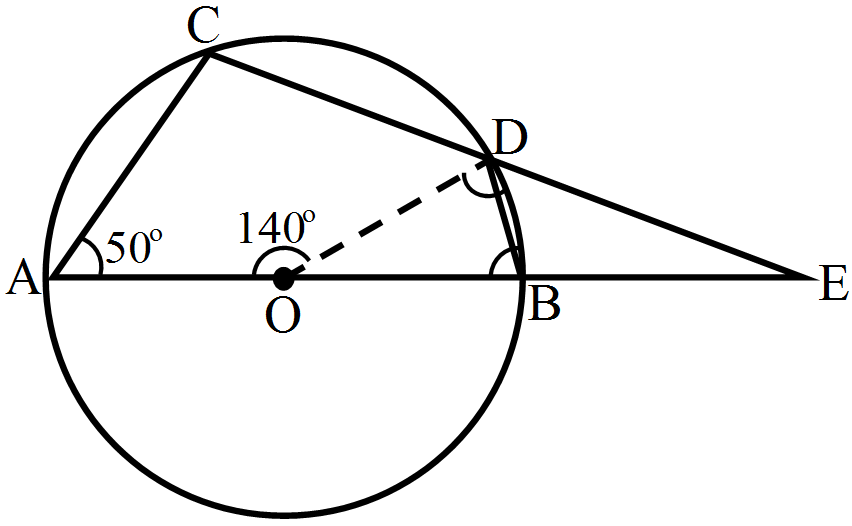
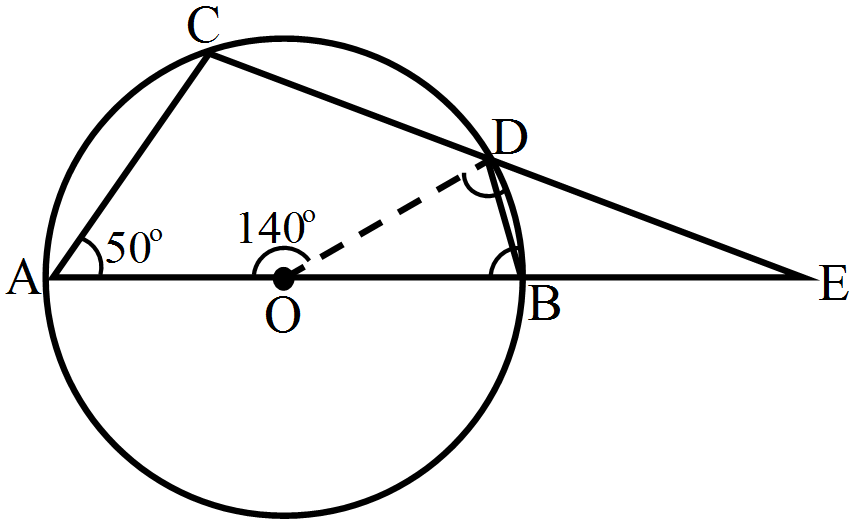
In the given figure, $O$ is the centre of a circle. If $\angle\text{AOC}=140^\circ$ and $\angle\text{CAB}=50^\circ,$ calculate
$i. \angle\text{EDB}$
$ii. \angle\text{EBD}$
Answer

 $O$ is the centre of the circle where $\angle\text{AOC}=140^\circ$ and $\angle\text{CAB}=50^\circ.$
$i. \angle\text{BOD}=180^\circ-\angle\text{AOD}$
$=(180^\circ-140^\circ)=40^\circ$
We have the following:
$OB = OD [$Radii of a circle$]$
$\angle\text{OBD}=\angle\text{ODB}$
In $\triangle\text{OBD},$ we have:
$\angle\text{BOD}+\angle\text{OBD}+\angle\text{ODB}=180^\circ$
$\Rightarrow\ \angle\text{BOD}+\angle\text{OBD}+\angle\text{OBD}=180^\circ$
$[\because\ \angle\text{OBD}=\angle\text{ODB}]$
$\Rightarrow\ 40^\circ+2\angle\text{OBD}=180^\circ$
$\Rightarrow\ 2\angle\text{OBD}=(180^\circ-40^\circ)=140^\circ$
$\Rightarrow\ \angle\text{OBD}=70^\circ$
Since $\text{ABCD}$ is a cyclic quadrilateral, we have:
$\angle\text{CAB}+\angle\text{BDC}=180^\circ$
$\Rightarrow\ \angle\text{CAB}+\angle\text{ODB}+\angle\text{ODC}=180^\circ$
$\Rightarrow\ 50^\circ+70^\circ+\angle\text{ODC}=180^\circ$
$\Rightarrow\ \angle\text{ODC}=(180^\circ- 120^\circ)= 60^\circ$
$\therefore\ \angle\text{ODC}= 60^\circ$
$\angle\text{EDB}=180^\circ-(\angle\text{ODC}+\angle\text{ODB})$
$=180^\circ-(60^\circ+70^\circ)$
$=180^\circ-130^\circ=50^\circ$
$\therefore\ \angle\text{EDB}= 50^\circ$
$ii. \angle\text{EDB}=180^\circ-\angle\text{OBD}$
$=180^\circ-70^\circ$
$=\angle\text{110}^\circ$
View full question & answer
Question 275 Marks
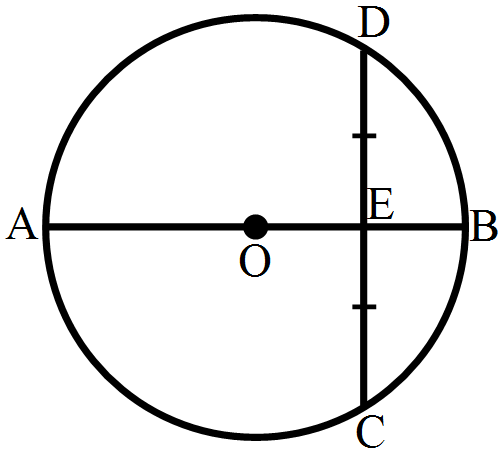
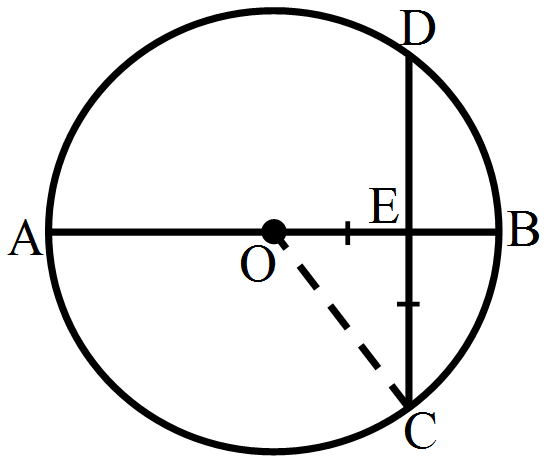
In the given figure, a circle with centre $O$ is given in which a diameter $A B$ bisects the chord $C D$ at a point $E$ such that $C E=E D=8 cm$ and $E B=4 cm$. Find the radius of the circle.
Answer
$AB$ is the diameter of the circle with centre $O$, which bisects the chord $CD$ at point $E$.
Given: $CE = ED = 8\ cm$ and $EB = 4cm$ Join $OC.$

 Let $OC = OB =$ $r\ cm$ [Radii of a circle]
Then $OE$ $= (r - 4)\ cm$ Now, in right angled $\triangle\text{OEC},$
we have: $OC^2 = OE^2 + EC^2$[Pythagoras theorem]
$\Rightarrow r^2 = (r - 4)^2 + 8^2$
$\Rightarrow r^2 = r^2 - 8r + 16 + 64$
$\Rightarrow r^2 = r^2 + 8r = 80$
$\Rightarrow 8r = 80$
$\Rightarrow\ \text{r}=\Big(\frac{80}{8}\Big)\text{cm}=10\text{cm}$
$\Rightarrow r = 10\ cm$
Hence, the required radius of the circle is $10\ cm$.
View full question & answer
Question 285 Marks
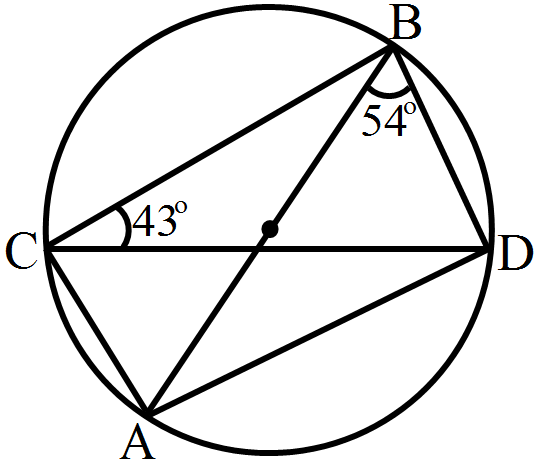
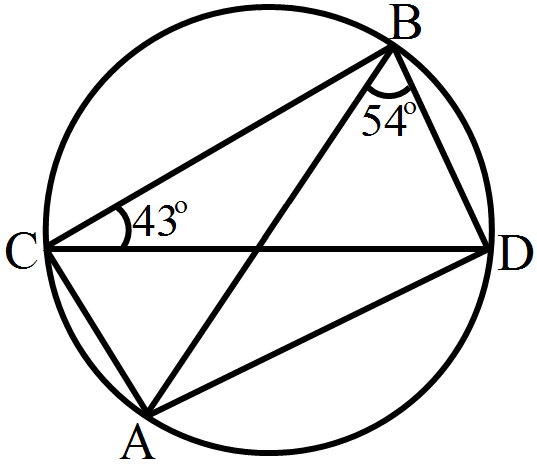
In the given figure, $\angle\text{ABD}=54^\circ$ and $\angle\text{BCD}=43^\circ,$ calculate
$i. \angle\text{ACD}$
$ii. \angle\text{BAD}$
$iii. \angle\text{BDA}$
Answer

$i.$ We know that the angles in the same segment of a circle are equal.
$\text{i.e.},\angle\text{ABD}=\angle\text{ACD}=54^\circ$
$ii.$ We know that the angles in the same segment of a circle are equal.
$\text{i.e.},\angle\text{BAD}=\angle\text{BCD}=43^\circ$
$iii.$ In $\triangle\text{ABD},$ we have:
$\angle\text{BAD}+\angle\text{ADB}+\angle\text{DBA}=180^\circ [$Angle sum property of a triangle$]$
$\Rightarrow\ 43^\circ+\angle\text{ADB}+54^\circ=180^\circ$
$\Rightarrow\ \angle\text{ADB}=(180^\circ-97^\circ)=83^\circ$
$\Rightarrow\ \angle\text{BDA}=83^\circ$
View full question & answer
Question 295 Marks
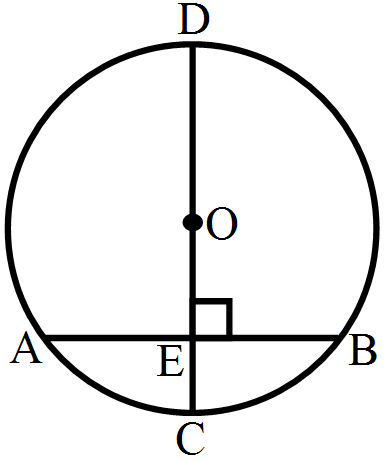
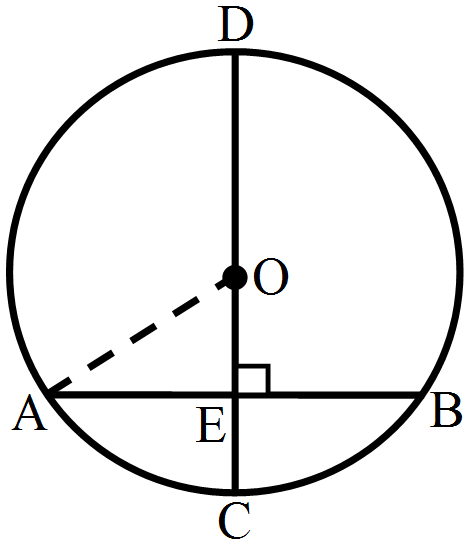
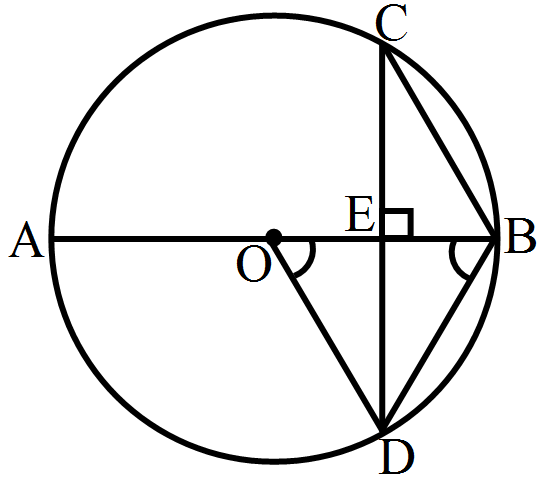
In the given figure, the diameter $C D$ of a circle with centre $O$ is perpendicular to chord $A B$. If $A B=12 cm$ and $C E=3 cm$, calculate the radius of the circle.
Answer
$C D$ is the diameter of the circle with centre $O$ and is perpendicular to chord $A B$. Join $O A$.

Given: $AB = 12cm$ and $CE = 3cm$ Let $OA = OC = rcm$ [Radii of a circle]
Then $OE = (r - 3)cm$
Since the perpendicular from the centre of the circle to a chord bisects the chord,
we have: $\text{AE}=\Big(\frac{\text{AB}}{2}\Big)=\Big(\frac{12}{2}\Big)\text{cm}=6\text{cm}$
Now, in right angled $\triangle\text{OEA},$
we have: $\Rightarrow OA^2 = OE^2 + AE^2$
$\Rightarrow r^2 = (r - 3)^2 + 6^2$
$\Rightarrow r^2 = r^2 - 6r + 9 + 36$
$\Rightarrow r^2 - r^2 + 6r = 45$
$\Rightarrow 6r = 45$
$\Rightarrow\ \text{r}=\Big(\frac{45}{6}\Big)\text{cm}=7.5\text{cm}$
$\Rightarrow r = 7.5cm$
Hence, the required radius of the circle is $7.5 cm.$
View full question & answer
Question 305 Marks
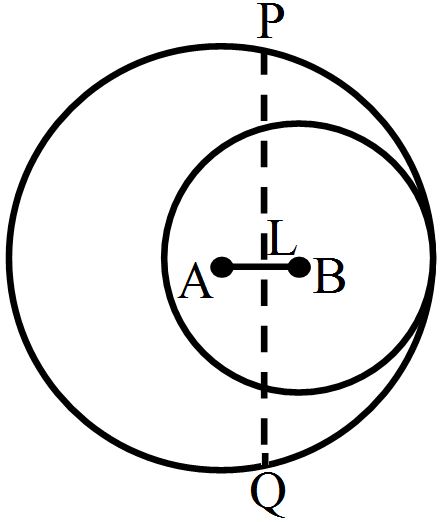
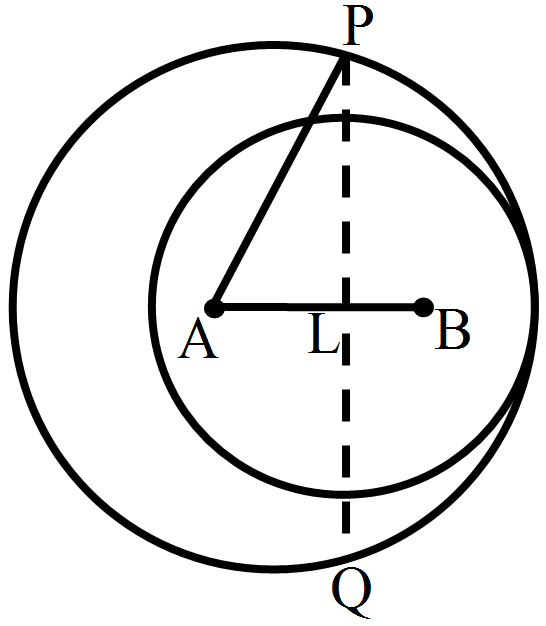
In the adjoining figure, two circles with centres at $A$ and $B$ , and of radii $5\  cm$ and $3\ cm$ touch each other internally. If the perpendicular bisector of $A B$ meets the bigger circle in $P$ and $Q$, find the length of $P Q$.
Answer
Two circles with centres $A$ and $B$ of respective radii $5\ cm$ and $3\ cm$ touch each other internally. The perpendicular bisector of $AB$ meets the bigger circle at $P$ and $Q$. Join $AP.$

Let $PQ$ intersect $AB$ at point $L$. Here, $AP = 5\ cm$
Then $AB = (5 - 3)cm = 2\ cm$ Since $PQ$ is the perpendicular bisector of $AB$,
we have: $\text{AL}=\Big(\frac{\text{AB}}{2}\Big)=\Big(\frac{2}{2}\Big)=1\text{cm}$
Now, in right angled $\triangle\text{PLA},$
we have: $AP^2 = AL^2 + PL^2$
$\Rightarrow PL^2 = AP^2 - AL^2 = 5^2 - 1^2 = 25 - 1 = 24$
$\Rightarrow\ \text{PL}=\sqrt{24}=2\sqrt{6}\text{cm}$
Thus $PQ = 2 \times PL$
$=\big(2\times2\sqrt{6}\big)=4\sqrt{6}\text{cm}$
Hence, the required length of $PQ$ is $4\sqrt{6}\text{cm}.$
View full question & answer
Question 315 Marks
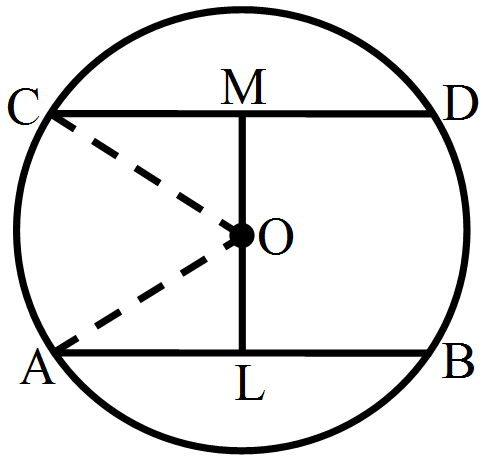
Two parallel chords of lengths $30\ cm$ and 16cm are drawn on the opposite sides of the centre of a circle of radius $17\ cm$. Find the distance between the chords.
Answer
Let $AB$ and $CD$ be two chords of a circle such that $AB$ is parallel to $CD$ and they are on the opposite sides of the centre.
Given: $AB = 30\ cm$ and $CD = 16\ cm$
Draw $\text{OL}\perp\text{AB}$ and $\text{OM}\perp\text{CD}.$

Join $OA$ and $OC. OA = OC = 17\ cm$ [Radii of a circle]
The perpendicular from the centre of a circle to a chord bisects the chord.
$\therefore\ \text{AL}=\Big(\frac{\text{AB}}{2}\Big)=\Big(\frac{30}{2}\Big)=15\text{cm}$
Now, in right angled $\triangle\text{OLA},$
we have: $OA^2 = AL^2 + LO^2$
$\Rightarrow LO^2= OA^2 - AL^2$
$\Rightarrow LO^2 = 17^2 - 15^2$
$\Rightarrow LO^2 = 289 - 225 = 64$
$\therefore$ $LO = 8\ cm$ Similarly,
$\therefore\ \text{CM}=\Big(\frac{\text{CD}}{2}\Big)=\Big(\frac{16}{2}\Big)=8\text{cm}$
In right angled $\triangle\text{CMO},$
we have: $\Rightarrow OC^2 = CM^2 + MO^2$
$\Rightarrow MO^2 = OC^2 - CM^{2}$
$ \Rightarrow MO^2 = 17^2 - 8^2$
$\Rightarrow MO^2 = 289 - 64 = 225$
$\therefore$
$MO = 15cm$
Hence, distance between the chords $= (LO + MO) = (8 + 15)cm = 23cm$
View full question & answer
Question 325 Marks
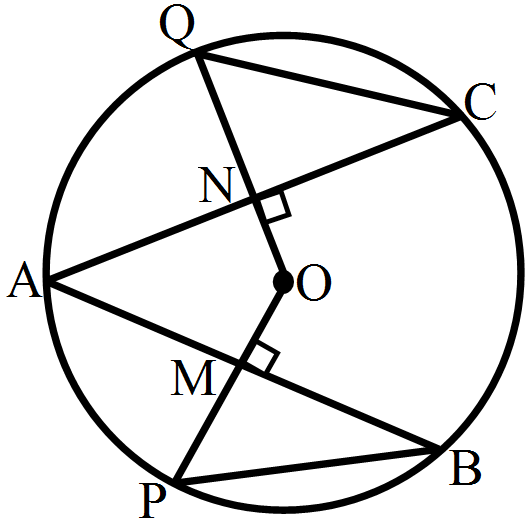
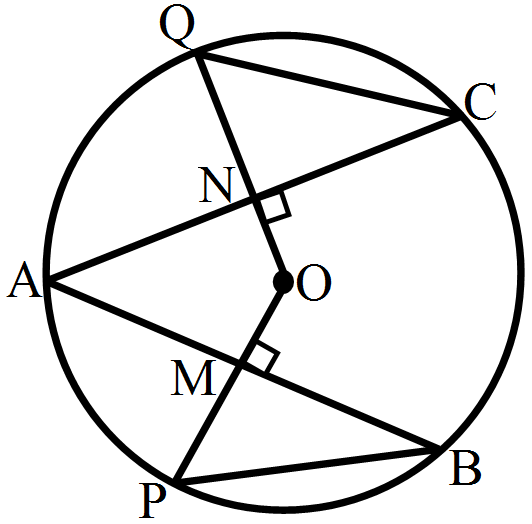
In the adjoining figure, $O$ is the centre of a circle. If $AB$ and $AC$ are chords of the circle such that $AB = AC$, $\text{OP}\perp\text{AB}$ and $\text{OQ}\perp\text{AC},$ prove that $PB = QC$.
Answer
Given: $AB$ and $AC$ are chords of the circle with centre $O$. $AB = AC$, $\text{OP}\perp\text{AB}$ and $\text{OQ}\perp\text{AC}.$
 To prove: $PB = QC$
 Proof: $AB = AC$ (Given)
$\Rightarrow\ \frac{1}{2}\text{AB}=\frac{1}{2}\text{AC}$
The perpendicular from the centre of a circle to a chord bisects the chord.
$\therefore$ $MB = NC ...(1)$
Also, $OM = ON$ (Equal chords of a circle are equidistant from the centre) and $OP = OQ$ (Radii)
$\Rightarrow OP - OM = OQ - ON$
 $\therefore$ $PM = QN ...(2)$
Now, in $\triangle\text{MPB}$ and $\triangle\text{NQC},$
we have: $MB = NC$ [From $(i)$]
$\angle\text{PMB}=\angle\text{QNC}$ [$90^\circ$ each]
$PM = QN$ [From $(ii)$]
i.e., $\triangle\text{MPB}\cong\triangle\text{NQC}$ ($SAS$ criterion)
$\therefore$ $PB = QC (C.P.C.T)$
View full question & answer
Question 335 Marks
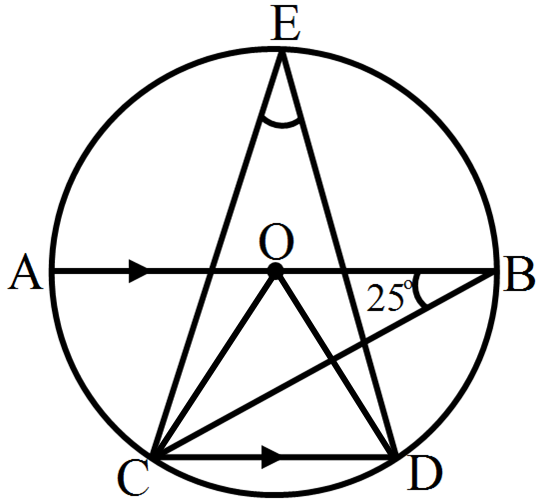
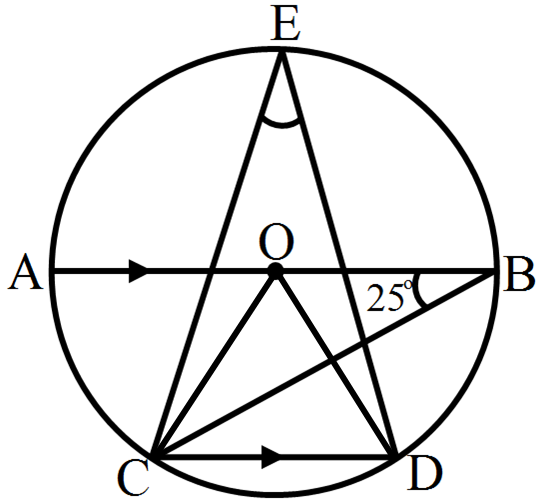
In the adjoining figure, $O$ is the centre of a circle. Chord $CD$ is parallel to diameter $AB$. If $\angle\text{ABC}=25^\circ,$ calculate $\angle\text{CED}.$
Answer

$\angle\text{BCD}=\angle\text{ABC}=25^\circ$ [Alternate angles] Join $CO$ and $DO$.
We know that the angle subtended by an arc of a circle at the centre is double the angle subtended by an arc at any point on the circumference.
Thus, $\angle\text{BOD}=2\angle\text{BCD}$
$\Rightarrow\ \angle\text{BOD}=2\times25^\circ=50^\circ$ Similarly, $\angle\text{AOC}=2\angle\text{ABC}$
$\Rightarrow\ \angle\text{AOC}=2\times25^\circ=50^\circ$ $AB$ is a straight line passing through the centre. $\text{i.e.},\angle\text{AOC}+\angle\text{COD}+\angle\text{BOD}=180^\circ$
$\Rightarrow\ 50^\circ+\angle\text{COD}+50^\circ=180^\circ$
$\Rightarrow\ \angle\text{COD}=(180^\circ-100^\circ)=80^\circ$
$\Rightarrow\ \angle\text{CED}=\frac{1}{2}\angle\text{COD}$
$\Rightarrow\ \angle\text{CED}=\Big(\frac{1}{2}\times80^\circ\Big)=40^\circ$
$\therefore\ \angle\text{CED}=40^\circ$
View full question & answer
Question 345 Marks
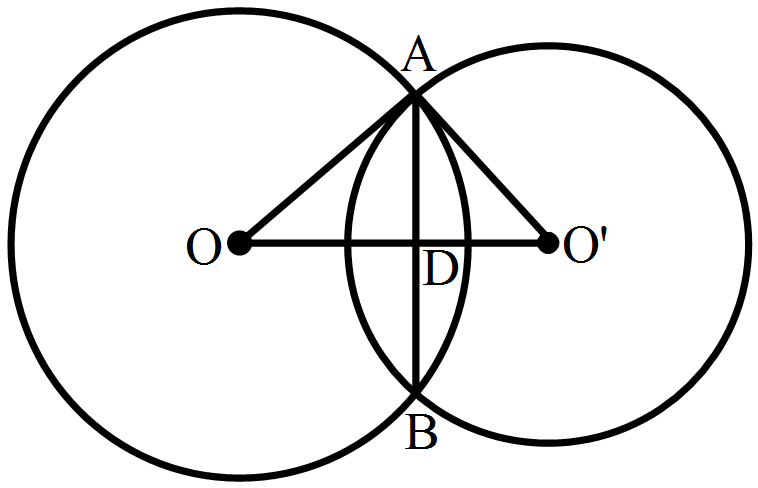
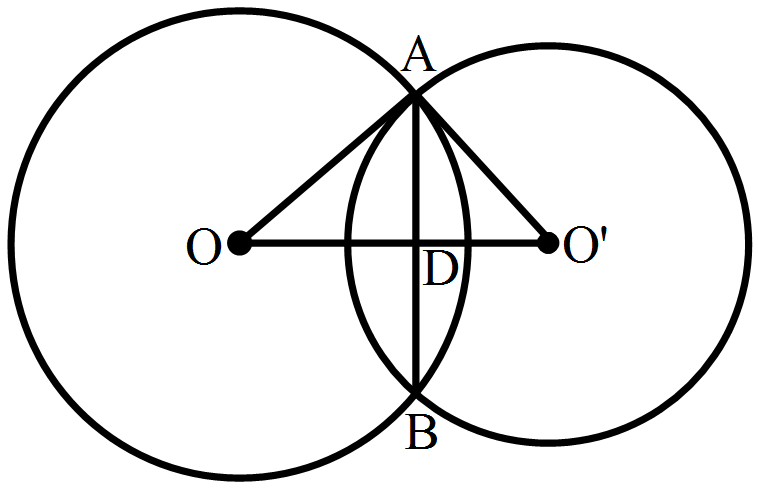
Two circles of radii $10\ cm$ and $8\ cm$ intersect each other, and the length of the common chord is $12\ cm$. Find the distance between their centres.
Answer

Given: $OA = 10cm$, $O'A = 8cm$ and $AB = 12\ cm$
$\text{AD}=\Big(\frac{\text{AB}}{2}\Big)=\Big(\frac{12}{2}\Big)=6\text{cm}$
Now, in right angled $\triangle\text{ADO},$
we have: $OA^2 = AD^2 + OD^2$
$\Rightarrow OD^2 = OA^2 - AD^2 = 10^2 - 6^2 = 100 - 36 = 64$
$\therefore$ OD = 8cm Similarly, in right angled $\triangle\text{ADO}',$
we have: $O'A^2 = AD^2 + O'D^2$
$\Rightarrow O'D^2= O'A^2 - AD^2$
$ = 8^2 - 6^2 = 64 - 36 = 28$
$\Rightarrow\ \text{O}'\text{D}=\sqrt{28}=2\sqrt{7}\text{cm}$
Thus, $OO' = (OD + O'D)$ $=\big(8+2\sqrt{7}\big)\text{cm}$
Hence, the distance between their centres is $\big(8+2\sqrt{7}\big)\text{cm}.$
View full question & answer
Question 355 Marks
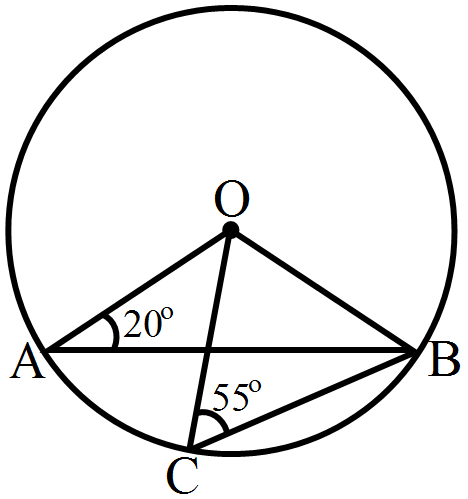
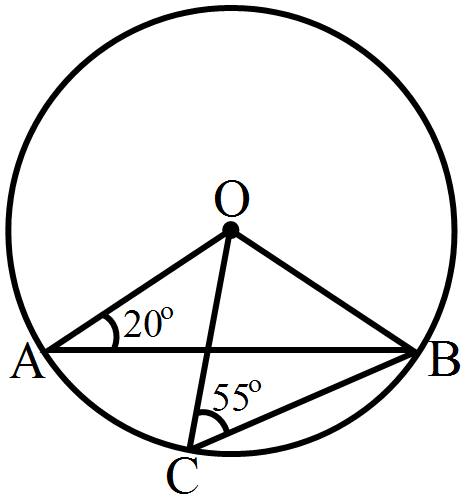
In the given figure, $O$ is the centre of a circle in which $\angle\text{OAB}=20^\circ$and $\angle\text{OCB}=55^\circ.$ Find
$i. \angle\text{BOC}$
$ii. \angle\text{AOC}$
Answer

$i. OB = OC [$Radii of a circle$]$
$\Rightarrow\ \angle\text{OBC}=\angle\text{OCB}=55^\circ$
Considering $\triangle\text{BOC},$ we have:
$\angle\text{BOC}+\angle\text{OCB}+\angle\text{OBC}=180^\circ [$Angle sum property of a triangle$]$
$\Rightarrow\ \angle\text{BOC}+55^\circ+55^\circ=180^\circ$
$\Rightarrow\ \angle\text{BOC}=(180^\circ-110^\circ)=70^\circ$
$ii. OA = OB [$Radii of a circle$]$
$\Rightarrow\ \angle\text{OBA}=\angle\text{OAB}=20^\circ$
Considering $\triangle\text{AOB},$ we have:
$\angle\text{AOB}+\angle\text{OAB}+\angle\text{OBA}=180^\circ [$Angle sum property of a triangle$]$
$\Rightarrow\ \angle\text{AOB}+20^\circ+20^\circ=180^\circ$
$\Rightarrow\ \angle\text{AOB}=(180^\circ-40^\circ)=140^\circ$
$\therefore\ \angle\text{AOC}=\angle\text{AOB}-\angle\text{BOC}$
$=(140^\circ-70^\circ)$
$=70^\circ$
Hence, $\angle\text{AOC}=70^\circ$
View full question & answer
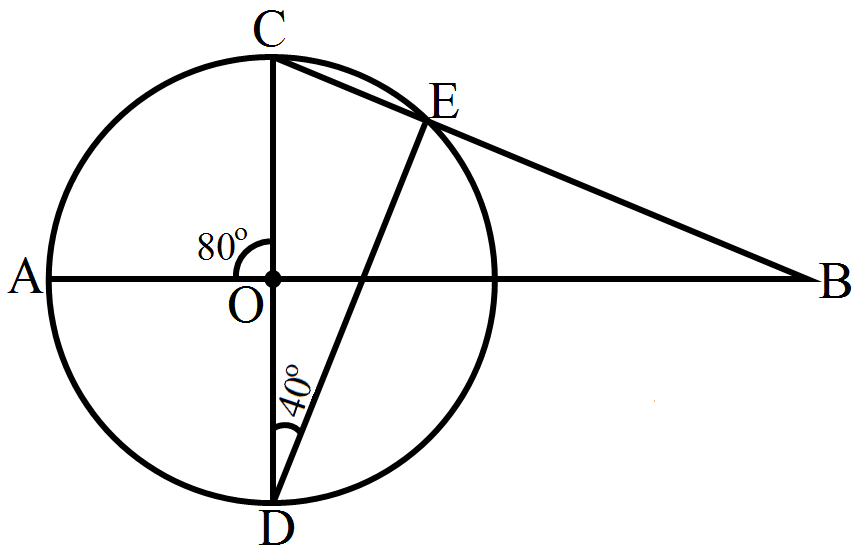
Question 365 Marks
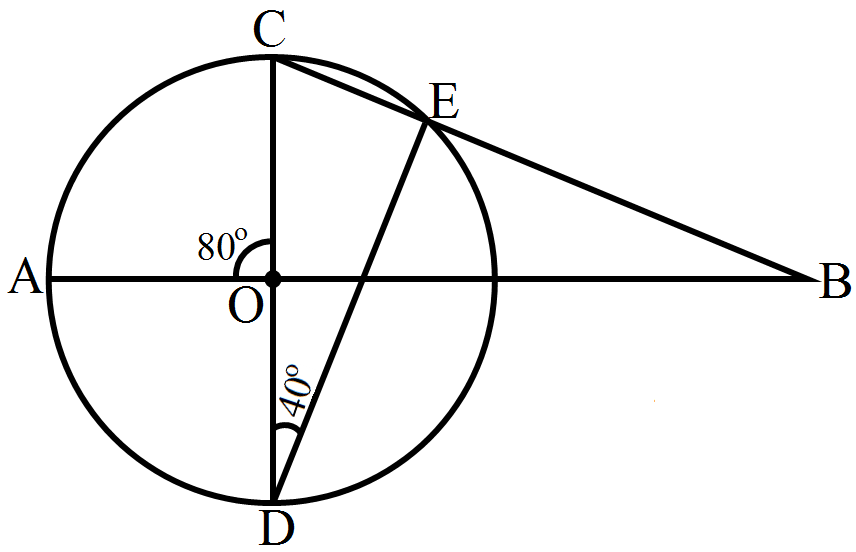
In the given figure, $AB$ and $CD$ are straight lines through the centre $O$ of a circle. If $\angle\text{AOC}=80^\circ$ and $\angle\text{CDE}=40^\circ,$ find
$i. \angle\text{DCE}$
$ii. \angle\text{ABC}$
Answer

$i. \angle\text{CED}=90^\circ [$Angle in a semi circle$]$
In $\triangle\text{CED},$ we have:
$\angle\text{CED}+\angle\text{EDC}+\angle\text{DCE}=180^\circ [$Angle sum property of a triangle$]$
$\Rightarrow\ 90^\circ+40^\circ+\angle\text{DCE}=180^\circ$
$\Rightarrow\ \angle\text{DCE}=(180^\circ-130^\circ)=50^\circ\dots(\text{i})$
$\therefore\ \angle\text{DCE}=50^\circ$
$ii.$ As $\angle\text{AOC}$ and $\angle\text{BOC}$ are linear pair, we have:
$\angle\text{BOC}=(180^\circ-80^\circ)=100^\circ\dots(\text{ii})$
In $\triangle\text{BOC},$ we have:
$\angle\text{ABC}+\angle\text{DCB}+\angle\text{BOC}=180^\circ$ $[\because\ \angle\text{OBC}=\angle\text{ABC}$ and $\angle\text{OCB}=\angle\text{DCE}]$
$\Rightarrow\ \angle\text{ABC}=180^\circ-(\angle\text{BOC}+\angle\text{DCE})$
$\Rightarrow\ \angle\text{ABC}=180^\circ-(100^\circ+50^\circ) [$From $(i)$ and $(ii)]$
$\Rightarrow\ \angle\text{ABC}=(180^\circ-150^\circ)=30^\circ$
View full question & answer
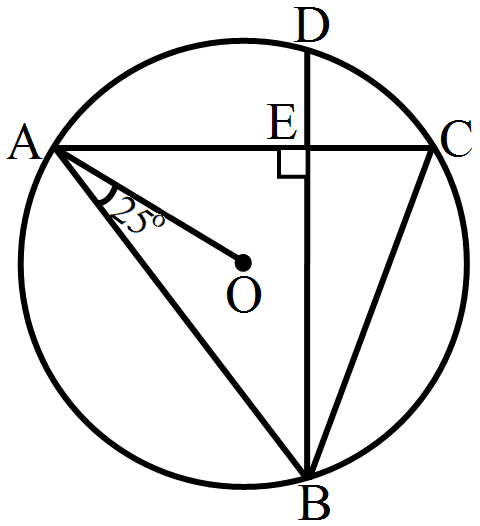
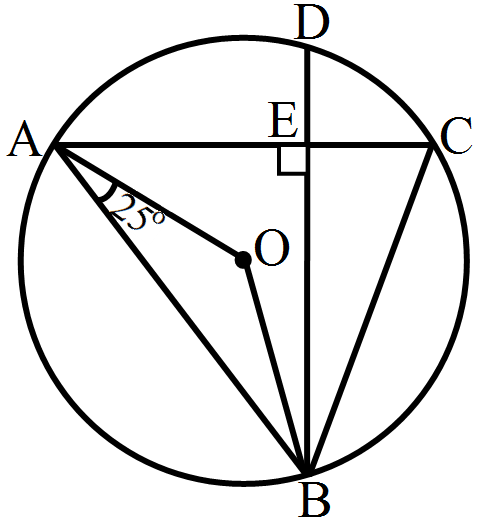
Question 375 Marks
In the adjoining figure, chords $AC$ and $BD$ of a circle with centre $O$, intersect at right angles at $E$. If $\angle\text{OAB}=25^\circ,$ calculate $\angle\text{EBC}.$
Answer
$OA = OB$ [Radii of a circle] Thus, $\angle\text{OBA}=\angle\text{OAB}=25^\circ$ Join OB.

Now in $\triangle\text{OAB},$
we have: $\angle\text{OAB}+\angle\text{OBA}+\angle\text{AOB}=180^\circ$ [Angle sum property of a triangle]
$\Rightarrow\ 25^\circ+25^\circ+\angle\text{AOB}=180^\circ$
$\Rightarrow\ 50^\circ+\angle\text{AOB}=180^\circ$
$\Rightarrow\ \angle\text{AOB}=(180^\circ-50^\circ)=130^\circ$
We know that the angle subtended by an arc of a circle at the centre is double the angle subtended by the arc at any point on the circumference. $\text{i.e},\angle\text{AOB}=2\angle\text{ACB}$
$\Rightarrow\ \angle\text{ACB}=\frac{1}{2}\angle\text{AOB}=\Big(\frac{1}{2}\times130^\circ\Big)=65^\circ $
Here, $\angle\text{ACB}=2\angle\text{ECB}$
$\therefore\ \angle\text{ECB}=65^\circ\dots(\text{i})$
Considering the right angled $\triangle\text{BEC},$
we have: $\angle\text{EBC}+\angle\text{BEC}+\angle\text{ECB}=180^\circ$ [Angle sum property of a triangle]
$\Rightarrow\ \angle\text{EBC}+90^\circ+65^\circ=180^\circ$ [From $(i)$]
$\Rightarrow\ \angle\text{EBC}=(180^\circ-155^\circ)=25^\circ$
​​​​​​​Hence, $ \angle\text{EBC}=25^\circ$
View full question & answer
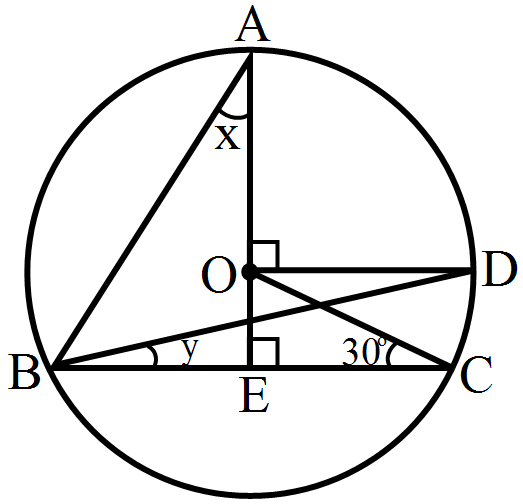
Question 385 Marks
In the given figure, $O$ is the centre of the circle and $\angle\text{BCO}=30^\circ.$ Find $x$ and $y$.
Answer
In the given figure, $OD$ is parallel to $BC$.
$\therefore\ \angle\text{BCO}=\angle\text{COD}$ [Alternate interior angles]
$\Rightarrow \angle\text{COD}=30^\circ\dots(\text{i})$
We know that the angle subtended by an arc of a circle at the centre is double the angle subtended by it on the remaining part of the circle.
Here, arc $CD$ subtends $\angle\text{COD}$ at the centre and $\angle\text{CBD}$ at $B$ on the circle.
$\therefore\ \angle\text{COD}=2\angle\text{CBD}$
$\Rightarrow \angle\text{CBD}=\frac{30^\circ}{2}=15^\circ$ [From $(i)$]
$\therefore\ \text{y}=15^\circ\dots(\text{ii})$ Also, arc $AD$ subtends $\angle\text{AOD}$ at the centre and $\angle\text{ABD}$ at $B$ on the circle. $\therefore\ \angle\text{AOD}=2\angle\text{ABD}$
$\Rightarrow \angle\text{ABD}=\frac{90^\circ}{2}=45^\circ$ In $\triangle\text{ABE},$
$\text{x}+\text{y}+\angle\text{ABD}+\angle\text{AEB}=180^\circ$ [Sum of the angles of a triangle]
$\Rightarrow\ \text{x}+15^\circ+45^\circ+90^\circ=180^\circ$ [From $(ii)$ and $(iii)$]
$\Rightarrow\ \text{x}=180^\circ-(15^\circ+45^\circ+90^\circ)$
$\Rightarrow\ \text{x}=180^\circ-150^\circ$
$\Rightarrow\ \text{x}=30^\circ$ Hence, $\text{x}=30^\circ$ and $\text{y}=15^\circ.$
View full question & answer
Question 395 Marks
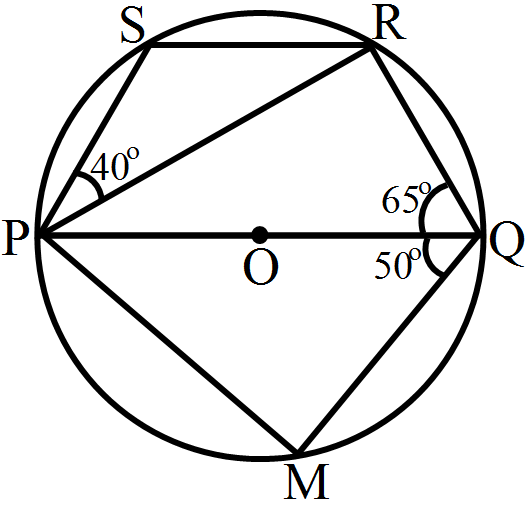
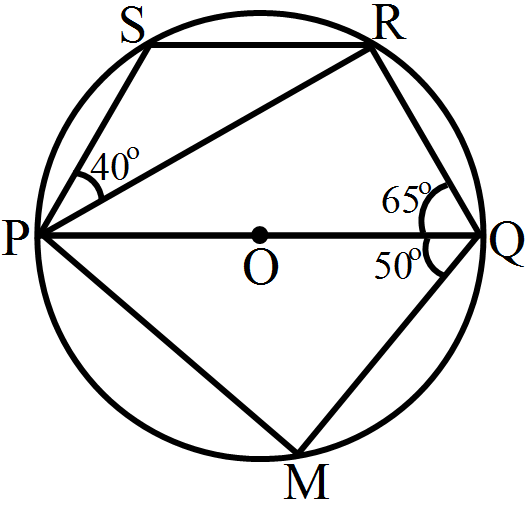
In the given figure, $PQ$ is a diameter of a circle with centre $O$. If $\angle\text{PQR}=65^\circ,\angle\text{SPR}=40^\circ$ and $\angle\text{PQM}=65^\circ,$ find $\angle\text{QPR},\angle\text{QPM}$ and $\angle\text{PRS}.$
Answer

Here, $PQ$ is the diameter and the angle in a semicircle is a right angle.
$\text{i.e},\angle\text{PRQ}=90^\circ$ In $\triangle\text{PRQ},$
we have: $\angle\text{QPR}+\angle\text{PRQ}+\angle\text{PQR}=180^\circ$ [Angle sum property of a triangle]
$\Rightarrow\ \angle\text{QPR}+90^\circ+65^\circ=180^\circ$
$\Rightarrow\ \angle\text{QPR}=(180^\circ-155^\circ)=25^\circ$ In
$\triangle\text{PQM}$ $PQ$ is the diameter.
$\angle\text{QPM}+\angle\text{PMQ}+\angle\text{PQM}=180^\circ$ [Angle sum property of a triangle]
$\Rightarrow\ \angle\text{QPM}+90^\circ+50^\circ=180^\circ$
$\Rightarrow\ \angle\text{QPM}=(180^\circ-145^\circ)=40^\circ$
Now, in quadrilateral $PQRS$, we have: $\angle\text{QPS}+\angle\text{SRQ}=180^\circ$ [Opposite angles of a cyclic quadrilateral]
$\Rightarrow\ \angle\text{QPR}+\angle\text{RPS}+\angle\text{PRQ}+\angle\text{PRS}=180^\circ$
$\Rightarrow\ 25^\circ+40^\circ+90^\circ+\angle\text{PRS}=180^\circ$
$\Rightarrow\ \angle\text{PRS}=180^\circ-155^\circ=25^\circ$
$\therefore\ \angle\text{PRS}=25^\circ$
Thus, $ \angle\text{QPR}=25^\circ, \angle\text{QPM}=25^\circ,\angle\text{PRS}=25^\circ$
View full question & answer
Question 405 Marks
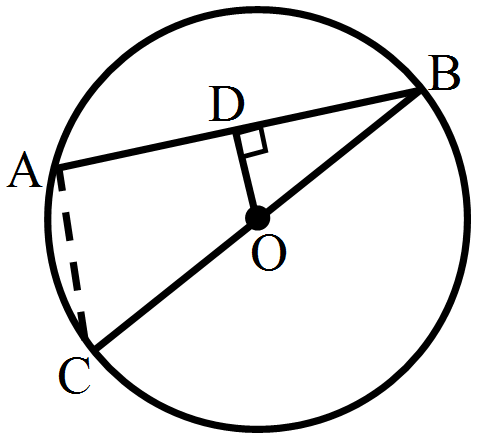
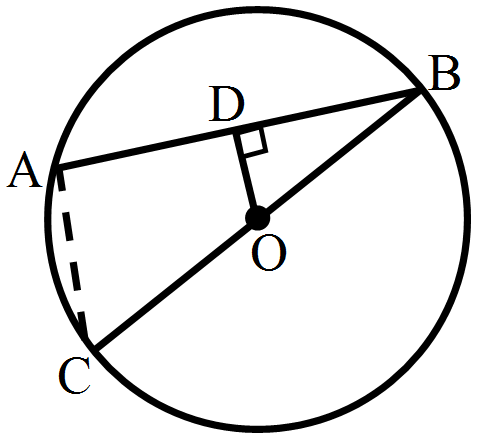
In the adjoining figure, $OD$ is perpendicular to the chord $AB$ of a circle with centre $O$. If BC is a diameter, show that $AC\ ||\ CD$ and $AC = 2 \times OD$.
Answer

Given: $BC$ is a diameter of a circle with centre $O$ and $\text{OD}\perp\text{AB}.$
To prove: $AC$ parallel to $OD$ and $AC = 2 \times OD$
Construction: Join$ AC$.
Proof: We know that the perpendicular from the centre of a circle to a chord bisects the chord.
Here, $\text{OD}\perp\text{AB}.$ $D$ is the mid point of $AB$. i.e., $AD = BD$
 Also, $O$ is the midpoint of $BC$. i.e., $OC = OB$ Now, in $\triangle\text{ABC},$
we have: $D$ is the midpoint of $AB$ and $O$ is the mid point of $BC$.
According to the mid point theorem, the line segment joining the mid points of any two sides of a triangle is parallel to the third side and equal to half of it. i.e., $OD\ ||\ AC$ and $\text{OD}=\frac{1}{2}\text{AC}$
​​​​​​​ $\therefore$ $AC = 2 \times OD$ Hence, proved.
View full question & answer
Question 415 Marks
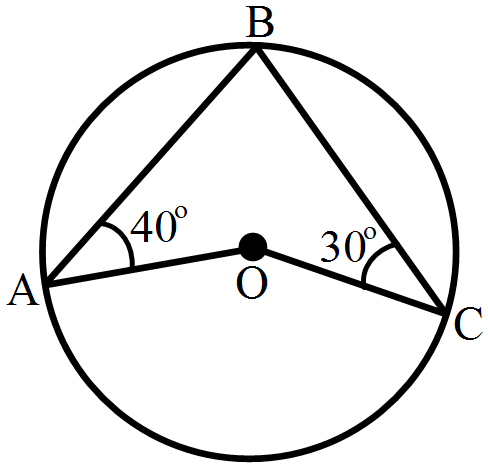
$i.$ In Figure $(1), O$ is the centre of the circle. If $\angle\text{OAB}=40^\circ$ and $\angle\text{OCB}=30^\circ,$ find $\angle\text{AOC}.$
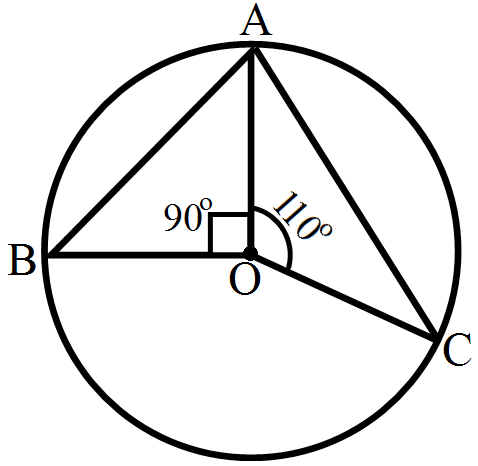
$ii.$ In Figure $(2), A, B$ and $C$ are three points on the circle with centre $O$ such that $\angle\text{AOB}=90^\circ$ and $\angle\text{AOC}=110^\circ.$ Find $\angle\text{BAC}.$
Answer
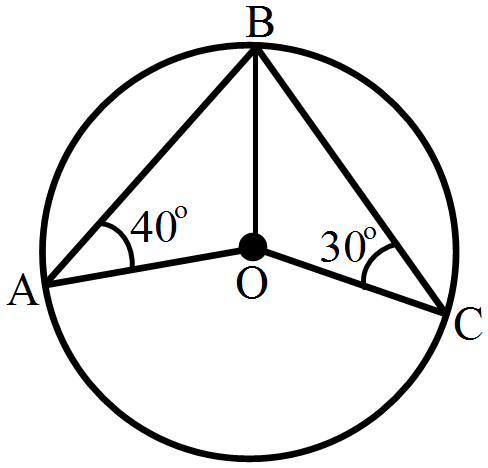
$i.$ Join $BO$.

In $\triangle\text{BOC},$ we have:
$OC = OB [$Radii of a circle$]$
$\Rightarrow\ \angle\text{OBC}=\angle\text{OCB}$
$\angle\text{OBC}=30^\circ\dots(\text{i})$
In $\triangle\text{BOA},$ we have:
$OB = OA ($Radii of a circle$)$
$\Rightarrow\ \angle\text{OBA}=\angle\text{OAB}$ $[\because\ \angle\text{OAB}=40^\circ]$
$\angle\text{OBA}=40^\circ\dots(\text{ii})$
Now, we have:
$\angle\text{ABC}=\angle\text{OBC}+\angle\text{OBA}$
$=30^\circ+40^\circ [$From $(i)$ and $(ii)]$
$\therefore\ \angle\text{ABC}=70^\circ$
The angle subtended by an arc of a circle at the centre is double the angle subtended by the arc at any point on the circumference.
i.e., $\angle\text{AOC}=2\angle\text{ABC}$
$=(2\times70^\circ)=140^\circ$
ii

Here, $\angle\text{BOC}=[360^\circ-(90^\circ+110^\circ)]$
$=(360^\circ-200^\circ)=160^\circ$
We know that $\angle\text{BOC}=2\angle\text{BAC}.$
$\Rightarrow\ \angle\text{BAC}=\frac{\angle\text{BOC}}{2}=\Big(\frac{160^\circ}{2}\Big)=80^\circ$
Hence, $\angle\text{BAC}=80^\circ$
View full question & answer
Question 425 Marks
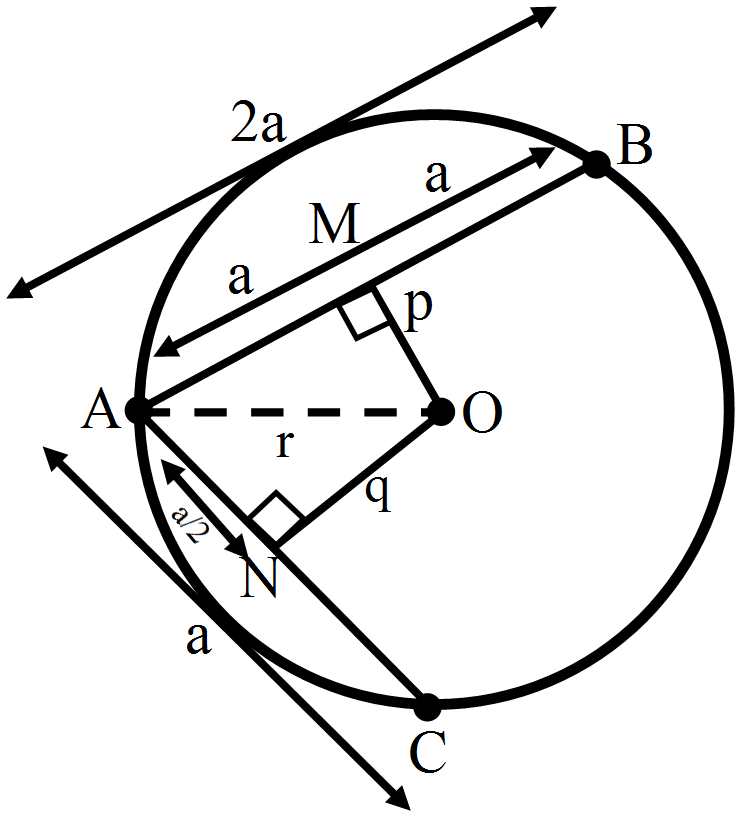
$AB$ and $AC$ are two chords of a circle of radius r such that $AB = 2AC$. If $p$ and $q$ are the distances of $AB$ and $AC$ from the centre then prove that $4q^2 = p^2 + 3r^2.$
Answer
Let $AC = a$. Since, $AB = 2AC$,
$\therefore$ $AB = 2a.$

 From centre $O,$ perpendicular is drawn to the chords $AB$ and $AC$ at points $M$ and $N$, respectively.
It is given that $OM = p$ and $ON = q.$
We know that perpendicular drawn from the centre to the chord, bisects the chord.
$\therefore AM = MB = a ...(1)$ and
$\text{AN}=\text{NC}=\frac{\text{a}}{2}\dots(2)$ In $\triangle\text{OAN},$
$(AN)^2 + (NO)^2 = (OA)^2​​​​​​​$^ [Pythagoras theorem]
$\Rightarrow\ \Big(\frac{\text{a}}{2}\Big)^2+(\text{q})^2=(\text{r})^2$
$\Rightarrow\ \frac{\text{a}^2}{4}+\text{q}^2=\text{r}^2$
$\Rightarrow \frac{\text{a}^2+4\text{q}^2}{4}=\text{r}^2$
$\Rightarrow\ \text{a}^2+4\text{q}^2=4\text{r}^2$
$\Rightarrow\ \text{a}^2=4\text{r}^2-4\text{q}^2\dots(3)$ In $\triangle\text{OAM},$
$(\text{AM})^2+(\text{MO})^2=(\text{OA})^2$ [Pythagoras theorem]
$\Rightarrow\ (\text{a})^2+\text{p}^2=(\text{r)}^2$
$\Rightarrow\ (\text{a})^2=(\text{r)}^2-\text{p}^2\dots(4)$ From equation $(3)$ and $(4)$,
$4\text{r}^2-4\text{q}^2=\text{r}^2-\text{p}^2$
$\Rightarrow\ 4\text{r}^2-\text{r}^2+\text{p}^2=4\text{q}^2$
$\Rightarrow\ 3\text{r}^2+\text{p}^2=4\text{q}^2$
Hence, $4\text{q}^2=\text{p}^2+3\text{r}^2$
View full question & answer
Question 435 Marks
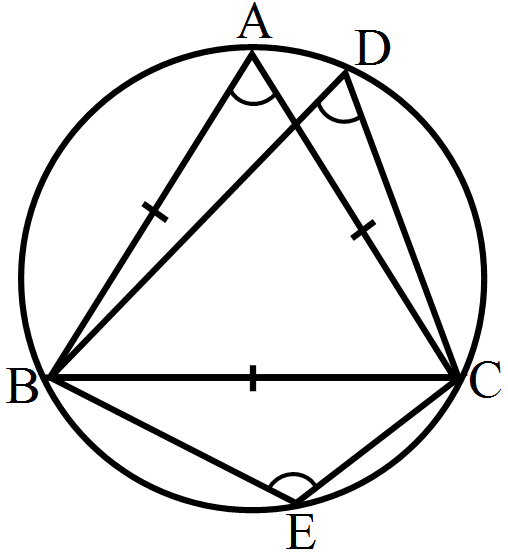
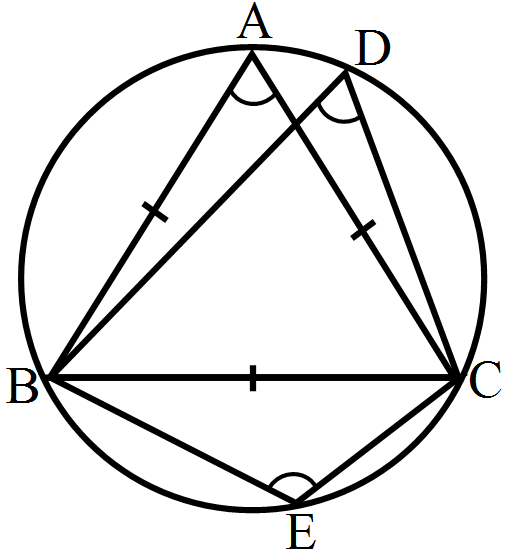
In the given figure, $\triangle\text{ABC}$ is equilateral. Find
$i. \angle\text{BDC}$
$ii. \angle\text{BEC}$
Answer

$i.$ Given: $\triangle\text{ABC}$ is an equilateral triangle
i.e., each of its angle $= 60^\circ$
$\Rightarrow\ \angle\text{BAC}=\angle\text{ABC}=\angle\text{ACB}=60^\circ$
Angles in the same segment of a circle are equal.
i.e.,$\angle\text{BDC}=\angle\text{BAC}=60^\circ$
$\therefore\ \angle\text{BDC}=60^\circ$
$ii.$ The opposite angles of a cyclic quadrilateral are supplementary.
Then in cyclic quadrilateral $\text{ABEC}$, we have:
$\angle\text{BAC}+\angle\text{BEC}=180^\circ$
$\Rightarrow\ 60^\circ+\angle\text{BEC}=180^\circ$
$\Rightarrow\ \angle\text{BEC}=(180^\circ-60^\circ)=120^\circ$
$\therefore\ \angle\text{BDC}=60^\circ$ and $\angle\text{BEC}=120^\circ$
View full question & answer
Question 445 Marks
In the given figure, $O$ is the centre of the circle, $BD = OD$ and $\text{CD}\perp\text{AB}.$ Find $\angle\text{CAB}.$
Answer
In the given figure, $BD = OD$ and $\text{CD}\perp\text{AB}.$

Join $AC$ and $OC$. In $\triangle\text{ODE}$ and $\triangle\text{DBE},$
$\angle\text{DOE}=\angle\text{DBE}$ [given] $\angle\text{DEO}=\angle\text{DEB}=90^\circ$
$OD = DB$ [given]
$\therefore$ By $AAS$ conguence rule, $\triangle\text{ODE}\cong\triangle\text{BDE},$ Thus, $OE = EB ...(1)$
Now, in $\triangle\text{COE}$ and $\triangle\text{CBE},$
$CE = CE$ [common] $\angle\text{CEO}=\angle\text{CEB}=90^\circ$
$OE = EB$ [From $(1)$]
$\therefore$ By $AAS$ conguence rule, $\triangle\text{COE}\cong\triangle\text{CBE},$
Thus, $CO = CB ...(2)$
Also, $CO = OB = OA$ [radius of the circle] $...(3)$
From $(2)$ and $(3), CO = CB = OB$
$\therefore\ \triangle\text{COB}$ is equilateral triangle.
$\therefore\ \triangle\text{COB}=60^\circ\dots(4)$
We know that the angle subtended by an arc of a circle at the centre is double the angle subtended by it on the remaining part of the circle.
Here, arc $CB$ subtends $\angle\text{COB}$ at the centre and $\angle\text{CAB}$ at $A$ on the circle.
$\therefore\ \angle\text{COB}=2\angle\text{CAB}$
$\Rightarrow\ \angle\text{CAB}=\frac{60^\circ}{2}=30^\circ$ [From $(4)$]
Hence, $\angle\text{CAB}=30^\circ.$
View full question & answer
Question 455 Marks
In a circle of radius $5\ cm, AB$ and $CD$ are two parallel chords of lengths $8\ cm$ and $6\ cm$ respectively. Calculate the distance between the chords if they are:
$i.$ On the same side of the centre.
$ii.$ On the opposite sides of the centre.
Answer
We have:
$i.$ Let $AB$ and $CD$ be two chords of a circle such that $AB$ is parallel to $CD$ on the same side of the circle.
Given: $AB = 8\ cm, CD = 6\ cm$ and $OB = OD = 5\ cm$
Join $OL$ and $OM.$

The perpendicular from the centre of a circle to a chord bisects the chord.
$\therefore\ \text{LB}=\frac{\text{AB}}{2}=\Big(\frac{8}{2}\Big)=4\text{cm}$
Now, in right angled $\triangle\text{BLO},$ we have:
$OB^2 = LB^2 + LO^2$
$\Rightarrow LO^2= OB^2 - LB^2$
$\Rightarrow LO^2= 5^2 - 4^2$
$\Rightarrow LO^2= 25 - 16 = 9$
Similarly,
$\Rightarrow MO = 4\ cm$
$\therefore$ Distance between the chords $= (MO - LO) = (4 - 3)cm = 1\ cm.$
$ii.$ Let $AB$ and $CD$ be two chords of a circle such that $AB$ is parallel to $CD$ and they are on the opposite sides of the centre.
Given: $AB = 8\ cm$ and $CD = 6\ cm$
Draw $\text{OL}\perp\text{AB}$ and $\text{OM}\perp\text{CD}.$

Join $OA$ and $OC.$
$OA = OC = 5\ cm [$Radii of a circle$]$
The perpendicular from the centre of a circle to a chord bisects the chord.
$\therefore\ \text{AL}=\frac{\text{AB}}{2}=\Big(\frac{8}{2}\Big)=4\text{ cm}$
Now, in right angled $\triangle\text{OLA},$ we have:
$OA^2 = AL^2 + LO^2$
$\Rightarrow LO^2= OA^2 - AL^2$
$\Rightarrow LO^2 = 5^2 - 4^2$
$\Rightarrow LO^2 = 25 - 16 = 9$
$\therefore$ $LO = 3\ cm$
Similarly, $\text{CM}=\frac{\text{CD}}{2}=\Big(\frac{6}{2}\Big)=3\text{cm}$
In right angled $\triangle\text{CMO},$
we have: $OC^2 = CM^2 + MO^2$
$\Rightarrow MO^2 = OC^2 - CM^2$
$\Rightarrow MO^2= 5^2 - 3^2$
$\Rightarrow MO^2= 25 - 9 = 16$
$\therefore$ $MO = 4\ cm$
Hence, distance between the chords $= (MO + LO) = (4 + 3) cm = 7\ cm.$
View full question & answer
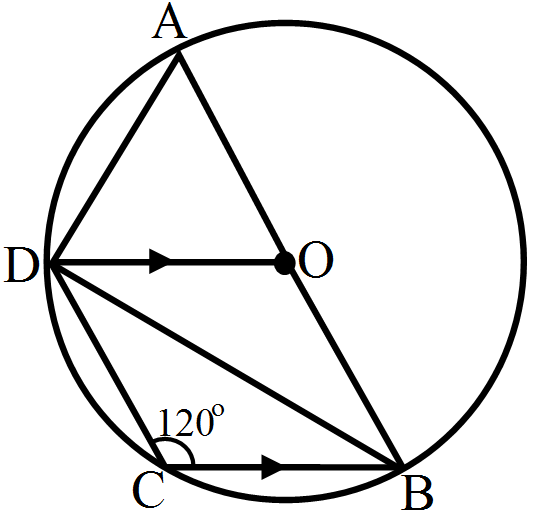
Question 465 Marks
In the given figure, $AB$ is a diameter of a circle with centre $O$ and $DO \|\ CB$. If $\angle\text{BCD}=120^\circ,$ calculate
$i. \angle\text{BAD}$
$ii. \angle\text{ABD}$
$iii. \angle\text{CBD}$
$iv. \angle\text{ADC}$
Also, show that $\triangle\text{AOD}$ is an equilateral triangle.
Answer
We have, $AB$ is a diameter of the circle where $O$ is the centre, $DO \|\ BC$ and $\angle\text{BCD}=120^\circ.$
Since $\text{ABCD}$ is a cyclic quadrilateral,
we have: $\angle\text{BCD}+\angle\text{BAD}=180^\circ$
$\Rightarrow\ 120^\circ+\angle\text{BAD}=180^\circ$
$\Rightarrow\ \angle\text{BAD}=(180^\circ-120^\circ)=60^\circ$
$\therefore\ \angle\text{BAD}=60^\circ$
$ \angle\text{BAD}=90^\circ$ [Angle in a semicircle] In $\triangle\text{ABD},$
we have: $\angle\text{BDA}+\angle\text{BAD}+\angle\text{ABD}=180^\circ$
$\Rightarrow\ 90^\circ+60^\circ+\angle\text{ABD}=180^\circ$
$\Rightarrow\ \angle\text{ABD}=(180^\circ-150^\circ)=30^\circ$
$\therefore\ \angle\text{ABD}=30^\circ$ $OD = OA [$Radii of a circle$]$
$\angle\text{ODA}=\angle\text{OAD}$
$=\angle\text{BAD}=60^\circ$
$\angle\text{ODB}=90^\circ-\angle\text{ODA}=(90^\circ-60^\circ)=30^\circ$
Here, $DO\ \|\ BC [$Given; alternate angles$]$
$\angle\text{CBD}=\angle\text{ODB}=30^\circ$
$\therefore\ \angle\text{CBD}=30^\circ$
$\angle\text{ADC}=\angle\text{ADB}+\angle\text{CDB}$
$=90^\circ+30^\circ=120^\circ$ In $\triangle\text{AOD},$
we have: $\angle\text{ODA}+\angle\text{OAD}+\angle\text{AOD}=180^\circ$
$\Rightarrow\ 60^\circ+60^\circ+\angle\text{AOD}=180^\circ$
$\Rightarrow\ \angle\text{AOD}=(180^\circ-120^\circ)=60^\circ$
Since all the angles of $\triangle\text{AOD}$ are of $60^\circ$ each, $\triangle\text{AOD}$ is an equilateral triangle.
View full question & answer