Question 12 Marks
What must be subtracted from $x^3 - 6x^2 - 15x + 80$ so that the result is exactly divisible by $x^2 + x - 12?$
Answer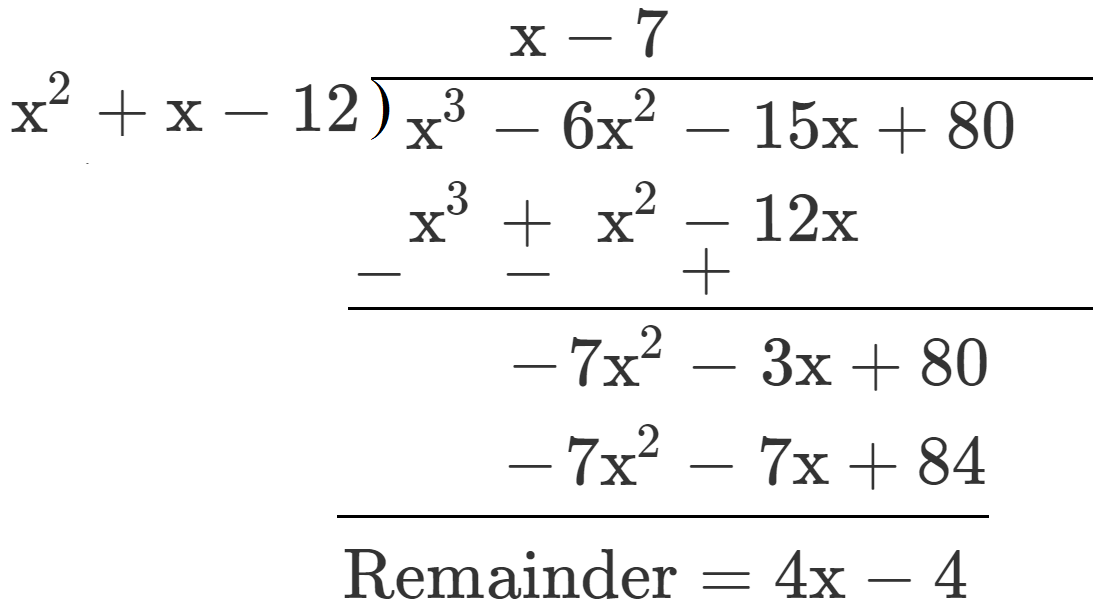
$\therefore$ 4x - 4 should subtracted from $x^3 - 6x^2- 15x + 80$
So that the result is exactly divisible by $x^2 + x - 12.$ View full question & answer→Question 22 Marks
Verify whether the indicated numbers are zeros of the polynomials corresponding to them in the following case: $f(x)=x^2, x=0$
Answer$f(x)=x^2, x=0$
we know that, $f(x)=x^2$
Given that value of $x$ is $' 0 '$
Substitute the value of $x$ in $f(x)$
$f(0)=0^2$
$=0$
Since, the result is zero, $x=0$ is the root of $x^2$
View full question & answer→Question 32 Marks
Find the remainder when $x^3+3 x^3+3 x+1$ is divided by:
$x$
AnswerHere,
$f(x)=x^3+3 x^2+3 x+1$
By remainder theorem
$x=0$
substitute the value of $x$ in $f(x)$
$f(0)=0^3+3(0)^2+3(0)+1$
$=0+0+0+1$
$=1$
View full question & answer→Question 42 Marks
In the following, use factor theorem to find whether polynomial $g(x)$ is a factor of polynomial $f(x)$ or, not: $f(x)=3 x^4+17 x^3+9 x^2-$ $7 x-10 ; g(x)=x+5$
AnswerLet $g ( x )=0 \Rightarrow x +5=0 $
$\Rightarrow x =-5$
Now, $f (-5)=3(-5)^4+17(-5)^3+9(-5)^2-7(-5)-10=3(625)+17(-125)+9(25)+35-10=1875-$
$2125+225+35-10 \because f(-5)=0$, by factor theorem $x+5$ is a factor of $f(x)$.
View full question & answer→Question 52 Marks
If $x+1$ is a factor of $x^3+a$, then write the value of $a$.
AnswerAs $(x+1)$ is a factor of polynomial $f(x)=x^3+a$.
i. e. $f(-1)=0$
$(-1)^3+a=0$
$\Rightarrow \mathrm{a}=1$
Thus, the value of $\mathrm{a}=1$.
View full question & answer→Question 62 Marks
If $x=\frac{1}{2}$ is a zero of the polynomial $f(x)=8 x^3+a x^2-4 x+2$, find the value of $a$.
AnswerSince $\text{x}=\frac{1}{2}$ is a zero of polynomial f(x). Therefore $\text{f}\Big(\frac{1}{2}\Big)=0$
$\Rightarrow\ 8\Big(\frac{1}{2}\Big)^3+\text{a}\Big(\frac{1}{2}\Big)^2-4\Big(\frac{1}{2}\Big)+2=0$
$\Rightarrow\ 1+\frac{\text{a}}{4}-2+2=0$
$\Rightarrow\ \text{a}=-4$ The value of a is -4.
View full question & answer→Question 72 Marks
If $f(x)=2 x^3-13 x^2+17 x+12$, Find: $f(-3)$
AnswerThe given polynomial is $f(x)=2 x^3-13 x^2+17 x+12$
$f(-3)$
we need to substitute the ' $(-3)^{\prime}$ ' in $f(x)$
$f(-3)=2(-3)^3-13(-3)^2+17(-3)+12$
$=(2 \times(-27))-(13 \times 9)-(17 \times 3)+12$
$=-54-117-51+12$
$=-210$
therefore $f(-3)=-210$
View full question & answer→Question 82 Marks
In the following, use factor theorem to find whether polynomial $g(x)$ is a factor of polynomial $f(x)$ or, not: $f(x)=x^3-6 x^2-19 x+$ $84, g(x)=x-7$
AnswerLet $g(x)=0 \Rightarrow x-7=0 $
$\Rightarrow x=7 f(7)=7^3-6(7)^2-19(7)+84=343-6(49)-19(7)+84=343-294-133+84=427-427=0 \because$
$f(7)=0$, by factor theorem $x-7$ is a factor of $f(x)$.
View full question & answer→Question 92 Marks
Find the remainder when $x^3+3 x^3+3 x+1$ is divided by: $x+1$
AnswerHere, $f(x)=x^3+3 x^2+3 x+1$ By remainder theorem
$x+1=0 \Rightarrow x=-1$ substitute the value of $x$ in $f(x) f(-1)=(-1)^3+3(-1)^2+$
$3(-1)+1=-1+3-3+1=0$
View full question & answer→Question 102 Marks
In the following, use factor theorem to find whether polynomial $g(x)$ is a factor of polynomial $f(x)$ or, not:
$f(x)=x^5+3 x^4-x^3-3 x^2+5 x+15, g(x)=x+3$
AnswerLet $g(x)=0$
$\Rightarrow x+3=0$
$\Rightarrow \mathrm{x}=-3$
$f(-3)=(-3)^5-3(-3)^4-(-3)^3-3(-3)^2+5(-3)+15$
$=-243+243+27-27-15+15=0$
$\because f(-3)=0$, by factor theorem $x+3$ is a factor of $f(x)$.
View full question & answer→Question 112 Marks
If $f(x)=x^4-2 x^3+3 x^2-a x-b$ when divided by $x-1$, the remainder is $6$ , then find the value of $a+b$.
AnswerWhen polynomial $f(x)=x^4-2 x^3+3 x^2-a x-b$ divided by $(x-1)$
The remainder is 6 . i. e. $f(1)=6(1)^4-2(1)^3+3(1)^2-a(1)-b=61$
$-2+3-a-b=62-(a+b)=6(a+b)=-4$
Thus, the value of $a+b=-4$.
View full question & answer→Question 122 Marks
In the following two polynomials, find the value of a, if $x + a$ is a factor.
$x^3+a x^2-2 x+a+4$
Answer$x^3+a x^2-2 x+a+4$
Let,
$x+a=0$
$\Rightarrow x=-a$
$\because(x+a)$ is a factor of $f(x)=x^3+a x^2-2 x+a+4$
$\therefore p(-a)=0$
$p(-a) \Rightarrow(-a)^3+(-a)^2-2(-a)+a+4=0$
$\Rightarrow-a^3+a^3+2 a+a+4=0$
$\Rightarrow 3 a+4=0$
$\Rightarrow 3 a=-4$
$\Rightarrow a=\frac{-4}{3}$
View full question & answer→Question 132 Marks
If $f(x)=2 x^3-13 x^2+17 x+12$, Find: $f(2)$
AnswerThe given polynomial is $f(x)=2 x^3-13 x^2+17 x+12$
$f(2)$
we need to substitute the ' 2 ' in $f(x)$
$f(2)=2(2)^3-13(2)^2+17(2)+12$
$=(2 \times 8)-(13 \times 4)+(17 \times 2)+12$
$=16-52+34+12$
$=10$
therefore $f(2)=10$
View full question & answer→Question 142 Marks
Verify whether the indicated numbers are zeros of the polynomials corresponding to them in the following case: $\text{f(x)}=\text{l(x)}+\text{m},\text{x}=-\frac{\text{m}}{\text{l}}$
Answer$\text{f(x)}=\text{l(x)}+\text{m},\text{x}=-\frac{\text{m}}{\text{l}}$
We know that, $\text{f(x)}=\text{l(x)}+\text{m}$
Given, that $\text{x}=-\frac{\text{m}}{\text{l}}$ Substitute the value of x in f(x) $\text{f}\Big(-\frac{\text{m}}{\text{l}}\Big)=\text{I}\Big(-\frac{\text{m}}{\text{l}}\Big)+\text{m}$
$=-\text{m}+\text{m}$
$=0$ Since, the result is $0$, $\text{x}=-\frac{\text{m}}{\text{l}}$ is the root of $lx + m$
View full question & answer→Question 152 Marks
Verify whether the indicated numbers are zeros of the polynomials corresponding to them in the following case: $\text{f(x)}=3\text{x}+1,\text{x}=-\frac{1}{3}$
Answer$\text{f(x)}=3\text{x}+1,\text{x}=-\frac{1}{3}$ We know that, $\text{f(x)}=3\text{x}+1$
Substitite $\text{x}=-\frac{1}{3}$ in f(x) $\text{f}\Big(-\frac{1}{3}\Big)=3\Big(-\frac{1}{3}\Big)+1$
$= -1 + 1$
$=0$ Since, the result is 0 $\text{x}=-\frac{1}{3}$ is the root of $3x + 1$
View full question & answer→Question 162 Marks
Give one example each of a binomial of degree $35$, and of a monomial of degree $100$
AnswerGiven, to write the examples for binomial and monomial with the given degrees.
Example of a binomial with degree $35-7 x^{35}-5$
Example of a monomial with degree $100-2 \mathrm{t}^{100}$
View full question & answer→Question 172 Marks
In the following two polynomials, find the value of a, if $x - a$ is factor:
$x^5-a^2 x^3+2 x+a+1$
Answer$x^5-a^2 x^3+2 x+a+1$
Let,
$x-a=0$
$\Rightarrow x=a$
$\because(x-a)$ is a factor of $f(x)=x^5-a^2 x^3+2 x+a+1$
$\therefore f(a)=0$
$f(a) \Rightarrow a^5-a^2 \times a^3+2 a+a+1=0$
$\Rightarrow a^5-a^5+3 a+1$
$\Rightarrow 3 a=-1$
$\Rightarrow a=-\frac{1}{3}$
View full question & answer→Question 182 Marks
In the following two polynomials, find the value of $a$, if $x-a$ is factor: $x^6-a x^5+x^4-a x^3+3 x-a+2$
Answer$x^6-a x^5+x^4-a x^3+3 x-a+2$ Let, $x-a=0 $
$\Rightarrow x=a \because x-a$ is a factor of the polynomial $f(x) $
$\therefore f(a)=0 f(a)=0 $
$\Rightarrow a^6-a \times a^5+a^4-$
$a \times a^3+3 a-a+2=0 $
$\Rightarrow a^6-a^6+a^4-a^4+3 a-a+2=0 $
$\Rightarrow 2 a+2=0 $
$\Rightarrow 2 a=-2 $
$\Rightarrow a=-1$
View full question & answer→Question 192 Marks
In the following, use factor theorem to find whether polynomial $g(x)$ is a factor of polynomial $f(x)$ or, not: $f(x)=x^3-6 x^2+11 x-6$; $g(x)=x-3$
AnswerLet $g(x)=0 $
$\Rightarrow x-3=0 $
$\Rightarrow x=3 f(3)=3^3-6(3)^2+11(3)-6=27-6(9)+33-6=60-60=0$
$ \because f(3)=0$, by factor theorem $x-3$ is a factor of $f ( x )$.
View full question & answer→Question 202 Marks
In the following two polynomials, find the value of $a$, if $x+a$ is a factor. $x^4-a^2 x^2+3 x-a$
Answer$x^4-a^2 x^2+3 x-a$ Let, $x+a=0 $
$\Rightarrow x=-a \because(x+a)$ is a factor of $f(x)=x^4-a^2 x^2+3 x-a$
$\therefore f(-a)=0 f(-a) $
$\Rightarrow(-a)^4-a^2(-a)^2+3(-a)-a$
$=0 $
$\Rightarrow a^4+a^4-3 a-a=0 $
$\Rightarrow-4 a=0 $
$\Rightarrow a=0$
View full question & answer→Question 212 Marks
Find the remainder when $x^3+3 x^3+3 x+1$ is divided by: $x-\frac{1}{2}$
AnswerHere, $f(x) = x3 + 3x2 + 3x + 1$ By remainder theorem $\text{x}-\frac{1}{2}$
$\Rightarrow\ \text{x}=\frac{1}{2}$ substitute the value of x in f(x) $\text{f}\Big(\frac{1}{2}\Big)=\Big(\frac{1}{2}\Big)^3+3\Big(\frac{1}{2}\Big)^2+3\Big(\frac{1}{2}\Big)+1$
$=\Big(\frac{1}{2}\Big)^3+3\Big(\frac{1}{2}\Big)^2+3\Big(\frac{1}{2}\Big)+1$
$=\frac{1}{8}+\frac{3}{4}+\frac{3}{2}+1$
$=\frac{1+6+12+8}{8}$
$=\frac{27}{8}$
View full question & answer→Question 222 Marks
If $f(x)=2 x^3-13 x^2+17 x+12$, Find: $f(0)$
AnswerThe given polynomial is $f(x)=2 x^3-13 x^2+17 x+12 f(0)$
we need to substitute the ' $(0)^{\prime}$ in $f(x) f(0)=2(0)^3-13(0)^2+17(0)+12=$
$(2 \times 0)-(13 \times 0)+(17 \times 0)+12=0-0+0+12=12$ therefore $f(0)=12$
View full question & answer→