Questions

5 Marks Questions

Take a timed test

12 questions · self-marked practice — reveal the answer and mark yourself.

Question 15 Marks
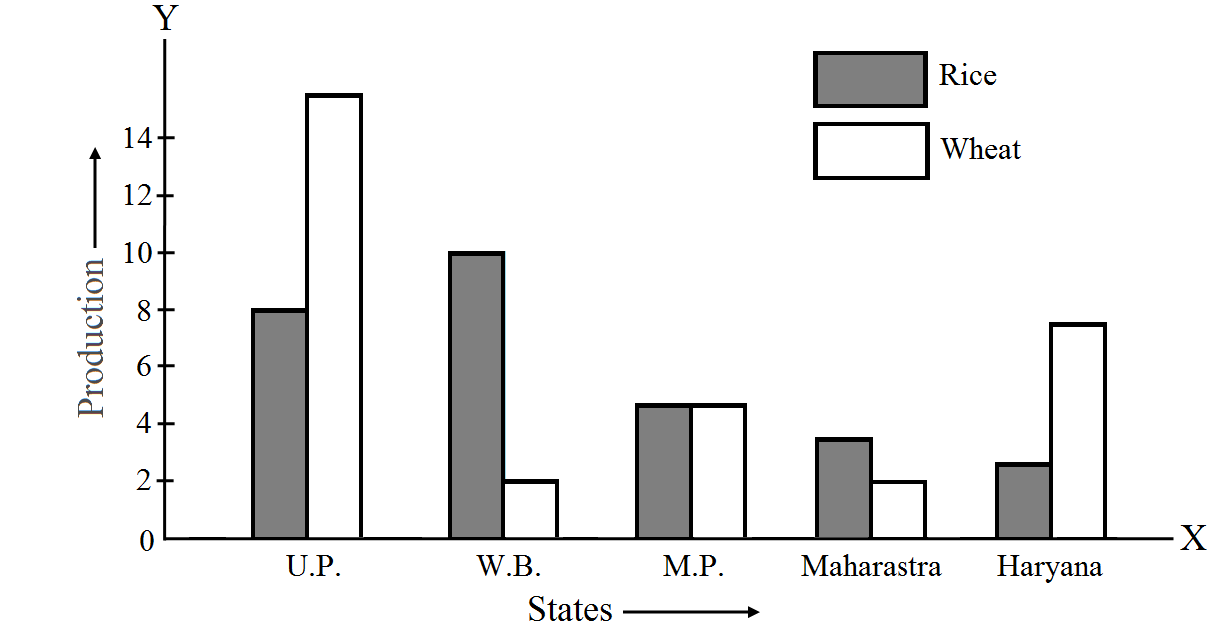
Read the following bar graph and answer the following questions:
$i.$ What information is given by the bar graph$?$
$ii.$ Which state is the largest producer of rice$?$
$iii.$ Which state is the largest producer of wheat$?$
$iv.$ Which state has total production of rice and wheat at its maximum$?$
$v.$ Which state has total production of wheat and rice at its minimum$?$
Answer
$i.$ The bar graph represents the production of rice and wheat in different states of India.
$ii.$ According to the height of the bars corresponding to rice, $W.B.$ is the largest producer of rice.
$iii.$ According to the height of the bars corresponding to wheat. $U.P.$ is the largest producer of wheat.
$iv. U.P.$ has the maximum total production of rice and wheat, which is $8 + 16 = 24$ units
$v.$ Maharashtra has the minimum total production of rice and wheat, which are exactly $2 + 4 = 6$ units.
View full question & answer
Question 25 Marks
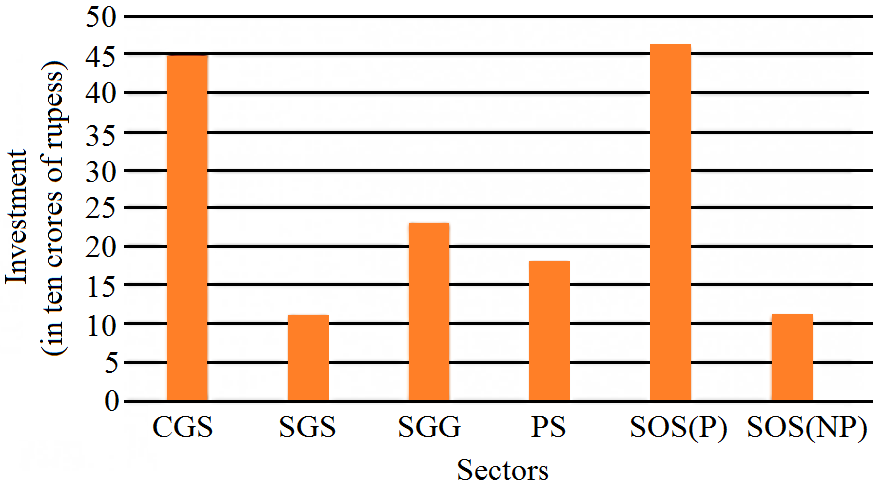
The investments $($in ten crores of rupees$)$ of Life Insurance Corporation of India in different sectors is given below:
Sectors Investment $($in ten crores of rupess$)$
Central government securities $45$
State government securities $11$
Securities guaranteed by the government $23$
Private sectors $18$
Socially oriented sectors $($plan$)$ $46$
Socially oriented sectors $($Non$–$plan$)$ $11$
Represent the above data with the help of a bar graph.
Answer
To represent the given data by a vertical bar graph, we first draw horizontal and vertical axes.
Let us consider that the horizontal and vertical axes represent the sectors and the investment in ten Crores of rupees respectively.
We have to draw $6$ bars of different lengths given in the table.
At first, we mark $6$ points in the horizontal axis at equal distances and erect rectangles of the same width at these points.
The heights of the rectangles are proportional to the investments of Life Insurance Corporation of India.
The vertical bar graph of the given data is following:

The short forms used in the graph are:
$a. C.G.S.:$ Central Government Securities.
$b. S.G.S.:$ State Government Securities.
$c. S.G.G.:$ Securities Guaranteed by Government.
$d. R.S.:$ Private Sectors.
$e. S.O.S.(P):$ Socially Oriented Sectors $($Plan$).$
$f. S.O.S.(NP):$ Socially Oriented Sectors $($Non$-$Plan$).$
View full question & answer
Question 35 Marks
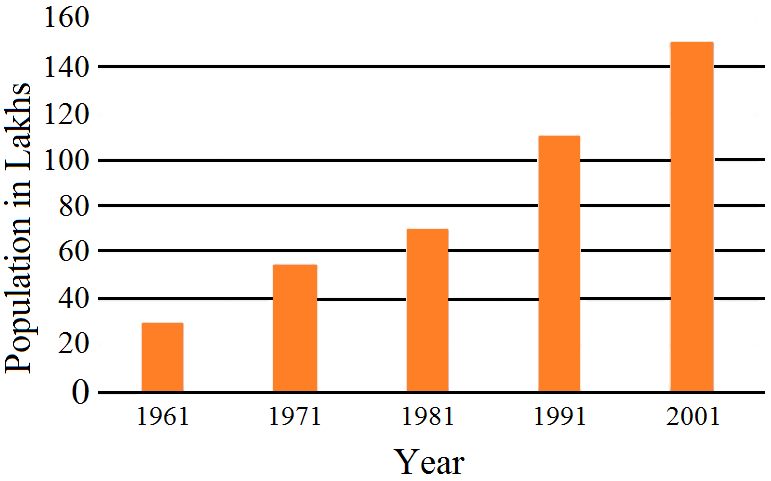
The population of Delhi State in different census years is as given below:
Census year
$1961$
$1971$
$1981$
$1991$
$2001$
Population in Lakhs
$30$
$55$
$70$
$110$
$150$
Represent the above information with the help of a bar graph.
Answer
While drawing a bar graph, we keep in mind that: The width of the bars should be uniform throughout. The gap between any two bars should be uniform throughout. Bars may be either horizontal or vertical. To represent the given data by a vertical bar graph, we first draw horizontal and vertical axes. Let us consider that the horizontal and vertical axes represent the years and the population in lakhs respectively. We have to draw 5 bars of different heights given in the table. At first, we mark $5$ points in the horizontal axis at equal distances and erect rectangles of the same width at these points. The heights of the rectangles are proportional to the population in lakhs. The vertical bar graph of the given data is following:
Note that each bar is of the same width and the gap between them is uniform. Make sure that the width of the bars and the gap between them should not be necessarily same.
View full question & answer
Question 45 Marks
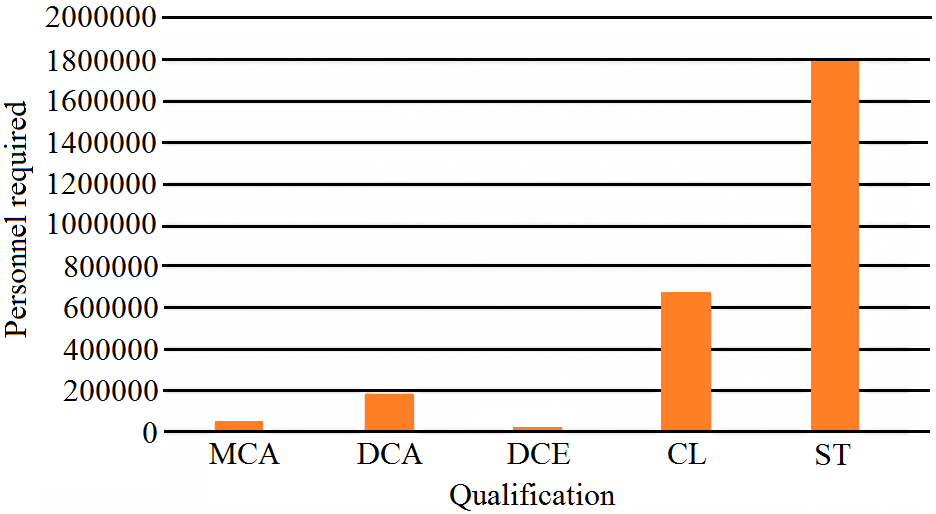
The following data gives the demand estimates of the Government of India, Department of Electronics for the personnel in the Computer sector during the Eighth Plan period $(1990–95):$
Qualifications
$MCA ($Masters in Computer Applications$)$
$DCA ($Diploma in Computer Applications$)$
$DCE ($Diploma in Computer Engineering$)$
$CL ($Certificate Level Course$)$
$ST ($Short Term Course$)$
Personnel required
$40600$
$181600$
$18600$
$670600$
$1802900$
Represent the data with the help of a bar graph. Indicate with the help of the bar graph the course where the estimated requirement is least.
Answer
To represent the given data by a vertical bar graph, we first draw horizontal and vertical axes. Let us consider that the horizontal and vertical axes represent the qualifications and the personnel required in hundreds respectively. We have to draw $5$ bars of different lengths given in the table. At first, we mark $5$ points in the horizontal axis at equal distances and erect rectangles of the same width at these points. The heights of the rectangles are proportional to the number of personnel required.The vertical bar graph of the given data is following:

It is seen from the bar graph that the height of the 3ffl bar from the left is least, which is corresponding to $DCE$. Hence, the requirement is least in $DCE.$
View full question & answer
Question 55 Marks
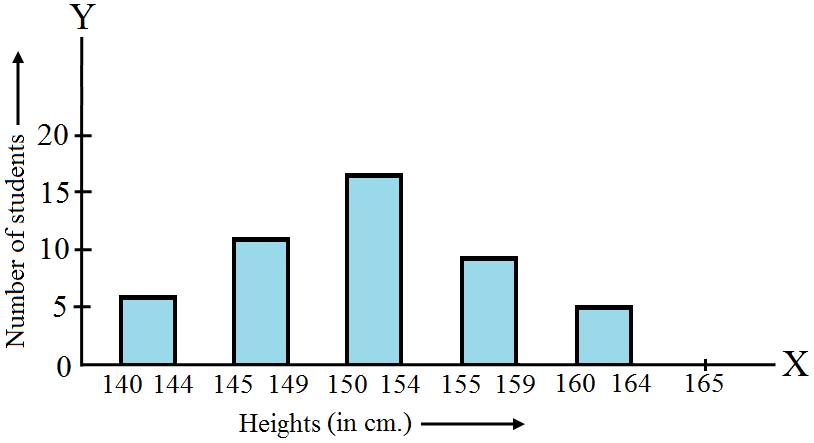
The following bar graph represents the heights $($in $cm)$ of $50$ students of Class $XI$ of a particular school. Study the graph and answer the following questions:

$i.$ What percentage of the total number of students have their heights more than $149\ cm?$
$ii.$ How many students in the class are in the range of maximum height of the class$?$
$iii.$The school wants to provide a particular type of tonic to each student below the height of $150\ cm$ to improve his height. If the cost of the tonic for each student comes out to be $Rs. 55,$ how much amount of money is required$?$
$iv.$ How many students are in the range of shortest height of the class$?$
$v.$ State whether true or false:
$a.$ There are $9$ students in the class whose heights are in the range of $155-159\ cm.$
$b.$ Maximum height $($in $cm)$ of a student in the class is $17.$
$c.$ There are $29$ students in the class whose heights are in the range of $145-154\ cm$
$d.$ Minimum height $($in $cm)$ of a student is the class is in the range of $140-144\ cms.$
$e.$ The number of students in the class having their heights less than $150\ cm$ is $12.$
$f.$ There are $14$ students each of whom has height more than $154\ cm$
Answer
$i.$ The total number of students is $50.$
The number of students having heights more than $149\ cm$
i.e desired percentage is:
$\Rightarrow\frac{(17+9+5)}{50\times100}$
$\Rightarrow62\%$
$ii.$ The maximum range of height is $164-165\ cm$.
The number of students belonging to this group is $5.$
$iii$. The number of students whose heights are less than $150\ cm$ is $7 + 12 = 19.$
Hence, the total cost is $19 × 55 = Rs. 1045/-$
$iv.$ The minimum range of height is $140–144\ cm.$
The number of students belonging to this group is $7.$
$a.$ The number of students whose heights are in the range $155–159\ cm$ is $9.$
Hence, the statement is true.
$b.$ The maximum possible height $($in $\ cm)$ of a student in the class can be $164\ cm.$
Hence the statement is false.
$c.$ The number of students whose heights are in the range $145-154\ cm$ is $12 + 17 = 29$.
Hence, the statement is true.
$d.$ The minimum range of heights of students in the class is $140-144\ cm.$
Hence, the statement is true.
$e.$ The number of students having heights less than $150\ cm$ is $7 + 12 = 19.$
Hence, the statement is false.
$f.$ The number of students having heights more than $154\ cm$ is $9 + 5 = 14.$
Hence, the statement is true.
View full question & answer
Question 65 Marks
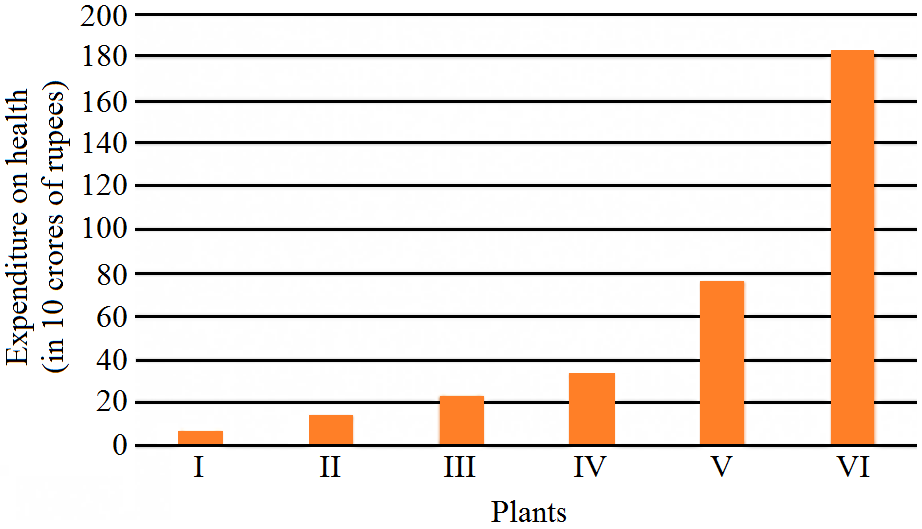
The expenditure (in $10$ crores of rupees) on health by the Government of India during the various five-year plans is shown below:
Plans
$I$
$II$
$III$
$IV$
$V$
$VI$
Expenditure on health(in 10 crores of rupees)
$7$
$14$
$23$
$34$
$76$
$182$
Construct a bar graph to represent the above data.
Answer
To represent the given data by a vertical bar graph, we first draw horizontal and vertical axes. Let us consider that the horizontal and vertical axes represent the years and the expenditures on health in $10$ Crores rupees respectively. We have to draw 6 bars of different lengths given in the table. At first, we mark $6$ points in the horizontal axis at equal distances and erect rectangles of the same width at these points. The heights of the rectangles are proportional to the expenditures on health by the government of India in different years.The vertical bar graph of the given data is following:
View full question & answer
Question 75 Marks
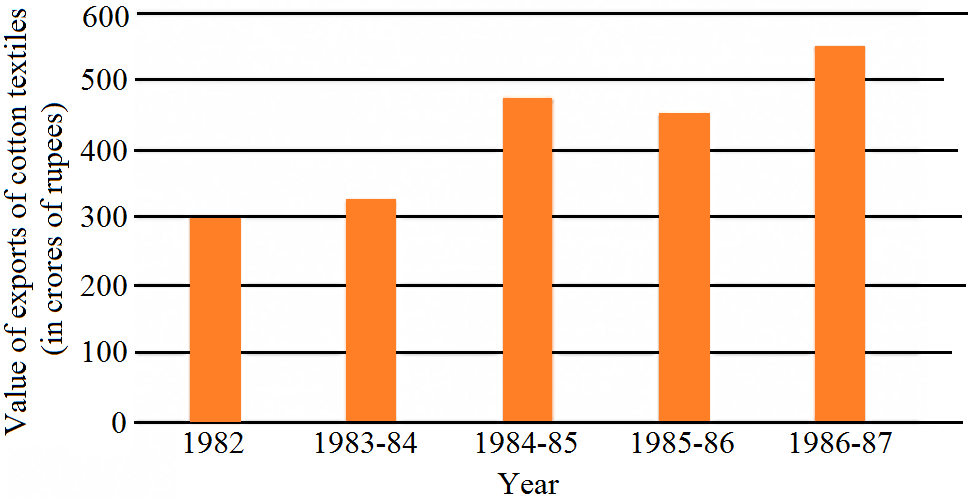
The following data gives the value $($in crores of rupees$)$ of the Indian export of cotton textiles for different years:
Years $1982–83$ $1983–84$ $1984–85$ $1985–86$ $1986–87$
Value of exports of cotton textiles $($in crores of rupees$)$ $300$ $325$ $475$ $450$ $550$
Represent the above data with the help of a bar graph. Indicate with the help of a bar graph the year in which the rate of increase in exports is maximum over the preceding year.
Answer
To represent the given data by a vertical bar graph, we first draw horizontal and vertical axes.
Let us consider that the horizontal and vertical axes represent the years and the value of Indian export of cotton textiles in Crores of rupees respectively.
We have to draw $5$ bars of different lengths given in the table.
At first, we mark $5$ points in the horizontal axis at equal distances and erect rectangles of the same width at these points.
The heights of the rectangles are proportional to the values of Indian export of cotton textiles in different years.The vertical bar graph of the given data is following:

The export increases in the years $1983–84, 1984–85$ and $1986–87.$ Now,
$a.$ The rate of increase in the year $1983–84$ is:
$\Rightarrow\frac{325-300}{300}\times100$
$\Rightarrow\frac{25}{3}$
$=8.33\%$
$b.$ The rate of increase in the year $1984–85$ is:
$\Rightarrow\frac{475-325}{325}\times100$
$\Rightarrow\frac{15000}{325}$
$\Rightarrow\frac{600}{13}$
$\Rightarrow46.15\%$
$c.$ The rate of increase in the year $1986–87$ is:
$\Rightarrow\frac{550-450}{450}\times100$
$\Rightarrow\frac{10000}{450}$
$\Rightarrow22.22\%$
View full question & answer
Question 85 Marks
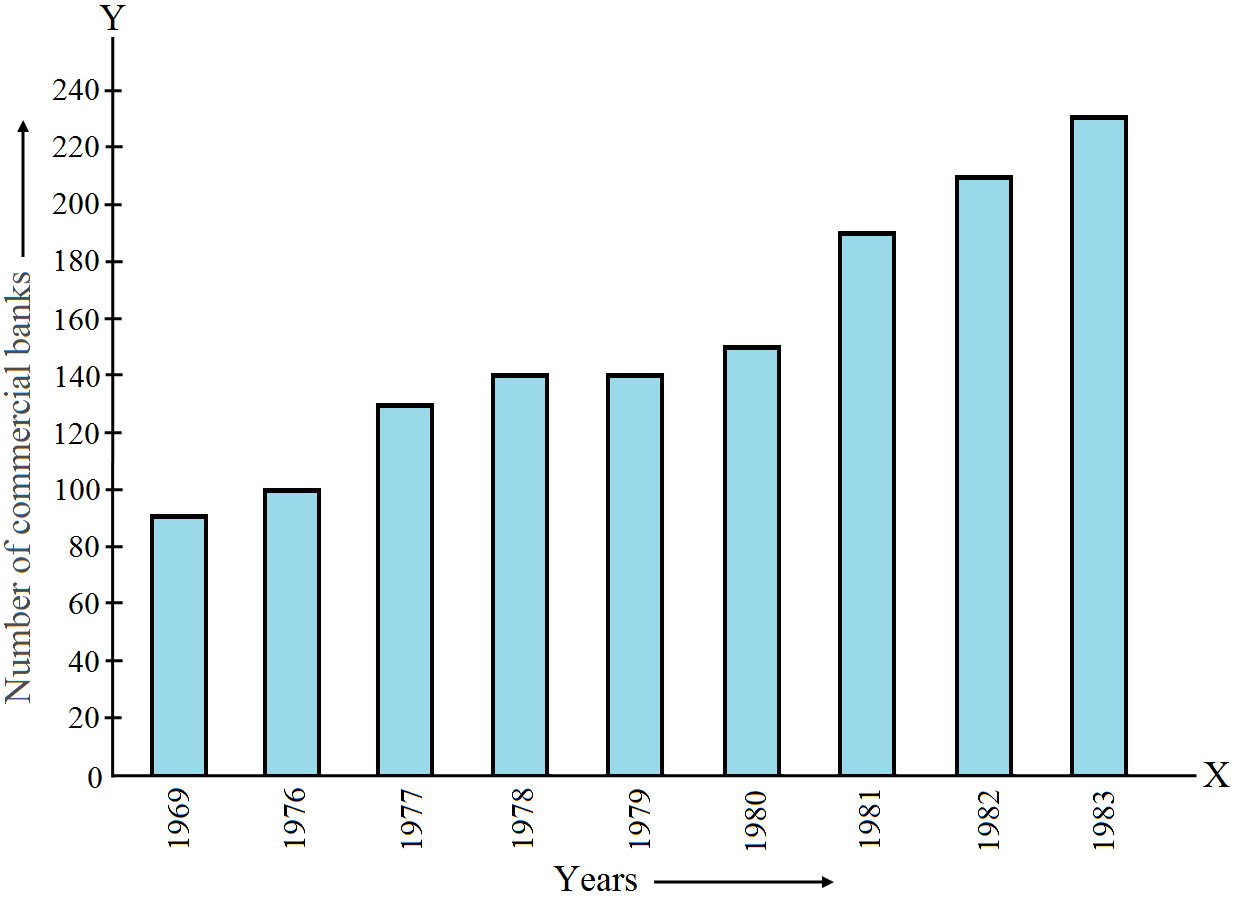
Read the bar graph shown in the figure and answer the following questions:
$i.$ What is the information given by the bar graph$?$

$ii.$ What was the number of commercial banks in $1977?$
$iii.$ What is the ratio of the number of commercial banks in $1969$ to that in $1980?$
$iv.$ State whether true or false:
The number of commercial banks in $1983$ is less than double the number of commercial banks in $1969.$
Answer
$i.$ The bar graph represents the number of commercial banks in India during some particular years.
$ii.$ The number of commercial banks in $1977$ was:
$120+\frac{(140-120)}{2}$
$\Rightarrow120+\frac{20}{2}$
$\Rightarrow120+10$
$\Rightarrow130$
$iii.$ The number of commercial banks in $1969$ was:
$80+\frac{(100-80)}{2}$
$\Rightarrow80+\frac{20}{2}$
$\Rightarrow80+10$
$\Rightarrow90$
The number of commercial banks in $1980$ was:
$140+\frac{(160-140)}{2}$
$\Rightarrow140+\frac{20}{2}$
$\Rightarrow140+10$
$\Rightarrow150$
Hence, the required ratio is $\frac{90}{150}$
$\Rightarrow\frac{3}5{}$
$\Rightarrow3:5$
$iv.$ The number of commercial banks in $1983$ was:
$220+\frac{(240-220)}{2}$
$\Rightarrow220+\frac{20}{2}$
$\Rightarrow220+10$
$\Rightarrow230$
The number of commercial banks in $1969$ was $90.$
When we multiply this number by $2,$ it becomes $2 \times 90 = 180$
Clearly, $230$ is not less than $180.$ Hence the statement is false.
View full question & answer
Question 95 Marks
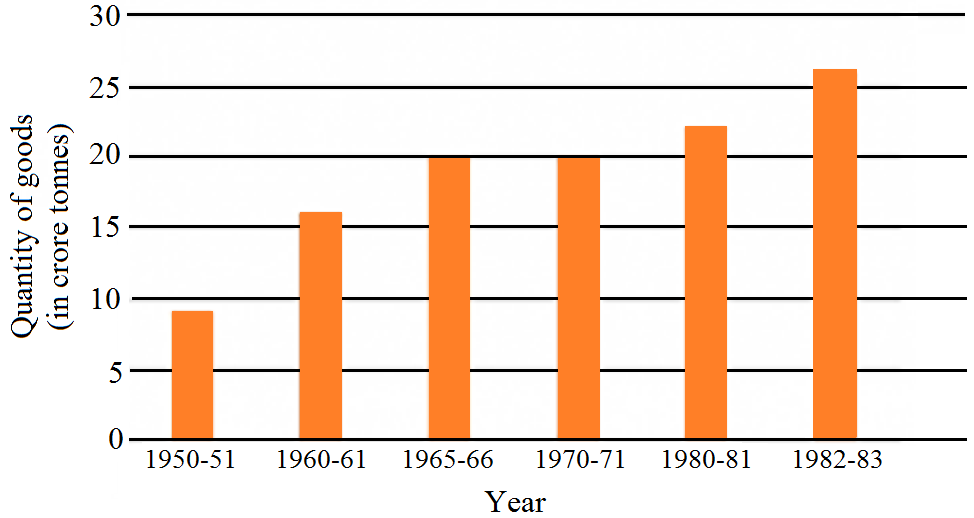
The following table gives the quantity of goods (in crores of rupees)
Year
$1950–51$
$1960–61$
$1965–66$
$1970–71$
$1980–81$
$1982–83$
Quantity of goods (in crore tonnes)
$9$
$16$
$20$
$20$
$22$
$26$
Represent this information with the help of a bar graph.
Answer
To represent the given data by a vertical bar graph, we first draw horizontal and vertical axes. Let us consider that the horizontal and vertical axes represent the years and the quantity of goods in Crores tonnes respectively. We have to draw $6$ bars of different lengths given in the table. At first, we mark $6$ points in the horizontal axis at equal distances and erect rectangles of the same width at these points. The heights of the rectangles are proportional to the quantity of goods carried by Indian railways in different years.The vertical bar graph of the given data is following:

 It is seen from the bar graph that the quantity of goods carried in the years $1950–51$ and $1965–66$ are $20$ Crores tonnes and $9$ Crores tonnes. Clearly $20$ is more than $2$ multiplied by $9.$ Hence, the statement is true.
View full question & answer
Question 105 Marks
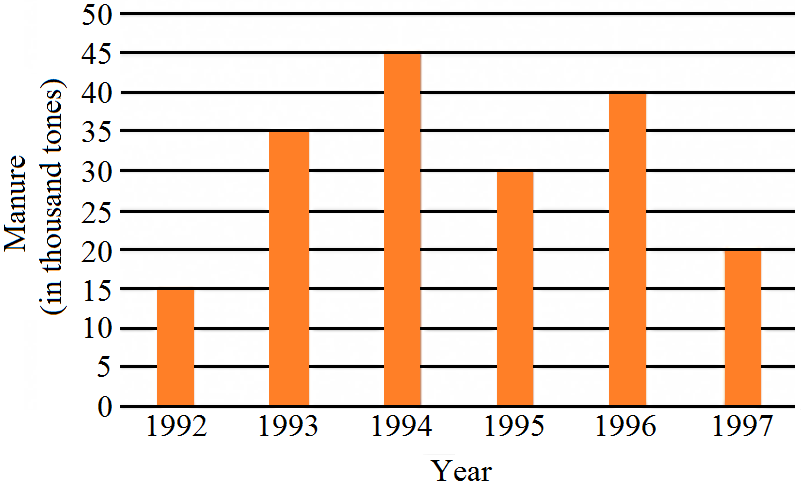
The following data gives the amount of manure $($in thousand tonnes$)$ manufactured by a company during some years:
Year
$1992$
$1993$
$1994$
$1995$
$1996$
$1997$
Manure $($in thousand tonnes$)$
$15$
$35$
$45$
$30$
$40$
$20$
$i.$ Represent the above data with the help of a bar graph.
$ii.$ Indicate with the help of the bar graph the year in which the amount of manufactured by the company was maximum.
$iii.$ Choose the correct alternative:
The consecutive years during which there was the maximum decrease in manure production are:
$a. 1994$ and $1995$
$b. 1992$ and $1993$
$c. 1996$ and $1997$
$d. 199$5 and $1996$
Answer
To represent the given data by a vertical bar graph, we first draw horizontal and vertical axes.
Let us consider that the horizontal and vertical axes represent the years and the amount of manure in thousand $9$ ones respectively.
We have to draw $6$ bars of different lengths given in the table.
At first, we mark $6$ points in the horizontal axis at equal distances and erect rectangles of the same width at these points.
The heights of the rectangles are proportional to the amount of manures manufactured by the company.
The vertical bar graph of the given data is following:
$i. $

$ii.$ It is seen from the bar graph that the height of the $3s$ bar from the left is maximum, which is corresponding to the year $1994.$
So in $1994,$ the quantity manufactured by the company was maximum.
$iii.$ It is seen from the bar graph that the manure production is decreased in the years 1995 $(1.5$ scale divisions$)$ and $1997 (2$ full$-$scale divisions$).$
So, the maximum decrease is in the year $1997.$
Hence, the correct choice is $(c).$
View full question & answer
Question 115 Marks
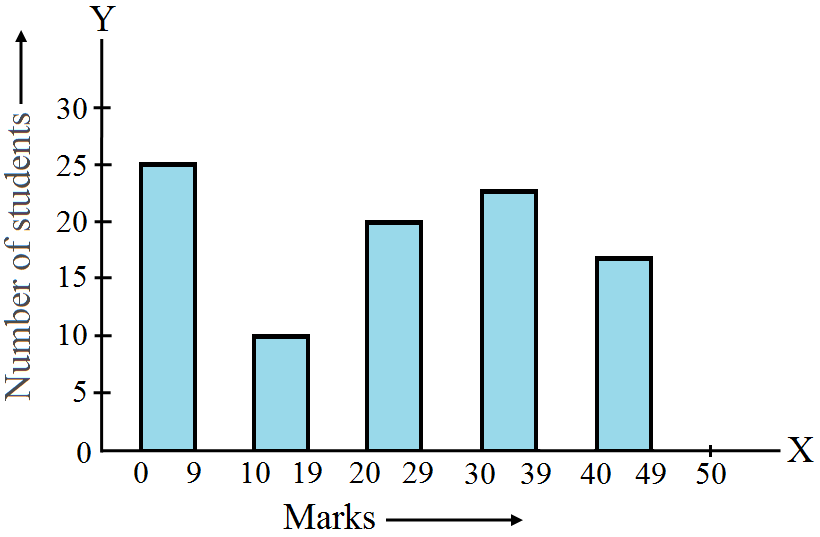
Given below is the bar graph indicating the marks obtained out of $50$ in mathematics paper by $100$ students. Read the bar graph and answer the following questions:

$i.$ It is decided to distribute workbooks on mathematics to the students obtaining less than $20$ marks, giving one workbook to each of such students.
 If a workbook costs $Rs. 5,$ what sum is required to buy the workbooks$?$
$ii.$ Every student belonging to the highest mark group is entitled to get a prize of $Rs. $
$10.$ How much amount of money is required for distributing the prize money$?$
$iii.$ Every student belonging to the lowest mark$-$group has to solve $5$ problems per day.
How many problems, in all, will be solved by the students of this group per day$?$
$iv.$ State whether true or false:
$a. 17\%$ students have obtained marks ranging from $40$ to $49.$
$b. 59$ students have obtained marks ranging from $10$ to $29.$
$v.$ What is the number of students getting less than $20$ marks$?$
$vi.$ What is the number of students getting more than $29$ marks$?$
$vii.$ What is the number of students getting marks between $9$ and $40?$
$viiii.$ What is the number of students belonging to the highest mark group$?$
$ix.$ What is the number of students obtaining more than $19$ marks$?$
Answer
$i.$ The number of students obtaining less than $20$ marks is $27 + 12 = 39$
$ii.$ Hence, the total cost to buy the work books is $5 \times 39 = Rs. 195.$
$iii.$ The highest mark group is $40–49$.
The number of students belonging to this group is $17.$
Hence, the total amount of money required to distribute the prize money is $10 \times 17 = Rs. 170$
$iv.$ The lowest mark group is $0-9$.
The number of students belonging to this group is $27.$
Hence, the total number of problems will be solved by the students of this group is $5 \times 27 = 135$
The total number of students is $100 ($given in the question$)$
$a.$ The number of students obtaining marks ranging from $40–49$ is $17.$
The percentage of students belonging to this group is $\Big(\frac{17}{100}\Big)\times100=17\%$
Hence, the statement is true.
$b.$ The number of students obtaining marks ranging from $10$ to $29$ is $12 + 20 = 32$
Hence, the statement is false.
$v.$ The number of students getting less than $20$ marks is $27 + 12 = 39$
$vi.$ The number of students getting more than $29$ marks is $24 + 17 = 41$
$vii.$ The number of students getting marks between $9$ to $40$ is $12 + 20 + 24 = 56$
$viii.$ The number of students belonging to the highest mark group $40–49$ is $17.$
$ix.$ The number of students obtaining more than $19$ marks is $20 + 24 + 17 = 61$
View full question & answer
Question 125 Marks
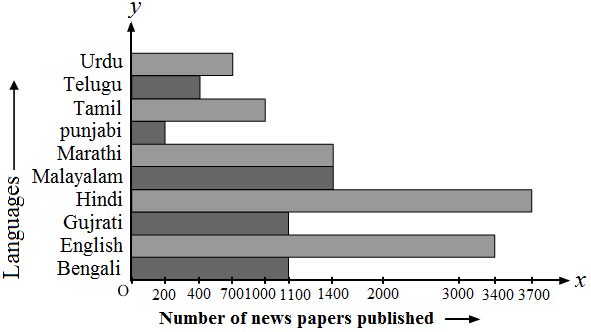
The bar graph shown in figure represents the circulation of newspapers in $10$ languages. Study the bar graph and answer the following questions:

$i.$ What is the total number of newspapers published in Hindi, English, Urdu, Punjabi, and Bengali?
$ii.$ What percent is the number of newspapers published in Hindi of the total number of newspapers?
$iii.$ Find the excess of the number of newspapers published in English over those published in Urdu.
$iv.$ Name two pairs of languages which publish the same number of newspapers.
$v.$ State the language in which the smallest number of newspapers are published.
$vi.$ State the language in which the largest number of newspapers are published.
$vii.$ State the language in which the number of newspapers published is between $2500$ and $3500.$
$viii.$ State whether true or false:
$a.$ The number of newspapers published in Malayalam and Marathi together is less than those published in English.
$b.$ The number of newspapers published in Telugu is more than those published in Tamil.
Answer
$i.$ The total number of news papers published in Hindi, English, Urdu, Punjabi and Bengali is $= 3700 + 3400 + 700 + 200 + 1100 = 9100.$
$ii.$ The total number of news papers published is $= 1100 + 3400 + 1100 + 3700 + 1400 + 1400 +200 + 1000 + 400 + 700 = 14400.$
The number of news papers published in Hindi is $3700$.
The percentage of published Hindi news papers is $\Big(\frac{3700}{14400}\Big)\times100=\frac{3700}{144}=25.7\%$
$iii.$ The number of news papers published in English and Urdu are $3400$ and $700$ respectively.
Hence, the excess of the number of news papers published in English over those published in Urdu is
$= 3400 - 700 = 2700$
$iv.$ According to the length of the $5^{\text {th }}$ and $6^{\text {th }}$ bars from the top, the number of news papers published in Marathi and Malayalam are same.
According to the length of the $1^{\text {st }}$ and $3^{\text {rd }}$ bars from the bottom, the number of news papers published in Bengali and Gujrati are same.
$v.$ According to the length of the $4^{th}$ bar from the top, the smallest number of news papers published in the language Punjabi.
$vi.$ According to the length of the $4^{th}$ bar from the bottom, the largest number of news papers published in the language Hindi.
$vii.$ The languages in which the number of published news papers is greater than or equal to $2500$ are English and Hindi.
Among the languages Hindi and English, the language in which the number of published news papers is less than or equal to $3500$ is English.
Hence, the language is English.
$viii. a.$ The number of news papers published in Malayalam and Marathi together is $1400+1400=2800$ The number of news papers published in English is $3400.$
Clearly, $2800$ is less than $3400.$
Hence, the statement is true.
$b.$ The number of news papers published in Telugu and Tamil are $400$ and $1000$ respectively.   
Clearly $400$ is not greater than $1000$.
Hence, the statement is false.
View full question & answer