Question 13 Marks
You know that the force applied on a body is directly proportional to the acceleration produced in the body. Write an equation to express this situation and plot the graph of the equation.
Answer
View full question & answer→Here the variables involved are force and acceleration. Let the force applied be $y$ units and the acceleration produced be $x$ units. From ratio and proportion, you can express this fact as $y=k x$, where $k$ is a constant. (From your study of science, you know that $k$ is actually the mass of the body.)
Now, since we do not know what $k$ is, we cannot draw the precise graph of $y=k x$. However, if we give a certain value to $k$, then we can draw the graph. Let us take $k=3$, i.e., we draw the line representing $y=3 x$. For this we find two of its solutions, say $(0,0)$ and $(2,6)$ (see Fig.)
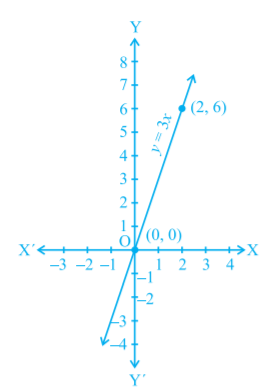
From the graph, you can see that when the force applied is $3$ units, the acceleration produced is $1$ unit. Also, note that $(0, 0) $ lies on the graph which means the acceleration produced is $0$ units, when the force applied is $0$ units.
Now, since we do not know what $k$ is, we cannot draw the precise graph of $y=k x$. However, if we give a certain value to $k$, then we can draw the graph. Let us take $k=3$, i.e., we draw the line representing $y=3 x$. For this we find two of its solutions, say $(0,0)$ and $(2,6)$ (see Fig.)
From the graph, you can see that when the force applied is $3$ units, the acceleration produced is $1$ unit. Also, note that $(0, 0) $ lies on the graph which means the acceleration produced is $0$ units, when the force applied is $0$ units.