Sample QuestionsLinear Equations in Two Variables questions
One sample from each question group in this chapter. Select any group above to see the full set with answer keys.
$x = 2, y = -1$ is a solution of the linear equation:
- ✓
$x + 2y = 0$
- B
$x + 2y = 4$
- C
$2x + y = 0$
- D
$2x + y = 5$
Answer: A.
View full solution →The equation of the $y-$axis is:
- ✓
$x = 0$
- B
$y = 0$
- C
$x + y = 0$
- D
$x = y$
Answer: A.
View full solution →The equation $2x + 5y = 7$ has a unique solution, if $x$ and $y$ are:
Answer: A.
View full solution →The graph of the linear equation $2x + 5y = 10$ meets the $x-$axis at the point.
- A
$(0, 5)$
- ✓
$(5, 0)$
- C
$(0, 2)$
- D
$(2, 0)$
Answer: B.
View full solution →The graph of the linear equation $2x + 3y = 6$ is a line which meets the $x-$axis at the point.
- A
$(0, 2)$
- B
$(0, 3)$
- ✓
$(3, 0)$
- D
$(2, 0)$
Answer: C.
View full solution →Directions: In the following questions, the Assertions $(A)$ and Reason(s) $(R)$ have been put forward. Read both the statements carefully and choose the correct alternative from the following:
Assertion: If $\big(\frac{1}{5}\big)\text{-x}=\frac{-4}{5}$ then $x$ is $1$.
Reason: $\frac{\text{p}}{4}+\frac{\text{p}}{3}=55-\frac{({\text{p}}+40)}{50} $ then the value of $p$ is $89.834$.
- A
Both Assertion and Reason are correct and Reason is the correct explanation for Assertion.
- ✓
Both Assertion and Reason are correct and Reason is not the correct explanation for Assertion.
- C
Assertion is true but the reason is false.
- D
Both assertion and reason are false.
Answer: B.
View full solution →Directions: In the following questions, the Assertions $(A)$ and Reason(s) $(R)$ have been put forward. Read both the statements carefully and choose the correct alternative from the following:
Assertion: The system of equations $ax + by = c,$ $lx + my = n$, has a unique solution.
Reason: Graphically, the pair of equations $7x - y = 5; 21x - 3y = 10$ represents two lines which are parallel.
- A
Both Assertion and Reason are correct and Reason is the correct explanation for Assertion.
- ✓
Both Assertion and Reason are correct and Reason is not the correct explanation for Assertion.
- C
Assertion is true but the reason is false.
- D
Both assertion and reason are false.
Answer: B.
View full solution →Directions: In the following questions, the Assertions $(A)$ and Reason$(s) (R)$ have been put forward. Read both the statements carefully and choose the correct alternative from the following:
Assertion: If $4 a-3=13$, then the value of $10 a^2-5 a+6$. is $149.$
Reason: Every horizontal line has an undefined slope.
- A
Both Assertion and Reason are correct and Reason is the correct explanation for Assertion.
- B
Both Assertion and Reason are correct and Reason is not the correct explanation for Assertion.
- C
Assertion is true but the reason is false.
- ✓
Both assertion and reason are false.
Answer: D.
View full solution →Directions: In the following questions, the Assertions $(A)$ and Reason(s) $(R)$ have been put forward. Read both the statements carefully and choose the correct alternative from the following:
Assertion: $\frac{1}{\text{x}}+\frac{1}{\text{y}}=\frac{1}{6}$ is the not linear equation in two variable.
Reason: $6x + 6y = xy$ is not form of the $y = mx + c$, hence it is not linear equation.
- ✓
Both Assertion and Reason are correct and Reason is the correct explanation for Assertion.
- B
Both Assertion and Reason are correct and Reason is not the correct explanation for Assertion.
- C
Assertion is true but the reason is false.
- D
Both assertion and reason are false.
Answer: A.
View full solution →Directions: In the following questions, the Assertions $(A)$ and Reason(s) $(R)$ have been put forward. Read both the statements carefully and choose the correct alternative from the following:
Assertion: Linear equation in one variable has only one variable with power one.
Reason: Linear equation in one variable has only one variable with power one.
- ✓
Both Assertion and Reason are correct and Reason is the correct explanation for Assertion.
- B
Both Assertion and Reason are correct and Reason is not the correct explanation for Assertion.
- C
Assertion is true but the reason is false.
- D
Both assertion and reason are false.
Answer: A.
View full solution →The boundaries of the solids are curves.
The coordinates of points in the table.
| $x$ |
$0$ |
$1$ |
$2$ |
$3$ |
$4$ |
| $y$ |
$2$ |
$3$ |
$4$ |
$-5$ |
$6$ |
represent some of the solutions of the equation $x – y + 2 = 0.$ View full solution →Every point on the graph of a linear equation in two variables does not represent a solution of the linear equation.
The graph of every linear equation in two variables need not be a line.
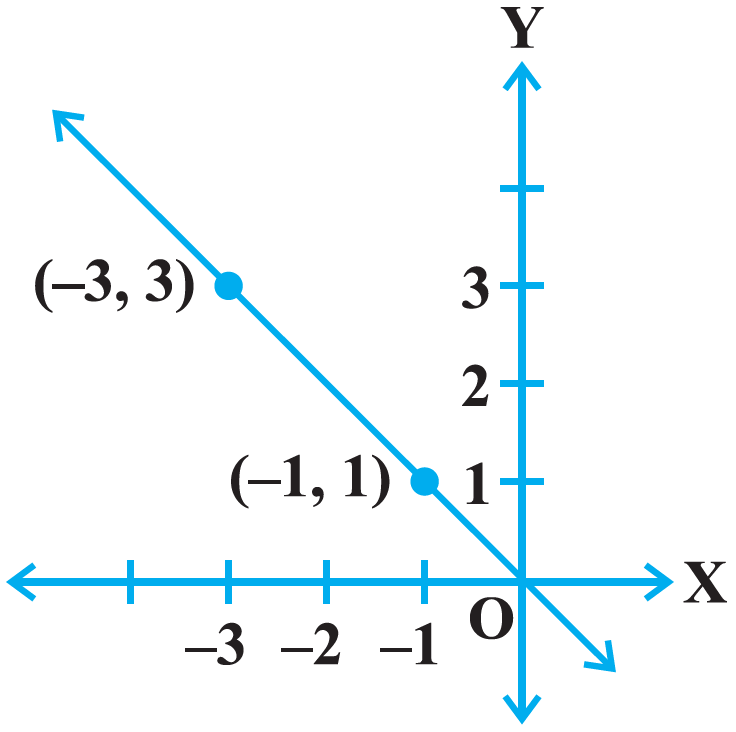
The graph given below represents the linear equation $x + y = 0.$
View full solution →Find the value of $k,$ if $x = 2, y = 1$ is a solution of the equation $2x + 3y =k.$
View full solution →Find whether $(1, 1)$ is the solution of the equation $x – 2y = 4$ or not.
View full solution →Find whether$(4, 0)$ is the solution of the equation $x – 2y = 4$ or not$?$
View full solution →Find whether $(2, 0)$ is the solution of the equation $x – 2y = 4$ or not$?$
View full solution →Express the linear equation in the form $ax + by + c = 0$ and indicate the values of $a, b$ and $c$ in $5 = 2x.$
View full solution →Find whether $(\sqrt{2},4\sqrt{2})$ is the solution of the equation $x – 2y = 4$ or not?
View full solution →Find whether $(0, 2)$ is the solution of the equation $x – 2y = 4$ or not?
View full solution →Write four solutions of the equation: $x = 4y.$
View full solution →Write four solutions of the equation: $\pi x + y = 9$
View full solution →Write four solutions of the equation: $2x + y = 7$
View full solution →You know that the force applied on a body is directly proportional to the acceleration produced in the body. Write an equation to express this situation and plot the graph of the equation.
Draw the graph of x + y = 7
Sodium silicate is one of the constituents in liquid soap. The graph shows the amount of sodium silicate in liquid soap.
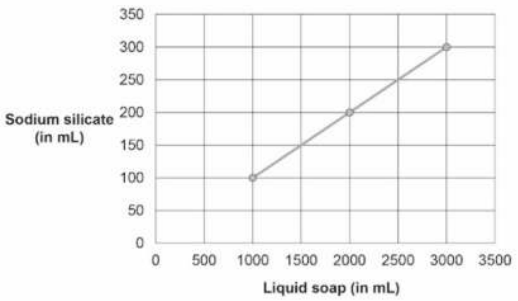
$5.$ How much sodium silicate (ml) is used for making $10$ L of soap?
A. $100$
B. $110$
C. $1000$
D. $10000$
6. Write an equation to show the relation between quantities of sodium silicate and liquid soap. View full solution →4. The soap bottles are available in small and large sizes.
A carton with $10$ small and 40 large bottles weighs $10.8 kg$. What is the mass of the carton with $50$ large bottles?
View full solution → A carton is checked randomly. Which of the following cannot be the number of fragrant and nonfragrant liquid bottles in the carton?
- A
$(5, 45)$
- B
$(15, 35)$
- C
$(20, 30)$
- ✓
$(30, 40)$
Answer: D.
View full solution →A carton contains both fragrant and non-fragrant liquid soap bottles.
Write an equation representing the number of fragrant and non$-$fragrant bottles in the carton.
View full solution →A soap manufacturer makes fragrant and non-fragrant liquid soaps. The liquid soaps are illed in plastic bottles and packed in equal size cartons for transportation. Each carton contains $50$ bottles. The mass of a full bottle of soap is $220\ gm$ and that of a half$-$illed bottle is $120\ gm.$ What will be the mass $(gm)$ of the empty bottle$?$
- A
$ 10$
- ✓
$ 20$
- C
$ 100$
- D
$ 110$
Answer: B.
View full solution →