MCQ 11 Mark
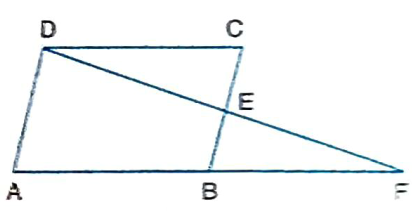
$ABCD$ is a parallelogram and $E$ is the mid-point of $BC$. $DE$ and $AB$ when produced meet at $F$. Then, $AF$ =
- A
$\frac{3}{2}\text{AB}$
- ✓
$2\text{AB}$
- C
$3\text{AB}$
- D
$\frac{5}{4}\text{AB}$
AnswerCorrect option: B. $2\text{AB}$
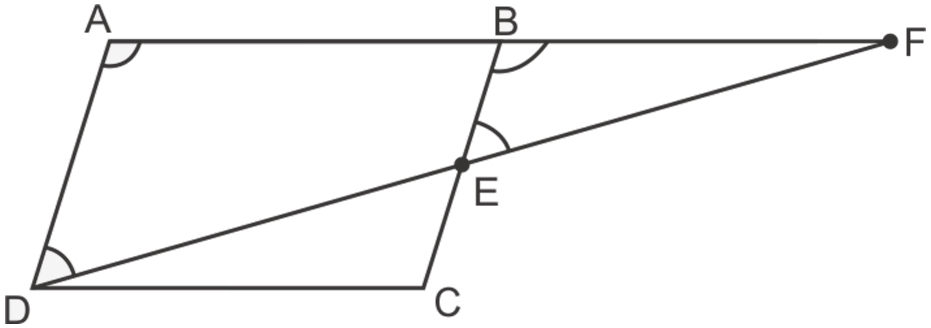
$BE || AD$
$\Rightarrow BE || AD$
Now, consider $\triangle\text{FAD}$
$BE || AD$
Also $\frac{\text{BE}}{\text{AD}}=\frac{1}{2}$
In $\triangle\text{FBE}$ and $\triangle\text{FAD},$
$\angle\text{FAD}=\angle\text{FBE}$ {Corresponding angles}
$\angle\text{ADF}=\angle\text{BEF}$ {Corresponding angles}
$\angle\text{F} =\angle\text{F}$ {Common}
Hence, $\triangle\text{FBE}\sim\triangle\text{FAD}$
$\Rightarrow\frac{\text{BF}}{\text{AF}}=\frac{\text{BE}}{\text{AD}}=\frac{1}{2}$
$\Rightarrow1-\frac{\text{BF}}{\text{AF}}=1-\frac{1}{2}$
$\Rightarrow\frac{\text{AF}-\text{BF}}{\text{AF}}=\frac{1}{2}$
$\Rightarrow\frac{\text{AB}}{\text{AF}}=\frac{1}{2}$
$\Rightarrow\text{AF}=\text{2AB}$ View full question & answer→MCQ 21 Mark
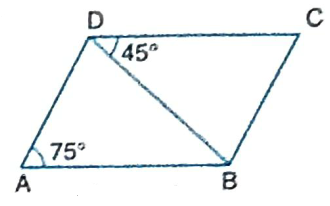
In a parallelogram $ABCD$, if $\angle\text{DAB}=75^\circ$ and $\angle\text{DBC}=60^\circ,$ then $\angle\text{BDC}=$
- A
$75^\circ $
- B
$60^\circ$
- ✓
$45^\circ$
- D
$55^\circ$
AnswerCorrect option: C. $45^\circ$
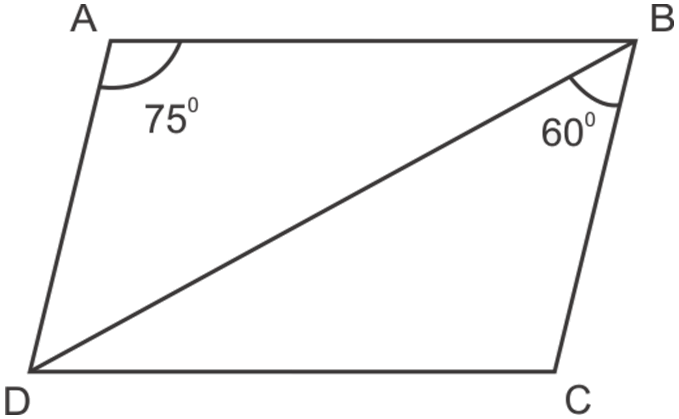
In parallelogram $ABCD$,
$\angle\text{A}+\angle\text{D}=180^\circ$
$\Rightarrow\angle\text{D}=180^\circ-75^\circ=105^\circ$
$\angle\text{ADB}=\angle\text{DBC}$ (Alternate angles)
$\Rightarrow\angle\text{ADB}=60^\circ$
$\angle\text{BDC}=\angle\text{ADC}-\angle\text{ADB}=105^\circ-60^\circ=45^\circ$ View full question & answer→MCQ 31 Mark
The figure formed by joining the mid-points of the adjacent sides of a quadrilateral is a:
Answer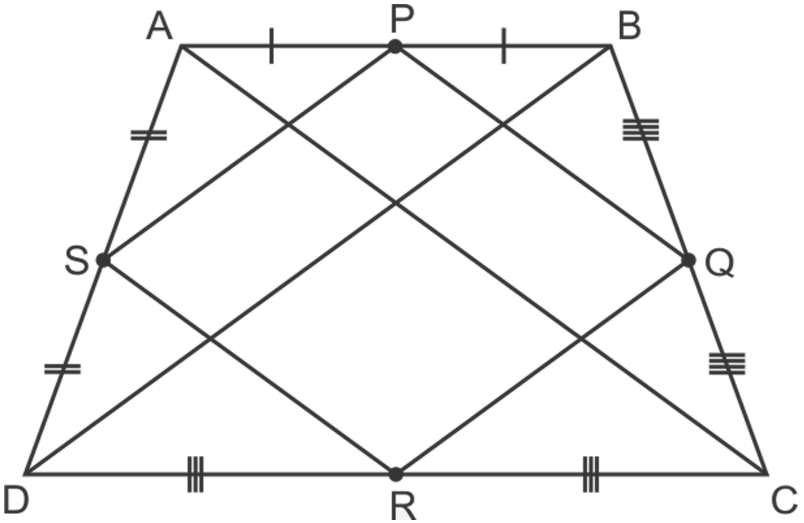
$P, Q, R$ & $S$ are the mid-points of $AB, BC, CD$ & $AD$ respectively.
Consider $\triangle\text{ADB},$
If in a triangle, the mid-points of two sides are joint by a line then the line is parallel to the third side.
$\Rightarrow\text{PS}||\text{DB}$ in $\triangle\text{ADB}$
Similarly in $\triangle\text{CDB},$
$RQ || DB$
Hence $PS || RQ ...(1)$
Similarly in $\triangle\text{ABC}$ and $\triangle\text{ADC}$
$SR || AC, PQ || AC$
$⇒ SR || PQ ...(2)$
From eq. $(1)$ and $(2)$, $PQRS$ is a parallelogram. View full question & answer→MCQ 41 Mark
In a rhombus $ABCD$, if $\angle\text{ACB}=40^\circ,$ then $\angle\text{ADB}=$
- A
$70^\circ$
- B
$45^\circ$
- ✓
$50^\circ$
- D
$60^\circ$
AnswerCorrect option: C. $50^\circ$
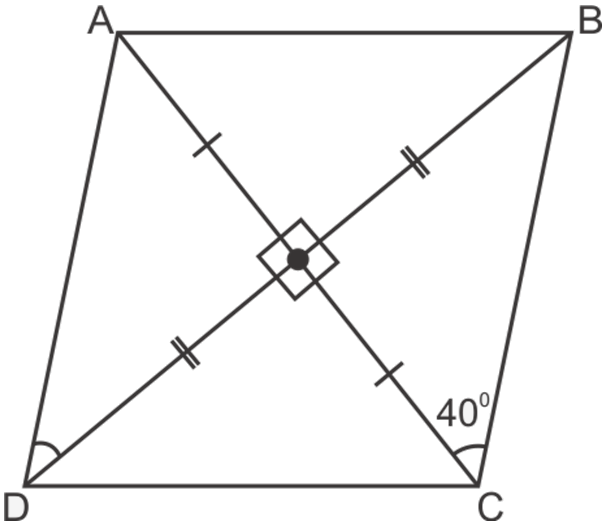
Consider $\triangle\text{AOD} \ \&\ \triangle\text{COB}$ $$
$\angle\text{AOD}=\angle\text{COB}=90^\circ$
$AD = BC$ (Sides of Rhombus)
$AO = CO$ (Diagonals bisects each other)
So by $RHS$ property, $\triangle\text{AOD}\cong\triangle\text{COB}$
$\Rightarrow\angle\text{OAD}=\angle\text{OCB}=40^\circ$
$\angle\text{ADB}=\angle\text{ADO}=180^\circ-90^\circ-40^\circ=50^\circ$ View full question & answer→MCQ 51 Mark
If an angle of a parallelogram is two-third of its adjacent angle, the smallest angle of the parallelogram is:
- A
$108^\circ$
- B
$54^\circ$
- ✓
$72^\circ$
- D
$81^\circ$
AnswerCorrect option: C. $72^\circ$
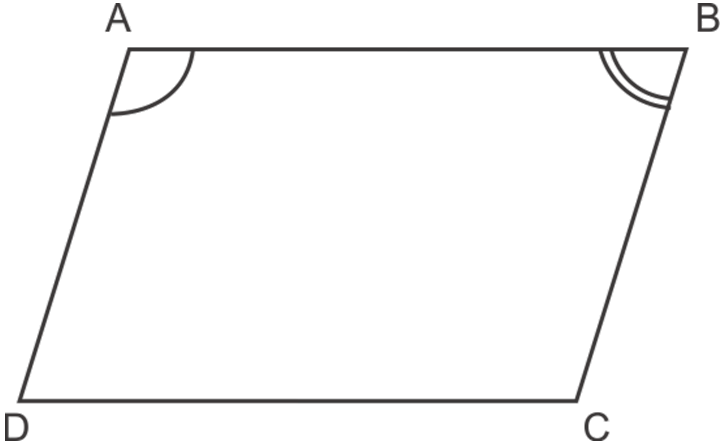
Let $ABCD$ be a parallelogram and $\angle\text{A}=\frac{2}{3}\angle\text{B}$
Also, $\angle\text{A}+\angle\text{B}=180^\circ$ (Adjacent angles in a parallelogram are supplementry)
$\Rightarrow\frac{2}{3}\angle\text{B}+\angle\text{B}=180^\circ$
$\Rightarrow\angle\text{B}=108^\circ$ and $\angle\text{A}=72^\circ$
$\Rightarrow$ Smallest angle is $72^\circ$. View full question & answer→MCQ 61 Mark
We get a rhombus by joining the mid-points of the sides of a:
Answer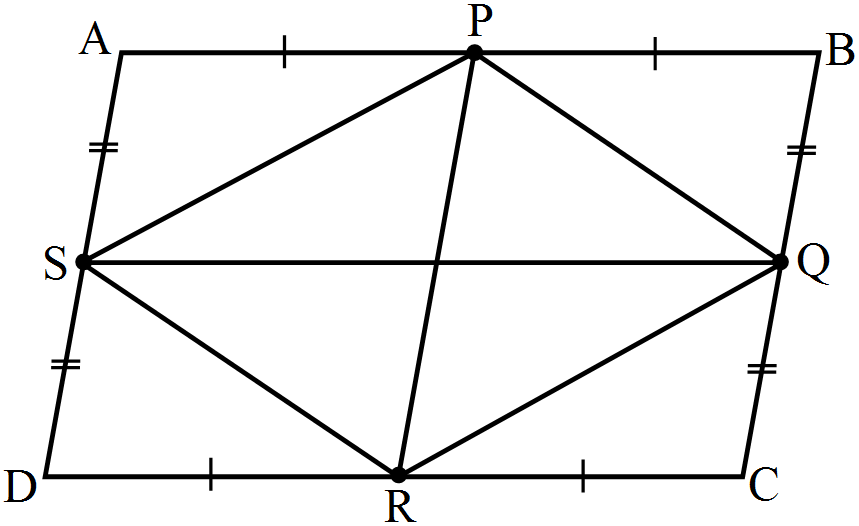
$\text{PR}||\text{AD}\Rightarrow\text{AB}\not\bot\text{AD}$
$\text{QS}||\text{AB}\Rightarrow\text{PR}\not\bot\text{QS}$
Since diagonals of $PQRS$ are not making $90^\circ$ between them,
$PQRS$ is not a Rhombus.
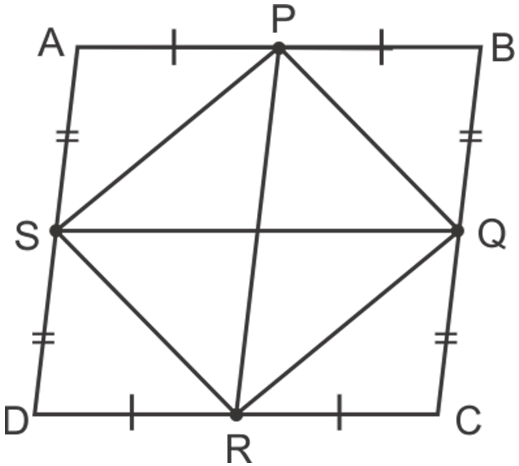
$P, Q, R$ and $S$ are the mid-points,
$PR$ and $QS$ are diagonals of quadrilateral PQRS.
$PR || AD, QS || AB$
Because they are Formed by joning of mid-points of sides of Rhombus $ABCD$.
$AD$ is not $\bot$ to $AB$
$\Rightarrow PR$ will not be $\bot$ to QS
i.e angle between diagonals $PR$ & $QS$ is not $90^\circ$.
So, $PQRS$ is not a Rhombus.
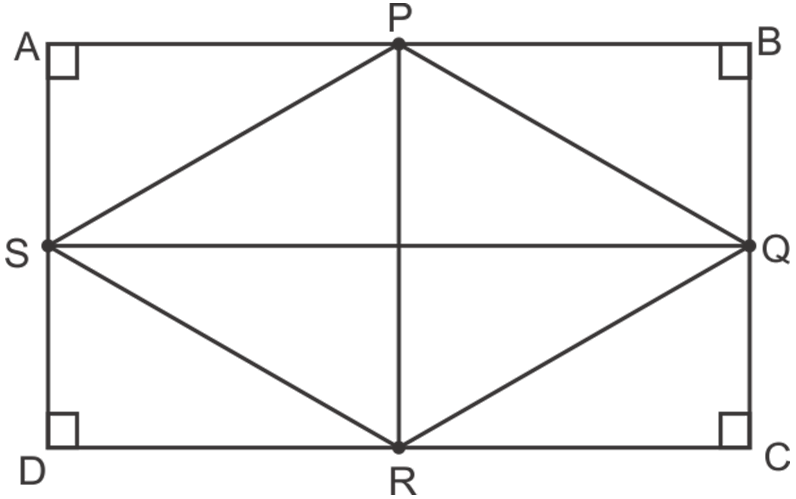
$PR$ and $QS$ are making $90^\circ$ with each - other.
Because $PR || AD, QS || AB$ and $\text{AD}\perp\text{AB}$
So $PR$ and $QS$ are diagonals of $PQRS$ and are $\perp$ to each other.
Hence , $PQRS$ is a Rhombus.
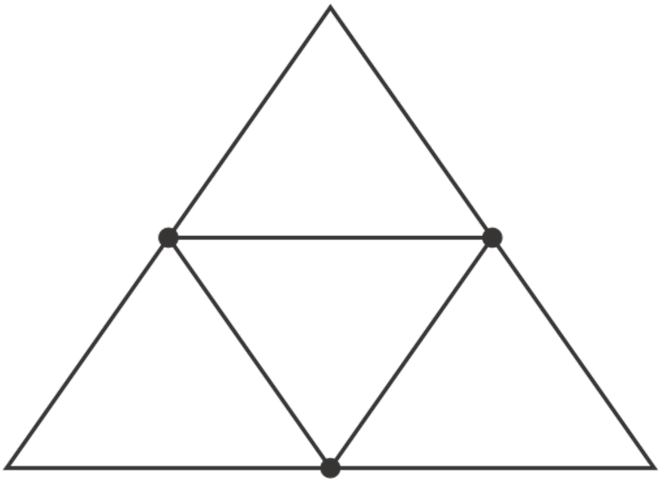
By joining the mid-points of sides of a triangle, no quadrilateral is formed. View full question & answer→MCQ 71 Mark
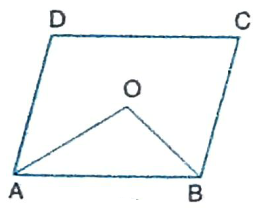
The bisectors of any two adjacent angles of a parallelogram intersect at:
- A
$30^\circ$
- B
$45^\circ$
- C
$60^\circ$
- ✓
$90^\circ$
AnswerCorrect option: D. $90^\circ$
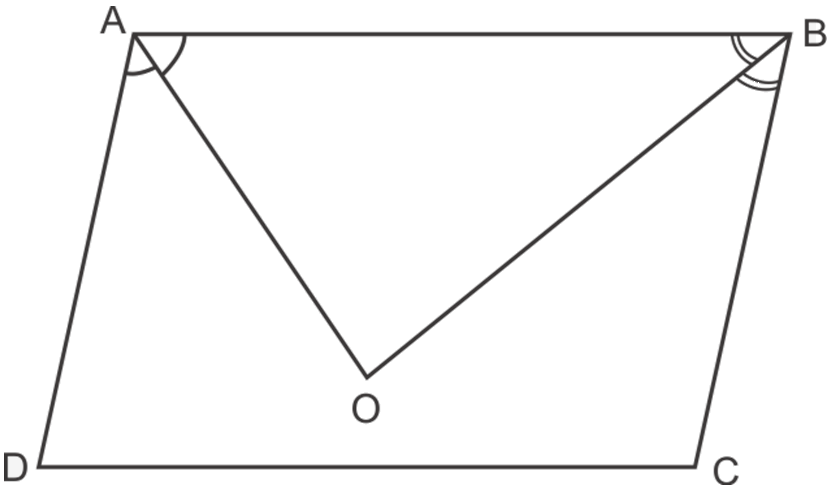
In a parallelogram, sum of adjacent angles $= 180^\circ$
$\Rightarrow \angle \text{A}+\angle\text{B}=180^\circ$
$\Rightarrow\frac{\angle\text{A}}{2}+\frac{\angle\text{B}}{2}=90^\circ\ ...(1)$
$\Rightarrow\angle\text{OAB}=\frac{\angle\text{A}}{2}$ and $\angle\text{OBA}=\frac{\angle\text{B}}{2}$
Thus, $\angle\text{OAB}+\angle\text{OBA}=90^\circ$ [From eq $(1)$]
$\Rightarrow\angle\text{AOB}=180^\circ-(\angle\text{OAB}+\angle\text{OBA})=180^\circ-90^\circ$
$\Rightarrow\angle\text{AOB}=90^\circ$ View full question & answer→MCQ 81 Mark
The figure formed by joining the mid-points of the adjacent sides of a rectangle is a:
Answer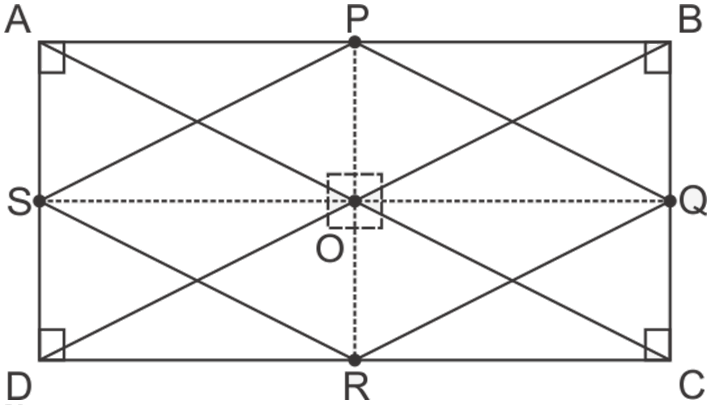
$PQ || AC$ (since in $\triangle\text{ABC}$ mid-points of $AB$ & $BC$ are meeting by $PQ$)
Similarly, $SR || AC$
$\Rightarrow PQ || SR$
Now in $\triangle\text{ABD}$ and $\triangle\text{CBD},$
$PS || BD$ and $QR || BD$
$\Rightarrow PS || QR$
Hence, $PQRS$ is a parallelogram.
But $\text{PR }\bot \text{ QS}$
$\Rightarrow $ Diagonals cut at $90^\circ$
$\Rightarrow PQRS$ is a Rhomus. View full question & answer→MCQ 91 Mark
The consecutive sides of a quadrilateral have:
- A
- ✓
- C
- D
Infinitely many common points.
Answer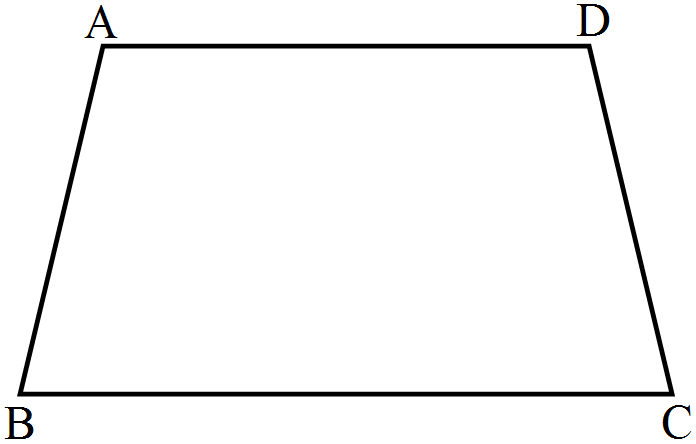
Consecutive sides of a Quadrilateral $ABCD$ are
$AB$ and $BC$,
$BC$ and $CD$,
$CD$ and $AD$,
$AD$ and $AB$,
Which have only one point in common
i.e the joint point of their ends. View full question & answer→MCQ 101 Mark
The figure formed by joining the mid-points of the adjacent sides of a parallelogram is a:
Answer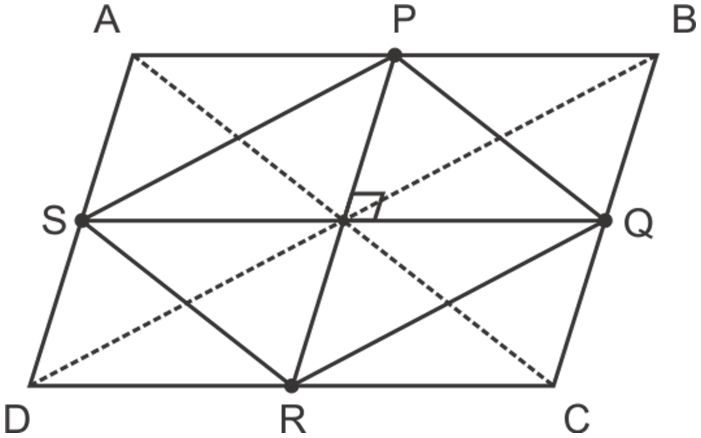
$PQ || SR || AC$
$QR || PS || BD$
{Because line joining the mid-points of two sides of triangle is $||$ to third side}
Now because $AC$ is not prependicular to $BD$ in parallelogram,
$\Rightarrow SR$ is not perpendicular to $QR$
Also $\triangle\text{ASP}\not\cong\triangle\text{DRS}$
$\Rightarrow \text{PS} \neq \text{SR}$
$\Rightarrow PQRS$ is just a parallelogram. View full question & answer→MCQ 111 Mark
Digonals necessarily bisect opposite angles in a:
AnswerDiagonals necessarily bisect opposite angles in a square.
View full question & answer→MCQ 121 Mark
$P$ is the mid-point of side $BC$ of a parallelogram $ABCD$ such that $\angle\text{BAP}=\angle\text{DAP}.$ If $AD = 10\ cm$, then $CD =$
- ✓
$5\ cm.$
- B
$6\ cm.$
- C
$8\ cm.$
- D
$10\ cm.$
AnswerCorrect option: A. $5\ cm.$
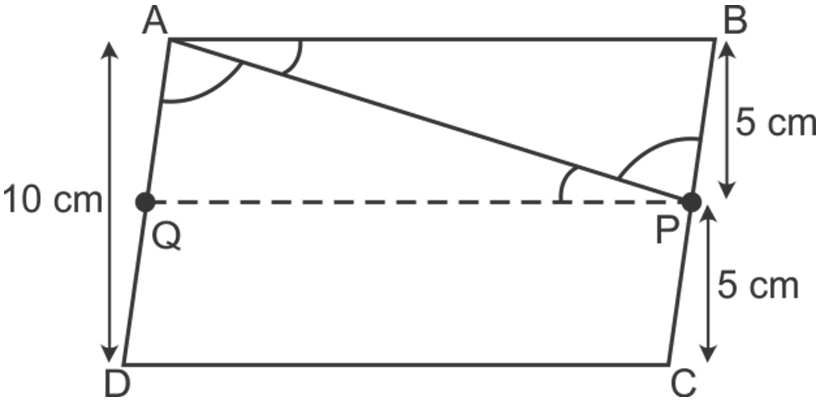
Let a line parallel to $AB$ is drawn from $P$ to meet $AD$ at $Q$.
$PQ || AB || DC$
$Q$ is also mid-point of $AD$.
Now, consider parallelogram $ABPQ$.
$\angle\text{PAQ}=\angle\text{APB}$ (Alternate angles)
Also $\angle\text{PAQ}=\angle\text{BAP}$ (Given)
$\Rightarrow\angle\text{APB}=\angle\text{BAP}$
So $\triangle\text{ABP}$ is isoseceles triangle.
$\Rightarrow\text{BP}=\text{AB}$
i.e. $\text{AB}=\frac{10}{2}=5\text{cm}$ View full question & answer→MCQ 131 Mark
If one angle of a parallelogram is $24^\circ$ less than twice the smallest angle, then the measure of the largest angle of the largest angle of the parallelogram is:
- A
$176^\circ$
- B
$68^\circ $
- ✓
$112^\circ$
- D
$102^\circ$
AnswerCorrect option: C. $112^\circ$
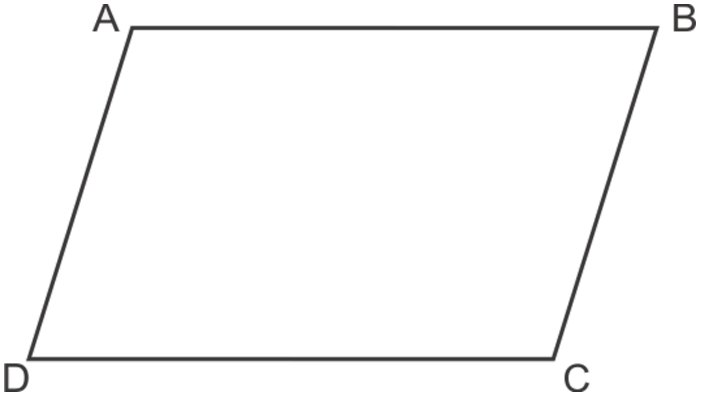
Let the smallest angle $=\angle\text{ADC}=\text{x}^\circ$
Other angle $\angle\text{BCD}$
$\Rightarrow\angle\text{BCD}=2\text{x}^\circ-24^\circ$
Also, $\angle\text{ACD}+\angle\text{BCD}=180^\circ$ (Sum of adjacent angles in $||^gram$ $= 180^\circ $)
$\Rightarrow\text{x}^\circ+2\text{x}^\circ-24^\circ=180^\circ$
$\Rightarrow3\text{x}^\circ=204^\circ$
$\Rightarrow\text{x}=68^\circ$
$\Rightarrow $ Largest angle $=\angle\text{BCD}=2\times68^\circ-24^\circ=112^\circ$ View full question & answer→MCQ 141 Mark
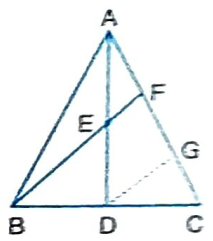
In $E$ is the mid-point of median $AD$ such that $BE$ produced meets $AC$ at $F$. If $AC = 10.5\ cm$, then $AF =$
- A
$3\ cm.$
- ✓
$3.5\ cm.$
- C
$2.5\ cm.$
- D
$5\ cm.$
AnswerCorrect option: B. $3.5\ cm.$
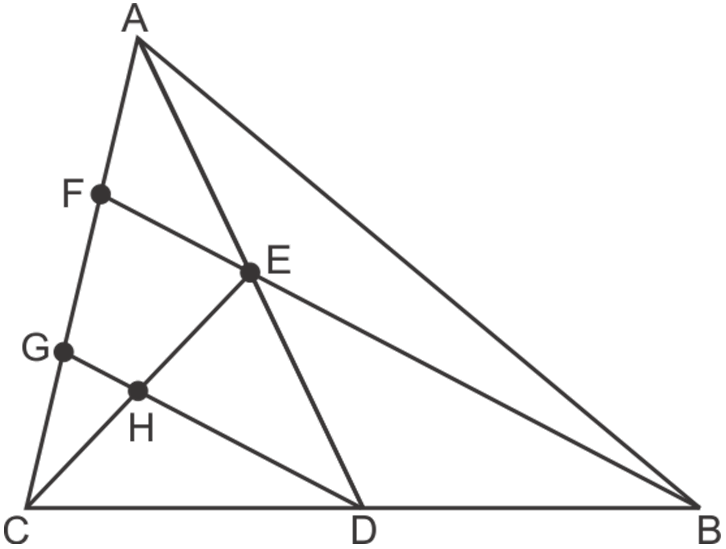
$A$ line $DG$ is drawn parallel to $EF$ to meet $AC$.
$FE || DG$ and $FE || GH$
Now, consider $\triangle\text{ADG}.$
$E$ is the mid-point of $AD$ and $EF$ is line from $E\ ||$ to Base $DG$.
So by property, it will meet $AG$ at its midpoint
i.e. $F$ is midpoint of $AG$.
$\Rightarrow AF = FG ...(1)$
Now, consider $\triangle\text{FBC}\ \&\ \triangle\text{GDC}$
$FE\ ||\ GH$ and $FE\ ||\ GD$
$D$ is mid-point of $BC$.
$\Rightarrow\frac{\text{DC}}{\text{BC}}=\frac{1}{2}\dots(2)$
Because $\triangle\text{FBC}\sim\triangle\text{GDC},$
$\Rightarrow\frac{\text{GC}}{\text{FC}}=\frac{1}{2}$
$\Rightarrow FC = 2GC$
or $FG = GC ...(3)$
From equation $(1)$ and $(3)$
$AF = FG = GC$
$\Rightarrow\text{AF}=\frac{\text{AC}}{3}=\frac{10.5}{3}=3.5\text{cm}$ View full question & answer→MCQ 151 Mark
The diagonals $AC$ and $BD$ of a rectangle $ABCD$ intersect each other at $P$. If $\angle\text{ABD}=50^\circ,$ then $\angle\text{DPC}=$
- A
$70^\circ$
- B
$90^\circ$
- ✓
$80^\circ$
- D
$100^\circ$
AnswerCorrect option: C. $80^\circ$
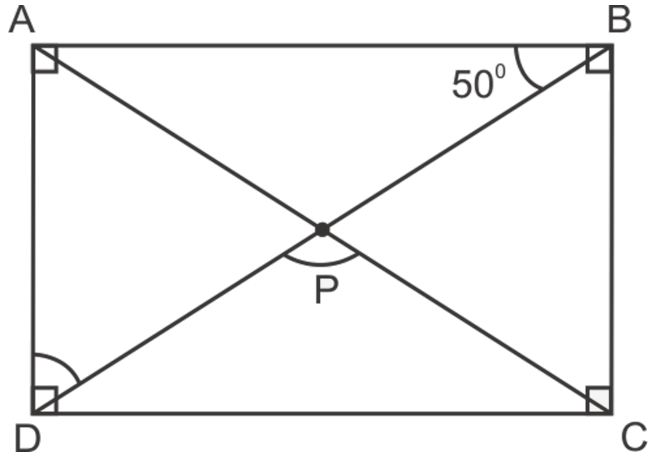
In $\triangle\text{ABD},$
$\angle\text{BDA}+\angle\text{ABD}+\angle\text{DAB}=180^\circ$
$\angle\text{ABD}=50^\circ$ and $\angle\text{DAB}=90^\circ$
$\Rightarrow\angle\text{BDA}=180^\circ-90^\circ-50^\circ=40^\circ$
Consider $\triangle\text{ABD}\ \&\ \triangle\text{BAC}$
$\text{AD}=\text{BC},\ \angle\text{DAB}=\angle\text{ABC}=90^\circ,\text{BD}=\text{AC}$
Hence, by $RHS$ property $\triangle\text{ABD}\cong\triangle\text{BAC}$
$\Rightarrow\angle\text{ABD}=\angle\text{BAC}=50^\circ$
Now, consider $\triangle\text{ABP}$
$\angle\text{PAB}+\angle\text{PBA}+\angle\text{APB}=180^\circ$
$\angle\text{PAB}=\angle\text{BAC}=50^\circ$
$\angle\text{PAB}=\angle\text{ABD}=50^\circ$
$\Rightarrow\angle\text{APB}=180^\circ-50^\circ-50^\circ=80^\circ$
Now, $\angle\text{APB}=\angle\text{DPC}$ (Opposite angles)
$\Rightarrow\angle\text{DPC}=80^\circ$ View full question & answer→MCQ 161 Mark
Which of the following quadrilateral is not a rhombus?
AnswerCorrect option: D. One angle between the diagonals is $60^\circ$.
For a rhombus, the angle between the diagonals is $90^\circ$ and not $60^\circ$.
View full question & answer→MCQ 171 Mark
The figure formed by joining the mid-points of the adjacent sides of a Square is a:
Answer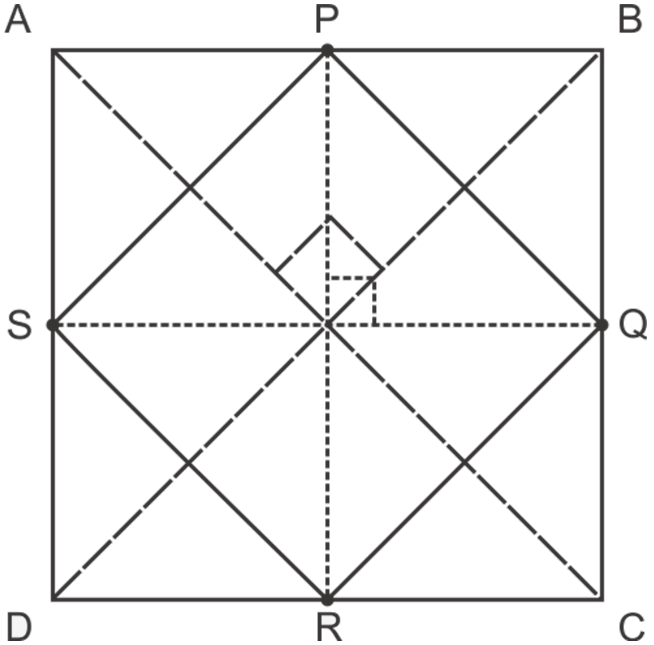
$PS\ ||\ QR, PQ\ ||\ SR ...(1)$
{Because lines joining the mid-points of any two sides of a triangle are parallel to the third side}
$\text{AC } \bot \text{ BD}$ & $\text{BR } \bot \text{ QS}$ (From Figure)
$SR\ ||\ AC$ and $QR\ ||\ BD$
$\text{AC } \bot \text{ BD}$
$\Rightarrow \text{SR }\bot \text{ QR}$
Hence $\angle\text{SRQ}=90^\circ\ ...(2)$
Also $\triangle\text{APS}\cong\triangle\text{DSR}$
$\Rightarrow\text{PS} = \text{SR}\dots(3)$
From equations $(1), (2), (3)$
$PQRS$ is a square. View full question & answer→MCQ 181 Mark
The figure formed by joining the mid-points of the adjacent sides of a rhombus is a:
Answer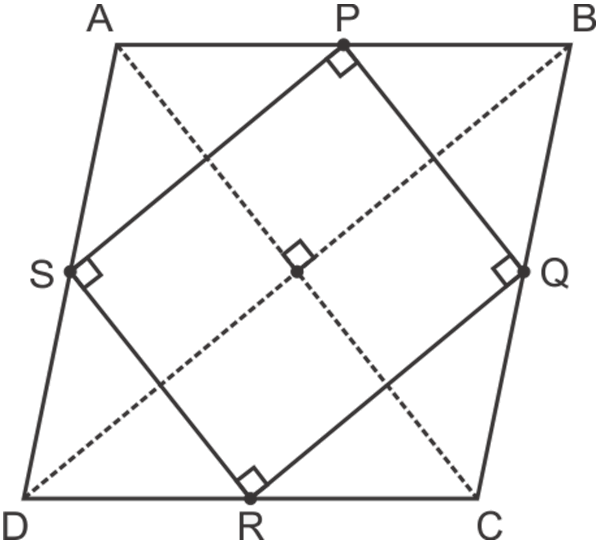
In $\triangle\text{ABD}$ and $\triangle\text{CBD}$
$PS || BD$ and $QR || BD$
{A line joining mid-points of two sides of triangle is parallel to third side}
$\Rightarrow PS\ ||\ QR$
Similiarly $PQ\ ||\ SR$
Because $SR || AC $and $QR\ ||\ BD$,
And angle between the diagonals of a Rhombus $AC$ and $BD =90^\circ$,
Angle between $SR$ and $QR = 90^\circ $
$\Rightarrow PQRS$ is a rectangle. View full question & answer→MCQ 191 Mark
In a quadrilateral $ABCD$, $\angle\text{A}+\angle\text{C}$ is 2 times $\angle\text{B}+\angle\text{D}$ If $\angle\text{A}=140^\circ$ and $\angle\text{D}=60^\circ$ then $\angle\text{B}=$
- ✓
$60^\circ $
- B
$80^\circ $
- C
$120^\circ$
- D
AnswerCorrect option: A. $60^\circ $
$\angle\text{A}+\angle\text{B}+\angle\text{C}+\angle\text{D}=360^\circ\dots(1)$
Now, $\angle\text{A}+\angle\text{C}=2(\angle\text{B}+\angle\text{D})$ (given) $...(2)$
Also, $\angle\text{A}=140^\circ,\ \angle\text{D}=60^\circ$
Putting value of $(\angle\text{A}+\angle\text{C})$ from eq. $(2)$ in eq. $(1)$
$2(\angle\text{B}+\angle\text{D})+\angle\text{B}+\angle\text{D}=360^\circ$
$3(\angle\text{B}+\angle\text{D})=360^\circ$
$\Rightarrow\angle\text{B}+\angle\text{D}=120^\circ$
$\Rightarrow\angle\text{B}+60^\circ=120^\circ$
$\Rightarrow\angle\text{B}=60^\circ$
View full question & answer→MCQ 201 Mark
The bisectors of the angle of a parallelogram enclose a:
Answer
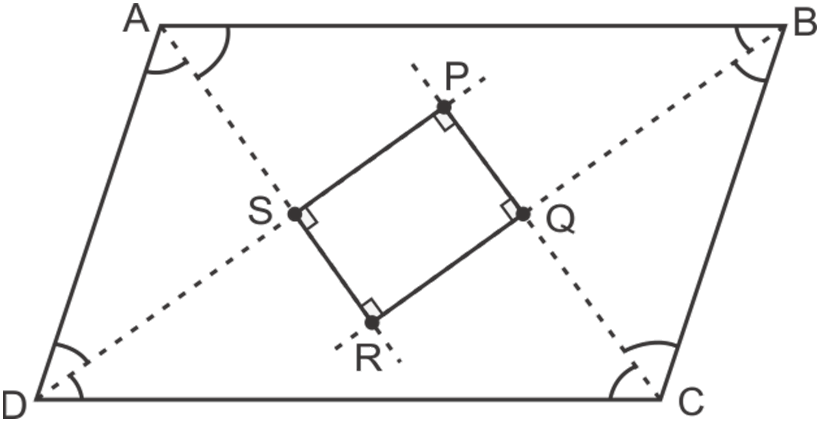
$AR, BR, CP, DP$ are the bisectors of angles of parallelogram.
Because two bisectors of adjacent angles make $90^\circ $ between them So $PQRS$ is a Rectangle
Because DP and BR are acute angle bisectors so the distance between them $PQ < PS$ (The distance between other two bisectors) So $\text{PQ}\neq\text{PS}$ (So $PQRS$ is not a square, but only a rectangle) View full question & answer→MCQ 211 Mark
In $\triangle\text{ABC},\angle\text{A}=30^\circ,\angle\text{B}=40^\circ$ and $\angle\text{C}=110^\circ.$ The angles of the triangle formed by joining the mid-points of the sides of this triangle are:
- A
$70^\circ , 70^\circ , 40^\circ $
- B
$60^\circ , 40^\circ , 80^\circ $
- ✓
$30^\circ , 40^\circ , 110^\circ$
- D
$60^\circ , 70^\circ , 50^\circ$
AnswerCorrect option: C. $30^\circ , 40^\circ , 110^\circ$
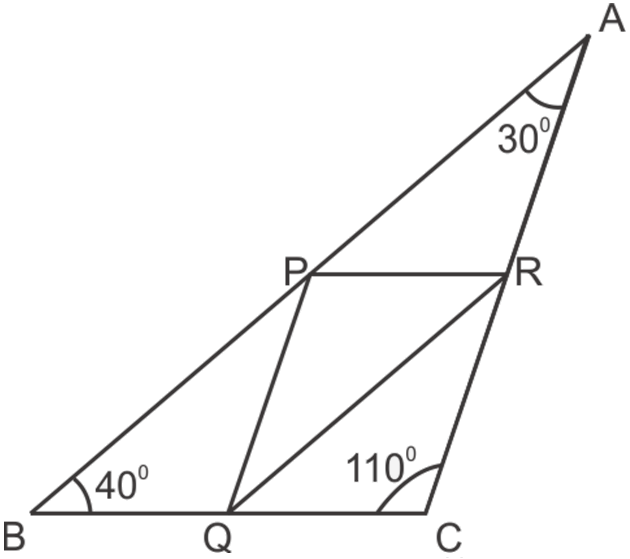
If in any triangle, all the mid-points (of each sides) are joined to form a triangle, then that triangle is similian to a parent triangle.
i.e.$\triangle\text{QPR}\sim\triangle\text{ABC}$
So angles of $\triangle\text{PQR}$ will be same as angles of $\triangle\text{ABC}.$
Thus, angles are $30^\circ , 40^\circ , 110^\circ $ View full question & answer→MCQ 221 Mark
$ABCD$ is a parallelogram and $E$ and $F$ are the centroids of triangles $ABD$ and $BCD$ respectively, then $EF =$
Answer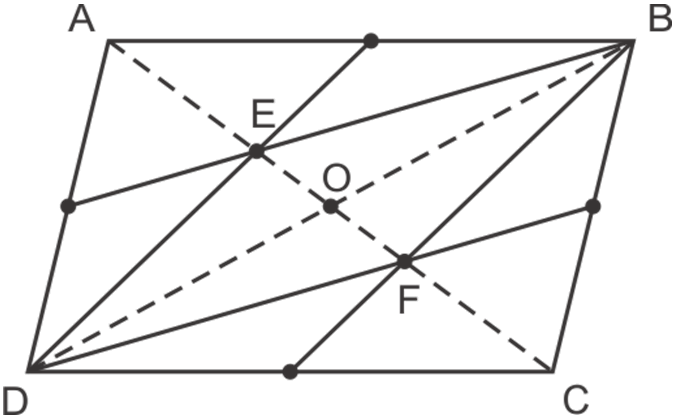
Centroid is the point where all medians of a meet.
In $\triangle\text{ABD},$ $E$ is the centroid,
And in $\triangle\text{BCD},$ F is the centroid.
By the property of centroid, centroid divides a median in $2 : 1$
So from figure,
$\frac{\text{AE}}{\text{EO}}=\frac{2}{1}\Rightarrow\text{EO}=\frac{\text{AE}}{2}\ ...(1)$
Also $\frac{\text{CF}}{\text{FO}}=\frac{2}{1}\Rightarrow\text{FO}=\frac{\text{CF}}{2}\ ...(2)$
Because $AC$ is a digonal of a parallelogram, $O$ is its midpoint.
$\Rightarrow OA = OC$
$\Rightarrow AE = CF$
Adding equations $(1)$ & $(2)$,
$\text{EO + FO} =\frac{\text{AE}+\text{CF}}{2}=\frac{\not2\text{AE}}{\not2}$
$\Rightarrow\text{EF}=\frac{\not2\text{AE}}{\not2}$
$\Rightarrow\text{EF}=\text{AE}$ View full question & answer→MCQ 231 Mark
The opposite sides of a quadrilateral have:
- ✓
- B
- C
- D
Infiniely many common points.
Answer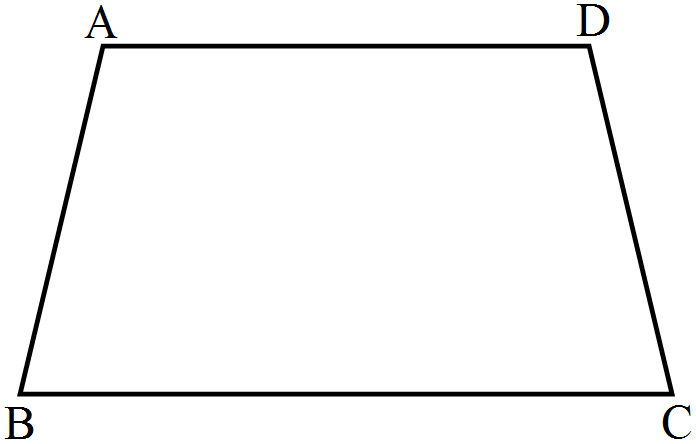
$ABCD$ is a Quadrilateral.
The opposite sides $AB$ and $DC, AD$ and $BC$ have no common point. View full question & answer→MCQ 241 Mark
If the diagonals of a rhombus of a rhombus are $18\ cm$ and $24\ cm$ respectively, then its side is equal to:
- A
$16\ cm.$
- ✓
$15\ cm.$
- C
$20\ cm.$
- D
$17\ cm.$
AnswerCorrect option: B. $15\ cm.$
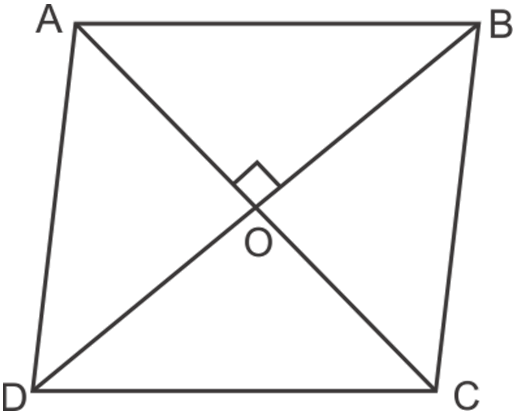
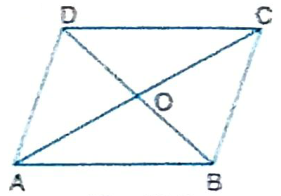
Let $BD = 24\ cm$ and $AC = 18\ cm$ (Given)
Now, $\frac{\text{AC}}{2}=\frac{18}{2}=9\text{cm}$ and $\text{BO}=\frac{\text{BD}}{2}=\frac{24}{2}=12\text{cm}$
Now, $\text{AB}=\sqrt{(\text{AO})^2+(\text{BO})^2}$ (Diagonals make $90^\circ$ between them)
$=\sqrt{9^2+12^2}$
$=\sqrt{81+144}$
$=\sqrt{225}$
$\text{AB}=15\text{cm}$ View full question & answer→MCQ 251 Mark
Diagonals of a quadrilateral $ABCD$ bisect each other. If $\angle\text{A}=45^\circ,$ then $\angle\text{B}=$
- A
$115^\circ$
- B
$120^\circ$
- C
$125^\circ$
- ✓
$135^\circ$
AnswerCorrect option: D. $135^\circ$
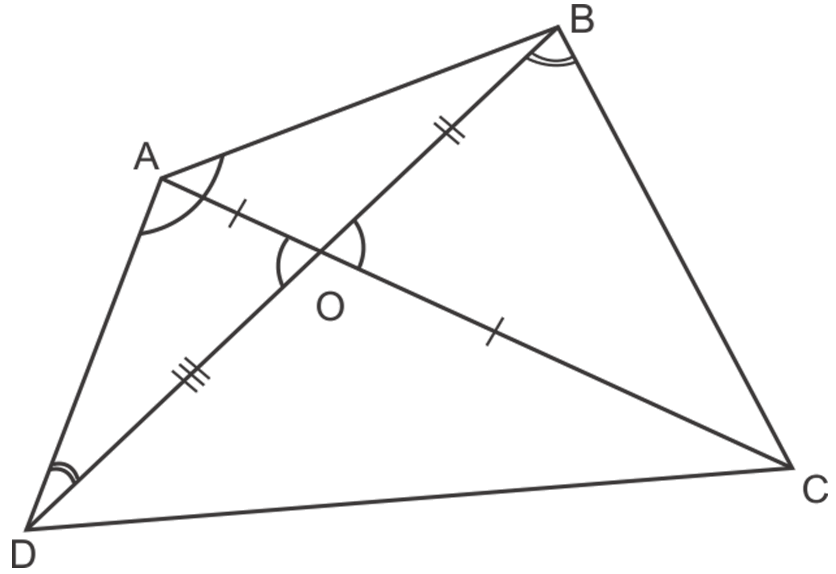
Consider $\triangle\text{AOD}\ \&\ \triangle\text{COB},$
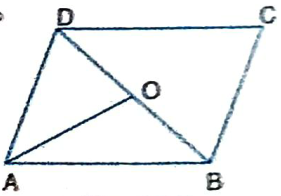
$AO = CO$ {Diagonals bisects each other}
$OD = OB$ {Diagonals bisects each other}
$\angle\text{AOD}=\angle\text{COB}$ (Opposite angles)
So by SAS property, $\triangle\text{AOD}\cong\triangle\text{COB},$
$\Rightarrow\angle\text{ADO}=\angle\text{CBO}\dots(1)$
$\angle\text{ABD}=180^\circ-\angle\text{A}-\angle\text{ADO}$ $($in $\triangle\text{ADB})$
$=180^\circ-45^\circ-\angle\text{ADO}$
$\angle\text{ABD}=135^\circ-\angle\text{ADO}\dots(2)$
$\angle\text{B}=\angle\text{ABD}+\angle\text{CBO}$
Putting values From eq $(1)$ and $(2)$
$\angle\text{B}=135^\circ-\angle\text{ADO}+\angle\text{ADO}$
$\angle\text{B}=135^\circ$ View full question & answer→MCQ 261 Mark
$ABCD$ is a parallelogram, $M$ is the mid-point of $BD$ and $BM$ bisects $\angle\text{B}.$ Then, $\angle\text{AMB}=$
- A
$45^\circ$
- B
$60^\circ$
- ✓
$90^\circ$
- D
$75^\circ$
AnswerCorrect option: C. $90^\circ$
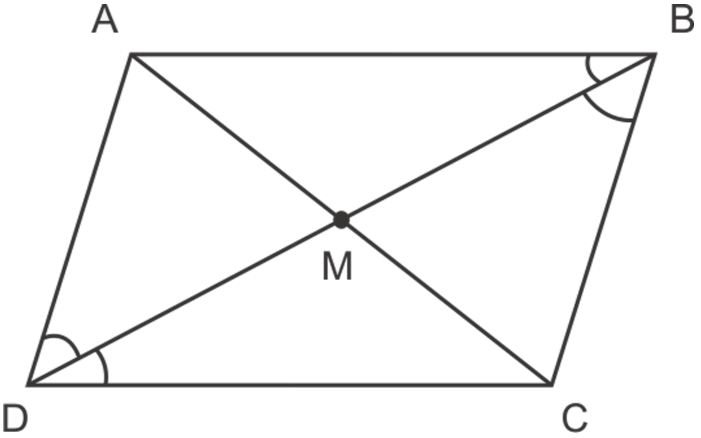
$\angle\text{ABM}=\angle\text{CBM}\ ...(1)$ $($BM bisects $\angle\text{B})$
$\angle\text{ABM}=\angle\text{MDC}\ ...(2)$ (Alternate angles)
$\angle\text{CBM}=\angle\text{ADM}\ ...(3)$ (Alternate angles)
From equations $(1), (2)$ & $(3)$
$\angle\text{MDC}=\angle\text{ADM}...(4)$
Now, consider $\triangle\text{ABM}$ & $\triangle\text{CBD}$
$\angle\text{CBD}=\angle\text{ABD}$ {from eq $(1)$}
$DB = DB$ (Common)
$\angle\text{ADB}=\angle\text{CDB}$ {from eq $(4)$}
Hence, by ASA property,
$\triangle\text{ADB}\cong\triangle\text{CBD}$
$\Rightarrow AB = CB, AD = CD$
Hence, it becomes a Rhombus.
So now diagonals of a Rhombus bisect each other at $90^\circ $.
$\Rightarrow\angle\text{AMB}=90^\circ$ View full question & answer→MCQ 271 Mark
If the degree measures of the angles of quadrilateral are 4x, 7x, 9x and 10, what is the sum of the measures of the smallest angle and largest angle?
AnswerSum of all angles of a Quadrilateral = 360°
4x + 7x + 9x + 10x = 360°
30x = 360°
x = 12°
So, sum of smallest and largest angle,
i.e. 4x + 10x = 14x = 14 × 12 = 168°
View full question & answer→MCQ 281 Mark
$ABCD$ is a trpezium in which $AB\ ||\ DC$. $M$ and $N$ are then mid-points of $AD$ and $BC$ respectively. If $AB = 12\ cm, MN = 14\ cm$, then $CD =$
- A
$10\ cm.$
- B
$12\ cm.$
- C
$14\ cm.$
- ✓
$16\ cm.$
AnswerCorrect option: D. $16\ cm.$
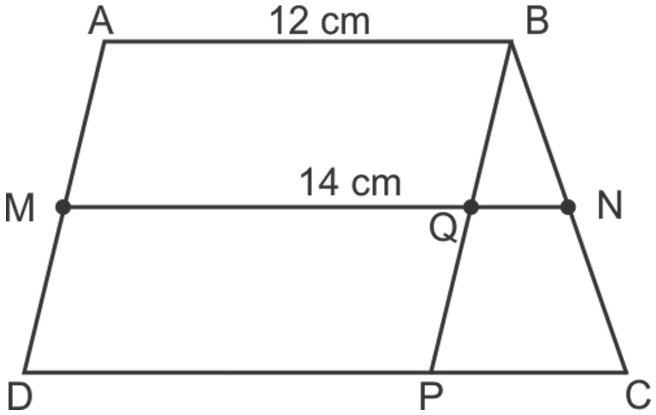
Let a line $BP$ is drawn || to $AD$ to meet $DC$ at $P.$
$ABPD$ is a parallelogram.
$AB || PD, AD || BP$
So $AB = DP$
Let $BP$ cuts $MN$ at $Q$.
$MQ$ is also || to $AB || PD$
So $AB = MQ = PD = 12\ cm ...(1)$
$QN = MN - MQ = 14 - 12 = 2\ cm$
Consider $\triangle\text{BPC}.$
$Q$ and $N$ are the mid-points of $BP$ & $BC$, and the line joining them $QN\ ||\ PC$.
Then by property, $\frac{\text{QN}}{\text{PC}}=\frac{1}{2}$
$\Rightarrow PC = 2QN = 2 \times 2 = 4cm$
Now, $DC = DP + PC$
$DP = 12\ cm$ [From $(1)$]
$\Rightarrow DC = 12 + 4 = 16cm$ View full question & answer→MCQ 291 Mark
$ABCD$ is a parallelogram in which diagonal $AC$ bisects $\angle\text{BAD}.$ if $\angle\text{BAC}=35^\circ,$ then $\angle\text{ABC}=$
- A
$70^\circ$
- ✓
$110^\circ$
- C
$90^\circ$
- D
$120^\circ$
AnswerCorrect option: B. $110^\circ$
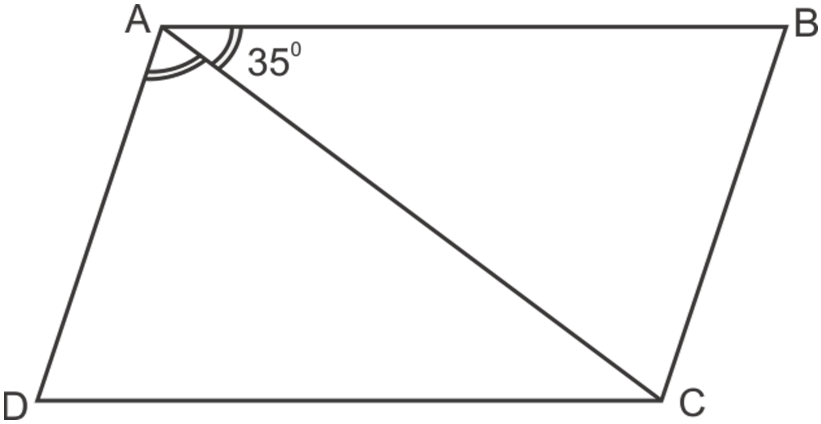
$AC$ bisects $\angle\text{DAB}.$
$\Rightarrow\angle\text{DAC}=\angle\text{BAC}=35^\circ$
$\Rightarrow\angle\text{BAD}=2\times35^\circ=70^\circ$
$\angle\text{A}+\angle\text{B}=180^\circ$ (Sum of any two adjacent angles in parallelogram $=180^\circ$)
$\Rightarrow\angle\text{B}=\angle\text{ABC}=180^\circ-\angle\text{BAD}$
$=180^\circ-70^\circ=110^\circ$ View full question & answer→MCQ 301 Mark
$PQRS$ is a quadrilateral. $PR$ and $QS$ intersect each other at $O$. in which of the following cases, $PQRS$ is a parallelogram?
- ✓
$\angle\text{P}=100^\circ,\angle\text{Q}=80^\circ,\angle\text{R}=100^\circ$
- B
$\angle\text{P}=85^\circ,\angle\text{Q}=85^\circ,\angle\text{R}=95^\circ$
- C
$\text{PQ}=7\text{cm},\text{QR}=7\text{cm},\text{RS}=8\text{cm},\text{SP}=8\text{cm}$
- D
$\text{OP}=6.5\text{cm},\text{OQ}=6.5\text{cm},\text{OR}=5.2\text{cm},\text{OS}=5.2\text{cm}$
AnswerCorrect option: A. $\angle\text{P}=100^\circ,\angle\text{Q}=80^\circ,\angle\text{R}=100^\circ$
In a parallelogram, opposite corner angles are equal and sum of adjacent angles $= 108^\circ$
Hence, in quadrrilateral $PQRS$,
$\Rightarrow\angle\text{P}=\angle\text{R}$ and $\angle\text{Q}=\angle\text{S}$
Also, $\angle\text{P}+\angle\text{Q}=\angle\text{Q}+\text{R}=180^\circ$
Hence, if $\angle\text{P}=100^\circ$ and $\angle\text{Q}=80^\circ,$ then
$\angle\text{P}+\angle\text{Q}=100^\circ+80^\circ=180^\circ$
Also, if $\angle\text{Q}+=80^\circ$ and $\angle\text{R}=100^\circ$ then
$\angle\text{Q}+\angle\text{R}=80^\circ+100^\circ=180^\circ$
View full question & answer→MCQ 311 Mark
The diagonals of a parallelogram $ABCD$ intersect at $O$. if $\angle\text{BOC}=90^\circ$ and $\angle\text{BDC}=50^\circ,$ then $\angle\text{AOB}=$
- ✓
$40^\circ$
- B
$50^\circ$
- C
$10^\circ$
- D
$90^\circ$
AnswerCorrect option: A. $40^\circ$
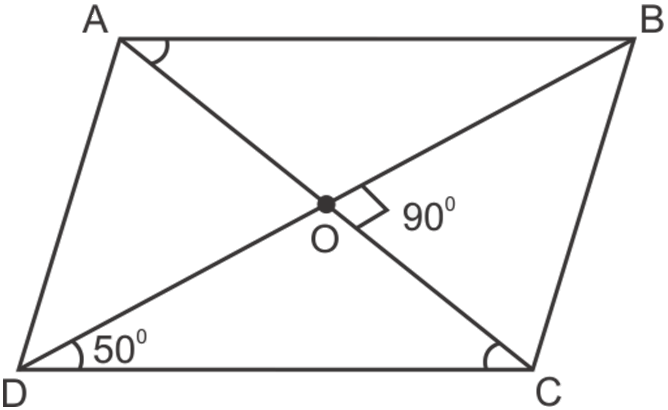
In a parallelogram $ABCD$,
$\angle\text{OAB}=\angle\text{OCB}$
In $\triangle\text{OCB}$
$\angle\text{OCD}+\angle\text{COD}+\angle\text{ODC}=180^\circ$
$\angle\text{COD}=90^\circ$
$\angle\text{ODC}=50^\circ$ (given)
$\angle\text{OCD}=180^\circ-90^\circ-50^\circ=40^\circ$
$\Rightarrow\angle\text{OAB}=\angle\text{OCD}=40^\circ$ View full question & answer→MCQ 321 Mark
The two digonals are equal in a:
AnswerThe two diagonals are equal in a rectangle (property).
View full question & answer→MCQ 331 Mark
In Fig., D and E are the mid-points of the sides AB and AC respectively of $\triangle A B C$. DE is produced to F. To prove that CF is equal and parallel to DA, we need an additional information which is
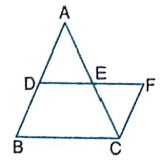
Answer(c) DE = EF
In order to prove that $C F=D A$ and $C F \| D A$, it is sufficient to show that $\triangle A E D=\triangle C E F$ for which we require $D E=E F$.
View full question & answer→MCQ 341 Mark
If APB and CQD are two parallel lines, then the bisectors of the angles $\angle A P Q, \angle B P Q$, $\angle C Q P$ and $\angle P Q D$ form
View full question & answer→MCQ 351 Mark
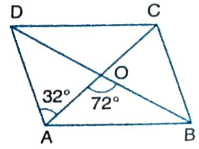
Diagonals AC and BD of a parallelogram ABCD intersect each other at the point O. If $\angle D A C=32^{\circ}$ and $\angle A O B=70^{\circ}$, then $\angle D B C$ is equal to
- A
$24^{\circ}$
- B
$86^{\circ}$
- ✓
$38^{\circ}$
- D
$32^{\circ}$
AnswerCorrect option: C. $38^{\circ}$
(c) $38^{\circ}$
We have, $\angle A O B=70^{\circ}$
$\therefore \quad \angle D O A=180^{\circ}-70^{\circ}=110^{\circ} \Rightarrow B O C=110^{\circ}$
Given that $\angle D A C=32^{\circ} \Rightarrow \angle O C B=32^{\circ}$
Thus, in $\triangle O C B$, we have
$\begin{array}{ll}& \angle O C B=32^{\circ} \text { and } \angle B O C=110^{\circ} \\
\therefore & \angle O B C=180^{\circ}-32^{\circ}-110^{\circ}=38^{\circ} \\
\text { Hence, } & \angle D B C=\angle O B C=38^{\circ}\end{array}$
View full question & answer→MCQ 361 Mark
Which of the following is not true for a parallelogram?
- A
- B
opposite angles are equal
- ✓
opposite angles are bisected by the diagonals
- D
diagonal bisects each other
AnswerCorrect option: C. opposite angles are bisected by the diagonals
View full question & answer→MCQ 371 Mark
If angles A, B, C and D of the quadrilateral ABCD, taken in order, are in the ratio $3: 7: 6: 4$, then ABCD is a
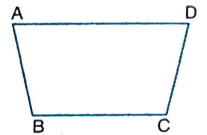
Answer(c) trapezium
Let $\angle A=3 x^{\circ}, \angle B=7 x^{\circ}, \angle C=6 x^{\circ}$ and $\angle D=4 x^{\circ}$. Then,
$\angle A+\angle B+\angle C+\angle D=360^{\circ} \Rightarrow 3 x^{\circ}+7 x^{\circ}+6 x^{\circ}+4 x^{\circ}=360^{\circ}\Rightarrow 20 x^{\circ}=360^{\circ} \Rightarrow x=18$
$\begin{array}{ll}\therefore & \angle A=54^{\circ}, \angle B=126^{\circ}, \angle C=108^{\circ} \text { and } \angle D=72^{\circ}
\\ \Rightarrow & \angle A+\angle B=180^{\circ} \text { and } \angle C+\angle D=108^{\circ}
\\ \Rightarrow & A D \| B C \Rightarrow A B C D \text { is a trapezium. }\end{array}$
View full question & answer→MCQ 381 Mark
Diagonal of a parallelogram ABCD intersect at O. If $\angle B O C=90^{\circ}$ and $\angle B D C=50^{\circ}$, then $\angle O A B$ is
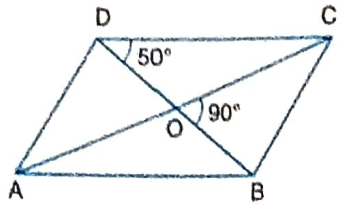
- A
$90^{\circ}$
- B
$50^{\circ}$
- ✓
$40^{\circ}$
- D
$10^{\circ}$
AnswerCorrect option: C. $40^{\circ}$
(c) $40^{\circ}$
In $\triangle O C D$, we have
$\angle O D C=50^{\circ} \text { and } \angle C O D=90^{\circ}$
$\begin{array}{ll}\therefore & \angle O C D=180^{\circ}-\left(150^{\circ}+90^{\circ}\right)=40^{\circ}
\\ \text { Hence, } & \angle O A B=\angle O C D \Rightarrow \angle O A B=40^{\circ}\end{array}$
View full question & answer→MCQ 391 Mark
If the bisectors of $\angle A$ and $\angle B$ of quadrilateral ABCD intersect each other at $P, \angle B$ and $\angle C$ at Q of $\angle C$ and $\angle D$ at R and of $\angle D$ and $\angle A$ at S, then PQRS is a
- A
- B
- C
- ✓
quadrilateral whose opposite angles are supplementary
AnswerCorrect option: D. quadrilateral whose opposite angles are supplementary
(d) quadrilateral whose opposite angles are supplementary
We find that
$\begin{aligned}& \angle P=\frac{1}{2}(\angle C+\angle D), Q=\frac{1}{2}(\angle A-\angle D), R=\frac{1}{2}(\angle A-\angle B) \text { and, } \angle S=\frac{1}{2}(\angle B-\angle C) \\
\Rightarrow & \angle P+\angle R=\frac{1}{2}(\angle A+\angle B+\angle C+\angle D)=180^{\circ} \text { and } \angle Q+\angle S=\frac{1}{2}(\angle A-\angle B-\angle C+\angle D)=180^{\circ}\end{aligned}$
Hence, option (d) is correct.
View full question & answer→MCQ 401 Mark
The quadrilateral formed by joining the mid-points of the sides of a quadrilateral PQRS. taken in order, is a rhombus, if
- A
- B
- C
diagonals of PQRS are perpendicular
- ✓
diagonals of PQRS are equal
AnswerCorrect option: D. diagonals of PQRS are equal
View full question & answer→MCQ 411 Mark
The quadrilateral formed by joining the mid-points of the pair of consecutive sides of a quadrilateral PQRS, taken in order, is a rectangle, if
- A
- B
- ✓
diagonals of PQRS are perpendicular
- D
diagonals of PQRS are equal
AnswerCorrect option: C. diagonals of PQRS are perpendicular
View full question & answer→MCQ 421 Mark
ABCD is a rhombus such that $\angle A C B=40^{\circ}$. Then, $\angle A D B=$
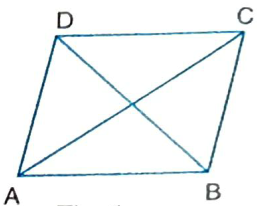
- A
$40^{\circ}$
- B
$45^{\circ}$
- ✓
$50^{\circ}$
- D
$60^{\circ}$
AnswerCorrect option: C. $50^{\circ}$
(c) $50^{\circ}$
Given that $\angle A C B=40^{\circ}$. Therefore, $\angle B C D=80^{\circ}$
and hence $\angle A D C=180^{\circ}-80^{\circ}=100^{\circ}$. Therefore, $\angle A D B=\frac{1}{2} \angle A D C=50^{\circ}$.
View full question & answer→MCQ 431 Mark
A diagonal of a rectangle is inclined to one side of the rectangle at $25^{\circ}$. The acute angle between the diagonals is
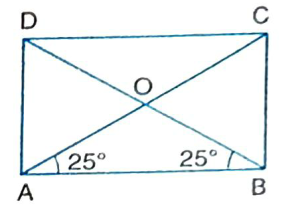
- A
$55^{\circ}$
- ✓
$50^{\circ}$
- C
$40^{\circ}$
- D
$25^{\circ}$
AnswerCorrect option: B. $50^{\circ}$
(b) $50^{\circ}$
In rectangle ABCD whose diagonals AC and BD intersect at O it is given that $\angle O A B=25^{\circ}$. Therefore, $\angle O B A=25^{\circ}$ and $\angle A O B=180^{\circ}-\left(25^{\circ}+25^{\circ}\right)=130^{\circ}$
$\therefore \quad \angle A O D=\angle B O C=180^{\circ}-130^{\circ}=50^{\circ}$
View full question & answer→MCQ 441 Mark
Three angles of a quadrilateral are $75^{\circ}, 90^{\circ}$ and $75^{\circ}$. The fourth angle is
- A
$90^{\circ}$
- B
$95^{\circ}$
- C
$105^{\circ}$
- ✓
$120^{\circ}$
AnswerCorrect option: D. $120^{\circ}$
(d) $120^{\circ}$
Let the measure of fourth angle be $x^{\circ}$. The sum of the angles of a quadrilateral is $360^{\circ}$.
$\therefore \quad 75^{\circ}+90^{\circ}+75^{\circ}+x^{\circ}=360^{\circ} \Rightarrow 240^{\circ}+x^{\circ}=360^{\circ}\Rightarrow x^{\circ}=120^{\circ}$
View full question & answer→MCQ 451 Mark
In a trapezium ABCD, if $A B \| C D$, then $A C^2+B D^2=$
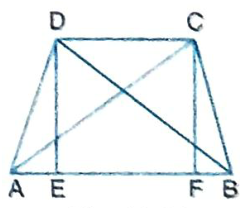
- A
$B C^2+A D^2+2 B C \times A D$
- B
$A B^2+C D^2+2 A B \times C D$
- C
$A B^2+C D^2+2 A D \times B C$
- ✓
$B C^2+A D^2+2 A B \times C D$
AnswerCorrect option: D. $B C^2+A D^2+2 A B \times C D$
(d) $B C^2+A D^2+2 A B \times C D$
In $\triangle A B C, \angle B$ is acute angle.
$\therefore \quad A C^2=A B^2+B C^2-2 A B \times B F \quad$...(i)
In $\triangle A B D, \angle A$ is acute angle.
$\therefore \quad B D^2=A B^2+A D^2-2 A B \times A E \quad$...(ii)
Adding (i) and (ii), we get
$\begin{aligned}A C^2+B D^2 & =B C^2+A D^2+2 A B^2-2 A B \times B F-2 A B \times A E \\
& =B C^2+A D^2+2 A B(A B-B F-A E) \\
& =B C^2+A D^2+2 A B \times E F=B C^2+A D^2+2 A B \times C D\end{aligned}$
View full question & answer→MCQ 461 Mark
- A
$1: 2$
- ✓
$2: 1$
- C
$2: 3$
- D
$1: 1$
AnswerCorrect option: B. $2: 1$
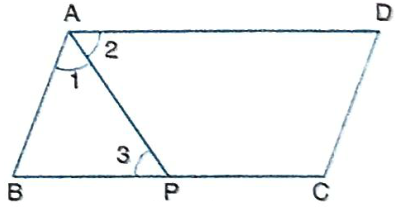
(b) $2: 1$
In parallelogram ABCD, we find that $A D \| B C$ and transversal AP cuts them at A and P respectively. Therefore,
$\angle 2=\angle 3 \quad$...(i)
But, AP is the bisector of $\angle B A D$. Therefore,
$\angle 1=\angle 2 \quad$...(ii)
From (i) and (ii), we obtain
$\angle 1=\angle 3 \Rightarrow B P=A B \quad$ [Sides opposite to equal angles]
$\Rightarrow \quad \frac{1}{2} B C=A B \quad[\because P$ is the mid-point of $B C]$
$\Rightarrow \quad \frac{1}{2} A D=C D \Rightarrow A D=2 C D \Rightarrow A D: C D=2: 1$
View full question & answer→MCQ 471 Mark
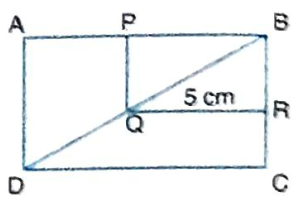
Answer(c) 10 cm
since ABCD and PQRB are rectangles. Therefore, $Q R \perp B C$ and $D C \perp B C$. Consequently, $Q R \| D C$.
In $\triangle B C D, Q$ is the mid-point of BD and $Q R \| D C$. Therefore, R is the mid-point of BC and$
Q R=\frac{1}{2} D C \Rightarrow 5=\frac{1}{2} A B \Rightarrow A B=10 cm
$
View full question & answer→MCQ 481 Mark
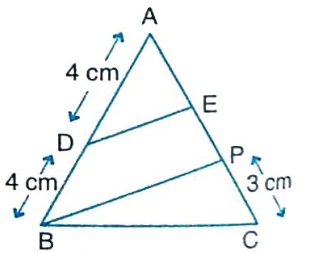
Answer(b) 3 cm
We have, $P C=\frac{1}{2} A P$ and $P C=3 cm$. Therefore, $A P=6 cm$.
In $\triangle A B P$, it is given that $D E \| B P$ and D is the mid-point of AB. Therefore, E is the mid-point of AP.
Hence, $A E=\frac{1}{2} A P=3 cm$.
View full question & answer→MCQ 491 Mark
In a parallelogram ABCD, if $\angle A=(2 x+25)^{\circ}$ and $\angle B=(3 x-5)^{\circ}$, then $x=$
- A
$30^{\circ}$
- B
$42^{\circ}$
- C
$24^{\circ}$
- ✓
$32^{\circ}$
AnswerCorrect option: D. $32^{\circ}$
(d) $32^{\circ}$
In a parallelogram any two adjacent angles are supplementary.
$\begin{array}{ll}\therefore & \angle A+\angle B=180^{\circ} \\
\Rightarrow & (2 x+25)^{\circ}+(3 x-5)^{\circ}=180^{\circ} \\
\Rightarrow & (5 x+20)^{\circ}=180^{\circ} \Rightarrow 5 x^{\circ}=160^{\circ} \Rightarrow x=32^{\circ}\end{array}$
View full question & answer→MCQ 501 Mark
In a parallelogram ABCD, if $\angle B A D=60^{\circ}$ and $\angle D B C=80^{\circ}$, then $\angle C D B=$
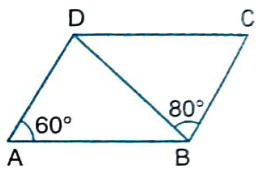
- A
$140^{\circ}$
- B
$20^{\circ}$
- ✓
$40^{\circ}$
- D
$120^{\circ}$
AnswerCorrect option: C. $40^{\circ}$
(c) $40^{\circ}$
we have,
$\angle B A D=60^{\circ} \Rightarrow \angle B C D=60^{\circ}$
Using angle sum property in $\triangle D B C$, we obtain
$\angle D B C+\angle B C D+\angle B D C=180^{\circ} \Rightarrow 80^{\circ}+60^{\circ}+\angle B D C=180^{\circ} \Rightarrow \angle B D C=40^{\circ}$
View full question & answer→MCQ 511 Mark
If the diagonals of a quadrilateral PQRS bisect each other such that $\angle P=40^{\circ}$, then $\angle Q=$
- ✓
$140^{\circ}$
- B
$50^{\circ}$
- C
$100^{\circ}$
- D
$120^{\circ}$
AnswerCorrect option: A. $140^{\circ}$
(a) $140^{\circ}$
Since the diagonal of quadrilateral PQRS bisect each other. Therefore, PQRS is a parallelogram.$
\therefore \quad \angle P+\angle Q=180^{\circ} \Rightarrow 40^{\circ}+\angle Q=180^{\circ} \Rightarrow \angle Q=140^{\circ}$
View full question & answer→MCQ 521 Mark
One of the diagonals of a rhombus is equal to a side of the rhombus. The angles of the rhombus are
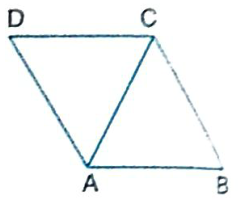
- A
$70^{\circ}, 110^{\circ}, 110^{\circ}, 70^{\circ}$
- B
$80^{\circ}, 100^{\circ}, 100^{\circ}, 80^{\circ}$
- ✓
$120^{\circ}, 60^{\circ}, 120^{\circ}, 60^{\circ}$
- D
AnswerCorrect option: C. $120^{\circ}, 60^{\circ}, 120^{\circ}, 60^{\circ}$
(c) $120^{\circ}, 60^{\circ}, 120^{\circ}, 60^{\circ}$
Let ABCD be a rhombus such that diagonal AC = AB. Then, $\triangle A B C$ is an equilateral triangle. Therefore,
$\angle B=60^{\circ} \Rightarrow \angle D=60^{\circ} \Rightarrow \angle A=\angle C=180^{\circ}-60^{\circ}=120^{\circ}$
Hence, the angles are $120^{\circ}, 60^{\circ}, 120^{\circ}, 60^{\circ}$.
View full question & answer→MCQ 531 Mark
In a parallelogram ABCD, if $\angle A=75^{\circ}$, then $\angle D-\angle C=$
- A
$5^{\circ}$
- B
$20^{\circ}$
- ✓
$30^{\circ}$
- D
$60^{\circ}$
AnswerCorrect option: C. $30^{\circ}$
(c) $30^{\circ}$
We have, $\angle A=75^{\circ}$
$\therefore \quad \angle C=75^{\circ} \text { and } \angle D=105^{\circ} \Rightarrow \angle D-\angle C=30^{\circ}$
View full question & answer→MCQ 541 Mark
In a rhombus ABCD, if $A B=A C$, then $\angle A B C$ is
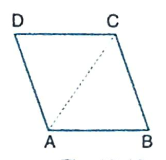
- A
$120^{\circ}$
- B
$90^{\circ}$
- ✓
$60^{\circ}$
- D
AnswerCorrect option: C. $60^{\circ}$
(c) $60^{\circ}$
ABCD is a rhombus
$\therefore \quad A B=B C=C D=D A$
Given that $A B=A C$. Therefore, in $\triangle A B C$, we obtain
$A B=B C=A C \Rightarrow \triangle A B C \text { is equilateral. } \Rightarrow \triangle A B C=60^{\circ} .$
View full question & answer→MCQ 551 Mark
D and E are the mid-points of the sides AB and AC of $\triangle A B C$ and O is any point on side BC. O is joined to A. If P and Q are mid-points of OB and OC respectively, the DEQP is
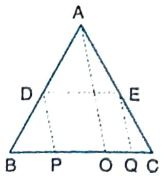
Answer(a) a parallelogram
Given that D and E are the mid-points of AB and AC respectively. Therefore,
$D E \| B C$ or, $D E \| P Q$
In $\triangle A B O, D$ and P are the mid-points of AB and OB respectively. Therefore, $D P \| A O$. Similarly, in $\triangle A O C$, we obtain $E Q \| A O$. Therefore, $D P \| E Q$. Hence, DEQP is a parallelogram.
View full question & answer→MCQ 561 Mark
The figure formed by joining the mid-points of the sides of a quadrilateral ABCD, taken in order, is a square only if,
- A
- B
diagonals of ABCD are equal
- ✓
diagonals of ABCD are equal and perpendicular
- D
diagonals of ABCD are perpendicular
AnswerCorrect option: C. diagonals of ABCD are equal and perpendicular
View full question & answer→MCQ 571 Mark
Answer(c) 4
Diagonals of a rhombus bisect each other at right angles. Therefore,
$O A=\frac{1}{2} A C, O B=\frac{1}{2} B D$ and $\angle A O B=90^{\circ}$
In right triangle $A O B$, we obtain
$O A^2+O B^2=A B^2$
$\Rightarrow \quad\left(\frac{1}{2} A C\right)^2+\left(\frac{1}{2} B D\right)^2=A B^2 \Rightarrow A C^2+B D^2=4 A B^2 \Rightarrow k A B^2=4 A B^2 \Rightarrow k=4$
View full question & answer→MCQ 581 Mark
- A
$30^{\circ}$
- B
$45^{\circ}$
- C
$60^{\circ}$
- ✓
$90^{\circ}$
AnswerCorrect option: D. $90^{\circ}$
(d) $90^{\circ}$
ABCD is a parallelogram.
$\therefore \quad \angle B=\angle D \Rightarrow \frac{1}{2} \angle B=\frac{1}{2} \angle D \Rightarrow \angle A BD=\angle A D B$
$\Rightarrow \quad A B=A D \quad$ [Sides opposite to equal angles in $\triangle A B D$ ]
$\Rightarrow \quad \triangle A B D$ is isosceles
$\Rightarrow \quad A O \perp B D \quad[\because O$ is the mid-point of $B D]$
$\Rightarrow \quad \angle A O B=90^{\circ}$
View full question & answer→MCQ 591 Mark
- A
$\frac{1}{2} A C$
- ✓
$\frac{1}{3} A C$
- C
$\frac{2}{3} A C$
- D
$\frac{3}{4} A C$
AnswerCorrect option: B. $\frac{1}{3} A C$
(b) $\frac{1}{3} A C$
Let G be the mid-point of FC. Join DG.
In $\triangle B C F$, and D and G are mid-points of BC and FC respectively.
$D G\|B F \Rightarrow D G\| E F$
In $\triangle A D G, E$ is the mid-point of $A D$ and $E F \| D G$.
$\therefore \quad F \text { is the mid-point of } A G \text {. }$
But, $G$ is the mid-point of $F C$.
$\therefore \quad A F=F G=G C=A F=\frac{1}{3} A C$
View full question & answer→MCQ 601 Mark
- ✓
- B
- C
$\frac{3}{2} A B$
- D
$\frac{5}{4} A B$
Answer(a) 2 AB
In $\triangle E D C$ and EFB, we have
$\angle D E C=\angle F E B$
$\angle D C E=\angle E B F$$\quad$[Alternate angles]
and $\quad B E=E C$
So, by using SAS congruence crikerion, we obtain
$\begin{aligned}& \triangle E D C \equiv \triangle E F B \Rightarrow B E=D C \Rightarrow B F=A B \\
\therefore \quad & A F=A B+B F=A B+A B \Rightarrow A F=2 A B .\end{aligned}$
View full question & answer→MCQ 611 Mark
If $\angle A, \angle B, \angle C$ and $\angle D$ of a quadrilateral ABCD, taken in order, are in the ratio $3: 7: 6: 4$, then ABCD is a
Answer(c) trapezium
Let $\angle A=3 x^{\circ}, \angle B=7 x^{\circ}, \angle C=6 x^{\circ}$ and $\angle D=4 x^{\circ}$. Then,
$\begin{array}{ll} & \angle A-\angle B+\angle C-\angle D=360^{\circ} \Rightarrow 20 x^{\circ}=360^{\circ} \Rightarrow x=18
\\ \therefore \quad & \angle A=55^{\circ}, \angle B=126^{\circ}, \angle C=100^{\circ} \text { and } \angle D=72^{\circ}
\\ \Rightarrow & \angle A-\angle B=180^{\circ} \text { and } \angle C-\angle D=180^{\circ} \Rightarrow A B C D \text { is a traperium. }\end{array}$
View full question & answer→MCQ 621 Mark
The bisectors of any two adjacent angles of parallelogram intersect at
- A
$30^{\circ}$
- B
$45^{\circ}$
- C
$60^{\circ}$
- ✓
$90^{\circ}$
AnswerCorrect option: D. $90^{\circ}$
(d) $90^{\circ}$
Let ABCD be a parallelogram such that the bisectors of $\angle A$ and $\angle B$ meet at O. Then,
$\angle A O B=\frac{1}{2}(\angle C+\angle D)=\frac{1}{2} \times 180^{\circ}=90^{\circ}[\because$ Adjacent angles are supplementary $]$
View full question & answer→MCQ 631 Mark
If one angle of a parallelogram is $24^{\circ}$ lesses than twice the smallest angle, then the largest angle of the parallelogram is
- A
$68^{\circ}$
- B
$102^{\circ}$
- ✓
$112^{\circ}$
- D
$136^{\circ}$
AnswerCorrect option: C. $112^{\circ}$
(c) $112^{\circ}$
Let $A B C D$ be a parallelogram with smallest angle $\angle B$. It is given that $\angle A=2 \angle B-24^{\circ}$.$
\begin{array}{ll}
\text { But, } & \angle A+\angle B=180^{\circ} \Rightarrow 2 \angle B-24^{\circ}+\angle B=180^{\circ} \Rightarrow 3 \angle B=204^{\circ} \Rightarrow \angle B=68^{\circ} \\
\therefore & \angle A=180^{\circ}-68^{\circ}=112^{\circ}\end{array}$
View full question & answer→MCQ 641 Mark
If an angle of a parallelogram is two thirds of its adjacent angle, the smallest angle of the parallelogram is
- A
$108^{\circ}$
- ✓
$72^{\circ}$
- C
$54^{\circ}$
- D
$81^{\circ}$
AnswerCorrect option: B. $72^{\circ}$
(b) $72^{\circ}$
Let $A B C D$ be a parallelogram such that $\angle A=\frac{2}{3} \angle B$. But,
$\angle A+\angle B=180^{\circ}$$\quad$[ $\because$ Adjacent angles are supplementary]
$\Rightarrow \quad \frac{2}{3} \angle B+\angle B=180^{\circ} \Rightarrow \frac{5}{3} \angle B=180^{\circ} \Rightarrow\angle B=108^{\circ} \Rightarrow \angle A=72^{\circ}$
Thus, smallest angle is $72^{\circ}$.
View full question & answer→MCQ 651 Mark
- A
$45^{\circ}$
- B
$55^{\circ}$
- ✓
$60^{\circ}$
- D
$75^{\circ}$
AnswerCorrect option: C. $60^{\circ}$
(c) $60^{\circ}$
We have $\angle A=75^{\circ}$. Therefore, $\angle C=75^{\circ}$.
Using angle sum property in $\triangle B C D$, we obtain: $\angle C B D=60^{\circ}$.
View full question & answer→MCQ 661 Mark
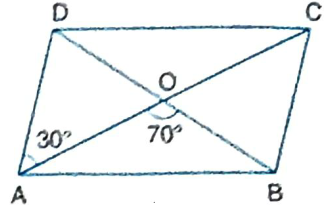
The diagonals AC and BD of a parallelogram ABCD intersect each other at O such that $\angle D A C=30^{\circ}$ and $\angle A O B=70^{\circ}$. Then, $\angle D B C=$
- ✓
$40^{\circ}$
- B
$35^{\circ}$
- C
$45^{\circ}$
- D
$50^{\circ}$
AnswerCorrect option: A. $40^{\circ}$
(a) $40^{\circ}$
Given $\angle A O B=70^{\circ}$. Therefore, $\angle A O D=110^{\circ}$.
Using angles sum property in $\triangle B O D$, we obtain $\angle A D B=40^{\circ}$. But,
$\angle D B C=\angle A D B$$\quad$[Alternate angles]
$\Rightarrow \quad \angle D B C=40^{\circ}$
View full question & answer→MCQ 671 Mark
Angles A,B,C,D of a quadrilateral ABCD are in the ratio $3: 4: 4: 7$. If the bisectors of angles A and B intersect al O, then $\angle A O B=$
- A
$70^{\circ}$
- B
$80^{\circ}$
- ✓
$110^{\circ}$
- D
$100^{\circ}$
AnswerCorrect option: C. $110^{\circ}$
(c) $110^{\circ}$
Let the measures of angles A,B,C,D be $(3 x)^{\circ},(4 x)^{\circ},(4 x)^{\circ}$ and $(7 x)^{\circ}$ respectively. The bisectors of $\angle A$ and $\angle B$ meet at O.
$\therefore \quad \angle A O B=\frac{1}{2}(\angle C+\angle D)=\frac{1}{2}\left\{(4 x)^{\circ}+(7x)^{\circ}\right\}=\left(\frac{11 x}{2}\right)^{\circ}$
Now, $\angle A+\angle B+\angle C+\angle D=360^{\circ} \Rightarrow(3 x)^{\circ}+(4 x)^{\circ}+(4 x)^{\circ}+(7x)^{\circ}=360^{\circ} \Rightarrow(18 x)^{\circ}=360^{\circ} \Rightarrow x=20$
$\therefore \quad \angle A O B=\left(\frac{11}{2} \times 20\right)^{\circ}=110^{\circ}$
View full question & answer→MCQ 681 Mark
The diagonals AC and BD of a rectangle ABCD intersect each other at P. If $\angle A B D=50^{\circ}$, then $\angle D P C=$
View full question & answer→MCQ 691 Mark
In a quadrilateral ABCD, $\angle A+\angle C$ is 2 times $\angle B+\angle D$. If $\angle A=140^{\circ}$ and $\angle D=60^{\circ}$, then $\angle B=$
View full question & answer→MCQ 701 Mark
ABCD is a parallelogram and E is the mid-point of BC. DE and AB when produced meet at F. Then, AF =
- A
$\frac{3}{2} A B$
- ✓
- C
- D
$\frac{5}{4} A B$
View full question & answer→MCQ 711 Mark
In $\triangle A B C$, E is the mid-point of median AD such that BE produced meets AC at F. If AC = 10.5cm then AF =
View full question & answer→MCQ 721 Mark
P is the mid-point of side BC of a parallelogram ABCD such that $\angle B A P=\angle D A P$. If AD = 10cm then CD =
View full question & answer→MCQ 731 Mark
Diagonals of a quadrilateral ABCD bisect each other. If $\angle A=45^{\circ}$, then $\angle B=$
View full question & answer→MCQ 741 Mark
ABCD is a trapezium in which AB || DC. M and N are the mid-points of AD and BC respectively. If AB = 12cm MN = 14cm then CD =
MCQ 751 Mark
The diagonals of a parallelogram ABCD intersect at O. If $\angle B O C=90^{\circ}$ and $\angle B D C=50^{\circ}$, then $\angle O A B=$
View full question & answer→MCQ 761 Mark
In $\triangle A B C, \angle A=30^{\circ}, \angle B=40^{\circ}$ and $\angle C=110^{\circ}$. The angles of the triangle formed by joining the mid-points of the sides of this triangle are
View full question & answer→MCQ 771 Mark
In a rhombus ABCD, if $\angle A C B=40^{\circ}$, then $\angle A D B=$
View full question & answer→MCQ 781 Mark
ABCD is a parallelogram in which diagonal AC bisects $\angle B A D$. If $\angle B A C=35^{\circ}$, then $\angle A B C=$
View full question & answer→MCQ 791 Mark
If the diagonals of a rhombus are 18 cm and 24 cm respectively, then its side is equal to
MCQ 801 Mark
If the degree measures of the angles of quadrilateral are 4x, 7x, 9x and 10x, what is the sum of the measures of the smallest angle and largest angle?
MCQ 811 Mark
If an angle of a parallelogram is two-third of its adjacent angle, the smallest angle of the parallelogram is
MCQ 821 Mark
ABCD is a parallelogram, M is the mid-point of BD and BM bisects $\angle B$. Then, $\angle A M B=$
View full question & answer→MCQ 831 Mark
ABCD is a parallelogram and E and F are the centroids of triangles ABD and BCD respectively, then EF =
MCQ 841 Mark
In a parallelogram ABCD, if $\angle D A B=75^{\circ}$ and $\angle D B C=60^{\circ}$, then $\angle B D C=$
View full question & answer→MCQ 851 Mark
If one angle of a parallelogram is 24° less than twice the smallest angle, then the measure of the largest angle of the parallelogram is
MCQ 861 Mark
The figure formed by joining the mid-points of the adjacent sides of a parallelogram is a
MCQ 871 Mark
The figure formed by joining the mid-points of the adjacent sides of a square is a
MCQ 881 Mark
The figure formed by joining the mid-points of the adjacent sides of a rhombus is a
MCQ 891 Mark
The figure formed by joining the mid-points of the adjacent sides of a rectangle is a
MCQ 901 Mark
The figure formed by joining the mid-points of the adjacent sides of a quadrilateral is a
MCQ 911 Mark
The bisectors of the angle of a parallelogram enclose a
MCQ 921 Mark
The bisectors of any two adjacent angles of a parallelogram intersect at
- A
$30^{\circ}$
- B
$45^{\circ}$
- C
$60^{\circ}$
- ✓
$90^{\circ}$
AnswerCorrect option: D. $90^{\circ}$
View full question & answer→MCQ 931 Mark
We get a rhombus by joining the mid-points of the sides of a
MCQ 941 Mark
The two diagonals are equal in a
MCQ 951 Mark
Diagonals necessarily bisect opposite angles in a
MCQ 961 Mark
Which of the following quadrilateral is not a rhombus?
- A
- B
Diagonals bisect each other
- C
Diagonals bisect opposite angles
- ✓
One angle between the diagonals is 60°
AnswerCorrect option: D. One angle between the diagonals is 60°
View full question & answer→MCQ 971 Mark
PQRS is a quadrilateral. PR and QS intersect each other at O. In which of the following cases, PQRS is a parallelogram?
- ✓
$\angle P=100^{\circ}, \angle Q =80^{\circ}, \angle R=100^{\circ}$
- B
$\angle P=85^{\circ}, \angle Q =85^{\circ}, \angle R=95^{\circ}$
- C
PQ = 7cm QR = 7cm RS = 8 cm, SP = 8cm
- D
OP = 6.5cm OQ = 6.5cm OR = 5.2cm OS = 5.2cm
AnswerCorrect option: A. $\angle P=100^{\circ}, \angle Q =80^{\circ}, \angle R=100^{\circ}$
View full question & answer→MCQ 981 Mark
The consecutive sides of a quadrilateral have
- A
- ✓
- C
- D
infinitely many common points
View full question & answer→MCQ 991 Mark
The opposite sides of a quadrilateral have
- ✓
- B
- C
- D
infinitely many common points
View full question & answer→