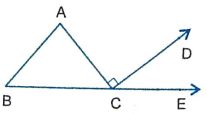
MCQ 11 Mark
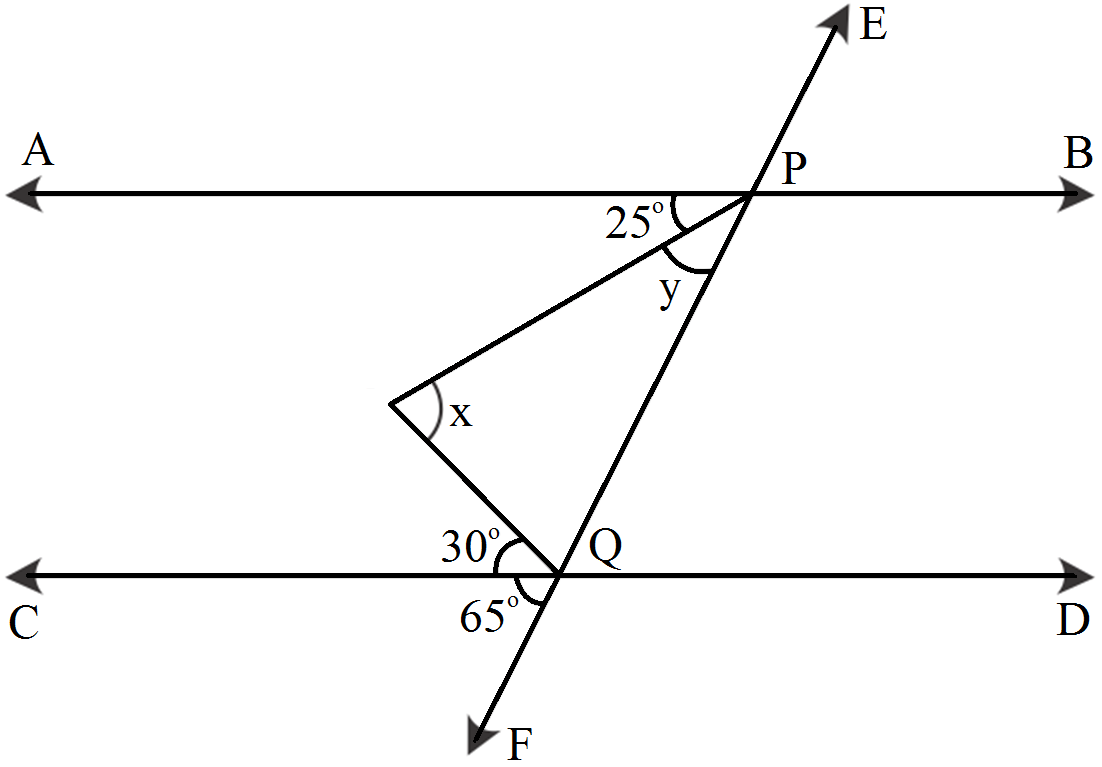
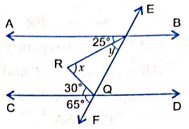
In Fig. $AB$ and $CD$ are parallel lines and transversal $EF$ intersect them at $P$ and $Q$ respectively. If $\angle\text{APR}=25^\circ,\angle\text{RQC}=30^\circ$ and $\angle\text{CQF}=65^\circ,$ then:
- ✓
$x = 55^\circ , y = 40^\circ $
- B
$x = 50^\circ , y = 45^\circ $
- C
$x = 60^\circ , y = 35^\circ$
- D
$x = 35^\circ , y = 60^\circ$
AnswerCorrect option: A. $x = 55^\circ , y = 40^\circ $
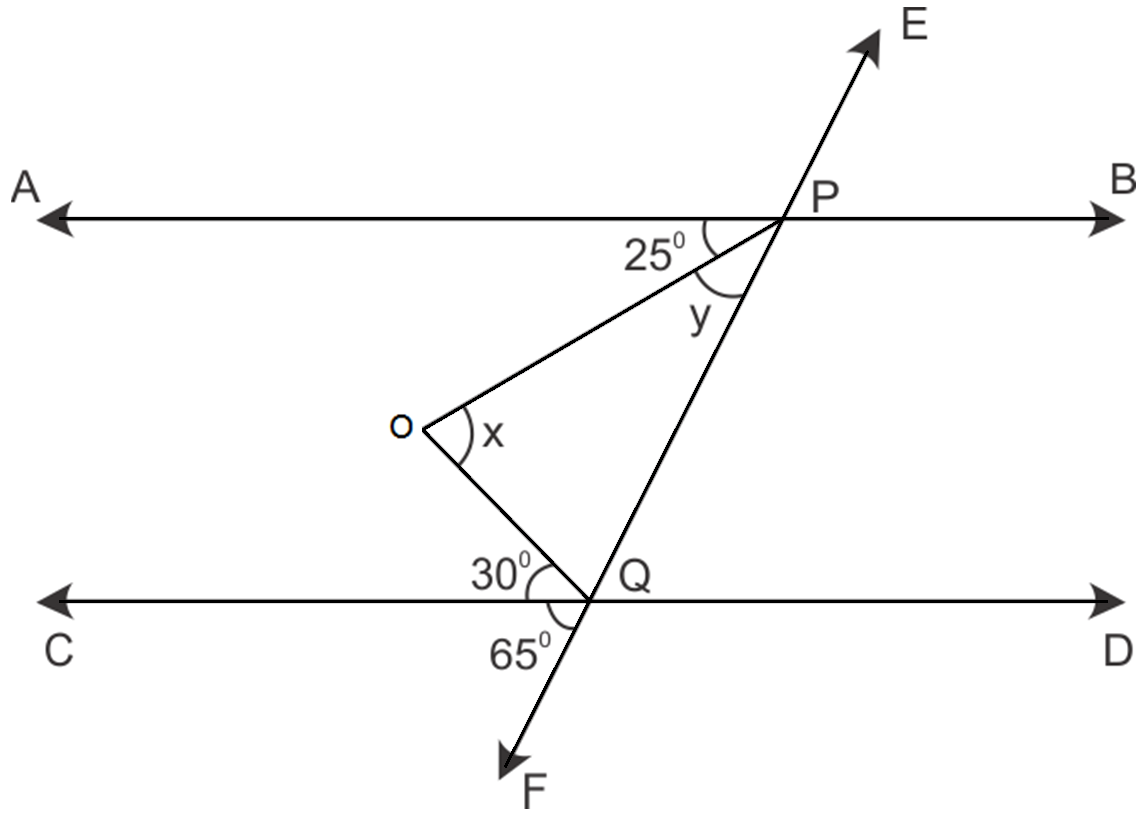
$\angle\text{OQP}=180^\circ-\angle\text{OQF}$
$=180^\circ-(30^\circ+65^\circ)$
$\Rightarrow\angle\text{OQP}=85^\circ\dots(1)$
$\angle\text{APQ}=\angle\text{CQF}$ (Corresponding angles)
$\Rightarrow25^\circ+\text{y}^\circ=65^\circ$
$\Rightarrow\text{y}^\circ=65^\circ-25^\circ$
$\Rightarrow\text{y}^\circ=40^\circ$
Now in $\triangle\text{OPQ}$
$\angle\text{O}+\angle\text{OPQ}+\angle\text{PQO}=180^\circ$
$\Rightarrow\text{x}^\circ+40^\circ+85^\circ=180^\circ$
$\text{x}^\circ=180^\circ-85^\circ-40^\circ=55^\circ$
$\Rightarrow\text{x}^\circ=55^\circ,\text{y}=40^\circ$ View full question & answer→MCQ 21 Mark
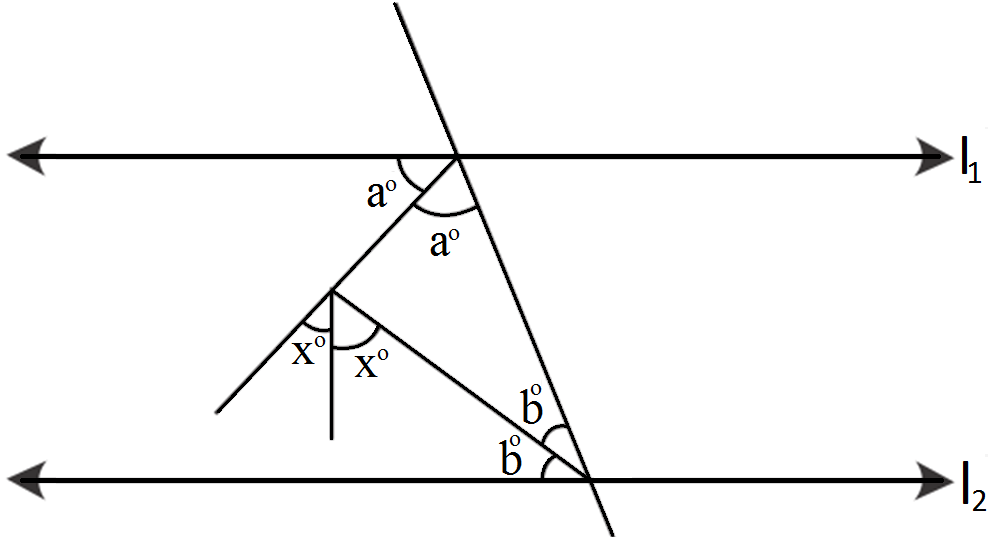
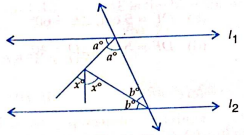
In Fig. if $l_1$ || $l_2$, the value of $x$ is:
- A
$22\frac{1}{2}$
- B
$30$
- ✓
$45$
- D
$60$
Answer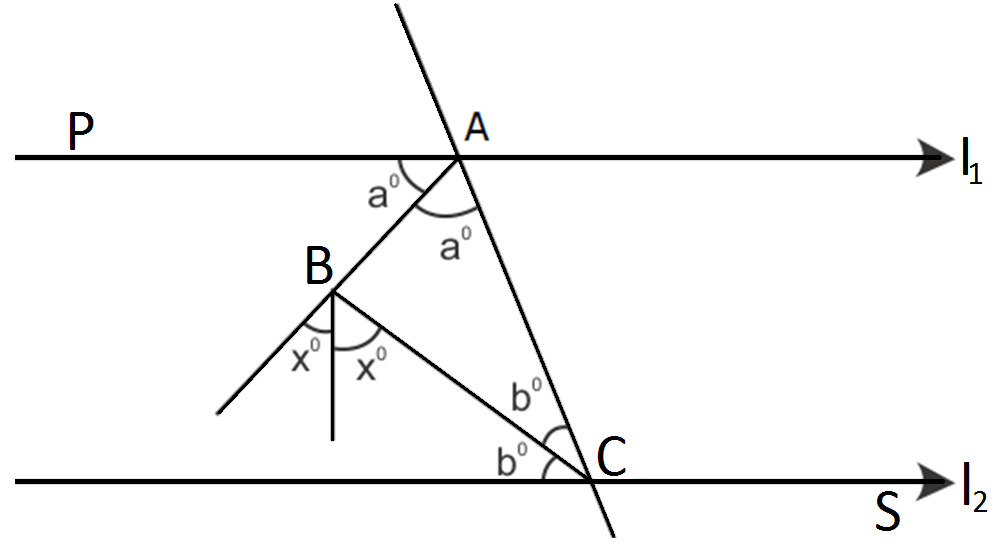
From figure,
$\angle\text{ACS}=180^\circ-2\text{b}^\circ$
also $\angle\text{ACS}=\angle\text{PAC}=2\text{a}^\circ$ (alternate angles)
$\Rightarrow2\text{a}^\circ=180^\circ-2\text{b}^\circ$
$\Rightarrow\text{a}^\circ+\text{b}^\circ=90^\circ$
Now, in $\triangle\text{ABC}$
$\text{a}^\circ+\text{b}^\circ+\angle\text{ABC}=180^\circ$
$\angle\text{ABC}=180^\circ-2\text{x}^\circ$
$\Rightarrow\text{a}^\circ+\text{b}^\circ+180^\circ-2\text{x}^\circ=180^\circ$
$\Rightarrow2\text{x}^\circ=\text{a}^\circ+\text{b}^\circ=90^\circ$
$\Rightarrow\text{x}^\circ=45^\circ$ View full question & answer→MCQ 31 Mark
In a $\triangle\text{ABC},$ if $\angle\text{A}=60^\circ,\angle\text{B}=80^\circ$ and the bisectors of $\angle\text{B}$ and $\angle\text{C}$ meet at $O$, then $\angle\text{BOC}=$
- A
$60^\circ$
- ✓
$120^\circ$
- C
$150^\circ$
- D
$30^\circ$
AnswerCorrect option: B. $120^\circ$
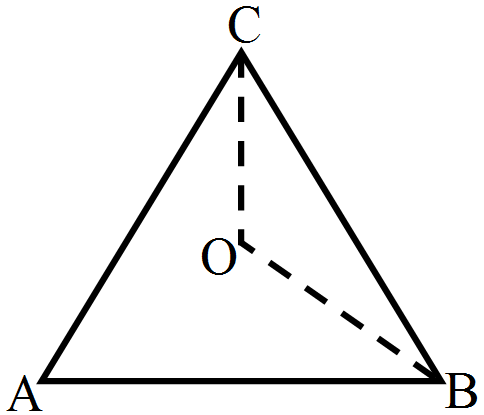
$O$ is point where bisectors of $\angle\text{C }\& \angle\text{B}$ meets.
$\angle\text{A}+\angle\text{B}+\angle\text{C}=180^\circ$
$60^\circ+80^\circ+\angle\text{C}=108^\circ$
$\angle\text{C}=40^\circ$
$\frac{\angle\text{C}}{2}=20^\circ$
$\frac{\angle\text{C}}{2}=20^\circ=\angle\text{BCO}\dots(1)$
$\frac{\angle\text{B}}{2}=\frac{80^\circ}{2}=40^\circ=\angle\text{OBC}\dots(2)$
In $\triangle\text{BOC}$
$\angle\text{BCO}+\angle\text{OBC}+\angle\text{BOC}=180^\circ$
from $(1)$ and $(2)$
$20^\circ+40^\circ+\angle\text{BOC}=180^\circ$
$\Rightarrow\angle\text{BOC}=180^\circ-60^\circ=120^\circ$ View full question & answer→MCQ 41 Mark
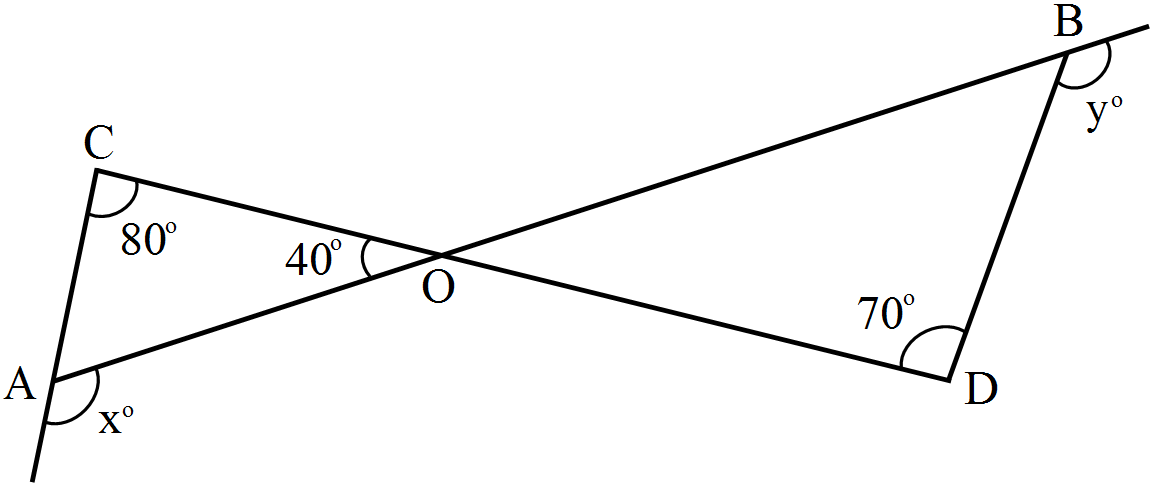
In Fig. $x + y =$
- A
$270^\circ$
- ✓
$230^\circ$
- C
$210^\circ$
- D
$190^\circ$
AnswerCorrect option: B. $230^\circ$
$\triangle\text{ACO}$
$\angle\text{ACO}+\angle\text{COA}+\angle\text{COA}=180^\circ$
Now, $\angle\text{OAC}=180^\circ-\text{x}^\circ$
$\Rightarrow80^\circ+40^\circ+180^\circ-\text{x}^\circ=180^\circ$
$\Rightarrow\text{x}^\circ=120^\circ$
$\angle\text{BOD}=\angle\text{COA}=40^\circ$ (Opposite angles)
$\angle\text{BDO}=70^\circ$
In $\triangle\text{OBD},$
$\angle\text{OBD}=180^\circ-40^\circ-70^\circ=70^\circ$
Also, $\text{y}^\circ=180^\circ-\angle\text{OBD}=180^\circ-70^\circ=110^\circ$
$\Rightarrow\text{x}^\circ+\text{y}^\circ=120^\circ+110^\circ=230^\circ$
View full question & answer→MCQ 51 Mark
In $\triangle\text{ABC},\angle\text{B}=\angle\text{C}$ and ray $AX$ bisects the exterior angle $\angle\text{DAC}.$ If $\angle\text{DAX}=70^\circ$ then $\angle\text{ACB}=$
- A
$35^\circ$
- B
$90^\circ$
- ✓
$70^\circ$
- D
$55^\circ$
AnswerCorrect option: C. $70^\circ$
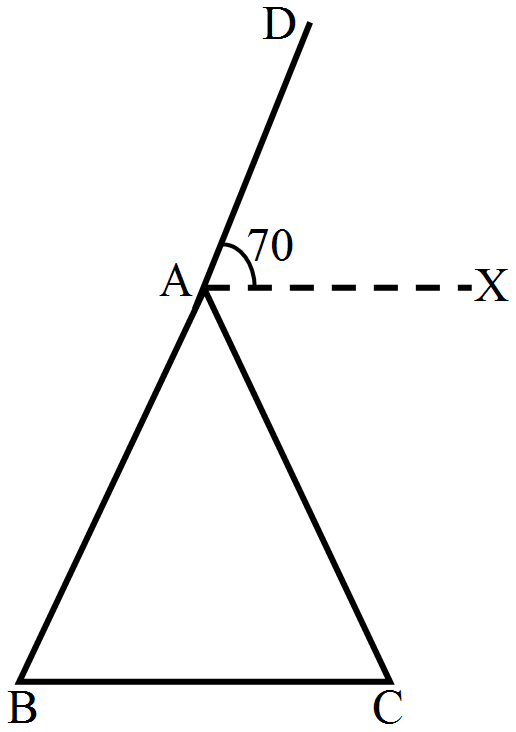
$AX$ is bisector of $\angle\text{DAC}.$
$\Rightarrow\angle\text{DAX}=\angle\text{XAC}=70^\circ$
$\Rightarrow\angle\text{DAC}=2\times70^\circ=140^\circ$
Now, $\angle\text{A}=180^\circ-\angle\text{DAC}=180^\circ-140^\circ=40^\circ$
In $\triangle\text{ABC},$
$\angle\text{A}+\angle\text{B}+\angle\text{C}=180^\circ$
$\Rightarrow40^\circ+\angle\text{B}+\angle\text{C}=180^\circ$
$\Rightarrow40^\circ+\angle\text{C}+\angle\text{C}=180^\circ\dots(\angle\text{B}=\angle\text{C})$
$\Rightarrow2\angle\text{C}=140^\circ$
$\Rightarrow\angle\text{C}=70^\circ$
$\text{i.e}\angle\text{ACB}=70^\circ$ View full question & answer→MCQ 61 Mark
The side $BC$ of $\triangle\text{ABC}$ is produced to a poin $D$. The bisector of $\angle\text{A}$ meet side $BC$ in $L$. If $\angle\text{ABC}=30^\circ$ and $\angle\text{ACD}=115^\circ,$ then $\angle\text{ALC}=$
- A
$85^\circ$
- ✓
$72\frac{1}{2}^\circ$
- C
$145^\circ$
- D
$\text{None of these}$
AnswerCorrect option: B. $72\frac{1}{2}^\circ$
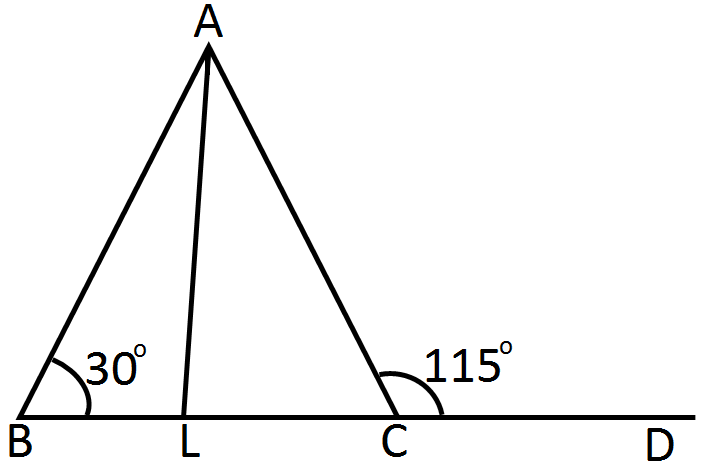
$\angle\text{C}=180^\circ-\angle\text{ACD}=180^\circ-115^\circ=65^\circ$
In $\triangle\text{ABC},$
$\angle\text{A}+\angle\text{B}+\angle\text{C}=180^\circ$
$\Rightarrow\angle\text{A}=180^\circ-30^\circ-65^\circ$
$\Rightarrow\angle\text{A}=85^\circ$
Now in $\angle\text{ALC}$
$\angle\text{ALC}+\angle\text{LAC}+\angle\text{C}=180^\circ$
$\Rightarrow\angle\text{ALC}=180^\circ-\angle\text{LAC}-\angle\text{C}$
$=180^\circ-\frac{\angle\text{A}}{2}-\angle\text{C}$
$=180^\circ-\frac{85^\circ}{2}-65^\circ$
$=\frac{145^\circ}{2}$
$=72\frac{1}{2}^\circ$ View full question & answer→MCQ 71 Mark
An exterior angle of a triangle is $108^\circ$ and its interior opposite angles are in the ratio $4 : 5$ The angles of the triangle are:
- ✓
$48^\circ , 60^\circ , 72^\circ$
- B
$50^\circ , 60^\circ , 70^\circ$
- C
$52^\circ , 56^\circ , 72^\circ$
- D
$42^\circ , 60^\circ , 76^\circ $
AnswerCorrect option: A. $48^\circ , 60^\circ , 72^\circ$
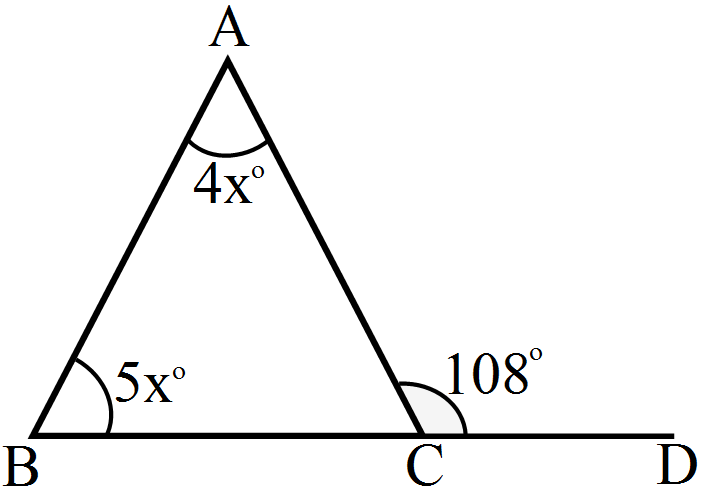
From figure, we have
$\angle\text{A}+\angle\text{B}=\angle\text{ACD}$
$\Rightarrow4\text{x}^\circ+5\text{x}^\circ=108^\circ$
$\Rightarrow9\text{x}^\circ=108^\circ$
$\Rightarrow\text{x}=12^\circ$
So, $\angle\text{A}=48^\circ,\angle\text{B}=60^\circ$
$\Rightarrow\angle\text{C}=180^\circ-48^\circ-60^\circ=72^\circ$ View full question & answer→MCQ 81 Mark
If one angle of a triangle is equal to the sum of the other two angles, then the triangle is:
AnswerLet the three angles of a triangle be $A, B$ and $C$.
Now, $A + B + C = 180^\circ$
If $A = B + C$
Then $A + (A) = 180^\circ$
i.e. $2A = 180^\circ $
i.e. $A = 90^\circ$
Since, one of the angle is $90^\circ$, the triangle is a Right triangle.
View full question & answer→MCQ 91 Mark
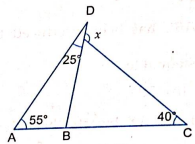
In Fig the value of $x$ is:
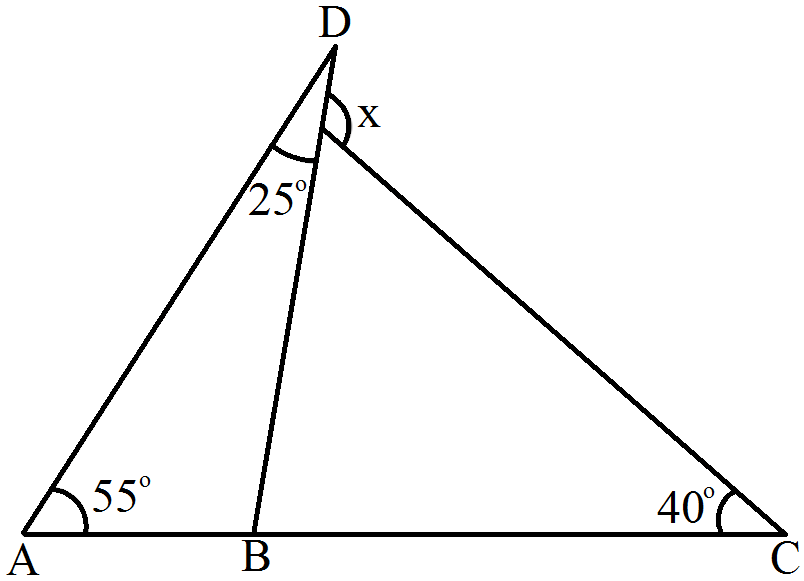
- A
$65^\circ$
- B
$80^\circ$
- C
$95^\circ$
- ✓
$120^\circ$
AnswerCorrect option: D. $120^\circ$
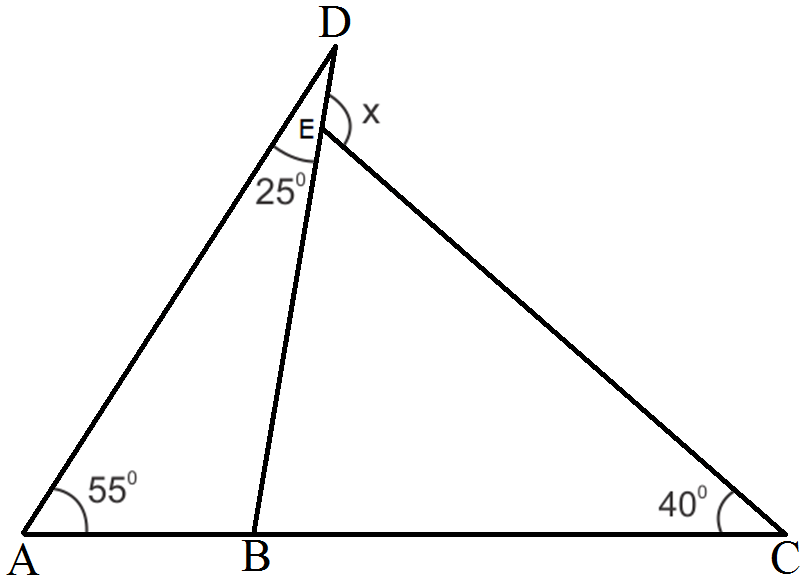
In $\triangle\text{ABD}$
$\angle\text{A}+\angle\text{B}+\angle\text{D}=180^\circ$
$\Rightarrow55^\circ+\angle\text{DBA}+25^\circ=180^\circ$
$\Rightarrow\angle\text{DBA}=180^\circ-55^\circ-25^\circ$
$=180^\circ-80^\circ$
$\Rightarrow\angle\text{DBA}=100^\circ$
So, $\angle\text{DBC}=180^\circ-\angle\text{DBA}$
$=180^\circ-100^\circ$
$\Rightarrow\angle\text{DBC}=80^\circ$
Now, in $\triangle\text{EBC}$
$\angle\text{E}+\angle\text{EBC}+\angle\text{C}=180^\circ$
$\Rightarrow\angle\text{E}+80^\circ+40^\circ=180^\circ$ $\big(\angle\text{DBC}=\angle\text{EBC}\big)$
$\Rightarrow\angle\text{E}=180^\circ-120^\circ=60^\circ$
Also, $\text{x}=180^\circ-\angle\text{E}=180^\circ-60^\circ$
$\Rightarrow\text{x}=120^\circ$ View full question & answer→MCQ 101 Mark
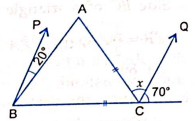
In Fig. if $BP || CQ$ and $AC = BC$, then the measure of $x$ is:
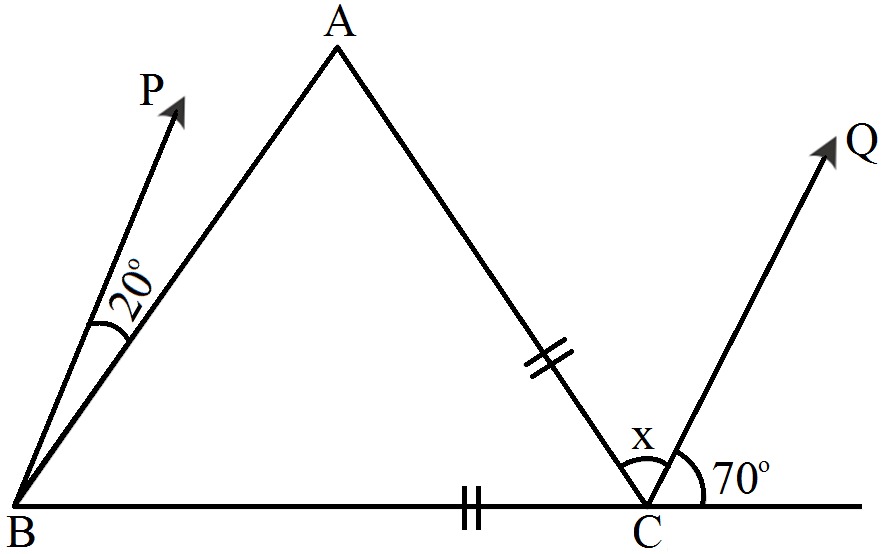
- A
$20^\circ$
- B
$25^\circ$
- ✓
$30^\circ$
- D
$35^\circ$
AnswerCorrect option: C. $30^\circ$
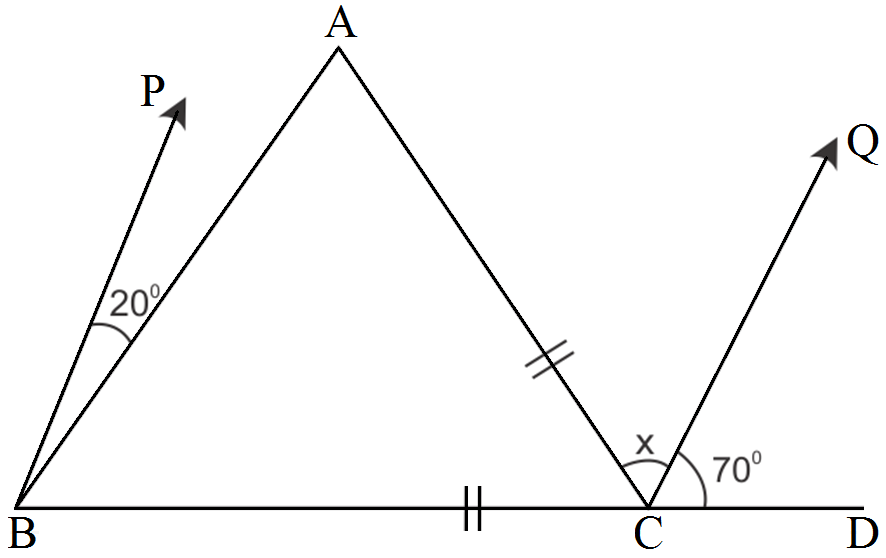
$\angle\text{PBC}=\angle\text{QCD}$ (Corresponding angles, $OP || CQ$ and $BC$ is transverse)
$\Rightarrow\angle\text{PBC}=70^\circ$
Now, $\angle\text{PBA}+\angle\text{ABC}+\angle\text{PBC}$
$\Rightarrow20^\circ+\angle\text{ABC}=70^\circ$
$\Rightarrow\angle\text{ABC}=50^\circ$
In $\triangle\text{ABC},$
$\angle\text{ABC}+\angle\text{BAC}+\angle\text{ACB}=180^\circ\dots(1)$
Now, $\angle\text{ABC}=\angle\text{BAC}=50^\circ$ $($isosceles $\triangle)$
And, $\angle\text{ACB}=180^\circ-(70^\circ+\text{x})$
From $(1)$
$50^\circ+50^\circ+180^\circ-(70^\circ+\text{x})=180^\circ$
$\Rightarrow\text{x}=30^\circ$ View full question & answer→MCQ 111 Mark
If the measure of angles of a triangle are in the ratio of $3 : 4 : 5$, what is the measure of the smallest angle of the triangle?
- A
$25^\circ$
- B
$30^\circ$
- ✓
$45^\circ$
- D
$60^\circ$
AnswerCorrect option: C. $45^\circ$
The measures of angles of a triangle are in ratio $3 : 4 : 5$.
Let the angles be $3x, 4x,$ and $5x$.
in any triangle, sum of all angles $= 180^\circ$
$\Rightarrow 3x + 4x + 5x = 180^\circ$
$\Rightarrow 12x = 180^\circ $
$\Rightarrow x = 15^\circ $
So, smallest angle $= 3 \times 15^\circ = 45^\circ$
View full question & answer→MCQ 121 Mark
In a $\triangle\text{ABC},\angle\text{A}=50^\circ$ and $BC$ is produced to a point $D$. If the bisectors of $\angle\text{ABC}$ and $\angle\text{ACD}$ meet at $E$, then $\angle\text{E}=$
- ✓
$25^\circ$
- B
$50^\circ$
- C
$100^\circ$
- D
$75^\circ$
AnswerCorrect option: A. $25^\circ$
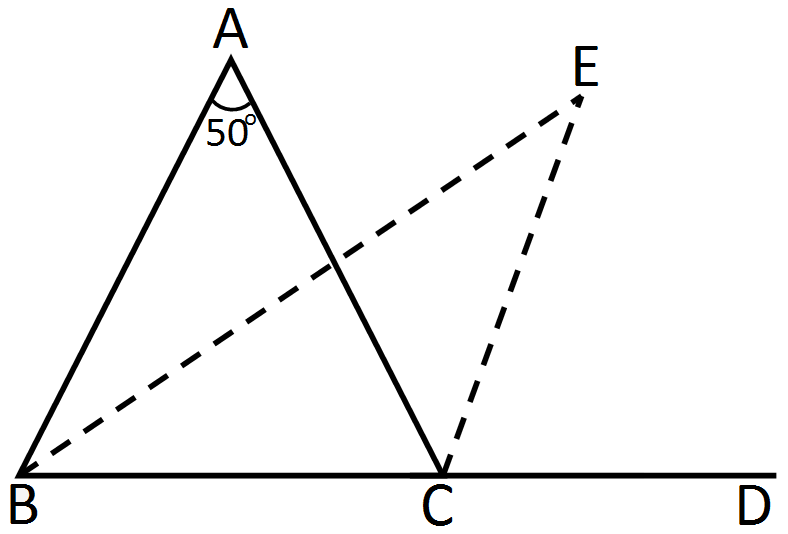
$BE$ and $CE$ are bisectors of $\angle\text{B}$ and $\angle\text{ACD}.$
In $\triangle\text{ABC},$
$\angle\text{A}+\angle\text{B}+\angle\text{C}=180^\circ$
$\Rightarrow\angle\text{B}+\angle\text{C}=180^\circ-50^\circ=130^\circ\dots(1)$
Now, in $\triangle\text{BEC}$
$\angle\text{CBE}+\angle\text{BEC}+\angle\text{ECB}=180^\circ\dots(2)$
$\angle\text{CBE}=\frac{\angle\text{B}}{2},\angle\text{BEC}=\angle\text{E},\angle\text{ECB}=\angle\text{C}+\angle\text{ACE}$
Now, $\angle\text{ACD}=180^\circ-\angle\text{C}$
$\angle\text{ACE}=\frac{\angle\text{ACD}}{2}=\frac{180^\circ-\angle\text{C}}{2}=90^\circ-\frac{\angle\text{C}}{2}$
So, $\angle\text{ECB}=\angle\text{C}+90^\circ-\frac{\angle\text{C}}{2}$
$\Rightarrow\angle\text{ECB}=90^\circ+\frac{\angle\text{C}}{2}$
Now putting all value in eq $(2)$
$\frac{\angle\text{B}}{2}+\angle\text{E}+90^\circ+\frac{\angle\text{C}}{2}=180^\circ$
$\Rightarrow\angle\text{E}=180^\circ-90^\circ-\Big(\frac{\angle\text{B}+\angle\text{C}}{2}\Big)$
$=90^\circ-\Big(\frac{\angle\text{B}+\angle\text{C}}{2}\Big)$
$=90^\circ-\frac{130^\circ}{2}$[From eq $(1)$]
$\Rightarrow\angle\text{E}=25^\circ$ View full question & answer→MCQ 131 Mark
If the sides of a triangle are produced in order, then the sum of the three exterior angles so formed is:
- A
$90^\circ$
- B
$180^\circ$
- C
$270^\circ$
- ✓
$360^\circ$
AnswerCorrect option: D. $360^\circ$
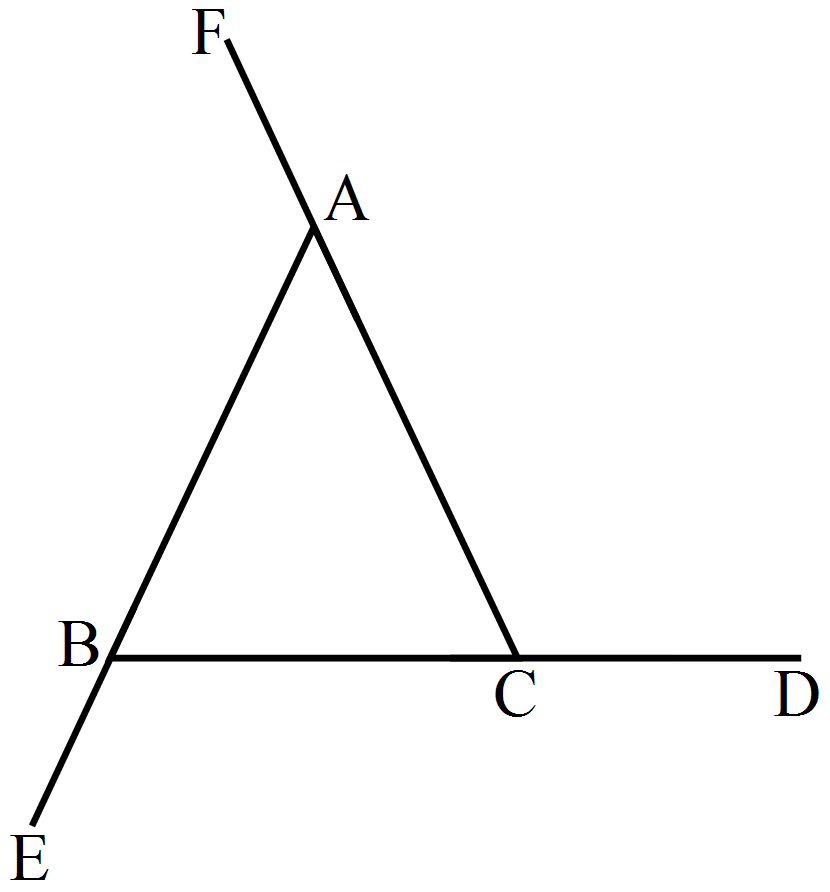
In $\triangle\text{ABC},$
$\angle\text{A}+\angle\text{B}+\angle\text{C}=180^\circ$
Now, $\angle\text{FAB}=180^\circ-\angle\text{A}\dots(1)$
$\angle\text{DCA}=180^\circ-\angle\text{C}\dots(2)$
$\angle\text{EBC}=180^\circ-\angle\text{B}\dots(3)$
Adding equation $(1), (2)$ and $(3)$$\angle\text{FAB}+\angle\text{DCA}+\angle\text{EBC}=180^\circ-\angle\text{A}+180^\circ-\angle\text{C}+180^\circ-\angle\text{B}$
$=540^\circ-(\angle\text{A}+\angle\text{B}+\angle\text{C})$
$=540^\circ-180^\circ$
$\Rightarrow $ Sum of all exterior angles $= 360^\circ $ View full question & answer→MCQ 141 Mark
The bisects of exterior angles at $B$ and $C$ of $\triangle\text{ABC}$ meet at $O$. If $\angle\text{A}=\text{x}^\circ,$ then $\angle\text{BOC}=$
- A
$90^\circ+\frac{\text{x}^\circ}{2}$
- ✓
$90^\circ-\frac{\text{x}^\circ}{2}$
- C
$180^\circ+\frac{\text{x}^\circ}{2}$
- D
$180^\circ-\frac{\text{x}^\circ}{2}$
AnswerCorrect option: B. $90^\circ-\frac{\text{x}^\circ}{2}$
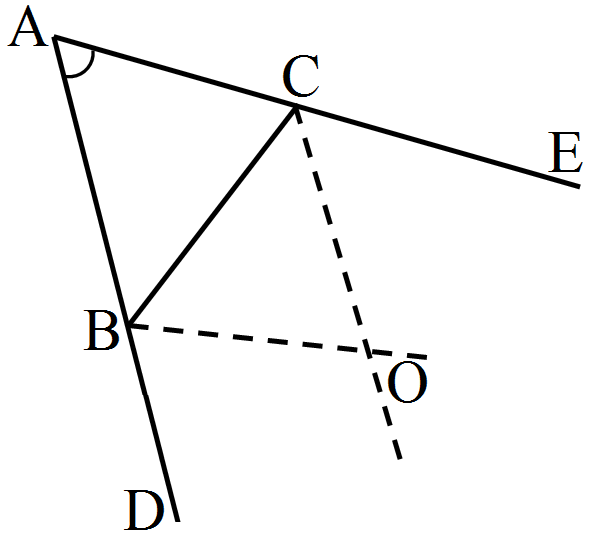
In $\triangle\text{ABC},$
$\angle\text{A}+\angle\text{B}+\angle\text{C}=180^\circ$
$\Rightarrow\angle\text{B}+\angle\text{C}=180^\circ-\text{x}^\circ\dots(1)$
$\Rightarrow\angle\text{CBD}=180^\circ-\angle\text{B}\dots(2)$
$\Rightarrow\angle\text{ECB}=180^\circ-\angle\text{C}\dots(3)$
$\Rightarrow\frac{\angle\text{CBD}}{2}=\angle\text{OBC}=90^\circ-\frac{\angle\text{B}}{2}\dots(4)$ [frpom eq(2)]
$\frac{\angle\text{ECB}}{2}=\angle\text{OCB}=90^\circ-\frac{\angle\text{C}}{2}\dots(5)$
Now, in $\triangle\text{BOC}$
$\angle\text{OBC}+\angle\text{OCB}+\angle\text{BOC}=180^\circ$
$\Rightarrow\angle\text{BOC}=180^\circ-(\angle\text{OBC}+\angle\text{OCB})$
From eq (4) and (5),
$\angle\text{BOC}=180^\circ-\Big(90^\circ-\frac{\angle\text{B}}{2}+90^\circ-\frac{\angle\text{C}}{2}\Big)$
$=180^\circ-\Big(180^\circ-\frac{\angle\text{B}}{2}-\frac{\angle\text{C}}{2}\Big)$
$=\Big(\frac{\angle\text{B}+\angle\text{C}}{2}\Big)$ [from eq $(1)$]
$=\frac{180^\circ-\text{x}^\circ}{2}$
$\Rightarrow\angle\text{BOC}=90^\circ-\frac{\text{x}^\circ}{2}$ View full question & answer→MCQ 151 Mark
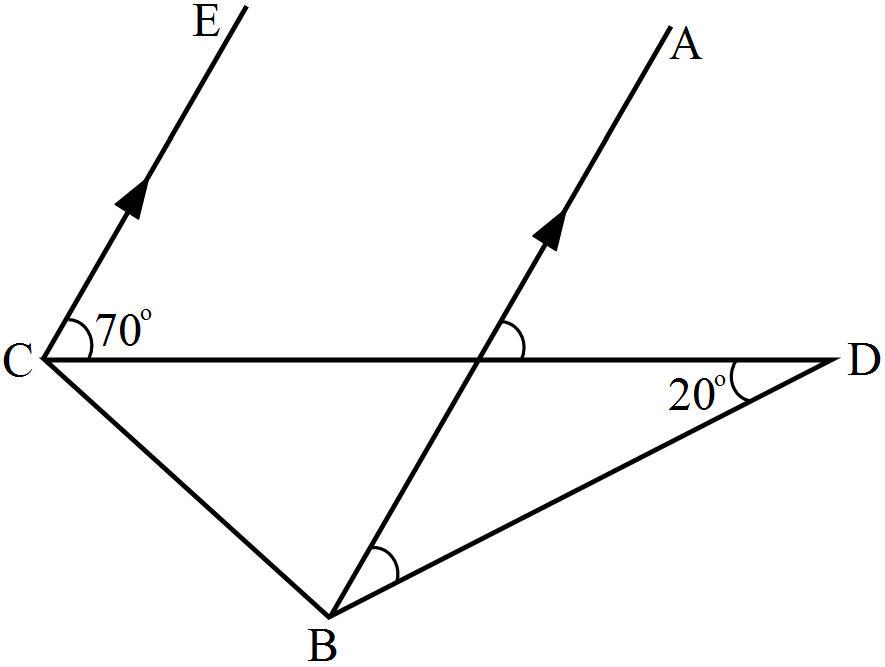
In Fig. if $\text{EC }||\text{ AB},\angle\text{ECD}=70^\circ$ and $\angle\text{ECD}=70^\circ$ and $\angle\text{BDO}=20^\circ,$ then $\angle\text{OBD}$ is:
- A
$20^\circ$
- ✓
$50^\circ$
- C
$60^\circ$
- D
$70^\circ$
AnswerCorrect option: B. $50^\circ$
$EC || AB$ And, $CD$ is transverse to it.
Now $\angle\text{ECD}=\angle\text{AOD}=70^\circ$ (Corresponding angles)
In $\triangle\text{OBD}$
$\angle\text{OBD}+\angle\text{BOD}+\angle\text{ODB}=180^\circ$
$\angle\text{BOD}=180^\circ-\angle\text{AOD}=180^\circ-70^\circ=110^\circ$
So $\angle\text{OBD}=180^\circ-\angle\text{BOD}-\angle\text{ODB}$
$=180^\circ-110^\circ-20^\circ$
$=50^\circ$
View full question & answer→MCQ 161 Mark
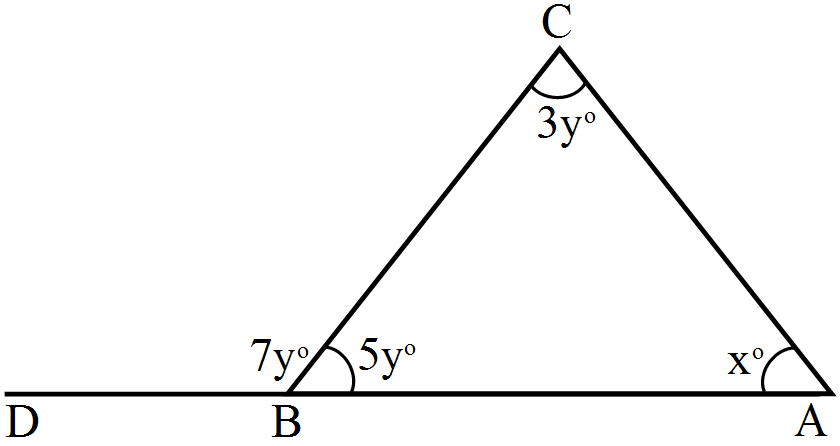
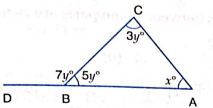
In Fig. what is the value of $x$?
- A
$35^\circ$
- B
$45^\circ$
- C
$50^\circ$
- ✓
$60^\circ$
AnswerCorrect option: D. $60^\circ$
In $\triangle\text{ABC},$
$\angle\text{BCA}+\angle\text{CAB}+\angle\text{ABC}=180^\circ$
$\Rightarrow3\text{y}^\circ+\text{x}^\circ+5\text{y}^\circ=180^\circ$
$\Rightarrow8\text{y}^\circ+\text{x}^\circ=180^\circ\dots(1)$
Also, $5\text{y}^\circ=180^\circ-7\text{y}^\circ$
$\Rightarrow12\text{y}^\circ=180^\circ$
$\Rightarrow\text{y}^\circ=15^\circ$
From $(1)$, $\text{x}^\circ=180^\circ-8\text{y}^\circ$
$\Rightarrow\text{x}^\circ=180^\circ-8\times15^\circ$
$\Rightarrow\text{x}^\circ=60^\circ$
View full question & answer→MCQ 171 Mark
In $\triangle\text{ABC},$ if $\angle\text{A}=100^\circ,\text{AD}$ bisects $\angle\text{A}$ and $\text{AD}\perp\text{BC}.$ Then, $\angle\text{B}=$
- A
$50^\circ$
- B
$90^\circ$
- ✓
$40^\circ$
- D
$100^\circ$
AnswerCorrect option: C. $40^\circ$
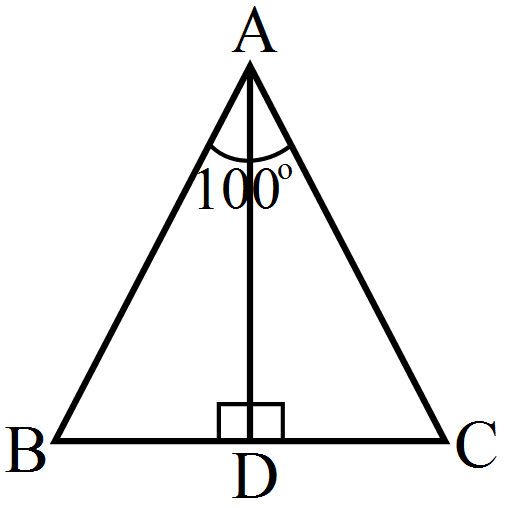
$\text{AD}\perp\text{BC}$ and $AD$ bisects $\angle\text{A}.$
$\Rightarrow\angle\text{BAD}=\angle\text{CAD}=50^\circ$
In Right $\triangle\text{ADB}$
$\angle\text{BAD}=50^\circ,\angle\text{ADB}=90^\circ$
Also sum of all interior angles $= 180^\circ$
$\Rightarrow\angle\text{BAD}+\angle\text{ADB}+\angle\text{B}=180^\circ$
$\Rightarrow\angle\text{B}=180^\circ-50^\circ-90^\circ$
$\Rightarrow\angle\text{B}=40^\circ$ View full question & answer→MCQ 181 Mark
In a triangle, an exterior angle at a vertex is $95^\circ$ and its one of the interior opposite angle is $55^\circ$ , then the measure of the other interior angle is:
- A
$55^\circ$
- B
$85^\circ$
- ✓
$40^\circ$
- D
$9.0^\circ$
AnswerCorrect option: C. $40^\circ$
Let the other interior opposite angle be $x^\circ$.
Then, we have
$x^\circ + 55^\circ = 95^\circ $
$\Rightarrow x^\circ = 95^\circ - 55^\circ = 40^\circ $
View full question & answer→MCQ 191 Mark
In $\triangle\text{RST}$ what is the value of $x$?
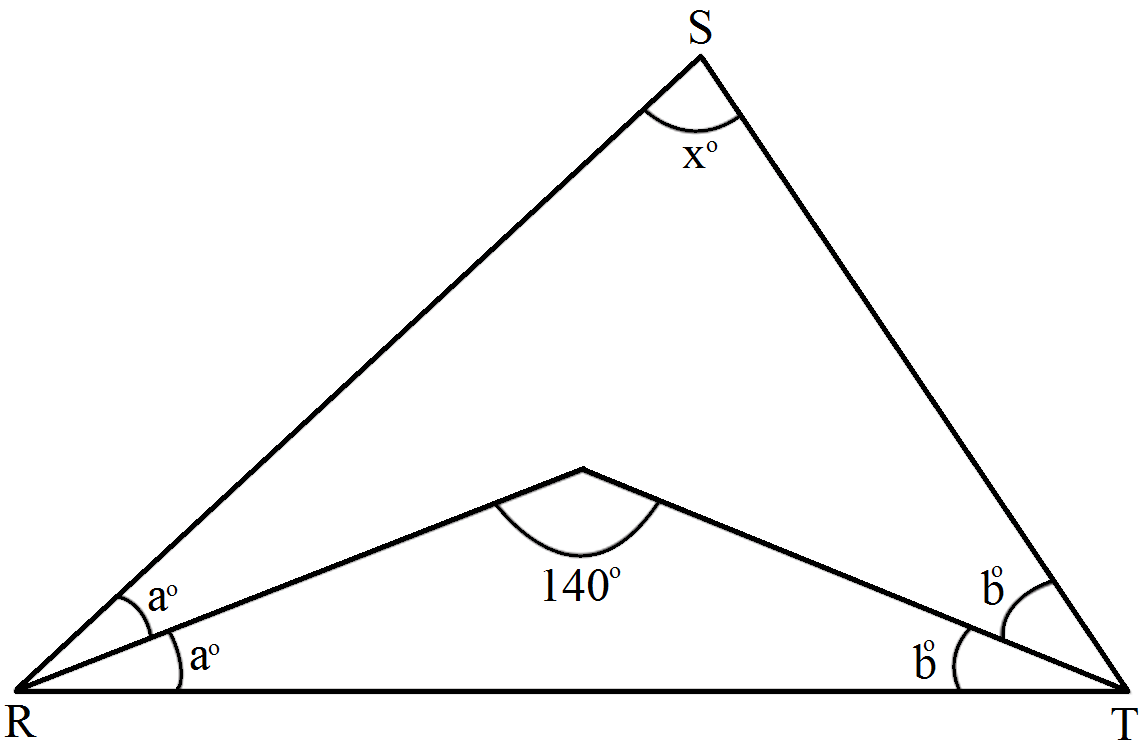
- A
$40^\circ$
- B
$90^\circ$
- C
$80^\circ$
- ✓
$100^\circ$
AnswerCorrect option: D. $100^\circ$
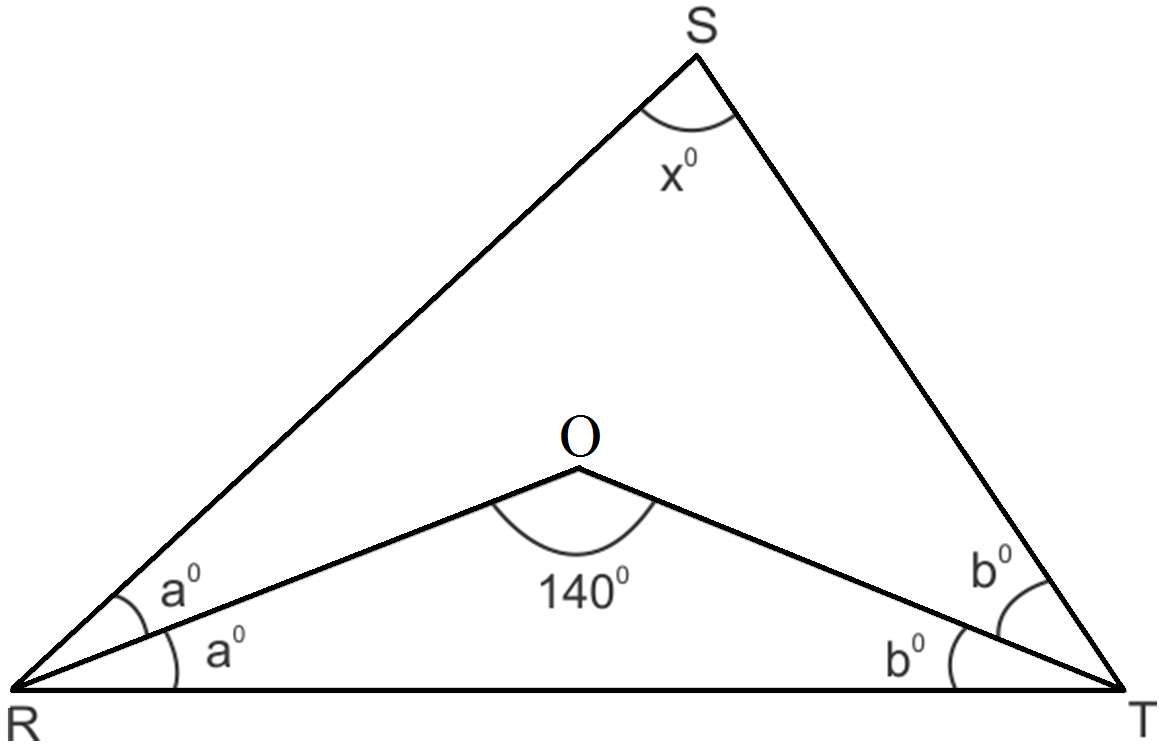
In $\triangle\text{RST}$
$\angle\text{R}+\angle\text{S}+\angle\text{T}=180^\circ$
$\Rightarrow2\text{a}^\circ+\text{x}^\circ+2\text{b}^\circ=180^\circ$
$\Rightarrow\text{x}^\circ=180^\circ-2(\text{a}+\text{b})^\circ\dots(1)$
Now in $\triangle\text{ROT}$
$\angle\text{ORT}+\angle\text{ROT}+\angle\text{OTR}=180^\circ$
$\Rightarrow\text{a}^\circ+140^\circ+\text{b}^\circ=180^\circ$
$\Rightarrow(\text{a}+\text{b})^\circ=180^\circ-140^\circ=40^\circ\dots(2)$
From $(1)$ and $(2)$
$\text{x}^\circ=180^\circ-2(40^\circ)$
$\Rightarrow\text{x}=100^\circ$ View full question & answer→MCQ 201 Mark
If the bisectors of the acute angles of a right triangle meet at $O$, then the angle at $O$ between the two bisectors is:
- A
$45^\circ$
- B
$95^\circ$
- ✓
$135^\circ$
- D
$90^\circ$
AnswerCorrect option: C. $135^\circ$
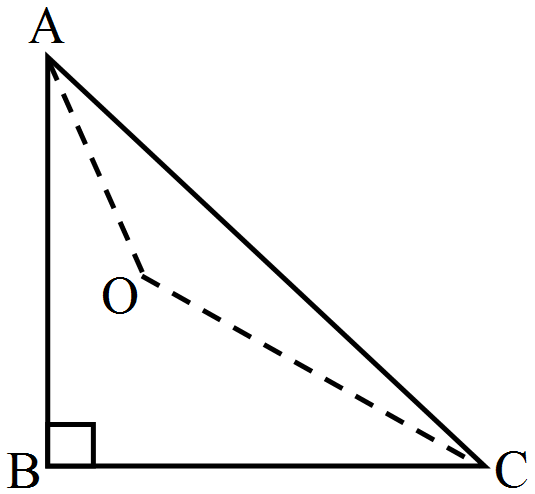
In $\triangle\text{ABC},$
$\angle\text{A}+\angle\text{B}+\angle\text{C}=180^\circ$
$\Rightarrow\angle\text{A}+90^\circ+\angle\text{C}=180^\circ$
$\Rightarrow\angle\text{A}+\angle\text{C}=90^\circ\dots(1)$
Now, in $\triangle\text{AOC},$
$\angle\text{COA}+\angle\text{OAC}+\angle\text{OCA}=180^\circ$
$\Rightarrow\angle\text{COA}+\frac{\angle\text{A}}{2}+\frac{\angle\text{C}}{2}=180^\circ$ {$AO$ and $CO$ bisects angle $\angle\text{A}$ and $\angle\text{C}$}
$\Rightarrow\angle\text{COA}=180-\Big(\frac{\angle\text{A}+\angle\text{C}}{2}\Big)$
$=180^\circ-\Big(\frac{90^\circ}{2}\Big)$ {From $(1)$}
$=100^\circ-45^\circ$
$=135^\circ$ View full question & answer→MCQ 211 Mark
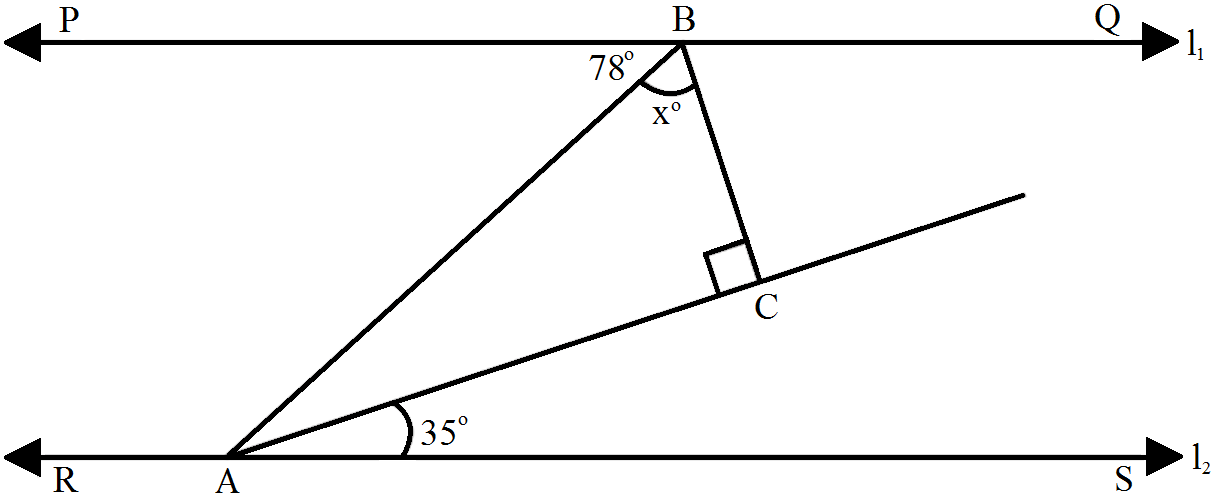
In Fig. for which value of $x$ is $l_1$ || $l_2$?
- A
$37^\circ$
- B
$43^\circ$
- C
$45^\circ$
- ✓
$47^\circ$
AnswerCorrect option: D. $47^\circ$
Let if $l_1$ || $l_2$ and $AB$ is tranverse to it.
Then,
$\angle\text{PBA}$ should be equal $\angle\text{BAS}$ (Alternate angles)
So if $l_1$ || $l_2$, then $\angle\text{BAS}=70^\circ$
$\Rightarrow\angle\text{BAC}=78^\circ-35^\circ=43^\circ\dots(1)$
Now, in $\triangle\text{ABC}$
$\text{x}^\circ+\angle\text{C}+\angle\text{BAC}=180^\circ$
$\Rightarrow\text{x}^\circ+90^\circ+43^\circ=180^\circ$
$\Rightarrow\text{x}^\circ=180^\circ-90^\circ-43^\circ=47^\circ$
$\Rightarrow\text{x}^\circ=47^\circ$
So if $x^\circ = 47^\circ$ then $l_1$ || $l_2$
View full question & answer→MCQ 221 Mark
An exterior angle of a triangle is equal to $100^\circ$ and two interrior opposite angles are equal. Each of these angles is equal to:
- A
$75^\circ$
- B
$80^\circ$
- C
$40^\circ$
- ✓
$50^\circ$
AnswerCorrect option: D. $50^\circ$
Let the two interior opposite angles be $x^\circ $ each.
Now, the exterior angle is equal to the sum of the two interior opposite angles.
$x^\circ + x^\circ = 180^\circ $
$\Rightarrow 2x^\circ = 100^\circ $
$\Rightarrow x^\circ = 50^\circ $
View full question & answer→MCQ 231 Mark
Side $BC$ of a triangle $ABC$ has been produced to a point $D$ such that $\angle\text{ACD}=120^\circ.$ If $\angle\text{B}=\frac{1}{2}\angle\text{A},$ then $\angle\text{A}$ is equal to :
- ✓
$80^\circ$
- B
$75^\circ$
- C
$60^\circ$
- D
$90^\circ$
AnswerCorrect option: A. $80^\circ$
$\angle\text{B}=\frac{1}{2}\angle\text{A}$
$\angle\text{ACD}$ is an exterior angle.
$\Rightarrow\angle\text{A}+\angle\text{B}=\angle\text{ACD}$
$\Rightarrow\angle\text{A}=\frac{1}{2}\angle\text{A}=120^\circ$
$\Rightarrow\frac{3\angle\text{A}}{2}=120^\circ$
$\Rightarrow3\angle\text{A}=240^\circ$
$\Rightarrow\angle\text{A}=80^\circ$
View full question & answer→MCQ 241 Mark
Line segments $AB$ and $CD$ intersect at $O$ such that $AC || DB$. If $\angle\text{CAB}=45^\circ$ and $\angle\text{CDB}=55^\circ,$ then $\angle\text{BOD}=$
- A
$100^\circ$
- ✓
$80^\circ$
- C
$90^\circ$
- D
$135^\circ$
AnswerCorrect option: B. $80^\circ$
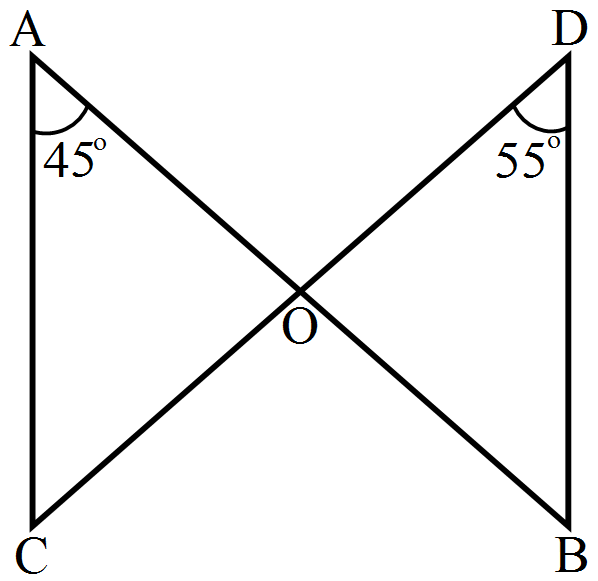
$AC || BD$
And, AB is transverse to these parallal lines
So $\angle\text{CAB}=\angle\text{ABD}$ (Alternate angles)
$\Rightarrow\angle\text{ABD}=45^\circ$
Now In $\triangle\text{BOD}$
$\angle\text{BOD}+\angle\text{ODB}+\angle\text{DBA}=180^\circ$
$\angle\text{DBA}=\angle\text{ABD}=45^\circ,\angle\text{ODB}=55^\circ$
So $\angle\text{BOD}=180^\circ-45^\circ-55^\circ$
$=80^\circ$ View full question & answer→MCQ 251 Mark
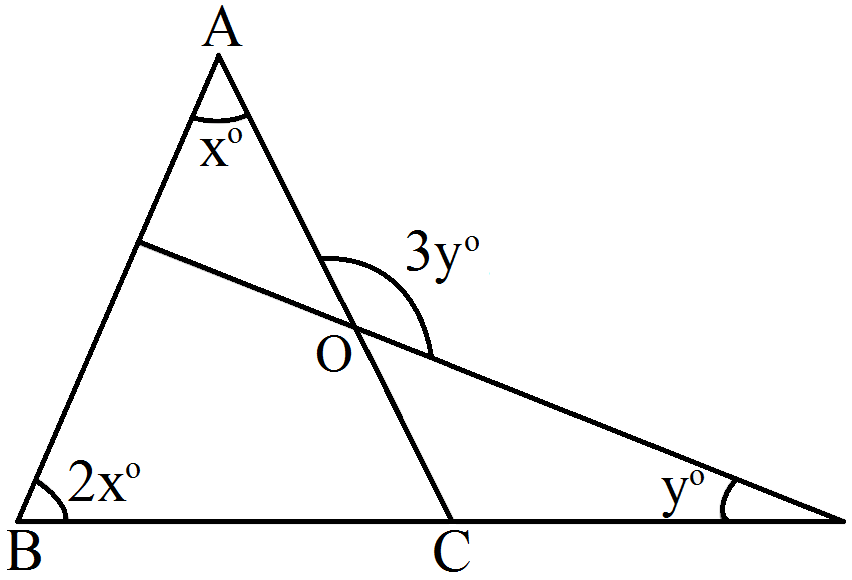
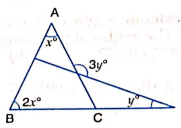
In Fig. what is $y$ in terms of $x$?
- ✓
$\frac{3}{2}\text{x}^\circ$
- B
$\frac{4}{3}\text{x}^\circ$
- C
$\text{x}^\circ$
- D
$\frac{3}{4}\text{x}^\circ$
AnswerCorrect option: A. $\frac{3}{2}\text{x}^\circ$
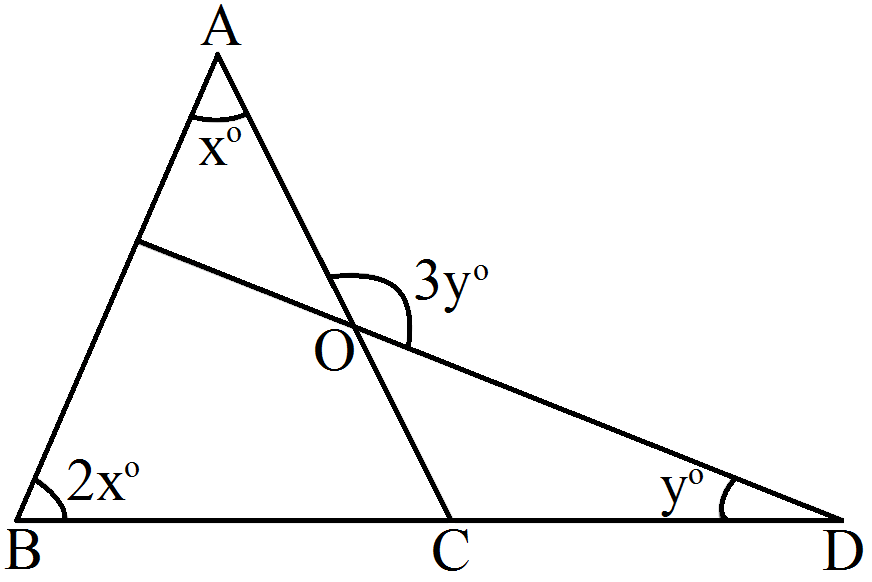
From figure,
$\angle\text{DOC}=180^\circ-\angle\text{AOD}$ (Both are Supplementary)
$\Rightarrow\angle\text{DOC}=180^\circ-3\text{y}^\circ$
Also, $\angle\text{ACB}=180^\circ-\angle\text{A}-\angle\text{B}$
$\Rightarrow\angle\text{ACB}=180^\circ-\text{x}^\circ-2\text{x}^\circ=180^\circ-3\text{x}^\circ$
And $\angle\text{ACD}=180^\circ-\angle\text{ACB}$
$=180^\circ-(180^\circ-3\text{x}^\circ)$
$\Rightarrow\angle\text{ACD}=3\text{x}^\circ$
Now, in $\triangle\text{OCD}$
$\angle\text{DOC}+\angle\text{OCD}+\angle\text{D}=180^\circ$
$180^\circ-3\text{y}^\circ+3\text{x}^\circ+\text{y}^\circ=180^\circ$ $\big[\angle\text{OCD}=\angle\text{ACD}\big]$
$\Rightarrow2\text{y}^\circ=3\text{x}^\circ$
$\Rightarrow\text{y}=\frac{3}{2}\text{x}^\circ$ View full question & answer→MCQ 261 Mark
If all the three angles of a triangle are equal, then each one of them is equal to:
- A
$90^\circ$
- B
$45^\circ$
- ✓
$60^\circ$
- D
$30^\circ$
AnswerCorrect option: C. $60^\circ$
Let the measure of each angle be $x^\circ $.
Now, the sum of all angles of any triangle is $180^\circ $.
Thus, $x^\circ + x^\circ + x^\circ = 180^\circ $
i.e. $3x^\circ = 180^\circ $
i.e. $x^\circ = 60^\circ$
View full question & answer→MCQ 271 Mark
The base $BC$ of triangle $ABC$ is produced both ways and the measure of exterior angles formed are $94^\circ$ and $126^\circ$. Then, $\angle\text{BAC}=$
- A
$94^\circ$
- B
$54^\circ$
- ✓
$40^\circ$
- D
$44^\circ$
AnswerCorrect option: C. $40^\circ$
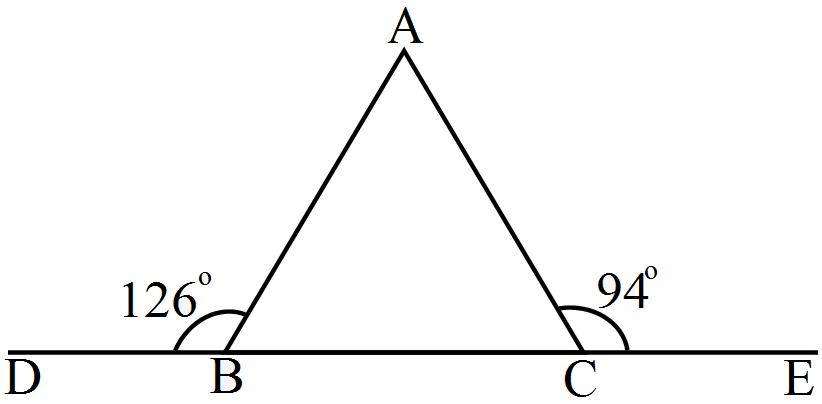
$\angle\text{ABC}=180^\circ-126^\circ=54^\circ$
$\angle\text{ACB}=180^\circ-94^\circ=86^\circ$
Now, in $\triangle\text{ABC}$
$\angle\text{BAC}+\angle\text{ABC}+\angle\text{ACB}=180^\circ$
$\Rightarrow\angle\text{BAC}=180^\circ-\angle\text{ABC}-\angle\text{ACB}$
$=180^\circ-54^\circ-86^\circ$
$\Rightarrow\text{BAC}=40^\circ$ View full question & answer→MCQ 281 Mark
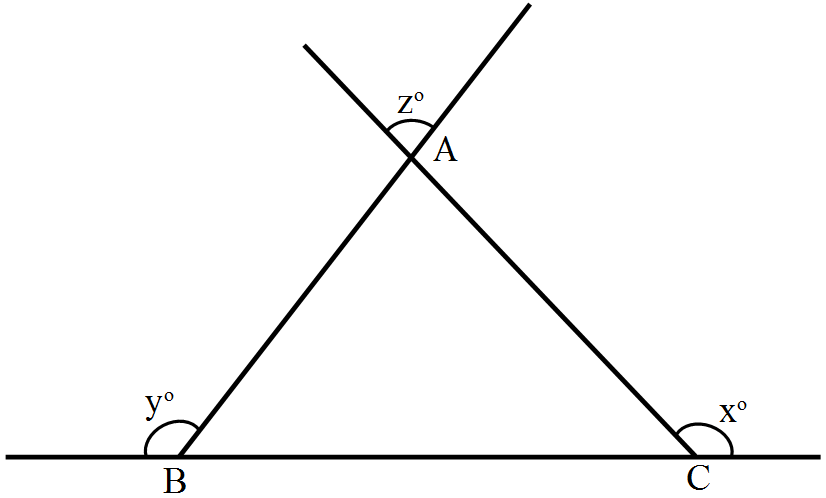
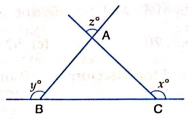
In Fig. what is $z$ in terms of $x$ and $y$?
- A
$x + y + 180^\circ $
- ✓
$x + y - 180^\circ$
- C
$180^\circ - (x + y)$
- D
$x + y + 360^\circ$
AnswerCorrect option: B. $x + y - 180^\circ$
From figure
$\angle\text{A}=\text{z}^\circ$
$\angle\text{ACB}=180^\circ-\text{x}^\circ$
$\angle\text{ABC}=180^\circ-\text{y}^\circ$
Now, in $\triangle\text{ABC}$
$\angle\text{A}+\angle\text{B}+\angle\text{C}=180^\circ$
$\Rightarrow\text{z}^\circ+180^\circ-\text{y}^\circ+180^\circ-\text{x}^\circ=180^\circ$
$\Rightarrow\text{z}^\circ=\text{x}^\circ+\text{y}^\circ-180^\circ$
View full question & answer→MCQ 291 Mark
If two acute angles of a right triangle are equal, then each acute is equal to:
- A
$30^\circ $
- ✓
$45^\circ$
- C
$60^\circ$
- D
$90^\circ$
AnswerCorrect option: B. $45^\circ$
Let the measure of each acute angle of a triangle be $x^\circ $.
Then, we have
$x^\circ + x^\circ + 90^\circ = 180^\circ $
i.e. $2x^\circ = 90^\circ$
i.e. $x^\circ = 45^\circ $
View full question & answer→MCQ 301 Mark
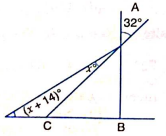
In Fig. if $\text{AB}\perp\text{BC},$ then x =
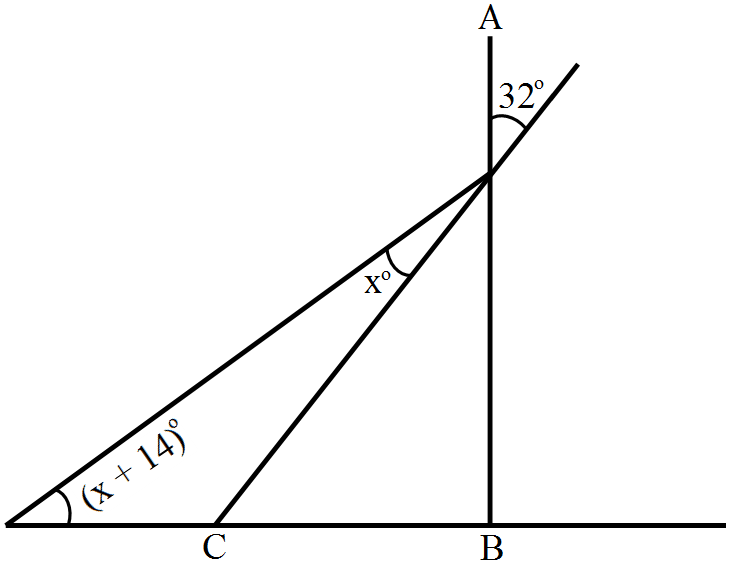
Answer$\text{AB}\perp\text{BC}$
$\Rightarrow\angle\text{ABC}=90^\circ$
$\angle\text{CAB}=32^\circ$ (Opposite angles)
Now, in $\triangle\text{ABD}$
$\angle\text{DAB}=\text{x}^\circ+32^\circ$
$\angle\text{ABD}=90^\circ$
$\angle\text{BDA}=\text{x}^\circ+14^\circ$
In a $\triangle,$ sum of all angles = 180º
$\Rightarrow\angle\text{DAB}+\angle\text{ABD}+\angle\text{BDA}=180^\circ$
$\Rightarrow\text{x}^\circ+32^\circ+90^\circ+\text{x}^\circ+14^\circ=180^\circ$
$\Rightarrow2\text{x}^\circ=180^\circ-136^\circ$
$\Rightarrow2\text{x}^\circ=44^\circ$
$\Rightarrow\text{x}^\circ=22^\circ$
View full question & answer→MCQ 311 Mark
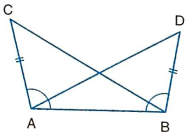
In Fig , if $A C=B D$ and $\angle C A B=\angle D B A$, then $\angle A C B=$
- A
$\angle B A D$
- B
$\angle A B C$
- C
$\angle A B D$
- D
$\angle B D A$
AnswerD. $\angle B D A$
In triangles $A B C$ and $A B D$, we have
$
A B=A B
$$\quad$[Common]
$\angle C A B=\angle D B A$$\quad$[Given]
and,$\quad$$
A C=B D
$$\quad$[Given]
So, by $S A S$ congruence criterion,
we obtain$
\triangle A B C \cong \triangle B A D \Rightarrow \angle A C B=\angle B D A
$
View full question & answer→MCQ 321 Mark
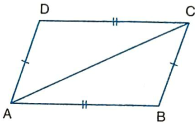
In Fig , $A B C D$ is a quadrilateral in which $A D=C B$ and $A B=C D$, then $\angle A C B$ is equal to
- A
$\angle A C D$
- B
$\angle B A C$
- C
$\angle C A D$
- D
$\angle B A D$
AnswerC. $\angle C A D$
solution In triangles $A C D$ and $C A B$, we have
$
A D=C B
$$\quad$[Given]
$
A B=C D
$$\quad$$\quad$[Given]
and,$\quad$$
A C=A C
$$\quad$[Common]
So, by $S S S$ congruence criterion, we obtain$
\triangle A C D \cong \triangle C A B \Rightarrow \angle A C B=\angle C A D
$
View full question & answer→MCQ 331 Mark
In Fig , ABCD is a quadrilateral in which $B N$ and DM are perpendiculars drawn to $A C$ such that $B N=D M$. If $O B=4 cm$, then $B D=$
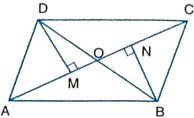
AnswerB. 8 cm
In triangles $O N B$ and $O M D$, we have
$
\angle O N B=\angle O M D\quad$[Each equal to $90^{\circ}$ ]
$\angle B O N=\angle D O M \quad$ [Vertically opposite angles]
and,$\quad$$ B N=D M$
So, by using $A A S$ congruence criterion, we obtain$
\begin{array}{ll}
& \triangle O N B \cong \triangle O M D \Rightarrow O B=O D \Rightarrow O D=O B=4 cm \\
\therefore & B D=O B+O D=4 cm+4 cm=8 cm
\end{array}
$
View full question & answer→MCQ 341 Mark
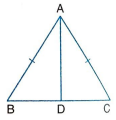
In Fig , if $\triangle A B C$ is an isosceles triangle with $A B=A C$ and $B D=C D$, then the congruence criterion by which $\triangle A D B \cong \triangle A D C$ is
AnswerB. RHS
In $\triangle A B C$, we have, $A B=A C$ and $D$ is the mid-point of $B C$.
Therefore, $A D \perp B C$. Thus, in $\triangle A B D$ and $\triangle A C D$, we have$
A B=A C, B D=C D \text { and } \angle A D B=\angle A D C=90^{\circ}
$
So, by RHS congruence criterion, we obtain $\triangle A D B \cong \triangle A D C$.
View full question & answer→MCQ 351 Mark
In Fig , $\triangle A B C$ is an isosceles triangle with $A B=A C$. If $A D$ is the bisector of $\angle A$, which one of the following options has words that correctly complete the following statement? By congruence criterion, $\triangle A B D \cong \triangle A C D$ and using c.p.c.t, we obtain $\angle A B C=\ldots \ldots$
- A
SAS; $\angle A C D$
- B
$SAS ; \angle A D C$
- C
$A S A ; \angle A C D$
- D
$A S A ; \angle A D C$
AnswerA. SAS; $\angle A C D$
In $\triangle^{\prime} s A B D$ and $A C D$, we have,
$
A B=A C, \angle B A D=\angle C A D \text { and } A D=A D
$
So, by SAS congruence criterion, we obtain$
\angle A B D \cong \triangle A C D \Rightarrow \angle A B D=\angle A C D \Rightarrow \angle A B C=\angle A C D
$
Hence, option (a) is correct.
View full question & answer→MCQ 361 Mark
In Fig. $A B C$ is an isosceles triangle with $A B=A C$ and $L M$ is parallel to $B C$. If $\angle A=50^{\circ}$, then $\angle L M C=$
- A
$65^{\circ}$
- B
$115^{\circ}$
- C
$130^{\circ}$
- D
$50^{\circ}$
View full question & answer→MCQ 371 Mark
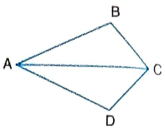
In Fig , if $\triangle A B C \cong \triangle A D C, \angle B A C=30^{\circ}$ and $\angle A B C=100^{\circ}$, then $\angle A C D=$
- A
$30^{\circ}$
- B
$80^{\circ}$
- C
$50^{\circ}$
- D
$70^{\circ}$
AnswerC. $50^{\circ}$
In $\triangle A B C$, we have
$
\begin{array}{ll}
& \angle B A C=30^{\circ} \text { and } \angle A B C=100^{\circ} \\
\therefore & \angle B A C+\angle A B C+\angle A C B=180^{\circ} \\
\Rightarrow & 30^{\circ}+100^{\circ}+\angle A C B=180^{\circ} \Rightarrow \angle A C B=50^{\circ} \\
\text { Now, } & \triangle A B C \cong \triangle A D C \Rightarrow \angle A C D=\angle A C B \Rightarrow \angle A C D=50^{\circ}
\end{array}
$
View full question & answer→MCQ 381 Mark
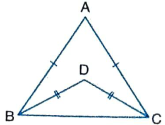
In Fig , if $A B=A C$ and $B D=C D$, then $\angle A B D: \angle A C D=$
- A
$1: 1$
- B
$1: 2$
- C
$2: 1$
- D
$2: 3$
AnswerA. $1: 1$
In triangles $A B C$ and $D B C$, we have
$
\begin{array}{ll}
& A B=A C \text { and } D B=D C \\
\Rightarrow & \angle C=\angle B \text { and } \angle D C B=\angle D B C \\
\Rightarrow & \angle C-\angle D C B=\angle B-\angle D B C \\
\Rightarrow & \angle A B D=\angle A C D \Rightarrow \angle A B D: \angle A C D=1: 1
\end{array}
$
View full question & answer→MCQ 391 Mark
In Fig , if $A B=F C, E F=B D$ and $\angle A F E=\angle C B D$. Then, the rule by which $\triangle A F E \cong \triangle C B D$ is
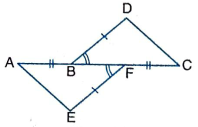
AnswerA. SAS
We have,
$
A B=F C \Rightarrow A B+B F=B F+F C \Rightarrow A F=B C
$
Thus, in triangles $A F E$ and $C B D$, we obtain
$
\begin{aligned}
A F & =B C \\
\angle A F E & =\angle C B D \\
and, F E & =B D
\end{aligned}
$
So, by $S A S$ congruence criterion, we obtain $\triangle A F E \cong \triangle C B D$.
View full question & answer→MCQ 401 Mark
In triangles $A B C$ and $P Q R$, if $A B=A C, \angle C=\angle P$ and $\angle B=\angle Q$. Then, the two triangles
- A
isosceles but not cogruent
- B
- C
congruent but not isosceles
- D
neither congruent nor isosceles
AnswerA. isosceles but not cogruent
In $\triangle A B C$,
we have$
A B=A C \Rightarrow \angle C=\angle B \Rightarrow \angle P=\angle Q \Rightarrow Q R=P R
$
Thus, $\triangle P Q R$ is isosceles.
$\triangle A B C \cong \triangle R Q P$ only if $B C=Q P$, otherwise not.
Hence, two triangles are isosceles but not congruent.
View full question & answer→MCQ 411 Mark
In a $\triangle P Q R$, if $\angle P=\angle R, P R=5 cm$ and $Q R=4 cm$, then $P Q=$
AnswerA. 4 cm
In $\triangle P Q R$, it is given that
$
\angle R=\angle P \Rightarrow P Q=Q R \Rightarrow P Q=4 cm
$[Sides opposite to equal angles]
View full question & answer→MCQ 421 Mark
In a $\triangle A B C, B C=A B$ and $\angle B=80^{\circ}$, then $\angle A=$
- A
$80^{\circ}$
- B
$50^{\circ}$
- C
$40^{\circ}$
- D
$100^{\circ}$
AnswerB. $50^{\circ}$
We have,
$B C=A B$ and $\angle B=80^{\circ}$$
\begin{array}{ll}
\therefore & \angle A=\angle C \text { and } \angle B=80^{\circ} \\
\text { Now } & \angle A+\angle B+\angle C=180^{\circ} \Rightarrow \angle A+80^{\circ}+\angle A=180^{\circ} \Rightarrow 2 \angle A=100 \Rightarrow \angle A=50^{\circ}
\end{array}
$
View full question & answer→MCQ 431 Mark
In a $\triangle A B C$, if $A B=A C$ and $\angle B=50^{\circ}$, then $\angle A=$
- A
$40^{\circ}$
- B
$50^{\circ}$
- C
$80^{\circ}$
- D
$130^{\circ}$
AnswerC. $80^{\circ}$
We have,
$
A B=A C \Rightarrow \angle C=\angle B \Rightarrow \angle C=50^{\circ} \quad \text { [Angles opposite to equal sides are equal] }
$
Thus, we obtain $\angle B=\angle C=50^{\circ}$.$
\therefore \quad \angle A+\angle B+\angle C=180^{\circ} \Rightarrow \angle A+50^{\circ}+50^{\circ}=180^{\circ} \Rightarrow \angle A=80^{\circ}
$
View full question & answer→MCQ 441 Mark
In Fig , by which criterion triangles $O A C$ and $O B D$ are congruent?
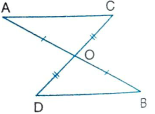
AnswerA. SAS
In triangles $O A C$ and $O B D$,
we find that$
O A=O B, \angle A O C=\angle B O D \text { and } O C=O D
$
So, by using $S A S$ congruence criterion, we obtain $\triangle O A C \cong \triangle O B D$.
View full question & answer→MCQ 451 Mark
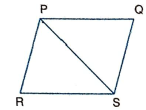
In Fig , $P Q R S$ is a parallelogram. Can it be concluded that $\triangle R P S \cong \triangle Q S P$ ? Why or why not?
- A
Yes, because $P S=P S, \angle S P R=\angle P S Q, \angle R S P=\angle S P Q$
- B
Yes becouse $P Q=R S, P S=Q R, \angle S P R=\angle R P Q, \angle S R P=\angle P R Q, \angle P S R=\angle P Q R$ and $P R=P R$
- C
No, because angle measures are not equal
- D
No, because side lengths are not equal.
View full question & answer→MCQ 461 Mark
In triangles $A B C$ and $P Q R, A B=P Q$ and $\angle B=\angle Q$. The two triangles are congruent by SAS criterion, if
AnswerD. BC = QR
In triangles $A B C$ and $P Q R$, we have $A B=P Q$ and $\angle B=\angle Q$. Therefore, two triangles will be congruent by $S A S$ criterion, if $B C=Q R$.
View full question & answer→MCQ 471 Mark
By which congruence criterion the following triangles are congruent?
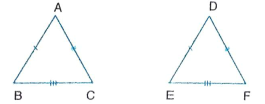
AnswerD. SSS
In triangles $A B C$ and $D E F$, we find that $A B=D E, B C=E F$ and $A C=D F$.
Hence by SSS congruence criterion, we obtain $\triangle A B C \cong \triangle D E F$.
View full question & answer→MCQ 481 Mark
If $\triangle P Q R \cong \triangle A C B$, then $A B$ is equal to
AnswerB. PR
We have,
$\triangle P Q R \cong \triangle A C B$$
\Rightarrow \quad P Q=A C, Q R=C B \text { and } P R=A B
$
View full question & answer→Question 491 Mark
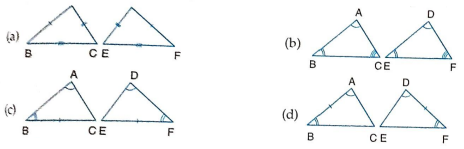
AnswerB. In option (a), we find that in triangles $A B C$ and $D E F$, we have
$A B=D F, A C=D E$ and $B C=E F$
So, by using $S S S$ criterion of congruence, we obtain $\triangle A B C \cong \triangle D F E$
In option (c), we find that in triangles $A B C$ and $D E F$, we have
$\angle A=\angle D, \angle B=\angle F$ and $B C=F E$
So, by using $A A S$ criterion of congruence, we obtain $\triangle A B C \cong \triangle D F E$.
In option (d), we observe that $\angle A=\angle D, \angle B=\angle F$ and $A B=D F$. So, by $S A S$ congruence criterion, we obtain $\triangle A B C \cong \triangle D F E$.
In option (b) we observe that $\angle A=\angle D, \angle B=\angle E$ and $\angle C=\angle F$. But, $\triangle A B C$ need not be congruent to $\triangle D E F$ as the corresponding sides of two triangles may not be same.
View full question & answer→MCQ 501 Mark
In Fig , two triangles $A B C$ and $P Q R$ shown. Which congruence criterion can be used to show that the triangles are congruent?
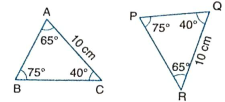
AnswerC. ASA
In triangles $A B C$ and $P Q R$, we find that
$\Rightarrow \quad \angle A=\angle R, A C=R Q$ and $\angle C=\angle Q$
Therefore, by ASA congruence criterion, we obtain $\triangle A B C \cong \triangle R P Q$
View full question & answer→MCQ 511 Mark
In two triangles $A B C$ and $P Q R$, if $A B=Q R, B C=R P$ and $C A=P Q$, then
- A
$\triangle A B C \cong \triangle P Q R$
- B
$\triangle C B A \cong \triangle P R Q$
- C
$\triangle B A C \cong \triangle R P Q$
- D
$\triangle P Q R \cong \triangle B C$
AnswerB. $\triangle C B A \cong \triangle P R Q$
We have, $A B=Q R, B C=R P$ and $C A=P Q$
$\Rightarrow \quad A \leftrightarrow Q, B \leftrightarrow R$ and $C \leftrightarrow P$
$\Rightarrow \quad \triangle A B C \cong \triangle Q R P, \triangle C B A \cong \triangle P R Q, \triangle B A C \cong \triangle R Q P$ and $\triangle B C A \cong \triangle R P Q$
Clearly, option (b) is correct.
View full question & answer→MCQ 521 Mark
Which of the following is not a criterion for congruence of triangles?
AnswerC. SSA
We have, $S S S, S A S, A S A, A A S$ and RHS as criteria for congruence of triangles. Hence SSA is not a criterion for congruence of triangles.
View full question & answer→MCQ 531 Mark
In Fig , $a+b=$
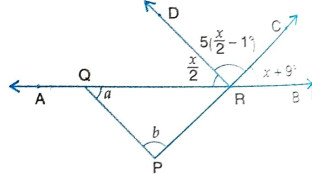
- A
$117^{\circ}$
- B
$130^{\circ}$
- C
$127^{\circ}$
- D
$158^{\circ}$
AnswerC. $127^{\circ}$
Since $A R B$ is a straight line.
$
\begin{array}{ll}
\therefore & \frac{x}{2}+5\left(\frac{x}{2}-1^{\circ}\right)+x+90^{\circ}=180^{\circ} \\
\Rightarrow & 4 x+4^{\circ}=180^{\circ} \Rightarrow 4 x=176^{\circ} \Rightarrow x=44^{\circ}
\end{array}
$
Using exterior angle property in $P Q R$, we obtain$
\begin{aligned}
& \angle Q R C=a+b \\
\Rightarrow \quad & \frac{x}{2}+5\left(\frac{x}{2}-1^{\circ}\right)=a+b \Rightarrow a+b=3 x-5^{\circ} \Rightarrow a+b=3 \times 44^{\circ}-5=127^{\circ}
\end{aligned}
$
View full question & answer→MCQ 541 Mark
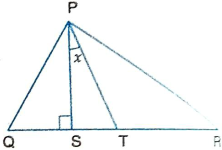
In Fig , if $P T$ is the bisector of $\angle Q P R$ in $\triangle P Q R, \angle P Q R=50^{\circ}, \angle P R Q=30^{\circ}$ and $P S \perp Q R$, then $x=$
- A
$40^{\circ}$
- B
$20^{\circ}$
- C
$30^{\circ}$
- D
$10^{\circ}$
AnswerD. $10^{\circ}$
Using angle sum property in $\triangle P Q R$, we obtain$
\begin{array}{ll}
& \angle P Q R+\angle P R Q+\angle R P Q=180^{\circ} \\
\Rightarrow & 50^{\circ}+30^{\circ}+\angle R P Q=180^{\circ} \Rightarrow \angle R P Q=100^{\circ} \\
\therefore \quad & \angle Q P T=\frac{1}{2} \angle R P Q=50^{\circ} \quad[\because P T \text { is bisector of } \angle Q P R]
\end{array}
$
Using exterior angle property in $\triangle P Q S$, we obtain$
\begin{array}{ll}
& \angle P S T=\angle P Q S+\angle Q P S \Rightarrow 90^{\circ}=50^{\circ}+\angle Q P S \Rightarrow \angle Q P S=40^{\circ} \\
\therefore & x=\angle Q P T-\angle Q P S=50^{\circ}-40^{\circ}=10^{\circ}
\end{array}
$
View full question & answer→MCQ 551 Mark
- A
$180^{\circ}$
- B
$360^{\circ}$
- C
$240^{\circ}$
- D
$300^{\circ}$
AnswerB. $360^{\circ}$
Using exterior angle property in $\triangle A B C$, we obtain
$\angle A C D=\angle A+\angle B, \angle C B F=\angle A+\angle C$ and, $\angle B A E=\angle B+\angle C$
$\therefore$ $\angle B A E+\angle C B F+\angle A C D=(\angle B+\angle C)+(\angle A+\angle C)+(\angle A+\angle B)$
$=2(\angle A+\angle B+\angle C)=2 \times 180^{\circ}=360^{\circ}$
View full question & answer→MCQ 561 Mark
In a $\triangle A B C$, it is given that $\angle A: \angle B: C=3: 2: 1$ and $\angle A C D=90^{\circ}$. If $B C$ is produced to $E$, then $\angle E C D=$
- A
$60^{\circ}$
- B
$30^{\circ}$
- C
$50^{\circ}$
- D
$40^{\circ}$
View full question & answer→MCQ 571 Mark
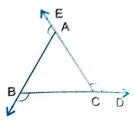
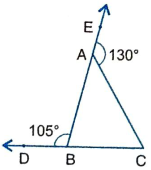
In Fig , sides $C B$ and $B A$ of $\triangle A B C$ are produced to $D$ and $E$ respectively. If $\angle A B D=105^{\circ}$ and $\angle C A E=130^{\circ}$, then $\angle A C B=$
- A
$50^{\circ}$
- B
$55^{\circ}$
- C
$75^{\circ}$
- D
$130^{\circ}$
AnswerB. $55^{\circ}$
We have, $\angle C A E=130^{\circ}$$
\therefore \quad \angle B A C=180^{\circ}-130^{\circ}=50^{\circ} \quad\left[\because \angle B A C+\angle C A E=180^{\circ}\right]
$
Using exterior angle property in $\triangle A B C$, we obtain$
\begin{array}{ll}
& \angle A B D=\angle B A C+\angle A C B \\
\Rightarrow \quad & 105^{\circ}=50^{\circ}+\angle A C B \Rightarrow \angle A C B=105^{\circ}-50^{\circ}=55^{\circ}
\end{array}
$
View full question & answer→MCQ 581 Mark
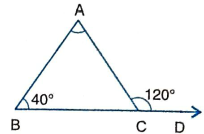
In Fig , $\angle A C D=120^{\circ}$ and $\angle A B C=40^{\circ}$, then $\angle B A C=$
- A
$80^{\circ}$
- B
$60^{\circ}$
- C
$50^{\circ}$
- D
$40^{\circ}$
AnswerA. $80^{\circ}$
In $\triangle A B C$, side $B C$ is produced to $D$. Using exterior angle property, we obtain$
\begin{array}{ll}
& \angle A C D=\angle A B C+\angle B A C \\
\Rightarrow \quad & 120^{\circ}=40^{\circ}+\angle B A C \Rightarrow \angle B A C=80^{\circ}
\end{array}
$
View full question & answer→MCQ 591 Mark
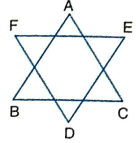
In Fig , $\angle A+\angle B+\angle C+\angle D+\angle E+\angle F=$
- A
$180^{\circ}$
- B
$360^{\circ}$
- C
$540^{\circ}$
- D
$90^{\circ}$
AnswerB. $360^{\circ}$
Using angle sum property in $\triangle^{\prime} s A B C$ and $D E F$, we obtain$
\begin{array}{ll}
& \angle A+\angle B+\angle C=180^{\circ} \text { and } \angle D+\angle E+\angle F=180^{\circ} \\
\Rightarrow \quad & \angle A+\angle B+\angle C+\angle D+\angle E+\angle F=180^{\circ}+180^{\circ}=360^{\circ}
\end{array}
$
View full question & answer→MCQ 601 Mark
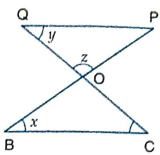
In Fig , $B C \| P Q, B P$ and $C Q$ intersect at $O$. If $x+y=80^{\circ}$ and $x-y=55^{\circ}$, then $z=$
- A
$80^{\circ}$
- B
$55^{\circ}$
- C
$90^{\circ}$
- D
$100^{\circ}$
AnswerD. $100^{\circ}$
It is given that $B C \| P Q$ and transversal $B P$ cuts them at $B$ and $P$ respectively.$
\begin{array}{ll}
\therefore & \angle C B P=\angle B P Q \\
\Rightarrow & \angle B P Q=x
\end{array}
$
Using angle sum property in $\triangle O P Q$, we obtain$
\angle P+\angle Q+\angle P O Q=180^{\circ} \Rightarrow x+y+z=180^{\circ} \Rightarrow 80^{\circ}+z=180^{\circ} \Rightarrow z=100^{\circ} \quad\left[\because x+y=80^{\circ} \text { (given) }\right]
$
View full question & answer→MCQ 611 Mark
In a $\triangle A B C$, if $\angle A=\angle B+\angle C$, then $\triangle A B C$ is
AnswerC. right triangle
We have,
\[
\angle A=\angle B+\angle C \Rightarrow \angle A+\angle A=\angle A+\angle B+\angle C \Rightarrow 2 \angle A=180^{\circ} \Rightarrow \angle A=90^{\circ}
\]
Hence, $\triangle A B C$ is a right triangle.
View full question & answer→MCQ 621 Mark
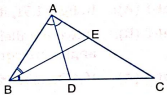
In Fig. ABC is a triangle in which $\angle B=2 \angle C$. D is a point on side BC such that AD bisects $\angle B A C$ and $A B=C D$. BE is the bisector of $\angle B$. The measure of $\angle B A C$ is
- ✓
$72^{\circ}$
- B
$73^{\circ}$
- C
$74^{\circ}$
- D
$95^{\circ}$
AnswerCorrect option: A. $72^{\circ}$
(a) $72^{\circ}$
[Hint: $\triangle A B E \cong \triangle B C E$ ]
View full question & answer→MCQ 631 Mark
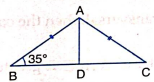
In fig. ABC is an isosceles triangle such that AB = AC and AD is the median to base BC. Then, $\angle B A D=$
- ✓
$55^{\circ}$
- B
$70^{\circ}$
- C
$35^{\circ}$
- D
$110^{\circ}$
AnswerCorrect option: A. $55^{\circ}$
View full question & answer→MCQ 641 Mark
$D, E, F$ are the mid-point of the sides $B C, C A$ and $A B$ respectively of $\triangle A B C$. Then $\triangle D E F$ is congruent to triangle
View full question & answer→MCQ 651 Mark
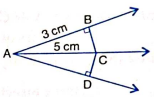
In Fig. if AC is bisector of $\angle B A D$ such that $A B=3 cm$ and $A C=5 cm$, then CD =
View full question & answer→MCQ 661 Mark
In Fig. ABC is an isosceles triangle whose side AC is produced to E. Through C, CD is drawn parallel to BA. The value of x, is
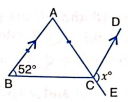
- A
$52^{\circ}$
- B
$76^{\circ}$
- C
$156^{\circ}$
- ✓
$104^{\circ}$
AnswerCorrect option: D. $104^{\circ}$
View full question & answer→MCQ 671 Mark
In Fig. if $A E \| D C$ and $A B=A C$, the value of $\angle A B D$ is
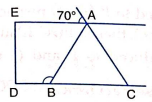
- A
$70^{\circ}$
- ✓
$110^{\circ}$
- C
$120^{\circ}$
- D
$130^{\circ}$
AnswerCorrect option: B. $110^{\circ}$
View full question & answer→MCQ 681 Mark
In Fig. $A B \perp B E$ and $F E \perp B E$. If $B C=D E$ and $A B=E F$, then $\triangle A B D$ is congruent to
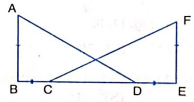
- A
$\triangle E F C$
- B
$\triangle E C F$
- C
$\triangle C E F$
- ✓
$\triangle F E C$
AnswerCorrect option: D. $\triangle F E C$
View full question & answer→MCQ 691 Mark
In Fig. the measure of $\angle B^{\prime} A^{\prime} C^{\prime}$ is
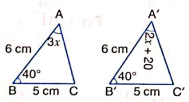
- A
$50^{\circ}$
- ✓
$60^{\circ}$
- C
$70^{\circ}$
- D
$80^{\circ}$
AnswerCorrect option: B. $60^{\circ}$
View full question & answer→MCQ 701 Mark
If $A B C$ and $D E F$ are two triangles such that $\triangle A B C \cong \triangle F D E$ and $A B=5 cm, \angle B=40^{\circ}$ and $\angle A=80^{\circ}$. Then, which of the following is true?
- A
$D F=5 cm, \angle F=60^{\circ}$
- B
$D E=5 cm, \angle E=60^{\circ}$
- ✓
$D F=5 cm, \angle E=60^{\circ}$
- D
$D E=5 cm, \angle D=40^{\circ}$
AnswerCorrect option: C. $D F=5 cm, \angle E=60^{\circ}$
View full question & answer→MCQ 711 Mark
Which of the following is not a criterion for congruence of triangles?
MCQ 721 Mark
In an isosceles triangle, if the vertex angle is twice the sum of the base angles, then the measure of vertex angle of the triangle is
- A
$100^{\circ}$
- ✓
$120^{\circ}$
- C
$110^{\circ}$
- D
$130^{\circ}$
AnswerCorrect option: B. $120^{\circ}$
View full question & answer→MCQ 731 Mark
In a $\triangle A B C$, if AB = AC and BC is produced to D such that $\angle A C D=100^{\circ}$ then $\angle A=$
- ✓
$20^{\circ}$
- B
$40^{\circ}$
- C
$60^{\circ}$
- D
$80^{\circ}$
AnswerCorrect option: A. $20^{\circ}$
View full question & answer→MCQ 741 Mark
If $\triangle P Q R \cong \triangle E F D$, then $\angle E=$
- ✓
$\angle P$
- B
$\angle Q$
- C
$\angle R$
- D
AnswerCorrect option: A. $\angle P$
View full question & answer→MCQ 751 Mark
If $\triangle P Q R \cong \triangle E F D$, then $E D=$
View full question & answer→MCQ 761 Mark
In triangles ABC and PQR, if $\angle A=\angle R, \angle B=\angle P$ and $A B=R P$, then which one of the following congruence conditions applies:
View full question & answer→MCQ 771 Mark
In triangles ABC and PQR three equality relations between some parts are as follows:
$A B=Q P, \angle B=\angle P$ and $B C=P R$
State which of the congruence conditions applies:
View full question & answer→MCQ 781 Mark
If $\triangle A B C \cong \triangle P Q R$ and $\triangle A B C$ is not congruent to $\triangle R P Q$, then which of the following is not true:
View full question & answer→MCQ 791 Mark
If $\triangle A B C \cong \triangle A C B$, then $\triangle A B C$ is isosceles with
View full question & answer→MCQ 801 Mark
If $\triangle A B C \cong \triangle L K M$, then side of $\triangle L K M$ equal to side AC of $\triangle A B C$ is
View full question & answer→MCQ 811 Mark
In $\triangle R S T$ (See Fig.) what is the value of x?
- A
- B
$90^{\circ}$
- C
$80^{\circ}$
- ✓
View full question & answer→MCQ 821 Mark
In Fig. if $l_1 \| l_2$, the value of x is
View full question & answer→MCQ 831 Mark
The side BC of $\triangle A B C$ is produced to a point D. The bisector of $\angle A$ meets side BC in L. If $\angle A B C=30^{\circ}$ and $\angle A C D=115^{\circ}$, then $\angle A L C=$
- A
$85^{\circ}$
- ✓
$72 \frac{1}{2}^{\circ}$
- C
$145^{\circ}$
- D
AnswerCorrect option: B. $72 \frac{1}{2}^{\circ}$
View full question & answer→MCQ 841 Mark
In a $\triangle A B C, \angle A=50^{\circ}$ and BC is produced to a point D. If the bisectors of $\angle A B C$ and $\angle A C D$ meet at $E$, then $\angle E=$
- ✓
$25^{\circ}$
- B
$50^{\circ}$
- C
$100^{\circ}$
- D
$75^{\circ}$
AnswerCorrect option: A. $25^{\circ}$
View full question & answer→MCQ 851 Mark
The bisects of exterior angles at B and C of $\triangle A B C$ meet at O. If $\angle A=x^{\circ}$, then $\angle B O C=$
- A
$90^{\circ}+\frac{x^{\circ}}{2}$
- ✓
$90^{\circ}-\frac{x^{\circ}}{2}$
- C
$180^{\circ}+\frac{x^{\circ}}{2}$
- D
$180^{\circ}-\frac{x^{\circ}}{2}$
AnswerCorrect option: B. $90^{\circ}-\frac{x^{\circ}}{2}$
View full question & answer→MCQ 861 Mark
If the bisectors of the acute angles of a right triangle meet at O, then the angle at O between the two bisectors is
- A
$45^{\circ}$
- B
$95^{\circ}$
- ✓
$135^{\circ}$
- D
$90^{\circ}$
AnswerCorrect option: C. $135^{\circ}$
View full question & answer→MCQ 871 Mark
In Fig., AB and CD are parallel lines and transversal EF intersects them at P and Q respectively. If $\angle A P R=25^{\circ}, \angle R Q C=30^{\circ}$ and $\angle C Q F=65^{\circ}$, then
- ✓
$x=55^{\circ}, y=40^{\circ}$
- B
$x=50^{\circ}, y=45^{\circ}$
- C
$x=60^{\circ}, y=35^{\circ}$
- D
$x=35^{\circ}, y=60^{\circ}$
AnswerCorrect option: A. $x=55^{\circ}, y=40^{\circ}$
View full question & answer→MCQ 881 Mark
In Fig. what is the value of x?
MCQ 891 Mark
In Fig. what is y in terms of x?
- ✓
$\frac{3}{2} x$
- B
$\frac{4}{3} x$
- C
- D
$\frac{3}{4} x$
AnswerCorrect option: A. $\frac{3}{2} x$
View full question & answer→MCQ 901 Mark
In Fig. what is z in terms of x and y?
- A
- ✓
- C
$180^{\circ}-(x+y)$
- D
$x+y+360^{\circ}$
View full question & answer→MCQ 911 Mark
In Fig. if $A B \perp B C$ , then x =
View full question & answer→MCQ 921 Mark
The base BC of triangle ABC is produced both ways and the measure of exterior angles formed are $94^{\circ}$ and $126^{\circ}$. Then, $\angle B A C=$
- A
$94^{\circ}$
- B
$54^{\circ}$
- ✓
$40^{\circ}$
- D
$44^{\circ}$
AnswerCorrect option: C. $40^{\circ}$
View full question & answer→MCQ 931 Mark
In Fig. if BP ||CQ and AC = BC then the measure of x is
- A
$20^{\circ}$
- B
$25^{\circ}$
- ✓
$30^{\circ}$
- D
$35^{\circ}$
AnswerCorrect option: C. $30^{\circ}$
View full question & answer→MCQ 941 Mark
In Fig. the value of x is
- A
$65^{\circ}$
- B
$80^{\circ}$
- C
$95^{\circ}$
- ✓
$120^{\circ}$
AnswerCorrect option: D. $120^{\circ}$
View full question & answer→MCQ 951 Mark
In Fig. for which value of x is $I_1 \| I_2$ ?
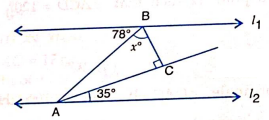
View full question & answer→MCQ 961 Mark
If the measures of angles of a triangle are in the ratio of 3 : 4 : 5 what is the measure of the smallest angle of the triangle?
- A
$25^{\circ}$
- B
$30^{\circ}$
- ✓
$45^{\circ}$
- D
$60^{\circ}$
AnswerCorrect option: C. $45^{\circ}$
View full question & answer→MCQ 971 Mark
In Fig. x + y =
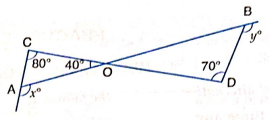
MCQ 981 Mark
In Fig. if EC ||AB, $\angle E C D=70^{\circ}$ and $\angle B D O=20^{\circ}$, then $\angle O B D$ is
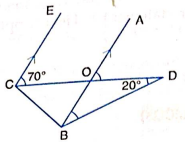
- A
$20^{\circ}$
- ✓
$50^{\circ}$
- C
$60^{\circ}$
- D
$70^{\circ}$
AnswerCorrect option: B. $50^{\circ}$
View full question & answer→MCQ 991 Mark
Line segments AB and CD intersect at O such that AC|| DB . If $\angle C A B=45^{\circ}$ and $\angle C D B=55^{\circ}$, then $\angle B O D=$
- A
$100^{\circ}$
- ✓
$80^{\circ}$
- C
$90^{\circ}$
- D
$135^{\circ}$
AnswerCorrect option: B. $80^{\circ}$
View full question & answer→MCQ 1001 Mark
In a $\triangle A B C$, if $\angle A=60^{\circ}, \angle B=80^{\circ}$ and the bisectors of $\angle B$ and $\angle C$ meet at $O$, then $\angle B O C=$
- A
$60^{\circ}$
- ✓
$120^{\circ}$
- C
$150^{\circ}$
- D
$30^{\circ}$
AnswerCorrect option: B. $120^{\circ}$
View full question & answer→MCQ 1011 Mark
An exterior angle of a triangle is $108^{\circ}$ and its interior opposite angles are in the ratio 4:5. The angles of the triangle are
- ✓
$48^{\circ}, 60^{\circ}, 72^{\circ}$
- B
$50^{\circ}, 60^{\circ}, 70^{\circ}$
- C
$52^{\circ}, 56^{\circ}, 72^{\circ}$
- D
$42^{\circ}, 60^{\circ}, 76^{\circ}$
AnswerCorrect option: A. $48^{\circ}, 60^{\circ}, 72^{\circ}$
View full question & answer→MCQ 1021 Mark
In $\triangle A B C$, if $\angle A=100^{\circ}, A D$ bisects $\angle A$ and $A D \perp B C$. Then, $\angle B=$
- A
$50^{\circ}$
- B
$90^{\circ}$
- ✓
$40^{\circ}$
- D
$100^{\circ}$
AnswerCorrect option: C. $40^{\circ}$
View full question & answer→MCQ 1031 Mark
If the sides of a triangle are produced in order, then the sum of the three exterior angles so formed is
- A
$90^{\circ}$
- B
$180^{\circ}$
- C
$270^{\circ}$
- ✓
$360^{\circ}$
AnswerCorrect option: D. $360^{\circ}$
View full question & answer→MCQ 1041 Mark
In a triangle, an exterior angle at a vertex is $95^{\circ}$ and its one of the interior opposite angle is $55^{\circ}$ then the measure of the other interior angle is
- A
$55^{\circ}$
- B
$85^{\circ}$
- ✓
$40^{\circ}$
- D
$9.0^{\circ}$
AnswerCorrect option: C. $40^{\circ}$
View full question & answer→MCQ 1051 Mark
In $\triangle A B C, \angle B=\angle C$ and ray $A X$ bisects the exterior angle $\angle D A C$. If $\angle D A X=70^{\circ}$, then $\angle A C B=$
- A
$35^{\circ}$
- B
$90^{\circ}$
- ✓
$70^{\circ}$
- D
$55^{\circ}$
AnswerCorrect option: C. $70^{\circ}$
View full question & answer→MCQ 1061 Mark
Side BC of a triangle ABC has been produced to a point D such that $\angle A C D=120^{\circ}$. If $\angle B=\frac{1}{2} \angle A$, then $\angle A$ is equal to
- ✓
$80^{\circ}$
- B
$75^{\circ}$
- C
$60^{\circ}$
- D
$90^{\circ}$
AnswerCorrect option: A. $80^{\circ}$
View full question & answer→MCQ 1071 Mark
If one angle of a triangle is equal to the sum of the other two angles, then the triangle is
MCQ 1081 Mark
An exterior angle of a triangle is equal to $100^{\circ}$ and two interior opposite angles are equal. Each of these angles is equal to
- A
$75^{\circ}$
- B
$80^{\circ}$
- C
$40^{\circ}$
- ✓
$50^{\circ}$
AnswerCorrect option: D. $50^{\circ}$
View full question & answer→MCQ 1091 Mark
If two acute angles of a right triangle are equal, then each acute is equal to
- A
$30^{\circ}$
- ✓
$45^{\circ}$
- C
$60^{\circ}$
- D
$90^{\circ}$
AnswerCorrect option: B. $45^{\circ}$
View full question & answer→MCQ 1101 Mark
If all the three angles of a triangle are equal, then each one of them is equal to
- A
$90^{\circ}$
- B
$45^{\circ}$
- ✓
$60^{\circ}$
- D
$30^{\circ}$
AnswerCorrect option: C. $60^{\circ}$
View full question & answer→