MCQ 11 Mark
The velocity of a body can change:
- A
If its acceleration is zero.
- ✓
If its acceleration is non-zero.
- C
Both $A \& B$
- D
AnswerCorrect option: B. If its acceleration is non-zero.
Acceleration is defined as change of velocity in unit time.
So if acceleration is zero, there is no change of velocity, the body is moving with a constant velocity.
View full question & answer→MCQ 21 Mark
The SI unit of retardation is $......$ ?
AnswerCorrect option: A. $\frac{\text{m}}{\text{s}}^{2}$
$S$i unit of retardation is same as that of acceleration as $\frac{\text{m}}{\text{s}}^{2}$
View full question & answer→MCQ 31 Mark
Which of the following could not be a unit of acceleration?
AnswerCorrect option: C. $\mathrm {km/s}$
Acceleration is defined as the rate of change of velocity.
View full question & answer→MCQ 41 Mark
Which of the following statements is correct for a particle travelling with a constant speed:
- A
Its position remains constant as time passes.
- B
It covers equal distances in unequal time intervals.
- ✓
Its acceleration is zero.
- D
It does not change its direction of motion.
AnswerCorrect option: C. Its acceleration is zero.
View full question & answer→MCQ 51 Mark
When two bodies moves uniformly towards each her then they cross each other at the speed of $10\ m/s$. If both the bodies move in the same direction, then they cross each other at the speed of 6m/s. The speed of both bodies are:
- ✓
$8\ m/s, 2\ m/s$
- B
$8\ m/s, 4\ m/s$
- C
$6\ m/s, 2\ m/s$
- D
$6\ m/s, 4\ m/s$
AnswerCorrect option: A. $8\ m/s, 2\ m/s$
Let the objects speed be $x$ and $y$ respectively, when moving towards each other:
$x + y = 10 ...(1)$
and, when moving in same direction
$x - y = 6 ...(2)$
now,
adding $1$ and $2$ we get
$2x = 16m/s$
$x = 8m/s$
and,
putting this in $1$
$y = 2m/s$
The speed of the bodies is $8 \mathrm{~m} / \mathrm{s}^2$ and $2 \mathrm{~m} / \mathrm{s}^2$.
View full question & answer→MCQ 61 Mark
Which of the following is most likely not a case of uniform circular motion?
- A
Motion of the earth around the sun.
- B
Motion of a toy train on a circular track.
- ✓
Motion of a racing car on a circular track.
- D
Motion of hours’ hand on the dial of a clock.
AnswerCorrect option: C. Motion of a racing car on a circular track.
View full question & answer→MCQ 71 Mark
For a body performing motion with uniform speed, the distance-time graph is:
AnswerCorrect option: B. Straight line inclined to the time axis.
Straight line inclined to the time axis.
View full question & answer→MCQ 81 Mark
Suppose a boy is enjoying a ride on a merry-go-round which is moving with a constant speed of $10 \mathrm{~ms}^{-1}$. It implies that the boy is:
- A
- B
Moving with no acceleration.
- ✓
- D
Moving with uniform velocity.
AnswerThe speed is constant but velocity is not constant, because its direction goes on changing i.e., there is acceleration in the motion. So, we can say that the boy is in accelerated motion.
View full question & answer→MCQ 91 Mark
- A
The shortest path between the initial and final positions
- B
The longest possible path between the initial and final positions
- ✓
The actual path travelled by the body between the initial and final positions
- D
AnswerCorrect option: C. The actual path travelled by the body between the initial and final positions
Distance is defined as the length of the actual path travelled by a moving body between its initial and final positions.
View full question & answer→MCQ 101 Mark
A stone tied to a string is whirled in a circle. As it is revolving, the rope suddenly breaks.Then:
- ✓
The stone flies off tangential to the circle of rotation
- B
The stone moves radially inward
- C
The stone moves radially outward
- D
The motion of the stone depends upon its velocity
AnswerCorrect option: A. The stone flies off tangential to the circle of rotation
When a stone is going around a circular path, the instantaneous velocity of stone is acting as tangent to the circle.
When the string breaks, the centripetal force stops to act.
Due to inertia, the stone continues to move along the tangent to circular path.
So, the stone flies off tangentially to the circular path
View full question & answer→MCQ 111 Mark
Uniform circular motion is called continuously accelerated motion mainly because its:
- ✓
Direction of motion changes
- B
- C
Velocity remains the same
- D
Direction of motion does not change
AnswerCorrect option: A. Direction of motion changes
An accelerating body is an object that is changing its velocity.
And since velocity is a vector that has both magnitude and direction, a change in either the magnitude or the direction constitutes a change in the velocity.
View full question & answer→MCQ 121 Mark
$y =$ constant: Uniform motion
$a =$ constant: __________
- A
Non-uniformly accelerated.
- B
- ✓
$v = 0$ at, $t = 0.$
- D
AnswerCorrect option: C. $v = 0$ at, $t = 0.$
No, when a body is under uniform acceleration doesn't mean that it is under uniform motion. Uniform acceleration means, that the velocity of body is changing with a constant rate. Uniform motion is the kind of motion in which a body covers equal distances in equal intervals of time. It means that speed is constant.
View full question & answer→MCQ 131 Mark
Which of the following statement is correct regarding velocity and speed of a moving body?
- A
Velocity of a moving body is always higher than its speed.
- B
Speed of a moving body is always higher than its velocity.
- C
Speed of a moving body is its velocity in a given direction.
- ✓
Velocity of a moving body is its speed in a given direction.
AnswerCorrect option: D. Velocity of a moving body is its speed in a given direction.
View full question & answer→MCQ 141 Mark
In a motion with constant acceleration the velocity is reduced to zero in $5$ seconds and after covering a distance of $100\ m$. The distance covered by the particle in next $5$ second will be:
- ✓
- B
$250\ m$
- C
$100\ m$
- D
$500\ m$
View full question & answer→MCQ 151 Mark
The speed-time graph of a body is straight line parallel to time axis.The body has:
AnswerIf the speed$-$time graph is parallel to the time axis, then this means that the body has the same speed at all the time.
Thus, speed $=$ constant
View full question & answer→MCQ 161 Mark
In a uniform circular motion-
- A
Both velocity and acceleration are constant.
- B
Acceleration and speed are constant but velocity changes.
- C
Both acceleration and velocity change
- ✓
Both acceleration and speed are constant
AnswerCorrect option: D. Both acceleration and speed are constant
For a body moving in uniform circular motion the speed attained by the object will remain constant not the velocity as velocity depends on the direction of motion, and in circular motion the direction of the object changes at every point.
As speed remains constant the acceleration will remain constant.
View full question & answer→MCQ 171 Mark
- A
zero speed and non-zero acceleration
- B
non-zero speed and zero acceleration
- ✓
constant velocity and a varying speed
- D
constant speed and a varying velocity
AnswerCorrect option: C. constant velocity and a varying speed
Speed of body is magnitude of velocity. So if velocity is only changing direction then speed is constant.
But if speed is changing then velocity have to be varying.
When a body starts moving the incident when $t=0$ then it have zero velocity but some acceleration is there.
Object moving with constant velocity has zero acceleration but non zero speed.
View full question & answer→MCQ 181 Mark
You can derive first equation of kinematics is from the formula of $….$
View full question & answer→MCQ 191 Mark
Area under a speed$-$time graph gives:
- A
The time taken by a moving object
- ✓
The distance travelled by a moving object
- C
Tthe acceleration of a moving object
- D
Tthe retardation of a moving object
AnswerCorrect option: B. The distance travelled by a moving object
The area under the velocity$-$time graph gives the distance traveled by a moving object during that time interval.
While the area under the velocity$-$time graph gives displacement of the particle.
View full question & answer→MCQ 201 Mark
If the velocity of a body does not change, its acceleration is:
AnswerAcceleration of a body is defined as the rate of change of the velocity of the body.
Now since the velocity doesn't change at all, the rate of change will be zero.
So, acceleration $= 0$
View full question & answer→MCQ 211 Mark
Which is the most simple type of motion among the following?
MCQ 221 Mark
Our alternatives are given to each of the following incomplete statements / questions, choose the right answer.
Uniform circular motion is called continuously accelerated motion mainly because
- ✓
Direction of motion changes
- B
- C
Velocity remains the same
- D
Direction of motion does not change
AnswerCorrect option: A. Direction of motion changes
Uniform circular motion is accelerated because the velocity changes due to continuous change in the direction of motion.
Thus, for a body moving in a circular path at a constant speed, its velocity changes continuously.
The change in velocity gives rise to an acceleration in the moving body.
View full question & answer→MCQ 231 Mark
Velocity, being a vector quantity, positive velocity means:
- ✓
That the body is moving away from the reference point
- B
That the body is moving towards the reference point
- C
That the body is stationary
- D
AnswerCorrect option: A. That the body is moving away from the reference point
View full question & answer→MCQ 241 Mark
When a car runs on a circular track with a uniform speed, its velocity is said to be changing. This is because:
- A
The car has a uniform acceleration.
- B
The direction of car varies continuously.
- C
The car travels unequal distances in equal time intervals.
- ✓
The car travels equal distances in unequal time intervals.
AnswerCorrect option: D. The car travels equal distances in unequal time intervals.
When a car runs on a circular track, its velocity changes continuously, as its direction keeps changing.
View full question & answer→MCQ 251 Mark
Name a physical quantity that remains constant in a uniform circular motion:
AnswerAs an object moves around in a circle at constant speed $($uniform circular motion$),$ both the velocity and the acceleration change.
The magnitudes of the velocity and acceleration don't change, but since velocity and acceleration are vectors, the fact that their directions change means that they change.
Momentum is directly proportional to the velocity of the body and hence it changes.
In the uniform circular motion, the angular speed is same for all the particles,
View full question & answer→MCQ 261 Mark
A car travels 10m in $5$ seconds, $20\ m$ in next $10$ seconds and 30m in the last $10$ seconds. The average speed of the motion is:
- A
$2.0 \mathrm{~ms}^{-1}$
- B
$2.2 \mathrm{~ms}^{-1}$
- C
$30 \mathrm{~ms}^{-1}$
- ✓
$2.4 \mathrm{~ms}^{-1}$
AnswerCorrect option: D. $2.4 \mathrm{~ms}^{-1}$
The average speed of motion is $2.4\ m/s.$
Average Speed $=\frac{ \text{(Total distance covered throughout the journey)}}{\text{(Total time taken for the journey)}}$
Average Speed $=\frac{(10\text{m}+20\text{m}+30\text{m})}{(5\text{s}+10\text{s}+10\text{s})}$
Average Speed $=\frac{60\text{m}}{25\text{s}}=2.4\text{m/s}$
View full question & answer→MCQ 271 Mark
The horizontal straight line obtained from the distance$-$time graph is related to which of the following velocity:
AnswerAccording to the given condition in the question, The Distance$-$time graph is horizontal and straight line as given in the above image.here the position of object is not changing with respect to time.
View full question & answer→MCQ 281 Mark
If a particle moves in a circle with constant speed, its velocity:
- A
- B
- ✓
- D
Changes both in magnitude and directions
AnswerWhen a particle is under uniform circular motion, its direction of motion continuously changes, hence the magnitude of its velocity remains constant while its direction changes.
View full question & answer→MCQ 291 Mark
No force acts on a current carrying conductor when it is placed$-$
- A
Perpendicular to the magnetic field.
- ✓
Parallel to the magnetic field.
- C
Far away from the magnetic field.
- D
AnswerCorrect option: B. Parallel to the magnetic field.
View full question & answer→MCQ 301 Mark
Define velocity.State its unit:
- A
Velocity is defined as the rate of change of distance of a body with respect to time.Its unit in $SI$ is $km/ s.$
- B
Velocity is defined as the rate of change of displacement of a body with respect to time. Its unit in $SI$ is $km/ s.$
- C
Velocity is defined as the rate of change of distance of a body with respect to time.Its unit in $SI$ is $m/ s.$
- ✓
Velocity is defined as the rate of change of displacement of a body with respect to time.Its unit in $SI$ is $m/ s.$
AnswerCorrect option: D. Velocity is defined as the rate of change of displacement of a body with respect to time.Its unit in $SI$ is $m/ s.$
Velocity is a vector quantity that refers to the rate at which an object changes its position.
It is a vector expression of the displacement that an object or particle undergoes with respect to time.
View full question & answer→MCQ 311 Mark
An electric motor is a device which transforms:
- A
Mechanical energy into electrical energy.
- ✓
Electrical energy into mechanical energy.
- C
Kinetic energy into potential energy.
- D
Electrical energy into Potential energy.
AnswerCorrect option: B. Electrical energy into mechanical energy.
View full question & answer→MCQ 321 Mark
Acceleration is defined as:
- ✓
The rate of change of velocity with respect to time.
- B
The rate of change of position with respect to time.
- C
The rate of change of momentum with respect to time.
- D
AnswerCorrect option: A. The rate of change of velocity with respect to time.
Acceleration is defined as the rate of change of velocity with respect to time.
View full question & answer→MCQ 331 Mark
The slope of a speed$-$time graph gives:
AnswerThe rate of change of speed per unit time is termed as acceleration.
View full question & answer→MCQ 341 Mark
Identify the correct statement:
- ✓
Acceleration increases velocity, retardation decreases it
- B
Acceleration decreases velocity, retardation increases it
- C
Acceleration and retardation both increase velocity
- D
Acceleration and retardation both decrease velocity
AnswerCorrect option: A. Acceleration increases velocity, retardation decreases it
View full question & answer→MCQ 351 Mark
A body moving in a circle of radius r, covers $\frac{3}{4}\text{th}$ of the circle. The ratio of the distance to displacement is:
- A
$\frac{2\sqrt{2}}{3\pi}$
- B
$\frac{3}{2\sqrt{2}}$
- C
$\frac{3\sqrt{2}}{2\pi}$
- ✓
$\frac{3\pi}{2\sqrt{2}}$
AnswerCorrect option: D. $\frac{3\pi}{2\sqrt{2}}$
Let Partical start from A. then after covering $\frac{3}{4}$ of circle it would be at B.
So, Distence covred.
$1\text{ circle}=2\pi\text{r}\text{ units}.$
$\frac{3}{4}\text{ circle}=\frac{3}{4}\times2\pi\text{r}=\frac{3\pi\text{r}}{2}\text{units}$
Displacement:
Here, displacement will be line joining A to B.
So, by pythagoras theorem.
$\text{AB}=\sqrt{\text{r}^2+\text{r}^2}$
$=\text{r}\sqrt{2}$
So, Ratio of distance and displace will be
$\frac{3\pi\text{r}}{2}\times\frac{1}{\text{r}\sqrt{2}}=3\times\frac{22}{7}\times\frac{1}{2}\times\frac{1}{\sqrt{2}}=\frac{33}{7\sqrt{2}}$
So, ratio will be $3\pi:2\sqrt{2}$
or, simplified $33:7\sqrt{3}$
View full question & answer→MCQ 361 Mark
The numerical ratio of displacement to distance for a moving object is:
- A
Always less than $1$
- B
Always equal to $1$
- C
Always more than $1$
- ✓
Aqual or less than $1$
AnswerCorrect option: D. Aqual or less than $1$
Displacement can be equal or less than distance but it will never be more than distance.
View full question & answer→MCQ 371 Mark
Which of the following can sometimes be 'zero' for a moving body?
- Average velocity.
- Distance travelled.
- Average speed.
- Displacement.
- A
only $(i)$
- B
$(i)$ and $(ii)$
- ✓
$(i)$ and $(iv)$
- D
only $(iv)$
AnswerCorrect option: C. $(i)$ and $(iv)$
Distance is the length of the actual path covered by a moving body. This implies that the distance travelled by a moving body and also its average speed can never be zero at any point of time. However, it is possible for the displacement as well as average velocity for the body to be zero at an instance during the motion of the particle.
View full question & answer→MCQ 381 Mark
Which of the quantities, speed or velocity gives the direction of motion of body:
MCQ 391 Mark
In a free fall the velocity of a stone is increasing equally ion equal intervals of time under the effect of gravitational force of the earth. Then what can you say about the motion of this stone? Whether the stone is having:
MCQ 401 Mark
A student draws a distance$-$time graph for a moving scooter and finds that a section of the graph is a horizontal line parallel to the time axis. Which of the following conclusion is correct about this section of the graph?
- A
The scooter has uniform speed in this section.
- B
The distance travelled by scooter is the maximum in this section.
- C
The distance travelled by the scooter is the minimum in this section.
- ✓
The distance travelled by the scooter is zero in this section.
AnswerCorrect option: D. The distance travelled by the scooter is zero in this section.
If distance time graph is parallel to the time axis then the object has not travelled any distance.
View full question & answer→MCQ 411 Mark
An object is released from a balloon rising up with a constant speed of $2 ms−1$. Its magnitude of velocity after $1$ s in $\mathrm{ms}^{-1}$ is:
AnswerThe ball initially will have the same velocity as that of the balloon.
Using the equations of motion, taking velocity to be positive upwards and negative downwards.
$v = u + at$
$v = 2 −g(1)$
$v = 7.8m/ s$
View full question & answer→MCQ 421 Mark
The rate of change of velocity is:
MCQ 431 Mark
Area under $a υ -1$ graph represents a physical quantity which has the unit:
- A
$\mathrm{m}^2$
- ✓
$m$
- C
$\mathrm{m}^3$
- D
$\mathrm{ms}^{-1}$
View full question & answer→MCQ 441 Mark
A merry-go-round is rotating about a vertical axis at the rate of $60rev/min$. If the distance of a man from its axis is $2m$, his linear speed is:
- A
$1\text{ms}^{-1}$
- B
$2\text{ms}^{-1}$
- ✓
$4\pi\text{ms}^{-1}$
- D
$2\pi\text{ms}^{-1}$
AnswerCorrect option: C. $4\pi\text{ms}^{-1}$
(c) $4\pi\text{ms}^{-1}$
View full question & answer→MCQ 451 Mark
Which of the following could not be a unit of speed?
- A
$km/h$
- ✓
$s/m$
- C
$m/s$
- D
$mm s^{-1}$
AnswerSpeed is the distance travelled by a moving body per unit time.
View full question & answer→MCQ 461 Mark
An object travels $20\ m$ in $5\ sec$ and then another $40\ m$ in $5\ sec$. What is the average speed of the object?
- ✓
$6\ m/s$
- B
$2\ m/s$
- C
$12\ m/s$
- D
$0\ m/s$
AnswerCorrect option: A. $6\ m/s$
$6\ m/s$
View full question & answer→MCQ 471 Mark
Area under a $v – t$ graph represents a physical quantity which has the unit:
AnswerCorrect option: B. $\text { m }$
The given area represents displacement. Unit of displacement is meter.
View full question & answer→MCQ 481 Mark
Which of the following situations is possible?
- A
An object can have acceleration, but constant velocity.
- ✓
The velocity of an object may be zero but acceleration is not zero.
- C
Distance and the magnitude of displacement are equal in circular motion.
- D
Average speed and the magnitude of average velocity are always equal in circular motion.
AnswerCorrect option: B. The velocity of an object may be zero but acceleration is not zero.
View full question & answer→MCQ 491 Mark
Which of the following is not an example of acceleration:
AnswerCorrect option: C. A cheetah running $27 m/ s$ east
A cheetah running $27 m/ s$ east
View full question & answer→MCQ 501 Mark
The velocity of a body moving with a uniform acceleration of 2m/sec2 is $10\ m/ sec$.Its velocity after an interval of $4$ sec is:
- A
$12\ m/ sec$
- B
$14\ m/ sec$
- C
$16\ m/ sec$
- ✓
$18\ m/ sec$
AnswerCorrect option: D. $18\ m/ sec$
By the first eqn of motion
$v = u + at$ Put the given values
$v = 10 + 2 \times 4$
$u = 18\ m/ sec$
View full question & answer→MCQ 511 Mark
A boy is sitting on a merry$-$go$-$round which is moving with a constant speed of $10 \mathrm{\sim ms}^{-1}$. This means that the boy is:
- A
- B
Moving with no acceleration.
- ✓
- D
Moving with uniform velocity.
AnswerAcceleration is the rate of change of velocity, and the velocity of the merry$-$go$-$round is changing with respect to time. Thus, it will move in an accelerated motion.
View full question & answer→MCQ 521 Mark
A body is projected vertically upward from the ground. Taking vertical upward direction as positive and point of projection as origin, the sign of displacement of the body from the origin when it is at height h during upward and downward journey will be:
MCQ 531 Mark
Velocity-time graph of a body with uniform velocity is a straight line:
- ✓
Parallel to $x-$axis
- B
Parallel to $y-$axis
- C
Inclined to $x-$axis
- D
Inclined to $y-$axis
AnswerCorrect option: A. Parallel to $x-$axis
Velocity-time graph of an object moving with uniform velocity.
The slope of a Velocity–time graph of an object moving in rectilinear motion with uniform velocity is straight line and parallel to $x-$axis when velocity is taken along $y-$axis and time is taken along $x-$axis.
View full question & answer→MCQ 541 Mark
A particle moves on the $x−$ axis. When the particle's acceleration is positive and increasing then
View full question & answer→MCQ 551 Mark
Using the $v - t$ graph, one can conclude:
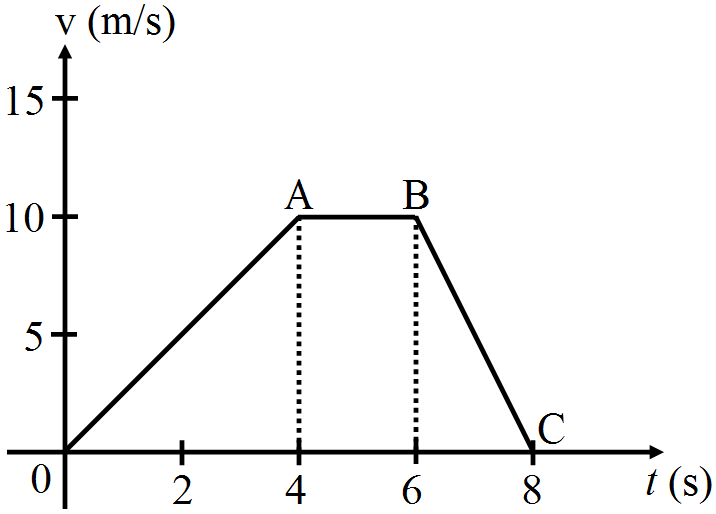
- Displacement in $(0 - 4)$ seconds is equal to the displacement in $(4 - 6)$ seconds.
- Acceleration is $2.5^{-2} ms$ in $OA$ and zero in $AB.$
- Acceleration is negative in time $(6 - 8)$ seconds.
- A
Only $A$ is correct.
- B
Only $B$ is correct.
- ✓
Only $C$ is correct.
- D
All the three are correct.
AnswerCorrect option: C. Only $C$ is correct.
For the statement$(A):\ $ Displacement in $(0 - 4)s$ increasing and Displacement in $(4 - 6)s$ is Constant. So, both the displacement of time $(0 - 4)s$ and $(4 - 6)s$ are not equal to each other.
For the statement$(B):\ $
Acceleration$(OA) =\frac{10}{4}=2.5\text{ ms}$
Acceleration$(AB) =\frac{10}{(4+6)}=1\text{ ms}$
For the statement$(C):\ $As we see that in the graph, part $BC$ is decreasing simultaneously from $10\ m$ to $0$. Hence, Statement $C$ is the correct one.
View full question & answer→MCQ 561 Mark
If body having initial velocity zero is moving with uniform acceleration 8m/ sec2.The distance travelled by it in fifth second will be:
- ✓
$36$ metres
- B
$40$ metres
- C
$100$ metres
- D
AnswerCorrect option: A. $36$ metres
$36$ metres
View full question & answer→MCQ 571 Mark
A car is travelling at a speed of $90\ km/h$. Brakes are applied so as to produce a uniform acceleration of – $0.5 \mathrm{~m} / \mathrm{s}^2$. Find how far the car will go before it is brought to rest?
- A
$8100\ m$
- B
$900\ m$
- ✓
$625\ m$
- D
$620\ m$
AnswerCorrect option: C. $625\ m$
$625\ m$
View full question & answer→MCQ 581 Mark
Odometer is to mileage as compass is to:
AnswerAn odometer is an instrument used to measure mileage.
A compass is an instrument used to determine direction.
Choices $a, b$ and $c$ are incorrect because none is an instrument.
View full question & answer→MCQ 591 Mark
A balloon is rising vertically up at constant speed $10 \ m/ s$.A stone is dropped from it when the balloon is at a height of $40\ m$. otal distance covered by the stone before reaching the ground is (take $g=10 m/ s2)$
- A
$40\ m$
- B
$45\ m$
- ✓
$50\ m$
- D
$60\ m$
AnswerCorrect option: C. $50\ m$
$50\ m$
View full question & answer→MCQ 601 Mark
If a bus travelling at $20\ m/ s$ is subject to a steady deceleration of $5 \mathrm{~m} / \mathrm{s}^2$, how long will it take to come rest:
- A
$400s$
- B
$0.4s$
- C
$40s$
- ✓
$4s$
AnswerUsing first equation of motion
$v = u + at,$
we have
$0 = 20 + (−5)t$
$\Rightarrow 5t = 20$
$\Rightarrow t = 4s$
View full question & answer→MCQ 611 Mark
Leaves are the food factories of plant. But, how does cactus $($desert plants$)$ carry out photosynthesis?
View full question & answer→MCQ 621 Mark
In uniform circular motion:
- A
Both velocity and speed are constant
- B
Speed is constant but velocity changes
- ✓
Both speed and velocity change
- D
Velocity is constant but speed changes
AnswerCorrect option: C. Both speed and velocity change
In a Uniform Circular Motion, the magnitude of velocity, which is speed remains constant.
But the direction of velocity, which is tangential to the circle, keeps changing.
So velocity also changes.
View full question & answer→MCQ 631 Mark
If the displacement of an object is proportional to square of time, then the object moves with:
AnswerWhen the rate of change of velocity with time of a body is constant then the object is said to be uniformly accelerated.
Or in other words in uniform acceleration, the displacement of an object is proportional to square of time.
View full question & answer→MCQ 641 Mark
Is it possible to have an accelerated motion with a constant speed? Name such type of motion:
AnswerCorrect option: A. Yes, Uniform Circular Motion.
Yes it is possible. Let us take an example, circular motion.
In this it has acceleration because direction of motion is changing but it has constant speed along tangential.
Hence it is possible.
View full question & answer→MCQ 651 Mark
If a body is moving on a circular path of radius $21\ cm$ with velocity of $2\ m/s$, then time taken by the body to complete half revolution is:
AnswerWe know that Speed $(v)$
$=\frac{\text{Distance}}{\text{Time}}$
Here, Distance = Circumference of the circular path
$=2\pi\text{r}$
$=\frac{2\times22}{7\times21}=132$
and, Speed
$=2\text{sec}$
This gives, Time
$=\frac{132}{2}=66\text{m/sec}$
Total time $=66\text{Sec}$
then time taken by the body to complete half revolution is:
$=\frac{66}{2}=33\text{sec}$
View full question & answer→MCQ 661 Mark
Which of the following defines displacement correctly:
- A
Change in position in a certain direction
- B
- ✓
- D
AnswerDisplacement is the linear distance between the initial and final positions.
So, it is change in position in a certain direction.
View full question & answer→MCQ 671 Mark
A particle is moving in a circular path of radius r. Its displacement after moving through half the circle would be:
- A
- B
$r$
- ✓
$2r$
- D
$\frac{2}{\text{r}}$
AnswerDisplacement is the minimum distance between the initial position and final position.
After moving half circle ($A$ to $B$) displacement will be $AB$
$AB$ is diameter i.e. $2r$
View full question & answer→MCQ 681 Mark
A bridge is 400m long. A $150\ m$ long train crosses the bridge at a speed of 50\ m/s. Time taken by the train to cross it.
AnswerTrain Length $= 150m$
Bridge length $= 400m$
Distance covered by train to cross bridge = Train Length + Bridge length
$= 150 + 400$
$= 550m$
$\text{Speed of train}=\frac{\text{Distance}}{\text{Time}}$
So,
$\text{Time}=\frac{\text{Distance}}{\text{Speed of train}}$
$=\frac{550}{50}$
$=11\text{sec}$
Time taken by the train to cross a bridge is $11sec.$
View full question & answer→MCQ 691 Mark
Which of the following is true about distance and time.
- A
Distance and time are always directly proportional to each other.
- B
Distance and time are always indirectly proportional to each other.
- ✓
Distance and time are directly proportional when the velocity is constant.
- D
Distance and time are indirectly proportional when the velocity is constant.
AnswerCorrect option: C. Distance and time are directly proportional when the velocity is constant.
Explanation:
Speed$=\frac{\text{Time}}{\text{Distance}} $
For uniform velocity, Distance $∝$ Time
View full question & answer→MCQ 701 Mark
Suppose a boy is enjoying a ride on a merry-go-round which is moving with a constant speed of $10\ m \mathrm{s}^{-1}$. It implies that the boy is:
- A
- B
Moving with no acceleration.
- ✓
- D
Moving with uniform velocity.
AnswerIn merry-go-round, the speed is constant but velocity is not constant, because its direction goes on changing i.e., there is acceleration in the motion.
So, we can say that the boy is in accelerated motion.
View full question & answer→MCQ 711 Mark
he numerical ratio of displacement to distance for a moving object is:
AnswerCorrect option: D. Equal to $1$ or less than $1$
Displacement is always smaller than or equal to displacement.
View full question & answer→MCQ 721 Mark
Physical quantity corresponding to the rate of change of displacement is:
AnswerVelocity is the rate of change of displacement
View full question & answer→MCQ 731 Mark
A ball is travelling with uniform translatory motion.This means that
AnswerCorrect option: C. All parts of the ball have the same velocity $($magnitude and direction$)$ and the velocity is constant.
In uniform translatory motion, all parts of the ball have the same velocity in magnitude and direction and this velocity is constant.
View full question & answer→MCQ 741 Mark
A man is 25m behind a bus, when bus starts accelerating at $2 m/ s^2$ and man starts moving with constant velocity of $10 m/ s.$ Time taken by him to board the bus is _________?
View full question & answer→MCQ 751 Mark
Which one of the following is most likely not a case of uniform circular motion?
- A
Motion of the earth around the sun.
- B
Motion of a toy train on a circular.
- ✓
Motion of a racing car on a circular tracki.
- D
Motion of hours' hand on the dial.
AnswerCorrect option: C. Motion of a racing car on a circular tracki.
View full question & answer→MCQ 761 Mark
Larger the slope of a displacement$-$time graph:
AnswerThe slope of a displacement$-$time graph with time axis measures velocity.
Larger slope $($steeper graph$)$ means the displacement is changing with a faster rate with respect to the time.
Faster rate of change of change of distance with respect to time simply means the body has a larger velocity.
View full question & answer→MCQ 771 Mark
For a body which has turned by $300^\circ $ in a circle of radius $r,$
AnswerCorrect option: A. Distance travelled is $\frac{5}{3}\pi\text{r}.$
Distance travelled is $\frac{5}{3}\pi\text{r}.$
View full question & answer→MCQ 781 Mark
A particle starts from the origin at $t = 0\ s$ with a velocity of $10.0$ j m/ s and moves in the xy−plane with a constant acceleration of the ms$^{−2}$. Then y−coordinate of the particle in $2$ sec is
- ✓
$24 \ m$
- B
$16\ m$
- C
$8\ m$
- D
$12 \ m$
AnswerCorrect option: A. $24 \ m$
A. $24\ m$
View full question & answer→MCQ 791 Mark
A bus moving along a straight line at $20m/s$ undergoes an acceleration of $4 \mathrm{~m} / \mathrm{s}^2$. After $2$ seconds, its speed will be:
- A
$8\ m/s$
- B
$12\ m/s$
- C
$16\ m/s$
- ✓
$28\ m/s$
AnswerCorrect option: D. $28\ m/s$
Acceleration of the moving object is $4 \mathrm{~m} / \mathrm{s}^2$
Initial velocity is $20\ m/s$.
Time taken is $2$ sec.
By applying $1^{\text {st }}$ equation of motion we get,$v = u + at$
$= 20 + 2(4)$
$= 28\ m/s$
View full question & answer→MCQ 801 Mark
Which of the following statement is correct regarding velocity and speed of a moving body?
- A
Velocity of a moving body is always higher than its speed.
- B
Speed of a moving body is always higher than its velocity.
- C
Speed of a moving body is its velocity in a given direction.
- ✓
Velocity of a moving body is its speed in a given direction.
AnswerCorrect option: D. Velocity of a moving body is its speed in a given direction.
Velocity is a vector quantity having a magnitude and a specific direction. So, velocity is nothing but speed in a particular direction.
View full question & answer→MCQ 811 Mark
A particle is moving in a circular path of radius $r.$ The displacement after half a circle would be:
- A
$\text{Zero}$
- B
$\pi\text{r}$
- ✓
$2\text{r}$
- D
$2\pi\text{r}$
AnswerCorrect option: C. $2\text{r}$
Given, after half the circle, the particle will reach the diametrically opposite point i.e., from point A to point $6$. And we know displacement is shortest path between initial and final point.
Displacement after half circle $= AB = OA + OB$ [v Given, $OA $and $06 = r]$
Hence, the displacement after half circle is $2r.$
View full question & answer→MCQ 821 Mark
If the particle completes one rotation along a circular track having radius $14\ m$ in $44$ seconds then the value of speed it’s speed is…
- A
$1\ m/s.$
- ✓
$2\ m/s.$
- C
$3\ m/s.$
- D
$4\ m/s$
AnswerCorrect option: B. $2\ m/s.$
$2\ m/s.$
View full question & answer→MCQ 831 Mark
Which of the following is a measurement of velocity:
AnswerCorrect option: B. $35 \ km/ h$ north
Velocity is defined as speed plus direction so unit of velocity should be unit of speed plus direction
So option B has unit of speed km/h and direction as north.
View full question & answer→MCQ 841 Mark
- A body moving in a circle has an acceleration directed towards the centre.
- Uniform circular motion is an example of variable acceleration.
- Linear velocity of a body moving in a circle differs with the distance from the axis.
- ✓
$'A\ ', 'B\ '$ and $'C\ '$ all are true statements.
- B
$'A\ ’$ is true, $'B\ '$ is false and $'C\ '$ is true statements.
- C
$'A\ ', 'B\ '$ and $'C\ '$ all are false statements.
- D
$'A\ ’$ is false, $'B\ '$ is true and $'C\ '$ is true statements.
AnswerCorrect option: A. $'A\ ', 'B\ '$ and $'C\ '$ all are true statements.
A body moving at constant speed in a circular path experiences an acceleration directed towards the centre of the circular path. This acceleration is called a centripetal acceleration and is provided by a centripetal force.
Uniform circular motion can be well$-$illustrated by swinging a tennis ball on a string in a circle over your head at a constant speed. The acceleration vector is considered variable because its direction changes, even though its magnitude is constant.
Thus, for a given angular velocity $ω$, the linear velocity $v$ of the particle is directly proportional to the distance of the particle from the centre of the circular path $($i.e$)$ for a body in a uniform circular motion, the angular velocity is the same for all points in the body but linear velocity is different.
View full question & answer→MCQ 851 Mark
- A
Direction of motion is fixed
- ✓
Direction of motion changes continuously
- C
- D
AnswerCorrect option: B. Direction of motion changes continuously
View full question & answer→MCQ 861 Mark
A bus begin to move with an acceleration of $1 \mathrm{~m} / \mathrm{s}^2$. A man who is 48m behind the bus starts running at $10\ m/s$ to catch the bus. The man will be able to catch the bus after.
AnswerVelocity of man $= 10\ m/s$
$s = 48m$
Acceleration of man with respect to bus = Acceleration of man - Acceleration of bus
$= 0 - (1) = - 1m/s$
Applying second equation of motion,
$\text{s}=\text{ut}+\frac{1}{2}\text{at}^{2}$
$48=10\text{t}-\frac{1}{2}\text{t}^{2}$
solving we get,
$t = 12sec$ or $t = 8sec$
therefore the minimum time is $8$ seconds.
View full question & answer→MCQ 871 Mark
Particles $P$ and $Q$ are undergoing uniform horizontal circular motions along concentric circles of different radii in clockwise sense $P $completes each round in $2\ min$ while $Q$ does it is 5min time required by $Q$ to make one revolution around $P$ is.
AnswerCorrect option: A. $3min.$
Time required by $Q$ to move around $P$
$=$ Time taken by $Q$ for for one complete round - Time taken by $P$ for one complete round
$= 5min - 2min$
$= 3min.$
View full question & answer→MCQ 881 Mark
Which of the following is a correct measure of velocity?
- A
$30s$
- B
$30\ m/s$
- C
$30$ South
- ✓
$30\ m/s$, South
AnswerCorrect option: D. $30\ m/s$, South
$30\ m/s$, South
View full question & answer→MCQ 891 Mark
Which of the following is not an example of a motion with a constant speed but variable velocity:
- ✓
A car moving at $80\ kmph$ on a straight road
- B
A car moving at $80\ kmph$ on a square track
- C
A car moving at $80\ kmph$ on a circular track
- D
A car moving at $80\ kmph$ on a zig-zag path
AnswerCorrect option: A. A car moving at $80\ kmph$ on a straight road
A part from motion on straight road, for all other cases, direction of motion changes although the speed remains uniform.
So, speed remaining constant, velocity is variable for all other cases.
View full question & answer→MCQ 901 Mark
A car accelerates uniformly from 18km/h to $36\ km/ h$ in $5s$. The distance covered by the car will be:
- A
$1\ m$
- B
$18\ m$
- ✓
$37.5\ m$
- D
AnswerCorrect option: C. $37.5\ m$
$37.5\ m$
View full question & answer→MCQ 911 Mark
The accelerated motion of a body changes due to change in:
AnswerThe accelerated motion of a body changes due to a change in speed, direction of motion, velocity.
As acceleration posses magnitude and direction.
Its magnitude changes by a change in speed, velocity, and direction can be changed by the direction of motion and velocity.
View full question & answer→MCQ 921 Mark
A car of mass $1000\ kg$ is moving with a velocity of $10 \mathrm{~ms}^{-1}$. If the velocity-time graph for this car is a horizontal line parallel to the time axis, then the velocity of car at the end of $25s$ will be:
- A
$25 \mathrm{~ms}^{-1}$
- B
$40 \mathrm{~ms}^{-1}$
- ✓
$10 \mathrm{~ms}^{-1}$
- D
$250 \mathrm{~ms}^{-1}$
AnswerCorrect option: C. $10 \mathrm{~ms}^{-1}$
It is given that the velocity time curve is parallel to $x$ axis hence velocity is constant with time and acceleration is $0.$
View full question & answer→MCQ 931 Mark
A car is moving on a circular track of radius R covering equal distance in equal intervals of time. This shows that the car has
- A
uniform speed and acceleration of constant magnitude
- B
Non-uniform velocity and acceleration
- C
uniform velocity and zero acceleration
- ✓
Both $(1)$ and $(2)$
AnswerCorrect option: D. Both $(1)$ and $(2)$
Both $(1)$ and $(2)$
View full question & answer→MCQ 941 Mark
Starting from rest objects $1$ falls freely for $4$ seconds and object $2$ falls freely for $8$ seconds.Compared to object $1$, object $2$ falls
View full question & answer→MCQ 951 Mark
The graph below shows the distance travelled and the time taken by four cars.
Which car travelled the slowest:
- A
Car $1$
- B
Car $2$
- C
Car $3$
- ✓
Car $4$
AnswerCorrect option: D. Car $4$
The slope of the distance-time graph represents the velocity.
The slope for the car $4$ is minimum, so its speed is also minimum.
View full question & answer→MCQ 961 Mark
A truck covers $40\ km$ with an average speed of $80\ m/h$. then it travels an average speed of 40km/h. the average speed of the truck for the total distanced covered is:
- A
$40\ km/h$
- B
$45\ km/h$
- C
$48\ km/h$
- ✓
$53\ km/h$
AnswerCorrect option: D. $53\ km/h$
$53\ km/h$
View full question & answer→MCQ 971 Mark
The displacement - time graph of a particle moving along a straight line is given below. Find the time at which its velocity is equal to zero.
AnswerThe slope of displacement - time graph gives us the velocity.
From the given graph, we see that the slope at $t=2$ is $0.$
View full question & answer→MCQ 981 Mark
The area of speed time graph is $…$
View full question & answer→MCQ 991 Mark
A body suffers retardation of $1 \mathrm{\sim ms}^{-2}$means:
AnswerCorrect option: C. Its velocity decreases by $1 \mathrm{\sim ms}^{-1}$ per second
Acceleration is the rate of change of the velocity of an object with respect to time.
Positive acceleration means increase in velocity with time and negative acceleration means decrease in velocity per unit time.
Negative acceleration is also called retardation.
So retardation means rate of decrease of velocity per second.
View full question & answer→MCQ 1001 Mark
Slope of a velocity $–$ time graph gives:
AnswerSlope of velocity$-$time graph gives acceleration.
Because slope of the curve $=\frac{\text{v}}{\text{t}},$ where $\frac{\text{v}}{\text{t}}=$ acceleration.
View full question & answer→MCQ 1011 Mark
The slope of the distance$-$time graph is:
View full question & answer→MCQ 1021 Mark
Who has stated the Right hand Thumb Rule?
MCQ 1031 Mark
Velocity of the particle is depend on $….$?
View full question & answer→MCQ 1041 Mark
If the displacement of an object is proportional to the square of time, then the object is moving with:
AnswerWe are given with the relationship that,
$\mathrm{x}=\mathrm{kt}^2$
Differentiating it twice we get,
$v = 2kt$
$a = 2k$
Where,
$v -$ velocity
$a -$ acceleration
View full question & answer→MCQ 1051 Mark
Which of the following statement is or are incorrect about the growing crops inside green$-$houses?
AnswerCorrect option: A. A Greenhouse is built of any material through which sunlight can’t pass.
View full question & answer→MCQ 1061 Mark
- A
- B
- C
Velocity is to acceleration
- ✓
Distance is to displacement
AnswerCorrect option: D. Distance is to displacement
View full question & answer→MCQ 1071 Mark
Speed of a body depends on:
- A
- B
- C
Distance travelled by the body
- ✓
Both $A$ and $C$
AnswerCorrect option: D. Both $A$ and $C$
Speed is defined as
$\text{Speed}=\frac{\text{Distance travelled}}{\text{Time intervel}}$
View full question & answer→MCQ 1081 Mark
A body moves in a uniform circular motion
- A
It is moving with constant velocity.
- B
Its acceleration is zero.
- ✓
The body has an acceleration.
- D
AnswerCorrect option: C. The body has an acceleration.
View full question & answer→MCQ 1091 Mark
Commercial electric motors do not use:
- A
An electromagnet to rotate the armature.
- B
Effectively large number of turns of conducting wire in the current carrying coil.
- ✓
A permanent magnet to rotate the armature.
- D
A soft iron core on which the coil is wound.
AnswerCorrect option: C. A permanent magnet to rotate the armature.
View full question & answer→MCQ 1101 Mark
The strength of magnetic field inside a long current carrying straight solenoid is:
- A
More at the ends than at the centre.
- B
- ✓
- D
Found to increase from one end to the other.
View full question & answer→MCQ 1111 Mark
When the distance an object travels is directly proportional to the time, it is said to travel with:
AnswerWhen the distance an object travels is directly proportional to time, it is said to travel with Constant Speed.
Speed$=\frac{\text{distance travelled}}{\text{time}}$
View full question & answer→MCQ 1121 Mark
A bus increases its speed from $36\ km/h$ to $72\ km/h$ in $10$ seconds. Its acceleration is:
- A
$5m/s^2$
- B
$2m/s^2$
- C
$6m/s^2$
- ✓
$1m/s^2$
AnswerCorrect option: D. $1m/s^2$
Final velocity $= 72km/h = 20m/s$
Initial velocity is $36km/h = 10m/s$
Time taken is $10$ sec. So,
Acceleration $=\frac{20-10}{10}$
$=1\text{m/s}^2$
View full question & answer→MCQ 1131 Mark
If an object moves $4\ km$ in a straight line then the value of displacement is….?
- A
$4\ km$
- B
$8\ km$
- C
$12\ km$
- ✓
$0\ km$
AnswerCorrect option: D. $0\ km$
$0\ km$
View full question & answer→MCQ 1141 Mark
One of the following is not a vector quantity. This one is:
AnswerVector quantities have magnitude as well as direction, and they obey the laws of vector addition.
View full question & answer→MCQ 1151 Mark
A body moving along a circular path will have:
AnswerVelocity is not constant since the direction of the ball changes every instance.
The ball has radial acceleration since there is a centripetal force acting on it towards the center.
Ball moving in a circular path has tangential velocity.Cutting the thread, the ball moves tangentially
View full question & answer→MCQ 1161 Mark
Slope of a velocity$-$time graph gives:
View full question & answer→MCQ 1171 Mark
The ratio of $SI$ units to $CGS$ units of retardation is:
- ✓
$10^2$
- B
$10$
- C
$10^3$
- D
$10^{-2}$
AnswerCorrect option: A. $10^2$
$10^2$
View full question & answer→MCQ 1181 Mark
What is the condition of an electromagnetic induction?
- A
There must be a relative motion between the coil of wire and galvanometer.
- B
There must be a relative motion between.
- C
There must be a relative motion between galvanometer and generator.
- ✓
There must be a relative motion between the coil of wire and a magnet.
AnswerCorrect option: D. There must be a relative motion between the coil of wire and a magnet.
View full question & answer→MCQ 1191 Mark
Which of the following is / are true about retardation:
AnswerRetardation is opposite of acceleration.
In case of acceleration, velocity increases with time and in case of retardation, velocity decreases over time.
View full question & answer→MCQ 1201 Mark
A particle is moving in a circular path of radius r. The displacement after half a circle would be:
- A
$0$
- B
$\pi\text{r}$
- ✓
$2\text{r}$
- D
$2\pi\text{r}$
AnswerCorrect option: C. $2\text{r}$
Displacement is the difference between the final and initial position of a body. It is a vector quantity and is independent of the path taken. So, for the movement of half of a circle, the displacement is $2r$, where r is the radius of the circular path.
View full question & answer→MCQ 1211 Mark
A $100\ m$ sprinter increases her speed from rest uniformly at the rate of $1\ m/s2$ upto $40\ m$ and covers the remaining distance with a uniform speed. The sprinter covers the first half of the run in $t1$s and second half in $t2$s, then.
- ✓
$t_1>t_2$
- B
$t_1
- C
$t_1=t_2$
- D
Information given is incomplete.
AnswerCorrect option: A. $t_1>t_2$
For the first $40 m$
Using the third equation of motion: $\mathrm{v}^2-\mathrm{u}^2=2$ as
where: $\mathrm{s}=$
distance covered $=40 \mathrm{mv}=$
final velocity $=? \mathrm{~m} / \mathrm{su}=$
initial velocity $=0 \mathrm{~m} / \mathrm{sa}=$
acceleration $=1 \mathrm{~m} / \mathrm{s}^2$
$ v^2-u^2=2 a s$
$v^2-0=2 \times 1 \times 40$
$v^2=80$
$v=8.94 \mathrm{~m} / \mathrm{s}$
Using the first equation of motion $v=u+$ at
where:
$ \mathrm{v}=\text { final velocity }=8.94 \mathrm{~m} / \mathrm{s}$
$\mathrm{u}=\text { initial velocity }=0 \mathrm{~m} / \mathrm{sa}=\text { acceleration }=1 \mathrm{~m} / \mathrm{s}^2$
$\mathrm{t}_1=\text { time }=? \mathrm{~s}$
$\mathrm{v}=\mathrm{u}+\mathrm{at}_1$
$8.94=0+1 \times \mathrm{t}_1$
$\mathrm{t}_1=8.94 \mathrm{~s}$
Here its given the speed is uniform not velocity, therefore acceleration will be $1 \mathrm{~m} / \mathrm{s}^2$ and speed will be $8.94 \mathrm{~m} / \mathrm{s}$ everywhere.
Using the third equation of motion: $v^2-u^2=2$ as
where
$\mathrm{s}=\text { distance covered }$
$=60 \mathrm{mv}=\text { final velocity }=? ? \mathrm{~m} / \mathrm{su}$
$=\text { initial velocity }=8.94 \mathrm{~m} / \mathrm{sa}$
$=\text { acceleration }=1 \mathrm{~m} / \mathrm{s}^2$
$\mathrm{v}^2-\mathrm{u}^2=2 \mathrm{as}$
$\mathrm{v}^2-(8.94)^2=2 \times 1 \times 60$
$\mathrm{v}^2-80=120$
$\mathrm{v}^2=120+80=200$
$v=14.14 \mathrm{~m} / \mathrm{s}$ Using the first equation of motion
$\mathrm{v}=\mathrm{u}+\mathrm{at}$
where:
$\mathrm{v}=\text { final velocity }=14.14 \mathrm{~m} / \mathrm{s}$
$\mathrm{u}=\text { initial velocity }=8.94 \mathrm{~m} / \mathrm{sa}=\text { acceleration }=1 \mathrm{~m} / \mathrm{s}^2$
$\mathrm{t}_2=\text { time }=? \mathrm{~s}$
$\mathrm{v}=\mathrm{u}+\mathrm{at}_2$
$14.14=8.94+1 \times \mathrm{t}_2$
$\mathrm{t}_2=14.14-8.94$
$\mathrm{t}_2=5.2 \text { secs. }$
View full question & answer→MCQ 1221 Mark
A truck traveling due north at $50\ km/ hr$ turns west and travels at the same speed. What is the change in magnitude of speed:
AnswerWhen the direction is changed then velocity changes but the speed or magnitude of velocity remains constant.
In this case, the truck changes only the direction of motion, not the magnitude.
So change in the magnitude of velocity is zero.
View full question & answer→MCQ 1231 Mark
A bi-quadratic equation has degree:
MCQ 1241 Mark
Which of the following terms does not go well with the motion of a bus on a crowded road:
AnswerOn a crowded road, depending on traffic conditions, the bus driver has to change its speed and direction of motion many times.
The driver will have to frequently apply brakes as well.
He might also have to accelerate the bus with different rates.
So, the velocity changes both by magnitude and direction.
Thus, uniform velocity is not attained in this case.
View full question & answer→MCQ 1251 Mark
If the displacement of an object is proportional to square of time, then the object moves with:
AnswerVelocity is measured in terms of distance per second, while acceleration is measured in terms of distance per square second.
Hence, uniform acceleration is the correct answer.
View full question & answer→MCQ 1261 Mark
The splash is heard $2.05s$ after the stone is dropped into a well of depth $19.6\ m$.The velocity of sound is?
- A
$342\ ms^{-1}$
- B
$372\ ms^{-1}$
- ✓
$392\ ms^{-1}$
- D
$352\ ms^{-1}$
AnswerCorrect option: C. $392\ ms^{-1}$
$392\ ms^{-1}$
View full question & answer→MCQ 1271 Mark
The speed of a moving object is determined to be $0.06\ m/s$. This speed is equal to:
- A
$2.16\ km/h$
- B
$1.08\ km/h$
- ✓
$0.216\ km/h$
- D
$0.0216\ km/h$
AnswerCorrect option: C. $0.216\ km/h$
We can convert $0.06\ m/s$ as:
$=\frac{0.06(3600)}{1000}\text{km/hr}$
$=0.216\text{km/hr}$
So, the answer is $0.216\ km/hr.$
View full question & answer→MCQ 1281 Mark
A particle is moving in positive $x-$direction with initial velocity of $10\ m/ s$ and uniform retardation such that it reaches the initial position after $10s$. he distance traversed by the particle in $6s$ is:
- A
$24\ m$
- B
$25\ m$
- ✓
$26\ m$
- D
$27\ m$
AnswerCorrect option: C. $26\ m$
$26\ m$
View full question & answer→MCQ 1291 Mark
A Negative charge is moving towards a person. The direction of magnetic field lines will be in:
- ✓
- B
- C
Vertically upward direction.
- D
Vertically downward direction.
View full question & answer→MCQ 1301 Mark
A heavy stone is thrown from a cliff of height $h$ with speed $v.$ The stone will hit the ground with maximum speed if it is thrown:
- A
- B
- C
- ✓
The speed does not depend on the inital direction
AnswerCorrect option: D. The speed does not depend on the inital direction
View full question & answer→MCQ 1311 Mark
A body thrown vertically up reaches a maximum height of $50\ m$.Another body with double the mass is thrown up with double the initial velocity will reach a maximum height of :
- A
$100\ m$
- ✓
$200\ m$
- C
$400\ m$
- D
$50\ m$
AnswerCorrect option: B. $200\ m$
$200\ m$
View full question & answer→MCQ 1321 Mark
A body is thrown vertically upward with velocity u, the greatest height h to which it will rise is,
- A
$\frac{\text{u}}{\text{g}}$
- ✓
$\frac{\text{u}^2}{2\text{g}}$
- C
$\frac{\text{u}^2}{\text{g}}$
- D
$\frac{\text{u}}{2\text{g}}$
AnswerCorrect option: B. $\frac{\text{u}^2}{2\text{g}}$
A body is thrown vertically upward.
at maximum height velocity of body $= 0$
use kinematics formula ,
$v^2 = u^2 + 2as$
Here,
$v = 0$
$a = -g$
$s = H$
$0 = u^2 - 2gH$
$\text{H}=\frac{\text{u}^2}{2\text{g}}$
Hence, maximum height attained by body $\frac{\text{u}^2}{2\text{g}}$
View full question & answer→MCQ 1331 Mark
A sprinter is running along the circumference of a big sports stadium with constant speed Which of following do you think is changing in this case?
- A
Magnitude of acceleration being produced.
- B
Distance covered by the sprinter per second.
- ✓
Direction in which the sprinter is running.
- D
Entripetal force acting on the sprit.
AnswerCorrect option: C. Direction in which the sprinter is running.
The sprinter is having a uniform circular motion in which the direction of motion continuously changes.
View full question & answer→MCQ 1341 Mark
When an object is accelerated:
- A
Its direction must be constant
- ✓
Its velocity is necessarily changing
- C
- D
Its speed is necessarily changing
AnswerCorrect option: B. Its velocity is necessarily changing
Acceleration is the time rate of change of velocity
View full question & answer→MCQ 1351 Mark
Choose the correct option.Odometer$:$ Distance $: ......:......$?
- ✓
Weighing scale$:$ Weight
- B
Length$:$ Width
- C
Inch$:$ Foot
- D
Mileage$:$ Speed
AnswerCorrect option: A. Weighing scale$:$ Weight
An odometer is an instrument used in a vehicle to measure the distance covered by it.
Similarly, the weighing scale is an instrument used to measure the weight of an object.
View full question & answer→MCQ 1361 Mark
The numerical ratio of displacement to distance for a moving object is:
- A
Always less than $1.$
- B
Always equal to $1.$
- C
Always more than $1.$
- ✓
Equal or less than $1.$
AnswerCorrect option: D. Equal or less than $1.$
Displacement of an object can be less than or equal to the distance covered by the object, because the magnitude of displacement is not equal to distance. However, it can be so if the motion is along a straight line without any change in direction.
View full question & answer→MCQ 1371 Mark
A bus is travelling the first one-third distance at a speed of $10\ km/h,$ the next one-fourth at $20\ km/h$ and the remaining at $40\ km/h$. What is the average speed of the bus?
- A
$17\ km/h.$
- B
$17.8\ km/h.$
- ✓
$18\ km/h.$
- D
$20\ km/h.$
AnswerCorrect option: C. $18\ km/h.$
If total distance is $S$ then
Average speed
$=\frac{\text{Total distance}}{\text{time}}$
$=\frac{\text{S}}{(\text{t}_{1}+\text{t}_{2})}$
$=\text{S}\ \frac{\text{S}}{(3\times10)}+\frac{\text{S}}{(4\times20)}+\frac{5\text{S}}{(12\times40)}$
$\therefore\text{Time}=\frac{\text{Distance}}{\text{Speed}}$
$=\frac{1}{\big(30+1\frac{1}{80}+\frac{5}{480}\big)}=17.7\text{kmph}$
View full question & answer→MCQ 1381 Mark
Which of the following situations are not possible?
- A
A body moving with constant acceleration but with zero velocity.
- B
A body moving horizontally with an acceleration in vertical direction.
- ✓
A body moving with a constant velocity in an accelerated motion.
- D
AnswerCorrect option: C. A body moving with a constant velocity in an accelerated motion.
View full question & answer→MCQ 1391 Mark
If north is the positive direction, which situation involves positive velocity and negative acceleration:
- A
A car speeding up as it moves southward
- B
A car moving southward at a constant speed
- ✓
A car slowing down as it moves northward
- D
A car slowing down as it moves southward
AnswerCorrect option: C. A car slowing down as it moves northward
The rate of change of velocity with respect to time is known as acceleration.
Negative acceleration means a decrease in velocity with respect to time.
If a car is moving northward and slowing down, the displacement will be along the north $($positive$),$ so the velocity will be positive until it gets stopped.
As the car is slowing down, the acceleration will be negative.
View full question & answer→MCQ 1401 Mark
When a car driver travelling at a speed of $10\ m/s$ applies brakes and brings the car to rest in $20s$, then retardation will be:
- A
$+2m/s^2$
- B
$-2m/s^2$
- C
$-0.5m/s^2$
- ✓
$+0.5m/s^2$
AnswerCorrect option: D. $+0.5m/s^2$
The term ''retardation'' means negative acceleration.Initial velocity $= 10m/s$
Final velocity $= 0m/s$
Time taken $= 20s$
Acceleration $=\frac{0-10}{20}$
$\Rightarrow $ Acceleration $= -0.5m/s^2$
$\Rightarrow $ Retardation $= 0.5m/s^2$
View full question & answer→MCQ 1411 Mark
A freely falling object travels $4.9m$ in $1^{st}$ second, $14.7m$ in $2^{nd}$ second, $24.5m$ in $3^{rd}$ second, and so on. This data shows that the motion of a freely falling object is a case of:
AnswerThe displacement of the body in equal interval of time is unequal, but acceleration is constant. The acceleration will thus be uniform.
View full question & answer→MCQ 1421 Mark
The north pole of Earth’s magnet is in:
MCQ 1431 Mark
In which of the following cases of motions, the distance moved and the magnitude of displacement are equal?
- ✓
If the car is moving on straight road.
- B
If the car is moving in circular path.
- C
The pendulum is moving to and fro.
- D
The earth is revolving around the Sun.
AnswerCorrect option: A. If the car is moving on straight road.
In all other class, displacement can be less than distance.
View full question & answer→MCQ 1441 Mark
Which of the following quantity remains constant in a uniform circular motion:
AnswerIn a uniform circular motion, the direction of velocity changes but its magnitude remains constant, hence, speed remains constant in a uniform circular motion.
View full question & answer→MCQ 1451 Mark
The $S.I.$ unit of acceleration is:
- A
$ms^{-2}$
- B
$ms$
- ✓
$ms^2$
- D
$m$
AnswerCorrect option: C. $ms^2$
$ms^2$
View full question & answer→MCQ 1461 Mark
You are sitting in a stationary car. There is a helium balloon tied to its floor. You accelerate and obviously feel like you are being pushed backwards $($against the direction of your accelerations$).$ The balloon.
AnswerThe densest air in your passenger compartment is the ambient air. The least dense is your helium$-$filled balloon. When you accelerate, the ambient air will try to remain where it is and will appear to "slosh" toward the rear $($if you can see the ambient air$).$ Because the balloon has less inertia, it will be displaced by the heavier ambient air and will be forced forward in the passenger compartment.
View full question & answer→MCQ 1471 Mark
The area under a speed-time graph represents a physical quantity which has the unit of:
- ✓
$m$
- B
$m^2$
- C
$ms^{-1}$
- D
$ms^{-2}$
AnswerThe area under the speed time graph gives us the distance.
View full question & answer→MCQ 1481 Mark
Speed is depend on $…?$
- ✓
- B
- C
Initial and final position of the object.
- D
View full question & answer→MCQ 1491 Mark
A water drop falls at regular intervals from a tap $9\ m$ above the ground. The fourth drop is leaving the tap at the instant, the first drop touches the ground. How high is the third drop at that instant?
- A
$2\ m$
- B
$4\ m$
- C
$6\ m$
- ✓
$8\ m$
AnswerCorrect option: D. $8\ m$
$8\ m$
View full question & answer→MCQ 1501 Mark
A body moving along a straight line at $20$ metre per second undergoes an acceleration of $4$ metre per second square. After $2$ second it speed will be:
- A
$12$ metre per second
- ✓
$28$ metre per second
- C
$72$ metre per second
- D
$20$ metre per second
AnswerCorrect option: B. $28$ metre per second
$28$ metre per second
View full question & answer→MCQ 1511 Mark
Is it possible for an object's velocity to increase while its acceleration decreases?
- A
No, this is impossible because of the way in which acceleration is defined.
- B
No, because if acceleration is decreasing the object will be slowing down.
- C
No, because velocity and acceleration must always be in the same direction.
- ✓
Yes, an example would be a falling object in a viscous medium, where the acceleration continuously decreases but velocity increases until a certain point.
AnswerCorrect option: D. Yes, an example would be a falling object in a viscous medium, where the acceleration continuously decreases but velocity increases until a certain point.
View full question & answer→MCQ 1521 Mark
A motorcycle is being driven at a speed of $20\ m/s$ when brakes are applied to bring it to rest five seconds. The deceleration produced in this case will be:
- ✓
$+4\ m/s^2$
- B
$-4\ m/s^2$
- C
$+0.25\ m/s^2$
- D
$-0.25\ m/s^2$
AnswerCorrect option: A. $+4\ m/s^2$
We have,
Initial velocity $= 20m/s$
Final velocity $= 0m/s$
Time taken $= 5 sec.$
So,
Deceleration = -Acceleration
$= \frac{-(0 - 20)}{5}$
$= 4\text{m/s}^2$
View full question & answer→MCQ 1531 Mark
When speed is stated along with its direction, it is called as:
AnswerVelocity of a body is the speed of the body defined along with the direction.
View full question & answer→MCQ 1541 Mark
The slope of displacement$-$time graph being negative implies
- ✓
That the object moves towards the reference point
- B
That the object moves away from the reference point
- C
That the object is stationary
- D
AnswerCorrect option: A. That the object moves towards the reference point
Negative slope of a displacement-time graph indicates negative velocity.
Velocity is measured negative when a body moves towards the reference point.
View full question & answer→MCQ 1551 Mark
A stone is thrown vertically up from the ground. It reaches a maximum height of $50\ m$ in $10s$. After what time will it reach the ground from the maximum height?
Answer$\text{t}_\text{a}=\frac{\text{u}}{\text{g}}=10\text{s}$
same amount of time it will take to fall down
View full question & answer→MCQ 1561 Mark
A sprinter has to cover a total run of $100\ m$. She increases her speed from rest under a uniform acceleration of $1.0m/s^2$ up to three quarters of the total run and covers the last quarter him uniform speed. The time she takes to cover the first half, and to cover the second half of the run will be.
- A
$3.25s.$
- ✓
$4.28s.$
- C
$5.25s.$
- D
$6.25s.$
AnswerCorrect option: B. $4.28s.$
Here, total distance $= 100m$ For the first half of run,
distance $= 50m u = Om/s, a = m/s^2$
So by $\text{s}=\text{ut}+\frac{1}{2}\text{at}^{2}$
$50=0+\frac{1}{2}\times1\times\text{t}^{2}$
$\Rightarrow\text{t}=10\text{sec}$ At the end of $50m, v = u + at = 0 + 1 x 10 = 10m/s $ For the second half of run,
we calculate fors $= 25m$ first(uni formly accelerated motion)
Here $u = 10m/s, a = 1m/s^2$
So, $v^2 = u^2 + 2as = 100 + 2 \times 1 \times 25 = 150$
For time $t, v = u + at $
$\Rightarrow 12.24 = 10 + t 1 = 2.24sec$
For the last $25m$
$\text{t}=\frac{\text{distance}}{\text{speed}}$
$=\frac{25}{12.24}=2.04\text{sec}$
Hence time taken for the first half of run$(50m) = 10sec$
time taken for the second half of run$(50m) = 2.24 + 2.04 = 4.28sec$
View full question & answer→MCQ 1571 Mark
A body was initially moving with $10 \ m/ sec$ and it starts acceleration with $2 m/ sec^2$, the distance covered by it in $10$ sec will be
- ✓
$200\ m$
- B
$100\ m$
- C
$150\ m$
- D
$250\ m$
AnswerCorrect option: A. $200\ m$
$200\ m$
View full question & answer→MCQ 1581 Mark
The ratio of speed to the magnitude of velocity when the body is moving in one direction is:
- A
- B
- ✓
- D
Greater than or equal to one
View full question & answer→MCQ 1591 Mark
Water drops fall at regular intervals from a roof at of $125\ m$ from the ground. At an instant when $11\ th$ drop is about leave the roof and $1st$ drop is at a height of $45\ m$ from the ground at that instant the dist of $10\ th$ drop from the roof is ($g=10 \mathrm{~m} / \mathrm{s}^2$)
- A
$0.40\ m$
- B
$0.20\ m$
- ✓
$0.80\ m$
- D
$1.2\ m$
AnswerCorrect option: C. $0.80\ m$
$0.80\ m$
View full question & answer→MCQ 1601 Mark
In which of the following cases of motion, the distance moved and the magnitude of displacement are equal?
- ✓
If the car is moving on straight road.
- B
If the car is moving on circular road.
- C
If the pendulum is moving to and fro.
- D
If a planet is moving around the sun.
AnswerCorrect option: A. If the car is moving on straight road.
The magnitude of displacement is equal to the distance travelled by a body when it travels in a straight line.
View full question & answer→MCQ 1611 Mark
Which of the following vehicles is undergoing a deacceleration?
- A
A car driving straight to the east on a road at a constant speed
- B
A truck rounding a corner at a constant speed
- ✓
A van slowing down as it approaches a stop sign
- D
AnswerCorrect option: C. A van slowing down as it approaches a stop sign
A object is said to have an acceleration if it changes its velocity either by increasing its speed, decreasing its speed or changing the direction of its velocity.
Since the car and the truck move with constant speed, thus they have zero acceleration.
But the van is slowing down its speed, thus it has deacceleration.
View full question & answer→MCQ 1621 Mark
Length of the straight line joining the initial to the final positions of a moving body is known as its:
AnswerDisplacement is the shortest distance joining initial and final points through a straight line
View full question & answer→MCQ 1631 Mark
Which parameters shown below are common between uniform circular motion and uniform linear motion:
AnswerIn uniform circular motion, speed remains constant and even in a uniform linear motion, speed remains constant.
The direction of velocity in a uniform circular motion keeps changing as the particle moves along the curve
View full question & answer→MCQ 1641 Mark
If a displacement-time graph of an object is a straight line parallel to the time axis, the object is:
- ✓
- B
Moving away from the reference point
- C
Moving towards the reference point
- D
Moving with an infinite velocity
AnswerDisplacement$-$time graph being parallel to the time axis, its slope is zero.
Slope of a displacement$-$time graph measures velocity.
So, velocity of the object is zero.
View full question & answer→MCQ 1651 Mark
What is the speed of a train which overtakes, a man walking at a speed of $5 \ km/ h$ in $30$ seconds, if the train is $274$ metres long?
- A
$51.88 \ km/ h$
- B
$47.88 \ km/ h$
- ✓
$37.88 \ km/ h$
- D
$21.67 \ km/ h$
AnswerCorrect option: C. $37.88 \ km/ h$
$37.88 \ km/ h$
View full question & answer→MCQ 1661 Mark
A car A is travelling on a straight level road with a uniform speed of $60\ km/h$. It is followed by another car $B$. Which is moving with a speed of $70\ km/h$. When the distance between them is $2.5\ km$, the car $B$ is given a deceleration of $20\ km/h2$. After how much time will $B$ catch up with $A?$
- A
$1h$
- ✓
$\frac{1}{2}\text{h}$
- C
$\frac{1}{4}\text{h}$
- D
$\frac{1}{8}\text{h}$
AnswerCorrect option: B. $\frac{1}{2}\text{h}$
$\text{S}_{\text{B}}=70\text{t}-\frac{1}{2}(20)\text{t}^{2}$
$\text{S}_{\text{A}}=60\text{t}$
$\text{S}_{\text{B}}-\text{S}_{\text{A}}=2.5\text{km}$
$70\text{t}-10\text{t}^{2}-60\text{t}=2.5$
$\Rightarrow10\text{t}^{2}-10\text{t}+2.5=0$
$\Rightarrow 4\text{t}^{2}-4\text{t}+1=0$
$\Rightarrow(2\text{t}-1)^{2}=0$
$\Rightarrow\text{t}=\frac{1}{2}\text{hr}=30\text{min}.$
View full question & answer→MCQ 1671 Mark
A motorcycle and a car start from rest at the same place at the same time and travel in the same direction.The motorcycle accelerates uniformly at $1 \mathrm{~m} / \mathrm{s}^2$ up to a speed of $36\ km/ h$ and the car at $0.5 \mathrm{~m} / \mathrm{s}^2$ up to a speed of $54\ km/ h$.Then the distance at which the car overtakes the cycle-
- ✓
$100\ m$
- B
$200\ m$
- C
$300\ m$
- D
$400\ m$
AnswerCorrect option: A. $100\ m$
$100\ m$
View full question & answer→MCQ 1681 Mark
$(1)$ In uniform circular motion, tangential acceleration is zero $(2)$ In uniform circular motion, velocity is constant.
- A
Both $1$ and $2$ are true and $2$ is correct explanation of $1$
- B
Both $1$ and $2$ are true and $2$ is not correct explanation of $1$
- ✓
$1$ is true and $2$ is false
- D
$1$ is false and $2$ is true
AnswerCorrect option: C. $1$ is true and $2$ is false
In uniform circular motion tangential acceleration is zero because angular velocity of motion is constant.
And the speed is uniform. But velocity of the particle in uniform circular motion keeps on changing.
View full question & answer→MCQ 1691 Mark
Pick out the wrong statement about retardation:
AnswerCorrect option: D. Retardation is a scalar quantity
View full question & answer→MCQ 1701 Mark
Direction of motion of a body is given by:
- A
- ✓
- C
Both its speed and velocity
- D
Neither of its speed and velocity
AnswerVelocity is a vector.
So, it gives the magnitude of speed and the direction of motion of the body as well.
Speed being a scalar, does not give the direction of motion.
View full question & answer→MCQ 1711 Mark
What determine the nature of the path followed by the particle:
AnswerWithout initial velocity and acceleration path of the particle cannot be decided.
So at a time velocity and acceleration are required to determine the path followed by the particle.
View full question & answer→MCQ 1721 Mark
Choose the correct statement:
- ✓
Velocity determines direction of motion of a body
- B
Acceleration determines direction of motion of a body
- C
Both velocity and acceleration determine direction of motion of a body
- D
Neither velocity nor acceleration determine direction of motion of a body
AnswerCorrect option: A. Velocity determines direction of motion of a body
Velocity, being a vector, gives the direction of the change of position of a body.
Hence it determines the direction of motion of a body.
In contrast, acceleration doesn't need to relate to the direction of motion.
View full question & answer→MCQ 1731 Mark
To find the height of a building, a student is following the steps as given below. The sequence of the steps are:
AnswerCorrect option: C. Stops the clock as the stone lands on the ground.
It is an Activity Question, so the steps that are followed to find the height of a building are simultaneously:
- Drops a stone from the top of the building.
- Simultaneously, starts a clock.
- Stops the clock as the stone lands on the ground.
- Follows the relation $\text{h}=\frac{1}{2}\text{gt}^2.$
View full question & answer→MCQ 1741 Mark
You can derive first equation of kinematics is from the formula of….
MCQ 1751 Mark
You are sitting in a stationary car. There is a helium balloon tied to its floor. You accelerate and obviously feel like you are being pushed backwards (against the direction of your accelerations). The balloon.
Answer - Will move forward.
Explanation:
The densest air in your passenger compartment is the ambient air. The least dense is your helium-filled balloon. When you accelerate, the ambient air will try to remain where it is and will appear to "slosh" toward the rear (if you can see the ambient air). Because the balloon has less inertia, it will be displaced by the heavier ambient air and will be forced forward in the passenger compartment.
View full question & answer→MCQ 1761 Mark
Who has stated the Right hand Thumb Rule?
MCQ 1771 Mark
Which parameters shown below are common between uniform circular motion and uniform linear motion:
Answer - Speed
Explanation:
In uniform circular motion, speed remains constant and even in a uniform linear motion, speed remains constant.
The direction of velocity in a uniform circular motion keeps changing as the particle moves along the curve
View full question & answer→MCQ 1781 Mark
Which of the quantities, speed or velocity gives the direction of motion of body:
MCQ 1791 Mark
Which of the following vehicles is undergoing a deacceleration?
- A
A car driving straight to the east on a road at a constant speed
- B
A truck rounding a corner at a constant speed
- C
A van slowing down as it approaches a stop sign
- D
Answer - A van slowing down as it approaches a stop sign
Explanation:
A object is said to have an acceleration if it changes its velocity either by increasing its speed, decreasing its speed or changing the direction of its velocity.
Since the car and the truck move with constant speed, thus they have zero acceleration.
But the van is slowing down its speed, thus it has deacceleration.
View full question & answer→MCQ 1801 Mark
Which of the following terms does not go well with the motion of a bus on a crowded road:
Answer - Uniform velociity
Explanation:
On a crowded road, depending on traffic conditions, the bus driver has to change its speed and direction of motion many times.
The driver will have to frequently apply brakes as well.
He might also have to accelerate the bus with different rates.
So, the velocity changes both by magnitude and direction.
Thus, uniform velocity is not attained in this case.
View full question & answer→MCQ 1811 Mark
Which of the following statements is correct for a particle travelling with a constant speed:
- A
Its position remains constant as time passes.
- B
It covers equal distances in unequal time intervals.
- C
Its acceleration is zero.
- D
It does not change its direction of motion.
Answer - Its acceleration is zero.
View full question & answer→MCQ 1821 Mark
Which of the following statement is or are incorrect about the growing crops inside green-houses?
- A
A Greenhouse is built of any material through which sunlight can’t pass.
- B
The air continues to heat up because it gets confined within the greenhouse.
- C
To provide warmer temperature for growing fruit and vegetable plants.
- D
Green-house also protect it from high blowing wind and rodents.
Answer - A Greenhouse is built of any material through which sunlight can’t pass.
View full question & answer→MCQ 1831 Mark
Which of the following statement is correct regarding velocity and speed of a moving body?
- A
Velocity of a moving body is always higher than its speed.
- B
Speed of a moving body is always higher than its velocity.
- C
Speed of a moving body is its velocity in a given direction.
- D
Velocity of a moving body is its speed in a given direction.
Answer - Velocity of a moving body is its speed in a given direction.
View full question & answer→MCQ 1841 Mark
Which of the following situations is possible?
- A
An object can have acceleration, but constant velocity.
- B
The velocity of an object may be zero but acceleration is not zero.
- C
Distance and the magnitude of displacement are equal in circular motion.
- D
Average speed and the magnitude of average velocity are always equal in circular motion.
Answer - The velocity of an object may be zero but acceleration is not zero.
View full question & answer→MCQ 1851 Mark
Which of the following situations are not possible?
- A
A body moving with constant acceleration but with zero velocity.
- B
A body moving horizontally with an acceleration in vertical direction.
- C
A body moving with a constant velocity in an accelerated motion.
- D
Answer - A body moving with a constant velocity in an accelerated motion.
View full question & answer→MCQ 1861 Mark
Which of the following quantity remains constant in a uniform circular motion:
Answer - Speed
Explanation:
In a uniform circular motion, the direction of velocity changes but its magnitude remains constant, hence, speed remains constant in a uniform circular motion.
View full question & answer→MCQ 1871 Mark
Which of the following is true about distance and time.
- A
Distance and time are always directly proportional to each other.
- B
Distance and time are always indirectly proportional to each other.
- C
Distance and time are directly proportional when the velocity is constant.
- D
Distance and time are indirectly proportional when the velocity is constant.
Answer - Distance and time are directly proportional when the velocity is constant.
Explanation:
$\text{Speed}=\frac{\text{Time}}{\text{Distance}} $
For uniform velocity, Distance ∝ Time
View full question & answer→MCQ 1881 Mark
Which of the following is not an example of a motion with a constant speed but variable velocity:
- A
A car moving at 80kmph on a straight road
- B
A car moving at 80kmph on a square track
- C
A car moving at 80kmph on a circular track
- D
A car moving at 80kmph on a zig-zag path
Answer - A car moving at 80kmph on a straight road
Explanation:
A part from motion on straight road, for all other cases, direction of motion changes although the speed remains uniform.
So, speed remaining constant, velocity is variable for all other cases.
View full question & answer→MCQ 1891 Mark
Which of the following is not an example of acceleration:
- A
A person jogging at 3 m/ s along a winding path
- B
A car stopping at a stop sign
- C
A cheetah running 27 m/ s east
- D
Answer - A cheetah running 27 m/ s east
View full question & answer→MCQ 1901 Mark
Which of the following is most likely not a case of uniform circular motion?
- A
Motion of the earth around the sun.
- B
Motion of a toy train on a circular track.
- C
Motion of a racing car on a circular track.
- D
Motion of hours’ hand on the dial of a clock.
Answer - Motion of a racing car on a circular track.
View full question & answer→MCQ 1911 Mark
Which of the following is/ are true about retardation:
- A
When velocity of a body decreases over time, the rate of change of velocity is known as retardation.
- B
- C
It is the negative of acceleration
- D
Answer - All the above.
Explanation:
Retardation is opposite of acceleration.
In case of acceleration, velocity increases with time and in case of retardation, velocity decreases over time.
View full question & answer→MCQ 1921 Mark
Which of the following is a measurement of velocity:
Answer - 35 km/ h north
Explanation:
Velocity is defined as speed plus direction so unit of velocity should be unit of speed plus direction
So option B has unit of speed km/h and direction as north.
View full question & answer→MCQ 1931 Mark
Which of the following is a correct measure of velocity?
MCQ 1941 Mark
Which of the following defines displacement correctly:
- A
Change in position in a certain direction
- B
- C
- D
Answer - Change in position in a certain direction
Explanation:
Displacement is the linear distance between the initial and final positions.
So, it is change in position in a certain direction.
View full question & answer→MCQ 1951 Mark
Which is the most simple type of motion among the following?
MCQ 1961 Mark
When two bodies moves uniformly towards each her then they cross each other at the speed of 10m/s. If both the bodies move in the same direction, then they cross each other at the speed of 6m/s. The speed of both bodies are:
Answer - 8m/s, 2m/s
Explanation:
Let the objects speed be x and y respectively, when moving towards each other:
x + y = 10 ...(1)
and, when moving in same direction
x - y = 6 ...(2)
now,
adding 1 and 2 we get
2x = 16m/s
x = 8m/s
and,
putting this in 1
y = 2m/s
The speed of the bodies is 8m/s2 and 2m/s2.
View full question & answer→MCQ 1971 Mark
When the distance an object travels is directly proportional to the time, it is said to travel with:
Answer - Constant speed
Explanation:
When the distance an object travels is directly proportional to time, it is said to travel with Constant Speed.
$\text{Speed}=\frac{\text{distance travelled}}{\text{time}}$
View full question & answer→MCQ 1981 Mark
When speed is stated along with its direction, it is called as:
Answer - Velocity
Explanation:
Velocity of a body is the speed of the body defined along with the direction.
View full question & answer→MCQ 1991 Mark
When an object is accelerated:
- A
Its direction must be constant
- B
Its velocity is necessarily changing
- C
- D
Its speed is necessarily changing
Answer - Its velocity is necessarily changing
Explanation:
Acceleration is the time rate of change of velocity.
View full question & answer→MCQ 2001 Mark
What is the speed of a train which overtakes, a man walking at a speed of 5 km/ h in 30 seconds, if the train is 274 metres long?
MCQ 2011 Mark
What is the condition of an electromagnetic induction?
- A
There must be a relative motion between the coil of wire and galvanometer.
- B
There must be a relative motion between.
- C
There must be a relative motion between galvanometer and generator.
- D
There must be a relative motion between the coil of wire and a magnet.
Answer - There must be a relative motion between the coil of wire and a magnet.
View full question & answer→MCQ 2021 Mark
What determine the nature of the path followed by the particle:
Answer - None
Explanation:
Without initial velocity and acceleration path of the particle cannot be decided.
So at a time velocity and acceleration are required to determine the path followed by the particle.
View full question & answer→MCQ 2031 Mark
Water drops fall at regular intervals from a roof at of 125m from the ground. At an instant when 11th drop is about leave the roof and 1st drop is at a height of 45m from the ground at that instant the dist of 10th drop from the roof is (g=10 m/ s2)
MCQ 2041 Mark
Velocity-time graph of a body with uniform velocity is a straight line:
Answer - Parallel to x-axis
Explanation:
Velocity-time graph of an object moving with uniform velocity.
The slope of a Velocity–time graph of an object moving in rectilinear motion with uniform velocity is straight line and parallel to x-axis when velocity is taken along y-axis and time is taken along x-axis.
View full question & answer→MCQ 2051 Mark
Velocity of the particle is depend on….?
MCQ 2061 Mark
Velocity, being a vector quantity, positive velocity means:
- A
That the body is moving away from the reference point
- B
That the body is moving towards the reference point
- C
That the body is stationary
- D
Answer - That the body is moving away from the reference point
View full question & answer→MCQ 2071 Mark
Uniform circular motion is called continuously accelerated motion mainly because its:
- A
Direction of motion changes
- B
- C
Velocity remains the same
- D
Direction of motion does not change
Answer - Direction of motion changes
Explanation:
An accelerating body is an object that is changing its velocity.
And since velocity is a vector that has both magnitude and direction, a change in either the magnitude or the direction constitutes a change in the velocity.
View full question & answer→MCQ 2081 Mark
The velocity of a body moving with a uniform acceleration of 2m/sec2 is 10m/ sec.Its velocity after an interval of 4 sec is:
Answer - 18m/ sec
Explanation:
By the first eqn of motion
v = u + at Put the given values
v = 10 + 2 × 4
u = 18m/ sec
View full question & answer→MCQ 2091 Mark
The velocity of a body can change:
- A
If its acceleration is zero.
- B
If its acceleration is non-zero.
- C
- D
Answer - If its acceleration is non-zero.
Explanation:
Acceleration is defined as change of velocity in unit time.
So if acceleration is zero, there is no change of velocity, the body is moving with a constant velocity.
View full question & answer→MCQ 2101 Mark
The strength of magnetic field inside a long current carrying straight solenoid is:
- A
More at the ends than at the centre.
- B
- C
- D
Found to increase from one end to the other.
View full question & answer→MCQ 2111 Mark
The splash is heard 2.05s after the stone is dropped into a well of depth 19.6m.The velocity of sound is?
MCQ 2121 Mark
The speed-time graph of a body is straight line parallel to time axis.The body has:
Answer - Uniform speed
Explanation:
If the speed-time graph is parallel to the time axis, then this means that the body has the same speed at all the time.
Thus, speed = constant
View full question & answer→MCQ 2131 Mark
The slope of the distance-time graph is:
MCQ 2141 Mark
The slope of displacement-time graph being negative implies
- A
That the object moves towards the reference point
- B
That the object moves away from the reference point
- C
That the object is stationary
- D
Answer - That the object moves towards the reference point
Explanation:
Negative slope of a displacement-time graph indicates negative velocity.
Velocity is measured negative when a body moves towards the reference point.
View full question & answer→MCQ 2151 Mark
The S.I. unit of acceleration is:
MCQ 2161 Mark
The SI unit of retardation is _____?
Answer - $\frac{\text{m}}{\text{s}}^{2}$
Explanation:
Si unit of retardation is same as that of acceleration as $\frac{\text{m}}{\text{s}}^{2}$
View full question & answer→MCQ 2171 Mark
The ratio of speed to the magnitude of velocity when the body is moving in one direction is:
- A
- B
- C
- D
Greater than or equal to one
View full question & answer→MCQ 2181 Mark
The ratio of SI units to CGS units of retardation is:
MCQ 2191 Mark
The rate of change of velocity is:
MCQ 2201 Mark
The numerical ratio of displacement to distance for a moving object is:
Answer - Aqual or less than 1
Explanation:
Displacement can be equal or less than distance but it will never be more than distance.
View full question & answer→MCQ 2211 Mark
The numerical ratio of displacement to distance for a moving object is:
Answer- Equal or less than 1.
Explanation:
Displacement of an object can be less than or equal to the distance covered by the object, because the magnitude of displacement is not equal to distance. However, it can be so if the motion is along a straight line without any change in direction.
View full question & answer→MCQ 2221 Mark
The numerical ratio of displacement to distance for a moving object is:
- A
- B
Equal to 1 or more than 1
- C
- D
Equal to 1 or less than 1
Answer - Equal to 1 or less than 1
Explanation:
Displacement is always smaller than or equal to displacement.
View full question & answer→MCQ 2231 Mark
The north pole of Earth’s magnet is in:
MCQ 2241 Mark
The horizontal straight line obtained from the distance-time graph is related to which of the following velocity:
Answer - Zero velocity
Explanation:
According to the given condition in the question, The Distance-time graph is horizontal and straight line as given in the above image.here the position of object is not changing with respect to time.
View full question & answer→MCQ 2251 Mark
The graph below shows the distance travelled and the time taken by four cars.
Which car travelled the slowest:
Answer - Car 4
Explanation:
The slope of the distance-time graph represents the velocity.
The slope for the car 4 is minimum, so its speed is also minimum.
View full question & answer→MCQ 2261 Mark
The displacement - time graph of a particle moving along a straight line is given below. Find the time at which its velocity is equal to zero.
Answer - 2
Explanation:
The slope of displacement - time graph gives us the velocity.
From the given graph, we see that the slope at t=2 is 0.
View full question & answer→MCQ 2271 Mark
The area of speed time graph is…
MCQ 2281 Mark
The accelerated motion of a body changes due to change in:
Answer - All of the above
Explanation:
The accelerated motion of a body changes due to a change in speed, direction of motion, velocity.
As acceleration posses magnitude and direction.
Its magnitude changes by a change in speed, velocity, and direction can be changed by the direction of motion and velocity.
View full question & answer→MCQ 2291 Mark
Suppose a boy is enjoying a ride on a merry-go-round which is moving with a constant speed of 10ms-1. It implies that the boy is:
- A
- B
Moving with no acceleration.
- C
- D
Moving with uniform velocity.
Answer- In merry-go-round.
Explanation:
The speed is constant but velocity is not constant, because its direction goes on changing i.e., there is acceleration in the motion. So, we can say that the boy is in accelerated motion.
View full question & answer→MCQ 2301 Mark
Suppose a boy is enjoying a ride on a merry-go-round which is moving with a constant speed of 10m s–1. It implies that the boy is:
- A
- B
Moving with no acceleration.
- C
- D
Moving with uniform velocity.
Answer- In accelerated motion.
Explanation:
In merry-go-round, the speed is constant but velocity is not constant, because its direction goes on changing i.e., there is acceleration in the motion.
So, we can say that the boy is in accelerated motion.
View full question & answer→MCQ 2311 Mark
Starting from rest objects 1 falls freely for 4 seconds and object 2 falls freely for 8 seconds.Compared to object 1, object 2 falls
MCQ 2321 Mark
Speed of a body depends on:
- A
- B
- C
Distance travelled by the body
- D
Answer - Both A and C
Explanation:
Speed is defined as
$\text{Speed}=\frac{\text{Distance travelled}}{\text{Time intervel}}$
View full question & answer→MCQ 2331 Mark
- A
- B
- C
Velocity is to acceleration
- D
Distance is to displacement
Answer - Distance is to displacement
View full question & answer→MCQ 2341 Mark
- A
- B
- C
Initial and final position of the object.
- D
View full question & answer→MCQ 2351 Mark
Using the v - t graph, one can conclude:
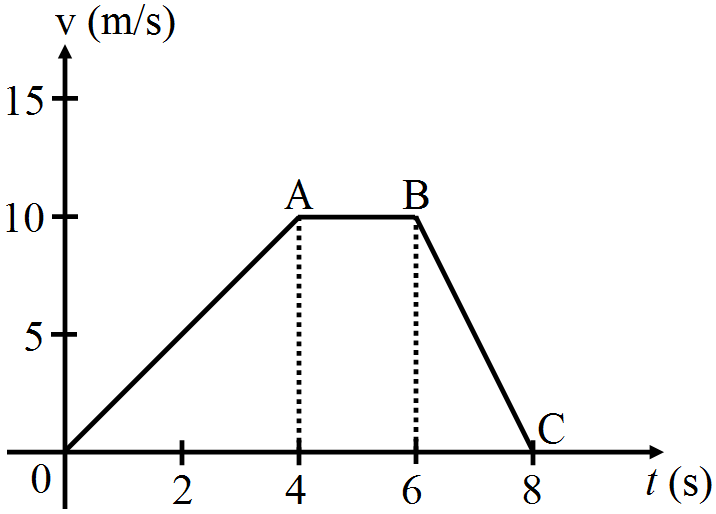
- Displacement in (0 - 4) seconds is equal to the displacement in (4 - 6) seconds.
- Acceleration is 2.5-2ms in OA and zero in AB.
- Acceleration is negative in time (6 - 8) seconds.
- A
- B
- C
- D
All the three are correct.
Answer - Only C is correct.
Explanation:
For the statement(A): Displacement in (0 - 4)s increasing and Displacement in (4 - 6)s is Constant. So, both the displacement of time (0 - 4)s and (4 - 6)s are not equal to each other.
For the statement(B):
Acceleration(OA) $=\frac{10}{4}=2.5\text{ms}$
Acceleration(AB) $=\frac{10}{(4+6)}=1\text{ms}$
For the statement(C): As we see that in the graph, part BC is decreasing simultaneously from 10m to 0. Hence, Statement C is the correct one.
View full question & answer→MCQ 2361 Mark
To find the height of a building, a student is following the steps as given below. The sequence of the steps are:
- Drops a stone from the top of the building.
- Simultaneously, starts a clock.
- Stops the clock as the stone lands on the ground.
- Follows the relation $\text{h}=\frac{1}{5}\text{gt}^2.$
Answer - A, B, C, D.
Explanation:
It is an Activity Question, so the steps that are followed to find the height of a building are simultaneously:
- Drops a stone from the top of the building.
- Simultaneously, starts a clock.
- Stops the clock as the stone lands on the ground.
- Follows the relation $\text{h}=\frac{1}{2}\text{gt}^2.$
View full question & answer→MCQ 2371 Mark
Slope of a velocity-time graph gives:
MCQ 2381 Mark
Slope of a velocity – time graph gives:
Answer - The acceleration.
Explanation:
Slope of velocity-time graph gives acceleration.
Because slope of the curve $=\frac{\text{v}}{\text{t}},$ where $\frac{\text{v}}{\text{t}}=$ acceleration.
View full question & answer→MCQ 2391 Mark
Pick out the wrong statement about retardation:
- A
Retardation is negative acceleration
- B
Retardation is rate of decrease of velocity with time
- C
SI unit of retardation is ms−2
- D
Retardation is a scalar quantity
Answer - Retardation is a scalar quantity
View full question & answer→MCQ 2401 Mark
Physical quantity corresponding to the rate of change of displacement is:
Answer - Velocity
Explanation:
Velocity is the rate of change of displacement
View full question & answer→MCQ 2411 Mark
Which one of the following is most likely not a case of uniform circular motion?
- A
Motion of the earth around the sun.
- B
Motion of a toy train on a circular.
- C
Motion of a racing car on a circular tracki.
- D
Motion of hours' hand on the dial.
Answer - Motion of a racing car on a circular tracki.
View full question & answer→MCQ 2421 Mark
Which of the following statement is correct regarding velocity and speed of a moving body?
- A
Velocity of a moving body is always higher than its speed.
- B
Speed of a moving body is always higher than its velocity.
- C
Speed of a moving body is its velocity in a given direction.
- D
Velocity of a moving body is its speed in a given direction.
Answer - Velocity of a moving body is its speed in a given direction.
Explanation:
Velocity is a vector quantity having a magnitude and a specific direction. So, velocity is nothing but speed in a particular direction.
View full question & answer→MCQ 2431 Mark
Which of the following could not be a unit of speed?
Answer - s/m
Explanation:
Speed is the distance travelled by a moving body per unit time.
View full question & answer→MCQ 2441 Mark
Which of the following could not be a unit of acceleration?
Answer - km/s
Explanation:
Acceleration is defined as the rate of change of velocity.
View full question & answer→MCQ 2451 Mark
When a car runs on a circular track with a uniform speed, its velocity is said to be changing. This is because:
- A
The car has a uniform acceleration.
- B
The direction of car varies continuously.
- C
The car travels unequal distances in equal time intervals.
- D
The car travels equal distances in unequal time intervals.
Answer - The car travels equal distances in unequal time intervals.
Explanation:
When a car runs on a circular track, its velocity changes continuously, as its direction keeps changing.
View full question & answer→MCQ 2461 Mark
When a car driver travelling at a speed of 10m/s applies brakes and brings the car to rest in 20s, then retardation will be:
Answer - +0.5m/s2
Explanation:
The term ''retardation'' means negative acceleration.
Initial velocity = 10m/s
Final velocity = 0m/s
Time taken = 20s
Acceleration $=\frac{0-10}{20}$
⇒ Acceleration = -0.5m/s2
⇒ Retardation = 0.5m/s2
View full question & answer→MCQ 2471 Mark
The speed of a moving object is determined to be 0.06m/s. This speed is equal to:
Answer - 0.216km/h
Explanation:
We can convert 0.06m/s as:
$=\frac{0.06(3600)}{1000}\text{km/hr}$
$=0.216\text{km/hr}$
So, the answer is 0.216km/hr.
View full question & answer→MCQ 2481 Mark
The slope of a speed-time graph gives:
Answer - Acceleration.
Explanation:
The rate of change of speed per unit time is termed as acceleration.
View full question & answer→MCQ 2491 Mark
The area under a speed-time graph represents a physical quantity which has the unit of:
Answer - m
Explanation:
The area under the speed time graph gives us the distance.
View full question & answer→MCQ 2501 Mark
50. Which of the following can sometimes be 'zero' for a moving body?
- Average velocity.
- Distance travelled.
- Average speed.
- Displacement.
Answer - (i) and (iv)
Explanation:
Distance is the length of the actual path covered by a moving body. This implies that the distance travelled by a moving body and also its average speed can never be zero at any point of time. However, it is possible for the displacement as well as average velocity for the body to be zero at an instance during the motion of the particle.
View full question & answer→MCQ 2511 Mark
One of the following is not a vector quantity. This one is:
Answer - Speed.
Explanation:
Vector quantities have magnitude as well as direction, and they obey the laws of vector addition.
View full question & answer→MCQ 2521 Mark
A bus increases its speed from 36km/h to 72km/h in 10 seconds. Its acceleration is:
Answer - 1m/s2
Explanation:
Final velocity = 72km/h = 20m/s
Initial velocity is 36km/h = 10m/s
Time taken is 10 sec. So,
Acceleration $=\frac{20-10}{10}$
$=1\text{m/s}^2$
View full question & answer→MCQ 2531 Mark
In which of the following cases of motion, the distance moved and the magnitude of displacement are equal?
- A
If the car is moving on straight road.
- B
If the car is moving on circular road.
- C
If the pendulum is moving to and fro.
- D
If a planet is moving around the sun.
Answer - If the car is moving on straight road.
Explanation:
The magnitude of displacement is equal to the distance travelled by a body when it travels in a straight line.
View full question & answer→MCQ 2541 Mark
If the displacement of an object is proportional to the square of time, then the object is moving with:
Answer - Uniform acceleration.
Explanation:
We are given with the relationship that,
x = kt2
Differentiating it twice we get,
v = 2kt
a = 2k
Where,
v - velocity
a - acceleration
View full question & answer→MCQ 2551 Mark
A student draws a distance-time graph for a moving scooter and finds that a section of the graph is a horizontal line parallel to the time axis. Which of the following conclusion is correct about this section of the graph?
- A
The scooter has uniform speed in this section.
- B
The distance travelled by scooter is the maximum in this section.
- C
The distance travelled by the scooter is the minimum in this section.
- D
The distance travelled by the scooter is zero in this section.
Answer - The distance travelled by the scooter is zero in this section.
Explanation:
If distance time graph is parallel to the time axis then the object has not travelled any distance.
View full question & answer→MCQ 2561 Mark
A sprinter is running along the circumference of a big sports stadium with constant speed Which of following do you think is changing in this case?
- A
Magnitude of acceleration being produced.
- B
Distance covered by the sprinter per second.
- C
Direction in which the sprinter is running.
- D
Entripetal force acting on the sprit.
Answer - Direction in which the sprinter is running.
Explanation:
The sprinter is having a uniform circular motion in which the direction of motion continuously changes.
View full question & answer→MCQ 2571 Mark
A motorcycle is being driven at a speed of 20m/s when brakes are applied to bring it to rest five seconds. The deceleration produced in this case will be:
Answer - +4m/s2
Explanation:
We have,
Initial velocity = 20m/s
Final velocity = 0m/s
Time taken = 5 sec.
So,
Deceleration = -Acceleration
$= \frac{-(0 - 20)}{5}$
$= 4\text{m/s}^2$
View full question & answer→MCQ 2581 Mark
A freely falling object travels 4.9m in 1st second, 14.7m in 2nd second, 24.5m in 3rd second, and so on. This data shows that the motion of a freely falling object is a case of:
Answer - Uniform acceleration.
Explanation:
The displacement of the body in equal interval of time is unequal, but acceleration is constant. The acceleration will thus be uniform.
View full question & answer→MCQ 2591 Mark
A car of mass 1000kg is moving with a velocity of 10ms-1. If the velocity-time graph for this car is a horizontal line parallel to the time axis, then the velocity of car at the end of 25s will be:
Answer - 10ms-1
Explanation:
It is given that the velocity time curve is parallel to x axis hence velocity is constant with time and acceleration is 0.
View full question & answer→MCQ 2601 Mark
A boy is sitting on a merry-go-round which is moving with a constant speed of 10 ms-1. This means that the boy is:
- A
- B
Moving with no acceleration.
- C
- D
Moving with uniform velocity.
Answer - In accelerated motion.
Explanation:
Acceleration is the rate of change of velocity, and the velocity of the merry-go-round is changing with respect to time. Thus, it will move in an accelerated motion.
View full question & answer→MCQ 2611 Mark
42. A bus moving along a straight line at 20m/s undergoes an acceleration of 4m/s2. After 2 seconds, its speed will be:
Answer - 28m/s
Explanation:
Acceleration of the moving object is 4m/s2
Initial velocity is 20m/s.
Time taken is 2 sec.
By applying 1st equation of motion we get,
v = u + at
= 20 + 2(4)
= 28m/s
View full question & answer→MCQ 2621 Mark
Particles P and Q are undergoing uniform horizontal circular motions along concentric circles of different radii in clockwise sense P completes each round in 2min while Q does it is 5min time required by Q to make one revolution around P is.
- A
- B
- C
$\frac{10}{3}\text{min}$
- D
This is not possible as Q is moving slower than P.
Answer - 3min.
Explanation:
Time required by Q to move around P
= Time taken by Q for for one complete round - Time taken by P for one complete round
= 5min - 2min
= 3min.
View full question & answer→MCQ 2631 Mark
Our alternatives are given to each of the following incomplete statements/questions, choose the right answer.
Uniform circular motion is called continuously accelerated motion mainly because
- A
Direction of motion changes
- B
- C
Velocity remains the same
- D
Direction of motion does not change
Answer - Direction of motion changes
Explanation:
Uniform circular motion is accelerated because the velocity changes due to continuous change in the direction of motion.
Thus, for a body moving in a circular path at a constant speed, its velocity changes continuously.
The change in velocity gives rise to an acceleration in the moving body.
View full question & answer→MCQ 2641 Mark
- A body moving in a circle has an acceleration directed towards the centre.
- Uniform circular motion is an example of variable acceleration.
- Linear velocity of a body moving in a circle differs with the distance from the axis.
- A
'A', 'B' and 'C' all are true statements.
- B
‘A’ is true, 'B' is false and 'C' is true statements.
- C
‘A’, 'B' and C' all are false statements.
- D
‘A’ is false, 'B' is true and 'C' is true statements.
Answer - 'A', 'B' and 'C' all are true statements.
Explanation:
A body moving at constant speed in a circular path experiences an acceleration directed towards the centre of the circular path. This acceleration is called a centripetal acceleration and is provided by a centripetal force.
Uniform circular motion can be well-illustrated by swinging a tennis ball on a string in a circle over your head at a constant speed. The acceleration vector is considered variable because its direction changes, even though its magnitude is constant.
Thus, for a given angular velocity ω, the linear velocity v of the particle is directly proportional to the distance of the particle from the centre of the circular path (i.e) for a body in a uniform circular motion, the angular velocity is the same for all points in the body but linear velocity is different.
View full question & answer→MCQ 2651 Mark
- y = constant: Uniform motion
- a = constant: __________
- A
Non-uniformly accelerated.
- B
- C
- D
Answer - v = 0 at, t = 0.
Explanation:
No, when a body is under uniform acceleration doesn't mean that it is under uniform motion. Uniform acceleration means, that the velocity of body is changing with a constant rate. Uniform motion is the kind of motion in which a body covers equal distances in equal intervals of time. It means that speed is constant.
View full question & answer→MCQ 2661 Mark
Odometer is to mileage as compass is to:
Answer - Direction
Explanation:
An odometer is an instrument used to measure mileage.
A compass is an instrument used to determine direction.
Choices a, b, and c are incorrect because none is an instrument.
View full question & answer→MCQ 2671 Mark
No force acts on a current carrying conductor when it is placed-
- A
Perpendicular to the magnetic field.
- B
Parallel to the magnetic field.
- C
Far away from the magnetic field.
- D
Answer - Parallel to the magnetic field.
View full question & answer→MCQ 2681 Mark
Name a physical quantity that remains constant in a uniform circular motion:
Answer - Angular speed
Explanation:
As an object moves around in a circle at constant speed (uniform circular motion), both the velocity and the acceleration change.
The magnitudes of the velocity and acceleration don't change, but since velocity and acceleration are vectors, the fact that their directions change means that they change.
Momentum is directly proportional to the velocity of the body and hence it changes.
In the uniform circular motion, the angular speed is same for all the particles,
View full question & answer→MCQ 2691 Mark
Length of the straight line joining the initial to the final positions of a moving body is known as its:
Answer- Displacement
Explanation:
Displacement is the shortest distance joining initial and final points through a straight line
View full question & answer→MCQ 2701 Mark
Leaves are the food factories of plant”. But, how does cactus (desert plants) carry out photosynthesis?
MCQ 2711 Mark
Larger the slope of a displacement-time graph:
Answer - Higher the velocity
Explanation:
The slope of a displacement-time graph with time axis measures velocity.
Larger slope (steeper graph) means the displacement is changing with a faster rate with respect to the time.
Faster rate of change of change of distance with respect to time simply means the body has a larger velocity.
View full question & answer→MCQ 2721 Mark
Is it possible to have an accelerated motion with a constant speed? Name such type of motion:
- A
Yes, Uniform Circular Motion.
- B
Yes, Non-Uniform Circular Motion.
- C
Yes, Uniform Linear Motion
- D
Answer - Yes, Uniform Circular Motion.
Explanation:
Yes it is possible. Let us take an example, circular motion.
In this it has acceleration because direction of motion is changing but it has constant speed along tangential.
Hence it is possible.
View full question & answer→MCQ 2731 Mark
Is it possible for an object's velocity to increase while its acceleration decreases?
- A
No, this is impossible because of the way in which acceleration is defined.
- B
No, because if acceleration is decreasing the object will be slowing down.
- C
No, because velocity and acceleration must always be in the same direction.
- D
Yes, an example would be a falling object in a viscous medium, where the acceleration continuously decreases but velocity increases until a certain point.
Answer - Yes, an example would be a falling object in a viscous medium, where the acceleration continuously decreases but velocity increases until a certain point.
View full question & answer→MCQ 2741 Mark
In which of the following cases of motions, the distance moved and the magnitude of displacement are equal?
- A
If the car is moving on straight road.
- B
If the car is moving in circular path.
- C
The pendulum is moving to and fro.
- D
The earth is revolving around the Sun.
Answer - If the car is moving on straight road.
Explanation:
In all other class, displacement can be less than distance.
View full question & answer→MCQ 2751 Mark
In uniform circular motion:
- A
Both velocity and speed are constant
- B
Speed is constant but velocity changes
- C
Both speed and velocity change
- D
Velocity is constant but speed changes
Answer - Speed is constant but velocity changes
Explanation:
In a Uniform Circular Motion, the magnitude of velocity, which is speed remains constant.
But the direction of velocity, which is tangential to the circle, keeps changing.
So velocity also changes.
View full question & answer→MCQ 2761 Mark
- A
Direction of motion is fixed
- B
Direction of motion changes continuously
- C
- D
Answer - Direction of motion changes continuously
View full question & answer→MCQ 2771 Mark
In a uniform circular motion-
- A
Both velocity and acceleration are constant.
- B
Acceleration and speed are constant but velocity changes.
- C
Both acceleration and velocity change
- D
Both acceleration and speed are constant
Answer - Both acceleration and speed are constant
Explanation:
For a body moving in uniform circular motion the speed attained by the object will remain constant not the velocity as velocity depends on the direction of motion, and in circular motion the direction of the object changes at every point.
As speed remains constant the acceleration will remain constant.
View full question & answer→MCQ 2781 Mark
In a motion with constant acceleration the velocity is reduced to zero in 5 seconds and after covering a distance of 100m. The distance covered by the particle in next 5 second will be:
MCQ 2791 Mark
In a free fall the velocity of a stone is increasing equally ion equal intervals of time under the effect of gravitational force of the earth. Then what can you say about the motion of this stone? Whether the stone is having:
- A
- B
Non-uniform acceleration.
- C
- D
View full question & answer→MCQ 2801 Mark
If the velocity of a body does not change, its acceleration is:
Answer - Zero
Explanation:
Acceleration of a body is defined as the rate of change of the velocity of the body.
Now since the velocity doesn't change at all, the rate of change will be zero.
So, acceleration = 0
View full question & answer→MCQ 2811 Mark
If the particle completes one rotation along a circular track having radius 14m in 44 seconds then the value of speed it’s speed is…
MCQ 2821 Mark
If the displacement of an object is proportional to square of time, then the object moves with:
Answer - Uniform acceleration.
Explanation:
Velocity is measured in terms of distance per second, while acceleration is measured in terms of distance per square second.
Hence, uniform acceleration is the correct answer.
View full question & answer→MCQ 2831 Mark
If the displacement of an object is proportional to square of time, then the object moves with:
Answer - Uniform acceleration
Explanation:
When the rate of change of velocity with time of a body is constant then the object is said to be uniformly accelerated.
Or in other words in uniform acceleration, the displacement of an object is proportional to square of time.
View full question & answer→MCQ 2841 Mark
If north is the positive direction, which situation involves positive velocity and negative acceleration:
- A
A car speeding up as it moves southward
- B
A car moving southward at a constant speed
- C
A car slowing down as it moves northward
- D
A car slowing down as it moves southward
Answer - A car slowing down as it moves northward
Explanation:
The rate of change of velocity with respect to time is known as acceleration.
Negative acceleration means a decrease in velocity with respect to time.
If a car is moving northward and slowing down, the displacement will be along the north (positive), so the velocity will be positive until it gets stopped.
As the car is slowing down, the acceleration will be negative.
View full question & answer→MCQ 2851 Mark
If body having initial velocity zero is moving with uniform acceleration 8m/ sec2.The distance travelled by it in fifth second will be:
MCQ 2861 Mark
If a particle moves in a circle with constant speed, its velocity:
- A
- B
- C
- D
Changes both in magnitude and directions
Answer - Changes direction
Explanation:
When a particle is under uniform circular motion, its direction of motion continuously changes, hence the magnitude of its velocity remains constant while its direction changes.
View full question & answer→MCQ 2871 Mark
If an object moves 4km in a straight line then the value of displacement is….?
MCQ 2881 Mark
If a displacement-time graph of an object is a straight line parallel to the time axis, the object is:
- A
- B
Moving away from the reference point
- C
Moving towards the reference point
- D
Moving with an infinite velocity
Answer - Stationary
Explanation:
Displacement-time graph being parallel to the time axis, its slope is zero.
Slope of a displacement-time graph measures velocity.
So, velocity of the object is zero.
View full question & answer→MCQ 2891 Mark
If a bus travelling at 20m/ s is subject to a steady deceleration of 5m/s2, how long will it take to come rest:
Answer - 4s
Explanation:
Using first equation of motion
v = u + at, we have
0 = 20 + (−5)t
⇒ 5t = 20
⇒ t = 4s
View full question & answer→MCQ 2901 Mark
If a body is moving on a circular path of radius 21cm with velocity of 2m/s, then time taken by the body to complete half revolution is:
Answer - 33s
Explanation:
We know that Speed (v)
$=\frac{\text{Distance}}{\text{Time}}$
Here, Distance = Circumference of the circular path
$=2\pi\text{r}$
$=\frac{2\times22}{7\times21}=132$
and, Speed
$=2\text{sec}$
This gives, Time
$=\frac{132}{2}=66\text{m/sec}$
Total time $=66\text{Sec}$
then time taken by the body to complete half revolution is:
$=\frac{66}{2}=33\text{sec}$
View full question & answer→MCQ 2911 Mark
Identify the correct statement:
- A
Acceleration increases velocity, retardation decreases it
- B
Acceleration decreases velocity, retardation increases it
- C
Acceleration and retardation both increase velocity
- D
Acceleration and retardation both decrease velocity
Answer - Acceleration increases velocity, retardation decreases it
View full question & answer→MCQ 2921 Mark
For a body which has turned by 300° in a circle of radius r,
AnswerCorrect option: A. Distance travelled is $\frac{5}{3}\pi\text{r}.$
(a) Distance travelled is $\frac{5}{3}\pi\text{r}.$
View full question & answer→MCQ 2931 Mark
For a body performing motion with uniform speed, the distance-time graph is:
- A
Straight line parallel to y-axis.
- B
Straight line inclined to the time axis.
- C
Straight line parallel to x-axis.
- D
Answer - Straight line inclined to the time axis.
View full question & answer→MCQ 2941 Mark
- A
The shortest path between the initial and final positions
- B
The longest possible path between the initial and final positions
- C
The actual path travelled by the body between the initial and final positions
- D
Answer - The actual path travelled by the body between the initial and final positions
Explanation:
Distance is defined as the length of the actual path travelled by a moving body between its initial and final positions.
View full question & answer→MCQ 2951 Mark
Direction of motion of a body is given by:
- A
- B
- C
Both its speed and velocity
- D
Neither of its speed and velocity
Answer - Its velocity
Explanation:
Velocity is a vector.
So, it gives the magnitude of speed and the direction of motion of the body as well.
Speed being a scalar, does not give the direction of motion.
View full question & answer→MCQ 2961 Mark
Define velocity.State its unit:
- A
Velocity is defined as the rate of change of distance of a body with respect to time.Its unit in SI is km/ s.
- B
Velocity is defined as the rate of change of displacement of a body with respect to time. Its unit in SI is km/ s.
- C
Velocity is defined as the rate of change of distance of a body with respect to time.Its unit in SI is m/ s.
- D
Velocity is defined as the rate of change of displacement of a body with respect to time.Its unit in SI is m/ s.
Answer - Velocity is defined as the rate of change of displacement of a body with respect to time.Its unit in SI is m/ s.
Explanation:
Velocity is a vector quantity that refers to the rate at which an object changes its position.
It is a vector expression of the displacement that an object or particle undergoes with respect to time.
View full question & answer→MCQ 2971 Mark
Commercial electric motors do not use:
- A
An electromagnet to rotate the armature.
- B
Effectively large number of turns of conducting wire in the current carrying coil.
- C
A permanent magnet to rotate the armature.
- D
A soft iron core on which the coil is wound.
Answer - A permanent magnet to rotate the armature.
View full question & answer→MCQ 2981 Mark
Choose the correct statement:
- A
Velocity determines direction of motion of a body
- B
Acceleration determines direction of motion of a body
- C
Both velocity and acceleration determine direction of motion of a body
- D
Neither velocity nor acceleration determine direction of motion of a body
Answer - Velocity determines direction of motion of a body
Explanation:
Velocity, being a vector, gives the direction of the change of position of a body.
Hence it determines the direction of motion of a body.
In contrast, acceleration doesn't need to relate to the direction of motion.
View full question & answer→MCQ 2991 Mark
Choose the correct option.Odometer: Distance :: ______:______?
Answer - Weighing scale: Weight
Explanation:
An odometer is an instrument used in a vehicle to measure the distance covered by it.
Similarly, the weighing scale is an instrument used to measure the weight of an object.
View full question & answer→MCQ 3001 Mark
A water drop falls at regular intervals from a tap 9m above the ground. The fourth drop is leaving the tap at the instant, the first drop touches the ground. How high is the third drop at that instant?
MCQ 3011 Mark
A truck traveling due north at 50km/ hr turns west and travels at the same speed. What is the change in magnitude of speed:
Answer - 0
Explanation:
When the direction is changed then velocity changes but the speed or magnitude of velocity remains constant.
In this case, the truck changes only the direction of motion, not the magnitude.
So change in the magnitude of velocity is zero.
View full question & answer→MCQ 3021 Mark
A truck covers 40km with an average speed of 80m/h. then it travels an average speed of 40km/h. the average speed of the truck for the total distanced covered is:
MCQ 3031 Mark
A stone tied to a string is whirled in a circle. As it is revolving, the rope suddenly breaks.Then:
- A
The stone flies off tangential to the circle of rotation
- B
The stone moves radially inward
- C
The stone moves radially outward
- D
The motion of the stone depends upon its velocity
Answer - The stone flies off tangential to the circle of rotation
Explanation:
When a stone is going around a circular path, the instantaneous velocity of stone is acting as tangent to the circle.
When the string breaks, the centripetal force stops to act.
Due to inertia, the stone continues to move along the tangent to circular path.
So, the stone flies off tangentially to the circular path
View full question & answer→MCQ 3041 Mark
A stone is thrown vertically up from the ground. It reaches a maximum height of 50m in 10s. After what time will it reach the ground from the maximum height?
Answer - 10s
Explanation:
$\text{t}_\text{a}=\frac{\text{u}}{\text{g}}=10\text{s}$
same amount of time it will take to fall down
View full question & answer→MCQ 3051 Mark
A sprinter has to cover a total run of 100m. She increases her speed from rest under a uniform acceleration of 1.0m/s2 up to three quarters of the total run and covers the last quarter him uniform speed. The time she takes to cover the first half, and to cover the second half of the run will be.
AnswerHere, total distance = 100m
For the first half of run, distance = 50m
u = Om/s, a = m/s2
So by
$\text{s}=\text{ut}+\frac{1}{2}\text{at}^{2}$
$50=0+\frac{1}{2}\times1\times\text{t}^{2}$
$\Rightarrow\text{t}=10\text{sec}$
At the end of 50m,
v = u + at = 0 + 1 x 10 = 10m/s
For the second half of run, we calculate fors
= 25m first(uni formly accelerated motion)
Here u = 10m/s, a = 1m/s2
So, v2 = u2 + 2as = 100 + 2 × 1 × 25 = 150
For time t, v = u + at
⇒ 12.24 = 10 + t
1 = 2.24sec
For the last 25m
$\text{t}=\frac{\text{distance}}{\text{speed}}$
$=\frac{25}{12.24}=2.04\text{sec}$
Hence time taken for the first half of run(50m) = 10sec
time taken for the second half of run(50m)
= 2.24 + 2.04 = 4.28sec
View full question & answer→MCQ 3061 Mark
Area under a υ -1 graph represents a physical quantity which has the unit:
MCQ 3071 Mark
Area under a v – t graph represents a physical quantity which has the unit:
Answer - m
Explanation:
The given area represents displacement. Unit of displacement is meter.
View full question & answer→MCQ 3081 Mark
Area under a speed-time graph gives:
- A
The time taken by a moving object
- B
The distance travelled by a moving object
- C
Tthe acceleration of a moving object
- D
Tthe retardation of a moving object
Answer - The distance travelled by a moving object
Explanation:
The area under the velocity-time graph gives the distance traveled by a moving object during that time interval.
While the area under the velocity-time graph gives displacement of the particle.
View full question & answer→MCQ 3091 Mark
A particle starts from the origin at t = 0s with a velocity of 10.0j m/ s and moves in the xy−plane with a constant acceleration of the ms−2. Then y−coordinate of the particle in 2 sec is
MCQ 3101 Mark
A particle moves on the x− axis. When the particle's acceleration is positive and increasing then
MCQ 3111 Mark
A particle is moving in positive x-direction with initial velocity of 10m/ s and uniform retardation such that it reaches the initial position after 10s. he distance traversed by the particle in 6s is:
MCQ 3121 Mark
A particle is moving in a circular path of radius r. The displacement after half a circle would be:
- A
$0$
- B
$\pi\text{r}$
- C
$2\text{r}$
- D
$2\pi\text{r}$
Answer - 2r
Explanation:
Displacement is the difference between the final and initial position of a body. It is a vector quantity and is independent of the path taken. So, for the movement of half of a circle, the displacement is 2r, where r is the radius of the circular path.
View full question & answer→MCQ 3131 Mark
A particle is moving in a circular path of radius r. The displacement after half a circle would be:
- A
$\text{Zero}$
- B
$\pi\text{r}$
- C
$2\text{r}$
- D
$2\pi\text{r}$
Answer- $2\text{r}$
Explanation:
Given, after half the circle, the particle will reach the diametrically opposite point i.e., from point A to point 6. And we know displacement is shortest path between initial and final point.
Displacement after half circle = AB = OA + OB [v Given, OA and 06 = r]
Hence, the displacement after half circle is 2r.
View full question & answer→MCQ 3141 Mark
A particle is moving in a circular path of radius r. Its displacement after moving through half the circle would be:
Answer- 2r
Explanation:
Displacement is the minimum distance between the initial position and final position.
After moving half circle (A to B) displacement will be AB
AB is diameter i.e. 2r
View full question & answer→MCQ 3151 Mark
An object travels 20m in 5sec and then another 40m in 5sec. What is the average speed of the object?
MCQ 3161 Mark
An object is released from a balloon rising up with a constant speed of 2 ms−1. Its magnitude of velocity after 1 s in ms−1 is:
Answer - 7.8
Explanation:
The ball initially will have the same velocity as that of the balloon.
Using the equations of motion, taking velocity to be positive upwards and negative downwards.
v = u + at
v = 2 −g(1)
v = 7.8m/ s
View full question & answer→MCQ 3171 Mark
An electric motor is a device which transforms:
- A
Mechanical energy into electrical energy.
- B
Electrical energy into mechanical energy.
- C
Kinetic energy into potential energy.
- D
Electrical energy into Potential energy.
Answer - Electrical energy into mechanical energy.
View full question & answer→MCQ 3181 Mark
A Negative charge is moving towards a person. The direction of magnetic field lines will be in:
- A
- B
- C
Vertically upward direction.
- D
Vertically downward direction.
View full question & answer→MCQ 3191 Mark
A motorcycle and a car start from rest at the same place at the same time and travel in the same direction.The motorcycle accelerates uniformly at 1m/ s2 up to a speed of 36km/ h and the car at 0.5m/ s2 up to a speed of 54km/ h.Then the distance at which the car overtakes the cycle-
MCQ 3201 Mark
A merry-go-round is rotating about a vertical axis at the rate of 60rev/min. If the distance of a man from its axis is 2m, his linear speed is:
- A
$1\text{ms}^{-1}$
- B
$2\text{ms}^{-1}$
- ✓
$4\pi\text{ms}^{-1}$
- D
$2\pi\text{ms}^{-1}$
AnswerCorrect option: C. $4\pi\text{ms}^{-1}$
(c) $4\pi\text{ms}^{-1}$
View full question & answer→MCQ 3211 Mark
A man is 25m behind a bus, when bus starts accelerating at 2 m/ s2 and man starts moving with constant velocity of 10 m/ s. Time taken by him to board the bus is _________?
MCQ 3221 Mark
A heavy stone is thrown from a cliff of height h with speed v. The stone will hit the ground with maximum speed if it is thrown:
- A
- B
- C
- D
The speed does not depend on the inital direction
Answer - The speed does not depend on the inital direction
View full question & answer→MCQ 3231 Mark
Acceleration is defined as:
- A
The rate of change of velocity with respect to time.
- B
The rate of change of position with respect to time.
- C
The rate of change of momentum with respect to time.
- D
Answer - The rate of change of velocity with respect to time.
Explanation:
Acceleration is defined as the rate of change of velocity with respect to time.
View full question & answer→MCQ 3241 Mark
A car travels 10m in 5 seconds, 20m in next 10 seconds and 30m in the last 10 seconds. The average speed of the motion is:
Answer - 2.4ms-1
Explanation:
The average speed of motion is 2.4m/s.
Average Speed $=\frac{ \text{(Total distance covered throughout the journey)}}{\text{(Total time taken for the journey)}}$
Average Speed $=\frac{(10\text{m}+20\text{m}+30\text{m})}{(5\text{s}+10\text{s}+10\text{s})}$
Average Speed $=\frac{60\text{m}}{25\text{s}}=2.4\text{m/s}$
View full question & answer→MCQ 3251 Mark
A car is travelling at a speed of 90km/h. Brakes are applied so as to produce a uniform acceleration of – 0.5m/s2. Find how far the car will go before it is brought to rest?
MCQ 3261 Mark
A car is moving on a circular track of radius R covering equal distance in equal intervals of time. This shows that the car has
- A
uniform speed and acceleration of constant magnitude
- B
Non-uniform velocity and acceleration
- C
uniform velocity and zero acceleration
- D
View full question & answer→MCQ 3271 Mark
A car A is travelling on a straight level road with a uniform speed of 60km/h. It is followed by another car B. Which is moving with a speed of 70km/h. When the distance between them is 2.5km, the car B is given a deceleration of 20km/h2. After how much time will B catch up with A?
- A
- B
$\frac{1}{2}\text{h}$
- C
$\frac{1}{4}\text{h}$
- D
$\frac{1}{8}\text{h}$
Answer - $\frac{1}{2}\text{h}$
Explanation:
$\text{S}_{\text{B}}=70\text{t}-\frac{1}{2}(20)\text{t}^{2}$
$\text{S}_{\text{A}}=60\text{t}$
$\text{S}_{\text{B}}-\text{S}_{\text{A}}=2.5\text{km}$
$70\text{t}-10\text{t}^{2}-60\text{t}=2.5$
$\Rightarrow10\text{t}^{2}-10\text{t}+2.5=0$
$\Rightarrow 4\text{t}^{2}-4\text{t}+1=0$
$\Rightarrow(2\text{t}-1)^{2}=0$
$\Rightarrow\text{t}=\frac{1}{2}\text{hr}=30\text{min}.$
View full question & answer→MCQ 3281 Mark
A car accelerates uniformly from 18km/h to 36km/ h in 5s. The distance covered by the car will be:
MCQ 3291 Mark
A bus is travelling the first one-third distance at a speed of 10km/h, the next one-fourth at 20km/h and the remaining at 40km/h. What is the average speed of the bus?
Answer - 18km/h.
Explanation:
If total distance is S then
Average speed
$=\frac{\text{Total distance}}{\text{time}}$
$=\frac{\text{S}}{(\text{t}_{1}+\text{t}_{2})}$
$=\text{S}\ \frac{\text{S}}{(3\times10)}+\frac{\text{S}}{(4\times20)}+\frac{5\text{S}}{(12\times40)}$
$\therefore\text{Time}=\frac{\text{Distance}}{\text{Speed}}$
$=\frac{1}{\big(30+1\frac{1}{80}+\frac{5}{480}\big)}=17.7\text{kmph}$
View full question & answer→MCQ 3301 Mark
A bus begin to move with an acceleration of 1m/s2. A man who is 48m behind the bus starts running at 10m/s to catch the bus. The man will be able to catch the bus after.
Answer - 8s
Explanation:
Velocity of man = 10m/s
s = 48m
Acceleration of man with respect to bus = Acceleration of man - Acceleration of bus
= 0 - (1) = - 1m/s
Applying second equation of motion,
$\text{s}=\text{ut}+\frac{1}{2}\text{at}^{2}$
$48=10\text{t}-\frac{1}{2}\text{t}^{2}$
solving we get,
t = 12sec or t = 8sec
therefore the minimum time is 8 seconds.
View full question & answer→MCQ 3311 Mark
A bridge is 400m long. A 150m long train crosses the bridge at a speed of 50m/s. Time taken by the train to cross it.
Answer - 11s
Explanation:
Train Length = 150m
Bridge length = 400m
Distance covered by train to cross bridge = Train Length + Bridge length
= 150 + 400
= 550m
$\text{Speed of train}=\frac{\text{Distance}}{\text{Time}}$
So,
$\text{Time}=\frac{\text{Distance}}{\text{Speed of train}}$
$=\frac{550}{50}$
$=11\text{sec}$
Time taken by the train to cross a bridge is 11sec.
View full question & answer→MCQ 3321 Mark
A body was initially moving with 10 m/ sec and it starts acceleration with 2 m/ sec2, the distance covered by it in 10 sec will be
MCQ 3331 Mark
A body thrown vertically up reaches a maximum height of 50m.Another body with double the mass is thrown up with double the initial velocity will reach a maximum height of :
MCQ 3341 Mark
A body suffers retardation of 1ms−2 means:
- A
Its velocity increases by 1ms−1 per second
- B
Its velocity remains constant
- C
Its velocity decreases by 1ms−1 per second
- D
Answer - Its velocity decreases by 1ms−1 per second
Explanation:
Acceleration is the rate of change of the velocity of an object with respect to time.
Positive acceleration means increase in velocity with time and negative acceleration means decrease in velocity per unit time.
Negative acceleration is also called retardation.
So retardation means rate of decrease of velocity per second.
View full question & answer→MCQ 3351 Mark
A body moving in a circle of radius r, covers $\frac{3}{4}\text{th}$ of the circle. The ratio of the distance to displacement is:
- A
$\frac{2\sqrt{2}}{3\pi}$
- B
$\frac{3}{2\sqrt{2}}$
- C
$\frac{3\sqrt{2}}{2\pi}$
- D
$\frac{3\pi}{2\sqrt{2}}$
Answer- $\frac{3\pi}{2\sqrt{2}}$
Explanation:
Let Partical start from A. then after covering $\frac{3}{4}$ of circle it would be at B.
So, Distence covred.
$1\text{ circle}=2\pi\text{r}\text{ units}.$
$\frac{3}{4}\text{ circle}=\frac{3}{4}\times2\pi\text{r}=\frac{3\pi\text{r}}{2}\text{units}$
Displacement:
Here, displacement will be line joining A to B.
So, by pythagoras theorem.
$\text{AB}=\sqrt{\text{r}^2+\text{r}^2}$
$=\text{r}\sqrt{2}$
So, Ratio of distance and displace will be
$\frac{3\pi\text{r}}{2}\times\frac{1}{\text{r}\sqrt{2}}=3\times\frac{22}{7}\times\frac{1}{2}\times\frac{1}{\sqrt{2}}=\frac{33}{7\sqrt{2}}$
So, ratio will be $3\pi:2\sqrt{2}$
or, simplified $33:7\sqrt{3}$
View full question & answer→MCQ 3361 Mark
A body moving along a straight line at 20 metre per second undergoes an acceleration of 4 metre per second square. After 2 second it speed will be:
MCQ 3371 Mark
A body moving along a circular path will have:
Answer - A radial acceleration
Explanation:
Velocity is not constant since the direction of the ball changes every instance.
The ball has radial acceleration since there is a centripetal force acting on it towards the center.
Ball moving in a circular path has tangential velocity.Cutting the thread, the ball moves tangentially
View full question & answer→MCQ 3381 Mark
A body moves in a uniform circular motion
- A
It is moving with constant velocity.
- B
Its acceleration is zero.
- C
The body has an acceleration.
- D
Answer - The body has an acceleration.
View full question & answer→MCQ 3391 Mark
A body is thrown vertically upward with velocity u, the greatest height h to which it will rise is,
- A
$\frac{\text{u}}{\text{g}}$
- B
$\frac{\text{u}^2}{2\text{g}}$
- C
$\frac{\text{u}^2}{\text{g}}$
- D
$\frac{\text{u}}{2\text{g}}$
Answer - $\frac{\text{u}^2}{2\text{g}}$
Explanation:
A body is thrown vertically upward.
at maximum height velocity of body = 0
use kinematics formula ,
v² = u² + 2as
Here,
v = 0
a = -g
s = H
0 = u² - 2gH
$\text{H}=\frac{\text{u}^2}{2\text{g}}$
Hence, maximum height attained by body $\frac{\text{u}^2}{2\text{g}}$
View full question & answer→MCQ 3401 Mark
A body is projected vertically upward from the ground. Taking vertical upward direction as positive and point of projection as origin, the sign of displacement of the body from the origin when it is at height h during upward and downward journey will be:
MCQ 3411 Mark
- A
zero speed and non-zero acceleration
- B
non-zero speed and zero acceleration
- C
constant velocity and a varying speed
- D
constant speed and a varying velocity
Answer - constant velocity and a varying speed
Explanation:
Speed of body is magnitude of velocity. So if velocity is only changing direction then speed is constant.
But if speed is changing then velocity have to be varying.
When a body starts moving the incident when t=0 then it have zero velocity but some acceleration is there.
Object moving with constant velocity has zero acceleration but non zero speed.
View full question & answer→MCQ 3421 Mark
A bi-quadratic equation has degree:
MCQ 3431 Mark
A balloon is rising vertically up at constant speed 10 m/ s.A stone is dropped from it when the balloon is at a height of 40m. otal distance covered by the stone before reaching the ground is (take g=10 m/ s2)
MCQ 3441 Mark
A ball is travelling with uniform translatory motion.This means that
- A
- B
The path can be straight line or circular and the ball travels with uniform speed.
- C
All parts of the ball have the same velocity (magnitude and direction) and the velocity is constant.
- D
The centre of the ball moves with constant velocity and the ball spins about its centre uniformly.
Answer - All parts of the ball have the same velocity (magnitude and direction) and the velocity is constant.
Explanation:
In uniform translatory motion, all parts of the ball have the same velocity in magnitude and direction and this velocity is constant.
View full question & answer→MCQ 3451 Mark
A 100m sprinter increases her speed from rest uniformly at the rate of 1m/s2 upto 40m and covers the remaining distance with a uniform speed. The sprinter covers the first half of the run in t1s and second half in t2s, then.
- A
- B
- C
- D
Information given is incomplete.
Answer - t1 > t2
Explanation:
For the first 40m
Using the third equation of motion: v2 - u2 = 2as
where: s = distance covered = 40mv = final velocity = ? m/su = initial velocity = 0m/sa = acceleration = 1m/s2
v2 - u2 = 2as
v2 - 0 = 2 × 1 × 40
v2 = 80
v = 8.94m/s
Using the first equation of motion v = u + at
where:
v = final velocity = 8.94m/s
u = initial velocity = 0m/sa = acceleration = 1m/s2
t1 = time = ?s
v = u + at1
8.94 = 0 + 1 × t1
t1 = 8.94s
Here its given the speed is uniform not velocity, therefore
acceleration will be 1m/s2 and speed will be 8.94m/s everywhere.
Using the third equation of motion: v2 - u2 = 2as
where
s = distance covered
= 60mv = final velocity = ??m/su
= initial velocity = 8.94m/sa
= acceleration = 1 m/s2
v2 - u2 = 2as
v2 - (8.94)2 = 2 × 1 × 60
v2 - 80 = 120
v2 = 120 + 80 = 200
v = 14.14m/s Using the first equation of motion
v = u + at
where:
v = final velocity = 14.14m/s
u = initial velocity = 8.94m/sa = acceleration = 1m/s2
t2 = time = ?s
v = u + at2
14.14 = 8.94 + 1 × t2
t2 = 14.14 - 8.94
t2 = 5.2 secs.
View full question & answer→MCQ 3461 Mark
(1) In uniform circular motion, tangential acceleration is zero (2)In uniform circular motion, velocity is constant.
- A
Both 1 and 2 are true and 2 is correct explanation of 1
- B
Both 1 and 2 are true and 2 is not correct explanation of 1
- C
- D
Answer - 1 is true and 2 is false
Explanation:
In uniform circular motion tangential acceleration is zero because angular velocity of motion is constant.
And the speed is uniform. But velocity of the particle in uniform circular motion keeps on changing.
View full question & answer→