MCQ 11 Mark
tan (90-θ) = ?
- Asin θ
- Bcos θ
- ✓cot θ
- Dtan θ
Answer
View full question & answer→Correct option: C.
cot θ
cot θ
50 questions · 8 auto-graded MCQ + 42 self-marked written.
$\text { Let } A\left(x_1, y_1\right)=A(-5,3) \text { and } B\left(x_2, y_2\right)=B(3,-5) \text {, }$
$a: b=1: 3$
$\therefore x_1=-5, y_1=3, x_2=3, y_2=-5, a=1, b=3 .$
$\therefore$ By section formula,
$\begin{array}{l|l}
\therefore \mathrm{x}=\frac{a x_2+b x_1}{a+b} & \therefore \mathrm{y}=\frac{a y_2+b y_1}{a+b} \\
\therefore \mathrm{x}=\frac{1(3)+3(-5)}{1+3} & \therefore \mathrm{y}=\frac{1(-5)+3(3)}{1+3} \\
\therefore \mathrm{x}=\frac{3-15}{4} & \therefore \mathrm{y}=\frac{-5+9}{4} \\
\therefore \mathrm{x}=\frac{-12}{4} & \therefore \mathrm{y}=\frac{4}{4} \\
\therefore \mathrm{x}=-3 & \therefore \mathrm{y}=1
\end{array}$
$\therefore$ Co-ordinates of $P$ are $(-3,1)$.
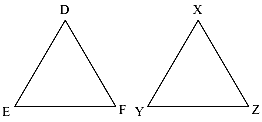
In $\triangle D E F$ and $\triangle X Y Z$,
$\frac{D E}{X Y}=\frac{F E}{Y Z} \quad \ldots(\text { Given }$
$\angle E \cong \angle Y \quad \ldots(\text { Given }$
$\therefore \triangle D E F \cong \triangle X Y Z \quad \ldots(\text { SAS Similarity triangle test) }$
$\sin \theta=\frac{1}{2}$
$\therefore \theta=30^{\circ} \quad \ldots\left[\sin 30^{\circ}=\frac{1}{2}\right]$
$A\left(x_1, y_1\right)=A(-4,2), B\left(x_2, y_2\right)=B(6,2)$
Here, $x_1=-4, y_1=2, x_2=6, y_2=2$
$\therefore$ Co-ordinates of the midpoint of seg $A B$
$=\left(\frac{x_1+x_2}{2}, \frac{y_1+y_2}{2}\right)$
$=\left(\frac{-4+6}{2}, \frac{2+2}{2}\right)$
$=\left(\frac{2}{2}, \frac{4}{2}\right)$
$=(1,2)$
In $\triangle A B C$ and $\triangle L M N$,
$\triangle A B C \sim \triangle L M N$
$\therefore \angle A \cong \angle L \quad \ldots$ (Corresponding angles of similar triangles)
But $\angle A=60^{\circ} \quad \ldots$ (Given)
$\therefore \angle L=60^{\circ}$.
$\frac{1+\cot ^2 \mathrm{~A}}{1+\tan ^2 \mathrm{~A}}$
$=\frac{\operatorname{cosec}^2 \mathrm{~A}}{\sec ^2 \mathrm{~A}}$
$=\frac{\frac{1}{\sin ^2 \mathrm{~A}}}{\frac{1}{\cos ^2 \mathrm{~A}}}$
$=\frac{\cos ^2 \mathrm{~A}}{\sin ^2 \mathrm{~A}}$
$=\cot ^2 \mathrm{~A}$
Since, seg $A B \| Y$-axis.
$\therefore \mathrm{x}$ co-ordinate of all points on seg $\mathrm{AB}$ will be the same. $x$ co-ordinate of $A(1,3)=1$
$x$ co-ordinate of $B(1,-3)=1$
$\therefore(1,-3)$ is option correct.
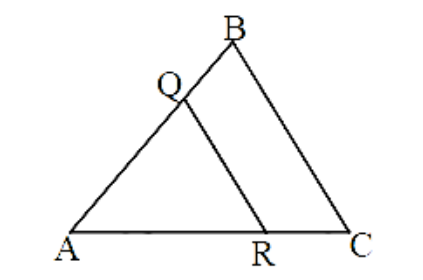
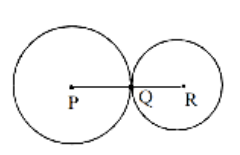
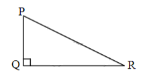
In $\triangle X Y Z$ and $\triangle P Q R$,
$\triangle X Y Z \sim \triangle P Q R \quad \ldots \text { (Given) }$
$\frac{X Y}{P Q}=\frac{Y Z}{Q R}=\frac{X Z}{P R} \quad$...[Corresponding sides of similar triangles. $]$
$\sin ^2 \theta+\sin ^2(90-\theta)=\sin ^2 \theta+\cos ^2 \theta=1$.
Let $A\left(x_1, y_1\right)$ and $B\left(x_2, y_2\right)=B(-1,-1)$
$P(x, y)=P(1,1)$ divides $A B$ in ratio $5: 2$.
$\therefore \mathrm{x}_1=1, \mathrm{y}_1=1, \mathrm{x}_2=-1, \mathrm{y}_2=-1, \mathrm{a}=5, \mathrm{~b}=2 \text {. }$
$\therefore$ By section formula,
$\therefore \mathrm{x}=\frac{a x_2+b x_1}{a+b}$
$\therefore 1=\frac{5(-1)+2 x_1}{5+2}$
$\therefore 7=-5+2 x_1$
$\therefore 7=-5+2 x_1$
$\therefore 2 \mathrm{x}_1=7+5$
$\therefore 2 \mathrm{x}_1=12$
$\therefore \mathrm{x}_1=\frac{12}{2}$
$\therefore \mathrm{x}_1=6$
$\therefore$ Co-ordinates of A are $(6,6)$.
$1+\tan ^2 \theta=\sec ^2 \theta$
$\because \sec ^2 \theta-\tan ^2 \theta=1 .$
Let $A\left(x_1, y_1\right)=A(-3,4)$ and $O\left(x_2, y_2\right)=O(0,0)$
Here, $x_1=-3, y_1=4, x_2=0, y_2=0$
By distance formula,
$d(A, O)=\sqrt{\left(x_2-x_1\right)^2+\left(y_2-y_1\right)^2}$
$\therefore d(A, O)=\sqrt{[0-(-3)]^2+(0-4)^2}$
$\therefore d(A, O)=\sqrt{9+16}$
$\therefore d(A, O)=\sqrt{25}$
$\therefore d(A, O)=5 \mathrm{~cm}$
In $\triangle \mathrm{ABC}$ and $\triangle \mathrm{DEF}$,
$\triangle \mathrm{ABC} \sim \triangle \mathrm{DEF}$...(Given)
$\therefore \angle B \cong \angle \mathrm{E}$ ...(Corresponding angles of similar triangles)
But $\angle \mathrm{E}=35^{\circ}$...(Given)
$\therefore \angle B=35^{\circ} \text {. }$
$\cot \theta \cdot \tan \theta=\frac{1}{\tan \theta} \cdot \tan \theta=1$
Here, $x_1=x_1 y_1=7, x_2=1, y_2=15$
By distance formula,
$d(L, M)=\sqrt{\left(x_2-x_1\right)^2+\left(y_2-y_1\right)^2}$
$\therefore d(L, M)=\sqrt{(1-x)^2+(15-7)^2}$
$\therefore 10=\sqrt{(1-x)^2+8^2}$
$\therefore 100=(1-x)^2+64$ $\quad$ $\ldots$[ Squaring both sides ]
$\therefore(1-x)^2=100-64$
$\therefore(1-x)^2=36$
$\therefore 1-x= \pm \sqrt{36}$ $\quad$ $\ldots$[ Taking square root of both sides ]
$\therefore 1-x= \pm 6$
$\therefore 1-x=6 \text { or } 1-x=-6$
$\therefore x=-5 \text { or } x=7$ $\quad$ $\ldots$[ Squaring both sides ]
$\therefore$ The value of $x$ is -5 or 7 .
Let $\triangle A B C$ and $\triangle P Q R$ be two similar triangles.
According to the given condition,
$\frac{\mathrm{A}(\triangle \mathrm{ABC})}{\mathrm{A}(\triangle \mathrm{PQR})}=\frac{9}{25}$
But $\frac{A(\triangle A B C)}{A(\triangle P Q R)}=\frac{A B^2}{P Q^2} \ldots(B y$ the theorem of areas of similar triangles)
$\therefore \frac{A B^2}{P Q^2}=\frac{9}{25}$
$\therefore \frac{A B}{P Q}=\frac{3}{5}$
$\therefore 3: 5$ is the ratio of their corresponding sides.
Let $P\left(x_1, y_1\right)=P(-1,1)$ and $Q\left(x_2, y_2\right)=Q(5,-7)$
Here, $x_1=-1, y_1=1, x_2=5, y_2=-7$
By distance formula,
$d(P, Q)=\sqrt{\left(x_2-x_1\right)^2+\left(y_2-y_1\right)^2}$
$\therefore d(P, Q)=\sqrt{[5-(-1)]^2+(-7-1)^2}$
$\therefore d(P, Q)=\sqrt{36+64}$
$\therefore d(P, Q)=\sqrt{100}$
$\therefore d(P, Q)=10 \mathrm{~cm}$
Here, $15^2=225$
$6^2+14^2=36+196=232$
$\therefore 15^2 \neq 6^2+14^2$
The square of the largest number is not equal to the sum of the squares of the other two numbers.
$\therefore(6,14,15)$ is not a Pythagoras triplet.
Let $P\left(x_1, y_1\right)=P(2,2)$ and $Q\left(x_2, y_2\right)=Q(5, x)$
Here, $x_1=2, y_1=2, x_2=5, y_2=x$
By distance formula,
$d(P, Q)=\sqrt{\left(x_2-x_1\right)^2+\left(y_2-y_1\right)^2}$
$\therefore 5=\sqrt{(5-2)^2+(x-2)^2}$
$\therefore 5=\sqrt{9+x^2-4 x+4}$
$\therefore 5^2=x^2-4 x+13 \quad \ldots[\text { Squaring both sides] }$
$\therefore 25=x^2-4 x+13$
$\therefore x^2-4 x+13-25=0$
$\therefore x^2-4 x-12=0$
$\therefore(x-6)(x+2)=0$
$\therefore x-6=0 \text { or } x+2=0$
$\therefore x=6 \text { or } x=-2$ $\quad$[..Squaring both sides]
Here, $15^2=225$
$7^2+8^2=49+64=113$
$\therefore 15^2 \neq 7^2+8^2$
The square of the largest number is not equal to the sum of the squares of the other two numbers.
$\therefore(7,8,15)$ is not a Pythagoras triplet.
$\cos \theta \cdot \sec \theta=\cos \theta \cdot \frac{1}{\cos \theta}=1$.
$A\left(x_1, y_1\right)=A(-4,2), B\left(x_2, y_2\right)=B(6,2)$
Here, $x_1=-4, y_1=2, x_2=6, y_2=2$
$\therefore$ Co-ordinates of the midpoint of seg $A B$
$=\left(\frac{x_1+x_2}{2}, \frac{y_1+y_2}{2}\right)$
$=\left(\frac{-4+6}{2}, \frac{2+2}{2}\right)$
$=\left(\frac{2}{2}, \frac{4}{2}\right)$
$=(1,2)$