MCQ 11 Mark
Choose the correct alternative answer for each of the following sub questions.
$15, 10, 5, ......$ In this $A.P.$ sum of first $10$ terms is $........$
AnswerFirst term $a=15$
Second term $t_1=10$
Third term $t _2=5$
Common difference $d=t_2-t_1=5-10=-5$
No. of terms $n =10$
Thus, By using sum of $n^{\text {th }}$ term of an $A.P.$ we will find it's sum
$S_n=\frac{n}{2}[2 a+(n-1)] d$
Where, $n =$ no. of terms
$a=$ first term
$d =$ common difference
$S_n=$ sum of $n$ terms
We need to find $S_{10}$
$\Rightarrow S_{10}=\frac{10}{2}[2 \times 15+(10-1) \times(-5)]$
$\Rightarrow S _{10}=5[30+9 \times(-5)]$
$\Rightarrow S _{10}=5[30-45]$
$\Rightarrow S _{10}=5 \times(-15)=-75$
Hence, correct answer is $(A)$
View full question & answer→MCQ 21 Mark
Choose the correct alternative answer for each of the following sub questions. Sum of first five multiples of $3$ is$. . .$
AnswerFirst five multiples of $3$ are
$3,6,9,12,15$
First term $a=3$
Second term $t_1=6$
Third term $t_2=9$
Common difference $d=t_2-t_1=9-6=3$
Thus, By using sum of $n^{\text {th }}$ term of an $A.P.$ We will find it's sum
$S_n=\frac{n}{2}[2 a+(n-1)] d$
Where, $n =$ no. of terms
$a=$ first term
$d =$ common difference
$S_n=$ sum of $n$ terms
We need to find $S_5$
$\Rightarrow S_5=\frac{5}{2}[2 \times 3+(5-1) \times 3] $
$ \Rightarrow S_5=\frac{5}{2}[6+4 \times 3] $
$ \Rightarrow S_5=\frac{5}{2}[6+12] $
$ \Rightarrow S_5=\frac{5}{2} \times 18=5 \times 9=45$
Thus, correct answer is $(A)$
View full question & answer→Question 31 Mark
Choose the correct alternative answer for each of the following sub questions.
If for any A.P. $d = 5$ then $t_{18} – t_{13}$ = ...
A. $5$
B. $20$
C. $25$
D. $30$
AnswerGiven $d = 5$
Now, By using $n^{th}$ term of an A.P. formula
$t_n = a + (n – 1)d$
where n = no. of terms
a = first term
d = common difference
$t_n = n^{th}$ terms
Thus, $t_{18} – t_{13} = [a + (18 – 1) \times 5] – [ a + (13 – 1) \times 5]$
$\Rightarrow t_{18} – t_{13} = [ 17 \times 5] – [ 12 \times 5]$
$\Rightarrow t_{18} – t_{13} = 85 – 60 = 25$
Thus, correct answer is $(C)$
View full question & answer→Question 41 Mark
Choose the correct alternative answer for each of the following sub questions.
In an A.P. first two terms are $– 3, 4$ then $21^{st}$ term is . . .
A. $– 143$
B. $143$
C. $137$
D. $17$
AnswerGiven: first term $a=-3$
Second term $t _1=4$
Common difference $d = t _1- a =4-(-3)=4+3=7$
We need to find $t _{21}$ where $n =21$
Now, By using $n ^{\text {th }}$ term of an A.P. formula
$t_n=a+(n-1) d$
where $n=n o$. of terms
$a =$ first term
$d =$ common difference
$t _{ n }= n ^{\text {th }}$ terms
Substituting all given value in the formulae we get,
$\Rightarrow t_{21}=-3+(21-1) \times 7$
$\Rightarrow t_{21}=-3+20 \times 7$
$\Rightarrow t_{21}=-3+140=137$
Hence, correct answer is $(C)$
View full question & answer→MCQ 51 Mark
Choose the correct alternative answer for each of the following sub questions.
For an given $A.P.\ a = 3.5$, $d = 0$, $n = 101$, then $t_n = .....$
- A
$0$
- ✓
$3.5$
- C
$103.5$
- D
$104.5$
AnswerGiven: $a=3.5, d=0, n=101$
Now, By using $n ^{\text {th }}$ term of an $A.P.$ formula
$t_n=a+(n-1) d$
where $n=n o$. of terms
$a=$ first term
$d =$ common difference
$t _{ n }= n ^{\text {th }}$ terms
Substituting all given value in the formulae we get,
$\Rightarrow t_n=3.5+(101-1) \times 0$
$\Rightarrow t_n=3.5$
Thus, correct answer is $(B)$
View full question & answer→MCQ 61 Mark
Choose the correct alternative answer for each of the following sub questions.
For an given A.P.$ t_7 = 4, d = – 4$ then a = . . .
AnswerNow, By using $n ^{\text {th }}$ term of an A.P. formula
$t_n=a+(n-1) d$
$\text { where } n=n o . \text { of terms }$
$a=\text { first term }$
$d=\text { common difference }$
$t_n=n^{\text {th }} \text { terms }$
$\Rightarrow t_7=a+(7-1) \times(-4)$
$\Rightarrow 4=a+6 \times(-4)$
$\Rightarrow 4=a-24$
$\Rightarrow a=24+4=28$
Thus, the correct answer is $(D)$
View full question & answer→MCQ 71 Mark
Choose the correct alternative answer for each of the following sub questions.
What is the sum of the first 30 natural numbers ?
AnswerList of first 30 natural number is
$1,2,3, \ldots \ldots \ldots, 30$
First term $a =1$
Second term $t _1=2$
Third term $t _2=3$
Common difference $d=t_3-t_2=3-2=1$
number of terms $n =30$
Thus, By using sum of $n ^{\text {th }}$ term of an A.P. we will find it's sum
$S_n=\frac{n}{2}[2 a+(n-1)] d$
Where, $n =$ no. of terms
$a =$ first term
$d=$ common difference
$S_n=$ sum of $n$ terms
We need to find $S _{30}$
$\Rightarrow S_{30}=\frac{30}{2}[2 \times 1+(30-1) \times 1]$
$\Rightarrow S_{30}=15[2+29]$
$\Rightarrow S_{30}=15 \times 31$
$\Rightarrow S_{30}=465$
Hence, Correct answer is (B)
View full question & answer→MCQ 81 Mark
Choose the correct alternative answer for each of the following sub questions.
First four terms of an $A.P.$ are $.....,$ whose first term is $– 2$ and common difference is $– 2.$
- A
$– 2, 0, 2, 4$
- B
$ – 2, 4, – 8, 16$
- ✓
$– 2, – 4, – 6, – 8$
- D
$ – 2, – 4, – 8, – 16$
AnswerCorrect option: C. $– 2, – 4, – 6, – 8$
Given first term $t_1 = – 2$
Common difference $d = – 2$
By using formula $t_{n + 1} = t_n + d$
$t_2 = t_1 + d = – 2 + ( – 2) = – 2 – 2 = – 4$
$t_3 = t_2 + d = – 4 + ( – 2) = – 4 – 2 = – 6$
$t_4 = t_3 + d = – 6 + ( – 2) = – 6 – 2 = – 8$
Hence, the A.P. is $– 2, – 4, – 6, – 8$
$\therefore $ correct answer is $(C)$
View full question & answer→MCQ 91 Mark
Choose the correct alternative answer for each of the following sub questions.
In an A.P. 1st term is 1 and the last term is 20. The sum of all terms is = 399 then n = . . .
AnswerGiven, first term = 1
Last term = 20
Sum of n terms, $S_n=399$
We need to find no. of terms n
Using Sum of n terms of an A.P. formula
$S _{ n }=\frac{ n }{2}[\text { first term }+ \text { last term }]$
where $n =$ no. of terms
$S _{ n }=$ sum of $n$ terms
Now, on substituting given value in formula we get,
$\Rightarrow 399=\frac{ n }{2}[1+20] $
$\Rightarrow 399=\frac{ n }{2} \times 21$
$\Rightarrow n =\frac{399 \times 2}{21}=19 \times 2=38$
$\therefore$ correct answer is (B)
View full question & answer→MCQ 101 Mark
Choose the correct alternative answer for each of the following sub questions.
The sequence $ - 10, - 6, - 2, 2, . . .$
- A
is an A.P., Reason $d = - 16$
- ✓
is an A.P., Reason $d = 4$
- C
is an A.P., Reason $d = - 4$
- D
AnswerCorrect option: B. is an A.P., Reason $d = 4$
First term $a = -10$
Second term $t_1 = -6$
Third term $t_2 = -2$
Fourth term $t_3 = 2$
Common difference $d = t_1 - a = -6 - ( - 10) = - 6 + 10 = 4$
Common difference $d = t_2 - t_1 = - 2 -(-6) = - 2 + 6 = 4$
Common difference $d = t_3 - t_2 = 2 - (-2) = 2 + 2 = 4$
Since, the common difference is same.
$\therefore$ The given sequence is A.P. with common difference $d = 4$
Hence, correct answer is (B)
View full question & answer→Question 111 Mark
Find the sum of first n odd natural numbers.
Question 121 Mark
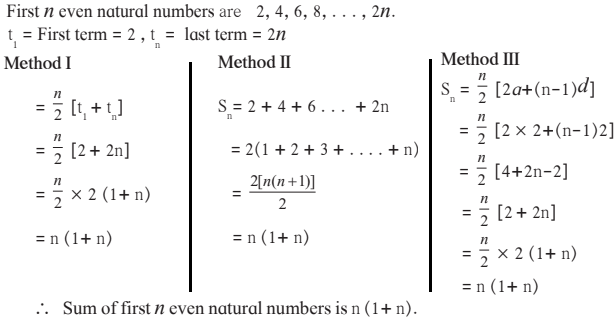
Find the sum of first n even natural numbers.
MCQ 131 Mark
State whether the given sequence is an A.P. or not: $1^3, 2^3, 3^3, 4^3, 5^3, \ldots$.
- A
an A.P. with $d=3$
- ✓
- C
an A.P. with $d=7$
- D
View full question & answer→MCQ 141 Mark
A meeting hall has 30 rows in all. There are 20 seats in the first row, 24 seats in the second row and 28 seats in the third row and so on. How many seats are there in the hall?
MCQ 151 Mark
The sum of first $n$ terms of an A.P. $S_n=$ _____
AnswerCorrect option: A. $\frac{n}{2}\left[t_1+t_n\right]$
$\frac{n}{2}\left[t_1+t_n\right]$
View full question & answer→MCQ 161 Mark
In an A.P., $a=8, t_{ n }=62, S_{ n }=210$ then find n .
View full question & answer→MCQ 171 Mark
The next two terms of the given sequence 1, 3, 7, 15, 31, ....
MCQ 181 Mark
For an A.P. if $t_4=12$ and $d=-10$ then find $a$.
View full question & answer→MCQ 191 Mark
Find the $t_2$ of the following sequence for which $S_1=2, S_2=12$ and $S_3=36$.
View full question & answer→MCQ 201 Mark
Find the missing term in the A.P.: -5, ...... , 13, ...
MCQ 211 Mark
Which of the following sequence is not an A.P.?
- A
$0.5,2,3.5,5 \ldots$
- B
$22,26,28,31 \ldots$
- C
$3,5,7,9, \ldots$
- D
$1,4,7,10, \ldots \ldots$
Answer$22,26,28,31, \ldots$
View full question & answer→MCQ 221 Mark
The sum of first 10 natural number is ______
MCQ 231 Mark
If $a=6, d=3$ then $S_{10}$ = ______
View full question & answer→MCQ 241 Mark
For an A.P. 4, 9, 14,....$t_{11}$= _______
View full question & answer→MCQ 251 Mark
In an A.P. 1st term is 1 and the last term is 20. The sum of all terms is = 399 then n = . . .
Answer(B) 38
Given, first term $=1$
Last term $=20$
Sum of $n$ terms, $S_n=399$
We need to find no. of terms $n$
Using Sum of $n$ terms of an A.P. formula
$S _{ n }=\frac{ n }{2}[\text { first term }+ \text { last term] }$
where $n=$ no. of terms
$S_n=\text { sum of } n \text { terms }$
Now, on substituting given value in formula we get,
$\begin{array}{l}
\Rightarrow 399=\frac{n}{2}[1+20] \\
\Rightarrow 399=\frac{n}{2} \times 21 \\
\Rightarrow n=\frac{399 \times 2}{21}=19 \times 2=38
\end{array}$
$\therefore$ correct answer is (B)
View full question & answer→MCQ 261 Mark
Sum of first five multiples of 3 is. . .
Answer(A) 45
First five multiples of 3 are
$3,6,9,12,15$
First term $a =3$
Second term $t_1=6$
Third term $t_2=9$
Common difference $d=t_2-t_1=9-6=3$
Thus, By using sum of $n^{\text {th }}$ term of an A.P. we will find it's sum
$S_n=\frac{n}{2}[2 a+(n-1) d]$
Where, $n=$ no. of terms
a = first term
d = common difference
Sn = sum of n terms
We need to find S5
$\begin{array}{l}
\Rightarrow S_5=\frac{5}{2}[2 \times 3+(5-1) \times 3] \\
\Rightarrow S_5=\frac{5}{2}[6+4 \times 3] \\
\Rightarrow S_5=\frac{5}{2}[6+12] \\
\Rightarrow S_5=\frac{5}{2} \times 18=5 \times 9=45
\end{array}$
Thus, correct answer is (A)
View full question & answer→MCQ 271 Mark
If for any A.P. d = 5 then t18 – t13 = ...
Answer(C) 25
Given d = 5
Now, By using nth term of an A.P. formula
tn = a + (n – 1)d
where n = no. of terms
a = first term
d = common difference
tn = nth terms
Thus, t18 – t13 = [a + (18 – 1) × 5] – [ a + (13 – 1) × 5]
⇒ t18 – t13 = [ 17 × 5] – [ 12 × 5]
⇒ t18 – t13 = 85 – 60 = 25
Thus, correct answer is (C)
View full question & answer→MCQ 281 Mark
In an A.P. first two terms are – 3, 4 then 21st term is . . .
Answer(C) 137
Given: first term a = – 3
Second term t1 = 4
Common difference d = t1 – a = 4 – ( – 3) = 4 + 3 = 7
We need to find t21 where n = 21
Now, By using nth term of an A.P. formula
tn = a + (n – 1)d
where n = no. of terms
a = first term
d = common difference
tn = nth terms
Substituting all given value in the formulae we get,
⇒ t21 = – 3 + (21 – 1) × 7
⇒ t21 = – 3 + 20 × 7
⇒ t21 = – 3 + 140 = 137
Hence, correct answer is (C)
View full question & answer→MCQ 291 Mark
For an given A.P. a = 3.5, d = 0, n = 101, then tn = . . .
Answer(B) 3.5
Given: a = 3.5, d = 0, n = 101Now, By using nth term of an A.P. formula
tn = a + (n – 1)d
where n = no. of terms
a = first term
d = common difference
tn = nth terms
Substituting all given value in the formulae we get,
⇒ tn = 3.5 + (101 – 1) × 0
⇒ tn = 3.5
Thus, correct answer is (B)
View full question & answer→MCQ 301 Mark
15, 10, 5, . . . In this A.P. sum of first 10 terms is . . .
Answer(A) -75
First term $a =15$
Second term $t_1=10$
Third term $t_2=5$
Common difference $d=t_2-t_1=5-10=-5$
No. of terms $n=10$
Thus, By using sum of $n^{\text {th }}$ term of an A.P. we will find it's sum
$S_n=\frac{n}{2}[2 a+(n-1) d]$
Where, $n=$ no. of terms
$a =\text { first term }$
$\begin{array}{l}
d=\text { common difference } \
S_n=\text { sum of } n \text { terms } \
\text { We need to find } S_{10} \
\Rightarrow S_{10}=\frac{10}{2}[2 \times 15+(10-1) \times(-5)] \
\Rightarrow S_{10}=5[30+9 \times(-5)] \
\Rightarrow S_{10}=5[30-45] \
\Rightarrow S_{10}=5 \times(-15)=-75
\end{array}$
Hence, correct answer is (A)
View full question & answer→MCQ 311 Mark
For an given A.P. t7 = 4, d = – 4 then a = . . .
Answer(D) 28
Now, By using nth term of an A.P. formulatn = a + (n – 1)d
where n = no. of terms
a = first term
d = common difference
tn = nth terms
⇒ t7 = a + (7 – 1) × ( – 4)
⇒ 4 = a + 6 × ( – 4)
⇒ 4 = a – 24
⇒ a = 24 + 4 = 28
Thus, the correct answer is (D)
View full question & answer→MCQ 321 Mark
What is the sum of the first 30 natural numbers ?
Answer(B) 465
List of first 30 natural number is
1, 2, 3,……..,30
First term a = 1
Second term t1 = 2
Third term t2 = 3
Common difference d = t3 – t2 = 3 – 2 = 1
number of terms n = 30
Thus, By using sum of nth term of an A.P. we will find it’s sum
$S_n=\frac{n}{2}[2 a+(n-1) d]$
Where, n = no. of terms
a = first term
d = common difference
Sn = sum of n terms
We need to find S30
⇒$S_{30}=\frac{30}{2}[2 \times 1+(30-1) \times 1]$
⇒ S30 = 15 [ 2 + 29]
⇒ S30 = 15 × 31
⇒ S30 = 465
Hence, Correct answer is (B)
View full question & answer→MCQ 331 Mark
First four terms of an A.P. are ....., whose first term is – 2 and common difference is – 2.
Answer(C)
– 2, – 4, – 6, – 8
Given first term t
1 = – 2
Common difference d = – 2
By using formula t
n + 1 = t
n + d
t
2 = t
1 + d = – 2 + ( – 2) = – 2 – 2 = – 4
t
3 = t
2 + d = – 4 + ( – 2) = – 4 – 2 = – 6
t
4 = t
3 + d = – 6 + ( – 2) = – 6 – 2 = – 8
Hence, the A.P. is – 2, – 4, – 6, – 8
∴ correct answer is (C)
View full question & answer→MCQ 341 Mark
The sequence – 10, – 6, – 2, 2, . . .
Answer(B)
is an A.P., Reason d = 4
First term a = – 10
Second term t
1 = – 6
Third term t
2 = – 2
Fourth term t
3 = 2
Common difference d = t
1 – a = – 6 – ( – 10) = – 6 + 10 = 4
Common difference d = t
2 – t
1 = – 2 – ( – 6) = – 2 + 6 = 4
Common difference d = t
3 – t
2 = 2 – ( – 2) = 2 + 2 = 4
Since, the common difference is same
∴ The given sequence is A.P. with common difference d = 4
Hence, correct answer is (B)
View full question & answer→MCQ 351 Mark
Find the sum of first n odd natural numbers.
Answer(B)n
2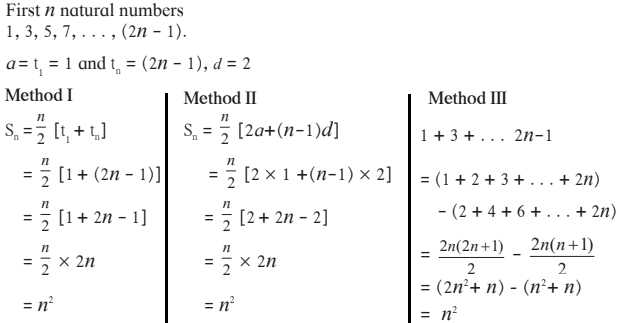
View full question & answer→MCQ 361 Mark
Find the sum of first n even natural numbers.
MCQ 371 Mark
Which of the following sequence is not an A.P.?
- A
$0.5,2,3.5,5 \ldots$
- ✓
$22,26,28,31 \ldots$
- C
$3,5,7,9, \ldots$
- D
$1,4,7,10, \ldots \ldots$
AnswerCorrect option: B. $22,26,28,31 \ldots$
View full question & answer→MCQ 381 Mark
The sum of first $n$ terms of an A.P. $S_n=$ _____
AnswerCorrect option: A. $\frac{n}{2}\left[t_1+t_n\right]$
View full question & answer→MCQ 391 Mark
The sum of first 10 natural number is ______
MCQ 401 Mark
The next two terms of the given sequence 1, 3, 7, 15, 31, ....
MCQ 411 Mark
State whether the given sequence is an A.P. or not: $1^3, 2^3, 3^3, 4^3, 5^3, \ldots$.
- A
an A.P. with $d=3$
- ✓
- C
an A.P. with $d=7$
- D
View full question & answer→MCQ 421 Mark
In an A.P., $a=8, t_{ n }=62, S_{ n }=210$ then find n .
View full question & answer→MCQ 431 Mark
If $a=6, d=3$ then $S_{10}$ = ______
View full question & answer→MCQ 441 Mark
For an A.P. if $t_4=12$ and $d=-10$ then find $a$.
View full question & answer→MCQ 451 Mark
For an A.P. 4, 9, 14,....$t_{11}$= _______
View full question & answer→MCQ 461 Mark
Find the $t_2$ of the following sequence for which $S_1=2, S_2=12$ and $S_3=36$.
View full question & answer→MCQ 471 Mark
Find the missing term in the A.P.: -5, ...... , 13, ...
MCQ 481 Mark
A meeting hall has 30 rows in all. There are 20 seats in the first row, 24 seats in the second row and 28 seats in the third row and so on. How many seats are there in the hall?