Question 14 Marks
If 460 is divided by a natural number, quotient is 6 more than five times the divisor and remainder is 1. Find quotient and diviser.
AnswerLet the divisor be x. Then, Quotient be 6 + 5x
Now according to question,
$\text { dividend }=\text { divisor } \times \text { quotient }+ \text { remainder. } $
$\Rightarrow 460=x \times(6+5 x)+1 $
$\Rightarrow 459=5 x^2+6 x $
$\Rightarrow 5 x^2+6 x-459=0 $
$\Rightarrow 5 x^2-45 x+51 x-459=0 $
$\Rightarrow 5 x(x-9)+51(x-9)=0 $
$\Rightarrow(5 x-51)(x-9)=0 $
$5 x-51=0 \text { or } x-9=0 $
$x=\frac{51}{5} \text { or } x=9$
$\therefore \text { divisor }=9 \text { and quotient }=6+5 \times 9=6+45=51$
∴Divisor = 9, quotient = 51
View full question & answer→Question 24 Marks
Pintu takes 6 days more than those of Nishu to complete certain work. If they work together they finish it in 4 days. How many days would it take to complete the work if they work alone.
AnswerSuppose Nishu alone takes x days to finish work. Then , Pintu alone can finish in (x + 6)days.
$\Rightarrow$ Nishu's one day work + Pintu's one day work $=\frac{1}{x}+\frac{1}{x+6}$
$\left(\right.$ Nishu + Pintu)'s one day work $=\frac{1}{4}$
$\therefore \frac{1}{ x }+\frac{1}{ x +6}=\frac{1}{4}$
$\Rightarrow \frac{x+6+x}{x(x+6)}=4 $
$\Rightarrow 4( x +6+ x )= x ( x +6)$
$\Rightarrow 4 x+24+4 x=x^2+6 x $
$\Rightarrow x^2+6 x-8 x-24=0$
$\Rightarrow x^2-2 x-24=0 $
$\Rightarrow x^2-6 x+4 x-24=0$
$\Rightarrow x(x-6)+4(x-6)=0$
$\Rightarrow(x-6)(x+4)=0$
$x-6=0 \text { or } x+4=0$
x = -4 is not possible, as no of days can't be negative.
Nishu will take 6 days alone and Pintu takes 12 days alone.
View full question & answer→Question 34 Marks
Pratik takes 8 hours to travel 36 km downstream and return to the same spot. The speed of boat in still water is 12 km. per hour. Find the speed of water current.
AnswerLet the speed of water current be x.
$\therefore T _1=\frac{ D _1}{S_1}=\frac{36}{12+ x } hr $
$ T _2=\frac{ D _2}{S_2}=\frac{36}{12- x } hr $
$ 8 hr =\frac{36}{12+ x }+\frac{36}{12- x } $
$ 8=\frac{[36(12- x )+36(12+ x )]}{144- x ^2} $
$ 8=\frac{36(12- x +12+ x )}{144- x ^2} $
$ 144- x ^2=\frac{36 \times 24}{8} $
$ 144- x ^2=108 $
$ 144-108= x ^2 $
$ \Rightarrow 36= x ^2 $
$ \Rightarrow x = \pm 6$
Speed od water current is 6km/hr
View full question & answer→Question 44 Marks
Mr. Kasam runs a small business of making earthen pots. He makes certain number of pots on daily basis. Production cost of each pot is ₹40 more than 10 times total number of pots, he makes in one day. If production cost of all pots per day is ` 600, find production cost of one pot and number of pots he makes per day.
AnswerLet the number of pots made by Mr. Kasam each day be $x$. Then, production cost of each pot $=₹ 40+10\ ( x )$
$\therefore \text { total cost }=(40+10 x) x=40 x+10 x^2 $
$10 x^2+40 x=600 $
$\Rightarrow 10 x^2+40 x-600=0 $
$\Rightarrow x^2+4 x-60=0 $
$\Rightarrow x^2-6 x+10 x-60=0 $
$\Rightarrow x(x-6)+10(x-6)=0 $
$\Rightarrow(x-6)(x+10)=0 $
$x-6=0 \text { or } x+10=0 $
$x=6 \text { or } x=-10$
Hence number of pots made cannot be negative. $\therefore$ number of pots he made each day $=6$
$\text { Cost of one pot }=40+10(6)=40+60=₹ 100$
View full question & answer→Question 54 Marks
Suyash scored 10 marks more in second test than that in the first. 5 times the score of the second test is the same as square of the score in the first test. Find his score in the first test.
AnswerLet the score of first test be x . Then, second test score $= x +10$.
$\therefore 5( x +10)= x ^2 $
$\Rightarrow 5 x +50= x ^2 $
$\Rightarrow x ^2-5 x -50=0 $
$\Rightarrow x ^2-10 x +5 x -50=0 $
$\Rightarrow x ( x -10)+5( x -10)=0 $
$\Rightarrow( x -10)( x +5)=0 $
$x -10=0 \text { or } x +5=0 $
$x =10 \text { or } x =-5$
Hence, score of first test is 10 as marks are not negative.
View full question & answer→Question 64 Marks
Vivek is older than Kishor by 5 years. The sum of the reciprocals of their ages is 1/6. Find their present ages.
AnswerLet Kishor’s present age be x. Then, vivek’s age = x + 5
$\therefore \frac{1}{x}+\frac{1}{x+5}=\frac{1}{6}$
$\Rightarrow \frac{x+5+x}{x(x+5)}=\frac{1}{6} \Rightarrow 6(5+2 x)=x^2+5 x$
$\Rightarrow 30+12 x=x^2+5 x $
$\Rightarrow x^2+5 x-12 x-30=0 $
$\Rightarrow x^2-7 x-30=0 $
$\Rightarrow x^2-10 x+3 x-30=0 $
$\Rightarrow x(x-10)+3(x-10)=0 $
$\Rightarrow(x-10)(x+3)=0 $
$x-10=0 \text { or } x+3=0 $
$x=10 \text { or } x=-3$
Hence, age cannot be negative. $\therefore$ age od Kishor is $10$
and age of Vivek is $15.$
View full question & answer→Question 74 Marks
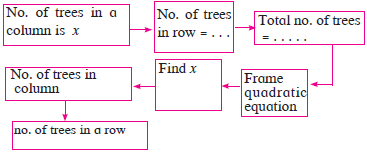
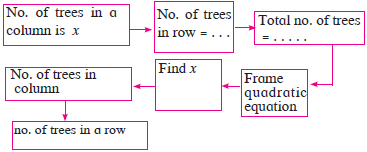
In the orange garden of Mr. Madhusudan there are 150 orange trees. The number of trees in each row is 5 more than that in each column. Find the number of trees in each row and each column with the help of following flow chart.
AnswerLet the number of columns be $x$
$\therefore \text { rows }=x+5 $
$x(x+5)=150 $
$\Rightarrow x^2+5 x-150=0 $
$\Rightarrow x^2+15 x-10 x-150=0 $
$\Rightarrow x(x+15)-10(x+15)=0 $
$\Rightarrow(x+15)(x-10)=0 $
$x+15=0 \text { or } x-10=0 $
$x=-15 \text { or } x=10$
Hence, columns cannot be negative. $\therefore$ columns are 10 and rows are 15 .
View full question & answer→Question 84 Marks
The sum of squares of two consecutive natural numbers is 244; find the numbers.
AnswerLet the two consecutive natural numbers be x and x + 2. Then,
$x^2+(x+2)^2=244 $
$\Rightarrow x^2+x^2+4 x+4=244 $
$ \Rightarrow 2 x^2+4 x-240=0 $
$ \Rightarrow x^2+2 x-120=0 $
$ \Rightarrow x^2+12 x-10 x-120=0 $
$ \Rightarrow x(x+12)-10(x+12)=0$
$\Rightarrow(x+12)(x-10)=0 $
$ x+12=0 \text { or } x-10=0 $
$ x=-12 \text { or } x=10$
No.s cannot be negative, ∴ numbers are 10 and 12
View full question & answer→Question 94 Marks
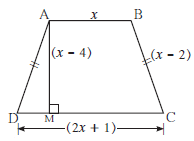
In the adjoining fig. $\square A B C D$ is a trapezium $A B \| C D$ and its area is $33 cm^2$. From the information given in the figure find the lengths of all sides of the $\square A B C D$. Fill in the empty boxes to get the solution.
Answer$\square A B C D$ is a trapezium.
$A B \| C D$
$A(\square A B C D)=\frac{1}{2}(A B+C D) \times A M $
$33=\frac{1}{2}(x+2 x+1) \times(x-4) $
$\therefore 3 x(x-7)+10(x-7)=0 $
$\therefore(3 x+10)(x-7)=0 $
$\therefore 3 x+10=0 \text { or } x-7=0 $
$\therefore x=-\frac{10}{3} \text { or } x=7$
But length is never negative.
$\therefore x \neq \frac{10}{3}$
$\therefore x =7$
$AB =7 cm, C D=15 cm, AD = BC =5 cm$
View full question & answer→Question 104 Marks
Product of Pragati’s age 2 years ago and 3 years hence is 84. Find her present age.
AnswerLet her present age be x
According to question,
$(x-2)(x+3)=84 $
$\Rightarrow x^2+x-6=84 $
$\Rightarrow x^2+x-90=0 $
$\Rightarrow x^2+10 x-9 x-90=0 $
$\Rightarrow x(x+10)-9(x+10)=0 $
$\Rightarrow(x-9)(x+10)=0 $
$\Rightarrow x-9=0 \text { or } x+10=0 $
$\Rightarrow x=9 \text { or } x=-10$
As age cannot be in negative, $\therefore$ Pragati' sage is 9 years.
View full question & answer→Question 114 Marks
A tank fills completely in 2 hours if both the taps are open. If only one of the taps is open at the given time, the smaller tap takes 3 hours more than the larger one to fill the tank. How much time does each tap take to fill the tank completely?
AnswerLet the time taken by larger tap alone be x hr . Then ,
Time taken by smaller tap be $x +3 hr$
In an hour, the larger tap can fill $\frac{1}{x}$ tank.
$\therefore$ In an hour, the larger tap can fill $\frac{1}{x+3}$ tank.
Two taps together can fill a tank in 2 hr .
But in an hour, taps fill in $\frac{1}{2} hr$ of the tank.
$\therefore \frac{1}{x}+\frac{1}{x+3}=\frac{1}{2} $
$\Rightarrow 2(x+3+x)=x(x+3) $
$\Rightarrow 4 x+6=x^2+3 x $
$\Rightarrow x^2+3 x-4 x-6=0 $
$\Rightarrow x^2-x-6=0 $
$\Rightarrow x^2-3 x+2 x-6=0 $
$\Rightarrow x(x-3)+2(x-3)=0 $
$\Rightarrow(x-3)(x+2)=0 $
$x-3=0 \text { or } x+2=0 $
$x=3 \text { or } x=-2$
$x=3$ because time taken cannot be negative
For larger tap 3 hours and for smaller tap 6 hours.
View full question & answer→Question 124 Marks
Mr. Dinesh owns an agricultural farm at village Talvel. The length of the farm is 10 meter more than twice the breadth. In order to harvest rain water, he dug a square shaped pond inside the farm. The side of pond is 1/3 of the breadth of the farm. The area of the farm is 20 times the area of the pond. Find the length and breadth of the farm and of the pond.
AnswerLet the breadth of the farm be $x$.
$\therefore$ length of the farm $=2 x +10$
side of the pond $=\frac{x}{3}$
According to the question,
area of farm $=20$ (area of pond)
$\Rightarrow x(2 x+10)=20\left(\frac{x}{3}\right)^2 $
$\Rightarrow 2 x^2+10 x=\frac{20 x^2}{9} $
$\Rightarrow 10 x=\frac{20 x^2}{9}-2 x^2 $
$\Rightarrow 10 x=\frac{20 x^2-18 x^2}{9} $
$\Rightarrow 90 x=2 x^2 \Rightarrow 2 x^2-90 x $
$\Rightarrow x(2 x-90)=0 $
$\Rightarrow x=0 \text { or } 2 x-90=0 $
$x=\frac{90}{2}=45$
length of the farm $=2 x+10=2(45)+10=100$
side of the pond $=\frac{x}{3}=\frac{45}{3}=15$
Breadth 45 m . length 100 m , side of the pond 15 m .
View full question & answer→Question 134 Marks
Ranjana wants to distribute 540 oranges among some students. If 30 students were more each would get 3 oranges less. Find the number of students.
AnswerTotal oranges = 540
Initial student = x
Initial orange for 1 student = n
$n x=540 $.
$(n-3)(x+30)=540 $
$ n x=(n-3)(x+30) $
$ n x=n x+30 n-3 x-90$
$ 30 n=3 x+90$
$ x=\frac{30 n-90}{3} $
$ x=10 n-30 $
$ \because n x=540 $
$n(10 n-30)=540$
$ n(n-3)=54 $
$ n^2-3 n-54=0 $
$n^2-9 n+6 n-54=0$
$ n(n-9)+6(n-9)=0 $
$ (n-9)(n+6)=0$
$ \Rightarrow n-9=0 \text { or } n+6=0 $
$ \Rightarrow n=9 \text { or } n=-6 $
$ n x=540 \Rightarrow x=\frac{540}{9} \Rightarrow x=60$
$\therefore$ number of students = 60 students.
View full question & answer→Question 144 Marks
The difference between squares of two numbers is $120.$ The square of smaller number is twice the greater number. Find the numbers.
AnswerLet the two numbers be a and b, such that, $a > b..$
As per the given conditions,
The difference of the square of the two numbers is $120.$
$a^2-b^2=120 \ldots I$
The square of smaller number is 2 times the larger number.
$b ^2=2 a \ldots II$
Put the value of $b ^2$ from eq. II in Eq. I, it gives
$a^2-2 a=120 $
$a^2-2 a-120=0 $
$\Rightarrow a^2+10 a-12 a-120=0 $
$\Rightarrow a(a+10)-12(a+10)=0 $
$\Rightarrow(a+10)(a-12)=0 $
$a +10=0 \text { or } a-12=0 $
$a =-10 \text { or } a=12 $
$b=\sqrt{2 a} \Rightarrow b =\sqrt{2(12}) \Rightarrow b =\sqrt{24} $
$b= \pm \sqrt{24} $
$12 \text { and } \sqrt{24} \text { or } 12 \text { and }-\sqrt{24}$
View full question & answer→Question 154 Marks
Find quadratic equation such that its roots are square of sum of the roots and square of difference of the roots of equation
$2 x^2+2(p+q) x+p^2+q^2=0$
AnswerLet’s assume roots are m and n.
So, we want the equation whose roots would be $( m + n )^2$ and $( m - n )^2$
So, the sum of the roots of our desired equation would be $2(m+n)^2$ and product of the roots would be $( m + n )^2(m- n )^2$
What we know from given equation are:
$m + n =-( p + q ) $
$\text { and } mn =\frac{ p ^2+ q ^2}{2}$
the sum and product are:
$s=2\left(m^2+n^2\right)=2(m+n)^2-2 m n $
$=2(p+q)^2-\left(p^2+q^2\right)=2 \times 2 p q=4 p q$
and
$P=(m+n)^2(m-n)^2 $
$=(p+q)^2(m+n)^2-4 m n $
$=(p+q)^2(p+q)^2-2\left(p^2+q^2\right) $
$=(p+q)^2\left(2 p q-p^2-q^2\right) $
$=-(p+q)^2(p-q)^2 $
$=-\left(p^2-q^2\right)^2$
Our desired equation would be $x ^2- sx + P =0$
So, $x^2-4 p q x-\left(p^2-q^2\right)^2=0$ is our desired equation
View full question & answer→Question 164 Marks
The sum of two roots of a quadratic equation is 5 and sum of their cubes is 35, find the equation.
Answer$\alpha+\beta=5 $
$ \Rightarrow \alpha^3+\beta^3=35 $
$ \because \alpha^3+\beta^3=(\alpha+\beta)\left(\alpha^2-\alpha \beta+\beta^2\right) $
$ \Rightarrow 35=5\left(\alpha^2+\beta^2+2 \alpha \beta-3 \alpha \beta\right) $
$ \Rightarrow 35=5\left\{(\alpha+\beta)^2-3 \alpha \beta\right\} $
$ \Rightarrow 7=25-3 \alpha \beta $
$ \Rightarrow 3 \alpha \beta=18 $
$\Rightarrow \alpha \beta=6 $
$ x^2-(\alpha+\beta) x+\alpha \beta \Rightarrow x^2-5 x+6=0$
View full question & answer→Question 174 Marks
Find $m$ if $(m-12) x^2+2(m-12) x+2=0$ has real and equal roots.
Answer$(m-12) x^2-(2 m-24) x+2=0 \text { compare with } a x^2+b x+c=0 $
$\Rightarrow a=m-12, b=-2 m+24 \text { and } c=2 $
$\therefore b^2-4 a c=(-2 m+24)^2-4(m-12)(2) $
$=4 m^2-96 m+576-8 m+96 $
$=4 m^2-104 m+672 $
$=m^2-26 m+168$
If roots are equal and real then, $\therefore b^2-4 a c=0$
$m ^2-26 m+168=0 $
$\Rightarrow m ^2-12 m-14 m+168=0 $
$\Rightarrow m ( m -12)-14(m-12)=0 $
$\Rightarrow( m -12)( m -14)=0 $
$m=12 \text { or } m =14$
$m = 12 \ or\ m = 14$
View full question & answer→Question 184 Marks
Solve the following quadratic equation.
$x^2-4 x-3=0$
Answer$x^2-4 x-3=0 \text { compare with } a x^2+b x+c=0 $
$\Rightarrow a =1, b=-4 \text { and } c =-3 $
$\therefore b ^2-4 ac =-4^2-4(1)(-3) $
$=16+12 $
$=28 $
$x =\frac{- b \pm \sqrt{ b ^2-4 ac }}{2 a } $
$\Rightarrow x =\frac{4 \pm \sqrt{28}}{2 \times 1} $
$\Rightarrow x=\frac{4 \pm 2 \sqrt{7}}{2} $
$\Rightarrow x =\frac{4+2 \sqrt{7}}{2} \text { or } x =\frac{4-2 \sqrt{7}}{2} $
$\Rightarrow x =\frac{2(2+\sqrt{7})}{2} \text { or } x =\frac{2(2-\sqrt{7})}{2} $
$\Rightarrow x=2+\sqrt{7} \text { or } x=2-\sqrt{7}$
View full question & answer→Question 194 Marks
Solve the following quadratic equation.
$5 m^2+2 m+1=0$
Answer$5 m^2+2 m+1=0 \text { compare with } ax ^2+ bx + c =0 $
$ \Rightarrow a =5, b=2 \text { and } c =1$
$ \therefore b ^2-4 ac =2^2-4(5)(1) $
$ =4-20 $
$ =-16$
Hence , roots are not real.
View full question & answer→Question 204 Marks
Solve the following quadratic equation.
$m^2+5 m+5=0$
Answer$ m ^2+5 m+5=0 \text { compare with } ax ^2+ bx + c =0$
$ \Rightarrow a =1, b=5 \text { and } c=5 $
$ \therefore b ^2-4 ac =5^2-4(1)(5)$
$ =25-20$
$=5$
$ x =\frac{- b \pm \sqrt{b^2-4 a c}}{2 a } $
$ \Rightarrow x =\frac{-5 \pm \sqrt{5}}{2 \times 1} $
$ \Rightarrow x =\frac{-5 \pm \sqrt{5}}{2} $
$\Rightarrow x =\frac{-5+\sqrt{5}}{2} \text { or } x=\frac{-5-\sqrt{5}}{2}$
View full question & answer→Question 214 Marks
Solve the following quadratic equation.
$(2 x+3)^2=25$
Answer$4 x^2+12 x +9-25=0 \Rightarrow 4 x ^2+12 x -16=0$
$ \Rightarrow x ^2+3 x -4=0 \text { compare with } ax ^2+ bx + c =0 $
$\Rightarrow a =1, b=3 \text { and } c=-4 $
$\therefore b ^2-4 ac =3^2-4(1)(-4) $
$=9+16 $
$ =25$
$ x =\frac{- b \pm \sqrt{b^2-4 a c}}{2 a }$
$ \Rightarrow x =\frac{-3 \pm \sqrt{25}}{2 \times 1} $
$ \Rightarrow x =\frac{-3 \pm 5}{2} $
$ \Rightarrow x =\frac{-3+5}{2} \text { or } x =\frac{-3-5}{2} $
$\Rightarrow x =\frac{2}{2} \text { or } x =\frac{-8}{2} $
$ \Rightarrow x =1 \text { or } x =-4 $
View full question & answer→Question 224 Marks
Solve the following quadratic equation.
$x^2-\frac{3 x}{10}-\frac{1}{10}=0$
Answer$10 x ^2-3 x -1=0 $
$ \Rightarrow 10 x ^2-3 x -1=0 \text { compare with } ax ^2+ bx + c =0 $
$ \Rightarrow a =10, b=-3 \text { and } c =-1$
$ \therefore b ^2-4 ac =-3^2-4(10)(-1) $
$ =9+40$
$=49 $
$ x =\frac{- b \pm \sqrt{ b ^2-4 a c}}{2 a } $
$ \Rightarrow x =\frac{3 \pm \sqrt{49}}{2 \times 10} $
$ \Rightarrow x =\frac{3 \pm 7}{20} $
$ \Rightarrow x =\frac{3+7}{20} \text { or } x =\frac{3-7}{20} $
$ \Rightarrow x =\frac{10}{20} \text { or } x =\frac{-4}{20} $
$ \Rightarrow x =\frac{1}{2} \text { or } x =-\frac{1}{5}$
View full question & answer→Question 234 Marks
Solve the following quadratic equation.
$\frac{1}{x+5} = \frac{1}{x^2}$
Answer$x ^2= x +5 $
$ \Rightarrow x ^2- x -5=0 $
$ \Rightarrow x ^2- x -5=0 \text { compare with } ax ^2+ bx + c =0$
$ \Rightarrow a =1, b=-1 \text { and } c =-5$
$ \therefore b ^2-4 ac =-1^2-4(1)(-5) $
$ =1+20 $
$ =21$
$ x =\frac{- b \pm \sqrt{ b ^2-4 ac }}{2 a } $
$ \Rightarrow x =\frac{1 \pm \sqrt{21}}{2 \times 1} $
$ \Rightarrow x =\frac{1 \pm \sqrt{21}}{2} $
$ \Rightarrow x =\frac{1+\sqrt{21}}{2} \text { or } x =\frac{1+\sqrt{21}}{2}$
View full question & answer→Question 244 Marks
A train travels 360 km with uniform speed.The speed of the train is increased by 5 km/hr, it takes 48 minutes less to cover the same distance. Find the initial speed of the train.
Question 254 Marks
Solve : x ² + 10 x + 2 = 0
Question 264 Marks
View full question & answer→Question 274 Marks
Solve the following quadratic equations by factorisation : 6√3 x² + 7x = √3
Question 284 Marks
Solve$:\sqrt{x^2-16}-\sqrt{x^2-8 x+16}=\sqrt{x^2-5 x+4}$
Answer$\sqrt{x^2-16}-\sqrt{x^2-8 x+16}=\sqrt{x^2-5 x+4}$
$\therefore \quad \sqrt{(x+4)(x-4)}-\sqrt{(x-4)^2}=\sqrt{(x-4)(x-1)}$
$\therefore \quad \sqrt{(x+4)(x-4)}-\sqrt{(x-4)^2}-\sqrt{(x-4)(x-1)}=0$
$\therefore \quad \sqrt{x-4}[\sqrt{x+4}-\sqrt{(x-4)}-\sqrt{x-1}]=0$
$\therefore \quad \sqrt{x-4}=0$ or $\sqrt{x+4}-\sqrt{x-4}-\sqrt{x-1}=0$
$\therefore \quad x-4=0$ or $\sqrt{x+4}-\sqrt{x-4}=\sqrt{x-1}$
$\therefore \quad x=4$ or $\sqrt{x+4}-\sqrt{x-4}=\sqrt{x-1}$
Now, $\sqrt{x+4}-\sqrt{x-4}=\sqrt{x-1}$...(i)
$\therefore \quad(\sqrt{x+4}-\sqrt{x-4})^2=x-1 \ldots($ Squaring both sides $)$
$\therefore \quad x+4-2 \sqrt{(x+4)(x-4)}+x-4=x-1$
$\therefore \quad 2 x-2 \sqrt{x^2-16}=x-1$
$\therefore \quad 2 x-x+1=2 \sqrt{x^2-16}$
$\therefore \quad x+1=2 \sqrt{x^2-16}$
$\therefore \quad(x+1)^2=4\left(x^2-16\right) \ldots$ (Squaring both sides)
$\therefore \quad x^2+2 x+1=4 x^2-64$
$\therefore \quad 4 x^2-x^2-2 x-64-1=0$
$\therefore \quad 3 x^2-2 x-65=0$
$\therefore \quad 3 x^2-15 x+13 x-65=0$
$\therefore \quad 3 x(x-5)+13(x-5)=0$
$\therefore \quad(3 x+13)(x-5)=0$
$\therefore \quad 3 x+13=0$ or $x-5=0$
$\therefore \quad x=\frac{-13}{3}$ or $x=5$
Now, $x \neq \frac{-13}{3}$ as it does not satisfy the (i)
$\therefore$ Hence, the roots of the given equation are 4 and 5.
View full question & answer→Question 294 Marks
If the sum of roots of the quadratic equation is $\frac{1}{x+p}+\frac{1}{x+q}=\frac{1}{r}$ is zero, show that the product of the roots is $-\left(\frac{p^2+q^2}{2}\right)$.
Answer$\frac{1}{x+p}+\frac{1}{x+q}=\frac{1}{r}$
$\therefore \quad \frac{x+q+x+p}{(x+p)(x+q)}=\frac{1}{r}$
$\therefore \quad \frac{2 x+q+p}{x^2+q x+p x+p q}=\frac{1}{r}$
$\therefore \quad r(2 x+p+q)=x^2+q x+p x+p q$
$\therefore \quad 2 r x+p r+q r=x^2+q x+p x+p q$
$\therefore \quad 0=x^2+q x+p x+p q-2 r x-p r-q r$
$\therefore \quad x^2+q x+p x-2 r x+p q-p r-q r=0$
$\therefore \quad x^2+x(q+p-2 r)+p q-p r-q r=0$
$\therefore \quad x^2+(p+q-2 r) x+(p q-p r-q r)=0$...(i)
Comparing with $a x^2+b x+c=0$, we get,
$a=1, b=p+q-2 r, c=p q-p r-q r$
Let $\alpha$ and $\beta$ be the roots of equation (i).
Let $\alpha+\beta=\frac{-b}{a}$
$=\frac{-(p+q-2 r)}{1}$
$\alpha+\beta=-p-q+2 r$
But $\alpha+\beta=0$.....[Given]
$\therefore \quad-p+q-2 r=0$
$\therefore 2 r \quad=p+q$
$\therefore \quad r \quad=\frac{p+q}{2}$
Also, $\alpha \beta=\frac{c}{a}$
$=\frac{p q-p r-q r}{1}$
$=p q-p r-q r$
$=p q-r(p+q)$
$=p q-\left(\frac{p+q}{2}\right)(p+q) \quad \ldots .\left[r=\frac{p+q}{2}\right]$
$=p q-\frac{(p+q)^2}{2}$
$=\frac{2 p q-(p+q)^2}{2}$
$=\frac{2 p q-\left(p^2+2 p q+q^2\right)}{2}$
$=\frac{2 p q-p^2-2 p q-q^2}{2}$
$=\frac{-p^2-q^2}{2}$
$\therefore \quad \alpha \beta=-\left(\frac{p^2+q^2}{2}\right)$
View full question & answer→Question 304 Marks
Two pipes running together can fill a cistern in $3 \frac{1}{13}$ minutes. If one pipe takes 3 minutes more than the other to fill it, find the time in which each pipe would fill the cistern.
AnswerLet the time taken by other pipe to fill the cistern be x minutes.
$\therefore \quad$ Time taken by first pipe to fill the cistern
$=(x+3)$ minutes
Portion of cistern filled by other pipe in one minute $=\frac{1}{2}$ and portion of cistern filled by first pipe in one minute $=\frac{1}{x+3}$
Position of cistern filled by both the pipes in one minute $=\frac{1}{3 \frac{1}{13}}$
$=\frac{1}{\frac{40}{13}}$
$=\frac{13}{40}$
As per given condition,
$\frac{1}{x}+\frac{1}{x+3}=\frac{13}{40}$
$\therefore \frac{x+3+x}{x(x+3)}=\frac{13}{40}$
$\therefore \quad \frac{2 x+3}{x^2+3 x}=\frac{13}{40}$
$\therefore \quad 40(2 x+3)=13\left(x^2+3 x\right)$
$\therefore \quad 80 x+120=13 x^2+39 x$
$\therefore \quad 13 x^2-41 x-120=0$
$\therefore \quad 13 x^2-65 x+24 x-120=0$
$\therefore \quad 13 x(x-5)+24(x-5)=0$
$\therefore \quad(x-5)(13 x+24)=0$
$\therefore \quad x-5=0$ or $13 x+24=0$
$\therefore \quad x=5$ or $x=\frac{-24}{13}$
$\therefore \quad x \neq \frac{-24}{13}$ as time cannot be negative.
$\therefore \quad x=5$ and $x+3=5+3=8$
$\therefore$ Time taken by two pipes to fill the cistern separately are 5 minutes and 8 minutes.
View full question & answer→Question 314 Marks
A number consists of two digits whose product is 56. When 9 is subtracted from the number, the digits interchange their places. Find the number.
AnswerLet the ten's digit $=x$ and unit's digit $=y$
So, the number $\quad=10 x+y$
Product of the digits = 56
$\therefore \quad x y=56$...(i)
On subtracting 9 from the number, the digits are interchanged.
$\therefore \quad(10 x+y)-9=10 y+x$
$\therefore \quad 10 x-x+y-10 y=9$
$\therefore \quad 9 x-9 y=9$
$\therefore \quad x-y=1$
$\therefore \quad x-\frac{56}{x}=1$... [From (i)]
$\therefore \quad x^2-56=x$
$\therefore \quad x^2-x-56=0$
$\therefore \quad x^2-8 x+7 x-56=0$
$\therefore \quad x(x-8)+7(x-8)=0$
$\therefore \quad(x-8)(x+7)=0$
$\therefore \quad x-8=0$ or $x+7=0$
$\therefore \quad x=8$ or $x=-7$
$\therefore \quad x \neq-7$ as it is a digit and cannot be negative.
$\therefore \quad x=8$.
Now, $8 \times y=56$...[From (i)]
$\therefore \quad y=\frac{56}{8}$
$\therefore \quad y=7$
$\therefore$ Hence, the number is $10 \times 8+7=87$.
View full question & answer→Question 324 Marks
A man travels by boat $36 \ km$ down a river and back in $8$ hours. If the speed of his boat in still water is $12 \ km/hr,$ find the speed of the river current.
AnswerLet the speed of river current $=x \ km / hr$
Speed of boat in still water $\quad=12 \ km / hr$
$\therefore$ Speed of boat up the river $=(12-x) \ km / hr$
Speed of boat down the river $=(12+x) \ km / hr$
Time $=\frac{\text { Distance }}{\text { speed }}$
$\therefore$ Time taken by boat to travel $36 \ km$ down the river $=\left(\frac{36}{12+x}\right) hrs$.
$\therefore$ Time taken by boat to travel $36 \ km$ up the river $=\left(\frac{36}{12-x}\right) hrs$.
As per given condition,
$\frac{36}{12+x}+\frac{36}{12-x}=8$
$36\left(\frac{1}{12+x}+\frac{1}{12-x}\right)=8$
$\therefore \frac{12-x+12+x}{(12+x)(12-x)}=\frac{8}{36}$
$\therefore \frac{24}{144-x^2}=\frac{2}{9}$
$\therefore 108=144-x^2$
$\therefore x^2=144-108$
$\therefore x^2=36$
$\therefore x= \pm 6$
$\therefore x \neq-6$ as speed cannot be negative.
$\therefore x=6$
$\therefore $ The speed of river current $=6 \ km / hr$.
View full question & answer→Question 334 Marks
A businessman bought some items for ₹ 600. Keeping 10 items for himself he sold the remaining items at a profit of ₹ 5 per item. From the amount received in this deal he could buy 15 more items. Find the original price of each item.
AnswerTotal cost price of some items= ₹ 600 (given)
Let the original cost price of 1 item = ₹ x
$\therefore$ Number of items purchased $=\frac{600}{x}$
Number of items sold after keeping 10 items $=\frac{600}{x}-10$
Selling price of each item = ₹ (x + 5)
Total selling price of all items = ₹ $(x+5)\left(\frac{600}{x}-10\right)$
Profit = S.P. – C.P.
$\therefore$ Net profit made in the deal
= ₹ $(x+5)\left(\frac{600}{x}-10\right)-600$
But, profit is equal to cost price of 15 items = ₹ $15 x$
As per given condition,
$(x+5)\left(\frac{600}{x}-10\right)-600=15 x$
$\therefore \quad x\left(\frac{600}{x}-10\right)+5\left(\frac{600}{x}-10\right)-600=15 x$
$\therefore \quad 600-10 x+\frac{3000}{x}-50-600-15 x=0$
$\therefore \quad-10 x+\frac{3000}{x}-50-15 x=0$
$\therefore \quad-25 x+\frac{3000}{x}-50=0$
$\therefore \quad-25 x^2+3000-50 x=0$...(Multiplying both sides by x)
$\therefore \quad x^2-120+2 x=0$...(Dividing both sides by –25)
$\therefore \quad x^2+2 x-120=0$
$\therefore \quad x^2+12 x-10 x-120=0$
$\therefore \quad x(x+12)-10(x+12)=0$
$\therefore \quad(x+12)(x-10)=0$
$\therefore \quad x+12=0$ or $x-10=0$
$\therefore \quad x=-12$ or $x=10$
$\therefore \quad x \neq-12$ as cost price cannot be negative.
$\therefore \quad x=10$
$\therefore$ Original price of each item is ₹ 10.
View full question & answer→Question 344 Marks
If the roots of the quadratic equation $a x^2+c x+c=0$ are in the ratio $p : q$, then show that
$\sqrt{\frac{p}{q}}+\sqrt{\frac{q}{p}}+\sqrt{\frac{c}{a}}=0$
AnswerLet $\alpha$ and $\beta$ be the roots of the given quadratic equation.
$\therefore \quad \alpha+\beta=\frac{-c}{a}$ and $\alpha \beta=\frac{c}{a}$
Also, $\frac{\alpha}{\beta}=\frac{p}{q}$... (Given)
$\therefore \sqrt{\frac{p}{q}}+\sqrt{\frac{q}{p}}+\sqrt{\frac{c}{a}}=\sqrt{\frac{\alpha}{\beta}}+\sqrt{\frac{\beta}{\alpha}}+\sqrt{\alpha \beta}$
$=\frac{\sqrt{\alpha}}{\sqrt{\beta}}+\frac{\sqrt{\beta}}{\sqrt{\alpha}}+\sqrt{\alpha \beta}$
$=\frac{\alpha+\beta}{\sqrt{\alpha \beta}}+\sqrt{\alpha \beta}$
$=\frac{\alpha+\beta+\alpha \beta}{\sqrt{\alpha \beta}}$
$=\frac{\frac{-c}{a}+\frac{c}{a}}{\sqrt{\alpha \beta}}$
$=\frac{0}{\sqrt{\alpha \beta}}$
= 0
$\therefore$$\sqrt{\frac{p}{q}}+\sqrt{\frac{q}{p}}+\sqrt{\frac{c}{a}}=0$
View full question & answer→Question 354 Marks
If the sum of the roots of the quadratic equation $a x^2+b x+c=0$ is equal to the sum of the squares of their reciprocals, then prove that $2 a^2 c=c^2 b+b^2 a$.
AnswerLet $\alpha$ and $\beta$ be the roots of the given quadratic equation
$\therefore \quad \alpha+\beta=\frac{-b}{a}$ and $\alpha \beta=\frac{c}{a}$
As per given condition,
$\alpha+\beta=\frac{1}{\alpha^2}+\frac{1}{\beta^2}$
$\therefore \quad \alpha+\beta=\frac{\alpha^2+\beta^2}{\alpha^2 \beta^2}$
$\therefore \quad \alpha+\beta=\frac{(\alpha+\beta)^2-2 \alpha \beta}{(\alpha \beta)^2}$
$\therefore \quad \frac{-b}{a}=\frac{\left(\frac{-b}{a}\right)^2-2\left(\frac{c}{a}\right)}{\left(\frac{c}{a}\right)^2}$
$\therefore \quad \frac{-b}{a}=\left[\frac{b^2}{a^2}-\frac{2 c}{a}\right] \div \frac{c^2}{a^2}$
$\therefore \quad \frac{-b}{a}=\left[\frac{b^2-2 a c}{a^2}\right] \div \frac{c^2}{a^2}$
$\therefore \quad \frac{-b}{a}=\frac{b^2-2 a c}{a^2} \times \frac{a^2}{c^2}$
$\therefore \quad \frac{-b}{a}=\frac{b^2 \square 2 a c}{c^2}$
$\therefore \quad b c^2=a\left(b^2-2 a c\right)$
$\therefore \quad b c^2=a b^2-2 a^2 c$
$\therefore$ $2 a^2 c=c^2 b+b^2 a$
... Hence proved.
View full question & answer→Question 364 Marks
Two trains leave a railway station at the same time. The first train travels due west and the second train due north. The first train travels 5 km/hr faster than second train. If after two hours, they are 50 km apart, find the speed of each train.
Question 374 Marks
The sum of reciprocals of Reshma's ages (in years) 3 years ago and 5 years after from now is $\frac{1}{3}$. Find her present age.
View full question & answer→Question 384 Marks
In garden, there are some rows and columns. The number of trees in a row is greater than that in each column by 10. Find the number of trees in each row if the total number of trees are 200.
Question 394 Marks
For doing some work, Ganesh takes 10 days more than John. If both work together, they will complete the work in 12 days. Find the number of days if Ganesh work alone?
Question 404 Marks
The sum of the squares of two consecutive natural numbers is 100 . Find the numbers.
Question 414 Marks
The sum of the squares of two consecutive natural numbers is 113 . Find the numbers.
Question 424 Marks
One tank can be filled up by two taps in 6 hours. The smaller tap alone takes 5 hours more than the bigger tap alone. Find the time required by each tap to fill the tank separately.
Question 434 Marks
A man riding on a hicycle covers a distance of 60 km in a direction of wind and comes back to his original position in 8 hours. If the speed of the wind is 10 km/hr, find the speed of the bicycle.
Question 444 Marks
The sum of two roots of a quadratic equation is 5 and sum of their cubes is 35, find the equation.
Answer
$\begin{array}{l}\alpha+\beta=5 \\ \Rightarrow \alpha^3+\beta^3=35 \\ \because \alpha^3+\beta^3=(\alpha+\beta)\left(\alpha^2-\alpha \beta+\beta^2\right) \\ \Rightarrow 35=5\left(\alpha^2+\beta^2+2 \alpha \beta-3 \alpha \beta\right) \\ \Rightarrow 35=5\left\{(\alpha+\beta)^2-3 \alpha \beta\right\} \\ \Rightarrow 7=25-3 \alpha \beta \\ \Rightarrow 3 \alpha \beta=18 \\ \Rightarrow \alpha \beta=6 \\ x^2-(\alpha+\beta) x+\alpha \beta \Rightarrow x^2-5 x+6=0 \end{array}$
View full question & answer→Question 454 Marks
Find m if (m-12)x2 + 2 (m - 12)x + 2 = 0 has real and equal roots.
Answer
$\begin{array}{l}
(m-12) x^2-(2 m-24) x+2=0 \text { compare with } a x^2+b x+c=0 \\
\Rightarrow a=m-12, b=-2 m+24 \text { and } c=2 \\
\therefore b^2-4 a c=(-2 m+24)^2-4(m-12)(2) \\
=4 m^2-96 m+576-8 m+96 \\
=4 m^2-104 m+672 \\
=m^2-26 m+168
\end{array}$
If roots are equal and real then, $. b ^2-4 ac =0$
$m^2-26 m+168=0$
$\begin{array}{l}\Rightarrow m^2-12 m-14 m+168=0 \\ \Rightarrow m(m-12)-14(m-12)=0 \\ \Rightarrow(m-12)(m-14)=0\end{array}$
m = 12 or m = 14
View full question & answer→Question 464 Marks
Solve the following quadratic equation.
x2 – 4x – 3 = 0
Answer
$\begin{array}{l}x^2-4 x-3=0 \text { compare with } a x^2+b x+c=0 \\ \Rightarrow a=1, b=-4 \text { and } c=-3 \\ \therefore b^2-4 a c=-4^2-4(1)(-3) \\ =16+12 \\ =28 \\ x=\frac{-b \pm \sqrt{b^2-4 a c}}{2 a} \\ \Rightarrow x=\frac{4 \pm \sqrt{28}}{2 \times 1}\end{array}$
$\begin{array}{l}\Rightarrow x=\frac{4 \pm 2 \sqrt{7}}{2} \\ \Rightarrow x=\frac{4+2 \sqrt{7}}{2} \text { or } x=\frac{4-2 \sqrt{7}}{2} \\ \Rightarrow x=\frac{2(2+\sqrt{7})}{2} \text { or } x=\frac{2(2-\sqrt{7})}{2} \\ \Rightarrow x=2+\sqrt{7} \text { or } x=2-\sqrt{7}\end{array}$
View full question & answer→Question 474 Marks
Solve the following quadratic equation.
5m2 + 2m + 1 = 0
Answer
$\begin{array}{l}
5 m^2+2 m+1=0 \text { compare with } a x^2+b x+c=0 \\
\Rightarrow a=5, b=2 \text { and } c=1 \\
\therefore b^2-4 a c=2^2-4(5)(1) \\
=4-20 \\
=-16
\end{array}$
Hence, roots are not real.
View full question & answer→Question 484 Marks
Solve the following quadratic equation.
m2 + 5m + 5 = 0
Answer
$\begin{array}{l}m^2+5 m+5=0 \text { compare with } a x^2+b x+c=0 \\ \Rightarrow a=1, b=5 \text { and } c=5 \\ \therefore b^2-4 a c=5^2-4(1)(5) \\ =25-20 \\ =5 \\ x=\frac{-b \pm \sqrt{b^2-4 a c}}{2 a} \\ \Rightarrow x=\frac{-5 \pm \sqrt{5}}{2 \times 1}\end{array}$
$\begin{array}{l}\Rightarrow x=\frac{-5 \pm \sqrt{5}}{2} \\ \Rightarrow x=\frac{-5+\sqrt{5}}{2} \text { or } x=\frac{-5-\sqrt{5}}{2}\end{array}$
View full question & answer→Question 494 Marks
Solve the following quadratic equation.
(2x + 3)2 = 25
Answer
$\begin{array}{l}4 x^2+12 x+9-25=0 \Rightarrow 4 x^2+12 x-16=0 \\ \Rightarrow x^2+3 x-4=0 \text { compare with } a x^2+b x+c=0 \\ \Rightarrow a=1, b=3 \text { and } c=-4 \\ \therefore b^2-4 a c=3^2-4(1)(-4) \\ =9+16 \\ =25 \\ x=\frac{-b \pm \sqrt{b^2-4 a c}}{2 a}\end{array}$
$\begin{array}{l}\Rightarrow x=\frac{-3 \pm \sqrt{25}}{2 \times 1} \\ \Rightarrow x=\frac{-3 \pm 5}{2} \\ \Rightarrow x=\frac{-3+5}{2} \text { or } x=\frac{-3-5}{2} \\ \Rightarrow x=\frac{2}{2} \text { or } x=\frac{-8}{2} \\ \Rightarrow x=1 \text { or } x=-4\end{array}$
View full question & answer→Question 504 Marks
Solve the following quadratic equation.
$x^2-\frac{3 x}{10}-\frac{1}{10}=0$
Answer
$\begin{array}{l}10 x^2-3 x-1=0 \\ \Rightarrow 10 x^2-3 x-1=0 \text { compare with } a x^2+b x+c=0 \\ \Rightarrow a=10, b=-3 \text { and } c=-1 \\ \therefore b^2-4 a c=-3^2-4(10)(-1) \\ =9+40 \\ =49 \\ x=\frac{-b \pm \sqrt{b^2-4 a c}}{2 a}\end{array}$
$\begin{array}{l}\Rightarrow x =\frac{3 \pm \sqrt{49}}{2 \times 10} \\ \Rightarrow x =\frac{3 \pm 7}{20} \\ \Rightarrow x =\frac{3+7}{20} \text { or } x =\frac{3-7}{20} \\ \Rightarrow x =\frac{10}{20} \text { or } x =\frac{-4}{20} \\ \Rightarrow x =\frac{1}{2} \text { or } x =-\frac{1}{5}\end{array}$
View full question & answer→Question 514 Marks
Solve the following quadratic equation.
$\frac{1}{x+5}=\frac{1}{x^2}$
Answer
$\begin{array}{l}x^2=x+5 \\ \Rightarrow x^2-x-5=0 \\ \Rightarrow x^2-x-5=0 \text { compare with } a x^2+b x+c=0 \\ \Rightarrow a=1, b=-1 \text { and } c=-5 \\ \therefore b^2-4 a c=-1^2-4(1)(-5) \\ =1+20 \\ =21\end{array}$
$\begin{array}{l}x=\frac{-b \pm \sqrt{b^2-4 a c}}{2 a} \\ \Rightarrow x=\frac{1 \pm \sqrt{21}}{2 \times 1} \\ \Rightarrow x=\frac{1 \pm \sqrt{21}}{2} \\ \Rightarrow x=\frac{1+\sqrt{21}}{2} \text { or } x=\frac{1+\sqrt{21}}{2}\end{array}$
View full question & answer→Question 524 Marks
A tank fills completely in 2 hours if both the taps are open. If only one of the taps is open at the given time, the smaller tap takes 3 hours more than the larger one to fill the tank. How much time does each tap take to fill the tank completely?
AnswerLet the time taken by larger tap alone be $x hr$. Then,
Time taken by smaller tap be $x+3 hr$
In an hour, the larger tap can fill $\frac{1}{ x }$ tank.
$\therefore$ In an hour, the larger tap can fill $\frac{1}{x+3}$ tank.
Two taps together can fill a tank in $2 hr$.
But in an hour, taps fill in $\frac{1}{2} hr$ of the tank.
$\begin{array}{l}
\therefore \frac{1}{x}+\frac{1}{x+3}=\frac{1}{2} \\
\Rightarrow 2(x+3+x)=x(x+3)
\end{array}$
$\begin{array}{l}\Rightarrow 4 x+6=x^2+3 x \\ \Rightarrow x^2+3 x-4 x-6=0 \\ \Rightarrow x^2-x-6=0 \\ \Rightarrow x^2-3 x+2 x-6=0 \\ \Rightarrow x(x-3)+2(x-3)=0 \\ \Rightarrow(x-3)(x+2)=0 \\ x-3=0 \text { or } x+2=0 \\ x=3 \text { or } x=-2\end{array}$
$x =3$ because time taken cannot be negative
For larger tap 3 hours and for smaller tap 6 hours.
View full question & answer→Question 534 Marks
Mr. Dinesh owns an agricultural farm at village Talvel. The length of the farm is 10 meter more than twice the breadth. In order to harvest rain water, he dug a square shaped pond inside the farm. The side of pond is 1/3 of the breadth of the farm. The area of the farm is 20 times the area of the pond. Find the length and breadth of the farm and of the pond.
AnswerLet the breadth of the farm be $x$.
$\begin{array}{l}
\therefore \text { length of the farm }=2 x+10 \\
\text { side of the pond }=\frac{x}{3}
\end{array}$
According to the question,
$\begin{array}{l}
\text { area of farm }=20 \text { (area of pond) } \\
\Rightarrow x(2 x+10)=20\left(\frac{x}{3}\right)^2 \\
\Rightarrow 2 x^2+10 x=\frac{20 x^2}{9}
\end{array}$
$\begin{array}{l}\Rightarrow 10 x=\frac{20 x^2}{9}-2 x^2 \\ \Rightarrow 10 x=\frac{20 x^2-18 x^2}{9} \\ \Rightarrow 90 x=2 x^2 \Rightarrow 2 x^2-90 x \\ \Rightarrow x(2 x-90)=0 \\ \Rightarrow x=0 \text { or } 2 x-90=0 \\ x=\frac{90}{2}=45\end{array}$
$\therefore$ length of the farm $=2 x +10=2(45)+10=100$
$\text { side of the pond }=\frac{x}{3}=\frac{45}{3}=15$
Breadth $45 m$. length $100 m$, side of the pond $15 m$.
View full question & answer→Question 544 Marks
Ranjana wants to distribute 540 oranges among some students. If 30 students were more each would get 3 oranges less. Find the number of students.
Answer$\begin{array}{l}\text { Total oranges }=540 \\ \text { Initial student }= x \\ \text { Initial orange for } 1 \text { student }= n \\ nx =540 \\ ( n -3)( x +30)=540 \\ nx =( n -3)( x +30) \\ nx = nx +30 n -3 x -90 \\ 30 n =3 x +90\end{array}$
$\begin{array}{l}x=\frac{30 n-90}{3} \\ x=10 n-30 \\ \because n x=540 \\ n(10 n-30)=540 \\ n(n-3)=54 \\ n^2-3 n-54=0\end{array}$
$\begin{array}{l}
n^2-9 n+6 n-54=0 \\
n(n-9)+6(n-9)=0 \\
(n-9)(n+6)=0 \\
\Rightarrow n-9=0 \text { or } n+6=0 \\
\Rightarrow n=9 \text { or } n=-6(\because \\
n x=540 \Rightarrow x=\frac{540}{9} \Rightarrow x=60
\end{array}$
$\therefore$ number of students $=60$ students.
View full question & answer→Question 554 Marks
The difference between squares of two numbers is 120. The square of smaller number is twice the greater number. Find the numbers.
AnswerLet the two numbers be $a$ and $b$, such that, $a > b$.
As per the given conditions,
The difference of the square of the two numbers is 120.
$a^2-b^2=120 \ldots I$
The square of smaller number is 2 times the larger number.
$b ^2=2 a \ldots II$
Put the value of $b^2$ from eq. Il in Eq. I, it gives
$\begin{array}{l}
a^2-2 a=120 \\
a^2-2 a-120=0
\end{array}$
$\begin{array}{l}\Rightarrow a^2+10 a-12 a-120=0 \\ \Rightarrow a(a+10)-12(a+10)=0 \\ \Rightarrow(a+10)(a-12)=0 \\ a+10=0 \text { or } a-12=0 \\ a=-10 \text { or } a=12 \\ b=\sqrt{2 a} \Rightarrow b=\sqrt{2(12}) \Rightarrow b=\sqrt{24} \\ b= \pm \sqrt{24} \\ 12 \text { and } \sqrt{24} \text { or } 12 \text { and }-\sqrt{24}\end{array}$
View full question & answer→Question 564 Marks
Find quadratic equation such that its roots are square of sum of the roots and square of difference of the roots of equation
2x2 + 2(p + q)x + p2 + q2 = 0
AnswerLet's assume roots are $m$ and $n$.
So, we want the equation whose roots would be $(m+n)^2$ and $(m-n)^2$
So, the sum of the roots of our desired equation would be $2(m+n)^2$ and product of the roots would be $(m+n)^2(m-n)^2$
What we know from given equation are:
$\begin{array}{l}
m+n=-(p+q) \\
\text { and } m n=\frac{p^2+q^2}{2}
\end{array}$
the sum and product are:
$s=2\left(m^2+n^2\right)=2(m+n)^2-2 m n$
$=2(p+q)^2-\left(p^2+q^2\right)=2 \times 2 p q=4 p q$
and
$\begin{array}{l}
P=(m+n)^2(m-n)^2 \\
=(p+q)^2(m+n)^2-4 m n \\
=(p+q)^2(p+q)^2-2\left(p^2+q^2\right) \\
=(p+q)^2\left(2 p q-p^2-q^2\right) \\
=-(p+q)^2(p-q)^2 \\
=-\left(p^2-q^2\right)^2
\end{array}$
Our desired equation would be $x ^2- sx + P =0$
So, $x^2-4 p q x-\left(p^2-q^2\right)^2=0$ is our desired equation.
View full question & answer→Question 574 Marks
If 460 is divided by a natural number, quotient is 6 more than five times the divisor and remainder is 1. Find quotient and diviser.
AnswerLet the divisor be $x$. Then, Quotient be $6+5 x$
Now according to question,
$\begin{array}{l}
\text { dividend }=\text { divisor } \times \text { quotient }+ \text { remainder. } \\
\Rightarrow 460=x \times(6+5 x)+1 \\
\Rightarrow 459=5 x^2+6 x \\
\Rightarrow 5 x^2+6 x-459=0 \\
\Rightarrow 5 x^2-45 x+51 x-459=0 \\
\Rightarrow 5 x(x-9)+51(x-9)=0
\end{array}$
$\begin{array}{l}\Rightarrow(5 x-51)(x-9)=0 \\ 5 x-51=0 \text { or } x-9=0 \\ x=\frac{51}{5} \text { or } x=9 \\ \therefore \text { divisor }=9 \text { and quotient }=6+5 \times 9=6+45=51 \\ \therefore \text { Divisor }=9, \text { quotient }=51\end{array}$
View full question & answer→Question 584 Marks
Pintu takes 6 days more than those of Nishu to complete certain work. If they work together they finish it in 4 days. How many days would it take to complete the work if they work alone.
AnswerSuppose Nishu alone takes $x$ days to finish work. Then , Pintu alone can finish in $(x+6)$ days.
$\Rightarrow$ Nishu's one day work + Pintu's one day work $=\frac{1}{x}+\frac{1}{x+6}$
(Nishu + Pintu)'s one day work $=\frac{1}{4}$
$\begin{array}{l}
\therefore \frac{1}{ x }+\frac{1}{ x +6}=\frac{1}{4} \\
\Rightarrow \frac{x+6+x}{x(x+6)}=4 \\
\Rightarrow 4( x +6+ x )= x ( x +6) \\
\Rightarrow 4 x +24+4 x = x ^2+6 x
\end{array}$
$\begin{array}{l}
\Rightarrow x^2+6 x-8 x-24=0 \\
\Rightarrow x^2-2 x-24=0 \\
\Rightarrow x^2-6 x+4 x-24=0 \\
\Rightarrow x(x-6)+4(x-6)=0 \\
\Rightarrow(x-6)(x+4)=0 \\
x-6=0 \text { or } x+4=0 \\
x=6 \text { or } x=-4 \\
x=-4 \text { is not possible, as no of days can't be negative. }
\end{array}$
Nishu will take 6 days alone and Pintu takes 12 days alone.
View full question & answer→Question 594 Marks
Pratik takes 8 hours to travel 36 km downstream and return to the same spot. The speed of boat in still water is 12 km. per hour. Find the speed of water current.
AnswerLet the speed of water current be $x$.
$\begin{array}{l}
\therefore T _1=\frac{ D _1}{ S _1}=\frac{36}{12+ x } hr \\
T _2=\frac{ D _2}{ S _2}=\frac{36}{12- x } hr \\
8 hr =\frac{36}{12+ x }+\frac{36}{12- x } \\
8=\frac{[36(12- x )+36(12+ x )]}{144- x ^2} \\
8=\frac{36(12- x +12+ x )}{144- x ^2}
\end{array}$
$\begin{array}{l}
144-x^2=\frac{36 \times 24}{8} \\
144-x^2=108 \\
144-108=x^2 \\
\Rightarrow 36=x^2 \\
\Rightarrow x= \pm 6
\end{array}$
Speed od water current is $6 km / hr$
View full question & answer→Question 604 Marks
Mr. Kasam runs a small business of making earthen pots. He makes certain number of pots on daily basis. Production cost of each pot is ₹40 more than 10 times total number of pots, he makes in one day. If production cost of all pots per day is ` 600, find production cost of one pot and number of pots he makes per day.
AnswerLet the number of pots made by Mr. Kasam each day be $x$. Then, production cost of each pot $=₹ 40+10$ (x)
$\begin{array}{l}
\therefore \text { total cost }=(40+10 x) x=40 x+10 x^2 \\
10 x^2+40 x=600 \\
\Rightarrow 10 x^2+40 x-600=0 \\
\Rightarrow x^2+4 x-60=0 \\
\Rightarrow x^2-6 x+10 x-60=0 \\
\Rightarrow x(x-6)+10(x-6)=0 \\
\Rightarrow(x-6)(x+10)=0
\end{array}$
$\begin{array}{l}
x-6=0 \text { or } x+10=0 \\
x=6 \text { or } x=-10
\end{array}$
Hence number of pots made cannot be negative. $:$ number of pots he made each day $=6$
$\text { Cost of one pot }=40+10(6)=40+60=₹ 100$
View full question & answer→Question 614 Marks
Suyash scored 10 marks more in second test than that in the first. 5 times the score of the second test is the same as square of the score in the first test. Find his score in the first test.
AnswerLet the score of first test be $x$. Then, second test score $= x +10$.
$\begin{array}{l}
\therefore 5(x+10)=x^2 \\
\Rightarrow 5 x+50=x^2 \\
\Rightarrow x^2-5 x-50=0 \\
\Rightarrow x^2-10 x+5 x-50=0 \\
\Rightarrow x(x-10)+5(x-10)=0 \\
\Rightarrow(x-10)(x+5)=0 \\
x-10=0 \text { or } x+5=0
\end{array}$
Let the score of first test be x. Then, second test score = x + 10.
$\begin{array}{l}\therefore 5(x+10)=x^2 \\ \Rightarrow 5 x+50=x^2 \\ \Rightarrow x^2-5 x-50=0 \\ \Rightarrow x^2-10 x+5 x-50=0 \\ \Rightarrow x(x-10)+5(x-10)=0 \\ \Rightarrow(x-10)(x+5)=0 \\ x-10=0 \text { or } x+5=0 \\ x=10 \text { or } x=-5\end{array}$
Hence, score of first test is 10 as marks are not negative.
View full question & answer→Question 624 Marks
Vivek is older than Kishor by 5 years. The sum of the reciprocals of their ages is 1/6. Find their present ages.
AnswerLet Kishor's present age be $x$. Then, vivek's age $=x+5$
$\begin{array}{l}
\therefore \frac{1}{x}+\frac{1}{x+5}=\frac{1}{6} \\
\Rightarrow \frac{x+5+x}{x(x+5)}=\frac{1}{6} \Rightarrow 6(5+2 x)=x^2+5 x \\
\Rightarrow 30+12 x=x^2+5 x \\
\Rightarrow x^2+5 x-12 x-30=0 \\
\Rightarrow x^2-7 x-30=0 \\
\Rightarrow x^2-10 x+3 x-30=0 \\
\Rightarrow x(x-10)+3(x-10)=0
\end{array}$
$\begin{array}{l}
\Rightarrow(x-10)(x+3)=0 \\
x-10=0 \text { or } x+3=0 \\
x=10 \text { or } x=-3
\end{array}$
Hence, age cannot be negative. $\therefore$ age od Kishor is 10 and age of Vivek is 15 .
View full question & answer→Question 634 Marks
AnswerLet the number of columns be $x$
$\begin{array}{l}
\therefore \text { rows }= x +5 \\
x ( x +5)=150 \\
\Rightarrow x ^2+5 x -150=0 \\
\Rightarrow x ^2+15 x -10 x -150=0 \\
\Rightarrow x ( x +15)-10( x +15)=0 \\
\Rightarrow( x +15)( x -10)=0 \\
x +15=0 \text { or } x -10=0
\end{array}$
$x =-15 \text { or } x =10$
Hence, columns cannot be negative. $\therefore$ columns are 10 and rows are 15 .
View full question & answer→Question 644 Marks
The sum of squares of two consecutive natural numbers is 244; find the numbers.
AnswerLet the two consecutive natural numbers be $x$ and $x+2$. Then,
$\begin{array}{l}
x^2+(x+2)^2=244 \\
\Rightarrow x^2+x^2+4 x+4=244 \\
\Rightarrow 2 x^2+4 x-240=0 \\
\Rightarrow x^2+2 x-120=0 \\
\Rightarrow x^2+12 x-10 x-120=0 \\
\Rightarrow x(x+12)-10(x+12)=0 \\
\Rightarrow(x+12)(x-10)=0
\end{array}$
$\begin{array}{l}
x+12=0 \text { or } x-10=0 \\
x=-12 \text { or } x=10
\end{array}$
No.s cannot be negative, $\therefore$ numbers are 10 and 12
View full question & answer→Question 654 Marks
Product of Pragati’s age 2 years ago and 3 years hence is 84. Find her present age.
AnswerLet her present age be $x$
According to question,
$\begin{array}{l}
(x-2)(x+3)=84 \\
\Rightarrow x^2+x-6=84 \\
\Rightarrow x^2+x-90=0 \\
\Rightarrow x^2+10 x-9 x-90=0 \\
\Rightarrow x(x+10)-9(x+10)=0 \\
\Rightarrow(x-9)(x+10)=0
\end{array}$
$\begin{array}{l}
\Rightarrow x-9=0 \text { or } x+10=0 \\
\Rightarrow x=9 \text { or } x=-10
\end{array}$
As age cannot be in negative, $\therefore$ Pragati'sage is 9 years.
View full question & answer→Question 664 Marks
A train travels 360 km with uniform speed.The speed of the train is increased by 5 km/hr, it takes 48 minutes less to cover the same distance. Find the initial speed of the train.
Question 674 Marks
Solve quadratic equation using formula : x ² + 10 x + 2 = 0
Answer
$x^2+10 x+2=0$ comparing with $a x^2+b x+c=0$
we get $a=1, b=10, c=2$,
$\begin{aligned}
\therefore b^2-4 a c & =(10)^2-4 \times 1 \times 2 \\
& =100-8 \\
& =92
\end{aligned}$
$\begin{aligned}
x & =\frac{-b \pm \sqrt{b^2-4 a c}}{2 a} \\
& =\frac{-10 \pm \sqrt{92}}{2 \times 1} \\
x & =\frac{-10 \pm \sqrt{4 \times 23}}{2}
\end{aligned}$
$\begin{aligned}
& =\frac{-10 \pm 2 \sqrt{23}}{2} \\
& =\frac{2(-5 \pm \sqrt{23})}{2} \\
\therefore x & =-5 \pm \sqrt{23} \\
\therefore x & =-5+\sqrt{23} \text { or } x=-5-\sqrt{23}
\end{aligned}$
$\therefore$ the roots of the given quadratic equation are $-5+\sqrt{23}$ and $-5-\sqrt{23}$.
View full question & answer→Question 684 Marks
View full question & answer→Question 694 Marks
Solve the following quadratic equations by factorisation : 6√3 x² + 7x = √3
Question 704 Marks
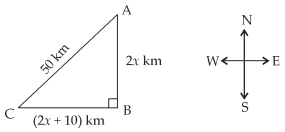
Two trains leave a railway station at the same time. The first train travels due west and the second train due north. The first train travels 5 km/hr faster than second train. If after two hours, they are 50 km apart, find the speed of each train.
Answer
Let the speed of second train be x km/hr.
$\therefore \quad$ Speed of first train $=(x+5) km / hr$
Distance = speed $\times$ time
Distance covered by second train $=x \times 2=2 x km$
Distance covered by first train $=(x+5) \times 2$
$=(2 x+10) km$
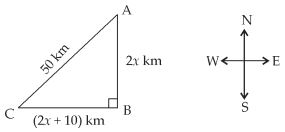
In $\triangle ABC , m \angle ABC =90^{\circ}$
$AB ^2+ BC ^2= AC ^2$... [Pythagoras theorem]
$\therefore \quad(2 x)^2+(2 x+10)^2=(50)^2$
$\therefore \quad 4 x^2+4 x^2+40 x+100=2500$
$\therefore \quad 8 x^2+40 x+100-2500=0$
$\therefore \quad 8 x^2+40 x-2400=0$
$\therefore \quad x^2+5 x-300=0$... (Dividing both sides by 8)
$\therefore \quad x^2+20 x-15 x-300=0$
$\therefore \quad x(x+20)-15(x+20)=0$
$\therefore \quad x+20=0$ or $x-15=0$
$\therefore \quad x=-20$ or $x=15$
$x \neq-20$ as speed cannot be negative.
$\therefore \quad x=15$ and $x+5=15+5=20$
$\therefore$ The speeds of the trains are 20 km/hr and 15 km/hr respectively. View full question & answer→Question 714 Marks
Two pipes running together can fill a cistern in $3 \frac{1}{13}$ minutes. If one pipe takes 3 minutes more than the other to fill it, find the time in which each pipe would fill the cistern.
AnswerLet the time taken by other pipe to fill the cistern be x minutes.
$\therefore \quad$ Time taken by first pipe to fill the cistern
$=(x+3)$ minutes
Portion of cistern filled by other pipe in one minute $=\frac{1}{2}$ and portion of cistern filled by first pipe in one minute $=\frac{1}{x+3}$
Position of cistern filled by both the pipes in one minute $=\frac{1}{3 \frac{1}{13}}$
$=\frac{1}{\frac{40}{13}}$
$=\frac{13}{40}$
As per given condition,
$\frac{1}{x}+\frac{1}{x+3}=\frac{13}{40}$
$\therefore \frac{x+3+x}{x(x+3)}=\frac{13}{40}$
$\therefore \quad \frac{2 x+3}{x^2+3 x}=\frac{13}{40}$
$\therefore \quad 40(2 x+3)=13\left(x^2+3 x\right)$
$\therefore \quad 80 x+120=13 x^2+39 x$
$\therefore \quad 13 x^2-41 x-120=0$
$\therefore \quad 13 x^2-65 x+24 x-120=0$
$\therefore \quad 13 x(x-5)+24(x-5)=0$
$\therefore \quad(x-5)(13 x+24)=0$
$\therefore \quad x-5=0$ or $13 x+24=0$
$\therefore \quad x=5$ or $x=\frac{-24}{13}$
$\therefore \quad x \neq \frac{-24}{13}$ as time cannot be negative.
$\therefore \quad x=5$ and $x+3=5+3=8$
$\therefore$ Time taken by two pipes to fill the cistern separately are 5 minutes and 8 minutes.
View full question & answer→Question 724 Marks
The sum of the squares of two consecutive natural numbers is 113 . Find the numbers.
Question 734 Marks
The sum of the squares of two consecutive natural numbers is 100 . Find the numbers.
Question 744 Marks
The sum of reciprocals of Reshma's ages (in years) 3 years ago and 5 years after from now is $\frac{1}{3}$. Find her present age.
View full question & answer→Question 754 Marks
Solve$:\sqrt{x^2-16}-\sqrt{x^2-8 x+16}=\sqrt{x^2-5 x+4}$
Answer
$\sqrt{x^2-16}-\sqrt{x^2-8 x+16}=\sqrt{x^2-5 x+4}$
$\therefore \quad \sqrt{(x+4)(x-4)}-\sqrt{(x-4)^2}=\sqrt{(x-4)(x-1)}$
$\therefore \quad \sqrt{(x+4)(x-4)}-\sqrt{(x-4)^2}-\sqrt{(x-4)(x-1)}=0$
$\therefore \quad \sqrt{x-4}[\sqrt{x+4}-\sqrt{(x-4)}-\sqrt{x-1}]=0$
$\therefore \quad \sqrt{x-4}=0$ or $\sqrt{x+4}-\sqrt{x-4}-\sqrt{x-1}=0$
$\therefore \quad x-4=0$ or $\sqrt{x+4}-\sqrt{x-4}=\sqrt{x-1}$
$\therefore \quad x=4$ or $\sqrt{x+4}-\sqrt{x-4}=\sqrt{x-1}$
Now, $\sqrt{x+4}-\sqrt{x-4}=\sqrt{x-1}$...(i)
$\therefore \quad(\sqrt{x+4}-\sqrt{x-4})^2=x-1 \ldots($ Squaring both sides $)$
$\therefore \quad x+4-2 \sqrt{(x+4)(x-4)}+x-4=x-1$
$\therefore \quad 2 x-2 \sqrt{x^2-16}=x-1$
$\therefore \quad 2 x-x+1=2 \sqrt{x^2-16}$
$\therefore \quad x+1=2 \sqrt{x^2-16}$
$\therefore \quad(x+1)^2=4\left(x^2-16\right) \ldots$ (Squaring both sides)
$\therefore \quad x^2+2 x+1=4 x^2-64$
$\therefore \quad 4 x^2-x^2-2 x-64-1=0$
$\therefore \quad 3 x^2-2 x-65=0$
$\therefore \quad 3 x^2-15 x+13 x-65=0$
$\therefore \quad 3 x(x-5)+13(x-5)=0$
$\therefore \quad(3 x+13)(x-5)=0$
$\therefore \quad 3 x+13=0$ or $x-5=0$
$\therefore \quad x=\frac{-13}{3}$ or $x=5$
Now, $x \neq \frac{-13}{3}$ as it does not satisfy the (i)
$\therefore$ Hence, the roots of the given equation are 4 and 5.
View full question & answer→Question 764 Marks
One tank can be filled up by two taps in 6 hours. The smaller tap alone takes 5 hours more than the bigger tap alone. Find the time required by each tap to fill the tank separately.
Question 774 Marks
In garden, there are some rows and columns. The number of trees in a row is greater than that in each column by 10. Find the number of trees in each row if the total number of trees are 200.
Question 784 Marks
If the sum of the roots of the quadratic equation $a x^2+b x+c=0$ is equal to the sum of the squares of their reciprocals, then prove that $2 a^2 c=c^2 b+b^2 a$.
AnswerLet $\alpha$ and $\beta$ be the roots of the given quadratic equation
$\therefore \quad \alpha+\beta=\frac{-b}{a}$ and $\alpha \beta=\frac{c}{a}$
As per given condition,
$\alpha+\beta=\frac{1}{\alpha^2}+\frac{1}{\beta^2}$
$\therefore \quad \alpha+\beta=\frac{\alpha^2+\beta^2}{\alpha^2 \beta^2}$
$\therefore \quad \alpha+\beta=\frac{(\alpha+\beta)^2-2 \alpha \beta}{(\alpha \beta)^2}$
$\therefore \quad \frac{-b}{a}=\frac{\left(\frac{-b}{a}\right)^2-2\left(\frac{c}{a}\right)}{\left(\frac{c}{a}\right)^2}$
$\therefore \quad \frac{-b}{a}=\left[\frac{b^2}{a^2}-\frac{2 c}{a}\right] \div \frac{c^2}{a^2}$
$\therefore \quad \frac{-b}{a}=\left[\frac{b^2-2 a c}{a^2}\right] \div \frac{c^2}{a^2}$
$\therefore \quad \frac{-b}{a}=\frac{b^2-2 a c}{a^2} \times \frac{a^2}{c^2}$
$\therefore \quad \frac{-b}{a}=\frac{b^2 \square 2 a c}{c^2}$
$\therefore \quad b c^2=a\left(b^2-2 a c\right)$
$\therefore \quad b c^2=a b^2-2 a^2 c$
$\therefore$ $2 a^2 c=c^2 b+b^2 a$
... Hence proved.
View full question & answer→Question 794 Marks
If the sum of roots of the quadratic equation is $\frac{1}{x+p}+\frac{1}{x+q}=\frac{1}{r}$ is zero, show that the product of the roots is $-\left(\frac{p^2+q^2}{2}\right)$.
Answer$\frac{1}{x+p}+\frac{1}{x+q}=\frac{1}{r}$
$\therefore \quad \frac{x+q+x+p}{(x+p)(x+q)}=\frac{1}{r}$
$\therefore \quad \frac{2 x+q+p}{x^2+q x+p x+p q}=\frac{1}{r}$
$\therefore \quad r(2 x+p+q)=x^2+q x+p x+p q$
$\therefore \quad 2 r x+p r+q r=x^2+q x+p x+p q$
$\therefore \quad 0=x^2+q x+p x+p q-2 r x-p r-q r$
$\therefore \quad x^2+q x+p x-2 r x+p q-p r-q r=0$
$\therefore \quad x^2+x(q+p-2 r)+p q-p r-q r=0$
$\therefore \quad x^2+(p+q-2 r) x+(p q-p r-q r)=0$...(i)
Comparing with $a x^2+b x+c=0$, we get,
$a=1, b=p+q-2 r, c=p q-p r-q r$
Let $\alpha$ and $\beta$ be the roots of equation (i).
Let $\alpha+\beta=\frac{-b}{a}$
$=\frac{-(p+q-2 r)}{1}$
$\alpha+\beta=-p-q+2 r$
But $\alpha+\beta=0$.....[Given]
$\therefore \quad-p+q-2 r=0$
$\therefore 2 r \quad=p+q$
$\therefore \quad r \quad=\frac{p+q}{2}$
Also, $\alpha \beta=\frac{c}{a}$
$=\frac{p q-p r-q r}{1}$
$=p q-p r-q r$
$=p q-r(p+q)$
$=p q-\left(\frac{p+q}{2}\right)(p+q) \quad \ldots .\left[r=\frac{p+q}{2}\right]$
$=p q-\frac{(p+q)^2}{2}$
$=\frac{2 p q-(p+q)^2}{2}$
$=\frac{2 p q-\left(p^2+2 p q+q^2\right)}{2}$
$=\frac{2 p q-p^2-2 p q-q^2}{2}$
$=\frac{-p^2-q^2}{2}$
$\therefore \quad \alpha \beta=-\left(\frac{p^2+q^2}{2}\right)$
View full question & answer→Question 804 Marks
If the roots of the quadratic equation $a x^2+c x+c=0$ are in the ratio $p : q$, then show that
$\sqrt{\frac{p}{q}}+\sqrt{\frac{q}{p}}+\sqrt{\frac{c}{a}}=0$
AnswerLet $\alpha$ and $\beta$ be the roots of the given quadratic equation.
$\therefore \quad \alpha+\beta=\frac{-c}{a}$ and $\alpha \beta=\frac{c}{a}$
Also, $\frac{\alpha}{\beta}=\frac{p}{q}$... (Given)
$\therefore \sqrt{\frac{p}{q}}+\sqrt{\frac{q}{p}}+\sqrt{\frac{c}{a}}=\sqrt{\frac{\alpha}{\beta}}+\sqrt{\frac{\beta}{\alpha}}+\sqrt{\alpha \beta}$
$=\frac{\sqrt{\alpha}}{\sqrt{\beta}}+\frac{\sqrt{\beta}}{\sqrt{\alpha}}+\sqrt{\alpha \beta}$
$=\frac{\alpha+\beta}{\sqrt{\alpha \beta}}+\sqrt{\alpha \beta}$
$=\frac{\alpha+\beta+\alpha \beta}{\sqrt{\alpha \beta}}$
$=\frac{\frac{-c}{a}+\frac{c}{a}}{\sqrt{\alpha \beta}}$
$=\frac{0}{\sqrt{\alpha \beta}}$
= 0
$\therefore$$\sqrt{\frac{p}{q}}+\sqrt{\frac{q}{p}}+\sqrt{\frac{c}{a}}=0$
View full question & answer→Question 814 Marks
For doing some work, Ganesh takes 10 days more than John. If both work together, they will complete the work in 12 days. Find the number of days if Ganesh work alone?
Question 824 Marks
A number consists of two digits whose product is 56. When 9 is subtracted from the number, the digits interchange their places. Find the number.
AnswerLet the ten's digit $=x$ and unit's digit $=y$
So, the number $\quad=10 x+y$
Product of the digits = 56
$\therefore \quad x y=56$...(i)
On subtracting 9 from the number, the digits are interchanged.
$\therefore \quad(10 x+y)-9=10 y+x$
$\therefore \quad 10 x-x+y-10 y=9$
$\therefore \quad 9 x-9 y=9$
$\therefore \quad x-y=1$
$\therefore \quad x-\frac{56}{x}=1$... [From (i)]
$\therefore \quad x^2-56=x$
$\therefore \quad x^2-x-56=0$
$\therefore \quad x^2-8 x+7 x-56=0$
$\therefore \quad x(x-8)+7(x-8)=0$
$\therefore \quad(x-8)(x+7)=0$
$\therefore \quad x-8=0$ or $x+7=0$
$\therefore \quad x=8$ or $x=-7$
$\therefore \quad x \neq-7$ as it is a digit and cannot be negative.
$\therefore \quad x=8$.
Now, $8 \times y=56$...[From (i)]
$\therefore \quad y=\frac{56}{8}$
$\therefore \quad y=7$
$\therefore$ Hence, the number is $10 \times 8+7=87$.
View full question & answer→Question 834 Marks
A man travels by boat 36 km down a river and back in 8 hours. If the speed of his boat in still water is 12 km/hr, find the speed of the river current.
AnswerLet the speed of river current $=x km / hr$
Speed of boat in still water $\quad=12 km / hr$
$\therefore$ Speed of boat up the river $=(12-x) km / hr$
Speed of boat down the river $=(12+x) km / hr$
Time $=\frac{\text { Distance }}{\text { speed }}$
$\therefore \quad$ Time taken by boat to travel 36 km down the river $=\left(\frac{36}{12+x}\right) hrs$.
$\therefore \quad$ Time taken by boat to travel 36 km up the river $=\left(\frac{36}{12-x}\right) hrs$.
As per given condition,
$
\begin{array}{l}
\frac{36}{12+x}+\frac{36}{12-x}=8 \\
36\left(\frac{1}{12+x}+\frac{1}{12-x}\right)=8 \\
\therefore \quad \frac{12-x+12+x}{(12+x)(12-x)}=\frac{8}{36} \\
\therefore \quad \frac{24}{144-x^2}=\frac{2}{9} \\
\therefore \quad 108=144-x^2 \\
\therefore \quad x^2=144-108 \\
\therefore \quad x^2=36 \\
\therefore \quad x= \pm 6
\end{array}
$
$\therefore \quad x \neq-6$ as speed cannot be negative.
$\therefore x=6$
$\therefore $ The speed of river current $=6 km / hr$.
View full question & answer→Question 844 Marks
A man riding on a hicycle covers a distance of 60 km in a direction of wind and comes back to his original position in 8 hours. If the speed of the wind is 10 km/hr, find the speed of the bicycle.
Question 854 Marks
A businessman bought some items for ₹ 600. Keeping 10 items for himself he sold the remaining items at a profit of ₹ 5 per item. From the amount received in this deal he could buy 15 more items. Find the original price of each item.
AnswerTotal cost price of some items= ₹ 600 (given)
Let the original cost price of 1 item = ₹ x
$\therefore$ Number of items purchased $=\frac{600}{x}$
Number of items sold after keeping 10 items $=\frac{600}{x}-10$
Selling price of each item = ₹ (x + 5)
Total selling price of all items = ₹ $(x+5)\left(\frac{600}{x}-10\right)$
Profit = S.P. – C.P.
$\therefore$ Net profit made in the deal
= ₹ $(x+5)\left(\frac{600}{x}-10\right)-600$
But, profit is equal to cost price of 15 items = ₹ $15 x$
As per given condition,
$(x+5)\left(\frac{600}{x}-10\right)-600=15 x$
$\therefore \quad x\left(\frac{600}{x}-10\right)+5\left(\frac{600}{x}-10\right)-600=15 x$
$\therefore \quad 600-10 x+\frac{3000}{x}-50-600-15 x=0$
$\therefore \quad-10 x+\frac{3000}{x}-50-15 x=0$
$\therefore \quad-25 x+\frac{3000}{x}-50=0$
$\therefore \quad-25 x^2+3000-50 x=0$...(Multiplying both sides by x)
$\therefore \quad x^2-120+2 x=0$...(Dividing both sides by –25)
$\therefore \quad x^2+2 x-120=0$
$\therefore \quad x^2+12 x-10 x-120=0$
$\therefore \quad x(x+12)-10(x+12)=0$
$\therefore \quad(x+12)(x-10)=0$
$\therefore \quad x+12=0$ or $x-10=0$
$\therefore \quad x=-12$ or $x=10$
$\therefore \quad x \neq-12$ as cost price cannot be negative.
$\therefore \quad x=10$
$\therefore$ Original price of each item is ₹ 10.
View full question & answer→