Questions

3 Marks Question

Take a timed test

68 questions · self-marked practice — reveal the answer and mark yourself.

Question 13 Marks
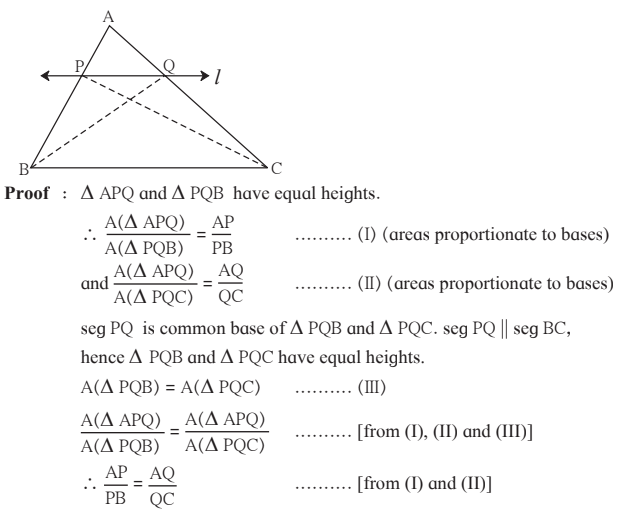
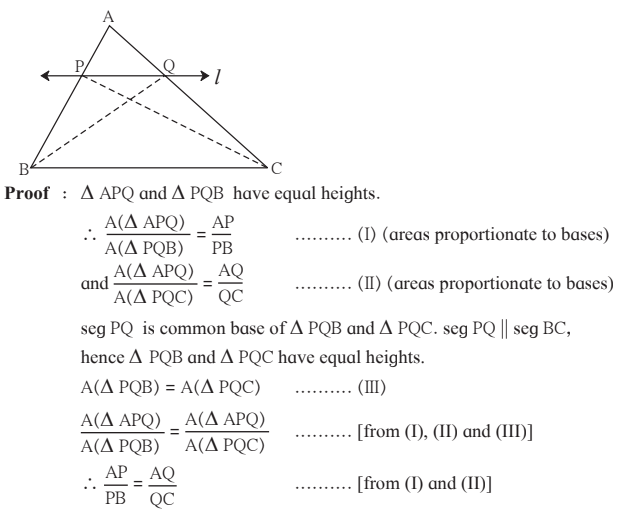
Prove The Theorem : If a line parallel to a side of a triangle intersects the remaining sides in two distinct points, then the line divides the sides in the same proportion.
Answer
Given : In $\triangle \mathrm{ABC}$ line $l \|$ line $\mathrm{BC}$ and line $l$ intersects $\mathrm{AB}$ and $A C$ in point $P$ and $Q$ respectively To prove : $\frac{\mathrm{AP}}{\mathrm{PB}}=\frac{\mathrm{AQ}}{\mathrm{QC}}$
Image

View full question & answer
Question 23 Marks
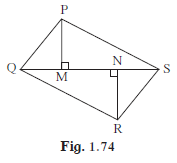
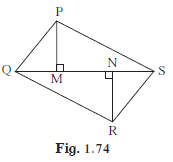
In figure 1.74, PM = 10 cm A(Δ PQS) = 100 sq.cm A (ΔQRS) = 110 sq.cm then find NR.
Answer
We know that, Area of triangle $=\frac{1}{2} \times$ base $\times$ height
$\Rightarrow \frac{ A (\triangle PQS )}{ A (\Delta QRS )}=\frac{\frac{1}{2} \times QS \times PM }{\frac{1}{2} \times QS \times NR } $
$\Rightarrow \frac{100}{110}=\frac{ PM }{ NR } $
$\Rightarrow \frac{100}{110}=\frac{10}{ NR } $
$\Rightarrow NR =11 cm$
View full question & answer
Question 33 Marks
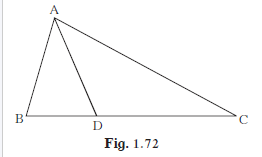
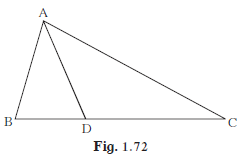
In Δ ABC, B - D – C and BD = 7, BC = 20 then find following ratios.

$(1)\frac{ A (\Delta ABD )}{ A (\Delta ADC )}$
$(2)\frac{ A (\Delta ABD )}{ A (\Delta ABC )}$
$(3)\frac{ A (\Delta ADC )}{ A (\Delta ABC )}$
Answer
Theorem: When two triangles are similar, the ratio of areas of those triangles is equal to the ratio of the squares of their corresponding sides.(1) $\frac{ A (\triangle ABD )}{ A (\triangle ADC )}=\frac{ BD ^2}{ DC ^2}$
$=\frac{ BD ^2}{( BC - BD )^2}$
$=\frac{7^2}{(20-7)^2}$
$=\frac{7^2}{13^2}$
$(2) \frac{ A (\Delta ABD )}{ A (\Delta ABC )}=\frac{ BD ^2}{ BC ^2}$
$=\frac{ BD ^2}{ BC ^2}$
$=\frac{7^2}{20^2}$
$(3) \frac{ A (\Delta ADC )}{ A (\Delta ABC )}=\frac{ DC ^2}{ BC ^2}$
$=\frac{\left( BC ^2- BD \right)^2}{ BC ^2}$
$=\frac{(20-7)^2}{20^2}$
$=\frac{13^2}{20^2}$
View full question & answer
Question 43 Marks
Δ ABC and ΔDEF are equilateral triangles. If A(ΔABC) : A(ΔDEF) = 1 : 2 and AB = 4, find DE.
Answer
We know that, all the angles of an equilateral triangles are equal, i.e., 60°.⇒ Δ ABC~Δ DEF ……(By AAA Similarity Test)
$\Rightarrow \frac{ A (\triangle ABC )}{ A (\triangle DEF )}=\frac{ AB ^2}{ DE ^2}$
And, $\frac{ A (\triangle ABC )}{ A (\triangle DEF )}=\frac{1}{2}$ (Given)
$\Rightarrow \frac{ AB ^2}{ DE ^2}=\frac{1}{2}$
$\Rightarrow D E^2=2 \times 4^2(\because A B=4)$
$\Rightarrow D E=\sqrt{ } 32$
$\Rightarrow D E=4 \sqrt{ } 2$
View full question & answer
Question 53 Marks
ΔLMN ~ ΔPQR, 9 × A(ΔPQR) = 16 × A (ΔLMN). If QR = 20 then find MN.
Answer
∵ Δ ABC~Δ PQR⇒ Given that, 9× A(Δ ABC) = 16× A(Δ PQR)
$\Rightarrow \frac{ A (\Delta PQR )}{ A (\Delta LMN )}=\frac{16}{9}$
And, $\frac{ A (\triangle PQR )}{ A (\Delta LMN )}=\frac{ QR ^2}{ MN ^2}$
$\Rightarrow \frac{ QR ^2}{ MN ^2}=\frac{16}{9} $
$\Rightarrow \frac{20^2}{ MN ^2}=\frac{16}{9} $
$\Rightarrow MN ^2=\frac{400 \times 9}{16}$
⇒ MN = 15
View full question & answer
Question 63 Marks
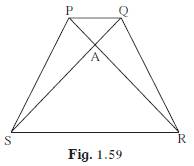
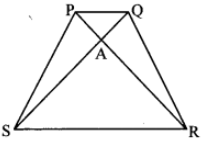
Given : In trapezium PQRS, side PQ || side SR, AR = 5AP, AS = 5AQ then prove that, SR = 5PQ
Answer
Given that, $A R=5 A P$ and $A S=5 A Q$
$\Rightarrow \frac{ AR }{ AP }=5\dots(1)$
And $\frac{ AS }{ AQ }=5\dots(2)$.
$\Rightarrow \frac{ AR }{ AP }=\frac{ AS }{ AQ }$
And, $\angle SAR \cong \angle QAP$ $\qquad$ (opposite angles)
$\Rightarrow \triangle SAR \sim \triangle QAP$ $\qquad$ (SAS Test of similarity)
$\Rightarrow \frac{ AS }{ AQ }=\frac{ AR }{ AP }=\frac{ SR }{ QP }$ (corresponding sides are proportional)
But, $\frac{ AS }{ AQ }=\frac{ AR }{ AP }=5$
$\Rightarrow \frac{ SR }{ QP }=5$
$\Rightarrow S R=5 P Q$
View full question & answer
Question 73 Marks
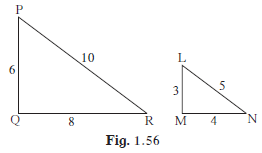
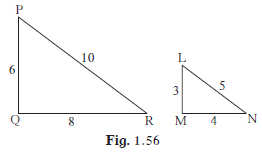
Are the triangles in figure 1.56 similar? If yes, by which test?
Answer
In $\triangle P Q R$ and $\triangle L M N \frac{P Q}{L M}=\frac{6}{3}=2$
And $\frac{ QR }{ MN }=\frac{8}{4}=2$
And $\frac{ PR }{ LN }=\frac{10}{5}=2$
$\Rightarrow \frac{P Q}{L M}=\frac{Q R}{M N}=\frac{P R}{L N}=2$
⇒ ΔPQR~ΔLMN …………(By SSS Similarity Test)
View full question & answer
Question 83 Marks
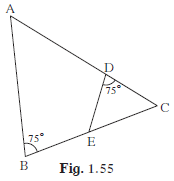
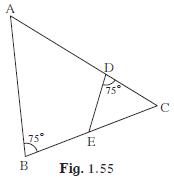
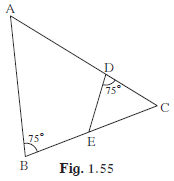
In figure 1.55, ∠ABC = 75°, ∠EDC = 75° state which two triangles are similar and by which test? Also write the similarity of these two triangles by a proper one to one correspondence.
Answer
With one- to-one correspondence ABC ↔ EDC∵ ∠ABC ≅ ∠EDC = 75°
∠ACB ≅ ∠ECD (Is common in both the triangles ABC and EDC)

⇒ Δ ABC~Δ EDC ………(By AA Test)
View full question & answer
Question 93 Marks
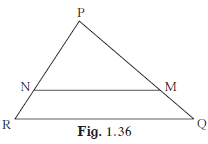
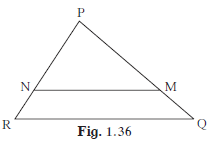
In Δ PQR, PM = 15, PQ = 25, PR = 20, NR = 8. State whether line NM is parallel to side RQ. Give reason.
Answer
$\Rightarrow$ If $\frac{ PN }{ NR }=\frac{ PM }{ MQ ^{\prime}}$, then line NM is parallel to side $R Q$.
$\therefore$ we'll check if $\frac{ PN }{ NR }=\frac{ PM }{ MQ }$.
$\Rightarrow \frac{ PN }{ NR }=\frac{ PR - NR }{ NR }$
$=\frac{20-8}{8}$
$=\frac{12}{8}$
$=\frac{3}{2}$ 
And, $\frac{P M}{M Q}=\frac{P M}{P Q-P M}$
$=\frac{15}{25-15}$
$=\frac{15}{10}$
$=\frac{3}{2}$
$\Rightarrow \frac{ PN }{ NR }=\frac{ PM }{ MQ }=\frac{3}{2}$, therefore line $NM \|$ side RQ
View full question & answer
Question 103 Marks
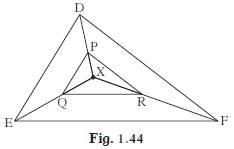
In the figure 1.44, X is any point in the interior of triangle. Point X is joined to vertices of triangle. Seg PQ || seg DE, seg QR || seg EF. Fill in the blanks to prove that, seg PR || seg DF.

Proof: IN $\triangle XDE , PQ \| DE$ $\square$
$\therefore \frac{ XP }{\square}=\frac{\square}{ QE }$
(Basic proportionality theorem)
In $\triangle XDE , QR \| EF......... \square$
$\therefore$ $\frac{\square}{\square}=\frac{\square}{\square}...............(ii)\square$
$\therefore$ $\frac{\square}{\square}=\frac{\square}{\square}...............$ from (i) and (ii)
$\therefore \text { seg PR\|seg DE .......... }$
(converse of basic proportionality theorem)
Answer
Proof: In $\triangle X D E, P Q|| D E$..... (Given)
$\therefore \frac{ XP }{ XQ }=\frac{ PD }{ DE }$
(Basic proportionality theorem)
In $\triangle X D E, Q R \| E F$ $\qquad$ (Given)
$\therefore \frac{ XR }{ RF }=\frac{ XQ }{ QE }$ $\qquad$ (II) (Basic Proportionality Theorem)
$\therefore \frac{ XP }{ PD }=\frac{ XR }{ RF }$ $\qquad$ from (I) and (II)
$\therefore$ seg PR\|Seg DE $\qquad$
(converse of basic proportionality theorem)
View full question & answer
Question 113 Marks
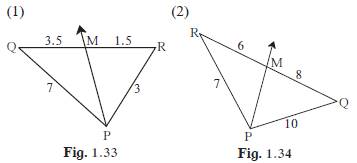
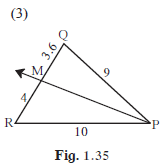
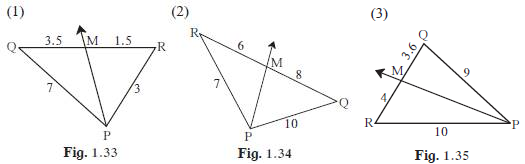
Given below are some triangles and lengths of line segments. Identify in which figures, ray PM is the bisector of ∠OPR.
Answer
Theorem: The bisector of an angle of a triangle divides the side opposite to the angle in the ratio of the remaining sides.Therefore, we’ll find the ratio for all the triangle.Hence, for
$\text { (1) } \frac{Q M}{M R}=\frac{3.5}{1.5} $
$=2.33$
And $\frac{ QP }{ PR }=\frac{7}{3}$
$=2.33 $
$\Rightarrow \frac{ QM }{ MR }=\frac{ QP }{ PR }$
$\Rightarrow \ln (1)$, ray PM is a bisector.
$\text { (2) } \frac{ RM }{ MQ }=\frac{6}{8} $
$=0.75$
And $\frac{ RP }{ PQ }=\frac{7}{10}$
$=0.7 $
$\Rightarrow \frac{ RM }{ MQ } \neq \frac{ RP }{ PQ }$
$\Rightarrow \ln (2)$, ray PM is not a bisector.
$\text { (3) } \frac{ RM }{ MQ }=\frac{4}{3.6} $
$=1.1$
And $\frac{R P}{P Q}=\frac{10}{9}$
$=1.11$
$\Rightarrow \frac{ RM }{ MQ }=\frac{ RP }{ PQ }$
$\Rightarrow \ln (3)$, ray PM is a bisector.
View full question & answer
Question 123 Marks
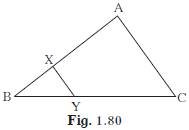
In fig 1.80, XY || seg AC. If 2AX = 3BX and XY = 9. Complete the activity to find the value of AC.


Activity : $2 AX =3 BX \therefore \frac{ AX }{ BX }=$ $\frac{ \square }{ \square }$
$\frac{ AX + BX }{ BX }=\frac{\square+\square}{\square}$ $\qquad$ by componendo.
$\frac{ AB }{ BX }=\frac{\square}{\square}=(1)$
$\Delta BCA \sim \Delta BYX \cdots \cdots \cdots \square\text { test of similarity. }$
$\therefore \frac{ BA }{ BX }=\frac{ AC }{ XY } \cdots \cdots \cdots . . \text { corresponding sides of similar triangles. }$
$\therefore \frac{\square}{\square \square}=\frac{ AC }{9} \therefore AC =\square . . . \text { from (l) }$
Answer
ACTIVITY: $2 A X=3 B X \therefore \frac{A X}{B X}=\frac{3 A X+B X}{2}=\frac{3+2}{2} \ldots \ldots$ (By Componendo) $\frac{ AB }{ BX }=\frac{5}{3} \ldots \ldots .(1)$
$\triangle B C A \sim \triangle B Y X \ldots \ldots$. (AA test of similarity).
$\therefore \frac{ BA }{ BX }=\frac{ AC }{ XY } \ldots \ldots \ldots$ (corresponding sides of similar triangles).
$\frac{5}{3}=\frac{A C}{9} \therefore A C=15 \ldots \ldots \text { from }(1)$
View full question & answer
Question 133 Marks
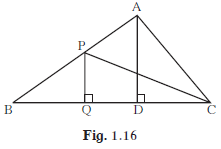
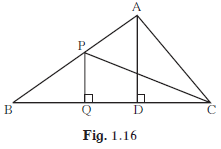
In adjoining figure PQ ⊥ BC, AD ⊥ BC then find following ratios.

(i) $\frac{ A (\Delta PQB )}{ A (\triangle PBC )}$
(ii) $\frac{ A (\Delta PBC )}{ A (\Delta ABC )}$
(iii) $\frac{ A (\Delta ABC )}{ A (\triangle ADC )}$
(iv) $\frac{ A (\Delta ADC )}{ A (\Delta PQC )}$
Answer
We know that area of triangle $=\frac{1}{2} \times$ Base $\times \operatorname{Height}( i ) \frac{ A (\triangle PQB )}{ A (\triangle PBC )}=\frac{ BQ }{ BC }$
(PROPERTY:Areas of triangles with equal heights are proportional to their corresponding bases.)
(ii) $\frac{A(\triangle P B C)}{A(\triangle ABC )}=\frac{P Q}{A D}$
(PROPERTY: Areas of triangles with equal bases are proportional to their corresponding heights.)
(iii) $\frac{A(\triangle A B C)}{A(\triangle A D C)}=\frac{B C}{D C}$
(PROPERTY:Areas of triangles with equal heights are proportional to their corresponding bases.)
(iv) $\frac{A(\triangle A D C)}{A(\triangle P Q C)}=\frac{\frac{1}{2} \times A D \times D C}{\frac{1}{2} \times P Q \times Q C}$
$=\frac{A D \times D C}{P Q \times Q C}$
View full question & answer
Question 143 Marks
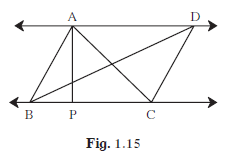
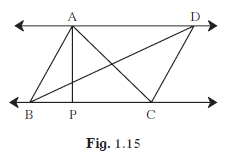
In adjoining figure, AP ⊥ BC, AD || BC, then find A(ΔABC) : A (ΔBCD)
Answer

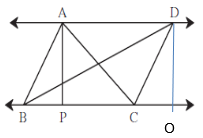
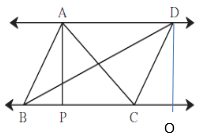
We can re-draw the fig.1.15(as shown above) where we add DO which will be height of $\triangle B C D$.
Now, $\frac{ A (\triangle ABC )}{ A (\triangle BCD )}=\frac{ AP }{ DO }$
(PROPERTY: Areas of triangles with equal bases are proportional to their corresponding heights.)
$\Rightarrow \frac{A(\triangle ABC )}{ A ( BBCD )}=\frac{ AP }{ DO } $
$\Rightarrow \frac{ A (\triangle ABC )}{ A (\triangle BCD )}=\frac{1}{1}$
( $\because$ the distance between the two parallel lines is always equal $\Rightarrow A P=D O$ )
$\Rightarrow \frac{ A (\triangle ABC )}{ A (\triangle BCD )}=1: 1$
View full question & answer
Question 153 Marks
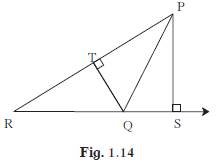
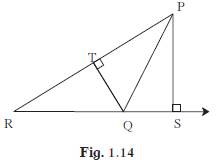
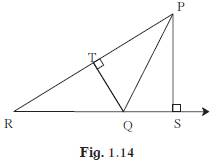
In adjoining figure 1.14 seg PS ⊥ seg RQ , seg QT ⊥ seg PR. If RQ = 6, PS = 6 and PR = 12, then find QT.
Answer

Considering, Area of (ΔPQR) with base QR⇒ PS will be the Height
Now, consider the Area of (ΔPQR) with base PR
⇒ QT will be the Height
∵ , the triangle is the same

⇒ the area will be the same irrespective of the base taken.
And we know that area of triangle = $\frac{1}{2}$ × Base× Height
⇒ $\frac{1}{2}$×QR×PS
= $\frac{1}{2}$×PR×QT
⇒ $\frac{1}{2}$×6×6
= $\frac{1}{2}$×12×QT
⇒ QT = 3
View full question & answer
Question 183 Marks
In △ ABC point △ on side BC is such that △C = 6, BC = 15. Find A(△ ABD) : A(△ ABC) and A(△ ABD) : A(△ ADC) .
View full question & answer
Question 193 Marks
In $\triangle ABC , PQ$ is a line segment intesecting $A B$ at point $P$ and $A C$ at point $Q$. $P Q \| B C$. If $P Q$ divides $\triangle A B C$ into two equal parts equal in area, find BP : AB.
Answer
$\frac{\sqrt{2}-1}{\sqrt{2}}$
View full question & answer
Question 203 Marks
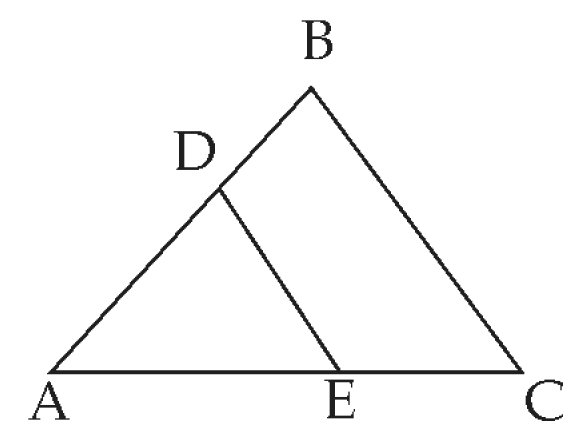
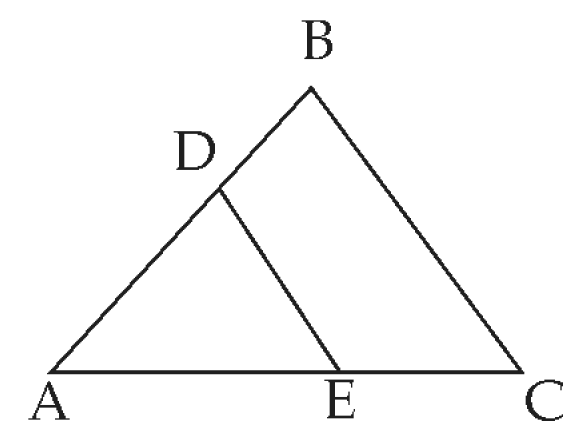
In the adjoining figure, seg DE || side BC. If DE: BC=3:5, then find $A (\triangle ADE ): A (\triangle DBCE )$  
Image
Answer
$9: 16$
View full question & answer
Question 213 Marks
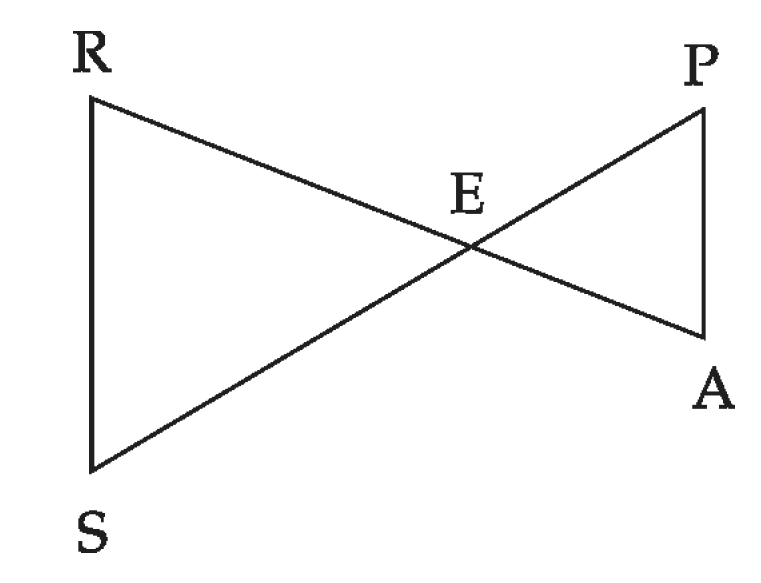
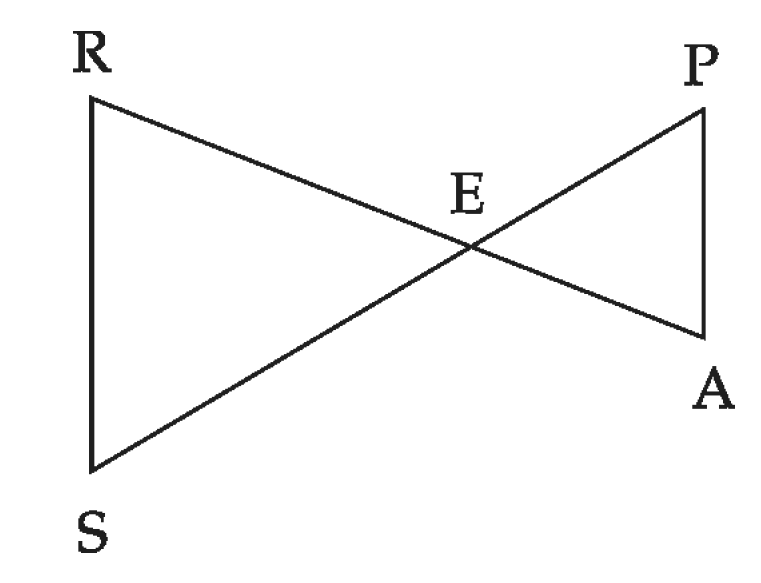
In $\Delta$RES, RE = 15, SE = 10. In $\Delta$PEA, PE = 8, AE = 12. Prove that $\Delta$RES ~ $\Delta$AEP
Image
Answer
self
View full question & answer
Question 223 Marks
$D$ is a point on side $B C$ of $\triangle A B C$ such that, $\angle A D C=\angle B A C$. Show that $A C^2=B C \times D C$.
Answer
self
View full question & answer
Question 233 Marks
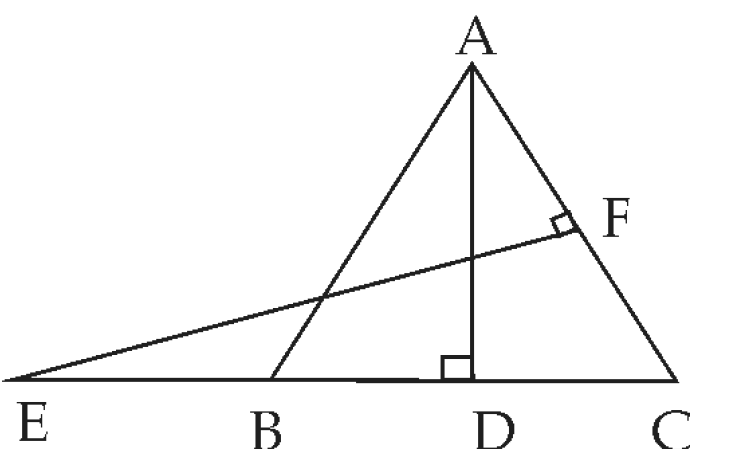
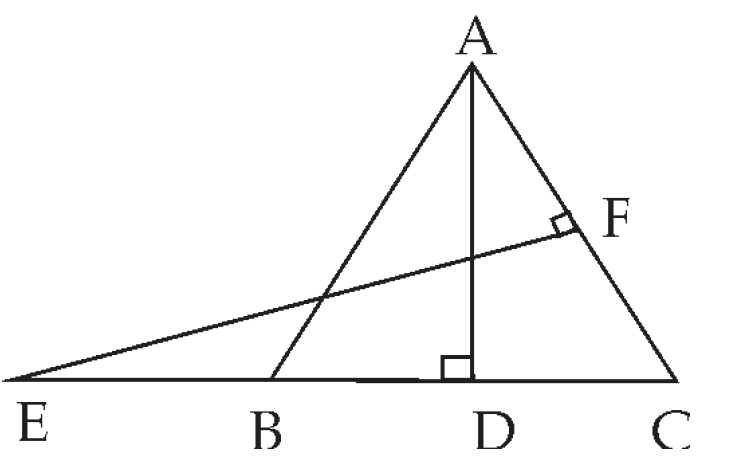
E is a point on side CB, C-B-E, In $\triangle A B C$ AB = AC. If seg AD BC, B-D-C and seg EF $\perp$ side AC, A-F-C. Prove that $\triangle ABD \sim \triangle ECF$. 
Image
Answer
self
View full question & answer
Question 243 Marks
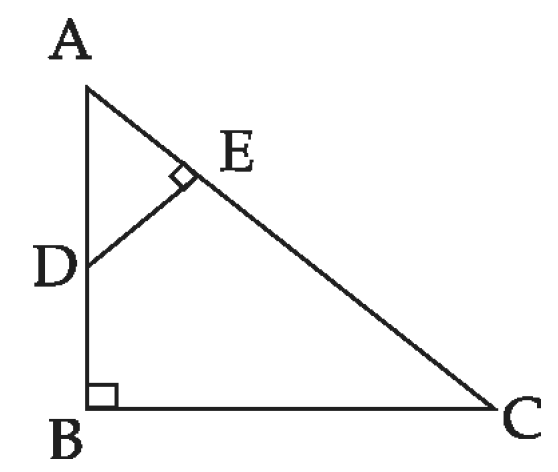
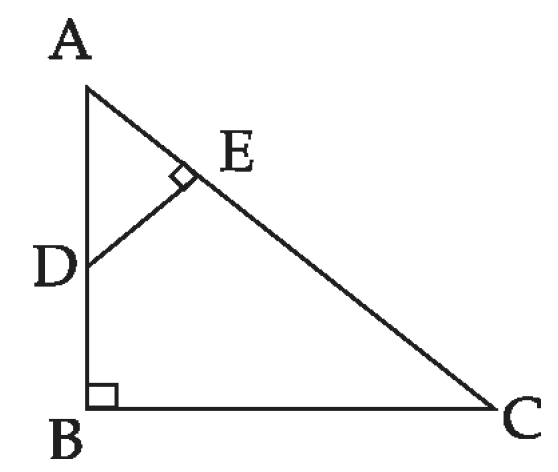
In $\triangle A B C, \angle B=90^{\circ}$, seg $DE \perp$ side AC . $A D=6, A B=12$, $A C=18$, then find $A E$.
Image
Answer
4 units
View full question & answer
Question 253 Marks
In $\triangle ABC , AB =5, BC =6, AC =7 . \Delta PQR \sim \triangle ABC$. Perimeter of $\triangle P Q R$ is 360 . Find $P Q, Q R$ and $P R$.
Answer
100 units, 120 units, 140 units
View full question & answer
Question 263 Marks
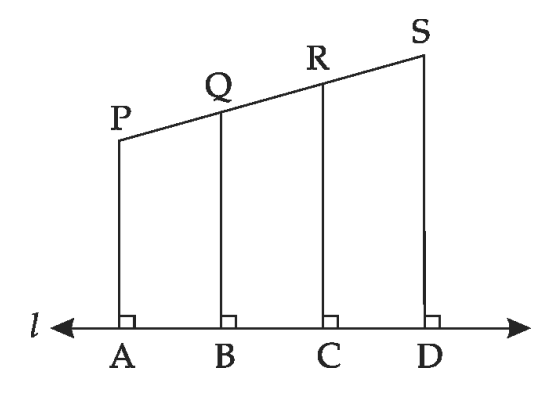
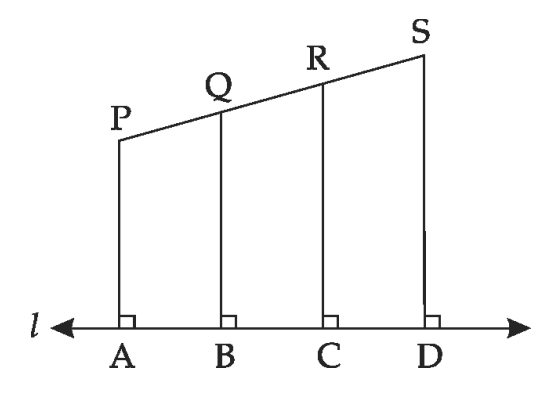
In the adjoining figure, seg PA, seg QB, seg RC and seg SD are $\perp$ to line $l$ AB = 6, BC = 9, CD = 12 and PS = 36, then find PQ, QR and RS.
Image
Answer
$PQ =8, QR =12, RS =16$
View full question & answer
Question 283 Marks
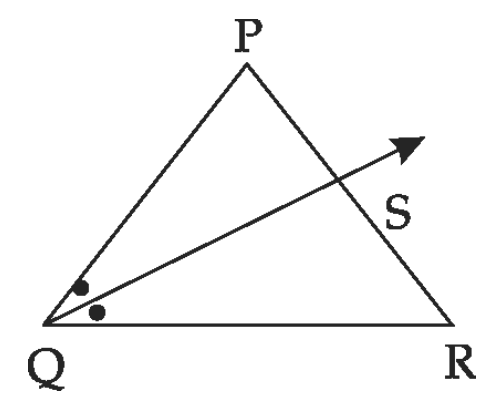
In $\Delta$PQR, ray QS bisects $\angle$PQR. P-S-R. Show that $\frac{ A (\Delta PQS )}{ A (\Delta QRS )}=\frac{ PQ }{ QR }$.
Image
Answer
self
View full question & answer
Question 293 Marks
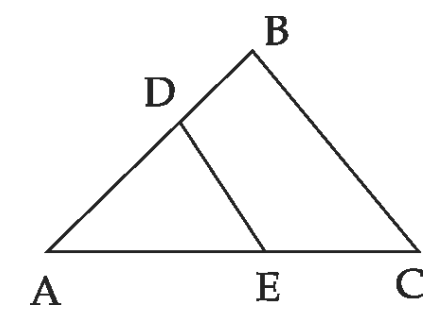
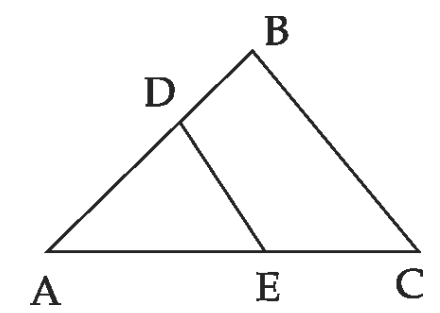
Point D and E are the points on sides AB and AC such athat AB = 5.6, AD = 1.4, AC = 7.2 and AE = 1.8. Show that DE || BC.
Image
Answer
self
View full question & answer
Question 303 Marks
$\square ABCD$ is a trapezium in which $AB \| DC$ and its diagonals intersect each other at point $O$. Show that $A O: B O=C O: D O$.
Answer
self
View full question & answer
Question 323 Marks
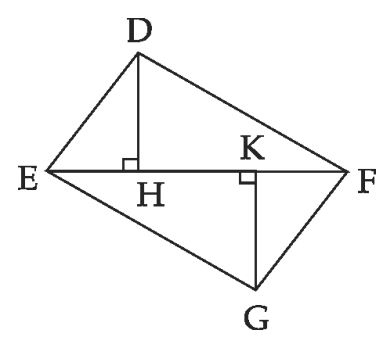
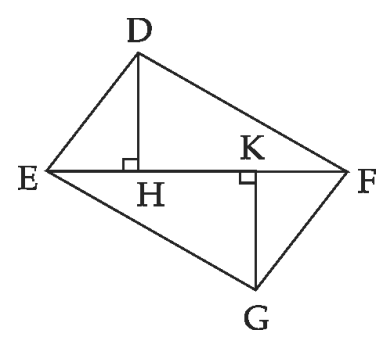
In the adjoining figure, seg DH $\perp$ seg EF, seg GK $\perp$ seg EF. If DH = 12 cm, GK = 20 cm and A(ADEF) = 300°cm², then find (i) EF (ii) A( $\triangle GEF)$
Image
Answer
(i) 50 cm (ii) $500 cm^2$
View full question & answer
Question 333 Marks
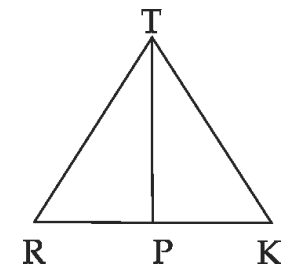
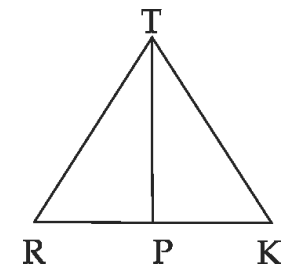
In the adjoining figure, $R P: P K=3: 2$, then find the value of
(i) $A (\triangle T R P): A (\triangle T P K)$
(ii) $A (\triangle T R K): A (\triangle TPK )$
(iii) $A (\Delta T R P)$ : A( $\triangle T R K$
Image
Answer
(i) $3: 2$ (ii) $5: 2$ (iii) $3: 5$
View full question & answer
Question 343 Marks
Prove The Theorem : If a line parallel to a side of a triangle intersects the remaining sides in two distinct points, then the line divides the sides in the same proportion.
Answer
Given : In $\triangle \mathrm{ABC}$ line $l \|$ line $\mathrm{BC}$ and line $l$ intersects $\mathrm{AB}$ and $A C$ in point $P$ and $Q$ respectively To prove : $\frac{\mathrm{AP}}{\mathrm{PB}}=\frac{\mathrm{AQ}}{\mathrm{QC}}$
Image

View full question & answer
Question 353 Marks
Write another proof of the above theorem (property of an angle bisector of a triangle). Use the following properties and write the proof.
i. The areas of two triangles of equal height are proportional to their bases.
ii. Every point on the bisector of an angle is equidistant from the sides of the angle.
Image
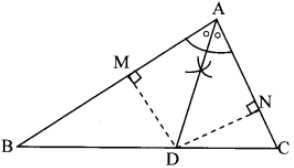
Given: In $\triangle CAB$,ray AD bisects ∠A.
To prove: $\frac{A B}{A C}=\frac{B D}{D C}$
Construction: Draw seg DM ⊥ seg AB A – M – B and seg DN ⊥ seg AC, A – N – C.
Answer
Proof:
In ∆ABC,
Point D is on angle bisector of ∠A. [Given]
∴DM = DN [Every point on the bisector of an angle is equidistant from the sides of the angle]
$\frac{A(\Delta A B D)}{A(\Delta A C D)}=\frac{A B \times D M}{A C \times D N}$ [Ratio of areas of two triangles is equal to the ratio of the product of their bases and corresponding heights]
$\therefore \frac{A(\triangle A B D)}{A(\triangle A C D)}=\frac{A B}{A C}$(ii) [From (i)]
Also, ∆ABD and ∆ACD have equal height.
$\therefore \frac{ A (\triangle ABD )}{ A (\triangle ACD )}=\frac{ BD }{ CD }$(iii) [Triangles having equal height]
$\therefore \frac{ AB }{ AC }=\frac{ BD }{ DC }$ [From (ii) and (iii)]
View full question & answer
Question 363 Marks
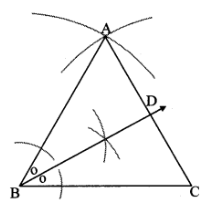
i. Draw a ∆ABC.
ii. Bisect ∠B and name the point of intersection of AC and the angle bisector as D.
iii. Measure the sides.
AB = ⬜ cm, BC = ⬜ cm,
AD = ⬜ cm, DC = ⬜ cm
iv. Find ratios $\frac{A B}{B C}$ and $\frac{A D}{D C}$
v. You will find that both the ratios are almost equal.
vi. Bisect remaining angles of the triangle and find the ratios as above.
Verify that the ratios are equal.
Image
$\frac{ AB }{ BC }=\frac{4}{4}=1$$\quad$$\quad$(i)
$\frac{ AD }{ DC }=\frac{2}{2}=1$$\quad$$\quad$(ii)
$\therefore \quad \frac{ AB }{ BC }=\frac{ AD }{ DC }$...[From (i) and (ii)]
Answer
i. Draw a ∆ABC.
ii. Bisect ∠B and name the point of intersection of AC and the angle bisector as D.
iii. Measure the sides.
AB = 4 cm, BC = 4 cm,
AD = 2 cm, DC = 2 cm
iv. Find ratios $\frac{A B}{B C}$ and $\frac{A D}{D C}$
v. You will find that both the ratios are almost equal.
vi. Bisect remaining angles of the triangle and find the ratios as above.
Verify that the ratios are equal.
Image
$\frac{ AB }{ BC }=\frac{4}{4}=1$$\quad$$\quad$(i)
$\frac{ AD }{ DC }=\frac{2}{2}=1$$\quad$$\quad$(ii)
$\therefore \quad \frac{ AB }{ BC }=\frac{ AD }{ DC }$...[From (i) and (ii)]
View full question & answer
Question 373 Marks
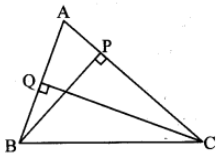
In the adjoining figure, BP ⊥ AC, CQ ⊥ AB, A – P – C, A – Q – B, then prove that ∆APB and ∆AQC are similar.
Image
Answer
In $\triangle APB$ and $\triangle AQC$,
$\angle APB =90^{\circ}$...(1)
$\angle AQC =90^{\circ}$ ...(2)
$\therefore \quad \angle APB \cong \angle AQC$ [From (i) and (ii)]
$\angle PAB \cong \angle QAC$ [Common angle]
$\therefore \quad \triangle APB \sim \triangle AQC$ [AA test of similarity]
2. SAS test for similarity of triangles:
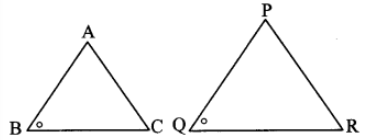
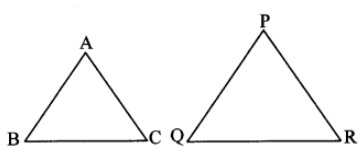
For a given correspondence, if two pairs of corresponding sides are in the same proportion and the angle between them is congruent, then the two triangles are similar.
ImageIn the given figure, if $\frac{A B}{P Q}=\frac{B C}{Q R}$, and $\angle B \cong \angle Q$, then $\triangle ABC \sim \triangle PQR$
3. SSS test for similarity of triangles:
For a given correspondence, if three sides of one triangle are in proportion with the corresponding three sides of the another triangle, then the two triangles are similar.
Image
In the given figure, if $\frac{A B}{P Q}=\frac{B C}{Q R}=\frac{A C}{P R^{\prime}}$ then $\triangle ABC \sim \triangle PQR$
Properties of similar triangles:
1. Reflexivity : $\triangle ABC \sim \triangle ABC$
2. If $\triangle ABC \sim \triangle DEF$, then $\triangle DEF \sim \triangle ABC$.
3. Transitivity : If $\triangle ABC \sim \triangle DEF$ and $\triangle DEF \sim \triangle GHI$, then $\triangle ABC \sim$ΔGHI.
View full question & answer
Question 383 Marks
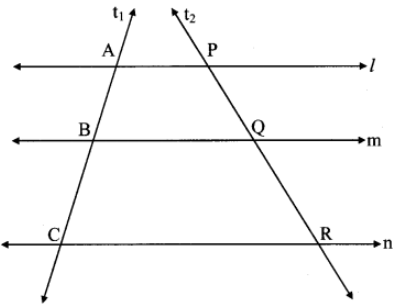
i. Draw three parallel lines.
ii. Label them as l, m, n.
iii. Draw transversals $t_1$ and $t_2$.
Iv. AB and BC are intercepts on transversal $t _1$.
v. PQ and QR are intercepts on transversal $t _2$.
vi. Find ratios $\frac{A B}{B C}$ and $\frac{P Q}{Q R}$. ou will find that they are almost equal. Verify that they are equal.
Answer

Image
Here, $AB =1.5 cm, BC =2.1 cm$,
$PQ =1.7 cm, QR =2.3 cm$
$\frac{ AB }{ BC }=\frac{1.5}{2.1}=0.714 \approx 0.7$
$\frac{ PQ }{ QR }=\frac{1.7}{2.3}=0.739 \approx 0.7$
∴$\frac{ AB }{ BC }=\frac{ PQ }{ QR }$
View full question & answer
Question 393 Marks
In the adjoining figure, seg PA, seg QB, seg RC and seg SD are $\perp$ to line $l$ AB = 6, BC = 9, CD = 12 and PS = 36, then find PQ, QR and RS.
Image
Answer
seg PA, seg QB, seg RC and seg SD are perpendicular to line AD.
∴ seg PA || seg QB || seg RC || seg SD (i) [Lines perpendicular to the same line are parallel to each other]
Let the value of PQ be x and that of QR be y.
PS = PQ + QS [P – Q – S]
∴ 280 – x + QS
∴ QS = 280 – x (ii)
Now, seg PA || seg QB || seg SD [From (i)]
$\therefore \frac{A B}{B D}=\frac{P Q}{Q S}$[Property of three parallel lines and their transversals]
$\therefore \frac{A B}{B C+C D}=\frac{P Q}{Q S}[B- C - D ]$
$\therefore \frac{60}{70+80}=\frac{x}{280-x}$
$\therefore \frac{60}{150}=\frac{x}{280-x}$
$\therefore \frac{2}{5}=\frac{x}{280-x}$
∴ 5x = 2 (280 – x)
∴ 5x = 560 – 2x
∴ 7x = 560
$\therefore x=\frac{560}{7}=80$
∴ PQ = 80 units
QS = 280 – x [From (ii)]
= 280 – 80
= 200 units
But, QS = QR + RS [Q – R – S]
∴ 200 = y + RS
∴ RS = 200 – y (ii)
Now, seg QB || seg RC || seg SD [From (i)]
$\therefore \frac{B C}{C D}=\frac{Q R}{R S}$ [Property of three parallel lines and their transversals]
$\therefore \frac{70}{80}=\frac{y}{200-y}$
$\therefore \frac{7}{8}=\frac{y}{200-y}$
$\therefore 8 y=7(200-y)$
$\therefore 8 y=1400-7 y$
$\therefore 15 y=1400$
$\therefore y=\frac{1400}{15}=\frac{280}{3}$
$\therefore QR =\frac{280}{3}$ units
RS = 200 – 7 [From (iii)]
$=200-\frac{280}{3}$
$=\frac{200 \times 3-280}{3}$
$=\frac{600-280}{3}$
$\therefore RS =\frac{320}{3}$units
View full question & answer
Question 403 Marks
Answer
Theorem: When two triangles are similar, the ratio of areas of those triangles is equal to the ratio of the squares of their corresponding sides.
(1) $\frac{ A (\triangle ABD )}{ A (\triangle ADC )}=\frac{ BD ^2}{ DC ^2}$
$\begin{array}{l}
=\frac{ BD ^2}{( BC - BD )^2} \\
=\frac{7^2}{(20-7)^2} \\
=\frac{7^2}{13^2} \\
\text { (2) } \frac{ A (\triangle ABD )}{ A (\triangle ABC )}=\frac{ BD ^2}{ BC ^2}
\end{array}$
$\begin{aligned}
= & \frac{ BD ^2}{ BC ^2} \\
= & \frac{7^2}{20^2}
\end{aligned}$
(3) $\frac{ A (\triangle ADC )}{ A (\triangle ABC )}=\frac{ DC ^2}{ BC ^2}$
$\begin{array}{l}
=\frac{( BC - BD )^2}{ BC ^2} \\
=\frac{(20-7)^2}{20^2} \\
=\frac{13^2}{20^2}
\end{array}$
View full question & answer
Question 423 Marks
Δ ABC and ΔDEF are equilateral triangles. If A(ΔABC) : A(ΔDEF) = 1 : 2 and AB = 4, find DE.
View full question & answer
Question 433 Marks
ΔLMN ~ ΔPQR, 9 × A(ΔPQR) = 16 × A (ΔLMN). If QR = 20 then find MN.
Answer

$\begin{array}{l}\because \triangle ABC \sim \Delta PQR \\ \Rightarrow \text { Given that, } 9 \times A (\triangle ABC )=16 \times A (\triangle PQR ) \\ \Rightarrow \frac{ A (\triangle PQR )}{ A (\Delta LMN )}=\frac{16}{9} \\ \text { And, } \frac{ A (\Delta PQR )}{ A (\Delta LMN )}=\frac{ QR ^2}{ MN ^2} \\ \Rightarrow \frac{ QR ^2}{ MN ^2}=\frac{16}{9} \\ \Rightarrow \frac{20^2}{ MN ^2}=\frac{16}{9} \\ \Rightarrow MN ^2=\frac{400 \times 9}{16} \\ \Rightarrow MN ^2=15\end{array}$
View full question & answer
Question 443 Marks
View full question & answer
Question 473 Marks
Answer
By Converse of basic Proportionality Theorem
(Theorem: If a line divides any two sides of a triangle in the same ratio, then the line is parallel to the third side.)
$\Rightarrow$ If $\frac{ PN }{ NR }=\frac{ PM }{ MQ }$, then line $N M$ is parallel to side $R Q$.
$\begin{array}{l}
\therefore \text { we'll check if } \frac{ PN }{ NR } \\
\Rightarrow \frac{ PN }{ NR }=\frac{ PR - NR }{ NR } \\
=\frac{20-8}{8} \\
=\frac{12}{8} \\
=\frac{3}{2}
\end{array}$
And, $\frac{ PM }{ MQ }=\frac{ PM }{ PQ - PM }$
$\begin{array}{l}
\vDash \frac{15}{25-15} \\
=\frac{\frac{15}{10}}{} \\
=\frac{3}{2} \\
\Rightarrow \frac{ PN }{ NR }=\frac{ PM }{ MQ }=\frac{3}{2} \text {, therefore line } NM \| \text { side } RQ
\end{array}$
View full question & answer
Question 483 Marks
View full question & answer
Question 493 Marks
View full question & answer
Question 503 Marks
Answer

Image
We can re-draw the fig.1.15(as shown above) where we add DO
which will be height of $\triangle B C D$.
Now, $\frac{ A (\triangle ABC )}{ A (\triangle BCD )}=\frac{ AP }{ DO }$
(PROPERTY: Areas of triangles with equal bases are proportional to their corresponding heights.)
$\begin{aligned}
\Rightarrow & \frac{A(\triangle A B C)}{A(\triangle B C D)}=\frac{A P}{D O} \\
\Rightarrow & \frac{A(\triangle A B C)}{A(\triangle B C D)}=\frac{1}{1}
\end{aligned}$
( $\because$ the distance between the two parallel lines is always equal $\Rightarrow A P=D O)$
$\Rightarrow \frac{ A (\triangle ABC )}{ A (\triangle BCD )}=1: 1$
View full question & answer
Question 513 Marks
Answer

Image
Considering, Area of $(\triangle P Q R)$ with base $Q R$
$\Rightarrow PS$ will be the Height
Now, consider the Area of $(\triangle P Q R)$ with base $P R$
$\Rightarrow$ QT will be the Height
$\because$, the triangle is the same
$\Rightarrow$ the area will be the same irrespective of the base taken.
And we know that area of triangle $=\frac{1}{2} \times$ Base $\times$ Height
$\begin{aligned}
& \frac{1}{2} \times Q R \times P S \\
= & \frac{1}{2} \times P R \times Q T
\end{aligned}$
$\begin{aligned}
& \frac{1}{2} \times 6 \times 6 \\
= & \frac{1}{2} \times 12 \times Q T \\
\Rightarrow & Q T=3
\end{aligned}$
View full question & answer
Question 523 Marks

Image
Answer
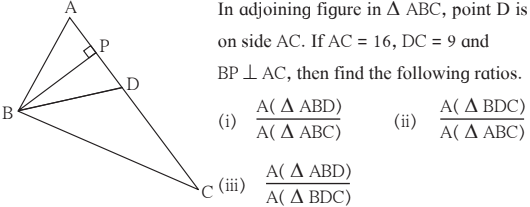
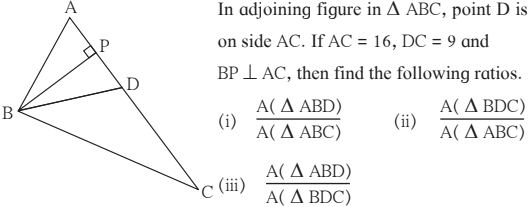
In $\triangle A B C$ point $P$ and $D$ are on side $A C$, hence $B$ is common vertex of $\triangle ABD , \triangle BDC , \triangle ABC$ and $\triangle APB$ and their sides $AD , DC , AC$ and $AP$ are collinear. Heights of all the triangles are equal. Hence, areas of these triangles are proportinal to their bases. $AC =16, DC =9$
$\therefore A D=16-9=7$
$\therefore \frac{ A (\triangle ABD )}{ A (\triangle ABC )}=\frac{ AD }{ AC }=\frac{7}{16} \ldots \ldots$. triangles having equal heights
$\frac{ A (\triangle BDC )}{ A (\triangle ABC )}=\frac{ DC }{ AC }=\frac{9}{16} \ldots \ldots$. triangles having equal heights
$\frac{ A (\Delta ABD )}{ A (\Delta BDC )}=\frac{ AD }{ DC }=\frac{7}{9} \ldots \ldots$. triangles having equal heights
View full question & answer
Question 533 Marks
In △ ABC point △ on side BC is such that △C = 6, BC = 15. Find A(△ ABD) : A(△ ABC) and A(△ ABD) : A(△ ADC) .
View full question & answer
Question 543 Marks

Image
Answer
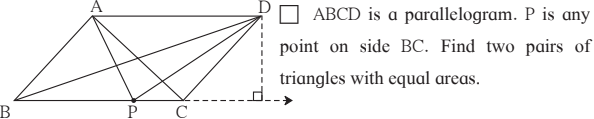
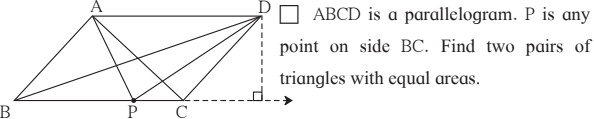
$ABCD$ is a parallelogram.
$\therefore AD \| BC$ and $AB \| DC$
Consider $\triangle ABC$ and $\triangle BDC$.
Both the triangles are drawn in two parallel lines. Hence the distance between the two parallel lines is the height of both triangles.
In $\triangle ABC$ and $\triangle BDC$, common base is $BC$ and heights are equal.
Hence, $A (\triangle ABC )= A (\triangle BDC )$
In $\triangle A B C$ and $\triangle A B D, A B$ is common base and and heights are equal.
$\therefore A (\triangle ABC )= A (\triangle ABD )$
View full question & answer
Question 553 Marks
$\square ABCD$ is a trapezium in which $AB \| DC$ and its diagonals intersect each other at point $O$. Show that $A O: B O=C O: D O$.
Answer
Since $A B \| D C$,
$\angle A O B=\angle C O D$ (vertically opposite angles),
$\angle A B O=\angle C D O$((alternate interior angles, as $A B \| D C)$.
Therefore, triangles $\triangle A O B$ and $\triangle C O D$ are similar by the AA similarity criterion.
Hence, the corresponding sides of similar triangles are proportional.
So, $\frac{A O}{B O}=\frac{C O}{D O}$
Therefore,
$A O: B O=C O: D O$
Hence, the given statement is proved.
View full question & answer
Question 563 Marks
Point D and E are the points on sides AB and AC such athat AB = 5.6, AD = 1.4, AC = 7.2 and AE = 1.8. Show that DE || BC.
Image
Answer
In triangle $\triangle A B C$,
$\frac{A D}{A B}=\frac{1.4}{5.6}=\frac{1}{4}$
Also,
$\frac{A E}{A C}=\frac{1.8}{7.2}=\frac{1}{4}$
Therefore,
$\frac{A D}{A B}=\frac{A E}{A C}$
Thus, point D divides side AB and point E divides side AC in the same ratio.
By the Converse of the Basic Proportionality Theorem, the line joining such points is parallel to the third side of the triangle.
Hence, $D E \| B C$.
View full question & answer
Question 573 Marks
In $\triangle ABC , PQ$ is a line segment intesecting $A B$ at point $P$ and $A C$ at point $Q$. $P Q \| B C$. If $P Q$ divides $\triangle A B C$ into two equal parts equal in area, find BP : AB.
Answer
$\frac{\sqrt{2}-1}{\sqrt{2}}$
View full question & answer
Question 583 Marks
In $\triangle A B C, \angle B=90^{\circ}$, seg $DE \perp$ side AC . $A D=6, A B=12$, $A C=18$, then find $A E$.
Image
Answer
4 units
View full question & answer
Question 593 Marks
In $\triangle ABC , AB =5, BC =6, AC =7 . \Delta PQR \sim \triangle ABC$. Perimeter of $\triangle P Q R$ is 360 . Find $P Q, Q R$ and $P R$.
Answer
100 units, 120 units, 140 units
View full question & answer
Question 603 Marks
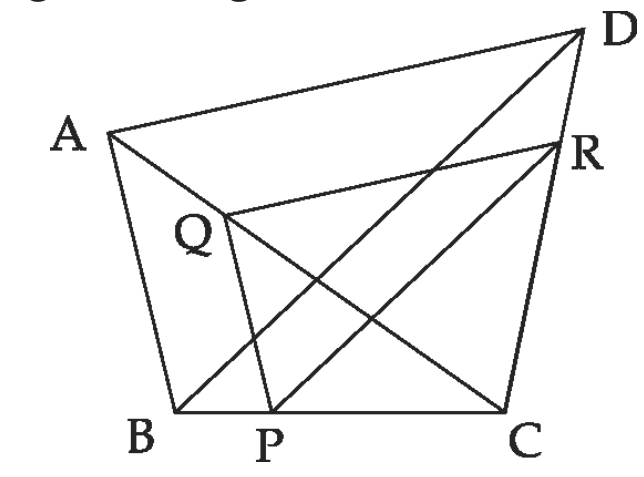
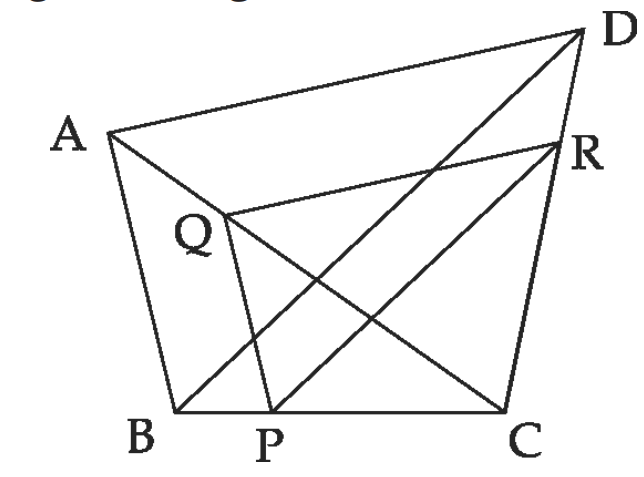
In the adjoining figure, seg PQ || seg AB. Seg PR || seg BD. Prove that QR || AD.
Image
Answer
Since segment $P Q \| A B$, the line through point Q is parallel to side AB.
Also, since segment $P R \| B D$, the line through point R is parallel to side BD.
Quadrilateral ABDC is formed by joining AB and BD to point D.
Through point Q, a line is drawn parallel to AB, and through point R, a line is drawn parallel to BD.
When two lines are drawn parallel to two sides of a triangle, the line joining their corresponding points is parallel to the third side.
Hence, the line joining points Q and R, that is segment QR, is parallel to segment AD.
Conclusion:
Therefore,$Q R \| A D$
View full question & answer
Question 613 Marks
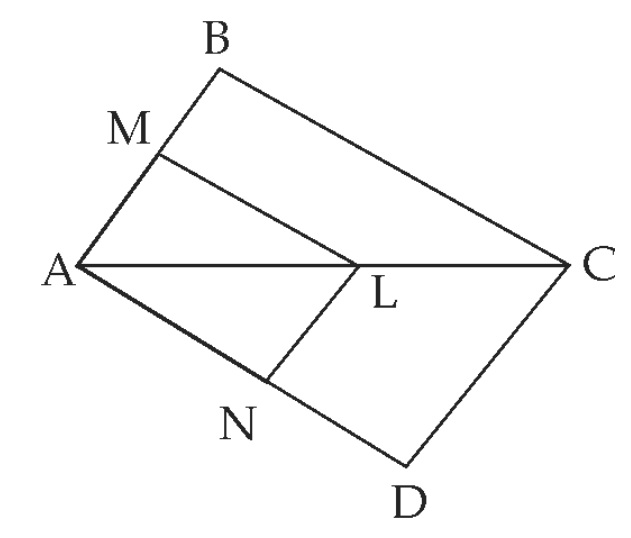
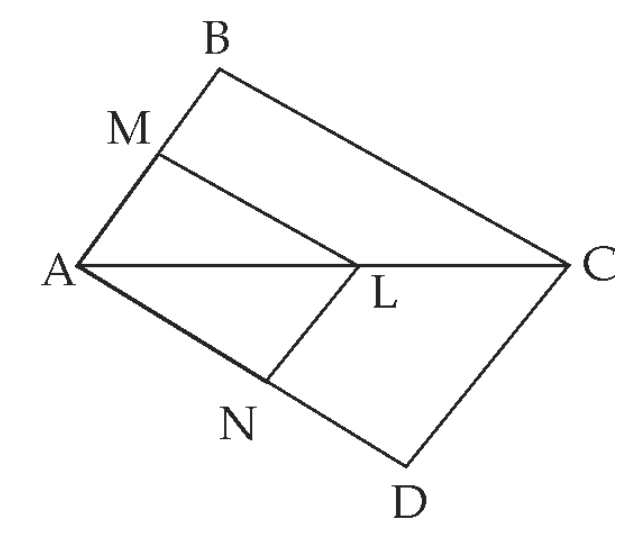
In the adjoining figure, seg ML || seg BC, seg NL || seg DC. Prove that AM : AB = AN : AD.
Image
Answer
Since segment $M L \| B C$, in triangle $\triangle A B C$, by the Basic Proportionality Theorem, the parallel line divides the sides proportionally.
Therefore, $\frac{A M}{A B}=\frac{A L}{A C}$ .....(1)
Similarly, since segment $N L \| D C$, in triangle $\triangle A D C$, by the Basic Proportionality Theorem, we get:
$\frac{A N}{A D}=\frac{A L}{A C}$ ...(2)
From equations (1) and (2),
$\frac{A M}{A B}=\frac{A N}{A D}$
Hence,
$\frac{A M}{A B}=\frac{A N}{A D}$
Therefore, the given statement is proved.
View full question & answer
Question 623 Marks
In the adjoining figure, seg DH $\perp$ seg EF, seg GK $\perp$ seg EF. If DH = 12 cm, GK = 20 cm and A(ADEF) = 300°cm², then find (i) EF (ii) A( $\triangle GEF)$
Image
Answer
(i) 50 cm (ii) $500 cm^2$
View full question & answer
Question 633 Marks
In the adjoining figure, seg DE || side BC. If DE: BC=3:5, then find $A (\triangle ADE ): A (\triangle DBCE )$  
Image
Answer
$9: 16$
View full question & answer
Question 643 Marks
In the adjoining figure, $R P: P K=3: 2$, then find the value of
(i) $A (\triangle T R P): A (\triangle T P K)$
(ii) $A (\triangle T R K): A (\triangle TPK )$
(iii) $A (\Delta T R P)$ : A( $\triangle T R K$
Image
Answer
(i) $3: 2$ (ii) $5: 2$ (iii) $3: 5$
View full question & answer
Question 653 Marks
In $\Delta$RES, RE = 15, SE = 10. In $\Delta$PEA, PE = 8, AE = 12. Prove that $\Delta$RES ~ $\Delta$AEP
Image
Answer
In $\triangle R E S$ and $\triangle A E P$,
$\frac{R E}{S E}=\frac{15}{10}=\frac{3}{2}$
Also, $\frac{A E}{P E}=\frac{12}{8}=\frac{3}{2}$
Therefore, $\frac{R E}{S E}=\frac{A E}{P E}$
Angle $\angle R E S$ and angle $\angle A E P$ are vertically opposite angles.
Hence,
$\angle R E S=\angle A E P$
Thus, two sides of $\triangle R E S$ are proportional to two sides of $\triangle A E P$. and the included angle between them is equal.
View full question & answer
Question 663 Marks
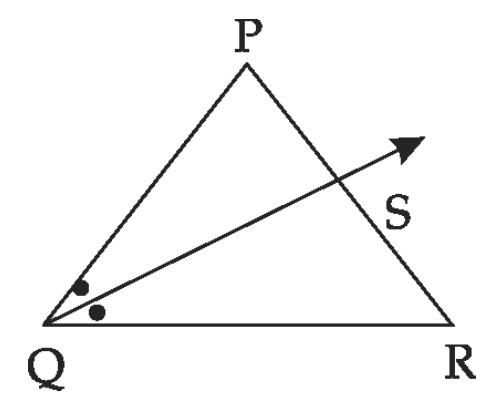
In $\Delta$PQR, ray QS bisects $\angle$PQR. P-S-R. Show that $\frac{ A (\Delta PQS )}{ A (\Delta QRS )}=\frac{ PQ }{ QR }$.
Image
Answer
Triangles $\triangle P Q S$ and $\triangle Q R S$ lie on the same base line PR and have the same altitude from point Q to line PR.
Hence, the ratio of the areas of triangles $s \triangle P Q S$ and $\triangle Q R S$ is equal to the ratio of their corresponding bases on line PR.
Therefore,
$\frac{A(\triangle P Q S)}{A(\triangle Q R S)}=\frac{P S}{S R}$
Since ray QS bisects $\angle P Q R$,by the Angle Bisector Theorem, the bisector divides the opposite side PR in the ratio of the sides containing the angle.
Thus,
$\frac{P S}{S R}=\frac{P Q}{Q R}$
Substituting this value in the area ratio, we get:
$\frac{A(\triangle P Q S)}{A(\triangle Q R S)}=\frac{P Q}{Q R}$
Conclusion:
Hence, $\frac{A(\triangle P Q S)}{A(\triangle Q R S)}=\frac{P Q}{Q R}$
Therefore, the given statement is proved.
View full question & answer
Question 673 Marks
E is a point on side CB, C-B-E, In $\triangle A B C$ AB = AC. If seg AD BC, B-D-C and seg EF $\perp$ side AC, A-F-C. Prove that $\triangle ABD \sim \triangle ECF$. 
Image
Answer
In $\triangle A B D$ and $\triangle E C F$,
$\angle A D B=90^{\circ} \quad($ since $A D \perp B C)$
$\therefore \angle A D B=\angle E F C$ ....(1)
Also, since $A B=A C, \triangle A B C$ is an isosceles triangle.
$\therefore \angle A B D=\angle B C A$ ....(2)
As points $E, B, C$ are collinear,
$\angle E C F=\angle B C A$ ....(3)
From (2) and (3),
$\angle A B D=\angle E C F$
Thus, in $\triangle A B D$ and $\triangle E C F$,
$\therefore \triangle A B D \sim \triangle E C F$( by AA similarity test)
View full question & answer
Question 683 Marks
$D$ is a point on side $B C$ of $\triangle A B C$ such that, $\angle A D C=\angle B A C$. Show that $A C^2=B C \times D C$.
Answer
To Prove: $A C^2=B C \times D C$
Consider $\triangle A D C$ and $\triangle B A C$.
$\angle A D C=\angle B A C$(Given)
Also,
$\angle A C D=\angle B C A \quad$ (Common angle)
Therefore,
$\triangle A D C \sim \triangle B A C$ (by AA similarity test)
Hence, the corresponding sides of similar triangles are proportional.
$\frac{A C}{B C}=\frac{D C}{A C}$
On cross-multiplying, we get
$A C^2=B C \times D C$
View full question & answer