Question 12 Marks
Check whether $6^n$ can end with the digit 0 for any natural number n.
AnswerIf the number $6^n$ ends with the digit zero, then it is divisibli by $5$ .
Therefore the prime factorization of $6^n$ contains the prime $5$ .
This is not possible because the only prime in the factorisation of $6^n$ is $2$ and $3$ and the uniqueness of the fundamental theorem of arithmetic guarantees that these are no other prime in the factorisation of $6^{ n }$.
Hence it is very clear that there is no value of $n$ in natural numbers for which $6^n$ ends with the digit zero.
View full question & answer→Question 22 Marks
Without actually performing the long division, state whether state whether the following rational numbers will have a terminating decimal expansion or a non terminating repeating decimal expansion.
$\frac{987}{10500}$
AnswerThe given number is
$\frac{987}{10500}=\frac{987\div21}{10500\div21}=\frac{47}{500}$
Now, $500 = 2^2 \times 5^3$
The denominator can be written in the form of $2^m \times 5^n.$
So, the given number has a terminating decimal expansion.
$\frac{987}{10500}=\frac{47}{500}=\frac{47}{5^3\times2^2}\times\frac{2}{2}$ $\frac{94}{5^3\times2^3}=\frac{94}{1000}=0.094$
View full question & answer→Question 32 Marks
Find the LCM and HCF of the following integer by applying the prime factorisation method.
17, 23 and 29
Answer17 = 1 × 17
23 = 1 × 23
29 = 1 × 29
LCM of 17, 23, & 29
$\begin{array}{c|c} 17 & 17-23-29 \\ \hline 23 & 1-23-29\\\hline29 & 1-1-29\\\hline & 1-1-1\end{array}$
So LCM of 17, 23 & 29 is 17 × 23 × 29
= 11339
From the above, HCF (17, 23, 29) = 1 and LCM (17, 23, 29) = 11339
View full question & answer→Question 42 Marks
Define HCF of two positive integers and find the HCF of the following pairs of numbers:
475 and 495
AnswerWe need to find H.C.F. of 475 and 495.
By applying Euclid’s Division lemma
495 = 475 × 1 + 20.
Since remainder ≠ 0, apply division lemma on 475 and remainder 20.
475 = 20 × 23 + 15.
Since remainder ≠ 0, apply division lemma on 20 and remainder 15.
20 = 15 × 1 + 5.
Since remainder ≠ 0, apply division lemma on15 and remainder 5.
15 = 5 × 3 + 0.
Therefore, H.C.F. of 475 and 495 = 5.
View full question & answer→Question 52 Marks
What is a composite number?
AnswerA composite number is a positive integer which has a divisor other than one or itself.
In other words a composite number is any positive integer greater than one that is not a prime number.
View full question & answer→Question 62 Marks
Without actually performing the long division, state whether state whether the following rational numbers will have a terminating decimal expansion or a non terminating repeating decimal expansion.
$\frac{125}{441}$
AnswerThe given number is $\frac{125}{441}$
Here, $441 = 3^2 \times 7^2 441 = 32 \times 72$ and none of $3$ and $7$ is a factor of $125$.
So, the given number is in its simplest form.
Now, $441 = 3^2 \times 7^2$^ is not of the form $2^m \times 5^n.$
So, the given number has a non-terminating repeating decimal expansion.
View full question & answer→Question 72 Marks
Write down the decimal expansions of the following rational numbers by writing their denominators in the form $2^m \times 5^n$, where, m, n are non-negative integers.
$\frac{14588}{625}$
AnswerThe given number is $\frac{14588}{625}.$
Clearly, $625 = 5^4$ is of the form $2^m \times 5^n$, where $m = 0$ and $n = 4.$
So, the given number has terminating decimal expansion.
$\therefore\ \frac{14588}{625}=\frac{14588\times2^4}{2^4\times5^4}=\frac{14588\times16}{(2\times5)^4}$ $=\frac{233408}{(10)^4}=\frac{233408}{10000}=23.3408$
View full question & answer→Question 82 Marks
Find the LCM and HCF of the following integer by applying the prime factorisation method.
$8, 9$ and $25$
Answer$8 = 2^3 \times 1$
$9 = 3^2 \times 1$
$25 = 5^2 \times 1$
LCM of $8, 9, 25$
$\begin{array}{c|c} 2 & 8-9-25 \\ \hline 2 & 4-9-25\\\hline2 & 2-9-25\\\hline 3 & 1-9-25\\\hline3 & 1-3-25\\\hline 5 & 1-1-25\\\hline5&1-1-5\\\hline & 1-1-1\end{array}$
So LCM of $8, 9, 25$ is$ = 2 × 2 × 2 × 3 × 3 × 5 × 5$
$= 1800$
From the above HCF $(8, 9, 25) = 1$ and LCM $(8, 9, 25) = 1800.$
View full question & answer→Question 92 Marks
If the prime factorization of a natural number n is $2^3 \times 3^2 \times 5^2 \times 7$, write the number of consecutive zeros in n.
AnswerGiven that prime factorization of a natural number is,
$n = 2^3 \times 3^2 \times 5^2 \times 7$
$n = 8 \times 9 \times 25 \times 7$
$n = 72 \times 175$
$n = 12600$
View full question & answer→Question 102 Marks
Has the rational number $\frac{441}{2^2\times5^7\times7^2}$ terminating or a non terminating decimal representation?
AnswerGiven rational number is $\frac{441}{2^2\times5^7\times7^2}$
The denominator $(2^2 \times 5^7 \times 7^2)$ of given rational number is not in the from of $(2^m \times 5^n).$
So, this is a non-terminating decimal representation.
View full question & answer→Question 112 Marks
Define HCF of two positive integers and find the HCF of the following pairs of numbers:
18 and 24
AnswerWe need to find H.C.F. of 18 and 24.
By applying division lemma
24 = 18 × 1 + 6
Since remainder ≠ 0, apply division lemma on divisor 18 and remainder 6.
18 = 6 × 3 + 0
Therefore, H.C.F. of 18 and 24 is 6
View full question & answer→Question 122 Marks
Prove that the product of two consecutive positive integers is divisible by $2$.
AnswerLet, $( n -1)$ and n be two consecutive positive integers
$\therefore \text { Their product }=n(n-1)$
$=n^2-n$
We know that any positive integer is of the form $2 q$ or $2 q+1$, for some integer $q$ When $n =2 q$, we have
$n^2-n=(2 q)^2-2 q$
$=4 q^2-2 q$
$2(2 q-1)$
Then $n ^2- n$ is divisible by $2$ .
When $n=2 q+1$, we have
$n^2-n=(2 q+1)^2-(2 q+1)$
$=4 q^2+4 q+1-2 q-1$
$=4 q^2+2 q$
$=2(2 q+1)$
Then $n ^2- n$ is divisible by $2 $.
Hence the product of two consecutive positive integers is divisible by $2$ .
View full question & answer→Question 132 Marks
Without actually performing the long division, state whether state whether the following rational numbers will have a terminating decimal expansion or a non terminating repeating decimal expansion.
$\frac{35}{50}$
Answer$\frac{35}{50}=\frac{7}{10}=\frac{7}{2\times5}$
So, the simplest from of the given rational number $\frac{35}{50}$ is $\frac{7}{10}$ and determination 10 is of the form $(2^m \times 5^n)$, where m and n are non-nagative integer.
Thus, $\frac{35}{50}$ has a terminating decimal expansion.
View full question & answer→Question 142 Marks
Without actually performing the long division, state whether state whether the following rational numbers will have a terminating decimal expansion or a non terminating repeating decimal expansion.
$\frac{23}{8}$
Answer$8 = 2^3$
The denominator is of the form $2^m \times 5^n.$
Hence, the decimal expansion of $\frac{23}{6}$ is terminating.
View full question & answer→Question 152 Marks
Define HCF of two positive integers and find the HCF of the following pairs of numbers:
70 and 30
AnswerPrime factors of 70 and 30 are
70 = 2 × 5 × 7
30 = 2 × 3 × 5
HCF (70, 30) = Product of the smallest power of each common prime factor in the number
= 2 × 5
= 10
View full question & answer→Question 162 Marks
State Euclid's division lemma.
AnswerEuclid’s Division Lemma:
Let a and b be any two positive integers.
Then, there exist unique integers q and r such that
a = bq + r, 0 ≤ r < b
If b|a then r = 0
Otherwise, r satisfies the stronger inequality 0 < r < b.
View full question & answer→Question 172 Marks
The HCF to two numbers is 16 and their product is 3072. Find their LCM.
AnswerGiven: HCF of two numbers is 16. If product of numbers is 3072
To Find: L.C.M of numbers
L.C.M × H.C.F = First Number × Second Number
L.C.M × 16 = 3072
L.C.M $= \frac{3072}{16}$
L.C.M = 192
View full question & answer→Question 182 Marks
What can you say about the prime factorisations of the 43 of the following rationals:
$43.\overline{123456789}$
AnswerWe have
$43.\overline{123456789}$
$43.\overline{123456789}$ has non-terminating decimal expansion.
So its denominator has factors other than 2 or 5.
View full question & answer→Question 192 Marks
Find the least number that is divisible by ail the numbers between 1 to 10 (both inclusive).
AnswerThe required least number which is divisible by 1 to 10 will be the L.C.M. of 1 to 10.
L.C.M. of 1 to 10.
$\begin{array}{c|c} 2 & 1,2,3,4,5,6,7,8,9,10 \\ \hline 2 & 1,1,3,2,5,3,7,4,9,5\\ \hline 3 & 1,1,3,1,5,3,7,2,9,5\\ \hline 5 & 1,1,1,1,5,1,7,2,3,6\\ \hline &1,1,1,1,1,1,7,2,3,1 \end{array}$
$= 2 \times 2\times 3 \times 5\times 7 \times 2 \times 3 = 2520$
View full question & answer→Question 202 Marks
Complete the missing entries in the following factor tree.
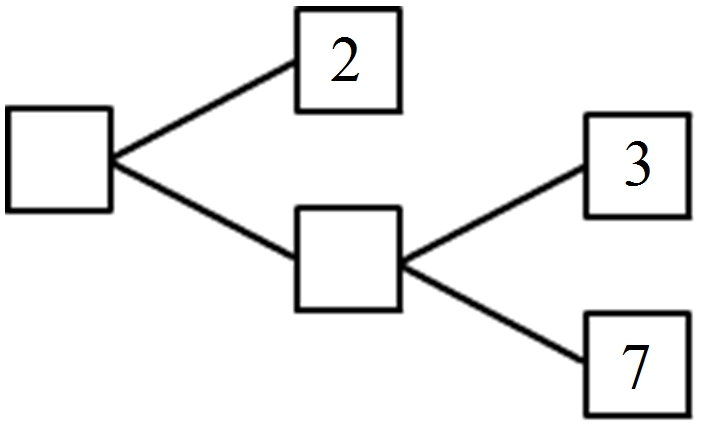
AnswerWe need to fill the values for a and b in the following factor tree:
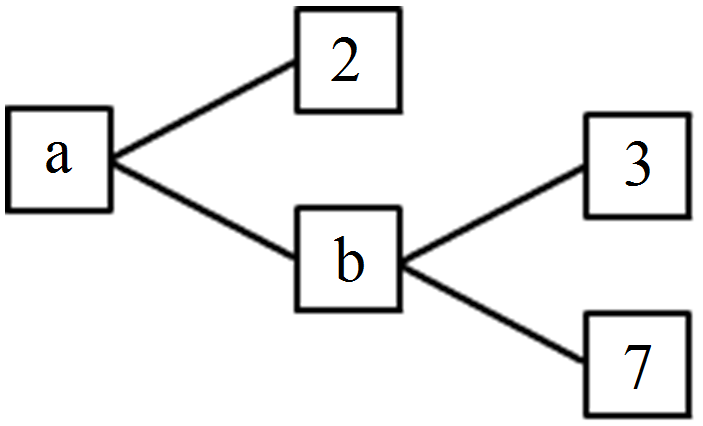
It is clear from the factor tree above that b = 3 × 7 b = 21 Also, a = 2 × b a = 2 × 21 a = 42 Thus, the missing entries are 21 and 42.
View full question & answer→Question 212 Marks
Write down the decimal expansions of the following rational numbers by writing their denominators in the form $2^m \times 5^n$^, where, m, n are non-negative integers.
$\frac{7}{80}$
Answer$\frac{7}{80}=\frac{7}{2^4\times5^1}$
($\because$ $80 = 16 × 5 = 2 × 2 × 2 × 2 × 5 = 24 × 51)$
{Multiplying and dividing by $5^3$}
$=\frac{875}{10000}=0.0875$
View full question & answer→Question 222 Marks
Without actually performing the long division, state whether state whether the following rational numbers will have a terminating decimal expansion or a non terminating repeating decimal expansion.
$\frac{77}{210}$
AnswerThe given number is $\frac{77}{210}$ and HCF$(77, 210) = 7.$
$\therefore\ \frac{77}{210}=\frac{77\div7}{210\div7}=\frac{11}{30}$
Here, $\frac{11}{30}$ is in its simplest form.
Here, $\frac{77}{210}$ is in its simplest form.
Now, $30 = 2 \times 3 \times 5$ is not of the form $2^m \times 5^n.$
So, the given number has a non-terminating repeating decimal expansion.
View full question & answer→Question 232 Marks
Write down the decimal expansions of the following rational numbers by writing their denominators in the form $2^m \times 5^n$, where, m, n are non-negative integers.
$\frac{3}{8}$
AnswerThe given number is $\frac{3}{8}.$
$\frac{3}{8} = \frac{3}{2^{3}} = \frac{3}{2^{3} \times 5^{3}}$
$= \frac{3\times 5^{3}}{2^{3}\times 5^{3}} = \frac{3\times 125}{(10)3} = \frac{375}{1000} = 0.375$
Thus, the decimal expansion of given rational number is $0.375$
View full question & answer→Question 242 Marks
Define HCF of two positive integers and find the HCF of the following pairs of numbers:
$100$ and $190$
AnswerPrime factors of $100$ and $190$ are
$100 = 2 \times 2 \times 5 \times 5 = 2^2 \times 5^2$
$190 = 2 \times 5 \times 19 = 2 \times 5 \times 19$
HCF $(100, 190)$ = Product of the smallest power of each common prime factor in the number
$= 2 \times 5$
$= 10$
View full question & answer→Question 252 Marks
The decimal expression of the rational number $\frac{43}{2^4\times5^3}$ will terminate after how many places of decimals.
AnswerThe denominator of $\frac{43}{2^4\times5^3}$ is $2^4 \times 5^3$ which is in the form of $2^m \times 5^n$ where m and n are positive integers $\frac{43}{2^4\times5^3}$ has terminating decimals.
The decimal expansion of $\frac{43}{2^4\times5^3}$ terminates after $4$ (the highest power is $4$) decimal places.
View full question & answer→Question 262 Marks
Write whether $\frac{2\sqrt{45}+3\sqrt{20}}{2\sqrt{5}}$ on simplification gives a rational or an irrational number.
AnswerLet us simplify $\frac{2\sqrt{45}+3\sqrt{20}}{2\sqrt{5}}$
$\frac{2\sqrt{45}+3\sqrt{20}}{2\sqrt{5}}=\frac{6\sqrt{5}+6\sqrt{5}}{2\sqrt{5}}$
$=\frac{12\sqrt{5}}{2\sqrt{5}}$
$=6$
6 is rational number.
View full question & answer→Question 272 Marks
Use Euclid's division algorithm to find the HCF of:
184, 230 and 276
AnswerGiven integers are 184, 230 and 276.
Let us first find the HCF of 184 and 230 by Euclid lemma.
Clearly, 230 > 184. So, we will apply Euclid’s division lemma to 230 and 184.
230 = 184 × 1 + 46
Remainder is 46 which is a non-zero number. Now, apply Euclid’s division lemma to 184 and 46.
184 = 46 × 4 + 0
The remainder at this stage is zero. Therefore, 46 is the HCF of 230 and 184.
Now, again use Euclid’s division lemma to find the HCF of 46 and 276.
276 = 46 × 6 + 0
The remainder at this stage is zero.
Therefore, 46 is the HCF of 184, 230 and 276.
View full question & answer→Question 282 Marks
What is the smallest number that, when divided by 35, 56 and 91 leaves remainders of 7 in each case?
AnswerL.C.M. of 35, 56, 91
$\begin{array}{c|c} 7 & 35, 56, 91 \\ \hline 2 & 5, 8, 13 \end{array}$
= 5 × 7 × 8 × 13 = 3640
Remainder in each case = 7
The required smallest number = 3640 + 7 = 3647
View full question & answer→Question 292 Marks
Define HCF of two positive integers and find the HCF of the following pairs of numbers:
56 and 88
AnswerBy applying Euclid’s division lemma
88 = 56 × 1 + 32
Since remainder ≠ 0, apply division lemma on divisor of 56 and remainder 32.
56 = 32 × 1 + 24
Since remainder ≠ 0, apply division lemma on divisor of 32 and remainder 24.
32 = 24 × 1 + 8
Since remainder ≠ 0, apply division lemma on divisor of 24 and remainder 8.
24 = 8 × 3 + 0
$\therefore$ HCF of 56 and 88 is = 8.
View full question & answer→Question 302 Marks
What can you say about the prime factorisations of the $43$ of the following rationals:
$43.123456789$
AnswerWe have
$43.123456789=\frac{43123456789}{1000000000}$
we can write denominator $1000000000$ is in the from of $(2^m \times 5^n).$
Hence, $43.123456789$ is terminating decimal, where m and n are non-negative integers.
View full question & answer→Question 312 Marks
Write the condition to be satisfied by q so that a rational number $\frac{\text{p}}{\text{q}}$ has a terminating decimal expansion.
AnswerLet rational number be n which is in the form of $\frac{\text{p}}{\text{q}}.$
The condition for non-terminating decimal expansion is that denominator of $\frac{\text{p}}{\text{q}}$ is q which is not in the form of $(2^m \times 5^n)$, where m, n are non-negativ inteagrs.
View full question & answer→Question 322 Marks
Use Euclid's division algorithm to find the HCF of:
196 and 38220
AnswerGiven integers are 38220 and 196.
Clearly 38220 > 196. So we will apply Euclid’s division lemma to 38220 and 196, we 38220 = (196)(195) + 0 get,
The remainder at this stage is 0. So the divisor at this stage is the H.C.F.
So the H.C.F of 38220 and 196 is 196.
View full question & answer→Question 332 Marks
Find the LCM and HCF of the following pairs of integers and verify that LCM$ \times$ HCF = Product of the integers:
$510$ and $92$
AnswerTo Find: L.C.M and H.C.F of following pairs of integers
To Verify: L.C.M $\times$ H.C.F $=$ product of the numbers
Let us first find the factors of $510$ and $92$
$510=2 \times 3 \times 5 \times 17$
$92=2^2 \times 23$
L.C.M of 510 , and $92=2 \times 2 \times 3 \times 5 \times 17 \times 23=23460$
H.C.F of 510 , and $92=2$
We know that,
L.C.M $\times$ H.C.F $=$ First number $\times$ Second number $\Rightarrow 23460 \times 2=510 \times 92 \Rightarrow 46920=46920$
L.C.M $\times$ H.C.F $=$ First number $\times$ Second number $\Rightarrow 23460 \times 2=510 \times 92 \Rightarrow 46920=46920$
Hence verified.
View full question & answer→Question 342 Marks
Write down the decimal expansions of the following rational numbers by writing their denominators in the form $2^m \times 5^n$, where, $m, n$ are non-negative integers.
$\frac{129}{2^2\times5^7}$
AnswerThe given number is $\frac{129}{2^2\times5^2}.$
$\frac{129}{2^2\times5^7}=\frac{125\times2^5}{(2^7\times5^7)}=\frac{129\times32}{(10)^7}$ $=\frac{4128}{10000000}=0.0004128$
Thus, the decimal expansion of $\frac{129}{2^2\times5^7}$ is 0.0004128
View full question & answer→Question 352 Marks
Define HCF of two positive integers and find the HCF of the following pairs of numbers:
32 and 54
AnswerBy applying Euclid’s division lemma
54 = 32 × 1 + 22
Since remainder ≠ 0, apply division lemma on division of 32 and remainder 22.
32 = 22 × 1 + 10
Since remainder ≠ 0, apply division lemma on division of 22 and remainder 10.
22 = 10 × 2 + 2
Since remainder ≠ 0, apply division lemma on division of 10 and remainder 2.
10 = 2 × 5 [remainder 0]
Hence, HCF of 32 and 54 is 2
View full question & answer→Question 362 Marks
The LCM and HCF of two numbers are 180 and 6 respectively. If one of the numbers is 30, find the other number.
AnswerSecond Number = 361
L.C.M × H.C.F = First Number × Second Number
180 × 6 = 30 × Second Number
Second Number $=\frac{180\times6}{30}=36$
View full question & answer→Question 372 Marks
If p and q are two prime number, then what is their HCF?
AnswerIt is given that p and q are two prime numbers; we have to find their HCF.
We know that the factors of any prime number are 1 and the prime number itself.
For example, let p = 2 and q = 3
Thus, the factors are as follows
p = 2 × 1
And
q = 3 × 1
Now, the HCF of 2 and 3 is 1.
Thus the HCF of p and q is 1.
View full question & answer→Question 382 Marks
Explain why 7 × 11 × 13 + 13 and 7 × 6 × 5 × 4 × 3 × 2 × 1 + 5 are composite numbers.
AnswerExplain: Why 7 × 11 × 13 + 13 and 7 × 6 × 5 × 4 × 3 × 2 × 1 + 5 are composite numbers.
We can see that both the numbers have common factor 7 and 1.
7 × 11 × 13 + 13 = (77 + 1) × 13
= 78 × 13
7 × 6 × 5 × 4 × 3 × 2 × 1 + 5 = (7 × 6 × 4 × 3 × 2 × 1) × 2
= 1008 × 5
And we know that composite numbers are those numbers which have at least one more factor other than 1.
Hence after simplification we see that both numbers are even and therefore the given two numbers are composite numbers.
View full question & answer→Question 392 Marks
The HCF of two numbers is 145 and their LCM is 2175. If one number is 725, find the other.
AnswerL.C.M × H.C.F = First Number × Second Number
2175 × 145 = 725 × Second Number
$\therefore$ Second Number $= \frac{(2175 \times 145)}{725} = 435$
View full question & answer→Question 402 Marks
Use Euclid's division algorithm to find the HCF of:
867 and 255
Answer867 > 255
867 = 225 × 3 + 102
255 = 102 × 2 + 51
102 = 51 × 2 + 0
Hence, HCF of 867 and 255 is 51.
View full question & answer→Question 412 Marks
A rational number in its decimal expansion is $327.7081$. What can you say about the prime factors of $q$, when this number is expressed in the form $\frac{\text{p}}{\text{q}}?$ Give reasons.
Answer$327.7081$ is terminating decimal number.
So, it represents a rational number and also its denominator must have the form $2^m \times 5^n.$
Thus, $327.7081=\frac{3277081}{10000}=\frac{\text{p}}{\text{q}}\ (\text{say})$
$\therefore$ $q = 10^4 = 2 \times 2 \times 2 \times 2 \times 5 \times 5 \times 5 \times 5 = 2^4 \times 5^4 = (2 \times 5)^4$
Hence, the prime factors of q is 2 and 5.
View full question & answer→Question 422 Marks
Define HCF of two positive integers and find the HCF of the following pairs of numbers:
105 and 120
AnswerBy applying Euclid’s division lemma
120 = 105 × 1 + 15
Since remainder ≠ 0, applying division lemma on divisor 105 and remainder 15.
105 = 15 × 7 + 0
$\therefore$ H.C.F of 105 and 120 = 15
View full question & answer→Question 432 Marks
Find the LCM and HCF of the following pairs of integers and verify that LCM × HCF = Product of the integers:
26 and 91
AnswerTo Find: L.C.M and H.C.F of following pairs of integers
To Verify: L.C.M × H.C.F = product of the numbers
Let us first find the factors of 26 and 91
26 = 2 × 13
91 = 7 × 13
L.C.M of 26, and 91 = 2 × 7 × 13 = 182
H.C.F of 26, and 91 = 13
We know that,
L.C.M × H.C.F = First number × Second number ⇒ 182 × 13 = 26 × 91 ⇒ 2366 = 2366
L.C.M × H.C.F = First number × Second number ⇒ 182 × 13 = 26 × 91 ⇒ 2366 = 2366
Hence verified.
View full question & answer→Question 442 Marks
Find the LCM and HCF of the following integer by applying the prime factorisation method.
12, 15 and 21
Answer12 = 2 × 2 × 3 15 = 5 × 3 21 = 7 × 3 3 is common for all, it means HCF of 12, 15 & 21 is 3 Now calculate LCM of 12, 15, 21$\begin{array}{c|c} 2 & 12-15-21 \\ \hline 2 & 6-15-21\\\hline3 & 3-15-21\\\hline 5 & 1-5-7\\\hline7 & 1-1-7\\\hline & 1-1-1\end{array}$
So LCM of 12, 15, 21 is 2 × 2 × 3 × 5 × 7 = 420 From the above, HCF (12, 15, 21) = 3 and LCM (12, 15, 21) = 420
View full question & answer→Question 452 Marks
What can you say about the prime factorisations of the 43 of the following rationals:
$27.\overline{142857}$
AnswerWe have
$27.\overline{142857}$
We can see that it is a non-terminating repeating decimal expersion.
So, its denominator has factors others them 2 or 5.
View full question & answer→Question 462 Marks
State Fundamental Theorem of Arithmetic.
AnswerFundamental Theorem of Arithmetics: Every composite number can be expressed (factorised) as a product of primes and this factorization is unique except for the order in which the prime factors occur.
View full question & answer→Question 472 Marks
Define HCF of two positive integers and find the HCF of the following pairs of numbers:
155 and 1385
AnswerWe need to find H.C.F. of 155 and 1385.
By applying Euclid’s Division lemma
1385 = 155 × 8 + 145.
Since remainder ≠ 0, apply division lemma on divisor 155 and remainder 145.
155 = 145 × 1 + 10.
Since remainder ≠ 0, apply division lemma on divisor 145 and remainder 10.
145 = 10 × 14 + 5.
Since remainder ≠ 0, apply division lemma on divisor 10 and remainder 5.
10 = 5 × 2 + 0.
Therefore, H.C.F. of 155 and 1385 = 5.
View full question & answer→Question 482 Marks
Find the LCM and HCF of the following pairs of integers and verify that LCM $\times $ HCF = Product of the integers:
$336$ and $54$
AnswerTo Find: L.C.M and H.C.F of following pairs of integers
To Verify: L.C.M $\times$ H.C.F $=$ product of the numbers
Let us first find the factors of 336 and 54
$336=2 \times 2 \times 2 \times 2 \times 3 \times 7$
$54=2 \times 3 \times 3 \times 3$
L.C.M of 336 , and $54=2^4 \times 3^3 \times 7=3024$
H.C.F of 336 , and $54=2 \times 3=6$
We know that,
$\text { L.C.M } \times \text { H.C.F }=\text { First number } \times \text { Second number } \Rightarrow 3024 \times 6=336 \times 54 \Rightarrow 18144=18144$
Hence verified.
View full question & answer→Question 492 Marks
If the product of two numbers is 1080 and their HCF is 30, find their LCM.
AnswerIt is given that the product of two numbers is 1080.
Let the two numbers be a and b.
Therefore,
a × b = 1080
HCF is 30.
We need to find the LCM
We know that the product of two numbers is equal to the product of the HCF and LCM.
Thus,
$\text{LCM}=\frac{\text{a}\times\text{b}}{\text{HCF}}$
$\text{LCM}=\frac{1080}{30}$
$\text{LCM}=36$
Hence the LCM is 36.
View full question & answer→Question 502 Marks
Use Euclid's division algorithm to find the HCF of:
135 and 225
AnswerWe have 225 > 135,
So, we apply the division lemma to 225 and 135 to obtain.
225 = 135 × 1 + 90
Here remainder 90 ≠ 0, we apply the division lemma again to 135 and 90 to obtain.
135 = 90 × 1 + 45
We consider the new divisor 90 and new remainder 45 ≠ 0, and apply the division lemma to obtain.
90 = 2 × 45 + 0
Since at this time the remainder is zero, the process is stopped.
The divisor at this stage is 45
Therefore, the HCF of 135 and 225 is 45.
View full question & answer→Question 512 Marks
Write down the decimal expansions of the following rational numbers by writing their denominators in the form $2^m \times 5^n$, where, m, n are non-negative integers.
$\frac{13}{125}$
AnswerThe given number is $\frac{13}{125}.$
$\frac{13}{125} = \frac{13}{5^{3}} = \frac{13}{5^{3} \times 2^0}$
$= \frac{13\times 2^{3}}{5^{3}\times 2^{3}} = \frac{13\times 8}{(10)^3} = \frac{104}{1000} = 0.104$
Thus, the decimal expansion of $\frac{13}{125}$ is $0.014.$
View full question & answer→Question 522 Marks
Without actually performing the long division, state whether state whether the following rational numbers will have a terminating decimal expansion or a non terminating repeating decimal expansion.
$\frac{129}{2^2\times5^7\times7^{17}}$
AnswerSince the denominator is not of the form $2^m 5^n$^, and it also has $7$ as its factor, the decimal expansion of $\frac{129}{2^2\times5^77^{17}}$ is non-terminating repeating.
View full question & answer→Question 532 Marks
Write 98 as product of its prime factors.
AnswerUsing factors tree for prime factorisation of 98.
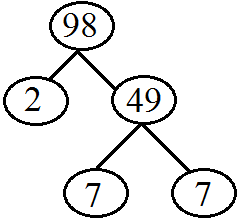
prime factoris of 98 = 2 × 7 × 7
View full question & answer→Question 542 Marks
Define HCF of two positive integers and find the HCF of the following pairs of numbers:
240 and 6552
AnswerBy applying Euclid’s division lemma
6552 = 240 × 27 + 72
Since remainder ≠ 0, apply division lemma on divisor of 240 and remainder 72.
240 = 72 × 3 + 24
Since remainder ≠ 0, apply division lemma on divisor of 72 and remainder 24.
72 = 24 × 3 + 0
$\therefore$ H.C.F of 6552 and 240 is = 24.
View full question & answer→Question 552 Marks
Find the HCF of the following pairs of integers and express it as a linear combination of them.
1288 and 575
AnswerBy applying Euclid’s division lemma
1288 = 575 × 2 + 138 …..(i)
Since remainder ≠ 0, apply division lemma on division 575 and remainder 138.
575 = 138 × 4 + 23 …..(ii)
Since remainder ≠ 0, apply division lemma on division 138 and remainder 23 …..(iii)
HCF = 23
Now, 23 = 575 - 138 × 4 [from (ii)]
= 575 - [1288 - 575 × 2] × 4 [from (i)]
= 575 - 1288 × 4 + 575 × 8
= 575 × 9 - 1288 × 4
View full question & answer→Question 562 Marks
Use Euclid's division algorithm to find the HCF of:
136, 170 and 255
AnswerGiven integers are 136, 170 and 255.
Let us first find the HCF of 136, 170 by Euclid lemma.
Clearly, 170 > 136. So, we will apply Euclid’s division lemma to 136 and 170.
170 = 136 × 1 + 34
Remainder is 34 which is a non-zero number.
Now, apply Euclid’s division lemma to 136 and 34.
136 = 34 × 4 + 0
The remainder at this stage is zero.
Therefore, 34 is the HCF of 136 and 170.
Now, again use Euclid’s division lemma to find the HCF of 34 and 255.
255 = 34 × 7 + 17
Remainder is 17 which is a non-zero number.
Now, apply Euclid’s division lemma to 34 and 17.
34 = 17 × 2 + 0
The remainder at this stage is zero.
Therefore, 17 is the HCF of 136, 170 and 255.
View full question & answer→Question 572 Marks
What can you say about the prime factorisations of the 43 of the following rationals:
0.120120012000120000...
AnswerWe have,
0.120120012000120000...
We can see that it is a non-terminating repeating decimal expersion.
So, its denominator has factors others them 2 or 5.
View full question & answer→Question 582 Marks
Define HCF of two positive integers and find the $HCF$ of the following pairs of numbers:
$75$ and $243$
AnswerPrime factors of $75$ and $243$ are
$75 = 3 \times 5 \times 5 = 3 \times 5^2$
$243 = 3 \times 3 \times 3 \times 3 \times 3 = 3^5$
$HCF\ (75, 243)$ = Product of the smallest power of each common prime factor in the number
$= 3$
View full question & answer→