Question types

1.4 Be SMART...! question types

6 questions across 1 question group — pick any mix to generate a My English Coursebook paper with step-by-step answer keys.

6
Questions
1
Question groups
5
Question types
Sample Questions

1.4 Be SMART...! questions

One sample from each question group in this chapter. Select any group above to see the full set with answer keys.

A1. Simple Factual Activity:
Complete the sentences with the help of the information in the passage:
(1) The quality and quantity of energy we put forth, _______________.
(2) _______________ is a walk in the dark.

    Time-bound: Establish time parameters around each goal, as it will help increase focus and accountability. To reduce weight we know how to go about it. But without consistent time - bound action, it never becomes a reality. It may be exercise, diet and stress-free thoughts. All these have to be practised and implemented without hesitation, doubt or indifference, but within a deadline.
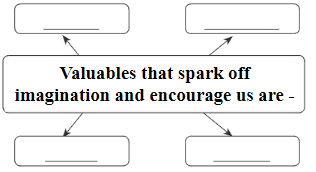
    Visions, wishes, intentions and dreams are all valuable. They spark off imagination and encourage us to define where we want to reach. In order to get there, however, we need to bring life images, down to earth and plan to execute our strategies. The quality and quantity of energy we put forth, directly impact the results. Life is something like a trumpet. If we don’t put anything in, we can’t get anything out.
     Success is a walk in the dark. Finding the right footing, precisely mastering the skills and getting to the next place, all depend on how we approach and
tackle the problem. The best way to get from where we are, to where we want to be is to find the footing of our next step. When we take the next step, it should support and hold us without a crack.

A2. Complex Factual Activity:

Pick out examples from the passage that support each of the following facts:
(a) Good results depend upon the quality and quantity of work put in.
(b) A time-limit should be set to achieve goals.
A3. Activities based on Vocabulary:
Classify the following words in their respective columns: 
ah, of, if, and, oh, from, we, but, it, hurrah

PronounPrepositionConjunctionInter- jection
    

A4. Activities based on Contextual Grammar:
(1) We need to bring life images. (Underline the infinitive.) 
(2) The next step should support and hold us without a crack.
(Choose the correct question tag.)
(a) should it? (b) don't it? (c) shouldn't it?
A5. Personal Response:
(1) 'If we don't put anything in, we can't get anything out.' Explain.
View full solution
A1. Simple Factual Activity:
Complete the sentences with the help of the information in the passage:
(1) For reducing weight, exercise, diet and stress- free thoughts should be _______________.
(2) Vision, wishes, intentions and dreams spark off imagination and encourage us _______________.

    Time-bound: Establish time parameters around each goal, as it will help increase focus and accountability. To reduce weight we know how to go about it. But without consistent time - bound action, it never becomes a reality. It may be exercise, diet and stress-free thoughts. All these have to be practised and implemented without hesitation, doubt or indifference, but within a deadline.
    Visions, wishes, intentions and dreams are all valuable. They spark off imagination and encourage us to define where we want to reach. In order to get there, however, we need to bring life images, down to earth and plan to execute our strategies. The quality and quantity of energy we put forth, directly impact the results. Life is something like a trumpet. If we don’t put anything in, we can’t get anything out.
     Success is a walk in the dark. Finding the right footing, precisely mastering the skills and getting to the next place, all depend on how we approach and
tackle the problem. The best way to get from where we are, to where we want to be is to find the footing of our next step. When we take the next step, it should support and hold us without a crack.

A2. Complex Factual Activity:

Complete the web: 
Image
A3. Activities based on Vocabulary:
Write antonyms for the following words :
(1) wrong ×
(2) decrease × 
(3) discourage × 
(4) light × 
A4. Activities based on Contextual Grammar:
(1) Establish time parameters around each goal. (Rewrite the sentence beginning with 'Let' and change the sentence into passive voice.)
(2) If we don't put anything in, we can't get anything out. (Rewrite the sentence using 'unless' in the beginning.)
A5. Personal Response:
(1) Write any four qualities of a successful person.
View full solution
A1. Simple Factual Activity:
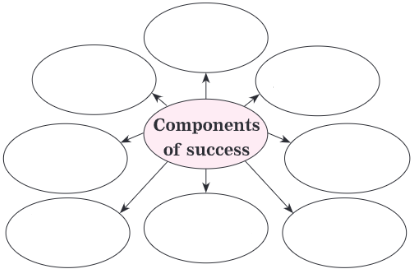
Complete the following web with the words associated with the passage and the given title:
Image

SMART goals have a specific rubric:
    Specific: Involves identifying a specific area for improvement. The more specific the area, the more refined the achievement of one’s goal can be. It makes it easier to set parameters and work towards the goal. For exaxmple, if it is building a house, what exactly is the capacity required and how long can it stretch ?
    Measurable: Quantifying goals provides specific ways to track progress against goals. This makes it easy to benchmark performance throughout the goal period, including areas to improve. While playing football, one’s exact role and position has to be clearly defined.
     Achievable: Setting goals that can be completed in the designated period of time. Often, these goals may act like stepping stones to help meet broader goals that further define a career. As students, we can’t become a President, a Prime Minister, but can hope to reach those heights in future.
      Realistic: It is important to create goals that are within one’s current skill set or area of expertise. Building expertise takes time, so expecting to become an expert in a short amount of time is unrealistic. Being realistic will make it easy to be successful at attaining goals. If defensive and not aggressive, the goal perhaps lacks realism. We must have the clear picture in mind and must have the ability to adhere to that picture.

A2. Complex Factual Activities:
Pick out examples from the text that support each of the following facts:
(1) Goals should be achievable.
(2) A specific field/area has to be fixed to achieve goals.
A3. Activities based on Vocabulary:
Cross the odd man out:
(1) involve, provide, important, create.
(2) specific, realistic, defensive, capacity.
(3) performance, achievement, aggressive, President.
(4) clearly, Ineky, freely, exactly.
A4. Activities based on Contextual Grammar:
Underline the Present Participles/ Infinitives: 
(1) Being realistic will make it easy to be successful at attaining goals.
(2) You must have the ability to adhere to that picture.
A5. Personal Response:
(1) Why is it necessary that our goals should be realistic?
View full solution
A1. Simple Factual Activity:
Complete the following sentences with the help of the passage:
(1) Specific goals make it easier to _______________.
(2) It is important to create goals that are _______________.

SMART goals have a specific rubric:
    Specific: Involves identifying a specific area for improvement. The more specific the area, the more refined the achievement of one’s goal can be. It makes it easier to set parameters and work towards the goal. For exaxmple, if it is building a house, what exactly is the capacity required and how long can it stretch ?
    Measurable: Quantifying goals provides specific ways to track progress against goals. This makes it easy to benchmark performance throughout the goal period, including areas to improve. While playing football, one’s exact role and position has to be clearly defined.
     Achievable: Setting goals that can be completed in the designated period of time. Often, these goals may act like stepping stones to help meet broader goals that further define a career. As students, we can’t become a President, a Prime Minister, but can hope to reach those heights in future.
      Realistic: It is important to create goals that are within one’s current skill set or area of expertise. Building expertise takes time, so expecting to become an expert in a short amount of time is unrealistic. Being realistic will make it easy to be successful at attaining goals. If defensive and not aggressive, the goal perhaps lacks realism. We must have the clear picture in mind and must have the ability to adhere to that picture.

A2. Complex Factual Activities:
(1) How does quantifying goals help us?
A3. Activities based on Vocabulary:
Find from the passage adjectives for the following:
(1) area
(2) period
(3) role
(4) stones 
A4. Activities based on Contextual Grammar:
Underline the Present Participles/ Infinitives: 
(1) It makes it easier to set parameters.
(2) These goals may act like stepping stones to help broader goals.
A5. Personal Response:
(1) Why is it necessary that our goals should be realistic?
View full solution
A1. Simple Factual Activity:
Write whether the following statements are True or False: 
(1) To accomplish goals, experts recommend a ten step approach.
(2) The champions have to have the skill and the will
(3) For anyone, setting goal is not easy but challenging.
(4) If we do not take action to achieve goals, we shall not achieve goals.

     Champions aren’t made in gyms. Champions are made from something they have deep inside them- a desire, a dream, a vision. They have to have the skill and the will. But the will must be stronger than the skill. Successful professionals thrive in the same manner. We all have natural talents. If we use that talent to set our goal in life, we can easily get success in life. We shall not achieve our goals if we do not take action to achieve them.
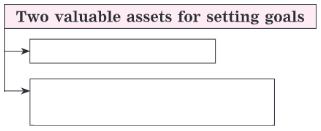
     Setting goals has two valuable assets - a sense of originality and a stepping stone to illuminate the path. Goals put one at the helm of life; pursuing them acknowledges a better future situation. They help to steer a course of life rather than simply drifting along and letting things happen.
     Setting goals may appear easy, but, for some, it is quite challenging. Fear of failure may be avoided in the absence of any goals. After all, one has to decide what one wants to achieve in the end. To accomplish goals, experts recommend a five step approach.
     SMART goals are a methodology of thinking that helps people reach success. SMART stands for specific, measurable, achievable, realistic and timebound.

A2. Complex Factual Activities:
Complete the web:
Image
A3. Activities based on Vocabulary:
Find from the passage adjectives for:
(1) profession 
(2) value
A4. Activities based on Contextual Grammar:
Do as directed:
(1) The will must be stronger than the skill.
(Select the 'positive degree' from the following.)
(a) The will must be as strong as the skill.
(b) The will must not be as strong as the skill.
(c) The skill must not be as strong as the will.
(d) The skill must be as strong as the skill.
(2) They have to have the skill and the will.
(Use 'not only...but also...'.)
A5. Personal Response:
(1) Write any one of your goal and what you will do to achieve it.
View full solution

Generate a 1.4 Be SMART...! paper free

Pick question groups from the list above, set marks and difficulty, and export a branded PDF with step-by-step answer keys. First 3 chapters free — no signup.

Download App