Question
A1. Simple Factual Activity:
Write whether the following statements are True or False: 
(1) To accomplish goals, experts recommend a ten step approach.
(2) The champions have to have the skill and the will
(3) For anyone, setting goal is not easy but challenging.
(4) If we do not take action to achieve goals, we shall not achieve goals.

     Champions aren’t made in gyms. Champions are made from something they have deep inside them- a desire, a dream, a vision. They have to have the skill and the will. But the will must be stronger than the skill. Successful professionals thrive in the same manner. We all have natural talents. If we use that talent to set our goal in life, we can easily get success in life. We shall not achieve our goals if we do not take action to achieve them.
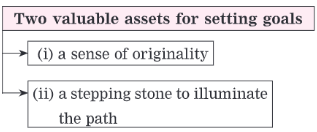
     Setting goals has two valuable assets - a sense of originality and a stepping stone to illuminate the path. Goals put one at the helm of life; pursuing them acknowledges a better future situation. They help to steer a course of life rather than simply drifting along and letting things happen.
     Setting goals may appear easy, but, for some, it is quite challenging. Fear of failure may be avoided in the absence of any goals. After all, one has to decide what one wants to achieve in the end. To accomplish goals, experts recommend a five step approach.
     SMART goals are a methodology of thinking that helps people reach success. SMART stands for specific, measurable, achievable, realistic and timebound.

A2. Complex Factual Activities:
Complete the web:
Image
A3. Activities based on Vocabulary:
Find from the passage adjectives for:
(1) profession 
(2) value
A4. Activities based on Contextual Grammar:
Do as directed:
(1) The will must be stronger than the skill.
(Select the 'positive degree' from the following.)
(a) The will must be as strong as the skill.
(b) The will must not be as strong as the skill.
(c) The skill must not be as strong as the will.
(d) The skill must be as strong as the skill.
(2) They have to have the skill and the will.
(Use 'not only...but also...'.)
A5. Personal Response:
(1) Write any one of your goal and what you will do to achieve it.
Answer

A1. Simple Factual Activities:
(1) False
(2) True
(3) True
(4) False
A2. Complex Factual Activities:
Image
A3. Activities based on Vocabulary:
(1) professional
(2) valuable
A4. Activities based on Contextual Grammar:
(1) The skill must not be as strong as the will.
(2) They have to have not only the skill but also the will.
A5. Personal Response:
(1) My goal is to join Indian Army. It requires good strength, endurance, courage and good mental power. I am trying my level best to be fit and fine physically. My consistent efforts will build my courage and endurance to achieve my goal.

Need a full question paper?

Generate a complete, print-ready paper with questions like this in minutes — across 16+ boards, with answer keys.

Start Generating Free

Similar questions

A1. Simple Factual Activities:
Complete the following sentences:
(1) Meena stayed alone as _______________.
(2) Meena had the habit of  _______________.

     Meena is a good friend of mine. She is an LIC officer earning a good salary. But there was always something strange about her. She was forever unhappy. Whenever I met her, I would start to feel depressed. It was as though her gloom and cynicism had a way of spreading to others. She never had anything positive to say on any subject or about any person.      
     For instance, I might say to her, ‘Meena, did you know Rakesh has come first in his school ?’     
     Meena’s immediate response would be to belittle the achievement. ‘Naturally, his father is a school teacher’, she would say.      
     If I said, ‘Meena, Shwetha is a very beautiful girl, isn’t she ?’ Meena would be pessimistic. ‘When a pony is young, he looks handsome. It is age that matters. Wait for some time. Shwetha will be uglier than anyone you know.’      
     ‘Meena, it’s a beautiful day. Let’s go for a walk’. 
     ‘No, the sun is too hot and I get tired if I walk too much. Besides, who says walking is good for health ? There’s no proof.’
     That was Meena. She stayed alone in an apartment as her parents lived in Delhi. She was an only child and had the habit of complaining about anything and everything. Naturally, she wasn’t a very pleasant company and nobody wanted to visit her. Then one day, Meena was transferred to Bombay and soon we all forgot about her.
     Many years later, I found myself caught in the rain at Bombay’s Flora Fountain. It was pouring and I didn’t have an umbrella. I was standing near Akbarallys, a popular department store, waiting for the rain to subside. Suddenly, I spotted Meena. My first reaction was to run, even in that pouring rain. I was anxious to avoid being seen by her, having to listen to her never-ending complaints. However, I couldn’t escape. She had already seen me and caught hold of my hand warmly. What’s more, she was very cheerful.
     ‘Hey ! I am really excited. It’s nice to meet old friends. What are you doing here ?’
     I explained that I was in Bombay on an official work.

A2. Complex Factual Activities:
(1) What was Meena's nature like?
A3. Activities based on Vocabulary:
Find similar words:
(1) pleasant -
(2) heavy rainfall -
(3) well known -
(4) noticed -
A4. Activities based on Contextual Grammar:
Make the following sentences negative:
(1) She was forever unhappy.
(2) Meena was a pessimistic girl.
A5. Personal Response:
(1) In your opinion, how should a friend be?
A1. Simple Factual Activity:
Fill in the blanks and complete the sentences:
(1) The number of World Heritage Sites in 2009 were _______________.
(2) _______________ of the World Heritage Sites are considered mixed.

    TYPES OF WORLD HERITAGE SITES
    As of 2009, there are 890 World Heritage Sites that are located in 148 countries (map). 689 of these sites are cultural and include places like the Sydney Opera House in Australia and the Historic Center of Vienna in Austria. 176 are natural and feature such locations as the U.S.'s Yellowstone and Grand Canyon National Parks. 25 of the World Heritage Sites are considered mixed i.e. natural and cultural Peru's Machu Picchu is one of these. Italy has the highest number of World Heritage Sites with 44.
     India has 36 (28 cultural, 7 natural and 1 mixed) World Heritage Sites. The World Heritage Committee has divided the world’s countries into five geographic zones which include (1) Africa, (2) Arab States, (3) Asia Pacific (including Australia and Oceania), (4)
Europe and North America and (5) Latin America and the Caribbean.
     WORLD HERITAGE SITES IN DANGER
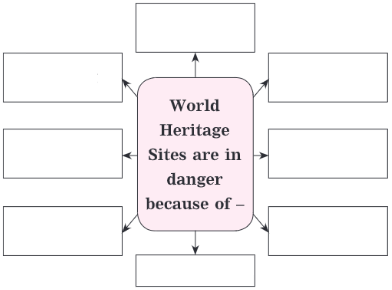
     Like many natural and historic cultural sites around the world, many World Heritage Sites are in danger of being destroyed or lost due to war, poaching, natural disasters like earthquakes, uncontrolled urbanization, heavy tourist traffic and environmental factors like air pollution and acid rain. World Heritage Sites that are in danger are inscribed on a separate List of World Heritage Sites in Danger which allows the World Heritage Committee to allocate resources from the World Heritage Fund to that site. In addition, different plans are put into place to protect and/or restore the site. If however, a site loses the characteristics which allowed for it to be originally included on the World Heritage List, the World Heritage Committee can choose to delete the site from the list. To learn more about World Heritage Sites, visit the World Heritage Centre’s website at whc.unesco.org.

A2. Complex Factual Activity:
Complete the following Web by giving reasons why World Heritage sites are in danger :
Image
A3. Activities based on Vocabulary:
Find out opposites from the passage for the following:
(1) artificial × _______________
(2) lowest × _______________
(3) exclude × _______________
(4) safe × _______________
A4. Activities based on Contextual Grammar:
Write the following sentences using 'not only... but also' and 'as well as' in two separate sentences:
(1) Opera House in Australia and the Historic Center of Vienna in Austria are cultural sites of the World Heritage.
A5. Personal Response:
(1) What is the role of the 'World Heritage Sites' in promoting tourism in any country?
A1. Simple Factual Activity:
Say whether the following statements are True or False:
(1) When the young seagull. pretended to be falling asleep, his parents took notice of him.
(2) Flying across the young seagull, the mother dropped into his beak a piece of fish.
(3) The young seagull was fed a piece of fish by his mother.
(4) The young seagull's father was preening the feathers on his white back.

     The sun was now ascending the sky, blazing on his ledge that faced the south. He felt the heat because he had not eaten since the previous nightfall.
     He stepped slowly out to the brink of the ledge, and standing on one leg with the other leg hidden under his wing, he closed one eye, then the other, and pretended to be falling asleep. Still they took no notice of him. He saw his two brothers and his sister
lying on the plateau dozing with their heads sunk into their necks. His father was preening the feathers on his white back. Only his mother was looking at him. She was standing on a little high hump on the plateau, her white breast thrust forward. Now and
again, she tore at a piece of fish that lay at her feet and then scrapped each side of her beak on the rock. The sight of the food maddened him. How he loved to tear food that way, scrapping his beak now and again to whet it.
     “Ga, ga, ga”, he cried begging her to bring him some food. “Gaw-col-ah”, she screamed back derisively. But he kept calling plaintively, and after a minute or so he uttered a joyful scream. His mother had picked up a piece of the fish and was flying across to him with it. He leaned out eagerly, tapping the rock with his feet, trying to get nearer to her as she flew across. But when she was just opposite to him, she halted, her wings motionless, the piece of fish in her beak almost within reach of his beak. He waited a moment in surprise, wondering why she did not come nearer, and then, maddened by hunger, he dived at the fish. With a loud scream he fell outwards
and downwards into space. Then a monstrous terror seized him and his heart stood still. He could hear nothing. But it only lasted a minute. The next moment he felt his wings spread outwards. The wind rushed against his breast feathers, then under his stomach, and against his wings. He could feel the tips of his wings cutting through the air. He was not falling headlong now. He was soaring gradually downwards and outwards. He was no longer afraid. He just felt a bit dizzy.

A2. Complex Factual Activity:

(1) What were the young seagull's parents doing? 
A3. Activities based on Vocabulary:
Match the words in Column 'A' with their meanings in Column 'B':

'A''B'
(1) ascending  (a) grabbed
(2) maddened (b) flying upward into the air
(3) soaring (c) made one very angry
(4) seized (d) rising up

A4. Activities based on Contextual Grammar:
Read the following sentences carefully, underline the verbs and find out the tenses in the sentences: 
(1) The sun was ascending now.
(2) Still they took no notice of him.
A5. Personal Response:
Complete the following statements:
(1) The seagull is afraid to fly because _______________ .
(2) Young birds are afraid to make their first flight because_______________.

A1. Simple Factual Activity:
Complete the sentences using the information from the passage:
(1) Mr Srivastava was talking to Kamal Kishore the owner of the photography shop.
(2) Sitaram was glad that he had been of service to both a customer and his friend.

      And Sitaram, glad that he had been of service to both a customer and his friend, hoisted his bag on his shoulders and went his way.
      Mrs. Srivastava had to do some shopping. She gave instructions to the ayah about looking after the baby, and told the cook not to be late with the midday meal. Then she set out for the Pipalnagar market place, to make her customary tour of the cloth shops.
      A large shady tamarind tree grew at one end of the bazaar, and it was here that Mrs. Srivastava found her friend Mrs. Bhushan sheltering from the heat. Mrs. Bhushan was fanning herself with a large handkerchief. She complained of the summer, which she affirmed, was definitely the hottest in the history of Pipalnagar. She then showed Mrs. Srivastava a sample of the cloth she was going to buy, and for five minutes they discussed its shade, texture and design. Having exhausted this topic, Mrs. Srivastava
said, ‘Do you know, my dear, that Seth Govind Ram’s bank can’t even pay its employees? Only this morning I heard a complaint from their sweeper, who hasn’t received his wages for over a month!’
     ‘Shocking!’ remarked Mrs. Bhushan. ‘If they can’t pay the sweeper they must be in a bad way. None of the others could be getting paid either.’
     She left Mrs. Srivastava at the tamarind tree and went in search of her husband, who was sitting in front of Kamal Kishore’s photography shop, talking with the owner.
    ‘So there you are!’ cried Mrs. Bhushan. ‘I’ve been looking for you for almost an hour. Where did you disappear ?’
    ‘Nowhere,’ replied Mr. Bhushan. ‘Had you remained stationary in one shop, I might have found you. But you go from one shop to another, like a bee in a flower garden.’
    ‘Don’t start grumbling. The heat is trying enough.I don’t know what’s happening to Pipalnagar. Even the bank’s about to go bankrupt.’   

A2. Complex Factual Activity:
Complete the following web:
Image
A3. Activities based on Vocabulary:
Find describing words for the following from the passage:
(1) shop (2) meal (3) tour (4) tamarind tree
A4. Activities based on Contextual Grammar:
(1) Mrs Bhushan went in search of her husband. He was sitting in front of Kamal Kishore's photography shop.
(Rewrite the sentence joining it with 'who'.)
(2) That summer was the hottest in the history of Pipalnagar.
(Change the sentence into Positive Degree.)
A5. Personal Response:
(1) Do you think, Mr Bhushan was right to compare his wife with a bee in a flower garden? Give your reason.
A1. Simple Factual Activities:
Answer in one word: 
(1) The motherland of Kailash Satyarthi
(2) The country which Iqbal Masih represents
(3) The place where Nobel Prize distribution programme was held
(4) The ancient texts of wisdom

     My dear children of the world ... Your Majesties, Your Royal Highnesses, Excellencies, distinguished members of the Norwegian Nobel Committee, dear brother Tom Harkin, brothers and sisters, and my dear daughter Malala.
      From this podium of peace and humanity, I am deeply honoured to recite a mantra from the ancient texts of wisdom, Vedas. This mantra carries a prayer, an aspiration and a resolve that has the potential to liberate humanity from all man-made crises.
      Let’s walk together. In the pursuit of global progress, not a single person should be left out or left behind in any corner of the world, from East to West, from South to North. Let’s speak together, let our minds come together! Learning from the experiences of our ancestors, let us together create knowledge for all that benefits all.
      I bow to my late parents, to my motherland India, and to the mother earth.
      With a warm heart I recall how thousands of times, I have been liberated, each time I have freed a child from slavery. In the first smile of freedom on their beautiful faces, I see the Gods smiling.
      I give the biggest credit of this honour to my movement’s Kaalu Kumar, Dhoom Das and Adarsh Kishore from India and Iqbal Masih from Pakistan who made the supreme sacrifice for protecting the freedom and dignity of children. I humbly accept this award on behalf of all such martyrs, my fellow activists across the world and my countrymen.
      My journey from the great land of Lord Buddha, Guru Nanak and Mahatma Gandhi; India to Norway is a connect between the two centres of global peace and brotherhood, ancient and modern.
      Friends, the Nobel Committee has generously invited me to present a “lecture.” Respectfully, I am unable to do that. Because, I am representing here - the sound of silence. The cry of innocence. And, the face of invisibility. I represent millions of those children who are left behind and that’s why I have kept an empty chair here as a reminder.

A2. Complex Factual Activities:
Complete the following sentences:
(1) The writer humbly accepts this award on behalf of all  _______________.
(2) The journey of the writer, that is India to Norway is a _______________.
A3. Activities based on Vocabulary:
Write the describing words for the following nouns from the passage:
(1) credit
(2) sacrifices
(3) chair
(4) pence
A4. Activities based on Contextual Grammar:
Make adjectives of:
(1) honour
(2) create
(3) silence
(4) peace
A5. Personal Response:
(1) Suggest any four ways to establish peace in the world.
A1. Simple Factual Activities:
Fill in the blanks:
(1) Ramlal had ________ sons and ________ daughters.
(2) All the children except Bholi were ________ and ________.

    Her name was Sulekha but since her childhood everyone had been calling her Bholi the simpleton.
    She was the fourth daughter of Numberdar Ramlal. When she was ten months old, she had fallen off the cot on her head and perhaps it had damaged some part of her brain. That was why she remained a backward child and came to be known
as Bholi, the simpleton.
     At birth the child was very fair and pretty. But when she was two years old, she had an attack of small pox. Only the eyes were saved. But the entire body was permanently disfigured by deep black pockmarks. Little Sulekha could not speak till she was five and when at last she learnt to speak, she stammered. The other children often made fun of
her and mimicked her. As a result, she talked very little.
     Ramlal had seven children, three sons and four daughters and the youngest of them was Bholi. It was a prosperous farmer’s household and there was plenty to eat and drink. All the children except Bholi were healthy and strong. The sons had been sent to
the city to study in schools and later in colleges. Of the daughters Radha, the eldest had already been married. The second daughter Mangla’s marriage had also been settled Ramlal would think of third Champa. They were good looking, healthy girls. And
it was not difficult to find bridegrooms for them.
     But Ramlal was worried about Bholi. She had neither good looks nor intelligence.
     Bholi was seven years old when Mangla was married. The same year a primary school for girls was opened in their village. The Tehsildar sahib came to perform its opening ceremony. He said to Ramlal, ‘‘As a revenue official you are the representative of the government in the village and so you must set an example to the villagers. You
must send your daughter to school.’’
      That night when Ramlal consulted his wife. She cried, ‘‘Are you crazy? If girls go to school, who will marry them?’’
      But Ramlal had not the courage to disobey the Tehsildar. At last his wife said, ‘‘I will tell you what to do. Send Bholi to school. As it is there is little chance of her getting married, with her ugly face and lack of sense. Let the teachers at school worry about her.’’

A2. Complex Factual Activities:
Give reasons:
(1) Little Sulekha used to talk very little because - _______________
A3. Activities based on Vocabulary:
Use the following phrases in the following sentences by making certain changes:
(to shout in terror, to pass on, to hand over)
(1) My sister _______________ a letter of apology to her class teacher.
(2) My father had the day off because he didn't want _______________ his flu to everyone in the office."
A4. Activities based on Contextual Grammar:
Do as directed:
(1) The child was very fair and pretty.
(Choose correct alternative to make it exclamatory.)
(a) What a fair and pretty the child was!
(b) How a fair and pretty the child was!
(c) How fair and pretty the child was!
(2) There was plenty to eat and drink.
(Pick out the infinitive.) 
A5. Personal Response:
(1) How do you feel on the first day of your school? 
A1. Simple Factual Activities:
State whether you Agree or Disagree with the following statements: 
Statements
(1) The narrator was fifty-five years old when this incident occurred.
(2) Even today, the narrator cannot forget that look in the mother langur's eyes.

    For a few seconds, the mother langur looked straight into my eyes. Even today, I cannot forget that look in her eyes, showering silent gratitude on me for saving her child. I was overwhelmed by the emotion, the sentiment and the way she said thanks to me. There sat a universal mother holding a stricken child in her lap.
    Then, in a flash, she jumped with her baby clinging to her belly and reached our kitchen roof. She surveyed the area for the vicious male langur and then leapt away in the direction opposite to the place of the violent encounter.
    The brief meeting with the mother and the baby langur convinced me that interspecies communication and mutual trust is indeed a reality and should anyone strike the right chord, the relationship hums into action. The mother langur showed me that food was not the only means of communication between man and animal but that there were other means of establishing a bond through trust, compassion and mutual understanding.
     Fifty-five years have passed since that day. I am now seventy years old. But I still fondly remember that ‘encounter of a special kind’.

A2. Complex Factual Activities:
Complete the web:
Image
 
A3. Activities based on Vocabulary:
Find the words from the passage for the following meanings:
(1) held closely
(2) moved downwards
(3) think very deeply
(4) comfort and peace
A4. Activities based on Contextual Grammar:
Do as directed:
(1) I cannot forget that look in her eyes. (Add a question tag.)
(2) I was overwhelmed by the emotion.
(Write the sentence in Active voice. Begin with The emotion....)
A5. Personal Response:
(1) What opinion do you form about the writer from the story?
A1. Simple Factual Activity:
Complete the following sentences with the help of the passage:
(1) Specific goals make it easier to _______________.
(2) It is important to create goals that are _______________.

SMART goals have a specific rubric:
    Specific: Involves identifying a specific area for improvement. The more specific the area, the more refined the achievement of one’s goal can be. It makes it easier to set parameters and work towards the goal. For exaxmple, if it is building a house, what exactly is the capacity required and how long can it stretch ?
    Measurable: Quantifying goals provides specific ways to track progress against goals. This makes it easy to benchmark performance throughout the goal period, including areas to improve. While playing football, one’s exact role and position has to be clearly defined.
     Achievable: Setting goals that can be completed in the designated period of time. Often, these goals may act like stepping stones to help meet broader goals that further define a career. As students, we can’t become a President, a Prime Minister, but can hope to reach those heights in future.
      Realistic: It is important to create goals that are within one’s current skill set or area of expertise. Building expertise takes time, so expecting to become an expert in a short amount of time is unrealistic. Being realistic will make it easy to be successful at attaining goals. If defensive and not aggressive, the goal perhaps lacks realism. We must have the clear picture in mind and must have the ability to adhere to that picture.

A2. Complex Factual Activities:
(1) How does quantifying goals help us?
A3. Activities based on Vocabulary:
Find from the passage adjectives for the following:
(1) area
(2) period
(3) role
(4) stones 
A4. Activities based on Contextual Grammar:
Underline the Present Participles/ Infinitives: 
(1) It makes it easier to set parameters.
(2) These goals may act like stepping stones to help broader goals.
A5. Personal Response:
(1) Why is it necessary that our goals should be realistic?
A1. Simple Factual Activities:
Complete the following sentences:
(1) Soldiers called Joan _______________.
(2) Joan wanted _______________.
(3) The shortest way to save your skin is to _______________.
(4) According to Joan, their soldiers are always beaten because they fight _______________.

Poulengey : (Going to the window) Yes! Joan, come up. (Joan enters.)
Poulengey : (Gravely) Be seated, Joan.
Robert : What is your name ?
Joan : They always called me Jenny, in Lorraine. Here in France, I am Joan. The soldiers call me the Maid.
Robert : How old are you ?
Joan : Seventeen, so they tell me. It might be nineteen. I don’t remember.
Robert : I suppose you think raising a siege is as easy as chasing a cow out of a meadow. You think soldiering is anybody’s job ?
Joan : I don’t think it can be very difficult if God is on your side.
Robert : (Grimly) Have you ever seen English soldiers fighting? Have you ever seen them plundering, burning, turning the countryside into a desert ? Have you heard no tales of their prince who is the devil himself, or of the English king’s father ?
Joan : You do not understand, squire. Our soldiers are always beaten because they are fighting only to save their skins and the shortest way to save your skin is to run away. But I will teach them all to fight for France. Then, they will drive the soldiers before them like sheep. You and Polly will live to see the day when there will not be a single English soldier on the soil of France.
Robert : (To Poulengey) This may all be nonsense, Polly. But the troops might just be inspired by it though nothing that we say seems to put any fire into them. Even the Dauphin might believe it. And if she can put some fire into him, she can put it into anybody.
Robert : (Turning to Joan) Now you, listen to me and don’t cut in before I have time to think. Your orders are that you are to go to Chinon under the escort of this gentleman and three of his friends.
Joan : (Radiant, clasping her hands) Oh, thank you, squire !
Poulengey : How is she to get into the royal presence ?
Robert : I don’t know. How did she get into my presence ? I will send her to Chinon and she can say I sent her. Then, let come what may. I can do no more.
Joan : And the dress ? I may have a soldier’s dress, squire ?
Robert : Take what you please. I wash my hands off it.
Joan : (Wildly excited by her success) Come, Polly. (She dashes out.)
Robert : (Shaking Poulengey’s hand) Goodbye, old man, I am taking a big chance. Few other men would have done it.

A2. Complex Factual Activities:
(1) What shows Joan was a person of immense faith?
A3. Activities based on Vocabulary:
Find out synonyms:
(1) looting - 
(2) seriously - 
(3) following - 
(4) hayfield - 
A4. Activities based on Contextual Grammar:
Rewrite as affirmative sentences:
(1) I don't remember.
(2) YYou do not understand Squire.
A5. Personal Response:
(1) Do you love your country? Why? 
A1. Simple Factual Activities:
Complete the following web: 
Image

To see a world in a grain of sand
     And a heaven in a wild flower,
Hold infinity in the palm of your hand
      And eternity in an hour
    We instinctively turn to outdoor activities and nature as a way of relaxing and enhancing our wellbeing. Nature soothes and nurtures. Nature fulfils and motivates. Nature whispers and commands.
    Are you listening?
    When I do, it leaves me in complete awe.
    We have a hibiscus plant in our garden. Every fortnight a flower blooms on it big, bright and tender. Through the day it smiles with the sun and dances with the wind, but as evening approaches, it starts wilting. The morning after, it withers completely and by evening it falls and becomes one with the earth again. The flower comes to life only for a day, yet it does so in full splendour. What if we too lived our life, however short, to its fullest?
    We went to a rocky beach and saw the spread of the majestic ocean and the rocks alongside, carved, sculpted and shaped by the water. Water is so gentle, rock so hard, yet, as the water flows over it every day, for years, the rock gives in. It takes the shape that the water commands. Our problems are so colossal and we are so small, yet if we persist.... 

A2. Complex Factual Activities:
The writer explains the contrast features of 'water' and 'rock' in the text. Write all the features of both water and rock in the given table: 
A3. Activities based on Vocabulary:
Match the pairs of antonyms.

 Words Antonyms
 (1) gentle (a) small
 (2) colossal (b) long
 (3) short (c) quit
 (4) persist (d) hard

A4. Activities based on Contextual Grammar:
Frame Wh-questions to get the underlined parts as answers:
(1) The flower comes to life only for a day.
(2) We saw the spread of the majestic ocean.
A5. Personal Response:
(1) Explain the line Nature whispers and commands.'