Question
A1. Simple Factual Activity:
Complete the following web with the words associated with the passage and the given title:
Image

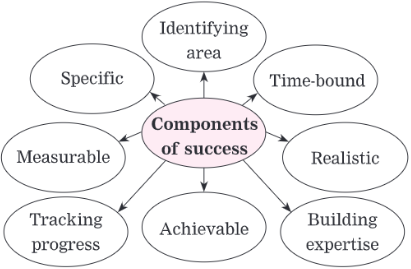
SMART goals have a specific rubric:
    Specific: Involves identifying a specific area for improvement. The more specific the area, the more refined the achievement of one’s goal can be. It makes it easier to set parameters and work towards the goal. For exaxmple, if it is building a house, what exactly is the capacity required and how long can it stretch ?
    Measurable: Quantifying goals provides specific ways to track progress against goals. This makes it easy to benchmark performance throughout the goal period, including areas to improve. While playing football, one’s exact role and position has to be clearly defined.
     Achievable: Setting goals that can be completed in the designated period of time. Often, these goals may act like stepping stones to help meet broader goals that further define a career. As students, we can’t become a President, a Prime Minister, but can hope to reach those heights in future.
      Realistic: It is important to create goals that are within one’s current skill set or area of expertise. Building expertise takes time, so expecting to become an expert in a short amount of time is unrealistic. Being realistic will make it easy to be successful at attaining goals. If defensive and not aggressive, the goal perhaps lacks realism. We must have the clear picture in mind and must have the ability to adhere to that picture.

A2. Complex Factual Activities:
Pick out examples from the text that support each of the following facts:
(1) Goals should be achievable.
(2) A specific field/area has to be fixed to achieve goals.
A3. Activities based on Vocabulary:
Cross the odd man out:
(1) involve, provide, important, create.
(2) specific, realistic, defensive, capacity.
(3) performance, achievement, aggressive, President.
(4) clearly, Ineky, freely, exactly.
A4. Activities based on Contextual Grammar:
Underline the Present Participles/ Infinitives: 
(1) Being realistic will make it easy to be successful at attaining goals.
(2) You must have the ability to adhere to that picture.
A5. Personal Response:
(1) Why is it necessary that our goals should be realistic?
Answer

A1. Simple Factual Activity:
Image
A2. Complex Factual Activities:
(1) Example: We can't become a President, a Prime Minister, but we can hope to hold the office of an important social worker and deliver results.
(2) Example: If it is building a house, what exactly is the capacity required and how long can it stretch?
A3. Activities based on Vocabulary:
(1) important
(2) capacity
(3) aggressive
(4) Iueky
A4. Activities based on Contextual Grammar:
(1) Being realistic will make it easy to be successful at attaining goals.
(2) You must have the ability to adhere to that picture.
A5. Personal Response:
(1) It is important to create goals that are within our current skills limit. We must be expert in the area we have undertaken. Our approach towards our goal must be realistic and positive. We must have to work hard and know how and when we can attain the goal.

Need a full question paper?

Generate a complete, print-ready paper with questions like this in minutes — across 16+ boards, with answer keys.

Start Generating Free

Similar questions

A1. Simple Factual Activities:
Choose the correct alternative for each of the following questions:
(1) What does the word 'Bholi' mean?
(a) angry (b) foolish (c) simpleton (d) sad.
(2) At what age Bholi had an attack of smallpox?
(a) six (b) two (c) ten (d) nine.

     Her name was Sulekha but since her childhood everyone had been calling her Bholi the simpleton.
    She was the fourth daughter of Numberdar Ramlal. When she was ten months old, she had fallen off the cot on her head and perhaps it had damaged some part of her brain. That was why she remained a backward child and came to be known
as Bholi, the simpleton.
     At birth the child was very fair and pretty. But when she was two years old, she had an attack of small pox. Only the eyes were saved. But the entire body was permanently disfigured by deep black pockmarks. Little Sulekha could not speak till she was five and when at last she learnt to speak, she stammered. The other children often made fun of
her and mimicked her. As a result, she talked very little.
     Ramlal had seven children, three sons and four daughters and the youngest of them was Bholi. It was a prosperous farmer’s household and there was plenty to eat and drink. All the children except Bholi were healthy and strong. The sons had been sent to
the city to study in schools and later in colleges. Of the daughters Radha, the eldest had already been married. The second daughter Mangla’s marriage had also been settled Ramlal would think of third Champa. They were good looking, healthy girls. And
it was not difficult to find bridegrooms for them.
     But Ramlal was worried about Bholi. She had neither good looks nor intelligence.
     Bholi was seven years old when Mangla was married. The same year a primary school for girls was opened in their village. The Tehsildar sahib came to perform its opening ceremony. He said to Ramlal, ‘‘As a revenue official you are the representative of the government in the village and so you must set an example to the villagers. You
must send your daughter to school.’’
      That night when Ramlal consulted his wife. She cried, ‘‘Are you crazy? If girls go to school, who will marry them?’’
      But Ramlal had not the courage to disobey the Tehsildar. At last his wife said, ‘‘I will tell you what to do. Send Bholi to school. As it is there is little chance of her getting married, with her ugly face and lack of sense. Let the teachers at school worry about her.’’

A2. Complex Factual Activities:
(i) Complete the reasons:
Ramlal decided to send Bholi to school because -
A3. Activities based on Vocabulary:
Use the following phrases in the following sentences by making certain changes:
(to shout in terror, to pass on, to look up at.)
(1) Ruta _______________ when she saw a cobra in front of her.
(2) The world _______________ Dr Kalam as a great visionary.
A4. Activities based on Contextual Grammar:
Correct the errors in the following sentences. Focus on verbs and subject:
(1) All children, except Bholi, was healthy and strong.
(2) Since childhood, everyone will have calling her Bholi.
A5. Personal Response:
(1) Explain the following statement: 
A1. Simple Factual Activities:
State who/what:
(1) Colours the entire sky.
(2) Takes new shapes with every passing moment,
(3) Makes trees dance.
(4) Changes its forın according to the dictates of the sun and the wind.

     We saw small bits of grass peeping through the small cracks in a concrete pavement. It left us thinking : however impossible things may look, there is always an opening...
     We saw a tree bare of all leaves in the cold winter months. We thought its chapter was over. But three months passed, spring set in and the tree was back to its green majesty once again, full of leaves, flowers, birds and life. What if we too had the conviction that, however difficult things are right now, it will not remain so for ever. Remember, this too shall pass.
     We saw an army of ants lugging a fly which was at least ten times the ant’s size. The ants organized themselves around the fly, lifted it on frail feelers and carried it to quite a distance. Their teamwork and perseverance were impressive. What if we too are consistent, organized, focused...Spider webs are delicate, yet very strong. A rainbow colours the entire sky. Oysters take in a grain of sand they open up with a pearl. Innumerable stars shine across the infinite sky. Clouds take new shapes with every passing moment. The wind makes trees dance with unhindered passion. Water, without hint of ego, changes its form according to the dictates of the sun and the wind. When we see a caterpillar turn into a butterfly, a flower turn into a fruit, we experience the alchemy of nature... we touch it and become gold ourselves.

A2. Complex Factual Activities:
(1) What are the alchemies of nature mentioned in the extract?
A3. Activities based on Vocabulary:
Match the pairs of antonyms:

 WordsAntonyms
 (1) impossible (a) easy
 (2) difficult (b) strong
 (3) delicate (c) forget
 (4) remember (d) possible

A4. Activities based on Contextual Grammar:
Identify the tenses:
(1) We saw an army of ants
(2) We experience the alchemy of nature
A5. Personal Response:
(1) 'Nature is our best teacher'-Explain.

A1. Simple Factual Activity:
State whether the following statements are True or False:
(1) The young seagull was not confident about the ability of his wings.
(2) The young seagull's parents guided and improved his siblings in the art of flying.
(3) The wings of the young seagull were not as short as his own.
(4) The whole family of seagulls commended him for his cowardice.

     The young seagull was alone on his ledge. His two brothers and his sister had already flown away the day before. He had been afraid to fly with them. Somehow when he had taken a little run forward to the brink of the ledge and attempted to flap his
wings he became afraid. The great expanse of sea stretched down beneath, and it was such a long way down - miles down. He felt certain that his wings would never support him; so he bent his head and ran away back to the little hole under the ledge where he slept at night. Even when each of his brothers and his little sister, whose wings were far
shorter than his own, ran to the brink, flapped their wings, and flew away, he failed to muster up courage to take that plunge which appeared to him so desperate. His father and mother had come around calling to him shrilly, upbraiding him, threatening to let him starve on his ledge unless he flew away. But for the life of him he could not move.
      That was twenty-four hours ago. Since then nobody had come near him. The day before, all day long, he had watched his parents flying about with his brothers and sister, perfecting them in the art of flight, teaching them how to skim the waves and how to dive for fish. He had, in fact, seen his older brother catch his first herring and devour it, standing on a rock, while his parents circled around raising a proud cackle. And all the morning the whole family had walked about on the big plateau midway down the opposite cliff taunting him for his cowardice.

A2. Complex Factual Activity:

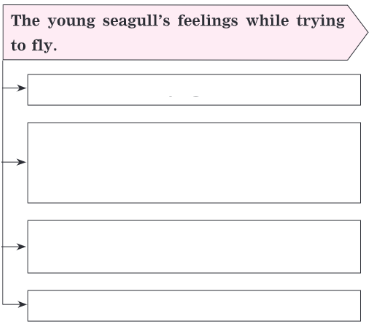
Complete the web describing the young seagull's feelings while trying to fly:
Image
A3. Activities based on Vocabulary:
Guess the meanings of :
(1) muster up courage
(2) eliff
(3) upbraiding
(4) brink
A4. Activities based on Contextual Grammar:
(1) He became afraid.
(2) Since then nobody had come near him.
A5. Personal Response:
(1) Are you afraid of playing any outdoor game? Explain why?
A1. Simple Factual Activity:
Write whether the following statements are 'true' or 'false":
(1) The compound where the writer was living, was rich in nature's bounty.
(2) Holidays provide the children an opportunity to read various magazines and storybooks.

     My father was a medical professional working for a private company in Raniganj in West Bengal. The officers of the company were housed in individual bungalows inside a large campus. Our house was in a corner of the campus. The officer’s club was adjacent to the boundary wall of our garden. The compound was luxurious with green grass, colourful flowers and a host of tall and majestic trees. The seasonal vegetables in the kitchen gardens of the households and the magnificent trees constantly attracted squirrels and many species of birds; a group of langurs had even made their den in an aswatha tree nearby. They had all become a part and parcel of our existence and daily life.
     A small incident on a Saturday afternoon left a profound effect on me and unfolded before my eyes a whole new dimension to the wonders of God’s creation. It was a few days into the Puja vacation. Just like for any other child, the holidays provided an opportunity for me to become engrossed in various magazines and storybooks published specially for children in the festive season.
     After a hearty lunch, my parents and my younger sisters lay down for an afternoon nap and I settled down with a storybook. The quiet afternoon presented the perfect backdrop for reading an adventure story. The silence was occasionally broken by the sound of my family snoring, the intermittent chirping of house sparrows, the harsh cawing of a crow the shrill call of a kite flying high above the ground. Minutes ticked by. I became deeply absorbed in the book.

A2. Complex Factual Activities:
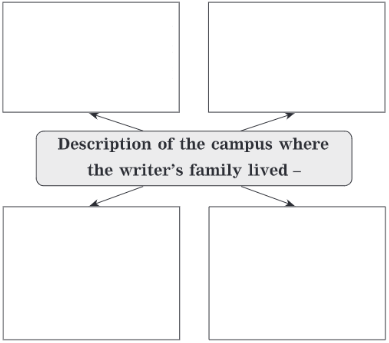
Complete the web describing the campus where writer's family lived:
Image
A3. Activities based on Vocabulary:
Find from the passage the antonyms of : 
(1) folded × _______________
(2) old x _______________
(3) outside x _______________
(4) distracted × _______________
A4. Activities based on Contextual Grammar: 
(1) They attracted squirrels and many species of birds. (Choose the correct passive voice) 
(a) Squirrels and many species of birds was attracted by them.
(b) Squirrels and many species of birds are attracted by them.
(c) Squirrels and many species of birds were attracted by them.
(d) Squirrels and many species of birds attract them.

(2) The compound was luxurious with green grass. (Choose the correct question tag.)
(a) doesn't it?  (b) does it? 
(c) wasn't it?    (d) was it?
A5. Personal Response :
(1) Which type of story do you like to read? Why? 
A1. Simple Factual Activities:
Choose the correct alternatives:
(1) What did Mary Kom prefer being called?
(a) Super mom    (b) Super woman
(c) Super being   (d) Super Boxer
(2) What would be a key factor in your conditioning for the Olympics? 
(a) saturated fats
(b) diet and nutrition
(c) trophies and medals

Interviewer :
Do you think interest in boxing in India will ever go beyond the Olympics ?
Mary Kom : Yes, I am sure that in a few years boxing will be very popular among everyone in India, all the year round.
Interviewer : How aware are Indian women of their nutritional requirements ? Diet and nutrition must’ve been a key factor in your conditioning for the Olympics. Do you think nutrition is a neglected area in Indian sports ?
Mary Kom : The awareness is growing now among the female athletes when it comes to nutritional requirements. Nutrition has definitely been a neglected area in Indian sports. I had to gain 3 kgs since I had to fight in the 51kg event instead of the usual 48kgs that I fight in. So I had to focus on what to eat. I gained weight by eating the right kind of healthy food rather than bad saturated fats.
Interviewer : How big a role did OGQ play in shaping the boxing scene in India for the better ?
Mary Kom : OGQ really played an important part in my success. They helped me out whenever I needed something. They took care of everything, which helped me focus on my boxing and kept me stress - free.
Interviewer : What’s your opinion on the future of Indian boxing ?
Mary Kom : The future is very bright and I am sure many more boxers will get medals for us.
Interviewer : Do you find it difficult to convince your children not to fight when they watch you go out and do it in style all the time ?
Mary Kom : Well, I have twins and yes, sometimes it becomes really difficult to keep them under control.
Interviewer : Will you train your kids to become boxers as well ?
Mary Kom : I haven’t really thought about it. As of now, just let their mother box !
Interviewer : You have broken several stereotypes about the women in India by showing that women can compete with men in any field. But how good are you at the ‘traditional’ feminine activities like cooking ?
Mary Kom : Well, I am good at cooking and other household work too.
Interviewer : Would you be interested in coaching Indian women in boxing one day ?
Mary Kom : Let’s see. In the future, may be yes.
Interviewer : What do you prefer being called -Super Mom or Super Boxer ?
Mary Kom : I love being a mom. That’s the best thing that has ever happened to me. 
Awards and recognitions
• Arjuna Award (Boxing) in 2003
• Padma Shree (Sports) in 2006
• Contender for Rajiv Gandhi Khel Ratna Award in 2007
• People of the Year - Limca Book of Records in 2007
• CNN-IBN and Reliance Industries Real Heroes Award in 2008
• Pepsi MTV Youth, AIBA in 2008
• ‘Magnificent Mary’, AIBA in 2008
• Felicitation by Zomi Student’s Federation (ZSF) at New Lamka YPA Hall in 2008
• Rajiv Gandhi Khel Ratna award in 2009
• International Boxing Association’s Ambassador for Women’s Boxing in 2009
• Sportswoman of the year, Sahara Sports Award in 2010.

A2. Complex Factual Activities:
(1) What did OGQ do for Mary Kom? 
A3. Activities based on Vocabulary:
Find out opposite words for the following from the passage.
(1) hated ×
(2) fair ×
(3) Inclusive ×
(4) diffident ×
A4. Activities based on Contextual Grammar:
Underline the subordinate clause and state its kind:
(1) The male boxers were kind enough to practise with me, whenever I required them.
Kind: _______________
(2) I think more and more people should take up sports as a full-time career.
Kind: _______________
A5. Personal Response:
(1) Name some sportswomen you know:
A1. Simple Factual Activities:
Write whether the following sentences are True or False:
(1) Meena chose the beggar as her role model.
(2) There was traffic on the road.
(3) The beggar and the young girl taught Meena how to be happy with life as it was.
(4) The beggar and the young girl were playing on the terrace.

     ‘Yes, a beggar,’ she repeated, as if to reassure me. ‘He was old and used to stay in front of my house with his five-year old granddaughter. As you know, I was a chronic pessimist. I used to give my leftovers to this beggar every day. I never spoke to him. Nor did he speak to me. One monsoon day, I looked out of my bedroom window and started cursing the rain. I don’t know why I did that because I wasn’t even getting wet. That day I couldn’t give the beggar and his granddaughter their daily quota of leftovers. They went hungry, I am sure.
     ‘However, what I saw from my window surprised me. The beggar and the young girl were playing on the road because there was no traffic. They were laughing, clapping and screaming joyously, as if they were in paradise. Hunger and rain did not matter.They were totally drenched and totally happy. I envied their zest for life.
     ‘That scene forced me to look at my own life. I realized I had so many comforts, none of which they had. But they had the most important of all assets, one which I lacked. They knew how to be happy with life as it was. I felt ashamed of myself. I even started to make a list of what I had and what I did not have. I found I had more to be grateful for than most people could imagine. That day, I decided to change my attitude towards life, using the beggar as my role model.’
      After a long pause, I asked Meena how long it had taken her to change.
     ‘Once this realization dawned’, she said, ‘it took me almost two years to put the change into effect. Now nothing matters. I am always happy. I find happiness in every small thing, in every situation and in every person.’
     ‘Did you give any gurudakshina to your guru ?’ I asked.
     ‘No. Unfortunately, by the time I understood things, he was dead. But I sponsored his granddaughter to a boarding school as a mark of respect to him.’

A2. Complex Factual Activities:

Arrange the following sentences as per their sequence occurred in the passage:
(i) Meena changed her attitude towards life.
(ii) Meena felt ashamed of herself.
(iii) The beggar and the young girl were playing on the road.
(iv) The beggar and the young girl were totally drenched and totally happy.
A3. Activities based on Vocabulary:
Find antonyms of the following words from the passage:
(1) frowned ×   _____________
(2) hell ×  _____________
(3) unhappy ×  _____________
(4) disrespect ×  _____________.
A4. Activities based on Contextual Grammar:
(1) Do as directed:
The beggar and the young girl were playing on the road.
(Rewrite it in 'present continuous tense'.)
(2) Change into indirect speech:
"Did you give any gurudakshina to your Guru?" I asked.
A5. Personal Response:
(1) Who is your role model? Why? 
A1. Simple Factual Activities:
State whether you Agree or Disagree with the following statements: 
(1) 'There is always an opening even in impossible things' - we learn it from small bits of grass. 
(2) Our difficult time never changes.
(3) The team work and perseverance of the ants were impressive.
(4) Clouds take new shapes with every passing moment.

     We saw small bits of grass peeping through the small cracks in a concrete pavement. It left us thinking : however impossible things may look, there is always an opening...
     We saw a tree bare of all leaves in the cold winter months. We thought its chapter was over. But three months passed, spring set in and the tree was back to its green majesty once again, full of leaves, flowers, birds and life. What if we too had the conviction that, however difficult things are right now, it will not remain so for ever. Remember, this too shall pass.
     We saw an army of ants lugging a fly which was at least ten times the ant’s size. The ants organized themselves around the fly, lifted it on frail feelers and carried it to quite a distance. Their teamwork and perseverance were impressive. What if we too are consistent, organized, focused...Spider webs are delicate, yet very strong. A rainbow colours the entire sky. Oysters take in a grain of sand they open up with a pearl. Innumerable stars shine across the infinite sky. Clouds take new shapes with every passing moment. The wind makes trees dance with unhindered passion. Water, without hint of ego, changes its form according to the dictates of the sun and the wind. When we see a caterpillar turn into a butterfly, a flower turn into a fruit, we experience the alchemy of nature... we touch it and become gold ourselves.

A2. Complex Factual Activities:
(1) What are the alchemies of nature mentioned in the extract? 
A3. Activities based on Vocabulary:
Frame meaningful sentences by using the given words:
(1) impressive
(2) passion
A4. Activities based on Contextual Grammar:
Identify the tenses:
(1) It will not remain so forever
(2) Ants were lugging a fly.
A5. Personal Response:
(1) Impossible itself says 'I M possible'. Do you agree? Justify your answer by citing some examples from the text and some that you have experienced or heard from someone.
A1. Simple Factual Activities:
State whether the following statements are Right or Wrong. Correct the wrong ones:
(1) The author and Meena were great enemies.
(2) Meena was a very cheerful person initially.

     Meena is a good friend of mine. She is an LIC officer earning a good salary. But there was always something strange about her. She was forever unhappy. Whenever I met her, I would start to feel depressed. It was as though her gloom and cynicism had a way of spreading to others. She never had anything positive to say on any subject or about any person.      
     For instance, I might say to her, ‘Meena, did you know Rakesh has come first in his school ?’     
     Meena’s immediate response would be to belittle the achievement. ‘Naturally, his father is a school teacher’, she would say.      
     If I said, ‘Meena, Shwetha is a very beautiful girl, isn’t she ?’ Meena would be pessimistic. ‘When a pony is young, he looks handsome. It is age that matters. Wait for some time. Shwetha will be uglier than anyone you know.’      
     ‘Meena, it’s a beautiful day. Let’s go for a walk’. 
     ‘No, the sun is too hot and I get tired if I walk too much. Besides, who says walking is good for health ? There’s no proof.’
     That was Meena. She stayed alone in an apartment as her parents lived in Delhi. She was an only child and had the habit of complaining about anything and everything. Naturally, she wasn’t a very pleasant company and nobody wanted to visit her. Then one day, Meena was transferred to Bombay and soon we all forgot about her.
     Many years later, I found myself caught in the rain at Bombay’s Flora Fountain. It was pouring and I didn’t have an umbrella. I was standing near Akbarallys, a popular department store, waiting for the rain to subside. Suddenly, I spotted Meena. My first reaction was to run, even in that pouring rain. I was anxious to avoid being seen by her, having to listen to her never-ending complaints. However, I couldn’t escape. She had already seen me and caught hold of my hand warmly. What’s more, she was very cheerful.
     ‘Hey ! I am really excited. It’s nice to meet old friends. What are you doing here ?’
     I explained that I was in Bombay on an official work.

A2. Complex Factual Activities:
Choose the correct alternative and rewrite the sentences:
(1) Meena who is an LIC officer, is _______________.
(a) a pessimistic person
(b) an optimistic person
(c) a disabled person.
(2) The writer was standing near Akbarallys, a popular department store because _______________.
(a) she was waiting for her friend Meena.
(b) she was waiting for the rain to stop.
(c) she wanted to buy something in Akbarallys.
A3. Activities based on Vocabulary:
Match the words with their meanings:

Group 'A'Group 'B'
 (1) gloom (a) to abate
 (2) cynicism (b) expecting the worst
 (3) subside (c) feeling of sadness
 (4) pessimistic (d) a distrustful attitude

A4. Activities based on Contextual Grammar:
(1) Choose the correct alternative of affirmative sentence:
She wasn't a very pleasant company.
(a) She was a very unpleasant company.
(b) She wasn't a very unpleasant company.
(c) She was a very pleasant company.
(d) She was a very beautiful company.
(2) Do as directed:
Meena is a LIC Officer.
(Frame a wh-question to get the underlined part as an answer)
A5. Personal Response:
(1) If you have a friend like Meena, what would be your attitude towards her?

A1. Simple Factual Activity:
Complete the sentences with the help of the information in the passage:
(1) The quality and quantity of energy we put forth, _______________.
(2) _______________ is a walk in the dark.

    Time-bound: Establish time parameters around each goal, as it will help increase focus and accountability. To reduce weight we know how to go about it. But without consistent time - bound action, it never becomes a reality. It may be exercise, diet and stress-free thoughts. All these have to be practised and implemented without hesitation, doubt or indifference, but within a deadline.
    Visions, wishes, intentions and dreams are all valuable. They spark off imagination and encourage us to define where we want to reach. In order to get there, however, we need to bring life images, down to earth and plan to execute our strategies. The quality and quantity of energy we put forth, directly impact the results. Life is something like a trumpet. If we don’t put anything in, we can’t get anything out.
     Success is a walk in the dark. Finding the right footing, precisely mastering the skills and getting to the next place, all depend on how we approach and
tackle the problem. The best way to get from where we are, to where we want to be is to find the footing of our next step. When we take the next step, it should support and hold us without a crack.

A2. Complex Factual Activity:

Pick out examples from the passage that support each of the following facts:
(a) Good results depend upon the quality and quantity of work put in.
(b) A time-limit should be set to achieve goals.
A3. Activities based on Vocabulary:
Classify the following words in their respective columns: 
ah, of, if, and, oh, from, we, but, it, hurrah

PronounPrepositionConjunctionInter- jection
    

A4. Activities based on Contextual Grammar:
(1) We need to bring life images. (Underline the infinitive.) 
(2) The next step should support and hold us without a crack.
(Choose the correct question tag.)
(a) should it? (b) don't it? (c) shouldn't it?
A5. Personal Response:
(1) 'If we don't put anything in, we can't get anything out.' Explain.

A1. Simple Factual Activity:
State whether you Agree or Disagree with the following statements:
(1) Swami is a close-mouthed little kid.
(2) Swami hated Mathematics even worse.

     A little bit about the book...
     Anything I mention about the book can be mistakenly understood as 'spoilers', so I would rather give a glance into the book without mentioning any events or plots of the story.
     Swami is a mischievous little kid of about 10 years old and living in the era where India was under the British rule... Like most kids of that age, Swami is a kid who cannot stay at one place and absolutely hates school, even worse Mathematics. School is his absolute nightmare. Anyway the story unfolds around the happenings of this kid and how he constantly gets into trouble and gets a good beating from his father.
      Swami is a talkative little kid and thinks that’s his way of facing life, talking himself out of everything. But he does learn the truth the harsh way. As many teens back then, all he wants to do is play under the sun, kick something, climb a tree, break something and harass somebody (unlike kids today!!!). This, in fact, was (and in most parts of India, still is) the life of a typical boy growing up. Technology isn’t big in a kid's life. All they want is to play havoc!!!
       In what ways is Swami a typical boy in his growing years ?
       In this regard, Narayan gets deeply into the workings of Swami’s ten year old mind, explaining exquisitely how he thinks and what his perspective of the world is. The reader does feel like Swami and gets very attached with the character as the story progresses. That's the magic of Narayan.

A2. Complex Factual Activity:
(1) Describe Swami's characteristics in 3-4 sentences. 
A3. Activities based on Vocabulary:
Underline the odd man:
(i) mentioning, happenings, everything, facing
(ii) mischievous, truth, talkative, typical
(iii) give, mention, stay, life
(iv) constantly, absolutely, lovely, deeply
A4. Activities based on Contextual Grammar:
Frame Wh-questions to get the underlined parts as answers:
(1) Narayan gets deeply into the working of Swami's mind.
(2) That's the magic of Narayan.
A5. Personal Response:
(1) Do you think, that even today most of our kids like to live the life Swami was living?