Questions

Write short notes

Take a timed test

6 questions · self-marked practice — reveal the answer and mark yourself.

Question 13 Marks
Role of calcium ions in contraction and relaxation of muscles.
Answer
Calcium ions play a major role in contraction and relaxation of muscles.
  1. Calcium ions are released from the sarcoplasm during muscle contraction and stored in sarcoplasmic reticulum during muscle relaxation.
  2. When a skeletal muscle is excited and an action potential travels along the T tubule, the concentration of calcium ions increases.
  3. These calcium ions bind to troponin which in turn undergoes a conformational change that causes tropomyosin to move away from the myosin-binding sites on actin. Once these binding sites are free, myosin heads bind to them to form cross-bridges and the muscle fiber contracts.
  4. The decrease in calcium ion concentration in the sarcoplasmic reticulum causes tropomyosin to slide back and block the myosin binding sites on actin. This causes the muscle to relax.
View full question & answer
Question 23 Marks
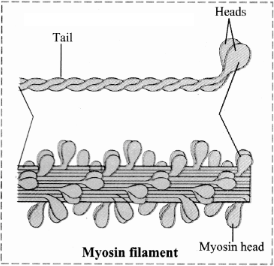
Myosin filament
Answer
i. Myosin filament:

  1. Each myosin filament is a polymerized protein.
    Many meromyosins (monomeric proteins) constitute one thick filament.
  2. Myosin molecule consists of two heavy chains (heavy meromyosin / HMM) coiled around each other forming a double helix. One end of each of these chains is projected outwardly is known as cross bridge. This end folds to form a globular protein mass called myosin head.
  3. Two light chains are associated with each head forming 4 light chains/light meromyosin / LMM.
  4. Myosin head has a special ATPase activity. It can split ATP to produce energy.
  5. Myosin contributes 55% of muscle proteins.
  6. In sarcomere, myosin tails are arranged to point towards the centre of the sarcomere and the heads point to the sides of the myofilament band.

Image

View full question & answer
Question 33 Marks
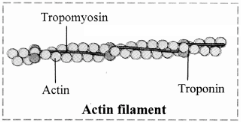
Actin filament
Answer
Actin filament: It is a complex type of contractile protein. It is made up of three components:

  1. F actin: It forms the backbone of actin filament. F actin is made up of two helical strands. Each strand is composed of polymerized G actin molecules. One ADP molecule is attached to G actin molecule.
  2. Tropomyosin: The actin filament contains two additional protein strands that are polymers of tropomyosin molecules. Each strand is loosely attached to an F actin. In the resting stage, tropomyosin physically covers the active myosin-binding site of the actin strand.
  3. Troponin: It is a complex of three globular proteins, is attached approx. 2/3rd distance along each tropomyosin molecule. It has affinity for actin, tropomyosin and calcium ions. The troponin complex is believed to attach the tropomyosin to the actin. The strong affinity of troponin for calcium ions is believed to initiate the contraction process.

Image

View full question & answer
Question 43 Marks
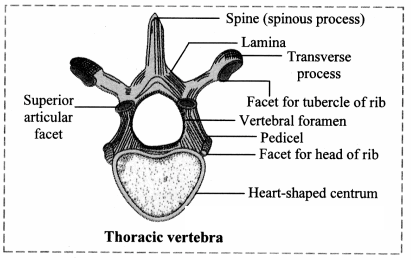
thoracic vertebrae. Sketch and label thoracic vertebrae.
Answer
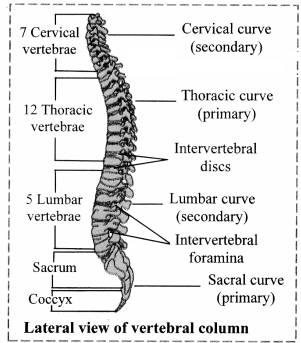
$1.$ There are $12$ thoracic vertebrae found in the chest region.
$2.$ The centrurn of thoracic vertebrae is heart shaped and all the processes are well developed.
$3.$ Except for $11^{th}$ and $12^{th}$ vertebrae; transverse process of other thoracic vertebrae show facets for attachment with ribs.
Image
View full question & answer
Question 63 Marks
role of calcium ions in contraction and relaxation of muscles.
Answer
Calcium ions play a major role in contraction and relaxation of muscles.
  1. Calcium ions are released from the sarcoplasm during muscle contraction and stored in sarcoplasmic reticulum during muscle relaxation.
  2. When a skeletal muscle is excited and an action potential travels along the T tubule, the concentration of calcium ions increases.
  3. These calcium ions bind to troponin which in turn undergoes a conformational change that causes tropomyosin to move away from the myosin-binding sites on actin. Once these binding sites are free, myosin heads bind to them to form cross-bridges and the muscle fiber contracts.
  4. The decrease in calcium ion concentration in the sarcoplasmic reticulum causes tropomyosin to slide back and block the myosin binding sites on actin. This causes the muscle to relax.

    [Note: Students can scan the adjacent Q.R code to get conceptual clarity with the aid of a relevant video.]
View full question & answer
Write short notes - Biology STD 11 Science Questions - Vidyadip