Questions

Answer the following questions in detail.

Take a timed test

6 questions · self-marked practice — reveal the answer and mark yourself.

Question 16 Marks
Write a note on the diagonal relationship between $Be$ and $Al.$ What are the similarities between beryllium and aluminium?
Answer
$i.$ Beryllium is placed in the group $2$ and period $2$ of the modem periodic table. It resembles aluminium which is placed in group $13$ and period $3.$
$ii.$ Due to nearly same charge to radius ratio of their ions, beryllium
$( \frac{2}{31} =0.065)$ and aluminium $\left(\frac{3}{53.55}=0.056\right)$ exhibit diagonal relationship.
$iii.$ Due to diagonal relationship, $Be$ and $Al$ show following similarities in their properties:
$a.$ Nature of bonding: Both $Be$ and $Al$ have tendency to form covalent chlorides.Image

$b.$ Lewis acids: $BeCl_2$ and $AlCl_3$ act as Lewis acids.
$c.$ Solubility in organic solvents: $BeCl_2$ and $AlCl_3$ are soluble in organic solvents.
$d.$ Nature of oxide: Both $Be$ and $Al$ form amphoteric oxides.
View full question & answer
Question 26 Marks
Naina is a school going kid. Every morning her mother makes her drink a glass of milk. When she asked her mother that why she has to drink a glass of milk daily, her mother told her that it is beneficial in maintaining healthy bones and teeth. Regular consumption of milk is recommended because it is a rich source of calcium.
$i.$ In which form is calcium important for bones and teeth?
$ii.$ Calcium belongs to which family in the modern periodic table?
$iii.$ Write its electronic configuration.
$iv.$ Calcium contain how many valence electrons?
$v.$ Give any two$-$biological importance of calcium.
Answer
$i.$ Calcium is important for bones and teeth in the form of apatite $[Ca(PO_4)_2].$
$ii.$ It belongs to the family of alkaline earth metals in the modem periodic table.
$iii.$ Electronic configuration of $20Ca$ is $1s^2 2s^2 2p^6 3s^2 3p^6 4s^2.$
$iv.$ Calcium contains two valence electrons as it has two electrons in its outermost shell $(4s).$
$v.$ Calcium ion $(Ca^{2+})$
$Ca^{2+}$ ions are important for bones and teeth in the fonn of apatite $[Ca_3(PO_4)_2].$
They play an important role in blood clotting.
$Ca^{2+}$ ions are required for contraction and stretching of muscles.
They are also required to maintain the regular beating of heart.


View full question & answer
Question 36 Marks
Describe the preparation of sodium hydroxide by Castner-Kellner process. ### Explain the electrolysis method for preparation of sodium hydroxide.
Answer
i. Sodium hydroxide (caustic soda) is commercially obtained by the electrolysis of aqueous sodium chloride solution (brine) in Castner-Kellner cell (mercury cathode cell).

ii. In Castner-Kellner cell, mercury is used as cathode, carbon rod as anode and brine solution is used as electrolyte which is subjected to electrolysis.

iii. During electrolysis, the following reactions take place:
a. At cathode: Sodium ions get reduced to metallic sodium, which combines with mercury to form sodium amalgam (Na-Hg).
$Na ^{+}+ e ^{-} \xrightarrow{ Hg } Na -$-amalgam
b. At anode: Chloride ions are oxidized and thus, chlorine gas is evolved.
$Cl ^{-} \longrightarrow \frac{1}{2} Cl _2+ e ^{-}$

iv. Sodium amalgam is then treated with water to obtain sodium hydroxide and hydrogen gas.
$\underset{\begin{array}{c}\text { Sodium } \\ \text { amalgam }\end{array}}{2 Na - Hg }+2 H _2 O \longrightarrow \underset{\begin{array}{c}\text { Sodium } \\ \text { hydroxide }\end{array}}{2 NaOH +2 Hg + H _2 \uparrow}$
View full question & answer
Question 46 Marks
Explain Solvay process for manufacture of sodium carbonate.
Answer
Sodium carbonate $(Na_2CO_3)$ is commercially prepared by Solvay process. Preparation of sodium carbonate by Solvay process involves two stages.
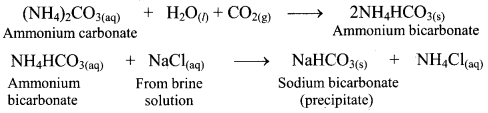
$i.$ In the first stage of Solvay process, carbon dioxide gas is bubbled through a concentrated solution of $NaCl$ which is saturated with $NH_3.$ This results in the formation of ammonium bicarbonate. Crystals of sodium bicarbonate separate as a result of the following reactions.
$\underset{\text { (Ammonia) }}{2 NH _{3( aq )}}+ H _2 O _{( f )}+ CO _{2( g )} \longrightarrow \underset{\text { Ammonium carbonate }}{\left( NH _4\right)_2 CO _{3( aq )}}$Image
$ii.$ Ammonium bicarbonate and sodium chloride undergoes double decomposition reaction to form sodium bicarbonate. As sodium bicarbonate has low solubility, it precipitates out in the form of crystals.
$iii.$ In the second stage, the separated crystals of sodium bicarbonate are heated to obtain sodium carbonate $(Na_2CO_3).$
Image
$iv. \ NH_4Cl$ obtained in this process is treated with slaked lime, $Ca(OH)_2,$ to recover $NH_3$ while $CaCl_2$ is obtained as a byproduct.
Image ​​​​​​​
View full question & answer
Question 56 Marks
Explain the reactivity of alkaline earth metals towards:  $i.$ Water $ii$. Hydrogen $iii.$ Halogens
Answer
$i.$ Reaction with water:
$a.$ The elements of group $2 ($alkaline earth metals$)$ react with water to form metal hydroxide and evolve hydrogen gas.
Image
$b.$ Be does not react with water at all, $Mg$ reacts with boiling water while $Ca, Sr, Ba$ react vigorously even with cold water.
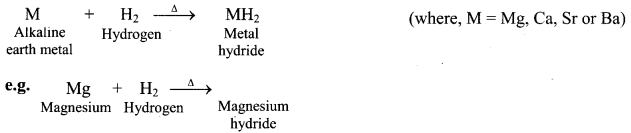
$ii.$ Reaction with hydrogen: All alkaline earth metals except beryllium $(Be),$ when heated with hydrogen form $MH_2$ type hydrides.
Image
$iii.$ Reaction with halogens: All the alkaline earth metals combine with halogens at high temperature to form their corresponding halides.
Image
$[$Note: As we move down the group, the chemical reactivity of alkaline earth metals increases in the order $Mg < Ca < Sr < Ba.]$
View full question & answer
Question 66 Marks
Give reasons: $s-$block elements are never found in free state in nature.
Answer
$s-$Block elements contain group $1$ and group $2$ elements.
The general outer electronic configuration of the group $1$ elements is $ns^1$ and that of the group $2$ elements is $ns^2.$
The loosely held $s-$electrons in the valence shell of these elements can be easily removed to form metal ions.
As a result, they are highly reactive in nature and always found in combined state.Hence, $s-$block elements are never found in free state in nature.
View full question & answer